THE WINNING OF THE "Y."
Reading edition
BY S. SCOVILLE, JUN.
The day of the Yale-Harvard meeting has come, and with it Jack Vail's chance of becoming a "'varsity man," and winning the right to wear the 'varsity Y on sweater and jersey front. What that right means none but a college man can really appreciate. Scores and scores of men spend long years in training, hoping to win the coveted honor, and out of them all only a few are chosen. To the 'varsity men more than to all others is the college honor entrusted. They personify the courage and manliness of the university, and must show themselves worthy of the trust, and the man who "makes the 'varsity" by so doing obtains the respect and consideration of the whole college world, for only one possessing unusual qualities of mind and body is chosen as worthy to join the few who represent their alma mater on track and field. And to-day, if Jack can win his race against Harvard in the annual competition for the great challenge cup, he wins his Y.
The sun rises in a cloudless sky, and the day gradually grows hotter, until, by afternoon, the last trace of heaviness has been burned out of the cinder path, and the tiers of "bleachers" are packed and jammed with cheering, sweltering college men and groups of equally enthusiastic college girls. Three of the bleachers are a mass of crimson flags, dresses, and ribbons—the Harvard "rooters," a loyal band who have come down from Cambridge to encourage their team. And now the air is shattered by volleys of cheers from the Yale tiers. Before each section stand prominent Seniors who in ordinary life bear themselves with a dignity befitting their high position in the college world, but who are now devoting every atom of the energy which has made them marked men to waving their arms and hats as leaders of the cheering, terminating each effort with a peculiarly enthusiastic bound. A triple "Rah! Rah! Rah!" from one section is followed from another by the classical "Brekity-kek-coax-coax"—a cheer adopted from Aristophanes. The cause of all the commotion is a great blue 'bus, which has just lumbered up to the training-house, a short distance from the track, with "Varsity" painted on the side. Out of this are pouring strapping hammer-throwers and shot-putters, slim distance-runners, wiry jumpers, and all the other competitors who go to make up an athletic team. And now the crimson delegation have their innings as the Harvard team file into the training-house. The Yale men are located on the ground-floor, while above them in the same house are their rivals.
In the training-house is the faint feverish smell of raw alcohol, and the sound of resounding slaps as the brawny rubbers massage divers sinewy legs. The sprinters and quarter-milers, whose events come first, are slipping into their scanty jeans and lacing up spiked shoes, every muscle quivering with that deathly nervousness which even veteran runners feel before a race.
Mike, the grim old trainer, is trotting around with a fixed smile on his face that he fondly imagines to be reassuring, answering numberless questions, encouraging this man, advising that, looking up lost articles—in short, giving backbone to the whole team by his presence. Suddenly the noise stops. The Captain of the team, a hammer-thrower with a frame like a young Hercules, has climbed upon the rubbing-table, and with a sixteen-pound hammer for a gavel, is calling for silence with a series of crashing blows on the long-suffering table-top.
"Boys, in five minutes we clinch with Harvard. All I've got to say is that I am proud of every one of you. I had a good eye when I chose this team, and there isn't a man on it but's full of sand. Keep cool, grit your teeth, and go in to win, and if we get whipped Harvard'll know she's been fighting."
Bang! goes the hammer, and the customary last words are over.
"Now, boys, a good big cheer for the Cap'n," shouts Mike, hopping up and down in his excitement. And a good big cheer it is. Hardly has the last deep-throated "Rah" died away before the door opens, and a field official with a flowing badge shouts, "All out for the hundred!" and the fight between the two great rivals is on.
Jack's race, the mile run, is the next to the last event. To-day is his first great race, for it was only this season, when he won the mile at the college spring games, that Mike had recognized him as a runner worthy to compete against Harvard. And he is not seasoned enough to endure well the tremendous suspense. Very weak and nervous Mike finds him as he rushes in from the track to see if all be well.
"Sort of shaky, eh?" the latter growls, looking him over critically. "Well, I wouldn't give a cent for a man that wasn't. You'll be all right the minute the pistol goes off. Lay well back until the last ten yards!" and Mike gives Jack a little shake to emphasize his words, "The last ten yards, mind, and you'll win. You won't if you don't. Save your strength for a last jump when you hear me yell. Throw yourself forward just before you get to the tape. I'll be there to catch you. And oh, my boy, win this race and the college is yours! Why—"
But all further conversation is cut short by the precipitous entrance of the Captain. He is all adrip with perspiration, for he has just won the hammer throw.
"We win the hammer," he shouts, "and the points are a tie. Now everything depends on the mile. Harvard will take the high jump and the two hundred and twenty, and we'll get the shot and pole-vault. So it's the mile that will decide everything. They'll call it the next event, Jack. Now, boys," and he again climbs upon the table, "I think a little music will quiet Jack's nerves." And in a voice that shakes the windows he commences the college slogan: "Here's to good old Yale—drink it down! Drink it down!"
"Every man on his feet and sing!" yells Mike.
Off the beds and from retired corners rolled in blankets they stagger into the circle, even the quarter and half milers, still deathly sick from their races, add a few husky notes to the chorus. From above comes a derisive yell and the rival strains of "Fair Harvard!"
"Last call for the mile," comes through the open door.
"Now, Jack," says the Captain, "we're all looking at you."
"Remember what I told you, Jack!" shouts Mike, and then somebody else calls for a cheer for Jack Vail. So Jack goes out of the door with their voices still ringing in his ears. The three Harvard milers are already out by the start, jogging up and down the track. Jack's appearance is the signal for a burst of cheers from the Yale bleachers, and a similar roar from the Harvard adherents.
"Now, boys," remarked Dickie Arnot, Jack's chum, who is leading the cheering in front of one tier, "save your voices until Jack turns into the homestretch; then we'll ejaculate a few feeble notes just to let him know that we're here."
Jack takes a little spin down the stretch to be sure that his legs are in proper working order, and then trots back to the starting-line, where the customary ceremony between the runners takes place. Each Harvard man shakes Jack's hand, and politely expresses great pleasure at the meeting, and Jack looks each one over, and wonders how fast he can go, and withal feels a bit lonely and lost—one man against three—without his running-mate "Shorty" Farnham, who became ill a week before the games, and had to stop training.
HE CROUCHES IN THE REGULATION SPRINT START.
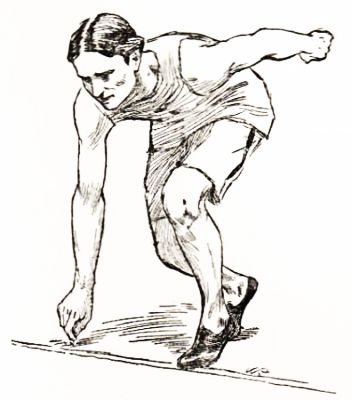
"Now-boys-I-shall-tell-you-to-get-set-and-then-fire-you-off. Any-man-breaking-off-his-mark-before-the-pistol-goes-back-ten-yards," clatters the starter, jumbling the words all together, according to the time-honored custom of starters. Jack is on the extreme edge of the track furthest from the pole. So when the command "Get set" comes, he crouches in the regulation sprint start, much to the astonishment of the Harvard milers, who are standing erect, as mile-runners usually start.
"Bang!" goes the pistol, and Jack springs from his mark as if beginning a hundred-yard dash. For nearly thirty yards he sprints, and rounds in ahead of the startled Harvard men, and secures the pole. A roar from the Yale men attests their appreciation of the neat manœuvre. But now the famed team-work of the Harvard men begins. With a tremendous spurt one of them comes up from the rear, passes Jack, and secures the pole just ahead, while at the same time another man tries to run up on the outside and complete the "pocket." But Jack avoids the attempt by suddenly swerving away from the pole. Immediately the other swerves out too, and Jack is forced to run yards wide of the pole.
He tries dropping back and trailing the others. But the two drop back with him, and continue their worrying tactics. How Jack longs for the faithful "Shorty" to protect him from threatened pockets. As it is now he must either run on the outside and cover yards more than the others, or take his chances at being cramped up in a pocket until the last lap. Neither of these alternatives is to be considered for a moment, for distance-runners learn by bitter experience that the amount of energy available for a race is a fixed quantity, and that the runner who diminishes it by the tiniest extra effort will fail in the stretch. Then it is that a plan flashes into Jack's head. Two of the Harvard runners he knows are only second-rate men. The other, plodding along placidly in the rear while his two pace-makers weaken his rival, is the Harvard record-holder, the great Cowles, and the only one of three that he need fear. And no one but a miler of the first rank can stand a fast first half-mile. So away goes Jack to the front, determined to make the first half under 2.10, which will drop all but Cowles, and take his chances of resting enough in the third quarter, undisturbed by any jockeying, to gain strength for the last sprint. For Jack's strong point is his sprinting, and a waiting race his best policy. So to the utter bewilderment of his friends, who know his methods, Jack suddenly dashes to the front, takes the pole away from the Harvard leader, and is off at a tremendous pace.
"Poor old Jack's lost his head," remarks Dickie, mournfully. "Mike's often told him never to set the pace. But, boys, how about a still small cheer?" And the energetic Richard leads his band of "Assorted Howlers," as he has appropriately christened his section of the bleachers, in a rattling, shattering "Brek-e-kek-kek" cheer that could have been heard clear to the deserted campus two miles away. Only Mike appreciates the true inwardness of Jack's action, for he has seen, with many misgivings, the trained team-work of the crimson-barred runners.
"Good boy! good boy!" he chuckles, slapping his knee ecstatically. "It's the only thing left to do. Jack runs with his head more than any man I've got."
One of the Harvard pace-makers essays his old trick, and tries to sprint up past Jack, but the latter is not to be passed this time, and the quartet swing past the first quarter-post at a tremendous gait.
"Sixty-one," shouts Mike, who has been holding his watch on the race, so as to announce the time of the different quarters to Jack.
The two Harvard pace-makers are unable to hold this gait, and as Jack begins the backstretch of the second quarter at the same pace, they begin to lag, and little by little drop back. Suddenly Cowles awakens to the fact that he must depend upon his own efforts for the rest of the race, and starts after Jack at a sprinting gait. Jack hears the rapid steps close behind him, and tries a little stratagem of his own, hardly hoping that it will succeed against a veteran runner like Cowles. By slow degrees he swings out from the pole until nearly a yard away, leaving a tempting gap. By the rules, any runner passing another on the inside may be disqualified for fouling if so he interferes with the runner ahead, for the leading runner has a right to the pole, and a runner taking the inside does so at his own risk. Cowles knows the rules well, but decides to take the chance and save the two or three yards that passing on the outside would take. But just as he is almost abreast of the crafty Jack, the latter swings back to the pole, and Cowles has to stop almost short to avoid a collision, which by the rules would be blamed to him, and while his stride is broken Jack gains nearly ten yards.
Now they are at the quarter-post again, and the first half-mile has been traversed in 2.08. Jack is still leading, and by degrees sets a slower and slower pace to save himself for the final effort in the stretch. But half-way around Cowles suddenly recognizes his tactics, and with an indignant effort takes the lead with that rapid even gait which seems to devour the ground, and which so imperceptibly draws away from a following runner if so be the latter relax his efforts in the least. Ah, the bitter third quarter! when the weakness creeps up from a runner's legs breast-high, and the laboring lungs feel as if iron bands were tight around them; when the head swims, and flashes come and go before the eyes, and every effort of body and mind is concentrated in a struggle not to let the white-jersey back just ahead draw away ever so little. Past the starting-post they go, and the others are hopelessly behind. There is a tremendous roar from the Harvard men as they begin the last quarter, and Cowles draws away ever so little from Jack. But the latter grits his teeth and calls upon his numb legs, and the gap closes up again. So they run like a tandem-team, and stride by stride the last quarter lessens and lessens.
The stretch is very near, and though the pace is terrific, Jack feels that he has an atom of spirit left somewhere down in his heels. And as they turn the last corner and the homestretch looms up before them, Jack lengthens his stride a trifle, and the blue Y with two little a's on either side, which the runner who has not won a point for Yale is condemned to wear, is almost parallel with the crimson bar. A roar of cheers fills the air as the two runners come down the stretch, fighting every yard, their heads back, their eyes fixed in an unwinking stare which sees only the red line between the finish posts but forty yards away.
"COME IN—COME IN, JACK!"
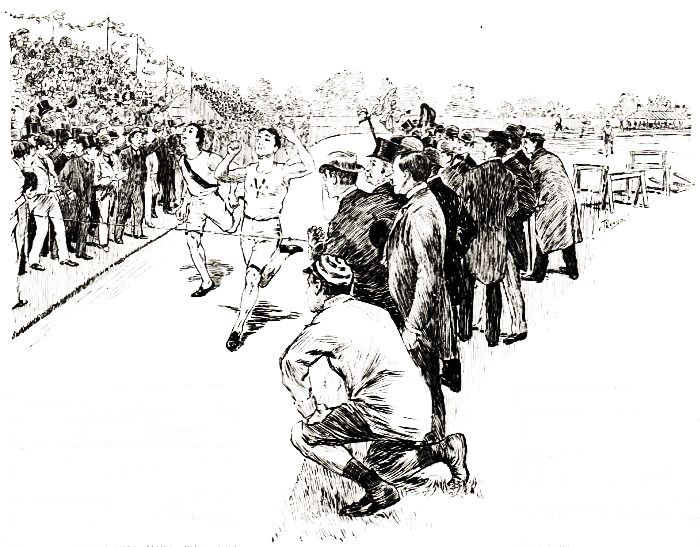
And now the band of Assorted Howlers get in their deadly work. Dickie's hat and coat are off, his collar limp, and with most marvellous gyrations he is leading his orchestra in a wonderfully constructed cheer. Finally, "Nine Jack Vails!" he whoops, "and let 'em come loud." And every Yale voice on the bleachers and grand stand joins in, and "Jack Vail! Jack Vail! Jack Vail!" they thunder. But Jack, only ten yards away from the finish, hears nothing but the sobbing gasps of the runner beside him, sees nothing but the tape and the face of Mike all working and distorted with excitement as he stands back of the judges. And suddenly out of the din, which seems somehow far away and like a dream, he hears Mike's voice, hoarse in its intensity: "It's the last ten yards, me boy! Oh, come in—come in, Jack!"
And Jack comes. With a last desperate staggering plunge he throws himself forward, and feels the blessed pressure of the parting tape that tells him the race is won.
Nothing more does Jack remember until he finds himself lying in Mike's strong arms in the training-house, while the rest of the team press up to shake his hand, and the Captain, full of joyful chuckles, kneels down, and with his penknife rips off the obnoxious a's, and the great blue Y stands forth on his jersey front—won at last.