HOW MAGIC IS MADE.
Reading edition
I.
When Samuel Butler wrote
"Doubtless the pleasure is as great Of being cheated, as to cheat,"
he afforded evidence that he had never been a conjurer.
There is a nervous strain, an excitement, in the act of cheating at conjuring that is entirely wanting when we are cheated.
For the one who does the tricks there is a fascination that has never been known to be even alleviated, but, like the proverbial brook, "goes on forever." Yet, knowing this, I propose to lure my readers to this incurable habit by teaching them the whole art and mystery of deceiving one's neighbor—in an honest way.
As an explanation of "palming," whether of coins, balls, or cards, or any of the preliminary exercises necessary in order to become a proficient conjurer, makes but dull reading, I shall postpone instruction in such finger movements until actually needed, and begin with a complete trick. I shall not content myself, however, with showing the mere bare bones of the illusions, but will present something more solid, and give such suggestions, with accompanying patter and other details, as will enable the student in what the French call "White Magic," with some practice, to perform the tricks to his own satisfaction and the delight of his audience.
At the start let me caution my readers against being too quick. The success of a sleight-of-hand trick depends on diverting the attention of the audience upon misdirection rather than on rapidity of movement. It is a fallacy that "the hand is quicker than the eye." The most accomplished conjurers this country has ever seen, men like Buatier de Kolta or the late Robert Heller, never made a rapid movement; they were deliberate. They relied more on a nimble wit, a turn of the head, a glance of the eye, a motion of the hand, and yet they successfully and artistically deceived the keenest-eyed witness of their performance.
And now to begin with our first lesson. As an opening for a performance, something that will impress an audience with your skill, there is nothing better than
THE EVANESCENT HANDKERCHIEF.
The performer begins by rolling up his sleeves, and showing his hands to be empty. Yet bringing the latter together the next moment, he produces a piece of colored silk about twelve inches square, which, in spite of its diminutive size, he dignifies by the name of handkerchief.
"This," he says, holding it out, "is property number One, and here," picking up a candle from his table, "is number Two. This candle is simply the light and airy product of the chandler, and has not been tampered with by any wicked trickster since it left his hands. And yet I propose to pass into its very centre this handkerchief."
THE CANDLE.
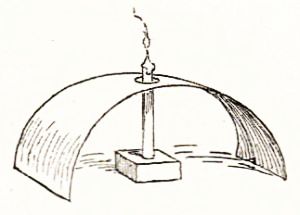
A narrow strip of card-board, bent into semicircular form and having a round hole cut in its centre, serves as a candlestick, and in this the candle is stood.
"You can readily see," continues the performer, "that there is absolutely no chance here to gall you—no apparatus of any kind. And now to begin."
He rolls the handkerchief between his hands, and then extending his closed right hand, while the left, also closed, goes behind his back, says: "I shall now cause the handkerchief which is in my right hand to pass invisibly into that candle. That will be a miracle, and a prerequisite for a miracle is faith. You must believe that the handkerchief is in my hand."
"But," whispers a sharp-eyed, keen-witted spectator, "the handkerchief is not there. He kept it in his left hand, and has thrust it into his coat-tail pocket."
Ah, suspicious mortal, how grievously mistaken you are! As Josh Billings has wisely said, "It's better not to know so much than to know so much that's not so." The performer opens his hand and shows that the handkerchief is still there.
Again he goes through the same manipulation, and again suspicion is aroused.
"Ah, ye of little faith!" he exclaims. "There is no need of concealing my hands for such a simple trick. See! I merely roll the handkerchief, so, between my hands"—suiting the action to the word—"and on opening them we find them empty, nothing concealed in them, and nothing up my sleeves," which he bares in proof. "Where has the handkerchief gone? It has passed, as I promised it would pass, into the candle."
"Should I cut open the candle," he goes on to say, "and in it find the missing bit of silk, you would conclude that I use a prepared candle. To prove this is not so I light the candle, and from its flame I thus extract the handkerchief." Which he does.
THE FALSE FINGER.
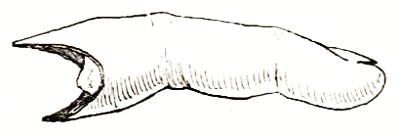
Pretty and mysterious as this trick is, it is very simple. The handkerchief which is produced from the empty hands is concealed in a hollow metal finger, which is painted a flesh-color, and is open at the lower end, where it is cut in the following shape >. This finger is placed between the second and third fingers of the left hand, and as the performer keeps all the fingers close together, and turns his hands rapidly backward and forward when showing them to be empty, it will be a keen eye indeed that will detect the apparatus. When the hands are brought together the false finger is quickly taken off, the handkerchief is pulled out and shown to the audience. In laying the handkerchief on the table the finger is placed there with it, or is retained in the hand and afterward pocketed.
Fastened to the performer's left arm, just below the elbow and under his coat sleeve, is a strong cord—a piece of fine fish-line is excellent—which passes up the sleeve, through the armholes of his vest, across his back, and down the right sleeve, where it ends in a loop placed over the right thumb. This cord is of such a length that it will only reach the thumb when the arms are held with the elbows at the hips and the forearm extended from that point. Releasing the loop from the thumb, and straightening the arms forward and slightly upward, carries the loop and anything in it well into the upper part of the sleeve. When the handkerchief is to disappear, the performer, under cover of his clasped hands, runs it through the loop, extends his arms quickly, and the handkerchief flies up the sleeve. Just here comes in a little piece of the misdirection already alluded to. The performer does not open his hands at once, but continues to rub them as if they still contained the handkerchief; then he closes the right hand and holds it well out from his body, letting the left hand fall, open, to his side. He continues for a second to work the fingers of the right hand, as though compressing the handkerchief, and finally, opening one finger after another, shows the hand empty. Next he bares his arms, but in doing so is careful to push up the left coat sleeve and turn his shirt sleeve over it, so as to conceal the place at which the cord is fastened.
THE MATCH-BOX AND THREAD.
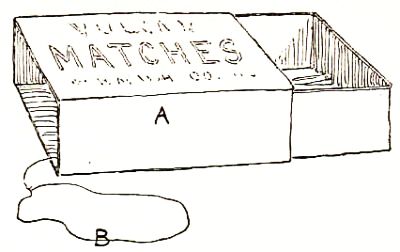
The production of the handkerchief from the candle is as ingenious as the rest of the trick. A duplicate handkerchief is folded as small as possible, and tied with very fine black cotton thread, to which is attached a loop of horse-hair. This is placed in one end of the cover of an ordinary parlor-match box, one of the kind that slides into its cover, like a drawer. The box, half-way open, stands on the table, the loop protruding. In picking it up to take out a match the forefinger of the left hand is run through the loop, and the act of closing the box pushes out the handkerchief, which dangles in the palm of the hand, and, as the back is kept toward the audience, is not seen. Care must be taken not to pull out the handkerchief lest the thread should break. To produce it the hands are closed quickly over the flame of the candle, extinguishing it, a sharp jerk breaks the thread, and the handkerchief appears as if pulled from the wick.
The metal finger has recently been improved on, but as the substitute requires more delicate handling, I shall defer the explanation of it for the present.
This little trick originated with De Kolta, the famous French conjurer, who, besides being the inventor of most of the tricks, great and small, exhibited by the other magicians, is an accomplished actor. In his hands it almost reaches the dignity of a work of art. Another trick of his is
THE MISSION OF A PLATE.
The performer shows a soup plate and two small handkerchiefs, a red one and a blue, "made of raw silk," he remarks, adding, "Though the silk is raw, let us hope the trick will be well done."
That there may be no suspicion of a trap in the table, it is covered with a newspaper. The plate is laid on it, mouth down. With his arms bare to the elbow, the performer picks up one handkerchief, rolls it in his hands, and after a moment shows first his right hand empty, then the left. The second handkerchief is treated in the same way, and on lifting the plate the handkerchiefs are found under it.
Of course two sets of handkerchiefs are used, one of which is concealed in the plate by means of a double bottom. The construction of the plate is quite simple. A hole about one-eighth of an inch in diameter is drilled in the bottom at the centre. A false bottom is made of metal—zinc or tin—one side painted white to match the plate, the other covered with newspaper. Soldered to the centre on the newspaper side is a short wire, slightly hooked at the end, which passes through the hole in the plate and just catches the edge. A touch with the finger of this projecting hook dislodges the bottom. The handkerchiefs cover the wire, while the newspaper lining, matching the paper on the table, conceals the false bottom.
CHANGING THE CORD.
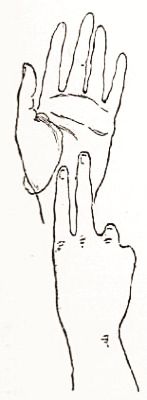
So much for the plate. Now for the disappearance of the handkerchiefs. For this a small black bag of some soft dull black material is used. This bag ought not to be more than an inch and three-quarters long by about the same measurement in width. In the mouth must be sewed a curtain ring about seven-eighths of an inch in diameter, and extending from the centre of one side of the bag to the centre of the other should be a loop of fine flesh-colored sewing-silk, long enough to pass over the forefinger and thumb when the former is held out from the fingers. This bag is lying on a table or hanging at the back of a chair, and is picked up with the first handkerchief. Shaking out this handkerchief, the performer pretends to gather it into his hands, in reality stuffing it into the bag by the help of his left forefinger. When completely in, he runs that finger and the left thumb through the loop, works the bag to the back of the left hand, and closes that hand. The right hand, of which the back has been toward the audience, is now turned and shown to be empty. The fingers of the left hand still keep moving, as if rolling the handkerchief into still smaller compass, and then that hand is opened and also shown empty. Almost at the same moment the tips of the right-hand fingers are laid, for an instant only, near the left palm, as if to emphasize the fact that the handkerchief has gone, but without saying a word. This brings the right forefinger about the centre of the loop, through which it passes. The hands almost immediately separate, the bag is lifted off and brought against the right palm, in which position it cannot be seen by the audience. Without calling attention to it by words, the audience are made to see that the left hand is empty, as the performer picks up the second handkerchief with it, thus showing the back and front.
The second handkerchief is now worked into the bag, which this time is left hanging from the forefinger of the right hand. This hand is opened, but the audience, though not allowed to see the palm, conclude it is empty, as it was in the case of the first handkerchief. The left hand is kept closed, as if containing the handkerchief; then it is given a sudden upward movement, as if throwing the handkerchief into space, and opened. "The handkerchiefs are gone," says the performer, "and are here." At this he touches the hook on the plate with the left forefinger, disengaging the false bottom, lifts up the plate, and reveals the duplicate handkerchiefs. These he picks up with his right hand, thus covering the bag therein concealed.
One who has not seen this trick cannot conceive the beauty of it, but if the young conjurer will follow literally the instructions here laid down, he will, with comparatively little practice, soon be able to surprise and delight his friends with it.
Mr. Adrian Plate, of New York, a most accomplished sleight-of-hand performer, who confines himself to giving drawing-room entertainments, has so far improved upon this trick that he dispenses with a prepared plate. His duplicate handkerchiefs, closely folded, are concealed beneath his table-top, and are drawn under the plate when lifting it, ostensibly to show that nothing has been smuggled under it.
There are two other very pretty handkerchief tricks easy of accomplishment, but I must reserve them for my next paper.