CROUP.
Reading edition
Roche's Herbal Embrocation.
The celebrated and effectual English Cure without internal medicine. Proprietors, W. Edward & Son.
London, England.
E. Fougera & Co., 30 North William St., N.Y.
An Appeal for a School-house.
Come, dear readers of the Table—Ladies, Knights, Patrons, and their friends—let us make possible the laying of the corner-stone of Good Will School next spring. The task is not a difficult one. It can be accomplished in this way:
Get one subscriber to Harper's Round Table. Remit the $2 for it for one year. Attach the accompanying Coupon. Say in your letter that you wish the 50 cents turned into the Fund. And the thing is done. The Fund is complete. The corner-stone will be laid. The boys will have an industrial school-house. The Order will have performed a grand, a chivalrous deed.
At this holiday-time every person who reads these lines has it within his or her power to build this school-house. Because, if you get the one subscriber, the house will be built. If you do not, it will not—not now. All depends on you.
Go out and ask your friends about it. Ask them to help you get the subscriber. Your parents and teachers will help you. Ask them to do so. Set your heart on getting this one subscriber. Go to a Sunday-school or church committee, a day school, some well-to-do man or woman who has young persons in the household. Ask the well-to-do neighbor. Relate the merits of the paper, and show a sample copy and Prospectus. We furnish them free. Ask us to do so.
But do more than this. Relate the story of Good Will. Tell the person whom you are asking to subscribe why you want the subscription, and why you want it now. Tell him or her that Good Will Farm, while in Maine, takes boys from any part of the country, and is therefore not a local but a national enterprise. Say that it is a house for an industrial school that the Order is to build. The Farm is in good hands, and the school itself will be well conducted. Our task is only to put up the building, not to conduct the school. Say that during the last few years—two or three—more than 700 poor boys have applied for admission to Good Will, and had to be refused it for lack of room. These boys were deserving. Say further that if you get the subscription the school will be built, and, by turning a house now used for the school into a dwelling, more boys can be taken—boys of five, six, and seven years of age, who are now homeless, may be given homes, school advantages, and a chance to become useful Christian men.
During the next two weeks will you get this subscription? Talk it up—and get it. The appeal is not made to the Order. It is made to you. If you do not wish to cut out the coupon, make a pen one nearly like it, ask us for duplicates, or send on the subscription without a coupon, simply saying that you got it to help the school, and that you want 50 cents of the $2 given to the Fund. Be sure to give the subscription address, and your own name for the Honor Roll.
Come on, dear friends, let us build this school-house.
THIS COUPON
Will be received by the publishers of Harper's Round Table as
when accompanied by an order for a NEW subscription to Harper's Round Table and One Dollar and Fifty Cents. The intent of this Coupon is to pay you for inducing another person, not now a subscriber, to subscribe for Harper's Round Table for one year. This Coupon has nothing whatever to do with your own subscription; that is, with the copy you expect to read next year, it matters not in whose name it be ordered, and will not be accepted in payment for any part of it. It is good for its face in the hands of any person who performs the work indicated, whether said person is a subscriber or not. HARPER & BROTHERS.
The St. Ives Puzzle Contest.
The St. Ives story excited much interest. To new readers we must explain that it was a tale of the man who came from St. Ives, related to the famous person bound for that place. There were four riddles in it, and the rest of the questions were double meanings of names, chiefly geographical. On the journey the man of wives said he saw "an island of Greece that wouldn't hold water"—Poros; and speaking of the character of his many children, the man said not one was "an island off the Mexican coast"—Angel.
A great many solvers wrote to ask if a mistake had not been made in Question No. 2, "because there were not one hundred words in the paragraph." No mistake was made. The "99th" word is the one preceding the c—100. Here are the answers:
1, Wake; 2, Be just before you are generous; 3, Fife; 4, Tietar; 5, Vilaine; 6, Wigtown; 7, Bureau; 8, Poros; 9, Net and Racquet; 10, Fad; 11, There is no wisdom like frankness; 12, Oka; 13. Mercury (quicksilver); 14, Gull: 15, Yule; 16, Sasa; 17, Angel; 18, Faro and Fortune; 19, Lard; 20, Book; 21, Clinch; 22, Palm; 23, Box-car.
Of the twenty-three questions in the story, twenty-one were correctly answered by William C. Thayer, aged 13, Michigan, and Pearl A. Coyle, aged 13, Pennsylvania. The former missed Nos. 13 and 23, and the latter Nos. 2 and 23. We divide the $10 prize between them, giving $5 to each. The other $15 of the $25 offered is divided among other high solvers thus: Frederic W. Darling and Joslyn Z. Smith, New York (Buffalo); Royal J. Davis. Indiana; Edward L. Lyon, New York; J. M. Espey and Nora B. Tucker, Pennsylvania, $2 each; and Ethel Ruth Sherman, New York; Mabel Josephine Frye, District of Columbia; and Amy Erickson, Wisconsin, $1 each. The money has been forwarded, and reached most of the winners by Christmas day.
The Quarter is in the Fund.
Dear Knights and Ladies,—I am a great black dog, and I have more to do with the Round Table Department than you imagine. I have helped one of your contributors prepare scores of articles for you, and you have me to thank for their briefness. Whenever a manuscript threatened to become too long, I would insist on having a door opened for me, or would beg for a drink of water. So that my wants might be supplied a long story had to be cut short.
I am a lazy old fellow, but I am as good as I can be, and goodness means everything with people, and dogs as well. Some little children who once had a society called "Peacemakers" let me join their club because I never fight.
I am glad to hear that you are to build an Industrial School for the Good Will Farm boys, for they have a Band of Mercy, and have promised to be kind to all dumb animals. This means that when everything does not go just right in the neat shops you are to fit up for them, they will not lose their tempers and throw their tools at any stray cat or dog which happens near. Kind boys will make kind men; and I think that all the pets that read the Round Table ought to raise a fund to help build that school for their mutual friends. I enclose twenty-five cents for this purpose. If I were a dog that could perform a great many tricks I would send a larger amount, but I will leave such an honor to my accomplished brothers. I suppose the little dogs would consider a dime as their proper offering; and, by-the-way, what if we adopt that as our standard? Will all the pets—dogs, kitties, rabbits, lambs, biddies, birds, ponies—which are interested in boys who are bound to ever protect them send ten cents for that Good Will School?
I suppose my letter will be published as long as it is the first from a dumb animal; but the rest of you must not be disappointed if yours do not appear in print. This magazine is for children, and they like it too well to give it over to us. However, I should not be surprised if the most interesting letters should be printed; and perhaps the pet that writes the most pleasing one will receive a reward—a pretty collar, it may be. Hoping to see a long list of "pet names" in the contributors' list for the School Fund, I will now say
Bow-wow, Billy. Bath, Me.
P. S.—Any pet that wishes boys to keep on abusing them should not send their dimes.
B.
Any questions in regard to photograph matters will be willingly answered by the Editor of this column, and we should be glad to hear from any of our club who can make helpful suggestions.
One of our Round Table patrons sends the following formula for a soda developer, which he says he has used successfully for years:
Hot Water10oz.
Sulphite of Soda Crystals2"
Sal Soda Crystals2"
Bromide Potassium30grs.
This will take about twelve hours to dissolve. Keep bottle tightly corked, and it will keep for two or three years, and be as good as if not better than when first made. To use, take 5 oz. of cold-water, 1 oz. of this solution, and 12 grs. of pyrogallic acid. This quantity will develop four 5 by 8 plates, or half a dozen 4 by 5 plates.
Several of our members have asked for formulas for developing solutions, and will find the above to give excellent results. In our answers to queries will be found a formula for hydroquinon and eikonogen developer, and either of those formulas will give excellent negatives.
Sir Knight William F. Tobey asks when the prizes are to be announced, and the grade of bromide paper most used by amateurs. The prizes will be announced as soon after the close of the competition as the judges are able to examine the pictures. The grade of bromide paper most used by amateurs is that made by Eastman & Co., of Rochester, N.Y. They make a bromide paper, called platino-bromide, which gives beautiful results. The use of bromide paper is recommended for winter, as by its use one is practically independent of sunlight.
Sir Knight John Byrne, of California, asks what is the best camera for beginners. A hand camera is the best for a beginner, and one that is fitted for glass plates instead of film. With a hand camera one can use a tripod, and make time pictures without the complex swing-back, which is always more or less trouble to a beginner. A good size is a camera that takes a 4 by 5 picture.
Sir Knight Alison Martin, who sent a collection of fine photographs to the contest, asks if those pictures which do not take a prize can be criticised. If Sir Knight Alison could see the quantity of pictures which have been sent in he would at once see that special criticism of each picture would involve more time and space than could be given to the Camera Club Department. After the contest closes there will be a general criticism or description of the pictures submitted.
Sir Knight Milton E. Pease, of Suffield, Connecticut, wants the address of some firm where he can get good supplies, and also wishes the formula for a good developing solution. Sir Knight Milton will find reliable firms in Boston and New York, any one of which will send price-list on application. The editor is not familiar with firms in Springfield, Connecticut, but would advise sending to some town near Suffield, as the charges are much less for transportation. A good developing solution is made as follows: Solution No. 1. Water, 10 oz.; sulphite of soda, 2 oz.; eikonogen, 165 grs.; hydroquinon, 80 grs.; and add enough water to make the solution up to 8 oz. Solution No. 2. Water, 10 oz.; carbonate of potassium, 1 oz.; sodium carbonate, 1 oz.; and enough more water to make the solution up to 16 oz. For developing take 1 oz. of No. 1, 1 oz. of No. 2, and 4 oz. of water.
Sir Knight Edwin V. Griswold asks what kinds of trays to use for developing, fixing, and toning. The best developing trays are made of rubber, but celuloid makes a very good tray. An amber glass tray is the best for a fixing-tray, as, being so unlike the other trays, one never mistakes the hypo-tray for any other. A white porcelain tray is usually chosen for a toning-tray.
A correspondent of Englewood, N.J., who does not sign name, asks a good and cheap way to make a developer. Our correspondent will find his question answered in the answer to Sir Knight Milton Pease in this number, and also at the beginning of this column.

This Department is conducted in the interest of stamp and coin collectors, and the Editor will be pleased to answer any question on these subjects so far as possible. Correspondents should address Editor Stamp Department.
The new U. S. Postage-due stamps are printed in aniline colors, and if wet the colors run badly. Do not soak any of them, as that would ruin them. The higher values of these stamps (30 and 50 cents) are still scarce, as many post-offices had large stocks of the old issue, or of the lower values (1, 2, 3, 5, and 10) of the current issue.
Proofs and essays of U. S. stamps are advancing in value rapidly. A few years ago they brought nominal prices only.
Unused U. S. stamps, with the original gum well centred, are worth from 30 per cent. to 50 per cent. more than when gum has been soaked off, or when not evenly centred.
F. Boggs.—Write to any of the firms mentioned in our advertising columns.
E. S. D.—Dealers ask 20c. for the 1835 dime.
J. S. Powelson.—The 2c. 1869 can be bought for 8c.
Ruth E. Chamberlin.—The 1804 half-cent is quoted at 15c.
Glen Carter.—"Helvetia" stamps are those of Switzerland from 1862 to date. They are worth from 1c. to $1 each, according to scarcity.
John H. Campbell.—The last issue of Mexico are the 1, 2, 3, 4, 5, 10, 12, 15, 20, and 50 centavos; 1, 5, and 10 pesos.
F. Waldron.—The prices quoted are those asked by dealers, not the prices paid by dealers for them. Address firms mentioned in our advertising columns.
R. S. C.—In die A, 1887, 2c. green U. S. envelope the bust points to the space between the third and fourth "tooth" of the edge. In die B, the common die, the bust points to space between second and third "tooth."
Ben B. Wooster.—It is frequently difficult to distinguish the two dies of the 1851 U. S. 1c. stamp, as they were printed with very small margins. The 1851 extra line U. S. 3c. is identical with the 1851 die, but perforated. The extra line is at top and bottom only.
A. C. G. Williams.—Die B, fawn, star watermark, is very common, and worth very little. The rare envelope has the die C stamp. In this the head of Washington is egg shaped.
Josie S. Grey.—There is no 1775 Washington U. S. cent. For the prices of the cents and half-cents see Round Table No. 842. The other coins and tokens mentioned have no premium value. I do not know the "Veto" token.
E. M. Farewell.—Old English telegraph and revenue stamps are not collected in this country.
A. J. Selover.—The flying eagle cent, 1856, is worth $5. The other dates do not bring any premium.
A. Walter.—No premium on the coins mentioned.
S. M.—The legend "One Hundred Years" appears on the stamps of New South Wales.
H. B. Barber.—The only way is to buy an illustrated catalogue, which will give you prices also.
Have you noticed when discussing household affairs with other ladies that each one has found some special use for Ivory Soap, usually the cleansing of some article that it was supposed could not be safely cleaned at home.
The Procter & Gamble Co., Cin'ti.
GEO. F. CRANE,
90 Nassau St.,
NEW YORK,
will pay cash for collections or scarce stamps.
BAKER sells recitations and PLAYS
23 Winter St., Boston
CATALOGUES FREE.

THE
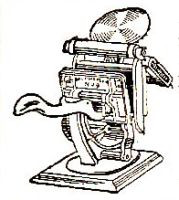
BALTIMOREAN PRINTING-PRESS
has earned more money for boys than all other presses in the market. Boys, don't idle away your time when you can buy a self-inking printing-press, type, and complete outfit for $5.00. Write for particulars, there is money in it for you.