THE STORY OF THE ARMY MULE'S LAST KICK.
Reading edition
There was an experiment tried at a Western fort many years ago, the results of which were never recorded at the War Department. The story is somewhat as follows:
One windy afternoon the Colonel, a fat pudgy little fellow, but a capital Indian-fighter, one of his captains, a long, lanky New-Englander, with whiskers and a drawl, and one of the sergeants were conversing together, every now and then glancing furtively at a solitary mule that was silently wearing the grass off the earth with his mouth.
"Waal, Colonel," drawled the Captain, "I like your scheme, and I reckon I'd try—" But just then the mule reached out with one of his hind legs in the direction of the talker in such an exceedingly suggestive manner that the Captain hastily backed into the Colonel. The Sergeant prevented the two men of war from falling by putting his shoulder to them, which position made the three look like an Egyptian pyramid, minus the sphinx—unless you included the mule for that purpose.
The Colonel's idea was that gun-carriages were useless in Indian fights, and if a howitzer were strapped upon an army mule's back, with the muzzle towards the tail, and loaded with ball-cartridge, the results that would accrue would be disastrous for the Indians.
"Waal," again drawled the Captain, with a wary look towards the mule, "let's experiment." And they did. They got a howitzer tied on that mule, who remained suspiciously quiet, looking steadily at the horizon, and they placed a time fuse in position, and then led the mule out on a bluff in front of a target. The three experimenters invited a number of brother officers to the scene, and when all was ready the pudgy Colonel lit the long fuse, and retired to the group of spectators.
The unruffled mule stood steady, gazing at the vanishing-point in the perspective, until the sputtering of the fuse aroused his curiosity, and he slowly turned his head and inquiringly watched it sputter. A little thing like that shouldn't bother an army mule. But his turning bothered the spectators; for as he did so, the muzzle of the howitzer began to describe sundry sweeps in all directions, like a telescope searching for a comet or a lost star. The mule grew alarmed, and betrayed his obstinate nature as he absolutely refused to stand still, and gathering his four legs together in a bunch, he began making what seemed one thousand revolutions a minute; and there was that loaded howitzer threatening death at all points of the compass! In the mad rush to reach safety that took place before that dancing mule a stampeding herd could have found points. The pudgy Colonel was stuck between the bars of a rail fence, and all that one could see was his fat legs kicking towards the sky. As for the lanky New-England Captain, he essayed the climbing of a tree, regardless of his country's uniform, with the result that what he left on the bark looked like a patched quilt, with stray bits of regimentals and bunches of whiskers. He was having a hard time keeping the trunk of the tree between himself and the muzzle of the howitzer. The rest were rapidly losing themselves in every direction, seeking cover as if a pack of Indians had hailed down upon them.
The gun went off at last, and, alas! the mule kicked his final—or else the gun kicked it for him, for it knocked him over the bluff to his grave. As for the ball, after taking a chip out of the Captain's tree trunk, and scraping the top rail of the Colonel's fence, it danced along and careened through the windows of the Colonel's headquarters, cutting a swath in the room like the path of a cyclone, then wandered out through the opposite partition to a yard in the rear, and after playfully lopping a proud rooster's astonished head, it brought up with a smash against the kitchen chimney, completely wrecking that smoke-carrier and the dinner it had smoked for, throwing the cook into a fit, for which she is still claiming a pension. For a long time mules were disliked on that frontier post.
Any questions in regard to photograph matters will be willingly answered by the Editor of this column, and we should be glad to hear from any of our club who can make helpful suggestions.
HINTS ON RETOUCHING.
I.—APPARATUS AND MATERIALS.
The apparatus and materials required for retouching negatives are an easel, or rest, for the negative, a few pencils, a sable brush, two cakes of moist water-color, and a little retouching varnish.
Retouching-frames may be bought of dealers in photographic supplies; but one which may be made at home, at a very small expense and in a short time, answers every purpose of the more expensive apparatus.
T T, Table; E E, Edge of board; S S, Support; F, Fastener.
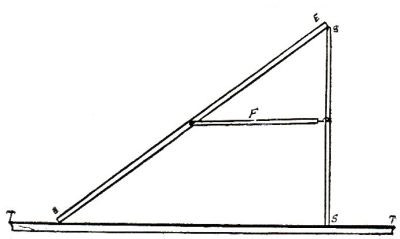
Take a piece of half-inch board twenty inches long and fourteen inches wide, and cut an opening in the centre just large enough to admit the largest size negative used by the amateur. Round the edges of this opening tack narrow strips of wood—cigar-boxes make about the right thickness—allowing them to project over enough to hold the negative after the fashion of a glass in a picture-frame. When a smaller size negative is used it is placed in a kit, and the kit fastened in the opening. Next take two pieces of wood twelve inches long, two inches wide, and half an inch thick, and attach them to one end of the board at the corners by hinges. At each side of the board fasten by a small screw, so that they may be moved easily, a small strip of wood having in one end a small hook. In the outside edge of each support fix a small staple or screw-eye, and when the board is wanted for use open the supports, hook the strips of wood into the staples, set the frame on a table, and you have as firm and solid a retouching easel as can be desired. The accompanying diagram will make the explanation clear to any one.
Three or four of Faber's pencils, varying in softness from HHH to HHHHHH, will be needed. Cut them in long slender points, leaving at least half an inch of lead at the end free from wood. They must be ground to almost needle sharpness. A handy device for renewing the point when it becomes dulled is to tack a piece of fine sand-paper to a small block, and use it for rubbing down the superfluous lead.
Two cakes of water-color are convenient, though they are not always used. Indigo blue and lamp-black in the moist colors are considered the best for this purpose. A very soft sable brush with a fine point is used to apply the paint. This brush must not be very long, but should be of medium thickness.
Retouching fluid or varnish may be bought ready prepared, or it may be made according to either of the following formulas:
Sandarach¼oz.
Alcohol1½oz.
Castor-oil20grs.
Put the gum-sandarach in the alcohol and shake till thoroughly dissolved, then add the castor-oil. Shake well before using.
Gum-dammar35grs.
Yellow resin3drms.
Oil of turpentine20oz.
A simple retouching varnish is made by adding dammar gum to turpentine in the proportion of 40 grains of the gum to 1 oz. of turpentine, but the addition of the resin as in the last formula seems to give a better grain to the negative.
Constant Reader asks if there is a solution for making green prints, and asks what is the matter with red prints, made by formula given in the Camera Club, which instead of being red, are a dirty brick color. Directions for green tones were given in No. 862, May 5, 1896.
Sir Knight B. A. Porter asks how to make carbon prints, and says he would like to learn photography in some studio, and asks what course to pursue to obtain a position. Directions for making carbon prints have not been given in this column. A paper on carbon-printing is prepared, and will appear after the holidays. Go to some first-class photographer and state what you wish to do. Many photographers take boys who wish to learn the art of photography and give them instruction, in payment for their services while learning. The rudiments are easily mastered, but perfection comes only by long and patient labor.
Fred. J. asks how to join the Camera Club; if the "Vive" is a good camera for beginners; and if the pictures made with it may be entered in the Round Table contest. Send name and address to the Round Table, stating your wish to become a member of the Camera Club, and your name will be enrolled on the books and a certificate sent you. Yes, to the other questions.
Sir Knight Raymond E. Reynolds asks if the Bullet is a good camera. The Bullet does excellent work for a small camera.
Sir Knight George Fuller asks if the Premo, Sr., is a good camera, or if he could get a better camera of some other make for the same price. The Premo is an excellent camera, and has been on the market long enough to have its merits tested. A Premo was given as one of the prizes in our competition two years ago, and the winner is very much pleased with it. Each make of camera has some special feature to recommend it. You would doubtless be entirely satisfied with the Premo, and the price is about the same for all cameras of the size named.