THE REMARKABLE ADVENTURES OF SANDBOYS.
Reading edition
BY JOHN KENDRICK BANGS.
AN INDIAN EXPERIENCE.
Sandboys, in his stories of adventure told to Bob and Jack, had so frequently in past years alluded to Indians that it suddenly occurred to Bob to find out if possible just how far Sandboys's experiences with the original owners of the soil had gone. There had been Indians in this section of New Hampshire. The boys knew that well, for the names of many of the hills and rivers attested the fact—Pemigewasset, Ammonoosuc, Moosilauke—all these names were decisive evidence that the red men had once inhabited the region, and dominated it sufficiently to leave their names at least forever impressed upon it. Furthermore, the Great Stone Face that looked stolidly out over the placid surface of the little lake, less than a mile from the hotel, had connected with it many an Indian legend which the boys had from time to time picked up in the course of their stay.
But it was not with the Indian as an idea, a memory, that caught their fancy. They wanted to have something of the Indian of the present, a live Indian and therefore a bad one, and with this end in view they approached Sandboys one evening while waiting for their parents to come down to supper.
"Of course," Sandboys said in reply to their question—"of course there's been Indians around here, but there ain't any now. Civilization's driven 'em all out to Nebrasky an' Honnerlulu and other Western States where they can afford to live. They hung on here as long as they could, but when the hotels began to get built and a new set of prices for things was established in the section, they couldn't afford to stay, so they enervated out West."
"They what?" asked Bob, to whom Sandboys's meaning was not quite obvious.
"Enervated—skipped—moved out. That's the right word, ain't it?" asked Sandboys.
"Emigrated, I guess you mean," suggested Jack.
"That's it—emigrated. I allers gets enervated and emigrated mixed up somehow," Sandboys confessed. "Fact is, when words gets above two syllabuls they kerflummux me. I really oughtn't to try to speak 'em, but once in awhile they drop off my tongue without my thinking, and most generally they gets fractured in the fall. But as I was tellin' you, when it began to git expensive living here in the mountains, the Indians found they was too poor to keep in with the best society, and they energated to Nebrasky and other cheaper spots. I've allers felt that the government ought to remember that point, an' instid of sendin' the army out with cannon and shot to kill the Indians and git kilt itself, they should civilize the section by buildin' a half a dozen swell hotels an' charge people ten dollars a day for breathin' the air. That'll kill an Indian quicker'n anything—or if it don't, instid of goin' about scalpin' soldiers and hullaballoin' in war-paint, after one or two seasons he'll begin to make baskits out of hay an' bulrushes an' sell 'em to guests for eight dollars. From what I know about Indians, they'd rather sell a baskit worth ten cents for eight dollars than kill a man, a fact which the government doesn't seem to take notice of. I'd like to be put in charge of the Indian question for just one administration at Washington. You wouldn't hear about any more Piute or Siouks uprisin's in the West, but you would hear of a great increase in the hay-baskit industry and summer-hotel-buildin' trade."
"It sounds well," said Jack.
"I guess it does," said Sandboys. "It would work too."
"It might be dangerous for two or three seasons for the guests, though," said Bobbie. "I don't think I'd want to go to a place for the summer where the Indians were thick and still wild. I don't want to get scalped."
"Oh, you'd be all right as long as you wasn't a dude!" rejoined Sandboys. "Now that the dudes has taken to wearin' their hair long in the back, no wild Indian's goin' to bother with boys. There's no fun scalpin' a small boy, with football scalps in sight. You've hit on the great trouble about Indians, though," Sandboys added, reflectively. "You can civilize 'em. You can teach 'em Latin, Greek, French, or plumbing. You can teach 'em to dance and sing. You can make 'em wear swaller-tail coats and knickerbockers instead o' paint an' hoss blankets, but you can't entirely kill their taste for takin' hair that don't belong to 'em. It was on just that point that I had my only experience with Indians in this place here, and I tell you what there was lively times that summer. It nearly ruined this hotel, and if it hadn't been for me, I kind o' think it would have been goin' on yet.
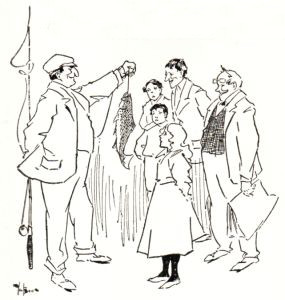
"It was back in the eighties somewhere that it happened. I don't remember whether it was '87 or '88. Tennyrate, it was the year Mr. Hicks's boy Jimmie caught a five-pound bass in Echo Lake with his Waterbury watch. Ever hear about that? Funniest thing y' ever heard of. Jimmie Hicks was the liveliest little boy you ever saw. You two rolled into one wouldn't be half as lively. He was everywhere at once, Jimmie was. He's the boy that busted the hole in the roof with the elevator. Set the thing goin' up, couldn't stop it, and bang! first thing he knew the whole thing had smashed up through the roof and toppled over on its side. He had a watch—a Waterbury watch. His father got it for him just because it took an hour to wind it up, and that kept Jimmie busy for an hour a day, anyhow, an' he used to be doin' everything he could with it. I've seen him smash a black fly on the wall with it, usin' it like a sling-shot; but the queerest thing of the lot was his catchin' the bass with it. He was out in a boat, an' nothin' would do but he should trail that watch in the water after him. The bass he see it, thought it was a shiner, snapped at it, swallered it, and Jimmie pulls him in. Weighed five pounds an' three ounces on the office scales. It was that year we had the time with old Rocky Face—I don't remember his Indian name, but Rocky Face was what it meant in English.
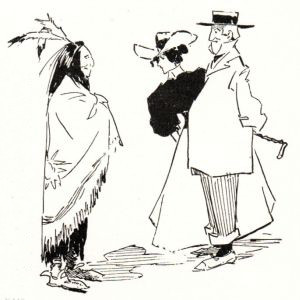
"He was a quiet, peaceable, civilized old Indian, and the last of the old tribe that used to live about here. The others had fled to Nebrasky, as I told you, because they couldn't stand the expense of livin' in the White Mountains, but Rocky Face said they couldn't freeze him out. He'd been born here, and he was goin' to die here, if he had to steal a livin'. So he staid on, an' lived in an old pine-bough shanty he built for himself up on the other side of Mount Lafyette. What he fed on nobody knew, but every once in a while he'd turn up at the hotel and ask what they'd charge to let him look at the clock, and everybody'd laugh, and call him a droll old Indian, and ask him to come back. Finally he got to makin' baskits and birch-bark canoes and bows and arrows, and he'd sell 'em to the guests. They took so many of 'em that Rocky Face soon got to earnin' twenty an' thirty dollars a day, an' when he got to that point he could afford a small back room in the hotel, and so he came here to live.
"He became one of what they call the features of the place, an' they got to puttin' his picture in the hotel perspectacle."
"Prospectus, do you mean?" queried Bob.
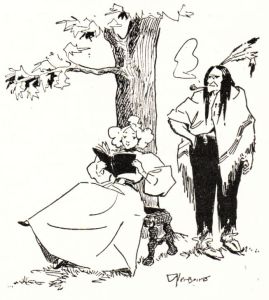
"Hyop. That's the thing," said Sandboys. "They put his picture in that as one o' the sights. They called him 'A Rollic of the Past: The last of the Pemmijehosophats.' He used to make a good many people nervous, the way he eyed their hair, for, as I've said, although he'd become more or less civilized, it wasn't in him not to covet other people's hair. About that time there was an awfully pretty girl here from down South somewheres—Conneticut, I think. She was a regular belle, and she had the finest yeller hair you ever see. Every night she'd be out rowin' on the lake with all the legible young men in the place; but all of a sudden she didn't come down to breakfast one morning. She had it sent up, an' her mother looked very anxious when she came down and said her daughter was very sick. Then two other ladies didn't appear any more, and a very well known old lady remarked in my hearin' that there was a thief in the house—she'd lost a switch. Well, that set me to thinkin', but I couldn't come to any conclusion until one night I took a pitcher of ice-water up to the Conneticut young lady's room, and, by Joe, there she sat readin', with scarcely no hair at all on her head."
"Scalped?" cried Bob, in horror.
"Not a bit of it," said Sandboys. "Robbed! An' then it all came to me. That old last of the Pemicans had spoke several times about her hair to me, an' I could see he was kind of thirsty for it, an' I made up my mind to two things. First was, Miss Conneticut's hair was nothin' but a wig; and second, old Rocky Face had it. I stole into his room that night when he was at supper and opened his trunk. Will you believe it, it was full o' false hair, an' in an old hat-box in one corner was the beautiful yeller locks of Miss Conneticut. That feller'd scalped enough bureaus to fill three good-sized mattresses."
"As much as that?" cried Jack.
"Hyop!" said Sandboys. "Most o' the ladies didn't like to mention it, but there was hardly one of 'em that hadn't lost two or three headsful to that old sinner, and I found it out. Of course I told the proprietor, and the hair was restored to its owners. Miss Conneticut appeared again, more popular than ever, and old Rocky Face was sent to jail, and he's never come out as I know of."
"Well, that is a singular story," said Bob.
"Isn't it," said Jack. "I should think Miss Conneticut ought to have been very much obliged to you."
"She was," replied Sandboys. "She gave me twenty-five dollars—five for findin' the wig, and twenty for keepin' quiet about it around the hotel. That's one reason I can't remember her real name."