THE SCHOOLBOY OF SIBERIA.
Reading edition
BY W. H. JACKSON.
The word Siberia recalls a broad yellow space across the map of northern Asia, with a dot here and there for a town with an unpronounceable name; and that is about all any of us knew of Siberia when your father and I were boys. But we are beginning to learn better, and the person old or young who now speaks of that country as a barren stretch of forests and marshes, where the people wear furs most of the time, and live mainly on seal-blubber, shows himself far behind the times.
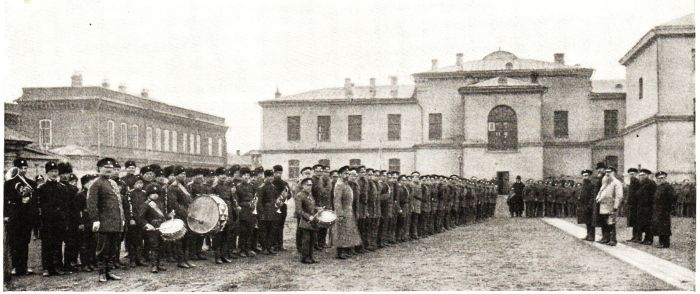
STARTING OFF FOR A HOLIDAY.
I must confess, however, that the schools of Siberia are a little ahead of what I expected to see when I made a flying trip across the country last year. My journey was from the Pacific coast to Russia, and, in winter, by more than 3000 miles of sledge travel. It extended from Habarofsk, at the junction of the Amoor and Ussuri rivers, northeast of Peking, to the city of Krasnoyarsk, which at that time was the terminus of the railway which the Russian government is rapidly building from Moscow to the Pacific coast. This route led me through the principal cities of Siberia, and I was able to stop in most of them a few days, and thus to see many places and things of interest. Many of these cities are large and handsome towns; and as all lie in the southern part of the country, where the climate and soil are much like those of eastern Canada, they are surrounded by wide farming tracts, lumbering districts, and mines, and have a trade that reaches to great distances. These are old towns, too, for it must not be forgotten that Siberia has been growing civilized during 250 years, or about as long as the United States itself, and they are often populous also, since Irkootsk, where the Governor-General of Western Siberia lives, has about 80,000 people; Tomsk, the university town, has 30,000; Blagovestschensk, the largest city in Eastern Siberia, 40,000; and half a dozen others 10,000 or 12,000 more. They have water-works, electric lights, police and fire departments, theatres, and all the rest that belongs to a wide-awake town; but they are proudest of their schools and the institutions of religion and public charity.
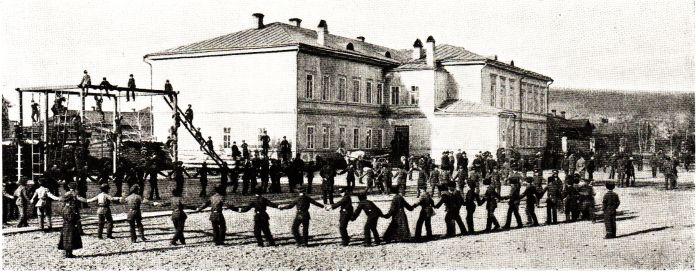
THE RING GAME AND OPEN-AIR GYMNASIUM.
In every city the central school-house, or gymnasium, as it is called, is one of the largest, most costly buildings, and often is surrounded by fine grounds, while within it are the best appliances that can be had. In many of them, for example, each pupil has a little desk to himself; and these are adjustable, and fitted to him, so that the short-legged youngster may have a low seat, while his next neighbor, who may be tall and thin, enjoys a higher one. This is more than most American schools can show. The walls are covered with blackboards, maps, and pictures, and always, at least in the principal rooms, there is a portrait of the Emperor, whom the Russian people often speak of as their Little Father, meaning he is next in their love and respect to the Great Father in heaven. You will notice these and some other things in the illustrations of one of the school-rooms in Krasnoyarsk, which, as well as the other pictures, has been made from a photograph taken by one of the teachers there.
Several other things are noticeable in that scene. You will observe that the right-hand corner is cut off, as if by a chimney; but this is the stove—the chimney being above it. The Russian stove is a small chamber built up of bricks, in the base of which is a fire-box, whose door in this case is hidden by the blackboard. A rousing wood fire is built in the early morning, then the doors are closed, and the dampers so regulated that the heat from the mass of coals permeates the brick walls, which diffuse a genial warmth throughout the room for the rest of the day.
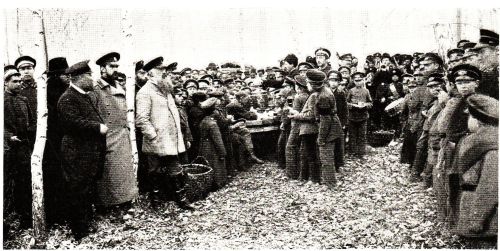
HOT TEA FROM THE SAMOVAR AT A PICNIC.
In the left-hand corner is hung the ikon, with its ever-burning lamp, found in every Russian house or public room, great or small, and which usually consists of one or more framed tablets that contain carvings or paintings of the head of Christ, with perhaps other subjects relating to the Saviour. It is the sacred symbol of religion in the Russian (or Greek) Church, like the crucifix in the Roman Church. Their religious duties are never forgotten by the Siberians, and form an important part of the school life. Each school has a chapel—often richly decorated; and to it is attached a chaplain or priest, who holds religious services there every morning and gives instruction in sacred subjects. One of these priests is sitting at the back of this room, as you may see by his robe and his long hair, parted in the middle, and his golden cross; these are the signs of his office. He has a kindly face, and is, no doubt, the friend of every boy in the establishment.
Next to him is seated the principal—a hearty-looking man, dressed, as usual, in military uniform—and other visitors, for this is evidently an examination day. A teacher stands at the blackboard, and perhaps has asked a question which the lad before him has been unable to answer, for he has turned to another boy, who has risen at his desk as though to give the needed reply. One need not go outside our Yankee school-rooms to make a similar picture any day; but he would never see in this country the abacus, which is used all over Siberia, China, and Japan by pupils and teachers in their arithmetic lessons, and by merchants in their stores, instead of the pencil and paper with which we do sums too large for head-work. It is a very ancient device, and the boys who went to school in Rome before Cæsar wrote that all Gaul was divided into three parts, or Virgil declared "Arma virumque cano," learned their multiplication table by the help of its sliding balls.
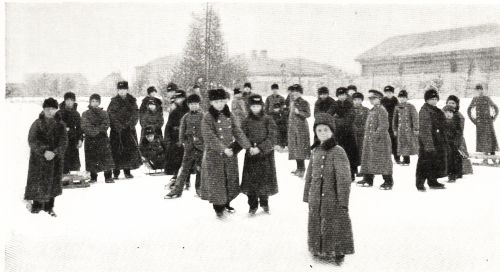
THE SKATING-POND.
The military rule that governs all Russia extends to the schools and colleges. They are free public schools, almost as fully as with us, and are attended by the children of the peasants and poor townspeople as well as by the sons of government officials and rich merchants, who later are to go to the university at Tomsk, or perhaps to Russia, for their college course. But here, though some are nobles by birth and others are mere peasants, all are treated exactly alike, and all dress in a uniform closely copied from that of the army. Even the girls—who always have separate schools from the boys—wear a simple regulation dress, so that there is no heart-burning in little Anna, from the cottage in the back street, because little Lady Anna, from the great house on the square, has a fine dress. The teachers are all regarded as officers of the government, and wear a military uniform. The school is drilled in tactics every day, and conducts all its exercises after military models, training its boys into soldierly young men. Even their play is mixed up with this, as you see in the picture of the ring game, where an officer wearing his sword stands in the centre.
The uniform is not so pretty as that worn by the cadets of our own military schools, and it is comical to see a little chap, with a round, roguish face under his flat cap, wearing big boots, and a gray overcoat belted about him with skirts long enough to touch the ground; but when he has earned the rank of corporal or sergeant in his school battalion, and feels the marks of his rank on his collar, he struts about as proud as a peacock.
Gymnastics are cultivated everywhere, and each school has a large hall devoted to calisthenics, and to exercises upon the bars, ladders, vaulting-horse, swinging-rings, trapeze, etc.; while many schools have out-of-door apparatus to be used in warm weather, such as that which appears in one of the illustrations. Everybody must go through these exercises, and some excel greatly in them, as you would expect of the sons of Cossacks, as many of them are.
Holidays are much more numerous than with us, and on these school is suspended, and parades and marches take their place. Then the school assembles, "company front," on the play-ground. All the principals, teachers, and drill-masters are here in full uniform; a band is borrowed from the garrison post, and after a few evolutions the young regiment marches away, to stirring drum and bugle notes, to some rural grove, where they have competition drills and athletic games, and then break ranks for a frolic. Lunch-time brings them all to headquarters at the roll of the drum, when every young soldier winds up with tumblers of weak tea, the hot water coming from the great brass urn, called a samovar, which is never far from a Russian gathering of any kind at any time of year.
Christmas in Siberia is the great day of the year for the youngsters—nowhere greater—and the soldier lads and quaint, gray girls look forward to it for weeks as they do elsewhere. I happened to be in Chita, the capital of the trans-Baikal province, at Christmas, and was invited to one of the festivals. Imagine a large and lofty room, where three or four hundred children were packed in a dense circle around a large Christmas tree ablaze with candles and loaded with good things. Outside of this circle were as many older persons as could find room—rich and poor, noble and simple—the army officer in his gold-embroidered coat jostling the peasant in sheepskin, and the grand dame in silk and sables beside the plain peasant mother, all equal in their happy interest as fathers and mothers. The exercises opened with the national anthem, led by the priests, who are very successful in teaching the children those choral songs so common and enjoyable in Russia. Dialogues and recitations followed, sometimes by little tots, and after that came games and dances—especially that curious, active, national dance, a sort of quadrille, performed by quaint little couples in uniform, with immense zest. By this time everybody was moving about, and all who wished, old and young, began waltzing to the music of the soldier band, the Governor himself, gorgeous with gold lace and orders, taking out one shy little maiden after another to spin about the polished floor. At last it was time to stop, and then everybody stood still while the children sang a final soul-stirring patriotic song to the accompaniment of blazing red lights, the older ones joining in the chorus and ending each refrain with a roar of "h'ras!"