Part 2 — CHAPTER XVI. Superstitions Generally.
Reading edition
“Even a single hair casts a shadow.” —Lord Verulam.
Editor’s Note.—In this chapter are collected all the loose and unclassified bits of Folk-Lore scattered among Sir Edgar MacCulloch’s manuscripts.
The widely-diffused idea that the spirits of the dead sometimes return in the form of birds, is not altogether obsolete in these islands.
A widow, whose husband had been drowned at sea, asked the Seigneur of Sark whether a robin that was constantly flying round her cottage and alighting on her window-sill, might not possibly be the soul of the departed.[241]
The robin is a bird specially reverenced in Guernsey, as the widely-accepted belief is that it was the robin who first brought fire to the island. In bringing it across the water he burned his breast, and this is the reason why, to this day, the breast of the robin is tinged with red. “My mother,” said the old woman who told me this, “had a great veneration for this little bird, which had been so great a benefactor to those who came before us, for who can live without fire.”[242]
Soucique. This is the name given in Guernsey to the marigold, and also to the fire-crested or golden-crested wren, the word being derived from the Latin “solsequium.” It is probably the same as the “heliotropium.” The shape and colour of the flower, resembling the disc of the sun surrounded with rays, and the fact of the flower opening at sunrise and closing at sunset, would naturally cause it to be associated with that luminary, and considered sacred to Apollo. It is not quite so easy to account for the same name being given to the fire-crested and golden-crested wren, but we know that the wren plays a considerable part in the mythology of the Aryan nations, and is one of those birds which is believed to have brought fire from heaven for the use of man.[243] The story of its outwitting the eagle, in the contest for the sovereignty among birds, and getting nearer the sun by perching on its back, may have gained for it a name, which, as we have seen, signifies “a follower of the sun.”
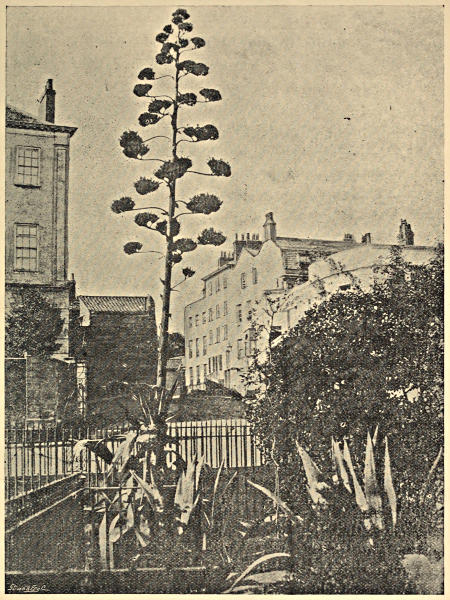
Portion of the Old Town House (on the left) of the de Sausmarez Family, situated where St. Paul’s Chapel now stands.
The willow-wren is known among us as “Le Ribet,” from Ri (roi), and “bet,” the form known in the province of Bearn of “bel.” Vallancey says:—“The Druids represented this as the king of birds, hence the name of this bird in all the European languages. Latin, Regulus; French, Roitelet; Welsh, Bren (or “king”); Teutonic, Konig Vogel; Dutch, Konije, etc.”
A magpie crossing one’s way is of evil augury, portending vexation, or trouble of some kind. Crows cawing much in the neighbourhood of a house is also a sign of impending trouble.[244]
When the cuckoo is heard for the first time in the year one ought to run a few steps forward in order to ensure being light for the rest of the year. If you have money in your pocket, and turn it, or shake it, it will ensure good luck, and you will not want money throughout the rest of the year.[245]
“Money should be turned in the pocket when the cuckoo is heard for the first time.”
An old woman, living at the Vale used to say:—“En Guernesi nous a coutume de dire en oyant le coucou pour la première fais:—‘Si tu ne cuers pas tu seras lourd toute l’annâie.’ Nous remue étout l’argent qu’nous peut aver dans les paoutes, en les secouant—et il y a des gens qui se mettent à genouaïx. La première fais que nous-ôt le coucou il faut mettre une grosse roque sus sa tête, arroütaïr à courre, et nou sera légier toute l’annâie.”
Cuckoo Rhymes.
“En Avril Le coucou crie S’il est vif.”
“Le coucou S’en va en Août La barbe d’orge Li pique la gorge.”
“Coucou-Varou Bave[246] partout.”
(See Notes and Queries, 4th Series, Vol. III., 1869.)
It is thought lucky to shake one’s pockets and run a few steps, the first time one hears the cuckoo sing. The following lines are also repeated by some, and the number of times the cuckoo utters his note is taken as an answer to the question.
“Coucou, cou-cou, dis mé Combien d’ans je vivrai.”[247]
I remember when I was a child, my aunt, Miss de Sausmarez, making me remark how chickens, when they drink, lift up their heads at every sip, and telling me that they did so to thank God.[248]
The bone of the cuttle fish, which is found at times thrown up on the beach, is called in Guernsey “Pépie.” It is supposed to possess the quality of healing the “pip” in chickens, also known as “la pépie.”
A stye in the eye is called in Guernsey “un laurier,” and is to be cured by bathing the eye with an infusion of laurel leaves or “lauriers.”
If a fisherman, on setting out, sees a humble bee flying in the same direction as he is going, he considers it a good omen, and that he is sure of a plentiful catch. If, however, the insect meets him, it is quite the reverse. The ill-luck, however, may be averted by spitting thrice over the left shoulder. Omens of good or bad luck are also derived from sea-birds. All depends on whether a gull or a cormorant is seen first, as, if a cormorant, no fish is to be expected that day. All fishermen also know how unlucky it is to count one’s fish until the catch has been landed, as, however freely they may be biting, counting them would inevitably stop all sport for the day.[249]
If a pair of bellows is put on a table, some great misfortune is sure to happen in the household.[250]
Richard Ferguson, fisherman, of the Salerie, tells me that there is a great objection against taking currant cake with them when they go a-fishing, it is sure to bring bad luck.
Editor’s Note.
The following scraps of Folk-Lore I have gathered from old people in St. Martin’s parish, in the years 1897-99.
The Man in the Moon.
“J’ai ouï dire à ma gran’mère i’y a be’tôt chinquante ans qu’l’bouan homme que nou veit dans la lune enlevit un fagot de bouais le Dimanche, et pour chut fait le Bon Gyu le condamnit à s’en allair dans la lune jusqu’au Jour du Jugement. V’la l’histouaire de chut poure Mâbet que non vait si souvent perqui là-haut.”—From Mrs. Le Patourel.
A robin flying to the window or in the house is a sign of death. Crows flocking together and cawing over the house are most unlucky. To go out and meet three crows or three magpies means good luck, all other numbers mean misfortune.
None should ever cut their finger nails on either a Sunday or a Friday if they wish to prosper. A baby’s first nails should never be cut, but bitten.
On being given a present of scissors or a knife, a double[251] should always be given in exchange. Parsley should never be taken as a gift, but it is very lucky to steal some (!).
No berried plants such as ivy, etc., should be brought into the house before Christmas, and it is especially unlucky if, when they are brought in, they are allowed to touch the mantel shelf. May should never be brought into a house, and many people, especially in Alderney, consider that to bring in furze or gorse means to introduce sorrow.
Should an unmarried woman go in and out of a house through a window which is not destined as a means of entrance or exit, she will never marry.
An umbrella should never be opened in a house, or placed upon a table, quarrelling and strife are sure to follow.
It is supposed to be very unlucky when going out of the house, if the first person you meet is a woman. Never pass her if you can avoid it, but stand still and let her pass you.
To keep witches from entering a stable and molesting the cattle a piece of naturally pierced flint-stone should be tied to the key of the stable door. On going down to a beach it is considered lucky to pick up a small stone and bring it away with you. Never give away money with a hole in it.
If you think you are bewitched or that any one has a spite against you, throw a lump of salt on the fire, and as it burns blue the spite will evaporate.
Fanny Ingrouille, of the Forest parish, from whom the foregoing was obtained, also repeated the following formula, which apparently was a programme for the week of a Guernsey country girl.
“Au matin—Pierre Martin Au ser—Jean Mauger[252] Lundi, Mardi—Fêtes Mercredi—Mà à ta tête Jeudi, Vendredi—Fort travâs Samedi—A la ville Dimanche—Vée les filles.”
Guernsey Local Nick-Names.
Alderney = Vâques (Cows).
Sark = Corbins (Crows).
Jersey = Crapauds (Toads).
Guernsey = Anes (Donkeys).
Guernsey Parish Nick-Names.
St. Pierre Port = Les Cllichards (See Métivier’s Dictionnaire, p. 134.)
St. Samson = Raïnes (Frogs.)
Le Valle = Ann’tons (Cockchafers.)
Le Catel = Le Câtelain est un âne-pur-sang.
St. Sauveur = Fouarmillons (Ant lions.)
St. Pierre-du-Bois = Equerbots (Beetles).
Torteval = Anes à pid de ch’vâ (Asses with horses’ feet.)
La Forêt = Bourdons (Drones.)
St. Martin = Dravants (Large Ray-fish.)
St. André = Craïnchons (siftings) “Ce qui reste dans le crible.”[253]
Editor’s Note.
The following is a rhyme describing the girls of each parish, given me by the late Mr. Isaac Le Patourel, of St. Martin’s.
Les Filles des Dix Paroisses.
“Ce sont les filles de la Ville Elles sont des jolies Belles! Ce sont les filles de Saint Samson Elles sont bonnes pour le lanchon![254] Ce sont les filles du Valle Elles sont prêtes pour faire du mal! Ce sont les filles du Câté Elles sont prêtes pour la gaieté! Ce sont les filles de Saint Sauveur, Elles sont toutes de bouane humeur! Ce sont les filles de Saint Pierre Ah! qu’elles sont terjours à braire![255] Ce sont les filles de Tortevâ Elles ont vraiment les pids de ch’vâ! Ce sont les filles de la Forêt Dame! ch’est qu’elles sont bien laides! Ce sont les filles de St. Martin Elles sont niais comme des lapins! Ce sont les filles de Saint André Elles seront toutes des delaissées!”