Part 2 — CHAPTER X. Witchcraft.
Reading edition
“Had learned the art that none may name In Padua far beyond the sea.”
“Tam saw an unco sight! Warlocks and witches in a dance; Nae cotillon brent new frae France, But horn pipes, gigs, strathspeys, and reels, Put life and mettle in their heels: … There sat auld Nick, in shape o’ beast; A towzie tyke, black, grim, and large, To gie them music was his charge.” —Tam O’Shanter, Burns.
“Wise judges have prescribed that men may not rashly believe the confessions of witches, nor the evidence against them. For the witches themselves are imaginative, and people are credulous, and ready to impute accidents to witchcraft.”—Bacon.

The belief in witchcraft dates from so very remote a period, it is so universally spread throughout all the various races that compose the human family, that it is not to be wondered at if it still retains its hold among the ignorant and semi-educated, especially when we find, even in the present day, that persons, who ought by their superior instruction, and by the position they hold in society, to be above such superstitions, are nevertheless, firm believers in judicial astrology, fortune telling, spiritualism, and other similar delusions. Although it is now but very seldom that public rumour goes so far as to point out any particular individual as a proficient in this forbidden art, the persuasion that sorcery does still exist, is by no means extinct. A sudden and unusual malady, either in man or beast, a strange and unlooked-for accident, the failure of crops from blight or insects,—all these, and many more evils, are attributed by the ignorant to supernatural causes; and, it is probable, will continue to be so as long as there are those who find it their interest to encourage this superstitious belief. For there are individuals, commonly called “désorceleurs” or “white-witches,” who pretend to be able to declare whether a person is bewitched or not, and to have it in their power, by charms and incantations, to counteract the evil influence. Of course this is not to be done for nothing; and cases of this kind, where large sums of money have been extorted from ignorant dupes, have, even of late years, formed the subject of judicial investigation. It is useless to attempt to reason with the lower orders on this subject. They have an answer ready which, in their minds at least, is a conclusive reply to all doubts that may be suggested:—
“Witches and witchcraft are frequently spoken of in the Holy Scriptures; who, then, but an unbeliever, can doubt that such things are?”
Guernsey did not escape the epidemic delusion which spread over the whole of Europe in the sixteenth and seventeenth centuries. Here, as elsewhere, a terror seized upon the people, and no man thought himself secure from the machinations of the agents of Satan. The records of the Royal Court of the island contain far too many condemnations of unfortunate men and women to the stake for sorcery; and the evidence on which the sentences against them were based, as well as their own confessions, extorted under the infliction of torture, and taken down in writing at the time, are still extant. The unhappy individuals were of various ages and conditions, but, judging from the statements of their accusers, and the evidence brought against them, they appear to have been in most, if not all cases, persons of irregular life, subsisting by begging and pilfering, vindictive towards those who offended them, and clever in taking advantage of, and working on, the fears and preconceived notions of their dupes.
They were accused of causing storms to arise, in which the unfortunate fisherman who had refused them a share of his catch, either lost his boat, his gear, or his life; or was so tempest-tossed as to be in danger of losing his wits. Women and children were, by their infernal influence, afflicted with sudden and strange maladies. Oxen, horses, calves, sheep, and swine died unexpectedly, the cows calved prematurely, and either gave no milk, or else blood in lieu of it. Butter would not come, or became rancid even while it was being made, and curds dissolved and turned to whey.
Maggots of unusual appearance, black at both extremities, appeared in prodigious quantities in the beds, and even under the women’s caps, and lice were in such numbers that they could be swept away with a broom.
The water in the fountains—usually so bright and limpid—became turbid and unfit for use, and full of tadpoles and disgusting insects. Frogs and black beasts (“des bêtes noires”), whatever they may have been, sat by the bedside of those who were under a spell; but all these evils disappear as suddenly as they have come, either on the sufferer weakly yielding to the demands of the supposed sorcerer, or having courage enough to threaten to denounce him to the judicial authorities.
It is not to be wondered at that the pretended wizards and witches should have shrunk from a judicial investigation at a time when all believed firmly in their supernatural powers, and when the examination into the alleged facts was carried on in a manner so different from the procedure of the present day, hearsay evidence of the vaguest description being admitted as proof, and when that failed, torture being resorted to in order to extort a confession.
From the evidence given, and the confessions of the sorcerers themselves, it appears that the means employed by them to effect their nefarious designs were various; but two in particular are mentioned.
A peculiar black powder, furnished them by their master, the Devil, which, being cast on man or beast, was the cause of serious and unusual maladies; and certain enchanted articles, introduced furtively into the beds or pillows of those on whom they wished to practise their evil arts.
These charms are variously described by the witnesses as consisting of seeds of different kinds, of which mildewed or blighted beans seem to have been the most common, and of feathers, knotted together with ends of thread or silk twist, and sometimes made into the shape of a small image.
When the beds or pillows were opened to search for these articles, it sometimes happened that an animal was seen to leave the bed, which, after taking various forms, as that of a black cat, a cock, a rat, a mouse, or a stoat, succeeded in evading all attempts to catch it, and escaped in a mysterious manner.
Isabell Le Moigne, one of the witches, declared in her confession that this was none other than Satan himself. If these charms were thrown into the fire, they produced a most noisome smell, but, in some instances, the immediate cure of the sufferer was the result. If the person under the influence of witchcraft was uncertain on whom he ought to fix the guilt of bewitching him, there was an infallible method for discovering the culprit.
The house-key was to be placed on the hearth-stone, and the fire heaped around it. As it became hot, the wizard or witch, apparently suffering great agony, would come to the door, and endeavour to force an entrance into the house, offering at the same time to put an end to the spell under which the inmates were bound.
Another means of finding out the guilty party was to roast the heart of some animal—some said that of a black sheep was the most efficacious—with certain prescribed rites and incantations, or to boil it with certain herbs known to the white witch or “désorceleur,” who, of course, could not be expected to give his valuable advice and services for nothing.
According to the confessions of the unfortunate victims of the superstition and credulity of their times, to which allusion has been made above, the doings of Satan with them were just such as we read of in the accounts of prosecutions for witchcraft in other countries. A desire to be revenged on some persons who had given them offence seems to have been the first motive.
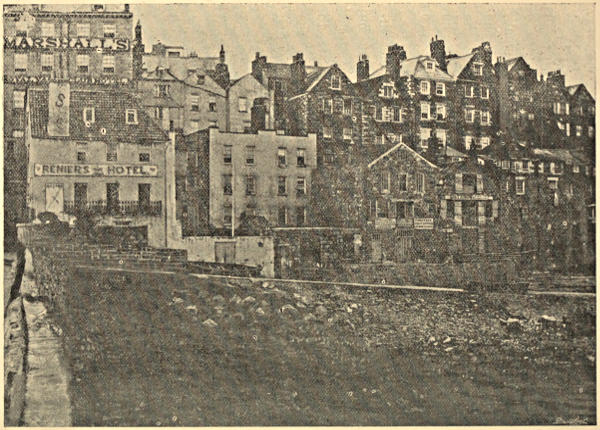
“North Arm, Old Harbour, showing back of Pollet.”
The Devil then appeared to them in the shape of a black dog, cat, or other animal, sometimes under one likeness, sometimes under another; offered his services, invited them to attend the “Sabbath,” which was generally held in some weird, out-of-the-way locality; furnished them with a certain ointment, which was to be rubbed on the back and stomach; after doing which, they found themselves carried through the air, with extraordinary velocity, to the appointed place of meeting, where they found other wizards and witches, and a number of imps in the shape of dogs, cats, and hares. They were unable to recognise the other sorcerers on account of their all appearing blackened and disfigured, but they knew who they were by their answering to their names when the roll was called over by Satan before entering on the business of the night.
They commenced by adoring their infernal master in a manner which it is not necessary to describe minutely. They then danced back to back, after which they were regaled with bread and wine, which Satan poured out of silver or pewter flagons into goblets of the same metals. They all agreed in describing the wine as being inferior to that usually drunk; and they asserted that salt was never seen at these feasts. The Devil, before dismissing the assembly, gave them a certain black powder, of which we have spoken before.
The favourite form assumed by Satan on these occasions seems to have been that of a large black dog, standing upright on his hind legs, but he sometimes appeared in the shape of a he-goat.
Isabell Le Moigne described him as a black dog of large size, with long erect horns, and hands like those of a man. Deeds were done at the Sabbath which will not bear being spoken of; but there are circumstances which lead one to suppose that the poor deluded wretches of women may, in some cases, have been deceived by designing men, who enticed them from their houses at night, and, under assumed disguises, abused their credulity.
All sorcerers were marked by Satan in some part or other of the body, and the mark thus made was insensible to pain, and bloodless.
One of the witches asserted that the Devil, before her enlistment into his service, required of her the gift of some living animal, and that she presented him with a young fowl. The next night at the Sabbath, whither she was conveyed through the air after having duly anointed her body with the ointment given her by the Devil, she was made to renounce the Holy Trinity, and to promise obedience to her infernal master. It appeared also from the confessions that if the servants of Satan refused to do his behests, they are beaten and otherwise maltreated by him.
It is clear from the evidence given in many of the trials for witchcraft that the accused, in a majority of cases, were persons who trafficked on the ignorance and credulity of the people, and who encouraged the idea of their being possessed of supernatural powers so long as they found it profitable to do so.
Even in the present day there are people who are afraid to refuse to give alms to a beggar, lest an evil eye should be cast upon them; and who can say how many deaths of cattle and pigs, attributed to witchcraft, may not have been caused by poison adroitly administered out of revenge for a supposed injury?
In their nocturnal flights through the air to their appointed place of meeting with the Demon, witches were said to utter loud cries; and persons may, perhaps, still be found ready to affirm that in tempestuous nights, when the wind was howling round their dwellings, they have been able to distinguish above all the tumult of the elements, the unearthly cry of “Har-hèri[146]! qué-hou-hou! Sabbat! Sabbat.” This cry is attributed to the “gens du hocq” or “gens du Vendredi,” as they are called by those whose prudence deters them from speaking of “sorciers” and “sorcières,” lest the use of such offensive epithets should give umbrage. It is believed, too, that in their assemblies on Friday nights on the hill of Catiôroc, around the cromlech called “Le Trepied,” or on the sands of Rocquaine Bay, they dance to a roundelay, the burden of which is “Qué-hou-hou! Marie Lihou!” Some suppose that these words are uttered in defiance of the Blessed Virgin Mary, in whose honour the church and priory were erected and dedicated by the name of Notre Dame, Ste. Marie de Lihou. They are now a heap of shapeless ruins, but the place must have been looked upon as one of peculiar sanctity, for even down to the present day French coasting vessels passing by salute it by lowering their topmast. It is not then to be wondered at if the infernal sisterhood—one of whose chief amusements, as is well known, is the raising of storms in which many a proud vessel goes down—should take a particular delight in insulting the “Star of the Sea,” the kind and ever-watchful guardian of the poor mariner.
Wizards and witches are supposed to have the power of navigating on the sea in egg-shells, and on the blade-bones of animals. It is to prevent this improper use of them that the spoon is always thrust through the egg-shell after eating its contents, and that a hole is made through the blade-bone before throwing it away.
It is believed that witches have the power of assuming the shape of various animals, and many stories turn on the exercise of this supposed faculty. The favourite forms with them appear to be those of cats, hares, and “cahouettes”[147] or red-legged choughs. It is not easy to conjecture how this beautiful and harmless bird got into such bad company; perhaps its predilection for the wild and unfrequented cliffs and headlands, where the witches are supposed to hold their unholy meetings, may have gained it the reputation of being in alliance with them.
In Guernsey, as elsewhere, a horseshoe, nailed on the lintel, door, or threshold, or on the mast or any other part of a ship or boat, is supposed to be a sure preservative against witchcraft, and, although a black cat is one of the most frequent disguises assumed by Satan’s imps and servants, the household in which a cat without a single white hair is domesticated, is thought to be highly favoured, as none of the infernal gang will venture to molest it. As some persons are fully persuaded that every black cat, however tame and well-behaved it may appear to be, is in reality in league with the Prince of Darkness, it may be that any interference on the part of others of the fraternity is contrary to the rules established among them, and resented accordingly, the old saying that “two of a trade cannot agree,” holding good in this case.
Allusion has been made to those who have an interest in encouraging a belief in witchcraft, and there is no doubt that persons who, for some reason or other, enjoy the unenviable reputation of dabbling in this forbidden art, now that they have no longer the fear of the stake and faggot before their eyes, and have only the minor terrors of a Police Court to dread, are not altogether unwilling to brave the latter danger if, by working on the credulity of the ignorant and superstitious, they can extort money, or even command a certain amount of consideration as the possessors of supernatural powers.
Few would venture in the present day to acknowledge openly that they could injure their neighbours by the exercise of unholy arts; but many may be found who pretend to a secret knowledge which may be used for beneficent purposes.
The difference, however, between a true witch—the servant of Satan—and what is commonly called “a white witch,” has never been clearly defined. The latter is known in Guernsey by the name of “désorceleresse” or “désorceleur,” for the art is quite as frequently, if not more frequently, exercised by men than by women. The persons who practise it pretend to be able to declare whether man or beast is suffering from the effects of witchcraft, to discover who it is that has cast the spell, and, by means of spells and incantations, to counteract the evil influence. It is clear, however, that one who is in possession of such powers must himself have a very intimate and profound knowledge of the arts he is fighting against, and that, if offended, he may perhaps be tempted to practise them. The “désorceleur” thus is as much feared as trusted, and as, of course, he cannot be expected to give his valuable services for nothing, the profession is often found to be very remunerative, large sums of money, besides presents in kind, being sometimes extorted from the superstition and fears of the credulous dupes.
There is no doubt, however, that some of these pretenders have some skill in the cure of the diseases to which cattle are liable, and even that some of the minor ailments to which the human race are subject, are occasionally relieved by them, especially those—and among ignorant, uneducated people they are not few—which arise out of a disordered imagination. The habits of close observation which those of his profession acquire must needs give the “désorceleur” a great insight into character; his cunning will soon teach him how to work on the fears and credulity of those who come to consult him, and his experience will guide him into the best way of exercising his knowledge.
How far the so-called white-witches are believers in their own supernatural powers is an open question. It may be that, in making use of certain forms or practices which they have learned from others, they may be fully persuaded in their own minds of their efficacy, it may be that in some cases they are labouring under a sort of hallucination.
A noted bone-setter, who, it is said, was occasionally resorted to when man or beast was supposed to be under evil influence, or when it was sought to discover the perpetration of a theft, used to account for his pretended knowledge of the anatomy of the human body by asserting solemnly that this knowledge had been revealed to him in a vision from Heaven, and he had repeated this story so often that it was evident to his hearers that he had come at last to believe fully in the truth of what he said.
The rustic bone-setter is not necessarily a “désorceleur,” although, as in the instance just noticed, the two professions may be combined; but he is skilled in the cure of those somewhat mysterious ailments known as “une veine trésaillie,” which seems to be a sprain or strain, and “les côtaïs bas,” which may be defined as that sort of dyspeptic affection which the lower orders call a “sinking of the stomach” or “all-overness.” This ailment is supposed popularly to be caused by the ribs slipping out of their place, and is cured by manipulation and pushing them gradually back into their proper position. The efficacy of friction properly applied in reducing a sprain is well known, and accounts for the frequent success of the bone-setter in the treatment of “veines trésaillies.”
Some of these practitioners—old women as well as men—pretend to have the gift of causing warts to disappear by counting them, and asking certain questions of the persons applying to them for relief. The principal information they seem to wish to arrive at is the age of the person; and this known, they predict that the warts are likely to disappear within a certain time. As these unsightly excrescences affect more particularly young persons, and as it is known that they frequently disappear naturally at that age when youth is passing into manhood, it is not unlikely that this fact may have been observed, and the knowledge of it turned to account. It is believed that those who possess the secret may impart it to one, and to one only; but they must receive neither fee nor reward for so doing; for if they do, or if they tell it to more than one, they lose their power of curing. They must not receive money for their services, but if a cure is effected they are at liberty to take a present.
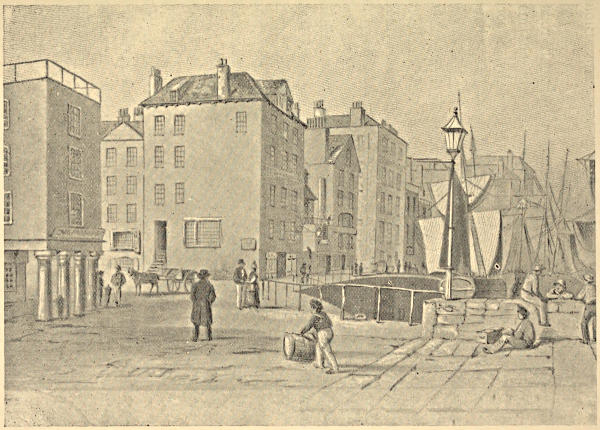
“Town Harbour, from an old picture.”
As might be expected, fortune-telling forms no small part of the white-witch’s profession, although all do not practise it, and some confine themselves to this particular branch alone. Cards seem to be now the principal means used for prying into the secrets of futurity, but other appliances have been used, and may, perhaps, still be used by some, such as the detection of a thief by means of a Bible and key.
A sort of rhabdomancy, or divination by small rods, shuffled together with certain ceremonies and charms, and then thrown on the ground, was used by a sort of half-demented creature called Collas Roussé, about the end of the last century.
He is said to have had a good deal of shrewdness, to have been very quick at repartee, and to have had great facility in expressing himself in rhymed sentences. He appears to have believed that he was really in possession of supernatural knowledge, and as his assumption of extraordinary powers gained credence with the vulgar, he found it an easy task to make a profit of their credulity. It is reported of him that when brought to justice for some gross act of imposition, he had the audacity to threaten his judges with the effects of his vengeance. His threats, however, did not deter the magistrates from sentencing him to exposure in the cage on a market day, with his divining apparatus by his side. He bore his punishment bravely, and entertained the multitude who crowded to see him with rhyming remarks. Another species of rhabdomancy is the use of the divining rod, the efficacy of which is fully believed in, not only for the discovery of springs of water, but also for the revealing of the spot where treasure has been concealed; and, if the stories that are told are all to be depended upon, there is evidence sufficient to stagger the sturdiest unbeliever.
A country gentleman, now dead, whom nobody who knew him took for a conjurer, was particularly renowned for his skill in this art. Not only could he tell by means of the rod where a spring of water was to be found, and to what depth it would be necessary to dig before coming to it, but he could also discover in what part of a field or house money or plate had been hidden. In order, however, to perform this last feat, it is necessary that the rod should be previously touched with metal of the same kind as that to be sought for. It is only in the hands of some few favoured individuals that the rod works, and even then it does so in various degrees; with some, being violently agitated, with others, moving slowly, and sometimes imperceptibly. The art of holding the forked stick may be taught to anyone, but unless a natural aptitude exists, the rod remains inert in the grasp of the holder.
A portion of the confessions of some of the unfortunate victims who suffered at the stake in 1617, translated from the records preserved in the Register Office of the Royal Court of Guernsey, will be given as a specimen of the absurdities to which credence could be given in a superstitious age.[148]
It must not, however, be forgotten that the island did not stand alone in this belief. No part of Europe seems to have escaped the absurd dread of witchcraft, which, like a pestilence, spread from one nation to another, and from which even the most learned of the age, men of profound thought, did not escape. One curious fact may be noticed; the practices imputed to the accused, who were for the most part of the lowest and most ignorant classes of society, and to which in numberless instances they confessed, appear to have been nearly identical in all countries. The inference is that they must have been handed down from a very remote period, and that they were in use among the pretenders to magical arts and supernatural powers among our pagan ancestors; just as in the present day we find similar ideas and practices existing among savage tribes, and in semi-civilised countries where the light of Christianity has not yet penetrated. It is well known how difficult it is to wean a people from their primitive belief, and how prone they are to cling to it in secret. Is it not possible that some secret society may have existed for ages after the spread of the Gospel in which heathen practices may have been perpetuated?
“Sabot-Daim—a witch hornpipe.” (Idem.)
“They play, in neo-latin mythology, a very interesting part, even to-day some traces of which are to be found. Wizards and witches, according to the councils, disguised themselves formerly as ‘cahouets’ and ‘cahouettes.’ Raphaël, Archbishop of Nicosie, capital of the island of Cyprus, in the year 1251, excommunicated all the ‘cahouets’ and the ‘cahouettes’ as well as those who supported and encouraged games of chance.—(Constitutions, ch. 15). And the Council of Nîmes, thirty years after, treats in the same manner witches and sooth sayers, ‘coavets’ and ‘coavettes.’
“In the hierarchy of Mithras, that type of the rising sun which bewitched the Gauls, the deacon, or minister was entitled ‘corneille’ or rook; and on the first day of the year, according to Porphyry, the initiates disguised themselves severally as beasts and birds.”
Mr. Métivier ends by citing two authorities on ancient traditions concerning these birds.
“Le corbeau est consacré à Apollon, et il est son ministre (famulus), voilà pourquoi il possède la faculté de prédire.” Gérard Jean Voss, liv. 3, sur l’Idolâtrie.
“Je crois que ces cérémonies se célébraient près de Coptos, ville dont le nom était si fameux, et d’où vient l’Egypte. Dans les environs de cette cité, on voyait deux corbeaux, c’étaient les seuls.… Et il y avait là l’image d’Apollon, auquel les corbeaux étaient consacrés.”
“La corneille est le symbole de l’amour conjugal.” Nicolas Caussin, Jésuite, natif de Troyes, Notes sur Horapollo. Paris, 1618, p. 165.
Trials for Witchcraft, and Confessions of Witches.
Editor’s Note.—The documents which follow are translated from the Records of the Royal Court preserved at the Greffe. Sir Edgar MacCulloch had copied out the depositions of the witnesses on loose sheets of paper, evidently meaning to incorporate them into his book. The “Confession of the Witches” in his MS. follows his essay on Witchcraft.
15th May, 1581.
Katherine Eustace and her daughter were accused by common consent of practising the art of witchcraft in the island.
The wife of Collas Cousin deposed that having refused to give milk to the accused, saying that there were poorer people to whom she would rather give, her cow then gave blood instead of milk.
Johan Le Roux deposed that having been seized with great pains in his knee, he believed himself to be bewitched by Katherine Eustace, so his wife went to the latter and threatened to denounce her to the Royal Court; after that he got better.
28th October, 1581.
Robert Asheley, found dead in the garden behind St. Peter Port parsonage, suspected of having committed suicide by shooting himself with an arquebus. This having been proved according to the law, the Court, after hearing the speech made by Her Majesty’s Procureur, found that the said Robert Asheley shall be carried to some unfrequented spot and there buried, a heap of stones being placed on his body,[149] and thus he shall be deprived of burial in the spot where Christian remains are placed; and that all his goods shall be confiscate to Her Majesty the Queen.
It has been conjectured that these heaps of stones were placed upon graves, more especially of criminals and suicides, to keep the spirit in the earth, and prevent the ghost from walking. Hence the modern gravestone.
25th February, 1583.
Collas de la Rue is accused of using the arts of witchcraft, and of grievously vexing and tormenting divers subjects of Her Majesty.
Matthieu Cauchez deposed that his wife being in a pining languorous condition, having heard that Collas de la Rue was a wizard, and knowing that he frequently visited his house, he asked him if he could help his wife. Collas replied:—
“As to her she is an ‘in pace’ (sic), she will not live much longer.”
De la Rue came to the place where his wife lay ill, and caused the bed to be reversed, putting the bolster at the foot; she died three hours afterwards.
James Blanche affirmed that having failed in a promise he had made to De la Rue, the latter swore he should repent. His wife soon afterwards became swollen all over, in which state she remained for some considerable time. He finally went to De la Rue, and consulted him as to how to cure his wife, and he gave him a decoction of herbs to be used as a drink, by which his wife was cured.
Thomas Behot deposed that on returning from fishing, he refused to give some fish to the son of Collas De la Rue. The son said he was a “false villain,” and complained to his father, who on that said, “Tais-toy, il n’en peschera plus guères.” (“Be quiet, he will not catch many more.”) That same day he was taken ill, and became so swollen that he could not rest between his sheets—(en ses draps). After having been ill for a long time, his wife unsewed his mattress and found therein several sorts of grains, such as broom, “alisandre” “nocillons” or “nerillons de fèves,” (black beans?), the treadles of sheep, pieces of laurel, rags with feathers stuck into them,[150] and several other things. His wife threw it all into the fire, and such an awful smell arose from the flames that they were obliged to leave the room, and immediately his swelling disappeared. The same day he was taken with such violent pains that he thought his last hour was come. Whereupon his wife put the key of their front door in the fire, and, as soon as it began to get red hot, Collas de la Rue, who had not been invited, and who had not put foot inside their house for six years, arrived there before sunrise, and said that he would undertake to cure him, but that it would be a lengthy operation, that he would have to refer to a book that he had at home, by which he had cured several people, Matthieu Cauchez among others, and that also he (the witness) would be cured. So Collas made him some poultices of herbs, but they did not cure him. With great difficulty he dragged himself to St. Martin’s Church (au temple de St. Martin), where De la Rue said to him:—
“I am glad to see you here, and yet not entirely glad, for you are not yet cured.”
When the deponent replied that he soon hoped to be on the sea again, De la Rue replied:
“Do not go, for you will not return without great danger.” (“N’y vas pas, car à grand’ peine en reviendras tu.”)
However, he persisted in going, and encountered such bad weather that he and all the crew were nearly drowned. And returning very ill, and his malady continuing, his wife again unsewed his mattress and there found an image made of a bone-like substance and apparently all gnawed, (d’une manière d’os tout rongé) which he took to the magistrates, and afterwards got better.
Collas De la Rue also told him that Collas Rouget had gone to Normandy to seek a cure. Had he only consulted him first, he need not have gone so far to be cured. In conclusion he said that on his conscience he believed and affirmed the said De la Rue to be a wizard.
Richard de Vauriouf deposed that having had several differences with Collas De la Rue on the subject of his cattle, which had caused him annoyance, De la Rue said to him:
“You are very strong and active, but before long you will not be thus, and you will be humbled after another manner.” (“Tu es bien robuste et fort, mais avant qu’il soit guères ce ne sera pas ainsy, et tu seras autrement abaissé.”)
Very soon afterwards the said Vauriouf was taken ill, and so was one of his daughters, and he was weak and languishing for more than a month.
Pierre Tardif, who had had some law-suits with Collas De la Rue, deposed that thereupon his daughter was taken ill, and her mattress being searched they found several … (here and in various places the record is torn) … of several kinds, and being … made principally of a coloured silken thread and of … of broom, of beans cut up, two of them being black … a pin stuck in a piece of rag and … After having taken advice he (Tardif) had thrashed De la Rue … after having given him two knock-down blows, his daughter was all right again. After which she was again taken ill, so he searched for De la Rue, and, having found him, he again thrashed him, this time drawing blood, and shortly after that his daughter was cured. In conclusion he also deposed upon oath his belief that De la Rue was a wizard.
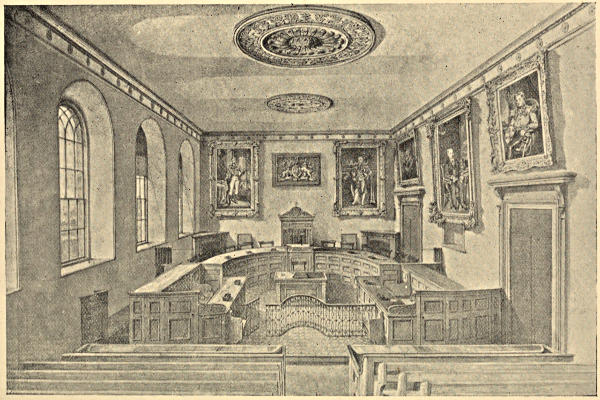
“Royal Court House in 1880.”
… deposed as to having heard Collas De la Rue say that he had means to silence those who spoke ill of him (“qu’il avait des moyens de faire taire ceux qui parloient mal de luy.”)
(The record is here again torn, and the trial apparently did not conclude, but in 1585 the proceedings against Collas De la Rue were recommenced and many of the same witnesses appeared).
The Trial of Collas de la Rue resumed. 17th December, 1585.
Collas Hugues appeared in person and showed his child to us in the Court. This said child cannot talk except at random and with an impediment in its speech that none can cure; and he declares his conviction that his said child is “detained” (detenu) by some wizard, and he will take his oath that it is Collas De la Rue who “detains” him, inasmuch that the latter threatened him that he would afflict him through his most precious treasure (du plus cher joyau qu’il peut avoir). On this declaration, Her Majesty’s Procureur testified to us that the said De la Rue had formerly been imprisoned for sorcery, and now, that though he had not always been proved guilty, yet that to all outward appearance he had practised the art of witchcraft, and so much so, that new complaints being made against him, he had demanded the arrest and the confiscation of the goods of the said De la Rue, which was granted.
On the 25th of December an investigation was ordered.
December, 1585.
James Blanche affirms that on a certain day, having promised to go for a day’s work to the aforesaid De la Rue, and not having done so, that he was heard to say to one of his people, that he, Blanche, should repent, and that soon afterwards his wife was seized with an illness which lasted for nearly a year. So that, finding the said De la Rue near “La Croix Guerin,”[151] he asked him if he could give him something to cure his wife. Then the said De la Rue took an apple, which he broke into six parts, of which he retained one, and gave the remaining five pieces to the said Blanche to carry back to his wife, forbidding him at the same time to eat a mouthful. Notwithstanding, when he quitted De la Rue, he ate the said apple, and at that moment the said De la Rue appeared before him, he having not yet reached his own house, and taxed him with having eaten the forbidden apple, and the same day his wife was cured. He, Blanche, says that this is a man given to threats, and is much suspected and generally denounced as being a wizard, and he has even heard that people have called him “sorcier” to his face and he has not resented it.
December, 1585.
Jehennet des Perques deposed that at divers times the said Collas De la Rue went to the fishermen and foretold to them when they should have fine weather and when they should have storms.… He was commonly reported to be a wizard. He also deposed that on a certain day, he being at the house of Collas Henry, where the said De la Rue had quarrelled with the wife of Collas de Bertran, who had called him “sorcier” (wizard), he threatened her that she should repent, and that the said Mrs. de Bertran fell in descending the stairs (cheut aval les degrez) and bruised herself from head to foot.
Several witnesses depose that Collas De la Rue is a man much given to threats, that various persons have fallen ill after having been threatened by him, and that he cured them at his will.
He was sent back to prison.
It appears that Collas De la Rue was executed, for, in a lawsuit against Denis de Garis for concealing a treasure that he had found in his house, it is said that the aforesaid treasure was found on the day of Collas De la Rue’s execution, that is to say the 25th of March, 1585-6.
24th November, 1602.
Marie Roland is accused of sorcery.
John Sohier witnesses that the aforesaid Marie, having been with him one day at the house of the Henry’s, together with Joan Henry, whose child lay ill, she confessed to having bewitched the child, and on being asked in what manner, said that she had put its clothes one night by the stream (auprès du douit) and that she and her master the Devil then entered into the house of the said Henry by the chimney, and found the said child by the hearth, and with a splinter she pricked the child, and it was bewitched for three months.
10th April, 1613.
An inquest on the suspicions of witchcraft against Olivier Omont, Cecile Vaultier, his wife, and Guillemine Omont, their daughter.
Jacques Bailleul deposed that having refused alms to Olivier Omont his son was taken with a pain in his ear which lasted twenty-four hours, that the doctor said that he could not understand it (qu’il n’y connaissait rien), that he believes that Olivier is a wizard.
Guillemine Le Pastourell affirms that Omont came begging from her, and she said that he was stronger than her and that he could gain his bread if necessary without begging, that the next day she was taken ill, that she remained ill for three weeks, that Omont, having come again, gave her some bread, and after that she recovered. During her illness all her cattle died. She believed it was from some spell cast by the said Omont.
Marie Sohier witnesses that the day after the death of her husband Olivier Omont came to her house demanding bread. She replied that having numerous children to feed she could not spare him any, that he went away grumbling. At that very moment her daughter Marguerite, aged six years, was taken ill, and when they gave her some bread she threw it away and ate cinders by the handful. That her daughter Marie, one year old, was taken ill one hour after the departure of Omont, and she had remained ill for two years. That having met Omont at the Mont Durand she threatened to throw a stone at him, and called him “sorcier,” that on returning home she gave a lump of white bread to her child, who ate it all, and since then is quite well. She believes that the said Omont was the cause of the sickness of her children.
Philippin Le Goubey witnesses that Olivier Omont having begged for cider from his wife, she refused him, and was instantly afflicted with grievous pains; that he entreated the said Omont several times to come into his house to see his wife, but that he always refused; that one day he forced him to enter, and he put one foot in the house and the other out, and then he fled; that rushing after him he threatened to denounce him to justice if he would not cure his wife; that then he said that she would be well again in a fortnight, but that he could not cure her at that moment; that he forced him to return to the house, and that, when there, he threatened to keep him there until he was delivered up to justice; that at that very moment his wife was cured of the worst of her pains; that having shortly afterwards come into the town to make a notification of these things, he found that the said Omont had already taken a boat and fled from the country.
Pierre Simon, of Torteval, being at the Hougue Antan,[152] met Olivier Omont lying with his face against the ground. He tried to awake him, shook him, and heard a buzzing (un bourdonnement) but saw nothing. Feeling rather frightened he left him and went on towards the Buttes[153] of Torteval, and then came back to the place where he had left him. Omont suddenly awoke, having his mouth full of mud, and his face all disfigured (défiguré). Omont having been questioned replied that he had fallen from the cliff, and that Pierre Nant had seen him fall.
Several people witnessed that having refused alms to Omont and to his wife, their cattle fell ill and died, their cows gave blood instead of milk, or gave nothing at all, their sows and their cows miscarried, and misfortunes happened to their wives.
29th June, 1613.
Thomas Mancell witnessed that his wife having refused alms to Omont, their cow fell ill, and they were obliged to kill it. Jean Hamon, who flayed the cow, cut it at the shoulder, and “there issued a black beast as large as a little ‘cabot’ (a small fish). Its throat was such that one could easily insert the tip of one’s little finger, and it had two little wings” (“en sortit une beste noire, grosse comme un petit cabot, dans la gueule duquell on aurait bien mis le bout du petit doigt et avait deulx petites ailes.”)
Jean Le Feyvre, of the Mielles,[154] witnesseth that one morning he found Cécile, wife of Omont, near the Chapelle de l’Epine, where she was searching, he could not tell for what, and where she remained for a long while without his being able to perceive that she found anything, and she did not perceive that he was watching her; and he having asked her shortly afterwards whether it was she that he had observed at such an hour near the chapel, she denied it, and that afterwards he asked her again whether it was she who was in that neighbourhood, and she replied in the affirmative, and then he started fine rumours, (ung beau bruit) saying that she was dancing on the thorn which grows in the aforesaid neighbourhood.
29th May, 1613.
Thomasse, wife of Collas Troussey, deposes that one night, her husband being on guard at the Castle, she was awakened by a frightful noise, like cats squalling, and she dared not cry out on account of Olivier Omont, who was sleeping in the same corridor as herself, though the miauling of the cats still continued. When her husband was returned from his patrol, she dared ask Omont if he had not heard the cats, to which he replied Yes, but there was nothing for her to be afraid of, that they would do her no harm. That another night, her husband being also there, she had heard Omont call “Cats! cats!” and on asking him if he had cats in his wallet (en son bisac,) he replied “No,” and that the noise seemed beneath where she lay, but that he was afraid that they would eat the fish that was on the table.
Olivier Omont, his wife and daughter, were all banished from the island.
30th June, 1613.
An enquiry was held on Laurence L’Eustace, wife of Thomas Le Comte, suspected of being a witch.
Jean Hallouvris witnesses that for four years he has driven his cart. As the wheels passed close to Laurence she dropped several strings and twists of rushes (quelques colliers et nattes de pavie)[155] that she was carrying, at which she was very angry. Two days afterwards, one of his bullocks set off running as if it were mad, and then fell down stone dead, and the other bullock died the next day.
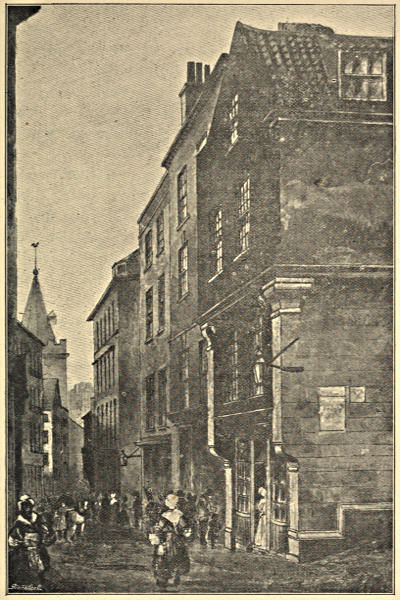
“High Street, 1850.”
Sketched from an Old Picture by the late Mr. A. C. Andros.
Pierre Machon deposes that he has heard Laurence swear “By God’s ten fingers” (“Par les dix doigts de Dieu”), and with oaths and blasphemies call devils to her assistance.
Christine, wife of Pierre Jehan, says that her first husband, Collas Henry, having had a quarrel with Laurence Le Comte, one of their children, aged two years, was taken with an illness which lasted for twelve months. When the attack first came on, he jumped high into the air, that, before being taken ill he walked very well, but that afterwards, all that year he crawled on his hands and knees. That, having had a quarrel with the said Laurence, and having put some curds to cool, (des caillebottes à refroidir), she found them the next day just like bits of rag (que de la mêque), and that on the following Monday the child was seized with terror, and cried out that someone was pulling his nose. That, as soon as she went to Laurence’s house, the child got better, but, on her return, fell ill again, and finally died.
Laurence L’Eustache, wife of Thomas Le Comte, was also banished from the island.
On the 17th of May, 1617, began the trial of Collette du Mont, widow of Jean Becquet, Marie, her daughter, wife of Pierre Massy, and Isebel Becquet, wife of Jean Le Moygne.
James Gallienne witnesses that one day, having quarrelled with Jean Le Moigne, husband of the aforesaid Isebell, the said Le Moigne said to him:—
“You are always seeking to pick quarrels with me, and you say that my wife is a witch, but before six months are over you will be very glad to come and implore me to help you;” that immediately his wife fell into a lingering illness, and, doubting not but that it was the effect of a spell, opened all the mattresses and found all kinds of filth and bits of feather, which he has showed to several people; and in some quite new pillows which he had at home he found a large quantity of worms. He says that about six years ago, one of his children being ill, he was putting a pillow under his head, found it hard, and, on unripping it, found it full of dirt. While they unsewed it they heard a flapping noise as of the wings of a cock, and the said child declared that he saw this cock; that, having shut all the doors, they tried to find what it really was, and that, having hunted and ransacked the house, they saw first a rat, then a weasel, which slipped through the holes of the pavement (sortit par les pertius de la dalle). And at the end of two or three days he was asked why he had beaten the said Isebell Becquet. He replied that he had not touched her, and soon after that he was advised to try whether she was a witch, by putting the key of his front door (de son grand huis) in the fire, which he did. When the said key had been nearly two days in the fire the said woman arrived at his house, without asking whether he were at home, and begged of him seven to nine (sept à neuf) things which he refused her, she wishing at all hazards to come in further (entrer plus outre) to see the sick child, which he would not allow.
Item. Deposeth that his wife having rebuked the said Isebell because her children annoyed those of the said Gallienne, she went away very vexed, and the next day one of his oxen broke its neck, his mare miscarried, and his wife was taken ill.
Item; that the children of the said Isebell said one day to the children of the said Gallienne, that if their mother was ill it was because she had spoken rudely; that some time afterwards, Mrs. Gallienne being in bed in her room, the door being shut and simply a sky-light (une luquerne sic, lucarne) open, she felt something like a cat, which, little by little, crept on her chest as she lay on her bed. Having shaken it to the ground, she heard one or two growls, on which, astonished, she began to threaten it that if it was a wizard or a witch she would cut it to pieces (que le couperoit en pièces), it returned by the said sky-light.
Thomas Sohier said that Jean Jehan having summoned him to come and make his will, he complained that the said Isebell was killing him for having refused to make a jacket for her son. That some little time afterwards James Gallienne, having a sick daughter, caused her bed to be unripped, out of which came a sort of animal like a rat (une manière de bête comme un rat), which hid itself in some wood and was hunted for throughout the house; that on the following day, having met the said Isebell, he noticed her face all torn (déchiré sic). On asking her the cause she said it was from “du mal d’Espagne,” (cantharides, the Spanish fly used for making blisters); that on that he asked James Gallienne if he had not beaten her, who replied in the negative; that, being the other day at the house of the said Gallienne, giving evidence to this, his wife fell down as if dead, and on returning to consciousness, said that she was bewitched.
Item. Testifies that in the bed of the aforesaid daughter (of Gallienne), were found twenty-one or twenty-two spells (sorcerons).[156]
Many other depositions told the same story. Oxen and calves died, cows and mares miscarried, sheep fell dead, children and women were taken ill, no cream was found on the milk, curds would not “make,” cows dried up, or only gave blood. Worms were bred in the beds, or even under the women’s caps. They were black at both ends, or sometimes had two heads. Frogs and black beasts (des bêtes noires) haunted the paths of the bewitched persons. Fountains were full of insects, black pimples appeared all over the bodies of the afflicted persons, and lice, in such abundance that they had to use a broom to sweep them away. On the witch being threatened the sick person recovered.
The trial was resumed on the 6th June, 1617.
Marie, wife of James Gallienne … deposed … Item; that for nearly ten years her eldest daughter Rachel had been bewitched; that, having unsewed her mattress, by which was some straw,[157] something was seen lurking in the said straw, and Jean Le Gallez, being present, said that it looked to him like a black cat, and sometimes like a cock, and then like a mouse, and then like a rat, that it—whatever it was—hid in some wood which was in the house, which was immediately rummaged and moved, but no one knew how to capture it (ne sçurent tant faire que de le prendre). That her husband saw it like a cock, and her daughter like a mouse; that on opening the mattress they found within it many spells (force sorcerons) and also beans with which were mingled black grains as if mildewed,[158] which beans or grains having been put in a porringer (une écuelle) in the presence of various women who were there, it dissolved in their presence, and they did not know what became of it (cela fondit en leur presence et ne sçurent que devint.) That the said Isabell, having come to the house at the end of two or three days, and asking for seven or nine sorts of things, and trying to force an entrance into the place where the child was lying ill, all which things were refused her by her husband, so she then went away, and her face was all cut; and went to her husband and said that she would not stay while Isebell Becquet was there, and she believes that she is a witch.
On the 4th of July, 1617, these three women, Collette Dumont, widow of Jean Becquet, Marie, her daughter, wife of Pierre Massy, and Isebell Becquet, wife of Jean le Moigne, were convicted by the Royal Court of Guernsey of having practised the damnable art of sorcery, and of having thereby caused the death of many persons, destroyed and injured much cattle, and done many other evil deeds. They were condemned to be tied to a stake, strangled, and burnt until their bodies were totally consumed; and their ashes to be scattered abroad. The sentence added that, previous to execution, they were to be put to the torture[159] in order to force them to declare the names of their accomplices.
First, the said Collette, immediately after the said sentence had been rendered, and before leaving the Court, freely acknowledged that she was a witch, but would not particularise the crimes which she had committed; whereupon she was conducted with the others to the torture-house, and, being put to the question, confessed that the Devil, when she was still young, appeared to her in the form of a cat,[160] in the parish of Torteval, it being yet day, as she was returning from tending her cattle; that he prevailed upon her by inviting her to revenge herself on one of her neighbours with whom she was on bad terms in consequence of some injury done to her by his cattle; that on subsequent occasions, when she had quarrelled with anyone, he again appeared to her in the same form, and sometimes in that of a dog, inducing her to revenge herself against those with whom she was displeased, and persuading her to cause the death of men and beasts; that the Devil having come to invite her to the Sabbath, called her, without its being perceived by others, and gave her a certain black ointment,[161] with which, having stripped, she rubbed her body nearly all over, and, having dressed herself again and gone out of doors, she was immediately carried through the air with great velocity to the place where the Sabbath was held, which was sometimes near the Torteval parish churchyard, and sometimes on the sea-shore near Rocquaine Castle; that, being arrived there, she met frequently as many as fifteen or sixteen wizards and witches, with devils, who were there in the form of dogs, cats, and hares; that she could not recognise the wizards and witches, because they were all blackened and disfigured, although she heard the Devil evoke them by name, and remembers among others, the wives Calais and Hardy. She confesses also that at the opening of the Sabbath, the Devil, in making the evocation, began sometimes by her name; that her daughter Marie, wife of Massy, at present under condemnation for the same crime, is a witch, and that she has taken her twice to the Sabbath with her. She does not know where the Devil has marked her. She says that at the Sabbath they adored the Devil, who stood upon his hind legs … in the form of a dog, that afterwards they danced back to back, and after having danced they drank wine, but of what colour she does not know, which the Devil poured out of a flagon into a silver or pewter goblet; but that the wine did not seem so good as that which is usually drunk, that they also ate white bread, which the Devil presented to them, but that she has never seen any salt[162] at the Sabbath.
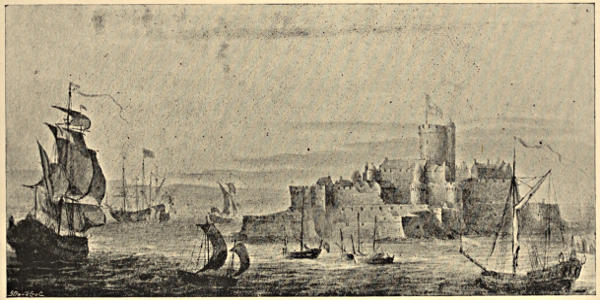
“Castle Cornet, 1660.”
She confesses that the Devil had charged her to call in on her way for Isebell Le Moigne, when she went to the Sabbath, and that she has done so several times; that on leaving the Sabbath the Devil invited her to perpetrate many evils, and that, for this purpose he gave her certain black powders, which he ordered her to throw on such persons and beasts as she pleased; and that with this powder she did much evil, which she cannot now call to mind, but she remembers that she threw some over Mr. Dolbel, the minister of the parish, and by this means was the cause of his death. With the same powder she bewitched the wife of Jean Manguès, but denies that her death was caused by it. She says that she touched the side, and threw some of this powder on the wife,[163] since deceased, of Mr. Perchard, who succeeded Mr. Dolbel as minister of the parish, thereby causing her death and that of her unborn babe. She cannot say what offence the deceased had given her. She says that on the refusal of Collas Tostevin’s wife to give her some milk, she caused her cow to run dry by throwing some of the powder over it, but that she cured the cow afterwards by giving it bran mixed with grass, which the Devil had given her, to eat.
The confession of her daughter Marie, wife of Pierre Massy, is much to the same effect, with this exception, that she seems to have been in the habit of meeting the Devil in the form of a dog, and that he changed her into an animal of the same species at the time of their interviews.
The third of these unfortunate wretches, Isebell, wife of Jean Le Moigne, enters, in her confession, into some additional details.
It was in the semblance of a hare, and in broad daylight, that the Devil appeared to her for the first time, and incited her to avenge herself on her sister-in-law, La Girarde, with whom she had quarrelled. At first she resisted the tempter, but he appeared to her a second time, again in the road next her house, and on this occasion left with her a packet of black powder, which she kept. A third time the demon appeared, in the same form, urging her, if she would not give herself to him, to make him a present of some living animal, whereupon she gave him a chicken, and he appointed her to meet him the next day before sunrise at the Sabbath, promising to send someone to guide her there. Accordingly old Collette Dumont came that night to her house, and gave her some black ointment, with which she rubbed herself. She was then carried over hedges and ditches to the place of meeting near Rocquaine Castle. She was received and welcomed by the Devil in the form of a dog, with long erect horns (avec de grandes cornes dressées en hautt), and hands like those of a man. He caused her to go down on her knees and renounce the Almighty in these words: “I deny God the Father, God the Son, and God the Holy Ghost.” (“Je renie Dieu le Père, Dieu le Fils, et Dieu le Saint Esprit”). After this, she was made to adore the Devil and invoke him in these terms: “Our great Master, help us!” (“Nostre grand Maistre, aide nous!”) and also to enter into an express covenant to adhere to his service. At the conclusion of this ceremony, the same acts of license, dancing and drinking (again bread and wine in mockery of the Holy Sacrament), took place as are described by Collette Dumont, widow Becquet, in her confession. On this occasion Isebell Le Moigne entered into a pact with Satan for one month only; but subsequently the agreement was extended to three years. She stated that Satan treated Collette Dumont with marked respect, always evoking her name first, styling her “Madame, la vieille Becquette,” and giving her a place by his side. She also said that one night, when she was at the Sabbath, the Devil marked her on the thigh. The mark thus made having been examined by women appointed for that purpose, they certified that they had thrust pins deep into it, and that Isebell felt no pain therefrom, nor did any blood follow when the pins were withdrawn.
According to her account, the Devil appeared occasionally in the form of a he-goat, and when they took leave of him, they all had to kiss him, that he inquired of them when they would return, and exhorted them to adhere to him and do all the evil in their power. He then took them all by the hand and they departed in different directions. She asserted also that it was the Devil who had been seen in the forms of a rat and a stoat in the house of James Gallienne, whose child she had bewitched; that she was in the neighbourhood of the house at the time; and that the Devil, having resumed the form of a man, came to her and beat her severely about the head and face, which ill-treatment she attributed to her having refused to go with him to Gallienne’s house. She said that she never went to the Sabbath except when her husband was gone out to sea for the night, fishing.
The depositions of the witnesses, taken down very minutely in the three cases above cited and in many others of a similar nature, have been preserved, and throw a good deal of light on the popular ideas of the day in respect to sorcerers and their doings.
Mr. J. Linwood Pitts, in his pamphlet on Witchcraft in the Channel Islands, points out, page 6, “that the natural tendency of wool and feathers to felt and clog together, has been distorted, by widely different peoples, into an outward and visible sign that occult and malignant influences were at work.”
“By the law approved (Terrien, Lib. XII, Cap. 37), torture is to be used, though not upon slight presumption, yet where the presumptive proof is strong, and much more when the proof is positive, and there wants only the confession of the party accused. Yet this practice of torturing does not appear to have been used in the Island for some ages, except in the case of witches, when it was too frequently applied, near a century since. The custom then was, when any person was supposed guilty of sorcery or witchcraft, they carried them to a place in the town called La Tour Beauregard, and there, tying their hands behind them by the two thumbs, drew them to a certain height, with an engine made for that purpose, by which means sometimes their shoulders were turned round, and sometimes their thumbs torn off; but this fancy of witches has for some years been laid aside.”
Wizards and Witches.
There are some families in Guernsey whose members have the reputation of being sorcerers from their birth. These individuals require no initiation into the diabolic mysteries of the “Sabbat,” Satan claiming them as his own from the very cradle. They are, however, furnished by him with a familiar, generally in the shape of a fly, so that the phrase “avoir une mouque” is well understood as meaning that the person of whom it is said is one of the infernal fraternity. Indeed, in talking of persons who are addicted to magical arts, it is reckoned highly imprudent to speak of them as “sorciers” or “sorcières,” or to call them by the now almost-forgotten name of “Quéraud.”[164] By so doing you give offence, and, what is of still more consequence, you put it in their power to injure you. It is, however, quite safe to speak of them as “gens du Vendredi,”[165] or “gens du hoc.”[166]
Satan does not always wait for their death to claim their souls as his own, but sometimes carries them off bodily; and a former schoolmaster of the Vale, who, from his eccentricities, had acquired the reputation of being a wizard, having disappeared mysteriously, and having never been seen again, is commonly believed, to this day, to have been spirited away.
Those who are born sorcerers have the faculty of transporting themselves at will wherever they please, but those who seek admission into the fraternity, and are initiated into the diabolical rites, are furnished by their infernal master with a certain ointment with which they anoint every part of their bodies before undertaking their aerial journeys. They are also supposed to be able to introduce themselves at night through the chinks and crevices of the buildings into the sheds in which the cattle are housed, for the purpose of milking the cows, not only thus depriving the owner of his property, but also worrying and alarming the poor animals, whose altered looks in the morning shew the ill-treatment to which they have been subjected. An old horse-shoe nailed on the door or lintel, or a naturally pierced flintstone pebble attached to the key of the stable door, are both considered efficacious in warding off these attacks—but an infallible method of driving off the witches is to suspend wreaths of the bramble from the rafters. Witches and wizards travelling, not on land, but through the air, finding these unexpected obstacles in their way, get scratched.[167]
After having rubbed themselves over with this ointment they are then instructed to pronounce without intermission the words “Roule, roule, par dessus ronces et buissons.” (“Roll, roll, above brambles and brakes”).
This was discovered in the following manner:—A prying valet, who lived in the service of a gentleman who was a wizard, of which fact he was nevertheless ignorant, was one day amusing himself by peeping through the key-hole of his master’s bed chamber. He observed his master make use of the ointment, and heard distinctly the words which he pronounced, immediately after which he became invisible. Wishing to try the effect of the unguent on his own person, he entered the room, and went through the process of anointment, but when he came to pronounce the magic formula, he made use of the word “dessous” instead of “dessus” (“under” instead of “over.”) Perhaps he was an Englishman, to whom the French “u” was an insurmountable difficulty. Be this as it may, he had reason to repent bitterly of his indiscreet curiosity, for, no sooner were the words out of his mouth, than he felt himself lifted up, and carried at a fearful rate through furze brakes and bramble hedges, while at the same time he had the mortification to see his master gliding along through the air, several feet above the bushes, and laughing heartily at his misfortunes. At last, dreadfully scratched and torn, and more dead than alive, he arrived at the spot where the infernal troops had their rendezvous, but was too much frightened to notice what took place there, only too happy to escape without being forced, against his will, to enrol himself among them. His curiosity, however, was effectually cured, and he vowed nevermore to pry into his master’s secrets.[168]
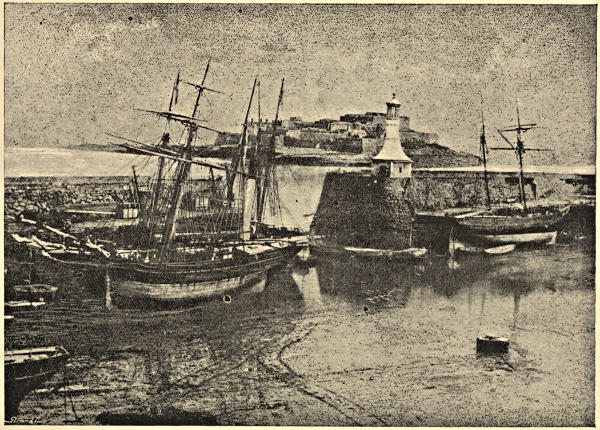
“Old Harbour.”
The following is another instance of the use of this infernal ointment. It is related that a lady of St. Pierre-du-Bois was astonished at the long time her husband remained in his private apartment, and her curiosity at last induced her to watch him. Accordingly she one day concealed herself in the room. Her husband came in shortly afterwards, and, after stripping off all his clothes, proceeded to anoint himself from head to foot with a certain ointment, after which he repeated the words “va et vient” (“go and come”), and immediately disappeared. Anxious to know whither he was gone, she went through the same ceremony, and no sooner had she repeated the mysterious words than she found herself on the summit of Pleinmont, in the midst of a large concourse of people. A table was set out, covered with a variety of viands of which some present invited her courteously to partake. Previously, however, to touching anything, she, like a good Christian, repeated aloud the words “Au nom de Dieu soit, Amen,” (“In the name of God, Amen”). No sooner had the sacred name passed her lips than she found herself alone. All had disappeared, and the only signs which remained of any living beings having been on the spot besides herself were recent marks of cloven feet indented on the sward in every direction.
The Aerial Journey.
There is a story told of two men who were neighbours and inhabitants of the parish of St. Saviour’s, that their occupation—that of quarrymen—took them frequently to the Vale parish, where the finest qualities of granite are to be procured. The distance they had to traverse before arriving at their destination was considerable, and the road in some places, rather lonely.
Leonard Sarre, who was of a companionable nature, thought that the tediousness of the way would be considerably lessened by having someone to talk to, even if it were only his fellow workman, Matthew Tostevin, whose taciturnity and reserve were proverbial. Often, when setting off in the early morning to go to his work, he would, as he passed Tostevin’s door, look in and offer his company. The answer was invariably the same:—
“Go on, I shall be there as soon as you, though I shall not leave home for an hour to come.”
When Sarre arrived at the quarry where they worked he was frequently astounded at finding Tostevin already there. The way which Sarre took was the very shortest and most direct. He was confident that Tostevin could not pass without his perceiving him, and any other road would entail at least half-an-hour’s extra walking to accomplish. There was evidently a mystery, and Leonard was resolved to fathom it.
At last, in answer to his repeated enquiries, Matthew told him that he was willing to let him into the secret. He bade him place his foot on one of his, clasp him tightly round the waist, shut his eyes closely, and, above all, on no account whatever, to utter a word.
Leonard Sarre did as he was directed, and immediately felt himself lifted into the air and carried along at a fearful rate. In his fright he forgot the injunctions that had been given him, opened his eyes, and, finding himself far above the earth, cried out in terror “O, mon Dieu!” The holy name dissolved the unhallowed spell, at least so far as poor Leonard was concerned. He fell; fortunately it was into one of the most boggy spots of La Grand’ Mare, so he escaped with a few scratches and bruises, a thorough ducking, and a tremendous fright. What became of Matthew Tostevin is not known.
It was not until many years had rolled over his head that Leonard Sarre ventured to relate his perilous adventure, and then Tostevin had long been dead.[169]
The Countrywoman and the Witch.
The barren and rugged hill of Catiauroc, situated near the sea-shore in the parish of St. Saviour’s, is the noted and favourite haunt of wizards and witches. Once every week on the Friday night they resort thither, and grand assemblies, at which their infernal master presides in person, are held at other seasons, particularly on St. Thomas’, or the longest night, and on the eve of Christmas.
Though the power of sorcerers in doing harm is very great, yet they themselves are subject to all the accidents and infirmities of life, nor can their supernatural skill extricate them from any difficulty they may chance to get into.
A countrywoman left her cottage one morning at daybreak to look after her cows. In passing through a furze brake that led to the meadow she thought she perceived, by the yet imperfect light, what appeared to her a bundle of clothes thrown on the top of a hedge. On approaching nearer she was astonished to recognise a lady from the town, whose dress was so entangled in the brambles that it was impossible for her to extricate herself, or to descend from her elevated situation, and who was so exhausted that she had scarcely sufficient strength left to beg for assistance. It immediately occurred to her, that the lady in her aërial journey to the Catiauroc that night had kept too close to the earth, and thus had been caught by the bushes, but, remembering that there are some persons with whom it is better to be friends than enemies, she immediately drew near and assisted the lady to descend, at the same time expressing her surprise at seeing her in such a singular position, and begging her to walk into her cottage and rest herself.
“No,” said the lady, thanking her, “I must now make the best of my way home. Mention to no living creature what you have seen this day, and all will go well with you, but bitterly will you repent your folly if you disobey this injunction.”
She then left the countrywoman. It is not easy for a man to keep a secret from his wife, but it is almost impossible for a woman to conceal anything from her husband.
The secret weighed on the poor woman’s heart and rendered her miserable, till at last she flattered herself she had discovered an expedient by which she might ease her mind without disobeying the commands put upon her. She therefore one morning desired her husband to follow her into the garden and stand at some little distance from her. She then addressed herself to a tree, and related to this inanimate object what she had seen, but the secret of course reached, as was intended, the ears of her husband. The subterfuge availed her nothing; before the close of day she was struck with deafness, and never, to her dying day, did she recover her hearing.
The old woman of the Castel, who related this story to Miss Lane, said that the woman was her great-aunt, and remembered having seen her when very young.
Stories very similar in their general features to the preceding are far from uncommon in the country, and in all the sorceress is represented as a lady of rank.
A countryman met a lady entangled in the brambles on the top of a hedge. He disengaged her, and was promised that as long as he kept the secret he should find every morning, under a stone which she pointed out to him, a piece of money.[170]
Magic Books.
“O Faustus, lay that damnèd book aside And gaze not on it, lest it tempt thy soul, And heap God’s heavy wrath upon thy head! Read, read the Scriptures:—that is blasphemy.” —Tragical History of Doctor Faustus, by Christopher Marlowe.
Many persons, although not absolutely considered as wizards, are looked upon with no favourable eye from their supposed possession of books relating to the black art, by the study of which they are thought to be able to control the elements, to produce strange effects either for good or bad on the bodies of man and beast, to discover hidden secrets, treasure, etc.
These books are generally known by the name of Albins, probably derived from that famous professor of magic, Albertus Magnus, many of whose formulas for raising the Devil, etc., they are said to contain.
They are also called “Le Grammaille” or “Grand-Mêle,”[171] and a distinction is made between the Grand-Mêle and the Petit-Mêle.
Among the effects which the possessors of these books are said to be able to produce is that of causing persons to walk in their sleep, and to direct their steps towards any point to which the dabbler in magic may wish them to go, but in order to accomplish this, it is necessary that he should have previously drawn blood from the person on whom he intends to practise his unlawful art. So small a quantity however as that produced by the scratch of a pin is amply sufficient for the purpose.
These books are said to be indestructible. If thrown on the fire they remain unconsumed, if sunk in the sea, or buried in the earth, they will be found again the next day in the cupboard or chest from whence they were taken.[172]
Editor’s Notes.
Nowadays the people, in speaking of the “bad books” as they frequently term them, call them the “Grand Albert” and the “Petit Albert,” the former being undoubtedly derived from “Albertus Magnus.” The “Petit Albert” is an abridgment of the larger book, and is supposed to be comparatively harmless, and, with proper precautions, some say it may even be used by good Christians. The country people to this day believe these books to be imperishable, and many is the tale they tell of how they will neither drown, nor burn, and how in particular, one old wizard’s books at Saints’ Bay had to be buried, and part of the funeral service read over them, to keep them from reappearing on their accustomed shelf.
Our old nurse, Margaret Mauger, has often told me the story of the books belonging to an extremely clever old gentleman who owned an estate in the country. At his death, when his daughters came to divide his large library, they were horrified to find many “witch books” and atheistical books included in it. These they set aside to be burnt, and also a great many harmless but dull histories, biographies, and sermons, which they did not wish to keep, and made one huge bonfire. But (and it was one of the daughters who vouched for the truth of this story) the good books would not burn with the bad books! A frightful smell arose, and thick columns of black smoke, but none were consumed, and they all had to be re-sorted, and made into two separate piles,—the sheep and the goats—and then they all burnt readily enough.—From Margaret Mauger.
“In Denmark and some neighbouring countries it is believed that a strange and formidable book exists, by means of which you can raise or lay the Devil—called the Book of Cyprianus. The owner of it can neither sell, bury or burn it, and if he cannot get rid of it before his death he becomes the prey of the fiend.”—Demonology and Devil-Lore, by Moncure Conway, Vol. 2., p. 282.
The Prior of Lihou.
The small islet of Lihou lies on the western coast of Guernsey, from which it is separated by an arm of the sea. An ancient causeway, which is uncovered at half-tide, affords an easy access to the main-land, but it is dangerous to attempt the passage when the tide is flowing, for the coast is so flat that the water rises with great rapidity, and many accidents have occurred. A church, the ruins of which are still to be seen, existed here until the Reformation. It was dedicated to Notre Dame de la Roche, and was served by a prior, who was appointed by the Prior of St. Michel du Valle, a dependency of the great Abbey of Mont St. Michel-au-peril-de-la-Mer, in the Bay of Avranches. The isle is to this day looked upon with such veneration by the Norman and Breton sailors employed in the coasting trade, that they never pass it without saluting, by lowering their topmasts, and there is reason to believe that it was a favourite resort of pilgrims. A house belonging to a family of the name of Lenfestey, and situated at Les Adams, is said to have been, in former days, the residence of the priest who officiated at Lihou. A free-stone let into one of the exterior walls has a rough delineation of a church incised on it, which is said to represent the Priory Church of Lihou as it formerly existed.[173]
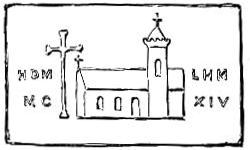
Stone supposed to represent the ancient Priory at Lihou.
A few years ago the remains of a skeleton were discovered in sinking a well on the property, to which a certain number of houses in the neighbourhood have a right of resorting for water. Many persons who have gone to draw water at night have heard groans, thrice repeated, as if from a person expiring, and these have generally been followed by the death of some near relation of the hearer. Three days after Mrs. Savidan heard the groans, a boat, in which were two of her relations named Le Cras, was capsized in a storm and both perished.[174]
Notwithstanding the sanctity of the place, however, the old proverb of “The nearer the church, the farther from God,” might at one time have been applied to it, for it is related of one of the priors that he was addicted to the black art. Neither the fear of God, nor the censures of the church, could wean him from the fascinating study of magic, and the Grand-Mêle was far oftener in his hands than the Bible or breviary. But wizards, it is well known, have often been the victims of their own art, and so it chanced with the profane Prior of Lihou.
One morning, taking advantage of the receding tide, he crossed over to Guernsey to seek an interview with another adept in necromancy, the priest of the neighbouring Chapel of Ste. Apolline. He was accompanied by his servant, to whom he had entrusted a ponderous tome, containing the formulas by which he performed his incantations, and to whom he had given strict orders on no account to open the volume or read a word which it contained.
The visit over, the prior prepared to return to his convent, and walked along leisurely, knowing as it was then spring tide that two or three hours must elapse before the returning waves could bar the passage to the islet. The servant lingered behind, and when he arrived on the beach found his master already half way over. His curiosity had been vividly excited by the repeated injunctions of his master that he should abstain carefully from opening the book. He began to think that it must contain something very wonderful, and that, as but few minutes must elapse before their arrival at the convent, when the mysterious volume would, without doubt, be instantly demanded by the prior, if he did not seize this opportunity of acquainting himself with its contents, no other occasion might ever present itself. He yielded to the temptation, opened the book, and began to read. The prior by this time had arrived at about the middle of the causeway, and was astonished to find the tide rising rapidly and threatening to cut off his further progress, either backwards or forwards. He felt that some unnatural agency was at work, and, guessing how matters stood, looked back to the shore which he had just left, and saw his faithless servant comfortably seated on a heap of dried sea-weed, with the fatal volume spread open on his knees. He was reading aloud, and the prior caught enough of the words to know that his attendant had hit upon the spell which causes the tides to rise out of their usual course, and, moreover, that he was reading most leisurely.
In great fright he called out to the man to read on quickly to the end, as he knew that then the waves would stop and return to their proper limits. The servant was too much absorbed in his reading to pay any attention to the directions given him, and the waves had by this time reached above the prior’s waist. In mortal agony he called out for the second time:—
“If thou canst not read forwards, read backwards!”
The roaring waves this time effectually drowned his voice. The servant read on, but long before he had arrived at the end of the incantation, the sea had covered the profane priest, and the demon whom the magic lines had evoked carried off his prey.[175]
“There is built into the wall of a house, on the Paysans Road, a sculptured stone, which corresponds so exactly with what might have been the Chapel of Lihou that I have, on the plan, restored the chapel on those lines. All the principal features work in exactly, the tower, the windows, the roof, etc.,—all except the door, of which there is positively no trace; but possibly, in view of the various coats of paint on the stone, it is merely a fancy of one of the many artists who have retouched it. Of the ruins which remain there is sufficient to show what its measurements once were. Of the tower, about twelve feet is still standing, a large portion of the north wall, and several smaller pieces; these all show that it consisted of a nave about thirty-four by twenty-three feet inside measurement, and a choir or sanctuary about thirty-four by twenty feet. There is enough of the north wall still standing to shew where the spring of the vaulting began, and thus, approximately, the height of the walls and roof. The corner of the chancel arch pier is a Caen stone, with a plain beading on it; there is also trace of a porphyry column on the south side of the sanctuary, and under the site of the altar is a paving of Malachite green and buff tiles, some of which still remain; they measure six and a quarter inches square and were laid alternately.”
The lettering has been explained as standing for “H … Dominus Lihou Mel,” “H … priest of Lihou Mel, (as Lihou was called in ancient times) in 1114.”
A Wizard on the West Coast.
We all know how dangerous it is to possess books which treat of the arts of magic and sorcery, or to tamper in any way with these forbidden practices.
It came to the ears of a former rector of St. Pierre-du-Bois or Torteval, that one of his parishioners, of the name of Sarre, not only owned such books, but was in the habit of reading and studying them. Indeed, if there was any truth in public rumour, many of Sarre’s neighbours had been sufferers from the improper use he made of the knowledge thus unlawfully acquired. The good rector thought it his duty to remonstrate with his parishioner, and to point out to him the sinfulness of his conduct, and the danger he was incurring of forfeiting both body and soul to the Prince of Darkness; but all his good advice was, for a long time, treated with contempt. At last, what the rector’s charitable remonstrances had been unable to effect was brought about by Sarre’s own fears. The presence of a large black cat, which followed him wherever he went, and was with him night and day, began to alarm him. It was useless to attempt to drive the beast away; it cared neither for threats nor blows. In short Sarre began to be seriously alarmed lest his assiduous study of the forbidden volumes should, at last, have brought, if not Satan, at least one of his familiars, to dog his steps continually, and to watch an opportunity of seizing on his prey.
Under these circumstances he thought it most prudent to get rid of the books, and, with this intent, went one night to the extreme verge of low-water mark at spring-tides, dug a hole in the sand, and buried the accursed volumes. The rising tide soon covered the spot, and Sarre returned home with his mind at ease. His feeling of security was not destined to be of long duration, for, on entering his door, he was met by the black cat, who, erecting his tail, and rubbing himself against his master’s legs, manifested his joy at seeing him again. The next object that his eyes rested on were the books he had just buried, carefully placed on their accustomed shelf, and as dry as if they had never left it. A profound melancholy seized him; he ceased to occupy himself in his usual avocations, and wandered about the cliffs and sea-shore in a disconsolate state, till, at last, he disappeared. Those who were charitably disposed, surmised that, in his despair, he had thrown himself over one of the lofty precipices of Pleinmont into the sea, but there were not wanting others who suggested that the master, into whose service he had entered, had at last claimed his own, and carried him off bodily.[176]
The Wizard’s Death.
A certain man of the name of Robin, who lived near Les Capelles, in the parish of St. Sampson’s, had risen from being a day labourer to be the possessor of what, in Guernsey, passes for a considerable landed estate. Riches are sure to create envy, and more particularly is this the case when a man has been prosperous in the world and has arrived at a rank and station to which he was not born. The poor hate him because he has acquired a title to consideration, which his origin, as humble as their own, can never confer. The rich pretend to despise him because he is wanting in the accidental circumstance of birth. All concur in attributing his success in life to luck, to want of honesty, to anything but intelligence, industry, and good conduct. It will not, therefore, be thought surprising if calumny was busy at work to blacken the character of one, who, like Robin, had been so fortunate in his undertakings. He was openly spoken of by his neighbours as being addicted to sorcery.
It was well known that he possessed the art of taming the most refractory bulls, and it therefore followed as a matter of course that he had also the power of bewitching other cattle. Sometimes, when a cow was sick, and all the usual nostrums of the village farrier had failed in effecting a cure, recourse was had, as a last resort, to Robin, who was generally successful. What conclusion was more natural, than that he, who could so easily remove a malady, had also the power of inflicting it? Besides, it was whispered about by some of those who contrive to be well informed of all that passes, even in the most secret recesses of their neighbours’ houses, that Robin would sit for hours together, shut up in his private room, with a pack of cards before him, with which he appeared to be playing some game. No adversary was seen, but what game can be played by one man alone? It was clear to the most obtuse that another was present, although invisible to mortal eye, and who could this be but the great enemy of human souls?
At last old age came on; Robin became more and more infirm, and was at last confined to his bed. During his illness his attendants were much annoyed by the continual creaking and cracking of an ancient oaken press, which stood in the corner of the room, and which he would not allow them on any account to open or meddle with. Of course they all thought that this chest contained untold gold, for he was known to be extremely avaricious—in fact he was one of those “who would cut a double[177] in two” as the saying is. He was frightfully hard on all his workmen, exacting every moment of their time. So far did he carry this, that it is said he only allowed them five minutes to take their noon-day meal, which, according to the universal custom at that time, was furnished by the employer, and eaten at his table. It was commonly believed that one source of his wealth was the discovery of a buried treasure in one of his fields. There was a well on his property which was intermittent, at times overflowing, and at others not having above an inch or so of water in it. It was supposed to conceal a treasure, and a man was sent down to examine it, but no sooner had he begun to bale out the water than it returned with such violence that he was obliged to be drawn up to avoid drowning. When Robin was dying, his son urged him to give something to the poor, but his constant answer was:—
“Je n’en counis pouïnt.” (“I do not know any.”)
His last hour was, however, rapidly approaching, and he desired the press to be opened, and certain books which it contained to be thrown on the hearth where a large fire was blazing. His orders were obeyed, but, to the great astonishment of the servants and attendants, instead of being consumed in the flames, the books extinguished the fire![178] Fresh faggots were, by the orders of the dying man, heaped on the hearth, and kindled, and, at last, the mysterious books, if not consumed, at least disappeared. The press had ceased to creak from the moment the books were taken out of it, and shortly afterwards Robin breathed his last.
A storm of unusual violence was raging at the time, but the most singular circumstance remains yet to be told. A crow of unusual size was seen to hover over the house, and finally alighted on the roof, and, it is said, that on the day of the funeral, as the corpse was leaving the house, it flew down and perched on the coffin. In vain did the bearers endeavour to drive it off; it held its ground, and even when the body was lowered into the grave it would not quit the station which it had chosen, but suffered itself to be covered with the mould by the sexton.[179]
The Witch of Caubo.[180]
Among the many bays with which the sea-coast of Guernsey is indented, few have a wilder aspect than that of Caûbo; not that it is surrounded with bold cliffs and precipices, like those of the southern coast, for, on the contrary, the sea is only prevented from inundating the neighbouring land by the banks of sand and shingle which the ever-restless waves have thrown up, or by the sea walls which the industry of man has raised to form a barrier against them.
Its charm consists in the wildness of its scenery[181]—the rugged promontory of “La Roque du Guet,” surmounted by an old watch-house and battery to the south; the point of land known as “Les Grandes Roques,” with its outlying reefs, the scene of many a wreck, to the north; the chain of rocks stretching right across the bay to the westward, and seeming to bar all access to the land. All this, whether seen when, with a westerly wind, the heavy waves are sweeping in with resistless force from the broad Atlantic, or when, on a calm summer’s day, the sun’s rays “like light dissolved in star-showers” pour down on the brilliantly blue water, from which the innumerable jagged peaks arise, from any of which one might expect to “have sight of Proteus rising from the sea, or hear old Triton blow his wreathèd horn.” The shores are alternately picturesque and rugged, or else smiling valleys of green fields overhung with trees, and with a few old thatched houses in the background, and, until lately, were inhabited almost exclusively by a race of poor hardy fishermen, to whom every passage through the intricate and rugged rocks of the bay are well known, but who are by no means exempt from the superstitions that seem to attach particularly to a sea-faring life.