Volume 1 — Illustrated (continued 7)
Reading edition
Philip the Great followed the Oriental fashion of marrying many wives; according to Athenæus, he was continually marrying new wives in war times, and seven more or less regular marriages are attributed to him. Of his numerous wives or mistresses, the strong-minded Olympias was the chief; and, as she survived both her husband Philip and her son Alexander, she played a dominant part in Macedonian history and was the most prominent woman of those stormy times. Olympias was the daughter of Neoptolemus, King of Epirus, who traced his lineage back to Neoptolemus, son of Achilles. Philip is said to have fallen in love with Olympias while both were being initiated into some religious mysteries in Samothrace, at a time when he was still a stripling and she an orphan. He was ardent in his suit, and, gaining the consent of her brother Arymbas, he shortly after married her. We know nothing of the first few years of their married life, but the union seems never to have been a happy one. Both were of too decided individuality to blend well together. Says President Wheeler: "Both were preëminently ambitious, energetic, and aggressive; but while Philip's ambition was guided by a cool, crafty sagacity, that of his queen manifested itself in impetuous outbreaks of almost barbaric emotion. In her, joined a marvellous compound of the mother, the queen, the shrew, and the witch. The passionate ardor of her nature found its fullest expression in the wild ecstasies and crude superstitions of her native religious rites."
Plutarch gives a graphic account of the religious intensity of Olympias's nature: "Another account is that all the women of this country, having always been addicted to the Orphic and Dionysiac mystery rites, imitated largely the practices of the Edonian and Thracian women about Mount Hæmus, and that Olympias, in her abnormal zeal to surround these states of trance and inspiration with more barbaric dread, was wont in the sacred dances to have about her great tame serpents, which, sometimes creeping out of the ivy and the mystic fans, and sometimes winding themselves about the staffs and the chaplets which the women bore, presented a sight of horror to the men who beheld."
In Olympias we find all the traits of character which selfishness and love of power, combined with intense religious fervor, could engender; and her devotion to weird religious rites makes more ghastly the story of her life. With a different husband she might have been a good woman, but when two such natures clash much evil is bound to result. To her young son, Alexander, she was ardently attached, and she expected great things of him. Just before her marriage with Philip she dreamed that a thunderbolt fell upon her body, which kindled a great fire, whose divided flames dispersed themselves all about and then were extinguished. This was later regarded as a presage of the rapid spread of Alexander's empire and its ultimate breaking-up among the Diadochi.
Philip's numerous infidelities and marriages caused an estrangement between him and Olympias that was far-reaching in its consequences. They reached their culmination when Philip with great ceremony wedded Cleopatra, a niece of his general, Attalus. At the wedding banquet, Attalus, the uncle of the bride, heated with wine, cried out:
"Macedonians, let us pray the gods that from this marriage may spring an heir to the throne!" Whereupon, Alexander, who was present, violently irritated at the speech, threw one of the goblets at the head of Attalus and exclaimed: "You villain, what! Am I, then, a bastard?" Philip, taking Attalus's part, rose up, and would have run his son through with his sword, but, overcome by rage and by drink, he slipped and fell to the floor. "Here is a man," scornfully exclaimed the prince, "preparing to cross from Europe into Asia, who is not able to step safely from one table to another." This incident brought to a climax the estrangement between Philip and his wife and Alexander. Olympias and Alexander fled, the one taking shelter with her brother, the King of Epirus, and the other going into Illyria, where he remained until a sort of reconciliation was effected by the marriage of Philip's daughter, Cleopatra, with the Epirote king. When Philip was assassinated, suspicions of complicity in the murder attached to both Olympias and Alexander. The young man's conduct fully acquits him of the crime, but it would not be strange if the mother, seeking her own vengeance and her son's preferment, should have abetted the youth Pausanias, who committed the deed.
Olympias could not brook any rivals, and shortly after the murder of Philip she despatched that king's last wife, Cleopatra, and her infant son. Throughout Alexander's brilliant but short-lived career, Olympias remained in Macedon, exercising a queenly power. She and her son seem to have been bound by the closest ties of affection and respect. With Antipater, however, who had been left behind by Alexander to govern Macedon in his absence, she was continually falling out. Plutarch gives an interesting account of the intimate relations between mother and son and of the quarrels between the old queen and the regent:
"How magnificent he, Alexander, was in enriching his friends appears by a letter which Olympias wrote to him, where she tells him he should reward those about him in a more moderate way. She said: 'For now you make them all equal to kings, you give them power and opportunity of making many friends of their own, and in the meantime you leave yourself destitute.' She often wrote to him to this purpose. To her he sent many presents, but would never suffer her to meddle with matters of State or war, not indulging her busy temper; and when she fell out with him on this account, he bore her ill humor very patiently. Nay, more, when he read a long letter from Antipater, full of accusations against her, 'Antipater,' he said, 'does not know that one tear of a mother effaces a thousand such letters as these.'
"The tidings of the difficulties he had gone through in his Indian expedition had begun to give occasion for revolt among many of the conquered nations, and for acts of great injustice, avarice, and insolence on the part of satraps and commanders. Even at home, Olympias and her daughter Cleopatra had raised a faction against Antipater and divided his government between them--Olympias seizing upon Epirus, and Cleopatra upon Macedon. When Alexander was told of it, he said his mother had made the best choice, for the Macedonians would never consent to be ruled by a woman."
Upon the death of Alexander, Olympias espoused with great devotion the cause of her daughter-in-law Roxana and the young Alexander against the intrigues of the generals, and she did everything in her power to maintain their rights in opposition to the cold and calculating Cassander. Diodorus gives a graphic account of her last days:
"As soon as Olympias heard that Cassander was entering Macedonia with a large army, she, taking with her the son of Alexander and his mother Roxana, and other kindred and eminent relations, entered the town of Pydna. Neither was there provision in that place sufficient for such a multitude to hold out any long siege. Yet she was resolved to stay here, expecting many Greeks and Macedonians to come in to her assistance by sea. Now spring came on, and the famine increased every day, whereupon most of the soldiers came up in a body and entreated Olympias to suffer them to leave the place because of the scarcity, who, not being able to supply them with bread, let them go. At length Olympias, perceiving that many went over to Cassander, without delay got ready a galley of five oars with a design to rescue herself and her kindred; but being discovered to the enemy by some of the deserters, Cassander sailed to the place and seized the vessel. Whereupon Olympias sent a herald to Cassander to treat upon terms of pacification, but he insisted upon the delivering up of herself to his mercy; she at length prevailed only for the preservation of her person. He then incited the relations of such as were put to death by Olympias to prosecute her in the general assembly of the Macedonians, who readily complied with what they were desired to do; and though she herself was not then present, nor had any person there to plead her cause, yet the Macedonians condemned her to die. Cassander therefore sent some of his friends to Olympias and advised her to get out of the way, and promised to procure for her a ship and to cause her to be conveyed safely to Athens. He did not do this for her preservation, but that, as one confessing her own guilt by her flight, it might be judged a just vengeance upon her if she was cut off as she was on her voyage; for he was afraid as well of the fickle disposition of the Macedonians as of the dignity of her person. But Olympias refused to fly, and said she was ready to defend her cause before all the Macedonians. Cassander therefore, fearing lest the people should change their minds and so take upon them to defend the queen, sent to her a band of two hundred soldiers with orders to despatch her forthwith, who, rushing on a sudden into the palace, as soon as they saw her, in reverence to her person, drew back without executing the command. But the kindred of those she had put to death, both to ingratiate themselves with Cassander, and likewise to gratify their own revenge for the death of their relations, cut her throat, she not in the least crying out in any womanish terror or fear to spare her. In this manner died Olympias, the greatest and most honorable woman in the age wherein she lived, daughter of Neoptolemus, King of Epirus; sister of Pyrrhus, who made the expedition into Italy; wife of Philip, the greatest and most victorious prince of all that ever lived before in Europe; and lastly the mother of Alexander, who never was exceeded by any for the many great and wonderful things that were done by him."
So Olympias showed herself in her death, as in her life, every inch a queen; and, in spite of her temper and her bloodthirstiness, she deserves a high place in the history of womanhood, because of her untiring devotion to her son and to his helpless widow and child against the machinations of cruel and powerful men.
Philip had three daughters who appear prominently in Macedonian history: Cynane, by an Illyrian princess, who figures in the history of her daughter Eurydice, which we shall recount later; Thessalonica, whom Cassander married after he had slain Olympias and all the heirs of Alexander, and after whom he named the famous city which he built; and Cleopatra, full sister of Alexander, who was first married to her uncle, Alexander, King of Epirus, murdered in Italy while he was trying to subdue the West. The young Princess Cleopatra was left a widow in good time to enter upon a career in the stormy days that followed the death of the world-monarch. She returned to Macedon, and notwithstanding the fact that she and her mother Olympias were both of violent tempers, and frequently quarrelled, yet their interests were too closely united to permit any permanent estrangement. Her claims to the throne were the strongest, next to those of the infant Alexander, and, in consequence, she was much sought after in marriage, and had her choice of almost all the distinguished men of the time. She regarded marriage as a legitimate weapon of diplomacy to advance her interests and to increase her influence. Yet a sad fatality seemed to attach to the men whom she proposed to honor with her hand. She first chose, probably from ardent affection, Leonnatus, one of the most gallant of Alexander's generals, but he was killed while assisting Antipater before Lamia. Her mother then offered her hand to Perdiccas, when he became regent, and he gladly accepted; but before the nuptials were celebrated, he was slain in an attack on Egypt. Had the loyal Eumenes been victorious in his long struggle against Antigonus, Cleopatra would doubtless have married him, in spite of the fact that he was not of royal blood. She then resided for fifteen years in Sardis, amid all the pomp and luxury naturally attending so noble and beautiful a princess, and became the object of intrigue among the rival generals. Old Antipater, when appointed regent, accused her of treason and sedition; but she publicly defended herself, in their native tongue, before the Macedonian soldiers, and so great was the influence she exerted over them that Antipater wisely concluded to withdraw the charge, and harassed her no further. At last, however, at Sardis, she fell into the power of her old enemy, Antigonus. Realizing her peril, this redoubtable princess, although past fifty, was planning escape and flight to Egypt to marry Ptolemy, who had already two wives and grown-up children. To prevent this marriage of the queen with his strongest rival, Antigonus put her to death.
Cleopatra manifested the same strength of personality and independence of character as her mother Olympias, and she had, in addition, all the advantages of education and culture which would naturally accrue to the sister of Alexander. She differed most strongly from her mother and other Macedonian princesses of the day, in that no murders could be laid at her door.
When we come to Cynane, the third daughter of Philip, we find another type of womanhood. She showed her Illyrian blood in her fondness for outdoor exercise, being a skilled horsewoman, and she would even enter into battle at the head of her troops. She was first married by Philip to her cousin Amyntas. Left a widow, she devoted herself to the education of her daughter, Eurydice, whom she trained in the same martial exercises for which she herself was famous. When Philip Arrhidæus, the imbecile half-brother of Alexander, son of a female dancer, Philinna of Larissa, was proclaimed joint heir with the posthumous son of Roxana to Alexander's dominions, Cynane determined to marry him to her daughter, and started over to Asia to accomplish this end. As her influence was great, Perdiccas and Antipater determined to forestall such a contingency by the murder of the mother, and Perdiccas sent his brother Alcetas to meet her on the way and put her to death. By her valor and her eloquence, however, she won over the Macedonian warriors, so that the schemes of the generals could not be publicly carried out; but, in defiance of the feelings of the soldiery, Alcetas secretly consummated the ruthless plot, and Cynane met her doom with dauntless spirit. After the death of the mother, the discontent of the Macedonian troops and the respect with which they looked on Eurydice, as one of the few surviving members of the royal house, induced Perdiccas not only to spare Eurydice's life, but also to give her in marriage to the unhappy King Philip Arrhidasus, whose weakened intellectual powers were due to the drugs of Olympias--the queen who never ceased to wreak her vengeance upon her rivals in Philip's affections and upon their ill-fated offspring.
Then began the long and bitter struggle for mastery between the new queen, Eurydice, and the old queen, Olympias, who took the part of Roxana and her son; and only the superior claims of Olympias, as the mother of Alexander, to the respect of the Macedonian soldiery led to her final victory over her gifted and powerful rival. These hostile factions in the royal party of Macedon were to lead to the extinction of all the legitimate heirs to the throne. After the death of her mortal enemy Antipater, Eurydice determined to make an active campaign against his successor, the less able Polysperchon, who had allied himself with Olympias. She therefore concluded an alliance with Cassander, assembled an army, and took the field in person. Polysperchon marched against her, accompanied by Olympias and Roxana, with the young Alexander, and the presence of Olympias decided the day.
"As the troops of Alcetas would not fight against her and Cynane, so the troops of Eurydice deserted her when she led them against the queen-mother. It was the moment when Olympias's pent-up fury burst out after many years. Amid her orgies of murder and of disentombing her enemies, she was not likely to spare the offspring of Philip's faithlessness; for Philip Arrhidæus was the son of a Thessalian dancing girl, and Eurydice the granddaughter of an Illyrian savage. She shut them up, and meant to kill them by gradual starvation. But her people began to expostulate, and then, having had Philip shot by Thracians, she sent Eurydice the sword, the halter, and the hemlock, to take her choice. But she, praying that Olympias might receive the same gifts, composed the limbs of her husband, and washed his wounds as best she could, and then, without one word of complaint at her fate, or the greatness of her misfortune, hanged herself with the halter. If these women knew not how to live, they knew how to die."
A word must be said about Alexander the Great and his relations with the fair sex; for notwithstanding the fact that in Alexander's career Persian woman plays the chief rôle, yet it was by breaking down the barriers between Greek and Barbarian, between Occidental and Oriental, that the way was prepared for the larger freedom of woman in succeeding generations; and in his younger days, before becoming a world-conqueror, Alexander was greatly influenced by certain women of his household. We have already spoken of his ardent affection and respect for his queen-mother. He also had in his childhood a nurse, Lanice, to whom he was devotedly attached, "He loved her as a mother," says an ancient writer. Her sons gave their lives in battle for him, and her one brother, Clitus, who had once rescued him from imminent death, was later slain by Alexander's own hand in a fit of anger. This deed occasioned the conqueror infinite regret and remorse, and Arrian tells graphically how, as he tossed weeping on his bed of repentance, "he kept calling the name of Clitus and the name of Lanice, Clitus's sister, who nursed and reared him--Lanice the daughter of Dropides,--'Fair return I have made in manhood's years for thy nurture and care--thou who hast seen thy sons die fighting in my behalf; and now I have slain thy brother with mine own hand!'"
Another friend of his youth was a lady of noble birth, by name Ada, whom he dignified with the title of "mother," and later established as Queen of Caria. Plutarch tells how, as a friendly attention, she used to send him daily not only all sorts of meats and cakes, but finally went so far as to send him the cleverest cooks and bakers she could find, though, owing to the rigid training of his tutor, he was extremely temperate in eating and drinking and did not avail himself of her indulgence.
Alexander was ever considerate of women, even when these were taken captive in battle, and Plutarch tells an interesting story of his treatment of a noble lady of Thebes, when he had captured and was about to raze that city:
"Among the other calamities that befell the city, it happened that some Thracian soldiers having broken into the house of a matron of high character and repute, named Timycha, their captain, after he had used violence with her, to satisfy his avarice as well as lust, asked her if she knew of any money concealed, to which she readily answered she did, and bade him follow her into a garden, where she showed him a well, into which, she told him, upon the taking of the city she had thrown what she had of the most value. The greedy Thracian presently stooping down to view the place where he thought the treasure lay, she came behind him and pushed him into the well, and then flung great stones in upon him till she had killed him. After which, when the soldiers led her away bound to Alexander, her very mien and gait showed her to be a woman of dignity and of a mind no less elevated. And when the king asked her who she was, 'I am,' she said, the sister of Theagenes who fought the battle of Chæronea with your father Philip, and fell there in command for the liberty of Greece.' Alexander was so surprised, both at what she had done and what she said, that he could not choose but give her and her children their liberty."
In the evil fortunes of the princesses of Macedon the Persian wives of Alexander shared. Roxana, the daughter of a Bactrian satrap, whose youthfulness and beauty charmed him at a drinking entertainment, was the first of his wives. Later, in celebrating at Susa the union of Europe and Asia by the marriage of his Greek officers to Persian maidens, he himself wedded Statira, the daughter of Darius. "After Alexander's death, Roxana," says Plutarch, "who was now with child, and upon that account much honored by the Macedonians, being jealous of Statira, sent for her by a counterfeit letter, as if Alexander had still been alive; and when she had her in her power, killed her and her sister and threw their babies into a well which they filled up with earth, not without the assistance of Perdiccas, who in the time immediately following the king's death, under cover of the name of Arrhidæus, whom he carried about with him as a sort of guard to his person, exercised the chief authority." There is no more tragic story than that of the fate of the young Alexander and his mother. Olympias, the grandmother, warmly espoused the youth's cause, but his existence was a menace to the ambitions of the rival generals. Cassander finally seized the power in Macedon and obtained possession of Roxana and her son, whom he confined in the fortress of Amphipolis and later caused to be secretly assassinated by the governor of the fortress.
After the murder of Roxana and her son, a movement was made to raise to the throne Heracles, son of Darius's daughter, Barsine, he being the sole surviving offspring of Alexander, though a bastard; but Cassander, perceiving the danger, conspired for the destruction of the young prince, and the latter was poisoned or strangled by the treacherous Polysperchon. His mother, who lived with him at Pergamum, was also secretly put to death. So perished by violent death all the women of the family of Philip and Alexander, except Thessalonica, who became the wife of Cassander, the destroyer of her mother and her half-sisters.
On the death of Alexander, his generals began the task of establishing independent dominions. They were surrounded by a group of princesses who added to the interest and liveliness of the court society of the times. These generals and their sons, in spite of their bitter rivalries and constant wars, eagerly sought family alliances with each other, such as would in any way increase their prestige. Hence, the princesses who were thus in demand were expected to take a part in the game of politics and diplomacy; and frequent marriages fell to the lot of many of them, as husbands were ofttimes either slain or murdered, and divorces were readily obtained for the slightest reasons of State. The marriage tie seems to have been regarded with but little sanctity; and no bonds were forbidden because of relationship or of family feuds, Cratesipolis, for instance, was the wife of Alexander, son of the titular regent Polysperchon; and at Alexander's death, the father married his son's widow. She had a thrilling career, and was famous not only for her warlike qualities, but also for her goodness of heart and kindness to the poor. Her first husband was Tyrant of Sicyon, and at his death she seized the reins of power. The citizens, despising her because she was a woman, revolted; but she met them in battle, herself commanding her troops, and defeated them and crucified the thirty ringleaders of the revolt. Thus she established her power.
Of all the princesses of this stormy period, the one who ranks as the noblest and most virtuous woman of her age was Phila, daughter of Antipater and wife of Demetrius the Besieger, son of Antigonus--the Alcibiades among the princes of the Succession. She shared with her brilliant husband his various vicissitudes of fortune; and she bore uncomplainingly his many infidelities, his disgraces, and his misfortunes. When, after an erratic career of successes and failures, he was made King of Macedon, she no doubt attained the height of her desires. But his ambition soared higher, and he endeavored to organize a movement to reconquer and embrace under his exclusive rule the whole extent of the empire of Alexander. He was unsuccessful; and after seven years of power as King of Macedon, he was expelled from his kingdom and was compelled to flee for his life to the Peloponnesus. The blow was too severe for his noble-hearted wife, and Phila poisoned herself when she thought his ruin inevitable. She left two children by Demetrius who became prominent in the politics of the times--Antigonus Gonatas, who stood nobly by his father in his misfortunes, and who finally became King of Macedon and was the first of that famous line of kings which became extinct only at the hands of the Romans; and Stratonice, who at the tender age of seventeen was married to the aged Seleucus, King of Syria.
Plutarch tells an interesting story of this princess. Antiochus, son of Seleucus, fell violently ill, and it was difficult for the royal physicians to discover the nature of the malady. Finally, the cleverest of them observed that when Stratonice, the prince's young stepmother, was present, he exhibited all the symptoms mentioned by Sappho in her famous ode,--"his ears rang, sweat poured down his forehead, a trembling seized his body, he became paler than grass." The physician at once perceived that Antiochus was sick for love of the queen. The wily physician, however, in explaining to Seleucus the nature of the malady, pretended at first that it was his own wife with whom the prince was in love; but, so soon as he fully ascertained the king's mind, he told him that his son was dying for love of his stepmother, the beautiful Stratonice. Without a moment's hesitation, the old king resigned his wife to his son and gave them an independent kingdom as a wedding present.
It is rather a remarkable society of queens and princesses to which the court of Macedon admits us,--the licentious and cruel Eurydice the Elder, mother of Philip; the gloomy and violent Olympias; the brilliant and versatile Cleopatra; the valiant and eloquent Cynane and her warlike and ambitious daughter Eurydice; the rather colorless and ill-fated wives of Alexander the Great; the kind-hearted Cratesipolis; the unselfish and noble Phila; and her beautiful daughter Stratonice.
The court life of which they formed a part had its brilliant side, with its veneering of Greek culture and much of the etiquette and ceremony of an Oriental monarchy, and they were the objects of all the respect with which high station endows royal women at the hands of courtiers and gallant soldiers. But one is apt to think rather of the storm and turmoil through which they passed, of their jealousies and intrigues, of their marriages and alliances, and of the violent deaths which they all, with one or two exceptions, found at last. Yet, the most wicked of them had redeeming qualities; even Olympias, who sent numberless men to death, was devoted to her own children, and fought to the bitter end for the rights of her son's heirs; and Eurydice the Younger, who carried on the losing battle with the aged queen, was ever the zealous wife of her weak husband, Arrhidæus. Phila stands out, however, amid this remarkable group, as the one against whom nothing can be said and whose virtues were preëminent--the ever-faithful and devoted wife of the most brilliant and most licentious man of his time.
A history of Greek womanhood would not be complete, did it not somewhere in the volume consider the story of two Greek queens noted for their beauty, their wisdom in counsels, and their valor in war, and withal for their devoted love,--the two Artemisias, Queens of Caria. The first flourished during the Persian Wars, in which she took a prominent part; the second, a century later, and her name is closely identified with the names of many members of the Hellenistic royal families and with the later history of Greek art. Hence we feel justified in appending the account to this chapter discussing the careers of Hellenistic princesses.
Herodotus delights to praise the first Artemisia's queenliness and wisdom, and the only fault he has to find with her is that she fought on the Persian side. He dwells on her story whenever the occasion offers, and we shall be pardoned for permitting the great story teller to sketch the account of her career:
"Of the rest of the officers [of the Persian fleet] I make no mention, but only of Artemisia, at whom I marvel most that she joined the expedition against Hellas, being a woman, for after her husband died, she, holding the power herself, although she had a son who was a young man, went on the expedition, impelled by high spirit and manly courage, no necessity being laid upon her; and she was the daughter of Lygdamus, and by descent she was of Halicarnassus, on the side of her father, but of Crete by her mother. She was ruler of the men of Halicarnassus, Cos, Nisyrus, and Calynda, furnishing five ships, and she furnished ships which were of all the fleet reputed the best after those of the Sidonians; and of all his allies she set forth the best counsels to the king. Of the States of which I said she was the leader, I declare the people to be all of Dorian race."
After the disaster to the Persian fleet at Artemisium, King Xerxes was in doubt as to his future policy. He knew that the Greeks had gathered a great fleet at Salamis, and, after sacking Athens, his own naval strength was being collected in the Saronic Gulf. The problem was whether to make a naval engagement, and accordingly "Xerxes sent Mardonius and inquired, making trial of each one, whether he should fight a battle by sea. So when Mardonius went round asking them, the others gave their opinions, all to the same effect, advising him to fight a battle by sea, but Artemisia spoke these words: 'Tell the king that I, who have proved myself to be not the worst in the sea fights which have been fought near Euboea, and have displayed deeds not inferior to those of others, speak to him thus: "Master, it is right that I set forth the opinion that I really have and say that which I happen to think best for thy cause; and this I say--spare thy ships and do not make a sea fight; for their men are as much stronger than thy men by sea, as men are stronger than women. And why must thou needs run the risk of sea battles? If, however, thou hasten to fight forthwith, I fear that damage done to the fleet may ruin the land army also. Moreover, O king, consider also this, that the servants of good men are apt to grow bad, and thou, who art of all men the best, hast bad servants, namely those who are reckoned as allies, Egyptians, Cyprians, and Cilicians, in whom there is no profit."' When she thus spoke, those who were friendly to Artemisia were grieved at her words, supposing that she would suffer some evil from the king; while those who had envy and jealousy of her, because she had been honored above all the allies, were rejoiced at the opposition, supposing that she would now be ruined. When, however, the opinions were reported to Xerxes, he was greatly pleased with the opinion of Artemisia; and whereas even before this he thought her excellent, he commended her now yet more."
Xerxes, however, did not follow the counsel of Artemisia, but was persuaded to attack the fleet of the Greeks. Artemisia entered most valiantly into the sea fight, which very soon began to be disastrous to the Persians.
"When the affairs of the king had come to great confusion, at this crisis the ship of Artemisia was being pursued by an Athenian ship; and as she was not able to escape, for in front of her were other ships of her own side, while her ship was further advanced toward the enemy, she resolved what she would do. She charged in full career against a ship of her own side manned by Calyndians and in which the King of the Calyndians was embarked. Now though even it be true that she had had some strife with him before while they were still about the Hellespont, yet I am not able to say whether she did this by intuition or whether the Calyndian ship happened by chance to fall in her way. Having charged against it and sunk it, she enjoyed good fortune and got for herself good in two ways; for first the captain of the Athenian ship, when he saw her charge against a ship manned by barbarians, turned away and went after others, supposing that the ship of Artemisia was either a Hellenic ship or was deserting from the barbarians and fighting for the Hellenes. Secondly, she gained great reputation by this thing with Xerxes, for besides other things which happened fortunately for her, there was this also, that not one of the crew of the Calyndian ship survived to become her accuser. Xerxes is reported to have said: 'My men have become women and my women men.'
"Now if the Athenian captain had known that Artemisia was sailing in this ship, he would not have ceased until either he had taken her or had been taken himself; for orders had been given to the Athenian captains and a prize was offered of ten thousand drachmas for the man who could take her alive; since they thought it intolerable that a woman should make an expedition against Athens."
After the calamitous issue of the battle of Salamis, Xerxes, having learned by hard experience that the insight of such a woman as Artemisia was more to be depended upon than the wisdom of his male advisers, once more sends for Artemisia and takes counsel with her. "When Xerxes was taking counsel with those of the Persians who were called to be his advisers, it seemed good to him to send for Artemisia also to give him counsel, because at the former time she alone had showed herself to have perception of that which ought to be done. So when Artemisia had come, Xerxes removed from him all the rest and spoke to her thus: 'Mardonius bids me stay here and make an attempt on the Peloponnesus, saying that the Persians and the land army are not guilty of any share in my calamity and that they would gladly give me proof of this. He bids me, therefore, either do this, or, if not, he desires himself to choose thirty myriads from the army and to deliver over to me Hellas reduced to subjection; and he bids me withdraw with the rest of the army to my own abode. So now advise me which of these things I shall do.' She spoke these words: 'O king! it seems good to me that thou shouldst retire back and leave Mardonius here, if he desires it, and undertakes to do this. If Mardonius suffer any disaster, no account will be made; and if the Hellenes conquer, they gain a victory which is no victory, having destroyed one who is but thy slave. Thou, however, wilt retire, having done that for which thou didst make thy march--that is to say, having delivered Athens to the fire,' With this advice Xerxes was greatly pleased, since she succeeded in saying that very thing which he himself was meaning to do. He commended Artemisia, therefore, and sent her away to conduct his sons to Ephesus, for there were certain sons of his who accompanied him."
This time Xerxes took the advice of Artemisia, and left Mardonius with three hundred thousand men to carry on the campaign, while he himself, with the greater part of his forces which had survived, retired to Persia. Artemisia, having won great glory by her valor and wisdom returned to her own dominions, and we know nothing authentic as to her later life. So queenly a woman, however, could not escape the Greek fondness for manufacturing marvellous stories concerning the great; and Ptolemy Hephæstion, a writer who mingles little fact with much fancy in his works, preserves a tradition that Artemisia came to her end in a most romantic manner. During her later years, she conceived a violent attachment for Dardanus, a beautiful youth of Abydos. As her passion was not returned, she avenged herself by putting out his eyes while he slept. This excited the anger of the gods, and in obedience to an oracle she, like the traditional Sappho, threw herself down from the Lover's Leap of Leucate.
The second Artemisia is immortalized by her attachment to her husband Mausolus, King of Caria, in memory of whom she built the celebrated and stately tomb, considered to be one of the seven wonders of the ancient world. This imposing structure, four hundred and forty feet in circuit, and one hundred and forty feet high, built by the most renowned architects of the time, embellished with sculptures from the hands of Scopas and his associates, and rendered gorgeous by the use of the most varied colors, gave the name of mausoleum to all succeeding sepulchres built on a colossal scale. No expense was spared by the devoted queen to make it expressive of her love for her husband and brother; for this species of marriage, so common later in Egypt, was sanctioned by the customs of the country.
She furthermore invited the most noted writers of the day to attend a literary contest, and offered the richest prizes to the one who should excel in composing a panegyric to her husband's virtue. Notwithstanding the interest she took in these memorials to her departed lord, she continued to be a prey to the deepest affliction. The story is told that she visited the place where her husband's ashes were deposited, and, mixing them with water, drank them off, for the purpose of becoming, as she said, the living tomb of her husband. In spite of her poignant grief, she did not neglect the duties of her elevated position, but conquered the island of Rhodes, whose inhabitants she treated with great severity. Her love of art was shown in the two statues she had set up in the city, one representing the city of Rhodes, habited like a slave, the other of herself branding the city with a hot iron. Though interested in making Halicarnassus a centre of art and culture, and extending and strengthening her dominions, she could not overcome her desolation of heart, and is said to have died of grief two years after the loss of her husband.
XV
THE ALEXANDRIAN WOMAN
The Forty-five Years' War came to a close in B.C. 277. It had been entered into by those generals of Alexander the Great who succeeded to his dominions, and its close witnessed three dynasties firmly established and a number of minor principalities governed by various petty rulers. The main divisions of the Hellenistic world at this time were the kingdoms of Macedonia, under the successors of Antigonus Gonatas; of Syria, under the Seleucidæ; and of Egypt, under the Ptolemies; while the chief second-rate powers were Pergamum and Rhodes. These States continued to be the great centres of Hellenism until they were one by one overthrown by the mightier power of Rome, which in its turn continued and perpetuated the Greek spirit, so that it has become an element in the culture and civilization of modern times.
The most striking feature of social life in the Hellenistic Age was its cosmopolitan character, reminding one of the European culture of to-day. We know almost nothing of the life of the peoples of the different nationalities, but the history of the times deals largely with the courts of the rulers, and with the wars and commercial rivalries of contending powers. As we have frequently noticed in previous chapters, the status of woman under the old monarchical governments was an elevated and influential one. Kings must have their courts, and court life always presupposes a queen, with her attendant ladies; and in the story of the Hellenistic periods of the world's history, one of the most striking features is the number of royal women who enter upon the stage of action and play a prominent part for the weal or woe of mankind.
We have already considered the character of the Macedonian woman--bold, fearless, ambitious, ready to resort to cruelty and to intrigue in the carrying-out of her ends. Macedonian character partook of the rugged, hardy nature of the land, and the women of the country cared more for outdoor sports and scenes of war than for the enervating luxuries of the East and the letters of Egypt.
The kingdom of Syria, with its luxurious capital at Antioch, under the dynasty of the Seleucidæ, was perhaps, as a whole, more Hellenistic in culture than either Egypt or Macedon, and united more generally the refinement of Greece with the luxury and splendor of the Orient. Unfortunately, we know but little of this important kingdom, except as to its wars and politics. Though Antiochus, the real founder of the dynasty, was a patron of letters and maintained learned men at his court, no literature of importance arose to tell us of its patrons; and, excepting the story already told of his romantic marriage with Stratonice, we know nothing of Antiochus's private life and but few incidents in the lives of his successors. We know that the population of Syria was manifold in nationality, in politics, and in manners, and that the Greek cities, which were so profusely established, developed a high degree of culture and created a general diffusion of knowledge. Juvenal, in describing the Greek influence on Rome, speaks of the Syrian river Orontes as flowing into the Tiber, and, doubtless, the Greek of the Orient was the type most largely represented in the mixed population of Rome. Antioch became a formidable rival of Alexandria as a social and commercial centre, and extended Greek influence over a far wider area than did the Egyptian city. But when we seek to know something of the social life of this important branch of Hellenism, of the details of private life and of the condition of women, we have absolutely no source of information. Outside of the history of the royal family, there is unbroken silence as to the more intimate story of Syria.
In this concluding chapter, therefore, we shall confine our attention to Alexandria and the court of the Ptolemies, whither the centre of gravity of the Greek world trended after the fall of Greek independence and the decline of Athens. Its great founder seems to have shown prophetic insight in his selection of the spot on which to build the city that should bear his name, and the supremacy of that city was assured when Alexander by his conquests opened up the Orient to Greek commerce; but the greatest good fortune of Alexandria lay in obtaining a ruler of the ability and insight and energy of Ptolemy Soter.
Ptolemy, the son of Lagus and Arsinoë, had grown up with Alexander as one of his playfellows, and later became one of his most trusted, though not most prominent, generals. There is a story that, before her marriage, Arsinoë was a mistress of Philip, and that Ptolemy was in truth the half-brother of Alexander; but there is no testimony to substantiate the tradition, unless it be found in Ptolemy's likeness to Philip in intrigue and governing power.
During the stormy years following the death of Alexander, Ptolemy, alone of the generals, seems to have preserved his mental balance; and instead of entering into the struggles of his rivals for world-empire, he preferred to acquire as his secure dominion the province of Egypt, so easily defensible, and separated from the contestable ground of opposing nations.
The policy of the first Ptolemy moulded the history of Egypt and the destinies of Hellenism. He surrounded himself with Greeks, so that they became the dominant faction in the government and determined the tone of court society. He gave religious freedom and large liberty in other respects to the Egyptians, so that they became supporters of the dynasty. By the foundation of the Museum, or University, of Alexandria, he made his capital the literary centre of the new era and attracted to his court learned men from all parts of the world. Greek became the language of the court, and Greek culture and manners there prevailed.
Mahaffy graphically describes the brilliant court life of Alexandria under Soter and his successors:
"So it came to pass that Ptolemy Soter gathered into his capital every kind of splendor.... He established the most brilliant palace and court, with festivals which were the wonder of the world. He gathered all that he could command of learning and literary fame, and the city was adequate to the largeness and splendor of its external appearance. We have it described in later times as astonishing the beholder not only with its vastness, but also with the splendor of its colonnades, which lined the streets for miles and kept the ways cool for passengers; with the din and bustle of the thoroughfares, of which the principal were horse and carriage ways, contrary to the usual Greek practice; with the number and richness of its public buildings, and with the holiday and happy airs of its vast population, who rested not day and night, but had their streets so well lighted that Achilles Tatius says the sun did not set, but was distributed to illumine the gay night. The palace and other royal buildings and parks were walled off like the palace at Pekin, and had their own port and seashore, but all the rest of the town had water near it and ship traffic in all directions. Every costume and language must have been met in its streets and quays. It had its fashionable suburbs too, and its bathing resorts to the east, Canopus, Eleusis, and Nicopolis; to the west, its Necropolis. But of all this splendor no eye-witness has left us in detail what we are reduced to infer by conjecture."
The dynasty of the Ptolemies, so ably founded by Ptolemy Soter and ending with the reign of the great Cleopatra, presents a series of monarchs renowned for their culture, their luxury, their lasciviousness, and their cruelty; and by the side of the kings may be found a series of queens unrivalled in history for their cleverness, their wickedness, or their beauty. Woman's place in this dynasty was a most influential one, and she possessed all the freedom and power that could well fall to her lot; she knew nothing whatever of the restrictions common in old Greek life or in the life of the Orient. This was no doubt partly due to the fact that the Macedonian spirit prevailed, partly that the status of woman among the Egyptians themselves had its influence on the conquerors. Papyri found in recent years demonstrate the legal independence and freedom of women among the ancient Egyptians. A married woman could make contracts and hold property in her own name and perform all legal acts, without reference to her husband. Monogamy was the rule, though in addition to the "dear wife" or "the lady of the house" there were frequently subordinate wives. So supreme was the position of woman that there were instances in which the husband settled all his property on his wife, upon condition that she support him for the rest of his days and give him a decent burial. There was such a contrast between the Egyptian and the old Greek conception of woman that the Greek ofttimes jeered at the Egyptian submission to feminine domination. In Alexandria under the Ptolemies, accordingly, owing to Macedonian respect for woman and the old Egyptian idea of feminine worth and capacity, the gentler sex experienced conditions altogether different from those in ancient Athens and enjoyed a freedom similar to that of modern times.
Ptolemy Soter, like his successors, was very fond of women, and recognized fully the influence to be gained by political marriage. Alexander, at the famous wedding feast, married his general to the daughter of one of the noblest of the Persians, but we hear nothing further of this union. His first political marriage was with Eurydice, daughter of Antipater, the old regent, and some years later he married Berenice, the grandniece of Antipater. He did not divorce Eurydice, but openly adopted the practice of polygamy, which was sanctioned in both Macedon and Egypt. The two wives seem to have lived together amicably, but Berenice was the favorite. She was a woman of amiable but strong character, and she maintained unbroken ascendency over her husband. So skilful was her diplomacy that her son Magas, the fruit of a former marriage, was appointed King of Cyrene, while her son Ptolemy was made her husband's successor on the throne of Egypt, to the exclusion of Eurydice's much older son, Ceraunus.
Ptolemy Philadelphus, son of Berenice, succeeded to the throne of Egypt in B.C. 285, and for forty years was the most famous monarch in the world. His court was renowned for its splendor and magnificence, and may be aptly compared to the courts of Haroun al Raschid and Lorenzo de' Medici, and here too woman played her part. Philadelphus's first wife was Arsinoë I., daughter of Lysimachus, King of Thrace, who bore him several children. It is not known definitely why Philadelphus divorced her, but there is a story that she was detected plotting against his life, which resulted in her divorce and banishment. The second wife was likewise named Arsinoë, Ptolemy's own full sister. This match proved to be a very happy one. Arsinoë had had an eventful career. Daughter of Ptolemy and Berenice, she first became the wife of King Lysimachus of Thrace, and at his untimely death she married Ptolemy Ceraunus, her half-brother, the banished son of Eurydice. She and her husband caused the murder of Agathocles, the rightful heir of Lysimachus, and Ceraunus later murdered the children of Arsinoë by Lysimachus. After such an experience in crime and misfortune, at the death of her second husband she retired for a season,--a widow of middle age,--and then emerged to become the consort of her brother Philadelphus. Arsinoë herself first assumed the title Philadelphus, "loving her brother," by which the king came to be known in later generations. As she was childless and was not likely to have any heirs of her own, Arsinoë adopted her predecessor's children; and being her husband's sister, she did not disturb him in the many amours which consumed so large a part of his time.
Arsinoë was a woman of brilliant intellectual gifts, and the union between her and Philadelphus seems to have been of the intellectual and spiritual kind. She proved to be an able helper in all the affairs of government; she assisted him in the financial administration and particularly in foreign affairs; she encouraged him in his endeavor to make Alexandria the centre of letters and art, and her name is coupled with his in all the great events of this period. The two were deified, and statues were erected to them as Gods Adelphi. The marriage between brother and sister was quite in accord with Egyptian notions, and in the public records, for ages past, the queen had been called sister of the king, whether she was really so or not. The marriage was compared by court poets with that of Zeus and Hera; and the couple were frequently lauded by them for their many achievements and the splendor of their court.
The reign of Philadelphus and Arsinoë was the brilliant epoch of Alexandrian literature, and we may well pause at this point to see what glimpses the poets of Alexandria give us into the feminine life of the day. Theocritus, the famous pastoral poet, lays the scene of his fifteenth idyl in Alexandria, and presents one of the most charming bits of feminine life that literature affords us. The feast of Adonis, described in an earlier chapter, was about to be celebrated at the palace of King Ptolemy, and two ladies of Alexandria had agreed to go together to see the image of Adonis which Queen Arsinoë "had decorated with great magnificence, and to hear a celebrated prima donna sing the Adonis song." The household details, the toilettes, the complaints of the two cronies about their husbands, the admiration of a new dress and its cost, the rough treatment of an unknown servant; then the crowd in the streets, the terrors of the passing cavalry, the squeeze at the entrance, the saucy rejoinder to a stranger who protests against their incessant jabber--these and many other comic and picturesque details have made this poem the best known among the so-called Idyls, and indicate that the everyday life of woman in Ptolemaic Alexandria was much the same as her life to-day. Gorgo, one of the ladies, goes by appointment to the house of her friend Praxinoe, where the dialogue begins:
GORGO.--Is Praxinoe at home?
PRAXINOE.--Dear Gorgo, how long it is since you have been here! She is at home. The wonder is that you have got here at last! Eunoe, see that she has a chair. Throw a cushion on it, too.
GORGO.--It does most charmingly as it is.
PRAXINOE.--Do sit down.
GORGO.--Oh, what a thing spirit is! I have scarcely got to you alive, Praxinoe! What a huge crowd, what hosts of four-in-hands! Everywhere cavalry boots, everywhere men in uniform! And the road is endless; yes, you really live too far away!
PRAXINOE.--It is all the fault of that madman of mine. Here he came to the ends of the earth and took--a hole, not a house, and all that we might not be neighbors. The jealous wretch, always the same, ever for spite!
GORGO.--Don't talk of your husband Dinon like that, my dear girl, before the little boy--look how he is staring at you! Never mind, Zopyrion, sweet child, she is not speaking about papa.
PRAXINOE.--Our Lady! the child takes notice,
GORGO.--Nice papa!
PRAXINOE.--That papa of his the other day--we call every day "the other day"--went to get soap and rouge at the shop, and back he came to me with salt--the great big endless fellow!
GORGO.--Mine has the same trick, too, a perfect spend-thrift--Diocleides! Yesterday he got what he meant for five fleeces, and paid seven shillings apiece for--what do you suppose?--dogskins, shreds of old leather wallets, mere trash--trouble on trouble! But come, take your cloak and shawl. Let us be off to the palace of rich Ptolemy, the king, to see the Adonis; I hear the queen has provided something splendid!
PRAXINOE.--Fine folks do everything finely.
GORGO.--What a tale you will have to tell about the things you have seen, to anyone who has not seen them! It seems nearly time to go.
PRAXINOE.--Idlers have always holiday. Eunoe, bring the water and put it down in the middle of the room, lazy creature that you are. Cats like always to sleep soft! Come, bustle, bring the water; quicker! I want water first, and how she carries it! give it me, all the same; don't pour out so much, you extravagant thing! Stupid girl! Why are you wetting my dress? There, stop, I have washed my hands, as heaven would have it. Where is the key of the big chest? Bring it here.
GORGO.--Praxinoe, that full bodice becomes you wonderfully. Tell me, how much did the stuff cost you just off the loom?
PRAXINOE.--Don't speak of it, Gotgo! More than eight pounds in good silver money,--and the work on it! I nearly slaved my soul out over it!
GORGO.--Well, it is most successful; all you could wish.
PRAXINOE,--Thanks for the pretty speech! Bring my shawl, and set my hat on my head, the fashionable way. No, child, I don't mean to take you. Boo! Bogies! There's a horse that bites! Cry as much as you please, but I cannot have you lamed. Let us be moving. Phrygia, take the child and keep him amused, call in the dog, and shut the street door.
(They go into the street.)
Ye gods, what a crowd! How on earth are we ever to get through this coil? They are like ants that no one can measure or number. Many a good deed have you done, Ptolemy; since your father joined the Immortals, there's never a malefactor to spoil the passer-by, creeping on him in Egyptian fashion--oh! the tricks those perfect rascals used to play. Birds of a feather, ill jesters, scoundrels all! Dear Gorgo, what will become of us? Here come the king's war horses! My dear man, don't trample on me. Look, the bay's rearing; see, what temper! Eunoe, you foolhardy girl, will you never keep out of the way? The beast will kill the man that's leading him. What a good thing it is for me that my brat stays safe at home!
GORGO.--Courage, Praxinoe. We are safe behind them now, and they have gone to their station.
PRAXINOE.--There! I begin to be myself again. Ever since I was a child, I have feared nothing so much as horses and the chilly snake. Come along, the huge mob is overflowing us.
GORGO (to an old woman).--Are you from the Court, mother?
OLD WOMAN.--I am, my child.
PRAXINOE.--Is it easy to get there?
OLD WOMAN.--The Achæans got into Troy by trying, my prettiest of ladies. Trying will do everything in the long run.
GORGO.--The old wife has spoken her oracles, and off she goes.
PRAXINOE.--Women know everything; yes, and how Zeus married Hera!
GORGO.--See, Praxinoe, what a crowd there is about the doors!
PRAXINOE.--Monstrous, Gorgo! Give me your hand; and you, Eunoe, catch hold of Eutychis; never lose hold of her, for fear lest you get lost. Let us all go in together; Eunoe, clutch tight to me. Oh, how tiresome, Gorgo, my muslin veil is torn in two already! For heaven's sake, sir, if you ever wish to be fortunate, take care of my shawl!
STRANGER.--I can hardly help myself, but, for all that, I will be as careful as I can.
PRAXINOE.--How close-packed the mob is, they hustle like a herd of swine!
STRANGER.--Courage, lady; all is well with us now.
PRAXINOE.--Both this year and forever may all be well with you, my dear sir, for your care of us. A good, kind man! We're letting Eunoe get squeezed--come, wretched girl, push your way through. That is the way. We are all on the right side of the door, quoth the bridegroom, when he had shut himself in with his bride.
GORGO.--Do come here, Praxinoe. Look first at these embroideries. How light and how lovely! You will call them the garments of the gods.
PRAXINOE.--Lady Athena! what spinning women wrought them, what painters designed those drawings, so true they are? How naturally they stand and move, like living creatures, not patterns woven! What a clever thing is man! Ah, and himself--Adonis--how beautiful to behold he lies on his silver couch, with the first down on his cheeks, the thrice-beloved Adonis,--Adonis beloved even among the dead!
A STRANGER.--You weariful women, do cease your endless cooing talk! They bore one to death with their eternal broad vowels!
GORGO.--Indeed! And where may this person come from? What is it to you if we are chatterboxes! Give orders to your own servants, sir. Do you pretend to command ladies of Syracuse? If you must know, we are Corinthians by descent, like Bellerophon himself, and we speak Peloponnesian. Dorian women may lawfully speak Doric, I presume?
PRAXINOE.--Lady Persephone!--never may we have more than one master! I am not afraid of your putting me on short commons.
GORGO.--Hush, hush, Praxinoe! the Argive woman's daughter, the great singer, is beginning the Adonis; she that won the prize last year for dirge singing. I am sure she will give us something lovely; see, she is preluding with her airs and graces.
THE PSALM OF ADONIS
O Queen that lovest Golgi, and Idalium, and the steep of Eryx, O Aphrodite, that playest with gold, Io, from the stream eternal of Acheron they have brought back to thee Adonis--even in the twelfth month they have brought him, the dainty-footed Hours. Tardiest of the Immortals are the beloved Hours, but dear and desired they come, for always, to all mortals, they bring some gift with them. O Cypris, daughter of Dione, from mortal to immortal, so men tell, thou hast changed Berenice, dropping softly in the woman's breast the stuff of immortality.
Therefore, for thy delight, O thou of many names and many temples, doth the daughter of Berenice, even Arsinoë, lovely as Helen, cherish Adonis with all things beautiful.
Before him lie all ripe fruits that the tall trees' branches bear, and the delicate gardens, arrayed in baskets of silver, and the golden vessels are full of incense of Syria. And all the dainty cakes that women fashion in the kneading tray, mingling blossoms manifold with the white wheaten flour, all that is wrought of honey sweet, and in soft olive oil, all cakes fashioned in the semblance of things that fly, and of things that creep, Io, here they are set before him.
Here are built for him shadowy bowers of green, all laden with tender anise, and children flit overhead--the little Loves--as the young nightingales perched upon the trees fly forth and try their wings from bough to bough.
O the ebony, O the gold, O the twin eagles of white ivory that carry to Zeus, the son of Cronos, his darling, his cupbearer! O the purple coverlet strewn above, more soft than sleep! So Miletus will say, and whoso feeds sheep in Samos.
Another bed is strewn for beautiful Adonis, one bed Cypris keeps, and one the rosy-armed Adonis. A bridegroom of eighteen or nineteen years is he, his kisses are not rough, the golden down being yet upon his lips! And now, good-night to Cypris, in the arms of her lover! But Io, in the morning we will all of us gather with the dew, and carry him forth among the waves that break upon the beach, and with locks unloosed, and ungirt raiment falling to the ankles, and bosom bare, will we begin our shrill, sweet song.
Thou only, dear Adonis, so men tell, thou only of the demigods, dost visit both this world and the stream of Acheron. For Agamemnon had no such lot, nor Aias, that mighty, lord of the terrible anger, nor Hector, the eldest born of the twenty sons of Hecuba, nor Patroclus, nor Pyrrhus, that returned out of Troy land, nor the heroes of yet more ancient days, the Lapithæ and Deucalion's sons, nor the sons of Pelops, and the chiefs of Pelasgian Argos. Be gracious now, dear Adonis, and propitious even in the coming year. Dear to us has thine advent been, Adonis, and dear shall it be when thou comest again.
GORGO.--Praxinoe, the woman is cleverer than we fancied! Happy woman to know so much, thrice happy to have so sweet a voice! Well, all the same, it is time to be making for home. Diocleides has not had his dinner, and the man is all vinegar--don't venture near him when he is kept waiting for dinner.--Farewell, beloved Adonis, may you find us glad at your next coming!
This idyl of Theocritus suggests the freedom of movement and the ordinary pursuits of the Alexandrian lady in the days of Arsinoë. A lost work of Callimachus, the Ætia, has also an importance in our quest, since it contained one of the earliest love stories in literature, showing the ideals of feminine character which were popular at that time. As the literary original of that sort of tale which makes love and marriage the beginning and end of the plot, and which emphasizes the constancy and purity of female love, this story, which was the model for the Greek novel of later generations, is evidence that in an age infamous for the wickedness of those in high places the people yet delighted in stories of domestic affection and innocence. The tale of Callimachus, according to Mahaffy, ran in this wise:
"There were once upon a time two young people of marvellous beauty, called Acontius and Cydippe. All previous attempts on the part of any youth or maiden to gain their affections had been fruitless; and the one went about, a modern Achilles in manly splendor; the other, with the roses and lilies of her cheeks, added a fourth to the number of the Graces. But the god Eros,--now already the winged urchin of the Anacreontics,--angry at this contumacy, determined to assert his power. They met at a feast of Delos, she from Athens, he from Ceos.... Seized with violent love at first sight, the youth inscribes on a quince, which was a fruit used at this particular feast, 'I swear by Artemis that Acontius shall be my husband,' and this he throws at the girl's feet. Her nurse picks it up and reads the words to the girl, who blushed 'in plots of roses' at the oath which she had never taken. But she too is seized with an absorbing passion, and the situation is complicated by the ignorance or hardness of heart of her parents, who had determined to marry her to another man. Her grief prostrates her with sore sickness, and the marriage is postponed. Meanwhile, Acontius flees the city and his parents, and wanders disconsolate through the woods, telling to trees and streams his love, writing 'Cydippe' upon every bark, and filling all the groves with his sighs. Thrice the parents of the maiden prepared the wedding, and thrice her illness rendered their preparation vain. At last the father determined to consult the oracle at Delphi, which revealed to him the facts and ordered him no longer to thwart the lovers. Acontius arrives at Athens. The young couple are married, and the tale ends with an explicit description of their happiness."
Though there were in Alexandrian literature shocking stories of unnatural passion, as found later in Ovid, among Roman poets, yet the type of the Acontius and Cydippe tale fascinated the age and held its ground, and its moral elevation in contrast to the prevailing corruption shows how the men and women of the times prized "the original purity of the maiden, and the importance of its preservation until the happy conclusion of marriage."
The son and successor of Philadelphus, the young King Ptolemy III., Euergetes, continued the literary traditions of the parental court. Soon after his father's death, he married the Princess Berenice II. of Cyrene, a young lady of beauty and spirit, who had already experienced the corruption of the court life of the day. Demetrius the Fair had been sent from Macedon to obtain her kingdom with her hand, but, while she was waiting to be of marriageable age, he had beguiled himself by intriguing with her mother. Berenice, in consequence, had him put to death. Doubtless her marriage with the young King of Egypt was a political alliance, but it was based also on mutual liking and appears to have turned out well. This reign of Euergetes and Berenice is, in fact, the one reign of the Ptolemies in which neither rival wives nor mistresses agitated the court. Information concerning this important period is meagre; we know, however, that no sooner had the bride entered upon her new happiness than the bridegroom was called away to Syria to avenge the horrid murder of his sister, also named Berenice, who had been wedded to the old King Antiochus Theos on condition that the latter repudiated his former wife Laodice and her children. But Laodice got the aged king again into her power; and she forthwith poisoned him and had her son proclaimed king. Her party in Antioch at once rose up against the new Egyptian queen and murdered her and her infant child.
Queen Berenice, upon the departure of her husband, consecrated a lock of her hair in the temple of Aphrodite, with a prayer for his safe return. The lock mysteriously disappeared, and the philosopher Conon, happening just at that time to discover a new constellation, declared that the lock of Berenice's hair had been set among the stars. Callimachus, one of the court poets, seized this occasion to compose a poem entitled the Lock of Berenice,--preserved in Catullus's elegant Latin version,--celebrating the accession to the constellations of this lock of hair, which, according to the conceit of the poet, notwithstanding its high honor, wishes that it had never been severed from Berenice's fair head.
The reigns of Ptolemy Soter, Philadelphus, and Euergetes, with their brilliant queens, mark the golden age of Alexandria. In Ptolemy IV., Philopator, we notice the curious and rapid change of the great family of the Lagidæ into debauchees, dilettanti, drunkards, dolts. This sovereign was a feeble and colorless personage who was completely under the control of his minister Sosibius, whom Polybius speaks of as "a wily old baggage and most mischievous to the kingdom; and first he planned the murder of Lysimachus, who was the son of Arsinoë, daughter of Lysimachus, and of Ptolemy; secondly, of Magas, the son of Ptolemy and Berenice, daughter of Magas; thirdly, of Berenice, daughter of Ptolemy and mother of Philopator; fourthly, of Cleomenes the Spartan; and fifthly, of Arsinoë, daughter of Berenice, the king's sister and wife." Surely a criminal of the deepest dye, at whose hands the princesses of Alexandria suffered untold horrors! During his later years, the king was under complete subjection to his mistress Agathoclea and her brother Agathocles. The Queen Arsinoë, the mother of the infant heir to the throne, who was young and vigorous, was regarded throughout Egypt as the natural protectress and regent of the young Ptolemy when his father's life was on the wane; but Agathocles and his sister secretly murdered her, and, when the king died, presented the prince to the populace and read a forged will in which they themselves were made his guardians during his minority. But the people learned of the sad fate of Queen Arsinoë, and her ill treatment roused the indignation of the populace; thereupon followed one of the mob riots for which Alexandria was noted. Polybius gives a dramatic description of the great riot and tells how the wicked regent Agathocles, his sister Agathoclea, and his mother Oenanthe, were seized by the multitude and torn in pieces, limb by limb, while yet they lived.
When the young King Ptolemy V., Epiphanes, grew up, he took for his queen Cleopatra, daughter of Antiochus III., the Great, and sister of Antiochus IV., Epiphanes. Now for the first time, with this Syrian princess, enters the name of Cleopatra in the annals of Egypt. Previous queens have been named either Berenice or Arsinoë, and from this time on the three names appear in almost inextricable confusion, Cleopatra prevailing and being applied at times even to sisters of the same house. The first Cleopatra was a great and good queen, and after the death of her husband, whose reign was short and uneventful, and of her elder son, who seems to have died soon after his accession, she became regent of her second son, Ptolemy VI., Philometor, who was not seven years old when he began to reign, Philometor married his sister, Cleopatra II., and was the last of the Ptolemies who could in any sense be called good. His later years were clouded by the rivalry of his wicked brother Physcon, who sought the throne.
When Philometor was killed in battle, Physcon, or Euergetes II., laid siege to Alexandria, forced the widowed queen Cleopatra II. to marry him, murdered her young son Ptolemy, Philopator Neos, the rightful heir, for whom the mother had made a bold attempt to maintain the throne, and reigned as Ptolemy VII. Physcon even married the queen's daughter, Cleopatra III., and we see this remarkable man managing, at the same time, two ambitious queens, mother and daughter, who were probably at deadly enmity throughout the period in which they were associated with him in the royalty. One story, almost too horrible to obtain credence, tells that Physcon served up as a birthday feast to the mother, Cleopatra II., his own heir Memphitis. When this wretch finally ended his days, Cleopatra III., who was as great a monster of ambition, selfishness, and cruelty as Physcon himself, seems to have murdered her queen-mother and to have assumed the reins of government, at first alone, and later associated with her eldest son, Lathyrus Soter II., who reigned as the eighth Ptolemy. Lathyrus first married his sister Cleopatra IV., but was finally compelled by his mother to divorce her and to marry his other sister, Selene. He was finally turned out of his kingdom by his mother, who desired the accession of his younger brother, Alexander I., the ninth Ptolemy; and the latter repaid her maternal interest in him by murdering her as soon as he was secure on the throne. His queen was Berenice III., with whom he reigned until they were in turn ousted by Lathyrus. Alexander II., Ptolemy X., succeeded Lathyrus, and married his stepmother, Berenice III., whom he speedily murdered, and was himself put to death after a brief reign of nineteen days. Ptolemy XI., Auletes, an illegitimate son of Soter II., then mounted the throne, his queen being Cleopatra V., Tryphæna. He was the last and the weakest of the Ptolemies, and is worthy of mention merely because of his base dealings with Rome, which introduced Roman intervention into Egyptian affairs, and because he was the father of the great Cleopatra.
We have given this brief chronicle of the later kings and queens of Egypt to prepare us for the consideration of the character of the foremost Egyptian woman of antiquity--Cleopatra. The Ptolemies, we have found, degenerated steadily and became in the end the most abominable and loathsome tyrants that the principle of absolute and irresponsible power ever produced. Regardless of all law, abandoned to the most unnatural vices, thoroughly depraved, and capable of every crime, they showed utter disregard of every virtuous principle and of every domestic tie. The Ptolemaic princesses seem, as a whole, to have been superior to the men. They usually possessed great beauty, great personal charm, and great wealth and influence. Yet among them always existed mutual hatred and disregard of all ties of family and affection. Ambitious to excess, high-spirited and indomitable, they removed every obstacle to the attainment of power, and fratricide and matricide are crimes at which they did not pause. When the student of history sees pass before him this dismal panorama of vice and crime, he wonders whether human nature had not deserted these women and the spirit of the tigress entered into them.
Cleopatra, the last Queen of Egypt, was the heiress of generations of legalized license, of cultured sensuality, of refined cruelty, and of moral turpitude, and she differed from her predecessors only in that she had redeeming qualities which offset in some degree the wickedness that she had inherited. To the thoughtful mind her character presents one of the most difficult of psychological problems, and to solve the enigma thus presented we have to consider her antecedents, her early training, and the part which she was compelled to play in the world's history.
Her early years were spent in the storm and turmoil of the conflict between her father Auletes and her sister Berenice. Ptolemy XI., Auletes, called "the Piper,"--because of his only accomplishment, his skill in playing the flute,--was perhaps the most degraded, dissipated, and corrupt of all the sovereigns of the dynasty. He inspired his contemporaries with scorn for his weakness of character and with abhorrence for his vices and crimes. His one redeeming trait was his love for his younger children, and he seems to have brought them up with every obtainable advantage and as much as possible removed from the turmoil of the court. For fear of losing his kingdom, he sought recognition from Rome and paid Cæsar enormous sums of money for his patronage. The people rose in revolt against the heavy taxes, and Ptolemy fled to Rome for aid. Berenice IV., his eldest daughter, was raised to the throne by the Alexandrians, and she began her reign in great splendor. Hoping to strengthen her position by marriage with a royal prince, she first wedded Seleucus of Syria. But she soon found him not to her taste, and disposed of him by strangling--in true Ptolemaic fashion. After many intrigues, she found a second husband in Archelaus, a prince of Asia Minor. She then made every preparation to offer effectual resistance to her father. Auletes succeeded in gaining a hearing at Rome, and a Roman army under Gabinius, with Mark Antony as his lieutenant, marched against the forces of Berenice and Archelaus. After many battles, the Romans were victorious. Archelaus was slain; Berenice was taken prisoner; her government was overthrown; and Auletes was restored to power, as a vassal of Rome. Ptolemy was filled with savage joy at his daughter's capture, and at once ordered her execution. After a reign of three years, Auletes died, leaving the kingdom jointly to Cleopatra, now eighteen years of age, and her brother Ptolemy, aged ten; and the brother and sister, in obedience to the custom of the Ptolemies, were married, that they might rule together.
Amid such scenes and excitements, a constant witness of the cruelty of her father and elder sister, Cleopatra had grown up, and with such examples before her she entered upon her reign. Her training, under most skilful masters, had been of the broadest character, and her intellectual endowments have seldom been surpassed. She was very learned, and is said to have mastered eight or ten languages; so that she could address in his own tongue whoever approached her--whether Egyptian, Greek, Latin, Hebrew, Arabic, or Syriac.
"With a fondness for philosophy she united a love of letters as rare as it is attractive; and in the companionship of scholars and poets her mind expanded as it added to its priceless store of wealth. She was not only familiar with the heroic tales and traditions, the poetic myths and chronicles, and the religious legends, of ancient Egypt, but she was well versed, too, in the literature and science of Phoenicia and Chaldæa, of Greece and Rome; she was skilled also in metallurgy and chemistry; and a proficient in astronomy and the other sciences cultivated in the age in which she lived. Her skill in music found none to equal it. Her voice itself was perfect melody, and touched by her fingers the cithara seemed instinct with life, and from its strings there rolled a gushing flood of glorious symphonies. She was eloquent and imaginative, witty and animated. Her conversation, therefore, was charming; and if she exhibited caprice, which she sometimes did, it was forgotten in the inevitable grace of her manner."
Essentially Greek in all her characteristics, she possessed the wisdom of Athena, the dignity of Hera, and the witchery of Aphrodite. An enthusiastic writer has thus described her: "She was tall of stature and queenly in gait and appearance. The warm sun of that southern clime had tinged her cheek with a hue of brown, but her complexion was as clear and pure as the serene sky that smiled above her head, and distinctly traced beneath it were the delicate veins filled with the rich blood that danced so wildly when inflamed with hate or heated with passion. Her eyes and hair were like jet and as glossy as the raven's plume. The former were large and, as was characteristic of her race, apparently half-shut and slightly turned up at the outer angles, thus adding to the naturally arch expression of her countenance; but they were full, too, of brilliancy and fire. Both nose and chin were small, but fashioned as with all the nicety of the sculptor's art; and her pearly teeth nestled lovingly between the coral lips whose kisses were as sweet as honey from the hives of Hybla."
Plutarch expresses himself rather differently from the modern writer,--who draws largely on his imagination,--and perhaps more truthfully:
"There was nothing so incomparable in her beauty as to compel admiration; but by the charm of her physiognomy, the grace of her whole person, the fascination of her presence, Cleopatra left a sting in the soul." Hence, as has been said, she probably possessed not supreme beauty, but supreme seductiveness.
Her social and moral qualities at this time seem not to have been inferior to her beauty or her intellectual endowments. Falsehood and hypocrisy were foreign to her. She gained her ends by the winningness of her disposition, the melody of her voice, the gentleness of her manner. Says Ebers, who of modern writers has drawn the most attractive picture of her character: "The fundamental principles which dominated this rare creature's life and character were two ceaseless desires: first, to surpass everyone, even in the most difficult achievements; and, secondly, to love and be loved in return." Ambition and love were the two ruling principles in her nature which raised her above all other women of her time.
CLEOPATRA After the painting by Alexandre Cabanel. From the period when the last Pharaoh died until it fell under the Roman domination, Egypt was ruled by the Greek Ptolemies, and the last of the rulers of Greek descent was the world-famous Cleopatra. Plutarch, in his life of Antony, states that after the defeat of Actium, Cleopatra, feeling the end of her reign imminent, busied herself in making a collection of poisons; and in order to see which of them was the least painful in operation, she had them tried upon prisoners condemned to die.
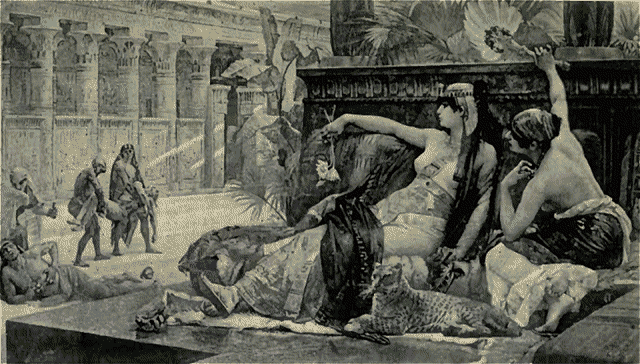
Such was Cleopatra when she began to reign. But neither her learning nor her beauty nor the charm of her manner protected her from the machinations of the court. Ptolemy XII., her boy husband, was under the control of his tutor, Pothinus, who, becoming jealous of Cleopatra's growing power, organized a conspiracy against her; and she was compelled to flee to Syria, where she began to raise an army to assert her rights. But a greater power now intervened in the affairs of Egypt. Cæsar entered upon the scene. Cleopatra appealed to him, and, rolled in a bale of carpet, gained admittance to his presence. When the carpet was unrolled and the queen appeared to view, the great conqueror was captivated at the spectacle. She was now about twenty-one, slender and graceful and of bewitching manner. Cæsar was about fifty-two, but thoroughly susceptible to the charms of youth and beauty. He warmly espoused her cause, and, after a conflict which nearly ended his career, restored her to the throne; and as Ptolemy XII. had been accidentally drowned in the Nile, he associated a younger brother, Ptolemy XIII., as her consort in the kingdom.
This is perhaps the most fascinating period in the life of Cleopatra, when, just entering upon her womanhood, she captivates the great commander and becomes, for a season, his Aspasia. In Egyptian eyes their union was regarded as a marriage, and the relations of these two never assumed the grossness and voluptuousness that were later exhibited by Antony and Cleopatra. Cæsar, with all his lofty intelligence, no doubt found in her one whose intellectual faculties rose to the level of his own. He passed the winter in her company, but at last had strength of mind enough to break away from her seductions, that he might continue his conquests and establish his dictatorship at Rome. When at the height of his power, he summoned to Rome Cleopatra, with his young son, Cæsarion, and gave them a residence in his villa on the Tiber. Here she lived in splendid state, and exercised a dominating influence over the ruler of the world, much to the disgust of the Romans. It was the height of her ambition to have Cæsar proclaim their son Cæsarion his heir, but the dictator in this regard resisted her allurements, and remained true to Roman traditions. Upon Cæsar's assassination, Cleopatra, disappointed in her fondest hopes, hastily returned to Egypt and her throne. There now appears a great change in the character of Cleopatra. The simplicity of nature and gentleness of spirit of earlier years gradually give place to a nature selfish, heartless, and designing. Jealous of her little brother, now fast approaching the age of fifteen, when he would share her power, she caused him to be poisoned. She was troubled by no conscientious scruples which might interfere with the fullest and most unrestrained indulgence of every propensity of her heart. In all her subsequent life she showed herself passionate and ambitious, cunning and politic, luxurious and pleasure-seeking.
Cleopatra was in her twenty-ninth year when she first met Antony--"a period of life," says Plutarch, "when woman's beauty is most splendid, and her intellect is in full maturity."
When Antony summoned Cleopatra to appear before him at Tarsus to answer charges brought against her for aiding Cassius and Brutus in the late war, she, fired with the idea of achieving a second time the conquest of the greatest general and highest potentate in the world, employed all the resources of her kingdom in making preparation for her journey. Shakespeare has most admirably described the splendor of her barge and the scene of enchantment that greeted Antony as she sailed up the Cydnus to meet him, a veritable Aphrodite surrounded by the Graces:
"The barge she sat in, like a burnish'd throne, Burn'd on the water; the poop was beaten gold; Purple the sails, and so perfum'd that The winds were love-sick with them: the oars were silver, Which to the tune of flutes kept stroke, and made The water, which they beat, to follow faster, As amorous of their strokes. For her own person, It beggar'd all description: she did lie In her pavilion (cloth-of-gold of tissue) O'er-picturing that Venus, where we see The fancy outwork nature: on each side her Stood pretty dimpl'd boys, like smiling Cupids, With diverse-color'd fans........ Her gentlewomen, like the Nereides, So many mermaids, tended her i' the eyes. ........ At the helm A seeming mermaid steers........ ........ From the barge A strange invisible perfume hits the sense Of the adjacent wharves. The city cast Her people out upon her; and Antony, Enthroned i' the market-place, did sit alone, Whistling to th' air; which, but for vacancy, Had gone to gaze on Cleopatra too, And made a gap in nature."
Antony was completely fascinated with her charms. Her beauty, her wit, and, above all, the tact, adroitness, and self-possession which she displayed in consenting thus to appear before him, forced him to yield his heart almost immediately to her undisputed sway. Cleopatra remained at Tarsus for some time, in an incessant round of gayety and revelry, and by her flatteries and caresses she prevailed on Antony, forgetful of his wife Fulvia and his duty as a Roman, to spend the winter at Alexandria, where the pair engaged in continual feastings, spectacles, and sports, as well as in every species of riot, irregularity, and excess. It is not our purpose to follow the well-known career of Cleopatra during these years of turmoil, or to dwell on the circumstances that caused her to prove the destruction of Antony's hopes at the battle of Actium; neither shall we describe in detail those closing days when both committed suicide rather than suffer the consequences of humiliation and defeat.
The case of Mark Antony is the most conspicuous example in history of the complete subjugation by the arts and fascinations of a woman of a will stern and indomitable, if reckless, and of a heart that was naturally generous and noble. Cleopatra led him to betray every public trust, to alienate from himself the affections of all his countrymen, to repel most cruelly the kindness and devotedness of a beautiful and faithful wife; and at last she led him away in a most cowardly and ignoble flight from the field of duty as a soldier, he knowing full well that she was hurrying him on to disgrace and destruction, and yet being utterly without power to break from the control of her irresistible charms.
Yet they were lovers--lovers who sacrificed wealth, ambition, duty, honor, on the altar of Aphrodite. It was a love which brought destruction; still, we may charitably account for the weakness exhibited by each as the natural consequence of that romantic love, than which history has given us no greater example.
Dire was the fate of Cleopatra. Hopes all frustrated,--Antony dying in her arms,--Octavius impervious to all her allurements,--rather than grace the conqueror's triumph, the most fascinating of Greek women ended her days, according to the prevailing tradition, by the bite of an asp, in her thirty-ninth year.
Cleopatra's character is a most fascinating and baffling study. Of many faults and vices she was guilty, but they were characteristic of her age. Her virtues must have been also many, for had she not possessed virtues she would not have been loved and admired by all who knew her. Her faithful attendants, Iras and Charmion, sacrificed themselves over her dead body, and by their devotion made even the Roman Proculius exclaim, in the words of Plutarch: "No other woman on earth was ever so admired by the greatest, so loved by the loftiest. Her fame echoed from nation to nation throughout the world. It will continue to resound from generation to generation; but, however loudly men may extol the bewitching charm, the fervor of the love which survived death, her intellect, her knowledge, the heroic courage with which she preferred the tomb to ignominy--the praise of these two must not be forgotten. Their fidelity deserves it. By their marvellous end they unconsciously erected the most beautiful monument to their mistress; for what genuine goodness and lovableness must have been possessed by the woman who, after the greatest reverses, made it seem more desirable to those nearest to her person to die rather than to live without her!"
Cleopatra was not a great queen, regarded as a ruler, yet she did a great service to her country in preserving its independence for a score of years after it had reached its end by a natural process of degeneracy; but she accomplished this end by the arts of intrigue. Cleopatra was too essentially a woman to be a great ruler, having all a woman's weaknesses, a woman's faults, and yet withal the charms and graces that make woman beautiful and lovable. Yet when we weigh her character with due reference to the times in which she lived, to the family influences which moulded her early years, and to the degeneracy of the Ptolemies to which she fell heir, she must rank as one of the best of her dynasty. Horace, the Roman poet, called Cleopatra: "non humilis mulier [a woman capable of no baseness];" and the phrase gains in importance from the fact that it occurs in the hymn which the poet dedicated to Octavius in honor of his victory over Antony and Cleopatra. In thus characterizing, in such an ode, the victor's foe, Horace gives us an estimate of the "Serpent of the Nile" which may stand as an epitome of her character and as a just claim to the partial respect and admiration of posterity.
"Age cannot wither her, nor custom stale Her infinite variety."
Cleopatra's intimate relations with Rome's greatest men, and the conversion of her kingdom into a Roman province after her death, but emphasize the fact that all Hellenistic lands were at that time in the power of Rome and that the period of Græco-Roman culture had begun much earlier. In B.C. 146 had occurred the destruction of Corinth and the absorption of Old Greece into a part of the Roman province of Macedon, and from that time Rome exerted a marked influence over the social life of Hellas. One of the chief characteristics of this age was the freer life of women of all classes. Even in Athens and Boeotia, the mistress of the house obtained her rights as mother and hostess. Perhaps it was in imitation of what they saw in Rome, perhaps it was merely the natural process of evolution, but, at any rate, the recognition of the capabilities and the elevated position of woman was general. Plutarch is the best chronicler of Greek life in the first century after the Christian era, and his works abound in precepts on the relations of the sexes, in whose equality he was a firm believer, and on the proper training and education of woman. His own wife, Timoxena, paid visits and received guests even when her husband was absent, shared fully the intellectual life of her husband, and took part in all his public interests.
The age was mending its manners. New ideas were prevailing among men. Woman was becoming more and more fully a factor in the world. Yet, for her complete emancipation, there was need of a new dogma, a great revelation, which would bring about startling reforms in the moral and social life of mankind. Already "the Word had been made flesh, and dwelt among them full of grace and truth"; yet the great writers of the first century of our era, Dion, Plutarch, even Josephus, seem never to have heard of the new teaching which had been preached throughout Asia Minor and at Athens and Corinth--the new teaching of Jesus of Nazareth, which was destined to overturn the prevailing conception of woman and her status and to lead her into a fulness of life such as had never been conceived in the imagination of even the most elevated of her sex.
In Cleopatra and other Greek women considered in the volume, we have observed from time to time the highest development of feminine endowments, physical, intellectual, or sensuous. The ethereal beauty of Helen, the poetic fervor of Sappho, the intellectual temper of Aspasia, the artistic temperament of Phryne, and the seductive sensibility of Cleopatra--these exhibit phases of feminine perfection that have not found their counterparts in modern times. Yet in each instance mentioned there was the one thing needful--the corresponding development of the moral and spiritual nature. These women were but pagans. Each sought in her own way to attain the highest perfection possible to woman; still, for them the truth was but seen in a glass darkly, and their philosophy had not yet taught them concerning the higher life of the spirit as distinct from the body.
Yet the dominion established by Julius Caesar, which embraced all the Hellenistic lands, was even in Cleopatra's time preparing the way for the dominion of the Son of Man, who brought into the world new conceptions of womanhood, new influences destined to elevate and ennoble the sex and emphasize the higher elements in human character that the ancients had so sadly neglected. Pagan Woman attained unrivalled excellence in physical beauty, intellectual endowment, and sensuous charm; to Christian Woman was vouchsafed the light which dispelled the moral darkness of antiquity and made attainable the highest spiritual excellence.