Volume 1 — Illustrated (continued 2)
Reading edition
Then is the son of Peleus the more enraged, and, had not the goddess Athena appeared and restrained his wrath, he would have assailed Agamemnon on the spot. However, he speaks again with bitter words and declares that hereafter longing for Achilles will come upon the Achæans one and all; for no more will he fight with the Greeks against the Trojans. So the assembly breaks up, after this battle of violent words between the twain. Achilles returns to his huts and trim ships, with Patroclus and his company; and Agamemnon sends forth Odysseus and others on a fleet ship to bear back to her father the lovely Chryseis, and to offer a hecatomb to Apollo. Thus Chryseis is restored to her father's arms, and appears no more in the story.
But Atrides ceases not from the strife with which he has threatened Achilles. He summons straightway two heralds, and bids them go to the tent of Achilles and take Briseis of the fair cheeks by the hand and lead her to him. Unwillingly they go on their mission, and find the young warrior sitting sorrowfully beside his hut and black ship. He knows wherefore they come, and bids his friend Patroclus bring forth the damsel and give them her to lead away. And Patroclus hearkens to his dear companion, and leads forth from the hut Briseis of the fair cheeks, and gives her to the heralds. And the twain take their way back along the ships of the Achæans and with them goes the maiden, all unwilling.
In this moment of grief at the loss of the woman he loves, Achilles bethinks him of his dear mother, the Nereid Thetis, and, stretching forth his hand toward the sea, he prays to her to hearken to him. His lady mother hears him as she sits in the sea depths beside her aged sire, and with speed she arises from the gray sea, and sits down beside him and strokes him with her hand and inquires the cause of his sorrow. Into her sympathetic ear he tells all the story of his wrongs, and the goddess shows herself the tenderest and most loving of mothers. He bids her seek justice for him at the throne of mighty Zeus, with whom she is potent on account of favors she has done him. She bewails with her son that she has borne him to brief life and evil destiny; but she bids him continue wroth with the Achæans, and refrain utterly from battle, while she will early fare to Zeus's palace upon Mount Olympus, and she thinks to win him. True to her promise, she betakes herself to sunny Olympus and finds the father of gods and men sitting apart from all the rest upon the topmost peak. She clasps his knees with one hand as a suppliant and with the other strokes his chin, and prays him to do honor to her son and exalt him with recompense for the gross wrong he has suffered. And Zeus, though he knows that it will lead to strife with Lady Hera, his spouse, promises to heap just vengeance upon Agamemnon.
Thus, upon the very threshold of the Iliad, the chord of maternal affection is struck; and when the wild passions of early manhood have led to sorrow and humiliation, the mother appears, affording sympathy and comfort, and is ready to traverse sea and earth and heaven to intercede for her wronged and grief-stricken son.
Achilles remains away from battle, sulking beside the ships. The odds are now in favor of the Trojans in the conflict that is being waged. Both sides are weary of continual fighting, and a single combat is arranged between Menelaus and Paris, the wronged husband and the present lord of Helen. The meed of victory is to be Helen herself, with all her treasures, she now appearing for the first time in the Epos.
Helen is summoned from her palace to witness the combat. So she hastens from her chamber, attended by two handmaidens, and comes to the place of the Scæan gates, where are gathered King Priam and the elders of the city.
Homer nowhere attempts to describe Helen's beauty in detail, but impresses it upon the reader merely by showing the bewitching effect of her presence upon others. Even these sage old men fall under the spell of her divine beauty, and, when they see her coming upon the towers, softly speak winged words, one to the other:
"Small blame is it that Trojans and well-greaved Achæans should for such a woman long time suffer hardships; marvellously like is she to the immortal goddesses to look upon. Yet even so, though she be so goodly, let her go upon their ships and not stay to vex us and our children after us."
Priam, however, addresses his beautiful daughter-in-law with gentle words, laying the blame, not on her, but on the gods, for the dolorous war of the Achæans. Helen utters expressions of self-reproach, and then, at Priam's request, points out the famous warriors of the invading host.
Paris is vanquished in the single combat, and Menelaus would have slain his foe, and in that moment have regained Helen, had not the goddess Aphrodite snatched up Paris in a cloud and transported him to his chamber. Aphrodite then appears to Helen, in the form of an aged dame, and bids her return to her lord. Helen recognizes the goddess, and her scornful, bitter reply shows how the high-spirited lady rebelled at the chains with which Aphrodite bound her. The wrath and menace of Aphrodite, however, overcome her noble resolution, and she reluctantly returns. When she sees her husband, she chides him scornfully for his cowardice, and regrets that he had not perished at the hands of Menelaus. But Paris is unaffected by her reproaches. His thoughts, as ever, are not of war, but of love, and Helen, owing to the subtle power of Aphrodite, cannot long resist his caresses. Meanwhile, the injured husband rages through the host like a wild beast, if anywhere he might set his eyes on and slay the wanton Paris.
We are now approaching a series of domestic scenes, in which figure the three principal female characters of the Iliad. Owing to the abortive issue of the single combat, the truce between Greeks and Trojans is declared at an end, and the forces once more array themselves in conflict. The Trojans are being hard pressed. Hector returns to the city to command Hecuba, his mother, to assemble the aged dames of Troy, who should go to Athena's temple and supplicate the goddess to have compassion on them. At the gates the Trojans' wives and daughters gather about him, inquiring of their loved ones. As he enters the royal palace, his beautiful mother meets him and clasps him by the hand, and bids him, weary of battle, pause to take refreshments. But Hector resists her solicitous entreaties, urges her to gather the aged wives together, and, with the most beautiful robe in the palace as an offering, to go to the temple and supplicate Athena to have mercy. Hecuba does as he commands, and the solemn procession mounts the citadel and implores the goddess to have mercy on them and turn the tide of combat. The goddess, however, is inflexible: she denies their prayer.
Hector, meanwhile, stops at the palace of Paris. He finds Helen seated among her handmaidens, distributing to them their tasks, and Paris polishing his beautiful armor. Hector severely rebukes his brother; but words of scorn make but little impression on the smooth and courteous Paris. Helen now addresses Hector, for whom she has a sisterly love and admiration that contrasts painfully with her contempt for her cowardly lord; and her words reveal the bitterness of her heart, because of her evil destiny and because "even in days to come we may be a song in the ears of men that shall be hereafter." Hector responds with sympathetic regard to the sisterly confidence of Helen, and bids her rouse her husband once more to enter the combat, while in the meantime he will go to his own house to behold his dear wife and infant boy; for he knows not if he shall return home to them again, or if the gods will now overthrow him at the hands of the Achæans.
When Hector comes to his palace, he finds not his beautiful wife, white-armed Andromache, within; upon inquiry he learns that, through anxiety because of the battle, like one frenzied, she had gone in haste to the wall, and the nurse bearing the child was with her. Hector hastens to the Scæan gates, and as he approaches them there came his dear-won wife, running to meet him, and with her the handmaid bearing in her bosom the tender boy, Hector's loved son Astyanax. Hector smiles and gazes at the boy; while Andromache stands by his side weeping and clasps his hand in hers, and urges him to take thought for himself and to have pity on her, forlorn, and on their infant boy. Hector tells her that he takes thought of all this, that his greatest grief is the thought of her anguish in the day when some mail-clad Achæan shall lead her away and rob her of the light of freedom, but it is his part to fight in the forefront of the Trojans. He lays his son in his dear wife's bosom, and, as she smiles tearfully upon the lad, her husband has pity to see her, and gently caresses her with his hand and seeks to console her. He bids her return to her own tasks, the loom and distaff, while he provides for war. So part these heroic souls. Hector sets out for the battlefield; and his dear wife departs to her home, oft looking back and letting fall big tears. When she reaches her house, she gathers her handmaidens about her, and stirs lamentations in them all. "So bewailed they Hector, while yet he lived, within his house; for they deemed that he would no more come home to them from battle nor escape the fury of the hands of the Achæans."
The closing scenes of the dramatic recital time and again present these three women--Hecuba, Helen, and Andromache. Achilles continues to sulk away from battle, in spite of Agamemnon's attempt at reconciliation. The Trojans are winning victory after victory. Achilles's comrade Patroclus finally gets permission to don the great warrior's armor, and he enters the conflict. Hector, supposing him to be Achilles, engages with him in combat and finally slays him. Achilles is overwhelmed with grief at the death of Patroclus. His lady mother, Thetis, rises from the depths of the sea to console him, and provides him a suit of armor fashioned by Hephæstus. Agamemnon and Achilles are reconciled before the assembly of the Achæans, and fair-faced Briseis is restored to her lover. She utters shrill laments over the body of Patroclus, who had been ever kind to her. Achilles enters the combat, clad in the armor of Hephæstus. Hector alone dares to face him, and he is slain, and his lifeless body is dragged behind Achilles's chariot as he drives exultantly toward the ships. Piteous wailings are heard from the walls, wailings of the aged Priam, and of the sorrowful Hecuba, whose cry is the full bitterness of maternal grief.
Within the city, in the inner chamber of her palace, a young wife is engaged in weaving a double purple web and directing the work of her handmaidens. Her thoughts are all of her warrior husband, and she has had a servant set a great tripod upon the fire that Hector might have warm washing when he comes home out of the battle--fond heart all unaware how, far from all washings, bright-eyed Athena has slain him by the hand of Achilles! But suddenly she hears shrieks and groans from the battlements, and her limbs tremble and the shuttle falls from her hands to earth. She dreads terribly lest Hector has met his fate at the hand of Achilles. Accompanied by her handmaidens, she rushes to the battlements, and beholds his lifeless body dragged by swift horses toward the hollow ships. Then dark night comes on her eyes and shrouds her, and she falls backward and gasps forth her spirit; and when at last her soul returns into her breast, she bewails her own sad lot and that of her child, deprived of such a husband and father.
The succeeding days are spent in gloom and sorrow, each side bewailing the loss of a favorite warrior. King Priam finally recovers the body of Hector from Achilles, and brings it back to Hector's palace, where the women gather about the corpse--and among them white-armed Andromache leads the lamentation, while in her hands she holds the head of Hector, slayer of men. Hecuba, too, grieves for Hector, of all her children the dearest to her heart; and, lastly, Helen joins in the sore lament, sorrowing for the loss of the dearest of her brethren in Troy, who had never spoken despiteful word to her, but had always been kind and considerate. Here the long story reaches its natural conclusion. The Iliad opens with a scene of wrath occasioned by man's passion for woman, and closes with a scene of mourning--women grieving for the loss of a slain husband and son and friend--knightly Hector.
Before we bid farewell to the martial tableaux presented to us in the Iliad, and direct our attention to the domestic scenes of the Odyssey, let us take a final glance at the heroines who have appeared in the first Homeric epos.
Worthy of note is the atmosphere of beauty and delicacy and charm with which the poet has enveloped Helen of Troy. She has committed a grievous fault, but there is in the recital nothing which offends the moral sense. This is because the poet has portrayed her with none of the seductions of vice, but with all the allurements of penitence. She has sinned, but it has been because of the mysterious and irresistible bond which united her to the goddess of love; her moral nature has not been perverted, and she is filled with shame and remorse because of the reproach that has been cast upon her name. By a long and bitter expiation, she has atoned for her fault; and memories of the days long past abide with her in all their sweetness and purity. One can but contrast the difference of attitude with which she addresses Priam and Hector on the one hand, and Aphrodite and Paris on the other. For the former she has the utmost consideration and respect, and in their presence she feels most keenly how compromised is her position; for the latter, the causes of her fall, she has nothing but the scorn and contempt of a cultivated and high-spirited queen. In portraying the regret of Helen for her first husband, and her contempt toward her second; in representing Menelaus and the Greeks as fighting to avenge "the longings and the groans of Helen"; and in subtly suggesting how inevitable are the chains with which Aphrodite has bound her, the poet wins for her our sympathy and admiration. Homer nowhere tells us of the reconciliation of Menelaus and Helen, after the fall of Troy; but in the Odyssey he presents a beautiful picture of Helen in Sparta, a queen once more, beloved of husband and attendants, and presiding over her palace with courtly grace and dignity; and in the prophecy of Proteus, the Old Man of the Sea, the destiny of the fair queen is suggested in that of her faithful spouse: "But thou, Menelaus, son of Zeus, art not ordained to die and meet thy fate in Argos, the pasture land of horses; for the deathless gods will convey thee to the Elysian plains and to the world's end, where is Rhadamanthus of the fair hair, where life is easiest for men. No snow is there, nor yet great storm, nor any rain, but always ocean sendeth forth the breeze of the shrill blast to blow cool on men; yea, for thou hast Helen to wife, and thereby they deem thee son to Zeus."
Thus, because wedded to Zeus-begotten Helen, Menelaus himself is deathless and immortal, and Homer meant, no doubt, to picture the royal couple passing together in the Isles of the Blest the æons of eternity.
Homer provided the literary types for all succeeding Greek poets, and it is but natural that so bewitching a conception as Helen should be frequently portrayed and adopted. But with the change in form of government from monarchy to oligarchy, and from oligarchy to democracy, the old epic conception of heroes and heroines frequently suffers disparagement. In later periods, men began to meditate on moral questions, and poets who sought to weigh the problems of human life and destiny saw in Helen's career the old, old story of sin and sufering, and they could not with Homeric chivalry gloze over that fatal step which caused the wreck of empires and brought infinite woes to men.
Stesichorus was the first poet to charge Helen with all the guilt and suffering of Hellas and of Troy; but for this offence against the daughter of Zeus, says tradition, he was smitten with blindness, and did not recover his sight until he had written the recantation beginning: "Not true is that tale; nor didst thou journey in benched ships, nor come to town of Troy,"--in which he adopted the theory that the real Helen remained in Egypt, while a phantom accompanied Paris to Troy.
Æschylus searches into the dire consequences of Helen's sin, and on her shoulders lays all the sufferings of Agamemnon and his descendants. "Rightly is she called Helen," says he; "a hell of ships, hell of men, hell of cities." He regards her as the very incarnation of evil, the curse of two great nations. Yet even stern Æschylus yields due reverence to her all-conquering beauty:
"Ah! silent, see she stands; Each glowing tint, each radiant grace, That charm th' enraptur'd eye, we trace; And still the blooming form commands, Still honor'd, still ador'd, Though careless of her former loves, Far o'er the rolling sea the wanton roves."
He also represents her forsaken husband ever dreaming of her, enraptured of her beauty:
"Oft as short slumbers close his eyes, His sad soul sooth'd to rest, The dream-created visions rise With all her charms imprest: But vain th' ideal scene that smiles With rapt'rous love and warm delight; Vain his fond hopes; his eager arms The fleeting form beguiles, On sleep's quick pinions passing light."
Æschylus is not the only one of the early dramatists to whom Helen furnished a worthy theme; the titles of four lost plays show that Sophocles wrote of the Argive queen. There is no means of knowing, however, how this master dealt with the romance. Judging from his treatment of the Antigone legend, it is probable that Sophocles treated Helen as a woman of rare beauty and power, more sinned against than sinning, and subjected her character to the most profound analysis.
While Æschylus deprived Helen of something of the delicacy and charm with which Homer had invested her, Euripides, in a number of his plays, goes even further, and brings her down to the level of common life. Upon her beautiful head were heaped the reproaches of the unfortunate maidens and matrons of Greece and Troy for the woes they had to suffer, and we must not always take the sentiments of a Hecuba or a Clytemnestra as expressing the poet's own convictions. In the Daughters of Troy, he represents her in violent debate with her mother-in-law, Hecuba, before Menelaus, leaving with the reader the impression that she is a guilty, wilful woman of ignoble traits, and in other plays he lays on her the load of guilt for all the dire consequences of her act; yet in his treatment of Helen there is always an ethereal element, hard to define, but recognizable. She causes ruin and destruction, she is roundly abused and reproached, yet she herself does not deal in invective and is proof against all physical ill, being finally deified as the daughter of Zeus, while suffering is invariably the fate of those who abuse and censure her. And, like Stesichorus, Euripides in his old age makes a recantation. In the Helen, he follows the Stesichorean version, and dramatizes the legend that, after she was promised to Paris by Aphrodite, Hera in revenge fashioned like to Queen Helen a breathing phantom out of cloud land wrought for Priam's princely son; while Hermes caught her away and transferred her to the halls of Proteus, King of Egypt, to keep her pure for Menelaus. Thus it was for a phantom Helen that Greek and Trojan fought at Troy; while the real Helen passed her days amid the palm gardens of Egypt, eagerly awaiting the return of Menelaus, and bewailing her ill name, though she was clean of sin. After the war, she is happily reunited with her lord.
It is hard, however, to besmirch a conception of ideal beauty, and later writers, casting aside the imputations of the dramatists, returned to the Homeric type. The Greek rhetoricians found in Helen a fruitful subject for panegyric, and made her synonymous with the Greek ideal of beauty and feminine perfection. Isocrates praises her as the incarnation of ideal loveliness and grace; beauty is all powerful, he says, and the Helen legend shows how beauty is the most desirable of all human gifts. Theocritus, in his exquisite Epithalamium, pays an unalloyed tribute to her beauty and goodness. She is "peerless among all Achæan women that walk the earth;--rose-red Helen, the glory of Lacedæmon;--no one is so gifted as she in goodly handiwork;--yea, and of a truth, none other smites the lyre, hymning Artemis and broad-breasted Athena, with such skill as Helen, within whose eyes dwell all the Loves."
Quintus Smyrnæus, of the fourth century of our era, who wrote a Post-Homerica, emphasizes the demonic influence that controlled the fate of Helen, and lays her frailty to the charge of Aphrodite. He gives a beautiful picture of the queen as she is being led to the ships of the Achæans: "Now, Helen lamented not, but shame dwelt in her dark eyes and reddened her lovely cheeks ... while round her the people marvelled as they beheld the flawless grace and winsome beauty of the woman, and none dared upbraid her with secret taunt or open rebuke. Nay, as she had been a goddess, they beheld her gladly, for dear and desired was she in their sight."
Thus the Helen legend became the allegory of Greek beauty, and so exquisite an ideal, uplifting the spirit and satisfying one's longing for higher things, strikes a responsive chord in the hearts of lovers of beauty in every clime. The romance of Helen, after lying dormant for centuries, came to life again in the legend of Faust. Marlowe treated merely the external phases of the Faust legend; Goethe allegorized the whole, and in the loves of Faust and Helen symbolized the passion of the Renaissance for the Greek ideal of beauty; the fruit of the union of the two is Euphorion, the genius of romantic art. Nor has Helen exerted less influence on modern English poets. Landor, in numerous poems, portrays the sweetness of her character and the omnipotence of her beauty and charm; Swinburne dwells on the innocence and joyfulness of her childhood; Tennyson speaks of her as
"A daughter of the gods, divinely tall, And most divinely fair;"
and Andrew Lang has written a lengthy poem on the Helen legend, in which he ascribes her frailty to the irresistible power of Aphrodite. Thus Homer and the Homeric Age are inextricably entwined about the name of Helen. It is significant in the study of Greek women that at the very dawn of Greek civilization we should find such an ideal conception of womanhood--one that universally captivates the fancy and has exerted an influence through all succeeding ages.
Let us now pause a moment to contemplate the most lovable of all the women of Homer, Hector's spouse, white-armed Andromache. Homer does not devote much space to her--only the famous parting scene and the two lamentations which she utters over her fallen husband. Yet, as the ideal type of the soldier's wife, the loving mother, she has taken a hold on the modern imagination and is the best known of all the female characters of Greek epos. We know that she must have been beautiful, though Homer uses only one epithet to describe her; we know that she must have been brave and devoted and domestic, for Homer has painted for us an ideal picture which portrays her with all these and many other lovable attributes. Andromache is neither Trojan nor Greek; she is universal; and wherever there are scenes of husband parted from wife, of uncertainty as to the issue of the combat and the destiny of the children, Andromache will be the great prototype. Andromache feels in her heart that sacred Ilium is doomed, and, in those cruel times when might was right, she knew but too well what was to be the fate of herself and the lad Astyanax. Euripides tells us how the forebodings of Andromache came true, and dwells on those sad days for the daughters of Troy when the mailed hand of the Achæans carried them off captive after the fall of the city and determined their destiny by lot.
Andromache was apportioned to Neoptolemus, Achilles's valiant son, and in Euripides's Daughters of Troy she reappears, with her child in her arms, haled forth to her new bondage. Sadly she bewails her lost Hector, who could have warded off from her the curse of thraldom. The Greek herald, Talthybius, demands from her the lad Astyanax, whom the Greeks have decided to hurl from the battlements of Troy. The child is ruthlessly torn from his mother's embrace, and she is led off to the hollow ships. Neoptolemus takes her over sea to his home in Thessaly, and loves her and treats her with a kindness and consideration that are sweetly perfect. To him she bears a son in her captivity; but not of her own will does she share his couch, for her heart is true to the memory of Hector. After many years, Neoptolemus weds Hermione, daughter of Menelaus and Helen, a princess of Sparta. To them no child is born, and Hermione's heart is filled with anger and jealousy toward the thrall, whom her husband still treats tenderly. With her father, Menelaus, Hermione, during Neoptolemus's absence, plots the destruction of Andromache and her boy, but the aged Peleus protects the defenceless ones. Neoptolemus is slain at Delphi, and Thetis, who appears at the close of the Andromache, thus solves the problem of fate:
"And that war-captive dame, Andromache, In the Molossian land must find a home In lawful wedlock joined to Helenus, With that child who alone is left alive Of AEacus' line. And kings Molossian From him one after other long shall reign In bliss."
Readers of Virgil will recall how Æneas found Andromache in the Molossian land, and how her heart yearned for the lad Ascanius, who reminded her of the lost Astyanax. Euripides has been true, in the main, to the Homeric conception of Andromache, and endows her in her captivity with the same womanliness and domestic traits that won our hearts in the Iliad; nevertheless, there is about her the infinite sadness that is natural to one who has lost all that life holds dear. Yet Euripides falls so infinitely below the master that the picture which will abide longest in the memory is the parting scene in the Iliad.
Homer endows his minor characters with an interest that is no less real to us than that given to Helen and Andromache. Of these lesser characters, a few stand out insistent of our notice. At the threshold of the story, Chryseis and Briseis appear as the innocent causes of the quarrel of the chieftains. Chryseis is still a maiden, as far as can be inferred, and had not lost kindred and friends when taken captive; for her father, the priest of sacred Chryse, comes to beg her release, with boundless ransoms. Hence her day of captivity is brief, and the aged father joyously welcomes his beloved daughter. She must have been beautiful and clever, for Agamemnon prized her far above Clytemnestra.
The story of Briseis is a much sadder one, and graphically illustrates the fate of a gentlewoman who fell into the hands of the foe. She was a captive widow, husband and kindred having been slain by Achilles. But her captor loved her devotedly, and to him she was a wife in all but in name; and Patroclus had promised her that she should in time become the wedded wife of Achilles. The young warrior weeps bitterly when she is taken from him, but at the close of the Iliad we see them happily reunited. She is remembered because of the great passions that gathered about her.
Homer presents two pictures of heroic motherhood in sorrow,--Hecuba and Thetis; for the latter, though a goddess, is perfectly human in her devotion to her fated son, Achilles. To her he goes for comfort, and she is ever resourceful in responding to his wants. She weeps over his destiny, but, since he has chosen the better part, she nobly supports him in every struggle. Hecuba is truly the companion of her husband, King Priam, associated with him in his projects, and sharing his counsels. She has borne him nineteen children, and these she has seen slain, one after another, by the hand of the foe. Hector is her favorite son, in whose courage she recognizes the bulwark of Ilium. When she sees him exposed to certain death, her anxiety overcomes her pride and she beseeches him to come within the walls; and when at last her son has succumbed, we find in her the same mingling of grief and of pride. Her wild despair seems to be assuaged by the thought that her son died gloriously. This heroic sentiment sustains her before the corpse of Hector, and even in her lamentation she voices her calm courage.
IV
WOMEN OF THE ODYSSEY
Ten years have passed since the fall of Ilium, and the various heroes of the Greeks have met with diverse fortunes. Agamemnon, king of men, has returned to his fatherland, but merely to find treason and death at the hands of Ægisthus, the new lord of Clytemnestra, his wife. Menelaus, after long wanderings, especially in Egypt, has reestablished his kingdom in Sparta, with Helen as his queen. Odysseus, King of Ithaca, had the longest and most perilous voyage homeward, and, after meeting with various misadventures, has been detained for nearly eight long years, consuming his own heart, in the island paradise of Calypso, Meanwhile, on his own island, Ithaca, things have begun to go amiss. The island chiefs, men of the younger generation, begin to woo Penelope and to harass her son, Telemachus. The wooers, after being rebuffed for years by the fair queen, are becoming insolent, quartering themselves upon her, and devouring her substance. At this time the action of the Odyssey begins.
The determined time has now arrived when, by the counsels of the gods, Odysseus is to be brought home to free his house, to avenge himself on the wooers, and to recover his kingdom, Pallas Athena is the chief agent in the restoration of Odysseus to his fatherland. She beseeches Zeus that he may be delivered, and in accordance with this prayer Hermes is sent to Calypso to bid her release Odysseus. Meanwhile, the goddess, in human form, visits Telemachus in Ithaca, and urges the young prince to withstand the suitors who are devastating his house, and to go in search of his father. Touched by the words of the goddess, youth rapidly gives way to manhood, and Telemachus determines to assert his rights and to find his father.
After the departure of the goddess, the prince enters the court where the suitors are gathered, listening to the singing of the renowned minstrel Phemius; and his song was of the pitiful return of the Achæans. We now have our first vision of discreet Penelope. From her upper chamber she hears the glorious strain, and she descends the high stairs from her apartments, accompanied by two of her handmaids. "Now, when the fair lady had come unto the wooers, she stood by the doorpost of the well-builded roof, holding up her glistening tire before her face; and a faithful maiden stood on either side of her." She begs Phemius to cease from this sorrowful strain, which wastes her heart within her breast, since to her, above all women, hath come a sorrow comfortless, because she holds in constant memory so dear a head,--even that man whose fame is noised abroad from Hellas to mid-Argos. Telemachus gently rebukes his mother for interrupting the song of the minstrel, and bids her return to her chamber and to her own housewiferies, the loom and distaff, and bid the handmaids ply their tasks. Then in amaze she goes back to her chamber, for she lays up the wise saying of her son in her heart. She ascends to the upper chamber with the women, her handmaids, and there bewails Odysseus, her dear lord, till gray-eyed Athena casts sweet sleep upon her eyelids.
Telemachus begins to assert himself before the violent suitors. When night falls and each goes to his own house to lie down to rest, the young prince is attended to his chamber by the aged Euryclea, who had nursed him when a little one. She bears the burning torches, and prepares the chamber for her young master; and when he takes off his soft doublet, she folds and smooths it and hangs it on a pin by the jointed bedstead. Then she goes forth from the room, and there, all night long, wrapped in a fleece of wool, Telemachus meditates in his heart upon the journey that Athena has shown him.
The next day, after a stormy meeting of the assembly, Telemachus secretly sets sail for Pylus, accompanied by the goddess Athena, in the form of Mentor. Only Euryclea, the youth's faithful nurse, knows of his journey, and she has taken a great oath not to reveal it to his mother till the eleventh or twelfth day. Nestor graciously receives Telemachus at Pylus, and, as he himself has no news of Odysseus, sends him on to Sparta, to King Menelaus, in the company of his own son, Pisistratus. The young men are graciously received by Menelaus and Helen, and Telemachus learns that Odysseus was a captive on an island of the deep in the halls of the nymph Calypso.
Meanwhile, the suitors in Ithaca learn of Telemachus's departure and lay an ambush to intercept him on his return. Discreet Penelope, too, learns by chance of his absence, and of the plots of the wooers, and her heart melts within her at the thought of danger to her child. The good nurse Euryclea tells her of Telemachus's plan, and lulls her queen's grief. Penelope returns to her chamber and prays to Athena to save her dear son and ward off from him the malice of the suitors. As she lies there in her upper chamber, fasting, and tasting neither meat nor drink, and musing over the fate of her dear son, gray-eyed Athena makes a phantom in the likeness of Penelope's sister, Iphthime, and sends her to comfort Penelope amid her sorrow and lamenting. Reassured by the phantom concerning her son, the devoted matron begs for news of her husband, pleading to know whether he be alive or dead, but this information is denied her. Yet the heart of the disconsolate wife and mother is cheered, so sweet was the vision that came to her in the dead of night.
Homer now transports us to an assembly of the gods. Athena tells the tale of the many woes of Odysseus, and Zeus commands Hermes, the messenger god, to bid Calypso release Odysseus and start him on his voyage to the Phæacians, who are destined to return the wanderer to his own dear country. Hermes quickly reaches the far-off isle of Ogygia, where was the grotto of the nymph of the braided tresses. The fair goddess at once knows him, and, after giving him entertainment, inquires his message. Calypso regretfully and well-nigh rebelliously receives the command of Zeus, and complains of the jealousy of the gods, who forbid goddesses openly to mate with men. Yet, as none can make void the purpose of Zeus, she will obey the command. Hermes departs, and the nymph goes on her way to the great-hearted Odysseus. She finds him sitting on the shore; his eyes were never dry of tears, his sweet life was ebbing away as he mourned for his return, and through his tears he looked wistfully over the unharvested deep. Calypso bids him sorrow no more, for she will send him away, and directs him how to prepare a barge on which to make the voyage. Four days are devoted to the making of the barge, and on the fifth the goddess sends him on his way, providing him with food and drink for his journey, and causing a gentle wind to blow.
Goodly Odysseus joyously sets his sail to the breeze, and keeps his eye on the star Orion, which the fair goddess had bidden him to keep ever on his left as he traverses the deep.
Seventeen days he sails placidly along, and on the eighteenth appear the shadowy hills of the land of the Phæacians, whither he is bound. Then spies him his old enemy, Poseidon, and the earth shaker gathers the clouds and rouses the storms, and down speeds night from heaven. The great waves smite down upon Odysseus, and he loses the helm from his hand and the mast is broken. He is thrown from his raft; but, again clutching it, clambers upon it, avoiding grim death. Woman is again destined to be the means of salvation for the hero. Ino of the fair ankles, daughter of Cadmus, in time past a mortal maiden, but now a sea nymph, Leucothea, marks his dire straits and takes pity upon him, and gives him her veil to wind about him when he throws himself into the deep. When his raft is at last broken asunder, he wraps the veil about him; and for two days and nights it bears him up until at length he makes the rugged shore. Throwing the veil into the stream, to be wafted back to fair-ankled Ino, Odysseus, bruised and battered, clambers among the reeds on the bank. He finds a resting place underneath two olive trees, and Athena sheds sweet sleep upon his eyelids.
That same night, the daughter of the king of the Phæacians, Nausicaa, beautiful like the goddesses, was sleeping in a sumptuous chamber. For it was to the island domain of King Alcinous, Scheria, land of the Phæacians, that Odysseus had come. To the palace of the king went Athena, devising a return for the great-hearted Odysseus.
"She betook her to the rich-wrought bower, wherein was sleeping a maiden like to the gods in form and comeliness, Nausicaa, the daughter of Alcinous, high of heart. Beside her, on each hand of the pillars of the door, were two handmaids, dowered with beauty from the Graces, and the shining doors were shut.
"But the goddess, fleet as the breath of the wind, swept toward the couch of the maiden, and stood above her head."
In the semblance of Nausicaa's favorite girl friend and comrade, the goddess addresses her:
"'Nausicaa, how hath thy mother so heedless a maiden to her daughter? Lo! thou hast shining raiment that lies by thee uncared for, and thy marriage day is near at hand, when thou thyself must needs go beautifully clad, and have garments to give to them who shall lead thee to the house of the bridegroom. And, behold, these are the things whence a good report goes abroad among men, wherein a father and lady mother take delight. But come, let us arise and go a-washing with the breaking of the day, and I will follow thee to be thy mate in the toil, that without delay thou mayst get thee ready, since truly thou art not long to be a maiden. Lo! already they are wooing thee, the noblest youths of all the Phæacians, among that people whence thou thyself dost draw thy lineage. So come, beseech thy noble father betimes in the morning to furnish thee with mules and a wain to carry the men's raiment, and the robes, and the shining coverlets. Yea, and for thyself it is seemlier far to go thus than on foot, for the places where we must wash are a great way from the town.'"
So spake the gray-eyed Athena, and departed to Olympus, seat of the gods.
"Anon came the throned Dawn, and awakened Nausicaa of the fair robes, who straightway marvelled on the dream, and went through the halls to tell her parents, her father dear and her mother. And she found them within, her mother sitting by the hearth with the women, her handmaids, spinning yarn of sea-purple stain, but her father she met as he was going forth to the renowned kings in their council, whither the noble Phæacians called him. Standing close by her dear father, she spake, saying: 'Father, dear, couldst thou not lend me a high wagon with strong wheels, that I may take the goodly raiment to the river to wash, so much as I have lying soiled? Yea, and it is seemly that thou thyself, when thou art with the princes in council, shouldst have fresh raiment to wear. Also, there are five dear sons of thine in the halls, two married, but three are lusty bachelors, and these are always eager for new-washen garments wherein to go to the dances; for all these things have I taken thought.'
"This she said, because she was ashamed to speak of glad marriage to her father; but he saw all and answered, saying:
"'Neither the mules nor aught else do I grudge thee, my child. Go thy ways, and the thralls shall get thee ready a high wagon with good wheels, and fitted with an upper frame.'"
So, in obedience to the king's command, the mule team is made ready in the courtyard, and the maiden and her mother store in the wagon the raiment, a basket filled with all manner of food, and wine in a goatskin bottle, and olive oil in a golden cruse, that the princess and her maidens might anoint themselves after the bath. Then Nausicaa herself takes the whip and the reins, and she and her attendants start off for a joyous holiday. When they reach the stream of the river, the maidens unharness the mules and turn them loose to graze on the honey-sweet clover. Then they take out the garments, wash and cleanse them from all stains, and spread them out along the shore to dry. Work over, they bathe, anoint themselves with olive oil, and partake of their noonday meal on the river banks. Now for an afternoon of maidenly pastime. They indulge in the choral game of ball, laying aside their headdresses, and among them Nausicaa of the white arms, who outshone in beauty her maiden company, began the song.
But Athena is overruling this girlish frolic, for the rescue of her hero. The princess throws the ball at one of her companions, but it misses her and falls into the eddying river, whereat the maidens all raise a piercing scream, as only maidens can. Odysseus is awakened, and, sitting up, wonders into what sort of land he is come; surely it was the shrill cry of maidens, but whether of nymphs or of mortals he cannot tell. He will make essay, however; and, tearing a leafy bough from a tree to cover him, he sallies forth from the thicket like a mountain-bred lion. Loathsome and terrible, being disfigured by the brine of the sea, does he appear to the maidens, and they flee cowering here and there about the shore. Only Alcinous's daughter stands firm, for Athena gives her courage of heart and takes all trembling from her limbs. Odysseus does not venture to approach in the attitude of a suppliant, but, standing aloof, beseeches her compassion with sweet and cunning words:
"I supplicate thee, O queen, whether thou art a goddess or a mortal! If indeed thou art a goddess of them that keep the wide heaven, then to Artemis, the daughter of great Zeus, I mainly liken thee, for beauty and stature and shapeliness. But if thou art one of the daughters of men who dwell on earth, thrice blessed are thy father and thy lady mother, and thrice blessed thy brethren. Surely their souls ever glow with gladness for thy sake each time they see thee entering the dance, so fair a flower of maidens! But he is of heart the most blessed beyond all other who shall prevail with gifts of wooing, and lead thee to his home. Never have mine eyes beheld such an one among mortals, neither man nor woman; great awe comes upon me as I look on thee.
"But, queen, have pity on me; for, after many trials and sore, to thee first of all am I come, and of the other folk who hold this city and land I know no man. Nay, show me the town, give me an old garment to cast about me, if thou hadst, when thou camest here, any wrap for the linen. And may the gods grant thee all thy heart's desire: a husband and a home, and a mind at one with his may they give--a good gift; for there is nothing mightier and nobler than when man and wife are of one heart and mind in a house, a grief to their foes, and to their friends great joy, but their own hearts know it best."
Then Nausicaa of the white arms answered him, and said: "Stranger, forasmuch as thou seemest no evil man nor foolish--and it is Olympian Zeus himself that giveth weal to men, to the good and to the evil, to each one as he will, and this thy lot doubtless is of him, and so thou must in any wise endure it:--now, since thou hast come to our city and our land, thou shalt not lack raiment, nor aught else that is the due of a hapless suppliant, when he has met them who can befriend him. And I will show thee the town, and name the name of the people. The Phæacians hold this city and land, and I am the daughter of Alcinous, great of heart, on whom all the might and force of the Phæacians depend."
The princess then calls her maidens and bids them give the stranger meat and drink, and olive oil for his bath, and raiment to put on. And when he had bathed and anointed himself, and had put on the raiment, Athena "made him greater and more mighty to behold, and from his head caused deep, curling locks to flow, like the hyacinth flower," shedding grace about his head and shoulders.
"Then to the shore of the sea went Odysseus apart, and sat down, glowing in beauty and grace; and the princess marvelled at him, and spake among her fair-tressed maidens, saying:
"'Listen, my white-armed maidens, and I will say somewhat. Not without the will of all the gods who hold Olympus hath this man come among the godlike Phæacians. Erewhile he seemed to me uncomely, but now he is like the gods that keep the wide heaven. Would that such an one might be called my husband, dwelling here, and that it might please him here to abide! But come, my maidens, give the stranger meat and drink.'"
Food is set before the famishing Odysseus, and, after his hunger is appeased, Nausicaa prepares for the homeward return. She addresses the hero, and gives him full directions how to reach her father's palace; part of the way he may accompany her, but not when they approach a populous part of the city; for she dreads the unfriendly comments of loungers and passers-by.
"And some one of the baser sort might meet me and say: 'Who is this that goes with Nausicaa, this tall and goodly stranger? Where found she him? Her husband he will be, her very own. Either she has taken in some shipwrecked wanderer of strange men, for no men dwell near us; or some god has come in answer to her instant prayer; from heaven has he descended, and will have her to wife for evermore. Better so, if herself she has ranged abroad and found a lord from a strange land; for verily she holds in no regard the Phæacians here in this country, the many men and noble who are her wooers.' So will they speak, and this would turn to my reproach. Yea, and I myself would think it blame of another maiden who did such things in despite of her friends, her father and mother being still alive, and was conversant with men before the day of open wedlock. But, stranger, heed well what I say, that as soon as may be thou mayst gain at my father's hands an escort and a safe return. Thou shalt find a fair grove of Athena, a poplar grove near the road, and a spring wells forth therein, and a meadow lies all around. There is my father's demesne, and his fruitful close, within the sound of a man's shout from the city. Sit thee down there, and wait until such time as we may have come into the city and reached the house of my father. But when thou deemest that we are got to the palace, then go up to the city of the Phæacians, and ask for the house of my father Alcinous, high of heart. It is easily known, and a young child could be thy guide, for nowise like it are builded the houses of the Phæacians, so goodly is the palace of the hero Alcinous. But when thou art within the shadow of the halls and the court, pass quickly through the great chamber, till thou comest to my mother, who sits at the hearth in the light of the fire, weaving yarn of sea-purple stain, a wonder to behold. Her chair is leaned against a pillar, and her maidens sit behind her. And there my father's throne leans close to hers, wherein he sits and drinks his wine, like an immortal. Pass thou by him, and cast thy hands about my mother's knees, that thou mayst see quickly and with joy the day of thy returning, even if thou art from a very far country. If but her heart be kindly disposed toward thee, then is there hope that thou shalt see thy friends, and come to thy well-builded house and to thine own country." The clever maiden had already learned where lies the real seat of authority.
Soon stranger and maiden part, and Nausicaa drives to the gateway of the palace, and her brothers loose the mules from the car and carry the raiment within; then the maiden passes to her chamber, where her attendant Eurymedusa meets her and prepares her supper. And at this point Nausicaa slips out of the main thread of the story, for maidens were not allowed to take part in the public functions with which the king entertained his guest.
When Odysseus has met with a favorable reception from the royal pair, the queen recognizes the garments which he wears, and this leads to the story of his rescue, but as yet he withholds his name. Alcinous is inclined to censure his daughter for not bringing the rescued one to the house when she returned with her maidens, but Odysseus gallantly defends the blameless maiden. And Alcinous, moved by his princely bearing, expresses the wish that so goodly a man would wed his daughter, and be called his son, there abiding. But the king does not insist, and the invitation was probably merely a courteous form of expression customary in those early days.
Only one more glimpse do we have of the Princess Nausicaa. After a day of athletic contests and various entertainments, Odysseus has arrayed himself for the evening, and is going to join the chiefs at their wine.
"And Nausicaa, dowered with beauty by the gods, stood by the doorpost of the well-builded hall, and marvelled at Odysseus, beholding him before her eyes, and she uttered her voice and spake to him winged words:
"'Farewell, stranger, and even in thine own country bethink thee of me upon a time, for that to me first thou owest the ransom of life.'
"And Odysseus of many counsels answered her, saying: 'Nausicaa, daughter of great-hearted Alcinous, yea, may Zeus, the thunderer, the lord of Hera, grant me to reach my home and see the day of my returning; so would I, even there, do thee worship as to a god, all my days for evermore, for thou, lady, hast given me my life.'"
Thus delicately did Odysseus make a patron saint of the pure-hearted maiden, who had so innocently shown her fondness for him.
Royally was Odysseus entertained by King Alcinous and his noble-hearted queen, Arete, daughter of his brother, who "was honored by him as no other woman in the world is honored, of all that nowadays keep house under the hand of their lords. Thus she hath, and hath ever had, all worship heartily from her dear children and from her lord Alcinous and from all the folk, who look on her as on a goddess, and greet her with reverent speech when she goes about the town. Yea, for she, too, hath no lack of understanding. To whomsoever she shows favor, even if they be men, she ends their feuds."
After the feast, Demodocus the minstrel sang the story of the Wooden Horse; and at the memory of all he had suffered, the heart of Odysseus melted and the tears wet his cheeks beneath his eyelids. His host marked his grief, and begged him to tell the story of his adventures. Odysseus complied by giving an account of his wanderings, from the fall of Troy up to his arrival among the Phæacians. The hero had struggled time and again against men, against giants and monsters, against the forces of nature, and finally against an adversary yet more powerful--the love of goddesses.
Among his adventures was the story of his trip to the isle of Æa, where dwelt Circe, an awful goddess, of mortal speech, own sister of the wizard Æetes, and aunt of the more terrible enchantress Medea. She dwelt in a house of polished stone, and all round her palace mountain-bred wolves and lions were roaming, whom she herself had bewitched with evil drugs. As half his band approached the house, they heard Circe singing in a sweet voice as she passed to and fro before the great web, imperishable, such as is the handiwork of goddesses, fine of woof and full of grace and splendor; truly a fascinating goddess was she, though rather gruesome in her surroundings. When the comrades of Odysseus called to her, she graciously invited them in. "So she led them in and set them upon chairs and high seats, and made them a mess of cheese and barley meal and yellow honey with Pramnian wine, and mixed harmful drugs with the food to make them utterly forget their own country. Now, when she had given them the cup and they had drunk it off, presently she smote them with a wand, and in the sties of the swine she penned them. So they had the head and voice, the bristles and the shape, of swine, but their mind abode even as of old. Thus were they penned there weeping, and Circe flung them acorns and mast and fruit of the cornel tree to eat, whereon wallowing swine do always batten."
Only one had been wise enough not to enter, and he rushed back to tell the tale to his lord. Odysseus started off alone to rescue his comrades; and Hermes met him on the way, in the likeness of a young man, and gave him moly, a magic herb, and full directions for its use, to ward off enchantment.
Fair Circe receives him most graciously and prepares also for him the magic potion, but for once her charm fails. He draws his sword to slay her, and then she becomes the suppliant. She has found her match, and at once, as if she were a mortal, falls in love with him. Her bonhomie is now her greatest charm. She swears a great oath not to harm him or his companions, and restores to the natural form those whom she had already bewitched. Royal entertainment and gracious hospitality and words of counsel are now the order of the day--attendant nymphs, delicious baths, and sumptuous banquets. So there they remained for a full year, feasting on abundant flesh and sweetest wine.
Lady Circe proved herself to be the counsellor and friend of Odysseus, and showed him how to carry out his fond desire of visiting the realm of Hades, to seek the spirit of Theban Tiresias, that he might unfold to the wanderer his future. Then, clad in a great, shining robe, light of woof and gracious, with a fair golden girdle about her waist, and a veil upon her head, she bade farewell to Odysseus and his crew, and sent a favoring wind as a kindly escort to the dark-prowed ship.
During his descent into Hades, Odysseus discourses with the Theban seer, who makes known to him his destiny, and also with the wraith of his mother, who tells him that faithful Penelope abides with steadfast spirit in his halls, and wearily for her the nights wane always and the days in the shedding of tears; and how she herself was reft of sweet life through her sore longing for him.
And, after her, there appears a great company of the famous women of heroic times, wives and daughters of mighty men, who had been beloved of gods and illustrious mortals,--Tyro, ancestress of Nestor's house; and Antiope, mother of Amphion and Zethus, founders of seven-gated Thebes; and Alcmene, mother of Heracles; and Epicaste, mother of Oedipus, who was wedded to her own son; and lovely Chloris, wife of Neleus; and Leda, mother of Castor and Pollux; and Iphimedia, and Phædra, and Procris, and Mæra, and Clymene, and hateful Eriphyle, and innumerable other wives and daughters of heroes,--Homer's Catalogue of Famous Women, who had exerted mighty influence in heroic times.
Upon Odysseus's return to the island of Æa, Circe greets them, and once more they enjoy meat and bread in plenty and dark red wine. And our hero Circe leads apart and makes him sit down, and lays herself at his feet and asks all his tale. She then warns him of the dangers he has yet to encounter, and tells him how to meet them. Then, with words of farewell, she sends the travellers on their voyage with a favoring breeze. First, Odysseus encounters the Sirens, whose enchanting strains he enjoys while he is bound tight to the mast, and the ears of his companions are deafened with wax; he evades the Clashing Rocks, escapes Scylla and Charybdis; and at last, on the Isle of the Sun, his comrades slaughter and devour the sacred cattle of Helios--in violation of the warnings of Tiresias and Circe. All are in consequence lost in a shipwreck, save Odysseus, who, after floating about for ten days on a raft, reaches the island of Ogygia, abode of the fair nymph Calypso, who holds him as her beloved for eight long years and would make him immortal.
Thus the tale ended--all are spellbound throughout the shadowy halls at the story, and Alcinous and his courtiers offer all manner of gifts to Odysseus. The next day, a ship is got ready for its voyage to far-off Ithaca; the gifts are stored on board, a farewell feast is held, and Odysseus bids farewell to his gracious hosts:
"My lord Alcinous, most notable of all the people, pour ye the drink offering, and send me safe upon my way; and as for you, fare ye well. For now have I all that my heart desired, an escort and loving gifts. May the gods of heaven give me good fortune with them, and may I find my noble wife in my home with my friends unharmed, while ye, for your part, abide here and make glad your gentle wives and children; and may the gods vouchsafe all manner of good, and may no evil come nigh the people!"
Then, after a grateful farewell to Queen Arete, the hero is conducted to the waiting ship, and there left reclining upon the soft rugs that have been spread for him, and soon a sound sleep, very sweet, falls upon his eyelids.
When Odysseus awakes, he is in his dear native land, though he does not recognize it until the goddess Athena appears and tells him how he is to regain wife and kingdom. For us, the rest of the story centres about Queen Penelope, who for so many, m'any years has been awaiting the return of her lord.
Odysseus, disguised by the goddess in the form of an aged beggar, goes to the hut of the swineherd Eumæus, with whose aid the plot for the destruction of the wooers is to be carried out; and Athena summons Telemachus to return from Lacedæmon to meet his father and bear his part in the final scenes. When the young man returns to the palace, after his interview with his father, "the nurse Euryclea saw him far before the rest, as she was strewing skin coverlets upon the carven chairs; and straightway she drew near him, weeping, and all the other maidens of Odysseus, of the hardy heart, gathered about him, and kissed him lovingly on the head and shoulders. Now wise Penelope came forth from her chamber, like Artemis or golden Aphrodite, and cast her arms about her dear son, and fell a-weeping, and kissed his face and both his beautiful eyes, and wept aloud, and spake to him winged words:
"'Thou art come, Telemachus, sweet light of mine eyes; methought I should see thee never again, after thou hadst gone in thy ship to Pylus, secretly, and without my will, to seek tidings of thy dear father. Come now, tell me, what sign didst thou get of him?'"
Telemachus tells his mother of his journey, and his friend Theoclymenus, who has the gift of second-sight, prophesies the speedy return of Odysseus. Soon the hero himself appears as a beggar in his own halls, and is roughly treated by the haughty wooers. He soundly whips the braggart beggar Irus, and the story of his presence is noised throughout the house.
Constant Penelope is ever anxious to hear some word of her lord, and every wandering stranger with a tale to tell could win rich gifts from her by devising some story of Odysseus. She has heard of the beggar in her halls, and summons him to her presence and questions him, and tells him of her grief and her longing for more news of the absent one. When crafty Odysseus fashioned a story of his entertaining her lord in Crete, her tears flowed as she listened, and she wept for her own lord who was sitting by her. The disguised hero had compassion for his wife; but he craftily hid his tears, and described the appearance of Odysseus so fully that she could not deny the certain likeness.
Then the aged nurse Euryclea, who had tended him in his youth, is asked to wash the feet of the old man. As the crone makes ready the caldron, a sudden fear seizes Odysseus lest when she handles his foot she might know the scar of the wound that the boar had dealt him with its white tusk in his boyhood. When the old woman took the scarred limb, she knew it by the touch, and grief and joy seized her, and she called him Odysseus, her dear child. Then would she have revealed the glad news to Penelope, had Odysseus not seized her by the throat and made her swear to keep his presence secret until the slaying of the lordly wooers.
CIRCE After the painting by Henri P. Motte. The myth of Circe turning the companions of Ulysses into swines shows the religious belief, in ancient Greece, in magical transformation of human beings into animals.
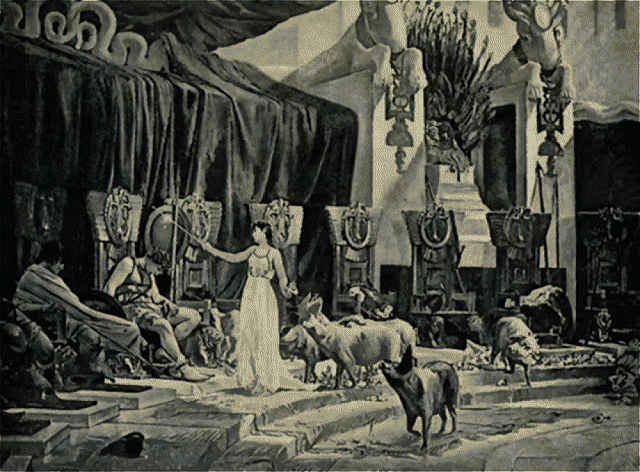
Next day occurs the famous trial of the bow of Odysseus, which none of the suitors can draw; then Odysseus gets the bow into his hands, strings it, sends the arrow through the axheads, and finally, leaping on the stone threshold, deals his shafts among the wooers. The wretched company are all slaughtered, the faithless women of the household are hanged, and ominous silence reigns over the palace of Odysseus.
Euryclea hastens to the upper chamber to bring to Queen Penelope the good news that Odysseus has surely come and has slain the haughty wooers. The fair lady can with difficulty believe the tidings, but she is finally persuaded to go down to see the wooers dead and him that slew them.
"With the word, she went down from the upper chamber, and much her heart debated whether she should stand apart and question her dear lord or draw nigh and clasp his head and hands. But when she had come within and had crossed the threshold of stone, she sat down over against Odysseus, in the light of the fire, by the further wall. Now, he was sitting by the tall pillar, looking down and waiting to know if perchance his noble wife would speak to him, when her eyes beheld him. But she sat long in silence, and amazement came upon her soul, and now she would look upon him steadfastly with her eyes, and now again she knew him not, for that he was clad in vile raiment. And Telemachus rebuked her, and spake and hailed her:
"'Mother mine, ill mother, of an ungentle heart, why turnest thou thus away from my father, and dost not sit by him and question him and ask him all? No other woman in the world would harden her heart to stand thus aloof from her lord, who, after much travail and sore, had come to her in the twentieth year to his own country. But thy heart is ever harder than stone.'
"Then wise Penelope answered him, saying: 'Child, my mind is amazed within me, and I have no strength to speak, or to ask him aught, nay, or to look on him face to face. But if in truth this be Odysseus, and he hath indeed come home, verily we shall be aware of each other the more surely; for we have tokens that we twain know of, even we, secret from all others.'
"So she spake, and the steadfast, goodly Odysseus smiled, and quickly he spake to Telemachus winged words: 'Telemachus, leave now thy mother to make trial of me within the chambers; so shall she soon come to a better knowledge than heretofore.'
"Meanwhile, the housedame Eurynome had bathed the great-hearted Odysseus within his house, and anointed him with olive oil, and cast about him a goodly mantle and a doublet. Moreover, Athena shed great beauty from his head downwards, and made him greater and more mighty to behold, and from his head caused deep, curling locks to flow, like the hyacinth flower. And as when some skilful man overlays gold upon silver, one that Hephæstus and Pallas Athena have taught all manner of craft, and full of grace is his handiwork, even so did Athena shed grace about his head and shoulders; and forth from the bath he came, in form like to the immortals. Then he sat down again on the high seat, whence he had arisen, over against his wife, and spake to her, saying:
"'Strange lady, surely to thee, above all womankind, the Olympians have given a heart that cannot be softened. No other woman in the world would harden her heart to stand thus aloof from her husband, who, after much travail and sore, had come to her, in the twentieth year, to his own country.--Nay, come, nurse strew a bed for me to lie all alone, for assuredly her spirit within her is as iron.'
"Then wise Penelope answered him again: 'Strange man, I have no proud thoughts, nor do I think scorn of thee, nor am I too greatly astonished, but I know right well what manner of man thou wert when thou wentest forth out of Ithaca, on the long-oared galley.--But come, Euryclea, spread for him the good bedstead outside the stablished bridal chamber that he built himself. Thither bring ye forth the good bedstead, and cast bedding thereon, even fleeces and rugs and shining blankets.'
"So she spake and made trial of her lord, but Odysseus in sore displeasure spake to his true wife, saying: 'Verily, a bitter word is this, lady, that thou hast spoken. Who has set my bed otherwhere? Hard would it be for one, how skilled soever, unless a god were to come that might easily set it in another place, if so he would. But of men there is none living, howsoever strong in his youth, that could lightly upheave it; for a great marvel is wrought in the fashion of the bed, and it was I that made it, and none other. There was growing a bush of olive, long of leaf, and most goodly of growth, within the inner court, and the stem as large as a pillar. Round about this I built the chamber, till I had finished it, with stones close set, and I roofed it over well and added thereto compacted doors fitting well. Next I sheared off all the light wood of the long-leaved olive, and rough-hewed the trunk upwards from the root, and smoothed it around with the adze, well and skilfully, and made straight the line thereto and so fashioned it into the bedpost, and I bored it all with the auger. Beginning from this headpost, I wrought at the bedstead till I had finished it, and made it fair with inlaid work of gold and of silver and of ivory. Then I made fast therein a bright purple band of oxhide. Even so I declare to thee this token, and I know not, lady, if the bedstead be yet fast in its place, or if some man has cut away the stem of the olive tree and set the bedstead otherwhere.'
"So he spake, and at once her knees were loosened, and her heart melted within her, as she knew the sure tokens that Odysseus showed her. Then she fell a-weeping, and ran straight towards him and cast her hands about his neck, and kissed his head and spake, saying:
"'Murmur not against me, Odysseus, for thou wert ever at other times the wisest of men. It is the gods that gave us sorrow, the gods who were jealous that we should abide together and have joy of our youth and come to the threshold of old age. So now be not wroth with me hereat nor full of indignation because I did not welcome thee gladly as now, when I first saw thee. For always my heart within my breast shuddered for fear lest some man should come and deceive me with his words, for many there be that devise gainful schemes and evil. Nay, even Argive Helen, daughter of Zeus, would not have lain with a stranger, and taken him for a lover, had she known that the warlike sons of the Achæans would bring her home again to her own dear country. Howsoever, it was the god that set her upon this shameful deed; nor ever, ere that, did she lay up in her heart the thought of this folly, a bitter folly, whence on us, too, first came sorrow. But now that thou hast told all the sure tokens of our bed, which never was seen by mortal man, save by thee and me, and one maiden only, the daughter of Actor, that my father gave me ere yet I had come hither, she who kept the doors of our strong bridal chamber, even now dost thou bend my soul, all ungentle as it is.'
"Thus she spake, and in his heart she stirred yet a greater longing to lament, and he wept as he embraced his beloved wife and true. And even as when the sight of land is welcome to swimmers, whose well-wrought ship Poseidon hath smitten on the deep, all driven with the wind and swelling waves, and but a remnant hath escaped the gray sea water and swum to the shore, and their bodies are all crusted with the brine, and gladly have they set foot on land and escaped an evil end; so welcome to her was the sight of her lord, and her white arms she would never quite let go from his neck.
"Now when the twain had taken their fill of sweet love, they had delight in the tales which they told one to the other. The fair lady spake of all that she had endured in the halls at the sight of the ruinous throng of wooers, who for her sake slew many cattle, kine, and goodly sheep; and many a cask of wine was broached. And, in turn, Odysseus, of the seed of Zeus, recounted all the griefs he had wrought on men, and all his own travail and sorrow; and she was delighted with the story, and sweet sleep fell not upon her eyelids till the tale was ended."
Filled with incidents of domestic life in heroic times, the Odyssey presents us a galaxy of women, if not more impressive, at any rate more brilliant than that of the Iliad. Of these attractive figures, who should first merit our consideration, if not the heroine of the poem?
Queen, wife, mother, the sentiment which most characterizes Penelope is love of husband, child, and home; her chief intellectual trait is prudence. We find in her the rare combination of warmth of temperament and sanity of judgment. Her sense of prudence does not exclude depth of devotion, longings for the absent one, and outbursts of indignation at the wrongs inflicted on her son. Her love for Odysseus is intense and constant. There is a beautiful legend that when Odysseus came to carry off his bride, her father entreated her to remain with him in his old age. The chariot is ready to bear her away, and the maiden pauses just a moment, hesitating 'twixt love and duty. Odysseus gives her her choice; but, drawing down her veil, she signifies that where her lover goes there will she go. This intensity of affection marks the twenty long years of separation. Every night, she bewails Odysseus, her dear lord, till gray-eyed Athena casts sweet sleep upon her eyelids. She ever longs for, though at times despairs of, his return; and she inquires of every stranger, that she may learn something of the wanderer. Penelope is also a devoted mother. Ever anxious about her son, she grieves for him when absent, and when at home guards him as far as possible from the insolence of the wooers. In her obedience to her son, she seems to have followed the Greek custom expected of a widow.
In her relations with the wooers, Penelope adopted the only attitude which was possible for a woman who would wait indefinitely for the return of her lord. Parents and son, Greek custom and precedents, all expected that a widow should remarry after so long an interval. And the wooers were insolent, overwhelming the palace and rapidly making away with the patrimony of Telemachus. Hence, only by coquettish dallying could she postpone the evil day.
In all things Penelope was a model housewife, ever engaged in feminine tasks, overseeing her maidens at their work, watching over the younger servants with the solicitude of a mother, and observing toward the aged slave the deference of a daughter. But when the uncivil Melantho is deficient in respect, the queen calls her severely to a sense of her duty. When her husband returns, for whom she has waited during twenty long years of widowhood, she does not throw herself straightway into his arms. She fears a god may deceive her, and, the better to preserve for Odysseus the treasures of the tenderness stored up in her heart, she devises every cunning test to make sure it is really he. Never was there in woman's heart a more ardent flame of love and devotion; never in a woman's head intelligence so subtle, judgment so sure. When we fully appreciate the charm of Penelope's character, we better understand how the hero should sacrifice the devotion of a goddess for the love of such a woman.
"These two meet at last together, he after his long wanderings, and she after having suffered the insistence of suitors in her palace; and this is the pathos of the Odyssey. The woman, in spite of her withered youth and tearful years of widowhood, is still expectant of her lord. He, unconquered by the pleasures cast across his path, unterrified by all the dangers he endures, clings in thought to the bride whom he led forth, a blushing maiden, from her father's halls. O just, subtle, and mighty Homer! There is nothing of Greek here more than of Hebrew, or of Latin, or of German. It is pure humanity."
Closely interwoven with the plot of the Odyssey is the aged and touching figure of the faithful slave Euryclea, who by her devotion has become a member of the family she serves. Taken captive in her girlhood, she had nursed Odysseus in his childhood, and, later, his own son, Telemachus. Thus she is to both a second mother. She assists the queen in managing the house, in bringing up her son, in succoring the stranger. When she recognizes her master, how ravishing is her joy, how she longs to share it with her mistress! Yet she knows how to keep a secret.
Circe and Calypso are styled goddesses, yet they are brought down to earth in their love for Odysseus, and are thoroughly human in their traits. Calypso feeds on ambrosia and nectar, and lives in a mysterious grotto on an enchanted island; yet she loves like any mortal woman, and bitter is her wail when she receives the command of the gods to let Odysseus go. The enchantress Circe is much more dangerous, and takes a ghoulish delight in metamorphosing men into swine; yet, when she falls in love with Odysseus, she is the queenly lady, considerate of his comrades, and in every way his guide, philosopher, and friend. Unlike Calypso, she seeks not to detain Odysseus against the will of the gods, but after the expiration of a year sends him on his way.
To return to the domestic heroines: Queen Arete of Phæacia is, like Penelope, an example of the elevated position held by women in the royal houses of heroic times. She exerts over the subjects of her husband the same influence she exercises in the family circle. Her children share the reverence and affection she has from husband and people. To her Odysseus makes supplication; for if he win her favor, sure is his return to his native land; she bids her people prepare gifts for her guest friend at his departure, and to her Odysseus extends the pledging cup in saying farewell.
Where can one find phrases sufficiently subtle, expressions sufficiently delicate, to reproduce the sweet picture of Nausicaa? Of all the creations of poetic fancy, none equals her in perennial charm. "She is simply," says Symonds, "the most perfect maiden, the purest, freshest lightest-hearted girl of Greek romance." This immortal child of the poetic imagination will, with two real women,--Lesbian Sappho, and Mary, Queen of Scots,--have lovers in every age and in every clime. Though merely a poet's fancy, Nausicaa is absolutely human and full of life, and thus differs from the heroine of The Tempest, who of all poetic creations most resembles her. Note her naive grace and charm, her girlish vivacity and joy, at the beginning of the scene; and when the occasion demands it, the girl becomes the woman, and with unaffected simplicity and dignity she addresses the hero. No wonder that Odysseus should seem the Prince Charming for whom she had been waiting; and there may have been a slight chill of disappointment when, in expressing his gratitude for his deliverance, he made her his patron saint instead of his sweetheart. Yet, no doubt, she soon learned that the unknown hero was the great Odysseus, husband of faithful Penelope, and hers was too buoyant, too healthy a nature to pine away and die at the shattering of a dream. Then, even if he had been a widower, he was too old for this bright beauty. But what an ideal father-in-law he would make! And if the young Telemachus should only come to Scheria!--and how do we know that he did not later arrive there, sent a-courting by Odysseus after the restoration of his realm? Eustathius preserves a tradition, based on such good authorities as Hellanicus and Aristotle, that Telemachus actually did wed the Princess Nausicaa; and the Athenian orator Andocides claimed to be a descendant of this illustrious pair.
So beautiful a legend could not escape treatment by later poets. Alcman, one of the earliest lyric composers, describes in a poem the meeting of Odysseus and Nausicaa, and Sophocles wrote a drama entitled Nausicaa, or The Washers; and there is a tradition that, contrary to his usual custom, the poet himself "appeared as an actor, winning much applause by his beauty and grace in the dancing and rhythmic ball play, in the character of Nausicaa herself." Lucian names her among the heroines of mythical times who, through their goodness of heart, humanity, gentleness of demeanor, and compassion toward the needy, deserve to rank as patterns of womanly virtue.
With such brilliant pictures of domestic life--the queens Penelope, Helen, and Arete, exerting a womanly influence in the palaces, the goddess-lovers Circe and Calypso on their enchanted islands, the slave Euryclea tenderly caring for mistress and young master, and the maiden Nausicaa, engaged in occupation and in pastime with her girl friends--the Odyssey is a mirror reflecting the character of the Heroic Age of Greece.
V
THE LYRIC AGE
From the fascinating visions of the heroic past as they are presented in the Homeric poems, we must now prepare to descend to the actualities of life as they disclose themselves at the dawn of Greek history. Hesiod, the epic poet of Boeotia, constitutes the bridge, as regards social conditions, between the Heroic Age and the early historical periods of the various peoples and cities of Greece. He describes the actual conditions about him, and gives us glimpses of the life of the Greek people which prepare us for the great changes that have taken place through the overturning of monarchies, the spread of commerce and colonization, and the awakening of the common people to a sense of their rights and their power. Hence we may expect to find in his poetry much light on the status of woman in remote times.
Hesiod is usually ascribed to the second half of the ninth century before the Christian Era. He lived at Ascra, near Mount Helicon, in Boeotia, the original home of the Æolians. Amid agricultural surroundings the poet grew up. Defrauded by his brother Perses of part of his inheritance, he experienced hardships that quickened his sympathy for the plain people and led him to reflection on life and its problems. He was commissioned by the Muses, who appeared to him on Mount Helicon, to utter true things to men--a phrase which strikes the keynote to his poetry, for he dealt in realities and sought to alleviate the social conditions of his times. His principal works are the Works and Days and the Theogony; there was also a Hesiodic Catalogue of Women, attested by many allusions in classical writers, but, unfortunately for our purpose, altogether lost to us. Very probably in this work, Hesiod or his school told of the aristocratic women of Greek mythology, from whose union with gods had sprung heroes. Lacking this, Hesiod is to us "the poet of the Helots," and we gain from him only knowledge of the common people of Boeotia and their manner of life.
Hesiod's estimate of women is vastly inferior to that of Homer. Homer, who sang for aristocratic ladies at the court of kings, has introduced us into a society where women presided over their houses with grace and dignity, and softened and refined the rough, warlike manners of men. Hesiod, the poet of the plain people, is impressed with the hopelessness of the conditions about him. The people are oppressed by the nobles; it is impossible for them to obtain justice; the world seems all wrong. And in seeking the causes of existing evils, the poet traces them back to the one great evil which the gods have inflicted upon men; and that is--woman.
This indictment first finds expression in his version, of the myth of Pandora, the Mother Eve of Greek legend.
Hesiod tells us in this poem that in old days the human race had the use of fire, and in gratitude to the gods offered burnt sacrifice. But Prometheus had defrauded the gods of their just share of the sacrifices and had compelled Zeus to be content with merely the bones and fat; and, in return for this deception, Zeus devised grievous troubles for mortals by depriving them of fire. Prometheus then stole fire from heaven. Zeus, angered at being outwitted by the crafty Prometheus, determined to inflict on men a bane from which they would not quickly recover. He straightway commanded Hephæstus to mix earth and water, to endow the plastic form with human voice and powers, and to liken it to a heavenly goddess--virginal, winning, and fair. Athena was commanded to teach her the domestic virtues; Aphrodite, to endow her with beauty, eager desire, and passion that wastes the bodies of mortals; and Hermes, to bestow on her a shameless mind and a treacherous nature. All obeyed the command of Zeus, and in this manner was fashioned the first woman. Then Athena added a girdle and ornaments; the Graces and Persuasion hung their golden chains over her body, and the Hours wove for her garlands of spring flowers. The name given this fascinating creature was Pandora, because each of the gods had bestowed on her gifts to make her a fatal bane unto mortals.
Hermes then led her down to earth to present her to Epimetheus, whom his brother Prometheus had bidden never to receive any presents from Olympian Zeus. Epimetheus, however, was captivated by Pandora's beauty and received her, and only after the evil befell did he remember his brother's command. Until the advent of woman, men, it is said, had lived secure from trouble, free from wearisome labor, and safe from painful diseases that bring death to mankind. But now Pandora with her hands lifted the lid from the great jar with which the gods had dowered her, the great jar wherein these evils had been securely imprisoned, and let them loose upon the earth. With the sorrows, hope had been confined; but when they were loosed, hope flew not forth, for too soon Pandora closed the lid of the vessel. Hence, laments Hesiod, hopeless is the lot of humanity, while innumerable ills pass hither and thither among hopeless men. Such is the mythus of the fall of man, as imagined by the early Greeks. Man was punished for rebelling against the will of heaven. Woman is the instrument of his chastisement, thrust upon him by the angry deity. She possesses every charm, every allurement, but her very fascination is a chief cause of ill to man. He in his folly receives her, and thence befall him all the ills of life. The whole argument of Hesiod in this passage indicates that he regarded woman as "a necessary deduction from the happiness of life," as "the rift in the lute that spoils its music." Contrasted with the Hebrew story, the Greek represents woman as closing the door of hope to man; while the Hebrew version sees in her seed the hope of the salvation that is to overcome the evils of the fall. Even stronger is Hesiod's invective against the female sex in the Theogony, where he repeats the story of Pandora, and concludes with the following reflections:
"From her the sex of tender woman springs; Pernicious is the race; the woman tribe Dwells upon earth, a mighty bane to men; No mates for wasting want but luxury; And as within the close-roofed hive, the drones, Helpers of sloth, are pampered by the bees; These all the day, till sinks the ruddy sun, Haste on the wing, 'their murmuring labors ply,' And still cement the white and waxen comb; Those lurk within the covered hive, and reap With glutted maw the fruits of others' toil; Such evil did the Thunderer send to man In woman's form, and so he gave the sex, Ill helpmates of intolerable toils. Yet more of ill instead of good he gave: The man who shunning wedlock thinks to shun The vexing cares that haunt the woman-state, And lonely waxes old, shall feel the want Of one to foster his declining years; Though not his life be needy, yet his death Shall scatter his possessions to strange heirs, And aliens from his blood. Or if his lot Be marriage and his spouse of modest fame Congenial to his heart, e'en then shall ill Forever struggle with the partial good, And cling to his condition. But the man Who gains the woman of injurious kind Lives bearing in his secret soul and heart Inevitable sorrow: ills so deep As all the balms of medicine cannot cure."
This passage contains in brief Hesiod's general ideas concerning woman. Pandora brought infinite ills to mortals, for from her sprang the tribe of woman, "a mighty bane to men." If a man marry, he will be sorry; and if he refrain from marriage, he will regret it. A wretched old age awaits the bachelor; and his possessions, at his death, are dissipated by indifferent kindred. Even if he marry, and get a good wife, sorrows and blessings are mingled in his lot; while if his wife be bad, ills so deep are his "as all the balms of medicine cannot cure." So woman is a being whose presence is a necessary evil; without her, man's destiny is not complete, but he must endure the ills she brings for the sake of the possible blessing that may come by sharing one's lot with her. A man, says the bard of Ascra, cannot be too cautious in choosing his helpmate, as the following sage counsel indicates:
"Take to thy house a woman for thy bride When in the ripeness of thy manhood's pride; Thrice ten thy sum of years, the nuptial prime; Nor fall far short nor far exceed the time. Four years the ripening virgin shall consume, And wed the fifth of her expanding bloom. A virgin choose: and mould her manners chaste; Chief be some neighboring maid by thee embraced; Look circumspect and long; lest thou be found The merry mock of all the dwellers round. No better lot has Providence assigned Than a fair woman with a virtuous mind; Nor can a worse befall than when thy fate Allots a worthless, feast-contriving mate. She with no torch of mere material flame Shall burn to tinder thy care-wasted frame; Shall send a fire thy vigorous bones within And age unripe in bloom of years begin."
The vein of contempt for woman which runs through the verses of Hesiod finds many echoes in later writers, which indicates that in this transition period, especially in Ionian Greece, evil influences were at work, causing men to rebel against the shackles of wedded life and to fail to realize the happiness they desired in the home and in the family. It seems strange that Hesiod, in describing farm duties, should not tell us more of the important function of the housewife. Yet in one passage he merely emphasizes the importance of starting with "a house, a wife, and an ox to plow," and in other passages speaks disparagingly of woman and her work. So that even in lines where he might well have commended her virtues the words of praise are left unsaid.
The two centuries of Greek history following Hesiod are chiefly known to us through the lyric poets, as epic poetry declined and the writing of history had not yet begun. Lyric poetry is an index to the hearts of the people: for in lyric poetry are expressed the thoughts and feelings of reflective man. Woman is the great mainspring of existence; she it is who is the general cause of man's thoughts, emotions, passions, joys, and sorrows. Hence, as lyric poetry is the poetry of the heart, we find recorded in the verses of Grecian lyrists man's attitude toward woman in this period of "storm and stress" in the development of Greek nationality.
Archilochus is the father of iambic poetry, and he made it the medium of expression of personal passion and satire. With all the ardor of his nature, he loved Neobule, daughter of Lycambes, of the island of Paros, where the poet had made his home. Certain fragments of his poems, still extant, indicate the intensity of the flame with which he was consumed. Archilochus has left us an exquisite picture of his loved one, clad in all the beauty and grace a poetic lover could portray, with a rose and a myrtle branch in her hand, and her tresses falling caressingly over her shoulders. He sighed "were it to touch but her hand," and she seems at first to have returned his affection. The lovers were betrothed, but suddenly the father objected, and the match was broken off. Love immediately turned into hate, and passion changed into rage. Thereupon, as Horace says:
"Archilochum proprio rabies armavit iambo,"
Archilochus used the iambic metre as his weapon of attack. As his love had been ardent, so, when betrayed, his rage was uncontrollable. Every possible taunt was cast at those who had deceived him. "Each verse he wrote was polished and pointed like an arrow head. Each line was steeped in the poison of hideous charges against his sweetheart, her sister, and her father. The set of poems which he produced, and, as it would appear, recited publicly at the festival of Demeter, was so charged with wit and fire that the country rang with them. The daughters of Lycambes, tradition avers, went straightway and hanged themselves--unable to endure the flight of fiery serpents that had fallen upon them; for, to quote the words of Browning, Archilochus had the art of writing verse that 'bit into the live man's flesh like parchment,' that sent him wandering, branded and forever shamed, about his native fields and streets."