Volume 1 — Illustrated (continued 4)
Reading edition
In the seclusion of the gyncæconitis, the girl-child was reared by its mother and nurse. Her playthings--dishes, toy spindles, and dolls--were such as to cultivate her taste for domestic duties. No regular public and systematized instruction was provided for a girl; no education was deemed necessary, for her life was to be devoted to the household, away from the world of affairs. But though there were no schools for maidens to attend, reading and writing and the fundamentals of knowledge were regularly imparted by a loving mother or a faithful nurse. The frescoed walls made the girls acquainted with the stories of mythology, and music and the recitation of poetry were frequent sources of instruction and recreation in the homes of the well-to-do. The maidens were, above all, made proficient in the strictly feminine arts of housekeeping, spinning, weaving, and embroidery. They were rigidly excluded from any intercourse with the other sex, and their contact with the outside world was confined to participation in the religious festivals, which occupied so large a part in the everyday life of the Greeks. "When I was seven years of age," says the chorus of Athenian women in the Lysistrata of Aristophanes, "I carried the mystic box in the procession; then, when I was ten, I ground the cakes for our patron goddess; and, clad in a saffron-colored robe, I was the bear at the Brauronian festival; and I carried the sacred basket when I became a beautiful girl." Such were the opportunities granted to the highborn Athenian maiden for occasional glimpses of the splendor and activity of her native city; and can we doubt that on such occasions she was impressed by the sublimity of the temples and works of art, and that there were cast many modest glances at the handsome youths on horseback, who, in turn, were fascinated by the beauty and freshness of these tenderly nurtured maidens?
The seclusion of Athenian girls and the careful rearing which they received at the hands of mothers and nurses were such as to fit them to rule the home. The Athenian maiden was noted throughout Hellas for her modesty and sweetness. The intelligence was not cultivated, but the heart and sensibilities had ample scope for development in the duties and recreations of the gynæconitis and in the participation in religious exercises. Such a simple and peaceful rearing tended to preserve the delicacy of the soul and to keep unstained innocence and purity. When comparison is instituted with the Spartan system, preference must be given to the Athenian method of education, with all its defects. The sweet modesty imparted by seclusion was far more womanly than the boldness of bearing acquired by athletic exercises in the presence of young men. The Spartan system trained the woman for public life, to be the patriotic mother of warriors; the Athenian system prepared the maiden to be the guardian of the home, the affectionate and devoted mother.
When the maiden reached the age of fifteen, her parents began negotiations for her marriage. An Athenian marriage was essentially a matter of convenience, and was usually arranged by contract between the respective fathers of the youth and maiden. Equality of birth and fortune were generally the chief considerations in the selection of the son-in-law or the daughter-in-law; and in an atmosphere where the attractions of a maiden were so little known, a professional matchmaker frequently brought the interested parties together. Thus the rustic Strepsiades, in Aristophanes's Clouds, expresses the wish that the feminine matchmaker had perished miserably who had induced him to marry the haughty, luxurious, citified niece of aristocratic Megacles, son of Megacles.
The Homeric custom of bringing valuable presents or of performing valiant deeds to win a maiden's hand had long passed away, and, in the great days of Athens, the father had to provide a dowry consisting partly of cash, partly of clothes, jewelry, and slaves. Solon, who, as Plutarch tells us, wished to have marriages contracted from motives of pure love or kind affection, and to further the birth of children, rather than for mercenary considerations, decreed that no dowries should be given and that the bride should have only three changes of clothes; but this good custom had passed away with the era of simple living. So distinctly was the dowry the indispensable condition of marriage, that poor girls were often endowed by generous relatives, or the State itself would provide a wedding portion for the daughters of men deserving well of their country. For example, when the Athenians heard that the granddaughter of Aristogiton, the Tyrannicide, was in needy circumstances in the isle of Lemnos, and was so poor that nobody would marry her, they brought her back to Athens, married her to a man of good birth, and gave her a farm at Potamos for a marriage portion. The dowry was generally secured to the wife by rigid restrictions; in most cases of separation, the dowry reverted to the wife's parents; and though the husband's fortune might be confiscated, the marriage portion of the wife was exempt.
Of the ceremonies and formalities of marriage, the solemn betrothal was the first and most important, as it established the legality of the union; and it was at this ceremony that the dowry was settled upon the bride. In the presence of the two families, the father of the maiden addressed the bridegroom in the following formula: "That legitimate children may be born, I present you my daughter." The betrothed then exchanged vows by clasping their right hands or by embracing each other, and the maiden received a gift from her affianced as a token of love. The marriage usually followed close upon the betrothal.
The favorite month for the ceremony was named Gamelion, or the "marriage month"; this included part of our January and part of February. On the eve of the wedding, the good will of the divinities protecting marriage, especially Zeus Teleios, Hera Teleia, and Artemis Eukleia, was invoked by prayer and sacrifices.
Strange to say, the wedding itself, though given a religious character by its attendant ceremonies, was neither a religious nor a legal act. The legality of the marriage was established by the betrothal, while its religious aspect was found solely in the rites in honor of the marriage gods.
A second ceremony, universally observed, was the bridal bath, taken individually by both bride and bridegroom previously to their union. In Athens, from time immemorial, the water for this bath was taken from the sacred fountain, Callirrhoë, called since its enclosure by Pisistratus "Enneacrunus," or "the Nine Spouts." Authorities differ as to whether a boy or a girl served as water carrier on this occasion; but the latter supposition is supported by an archaic picture on a hydria, representing the holy fountain Callirrhoë flowing from the head of a lion under a Doric superstructure. A girl, holding in her hand branches of laurel or myrtle, looks musingly down on a hydria, which is being filled with the bridal water. Five other maidens are grouped about the fountain, some with empty pitchers awaiting their turn, others about to go home with their filled pitchers. No doubt it is in the month of marriage, and many maidens are preparing for the happy event.
On the wedding day, toward dark, a feast was held at the parental home, at which were gathered all the bridal party--for this was one of the few occasions in Athenian life when men and women dined together. Here the bride and groom appeared, clad in purple and crowned with flowers sacred to Aphrodite. The distinctive mark of the bride was the veil, which covered her head and partly concealed her face. All the guests wore wreaths in honor of the joyous event. With her own hand the bride plucked the poppies and sesame which were to crown her forehead, for it would have been an ill omen to wear a nuptial wreath that had been purchased.
Soon the banquet is concluded with libations and prayer, just as night begins to fall. Then the bride leaves the festively adorned parental home, and takes her place in a chariot, between the bridegroom and his best man, for the wedding journey to her new abode. The place of honor in the procession that follows is held by the bride's mother, who walks behind the chariot, carrying the wedding torches, which have been kindled at the family hearth, that the bride may have the sacred fire of her own home continued in her new dwelling. The festal company join in singing the wedding song to Hymenæus to the sound of flutes as the chariot leads slowly toward the bridegroom's house. At the close of the Birds of Aristophanes, when occurs the wedding of Pisthetærus and Basileia, the chorus attends the wedded pair with the following lines:
"Jupiter, that god sublime, When the Fates in former time Matched him with the Queen of Heaven At a solemn banquet given, Such a feast was held above, And the charming God of Love Being present in command, As a bridegroom took his stand With the golden reins in hand, Hymen, Hymen, Ho!"
The new home, like that of the bride's father, is adorned with garlands of laurel and ivy--the laurel for the husband, as the symbol of victory, and the delicate and graceful ivy for the bride, embodying her attachment for her husband, as that of the ivy for the sturdy oak. At the door, the bridegroom's mother is awaiting the young couple, with the burning torches in her hand. As the spouses enter, a shower of sweetmeats is poured upon their heads, partly in jest, partly to symbolize the abundance and prosperity invoked upon them. To typify the bride's new duties as mistress of the house, a pestle used for bruising corn has been hung up near the bridal chamber; and in conformity to another custom, prevailing since the days of Solon, she is expected to eat a quince, which was considered to be a symbol of fruitfulness. Soon the bridegroom's mother attends the couple to the thalamos, or nuptial chamber, where, for the first time, the bride unveils herself to her husband. Meanwhile, before the door, the bride's attendants, crowned with hyacinth, join in the epithalamium, or marriage hymn, a characteristic specimen of which we possess in the bridal hymn to Helen, by Theocritus:
"Slumberest so soon, sweet bridegroom? Art thou overfond of sleep? Or hast thou leaden-weighted limbs? Or hast thou drunk too deep When thou didst fling thee to thy lair? Betimes thou shouldst have sped, If sleep were all thy purpose, Unto thy bachelor's bed, And left her in her mother's arms, To nestle and to play, A girl among her girlish mates, Till deep into the day:-- For not alone for this night, Nor for the next alone, But through the days and through the years Thou hast her for thine own."
And it ends thus:
"Sleep on, and love and longing Breathe in each other's breast, But fail not when the morn returns To rouse you from your rest; With dawn shall we be stirring, When, lifting high his fair And feathered neck, the earliest bird To clarion to the dawn is heard. O God of brides and bridals, Sing, 'Happy, happy pair!'"
A fragment of Anacreon has preserved for us an example of the morning nuptial chant, sung by the chorus to greet the bride and groom on their awakening:
"Aphrodite, queen of goddesses; Love, powerful conqueror; Hymen, source of life: it is of you that I sing in my verses. 'Tis of you I chant, Love, Hymen, and Aphrodite. Behold, young man, behold thy wife! Arise, O Straticlus, favored of Aphrodite, husband of Myrilla, admire thy bride! Her freshness, her grace, her charms, make her shine among all women. The rose is queen of flowers; Myrilla is a rose midst her companions. Mayst thou see grow in thy house a son like to thee!"
Then begins a second fête day for the bridal pair. Husband and wife receive visits and gifts from relatives and friends, and exchange presents with each other. The festivities are concluded with a banquet in the husband's home, at which the wife's position in the clan of her husband's family is recognized; and she may now appear without her veil, as the mistress of her new home.
Wedding scenes are frequently the subject of illustration in antique art. The most remarkable of these is the splendid wall painting known as the Aldobrandini Wedding, preserved in the Vatican. It represents, painted on one surface, three different scenes of the marriage ceremony. The central picture represents a chamber of the gynoe onitis, where the bride, chastely veiled, reclines on a beautiful couch; "Peitho, the goddess of persuasion, sits by her side, as appears from the crown on her head and from the many-folded peplus falling over her back. She pleads the bridegroom's cause, and seems to encourage the timorous maiden. A third female figure, to the left of the group, leaning on a piece of a column, seems to expect the girl's surrender; for she is pouring ointment from an alabastron into a vase made of shell, so as to have it ready for use after the bridal bath. Most likely she represents the second handmaiden of Aphrodite, Charis, who, according to the myth, bathed and anointed her mistress with ambrosial oil in the holy grove of Paphos. The pillar at the back of Charis indicates the partition wall between this chamber and the one next to it on the left. We here see a large basin filled with water, standing on a columnar base. The water is perhaps that of the well Callirrhoë, fetched by the young girl standing close by for the nuptial bath. The girl seems to look inquiringly at the matronly figure approaching the basin on the other side, and putting her fingers into the water as if to test its warmth. Her sublime form and priestly dress, together with the leaf-shaped instrument in her hand (probably the instrument used at lustrations), seem to portray her as Hera Teleia, the protecting goddess of marriage, in the act of examining and blessing the bridal bath. The third scene of the picture is placed at the entrance of the bride's house. The bridegroom, crowned with vine branches, is sitting on the threshold, as if listening impatiently for the close of the ceremony inside the house. In front of him is a group of three maidens, one of whom seems to be making an offering at a portable altar, while the other two begin the hymenæus to the accompaniment of the cithara."
With the completion of the marriage ceremonies, the maiden has passed from the gynæconitis of her father to that of her husband; but, though still under masculine control, she is absolute mistress of her limited sphere; yet she is expected to refrain from manifesting interest in the public affairs of her husband and to confine her attention to her domestic duties.
"Good women must abide within the house; Those whom we meet abroad are nothing worth,"
writes the poet; and this couplet expresses the Athenian husband's idea of the wife's proper sphere of activity. His life is essentially an outdoor one. The market place, a the law courts, the numerous colonnades, are the centres of his activity, where he passes his time in attending to business, in discussing politics, in telling or hearing some new thing. His recreations consist in visiting the palæstræ or the gymnasia, the clubhouses of ancient Greece, and in participating with his chosen friends in banquets at which beautiful flute players and cultivated hetæræ afford pastime and amusement. He passes but little time at home.
Meanwhile, the wife superintends the slaves and assigns them their several duties; she looks after the stores, utensils, and furnishings of the household; she presides over the kitchen; she nurses the sick; and, above all, she devotes her attention to the careful rearing of the children, whose prattle breaks the otherwise monotonous existence of the women's apartments. Occasionally, she visits her friends, or receives them in her house; but the gathering of women was discouraged by the husbands, who believed the effect of gossip to be matrimonial discontent.
Religious ceremonies occupied a large part of feminine life, and women over sixty might attend any funerals to which inclination called them; and funerals among the Greeks, save in isolated cases, were not hopelessly solemn affairs. These elderly women were also privileged to attend memorial exercises in honor of the distinguished dead, and it was on an occasion such as this that Thucydides puts into the mouth of Pericles the famous dictum, expressing so aptly the Athenian conception of the ideal woman: "The best wife is the one of whom the least is said, either of good or evil." The tortoise was the symbol of feminine life--the creature that never goes out of her shell. Lycurgus draws a dramatic picture of the receipt of the news at Athens of the fateful day at Chæronea, when the Athenian women stood in the doors of their houses, making inquiries concerning husbands and brothers and fathers, but not, as might have been expected, gathering in the streets to discuss the terrible tidings.
Although their opportunities for social life were so limited, the Athenian women devoted much time to their toilet. Bathing was a daily habit, and was attended by anointing with oils and fragrant essences. The dignity and grace of Athenian dress are admirably illustrated by the drapery of the female forms which support the roof of the southern portico of the Erechtheum. The tunic, with its overhanging diplois, fastened round the hips by means of a girdle, was gracefully arranged in symmetrical folds. Linen was usually the material employed, and white was the favorite color among modest Greek women; yet particolored Oriental garments were also worn. Dresses were frequently adorned with inwoven patterns and attached borders and embroideries. The outer garment was the mantle, or peplos, shaped like a shawl and capable of a variety of picturesque drapings. The headdress of women was simple. Hats were not worn, except on journeys, and, beyond the customary veil, the chief ornament was a band for holding together the plentiful hair. This was frequently knotted at the top of the head and fastened by pins of gold and silver, the tops of which were shaped like the pineapple or the lotus flower; sometimes the front hair was arranged in small ringlets, while the back hair partly fell smoothly over the neck, and partly descended below the shoulders in long curls. Frequently, ribbons were used to bind the hair, adorned, where it rested on the forehead, with a plaque of metal formed like a frontal, called the stephané; or a band of cloth or leather was used, broad in the centre and growing narrower at the ends, styled sphendoné from its similarity to a sling. Sandals were the usual form of footwear, and variety was given by the length and graceful folding of the straps. Exquisite simplicity was also seen in the jewelry. The chief ornament was the necklace; these were sometimes composed of balls of gold and garnets intermingled, or of emeralds alternating with fine pearls and attached by little chains. Bracelets owe their Greek name to the form they were generally given--that of a serpent. They were usually worn on the wrist, sometimes on the upper arm, and sometimes even about the ankle. At times, bracelets were merely circlets of gold. Sometimes they were adorned with medallions at intervals, sometimes they were set with emeralds, garnets, or pearls. The ear-rings were of graceful form, sometimes representing a swan in black enamel, with bill, wings, feet, and tail of gold, sometimes a dove on a delicate pedestal, a bunch of grapes with a golden stem, or a sphinx, or a panther's head. The clasps or buckles which bound the tunic or the peplus, usually shaped in the form of an arc, exhibited rare beauty. Rings, set with carnelian, agate, sardonyx, amethyst, and other gems, and brooches of every variety, completed the ornaments in the jewel cases of the Athenian women.
In disclosing the secrets of the Athenian toilet, love of truth compels us to state that these fair dames had recourse to the use of cosmetics, perhaps to overcome the paleness of complexion incident to lack of outdoor life. Cheeks and lips were given a ruddy hue by the use of minium, or the root of the alkanet; eyebrows were darkened by applying pulverized antimony; and dark hair could be changed to blonde by the use of a certain powder, which gave a golden tint, much sung of by poets.
When one reads of the great attention paid by the Athenian women to the cultivation of grace of form, of taste in dress, and of beauty of feature, it is hard to realize that such charms were confined to the women's apartments, and merely revealed themselves to the outside world on festive occasions.
Though the gallantry of modern times was not a part of the habitual equipment of an Athenian gentleman, yet he was very careful as to his behavior in the presence of ladies. There was strict observance of the etiquette which controlled the relations of the sexes. No gentleman would enter an abode of women in the absence of the master, and unbecoming language in the presence of women was a gross offence. The husband carefully abstained in his wife's presence from doing anything that might lower her estimation of his dignity. A certain distance was apparently maintained between married persons, and cordial familiarity was sometimes sacrificed to love of social forms. No doubt, too, fine breeding and true courtesy were generally shown the wife and ruler of his home by the Athenian husband who, like Agathon in the Symposium of Plato, exhibited the most delicate tact and sentiment in his treatment of men.
In the peaceful atmosphere of the home, the Athenian gentlewoman was expected to live an irreproachable life. Infidelity on the part of the husband was regarded as a venial office, but the wife who violated her marriage vows was punished with the most terrible disgrace. Should she marry again, the man who ventured to wed her was disfranchised. She was to all intents and purposes an outcast from society. If she appeared in a temple, she might be subjected to any indignity short of death. Furthermore, a man could divorce his wife on the slightest pretext; while the wife, to obtain a divorce, was compelled to lodge with the archon a complaint against her husband and a prayer for the return of her dowry, and in the ensuing process she was subjected to many delays and inconveniences. Then, as she was still a minor in the eyes of the law, a wife who had left her husband was obliged to return to a state of tutelage under her father or brother; and many a suffering wife endured in silence neglect or ill usage rather than thus return to her father's control. Yet many a high-spirited woman revolted against the infidelities of her husband. The saddest incident of this marital inequality that we find in Greek literature is the story of Alcibiades's wife, Hipparete, and her case shows how difficult it was for a wife to assert her rights. Hipparete's early death leaves on the reader the impression that her heart was broken by her brilliant husband's inconstancy and brutality.
"Hipparete," writes Plutarch, "was a virtuous and dutiful wife, but at last growing impatient because of the outrages done to her by her husband's continual entertaining of hetæræ, strangers as well as Athenians, she departed from him and retired to her brother's house. Alcibiades seemed not at all concerned at this, and lived on still in the same luxury; but the law required that she should deliver to the archon, in person, and not by proxy, the instrument by which she claimed a divorce; and when, in obedience thereto, she presented herself before the archon to perform this, Alcibiades came in, caught her up, and carried her home through the market place, no one daring to oppose him or to take her from him. She continued with him till her death, which happened not long after, when Alcibiades had gone to Ephesus."
We find in Xenophon's remarkable treatise on Domestic Economy an interesting description of the method pursued by a model Greek gentleman in training for her domestic duties his young wife, a tender girl of fifteen, reared under the strictest restraint to the end that she might "see as little, hear as little, and ask as few questions as possible."
He was not content that his young wife should simply know the ordinary household duties of spinning and weaving, and directing her maid, but he wished to educate her so that she might have larger conceptions of her sphere as well as the ability to understand what was desirable for the happiness of both. The account which the model husband, Ischomachus, gives in his dialogue with Socrates of his experience in wife training throws many sidelights on the marriage relations of the Athenians and the philosophy of their system. As soon as the child-wife was properly domesticated, so that she dared to converse freely, her husband began to talk to her of their mutual responsibilities and to inculcate those lessons which would be to their mutual advantage. She was now, he goes on, the mistress of his house; henceforth everything should be theirs in common--the caring for their fortune, as well as the education of the children whom the gods might grant them. He will never question which of them has done the more to increase their common store, but each shall strive to contribute largely to that fortune.
The young wife, in her astonishment at such words, asks: "How can I help you in this, or wherein can the little power I have do you any good? For my mother told me that both my fortune as well as yours was wholly at your command, and that it must be my chief care to live virtuously and soberly."
ISCHOMACHUS.--This is true, good wife; but it is the part of a sober husband and virtuous wife not only to preserve the fortune they are possessed of, but to contribute equally to improve it.
WIFE.--And what do you see in me that you believe me capable of assisting in the improvement of your fortune? ISCHOMACHUS.--Use your endeavor, good wife, to do those things which are acceptable to the gods and are appointed by the law for you to do.
WIFE.--And what are those things, dear husband?
Ischomachus then enumerates the things which are acceptable to the gods and appointed by the law, and determines the limits which separate the duties of man from those of woman. He says: "The wisdom of the divinity has prepared the union of the two sexes, and has made of marriage an association useful to each one,--a union which will secure for them, in their children, support in their old age.
"It is man's duty to acquire food, to be busied with field work, to care for flocks, and to defend himself against enemies. Therefore the god has given him strength and courage. The woman must care for and prepare the food, weave garments, and rear the children. Therefore the god has given her a delicate physique which will keep her in the home, an exquisite tenderness of heart which brings about her maternal care and love and a watchful vigilance for the safety of her little ones.
"Since they are united for their common advantage, they are endowed with the same faculties of memory and diligence. Both are endowed with the same force of soul to refrain from things harmful, and the one who practises this virtue the more has, by the grace of the divinity, the better recompense. However," he adds, "as they are not equally perfect, they have the more occasion for each other's assistance; for when man and woman are thus united, what the one has occasion for is supplied by the other."
Ischomachus then shows that in well performing their respective functions husband and wife conform themselves to the rules of the good and the beautiful. If the wife leave the home, or the husband remain there, he or she is violating the laws of nature. He compares the duties of the wife to those of the queen bee, which, without leaving the hive, extends her activity around her, sends others to the field, receives and stores away provisions as they are brought, watches over the construction of cells, and brings up the little bees.
There is one duty of which he tells her with hesitation--the caring for the slaves when they may be ill. But to his great joy she responds: "That is surely an act of charity, and becoming every good-natured mistress, for we cannot oblige people more than by helping them when they are sick. This will surely engage the love of our servants to us and make them doubly diligent to us on every occasion."
He answers: "By reason of the good care and tenderness of the queen bee, all the rest of the hive are so affectionate to her, that whenever she is disposed to go abroad the whole colony belonging to her accompany and attend upon their queen."
The thought of being queen startles the young girl, whose education has taught her that passive obedience is the first duty of a wife. Her husband has placed in her hands a sceptre which she thinks herself unable to wield. She therefore says:
"Dear Ischomachus, tell me, is not the business of the mistress bee what you ought to do rather than myself? or have you not a share in it? For my keeping at home and directing my servants will be of little account, unless you send home such provisions as are necessary to employ us."
ISCHOMACHUS.--And my providence would be of little use, unless there is one at home who is ready to receive and take care of those goods that I send home. Have you not observed what pity people show to those who are punished by being sentenced to pour water into sieves until they are full? The occasion of pity is because those people labor in vain.
WIFE.--I esteem those people to be truly miserable who have no benefit from their labors.
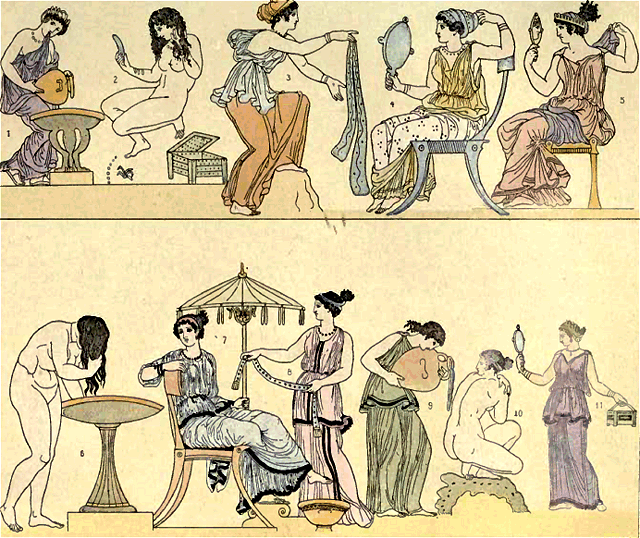
THE GRECIAN TOILETTE From an antique vase The Greek women took great care of their bodies. It was their habit after bathing to anoint themselves with perfume, pastes or liquids, pomades, and oils. Nos. 1, 2 and 6 exhibits the basin, supplied with perfumed water. The figure at No. 6 is washing from her hair the color of powder which had been applied the evening before. The colors used might be black, red, silver, gold, or any other tint, according to taste. The eyebrows were tinted to harmonize. Nos. 9 and 10 represent the application of oil, which followed completion of the coiffure. Nos. 3 and 4 exhibit the slave's simple dress and the rich transparent costume of the lady. The mirrors, Nos. 4, 5, and 11, were framed in ivory or chiselled silver, ornamented with precious stones. One of the fêtes in honor of Minerva was that of the Parasols, which were often made of silk, see No. 7.
ISCHOMACHUS.--Suppose, dear wife, you take into your service one who can neither card nor spin, and you teach her to do those things, will it not be an honor to you? Or if you take a servant who is negligent and does not understand how to do her business, or has been given to pilfering, and you make her diligent and instruct her in the manners of a good servant, and teach her honesty, will you not rejoice in your success, and will you not be pleased with your action? So, when you see your servants sober and discreet, you should encourage and show them favor. But those who are incorrigible and will not follow your directions you must punish. Consider how laudable it will be for you to excel others in the well-ordering of your house. Be therefore diligent, virtuous, and modest, and give your necessary attendance on me, your children, and your house, and your name shall be honorably esteemed, even after your death; for it is not the beauty of your face and form, but your virtue and goodness, which will bring you honor and esteem that will last forever."
Thus does he conclude his first discourse with his wife on the subject of her duties, and she is diligent to learn and to practise what has been taught her. When, a little later, he asks her to find him a parcel which he had brought home, and she, with flushed cheeks and troubled look, has to confess that she is unable to find it, he takes this occasion to talk to her on order and harmony in all things. He tells her not to be grieved over her failure to find the parcel, as it is his fault for not having assigned a definite place for each thing. He shows her how everything is perfectly arranged in a chorus, in a large army, and in the crew of a vessel, that all may be done harmoniously and in order. "Let us therefore fix upon a proper place where our stores may be laid up, not only in security, but where they may be so disposed that we may know where to look for every particular thing. By this means, we shall know what we gain and what we lose; and in surveying our storehouses, we shall be able to judge what is necessary to be brought in or what may want repairing and what will be impaired by keeping." With the simplicity natural to men of high intelligence, he does not hesitate to confess that he finds beauty even in kitchen utensils orderly arranged.
The young wife is enchanted at his idea, and they go through the house assigning a place for each thing; they distribute duties to the slaves, and give them other instructions, with the endeavor to win their affections and elevate their characters. Ischomachus then tells her that all care will be useless if the mistress of the house do not watch to see that the established order is not disturbed. Comparing her to magistrates who make the laws of a city respected, he adds: "This, dear wife, I chiefly commend to you, that you may look upon yourself as chief overseer of the laws within our house."
He tells her that it is within her jurisdiction to oversee everything in the house, as a garrison commander inspects his soldiers; that she has as great power in her own home as a queen, to distribute rewards to the virtuous and diligent and to punish those who deserve it. He desires her not to be displeased that he has intrusted more to her than to any of the servants, for they have not the same incentive to preserve those things which are not their own but hers.
Up to this time, it is the loving and inexperienced child who has been conversing with her husband. Now, it is the woman, the mistress of the house, who says:
"It would have been a great grief to me if, instead of those good rules you instruct me in for the welfare of our house, you had directed me to have no regard to the possessions I am endowed with; for as it is natural for a good woman to be careful and diligent about her own children rather than to have a disregard for them, so it is no less agreeable and pleasant to a woman, who has any share of sense, to look after the affairs of her family rather than to neglect them."
The great Socrates admires much the wisdom of his friend's wife, and adds, asking Ischomachus to continue the narrative: "It is far more delightful to hear the virtuous woman described than if the famous painter Zeuxis were to show me the portrait of the fairest woman in the world."
This dialogue between husband and wife is doubtless typical of the relations between married couples in the Athenian household, and in the girl-wife one may recognize the innocence and ingenuousness of the average maiden of fifteen transferred from the seclusion of her girlhood life at home to the seclusion of married life in her husband's house. It is noticeable that in the training provided by Ischomachus no provision whatever is made for intellectual discipline, or for social obligations, which leaves the reader to infer that the career of the wife was to be a purely domestic one, and that her aspirations must be confined within the walls of her house.
While such implicit obedience was the rule, however, there were notable exceptions to such ingenuousness on the part of the wife, and there were doubtless many instances where the wife was the ruling power of the household because of mental superiority, domineering disposition, or amount of dower. Human nature is much the same the world over, and strong personality in women demanded expression in ancient as well as in modern times. It is also true that there were instances of beautiful affection between husband and wife, though the fact that such were much talked of proves that conjugal love was the exception, not the rule.
It is a pity that we do not know more of the wives and sisters and mothers of great Athenians, as the few of whom we know are of unusual interest. Many wives enjoyed the hearty admiration and companionship of their husbands. Cimon, in spite of occasional lapses on his part, had an unusually passionate affection for his wife, Isodice, and was filled with bitterest grief at her death. Socrates mentions Niceratus as "one who was in love with his wife and loved by her." There is a pleasing anecdote of Themistocles, told us by Plutarch, which shows where in his household lay the seat of authority. "Laughing at his own son, who got his mother, and, through his mother, his father also, to indulge him, he told him he had the most power of anyone in Greece, 'for the Athenians command the rest of Greece, I command the Athenians, your mother commands me, and you command your mother.'"
Plutarch also relates of the great statesman that of two who made love to his daughter, he preferred the man of worth to the one who was rich, saying that he desired a man without riches rather than riches without a man! The most pleasing, however, among the wives of great Athenians is the wife of Phocion, the incorruptible, as she is presented to us in the pages of Plutarch. The latter describes Phocion's simple way of living, and speaks of his wife as employed in kneading bread with her own hands. "She was," he continues, "renowned no less among the Athenians for her virtues and simple living than was Phocion for his probity." It happened once when the people were entertained with a new tragedy, that the actor, as he was about to enter the stage to perform the part of a queen, demanded to have a number of attendants, sumptuously dressed, to follow in his train; and when they were not provided, he became sullen and refused to act, keeping the audience waiting, till at last Melanthius, who had to furnish the chorus, pushed him on the stage, crying out: "What! don't you know that Phocion's wife is never attended by more than a single waiting-woman, but you must needs be grand, and fill our women's heads with vanity?" This speech, spoken loud enough to be heard, was received with great applause. Phocion's wife herself once said to a visitor from Ionia, who showed her all her rich ornaments made of gold and set with jewels, her wreaths, necklaces, and the like: "For my part, all my ornament is my husband Phocion, now for the twentieth year in office as general at Athens."
Aristotle said many things which are quoted as suggesting his low estimate of the weaker sex, but he loved with great tenderness his wife Pythias, niece and adopted daughter of his friend Hermias, ruler of Atarneus and Assos in Mysia. When she died after a few brief years of wedded life, Aristotle gave directions that at his own death the two bodies should be placed side by side in the same tomb. When his own death came, he left behind a second wife, Herpyllis, whose virtues he esteemed, and he besought his friends to care for her, and to provide her with another husband should she wish to marry again.
These instances of domestic affection dissolve the cold logic of rigid theory, and prove how, in spite of legislation and convention, love is lord of all, and that among the Athenians happy married life was not unknown.
Nor was the strong-minded woman altogether lacking in Athens, for there was Elpinice, sister of Cimon, who, taking the Spartan women as her model, went about alone, and did many other things which shocked the staid Athenian matrons. Unpleasant remarks were made about her--as in the case of every woman who defies convention: among them, that she was over intimate with Polygnotus the painter, who portrayed her as Laodice in his fresco of the Trojan women in the Stoa Poikile. But the essence of this scandal may have been merely that she served the painter as a model, at a time when few women would have dared to visit an artist's studio. To her brother Cimon she proved a devoted sister. Once, when he was on trial for his life, she pleaded with Pericles so earnestly that acquittal was the result; and later she arranged with this great rival the negotiations that led to Cimon's return from banishment. So lovable was she that Callias, one of the richest men in Athens, fell violently in love with her, and offered to pay the fine to which her father was condemned, if he could obtain the daughter in marriage; and with Elpinice's own consent, Cimon betrothed her to Callias.
We have reserved a brief consideration of the best known of all Athenian women, one who defies all out notions regarding the prevailing conventions--Xanthippe, wife of the philosopher Socrates. From all accounts, it seems likely that she was an aristocratic lady, in reduced circumstances, who had married Socrates when advanced in life, she herself being beyond the years at which women usually marry, yet a score of years younger than her husband. Socrates once said he married her for the excitement of conquest, just as one would enjoy the breaking of a high-spirited horse; but, at any rate, the philosopher was worsted, and Xanthippe ruled the household. Xanthippe has acquired the reputation of being the typical scold of antiquity. Doubtless this reputation is not without foundation, yet she should have our sympathy, for the strangest and most difficult of husbands fell to her lot. Her naturally infirm temper must have been tried beyond endurance by the calm unconcern of her husband toward the domestic problem of "making both ends meet." Ugly, careless of dress, keeping bad company, given to trances, utterly neglectful of his family--can one be surprised that the wife of such a man should lose all patience with him, and through repeated failures to improve him should by degrees become an arch termagant? Yet the stories of Xanthippe's temper rest on uncertain authority, and her reputation may be due largely to the fact that it was necessary for the story mongers to provide a foil for the always serene and placid philosopher. Plato, the most reliable authority, tells us nothing disparaging of Xanthippe, and the violent grief he attributes to her at the last parting suggests a high degree of affection for her phlegmatic spouse. Socrates preferred philosophical discussions with his friends to the society of his wife in his last hours of life, but he committed her and her children tenderly to their care. Thus parted the ill-assorted pair, each of whom has attained world-wide celebrity--the one as the world's philosopher, the other as the proverbial shrew.
In the early days of the Athenian democracy, women were powerful influences in civic matters, as is instanced in the case of Cylon and his conspirators, all of whom were ruthlessly slain except those who fell at the feet of the archons' wives, who in pity saved them. Herodotus tells a story which shows the intense interest of the Athenian women in public affairs in early times. There was always great rivalry between Athens and the neighboring island of Ægina. At one time, the Athenians demanded of the Æginetans the fulfilment of certain conditions regarding the statues of Attic olive wood which the latter had stolen from the Epidaurians. "The people of Ægina refused; and the members of an expedition sent against them, attempting to drag away the sacred statues with ropes, were seized with madness and destroyed, one after another, so that only one man returned alive to Athens. This man, recounting the disasters, was surrounded by the women whose husbands had been killed, and each one pierced him with the bodkin that fastened her garment; so that he died under their hands. The conduct of these women filled the Athenians with horror, and, as a punishment, they obliged all the women of Athens to give up the Dorian dress which they wore, and instead to clothe themselves with the Ionian tunic, which had no need of any pin to fasten it."
Under the tyrants, the women of aristocratic families throughout Hellas possessed an influence which was lost under the levelling process of democracy. Pisistratus, after his first banishment, furthered the reestablishment of his tyranny by wedding the daughter of Megacles, and thus winning for himself the influence of the powerful Alcmæonidæ. He worshipped Athena as his patron goddess, and, to give proper religious sanction to his return, arranged a singular ceremony, which Herodotus regards as "the most ridiculous that was ever imagined," but which introduces to us the most beautiful Athenian maiden of the times:
"In the Pæanian tribe, there was a woman named Phya, four cubits tall, and in other respects handsome. Having dressed this woman in a complete suit of armor, and placed her in a chariot, and instructed her how to assume a becoming demeanor, the followers of Pisistratus drove her to the city, having sent heralds before to proclaim: 'O Athenians, welcome back Pisistratus, whom Athena herself, honoring above all men, now conducts back to her own citadel!' Thus the report was spread about that the goddess Athena was bringing back Pisistratus; and the people, believing it to be true, paid worship to the woman, and allowed Pisistratus to return." The return was most happily effected, and, soon after, the usurper celebrated the marriage of this "counterfeit presentment" of the goddess to one of his sons.
Woman was to continue to play a fateful part in the history of the usurped power of Pisistratus. The tyrant ill-treated his young wife, and this threw her father, Megacles, again into the party of the opposition. Pisistratus was once more driven from Athens, and this time from Attica as well. But he returned a third time, and established his power so firmly that at his death he bequeathed it to his sons unimpaired. Hippias and Hipparchus ruled wisely at first, and carried on the many public works in which Pisistratus had engaged; but their downfall finally came through an insult to a highborn Athenian maiden, and the story as told by Thucydides shows how highly a sister's honor was cherished at Athens.
Harmodius, an aristocratic young Athenian, had rejected the friendship of Hipparchus, preferring that of Aristogiton, a citizen of modest station. The tyrant basely avenged himself. After summoning a sister of Harmodius to come to take part in a certain procession as bearer of one of the sacred vessels, Hippias and Hipparchus publicly rejected the maiden when she presented herself in her festal dress, asserting that they had not invited her to participate, as she was unworthy of the honor.
Harmodius was very indignant at this insult, and with his friend, who was equally incensed, formed a plot which led to the death of Hipparchus, though Harmodius was also killed in the prosecution of the plan. Aristogiton was put to the torture; and tradition relates that Leæna, his mistress, was also tortured, and fearing lest in her agony she might betray any of the conspirators bit off her tongue. After the expulsion of the Pisistratidæ, the Athenians honored her memory by a bronze statue of a lioness without a tongue, which was set up on the Acropolis. The Athenians by this act showed their delight in a play on names, as Leæna is the Greek word for "lioness."
The Athenian woman has never had the reputation for patriotism that characterized her Spartan sister, yet at times she showed an almost superhuman devotion to the State. After the sack of Athens by Mardonius and his troops in the Persian War, a senator, Lycidas, advised his fellow countrymen to accept the terms which were offered them by the Persian general. The Athenians in scorn stoned to death the man who could suggest such a cowardly deed. And the women, hearing what their husbands had done, passed the word on to one another, and, gathering together, they went of their own accord to the house of Lycidas and inflicted the same punishment on his wife and children--a cruel act, but one showing their love of country and their hatred of treason.
These women, who could be so ruthless when patriotism was involved, knew how to be genuine comforters when their own loved ones were in trouble. The orator Andocides and his companions were tried and imprisoned for impiety in violating the Eleusinian mysteries. "When," says Isocrates, "we had all been bound in the same chamber, and it was night, and the prison had been closed, there came to one his mother, to another his sister, to another his wife and children, and there was woe and lamentation as they wept over their misfortunes."
In so brilliant a race, it was impossible that some women should not rise above the surface and, by extraordinary virtue and by intellectual and spiritual endowments of a high order, win the lasting regard of men.
IX
ASPASIA
The period in Greek history when the intellectual and artistic life of Hellas reached its zenith is known as the Golden Age of Pericles. The lofty ideals of this greatest of Greek statesmen incited him to make Athens the seat of a mighty empire that should spread the noblest and most elevating influences throughout all Hellas. He called to his assistance all the great men of his native city, and made also the fine arts serve as handmaidens of Athens and contribute to her power and splendor. Every condition was present for the realization of an intellectual and artistic epoch such as the world had never witnessed. At the disposal of Pericles was an inexhaustible treasury--the accumulation of the tribute of subject allies. The quarries of Pentelicon offered in great abundance the material necessary for the erection of public buildings which might express in sensuous form the noblest ideals of the Greek race. There were in Athens statesmen, philosophers, artists, dramatists, historians, men preeminent in all departments of the higher life. Foremost among these was Pericles's friend and counsellor, Phidias, a "king in the domain of art, as Pericles was in political life."
"What an age it was, truly, when, as the companions of Pericles, there were assembled in one city Sophocles and Euripides, Herodotus and Thucydides, Meton and Hippocrates, Aristophanes and Phidias, Socrates and Anaxagoras, Appollodorus and Zeuxis, Polygnotus and Parrhasius;--in a city which had but lately lost Æschylus, and was soon to possess Xenophon, Plato, and Aristotle; a city which, moreover, to make the illustrious dead its own, erected statues to their memory!"
"What should we expect the pupils of such masters to be? What they were,--the masters of Greece. Thucydides says that Athens was at this time the instructress of Greece, as she was the source of its supplies. Behold this fine democracy going from the theatre of Sophocles to the Parthenon of Phidias, or to the Bema where Pericles speaks to them in the language of the gods; listening to Herodotus, who recounts the great collision between Europe and Asia; Hippocrates of Cos, and the Athenian Meton, of whom one founded the science of medicine, and the other, mathematical astronomy; Anaxagoras, who eliminates the idea of God as distinct from matter; Socrates, who establishes the principles of morals! What lessons were these! Art, history, poetry, philosophy--all take a sublime flight. There is no place for second-rate talent here. The art that Athens honors most is the greatest of all arts--architecture; her poetry is the drama--the highest expression of poetic genius, for it unites all forms in itself, as architecture calls all the other arts to its service. At this fortunate moment all is great, the power of Athens as well as the genius of the eminent men who guide the city and do it honor."
Such, in brief, is the picture of Athens in her greatest days, as drawn by an eminent historian. The splendor and supremacy of the city in this epoch were largely due to the constructive genius of one man--Pericles; and if we study his private life to the end that we may discover the formative influences which contributed to his greatness, we find that the chief source of his inspiration was a woman--the Milesian Aspasia, the most brilliant and cultured woman of classic times.
Aspasia ranks as one of the most remarkable women of all antiquity; and her ascendency as one of the foremost of her sex is due to the fact that she is the only woman whose name appears in the brilliant galaxy of the Periclean age and that the greatest leaders in that coterie of great men were glad to acknowledge their indebtedness to her for Instruction and inspiration. She is the only woman prominent in the life of Athens of whom much is known to us, and she has won for herself a place altogether unique in the history of Greek womanhood.
She was the daughter of one Axiochus, and was born and reared in Miletus, the most pleasure-loving and artistic of the cities of Asia Minor. The story of her childhood and youth is a closed book, but we know that she was carefully trained in rhetoric, music, and the fine arts, and became the possessor of every feminine accomplishment. Her preceptress is said to have been the celebrated Thargelia, also of Miletus, who exerted her power for the Great King during the Persian War and finally married one of the kings in Thessaly. How Aspasia was drawn to Athens is not known, but the most probable theory is that she settled there as a young and brilliant teacher of rhetoric, following the precedent established by Anaxagoras in philosophy and by Protagoras and other men in rhetoric, who found in Athens the most profitable field for the exercise of their talents. Here Aspasia gathered about her all the learned and accomplished men of Athens. She was no mere creature of pleasure, who ministered to luxury and lust; but by her beauty and culture she sought to draw to her the first men of the town, that she might learn of them as they of her. "Nor was it long before it was recognized that she enchained the souls of men by no mere arts of deception of which she had learned the trick. Hers was a lofty and richly endowed nature, with a perfect sense of the beautiful, and hers a harmonious and felicitous development. For the first time, the treasures of Hellenic culture were found in the possession of a woman, surrounded by the grace of her womanhood, a phenomenon which all men looked upon with eyes of wonder. She was able to converse with irresistible grace on politics, philosophy, and art, so that the most serious Athenians, even such men as Socrates, sought her out in order to listen to her conversation."
There could be nothing more natural than that when Pericles and Aspasia met the soul of each should discover in the other its affinity, Pericles was married to an Athenian kinswoman, but they did not find conjugal life altogether congenial, and by mutual agreement their marriage ties were dissolved and Pericles found for his wife another husband. He then took Aspasia to his home and called her his wife. They could not wed, for she was a foreigner, and their union in consequence lacked civil sanction; yet it was a real marriage in all but in name, based on the truest and tenderest affection, and dissolved only by death.
So remarkable was Pericles's devotion to Aspasia, that Plutarch records, as an indication of its sincerity, that the great Athenian kissed Aspasia upon going out in the morning and upon his return home--clearly an unusual occurrence in Athenian homes, or it would not have seemed worthy of mention. The possession of so rare a woman was doubtless in many respects invaluable to the great statesman. Plutarch states that the latter was first attracted to the Milesian by her wisdom and political sagacity. Socrates, who confessed also his own indebtedness to Aspasia, states that she was Pericles's teacher in the art of rhetoric, and could even write his speeches. Pericles was a reserved man, who devoted himself strictly to his official cares and refrained from social intercourse with those about him. Hence he found in Aspasia not only the delight of his leisure moments and a sympathizing friend and counsellor hi his perplexities, but also the link that connected him with the daily life about him. She knew how to be at ease in every kind of society; how to keep informed of everything that took place in the city that Pericles should know; how to keep in touch with the great movements throughout Hellas and to make them contribute to the glory of Athens: and in all these, and in many other respects, she proved of use to him in his political life.
It is probable that Aspasia was still in her twenties when Pericles first met her, while he himself was much older. She must have possessed a fascinating personality which at once captivated the great statesman; but, aside from her intellectual gifts, it is difficult in this day to analyze her charm. There is no positive evidence that she was beautiful, according to Greek standards, though this is the natural inference. Ancient writers call her the good, the wise, the eloquent; they speak of her "honey-colored" or golden hair, of her "silvery voice," of her "small, high-arched foot," but no writer of the time has expressly said that she was beautiful. In the museums of Europe, there are various busts on which her name is inscribed, but they impress us rather by the expression of earnest and deep thought, by the delicacy and distinction of the features, than by mere beauty. Her charm lay, no doubt, rather in her wisdom, her vivacity, her sweetness of utterance, than in perfection of form and feature. Aspasia made the home of Pericles the first salon that history has made known to us; and what woman ever gathered about her a more brilliant coterie of friends? With Phidias and his group of eminent artists, she talked of the embellishment of the Acropolis with beautiful temples and statues; with Anaxagoras and Socrates, she discussed the problems of philosophy and the narrow conservatism of the Athenians; with Sophocles and Euripides, she conversed concerning the works of the dramatists and the ideal women presented in their plays. Herodotus, perhaps, was the inimitable story teller of this learned circle, and the melancholy Thucydides dwelt on the dark tragedy underlying human events; no doubt the satirical Aristophanes sometimes attended, for the Platonic dialogues show us the social side of his nature, and, while in his plays he scorns the philosophical set, he found among them intellectual companionship; and the young and gay Alcibiades was doubtless frequently present, talking with the hostess of the latest events in the high life of the city, of betrothals and marriages, of scandals and escapades.
One of the sons of Pericles scoffed at this circle of intellectual lights, and made fun of their metaphysical speculations and learned talk; but this merely indicates that such a salon was an innovation in Athens, and, therefore, led to harsh criticism and unseemly gossip on the part of those who could not appreciate its privileges. Music, poetry, and wit relieved the serious discussion of politics, philosophy, and literature. The salon of Aspasia must have been altogether decorous, for many men broke the traditions of their fathers and brought their wives to converse about wifely duties with the famous hetæra. She seems to have thought earnestly and deeply on the duties and destiny of woman, to have realized how contracted were the lives of Athenian women, and to have wished to better their condition, Æschines, in one of his dialogues, gives us in her conversation with Xenophon and his wife Philesia a glimpse of her method.
"Tell me, Philesia," said Aspasia, "whether if your neighbor had a piece of gold of more value than your own, you would not choose it before your own?" "Yes," answered Philesia. "If she had a gown, or any of the female ornaments, better than yours, would not you choose them rather than your own?" "Yes," answered she. "But," said Aspasia, "if she had a husband of more merit than your own, would not you choose the former?" Upon this, Philesia blushed. Aspasia then addressed herself to Xenophon. "If your neighbor, Xenophon, had a horse better than your own, would you not choose him preferably to your own?" "Yes," answered he. "If he had an estate or a farm of more value than your own, which would you choose?" "The former," answered he; "that is, that which is of more value." "But if his wife were better than your own, would not you choose your neighbor's?" Xenophon was silent upon this question. Aspasia therefore proceeded thus: "Since both of you, then, have refused to answer me in that point only which I wanted you to satisfy me in, I will tell you myself what you both think: you, Philesia, would have the best of husbands, and you, Xenophon, the best of wives. And, therefore, if you do not endeavor that there be not a better husband and wife in the world than yourselves, you will always be wishing for that which you shall think best: you, Xenophon, will wish you might be married to the best of wives, and Philesia, that she might have the best of husbands."
Thus this brilliant and withal domestic woman would counsel women to be the best of wives, and men the most considerate of husbands, that each might find in the joys of home and in conjugal harmony their greatest felicity. Doubtless many a wife went away from her with higher conceptions of wifely duty than custom had taught her, and sought to make her home a more congenial retreat for her husband. Many, however, looked askance at these gatherings of men and women and could see nothing but evil in their violations of custom. Husbands, too, saw in these novel proceedings dangerous tendencies; for if their wives became emancipated, there would be a limit to their own pleasant indulgences. It was Aspasia who preeminently labored to this end. The status of woman at Athens was far from ideal, and the need tor reform was great; and if we endeavor to discover who was chiefly responsible for the agitation which had for its purpose the emancipation of woman from the thraldom in which she was held, we find that it was the wise and far-seeing Aspasia.
Owing to the intellectual awakening at Athens during the Periclean Age and the influx of new ideas from the various Hellenic countries, a liberal party had arisen in the city, chiefly under the leadership of Pericles and Anaxagoras--a radical party, headed by men of culture and science, who taught that knowledge was power, who despised the established religion, and who set at naught the domestic manners of the day by seeking to elevate woman. Socrates, also, was heartily in sympathy with the objects of this party, as was the dramatist Euripides. On the other side were the ultra-conservatives, of whom Cimon and Aristophanes were representatives. The latter frequently made Pericles, Aspasia, Socrates, and Euripides the subjects of his satire. These Tories of the day saw in the tenets of the new party the subversion of all the principles of the old democracy, and they fought most bitterly to preserve established institutions. Toward the close of Xenophon's treatise on Domestic Economy, Critobulus, who has been impressed by the story of Ischomachus, wishes to learn how he too, may educate his young wife, and Socrates advises him to consult with Aspasia. The profound deference in which she was held by all the philosophers is a further indication that from her they had derived many of their advanced ideas regarding the relations of the sexes. Hence while positive evidence is lacking, incidental touches and sidelights on the Woman Question point unerringly to the one great woman of ancient Athens as the originator of the first movement for the emancipation of woman recorded in history.
As Aspasia, through her intercourse with the great, had attained unbounded influence in the State, and as her circle was the exponent of the ideas which offended the conventional spirit, it was natural that she should be involved in the storm of criticism that befell the leaders of thought. As a woman who had stepped out of the beaten track of womanhood, she was made the subject of the coarsest slanders. She was called the Hera to this Zeus, Pericles, the Omphale, the Deianira of the Heracles of the day; her girl friends and pupils, who enjoyed the same liberty she claimed for herself, were most violently defamed; she was said to have induced, for the basest of reasons, Pericles to bring on the Peloponnesian and Samian wars. The comic poets, as the chief organs of the opposition, engaged in this most merciless and unjust tirade against the party of the philosophers. None of their charges, however, can be said to have had any basis in fact, and all may easily be accounted for when the envy and hatred of the ignorant toward the beautiful and accomplished and independent woman is taken into consideration. In the Athens of the fifth century before our era, when people were just beginning to break away from the narrow conservatism of centuries, a woman who enjoyed an unheard-of degree of liberty, and because of her talents was regarded with admiration by the greatest men of the city, might well be the target for the grossest abuse. A vicious woman would be the last to undertake, as did Aspasia, the study of philosophy, which, with Socrates, was the study of virtue.
The party of the philosophers suffered for their opinions, Phidias was accused of theft, and died in prison; Anaxagoras, to escape the charges against him, went into voluntary exile; and Aspasia was brought to trial on a charge of impiety, which merely meant that she, as others of her circle, set at naught the polytheism of the multitude, and recognized but one creative mind in the government of the universe, an accusation under which Socrates later suffered martyrdom. She was brought before the judges, and Pericles pleaded her cause. Plutarch says that he pleaded with tears; and as the people could not resist the emotion of their great leader, she was acquitted.
Perides's last days were passed in the gloom of the outbreak of the Peloponnesian War, of the plague that depopulated the city, and of the discontent of his beloved people. No brilliant sun ever had a more gloomy setting. Yet in his last moments his thoughts were of the two beloved objects that had absorbed his tenderest affections. "Athens has intrusted her greatness and Aspasia her happiness to me," Pericles said, when dying; and there could be no stronger testimony to the purity of Aspasia's character, to the influence of her life on his, to the role she had played in that Golden Age of Athens.
Athens and Aspasia--these were linked in the thoughts of the dying statesman; and as he made the one great, so he made the other immortal. Had his life not been blessed with union with hers, had his temperament not been sweetened by her companionship, had his policy not been moulded partly by her counsel and her wisdom, had his taste not been made so subtle and refined by communion with her artistic temperament, Athens would not have been embellished by the works of art which have made that city the unapproachable ruler in the domain of the spirit. Woman's influence, where it has counted most, has always been a silent one, and has worked through man. Is not Aspasia worthy of the laurel wreath for the results of her life on "the city of the violet crown"?
X
APHRODITE PANDEMUS
For the proper understanding of the status of woman among the Greeks of ancient times, it becomes necessary for the historian of Greek womanhood to call attention to a conspicuous social phenomenon pervading the life of all the nations of antiquity, but nowhere else so marked a feature of the higher life as in the lands of Hellas--a phenomenon bringing about social conditions that divided the female population of Greece into two sharply distinguished classes: the citizen-woman and the courtesan or mistress.
This notable aspect of Greek life is due to the fact that the ancient Hellene, as a rule, sought recreation and pleasure, not at the domestic hearth, but in the society of clever women, who had not only cultivated their physical charms, but had also trained their intellects and sensibilities so as to become virtuosi in all the arts of pleasure. Their pleasing forms of intercourse, their light and vivacious conversation, lent to association with them a peculiar seductiveness and fascination.
To designate this class of women in a manner which would distinguish them from the citizen-women on the one hand and the debased prostitute on the other, they were euphemistically called "hetæræ," or companions. The term hetæræ had been originally a most honorable one, and Sappho had used it, in the highest and best sense, of her girl friends as implying companions of like rank and interests. It is not known when it was first used with sinister suggestion, but, like our word mistress, it fell from its honorable estate and became the usual term to describe these women of pleasure.
The causes of the extent of hetairism among the Greeks are to be found in their religious conceptions, their political institutions, and the innate sensualism of the Greek peoples.
The Greeks were worshippers of the productive forces of nature as manifested in animal and plant life. Aphrodite is the female and Dionysius the male personification of the generative principles, and in consequence the religious ceremonials of these two deities assumed at times a most licentious aspect. In course of time, a distinction arose in the conception of Aphrodite, expressed by the surname applied to her. Thus Aphrodite Urania came to be generally regarded as the goddess of the highest love, especially of wedded love and fruitfulness, in contrast to Aphrodite Pandemus, the goddess of sensual lust and the patron deity of courtesans.
We could hardly expect high moral ideas in regard to sexual relations among the Greeks, whose deities were so lax. Zeus himself was given to illicit intercourse with mortal maidens and was continually arousing the jealousy of his prudent wife, the Lady Hera. Aphrodite was not faithful to her liege lord, Hephæstus, but was given to escapades with the warlike Ares. Apollo had his mortal loves, and Hades abducted the beautiful Proserpina. A people who from their childhood were taught such stories could hardly be expected to be more moral than their deities.
As has been shown in a previous chapter, the Greek conception of the city-state lay at the basis of laws and customs which repressed the citizen-woman and prevented proper attention to her education and to the full and well-rounded cultivation of womanly graces. The State hedged itself about with the most rigid safeguards to preserve the purity of the citizen blood. Stringent laws were passed prohibiting any citizen-man from marrying a stranger-woman, or any stranger-man from marrying a citizen-woman. To enforce these laws, it was necessary to keep the wives and daughters of the State within the narrow bounds of the gynæceum; and they were forbidden a knowledge of public affairs, which would make them more interesting to men. Hence the limitations of their culture made it impossible for them to be in every sense the companions of their husbands. But it is not natural for men to be deprived of the sympathy and inspiration that is found in association with cultivated women; hence there was, especially in Athens, a peculiar sphere for the cultivated hetæra. The men of the city recognized the need of feminine society in their recreations, in their political life, and on military expeditions. The hetæra entered this sphere, from which the citizen-woman was excluded.
A further reason for the predominance of hetairism is seen in the artistic impulses of the Greek people. These courtesans made an art of the life of pleasure. Cultivating every feminine grace, carefully attentive to all the little niceties of social intercourse, studying in every way how to be agreeable to the men, adepts in conversation, devotees of the Muses and the Graces, they knew how to make their relations with men answer to all the impulses of a beauty-loving people. And as the Greeks found æsthetic satisfaction in their masterpieces of prose and poetry, in their works of architecture and sculpture and painting, so they found it in their association with the hetæræ.
Owing to such conditions, there arose a most unnatural division of the admitted functions of woman in the world-order. Says the great orator Demosthenes: "We take a hetæra for our pleasure, a concubine for daily attention to our physical wants, a wife to give us legitimate children and a respected house"--an utterance narrowly defining the status of the hetæra as contrasted with that of the honorable wife. The latter was the housewife and mother, nothing more, though surrounded by all the dignities and privileges of her high station; the former was the companion, the comrade in whose society were found recreation and sympathy and intellectual delight, but she was outside the pale of society, not respected, yet not altogether despised.
It is difficult to ascertain the beginnings of hetairism among the Greeks. There is a noteworthy absence of it in the Homeric poems, though the Greek chieftains frequently had concubines, who were slaves captured in war.
Allusions in the lyric poets show that as early as the sixth century before our era the hetæra had made her appearance. The earliest reference to the social evil in the history of Athens is found in the administration of the lawgiver Solon, who was the first to legalize prostitution. With the avowed purpose of forestalling the seduction of virgins and wives, he bought slave girls in the markets of Asia Minor and placed them in public houses in Athens. This regulation for the protection of the home was generally regarded as deserving of praise. Thus speaks the comic poet Philemon:
"But you did well for every man, O Solon: For they do say you were the first to see The justice of a public-spirited measure, The saviour of the State (and it is fit For me to utter this avowal, Solon); You, seeing that the State was full of men, Young, and possessed of all the natural appetites, And wandering in their lusts where they'd no business. Bought women and in certain spots did place them, Common to be and ready for all comers. They naked stood: look well at them, my youth,-- Do not deceive yourself; aren't you well off? You're ready, so are they: the door is open-- The price an obol: enter straight--there's No nonsense here, no cheat or trickery; But do just what you like, how you like. You're off: wish her good-bye; she's no more claim on you."
In the early days antedating the Persian War, before the Athenians had been corrupted by power and by extensive intercourse with the outside world, it was regarded as shameful for a married man to associate with a hetæra. When the husband was guilty of such conduct, the insulted wife could obtain a decree of separation, which involved the return to the wife's family of the full dowry, while the enmity of the wife's kindred was visited upon the unfaithful husband. During the Golden Age of Pericles, however, Athens departed from her earlier simplicity, and the increase of wealth and the influx of foreigners swept away the old-fashioned standards of morality. The influence of Pericles and Aspasia on smaller minds seems to have been unfortunate. Reverential regard for the marriage bond became a thing of the past, and hetairism became the common practice. Almost all the great men of Athens had relations with hetærsæ; the young men gave themselves up to the life of pleasure; and with the disruption of family ties began the downfall of the State.
In Corinth, hetairism was invested with all the sanctity of religion, and these votaries of pleasure enjoyed a distinction accorded them in no other Greek city. When Xerxes was advancing against Hellas with his vast armament, the courtesans of Corinth betook themselves in solemn procession to the temple of Aphrodite, the patron deity of the city, and implored her aid for the preservation of the fatherland, dedicating their services to her in return for a favorable answer to their prayers, and vowing to reward with their unpurchased embraces the victorious warriors upon their return. The goddess was supposed to have heard their petitions, and out of gratitude the Corinthians dedicated to Aphrodite a painting, in which were represented various hetaerae who had supplicated the goddess, while beneath were inscribed the following verses of Simonides:
"These damsels, in behalf of Greece, and all Their gallant countrymen, stood nobly forth, Praying to Venus, the all-powerful goddess; Nor was the queen of beauty willing ever To leave the citadel of Greece to fall Beneath the arrows of the unwarlike Persians."
Private individuals frequently vowed, upon the fortunate issue of some undertaking, to dedicate to the goddess of love a certain number of hetæræ. These votaries of Aphrodite were called hierodulæ, or temple attendants. Pindar in his immortal verses thus describes them:
"O hospitable damsels, fairest train Of soft Persuasion,-- Ornament of the wealthy Corinth, Bearing in willing hands the golden drops That from the frankincense distil, and flying To the fair mother of the Loves, Who dwelleth in the sky, The lovely Venus,--you do bring to us Comfort and hope in danger, that we may Hereafter, in the delicate beds of Love, Reap the long-wished-for fruits of joy Lovely and necessary to all mortal men."
Strabo states that there were over a thousand hierodulæ in the Corinth of his day. Because of the enormous number of such damsels and of the respect which was accorded them, Corinth became the most noted hetæra city. Here dwelt the wealthiest and most beautiful hetæræ. As the most important commercial centre of Greece, the city was the abiding place of wealthy merchants and travellers; these fell victims to the voluptuous and licentious life of the place, and the vast fortunes accumulated by the professional courtesans were acquired by the ruin of many a merchant. The expression "Corinthian maiden" denoted the acme of voluptuousness, and to "Corinthianize" became synonymous with leading the most dissolute life.
In other prominent commercial centres of Hellas and of the Greek colonies hetairism also flourished. Piræus, the harbor of Athens, had its demi-monde quarter, and the number of courtesans in Athens and its harbor town was only surpassed by that of Corinth.
The inland cities were much more moral in this regard. From Sparta, in its best days, hetæræ were rigidly excluded. Plutarch records a saying of the Spartans, that when Aphrodite passed over the Eurotas River she put off her gewgaws and female ornaments, and for the sake of Lycurgus armed herself with shield and spear. This Venus armata of the Spartans, as well as their sturdy morals, forbade the presence of the seductive strangers in their midst; but Ares was ever susceptible to Aphrodite, and the Spartan warrior, when located in the voluptuous Ionian cities, frequently forgot his early training, and fell a victim to his environment.
There were in Athens, in the fifth and fourth centuries, four classes of hetæræ, graded according to political standing. The first and lowest class was that of the public prostitute--slaves bought by the State for the public houses, which were taxed for the benefit of the city and were under the supervision of city inspectors. These unfortunate women were gathered from the slave markets of Samos, Lesbos, Cyprus, and the Ionian cities, where every year large numbers of wretched human beings, who had been torn from their homes, usually as a result of war, were exposed for sale. These included many young girls who had been taken captive in the sacking of cities or had been stolen from their homes by the fiends in human form who made it a business to secure maidens of promising beauty or charm for the bawdy houses of the Greek cities. From these markets, too, came usually the hetæræ of the second class, who were likewise slaves, but were the property of panders or procuresses, who bought girls of tender age and educated them for the sake of the wealth to be acquired from traffic in lust. Aged and faded hetæræ, who had passed their lives in gross licentiousness and had finally lost their hold on the public, especially devoted themselves to this horrible trade. They owned their own houses, and had in conjunction with them regular schools or institutes for the training of hetæræ. In these institutes the girls were trained in physical culture, in music and dancing, and frequently in all the branches of learning that were popular at the time. They became experts in all the arts of pleasure, and were offered every advantage that would make them pleasing to men. From these institutes often emerged young women who played an important role in the social and intellectual life of the day, as Leontium, Gnathæna, Pythionice, and others. The names of certain of these establishments are preserved, as those of Nicarete, of Bacchis, and of the Thracian Sinope, who removed her institute from Ægina to Athens. Girls in such establishments remained at all times in the relation of slaves, and were compelled always to surrender to the mistresses or the panders the funds they collected from the sale of their favors. As young girls they acted as musicians or dancers at the banquets of the men, and as they developed into womanhood they entered upon their careers as regular courtesans. Often they were hired out for a considerable time; or if a good purchaser presented himself, they were sold outright, and lived as the kept mistress of a single lover. From him they usually obtained their freedom, in time, either as a mark of favor, or as the readiest means of ridding himself of a burden when the lover had wearied of the hetæra's charm.
Slave girls who obtained their freedom belonged to the third and most numerous hetæra class; they lived on a fully independent footing, and conducted their business on their own account. This class attached themselves especially to young and inexperienced men, preferably to youths who were still under parental control. They frequented the schools of rhetoricians and philosophers and the studios of artists, and sought in every way possible to make themselves interesting and indispensable to men. The jeunesse dorée of the day found in association with these young and beautiful and independent damsels their especial delight. At the banquets and drinking bouts of the young men, they were invited to take part; and the gay and frivolous youths would assemble in numbers at their houses, or take them on pleasure trips in the suburbs of the city, and would frequently engage in serenades and torchlight processions in their honor. Such a life was full of pitfalls for the young men, and they frequently brought down on themselves the rage of parents for their intercourse with these sirens. The avarice and greed of women of this class was such that they led their lovers into every form of deceit to obtain for them money and presents. To purloin and sell a mother's jewels and to contract debts in a father's name were frequent devices to which youths resorted whose parents kept a tight hold on the purse strings. These heroines of the demi-monde also sought to draw their lovers away from serious pursuits. Lucian, in his Dialogues of Courtesans, recounts an interesting conversation between two hetæræ, Chelidonion [Little Swallow] and Drosis [Dewdrop], about a youth whom his father had suddenly checked in his wild career and placed in the hands of a wise and artful tutor, to the end that he might be drawn away from his wild associations and given instruction in philosophy.
The fourth and most elevated hetæra class was that of freeborn women, who were attracted to this calling because of dissatisfaction with the restraint of home and longing for the ease and independent life which it seemed to offer. Frequently, the daughters of citizens, through the poverty or greed of their parents, or their own wilfulness, were driven to a life of shame. Usually, they changed their names, to bring forgetfulness of their former standing, and they sought by outward splendor to make up for the loss of virtue. To us in this day such a change seems most disgraceful; but to the Greeks it appeared to be in many instances nothing more serious than a change of patron goddess. Thus the maiden transferred herself from the protection of one of the austere virgin goddesses, Artemis and Athena, to that of the gracious and seductive Paphian goddess; or the widow, who with the death of her husband had lost her means of subsistence, would renounce Hera, the goddess of wedded love, for the frivolous and light-minded Aphrodite. This transfer was usually accompanied with solemn religious ceremonies, Greek epigrammatists frequently give us a poetical treatment of such life histories, and we thereby gain glimpses into the woes of many a feminine heart; thus we have a pathetic genre picture of a maiden, who, weary of the spindle and the service of Athena, betakes herself to the patron goddess of the hetæræ and pledges to her for her protection a tithe of all her earnings in her new calling.
The giving of votive offerings to Aphrodite for successes and rich gains in their dealings with men was a customary act of "pious" hetæræ. Toilet articles which enhance beauty, and costly gifts, such as statues, were frequently dedicated to the goddess. The hetæræ who followed in the wake of the Athenian army led by Pericles to Samos built a temple to Aphrodite from the tithes of their gains. This giving of votive offerings is frequently the subject of Greek epigrams.
The daughters or widows of citizens constituted but the smaller number of hetæræ of this class. The larger number were stranger-women, chiefly from Ionia, who came to Athens, attracted by its prominence in politics and the arts, that they might play their role on a larger and more brilliant stage. In the various cities of Asia Minor, there were groups of freeborn women who had broken away from the conventional bonds and had devoted themselves to intellectual and artistic pursuits and to the cultivation of every personal grace and charm. It was natural that they and others like them from other parts of Hellas should flock to Athens. Such women, though they were politically only resident aliens, were granted great freedom and had the benefit of all the intellectual advantages the city afforded. Marriage was the only political sin these beautiful and cultivated strangers could commit; they might do anything else that they liked. Hence they entered into relations with citizens as "companions," and soon became an important factor in the social life of the day. Bringing with them from their homes all the attractions and graces that attended the service of the Muses, they undoubtedly exercised a beneficial influence on the social customs and manners, but they also contributed much to the general demoralization of the Athenian people.
From the number of these women of foreign birth came the most beautiful and distinguished, as also the most selfish and proud, representatives of the hetæra class. Through their beauty and the outward splendor of their station they posed as veritable priestesses of Aphrodite, while through their intellectual brilliancy and their social charms they exercised a great influence over the daily life of the Athenians.
To this class belonged the celebrated "daughters of the people," for whose favor the most prominent and dignified men of the State became suppliants. As Propertius sang of Lais, they could literally boast that "all Hellas lay before their doors." Among these hetæræ we see the high life of the day on a most brilliant scale. Their dwellings were most sumptuous in their appointments; the walls were painted in frescoes, pieces of statuary and rich tapestries embellished their apartments, while the grounds about their houses were laid off with flower beds and beautiful fountains. Their apparel was of the richest fabrics and was made up in the most fashionable styles. They possessed numberless jewels and ornaments of enormous value. They never appeared in public without an imposing cortége of female slaves and eunuchs. Much of the etiquette of the courts of princes was maintained in their establishments.
To keep up this elaborate state, they sold their favors at almost shameless prices. Thus the elder Lais, Gnathæna, and Phryne were celebrated for their incredible demands. There is a story that the orator Demosthenes made a trip to Corinth and paid ten thousand drachmæ for a single evening with the younger Lais. As has been intimated, Corinth possessed the most voluptuous, Athens the most highly cultivated hetæræ. The excessive charges of "the Corinthian maiden" gave occasion for the proverb: "Not every man can journey to Corinth." Not only the celebrated beauties made such exorbitant demands, but even the ordinary courtesans asked prices which forbade to men of moderate means intercourse with them.
Beauty and wealth were the factors which determined the social status of the hetæræ, and with the fading of beauty and the squandering of their gains many celebrated hetæræ fell from the highest to the lowest station.
The principal classification of the queens of the demi-monde, however, was into "domestic" and "learned" hetæræ. The former attracted chiefly by their beauty and their social grace; the latter, by their native wit, their vivacity, and their intellectual endowments. These gifted women entered into intimate relations with the philosophers and rhetoricians of the day; they visited the lecture halls, devoted themselves to earnest study, and carried on their prostitution under the protection of philosophy. They allied themselves with the various philosophical schools, and by their manner of bestowing their favors sought to advance the interests of the sect they espoused.
They found, too, in the pursuit of philosophy the justification of their calling. The hetæræ of the Academy claimed that they were merely putting into practice Plato's doctrine of the community of women. The followers of the Cyrenaic school, with its doctrine of moderation in the pursuit of pleasure, maintained that they carried out the maxims of Aristippus in their pursuit of the joys of love. The female adherents of the Cynics, or "the Bitches," as they were called, sought to surpass one another in taking the beasts as models of imitation. The Dialecticians found in their system the widest range for feminine cleverness of speech, and defended hetairism with the greatest subtlety and the most ingenious sophism. The feminine Epicureans saw in the teachings of their school, with its doctrine of friendship and of the broadest cultivation of the sensibilities, the fullest justification for the pursuit of sexual enjoyment, and they sought to illustrate the greatest voluptuousness and refinement in their methods of gratifying animal passion.
The hetæræ of the various schools surpassed the men in their imitation of the jargon and the manners of the leading lights of their systems. Many of the philosophers yielded themselves readily to the seductions of their beautiful and clever adherents; yet there were some choice spirits who deplored the demoralizing tendencies which hetairism brought into serious pursuits, and protested in no uncertain language.
These philosopher-hetæræ were indisputably the most interesting phenomenon in the social life of ancient times, to which the later Greek world and modern times afford no adequate parallel. They were present always at theatrical exhibitions and on all public occasions when respectable women remained at home. They took an absorbing interest in politics and in all public affairs; they discussed with the citizens the burning questions of the day; they criticised the acts of statesmen, the speeches of orators, the dramas of the poets, the productions of painters and sculptors. They exerted, in a word, an enormous influence for good or ill on the social and political life of the day; while they themselves had the consciousness of a mission to perform in having in their hands the real power of their sex.
Almost every great man in Athens had his "companion," usually in addition to a lawful wife. Plato had Archeanassa, to whom he wrote sonnets; but we know not what were her attractions. "For dear to me Theoris is," sings Sophocles; and we should like to know more of Archippa, to whom he left his fortune. Aristotle had his Herpyllis, and the eloquent Isocrates his Metaneira. Speusippus, Plato's successor, found a "companion" in Lasthenia, and Epicurus in Leontium. It is difficult to believe that all these for whom the learned men of the day showed such regard were vicious women; in fact, some of them are described as noble and high-minded.
"She was a citizen, without a guardian Or any near relations, and her manner Pure, and on virtue's strictest model form'd, A genuine mistress [Greek: heraira]: for the rest of the crew Bring into disrepute, by their vile manner, A name which in itself has nothing wrong."
But if the careers of the learned hetæræ were influential, they did not equal in brilliancy and power those of the more celebrated domestic hetæræ. The vastness of the influence of this latter class is best shown by naming the prominent rulers of various periods who were under the domination of their "companions." We have in an earlier chapter called attention to the work of Thargelia in moulding Persian sentiment before the invasions of Darius and Xerxes, and to the influence of Aspasia during the Periclean Age. Many later hetæræ played prominent roles in the courts of princes and kings, and not infrequently enjoyed royal honors, Leæna, Myrrhine, and Lamia were favorites of Demetrius the Besieger, and the latter shared with him all except the throne. Thais, for a time beloved of Alexander the Great, and at whose nod he set fire to the palace of the Persian kings, later bore two sons and a daughter to Ptolemy Soter, the first Macedonian king of Egypt. Pythionice and Glycera were in high favor at the court of Harpalus. Hieronymus of Syracuse elevated a beautiful prostitute named Pytho from the bawdy house to his palace and throne. Ptolemy Philadelphus was celebrated for the number of his mistresses, among them being a Didyma, a Blistyche, a Stratonice, a Myrtion. Ptolemy Philopator was under the degrading influence of an Agathoclea, daughter of the procuress Oenanthe, both of whom, in the trenchant phrase of Plutarch, trod diadems under their feet and were finally murdered by the Alexandrian mob.