Volume 1 — Illustrated (continued 3)
Reading edition
Archilochus's verses indicate that, in the eighth century before our era, there was in Greece a certain freedom of intercourse between the sexes, and that love was, at times at least, the basis for betrothal; it also shows the absolute control of the father over the hand of his daughter. The poet's story is also the earliest we have of love betrayed, and the name of Neobule is inextricably intertwined with the rise of satiric verse.
A different note is struck by Archilochus's contemporary, Semonides of Amorgus, who takes up and continues the tradition of Hesiod in speaking of woman in tones of contempt and disparagement. He composed a celebrated satire on woman, in which her various temperaments are ascribed to a kinship with different domestic animals,--the hog, the fox, the dog, the ass, the mare, the ape,--or are compared to mud, sea water, and the bee.
Semonides first deals with the class of women of the hog variety: "God made the mind of woman in the beginning of different qualities; for one he fashioned like a bristly hog, in whose house everything tumbles about in disorder, bespattered with mud, and rolls upon the ground; she, dirty, with unwashed clothes, sits and grows fat on a dungheap."
The woman like mud is thus satirized: "This woman is ignorant of everything, both good and bad; her only accomplishment is eating: cold though the winters be, she is too stupid to draw near the fire."
Here is the poet's picture of the woman who resembles the sea: "She has two minds; when she laughs and is glad, the stranger seeing her at home will give her praise--there is nothing better than this on the earth, no, nor fairer; but another day she is unbearable, not to be looked at or approached, for she is raging mad. To friend and foe she is alike implacable and odious. Thus, as the sea is often calm and innocent, a great delight to sailors in summertime, and oftentimes again is frantic, tearing along with roaring billows, so is this woman in her temper."
The woman who resembles a mare offers other disagreeable qualities: She is "delicate and long-haired, unfit for drudgery or toil; she would not touch the mill, or lift the sieve, or clean the house out! She bathes twice or thrice a day, and anoints herself with myrrh; then she wears her hair combed out long and wavy, dressed with flowers. It follows that this woman is a rare sight to one's guests; but to her husband she is a curse, unless he be a tyrant who prides himself on such expensive luxuries."
The ape-like wife is perhaps the worst of the lot: "This one, above all, has Zeus given as the greatest evil to men. Her face is most hateful. Such a woman goes through the city a laughing-stock to all the men. Short of neck, with narrow hips, withered of limb, she moves about with difficulty. O wretched man, who weds such a woman! She knows every cunning art, just like an ape, nor is ridicule a concern to her. To no one would she do a kindness, but every day she schemes to this end,--how she may work some one the greatest injury."
But at last we reach the bee: "The man who gets her is lucky; to her alone belongs no censure; one's household goods thrive and increase under her management; loving, with a loving spouse, she grows old, the mother of a fair and famous race. She is preeminent among all women, and a heavenly grace attends her. She cares not to sit among the women when they indulge in lascivious chatter. Such wives are the best and wisest mates Zeus grants to men."
Only one woman in ten has been found in some measure desirable, and the poet concludes with a lengthy and comprehensive dunciad of the female sex, the gist of which is as follows: "Zeus made this supreme evil--woman: even though she seem to be a blessing, when a man has wedded one she becomes a plague."
How much truth is there in Semonides's views on the women of his time? The poet agrees with Hesiod in regarding woman as a necessary evil. Nine women out of ten he finds altogether bad, and the tenth is prized only for her domestic virtues. Industrious, quiet, economical, the mother of children, she is merely the good housewife, which seems to have been the primitive ideal of the perfect woman. The poem treats of women of the middle class, and is important in showing the freedom of movement, and appearance in public, of the married woman. She is not shut up in the harem; but in the use of her tongue, and in her capacity as a busybody, there seems to be no restraint upon her. Semonides's range of vision was narrow, and he probably knew not much beyond his own little island, but we may credit him with expressing the prevalent views of the honest burghers of Amorgus.
Phocylides of Miletus, a successor of Semonides by rather more than a century, composed in the same strain an epigrammatic satire on woman. It is manifestly an imitation of the tirade of Semonides.
"The tribe of women," says he, "is of these four kinds,--that of a dog, that of a bee, that of a burly sow, and that of a long-maned mare. This last is manageable, quick, fond of gadding about, fine of figure; the sow kind is neither good nor bad; that of the dog is difficult and snarling; but the bee-like woman is a good housekeeper, and knows how to work. This desirable marriage, pray to obtain, dear friend."
The bitterest of all the observations against woman by the iambic writers, however, is that of Hipponax, a brilliant satirist of the sixth century before Christ, He says:
"Two happy days a woman brings a man: the first, when he marries her; the second, when he bears her to the grave."
Theognis is another of the poets of Greece who took a gloomy view of life, and was not happy in his matrimonial ties. He laments that marriages in his native town of Megara are made for money, and avers that such marriages are the bane of the city. Says Theognis:
"Rams and asses, Cyrnus, and horses, we choose of good breed, and wish them to have good pedigrees; but a noble man does not hesitate to wed a baseborn girl if she bring him much money; nor does a noble woman refuse to be the wife of a base but wealthy man, but she chooses the rich instead of the noble. For they honor money; and the noble weds the baseborn, and the base the highborn; wealth has mixed the race. So, do not wonder, Polypaides, that the race of the citizens deteriorates, for the bad is mixed with the good."
To sum up this cursory survey of the iambic poets, we find that in their period woman is still regarded as the determining factor of man's weal or woe, but that there exists in the sex every variety of woman which lack of education and, especially, lack of appreciation can produce. Woman is prized by man only for her domestic virtues; and any endeavor she may make to step beyond the narrow circle of the home is resented by the lords of creation. Man looks down on her as his inferior, and gives her no share in his larger life. Among the aristocratic the bane of wealth has entered, and marriages of convenience are the prevailing custom.
When we pass from the iambic to the elegiac poets, we begin to note the causes why wedded life, especially among the Ionian Greeks, does not present the beautiful pictures of domestic bliss and conjugal comradeship so attractive in heroic times. The martial elegists show how woman could still inspire man to deeds of valor, but the erotic poets give us glimpses of the root of the evil that was undermining the very foundations of domestic life. The Greek woman did not develop under enlarged conditions with the same rapidity as the Greek man; the wife was expected to be merely the mother of her husband's children and the keeper of his house; for companionship and pleasure he looked elsewhere. The free woman, or the hetæra, has entered upon the stage. Poets were inspired by love, but romantic love between husband and wife is being replaced by the love of the beautiful and highly educated "companion," or the natural place of the highborn woman is being invaded by the baser passion for "those fair and stately youths, with their virgin looks and maiden modesty "--two classes that were to play so large a rôle in society in the greatest days of Greece, and who were to bring about its downfall.
In the fragments of Alcman are many allusions to his passion for his sweetheart Megalostrata; and many of the elegies of Mimnermus are said to have been addressed to a flute player, Nanno, who, according to one account, did not return his passion. The following, translated by Symonds, shows the intensity of his love:
"What's life or pleasure wanting Aphrodite? When to the gold-haired goddess cold am I, When love and love's soft gifts no more delight me, Nor stolen dalliance, then I fain would die! Ah! fair and lovely bloom the flowers of youth; On man and maids they beautifully smile: But soon comes doleful eld, who, void of ruth, Indifferently afflicts the fair and vile. Then cares wear out the heart; old eyes forlorn Scarce serve the very sunshine to behold-- Unloved of youths, of every maid the scorn-- So hard a lot gods lay upon the old."
Even from Solon the Sage, maker of constitutions, we possess some amorous verses, of so questionable a character that it would hardly be fitting to present them in this volume. They are ascribed to his early youth. They afforded much comfort to the libertines of antiquity, who were glad to be able to cite so respectable an exemplar; but the good people were scandalized by these couplets.
Ibycus resembles Sappho in the intensity of his passion and in his conception of Eros as a concrete existence. "Love once again looking upon me from his cloud-black brows, with languishing glances drives me by enchantments of all kinds to the endless nets of Cypris. Verily, I tremble at his onset as a chariot horse, which hath won prizes, in old age goes grudgingly to try his speed in the swift race of cars."
Anacreon, to English readers the best known of the erotic poets of Greece, had as his mistress the golden-haired Eurypyle. He was very susceptible to the influence of love, and, owing to the grace and sweetness and ease of expression in his verses, has won an enduring fame. Many of his verses and numerous imitations of his poems are extant, and in these love is the constant theme.
Stesichorus was the composer of love poems with a plot, which were highly popular among the ladies of ancient days. As forerunners of the Greek Romance they possess unique literary importance, and as love stories of an early day they throw much light on the status and ideals of woman. Aristoxenus had preserved an outline of the plot of the Calyce: "The maiden Calyce having fallen madly in love with a youth, prays to Apollo that she may become his lawful wife; and when he continues to be indifferent to her, she commits suicide." Ancient critics favorably comment on the purity and modesty of the maiden, and the story indicates that marriages were not always a matter of arrangement, that love at times determined one's choice, and that to the ancient highborn maiden death was preferable to dishonor. Another of these romantic poems, called Rhadina, tells also a tale of unhappy love, how a Samian brother and sister were put to death by a cruel tyrant because the sister resisted his advances.
Yet we cannot hold that woman had in this period universally assumed a lower status than that accorded her in the Homeric poems. Among Ionian peoples, this was doubtless true; but among Æolians and Dorians, woman had not only attained a greater degree of freedom than was permitted her in the Heroic Age, but had also shown herself the equal of man in literary and æsthetic pursuits. In this transition age, the name of one woman--Sappho--presents itself as the bright morning star in the history of cultured womanhood.
VI
SAPPHO
Toward the close of the seventh century before Christ, a singular phenomenon presented itself in the history of Greek womanhood. Heretofore Greek women have been beautiful; they have been fascinating; they have exerted great influence on the course of events; but it cannot be said that they have been intellectual. At the time mentioned, there occurred an unusual movement in the intellectual realm. This remarkable movement centres about the name of the first great historical woman of Greece--Lesbian Sappho, "the Tenth Muse." In the history of universal woman, Sappho holds a position altogether unique; for she is not only regarded as the greatest of lyric poets, but she was also the founder of the first woman's club of which we have any record. Sappho consecrated herself heart and soul to the elevation of her sex. As poetry and art constitute the natural channels for the aesthetic cultivation of woman, she trained her pupils to be poets like herself. The result of her lifelong devotion to the service of Aphrodite and the Muses was that she herself not only achieved an immortal reputation as a poet, but through her inspiring influence her pupils carried the love of poetry and of intellectual and artistic pursuits back to their distant homes. Hence, it is not surprising to learn that from this time there were to be found here and there in the Greek world women who in intellectual pursuits were the peers of their male compeers, and that there should be found among women the nine terrestrial Muses, so called as a counterpart to the celestial Nine.
Sappho's unique greatness is best appreciated when we consider how she has been regarded by the great men of antiquity and of modern times.
Among the Greeks, she possessed the unique renown of being called "The Poetess," just as Homer was "The Poet." Solon, hearing one of her poems, prayed that he might not see death until he had learned it. Plato numbered her among the wise. Aristotle quotes without reservation a judgment that placed her in the same rank as Homer and Archilochus. Plutarch likens her "to the heart of a volcano," and says that the grace of her poems acted on her listeners like an enchantment, and that when he read them he set aside the drinking cup in very shame. Strabo called her "a wonderful something," and says that "at no period within memory has any woman been known who, in any way, even the least degree, could be compared to her for poetry." Demetrius of Phaleron adds his word of praise: "Wherefore Sappho is eloquent and sweet when she sings of beauty and of love and spring, and of the kingfisher; and every beautiful expression is woven into her poetry besides what she herself invented."
Writers in the Greek Anthology continually sing her praises, calling her "the Tenth Muse," "pride of Hellas," "comrade of Apollo," "child of Aphrodite and Eros," "nursling of the Graces and Persuasion." Nor have modern critics been less restrained in their praises, notwithstanding the fact that they possess merely a handful of fragments by which to judge "The Poetess." Addison, for example, says: "Among the mutilated poets of antiquity there is none whose fragments are so beautiful as those of Sappho." John Addington Symonds is even more enthusiastic. "The world has suffered no greater literary loss," says he, "than the loss of Sappho's poems. So perfect are the smallest fragments preserved, that we muse in a sad rapture of astonishment to think what the complete poems must have been." And Swinburne, her best modern interpreter, calls Sappho "the unapproachable poetess," and says: "Her remaining verses are the supreme success, the final achievement, of the poetic art."
Sappho was at the zenith of her fame about the beginning of the sixth century before the Christian era. Her home was at Mytilene, on the island of Lesbos. The lapse of twenty-five centuries has left us few authentic records of her life. There is a tradition that she was born at Eresus, on the island of Lesbos, and later established herself in the capital city, Mytilene. She was of a wealthy and aristocratic family. Herodotus says that she was the daughter of Scamandronymus, and Suidas states that her mother's name was Cleis, that she was the wife of a rich citizen of Andros, Cercylas or Cercolas by name, and that she had a daughter named after her grandmother, Cleis. Sappho refers to a daughter by this name in one of the extant fragments, but none of these other statements are corroborated. She had two brothers, Larichus, a public cupbearer at Mytilene,--an office reserved for noble youths,--and Charaxus, a wine merchant, of whom we shall speak more fully later. From one source we learn that she went into exile to Sicily along with other aristocrats of Lesbos, but the date is a matter of conjecture. Pittacus was tyrant of Mytilene at this time, and Sappho probably returned to Lesbos at the time when he granted amnesty to political exiles. How long she lived we cannot tell, while how and when she died are also unknown. Judging from the allusions of the writers in the Anthology, her tomb, erected in the city of her adoption, was for centuries afterward regularly visited by her votaries.
These are the few facts we can positively state regarding the life of Sappho; but myth and legend have supplied what was lacking, and those scandalmongers, the Greek comic poets, have woven all sorts of stories about her manner of life. These stories centre chiefly about the names of three men,--Alcæus and Anacreon, the poets, and Phaon, the mythical boatman of Mytilene, endowed by Aphrodite with extraordinary and irresistible beauty.
Alcæus, the poet of love and wine and war, was a native of Mytilene, and a contemporary of Sappho, and the two poets no doubt knew each other well. The comic poets made them lovers. There is still extant the opening of a poem which Alcæus addressed to Sappho:
"Violet-crowned, chaste, sweet-smiling Sappho, I fain would speak; but bashfulness forbids."
To which she replied:
"Had thy wish been pure and manly, And no evil on thy tongue, Shame had not possessed thine eyelids; From thy lips the right had rung."
Anacreon, the lyric poet, was also represented as a lover of Sappho; and two poems are preserved, one of which he is said to have addressed to her, while the other is said to be her reply. But there is no doubt whatever that Anacreon flourished at least a generation after Sappho, so that the two could never have met. It seems to have been one of the stock motifs of the comic poets to represent Greek lyrists as being lovers of the Lesbian; thus Diphilus, in his Sappho, pictured Archilochus and Hipponax, her predecessors by a generation, as her lovers.
The story of Sappho's love for Phaon and her leap from the Leucadian rock in consequence of his disdaining her, though it has been so long implicitly believed, rests on no historical basis. The perpetuation of the story is due chiefly to Ovid, who, in his epistle, Sappho to Phaon, tells of her unquenchable love and of her determination to attempt the leap. The story is best told by Addison:
"Sappho, the Lesbian, in love with Phaon, arrived at the temple of Apollo, habited like a bride, in garments white as snow. She wore a garland of myrtle on her head, and carried in her hand the little musical instrument of her own invention. After having sung a hymn to Apollo, she hung up her garland on one side of his altar, and her harp on the other. She then tucked up her vestments, like a Spartan virgin, and amidst thousands of spectators, who were anxious for her safety and offered up vows for her deliverance, marched directly forward to the utmost summit of the promontory, where, after having repeated a stanza of her own verses, she threw herself off the rock with such an intrepidity as was never observed before in any who had attempted that leap. Many who were present related that they saw her fall into the sea, from whence she never rose again; though there were others who affirmed that she never came to the bottom of her leap, but that she was changed to a swan as she fell, and that they saw her hovering in the air under that shape. But whether or not the whiteness and fluttering of her garments might not deceive those who looked upon her, or whether she might not really be metamorphosed into that musical and melancholy bird, is still a doubt among the Lesbians."
Modern critics justly set aside the whole story as fabulous, explaining it as derived from the myth of Aphrodite and Adonis, who in the Greek version was called Phaethon or Phaon. The leap from the Leucadian rock--the promontory of Santa Maura, or Leucate, in Sicily, known to this day as "Sappho's Leap"--was used by other poets, notably Stesichorus and Anacreon, as a metaphorical expression to denote complete despair, and Sappho herself may have used it in this sense. The legend did not connect itself with Sappho until two centuries after her death, and then only in the comic poets; hence it can have no basis in fact. The tradition of Sappho's Æolian grave, preserved in the Anthology, indicates strongly that she died a peaceful death on her own island. "Sappho," says Edwin Arnold, "loved, and loved more than once, to the point of desperate sorrow; though it did not come to the mad and fatal leap from Leucate, as the unnecessary legend pretends. There are, nevertheless, worse steeps than Leucate down which the heart may fall; and colder seas of despair than the Adriatic in which to engulf it."
The whole story of her love for Phaon is an instance of how her name was maligned by the comic poets of the later Attic school. It was impossible for the Athenians, who kept their women in seclusion, to understand how a woman could enjoy the freedom of life and movement that Sappho enjoyed and yet remain chaste. Consequently, she became a sort of stock character of the licentious drama, and even modern writers have used her name as the synonym for the brilliant, beautiful, but licentious woman. As says Daudet, who of all recent writers has done most to degrade the name: "The word Sappho itself, by the force of rolling descent through ages, is encrusted with unclean legends, and has degenerated from the name of a goddess to that of a malady." The Greek comic poets invented the misrepresentation; the early Christian writers accepted it, and exaggerated it in their tirades against heathenism; and thus the tradition that Sappho was a woman of low moral character became fixed.
Only in the present century have the ancient calumnies against Sappho been seriously investigated. A German scholar, Friedrich Gottlieb Welcker, was the first to show that they were based on altogether insufficient evidence. Colonel Mure, with great lack of gallantry, endeavored, without success, to expose fallacies in Welcker's arguments. Professor Comparetti has more recently gone laboriously over the whole ground, and his work substantiates in the main the conclusions of Welcker. The whole tendency of modern scholarship is to vindicate the name of Sappho.
We cannot claim that Sappho was a woman of austere virtue; but she was one of the best of her race, and there is no trace of wantonness in any stanza of hers preserved to us. She repulsed Alcæus when he made improper advances, while a recently discovered papyrus fragment shows how keenly she felt a brother's disgrace, and this aversion to the dishonorable would hardly have existed had her own life been open to censure.
Sappho's brother Charaxus, who was a Lesbian wine merchant, fell violently in love with the famous courtesan Rhodopis, then a slave in Naucratis, and subsequently the most noted beauty of her day. He ransomed her from slavery, devoted himself exclusively to her whims, and squandered all his substance upon her maintenance. Sappho was violently incensed at his conduct, and resorted to verse for the expression of her anger and humiliation. According to the story in Ovid, Charaxus was fiercely provoked by her ill treatment of him, and would listen to no attempts at reconciliation made by his poet-sister after her anger had cooled, though she reproached herself for the estrangement and did all she could to win him back.
A twenty-line fragment of a poem, found a few years ago among the Oxyrhynchus papyri, in a reference to the poet's brother, in its tone of reproach, in its expression of a desire for reconciliation, in dialect and in metre, indicates its origin as a part of an ode addressed by Sappho to her brother Charaxus. It is conceived by its editors and translators to be one of her vain appeals that he would forget the past:
"Sweet Nereids, grant to me That home unscathed my brother may return, And every end for which his soul shall yearn, Accomplished see! "And thou, immortal Queen, Blot out the past, that thus his friends may know Joy, shame his foes--nay, rather, let no foe By us be seen! "And may he have the will To me his sister some regard to show, To assuage the pain he brought, whose cruel blow My soul did kill, "Yea, mine, for that ill name Whose biting edge, to shun the festal throng Compelling, ceased a while; yet back ere long To goad us came!"
Was Sappho's beauty a myth? Greek standards of feminine beauty included height and stateliness. Homer celebrates the characteristic beauty of Lesbian women in speaking of seven Lesbian captives whom Agamemnon offered to Achilles, "surpassing womankind in beauty." Plato, in the Phaedrus, calls Sappho "beautiful," but he was probably referring to the sweetness of her songs. Democharis, in the Anthology, in an epigram on a statue of Sappho, speaks of her bright eyes and compares her beauty with that of Aphrodite. According to Maximus of Tyre, who preserves the traditions of the comic poets, she was "small and dark," a phrase immortalized by Swinburne:
"The small dark body's Lesbian loveliness, That held the fire eternal."
The problem, therefore, is whether she conformed to the Greek ideal of beauty or was small and dark. Our only evidence in this matter is that furnished by art. The portrait of Sappho is preserved on coins of Mytilene, which present a face exquisite in contour. A fifth century vase, preserved in Munich, gives us representations of Alcæus and Sappho, in which Sappho is taller than Alcæus, of imposing figure and exceedingly beautiful. She was frequently portrayed in plastic art. According to Cicero, a bronze statue of Sappho, made by Silanion, stood in the prytaneum at Syracuse, and was stolen by Verres. In the fifth century of our era, there was a statue of her in the gymnasium of Zeuxippus, in Byzantium. The Vatican bust is that of a woman with Greek features, but, of course, lends no corroborating testimony as to her size and complexion.
Alma-Tadema has fixed the current tradition in his ideal representation of Sappho's school at Lesbos--a marble exedra on the seashore at Mytilene. The poetess is seated on the front row of seats, with her favorite pupil, Erinna, standing by her side. Her chin rests on her hands as she leans forward against the desk, listening intently as Alcæus plays the lyre. She is small, dark, beautiful, intense; and the artist has "subtly caught the prophetic light of her soul, her eager intellect, her unconscious grace, and the slumbering passion in her eloquent eyes."
Let us now consider the conditions under which Sappho's genius blossomed to fruition.
There is a legend that after the Thracian women's murder of Orpheus, the mythical singer of Hellas, his head and his lyre were thrown into the sea and were wafted upon its waves to the island of Lesbos. This legend is an allegory of the island's supremacy in song, and of the unbroken continuity of lyric poetry from its budding in prehistoric times up to its full flower among the Lesbian poets of the sixth century before the Christian era. Every condition existed in Lesbos for the fostering of the love of beauty and the cultivation of all the refinements of life. The land itself presented mountain and coast, hill and dale, in pleasing and harmonious variety, while about it billowed a brilliant sapphire sea. The island was renowned for the salubrity of its climate, the purity of its atmosphere, and the transparency of its skies. Its inhabitants, owing to the variety of the products of the soil and their attention to commerce, enjoyed unbounded prosperity. They gave themselves up to the enjoyments of life, and cultivated everything that contributed to luxury, elegance, and material well-being. The men devoted their energies to politics and war and the pursuits of pleasure. The women, who were remarkable for their beauty and grace, enjoyed a freedom and rank accorded them nowhere else in Greece. Symonds thus vividly describes the free and artistic life of Æolian women:
"Æolian women were not confined to the harem, like Ionians, or subjected to the rigorous discipline of the Spartans. While mixing freely with male society, they were highly educated, and accustomed to express their sentiments to an extent unknown elsewhere in history--until, indeed, the present time. The Lesbian ladies applied themselves successfully to literature. They formed clubs for the cultivation of poetry and music. They studied the art of beauty, and sought to refine metrical form and diction. Nor did they confine themselves to the scientific side of art. Unrestrained by public opinion, and avid for the beautiful, they cultivated their senses and emotions, and developed their wildest passions. All the luxuries and elegancies of life which the climate and the rich valleys of Lesbos could afford were at their disposal; exquisite gardens in which the rose and hyacinth spread perfume; river beds ablaze with the oleander and wild pomegranate; olive groves and fountains, where the cyclamen and violet flowered with feathery maiden-hair; pine-shadowed coves, where they might bathe in the calm of a tideless sea; fruits such as only the southern sea and sea wind can mature; marble cliffs, starred with jonquil and anemone in spring, aromatic with myrtle and lentisk and samphire and wild rosemary through all the months; nightingales that sang in May; temples dim with dusky gold and bright with ivory; statues and frescoes of heroic forms. In such scenes as these, the Lesbian poets lived and thought of love. When we read their poems, we seem to have the perfumes, colors, sounds, and lights of that luxurious land distilled in verse."
Amid such surroundings, burning Sappho sang:
"Songs that move the heart of the shaken heaven, Songs that break the heart of the earth with pity, Hearing, to hear them."
The complete works of Sappho must have been considerable. She was the greatest erotic poet of antiquity, the chief composer of epithalamia, or wedding songs, the writer of epigrams and elegies, invocatory hymns, iambics, and monodies. Nine books of her lyric odes existed in ancient times, and were known to Horace, who frequently imitated her style and metre, and who doubtless at times in his odes directly translated her poems. But of all this we have only two poems which may be said to be in any way complete: a considerable portion of the ode to her brother Charaxus, already quoted, and somewhat over a hundred and fifty fragments, the total comprising not more than three hundred lines. Within the last few months, Doctor Schubart, of the Egyptian Section of the Royal Museum in Berlin, has discovered in papyri, recently added to its collection, several hitherto unknown poems of Sappho.
"Few, indeed, but those roses," as says Meleager, in the Anthology, are the precious verses spared to us in spite of the unholy zeal of antipaganism. And, strange to relate, we are indebted for what we have to the quotations of grammarians and lexicographers, who preserved the verses, not usually for their poetic beauty, but to illustrate a point in syntax or metre. But, though so few and fragmentary, they are, as Professor Palgrave says, "grains of golden sand which the torrent of Time has carried down to us."
Sappho wrote in the Æolic dialect, noted for the soft quality of its vowel sounds; and her poems were undoubtedly written for recitation to the accompaniment of the lyre, being the earliest specimens of the song or ballad so popular in modern times.
Predecessors of the melic poetry of Sappho are to be found in the chants and hymns in honor of Apollo prevalent throughout Greece, in the popular songs of Hellas, and in the songs sung in the home and at religious festivals by Lesbian men and women,--children's rhymes, songs at vintage festivals, plaints of shepherds expressive of rustic love, epithalamia or bridal songs, dirges, threnodies and laments for Adonis, typifying the passing of spring and summer.
SAPPHO IN HER SCHOOL OF POETRY IN LESBOS. After the painting by Hector Leroux. Wharton, in his great Memoir of Sappho, says she "seems to have been the centre of society in Mitylene,-- capital of Lesbos,--a kind of æsthetic club devoted to the service of the Muses. Around her gathered maidens from even comparatively distant places, attracted by her fame, to study, under her guidance, all that related to poetry and music". In the memoir he defends her character and speaks of "the fervor of her love and the purity of her life." The Encyclopedia Britannica ranks her as "incomparably the greatest poetess the world has ever seen."
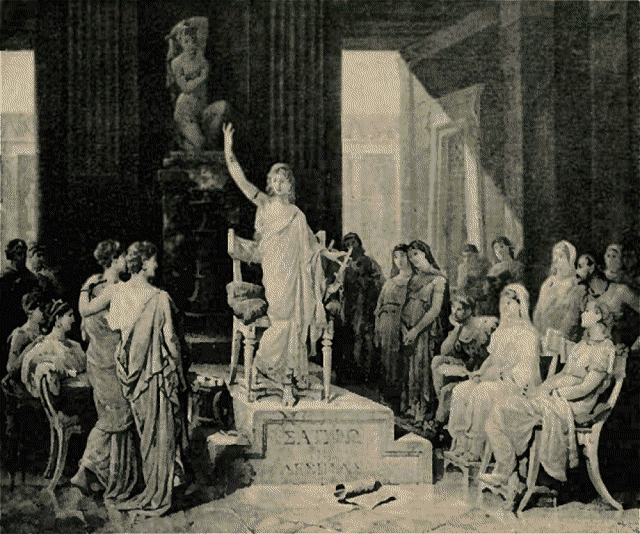
The form and melody of Sappho's poems are due to the fact that they were to accompany vocal and instrumental music, which, thanks to the innovations of Terpander of Lesbos, was at that time exquisitely adapted to the purposes of the lyric. Terpander introduced the seven-stringed lyre, or cithara, with its compass of a diapason, or Greek octave, and this became the peculiar instrument of Sappho and her school. The choice of the musical measure determined the tone of the poem. Terpander united the music of Asia Minor with that of Greece proper, and the resulting product of Æolian poetry was the union of Oriental voluptuousness with Greek self-restraint and art. Of Sappho's numerous songs, two odes alone are presented to us in anything like their entirety, one dedicated to the service of Aphrodite, and the other composed in honor of a girl friend, Anactoria. Dionysius of Halicarnassus embodies the first in one of his rhetorical works, as a perfect illustration of the elaborately finished style of poetry, and comments on the fact that its grace and beauty lie in the subtle harmony between the words and the ideas. Edwin Arnold renders it as follows:
"Splendor-throned Queen, immortal Aphrodite, Daughter of Jove, Enchantress, I implore thee Vex not my soul with agonies and anguish; Slay me not, Goddess! Come in thy pity--come, if I have prayed thee; Come at the cry of my sorrow; in the old times Oft thou hast heard, and left thy father's heaven, Left the gold houses, Yoking thy chariot. Swiftly did the doves fly, Swiftly they brought thee, waving plumes of wonder-- Waving their dark plumes all across the æther, All down the azure. Very soon they lighted. Then didst thou, Divine one, Laugh a bright laugh from lips and eyes immortal, Ask me 'What ailed me--wherefore out of heaven, Thus I had called thee? What was it made me madden in my heart so?' Question me smiling--say to me, 'My Sappho, Who is it wrongs thee? Tell me who refuses Thee, vainly sighing. Be it who it may be, he that flies shall follow; He that rejects gifts, he shall bring thee many; He that hates now shall love thee dearly, madly-- Aye, though thou wouldst not' So once again come, Mistress; and, releasing Me from my sadness, give me what I sue for, Grant me my prayer, and be as heretofore now Friend and protectress."
The ode to Anactoria is quoted by the author of the treatise on The Sublime as an illustration of the perfection of the sublime in poetry. John Addington Symonds thus renders it in English:
"Peer of gods he seemeth to me, the blissful Man who sits and gazes at thee before him, Close beside thee sits, and in silence hears thee Silverly speaking, Laughing love's low laughter. Oh this, this only Stirs the troubled heart in my breast to tremble I For should I but see thee a little moment, Straight is my voice hushed; Yea, my tongue is broken, and through and through me 'Neath the flesh impalpable fire runs tingling; Nothing see mine eyes, and a noise of roaring Waves in my ear sounds; Sweat runs down in rivers, a tremor seizes All my limbs, and paler than grass in autumn, Caught by pains of menacing death, I falter, Lost in the love-trance."
Epithalamia, or wedding songs, were the most numerous of all Sappho's works, and in them she attained an excellence unequalled by any other poet. Catullus, in despair, seems to have been content with adapting in his marriage odes well-known songs of Sappho. The poet seems to have described all the stages in the ceremony--the Greek maidens leading the pale bride to the expectant bridegroom, chanting their simple chorus to Hymen, the god of marriage. At one time, they sing the approach of the bridegroom:
"Raise high the roof-beam, carpenters, Hymenæus! Like Ares comes the bridegroom, Hymenæus! Taller far than a tall man, Hymenæus!"
But their thoughts are all for the rejoicing bride, who blushes "as sweet as the apple on the end of the bough."
"O fair--O sweet! As the sweet apple blooms high on the bough, High as the highest, forgot of the gatherers: So thou:-- Yet not so: nor forgot of the gatherers; High o'er their reach in the golden air, O sweet--O fair!"
We shall arrange the briefer fragments according to subject, not according to metre, in order that through them we may gain a clear conception of Sappho's attitude toward life and nature, that we may know the poetess in her love and friendship, her longings and her sorrows, her sensibility to the influences of nature and art.
Her conception of love has been already noticed in the longer poems just quoted. A number of the fragments indicate a similar intensity of emotion. Thus she says:
"Lo, Love once more, the limb-dissolving king, The bitter-sweet, impracticable thing, Wild-beast-like rends me with fierce quivering."
In another:
"Lo, Love once more my soul within me rends Like wind that on the mountain oak descends."
A being so intense as Sappho, with sensibilities so refined and intuitions so keen, naturally possessed an ardent love of nature. Her power of expressing its charm is shown in a number of fragments. Every aspect of nature seems to have appealed to her.
Of the morning she says:
"Early uprose the golden-sandalled Dawn."
And of the evening:
"Evening, all things thou bringest Which Dawn spreads apart from each other; The lamb and the kid thou bringest, Thou bringest the boy to his mother."
And of the night:
"And dark-eyed Sleep, child of Night"
She sings to us also of the
"Rainbow, shot with a thousand hues."
And of the stars:
"Stars that shine around the refulgent full moon Pale, and hide their glory of lesser lustre When she pours her silvery plenilunar Light on the orbed earth."
And again of the moon and the Pleiades:
"The moon has left the sky; Lost is the Pleiads' light; It is midnight And time slips by; But on my couch alone I lie."
Trees and flowers and plants appeal to her as if they were endowed with life, and by her mention of them she calls up to the imagination a tropical summer with its attendant recreations. Thus she sings of the breeze murmuring cool through the apple boughs:
"From the sound of cool waters heard through the green boughs Of the fruit-bearing trees, And the rustling breeze, Deep sleep, as a trance, down over me flows."
Sappho loves flowers with a personal sympathy. She feels for the hyacinth:
"As when the shepherds on the hills Tread under foot the hyacinth, And on the ground the purple flower lies crushed."
She sings also of the golden pulse that grows on the shores, and of the pure, soft bloom of the grass trampled under foot by the Cretan women as they dance round the fair altar of Aphrodite. The rose seems to have been her favorite flower, for, says Philostratus, "Sappho loves the rose, and always crowns it with some praise, likening beautiful maidens to it."
The birds, too, found in her a most sympathetic friend. Her ear is open to:
"Spring's messenger, the sweet-voiced nightingale,"
and she pities the wood-doves as "their heart turns cold and their wings fall," under the stroke from the arrow of the archer.
Sappho's love for nature is only surpassed by her love for art, for splendor and festivity, as they appeal to the æsthetic nature. She loves her lyre, the song and the dance, garlands, purple robes, and all that attended the worship of Aphrodite and the Muses. Her lyre she thus addresses:
"Come, then, my lyre divine! Let speech be thine."
And to Aphrodite she utters this appeal:
"Come, Queen of Cyprus, pour the stream Of nectar, mingled lusciously With merriment, in cups of gold."
She also calls about her the Muses and the Graces:
"Hither come, ye dainty Graces And ye fair-haired Muses now!"
And again:
"Come, rosy-armed, chaste Graces! come, Daughter of Jove."
And yet again:
"Hither, hither come, ye Muses! Leave the golden sky."
In the worship of Aphrodite and the Graces, garlands are appropriate for the devotees:
"Of foliage and flowers love-laden Twine wreaths for thy flowing hair With thine own soft fingers, maiden, Weave garlands of parsley fair; "For flowers are sweet, and the Graces On suppliants wreathed with may Look down from their heavenly places, But turn from the crownless away."
Such was the joy of the devotees of the Muses. Sappho believed in the adornment of the soul as well as of the body, and she thus addresses one who neglected the services of the Muses:
"Yea, thou shalt die, And lie Dumb in the silent tomb; Nor of thy name Shall there be any fame In ages yet to be or years to come; For of the flowering Rose, Which on Pieria blows, Thou hast no share: But in sad Hades' house Unknown, inglorious 'Mid the dark shades that wander there Shalt thou flit forth and haunt the filmy air."
"I think there will be memory of us yet in after days," said Sappho, and the sentiment is one which later poets have often imitated. Thus the poetess had intimations of the immortality that is justly hers, and the reader will heartily enter into the spirit of Swinburne's paraphrase:
"I, Sappho, shall be one with all these things, With all things high forever; and my face Seen once, my songs once heard in a strange place, Cleave to men's lives, and waste the days thereof In gladness, and much sadness and long love."
Sappho sings of love and its manifestations, of longing and passion, of grief and regret, of natural beauty in sea and sky, by day and by night, of the birds and trees and flowers, and "all this is told us in language at once overpowering and delicate, in verse as symmetrical as it is exquisite, free, and fervid, through metaphor simple or sublime; each word, each line, expressive of the writer's inmost sense; with an art that, in its Greek constraint, comparison, and sweetness, and in its Oriental fervor, is faultless and unerring."
Not only as a poet is Sappho of interest to the women of our day, but also because she was the founder of the first woman's club of which we have knowledge. This Lesbian literary club did not engage, however, in the study of current topics, or seek to gather sheaves of knowledge from the field of science and history, but was consecrated strictly to the service of the Muses. Sappho attracted by her fame young women of Lesbos and of neighboring cities. She gathered them about her, gave them instruction in poetry and music, and incited them to the cultivation of all the arts and graces. Many of these maidens from a distance doubtless sought the society of Sappho because they were weary of the low drudgery and monotonous routine of home life that fell to the lot of women in Ionian cities, and because they felt the need of a freer atmosphere and more inspiring surroundings.
Sappho eagerly sought to elevate her sex. She showed them that, through the more perfect training of mind and body, their horizon would be enlarged, their resources for happiness increased, and their homes become centres of inspiring influences for husband and children.
Never was there a teacher more eager to possess her pupils' love and confidence. Maximus of Tyre compares her relations with her girl friends to Socrates's relations with young men. At times, men have seen fit to censure these intimate friendships of Socrates and Sappho with their pupils, and to see in them immoral relations such as characterized the passionate devotion of many Greek men to beautiful youths; but there is no ground for such imputations. While manifesting the beauty and sweetness and satisfaction in woman's love for woman, Sappho did not attempt to make this love a substitute for the love of men. She herself was married; and there are intimations in her poems that certain of her girl friends exchanged the pleasures of aesthetic comradeship for the joys of wedded life.
From the fragments of her songs, we know the names of at least fourteen of her pupils, and it pleases the fancy to attempt to reconstruct a picture of that delightful band of girl friends, who spent their days in the study of poetry and music and their evenings in every elevating form of recreation. A writer has thus sketched the picture: "Let us call around her in fancy the maidens who have come from different parts of Greece to learn of her. Anactoria is here from Miletus, Eunica from Salamis, Gongyle from Colophon, and others from Pamphylia, and the isle of Telos. Erinna and Damophyla study together the composition of Sapphic metres. Atthis learns how to strike the harp with the plectrum, Sappho's invention; Mnasidica embroiders a sacred robe for the temple. The teacher meanwhile corrects the measures of the one, the notes of another, the strophes of a third; then summons all from their work, to rehearse together some sacred chorus or temple ritual; then stops to read a verse of her own, or to denounce a rival preceptress. Throughout her intercourse with these maidens her conduct is characterized by passionate love, as between equals in mind and heart, and is expressed in fervid and high-wrought language embodying a purity that cannot be misunderstood or cavilled away."
VII
THE SPARTAN WOMAN
It was from Sparta that Paris in the Heroic Age bore away to his Phrygian home Argive Helen, fairest of mortals, the Greek ideal of feminine beauty and charm. But never since that fateful day--as, indeed, never before it--was there in Sparta any woman to compare with her; for the Spartan maidens of historical times, though comely and vigorous and noted for physical beauty, were cast in a firmer, sturdier mould than that which characterized Helen, the flower of grace and loveliness. Yet the traveller in Sparta in her prime must have marvelled at the splendid maidens and matrons he saw amid the hills of Lacedæmon--trained in athletic exercises, fleet of foot, vigorous and well-proportioned, and showing in their very bearing how important they were to the well-being of the State.
In Sparta, woman was the equal of man--in Athens, his inferior. In this fact lies the secret of the training that was given her, for the character of the education of woman is an index to the position assigned her by the spirit of the State. Spartan legislation concerning woman was controlled by one idea--to develop in the maiden the mother-to-be. This idea is so beautiful, so profound, that, after all the centuries which have elapsed, one cannot find a better principle for feminine education. Like mother, like son--and the Spartan ideal of the son was the warrior strong, brave, and resolute, enduring hardship and living solely for the State. Hence the mother must be strong, brave, and resolute, sacrificing every womanly tenderness to the prevailing conception of patriotism.
Great is the contrast between the women of the various peoples of Greece. The Achæan woman, in Homeric times, played no prominent part in public affairs; her home was her palace, and she manifested those domestic traits and womanly qualities that in this day still constitute womanly charm. The life of the Ionian woman was a secluded one; she was under the domination of the sterner sex, and compelled to devote herself largely to the varied duties of the household. The Æolian woman, on the contrary, had asserted her freedom, and lived on terms of social and intellectual comradeship with men. She devoted herself to the cultivation of every womanly grace, and was the earnest follower of Aphrodite and the Muses. In contrast to these, the Spartan woman presents an altogether unique type. She was merely a creature of the State, the cultivation of her higher nature being under the control of a rigid system. As such, she contributed in a large degree to the public welfare, but it was at the sacrifice of many feminine attributes. In her, natural affection and womanly sympathy were sacrificed to a single virtue--patriotism. But one function was emphasized--that of motherhood. All her training was devoted to but one end--that of producing soldiers. The life of the individual was strictly subordinated to the good of the State. Such a system evolved a remarkable type of womanhood, and the Spartan matron has won an immortal name in history.
From the central mass of the mountain system of the Peloponnesus in Arcadia, two chains, Taÿgetus and Parnon, detach themselves and extend southward, terminating in the two dangerous promontories of Tænarum and Malea. Between the two ridges the river Eurotas winds its way in a southeasterly course. In the undulating valley formed by the bed of the stream, and shut in by the mountain ranges, lay ancient Sparta. The country, by nature and climate, was such as to make men hardy and determined. Euripides styles it "a country rich in productions, but difficult to cultivate; shut in on all sides by a barrier of stern mountains; almost inaccessible to the foe." Its hidden situation in the Eurotas valley made it a well-guarded camp, and the Dorian conquerors of the Peloponnesus, surrounded by enemies and threatened by warlike neighbors, soon saw that the only hope of holding their conquests and extending their power lay in the maintenance of a warlike race.
Lycurgus, usually reputed to have lived in the ninth century before Christ, was the founder of the legislation which constituted the greatness of Sparta. He was one of the originators of the principle, so characteristic of antiquity and in such contrast to the spirit of modern times: "The citizen is born and lives for the State; to it his time, his strength, and all his powers belong." Nowhere was this maxim so rigidly enforced as at Sparta. Lycurgus established institutions of a public nature which gave a centralized administration of the most rigid sort, and regulations relating to private life which would develop a warlike type of citizen, the whole system tending to make Sparta supreme in the Peloponnesus, and her soldiers invincible in war. To accomplish this end, the daily life of every individual, both male and female, was under the control of the State. The effect of such a system on the character has been happily expressed by Rousseau: "He strengthened the citizen by taking away the human traits from the man."
Lycurgus saw that the salvation of Sparta depended on its citizens being a nation of warriors. Only by being always ready for war and by possessing an invincible body of soldiery could the State fulfil its destiny in the work of the world. He realized further that the natural antecedent of a nation of men strong physically and intellectually is a race of healthy, sturdy, able-bodied women. Hence his training of the daughters of Sparta was the corner-stone of his system. Valuing woman only for her fruitfulness, his legislation in regard to her had but one object in view--fitting her to be the mother of a powerful race of men. Maidens, therefore, as well as youths, were subjected to the most rigid physical training.
From the moment of birth, the Spartan boy or girl was in the hands of the State. The infant was exposed in the place of public assembly, and if the elders considered it frail and unpromising, or for any reason regarded its existence of no value to the State, the child was thrown off a cliff of Mount Taÿgetus,--a usage shocking to modern sensibilities, but accepted as a necessity by Plato, Aristotle, and other ancient philosophers. The able-bodied child was restored to its mother, and she directed the early training of her charge under the eye of the magistrates. Though the Spartan girl was not, as the youth, removed altogether from the mother at the age of seven and brought up in the barracks, yet her training was scarcely less severe than that of the boys. The feminine tasks of spinning and weaving, customary for free women of other peoples, were by the Spartans committed to female slaves, and the State so ordered the lives of the free maidens that they might become in the future the mothers of robust children. "He [Lycurgus] directed the maidens," says Plutarch, "to exercise themselves with wrestling, running, throwing the quoit, and casting the dart, to the end that the fruit they conceived might in strong and healthy bodies take firmer root and find better growth." These gymnastic exercises they practised in public, clad in little else save their own modesty, thus overcoming fear of exposure to the air, as well as overgreat tenderness and shyness. Similarly clad, they took part in processions along with the young men, and were trained in singing and dancing in the public choruses. This carefully regulated comradeship between youths and maidens was encouraged with a view to stimulating the young men to deeds of valor. The maidens on these occasions would make, by means of jests, befitting reflections on the young men who had misbehaved themselves in the wars, and would sing encomiums upon those who had done gallant actions. Thus the young men were spurred on to greater endeavor by the dread of feminine ridicule, and were inspired by feminine praise to the performance of great deeds. It was always the part of the Spartan maiden, then, to keep bright the fires of patriotism and heroic endeavor. The mother, by precept and example, taught the daughter to repress every emotion of womanly tenderness, to elevate the State to the first place in her heart and life, and to find her destiny in bearing brave sons to defend her country. Thus admitted to the freedom of companionship with their brothers in the games and processions, and stimulated by the instructions of their mothers, they early caught the spirit and purpose which animated one and all--the spirit of unselfish patriotism. It was natural, therefore, that they accepted without a murmur the tyranny of a single idea and found in it their glory and pride. Many stories are told of their remarkable devotion to the State. A Spartan mother who has lost her boy in battle exclaims: "Did I not bear him that he might die for Sparta?" To another, waiting for tidings of the battle, comes a messenger announcing that her five sons have perished. "You contemptible slave," she replies, "that is not what I wish to hear. How fares my country?" On hearing that Sparta is victorious, she adds, without a tremor: "Willingly, then, do I hear of the death of my sons."
Marriage is the determining factor in the economic conditions of society, and the regulations prescribed concerning it are an excellent index to the character of any people. Under the Lycurgan system, marriage was strictly under the control of the State. The goddess of love was practically banished from Sparta. Only one temple to Aphrodite stood in Lacedæmon; and in this the goddess was represented armed, not with her magic girdle, but with a sword, and seated with a veil over her head and fetters upon her feet, symbolizing that she was under restraint. History records many instances of affection between husband and wife, but considerations of love did not enter into the marriage contract. No frail woman was allowed to marry. The age of marriage was fixed at the period which was considered best for the perfection of the offspring, usually about thirty years in the case of the men, and about twenty for the maidens. Plutarch describes in uncolored language the chief features of the marriage relations of the Spartans:
"In their marriages, the husband carried off his bride by a sort of force; nor were brides ever small and of tender years, but in their full bloom and ripeness. After this, she who superintended the wedding comes and clips the hair of the bride close round her head, dresses her up in man's clothes, and leaves her upon a mattress in the dark; afterward comes the bridegroom, in his everyday clothes, sober and composed, as having supped at the common table; and entering privately into the room where the bride lies, unties her virgin zone, and takes her to himself; and after staying some time together, he returns composedly to his own apartment, to sleep as usual with the other young men. And so he continues to do, spending his days and indeed his nights with them, visiting his bride in fear and shame and with circumspection, when he thought he should not be observed; she also, on her part, using her wit to help to find favorable opportunities for their meeting, when company was out of the way. In this manner they lived a long time, insomuch that they sometimes had children by their wives before ever they saw their faces by daylight. Their interviews being thus difficult and rare, served not only for continual exercise of their self-control, but brought them together with their bodies healthy and vigorous, and their affections fresh and lively, unsated and undulled by easy access and long continuance with each other, while their partings were always early enough to leave behind unextinguished in each of them some remaining fire of longing and mutual delight.
"After guarding marriage with this modesty and reserve, Lycurgus was equally careful to banish empty and womanish jealousy. For this object, excluding all licentious disorders, he made it nevertheless honorable for men to give the use of their wives to those whom they should think fit, that so they might have children by them; ridiculing those in whose opinion such favors are so unfit for participation as to fight and shed blood and go to war therefor. Lycurgus allowed a man, who was advanced in years and had a young wife, to recommend some virtuous and approved young man, that she might have a child by him, who might inherit the good qualities of the father, and be a son to himself. On the other side, an honest man who had love for a married woman upon account of her modesty and the well-favoredness of her children might, without formality, beg her company of her husband, that he might raise, as it were, from this plot of good ground worthy and well-allied children for himself."
Regulations such as these, though shocking to modern sensibilities, seem not to have been detrimental to public morals while Sparta submitted to the severe austerity of the laws. It seems surprising that, while a woman might lawfully be the recognized wife of two husbands, no such duplication of spouses was allowed to a man. This rule is illustrated by its one historical exception In the case of King Anaxandrides, who, says Herodotus, when the royal Heraclidæan line of Eurystheus was in danger of becoming extinct, married his niece, who bore him no children. The people besought him to divorce her, and to contract another marriage; but, owing to his love for his wife, he positively refused. Upon this, they made a suggestion to him as follows: "Since then we perceive thou art firmly attached to the wife whom thou now hast, consent to do this, and set not thyself against it, lest the Spartans take some counsel against thee other than might be wished. We do not ask of thee the putting away of the wife thou now hast; but do thou give to her all that thou givest now, and at the same time take to thy house another wife in addition to this one, to bear thee children." When they spoke to him after this manner, Anaxandrides consented, and from this time forth he kept two separate households, having two wives, a thing which, we are told, was not by any means after the Spartan fashion.
Every inducement was offered to encourage matrimony, and bachelors were the objects of general scorn and derision. "Those who continued bachelors," says Plutarch, "were in a degree disfranchised by law; for they were excluded from the sight of the public processions in which the young men and maidens danced naked, and in the winter-time the officers compelled them to walk naked round the market place, singing, as they went, a certain song to their own disgrace, that they justly suffered this punishment for disobeying the laws." Furthermore, at a certain festival the women themselves sought to bring these misguided individuals to a proper sense of their duty by dragging them round an altar and continually inflicting blows upon them. Without doubt, the maidens were all inclined to matrimony, as it enhanced their influence and enabled them to fulfil their mission; and the rulers were ever ready to provide husbands for them.
A kind of disgrace attached to childlessness. Men who were not fathers were denied the respect and observance which the young men of Sparta regularly paid their elders. On one occasion, Dercyllidas, a commander of great renown, entered an assembly. A young Spartan, contrary to custom, failed to rise at his approach. The veteran soldier was surprised. "You have no sons," said the youth, "who will one day pay the same honor to me." And public opinion justified the excuse.
The effects of the athletic training upon the physical nature of woman were most commendable. The Spartan maiden was renowned throughout Greece for preeminence in vigor of body and beauty of form. Even the Athenian was impressed by this. Lysistrata, in the play of Aristophanes, in greeting Lampito, the delegate from Sparta, who has come to a women's conference, speaks thus:
"O dearest Laconian, O Lampito, welcome! How beautiful you look, sweetest one! What a fresh color! How vigorous your body is! What beautiful breasts you have! Why, you could throttle an ox!" To this greeting comes the reply:
"Yes, I think I could, by Castor and Pollux! for I practise gymnastics and leap high."
Ideals of beauty differ in different ages and countries, and there is no doubt that Lampito was a magnificent specimen of woman; yet it may be doubted whether such masculine vigor is consonant with the highest moral and spiritual development, which, after all, is the chief factor in womanly charm. Spartan women were in demand everywhere as nurses, and were universally respected for their vigor and prowess; yet it was the equally healthy, but more graceful, Ionian woman who was chosen as the model of the statues of the goddess of love and beauty.
Spartan discipline produced beautiful animals, but any system which dulled the sensibilities could hardly inculcate that grace and sweetness and warmth of temperament which are essential to beauty.
As to the moral nature of the Spartan woman, there is no doubt that the unselfish devotion to the State, and the subordination of individual inclination to the good of the whole, would tend to promote a rigid morality. Yet the free intercourse between the sexes shocked the Athenians; and Euripides, in the Andromache, has put into the mouth of Peleus a severe indictment of the Spartan woman:
"Though one should essay, Virtuous could daughter of Sparta never be. They gad abroad with young men from their homes, And--with bare thighs and loose, disgirdled vesture-Race, wrestle with them--things intolerable To me! And is it wonder-worthy then That ye train not your women to be chaste?"
The Spartan laws, it is true, permitted and encouraged certain practices regarded as morally wrong in this day, yet that which was lawful could not well be considered immoral. Xenophon and Plutarch were ardent admirers of the Spartan system, and strongly affirm the uprightness and nobility of the Spartans. Plutarch tells an incident to illustrate Spartan virtue in the old days. Geradas, a very ancient Spartan, being asked by a stranger what punishment their law had appointed for adulterers, answered: "There are no adulterers in our country." "But," replied the stranger, "suppose there were." "Then," answered he, "the offender would have to give the plaintiff a bull with a neck so long that he might drink from the top of Taygetus of the Eurotas River below it." The man, surprised at this, said: "Why, 'tis impossible to find such a bull." Geradas smilingly replied: "It is as impossible to find an adulterer in Sparta."
Though we have to recognize much in the Spartan polity which is repugnant to our ideas of the sacredness of family ties, yet we must feel the utmost respect for the Spartan matron in the best days of Lacedæmon. This rigid system provided for four or five centuries "a succession of the strongest men that possibly ever existed on the face of the earth," and the strength of character of the mothers made the sons what they were. Only the Roman matron can be fitly compared to the Spartan mother.
It is not surprising that such mothers possessed an influence envied throughout Greece. "You Spartan women are the only ones who rule over men," said a stranger to Gorgo, wife of Leonidas. "True," she rejoined; "for we are the only ones who are the mothers of men."
For several centuries, owing to her peculiar discipline, Sparta was, excepting Athens, the foremost State of Greece. But time is an enemy often not taken sufficiently into consideration by men who establish peculiar systems. And Lycurgus, who wished to make his system perpetual, did not fully consider the disintegrating effects which time exerts on all things temporal. "Naturam expellas furca, tamen usque recurret [You may repress natural propensities by force, but they will be certain to reappear]," says Horace, the wisest of Roman satirists; and the Spartan polity had attempted to repress nature in men and women and to control it by law. The great fault in the Lacedæmonian constitution was in effect the violation of the eternal laws which assign to each creature his rôle in the harmony of the world. Men are made for war, but they are made for peace as well. Therefore, as Lycurgus made the city an armed camp, in periods of peace the Spartan man "rusted like an unused sword in its scabbard," and in idleness at home or in garrison duty abroad fell an easy victim to avarice and lust.
In his legislation concerning women, Lycurgus violated natural propensities to an even greater extent than he had in his laws governing the conduct of men. Woman was destined primarily for domestic life. She was created to bear children; but her kingdom is the home, with its manifold duties, and rearing children is as much her function as bearing them. Yet the Spartan lad was taken forcibly from his mother at the tender age of seven, and the Spartan maiden, while living at home, was subject to stringent regulations formulated and enforced by the State.
Woman is intuitively interested in domestic duties, in housekeeping and clothes mending, and in caring for the innumerable wants of husband and children. Yet the Syssitia, or public meals, deprived her of the society of husband and sons, and took from her domestic cares because they were deemed too menial for a free Spartan. "Female slaves," averred Lycurgus, "are good enough to sit at home spinning and weaving; but who can expect a splendid offspring--the appropriate mission and duty of a free Spartan woman toward her country--from mothers brought up in such occupations?"
Although the Spartan system prescribed rigid discipline for the Spartan woman up to the time of motherhood, after that time it left her life altogether unregulated by law. Plato, who was in many respects a great admirer of the Spartans, criticises this singular defect. He found fault with a system which regarded woman only as a mother, and consequently, when children had been born and turned over to the State, did not by law provide occupation for the mothers or in any way regulate their conduct. There was nothing to restrain their luxury or keep them loyal to duty and probity. Higher culture was discouraged, intercourse with strangers was forbidden, and woman was left largely to her own devices for employment and recreation; but she was deprived in large measure of the usual feminine occupations. During the old days, when the State was the all in all of the citizens, and the mothers were urging on husbands and sons to valiant deeds, the evils of the Lycurgan system did not show themselves; but when the crisis came, and Sparta lost her supremacy in Greek affairs, then old manners gave way, vice and weakness rushed in, and men and women alike were debauched and evil.
Aristotle, who was at his zenith during the latter part of the fourth century before Christ, is severe in his denunciations of the license of the Spartan women. This he regards as defeating the intention of the Spartan constitution and subversive of the good order of the State. He argues that, while Lycurgus sought to make the whole State hardy and temperate, and succeeded in the case of the men, he had not done so with the women, who lived in every sort of intemperance and luxury. He charges that the Spartan men are under the domination of their wives--Ares being ever susceptible to the wishes and inclinations of Aphrodite. And the result is the same, he adds, "whether women rule or the rulers are ruled by women." He also attacks the courage of the women, stating that in a Theban invasion they had been utterly useless and caused more confusion than the enemy. He finds them prone to avarice, and regrets that, owing to the inequality of the laws governing property, more than two-fifths of the whole country was already in the hands of women.
Nature in the end asserted herself, and the evils inherent in the Lycurgan system brought about the fall of the State. Sparta had sacrificed the liberties of her citizens, she had despised the laws of nature in the destiny and education of women, she had banished the arts, and had sought to keep out every humanizing influence. Consequently, when that constitution, inflexible and in certain respects immoral and unnatural, was impaired, her decline was rapid. Sad it is that Aristotle should have perceived in the immorality, the greed, the misconduct, of the women, one of the causes of the fall of Sparta!
Sparta had become degenerate, but she was not to die without a final struggle. In the middle of the third century before Christ, two kings of Sparta, inspired by the stories of her early days, endeavored to overcome the luxury and vice that were rampant and to restore the State to its primitive simplicity and greatness. In their meritorious efforts to accomplish the impossible, they enlisted the efforts of noble women, who by their self-sacrificing devotion cast a momentary radiance over the dying State.
The earliest of these two kings was the young and gentle Agis. In the corrupt state of society he saw need of reforms, and wished to begin at the root of the evil by annulling debts and redistributing the land. One of the first counsellors whom he consulted in his projected reforms was his mother, Agesistrata, a woman of great wealth and power, who had many of the Spartans in her debt and would be seriously affected by the change. Yet, becoming conscious of the need of reforms, she, with the grandmother of the young king, entered heartily into his plans to restore the greatness of Sparta. Agesistrata urged other aristocratic women to join in the movement, "knowing well that the Lacedæmonian wives always had great power with their husbands." These, however, violently opposed the scheme, because at this time most of the money of Sparta was in the women's hands and was the main support of their credit and power. Leonidas, the other king, was the head of the opposition, and a deadly struggle followed between Agis and Leonidas--the one standing for the people, the other for the aristocrats. Agis was at first successful, and Leonidas was deposed, Cleombrotus, his son-in-law, being elevated to the kingship in his stead. Another woman now comes to the front. Chilonis, Cleombrotus's wife and Leonidas's daughter, seeing her aged father in exile and distress, leaves her husband in the height of his power and devotes herself to her aged father.
However, the wheel of fortune again turns, and Leonidas is restored to power. Agis and Cleombrotus flee for their lives, and become suppliants--the one at the temple of the Brazen House, the other at the temple of Poseidon. Leonidas, being more incensed against his son-in-law, leaves Agis for the time and goes with his soldiers to Cleombrotus's sanctuary to reproach him for having conspired with his enemies, usurped his throne, and driven him from his country. Chilonis, perceiving the great danger threatening her husband, leaves her father and seeks to aid and comfort the fugitive. Plutarch thus tells her story:
"Cleombrotus, having little to say for himself, sat silent. His wife, Chilonis, the daughter of Leonidas, had chosen to follow her father in his sufferings; for when Cleombrotus usurped the kingdom, she forsook him and wholly devoted herself to comforting her father in his affliction; whilst he still remained in Sparta, she remained also, as a suppliant, with him; and when he fled, she fled with him, bewailing his misfortune, and extremely displeased with Cleombrotus. But now, upon this turn of fortune, she changed in like manner, and was seen sitting now, as a suppliant, with her husband, embracing him with her arms, and having her two little children beside her. All men were full of wonder at the piety and tender affection of the young woman, who, pointing to her robes and her hair, both alike neglected and unattended to, said to Leonidas: 'I am not brought, my father, to this condition you see me in, on account of the present misfortune of Cleombrotus; my mourning habit is long since familiar to me; it was put on to condole with you in your banishment; and now you are restored to your country, and to your kingdom, must I still remain in grief and misery? Or would you have me attired in my royal ornaments, that I may rejoice with you when you have killed, within my arms, the man to whom you gave me for a wife? Either Cleombrotus must appease you by mine and my children's tears, or he must suffer a punishment greater than you propose for his faults, and shall see me, whom he loves so well, die before him. To what end should I live, or how shall I appear among the Spartan women, when it shall so manifestly be seen that I have not been able to move to compassion either a husband or a father? I was born, it seems, to participate in the ill fortune and in the disgrace, both as a wife and a daughter, of those nearest and dearest to me. As for Cleombrotus, I sufficiently surrendered any honorable plea on his behalf when I forsook him to follow you; but you yourself offer the fairest excuse for his proceedings, by showing to the world that for the sake of a kingdom it is just to kill a son-in-law and be regardless of a daughter.' Chilonis, having ended this lamentation, rested her face on her husband's head, and looked round with her weeping and woe-begone eyes upon those who stood before her.
"Leonidas, touched with compassion, withdrew a while to advise with his friends; then, returning, bade Cleombrotus leave the sanctuary and go into banishment; 'Chilonis,' he said, 'ought to stay with him, it not being just that she should forsake a father whose affection had granted to her the life of a husband.' But all he could say would not prevail. She rose up immediately, and taking one of her children in her arms, gave the other to her husband, and making her reverence to the altar of the deity, went out and followed him. So that, in a word, if Cleombrotus were not utterly blinded by ambition, he would surely choose to be banished with so excellent a woman rather than without her to possess a kingdom."
Having disposed of Cleombrotus, Leonidas next proceeded to consider how he might entrap Agis. Agis, however, held his sanctuary until he was finally betrayed by the treachery of three pretended friends, Amphares, Damochares, and Arcesilaus. He was led off to prison and executed.
Plutarch says: "Immediately after he was dead, Amphares went out of the prison gate, where he found Agesistrata, who, believing him still the same friend as before, threw herself at his feet. He gently raised her up, and assured her she need not fear any further violence or danger of death for her son, and that, if she pleased, she might go in and see him. She begged her mother might also have the favor to be admitted, and he replied that nobody should hinder it. When they were entered, he commanded the gate should again be locked, and Archidamia, the grandmother, to be first introduced; she was now grown to be very old, and had lived all her days in the highest repute among her fellows. As soon as Amphares thought she was despatched, he told Agesistrata she might now go in if she pleased. She entered; and beholding her son's body stretched on the ground, and her mother's hanging by the neck, the first thing she did was, with her own hand, to assist the officers in taking down the body; then, covering it decently, she laid it out by her son's, whom then embracing, and kissing his cheeks, 'O my son,' said she, 'it was thy too great mercy and goodness which brought thee and us to ruin.' Amphares, who stood watching behind the door, on hearing this, broke in, and said angrily to her, 'Since you approve so well of your son's actions, it is fit you should partake in his reward.' She, rising up to offer herself to the noose, said only, 'I pray that it may redound to the good of Sparta.'"
Thus was defeated the first effort for the reformation of Sparta. In the city's long history, Agis was the first king who had been put to death by the order of the ephors. When the bodies of the gentle king and his noble mother and grandmother were exposed, the horror of the people knew no bounds, and the aged Leonidas and Amphares became the objects of public detestation.
The second attempt at the reformation of Sparta is also remarkable for the unselfishness and nobility of the women who took part.
After the execution of King Agis, his wife, Agiatis, was compelled by Leonidas to become the wife of his son Cleomenes, though the latter was as yet too young to marry. As Agiatis was the heiress of the great estate of her father, Gylippus, the old king was unwilling that she should be the wife of anyone but his son. Agiatis was, says Plutarch, "in person the most youthful and beautiful woman in all Greece, and well-conducted in her habits of life." She resisted the union as long as she could; but when forced to marry, she became to the youth a kind and obliging wife. Cleomenes loved her very dearly, and often asked her about the reforms of Agis; and she did not fail to inspire him with the lofty ideals of her former gentle and high-minded husband. Cleomenes himself, in consequence, fell in love with the old ways, and, after Leonidas's death, attempted to carry out the reforms in which Agis had failed. His mother, Cratesiclea, was also very zealous to promote his ambitions; and in order that she might effectually assist him in his plans, she accepted as her husband one of the foremost in wealth and power among the citizens. With her help, the king succeeded in breaking the power of the ephors, and a return to the system of Lycurgus was partially accomplished. But Cleomenes had aroused a formidable enemy in the person of Aratus, head of the Achæan League. He carried into Achæa the war against Aratus, and made himself master of almost all Peloponnesus, but, through the persistence of his enemies, almost as quickly lost that territory. In the midst of his misfortunes, he received news of the death of his wife, to whom he was devotedly attached. "This news afflicted him extremely," says Plutarch, "and he grieved as a young man would do, for the loss of a very beautiful and excellent wife." When all seemed lost, he received promise of assistance from King Ptolemy of Egypt, but only on condition that he send the latter his mother and children as hostages. Plutarch thus continues the story:
"Now Ptolemy, the King of Egypt, promised him assistance, but demanded his mother and children for hostages. This, for a considerable time, he was ashamed to discover to his mother; and though he often went to her on purpose, and was just upon the discourse, yet he still refrained, and kept it to himself; so that she began to suspect, and asked his friend whether Cleomenes had something to say to her which he was afraid to speak. At last, Cleomenes venturing to tell her, she laughed aloud, and said: 'Was this the thing that you had so often a mind to tell me, but were afraid? Make haste and put me on shipboard, and send this carcass where it may be most serviceable to Sparta, before age destroys it unprofitably here,' Therefore, all things being provided for the voyage, they went by land to Tænarum, and the army waited on them. Cratesiclea, when she was ready to go on board, took Cleomenes aside into Poseidon's temple, and, embracing him, who was much dejected and extremely discomposed, she said: 'Go to, King of Sparta; when we come forth at the door, let none see us weep or show any passion that is unworthy of Sparta, for that alone is in our power; as for success or disappointment, those wait on us as the deity decrees,' Having this said, and composed her countenance, she went to the ship with her little grandson, and bade the pilot put out at once to sea. When she came to Egypt, and understood that Ptolemy entertained proposals and overtures of peace from Antigonus, and that Cleomenes, though the Achæans invited and urged him to an agreement, was afraid for her sake to come to any without Ptolemy's consent, she wrote to him, advising him to do that which was most becoming and most profitable for Sparta, and not, for the sake of an old woman and a little child, stand always in fear of Ptolemy. This character she maintained in her misfortunes."
Cleomenes, however, soon realized how little reliance is to be put in the favors of princes. Antigonus of Syria took the part of Aratus against him, and Ptolemy, who had been ever ready to help the valiant Spartan, did not care to invite the hostility of a greater foe. Cleomenes was defeated by Antigonus, and became an exile at the court of Ptolemy, but it proved to be a prison instead of a home. Upon the death of the elder Ptolemy, his son kept Cleomenes and his friends under restraint, and, to please Antigonus, purposed putting them to death. Cleomenes and his companions, knowing that a tragic end awaited them, determined to break through their prison bars and to rouse the populace to a revolt against Ptolemy. They easily made their escape, but the people could not be persuaded to undertake any struggle for liberty; and so the devoted band resolved to die. Then each one killed himself, except Panteus, the youngest and handsomest of them all, who was selected by Cleomenes to wait till the rest were dead, so that he might perform for them the last offices. He carefully arranged all the bodies of his comrades, and then, kissing his beloved king and throwing his arms about him, slew himself. The news of this sad event, having spread through the city, finally reached the aged mother, Cratesiclea, who, though a woman of great spirit, could hardly bear up against the weight of this affliction, especially as she knew that an equally tragic fate awaited her grandchildren.
The Egyptian king ordered that Cleomenes's body should be flayed, and that his children, his mother, and the women that were with her, should be put to death. Among these was the wife of Panteus, still very young and exquisitely beautiful, who had but lately been married. Her parents would not suffer her to embark with Panteus for Egypt so soon after they had been married, though she eagerly desired it, and her father had shut her up and kept her forcibly at home. But she found means of escape. A few days after Panteus's departure, she slipped out by night, mounted a horse and rode to Taenarum, and there embarked on a vessel sailing for Egypt, where she soon found her husband, and with him cheerfully endured all the sufferings and hardships that befell them in a hostile country. She was now the moral support of the whole company of helpless women. She moved about among them, comforting and consoling. She gave her hand to Cratesiclea, as the latter was being led out by the soldiers to execution, held up her robe, and begged her to be courageous, being herself not in the least afraid of death, and desiring nothing else than to be killed before the children were put to death. When they reached the place of execution, the children were first killed before Cratesiclea's eyes; and afterward she herself suffered death, with these pathetic words on her lips: "O children, whither are you gone?" Panteus's wife, as her husband did for the men, performed the last offices for the women. In silence and perfect composure, she looked after every one that was slain, and laid out the bodies as decently as circumstances would permit. And then, after all were killed, adjusting her own robe so that she might fall becomingly, she courageously submitted to the stroke of the executioner.
Thus ended the second great movement for the reformation of Sparta, and henceforth Sparta, as an independent State; disappears from history. The story of the fall of Sparta owes its human interest chiefly to the women involved, and Plutarch recognizes this fact when, in concluding his story of Cleomenes, he, with the Greek dramatic contests before his mind, says: "Thus Lacedaemon, exhibiting a dramatic contest in which the women vied with the men, showed in her last days that virtue cannot be insulted by fortune."
Chilonis, Agesistrata, Agiatis, Cratesiclea, the wife of Panteus,--what a pity that we do not know her name!--constitute the most admirable feminine group that Greek history offers us. What especially charms us is that they unite with the strength and self-abnegation of the ancient Spartan matron a sweetness, a tenderness, a womanliness, which we have not been accustomed to attribute to Spartan women. They are Spartans, but they are, above all, women.
VIII
THE ATHENIAN WOMAN
Divergent views have been entertained by writers who have discussed the social position of woman at Athens and the estimation in which she was held by man. Many scholars have asserted that women were held in a durance not unlike that of the Oriental harem, that their life was a species of vassalage, and that they were treated with contempt by the other sex; while the few have contended that there existed a degree of emancipation differing but slightly from that of the female sex in modern times. As is usually the case, the truth lies in the golden mean between these two extremes; and a careful perusal of Greek authors, with the judgment directed to the spirit of their references to women rather than to a literal interpretation of disparate passages, will show that the status of the freeborn Athenian woman, while by no means ideal or conforming to our present standards, was far better than is usually conceded by the writers upon Greek life.
It cannot be denied, however, that the social position of the Athenian woman was far inferior to that of the woman of the Heroic Age, and that, despite the boasted democracy and freedom of thought of the period, woman's status in the years of republican Athens was a reproach to the advanced culture and love of the good and the beautiful of which the city of the violet crown was the exponent. There had been a revolution in the habits of life of the Greeks since the days when Homer sang of the women of heroic Greece, and the student does not have to search far to discover the principal causes of the change.
The chief of these is the Greek idea of the city-state, which reached its highest development in Athens. Citizenship was, as a rule, hereditary, and every possible legal measure was taken to preserve its purity. The main principle of this hereditary citizenship was that the union from which the child was sprung must be one recognized by the State. This was accomplished by requiring a legitimate marriage, either through betrothal by a parent or guardian, or through assignment by a magistrate. Pericles revised the old conditions, which had become lax during the tyranny, by passing a measure limiting citizenship to those who were born of two Athenian parents. Greater stress was laid on the citizenship of the mother than on that of the father, as the child was regarded as belonging naturally to the mother. It was possible to increase the citizen body by a vote of the people; but in the best days of Athens her citizenship was regarded as so high a privilege that the franchise was most jealously guarded. Consequently, in the fifth century we see in Athens and Attica a population of about four hundred thousand, of which not more than fifty thousand were citizens; the rest consisted of minors, of resident aliens numbering some fifteen thousand, and of slaves, of whom there were about two hundred thousand in the Periclean Age.
To preserve the purity of the citizenship in so large a population of residents, increased by thousands of visitors and strangers who frequented the metropolis, every precaution was taken that the daughters of Athens should not be wedded to foreigners, and that no spurious offspring should be palmed off on the State. Hence marriage by a citizen was restricted to a union with a legitimate Athenian maiden with full birthright. The marriage of an Athenian maiden with a stranger, or of a citizen with a foreigner, was strictly forbidden, and the offspring of such a union was illegitimate.
Under such a conception of polity, marriage lay at the very basis of the State; and respect for the local deities, obligations of citizenship, and regard for one's race and lineage, demanded that every safeguard should be thrown about it, and that the women of Athens should conform to those enactments and customs which would fit them to be the mothers of citizens and would keep from them every entangling intrigue with strangers.
The result of this polity was a singular phenomenon: there were in Athens two classes of women--one carefully secluded and restricted, under the rigid surveillance of law and custom; the other, free to do whatever it pleased, except to marry citizens. Yet the latter class would gladly have exchanged places with the former; while the former, no doubt, envied the freedom and social accomplishments of the latter. The one class consisted of the highborn matrons of Athens, glorying in their birthright, and rulers of the home; the other, of the resident aliens of the female sex, unmarried, emancipated intellectually as untrammelled morally, who could become the "companions" of the great men of the city. Thus, owing to the Athenian conception of the city-state, the natural functions of woman--domesticity and companionship, which should be united in one person, were divided, the Athenian man looking to his wife merely for the care of the home and the bearing and rearing of children, and to the hetæra for comradeship and intellectual sympathy. This evil was the canker-worm which gnawed out the core of the social life of Athens and caused the unhappiness of the female sex.
At the birth of a girl in Athens, woollen fillets were hung upon the door of the house to indicate the sex of the child, the olive wreath being used to proclaim the birth of a boy. This custom demonstrates the relative importance of son and daughter in the eyes of the parents and the public. The son was destined for all the victories that public life and the prestige of the State can give; therefore, the olive, symbol of victory, served to make known his advent. The daughter's life was to be one of domestic duties, hence the band of wool, with its connotation of spinning and weaving, was a fitting emblem of the career for which the babe was destined. The plan of a Greek house indicates how secluded woman's whole life was to be. In the interior part of the Greek mansion, separated from the front of the building by a door, lay the gyncæconitis, or women's apartments, usually built around a court. Here were bedrooms, dining-rooms, the nursery, the rooms for spinning and weaving, where the lady of the house sat at her wheel. This was, in brief, the feminine domain.