GREAT SINGERS ON THE ART of SINGING
Reading edition
EDUCATIONAL CONFERENCES WITH FOREMOST ARTISTS
BY JAMES FRANCIS COOKE
A SERIES OF PERSONAL STUDY TALKS WITH THE MOST RENOWNED OPERA CONCERT AND ORATORIO SINGERS OF THE TIME
ESPECIALLY PLANNED FOR VOICE STUDENTS

THEO. PRESSER CO. PHILADELPHIA, PA.
Copyright, 1921, by Theo. Presser Co. International Copyright Secured
CONTENTS
PAGE
Introduction5
The Technic of Operatic Production21
What the American Girl Should Know About an Operatic Career Frances Alda31
Modern Vocal Methods in ItalyPasquale Amato38
The Main Elements of InterpretationDavid Bispham45
Success in Concert SingingDame Clara Butt58
The Value of Self-Study in Voice TrainingGiuseppe Campanari68
Italy, the Home of SongEnrico Caruso79
Modern Roads To Vocal SuccessJulia Claussen90
Self-Help in Voice StudyCharles Dalmores100
If My Daughter Should Study for Grand OperaAndreas Dippel110
How a Great Master Coached Opera SingersEmma Eames121
The Open Door To OperaFlorence Easton133
What Must I Go Through to Become a Prima Donna?Geraldine Farrar144
The Master Songs of Robert SchumannJohanna Gadski154
Teaching Yourself to SingAmelita Galli-Curci166
The Know How in the Art of SingingMary Garden176
Building a Vocal RepertoireAlma Gluck185
Opportunities for Young Concert SingersEmilio de Gogorza191
Thoroughness in Vocal PreparationFrieda Hempel200
Common Sense in Training and Preserving the VoiceDame Nellie Melba207
Secrets of Bel CantoBernice de Pasquali217
How Fortunes Are Wasted in Vocal EducationMarcella Sembrich227
Keeping the Voice in Prime ConditionErnestine Schumann-Heink 235
Italian Opera in AmericaAntonio Scotti251
The Singer's Larger Musical PublicHenri Scott260
Singing in Concert and What It MeansEmma Thursby269
New Aspects of the Art of Singing in AmericaReinald Werrenrath283
How I Regained a Lost VoiceEvan Williams292
INTRODUCTION
Vocal Gold Mines and How They are Developed
Plutarch tells how a Laconian youth picked all the feathers from the scrawny body of a nightingale and when he saw what a tiny thing was left exclaimed,
"Surely thou art all voice
and nothing else!"
Among the tens of thousands of young men and women who, having heard a few famous singers, suddenly determine to follow the trail of the footlights, there must be a very great number who think that the success of the singer is "voice and nothing else." If this collection of conferences serves to indicate how much more goes into the development of the modern singer than mere voice, the effort will be fruitful.
Nothing is more fascinating in human relations than the medium of communication we call speech. When this is combined with beautiful music in song, its charm is supreme. The conferences collected in this book were secured during a period of from ten to fifteen years; and in every case the notes have been carefully, often microscopically, reviewed and approved by the artist. They are the record of actual accomplishment and not mere metempirical opinions. The general design was directed by the hundreds of questions that had been presented to the writer in his own experience in teaching the art of singing. Only the practical teacher of singing has the opportunity to discover the real needs of the student; and only the artist of wide experience can answer many of the serious questions asked.
The writer's first interest in the subject of voice commenced with the recollection of the wonderfully human and fascinating vocal organ of Henry Ward Beecher, whom he had the joy to know in his early boyhood. The memory of such a voice as that of Beecher is ineradicable. Once, at the same age, he was taken to hear Beecher's rival pulpit orator, the Rev. T. de Witt Talmage, in the Brooklyn Tabernacle. The harsh, raucous, nasal, penetrating, rasping, irritating voice of that clergyman only served to emphasize the delight in listening to Beecher. Then he heard the wonderful orotund organ of Col. Robert J. Ingersoll and the sonorous, mellow voice of Edwin Booth.
Shortly he found himself enlisted as a soprano in the boy choir of a large Episcopal church. While there he became the soloist, singing many of the leading arias from famous oratorios before he was able to identify the musical importance of such works. Then came a long training in piano and in organ playing, followed by public appearances as a pianist and engagements as an organist and choirmaster in different churches. This, coupled with song composition, musical criticism and editing, experience in conducting, managing concerts, accompanying noted singers and, later, in teaching voice for many years, formed a background that is recounted here only to let the reader know that the conferences were not put down by one unacquainted with the actual daily needs of the student, from his earliest efforts to his platform triumphs.
What Must the Singer Have?
What must the singer have? A voice? Of course. But how good must that voice be? "Ah, there's the rub!" It is this very point which adds so much fascination to the chances of becoming a great singer; and it is this very point upon which so many, many careers have been wrecked. The young singer learns that Jenny Lind was first refused by Garcia because he considered her case hopeless; he learns that Sir George Henschel told Bispham that he had insufficient voice to encourage him to take up the career of the singer; he learns dozens of similar instances; and then he goes to hear some famous singer with slender vocal gifts who, by force of tremendous dramatic power, eclipses dozens with finer voices. He thereupon resolves that "voice" must be a secondary matter in the singer's success.
There could not be a greater mistake. There must be a good vocal basis. There must be a voice capable of development through a sufficient gamut to encompass the great works written for such a voice. It must be capable of development into sufficient "size" and power that it may fill large auditoriums. It must be sweet, true to pitch, clear; and, above all, it must have that kind of an individual quality which seems to draw the musical interest of the average person to it.
The Perfect Voice
Paradoxically enough, the public does not seem to want the "perfect" voice, but rather, the "human" voice. A noted expert, who for many years directed the recording laboratories of a famous sound reproducing machine company, a man whose acquaintance with great singers of the time is very wide, once told the writer of a singer who made records so perfect from the standpoint of tone that no musical critic could possibly find fault with them. Yet these records did not meet with a market from the general public. The reason is that the public demands something far more than a flawless voice and technically correct singing. It demands the human quality, that wonderful something that shines through the voice of every normal, living being as the soul shines through the eyes. It is this thing which gives individuality and identity to the voice and makes the widest appeal to the greatest number of people.
Patti was not great because her dulcet tones were like honey to the ear. Mere sweetness does not attract vast audiences time and again. Once, in a mediæval German city, the writer was informed that a nightingale had been heard in the glacis on the previous night. The following evening a party of friends was formed and wandered through the park whispering with delight at every outburst from the silver throat. Never had bird music been so beautiful. The next night someone suggested that we go again; but no one could be found who was enthusiastic enough to repeat the experience. The very perfection of the nightingale's song, once heard, had been sufficient.
The Lure of Individuality
Certain performers in vaudeville owe their continued popularity to the fascinating individuality of their voices. Albert Chevalier, once heard, could never be forgotten. His pathetic lilt to "My Old Dutuch" has made thousands weep. When he sings such a number he has a far higher artistic control over his audience than many an elaborately trained singer trilling away at some very complicated aria.
A second-rate opera singer once bemoaned his fate to the writer. He complained that he was obliged to sing for $100.00 a week, notwithstanding his years of study and preparation, while Harry Lauder, the Scotch comedian, could get $1000 a night on his tours. As a matter of fact Mr. Lauder, entirely apart from his ability as an actor, had a far better voice and had that appealing quality that simply commandeers his auditors the moment he opens his mouth.
Any method or scheme of teaching the art of singing that does not seek to develop the inherent intellectual and emotional vocal complexion of the singer can never approach a good method. Vocal perfection that does not admit of the manifestation of the real individual has been the death knell of many an aspiring student. Nordica, Jean de Reszke, Victor Maurel, Plançon, Sims Reeves, Schumann-Heink, Garden, Dr. Wüllner, Evan Williams, Galli-Curci, and especially our greatest of American singers, David Bispham, all have manifested a vocal individuality as unforgetable to the ear as their countenances are to the eye.
If the reader happens to be a young singer and can grasp the significance of the previous paragraph, he may have something more valuable to him than many lessons. The world is not seeking merely the perfect voice but a great musical individuality manifested through a voice developed to express that individuality in the most natural and at the same time the most comprehensive manner possible. Therefore, young man and young woman, does it not seem of the greatest importance to you to develop, first of all, the mind and the soul, so that when the great hour comes, your audience will hear through the notes that pour from your throat something of your intellectual and emotional character? They will not know how, nor will they ask why they hear it,—but its manifestation will either be there or it will not be there. Upon this will depend much of your future success. It can not be concealed from the discerning critics in whose hands your progress rests. The high intellectual training received in college by Ffrangçon Davies, David Bispham, Plunkett Greene, Herbert Witherspoon, Reinald Werrenrath and others, is just as apparent to the intelligent listener, in their singing at recitals, as it would be in their conversation. Others have received an equivalent intellectual training in other ways. The young singer, who thinks that in the future he can "get by" without such a training, is booked for disappointment. Get a college education if you can; and, if you can not, fight to get its equivalent. No useful experience in the singer's career is a wasted one. The early instrumental training of Melba, Sembrich, Campanari, Hempel, Dalmores, Garden, and Galli-Curci, shows out in their finished singing, in wonderful manner. Every singer should be able to play the piano well. It has a splendid effect in the musical discipline of the mind. In European conservatories, in many instances, the study of the piano is compulsory.
Your Philosophy of Singing
The student of singing should be an inveterate reader of "worthwhile" comments upon his art. In this way, if he has a discriminating mind, he will be able to form a "philosophy of singing" of his own. Richard Wagner prefaced his music dramas with lengthy essays giving his reasons for pursuing a certain course. Whatever their value may be to the musical public at this time, it could not have been less than that to the great master when he was fighting to straighten out for his own satisfaction in his own mind just what he should do and how he should do it. Therefore, read interminably; but believe nothing that you read until you have weighed it carefully in your own mind and determined its usefulness in its application to your own particular case.
The student will find the following books of real value in his quest for vocal truth: The Philosophy of Singing, Clara Kathleen Rogers; The Vocal Instructor, E. J. Myer; The Psychology of Singing, David C. Taylor; How to Sing, Lilli Lehmann; Reminiscences of a Quaker Singer, David Bispham; The Art of the Singer, W. J. Henderson.
The student should also read the biographies of famous singers and keep in touch with the progress of the art, through reading the best magazines.
The History of Singing
The history of singing parallels the history of civilization. Egypt, Israel, Greece and Rome made their contributions; but how they sang and what they sang we can not definitely know because of the destruction of the bridge between ancient and modern notation, and because not until Thomas Edison invented the phonograph in 1877, was there any tangible means of recording the voices of the singers. The wisdom of Socrates, Plato and Cæsar is therefore of trifling significance in helping us to find out more than how highly the art was regarded. The absurd antics of Nero, in his ambition to distinguish himself as a singer, indicated in some more or less indefinite way the importance given to singing in the heyday of Rome. The incessant references to singing, in Greek literature, tell us that singing was looked upon not merely as an accomplishment but as one of the necessary arts.
Coincident with the coming of Italian opera, about 1600, we find a great revival of the art of singing; and many of the old Italian masters have bequeathed us some fairly instructive comments upon the art of bel canto. That these old Italian teachers were largely individualists and taught empirically, with no set methods other than that which their own ears determined, seems to be accepted quite generally by investigators at this date. The Osservazione sopra il Canto figurato of Pietro Francesco Tosi (procurable in English), published in 1723, and the Reflessioni pratichi sul Canto figurato, published in 1776, are valuable documents for the serious student, particularly because these men seemed to recognize that the so-called registers should be equalized. With them developed an ever-expanding jargon of voice directions which persist to this day among vocal teachers. Such directions as "sing through the mask" (meaning the face); "sing with the throat open"; "sing as though you were just about to smile"; "sing as though you were just about to experience the sensation of swallowing" (come bere); "support the tone"; etc., etc., are often more confusing than helpful. Manual Garcia (1805-1906), who invented the laryngoscope in 1855, made an earnest effort to bring scientific observation to the aid of the vocal teacher, by providing a tiny mirror on the end of a rod, enabling the teacher to see the vocal cords during the process of phonation. How much this actually helped the singing teacher is still a moot point; but it must be remembered that Garcia had many extremely successful pupils, including the immortal Jenny Lind.
The writer again advises the serious student of singing to spend a great deal of time in forming his own conception of the principles by which he can get the most from his voice. Any progressive artist teacher will encourage him in this course. In other words, it is not enough in these days that he shall sing; but he must know how he produces his results and be able to produce them time and time again with constantly increasing success. Note in the succeeding conferences how many of the great singers have given very careful and minute consideration to this. The late Evan Williams spent years of thought and study upon it; and the writer considers that his observations in this volume are among the most important contributions to the literature of voice teaching. This was the only form in which they appeared in print. Only one student in a hundred thousand can dispense with a good vocal teacher, as did the brilliant Galli-Curci or the unforgetable Campanari. A really fine teacher of voice is practically indispensable to most students. This does not mean that the best teacher is the one with the greatest reputation. The reputation of a teacher only too often has depended upon his good fortune early in life in securing pupils who have made spectacular successes in a short time. There are hundreds of splendid vocal teachers in America now, and it is very gratifying to see many of their pupils make great successes in Europe without any previous instruction "on the other side."
Surely nothing can be more helpful to the ambitious vocal student than the direct advice, personal suggestions and hints of the greatest singers of the time. It is with this thought that the writer takes especial pride in being the medium of the presentation of the following conferences. It is suggested that a careful study of the best sound-reproducing-machine records of the great singers included will add much to the interest of the study of this work.
The enormous incomes received from some vocal gold mines, such as Caruso, John McCormack, Patti, Galli-Curci, and others, have made the lure of the singer's career so great that many young vocalists are inclined to forget that all of the great singers of the day have attained their triumphs only after years of hard work. Galli-Curci's overwhelmingly successful American début followed years of real labor, when she was glad to accept small engagements in order to advance in her art. John McCormack's first American appearances were at a side show at the St. Louis World's Fair. Sacrifice is often the seed kernel of large success. Too few young singers are willing to plant that kernel. They expect success to come at the end of a few courses of study and a few hundred dollars spent in advertising. The public, particularly the American public, is a wary one. It may be possible to advertise worthless gold mining stock in such a way that thousands may be swindled before the crook behind the scheme is jailed. But it is impossible to sell our public a so-called golden-voiced singer whose voice is really nothing more than tin-foil and very thin tin-foil at that.
Every year certain kinds of slippery managers accept huge fees from would-be singers, which are supposed to be invested in a mysterious formula which, like the philosopher's stone, will turn a baser metal into pure gold. No campaign of advertising spent upon a mediocrity or an inadequately prepared artist can ever result in anything but a disastrous waste. Don't spend a penny in advertising until you have really something to sell which the public will want. It takes years to make a fine singer known; but it takes only one concert to expose an inadequate singer. Every one of the artists represented in this book has been "through the mill" and every one has triumphed gloriously in the end. There is one road. They have defined it in remarkable fashion in these conferences. The sign-posts read, "Work, Sacrifice, Joy, Triumph."
With the multiplicity of methods and schemes for practice it is not surprising that the main essentials of the subject are sometimes obscured. That such discussions as those included in this book will enable the thinking student to crystallize in his own mind something which to him will become a method long after he has left his student days, can not be questioned. One of the significant things which he will have to learn is perfect intonation, keeping on the right pitch all the time; and another thing is freedom from restriction, best expressed by the word poise. William Shakespeare, greatest of English singing teachers of his day, once expressed these important points in the following words:
"The Foundations of the Art of Singing are two in number:
"First: (A) How to take breath and (B) how to press it out slowly. (The act of slow exhalation is seen in our endeavor to warm some object with the breath.)
"Second: How to sing to this controlled breath pressure.
"It may be interesting at this point to observe how the old singers practiced when seeking a full tone while using little breath. They watched the effect of their breath by singing against a mirror or against the flame of a taper. If a note required too much pressure the command over the breath was lost—the mirror was unduly tarnished or the flame unduly puffed. 'Ah' was their pattern vowel, being the most difficult on account of the openness of the throat—the vowel which, by letting more breath out, demanded the greatest control. The perfect poise of the instrument on the controlled breath was found to bring about three important results to the singer:
"First result—Unerring tuning. As we do not experience any sensation of consciously using the muscles in the throat, we can only judge of the result by listening. When the note sounds to the right breath control it springs unconsciously and instantaneously to the tune we intended. The freedom of the instrument not being interfered with, it follows through our wishing it—like any other act naturally performed. This unerring tuning is the first result of a right foundation.
"Second result—The throat spaces are felt to be unconscious and arrange themselves independently in the different positions prompted by the will and necessary to pronounciation, the factors being freedom of tongue and soft palate, and freedom of lips.
"Third result—The complete freedom of the face and eyes which adapt themselves to those changes necessary to the expression of the emotions.
"The artist can increase the intensity of his tone without necessarily increasing its volume, and can thus produce the softest effect. By his skill he can emit the soft note and cause it to travel as far as a loud note, thus arousing emotions as of distance, as of memories of the past. He produces equally well the more powerful gradations without overstepping the boundary of noble and expressive singing. On the other hand, an indifferent performer would scarcely venture on a soft effect, the absence of breath support would cause him to become inaudible and should he attempt to crescendo such a note the result would be throaty and unsatisfactory."
Another most important subject is diction, and the writer can think of nothing better than to quote from Mme. Lilli Lehmann, the greatest Wagnerian soprano of the last century.
"Let us now consider some of the reasons why some American singers have failed to succeed. How do American women begin their studies? Many commence their lessons in December or January. They take two or three half-hour lessons a week, even attending these irregularly, and ending their year's instruction in March or, at the latest, in April. Surely music study under such circumstances is little less than farcical. The voice, above all things, needs careful and constant attention. Moreover, many are lacking lamentably in the right preparations. Some are evidently so benighted as to believe that preparation is unnecessary. Or do they believe that the singing teacher must also provide a musical and general education?
"Is there one among them, for instance, who can enunciate her own language faultlessly; that is, as the stage demands? Many fail to realize that they should, first of all, be taught elocution (diction) by teachers who can show them how to pronounce vowels purely and beautifully, and consonants correctly and distinctly, so as to give words their proper sounds. How can anyone expect to sing in a foreign language when he has no idea of his own language—no idea how this wonderful member, the tongue, should be used—to say nothing of the terrible faults in speaking? I endorse the study of elocution as a preparatory study for all singing. No one can realize how much simpler and how much more efficient it would make the work of the singing teacher."
Finally, the writer feels that there is much to be inferred from the popular criticism of the man in the street—"There is no music in that voice." Mr. Hoipolloi knows just what he means when he says that. As a matter of fact, the average voice has very little music in it. By music the man means that the pitch of the tones that he hears shall be so unmistakable and so accurate, that the quality shall be so pure and the thought of the singer so sincere and so worth-while, that the auditor feels the wonderful human emotion that comes only from listening to a beautiful human voice. Put real music in every tone and your success will not be far distant.
James Francis Cooke.
Bala, Pa.
THE TECHNIC OF OPERATIC PRODUCTION
What the Student Who Aspires to Go Into Opera Should Know about the Mechanical Side of Giving an Operatic Performance
Even after one has mastered the art of singing there is still much that the artist must learn about the actual working of the opera house itself. This of course is best done by actual experience; but the writer has found that much can be gained by insight into some of the conditions that exist in the modern opera house.
In the childhood of hundreds of people now living opera was given with scenery and costumes that would be ridiculed in vaudeville if seen to-day. Pianos, lamps, chairs and even bird cages were often painted right on the scenery. One set of costumes and properties was made to do for the better part of the repertoire in such a way that even the most flexible imagination was stretched to the breaking point several times during the performance. Now, most of this has changed and the modern opera house stage is often a mechanical and electrical marvel.
It is most human to want to peep behind the scenes and see something of the machinery which causes the wonderful spectacle of the stage. We remember how, as children, we longed to open the clock and see the wheels go round. Behind the asbestos curtain there is a world of ropes, lights, electrical and mechanical machinery, paints and canvas, which is always a territory filled with interest to those who sit in the seats in front.
Much of the success of the opera in New York, during the early part of the present century, was due to the great efficiency of the Director, Giulio Gatti-Casazza. Gatti-Casazza was a graduate of the Royal Italian Naval Academy at Leghorn, and had been intended for a career as a naval engineer before he undertook the management of the opera at Ferrara. This he did because his father was on the board of directors of the Ferrara opera house, and the institution had not been a great success. His directorship was so well executed that he was appointed head director of the opera at La Scala in Milan and astonished the musical world with his wonderful Italian productions of Wagner's operas under the conductorship of Toscanini. In New York many reforms were instituted, and later took the New York company to Paris, giving performances which made Europe realize that opera in New York is as fine as that in any music center in the world, and in some particulars finer. The New York opera is more cosmopolitan than that of any other country. Its company included artists from practically every European country, but fortunately includes more American singers and musicians to-day than at any time in our operatic history. We are indebted to the staff of the Metropolitan Opera House, experts who, with the kind permission of the director, furnished the writer with the following interesting information:
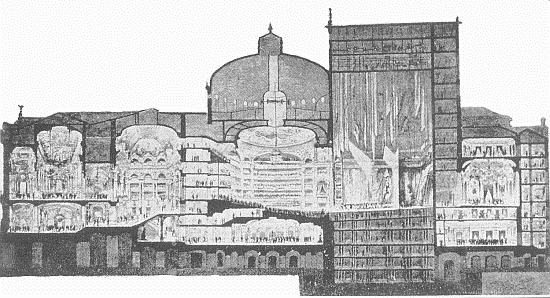
Profile of the Paris Grand Opera. (Note That the Stage Section Is Larger Than the Auditorium. Also Note the Immense Space Given to the Grand Entrance Stairway.)
A World of Detail
Few people have any idea of how many persons and how many departments are connected with the opera and its presentation. Considering them in order, they might be classed as follows:
The General Manager and his assistants.
The Musical Director and his assistants.
The Stage Director and his assistants.
The Technical Director and his assistants.
The Business Director and his assistants.
The Wardrobe Director and his assistants.
The Master of Properties and his assistants.
The Head Engineer and his assistants.
The Accountant and his assistants.
The Advertising Manager and his assistants.
The Press Representatives and his assistants.
The Superintendent and his assistants.
The Head Usher and his assistants.
The Electrician and his assistants.
Few of these important and necessary factors in the production ever appear before the public. Like the miners who supply us with the wealth of the earth, they work, as it were, underground. No one is more directly concerned with making the production than the Technical Director. In that we are fortunate in having the views of Mr. Edward Siedle, Technical Director of the Metropolitan Opera Company, of New York. The complete picture that the public sees is made under the supervision of Mr. Siedle, and during the actual production he is responsible for all of the technical details. His experience has extended over a great many years in different countries. He writes:
The Technic of the Production
I understand you wish me to give you some idea of the technicalities involved in producing the stage pictures which go to form an opera. Let us suppose it is an opera by an American composer. My first procedure would be to place myself in touch with the author and composer. After having one or two talks with them I secure a libretto. When a mutual understanding is agreed upon between us as to the character of the scenes required and the positions of particular things in relation to the business which has to take place during the performance, I make my plans accordingly, and look up all the data available bearing upon the subject.
It is now time to call in the scenic artist, giving him my views and ideas, so that he can start upon the designing and painting of the scenery. His first design would be in the form of a rough sketch and a more clearly worked-out ground plan. After further discussion and alterations we should definitely agree upon a scheme, and he would proceed to make a scale model. When this model is finished it is a perfect miniature scene of the opera as it will appear on the night the opera is produced.
The author and composer are then called in to meet the impresario and myself for a final consultation. We now finally criticize our plans, making any alterations which may seem necessary to us. When these alterations are completed the plans are handed over to the carpenter, who immediately starts making his frames and covering them with canvas, working from the scale model. The scenic artist is now able to commence his work in earnest.
The "properties" are our next consideration. Sketches and patterns are made, authorities are consulted, and everything possible is done to aid the Property Master in doing his part of the work.
Unless the opera in question calls for special mechanical effects, or special stage machinery, the scene is adapted to the stage as it is. If anything exceptional has to be achieved, however, special machinery is constructed.
The designing of the costumes is gone over in much the same way as the construction of the scenery. The period in which the opera is laid, the various characters and their station in life, are all well talked over by the composer, author and myself. The costume designer is then called in, and after listening to what every one has to say and reading the libretto, he submits his designs. These, when finished, are criticized by the impresario, the composer, the author and myself, and any suggestion which will improve them is accepted by the designer, and alterations are made until everything is satisfactory. The designs are then sent to the costume maker.
The important matter of lighting and electrical effects is not dealt with until after the scenery has been completed, painted and set up on the stage, except in the case when exceptional effects are demanded. The matter is then carefully discussed and arranged so that the apparatus will be ready by the time the earlier rehearsals are taking place.
The staff required by a Technical Director in such an institution as the Metropolitan Opera House is necessarily a large one. He needs an able scenic artist with his assistants and an efficient carpenter with his assistants to complete the scenic arrangements as indicated in the models. The completed scenery is delivered over to the stage carpenter who has a large body of assistants, and is held responsible for the running of the opera during rehearsals and performances. The stage carpenter has also under his control a body of carpenters who work all night, commencing their duties after the opera is over, removing all the scenery used in the opera just finished from the opera house and bringing from the various storehouses the scenery required for the next performance or rehearsal. The electrician is an important member of my staff, and he, of course, has a number of assistants. The Property Master and his assistants and the Wardrobe Mistress and her assistants also are extremely important. Then the active engineer who is responsible for the heating and ventilating, and also for many of the stage effects, is another necessary and important member. In all, the Opera House, when in full swing, requires for the technical or stage detail work alone about 185 people.
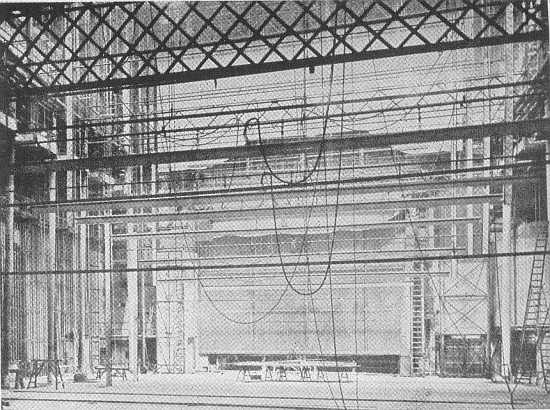
How an Operatic Stage looks From Behind.
Thus far we have not considered the musical side of the production. This is, of course, under the management of the General Director and the leading Musical Director. Very little time at best is at the disposal of the musical director. A director like Toscanini would, in a first-class opera house, with a full and competent company, require about fifteen days to complete the rehearsals, and other preparations for such a production as Aïda, should such a work be brought out as a novelty. A good conductor needs at least four orchestra rehearsals. Pelleas et Melisande would require more extensive rehearsing, as the music is of a new order and is, in a sense, a new form of art.
Important Rehearsals
While the head musical director is engaged with the principals and the orchestra, the Chorus-master spends his time training the chorus. If his work is not efficiently done, the entire production is greatly impeded. The assistant conductors undertake the work of rehearsing the soloists prior to their appearance in connection with the orchestra. They must know the Head Director's ideas perfectly, and see that the soloists do not introduce interpretations which are too much at variance with his ideas and the accepted traditions. In all about ten rehearsals are given to a work in a room set aside for that purpose, then there are five stage rehearsals, and finally four full ensemble rehearsals with orchestra. In putting on an old work, such as those in the standard repertoire, no rehearsals are demanded.
The musical forces of the Metropolitan Opera House, for instance, make a company of at least two leading conductors, twelve assistant conductors, about ninety soloists, a chorus numbering at least one hundred and twenty-five singers, thirty musicians for stage music, about twenty stage attendants and an orchestra of from eighty to one hundred performers, to say nothing of the costume, scenic and business staff, making a little industry all in itself.
The General Director, the Stage Manager, and often the Musical Director make innumerable suggestions to the singers regarding the proper histrionic presentation of their rôles. As a rule singers give too little attention to the dramatic side of their work and demand too much of the stage manager. In recent years there has been a great improvement in this. Prior to the time of Gluck, Weber and Wagner, acting in opera was a matter of ridicule.
The Ballet
About seventy or one hundred persons make up the ballet of a modern grand opera. At least ten years of continuous study are required to make a finished ballet dancer in the histrionic sense. Many receive very large fees for their services. The art of stage dancing also has undergone many great reforms in recent years; and the ballets of to-day are therefore much more popular than they were in the latter part of the last century. The most popular ballets of to-day are the Coppelia and Sylvia of Delibes. The ballets from the operas of La Gioconda, Samson et Delila, Armide, Mephistophele, Aïda, Orfeo, L'Africaine, and The Damnation of Faust also are very popular.
At a modern opera house like the Metropolitan in New York City the number of employees will be between six hundred and seven hundred, and the cost of a season will be about one million dollars.
FRANCES ALDA (MME. GIULIO GATTI-CASAZZA)
Biographical
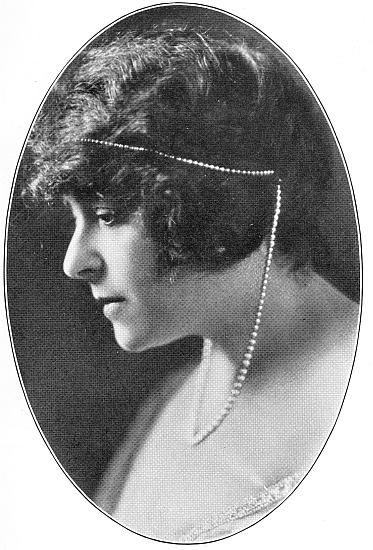
Mme. Frances Alda was born at Christ Church, New Zealand, May 31st, 1883. She was educated at Melbourne and studied singing with Mathilde Marchesi in Paris. Her début was made in Massenet's Manon, at the Opera Comique in Paris in 1904. After highly successful engagements in Paris, Brussels, Parma and Milan (where she created the title rôle in the Italian version of Louise), she made her American début at the Metropolitan Opera House in New York as Gilda in Verdi's Rigoletto. Since her initial success in New York she has been connected with the Metropolitan stage every season. In 1910 she married Giulio Gatti-Casazza, manager of the Metropolitan Opera House, and is probably better able to speak upon the subject herewith discussed than any one in America. She has also appeared with great success in London, Warsaw, Buenos Aires and other cities, in opera and in concert. Many of the most important leading rôles in modern opera have been created by her in America.
Mme. Frances Alda. © Underwood & Underwood.
WHAT THE AMERICAN GIRL SHOULD KNOW ABOUT AN OPERATIC CAREER MME. FRANCES ALDA (MME. GATTI-CASAZZA)
Regularity and Success
To the girl who aspires to have an operatic career, who has the requisite vocal gifts, physical health, stage presence and—most important of all—a high degree of intelligence, the great essential is regular daily work. This implies regular lessons, regular practice, regular exercise, regular sleep, regular meals—in fact, a life of regularity. The daily lesson in most cases seems an imperative necessity. Lessons strung over a series of years merely because it seems more economical to take one lesson a week instead of seven rarely produce the expected results. Marchesi, with her famous wisdom on vocal matters, advised twenty minutes a day and then not more than ten minutes at a time.
For nine months I studied with the great Parisian maestra and in my tenth month I made my début. Of course, I had sung a great deal before that time and also could play both the piano and the violin. A thorough musical knowledge is always valuable. The early years of the girl who is destined for an operatic career may be much more safely spent with Czerny exercises for the piano or Kreutzer studies for the violin than with Concone Solfeggios for the voice. Most girls over-exercise their voices during the years when they are too delicate. It always pays to wait and spend the time in developing the purely musical side of study.
Moderation and Good Sense
More voices collapse from over-practice and more careers collapse from under-work than from anything else. The girl who hopes to become a prima donna will dream of her work morning, noon and night. Nothing can take it out of her mind. She will seek to study every imaginable thing that could in any way contribute to her equipment. There is so much to learn that she must work hard to learn all. Even now I study pretty regularly two hours a day, but I rarely sing more than a few minutes. I hum over my new rôles with my accompanist, Frank La Forge, and study them in that way. It was to such methods as this that Marchesi attributed the wonderful longevity of the voices of her best-known pupils. When they followed the advice of the dear old maestra their voices lasted a long, long time. Her vocal exercises were little more than scales sung very slowly, single, sustained tones repeated time and again until her critical ear was entirely satisfied, and then arpeggios. After that came more complicated technical drills to prepare the pupil for the fioriture work demanded in the more florid operas. At the base of all, however, were the simplest kind of exercises. Through her discriminating sense of tone quality, her great persistence and her boundless enthusiasm, she used these simple vocal materials with a wizardry that produced great prime donne.
The Precious Head Voice
Marchesi laid great stress upon the use of the head voice. This she illustrated to all her pupils herself, at the same time not hesitating to insist that it was impossible for a male teacher to teach the head voice properly. (Marchesi herself carried out her theories by refusing to teach any male applicants.) She never let any pupil sing above F on the top line of the treble staff in anything but the head voice. They rarely ever touched their highest notes with full voice. The upper part of the voice was conserved with infinite care to avoid early breakdowns. Even when the pupils sang the top notes they did it with the feeling that there was still something in reserve. In my operatic work at present I feel this to be of greatest importance. The singer who exhausts herself upon the top notes is neither artistic nor effective.
The American Girl's Chances in Opera
The American girl who fancies that she has less chances in opera than her sisters of the European countries is silly. Look at the lists of artists at the Metropolitan, for instance. The list includes twice as many artists of American nationality as of any other nation. This is in no sense the result of pandering to the patriotism of the American public. It is simply a matter of supply and demand. New Yorkers demand the best opera in the world and expect the best voices in the world. The management would accept fine artists with fine voices from China or Africa or the North Pole if they were forthcoming. A diamond is a diamond no matter where it comes from. The management virtually ransacks the musical marts of Europe every year for fine voices. Inevitably the list of American artists remains higher. On the whole, the American girls have better natural voices, more ambition and are willing to study seriously, patiently and energetically. This is due in a measure to better physical conditions in America and in Australia, another free country that has produced unusual singers. What is the result? America is now producing the best and enjoying the best. There is more fine music of all kinds now in New York during one week than one can get in Paris in a month and more than one can get in Milan in six months. This has made New York a great operatic and musical center. It is a wonderful opportunity for Americans who desire to enter opera.
The Need for Superior Intelligence
There was a time in the halcyon days of the old coloratura singers when the opera singer was not expected to have very much more intelligence than a parrot. Any singer who could warble away at runs and trills was a great artist. The situation has changed entirely to-day. The modern opera-goer demands great acting as well as great singing. The opera house calls for brains as well as voices. There should properly be great and sincere rivalry among fine singers. The singer must listen to other singers with minute care and patience, and then try to learn how to improve herself by self-study and intelligent comparison. Just as the great actor studies everything that pertains to his rôle, so the great singer knows the history of the epoch of the opera in which he is to appear, he knows the customs, he may know something of the literature of the time. In other words, he must live and think in another atmosphere before he can walk upon the stage and make the audience feel that he is really a part of the picture. Sir Herbert Beerbohm Tree gave a presentation that was convincing and beautiful, while the mediocre actor, not willing to give as much brain work to his performance, falls far short of an artistic performance.
A modern performance of any of the great works as they are presented at the Metropolitan is rehearsed with great care and attention to historical detail. Instances of this are the performances of L'Amore di Tre Re, Carmen, Bohême, and Lohengrin, as well as such great works as Die Meistersinger, and Tristan und Isolde.
Physical Strength and Singing
Few singers seem to realize that an operatic career will be determined in its success very largely through physical strength, all other factors being present in the desired degree. That is, the singer must be strong physically in order to succeed in opera. This applies to women as well as to men. No one knows what the physical strain is, how hard the work and study are. In front of you is a sea of highly intelligent, cultured people, who for years have been trained in the best traditions of the opera. They pay the highest prices paid anywhere for entertainment. They are entitled to the best. To face such an audience and maintain the high traditions of the house through three hours of a complicated modern score is a musical, dramatic and intellectual feat that demands, first of all, a superb physical condition. Every day of my life in New York I go for a walk, mostly around the reservoir in Central Park, because it is high and the air is pure and free. As a result I seldom have a cold, even in mid-winter. I have not missed a performance in eight years, and this, of course, is due to the fact that my health is my first daily consideration.
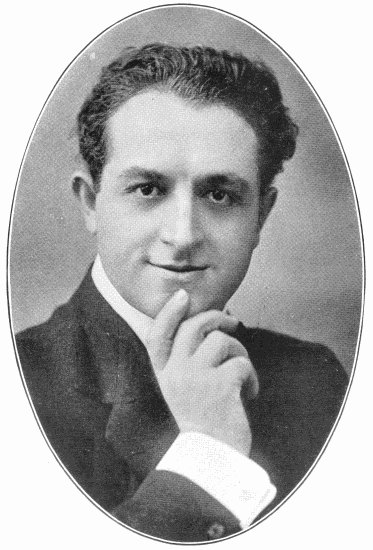
Pasquale Amato. © Mishkin.
PASQUALE AMATO
Biographical
Pasquale Amato, for so many years the leading baritone at the Metropolitan Opera House in New York, was born at Naples March 21st, 1878. He was intended for the career of an engineer and was educated at the Instituto Tecnico Domenico. He then studied at the Conservatory of Naples from 1896 to 1899. His teachers there were Cucialla and Carelli. He made his début as Germont in La Traviata in the Teatro Bellini at Naples in 1900. Thereafter his successes have been exceptionally great in the music centers of South America, Italy, Russia, England, Egypt, and Germany. He has created numerous rôles at the Metropolitan Opera House, among them Jack Rance in the Girl of the Golden West; Golaud in Pelleas and Melisande (Milan); L'Amore di Tre Re; Cyrano (Damrosch); Lodoletta (Mascagni); Madame Sans Gene. He has visited South America as an artist no less than ten times. His voice is susceptible of fine dramatic feeling.
MODERN VOCAL METHODS IN ITALY
PASQUALE AMATO
When I was about sixteen years of age my voice was sufficiently settled to encourage my friends and family to believe that I might become a singer. This is a proud discovery for an Italian boy, as singing—especially operatic singing—is held in such high regard in Italy that one naturally looks forward with joy to a career in the great opera houses of one's native country and possibly to those over the sea. At eighteen I was accordingly entered in the conservatory, but not without many conditions, which should be of especial interest to young American vocal students. The teachers did not immediately accept me as good vocal material. I was recognized to have musical inclinations and musical gifts and I was placed under observation so that it might be determined whether the state-supported conservatory should direct my musical education along vocal lines or along other lines.
This is one of the cardinal differences between musical education in America and musical education in Italy. In America a pupil suddenly determines that he is destined to become a great opera singer and forthwith he hires a teacher to make him one. He might have been destined to become a plumber, or a lawyer, or a comedian, but that has little to do with the matter if he has money and can employ a teacher. In Italy such a direction of talents would be considered a waste to the individual and to the state. Of course the system has its very decided faults, for a corps of teachers with poor or biased judgment could do a great deal of damage by discouraging real talent, as was, indeed, the case with the great Verdi, who at the age of eighteen was refused admission to the Milan Conservatory by the director, Basili, on the score of lack of talent.
However, for the most part the judges are experienced and skilful men, and when a pupil has been under surveillance for some time the liability of an error in judgment is very slight. Accordingly, after I had spent some time in getting acquainted with music through the study of Notation, Sight-singing, Theory, Harmony, Piano, etc., I was informed at the end of two years that I had been selected for an operatic career. I can remember the time with great joy. It meant a new life to me, for I was certain that with the help of such conservative masters I should succeed.
On the whole, at this time, I consider the Italian system a very wise one for it does not fool away any time with incompetence. I have met so many young musicians who have shown indications of great study but who seem destitute of talent. It seems like coaxing insignificant shrubs to become great oak trees. No amount of coaxing or study will give them real talent if they do not have it, so why waste the money of the state and the money of the individual upon it. On the other hand, wherever in the world there is real talent, the state should provide money to develop it, just as it provides money to educate the young.
Italian Vocal Teaching
So much has been said about the Old Italian Vocal Method that the very name brings ridicule in some quarters. Nothing has been the subject for so much charlatanry. It is something that any teacher, good or bad, can claim in this country. Every Italian is of course very proud indeed of the wonderful vocal traditions of Italy, the centuries of idealism in search of better and better tone production. There are of course certain statements made by great voice teachers of other days that have been put down and may be read in almost any library in large American cities. But that these things make a vocal method that will suit all cases is too absurd to consider. The good sense of the old Italian master would hold such a plan up to ridicule. Singing is first of all an art, and an art can not be circumscribed by any set of rules or principles.
The artist must, first of all, know a very great deal about all possible phases of the technic of his art and must then adjust himself to the particular problem before him. Therefore we might say that the Italian method was a method and then again that it was no method. As a matter of fact it is thousands of methods—one for each case or vocal problem. For instance, if I were to sing by the same means that Mr. Caruso employs it would not at all be the best thing for my voice, yet for Mr. Caruso it is without question the very best method, or his vocal quality would not be in such superb condition after constant years of use. He is the proof of his own method.
I should say that the Italian vocal teacher teaches, first of all, with his ears. He listens with the greatest possible intensity to every shade of tone-color until his ideal tone reveals itself. This often requires months and months of patience. The teacher must recognize the vocal deficiencies and work to correct them. For instance, I never had to work with my high tones. They are to-day produced in the same way in which I produced them when I was a boy. Fortunately I had teachers who recognized this and let it go at that.
Possibly the worst kind of a vocal teacher is the one who has some set plan or device or theory which must be followed "willy-nilly" in order that the teacher's theories may be vindicated. With such a teacher no voice is safe. The very best natural voices have to follow some patent plan just because the teacher has been taught in one way, is inexperienced, and has not good sense enough to let nature's perfect work alone. Both of my teachers knew that my high tones were all right and the practice was directed toward the lower tones. They worked me for over ten months on scales and sustained tones until the break that came at E flat above the Bass Clef was welded from the lower tones to the upper tones so that I could sing up or down with no ugly break audible.
I was drilled at first upon the vowel "ah." I hear American vocal authorities refer to "ah" as in father. That seems to me too flat a sound, one lacking in real resonance. The vowel used in my case in Italy and in hundreds of other cases I have noted is a slightly broader vowel, such as may be found half-way between the vowel "ah" as in father, and the "aw" as in law. It is not a dull sound, yet it is not the sound of "ah" in father. Perhaps the word "doff" or the first syllable of Boston, when properly pronounced, gives the right impression.
I do not know enough of American vocal training to give an intelligent criticism, but I wonder if American vocal teachers give as much attention to special parts of the training as teachers in Italy do. I hope they do, as I consider it very necessary. Consider the matter of staccato. A good vocal staccato is really a very difficult thing—difficult when it is right; that is, when on the pitch—every time, clear, distinct, and at the same time not hard and stiff. It took me weeks to acquire the right way of singing such a passage as Un di, quando le veneri, from Traviata, but those were very profitable weeks—
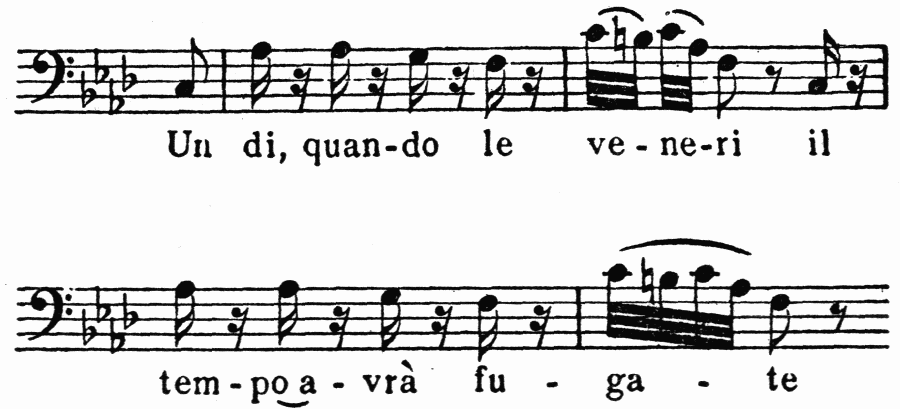
Accurate attack in such a passage is by no means easy. Anyone can sing it—but how it is sung makes the real difference.
The public has very odd ideas about singing. For instance, it would be amazed to learn that Trovatore is a much more difficult rôle for me to sing and sing right than either Parsifal or Pelleas and Melisande. This largely because of the pure vocal demands and the flowing style. The Debussy opera, wonderful as it is, does not begin to make the vocal demands that such a work as Trovatore does.
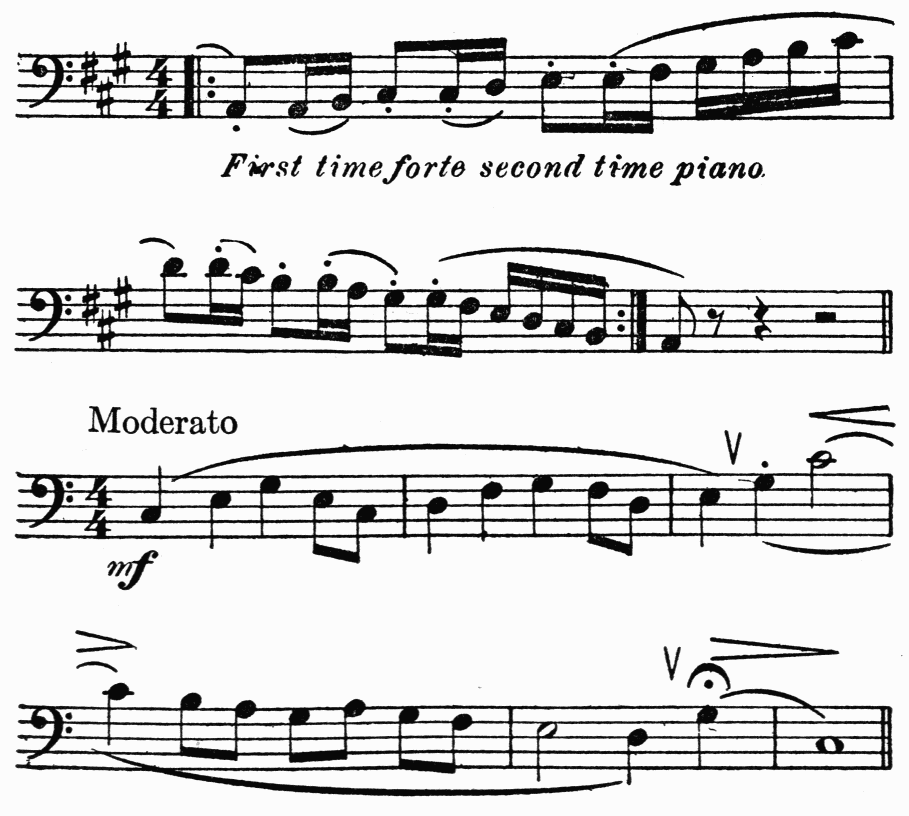
When the singer once acquires proficiency, the acquisition of new rôles comes very easy indeed. The main difficulty is the daily need for drilling the voice until it has the same quality every day. It can be done only by incessant attention. Here are some of the exercises I do every day with my accompanist:
DAVID BISPHAM
Biographical
David Bispham, in many ways the most distinguished of all American singers, was born in Philadelphia January 5th, 1857. Educated at Haverford College, Pa. At first a highly successful amateur in Philadelphia choirs and theatricals, he went to Milan in 1886, studying with Vannuccini, Lamperti and later in London with Shakespeare and Randegger. His operatic début was made in Messager's Basoche at the Royal English Opera House, 1891. In 1892 he appeared as Kurvenal and met with great favor. His Wagnerian rôles have been especially distinctive since the start. From 1896 to 1909 he sang alternately at the Metropolitan in New York and at Covent Garden in London, and was admittedly one of the foremost attractions of those great companies in the golden era of our operatic past. He was also immensely in demand as a recital and as an oratorio singer and as a dramatic reader. Few singers have shown the versatility and mastery of David Bispham and few have been so justly entitled to the academic honors LL.D., B.A., and Mus. Doc., which he had earned. He was the author of numerous articles on singing—the very successful autobiography, "A Quaker Singer's Reminiscences," and the collections, "David Bispham's Recital Album," "The David Bispham Song Book" (for schools). He was also ever a strong champion of the use of the English language in singing. He died in New York City Oct. 2d, 1921.
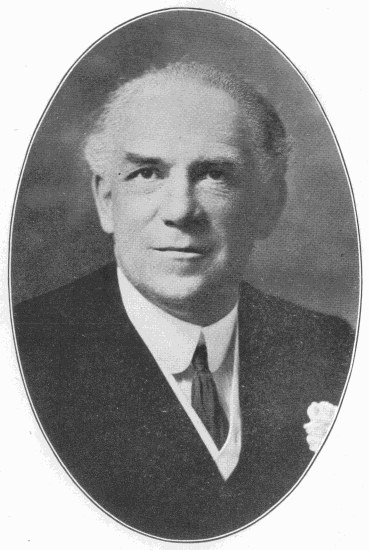
David Bispham.
THE MAIN ELEMENTS OF INTERPRETATION
DAVID BISPHAM
So many things enter into the great problem of interpretation in singing that it is somewhat difficult to state definitely just what the young singer should consider the most important. Generally speaking, the following factors are of prime significance:
1. Natural Aptitude.
2. General Education and Culture.
3. Good Musical Training.
4. Accurate Vocal Training.
5. Familiarity with Traditions.
6. Freedom of Mind.
7. Good Health.
8. Life Experience.
9. Personal Magnetism—one of the most essential,—and
10. Idealism.
1. Natural Aptitude.—You will notice that foremost consideration is given to those broad general qualities without which all the technical and musical training of the world is practically worthless. The success of the art worker in all lines depends first upon the nature of the man or woman. Technical training of the highest and best kind is essential, but that which moves great audiences is not alone the mechanics of an art, but rather the broad education, experience, ideals, culture, the human sympathy and magnetism of the artist.
2. The Value of Education and Culture.—I cannot emphasize too strongly the value of a good general education and wide culture for the singer. The day has passed when a pretty face or a well-rounded ankle could be mistaken for art on the operatic stage. The public now demands something more than the heroic looking young fellow who comes down to the footlights with the assurance of youth and offers, for real vocal art, a voice fresh but crudely trained, and a bungling interpretation.
Good education has often been responsible for the phenomenal success of American singers in European opera houses. Before the last war, in nearly all of the great operatic centers of the Continent, one found Americans ranking with the greatest artists in Europe. This was a most propitious condition, for it meant that American audiences have been compelled to give the long-delayed recognition to our own singers, and methods of general and vocal education.
In most cases the young people of America who aspire to operatic triumphs come from a somewhat better class than singers do in Europe. They have had, in most cases, better educational, cultural and home advantages than the average European student. Their minds are trained to study intelligently; they are acquainted with the history of the great nations of the world; their tastes are cultivated, and they are filled with the American energy which is one of the marvels of the centuries. More than this, they have had a kind of moral uplift in their homes which is of immense value to them. They have higher ideals in life, they are more businesslike and they keep their purposes very clearly in view. This has created jealousy in some European centers; but it is simply a case of the survival of the fittest, and Europe was compelled to bow in recognition of this. Vocal art in our own land is no longer to be ignored, for our standards are as high as the highest in the world, and we are educating a race of singers of which any country might be proud.
3. Good Musical Training.—A thorough musical training—that is, a training upon some musical instrument such as the piano—is extremely desirable, but not absolutely essential; for the instrument called the Human Voice can be played on as effectively as a violin. The singer who is convinced of his ability, but who has not had such advantages in early youth, should not be discouraged. He can acquire a thorough knowledge of the essentials later on, but he will have to work very much harder to get his knowledge—as I was obliged to do. Artistic ability is by no means a certain quality. The famous art critic, Vassari, has called our attention to the fact that one painter who produced wonderful pictures had an exhaustive technical training, another arising at his side who also achieved wonderful results had to secure them by means of much bungling self-study. It is very hard to repress artistic ability. As the Bible says: "Many waters cannot quench love." So it is with music; if the ability is there, it will come to the front through fire and water.
4. Accurate and Rational Vocal Training.—I have added the word rational for it seems a necessary term at a time when so much vocal teaching is apparently in the hands of "faddists." There is only one way to sing, that is the right way, the way that is founded upon natural conditions. So much has been said in print about breathing, and placing the voice, and resonance, that anything new might seem redundant at this time. The whole thing in a nutshell is simply to make an effort to get the breath under such excellent control that it will obey the will so easily and fluently that the singer is almost unconscious of any means he may employ to this end. This can come only through long practice and careful observation. When the breath is once under proper control the supply must be so adjusted that neither too much nor too little will be applied to the larynx at one time. How to do this can be discovered only by much practice and self-criticism. When the tone has been created it must be reinforced and colored by passing through the mouth and nose, and the latter is a very present help in time of vocal trouble. This leads to a good tone on at least twenty-six steps and half-steps of the scale and with twenty or more vowel sounds—no easy task by any means. All this takes time, but there is no reason why it should take an interminable amount of time. If good results are not forthcoming in from nine months to a year, something is wrong with either the pupil or the teacher.
The matter of securing vocal flexibility should not be postponed too long, but may in many instances be taken up in conjunction with the studies in tone production, after the first principles have been learned. Thereafter one enters upon the endless and indescribably interesting field of securing a repertoire. Only a teacher with wide experience and intimacy with the best in the vocal literature of the world can correctly grade and select pieces suitable to the ever-changing needs of the pupil.
No matter how wonderful the flexibility of the voice, no matter how powerful the tones, no matter how extensive the repertoire, the singer will find all this worthless unless he possesses a voice that is susceptible to the expression of every shade of mental and emotional meaning which his intelligence, experience and general culture have revealed to him in the work he is interpreting. At all times his voice must be under control. Considered from the mechanical standpoint, the voice resembles the violin, the breath, as it passes over the vocal cords, corresponding to the bow and the resonance chambers corresponding to the resonance chambers in the violin.
5. Familiarity With Vocal Traditions.—We come to the matter of the study of the traditional methods of interpreting vocal masterpieces. We must, of course, study these traditions, but we must not be slaves to them. In other words, we must know the past in order to interpret masterpieces properly in the present. We must not, however, sacrifice that great quality—individuality—for slavery to convention. If the former Italian method of rendering certain arias was marred by the tremolo of some famous singers, there is no good artistic reason why any one should retain anything so hideous as a tremolo solely because it is traditional.
There is a capital story of a young American singer who went to a European opera house with all the characteristic individuality and inquisitiveness of his people. In one opera the stage director told him to go to the back of the stage before singing his principal number and then walk straight down to the footlights and deliver the aria. "Why must I go to the back first?" asked the young singer. The director was amazed and blustered: "Why? Why, because the great Rubini did it that way—he created the part; it is the tradition." But the young singer was not satisfied, and finally found an old chorus man who had sung with Rubini, and asked him whether the tradition was founded upon a custom of the celebrated singer. "Yes," replied the chorus man, "da gretta Rubini he granda man. He go waya back; then he comea front; then he sing. Ah, grandissimo!" "But," persisted the young American, "Why did he go to the back before he sang?" "Oh!" exclaimed the excited Italian; "Why he go back? He go to spit!"
Farcical as this incident may seem, many musical traditions are founded upon customs with quite as little musical or esthetic importance. Many traditions are to-day quite as useless as the buttons on the sleeves of our coats, although these very buttons were at one time employed by our forefathers to fasten back the long cuffs. There are, however, certain traditional methods of rendering great masterpieces, and particularly those marked by the florid ornamentation of the days of Handel, Bach and Haydn, which the singer must know. Unfortunately, many of these traditions have not been preserved in print in connection with the scores themselves, and the only way in which the young singer can acquire a knowledge of them is through hearing authoritative artists, or from teachers who have had wide and rich experience.
6. Freedom of Mind.—Under ideal conditions the mind should be free for music study and for public performance. This is not always possible; and some artists under great mental pressure have done their best work solely because they felt that the only way to bury sorrow and trouble was to thrust themselves into their artistic life and thus forget the pangs of misfortune. The student, however, should do everything possible to have his mind free so that he can give his best to his work. One who is wondering where the next penny is coming from is in a poor condition to impress an audience. Nevertheless, if the real ability is there it is bound to triumph over all obstacles.
7. Good Health.—Good health is one of the great factors of success in singing. Who needs a sounder mind than the artist? Good health comes from good, sensible living. The singer must never forget that the instrument he plays upon is a part of his body and that that instrument depends for its musical excellence and general condition upon good health. A $20,000 Stradivarius would be worthless if it were placed in a tub of water; and a larynx that earns for its owner from $500 to $1,500 a night is equally valueless when saturated with the poisons that come from intemperate or unwise living. Many of the singer's throat troubles arise from an unhealthy condition of the stomach caused by excesses of diet; but, aside from this, a disease localized in any other part of the body affects the throat sympathetically and makes it difficult for the singer to get good results. Recital work, with its long fatiguing journeys on railroads, together with the other inconveniences of travel and the responsibility and strain that come from knowing that one person alone is to hold from 1,000 to 5,000 people interested for nearly two hours, demands a very sound physical condition.
8. Life Experience.—Culture does not come from the schoolroom alone. The refining processes of life are long and varied. As the violin gains in richness of tone and intrinsic value with age, so the singer's life experience has an effect upon the character of his singing. He must have seen life in its broadest sense, to place himself in touch with human sympathy. To do this and still retain the freshness and sweetness of his voice should be his great aim. The singer who lives a narrow and bigoted existence rarely meets with wide popular approval. The public wants to hear in a voice that wonderful something that tells them that it has had opportunities to know and to understand the human side of song, not giving parrot-like versions of some teacher's way of singing, but that the understanding comes from the very center of the mind, heart and soul. This is particularly true in the field of the song recital. Most of the renowned recital singers of the last half century, including Schumann-Heink, Sembrich, Wüllner, the Henschels and others, were considerably past their youth when they made their greatest successes. A painting fresh from the artist's brush is raw, hard and uninteresting, till time, with its damp and dust, night and day, heat and cold, gives the enriching touch which adds so wonderfully to the softness and beauty of a picture. We singers are all living canvases. Time, and time only, can give us those shades and tints which reveal living experience. The young artist should hear many of the best singers, actors, and speakers, should read many of the best books, should see many beautiful pictures and wonderful buildings. But most of all, he should know and study many people and learn of their joys and their sorrows, their successes and their failures, their strength and their weaknesses, their loves and their hates. In all art human life is reflected, and this is particularly true in the case of vocal art. For years, in my youth, I never failed to attend all of the musical events of consequence in my native city. This was of immense value to me, since it gave me the means of cultivating my own judgment of what was good or bad in singing. Do not fear that you will become blasé. If you have the right spirit every musical event you attend will spur you on.
You may say that it is expensive to hear great singers, and that you can only attend recitals and the opera occasionally. If this is really the case you still have a means of hearing singers which you should not neglect. I refer to the reproducing machines which have grown to be of such importance in vocal education. Phonograph records are nothing short of marvelous, and my earnestness in this cause is shown by the fact that I have long advocated their employment in the public schools, and have placed the matter before the educational authorities of New York. I earnestly urge the music teachers of this country, who are working for the real musical development of our children, to take this matter up in all seriousness. I can assure them that their efforts will bring them rich dividends in increased interest in musical work of their pupils, and the forming of a musical public. But nothing but the classics of song must be used. The time for the scorning of "high-brow" songs is past, and music must help this country to rid itself of the vogue of the "low-brow" and the "tough." Let singers strive to become educated ornaments of their lofty profession.
9. Personal Magnetism.—One of the most essential. The subject of "personal magnetism" is ridiculed by some, of course, but rarely laughed at by the artist who has experienced the astonishing phenomena in the opera house or the concert room. Like electricity it is intangible, indefinable, indescribable, but makes its existence known by manifestations that are almost uncanny. If personal magnetism does not exist, how then can we account for the fact that one pianist can sit down to the instrument and play a certain piece, and that another pianist could play the same piece with the same technical effect but losing entirely the charm and attractiveness with which the first pianist imbued the composition? Personal magnetism does not depend upon personal beauty nor erudition nor even upon perfect health. Henry Irving and Sarah Bernhardt were certainly not beautiful, but they held the world of the theater in the palm of their hand. Some artists have really been in the last stages of severe illness but have, nevertheless, possessed the divine electric spark to inspire hundreds, as did the hectic Chopin when he made his last famous visit to England and Scotland.
Personal magnetism is not a kind of hypnotic influence to be found solely in the concert hall or the theater. Most artists possess it to a certain degree. Without this subtle and mysterious force, success with the public never comes.
10. Idealism.—Ideals are the flowers of youth. Only too often they are not tenderly cared for, and the result is that many who have been on the right track are turned in the direction of failure by materialism. It is absolutely essential for the young singer to have high ideals. Direct your efforts to the best in whatever branch of vocal art you determine to undertake. Do not for a moment let mediocrity or the substitution of artificial methods enter your vision. Holding to your ideal will mean costly sacrifices to you; but all sacrifices are worth while if one can realize one's ideal. The ideal is only another term for Heaven to me. If we could all attain to the ideal, we would all be in a kind of earthly Paradise. It has always seemed to me that when our Lord said "The Kingdom of Heaven is at hand," he meant that it is at hand for us to possess now; that is the ideal in life.
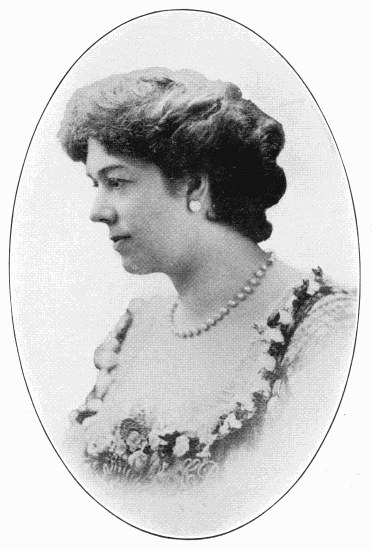
Dame Clara Butt.
DAME CLARA BUTT
Biographical
Dame Butt was born at Southwick, Sussex, February 1, 1873. Her first lessons were with D. W. Rootham in Bristol.
In 1889 she won a scholarship at the Royal College of music where the teacher was J. H. Blower. Later she studied for short periods with Bouhy in Paris and Etelka Gerster in Berlin. Her début was made as Ursula in Sullivan's setting of the Longfellow poem, Golden Legend. Her success was immediate and very great. She became in demand at all of the great English musical festivals and also sang before enormous audiences for years in the great English cities. In 1900 she married the noted English baritone R. Kennerly Rumford and together they have made many tours, including a tour of the world, appearing everywhere with continued success. Her voice is one of rich, full contralto quality with such individual characteristics that great English composers have written special works to reveal these great natural gifts. Dame Butt received her distinction of "Dame" from King George in 1920. Her happy family life with her children has won her endless admirers among musical people everywhere.
SUCCESS IN CONCERT SINGING
DAME CLARA BUTT
HEALTH AND SINGING
It must be obvious to all aspiring vocal students that splendid good health is well nigh indispensable to the singer. There have been singers, of course, who have had physical afflictions that have made their public appearances extremely painful, but they have succeeded in spite of these unfortunate drawbacks. In fact, if the young singer is ambitious and has that wonderful gift of directing her efforts in the way most likely to bring fortunate results, even physical weakness may be overcome. By this I mean that the singer will work out some plan for bringing her physical condition to the standard that fine singing demands. I believe most emphatically that the right spirit will conquer obstacles that often seem impassable. One might safely say that nine-tenths of the successes in all branches of artistic work are due to the inextinguishable fire that burns in the heart and mind of the art worker and incites him to pass through any ordeal in order to deliver his message to the world.
Misdirected Effort
The cruel part of it all is that many aspire to become great singers who can never possibly have their hopes realized. Natural selection rather than destiny seems to govern this matter. The ugly caterpillar seems like an unpromising candidate for the brilliant career of the butterfly, and it oftentimes happens that students who seem unpromising to some have just the qualities which, with the right time, instruction and experience, will entitle them to great success. It is the little ant who hopes to grow iridescent wings, and who travels through conservatory after conservatory, hoping to find the magic chrysalis that will do this, who is to be pitied. Great success must depend upon special gifts, intellectual as well as vocal. Oh, if we only had some instinct, like that possessed by animals, that would enable us to determine accurately in advance the safest road for us to take, the road that will lead us to the best development of our real talents—not those we imagine we may have or those which the flattery of friends have grafted upon us! Mr. Rumford and I have witnessed so much very hard and very earnest work carried on by students who have no rational basis to hope for success as singers, that we have been placed in the uncomfortable position of advising young singers to seek some other life work.
When To Begin
The eternal question, "At what age shall I commence to study singing?" is always more or less amusing to the experienced singer. If the singer's spirit is in the child, nothing will stop his singing. He will sing from morning until night, and seems to be guided in most cases by an all-providing Nature that makes its untutored efforts the very best kind of practice. Unless the child is brought into contact with very bad music he is not likely to be injured. Children seem to be trying their best to prove the Darwinian theory by showing us that they can mimic quite as well as monkeys. The average child comes into the better part of his little store of wisdom through mimicry. Naturally if the little vocal student is taken to the vaudeville theatre, where every imaginable vocal law is smashed during a three-hour performance, and if the child observes that the smashing process is followed by the enthusiastic applause of the unthinking audience, it is only reasonable to suppose that the child will discover in this what he believes to be the most approved art of singing.
It is evident then that the first thing which the parent of the musical child should consider is that of teaching him to appreciate what is looked upon as good and what is looked upon as bad. Although many singers with fine voices have appeared in vaudeville, the others must be regarded as "horrible" examples, and the child should know that they are such. On the other hand, it is quite evident that the more good singing that the child hears in the impressionable years of its youth the greater will be the effect upon the mind which is to direct the child's musical future. This is a branch of the vocalist's education which may begin long before the actual lessons. If it is carefully conducted the teacher should have far less difficulty in starting the child with the actual work. The only possible danger might be that the child's imitative faculty could lead it to extremes of pitch in imitating some singer. Even this is hardly more likely to injure it than the shouting and screaming which often accompanies the play of children.
The actual time of starting must depend upon the individual. It is never too early for him to start in acquiring his musical knowledge. Everything he might learn of music itself, through the study of the piano or any other instrument would all become a part of his capital when he became a singer. Those singers are fortunate whose musical knowledge commenced with the cradle and whose first master was that greatest of all teachers, the mother. Speaking generally, it seems to be the impression of singing teachers that voice students should not commence the vocal side of their studies until they are from sixteen to seventeen years of age. In this connection, consider my own case. My first public appearance with orchestra was when I was fourteen. It was in Bristol, England, and among other things I sang Ora Pro Nobis from Gounod's Workers.
I was fortunate in having in my first teacher, D. W. Rootham, a man too thoroughly blessed with good British common sense to have any "tricks." He had no fantastic way of doing things, no proprietary methods, that none else in the world was supposed to possess. He listened for the beautiful in my voice and, as his sense of musical appreciation was highly cultivated, he could detect faults, explain them to me and show me how to overcome them by purely natural methods. The principal part of the process was to make me realize mentally just what was wrong and then what was the more artistic way of doing it.
Letting the Voice Grow
After all, singing is singing, and I am convinced that my master's idea of just letting the voice grow with normal exercise and without excesses in any direction was the best way for me. It was certainly better than hours and hours of theory, interesting to the student of physiology, but often bewildering to the young vocalist. Real singing with real music is immeasurably better than ages of conjecture. It appears that some students spend years in learning how they are going to sing at some glorious day in the future, but it never seems to occur to them that in order to sing they must really use their voices. Of course, I do not mean to infer that the student must omit the necessary preparatory work. Solfeggios, for instance, and scales are extremely useful. Concone, tried and true, gives excellent material for all students. But why spend years in dreaming of theories regarding singing when everyone knows that the theory of singing has been the battleground for innumerable talented writers for centuries? Even now it is apparently impossible to reconcile all the vocal writers, except in so far as they all modestly admit that they have rediscovered the real old Italian school. Perhaps they have. But, admitting that an art teacher rediscovered the actual pigments used by Leonardo da Vinci, Rembrandt or Raphael, he would have no little task in creating a student who could duplicate Mona Lisa, The Night Watch or the Sistine Madonna.
After leaving Rootham, I won the four hundred guinea scholarship at the Royal College of Music and studied with Henry Blower. This I followed with a course with Bouhy in Paris and Etelka Gerster in Berlin. Mr. Rumford and I both concur in the opinion that it is necessary for the student who would sing in any foreign language to study in the country in which the language is spoken. In no other way can one get the real atmosphere. The preparatory work may be done in the home country, but if one fails to taste of the musical life of the country in which the songs came into being, there seems to be an indefinable absence of the right flavor. I believe in employing the native tongue for songs in recital work. It seems narrow to me to do otherwise. At the same time, I have always been a champion for songs written originally with English texts, and have sung innumerable times with programs made from English lyrics.
Preparing a Repertoire
The idea that concert and recital work is not as difficult as operatic work has been pretty well exploded by this time. In fact, it is very much more difficult to sing a simple song well in concert than it is to sing some of the elaborate Wagnerian recitatives in which the very complexities of the music make a convenient hiding place for the artist's vocal shortcomings. In concert everything is concentrated upon the singer. Convention has ever deprived him of the convenient gestures that give ease to the opera singer.
The selection of useful material for concert purposes is immensely difficult. It must have artistic merit, it must have human interest, it must suit the singer, in most cases the piano must be used for accompaniment and the song must not be dependent upon an orchestral accompaniment for its value. It must not be too old, it must not be too far in advance of popular tastes. It is a bad plan to wander indiscriminately about among countless songs, never learning any really well. The student should begin to select numbers with great care, realizing that it is futile to try to do everything. Lord Bolingbroke, in his essay on the shortness of human life, shows how impossible it is for a man to read more than a mere fraction of a great library though he read regularly every day of his life. It is very much the same with music. The resources are so vast and time is so limited that there is no opportunity to learn everything. Far better is it for the vocalist to do a little well than to do much ineffectually.
Good music well executed meets with very much the same appreciation everywhere. During our latest tour we gave almost the very same programs in America as those we have been giving upon the European Continent. The music-loving American public is likely to differ but slightly from that of the great music centers of the old world. Music has truly become a universal language.
In developing a repertoire the student might look upon the musical public as though it were a huge circle filled with smaller circles, each little circle being a center of interest. One circle might insist upon old English songs, such as the delightful melodies of Arne, Carey, Monroe. Another circle might expect the arias of the old Italian masters, Carissimi, Jomelli, Sacchini or Scarlatti. Another circle would want to hear the German Lieder of such composers as Schumann, Schubert, Brahms, Franz and Wolf. Still another circle might go away disappointed if they could not hear something of the ultra modern writers, such as Strauss, Debussy or even that freak of musical cacophony, Schoenberg. However diverse may be the individual likings of these smaller circles, all of the members of your audience are united in liking music as a whole.
The audience will demand variety in your repertoire but at the same time it will demand certain musical essentials which appeal to all. There is one circle in your audience that I have purposely reserved for separate discussion. That is the great circle of concert goers who are not skilled musicians, who are too frank, too candid, to adopt any of the cant of those social frauds who revel in Reger and Schoenberg, and just because it might stamp them as real connoisseurs, but who really can't recognize much difference between the Liebestod of Tristan und Isolde and Rule Britannia,—but the music lovers who are too honest to fail to state that they like the Lost Chord or the lovely folk songs of your American composer, Stephen Foster. Mr. Plunkett Greene, in his work upon song interpretation, makes no room for the existence of songs of this kind. Indeed, he would cast them all into the discard. This seems to me a huge mistake. Surely we can not say that music is a monopoly of the few who have schooled their ears to enjoy outlandish disonances with delight. Music is perhaps the most universal of all the arts and with the gradual evolution of those who love it, a natural audience is provided for music of the more complicated sort. We learn to like our musical caviar with surprising rapidity. It was only yesterday that we were objecting to the delightful piano pieces of Debussy, who can generate an atmosphere with a single chord just as Murillo could inspire an emotion with a stroke of the brush.
It is not safe to say that you do not like things in this way. I think that even Schoenberg is trying to be true to his muse. We must remember that Haydn, Beethoven, Wagner and Brahms passed through the fire of criticism in their day. The more breadth a singer puts into her work the more likely is she to reap success. Time only can produce the accomplished artist. The best is to find a joy in your work and think of nothing but large success. If you have the gift, triumph will be yours.
Giuseppe Campanari. © Dupont.
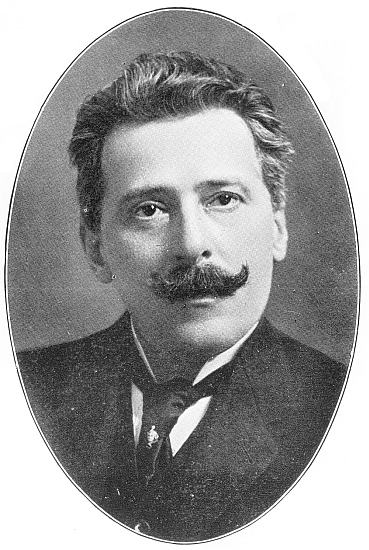
GIUSEPPE CAMPANARI
Biographical
Giuseppe Campanari was born at Venice, Italy, Nov. 17th, 1858. His parents were not particularly musical but were very anxious for the boy to become a musician. At the age of nine he commenced to study the piano and later he entered the Conservatory of Milan, making his principal instrument the violoncello. Upon his graduation he secured a position in the 'cello section of the orchestra at "La Scala." Here for years he heard the greatest singers and the greatest operas, gaining a musical insight into the works through an understanding of the scores which has seldom if ever been possessed by a great opera singer. His first appearance as singer was at the Teatro dal Verme in Milan. Owing to voice strain he was obliged to give up singing and in the interim he took a position as a 'cellist in the Boston Symphony Orchestra, remaining with that organization some years. He then made appearances with the Emma Juch Opera Company, the Heinrichs Opera Company, and eventually at the Metropolitan Opera Company in New York, where he achieved his greatest triumphs as leading baritone. Mr. Campanari long since became an American citizen and has devoted his attention to teaching for years.
His conference which follows is particularly interesting, as from the vocal standpoint he is almost entirely self taught.
THE VALUE OF SELF-STUDY IN VOICE TRAINING
GIUSEPPE CAMPANARI
So much has been written upon the futility of applying one method to all cases in vocal instruction that it seems useless for me to say anything that would add to the volume of testimony against the custom of trying to teach all pupils in the same manner. No one man ever has had, has, or ever will have, a "method" superior to all others, for the very simple reason that the means one vocalist might employ to reach artistic success would be quite different from that which another singer, with an entirely different voice, different throat and different intellect, would be obliged to employ. One of the great laws of Nature is the law of variation; that is, no two children of any parents are ever exactly alike. Even in the case of twins there is often a great variation. The great English philosopher, Darwin, made much of this principle. It is one which all voice students and teachers should consider, for although there are, from the nature of things, many foundation principles which must remain the same in all cases, the differences in individual cases are sufficient to demand the greatest keenness of observation, the widest experience and an inexhaustible supply of patience upon the part of the teacher.
Please understand, I am not decrying the use of books of exercises such as those of Concone, Marchesi, Regine, Panofka and others. Such books are necessary. I have used these and others in teaching, suiting the book to the individual case. The pupil needs material of this kind, and it should be chosen with the greatest care and consideration not only of the pupil's voice, but of his intellectual capacity and musical experience. These books should not be considered "methods." They are the common property of all teachers, and most teachers make use of them. My understanding of a "method" is a set of hard and fast rules, usually emanating from the mind of some one person who has the effrontery to pass them off upon an all too gullible public as the one road to a vocal Parnassus. Only the singer with years of experience can realize how ridiculous this course is and how large is the percentage of failure of the pupils of teachers whose sole claim to fame is that they teach the—— method. Proud as I am of the glorious past of vocal art in the country of my birth, I cannot help being amused and at the same time somewhat irritated when I think of the many palpable frauds that are classed under the head of the "Real Old Italian Method" by inexperienced teachers. We cannot depend upon the past in all cases to meet present conditions. The singers of the olden day in Italy were doubtless great, because they possessed naturally fine voices and used them in an unaffected, natural manner. In addition to this they were born speaking a tongue favorable to beautiful singing, led simple lives and had opportunities for hearing the great operas and the great singers unexcelled by those of any other European country. That they became great through the practice of any set of rules or methods is inconceivable. There were great teachers in olden Italy, very great teachers, and some of them made notes upon the means they employed, but I cannot believe that if these teachers were living to-day they would insist upon their ideas being applied to each and every individual case in the same identical manner.
The Value of Opera
This leads us to the subject at hand. The students in Italy in the past have had advantages for self-study that were of greatest importance. On all sides good singing and great singing might be heard conveniently and economically. Opera was and is one of the great national amusements of Italy. Opera houses may be found in all of the larger cities and in most of the smaller ones. The prices of admission are, as a rule, very low. The result is that the boys in the street are often remarkably familiar with some of the best works. Indeed, it would not be extravagant to say that they were quite as familiar with these musical masterpieces as some of the residents of America are with the melodramatic doings of Jesse James or the "Queen of Chinatown." Thus it is that the average Italian boy with a fair education and quick powers of observation reaches his majority with a taste for singing trained by many opportunities to hear great singers. They have had the best vocal instruction in the world, providing, of course, they have exercised their powers of judgment. Thus it is that it happens that such a singer as Caruso, certainly one of the greatest tenors of all time, could be accidentally heard by a manager while singing and receive an offer for an engagement upon the spot. Caruso's present art, of course, is the result of much training that would fall under the head of "coaching," together with his splendid experience upon the operatic stage itself.