GREAT SINGERS ON THE ART of SINGING (continued 3)
Reading edition
Necessity of Routine
Nothing can take the place of routine in learning operas. Many, many opera singers I have known seem to be woefully lacking in it. In learning a new opera, I learn all the parts that have anything to do with the part I am expected to sing. In other words, I find it very inadvisable to depend upon cues. There are so many disturbing things constantly occurring on the stage to throw one off one's track. For instance, when I made my first appearance in Mascagni's Lodoletta I was obliged to go on with only twenty-four hours' notice, without rehearsal, in an opera I had seen produced only once. I had studied the rôle only two weeks. While on the stage I was so entranced with the wonderful singing of Mr. Caruso that I forgot to come in at the right time. He said to me quickly sotto voce—
"Canta! Canta! Canta!"
And my routine drill of the part enabled me to come in without letting the audience know of my error.
The mere matter of getting the voice to go with the orchestra, as well as that of identifying cues heard in the unusual quality of the orchestral instruments (so different from the tone quality of the piano), is most confusing, and only routine can accustom one to being ready to meet all of these strange conditions.
One is supposed to keep an eye on the conductor practically all of the time while singing. The best singers are those who never forget this, but do it so artfully that the audience never suspects. Many singers follow the conductor's baton so conspicuously that they give the appearance of monkeys on a string. This, of course, is highly ludicrous. I don't know of any way of overcoming it but experience. Yes, there is another great help, and that is musicianship. The conductor who knows that an artist is a musician in fact, is immensely relieved and always very appreciative. Singers should learn as much about the technical side of music as possible. Learning to play the violin or the piano, and learning to play it well is invaluable.
Watching for Opportunities
The singer must be ever on the alert for opportunities to advance. This is largely a matter of preparation. If one is capable, the opportunities usually come. I wonder if I may relate a little incident which occurred to me in Germany long before the war. I had been singing in Berlin, when the impresario of the Royal Opera approached me and asked me if I could sing Aïda on a following Monday. I realized that if I admitted that I had never sung Aïda before, the thoroughgoing, matter-of-fact German Intendant would never even let me have a chance. Emmy Destinn was then the prima donna at the Royal Opera, and had been taken ill. The post was one of the operatic plums of all Europe. Before I knew it, I had said "Yes, I can sing Aïda." It was a white lie, and once told, I had to live up to it. I had never sung Aïda, and only knew part of it. Running home I worked all night long to learn the last act. Over and over the rôle hundreds and hundreds of times I went, until it seemed as though my eyes would drop out of my head. Monday night came, and thanks to my routine experience in smaller companies, I had learned Aïda so that I was perfectly confident of it. Imagine the strain, however, when I learned that the Kaiser and the court were to be present. At the end I was called before the Kaiser, who, after warmly complimenting me, gave me the greatly coveted post in his opera house. I do not believe that he ever found out that the little Toronto girl had actually fibbed her way into an opportunity.
Tales of Strauss
Strauss was one of the leading conductors while I was at the Royal Opera and I sang under his baton many, many times. He was a real genius,—in that once his art work was completed, his interest immediately centered upon the next. Once while we were performing Rosenkavalier he came behind the scenes and said:
"Will this awfully long opera never end? I want to go home." I said to him, "But Doctor, you composed it yourself," and he said, "Yes, but I never meant to conduct it."
Let it be explained that Strauss was an inveterate player of the German card game, Scat, and would far rather seek a quiet corner with a few choice companions than go through one of his own works night after night. However, whenever the creative instinct was at work he let nothing impede it. I remember seeing him write upon his cuffs (no doubt some passing theme) during a performance of Meistersinger he was conducting.
The Singer's Greatest Need
The singer's greatest need, or his greatest asset if he has one, is an honest critic. My husband and I have made it a point never to miss hearing one another sing, no matter how many times we have heard each other sing in a rôle. Sometimes, after a big performance, it is very hard to have to be told about all the things that one did not do well, but that is the only way to improve. There are always many people to tell one the good things, but I feel that the biggest help that I have had through my career has been the help of my husband, because he has always told me the places where I could improve, so that every performance I had something new to think about. An artist never stands still. He either goes forward or backward and, of course, the only way to get to the top is by going forward.
The difficulty in America is in giving the young singers a chance after their voices are placed. If only we could have a number of excellent stock opera companies, even though there had to be a few traveling stars after the manner of the old dramatic companies, where everybody had to start at the bottom and work his way up, because with a lovely voice, talent and perseverance anyone can get to the top if one has a chance to work. By "work" I mean singing as many new rôles as possible and as often as possible and not starting at a big opera house singing perhaps two or three times during a season. Just think of it,—the singer at a small opera house has more chance to learn in two months than the beginner at a big opera house might have in five years. After all, the thing that is most valuable to a singer is time, as with time the voice will diminish in beauty. Getting to the top via the big opera house is the work of a lifetime, and the golden tones are gone before one really has an opportunity to do one's best work.
Geraldine Farrar.
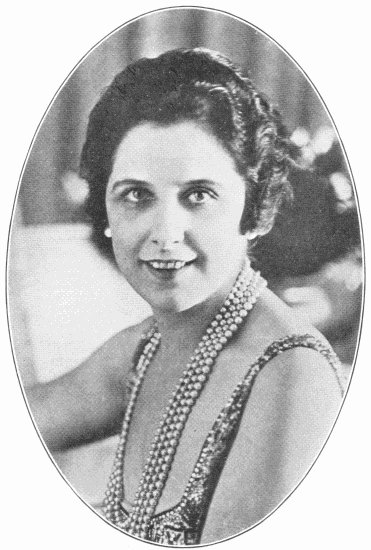
GERALDINE FARRAR
Biographical
Although one of the youngest of the noted American singers, none has achieved such an extensive international reputation as Miss Farrar. Born February 28, 1882, in Melrose, Mass., she was educated at the public schools in that city. At the school age she became the pupil of Mrs. J. H. Long, in Boston. After studying with several teachers, including Emma Thursby, in New York, and Trabadello, in Paris, she went to Lilli Lehmann in Berlin, and under this, the greatest of dramatic singers of her time, Miss Farrar received a most thorough and careful training in all the elements of her art. She made her début as Marguerite in Faust at the Royal Opera in Berlin, October 15th, 1901. Later, after touring European cities with ever increasing successes, she was engaged at the Opera Comique and Grand Opera, Paris, and then at the Metropolitan Opera House in New York, where she has been the leading soprano for many seasons. The many enticing offers made for appearances in moving pictures led to a new phase of her career. In many pictures she has appeared with her husband, M. Lou Tellegen, one of the most distinguished actors of the French school, who at one time was the leading man for Sarah Bernhardt.
The following conference is rich in advice to any young woman who desires to know what she must do in order to become a prima donna.
WHAT MUST I GO THROUGH TO BECOME A PRIMA DONNA?
MME. GERALDINE FARRAR
What must I do to become a prima donna? Let us reverse the usual method of discussing the question and begin with the artist upon the stage in a great opera house like the Metropolitan in New York, on a gala night, every seat sold and hundreds standing. It is a modern opera with a "heavy" score. What is the first consideration of the singer?
Primarily, an artist in grand opera must sing in some fashion to insure the proper projection of her rôle across the large spaces of the all-too-large auditoriums. Those admirable requisites of clear diction, facial expression and emotional appeal will be sadly hampered unless the medium of sound carries their message. It is only from sad experience that one among many rises superior to some of the disadvantages of our modern opera repertoire. Gone are the days when the facile vocalist was supported by a small group of musicians intent upon a discreet accompaniment for the benefit of the singer's vocal exertions. Voices trained for the older repertoire were not at the mercy of an enlarged orchestra pit, wherein the over-zealous gentlemen now fight—furioso ad libitum—for the supremacy of operatic effects.
An amiable musical observer once asked me why we all shouted so in opera. I replied by a question, asking if he had ever made an after-dinner speech. He acquiesced. I asked him how many times he rapped on the table for attention and silence. He admitted it was rather often. I asked him why. He said, so that he might be heard. He answered his own question by conceding that the carrying timbre of a voice cannot compete successfully against even banquet hall festivities unless properly focused out of a normal speaking tone. The difference between a small room and one seating several hundred is far greater than the average auditor realizes. If the mere rattling of silver and china will eclipse this vocal effort in speech I leave to your imagination what must transpire when the singer is called upon to dominate with one thread of song the tremendous onslaught of an orchestra and to rise triumphant above it in a theater so large that the faithful gatherers in the gallery tell me we all look like pigmies, and half the time are barely heard. Since the recesses where we must perform are so exaggerated everything must be in like proportion, hence we are very often too noisy, but how can it be otherwise if we are to influence the eager taxpayer in row X? After all, he has not come to hear us whisper, and his point of vantage is not so admirable as if he were sitting at a musical comedy in a small theater. For this condition the size of the theater and the instrumentation imposed by the composer are to be censured, and less blame placed upon the overburdened shoulders of the vocal competitor against these odds. Little shading in operatic tone color is possible unless an accompanying phrase permits it or the trumpeter swallows a pin!
Lucia or Zaza
If your repertoire is The Barber, Lucia, Somnambula and all such Italian dainties, well and good. Nothing need disturb the complete enjoyment of this lace-work. But if your auditors weep at Butterfly and Zaza or thrill to Pagliacci, they demand you use a quite different technic, which comes to the point of my story.
I believe it was Jean de Reszke who advocated the voice "in the mask" united to breath support from the diaphragm. From personal observation I should say our coloratura charmers lay small emphasis on that highly important factor and use their head voices with a freedom more or less God given. But the power and life-giving quality of this fundamental cannot be too highly estimated for us who must color our phrases to suit modern dramatics and evolve a carrying quality that will not only eliminate the difficulty of vocal demands, but at the same time insure immunity from harmful after-effects. This indispensable twin of the head voice is the dynamo which alone must endure all the necessary fatigue, leaving the actual voice phrases free to float unrestricted with no ignoble distortions or possible signs of distress. Alas! it is not easy to write of this, but the experience of years proves how vital a point is its saving grace and how, unfortunately, it remains an unknown factor to many.
To note two of our finest examples of greatness in this marvelous profession, Lilli Lehmann and Jean de Reszke, neither of whom had phenomenal vocal gifts, I would point out their remarkable mental equipment, unceasing and passionate desire for perfection, paired with an unerring instinct for the noble and distinguished such as has not been found in other exponents of purely vocal virtuosity, with a few rare exceptions, as Melba and Galli-Curci, for instance, to mention two beautiful instruments of our generation.
The singing art is not a casual inspiration and it should never be treated as such. The real artist will have an organized mental strategy just as minute and reliable as any intricate machinery, and will under all circumstances (save complete physical disability) be able to control and dominate her gifts to their fullest extent. This is not learned in a few years within the four walls of a studio, but is the result of a lifetime of painstaking care and devotion.
There was a time when ambition and overwork so told upon me that mistakenly I allowed myself to minimize my vocal practice. How wrong that was I found out in short time and I have returned long since to my earlier precepts as taught me by Lilli Lehmann.
Keep the Voice Strong and Flexible
In her book, How to Sing, there is much for the student to digest with profit, though possible reservations are advisable, dependent upon one's individual health and vocal resistance. Her strong conviction was, and is, that a voice requires daily and conscientious exercise to keep it strong and flexible. Having successfully mastered the older Italian rôles as a young singer, her incursion into the later-day dramatic and classic repertoire in no wise became an excuse to let languish the fundamental idea of beautiful sound. How vitally important and admirably bel canto sustained by the breath support has served her is readily understood when one remembers that she has outdistanced all the colleagues of her earlier career and now well over sixty, she is as indefatigable in her daily practice as we younger singers should be.
This brief extract about Patti (again quoting Lilli Lehmann) will furnish an interesting comparison:
In Adelina Patti everything was united—the splendid voice paired with great talent for singing, and the long oversight of her studies by her distinguished teacher, Strakosch. She never sang rôles that did not suit her voice; in her earlier years she sang only arias and duets or single solos, never taking part in ensembles. She never sang even her limited repertory when she was indisposed. She never attended rehearsals, but came to the theater in the evening and sang triumphantly, without ever having seen the persons who sang or acted with her. She spared herself rehearsals, which, on the day of the performance or the day before, exhaust all singers because of the excitement of all kinds attending them, and which contribute neither to the freshness of the voice nor to the joy of the profession.
Although she was a Spaniard by birth and an American by early adoption, she was, so to speak, the greatest Italian singer of my time. All was absolutely good, correct and flawless, the voice like a bell that you seemed to hear long after its singing had ceased. Yet she could give no explanation of her art, and answered all her colleagues' questions concerning it with "Ah, je n'en sais rien!" She possessed unconsciously, as a gift of nature, a union of all those qualities that other singers must attain and possess consciously. Her vocal organs stood in the most favorable relations to each other. Her talent and her remarkably trained ear maintained control over the beauty of her singing and her voice. Fortunate circumstances of her life preserved her from all injury. The purity and flawlessness of her tone, the beautiful equalization of her whole voice constituted the magic by which she held her listeners entranced. Moreover, she was beautiful and gracious in appearance. The accent of great dramatic power she did not possess, yet I ascribe this more to her intellectual indolence than to her lack of ability.
But how few of us would ever make a career if we waited for such favors from Nature!
Lessons Must be Adequate
Bearing in mind the absolute necessity and real joy in vocal work, it confounds and amazes me that teachers of this art feel their duty has been accomplished when they donate twenty minutes or half an hour to a pupil! I do not honestly believe this is a fair exchange, and it is certainly not within reason to believe that within so short a time a pupil can actually benefit by the concentration and instruction so hastily conferred upon her. If this be very plain speaking, it is said with the object to benefit the pupil only, for it is, after all, they who must pay the ultimate in success or failure. An hour devoted to the minute needs of one pupil is not too much time to devote to so delicate a subject. An intelligent taskmaster will let his pupil demonstrate ten or fifteen minutes and during the same period of rest will discuss and awaken the pupil's interest from an intelligent point of view, that some degree of individuality may color even the drudgery of the classroom. A word of counsel from such a mistress of song as Lehmann or Sembrich is priceless, but the sums that pour into greedy pockets of vocal mechanics, not to say a harsher word, is a regretable proceeding. Too many mediocrities are making sounds. Too many of the same class are trying to instruct, but, as in politics, the real culprit is the people. As long as the public forbear an intelligent protest in this direction, just so long will the studios be crowded with pathetic seekers for fame. What employment these infatuated individuals enjoyed before the advent of grand opera and the movies became a possible exhaust pipe for their vanity is not clear, but they certainly should be discouraged. New York alone is crowded with aspirants for the stage, and their little bag of tricks is of very slender proportions. Let us do everything in our power to help the really worthy talent; but it is a mistaken charity, and not patriotic, to shove singers and composers so called, of American birth, upon a weary public which perceives nothing except the fact that they are of native birth and have no talent to warrant such assumption.
I do not think the musical observers are doing the cause of art in this country a favor when columns are written about the inferior works of the non-gifted. An ambitious effort is all right in its way, but that is no reason to connect the ill-advised production with American hopes. On the contrary, it does us a bad turn. I shall still contend that the English language is not a pretty one for our vocal exploitations, and within my experience of the past ten years I have heard but one American work which I can sincerely say would have given me pleasure to create, that same being Mr. Henry Hadley's recently produced Cleopatra's Night. His score is rich and deserving of the highest praise.
In closing I should like to quote again from Mme. Lehmann's book an exercise that would seem to fulfill a long-felt want:
"The great scale is the most necessary exercise for all kinds of voices. It was taught me by my mother. She taught it to all her pupils and to us."
Here is the scale as Lehmann taught it to me.
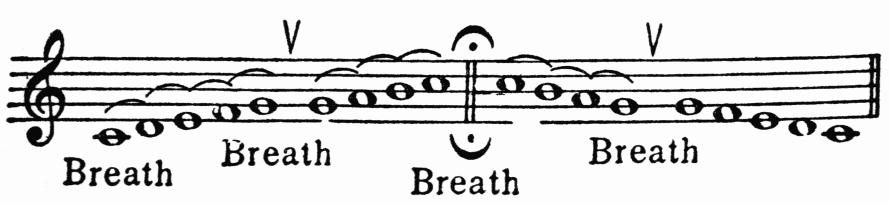
It was sung upon all the principal vowels. It was extended stepwise through different keys over the entire range of the two octaves of the voice. It was not her advice to practice it too softly, but it was done with all the resonating organs well supported by the diaphragm, the tone in a very supple and elastic "watery" state. She would think nothing of devoting from forty minutes to sixty minutes a day to the slow practice of this exercise. Of course, she would treat what one might call a heavy brunette voice quite differently from a bright blonde voice. These terms of blonde and brunette, of course, have nothing to do with the complexion of the individual, but to the color of the voice.
The Only Cure
Lehmann said of this scale: "It is the only cure for all injuries, and at the same time the most excellent means of fortification against all over-exertion. I sing it every day, often twice, even if I have to sing one of the heaviest rôles in the evening. I can rely absolutely upon its assistance. I often take fifty minutes to go through it once, for I let no tone pass that is lacking in any degree in pitch, power, duration or in single vibration of the propagation form."
Personally I supplement this great scale often with various florid legato phrases of arias selected from the older Italians or Mozart, whereby I can more easily achieve the vocal facility demanded by the tessitura of Manon or Faust and change to the darker-hued phrases demanded in Carmen or Butterfly.
But the open secret of all success is patient, never-ending, conscientious work, with a forceful emphasis on the WORK.
Johanna Gadski.
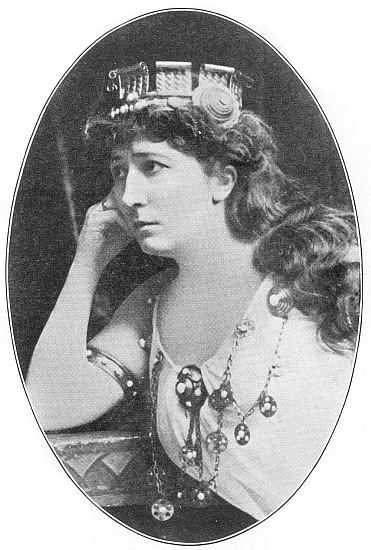
MME. JOHANNA GADSKI
Biographical
Mme. Gadski was born at Anclam, Prussia, June 15, 1872. Her studies in singing were principally with Mme. Schroeder-Chaloupha. When she was ten years old she sang successfully in concert at Stettin. Her operatic début was made in Berlin, in 1889, in Weber's Der Freischütz. She then appeared in the opera houses of Bremen and Mayence. In 1894 Dr. Walter Damrosch organized his opera company in New York and engaged Mme. Gadski for leading rôles. In 1898 she became high dramatic soprano with the Metropolitan Opera Company in New York, and the following year appeared at Covent Garden. She was constantly developing as a singer of Wagner rôles, notably Brunhilde and Isolde. Her repertoire included forty rôles in all, and the demand for her appearance at festivals here and abroad became more and more insistent. She sang at the Metropolitan Opera House in New York until 1917, when the notoriety caused by the activities of her husband, Captain Hans Tauscher, American agent for large German weapon manufacturers, forced her to resign. Mme. Gadski made a close study of the Schumann Songs for years; and the following can not fail to be of artistic assistance to the singer.
THE MASTER SONGS OF ROBERT SCHUMANN
MME. JOHANNA GADSKI
Robert Schumann's Lyric Gift
One cannot delve very far into the works of Schumann without discovering that his gifts are peculiarly lyric. His melodic fecundity is all the more remarkable because of his strong originality. Even in many of his piano pieces, such as Warum?, Träumerei or the famous Slumber Song, the lyric character is evident. Beautiful melodies which seem to lend themselves to the peculiar requirements of vocal music crop up every now and then in all his works. This is by no means the case with many of the other great masters. In some of Beethoven's songs, for instance, one can never lose sight of the fact that they are instrumental pieces. It was Schumann's particular privilege to be gifted with the acute sense of proportion which enabled him to estimate just what kind of an accompaniment a melody should have. Naturally some of his songs stand out far above others; and in these the music lover and vocal student will notice that there is usually a beautiful artistic balance between the accompaniment and the melody.
Another characteristic is the sense of propriety with which Schumann connected his melodies with the thought of the poems he employed. This is doubtless due to the extensive literary training he himself enjoyed. It was impossible for a man of Schumann's life experience to apply an inappropriate melody to any given poem. With some song writers, this is by no means the case. The music of one song would fit almost any other set of words having the same poetic metre. Schumann was continually seeking after a distinctive atmosphere, and this it is which gives many of his works their lasting charm.
The Intimate and Delicate Character of Schumann Songs
Most of the greater Schumann songs are of a deliciously ultimate and delicate character. By this no one should infer that they are weak or spineless. Schumann was a deep student of psychology and of human life. In the majority of cases he eschewed the melodramatic. It is true that we have at least one song, The Two Grenadiers, which is melodramatic in the extreme; but this, according to the greatest judges, is not Schumann at his best. It was the particular delight of Schumann to take some intense little poem and apply to it a musical setting crowded full of deep poetical meaning. Again, he liked to paint musical pastels such as Im wunderschönen Monat Mai, Frühlingsnacht and Der Nussbaum. These songs are redolent with the fragrance of out-of-doors. There is not one jarring note. The indefinable beauty and inspiration of the fields and forests have been caught by the master and imprisoned forever in this wonderful music.
Im wunderschönen Monat Mai, which comes from the Dichterliebe cycle, is indescribably delicate. It should be sung with great lightness and simplicity. Any effort toward a striving for effect would ruin this exquisite gem. Frühlingsnacht with its wonderful accompaniment, which Franz Liszt thought so remarkable that he combined the melody and the accompaniment, with but slight alterations, and made a piano piece of the whole—is a difficult song to sing properly. If the singer does not catch the effervescent character of the song as a whole, the effect is lost. Any "dragging" of the tones destroys the wonderful exuberance which Schumann strove to connote. The balance between the singer and the accompanist must be perfect, and woe be to the singer who tries to sing Frühlingsnacht with a lumbering accompanist.
Der Nussbaum is one of the most effective and "thankful" of all the Schumann songs. Experienced public singers almost invariably win popular appreciation with this song. It is probably my favorite of all the Schumann songs. Here again delicacy and simplicity reign supreme. In fact simplicity in interpretation is the great requirement of all the art songs. The amateur singer seems to be continually trying to secure "effect" with these songs and the only result of this is affectation. If amateurs could only realize how hard the really great masters tried to avoid results that were to be secured by the cheap methods of "affectation" and "show," they would make their singing more simple. Success in singing art songs comes through the ability of the artist to bring out the psychic, poetical and musical meaning of the song. There is no room for cheap vocal virtuosity. The great songs bear the sacred message of the best and finest in art. They represent the conscientious devotion of their composers to their loftiest ideals.
I have mentioned three songs which are representative, but there are numberless other songs which reveal the intimate and personal character of Schumann's works. One popular mistake regarding these songs which is quite prevalent is that of thinking that they can only be sung in tiny rooms and never in large auditoriums. Time and again I have achieved some of the best results I have ever secured on the concert stage with delicate intimate works sung before audiences of thousands of people. The size of the auditorium has practically nothing to do with the song. The method of delivery is everything. If the song is properly and thoughtfully delivered, the audience, though it be one of thousands, will sit "quiet as mice" and listen reverently to the end. However, if one of these songs were to be sung in a flamboyant, bombastic manner, by some singer infected with the idea that in order to impress a multitude of people an exaggerated style is necessary, the results would be ruinous. If overdone, they are never appreciated. Art is art. Rembrandt in one of his master paintings exhibits just the right artistic balance. A copy of the same painting might become a mere daub, with a few twists of some bungling amateur's brush. Let the young singer remember that the results that are the most difficult to get in singing the art song are not those by which she may hope to make a sensational impression by means of show, but those which depend first and always upon sincerity, simplicity and a deep study of the real meaning of the masterpiece.
The Love Interest in the Schumann Songs
Up to the time Schumann was thirty years of age (1840), his compositions were confined to works for the piano. These piano works include some of the very greatest and most inspired of his compositions for the instrument. In 1840 Schumann married Clara Wieck, daughter of his former pianoforte teacher. This marriage was accomplished only after the most severe opposition imaginable upon the part of the irate father-in-law, who was loath to see his daughter, whom he had trained to be one of the foremost pianists of her sex, marry an obscure composer. The effect of this opposition was to raise Schumann's affection to the condition of a kind of fanaticism. All this made a pronounced impression upon his art and seemed to make him long for expression through the medium of his love songs. He wrote to a friend at this time, "I am now writing nothing but songs great and small. I can hardly tell you how delightful it is to write for the voice, as compared with instrumental composition; and what a tumult and strife I feel within me as I sit down to it. I have brought forth quite new things in this line." In letters to his wife he is quite as impassioned over his song writing as the following quotations indicate: "Since yesterday morning, I have written twenty-seven pages of music (something new of which I can tell you nothing more than that I have laughed and wept for joy in composing them). When I composed them my soul was within yours. Without such a bride, indeed no one could write such music; once more I have composed so much that it seems almost uncanny. Alas! I cannot help it: I could sing myself to death like a nightingale."
During the first year of his marriage Schumann wrote one hundred of the two hundred and forty-five songs that are attributed to him. In the published collections of his works, there are three songs attributed to Schumann which are known to be from the pen of his talented wife. As in his piano compositions Schumann avoided long pieces and preferred collections of comparatively short pieces, such as those in the Carnaval, Kreisleriana, Papillons, so in his early works for the voice Schumann chose to write short songs which were grouped in the form of cycles. Seven of these cycles are particularly well known. They are here given together with the best known songs from each group.
Cycle Songs
Liederkreis{Ich wandelte unter den Bäumen. Mit Myrthen und Rosen.
Myrthen{Die Lotusblume. Lass mich ihm am Busen hangen. Du bist wie eine Blume. Der Nussbaum.
Eichendorff Liederkreis{Waldesgespräch. Frühlingsnacht.
Kerner Cycle{Wanderlust. Frage. Stille Thränen.
Frauenliebe und Leben{O, Ring an meinem Finger. Er, der Herrlichste von Allen.
Dichterliebe{Ich grolle nicht. Im wunderschönen Mai. Ich hab' im Traum geweinet.
Liebesfrühling{ Three of the songs in this Cycle are attributed to Clara Schumann.
Critics seem to be agreed that Schumann's talent gradually deteriorated as his mental disease increased. Consequently, with but few exceptions his best song works are to be found among his early vocal compositions. I have tried repeatedly to bring forth some of the lesser known songs of Schumann and have time and again devoted long periods to their study, but apparently the public, by an unmistakable indication of lack of approval, will have none of them.
Evidently, the songs by which Schumann is now best known are his best works from the standpoint of popular appreciation. Popular approval taken in the aggregate is a mighty determining factor. The survival of the fittest applies to songs as well as to other things in life. This is particularly so in the case of the four famous songs, Die beiden Grenadiere, Widmung, Der Nussbaum and Ich grolle nicht, which never seem to diminish in popularity.
Schumann's Love for the Romantic
Schumann's fervid imagination readily led to a love for the romantic. His early fondness for the works of Jean Paul developed into a kind of life tendency, which resulted in winning him the title of the "Tone-Poet of Romanticism." Few of his songs, however, are really dramatic. Waldesgespräch, which Robert Franz called a pianoforte piece with a voice part added, is probably the best of Schumann's dramatic-romantic songs. I have always found that audiences are very partial to this song; and it may be sung by a female voice as well as the male voice. The Two Grenadiers is strictly a man's song. Ich grolle nicht, while sung mostly by men, may, like the Erl-King of Schubert, be sung quite as successfully by women singers possessing the qualities of depth and dramatic intensity.
Peculiar Difficulties in Interpreting Schumann Songs
I have already mentioned the necessity for simplicity in connection with the interpretation of the Schumann songs. I need not tell the readers of these pages that the proper interpretation of these songs requires a much more extensive and difficult kind of preparatory work than the more showy coloratura works which to the novice often seem vastly more difficult. The very simplicity of the Schubert and Schumann songs makes them more difficult to sing properly than the works of writers who adopted a somewhat more complicated style. The smallest vocal discrepancies become apparent at once and it is only by the most intense application and great attention to detail that it is possible for the singer to bring her art to a standard that will stand the test of these simple, but very difficult works. Too much coloratura singing is liable to rob the voice of its fullness and is not to be recommended as a preparation for the singer who would become a singer of the modern art songs. This does not mean that scales and arpeggios are to be avoided. In fact the flexibility and control demanded of the singers of art songs are quite as great as that required of the coloratura singer. The student must have her full quota of vocal exercises before she should think of attempting the Schumann Lieder.
Schumann's Popularity in America
Americans seem to be particularly fond of Schumann. When artists are engaged for concert performances it is the custom in this country to present optional programs to the managers of the local concert enterprises. These managers represent all possible kinds of taste. It is the experience of most concert artists that the Schumann selections are almost invariably chosen. This is true of the West as well as of the South and East. One section of the program is without exception devoted to what they call classical songs and by this they mean the best songs rather than the songs whose chief claim is that they are from the old Italian schools of Carissimi, Scarlatti, etc. I make it a special point to present as many songs as possible with English words. The English language is not a difficult language in which to sing; and when the translation coincides with the original I can see no reason why American readers who may not be familiar with a foreign tongue should be denied the privilege of understanding what the song is about. If they do not understand, why sing words at all? Why not vocalize the melodies upon some vowel? Songs, however, were meant to combine poetry and music; and unless the audience has the benefit of understanding both, it has been defrauded of one of its chief delights.
Some German poems, however, are almost untranslatable. It is for this reason that many of the works of Löwe, for instance, have never attained wide popularity. The legends which Löwe employed are often delightful, but the difficulties of translation are such that the original meaning is either marred or destroyed. The songs or ballads of Löwe, without the words, do not seem to grasp American audiences and singers find it a thankless task to try to force them upon the public.
I have been so long in America that I feel it my duty to share in popularizing the works of the many talented American composers. I frequently place MacDowell's beautiful songs on my programs; and the works of many other American composers, including Mrs. H. H. A. Beach, Sidney Homer, Frank Le Forge and others make fine concert numbers. It has seemed to me that America has a large future in the field of lyric composition. American poets have long since won their place in the international Hall of Fame. The lyrical spirit which they have expressed verbally will surely be imbued in the music of American composers. The opportunity is already here. Americans demand the best the world can produce. It makes no difference what the nationality of the composer. However, Americans are first of all patriotic; and the composer who produces real lyric masterpieces is not likely to be asked to wait for fame and competence, as did Schubert and Schumann.
Mme. Amelita Galli-Curci. © Victor Georg.
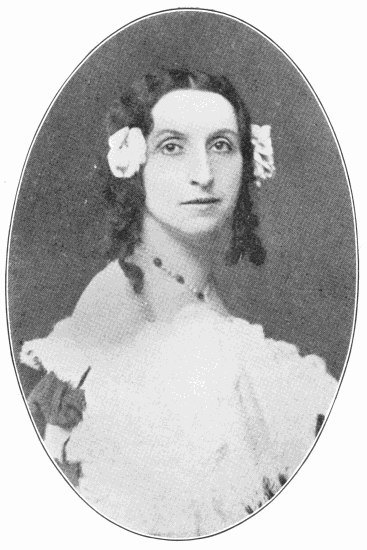
MME. AMELITA GALLI-CURCI
Biographical
Mme. Galli-Curci was born at Milan, November 18th, 1889, of a family distinguished in the arts and in the professions. She entered the Milan Conservatory, winning the first prize and diploma in piano playing in 1903. For a time after her graduation she toured as a pianist and then resolved to become a singer. She is practically self-taught in the vocal art. Her début was made in Rome at the Teatro Constanzi, in the rôle of Gilda in Rigoletto. She was pronouncedly successful from the very start. During the next six years she sang principally in Italy, South America (Three Tours), and in Spain, her success increasing with every appearance. In 1916 she appeared at Chicago with the Chicago Opera Company, creating a furore. The exceptionally beautiful records of her interpretations created an immense demand to hear her in concert, and her successes everywhere have been historic. Not since Patti has there been a singer upon whom such wide-spread critical comment has been made in praise of her exquisite velvety quality of tone, vocal technic and interpretative intelligence. Hailed as "Patti's only successor," she has met with greater popular success in opera and concert than any of the singers of recent years. In 1921 she married the gifted American composer, Homer Samuels, who for many years had been the pianist upon her tours.
TEACHING YOURSELF TO SING
MME. AMELITA GALLI-CURCI
Just what influence heredity may have upon the musical art and upon musicians has, of course, been a much discussed question. In my own case, I was fortunate in having a father who, although engaged in another vocation, was a fine amateur musician. My grandfather was a conductor and my grandmother was an opera singer of distinction in Italy. Like myself, she was a coloratura soprano, and I can recollect with joy her voice and her method of singing. Even at the age of seventy-five her voice was wonderfully well preserved, because she always sang with the greatest ease and with none of the forced throat restrictions which make the work of so many singers insufferable.
My own musical education began at the age of five, when I commenced to play the piano. Meanwhile I sang around the house, and my grandmother used to say in good humor: "Keep it up, my dear; perhaps some day you may be a better singer than I am." My father, however, was more seriously interested in instrumental music, and desired that I should become a pianist. How fortunate for me! Otherwise, I should never have had that thorough musical drill which gave me an acquaintance with the art which I cannot believe could come in any other way. Mascagni was a very good friend of our family and took a great interest in my playing. He came to our house very frequently, and his advice and inspiration naturally meant much to a young, impressionable girl.
General Education
My general education was very carefully guarded by my father, who sent me to the best schools in Milan, one of which was under the management of Germans, and it was there that I acquired my acquaintance with the German language. I was then sent to the Conservatorio, and graduated with a gold medal as a pianist. This won me some distinction in Italy and enabled me to tour as a pianist. I did not pretend to play the big, exhaustive works, but my programs were made up of such pieces as the Abeg of Schumann, studies by Scharwenka, impromptus of Chopin, the four scherzos of Chopin, the first ballade, the nocturnes (the fifth in the book was my favorite) and works of Bach. (Of course, I had been through the Wohltemperiertes Clavier.) In those days I was very frail, and I had aspired to develop my repertoire so that later I could include the great works for the piano requiring a more or less exhaustive technic of the bravura type.
Once I went to hear Busoni, and after the concert, came to me like a revelation, "You can never be such a pianist as he. Your hand and your physical strength will not permit it." I went home in more or less sadness, knowing that despite the success I had had in my piano playing, my decision was a wise one. Figuratively, I closed the lid of my piano upon my career as a pianist and decided to learn how to sing. The memory of my grandmother's voice singing Bellini's Qui la Voce was still ringing in my ears with the lovely purity of tone that she possessed. Mascagni called upon us at that time, and I asked him to hear me sing. He did so, and threw up his hands, saying, "Why in the world have you been wasting your time with piano playing when you have a natural voice like that? Such voices are born. Start to work at once to develop your voice." Meanwhile, of course, I had heard a great deal of singing and a great deal of so-called voice teaching. I went to two teachers in Milan, but was so dissatisfied with what I heard from them and from their pupils that I was determined that it would be necessary for me to develop my own voice. Please do not take this as an inference that all vocal teachers are bad or are dispensable. My own case was peculiar. I had been saturated with musical traditions since my babyhood. I had had, in addition, a very fine musical training. Of course, without this I could not have attempted to do what I did in the way of self-training. Nevertheless, it is my firm conviction that unless the student of singing has in his brain and in his soul those powers of judging for himself whether the quality of a tone, the intonation (pitch), the shading, the purity and the resonance are what they should be to insure the highest artistic results, it will be next to impossible for him to secure these. This is what is meant by the phrase—"singers are born and not made." The power of discrimination, the judgment, etc., must be inherent. No teacher can possibly give them to a pupil, except in an artificial way. That, possibly, is the reason why so many students sing like parrots: because they have the power of mimicry, but nothing comes from within. The fine teacher can, of course, take a fine sense of tonal values, etc., and, provided the student has a really good natural voice, lead him to reveal to himself the ways in which he can use his voice to the best advantage. Add to this a fine musical training, and we have a singer. But no teacher can give to a voice that velvety smoothness, that liquid fluency, that bell-like clarity which the ear of the educated musician expects, and which the public at large demands, unless the student has the power of determining for himself what is good and what is bad.
Four Years of Hard Training
It was no easy matter to give up the gratifying success which attended my pianistic appearances to begin a long term of self-study, self-development. Yet I realized that it would hardly be possible for me to accomplish what I desired in less than four years. Therefore, I worked daily for four years, drilling myself with the greatest care in scales, arpeggios and sustained tones. The colorature facility I seemed to possess naturally, to a certain extent; but I realized that only by hard and patient work would it be possible to have all my runs, trills, etc., so that they always would be smooth, articulate and free—that is, unrestricted—at any time. I studied the rôles in which I aspired to appear, and attended the opera faithfully to hear fine singing, as well as bad singing.
As the work went on it became more and more enjoyable. I felt that I was upon the right path, and that meant everything. If I had continued as a pianist I could never have been more than a mediocrity, and that I could not have tolerated.
About this time came a crisis in my father's business; it became necessary for me to teach. Accordingly, I took a number of piano pupils and enjoyed that phase of my work very much indeed. I gave lessons for four years, and in my spare time worked with my voice, all by myself, with my friend, the piano. My guiding principles were:
There must be as little consciousness of effort in the throat as possible.
There must always be the Joy of Singing.
Success is based upon sensation, whether it feels right to me in my mouth, in my throat, that I know, and nobody else can tell me.
I remember that my grandmother, who sang Una voce poco fa at seventy-five, always cautioned me to never force a single tone. I did not study exercises like those of Concone, Panofka, Bordogni, etc., because they seemed to me a waste of time in my case. I did not require musical knowledge, but needed special drill. I knew where my weak spots were. What was the use of vocal studies which required me to do a lot of work and only occasionally touched those portions of my voice which needed special attention? Learning a repertoire was a great task in itself, and there was no time to waste upon anything I did not actually need. Because of the natural fluency I have mentioned, I devoted most of my time to slower exercises at first. What could be simpler than this?
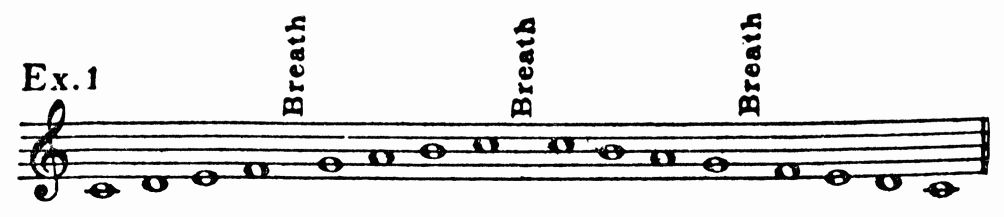
These, of course, were sung in the most convenient range in my voice. The more rapid exercises I took from C to F above the treble staff.
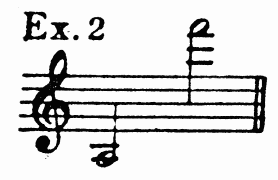
Even to this day I sing up to high F every day, in order that I may be sure that I have the tones to E below in public work. Another exercise which I used very frequently was this, in the form of a trill. Great care was taken to have the intonation (pitch) absolutely accurate in the rapid passages, as well as in the slow passages.
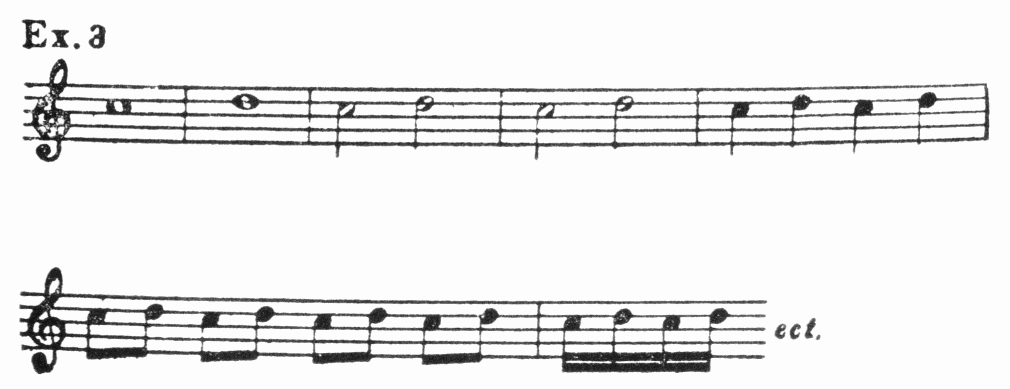
When I had reached a certain point, I determined that it might be possible for me to get an engagement. I was then twenty, and my dear mother was horrified at the idea of my going on the stage so young. She was afraid of evil influences. In my own mind I realized that evil was everywhere, in business, society, everywhere, and that if one was to keep out of dirt and come out dean, one must make one's art the object first of all. Art is so great, so all-consuming, that any one with a deep reverence for its beauties, its grandeur, can have but little time for the lower things of life. All that an artist calls for in his soul is to be permitted to work at his best in his art. Then, and then only, is he happiest. Because of my mother's opposition, and because I felt I was strong enough to resist the temptations which she knew I might encounter, I virtually eloped with a copy of Rigoletto under my arm and made my way for the Teatro Constanzi, the leading Opera House of Rome.
I might readily have secured letters from influential musical friends, such as Mascagni and others, but I determined that it would be best to secure an engagement upon my own merits, if I could, and then I would know whether or not I was really prepared to make my début, or whether I had better study more. I went to the manager's office and, appealing to his business sense, told him that, as I was a young unknown singer, he could secure my services for little money, and begged for permission to sing for him. I knew he was beset by such requests, but he immediately gave me a hearing, and I was engaged for one performance of Rigoletto. The night of the début came, and I was obliged to sing Caro Nome again in response to a vociferous encore. This was followed by other successes, and I was engaged for two years for a South American tour, under the direction of my good friend and adviser, the great operatic director, Mugnone. In South America there was enthusiasm everywhere, but all the time I kept working constantly with my voice, striving to perfect details.
At the end of the South American tour I desired to visit New York and find out what America was like. Because of the war Europe was operatically impossible (it was 1916), but I had not the slightest idea of singing in the United States just then. By merest accident I ran into an American friend (Mr. Thorner) on Broadway. He had heard me sing in Italy, and immediately took me to Maestro Campanini, who was looking then for a coloratura soprano to sing for only two performances in Chicago, as the remainder of his program was filled for the year. This was in the springtime, and it meant that I was to remain in New York until October and November. The opportunity seemed like an unusual accident of fate, and I resolved to stay, studying my own voice all the while to improve it more and more. October and the début in Rigoletto came. The applause astounded me; it was electric, like a thunderstorm. No one was more astonished than I. Engagements and offers came from everywhere, but not enough, I hope, to ever induce me not to believe that in the vocal art one must continually strive for higher and higher goals. Laziness, indifference and lassitude which come with success are the ruin of Art and the artist. The normal healthy artist with the right ideals never reaches his Zenith. If he did, or if he thought he did, his career would come to a sudden end.
Mary Garden. © Mishkin.
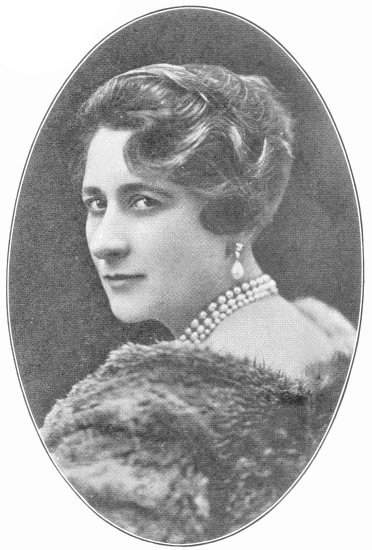
MARY GARDEN
Biographical
Mary Garden was born February 20th, 1877, in Aberdeen, Scotland. She came to America with her parents when she was eight years of age and was brought up in Chicopee, Massachusetts, Hartford, Connecticut, and Chicago, Illinois. She studied the violin when she was six and the piano when she was twelve. It was the ambition of her parents to make her an instrumental performer. She studied voice with Mrs. S. R. Duff, who in time took her to Paris and placed her under the instruction of Trabadello and Lucien Fugére. Her operatic début was made in Charpentier's Louise at the Opera Comique in 1900. Her success was immediate both as an actress and as a singer. She was chosen by Debussy and others for especially intricate rôles. She created the rôle of Melisande; also, Fiammette in Laroux's La Reine Fiammette. In 1907 she made her American début in Thaïs at the Manhattan Opera House in New York City. Later she accepted leading rôles with the Philadelphia-Chicago Opera Co. She is considered by many the finest singing actress living—her histrionic gifts being in every way equal to her vocal gifts. In 1921 she was made the manager of the Chicago Opera Company.
THE KNOW HOW IN THE ART OF SINGING
MARY GARDEN
The modern opera singer cannot content herself merely with the "know how" of singing. That is, she must be able to know so much more than the mere elemental facts of voice production that it would take volumes to give an intimation of the real requirements.
The girl who wants to sing in opera must have one thought and one thought only—"what will contribute to my musical, histrionic and artistic success?"
Unless the "career" comes first there is not likely to be any "career."
I wonder if the public ever realizes what this sacrifice means to an artiste—to a woman.
Of course, there are great recompenses—the thrill that comes with artistic triumphs—the sensations that accompany achievement—who but the artist can know what this means—the joy of bringing to life some great masterpiece?
Music manifests itself in children at a very early age. It is very rare indeed that it comes to the surface later in life. I was always musical. Only the media changed—one time it was violin, then piano, then voice. The dolls of my sisters only annoyed me because I could not tolerate dolls. They seemed a waste of time to me, and when they had paper dolls, I would go into the room when nobody was looking and cut the dolls' heads off. I have never been able to account for my delight in doing this.
My father was musical. He wanted me to be a musician, but he had little thought at first of my being a singer. Accordingly, at eight I was possessed of a fiddle. This meant more to me than all the dolls in the world. Oh, how I loved that violin, which I could make speak just by drawing a bow over it! There was something worth while.
I was only as big as a minute, and, of course, as soon as I could play the routine things of de Beriot, variations and the like, I was considered one of those abominable things, "an infant prodigy."
I was brought out to play for friends and any musical person who could stand it. Then I gave a concert, and my father saw the finger of destiny pointing to my career as a great violinist.
To me the finger of destiny pointed the other way; because I immediately sickened of the violin and dropped it forever. Yes, I could play now if I had to, but you probably wouldn't want to hear me.
Ah, but I do play. I play every time I sing. The violin taught me the need for perfect intonation, fluency in execution, ever so many things.
Then came the piano. Here was a new artistic toy. I worked very hard with it. My sister and I went back to Aberdeen for a season of private school, and I kept up my piano until I could play acceptably many of the best-known compositions, Grieg, Chopin, etc., being my favorites. I was never a very fine pianist, understand me, but the piano unlocked the doors to thousands of musical treasure houses—admitted me to musical literature through the main gate, and has been of invaluable aid to me in my career. See my fingers, how long and thin they are—of course, I was a capable pianist—long, supple fingers, combined with my musical experience gained in violin playing, made that certain.
Then I dropped the piano. Dropped it at once. Its possibilities stood revealed before me, and they were not to be the limit of my ambitions.
For the girl who hopes to be an operatic "star" there could be nothing better than a good drilling in violin or piano. The girl has no business to sing while she is yet a child—and she is that until she is sixteen or over. Better let her work hard getting a good general education and a good musical education. The voice will keep, and it will be sweeter and fresher if it is not overused in childhood.
Once, with my heart set upon becoming a singer, my father fortunately took me to Mrs. Robinson Duff, of Chicago. To her, my mentor to this day, I owe much of my vocal success. I was very young and very emotional, with a long pigtail down my back. At first the work did not enrapture me, for I could not see the use of spending so much time upon breathing. Now I realize what it did for me.
What should the girl starting singing avoid? First, let her avoid an incompetent teacher. There are teachers, for instance, who deliberately teach the "stroke of the glottis" (coup de glotte).
What is the stroke of the glottis? The lips of the vocal cords in the larynx are pressed together so that the air becomes compressed behind them and instead of coming out in a steady, unimpeded stream, it causes a kind of explosion. Say the word "up" in the throat very forcibly and you will get the right idea.
This is a most pernicious habit. Somehow, it crept into some phases of vocal teaching, and has remained. It leads to a constant irritation of the throat and ruin to the vocal organs.
When I went to Paris, Mrs. Duff took me to many of the leading vocal teachers of the city, and said, "Now, Mary, I want you to use your own judgment in picking out a teacher, because if you don't like the teacher you will not succeed."
Thus we went around from studio to studio. One asked me to do this—to hum—to make funny, unnatural noises, anything but sing. Finally, Trabadello, now retired to his country home, really asked me to sing in a normal, natural way, not as a freak. I said to myself, "This is the teacher for me." I could not have had a better one.
Look out for teachers with freak methods—ten to one they are making you one of their experiments. There is nothing that any voice teacher has ever found superior to giving simple scales and exercises sung upon the syllables Lah (ah, as in harbor), Leh (eh, as in they), Lee (ee, as in me). With a good teacher to keep watch over the breathing and the quality, "what more can one have?"
I have always believed in a great many scales and in a great deal of singing florid rôles in Italian. Italian is inimitable for the singer. The dulcet, velvet-like character of the language gives something which nothing else can impart. It does not make any difference whether you purpose singing in French, German, English, Russian or Soudanese, you will gain much from exercising in Italian.
Staccato practice is valuable. Here is an exercise which I take nearly every day of my life:

The staccato must be controlled from the diaphragm, however, and this comes only after a great deal of work.
Three-quarters of an hour a day practice suffices me. I find it injurious to practice too long. But I study for hours. Such a rôle as Aphrodite I take quietly and sing it over mentally time and time again without making a sound. I study the harmonies, the nuances, the phrasing, the breathing, so that when the time for singing it comes I know it and do not waste my voice by going over it time and again, as some singers do. In the end I find that I know it better for this kind of study.
The study of acting has been a very personal matter with me. I have never been through any courses of study, such as that given in dramatic schools. This may do for some people, but it would have been impossible for me. There must be technic in all forms of art, but it has always seemed to me that acting was one of the arts in which the individual must make his own technic. I have seen many representatives of the schools of acting here and abroad. Sometimes their performances, based upon technical studies of the art, result in superb acting. Again, their work is altogether indifferent. Technic in acting is more likely to suppress than to inspire. If acting is not inspired, it is nothing. I study the human emotions that would naturally underlie the scene in which I am placed—then I think what one would be most likely to do under such conditions. When the actual time of appearance on the stage arrives, I forget all about this and make myself the person of the rôle.
This is the Italian method rather than the French. There are, to my mind, no greater actors living than Duse and Zacchona, and they are both exponents of the natural method that I employ.
Great acting has always impressed me wonderfully. I went from Paris to London repeatedly to see Beerbohm Tree in his best rôles. Sir Herbert was not always uniformly fine, but he was a great actor and I learned much from watching him. Once I induced Debussy to make the trip to see him act. Debussy was delighted.
Debussy! Ah, what a rare genius—my greatest friend in Art! Everything he wrote we went over together. He was a terribly exacting master. Few people in America realize what a transcendent pianist he was. The piano seemed to be thinking, feeling, vibrating while he was at the keyboard. Time and again we went over his principal works, note for note. Now and then he would stop and clasp his hands over his face in sudden silence, repeating, "It is all wrong—it is all wrong." But he was too good a teacher to let it go at that. He could tell me exactly what was wrong and how to remedy it. When I first sang for him, at the time when they were about to produce Pelleas and Melisande at the Opera Comique, I thought that I had not pleased him. But I learned later that he had said to M. Carré, the director: "Don't look for anyone else." From that time he and his family became my close friends. The fatalistic side of our meeting seemed to interest him very much. "To think," he used to say, "that you were born in Aberdeen, Scotland, lived in America all those years and should come to Paris to create my Melisande!"
As I have said, Debussy was a gorgeous pianist. He could play with the greatest delicacy and could play in the leonine fashion of Rubinstein. He was familiar with Beethoven, Bach, Handel and the classics, and was devoted to them. Wagner he could not abide. He called him a "griffe papier"—a scribbler. He thought that he had no importance in the world of music, and to mention Wagner to him was like waving a red flag before a bull.
It is difficult to account for such an opinion. Wagner, to me, is the great tone colorist, the master of orchestral wealth and dramatic intensity. Sometimes I have been so Wagner-hungry that I have not known what to do. For years I went every year to Munich to see the wonderful performances at the Prinzregenten Theater.
In closing let me say that it seems to me a great deal of the failure among young singers is that they are too impatient to acquire the "know how." They want to blossom out on the first night as great prima donnas, without any previous experience. How ridiculous this is! I worked for a whole year at the Opera Comique, at $100 a month, singing such a trying opera as Louise two and three times a week. When they raised me to $175 a month I thought that I was rich, and when $400 a month came, my fortune had surely been made! All this time I was gaining precious experience. It could not have come to me in any other way. As I have said, the natural school—the natural school, like that of the Italians—stuffed as it is with glorious red blood instead of the white bones of technic in the misunderstood sense, was the only possible school for me. If our girls would only stop hoping to make a début at $1,000 a night and get down to real hard work, the results would come much quicker and there would be fewer broken hearts.
MME. ALMA GLUCK
Biographical
Mme. Alma Gluck was born at Jassy, Roumania. Her father played the violin, but was not a professional musician. At the age of six she was brought to America. She was taught the piano and sang naturally, but had no idea of becoming a singer. Her vocal training was not begun until she was twenty years of age. Her teacher, at that time, was Signor Buzzi-Peccia, with whom she remained for three years, going directly from his studio to the Metropolitan Opera House of New York. She remained there for three years, when the immense success of her concert work drew her away from opera. She then studied with Jean de Reszke, and later with Mme. Sembrich for four or five years. Since then she has appeared in all parts of the United States with unvarying success. Her records have been among the most popular of any ever issued. Together with her husband, Efrem Zimbalist, the distinguished violinist, she has appeared before immense audiences in joint recitals.
Mme. Alma Gluck. © Mishkin.
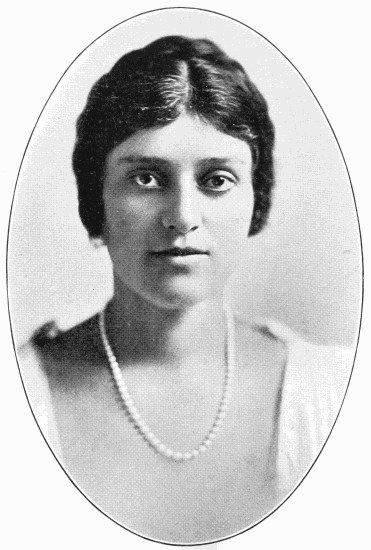
BUILDING A VOCAL REPERTOIRE
Alma Gluck
Many seem surprised when I tell them that my vocal training did not begin until I was twenty years of age. It seems to me that it is a very great mistake for any girl to begin the serious study of singing before that age, as the feminine voice, in most instances, is hardly settled until then. Vocal study before that time is likely to be injurious, though some survive it in the hands of very careful and understanding teachers.
The first kind of a repertoire that the student should acquire is a repertoire of solfeggios. I am a great believer in the solfeggio. Using that for a basis, one is assured of acquiring facility and musical accuracy. The experienced listener can tell at once the voice that has had such training. Always remember that musicianship carries one much further than a good natural voice. The voice, even more than the hands, needs a kind of exhaustive technical drill. This is because in this training you are really building the instrument itself. In the piano, one has the instrument complete before he begins; but in the case of the voice, the instrument has to be developed and sometimes made by study. When the pupil is practicing, tones grow in volume, richness and fluency.
There are exercises by Bordogni, Concone, Vaccai, Lamperti, Marchesi, Panofka, Panserson and many others with which I am not familiar, which are marvelously beneficial when intelligently studied. These I sang on the syllable "Ah," and not with the customary syllable names. It has been said that the syllables Do, Re, Mi, Fa, etc., aid one in reading. To my mind, they are often confusing.
Go to the Classics
After a thorough drilling in solfeggios and technical exercises, I would have the student work on the operatic arias of Bellini, Rossini, Donizetti, Verdi, and others. These men knew how to write for the human voice! Their arias are so vocal that the voice develops under them and the student gains vocal assurance. They were written before modern philosophy entered into music—when music was intended for the ear rather than for the mind. I cannot lay too much stress on the importance of using these arias. They are a tonic for the voice, and bring back the elasticity which the more subdued singing of songs taxes.
When one is painting pictures through words, and trying to create atmosphere in songs, so much repression is brought into play that the voice must have a safety-valve, and that one finds in the bravura arias. Here one sings for about fifty bars, "The sky is clouded for me," "I have been betrayed," or "Joy abounds"—the words being simply a vehicle for the ever-moving melody.
When hearing an artist like John McCormack sing a popular ballad it all seems so easy, but in reality songs of that type are the very hardest to sing and must have back of them years of hard training or they fall to banality. They are far more difficult than the limpid operatic arias, and are actually dangerous for the insufficiently trained voice.
The Lyric Song Repertoire
Then when the student has her voice under complete control, it is safe to take up the lyric repertoire of Mendelssohn, Old English Songs, etc. How simple and charming they are! The works of the lighter French composers, Hahn, Massenet, Chaminade, Gounod, and others. Then Handel, Haydn, Mozart, Löwe, Schubert, Schumann and Brahms. Later the student will continue with Strauss, Wolf, Reger, Rimsky-Korsakoff, Mousorgsky, Borodin and Rachmaninoff. Then the modern French composers, Ravel, Debussy, Georges, Köchlin, Hue, Chausson, and others. I leave French for the last because it is, in many ways, more difficult for an English-speaking person to sing. It is so full of complex and trying vowels that it requires the utmost subtlety to overcome these difficulties and still retain clarity in diction. For that reason the student should have the advice of a native French coach.
When one has traveled this long road, then he is qualified to sing English songs and ballads.
American Songs
In this country we are rich in the quantity of songs rather than in the quality. The singer has to go through hundreds of compositions before he finds one that really says something. Commercialism overwhelms our composers. They approach their work with the question, "Will this go?" The spirit in which a work is conceived is that in which it will be executed. Inspired by the purse rather than the soul, the mercenary side fairly screams in many of the works put out by every-day American publishers. This does not mean that a song should be queer or ugly to be novel or immortal. It means that the sincerity of the art worker must permeate it as naturally as the green leaves break through the dead branches in springtime. Of the vast number of new American composers, there are hardly more than a dozen who seem to approach their work in the proper spirit of artistic reverence.
Art for Art's Sake, a Farce
Nothing annoys me quite so much as the hysterical hypocrites who are forever prating about "art for art's sake." What nonsense! The student who deceives himself into thinking that he is giving his life like an ascetic in the spirit of sacrifice for art is the victim of a deplorable species of egotism. Art for art's sake is just as iniquitous an attitude in its way as art for money's sake. The real artist has no idea that he is sacrificing himself for art. He does what he does for one reason and one reason only—he can't help doing it. Just as the bird sings or the butterfly soars, because it is his natural characteristic, so the artist works.
Time and again a student will send me an urgent appeal to hear her, saying she is poor and wants my advice as to whether it is worth while to continue her studies. I invariably refuse such requests, saying that if the student could give up her work on my advice she had better give it up without it. One does not study for a goal. One sings because one can't help it! The "goal" nine times out of ten is a mere accident.
Art for art's sake is the mask of studio idlers. The task of acquiring a repertoire in these days, when the vocal literature is so immense, is so overwhelming, that the student with sense will devote all his energies to work, and not imagine himself a martyr to art.
EMILIO DE GOGORZA
Biographical
Emilio Edoardo de Gogorza was born in Brooklyn, New York, May 29th, 1874, of Spanish parents. His boyhood was spent in Spain, France and England. In the last named country he became a boy soprano and sang with much success. Part of his education was received at Oxford. He returned to America, where his vocal teachers were C. Moderati and E. Agramonte. His début was made in 1897 in a concert with Mme. Marcella Sembrich. His rich fluent baritone voice made him a great favorite at musical festivals in America. He has sung with nearly all of the leading American orchestras. The peculiar quality of his voice is especially adapted to record making and his records have been immensely popular. He married Emma Eames, July 13th, 1911.
Emilio de Gogorza. © Dupont
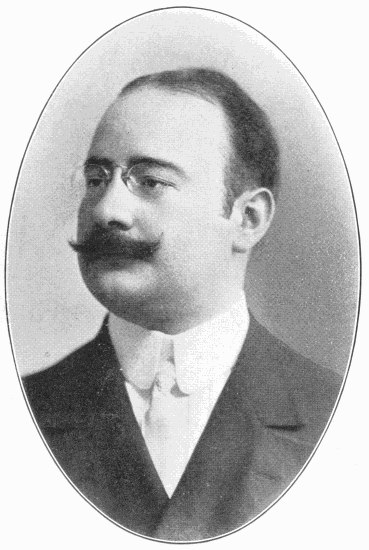
OPPORTUNITIES FOR YOUNG CONCERT SINGERS
EMILIO DE GOGORZA
There has never been a time or a country presenting more inviting opportunities to the concert and the oratorio singer than the America of to-day. As a corollary to this statement there is the obvious fact that the American public, taken as a whole, is now the most discriminating public to be found anywhere in the world. Every concert is adequately reviewed by able writers; and singers are continually on their mettle. It therefore follows that while there are opportunities for concert and oratorio singers, there is no room for the inefficient, the talentless, brainless aspirants who imagine that a great vocal career awaits them simply because they have a few good tones and a pleasing stage presence.
This is the age of the brain. In singing, the voice is only a detail. It is the mentality, the artistic feeling, the skill in interpretation that counts. Some of the greatest artists are vocally inferior to singers of lesser reputation. Why? Because they read, because they study, because they broaden their intellects and extend their culture until their appreciation of the beautiful is so comprehensive that every degree of human emotion may be effectively portrayed. In a word they become artists. Take the case of Victor Maurel, for instance. If he were ninety years old and had only the shred of a voice but still retained his artistic grasp, I would rather hear him than any living singer. I have learned more from hearing him sing than from any other singer. Verdi chose him to sing in Otello against the advice of several friends, saying: "He has more brain than any five singers I know."
Some people imagine that when an artist is embarked upon his professional work study ceases. It is a great mistake. No one works harder than I do to broaden my culture and interpretative skill. I am constantly studying and trust that I may never cease. The greater the artist the more incessant the study. It is one of the secrets of large success.
Special Study Required for Concert Singing
People imagine that the opera requires a higher kind of vocal preparation than the concert or oratorio stage. This is also a great misconception. The operatic singers who have been successful as concert singers at once admit that concert singing is much more difficult. Comparatively few opera singers succeed as concert singers. Why? Because in opera the voice needs to be concentrated and more or less uniform. An opera house is really two buildings, the auditorium and the stage. The stage with its tall scene-loft is frequently as large from the standpoint of cubic feet as the auditorium. Sometimes it is larger. To fill these two immense buildings the voice must be strong and continually concentrated, dans le Masque. The delicate little effects that the concert singer is obliged to produce would not be heard over the footlights. In order to retain interest without the assistance of scenery and action the concert singer's interpretative work must be marked by an attention to details that the opera singer rarely considers. The voice, therefore, requires a different treatment. It must be so finely trained that it becomes susceptible to the most delicate change of thought in the singer's mind. This demands a really enormous amount of work.
The successful concert singer must also have an endurance that enables her to undergo strains that the opera singer rarely knows. The grand opera singer in the great opera houses of the world rarely sings more than two or three times a week. The concert singer is often obliged to sing every night for weeks. They must learn how to relax and save the voice at all times, otherwise they will lose elasticity and sweetness.
A young woman vocal student, with talent, a good natural voice, intelligence, industry, sufficient practice time, a high school education, and a knowledge of the rudiments of music, might complete a course of study leading to a successful concert début in three years. More frequently four or five years may be required. With a bungling teacher she may spend six or seven. The cost of her instruction, with a good teacher in a great metropolis, will be more per year than if she went to almost any one of the leading universities admitting women. She will have to work harder than if she took a regular college course. Progress depends upon the individual. One girl will accomplish more in two years than another will accomplish in five years. Again, the rate of progress depends upon personal development. Sometimes a course of study with a good teacher will awaken a latent energy and mental condition that will enable the student to make great strides.
My most important work has been done by self-study with the assistance and advice of many singers and teachers who have been my friends. No pupil who depends entirely upon a teacher will succeed. She must work out her own salvation. It is the private thought, incessant effort and individual attitude that lead to success.
Study in Your Home Country
I honestly believe that the young vocal student can do far better by studying in America than by studying abroad. European residence and travel are very desirable, but the study may be done to better advantage right here in our own country. Americans want the best and they get it. In Europe they have no conception whatever of the extent of musical culture in America. It is a continual source of amazement to me. In the West and Northwest I find audiences just as intelligent and as appreciative as in Boston. There is the greatest imaginable catholicity of taste. Just at present the tendency is away from the old German classics and is leading to the modern works of French, German and American composers. Still I find that I can sing a song like Schumann's "Widmung" in Western cities that only a few years ago were mere collections of frontier huts and shacks, and discover that the genius of Schumann is just as potent there as in New York City. I have recently been all over Europe, and I have seen no such condition anywhere as that I have just described. It is especially gratifying to note in America a tremendous demand for the best vocal works of the American composers.
The young concert singer must have a very comprehensive repertoire. Every new work properly mastered is an asset. In oratorio she should first of all learn those works that are most in demand, like the Messiah, the Elijah, the Creation and the Redemption. Then attention may be given to the modern works and works more rarely performed, like those of Elgar, Perosi and others. After the young singer has proven her worth with the public she may expect an income of from $10,000.00 to $15,000.00 a year. That is what our first-class singers have received for high-class concert work. Some European prima donnas like Schumann-Heink and others have commanded much higher figures.
You ask me what influence the sound reproducing machines have had upon the demand for good vocal music in America. They have unquestionably increased the demand very greatly. They have even been known to make reputations for singers entirely without any other road to publicity. Take the case of Madame Michaelowa, a Russian prima donna who has never visited America. Thousands of records of her voice have been sold in America, and now the demand for her appearance in this country has been so great that she has been offered huge sums for an American tour. I believe that if used intelligently the sound reproducing machine may become a great help to the teacher and student. It is used in many of the great opera houses of the world as an aid in determining the engagement of new singers who cannot be personally heard. Some of the records of my own voice have been so excellent that they seem positively uncanny to me when I hear them reproduced.
I have no patent exercises to offer to singing students. There are a thousand ways of learning to breathe properly and they all lead to one end. Breathing may best be studied when it is made coincident with the requirements of singing. I have no fantastic technical studies to offer. My daily work simply consists of scales, arpeggios and the simplest kind of exercises, the simpler the better. I always make it a point to commence practicing very softly, slowly and surely. I never sing notes outside my most comfortable range at the start. Taking notes too high or too low is an extremely bad plan at first. Many young students make this fault. They also sing much too loud. The voice should be exercised for some considerable time on soft exercises before loud notes are even attempted. It is precisely the same as with physical exercises. The athlete who exerts himself to his fullest extent at first is working toward ultimate exhaustion. I have known students who sang "at the top of their lungs" and called it practice. The next day they grew hoarse and wondered why the hoarseness came.
Never Sing When Tired
Never sing when out of sorts, tired or when the throat is sore. It is all very well to try to throw such a condition off as if it were a state of mind. My advice is, DON'T. I have known singers to try to sing off a sore throat and secure as a result a loss of voice for several days.
Our American climate is very bad for singers. The dust of our manufacturing cities gets in the throat and irritates it badly. The noise is very nerve racking, and I have a theory that the electricity in the air is injurious.
As I have said, the chances in the concert and operatic field are unlimited for those who deserve to be there. Don't be misled. Thousands of people are trying to become concert and oratorio singers who have not talent, temperament, magnetism, the right kind of intelligence nor the true musical feeling. It is pitiful to watch them. They are often deluded by teachers who are biased by pecuniary necessity. It is safe to say that at the end of a year's good instruction the teacher may safely tell what the pupil's chances are. Some teachers are brutally frank. Their opinions are worth those of a thousand teachers who consider their own interests first. Secure the opinions of as many artists as possible before you determine upon a professional career. The artist is not biased. He does not want you for a pupil and has nothing to gain in praising you. If he gives you an unfavorable report, thank him, because he is probably thinking of your best interests.
As I have said, progress depends upon the individual. One man can go into a steel foundry and learn more in two years than another can in five. If you do not become conscious of audible results at the end of one or two years' study do some serious thinking. You are either on the wrong track or you have not the natural qualifications which lead to success on the concert and oratorio stage.
Mme. Frieda Hempel. © Mitzi
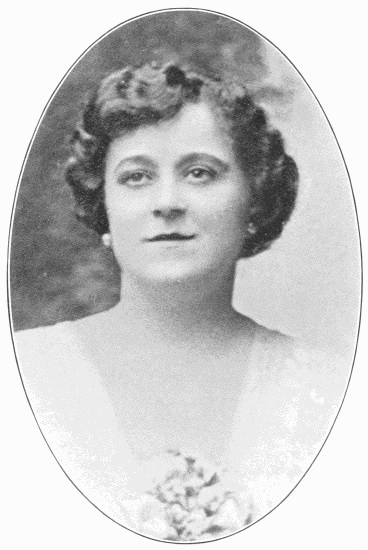
FRIEDA HEMPEL
Biographical
Frieda Hempel was born at Leipzig, June 26, 1885. She studied piano for a considerable time at the Leipzig Conservatory and the Stern Conservatory. Later she studied singing with Mme. Nicklass Kempner, to whom she is indebted for her entire vocal education up to the time of her début in opera. Her first appearance was in the Merry Wives of Windsor, at the Royal Opera in Berlin. After many very successful appearances in leading European Opera Houses she was engaged for the Metropolitan Opera House in New York where she immediately became very popular in stellar rôles. Her repertoire runs from the Marriage of Figaro to Die Meistersinger. Her voice is a clear, pure, sweet soprano; and, like Mme. Sembrich and Mme. Galli-Curci, she clearly shows the value of her instrumental training in the accuracy, precision and clarity of her coloratura work. She has made many successful concert tours of the United States. In addition to being a brilliant singer she is an excellent actress. She is now an American citizen and the wife of an American business man.
THOROUGHNESS IN VOCAL PREPARATION
MME. FRIEDA HEMPEL
Why Some Succeed and Some Fail
In every thousand girls who aspire to Grand Opera probably not more than one ever succeeds. This is by no means because of lack of good voices. There are great numbers of good voices; although many girls who want to be opera singers either deceive themselves or are deceived by others (often charlatan teachers) into believing that they have fine natural voices when they have not. There is nothing more glorious than a beautiful human voice—a voice strong, resonant, if necessary, but velvety and luscious if needs be. There are many girls with really beautiful natural voices who have lost their chances in Grand Opera largely because they have either not had the personal persistence necessary to carry them to the point where their services are in demand by the public or they have had the misfortune not to have the right kind of a vocal or musical drill master—a really good teacher.
Teachers in these days waste a fearful amount of time in what they consider to be their methods. They tell you to sing in the back, or on the side or through the mask or what not, instead of getting right down to the real work. My teacher in Berlin, at the Conservatory, insisted first of all upon having me sing tones and scales—mostly long sustained tones—for at least one entire year. These were sung very softly, very evenly, until I could employ every tone in my voice with sureness and certainty. I don't see how it could possibly have been accomplished in less time. Try that on the American girl and she will think that she is being cheated out of something. Why should she wait a whole year with silly tones when she knows that she can sing a great aria with only a little more difficulty?
The basis of all fine singing, whether in the opera house or on the concert stage, is a good legato. My teacher (Nicklass Kempner) was very insistent upon this. In working with such studies as those of Concone, Bordogni, Lütgen, Marchesi or Garcia—the best part of the attention of the teacher was given to the simple yet difficult matter of a beautiful legato. After one has been through a mass of such material, the matter of legato singing becomes more or less automatic. The tendency to slide from one tone to another is done away with. The connection between one tone and another in good legato is so clean, so free from blurs that there is nothing to compare it with. One tone takes the place of another just as though one coin or disk were placed directly on top of another without any of the edges showing. The change is instantaneous and imperceptible. If one were to gradually slide one coin over another coin you would have a graphic illustration of what most people think is legato. The result is that they sound like steam sirens, never quite definitely upon any tone of the scale.
A Good Legato
A good legato can only be acquired after an enormous amount of thorough training. The tendency to be careless is human. Habits of carefulness come only after much drill. The object of the student and the teacher should be to make a singer—not to acquire a scanty repertoire of a few arias. Very few of the operas I now sing were learned in my student days. That was not the object of my teacher. The object was to prepare me to take up anything from Martha to Rosenkavalier and know how to study it myself in the quickest and most thorough manner. Woe be to the pupil of the teacher who spends most of the time in teaching songs, arias, etc., before the pupil is really ready to study such things.
Good Foundations
Everything is in a good foundation. If you expect a building to last only a few weeks you might put up a foundation in a day or so—but if you watch the builders of the great edifices here in American cities you will find that more time is often spent upon the foundation than upon the building itself. They dig right down to the bed rock and pile on so much stone, concrete and steel that even great earthquakes are often withstood.
A Large Repertoire
With such a thorough foundation as I had it has not been difficult to acquire a repertoire of some seventy-five operas. That is, by learning one at a time and working continually over a number of years the operas come easily. In learning a new work I first read the work through as a whole several times to get the character well fixed in my mind. Then I play the music through several times until I am very familiar with it. Then I learn the voice part, never studying it as a voice part by itself, but always in relation to the orchestra and the other rôles. Finally, I learn the interpretation—the dramatic presentation. One gets so little help from the orchestra in modern works that many rehearsals are necessary. In some passages it is just like walking in a dark night. Only a true ear and thorough training can serve to keep one on the key or anywhere near the key. It is therefore highly necessary that vocal students should have a good musical training in addition to the vocal training. In most European conservatories the study of piano and harmony are compulsory for all vocal students. Not to have had this musical training that the study of the piano brings about, not to have had a good course in theory or in training for sight-singing (ear training) is to leave out important pillars in a thorough musical foundation.
More Opera for America
It would be a great gratification for all who are interested in opera to see more fine opera houses erected in America with more opportunities for the people. The performances at the Metropolitan are exceedingly fine, but only a comparatively few people can possibly hear them and there is little opportunity for the performance of a wide variety of operas. The opera singer naturally gets tired of singing a few rôles over and over again. The American people should develop a taste for more and more different operas. There is such a wonderful field that it should not be confined to the performance of a very few works that happen to be in fashion. This is not at all the case in Europe—there the repertoires are very much more extensive—more interesting for the public and the artists alike.
Strong Educational Value of Opera
Opera has always seemed to me a very necessary thing in the State. It has a strong educational value in that it develops the musical taste of the public as well as teaching lessons in history and the humanities in a very forceful manner. Children should be taken to opera as a regular part of their education. Opera makes a wonderful impression upon the child's imagination—the romance, the color, the music, the action are rarely forgotten. Many of the operas are beautiful big fairy stories and the little folks glory in them. Parents who desire to develop the taste of their children and at the same time stimulate their minds along broader lines can do no better than to take them to opera. Little towns in Europe often have fine opera houses, while many American cities several times their size have to put up with moving picture theatre houses. Why does not some enthusiastic American leader take up a campaign for more opera in America? With the taste of the public educated through countless talking machine records, it should not prove a bad business venture if it is gone about in a sensible manner.
DAME NELLIE MELBA
Biographical
Dame Nellie Melba (stage name for Mrs. Nellie Porter Armstrong, née Mitchell) is described in Grove's Dictionary as "the first singer of British birth to attain such an exalted position upon the lyric stage as well as upon the concert platform." Dame Melba was born at Burnley near Melbourne, May 19, 1861, of Scotch ancestry. She sang at the Town Hall at Richmond when she was six years of age. She studied piano, harmony, composition and violin very thoroughly. At one time she was considered the finest amateur pianist in Melbourne. She also played the church organ in the local church with much success. In 1882 she married Captain Charles Armstrong, son of Sir Andrew Armstrong, Baronet (of Kings County, Ireland). In 1886 she sang at Queens Hall in London. After studying with Mme. Marchesi for twelve months she made her début as Gilda (Rigoletto) at the Théâtre de la Monnaie in Brussels. Her success was instantaneous. Her London début was made in Lucia in 1888. One year later she made her Parisian début in Thomas' Hamlet. In 1894 she created the rôle of Nedda in I Pagliacci. Petrograd "went wild" over her in 1892. In 1892 she repeated her successes and in 1893 she began her long series of American triumphs. The fact that her voice, like that of Patti, has remained astonishingly fresh and silvery despite the enormous amount of singing she has done attests better than anything else to the excellence of her method of singing. In the following conference she gives the secret of preserving the voice.