GREAT SINGERS ON THE ART of SINGING (continued 2)
Reading edition
I trust that I have not by this time given the reader of this page the impression that teachers are unnecessary. This is by no means the case. A good teacher is extremely desirable. If you have the good fortune to fall into the hands of a careful, experienced, intelligent teacher, much may be accomplished; but the teacher is by no means all that is required. The teacher should be judged by his pupils, and by nothing else. No matter what he may claim, it is invariably the results of his work (the pupil's) which must determine his value. Teachers come to me with wonderful theories and all imaginable kinds of methods. I always say to them: "Show me a good pupil who has been trained by your methods and I will say that you are a good teacher."
Before our national elections I am asked, "Which one of the candidates do you believe will make the best President?" I always reply, "Wait four years and I will pass my opinion upon the ability of the candidate the people select." In other words, "the proof of the pudding is in the eating."
Singers Not Born, But Made
We often hear the trite expression, "Singers are born, not made." This, to my mind, is by no means the case. One may be born with the talent and deep love for music, and one may be born with the physical qualifications which lead to the development of a beautiful voice, but the singer is something far more than this. Given a good voice and the love for his music, the singer's work is only begun. He is at the outstart of a road which is beset with all imaginable kinds of obstacles. In my own case I was extremely ambitious to be a singer. Night after night I played 'cello in the orchestra at La Scala, in Milan, always wishing and praying that I might some day be one of the actors in the wonderful world behind the footlights. I listened to the famous singers in the great opera house with the minutest attention, making mental notes of their manner of placing their voices—their method of interpretation, their stage business, and everything that I thought might be of any possible use to me in the career of the singer, which was dearest to my heart. I endeavored to employ all the common sense and good judgment I possessed to determine what was musically and vocally good or otherwise. I was fortunate in having the training of the musician, and also in having the invaluable advantage of becoming acquainted with the orchestral scores of the famous operas. Finally the long-awaited opportunity came and I made my début at the Teatro dal Verme, in Milan. I had had no real vocal instruction in the commonly accepted sense of the term; but I had really had a kind of instruction that was of inestimable value.
Not Given To All To Study Successfully Without A Teacher
Success brought with it its disadvantages. I foolishly strained my voice through overwork. But this did not discourage me. I realized that many of the greatest singers the world has ever known were among those who had met with disastrous failure at some time in their careers. I came to America and played the violoncello in the Boston Symphony Orchestra. All the time I was practicing with the greatest care and with the sole object of restoring my voice. Finally it came back better than ever and I sang for Maurice Grau, the impresario of the Metropolitan Opera House, in New York. He engaged me and I sang continuously at the Metropolitan for several years. Notwithstanding this varied experience, I will seek to learn, and to learn by practical example, not theory. The only opera school in the world is the opera house itself. No school ever "made" a great singer or a great artist. The most they have done has been to lay the foundation. The making of the artist comes later.
In order to do without instruction one must be very peculiarly constituted. One must be possessed of the pedagogical faculty to a marked degree. One must have within oneself those qualities for observing and detecting the right means leading to an artistic end which every good teacher possesses. In other words, one must be both teacher and pupil. This is a rare combination, since the power to teach, to impart instruction, is one that is given to very few. It is far better to study alone or not at all than with a poor teacher. The teacher's responsibility, particularly in the case of vocal students, is very great. So very much depends upon it. A poor teacher can do incalculable damage. By poor teachers I refer particularly to those who are carried away by idiotic theories and quack methods. We learn to sing by singing and not by carrying bricks upon our chest or other idiotic antics. Consequently I say that it is better to go all through life with a natural or "green" voice than to undergo the vocal torture that is sometimes palmed off upon the public as voice teaching. At best, all the greatest living teacher can do is to put the artist upon the right track and this in itself is responsibility enough for one man or one woman to assume.
Singers Make Their Own Methods
As I have already said, most every singer makes a method unto himself. It is all the same in the end. The Chinese may, for instance, have one name for God, the Persians another, the Mohammedans another, and the people of Christian lands another. But the God principle and the worship principle are the same with all. It is very similar in singing. The means that apply to my own case may apparently be different from those of another, but we are all seeking to produce beautiful tones and interpret the meaning of the composer properly.
One thing, however, the student should seek to possess above all things, and this is a thorough foundation training in music itself. This can not begin too early. In my own home we have always had music. My children have always heard singing and playing and consequently they become critical at a very early age.
I can not help repeating my advice to students who hope to find a vocal education in books or by the even more ridiculous correspondence method. Books may set one's mental machinery in motion and incite one to observe singers more closely, but teach they can not and never can. The sound-reproducing machines are of assistance in helping the student to understand the breathing, phrasing, etc., but there is nothing really to take the place of the living singer who can illustrate with his voice the niceties of placing and timbre.
My advice to the voice students of America is to hear great singers. Hear them as many times as possible and consider the money invested as well placed as any you might spend in vocal instruction. The golden magnet, as well as the opportunities in other ways offered artists in America, has attracted the greatest singers of our time to this country. It is no longer necessary to go abroad to listen to great singers. In no country of the world is opera given with more lavish expenditure of money than in America. The great singers are now by no means confining their efforts to the large Eastern cities. Many of them make regular tours of the country, and students in all parts of this land are offered splendid opportunities for self-help through the means of concerts and musical festivals. After all, the most important thing for any singer is the development of the critical sense. Blind imitation is, of course, bad, but how is the student to progress unless he has had an opportunity to hear the best singers of the day? In my youth I heard continually such artists as La Salle, Gayarre, Patti, De Reszke and others. How could I help profiting by such excellent experiences?
Great Voices are Rare
One may be sure that in these days few, if any, great voices go undiscovered. A remarkable natural voice is so rare that some one is sure to notice it and bring it to the attention of musicians. The trouble is that so many people are so painfully deluded regarding their voices. I have had them come to me with voices that are obviously execrable and still remain unconvinced when I have told them what seemed to me the truth. This business of hearing would-be singers is an unprofitable and an uncomfortable one; and most artists try to avoid the ordeal, although they are always very glad to encourage real talent. Most young singers, however, have little more than the bare ambition to sing, coupled with what can only be described by the American term, "a swelled head." Someone has told them that they are wonderfully gifted, and persons of this kind are most always ready to swallow flattery indiscriminately. Almost everyone, apparently, wants to go into opera nowadays. To singers who have not any chance whatever I have only to say that the sooner this is discovered the better. Far better put your money in bank and let compound interest do what your voice can not.
ENRICO CARUSO
Biographical
Enrico Caruso was born at Naples, February 25th, 1873. His fondness for music dates from his earliest childhood; and he spent much of his spare money in attending the opera at San Carlo and hearing the foremost singers of his time in many of the rôles in which he appeared later on. His actual study, however, did not start until he was eighteen, when he came under the tuition of Guglielmo Vergine. In 1895 he made his début at the Teatro Cimarosa in Caserta. His first appearances drew comparatively little attention to his work and his future greatness was hardly suspected by many of those who heard him. However, by dint of long application to his art he gained more and more recognition. In 1902 he made his début in London. The following year he came to New York, where the world's greatest singers had found an El Dorado for nearly a quarter of a century. There he was at once proclaimed the greatest of all tenors and from that time his success was undeviating. Indeed his voice was so wonderful and so individual that it is difficult to compare him with any of his great predecessors; Tamagno, Campanini, de Reszke and others. In Europe and in America he was welcomed with acclaim and the records of his voice are to be found in thousands of homes of music lovers who have never come in touch with him in any other way. Signor Caruso had a remarkable talent for drawing and for sculpture. His death, August 2d, 1921, ended the career of the greatest male singer of history.
Enrico Caruso.
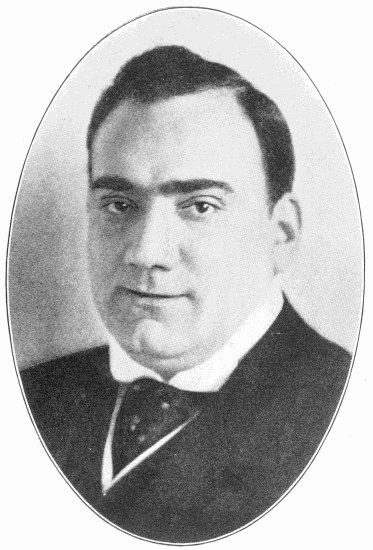
ITALY, THE HOME OF SONG
ENRICO CARUSO
Opera and the Public in Italy
Anyone who has traveled in Italy must have noticed the interest that is manifested at the opening of the opera season. This does not apply only to the people with means and advanced culture but also to what might be called the general public. In addition to the upper classes, the same class of people in America who would show the wildest enthusiasm over your popular sport, base-ball, would be similarly eager to attend the leading operatic performances in Italy. The opening of the opera is accompanied by an indescribable fervor. It is "in the air." The whole community seems to breathe opera. The children know the leading melodies, and often discuss the features of the performances as they hear their parents tell about them, just as the American small boy retails his father's opinions upon the political struggles of the day or upon the last ball game.
It should not be thought that this does not mean a sacrifice to the masses, for opera is, in a sense, more expensive in Italy than in America; that is, it is more expensive by comparison in most parts of the country. It should be remembered that monetary values in Italy are entirely different from those in America. The average Italian of moderate means looks upon a lira as a coin far more valuable than its equivalent of twenty cents in United States currency. His income is likely to be limited, and he must spend it with care and wisdom. Again, in the great operatic centers, such as Milan, Naples or Rome, the prices are invariably adjusted to the importance of the production. In first-class productions the prices are often very high from the Italian standpoint. For instance, at La Scala in Milan, when an exceptionally fine performance is given with really great singers, the prices for orchestra chairs may run as high as thirty lira or six dollars a seat. Even to the wealthy Italian this amount seems the same as a much larger amount in America.
To give opera in Italy with the same spectacular effects, the same casts composed almost exclusively of very renowned artists, the same mise en scene, etc., would require a price of admission really higher than in America. As a matter of fact, there is no place in the world where such a great number of performances, with so many world-renowned singers, are given as at the Metropolitan Opera House in New York. There is no necessity for any one to make a special trip to Europe to hear excellent performances in these days. Of course such a trip would be interesting, as the performances given in many European centers are wonderfully fine, and they would be interesting to hear if only from the standpoint of comparing them with those given at the Metropolitan. However, the most eminent singers of the world come here constantly, and the performances are directed by the ablest men obtainable, and I am at loss to see why America should not be extremely proud of her operatic advantages. In addition to this the public manifests a most intelligent appreciation of the best in music. It is very agreeable to sing in America, as one is sure that when he does well the public will respond at once.
Italian, the Language of Music
Perhaps the fact that in Italy the audiences may understand the performances better because of their knowledge of their native language may add to the pleasure of opera-going. This, however, is a question, except in the case of some of the more modern works. The older opera librettos left much to be desired from the dramatic and poetic standpoints. Italian after all is the language of music. In fact it is music in itself when properly spoken. Note that I say "when properly spoken." American girls go to Italy to study, and of course desire to acquire a knowledge of the language itself, for they have heard that it is beneficial in singing. They get a mere smattering, and do not make any attempt to secure a perfect accent. The result is about as funny as the efforts of the comedians who imitate German emigrants on the American stage.
If you start the study of Italian, persist until you have really mastered the language. In doing this your ear will get such a drill and such a series of exercises as it has never had before. You will have to listen to the vowel sounds as you have never listened. This is necessary because in order to understand the grammar of the language you must hear the final vowel in each word and you must hear the consonants distinctly.
There is another peculiar thing about Italian. If the student who has always studied and sung in English, German or French or Russian, attempts to sing in Italian, he is really turning a brilliant searchlight upon his own vocal ability. If he has any faults which have been concealed in his singing in his own language, they will be discovered at once the moment he commences to study in Italian. I do not know whether this is because the Italian of culture has a higher standard of diction in the enunciation of the vowel sounds, or whether the sounds themselves are so pure and smooth that they expose the deficiencies, but it is nevertheless the case. The American girl who studies Italian for six months and then hopes to sing in that language in a manner not likely to disturb the sense of the ridiculous is deceiving herself. It takes years to acquire fluency in a language.
Audiences the Same the World Around
Audiences are as sensitive as individuals. Italy is known as "the home of the opera"; but I find that, as far as manifesting enthusiasm goes, the world is getting pretty much the same. If the public is pleased, it applauds no matter whether it be in Vienna, Paris, Rome, Buenos Aires, New York, or Oshkosh. An artist feels his bond with his audience very quickly. He knows whether his auditors are delighted, whether they are merely interested or whether they are indifferent a few seconds after he has been upon the stage. I can judge my own work at once by the attitude of the audience. No artist sings exactly alike on two successive nights. That would be impossible. Although every sincere artist tries to do his best at all times, there are, nevertheless, occasions when one sings better than at others. If I sing particularly well the audience is particularly enthusiastic; if I am not feeling well and my singing indicates it, the audience will let me know at once by not being quite so enthusiastic. It is a barometer which is almost unfailing. This is also an important thing for the young singer to consider. Audiences judge by real worth and not by reputation.
Reputation may attract money to the box office, but once the people are inside the opera house the artist must really please them or suffer. Young singers should not be led to think that anything but real worth is of any lasting value. If the audience does not respond, do not blame the audience. It would respond if you could sing so beautifully that you could compel a response that you know should follow real artistic achievement. Don't blame your teacher or your lack of practice or anything or anybody but yourself. The verdict of the audience is better than the examination of a hundred so-called experts. There is something about an audience that makes it seem like a great human individual, whether in Naples or in San Francisco. If you touch the heart or please the sense of beauty, the appetite for lovely music—common to all mankind—the audience is yours, be it Italian, French, German or American.
Operatic Preparation in Italy
The American student with a really good voice and a really fine vocal and musical training, would have more opportunities for engagements in the smaller Italian opera houses, for the simple reason that there are more of these opera houses and more of these opera companies. Bear in mind, however, that opera in Italy depends to a large extent upon the standing of the artists engaged to put on the opera. In some cities of the smaller size the municipality makes an appropriation, which serves as a guarantee or subsidy. An impresario is informed what operas the community desires and what singers. He tries to comply with the demand. Often the city is very small and the demand very slightly indicated in real money. As a result the performances are comparatively mediocre. The American student sometimes fails to secure engagements with the big companies and tries to gain experience in these small companies. Sometimes he succeeds, but he should remember before undertaking this work that many native Italian singers with realty fine voices are looking for similar opportunities and that only a very few stand any chance of reaching really noteworthy success.
Opera Will Always Be Expensive
He should, of course, endeavor to seek engagements with the big companies if his voice and ability will warrant it. Where the most money is, there will be the salaried artists and the finest operatic spectacle. That is axiomatic. Opera is expensive and will always be expensive. The supply of unusual voices has always been limited and the services of their possessors have always commanded a high reward. This is based upon an economic law which applies to all things in life. The young singer should realize that, unless he can rise to the very top of his profession, he will be compelled to enlist in a veritable army of singers with little talent and less opportunity.
One thing exists in Italy which is very greatly missed in America. Even in small companies in Italy a great deal of time is spent in rehearsals. In America rehearsals are tremendously expensive and sometimes first performances have suffered thereby. In fact, I doubt whether the public realizes what a very expensive thing opera is. The public has little opportunity to look behind the scenes. It sees only the finished performance, which runs smoothly only when a tremendous amount of mental, physical and financial oil has been poured upon the machinery. I often hear men say here in New York, "I had to pay fifty dollars for my seat to-night." That is absurd—the money is going to speculators instead of into the rightful channels. This money is simply lost as far as doing any service whatever to art is concerned. It does not go into the opera house treasury to make for better performances, but simply into the hands of some fellow who had been clever enough to deprive the public of its just opportunity to purchase seats. The public seems to have money enough to pay an outrageous amount for seats when necessary. Would it not be better to do away with the speculator at the door and pay say $10.00 for a seat that now costs $7.00? This would mean more rehearsals and better opera and no money donated to the undeserving horde at the portals of the temple.
The Student's Preparation
I am told that many people in America have the impression that my vocal ability is kind of a "God-given" gift; that is, something that has come to me without effort. This is so very absurd that I can hardly believe that sensible people would give it a moment's credence. Every voice is in a sense the result of a development, and this is particularly so in my own case. The marble that comes from the quarries of Carrara may be very beautiful and white and flawless, but it does not shape itself into a work of art without the hand, the heart, and the intellect of the sculptor.
Just to show how utterly ridiculous this popular opinion really is, let me cite the fact that at the age of fifteen everybody who heard me sing pronounced me a bass. When I went to Vergine I studied hard for four years. During the first three years the work was for the most part moulding and shaping the voice. Then I studied repertoire for one year and made my début. Even with the experience I had had at that time it was unreasonable to expect great success at once. I kept working hard and worked for at least seven years more before any really mentionable success came to me. All the time I had one thing on my mind and that was never to let a day pass without seeing some improvement in my voice. The discouragements were frequent and bitter; but I kept on working and waiting until my long awaited opportunities came in London and in New York. The great thing is, not to stop. Do not think that, because these great cities gave me a flattering reception, my work ceased. Quite on the contrary, I kept on working and am working still. Every time I go upon the stage I am endeavoring to discover something that will make my art more worthy of public acceptance. Every act of each opera is a new lesson.
Different Rôles
It is difficult to invest a rôle with individuality. I have no favorite rôles. I have avoided this, because the moment one adopts a favorite rôle he becomes a specialist and ceases to be an artist. The artist does all rôles equally well. I have had the unique experience of creating many rôles in operas such as Fedora, Adrienne, Germania, Girl of the Golden West, Maschera. This is a splendid experience, as it always taxes the inventive faculties of the singing actor. This is particularly the case in the Italian opera of the newer composers, or rather the composers who have worked in Italy since the reformation of Wagner. Whatever may be said, the greatest influence in modern Italian opera is Wagner. Even the great Verdi was induced to change his methods in Aïda, Otello, and Falstaff—all representing a much higher art than his earlier operas. However, Wagner did nothing to rob Italy of its natural gift of melody, even though he did institute a reform. He also did not influence such modern composers as Puccini, Mascagni, and Leoncavallo to the extent of marring their native originality and fertility.
Mme. Julia Claussen.
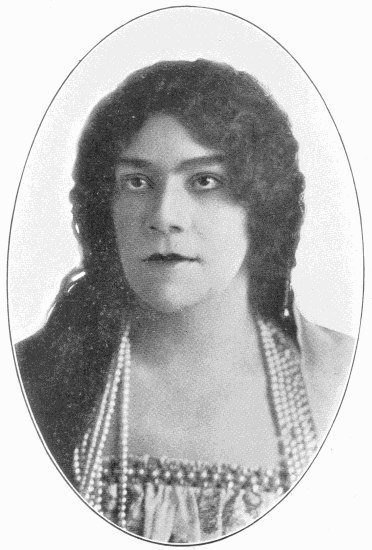
MME. JULIA CLAUSSEN
Biographical
Mme. Julia Claussen was born at Stockholm, Sweden, the land of Jenny Lind and Nilsson. Her voice is a rich, flexible mezzo-soprano, with a range that has enabled her to assume some contralto rôles with more success than the average so-called contralto. In her childhood she studied piano, but did not undertake the serious study of voice until she was eighteen, when she became a student at the Royal Academy of Music, under Professor Lejdstrom (studying harmony and theory under the famous Swedish composer Sjogren). Her début was made at the Royal Opera, at the age of twenty-two, in La Favorita, singing the rôle in Swedish. Later she went to Berlin, where she was coached in German opera by Professor Friedrich at the Royal High School of Music. Her American début was made in 1912, in Chicago, where she made an immediate success in such rôles as Ortrud, Brünnhilde and Carmen. She was then engaged at Covent Garden and later sang at the Champs Elysée Theatre, under Nikisch, in Paris. For two years she appeared at the Metropolitan. She has received the rare distinction of being awarded the Jenny Lind Medal from her own government and also of being admitted to the Royal Academy of Sweden, the youngest member ever elected to that august scientific and artistic body. She has also been decorated by King Gustavus V of Sweden with Literis et Artibus. In America she has made an immense success as a concert singer.
MODERN ROADS TO VOCAL SUCCESS
MME. JULIA CLAUSSEN
Why Sweden Produces So Many Singers
The question, "Why does Sweden produce so many singers?" is often asked me. First it is a matter of climate, then a matter of physique, and lastly, because the Swedish children do far more singing than any one finds in many other countries. The air in Sweden is very rarefied, clear and exhilarating. Owing to frugal living and abundant systematic exercise, the people become very robust. This is not a matter of one generation or so, but goes back for centuries. The Swedes are a strong, energetic, thorough race; and the same attributes of industry and precision which have made them famous in science are applied to the study of music.
The Swedish child is made to understand that singing is a needful, serious part of his life. His musical training begins very early in the schools, with a definite scheme. All schools have competent, experienced teachers of singing. In my childhood another factor played a very important part. There was never the endless round of attractions, toys, parties, theatres and pastimes (to say nothing of the all-consuming movies). Life was more tranquil and therefore the pursuit of good music was far more enjoyable. American life moves at aeroplane speed. The poor little children hardly have time to breathe, let alone time to study music. Ragtime is the musical symptom of this American craving for speed and incessant excitement. In a blare and confusion of noises, like bedlam broken loose, what chance has a child to develop good taste? It is admittedly fascinating at times; but is without rhyme, reason or order. I never permit my children to pollute my piano with it. They may have it on the talking machine, but they must not be accomplices in making it.
Of course, things have changed in Sweden, too; and American ragtime, always contagious, has now infected all Europe. This makes the music teacher's task in this day far more difficult than formerly. I hear my daughters practicing, and now and then they seem to be putting a dash of ragtime into Bach. If I stop them I find that "Bach is too slow, I don't like Bach!" This is almost like saying, "I don't like Rubens, Van Dyke or Millet; please, teacher, give me Mutt and Jeff or the Katzenjammer Kids!" American children need to be constantly taught to reverence the great creators of the land. Why, Jenny Lind is looked upon as a great national heroine in Sweden, much as one might regard George Washington in America. Before America can go about musical educational work properly, the teachers must inculcate this spirit, a proper appreciation of what is really beautiful, instead of a kind of wild, mob-like orgy of blare, bang, smash and shriek which so many have come to know as ragtime and jazz.
Self-Criticism
If one should ask me what is the first consideration in becoming a success as a singer, I should say the ability to criticise one's self. In my own case I had a very competent musician as a teacher. He told me that my voice was naturally placed and did very little to help place it according to his own ideas. Perhaps that was well for me, because I knew myself what I was about. He used to say, "That sounds beautiful," but all the time I knew that it sounded terrible. It was then that I learned that my ear must be my best teacher. My teacher, for instance, told me that I would never be able to trill. This was very disheartening; but he really believed, according to his conservative knowledge, that I should never succeed in getting the necessary flexibility.
By chance I happened to meet a celebrated Swedish singer, Mme. Östberg, of the old school. I communicated to her the discouraging news that I could never hope to trill. "Nonsense, my dear," she said, "someone told me that too, but I determined that I was going to learn. I did not know how to go about it exactly, but I knew that with the proper patience and will-power I would succeed. Therefore I worked up to three o'clock one morning, and before I went to bed I was able to trill."
I decided to take Mme. Östberg's advice, and I practiced for several days until I knew that I could trill, and then I went back to my teacher and showed him what I could do. He had to admit it was a good trill, and he couldn't understand how I had so successfully disproved his theories by accomplishing it. It was then that I learned that the singer can do almost anything within the limits of the voice, if one will only work hard enough. Work is the great producer, and there is no substitute for it. Do not think that I am ungrateful to my teacher. He gave me a splendid musical drilling in all the standard solfeggios, in which he was most precise; and in later years I said to him, "I am not grateful to you for making my voice, but because you did not spoil it."
After having sung a great deal and thought introspectively a great deal about the voice, one naturally begins to form a kind of philosophy regarding it. Of course, breathing exercises are the basis of all good singing methods, but it seems to me that singing teachers ask many of their pupils to do many queer impractical things in breathing, things that "don't work" when the singer is obliged to stand up before a big audience and make everyone hear without straining.
If I were to teach a young girl right at this moment I would simply ask her to take a deep breath and note the expansion at the waist just above the diaphragm. Then I would ask her to say as many words as possible upon that breath, at the same time having the muscles adjacent to the diaphragm to support the breath; that is, to sustain it and not collapse or try to push it up. The trick is to get the most tone, not with the most breath but with the least breath, and especially the very least possible strain at the throat, which must be kept in a floating, gossamer-like condition all the time. I see girls, who have been to expensive teachers, doing all sorts of wonderful calisthenics with the diaphragm, things that God certainly did not intend us to do in learning to speak and to sing.
Any attempt to draw in the front walls of the abdomen or the intercostal muscles during singing must put a kind of pneumatic pressure upon the breath stream, which is sure to constrict the throat. Therefore, in my own singing, I note the opposite effect. That is, there is rather a sensation of expansion instead of contraction during the process of expiration. This soon becomes very comfortable, relieves the throat of strain, relieves the tones of breathiness or all idea of forcing. There is none of the ugly heaving of the chest or shoulders; the body is in repose, and the singer has a firm grip upon the tone in the right way. The muscles of the front wall of the abdomen and the muscles between the lower ribs become very strong and equal to any strain, while the throat is free.
In the emission of the actual tone itself I would advise the sensation of inhaling at first. The beginner should blow out the tone. Usually instead of having a lovely floating character, with the impression of control, the tone starts with being forced, and it always remains so. The singer oversings and has nothing in reserve. When I am singing I feel as though the farther away from the throat, the deeper down I can control the breath stream, the better and freer the tone becomes. Furthermore, I can sing the long, difficult Wagnerian rôles, with their tremendous demands upon the vocal organs, without the least sensation of fatigue. Some singers, after such performances, are "all in." No wonder they lose their voices when they should be in their prime.
For me the most difficult vowel is "ah." The throat then is most open and the breath stream most difficult to control properly. Therefore I make it a habit to begin my practice with "oo, oh, ah, ay, ee" in succession. I never start with sustained tones. This would give my throat time to stiffen. I employ quick, soft scales, always remembering the basic principle of breath control I have mentioned, and always as though inhaling. This is an example of what I mean. To avoid shrillness on the upper tone I take the highest note with oo and descend with oo.

The same thought applied to an arpeggio would be:
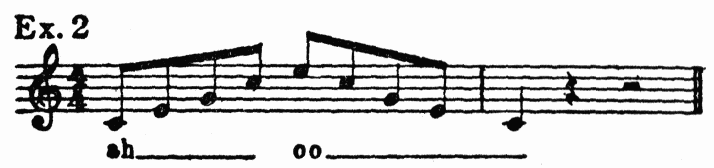
These I take within comfortable limits of my voice, always remembering that the least strain is a backward step. These exercises are taken through all possible keys. There can never be too much practice of a scale or arpeggio exercise. Many singers, I know, who wonder why they do not succeed, cannot do a good scale, the very first thing they should be able to do. Every one should be like perfect pearls on a thread.
America's Fatal Ambition
One of the great troubles in America is the irrepressible ambition of both teachers and pupils. Europe is also not untinged with this. Teachers want to show results. Some teachers, I am told, start in with songs at the first or second lesson, with the sad knowledge that if they do not do this they may lose the pupil to some teacher who will peddle out songs. After four or five months I was given an operatic aria; and, of course, I sang it. A year of scales, exercises and solfeggios would have been far more time-saving. The pupils have too much to say about their education in this way. The teacher should be competent and then decide all such questions. American girls do not want this. They expect to step from vocal ignorance to a repertoire over night. When you study voice, you should study not for two years, but realize you will never stop studying, if you wish to keep your voice. Like any others, without exercise, the singing muscles grow weak and inefficient. There are so many, many things to learn.
Of course, my whole training was that of the opera singer, and I was schooled principally in the Wagnerian rôles. With the coming of the war the prejudice against the greatest anti-imperialist (with the possible exception of Beethoven) which music ever has known—the immortal Wagner—became so strong that not until now has the demand for his operas become so great that they are being resumed with wonderful success. Therefore, with the exception of a few Italian and French rôles, my operatic repertoire went begging.
It was necessary for me to enter the concert field, as the management of the opera company with which I had contracts secured such engagements for me. It was like starting life anew. There is very little opportunity to show one's individuality in opera. One must play the rôle. Therefore I had to learn a repertoire of songs, every one of which required different treatment and different individuality. With eighteen members on the program, the singer has a musical, mental and vocal task which devolves entirely upon herself without the aid of chorus, co-singers, orchestra, costumes, scenery and the glamour of the footlights. It was with the greatest delight that I could fulfill the demands of the concert platform. American musical taste is very exacting. The audiences use their imagination all the time, and like romantic songs with an atmospheric background, which accounts for my great success with songs of such type as Lieurance's By the Waters of Minnetonka. One of the greatest tasks I ever have had is that of singing my rôles in many different languages. I learned some of them first in Swedish, then in Italian, then in French, then in German, then in English; as I am obliged to re-learn my Wagnerian rôles now.
The road to success in voice study, like the road to success in everything else, has one compass which should be a consistent guide, and that is common sense. Avoid extremes; hold fast to your ideals; have faith in your possibilities, and work! work!! work!!!
Charles Dalmores in Massenet's Herodiade. © Mishkin.
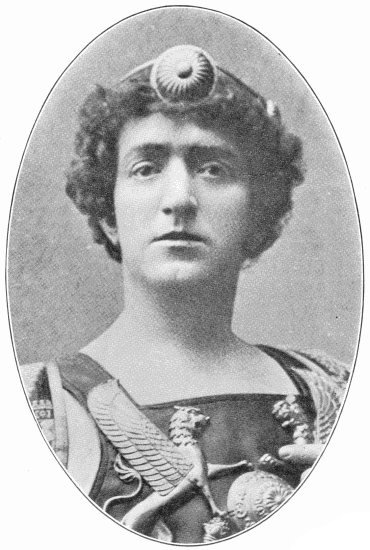
CHARLES DALMORES
Biographical
M. Charles Dalmores was born at Nancy, France, December 31st, 1871. His musical education was received at the Nancy Conservatoire under Professor Dauphin, and it was his intention to become a specialist in French horn. He also played the 'cello. When he applied to the Paris Conservatoire he was refused admission to the singing course because "he was too good a musician to waste his time with singing." He became professor of French horn at the Lyons Conservatory; but his love for opera led him to study by himself until he made his début at Rouen in 1899. He then sang at the Theatre de la Monnaie in Brussels, Covent Garden, Bayreuth, New York, and Chicago, with ever-increasing success. Dalmores is a dramatic tenor, and his musicianship has enabled him to take extremely difficult rôles of the modern type and achieve real artistic triumphs. He is one of the finest examples of the self-trained vocalist.
SELF-HELP IN VOICE STUDY
Charles Dalmores
It is always a pleasure to talk upon self-help and not self-study, because I believe most implicitly in the former and very much doubt the efficacy of the latter in actual voice study. The voice, of all things, demands the assistance of a good teacher, although in the end the results all come from within and not from without. That is, the voice is an organ of expression; and what we make of it depends upon our own thought a thousand times more than what we take in from the outside.
It is the teacher who stimulates the right kind of thinking who is the best teacher. The teacher who seeks to make his pupils parrots rarely meets with success. My whole career is an illustration of this, and when I think of the apparently insurmountable obstacles over which I have been compelled to climb I cannot help feeling that the relation of a few of my own experiences in the way of self-help could not fail to be beneficial.
At the Paris Conservatory
I was born at Nancy on the 31st of December, 1871. I gave evidences of having musical talent and my musical instruction commenced at the age of six years. I studied first at the Conservatory at Nancy, intending to make a specialty of the violin. Then I had the misfortune of breaking my arm. It was decided thereafter that I had better study the French horn. This I did with much success and attribute my control of the breath at this day very largely to my elementary struggles with that most difficult of instruments. At the age of fourteen I played the second horn at Nancy. Finally, I went, with a purse made up by some citizens of my home town, to enter the great Conservatory at Paris. There I studied very hard and succeeded in winning my goal in the way of receiving the first prize for playing the French horn.
For a time I played under Colonne, and between the ages of seventeen and twenty-three in Paris I played with the Lamoureaux Orchestra. All this time I had my heart set upon becoming a singer and paid particular attention to all of the wonderful orchestral works we rehearsed. The very mention of the fact that I desired to become a singer was met with huge ridicule by my friends, who evidently thought that it was a form of fanaticism. For a time I studied the 'cello and managed to acquire a very creditable technic upon that instrument.
A Discouraging Prospect
Notwithstanding the success I had with the two instruments, I was confronted with the fact that I had before me the life of a poor musician. My salary was low, and there were few, if any, opportunities to increase it outside of my regular work with the orchestra. I was told that I had great talent, but this never had the effect of swelling my pocketbook. In my military service I played in the band of an infantry regiment; and when I told my companions that I aspired to be a great singer some day they greeted my declaration with howls of laughter, and pointed out the fact that I was already along in years and had an established profession.
At the sedate age of twenty-three I was surprised to find myself appointed Professor of French Horn at the Conservatory of Lyons. Lyons is the second city of France from the standpoint of population. It is a busy manufacturing center, but is rich in architectural, natural and historical interest; and the position had its advantages, although it was away from the great French center, Paris. The opera at Nancy was exceedingly good, and I had an opportunity to go often. Singing and the opera were my life. My father had been manager at Nancy and I had made my first acquaintance with the stage as one of the boys in Carmen.
A Test That Failed
I have omitted to say that at Paris I tried to enter the classes for singing. My voice was apparently liked, but I was refused admission upon the basis that I was too good a musician to waste my time in becoming an inferior singer. Goodness gracious! Where is musicianship needed more than in the case of the singer? This amused me, and I resolved to bide my time. I played in opera orchestras whenever I had a chance, and thus became acquainted with the famous rôles. One eye was on the music and the other was on the stage. During the rests I dreamt of the time when I might become a singer like those over the footlights.
Where there is a will there is usually a way. I taught solfeggio as well as French horn in the Lyons Conservatory. I devised all sorts of "home-made" exercises to improve my voice as I thought best. Some may have done me good, others probably were injurious. I listened to singers and tried to get points from them. Gradually I was unconsciously paving the way for the great opportunity of my life. It came in the form of an experienced teacher, Dauphin, who had been a basso for ten years at the leading theatre of Belgium, fourteen years in London, and later director at Geneva and Lyons. He also received the appointment of Professor at the Lyons Conservatory.
A Famous Opportunity
One day Dauphin heard me singing and inquired who I was. Then he came in the room and said to me, "How much do you get here for teaching and playing?" I replied, proudly, "six thousand francs a year." He said, "You shall study with me and some day you shall earn as much as six thousand francs a month." Dauphin, bless his soul, was wrong. I now earn six thousand francs every night I sing instead of every month.
I could hardly believe that the opportunity I had waited for so long had come. Dauphin had me come to his house and there he told me that my success in singing would depend quite as much upon my own industry as upon his instruction. Thus one professor in the conservatory taught another in the art he had long sought to master. Notwithstanding Dauphin's confidence in me, all of the other professors thought that I was doing a perfectly insane thing, and did all in their power to prevent me from going to what they thought was my ruin.
Discouraging Advice
Nevertheless, I determined to show them that they were all mistaken. During the first winter I studied no less than six operas, at the same time taking various exercises to improve my voice. During the second winter I mastered one opera every month, and at the same time did all my regular work—studying in my spare hours. At the end of my course I passed the customary examination, receiving the least possible distinction from my colleagues who were still convinced that I was pursuing a course that would end in complete failure.
This brought home the truth that if I was to get ahead at all I would have to depend entirely upon myself. The outlook was certainly not propitious. Nevertheless I studied by myself incessantly and disregarded the remarks of my pessimistic advisers. I sang in a church and also in a big synagogue to keep up my income. All the time I had to put up with the sarcasm of my colleagues who seemed to think, like many others, that the calling of the singer was one demanding little musicianship, and tried to make me see that in giving up the French horn and my conservatory professorship I would be abandoning a dignified career for that of a species of musician who at that time was not supposed to demand any special musical training. Could not a shoemaker or a blacksmith take a few lessons and become a great singer? I, however, determined to become a different kind of a singer. I believed that there was a place for the singer with a thorough musical training, and while I kept up my vocal work amid the rain of irony and derogatory remarks from my mistaken colleagues, I did not fail to keep up my interest in the deeper musical studies. I had a feeling that the more good music I knew the better would be my work in opera. I wish that all singers could see this. Many singers live in a little world all of their own. They know the music of the footlights, but there their experience ends. Every symphony I have played has been molded into my life experience in such a way that it cannot help being reflected in my work.
A Critical Moment
Finally the time came for my début in 1899. It was a most serious occasion for me; for the rest of my career as a singer depended upon it. It was in Rouen, and my fee was to be fifteen hundred francs a month. I thought that that would make me the richest man in the world. It was the custom of the town for the captain of the police to come before the audience at the end and inquire whether the audience approved of the artist's singing or whether their vocal efforts were unsatisfactory. This was to be determined by a public demonstration. When the captain held up the sign "Approved," I felt as though the greatest moment in my life had arrived. I had worked so long and so hard for success and had been obliged to laugh down so much scorn that you can imagine my feelings. Suddenly a great volume of applause came from the house and I knew in a second what my future should be.
Then it was that I realized that I was only a little way along my journey. I wanted to be the foremost French tenor of my time. I knew that success in France alone, while gratifying, would be limited, so I set out to conquer new worlds. Wagner, up to that time, had never been sung by any French tenor, so I determined to master German and become a Wagner singer. This I did, and it fell to me to receive that most coveted of Wagnerian distinctions, "soloist at Beyreuth," the citadel of the highest in German operatic art. In after years I sang in all parts of Germany with as much success as in France. Later I went to London and then to America, where I sang for many seasons. It has been no small pleasure for me to return to Paris, where I once lived in penury, and to receive the highest fee ever paid to a French singer in the French capital.
The Need For Great Care
I don't know what more I can say upon the subject of self-help for the singer. I have simply told my own story and have related some of the obstacles that I have overcome. I trust that no one who has not a voice really worth while will be misled by what I have had to say. The voice is one of the most intricate and wonderful of the human organs. Properly exercised and cared for, it may be developed to a remarkable degree; but there are cases, of course, where there is not enough voice at the start to warrant the aspirant making the sacrifices that I have made to reach my goal. This is a very serious matter and one which should be determined by responsible judges. At the same time, the singers may see how possible it is for even experienced musicians, like my colleagues in Lyons, to be mistaken. If I had depended upon them and not fought my own way out, I would probably be an obscure teacher in the same old city earning the munificent salary of one hundred dollars a month.
Fighting Your Own Way
The student who has to fight his own way has a much harder battle of it; but he has a satisfaction which certainly does not come to the one who has all his instruction fees and living expenses paid for him. He feels that he has earned his success; and, by the processes of exploration through which the self-help student must invariably pass, he becomes invested with a confidence and "I know" feeling which is a great asset to him. The main thing is for him to keep busy all the time. He has not a minute to spare upon dreaming. He has no one to carry his burden but himself; and the exercise of carrying it himself is the thing which will do most to make him strong and successful.
The artists who leap into success are very rare. Hundreds who have held mediocre positions come to the front, while those who appear most favored stay in the background. Do not seek to gain eminence by any influence but that of real earnest work; and if you do not intend to work and to work hard, drop all of your aspirations for operatic laurels.
Andreas Dippel. © Dupont.
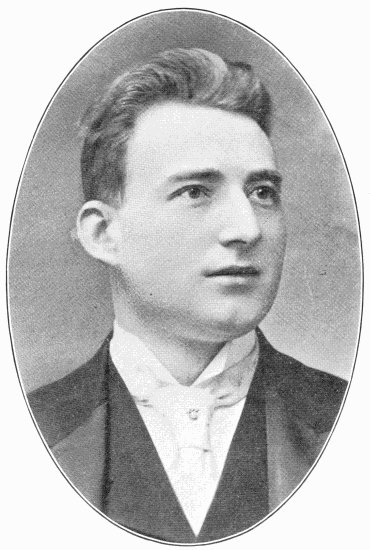
ANDREAS DIPPEL
Biographical
Andreas Dippel was born at Cassel, 1866. His father was a manufacturer who had the boy educated at the local gymnasium, with the view to making him a banker. After five years in a banking house he decided to become a singer and studied with Mme. Zottmayr. Later he went to Berlin, Milan and Vienna, where he studied with Julius Hey, Alberto Leoni and Johann Ress. In 1887 he made his début at Bremen, in The Flying Dutchman. He remained with that company until 1892. In the meantime, however, he had appeared at the Metropolitan in New York, with such success that he toured America as a concert singer with Anton Seidl, Arthur Nikisch, and Theodore Thomas. From 1893 to 1898 he was a member of the Imperial Court Opera at Vienna. In 1898 he returned to America to the Metropolitan. In 1908 he was appointed administrative manager of the Metropolitan Company, later becoming the manager of the Philadelphia-Chicago Opera Company. Mr. Dippel is a fine dramatic tenor with the enormous repertoire of 150 works in four different languages. He is a fine actor and has been equally successful in New York, London, and Beyreuth. He also has a repertoire of 60 oratorios.
IF MY DAUGHTER SHOULD STUDY FOR GRAND OPERA
ANDREAS DIPPEL
The training of the girl designed to become a great prima donna is one of the most complex problems imaginable. You ask me to consider the case of an imaginary daughter designed for the career in order to make my opinions seem more pertinent. Very well. If my daughter were studying for grand opera, and if she were a very little girl, I should first watch her very carefully to see whether she manifested any uncontrollable desire or ambition to become a great singer. Without such a desire she will never become great. Usually this ambition becomes evident at a very early age. Then I should realize that the mere desire to become a great singer is only an infinitesimal part of the actual requirements.
She must have, first of all, fine health, abundant vitality and an artistic temperament. She must show signs of being industrious. She should have the patience to wait until real results can be accomplished. In fact, there are so many attributes that it is difficult to enumerate them all. But they are all worth considering seriously. Why? Simply because, if they are not considered, she may be obliged to spend years of labor for which she will receive no return except the most bitter disappointment conceivable. Of the thousands of girls who study to become prima donnas only a very few can succeed, from the nature of things. The others either abandon their ambitions or assume lesser rôles from little parts down to the chorus.
You will notice that I have said but little about her voice. During her childhood there is very little means of judging of the voice. Some girls' voices that seem very promising when they are children turn out in a most disappointing manner. So you see I would be obliged to consider the other qualifications before I even thought of the voice. Of course, if the child showed no inclination for music or did not have the ability to "hold a tune," I should assume that she was one of those frequent freaks of nature which no amount of musical training can save.
Above all things I should not attempt to force her to take up a career against her own natural inclinations or gifts. The designing mother who desires to have her own ambitions realized in her daughter is the bane of every impresario. With a will power worthy of a Bismarck she maps out a career for the young lady and then attempts to force the child through what she believes to be the proper channels leading to operatic success. She realizes that great singers achieve fame and wealth and she longs to taste of these. It is this, rather than any particular love for her child, that prompts her to fight all obstacles. No amount of advice or persuasion can make her believe that her child cannot become another Tetrazzini, or Garden, or Schumann-Heink, if only the impresario will give her a chance. In nine cases out of ten Fate and Nature have a conspiracy to keep the particular young lady in the rôle of a stenographer or a dressmaker; and in the battle with Fate and Nature even the most ambitious mother must be defeated.
Her Very Early Training
Once determined that she stood a fair chance of success in the operatic field I should take the greatest possible care of her health, both physically and intellectually. Note that I lay particular stress upon her physical training. It is most important, as no one but the experienced singer can form any idea of what demands are made upon the endurance and strength of the opera singer.
Her general education should be conducted upon the most approved lines. Anything which will develop and expand the mind will be useful to her in later life. The later operatic rôles make far greater demands upon the mentality of the singer than those of other days. The singer is no longer a parrot with little or nothing to do but come before the footlights and sing a few beautiful tones to a few gesticulations. She is expected to act and to understand what she is acting. I would lay great stress upon history—the history of all nations—she should study the manners, the dress, the customs, the traditions, and the thought of different epochs. In order to be at home in Pelleas and Melisande, or Tristan und Isolde, or La Bohême she must have acquainted her mind with the historical conditions of the time indicated by the composer and librettist.
Her First Musical Training
Her first musical training should be musical. That is, she should be taught how to listen to beautiful music before she ever hears the word technic. She should be taught sight reading, and she ought to be able to read any melody as easily as she would read a book. The earlier this study is commenced with the really musical child, the better. Before it is of any real value to the singer her sight reading should become second nature. She should have lost all idea of the technic of the art and read with ease and naturalness. This is of immense assistance. Then she should study the piano thoroughly. The piano is the door to the music of the opera. The singer who is dependent upon some assistant to play over the piano scores is unfortunate. It is not really necessary for her to learn any of the other instruments; but she should be able to play readily and correctly. It will help her in learning scores, more than anything else. It will also open the door to much other beautiful music which will elevate her taste and ennoble her ideals.
She should go to the opera as frequently as possible in order that she may become acquainted with the great rôles intuitively. If she cannot attend the opera itself she can at least gain an idea of the great operatic music through the talking machines. The "repertory" of records is now very large, but of course does not include all of the music of all of the scenes.
She should be taught the musical traditions of the different historical musical epochs and the different so-called music schools. First she should study musical history itself and then become acquainted with the music of the different periods. The study of the violin is also an advantage in training the ear to listen for correct intonation; but the violin is by no means absolutely necessary.
Languages
All educators recognize the fact that languages are attained best in childhood. The child's power of mimicry is so wonderful that it acquires a foreign language quite without any suggestion of accent, in a time which will always put their elders to shame. Foreign children, who come to America before the age of ten, speak both then-native tongue and English with equal fluency.
The first new language to be taken up should be Italian. Properly spoken, there is no language so mellifluous as Italian. The beautiful quantitative value given to the vowels—the natural quest for euphony and the necessity for accurate pronunciation of the last syllable of a word in order to make the grammatical sense understandable—is a training for both the ear and the voice.
Italy is the land of song; and most of the conductors give their directions in Italian. Not only the usual musical terms, but also the other directions are denoted in Italian by the orchestral conductors; and if the singer does not understand she must suffer accordingly.
After the study of Italian I would recommend, in order, French and German. If my daughter were studying for opera, I should certainly leave nothing undone until she had mastered Italian, French, German and English. Although she would not have many opportunities to sing in English, under present operatic conditions, the English-speaking people in America, Great Britain, Canada, South Africa, and Australia are great patrons of musical art; and the artist must of course travel in some of these countries.
The Study of the Voice Itself
Her actual voice study should not commence before she is seventeen or eighteen years of age. In the hands of a very skilled and experienced teacher it might commence a little earlier; but it is better to wait until her health becomes more settled and her mature strength develops. At first the greatest care must be taken. The teacher has at best a delicate flower which a little neglect or a little over training may deform or even kill. I can not discuss methods, as that is not pertinent to this conference. There is no one absolutely right way; and many famous singers have traveled what seem quite different roads to reach the same end. However, it is a historic fact that few great singers have ever acquired voices which have had beautiful quality, perfect flexibility and reliability, who have not sung for some years in the old Italian style. Mind you, I am not referring to an old Italian school of singing here, but more to that class of music adopted by the old Italian composers—a style which permitted few vocal blemishes to go by unnoticed. Most of the great Wagnerian singers have been proficient in coloratura rôles before they undertook the more complicated parts of the great master at Beyreuth.
It is better to leave the study of repertoire until later years; that is, until the study of voice has been pursued for a sufficient time to insure regular progress in the study of repertoire. Personally, I am opposed to those methods which take the student directly to the study of repertoire without any previous vocal drill. The voice, to be valuable to the singer, must be able to stand the wear and tear of many seasons. It is often some years before the young singer is able to achieve real success and the profits come with the later years. A voice that is not carefully drilled and trained, so that the singer knows how to get the most out of it, with the least strain and the least expenditure of effort, will not stand the wear and tear of many years of opera life.
After all, the study of repertoire is the easiest thing. Getting the voice properly trained is the difficult thing. In the study of repertoire the singer often makes the mistake of leaping right into the more difficult rôles. She should start with the simpler rôles; such as those of some of the lesser parts in the old Italian operas. Then, she may essay the leading rôles of, let us say, Traviata, Barber of Seville, Norma, Faust, Romeo and Juliet, and Carmen.
Instead of simple rôles, she seems inclined to spend her time upon Isolde, Mimi, Elsa or Butterfly. It has become so, that now, when a new singer comes to me and wants to sing Tosca or some rôle that (sic) the so-called new or verissimo Italian school, I almost invariably refuse to listen. I ask them to sing something from Norma or Puritani or Dinorah or Lucia in which it is impossible for them to conceal their vocal faults. But no, they want to sing the big aria from the second act of Madama Butterfly, which is hardly to be called an aria at all but rather a collection of dramatic phrases. When they are done, I ask them to sing some of the opening phrases from the same rôle, and ere long they discover that they really have nothing which an impresario can purchase. They are without the voice and without the complete knowledge of the parts which they desire to sing.
Then they discover that the impresario knows that the tell-tale pieces are the old arias from old Italian operas. They reveal the voice in its entirety. If the breath control is not right, it becomes evident at once. If the quality is not right, it becomes as plain as the features of the young lady's face. There is no dramatic—emotional—curtain under which to hide these shortcomings. Consequently, knowing what I do, I would insist upon my daughter having a thorough training in the old Italian arias.
Her Training in Acting
Her training in acting would depend largely upon her natural talent. Some children are born actors—natural mimics. They act from their childhood right up to old age. They can learn more in five minutes than others can learn in years. Some seem to require little or no training in the art of acting. As a rule they become the most forceful acting singers. Others improve wonderfully under the direction of a clever teacher.
The new school of opera demands higher histrionic ability from the singer. In fact, we have come to a time when opera is a real drama set to music which is largely recitative and which does not distract from the action of the drama. The librettos of other days were, to say the least, ridiculous. If the music had not had a marvelous hold upon the people they could not have remained in popular favor. To my mind it is an indication of the wonderful power of music that these operas retain their favor. There is something about the melodies which seems to preserve them for all time; and the public is just as anxious to hear them to-day as it was twenty-five and fifty years ago.
Richard Wagner turned the tide of acting in opera by his music dramas. Gluck and von Weber had already made an effort in the right direction; but it remained for the mighty power of Wagner to accomplish the final work. Now we are witnessing the rise of a school of musical dramatic actors such as Garden, Maurel, Renaud, and others which promises to raise the public taste in this matter and which will add vastly to the pleasure of opera going, as it will make the illusion appear more real.
This also imposes upon the impresario a new contingency which threatens to make opera more and more expensive. Costumes, scenery and all the settings nowadays must be both historically authentic and costly. The collection of wigs, robes, and armor, together with a few sets of scenery, often with the chairs and other furniture actually painted on the scenes, which a few years ago were thought adequate for the equipment of an opera company, have now given way to equipment more elaborate than that of a Belasco or a Henry Irving. Nothing is left undone to make the picture real and beautiful. In fact operatic productions, as now given in America, are as complete and luxurious as any performances given anywhere in the world.
MME. EMMA EAMES
Biographical
Mme. Emma Eames was born at Shanghai, China. Her father, a graduate of Harvard Law School, had been a sea-captain and had been in business in the Chinese city. At the age of five she was brought back to the home of her parents at Bath, Maine. Her mother was an accomplished amateur singer who supervised her early musical training. At sixteen she went to Boston to study with Miss Munger. At nineteen she became a pupil of Marchesi in Paris and remained with the celebrated teacher for two years. At twenty-one she made her début at the Grand Opera in Paris in Romeo et Juliette. Two years later she appeared at Covent Garden, London, with such success that she was immediately engaged for the Metropolitan Opera House in New York. Few singers ever gained such a strong hold upon the American and English public. Her voice is a fine flexible soprano, capable of doing Marguerite or Elisabeth equally well. Her husband, Emilio de Gogorza, with whom it is our privilege to present a conference later in this book, is one of the foremost baritones of our time.
Mme. Emma Eames.
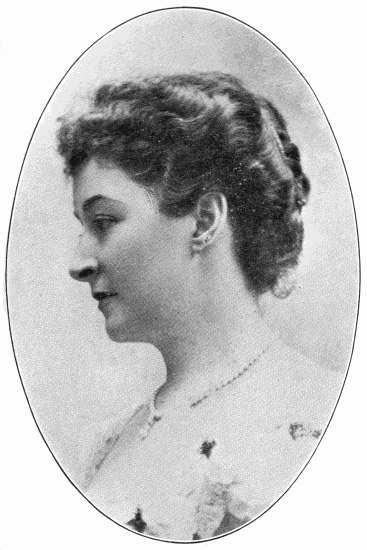
HOW A GREAT MASTER COACHED OPERA SINGERS
MME. EMMA EAMES
Gounod an Idealist
One does not need to review the works of Charles Gounod to any great extent before discovering that above all things he was an idealist. His whole aspect of life and art was that of a man imbued with a sense of the beautiful and a longing to actualize some noble art purpose. He was of an age of idealists. Coming at the artificial period of the Second Empire, he was influenced by that artistic atmosphere, as were such masters of the brush as Jean August Ingres and Eugène Delacroix. This, however, was unconscious, and in no way affected his perfect sincerity in all he did.
First Meeting with Gounod
I was taken to Gounod by my master, Mme. Mathilde Marchesi, who, perhaps, had some reason to regret her kindness in introducing me, since Gounod did not favor what he conceived as the Italian method of singing. He had a feeling that the Italian school, as he regarded it, was too obvious, and that French taste demanded more sincerity, more subtlety, better balance and a certain finesse which the purely vocal Italian style slightly obscured. Mme. Marchesi was very irate over Gounod's attitude, which she considered highly insulting; whereas, as a matter of fact, Gounod was doing the only thing that a man of his convictions could do, and that was to tell what he conceived as the truth.
Gounod's study was a room which fitted his character perfectly. His very pronounced religious tendencies were marked by the stained glass windows which cast a delicate golden tint over the little piano he occasionally used when composing. On one side was a pipe organ upon which he was very fond of playing. In fact, the whole atmosphere was that of a chapel, which, together with the beautiful and dignified appearance of the master himself, made an impression that one could not forget. His great sincerity, his lofty aims, his wonderful earnestness, his dramatic intensity, were apparent at once. Many composers are hopelessly disappointing in their appearance, but when one saw Gounod, it was easy to realize whence come the beautiful musical colors which make Romeo et Juliette, Faust and The Redemption so rich and individual. His whole artistic character is revealed in a splendid word of advice he gave to me when I first went to him: "Anyone who is called to any form of musical expression must reveal himself only in the language that God has given him to speak with. Find this language yourself and try, above all things, to be sincere—never singing down to your public."
Gounod had a wonderful power of compelling attention. While one was with him his personality was so great that it seemed to envelop you, obliterating everything else. This can be attributed not only to magnetism or hypnotism, but also to his own intense, all-burning interest in whatever he was engaged upon. Naturally the relationship of teacher and pupil is different from that of comradeship, but I was impressed that Gounod, even in moments of apparent repose, never seemed to lose that wonderful force which virtually consumed the entire attention of all those who were in his presence.
He had remarkable gifts in painting word-pictures. His imagination was so vigorous that he could make one feel that which he saw in his mind's eye as actually present. I attribute this to the fact that he himself was possessed by the subject at hand and spoke from the fountains of his deepest conviction. First he made you see and then he made you express. He taught one that to convince others one must first be convinced. Indeed, he allowed a great variety of interpretations in order that one might interpret through one's own power of conception rather than through following blindly his own.
During my lessons with Gounod he revealed not only his very pronounced histrionic ability, but also his charming talent as a singer. I had an accompanist who came with me to the lessons and when I was learning the various rôles, Gounod always sang the duets with me. Although he was well along in years, he had a small tenor voice, exquisitely sweet and sympathetic. He sang with delightful ease and with invariably perfect diction, and perfect vision. If some of our critics of musical performances were more familiar with the niceties of pronunciation and accentuation of different foreign languages, many of our present-day singers would be called upon to suffer some very severe criticisms. I speak of this because Gounod was most insistent upon correct pronunciation and accent, so that the full meaning of the words might be conveyed to every member of the audience.
A Hearing at the Opera
When I went to the opera for my hearing or audition, Gounod went with me and we sang the duets together. The director, M. Gailhard, refused my application, claiming that I was a debutante and could not expect an initial performance at the Grand Opéra despite my ability and musical attainments. It may be interesting for aspiring vocal students to learn something of the various obstacles which still stand in the way of a singer, even after one has had a very thorough training and acquired proficiency which should compel a hearing. Alas! in opera, as in many other lines of human endeavor, there is a political background that is often black with intrigue and machinations. I was determined to fight my way on the merit of my art, and accordingly I was obliged to wait for nearly two years before I was able to make my début. These were years filled with many exasperating circumstances.
I went to Brussels after two years' study with Marchesi, having been promised my début there. I was kept for months awaiting it and was finally prevented from making an appearance by one who, pretending to be my friend and to be doing all in her power to further my career, was in reality threatening the directors with instant breaking of her contract should I be allowed to appear. I had this on the authority of Mr. Gevaërt, the then director of the Conservatoire and my firm friend. The artist was a great success and her word was law. It was on my return that I was taken to Gounod and I waited a year for a hearing.
Gounod's opera, Romeo et Juliette, had been given at the Opéra Comique many times but there was a demand for performances at the Grand Opéra. Accordingly Gounod added a ballet, which fitted it for performance at the Opéra. Apropos of this ballet, Gounod said to me, with no little touch of cynicism, "Now you shall see what kind of music a Ga Ga can write" (Ga Ga is the French term for a very old man, that is, a man in his dotage). He was determined that I should be heard at the Grand Opera as Juliette, but even his influence could not prevent the director from signing an agreement with one he personally preferred, which required that she should have the honor of making her début at the Grand Opéra in the part. Then it was that I became aware that it was not only because I was a debutante that I had been denied. Gounod would not consent to this arrangement, insisting on her making her début previously in Faust, and fortunate it was, since the singer in question never attained more than mediocre success. Gounod still demanded as a compromise that the first six performances of the opera should be given to Adelina Patti, and that they should send for me for the subsequent ones.
In the meantime I was engaged at the Opéra Comique. There Massenet looked with disfavor upon my début before that of Sybil Sanderson. Massenet had brought fortunes to the Opéra Comique through his immensely popular and theatrically effective operas. Consequently his word was law. I waited for some months and no suggestion of an opportunity for a performance presented itself. All the time I was engaged in extending my repertoire and becoming more and more indignant at the treatment I was receiving in not being allowed to sing the operas thus acquired. My year's contract had still three months to run when I received an offer from St. Petersburg. Shortly thereafter I received a note from M. Gailhard announcing that he wished to see me. I went and he informed me that Gounod was still insistent upon my appearance in the rôle of Juliette. I was irritated by the whole long train of aggravating circumstances, but said, "Give me the contract, I'll sign it." Then I went directly to the Opéra Comique and asked to see the director. I was towering with indignation—indeed, I felt myself at least seven feet tall and perhaps quite as wide. I demanded my contract. To his "Mais, Mademoiselle—" I commanded, "Send for it." He brought the contract and tore it up in my presence, only to learn next morning to his probable chagrin that I was engaged and announced for an important rôle at the Grand Opéra. The first performance of a debutante at the Grand Opéra is a great ordeal, and it is easy to imagine that the strain upon a young singer might deprive her of her natural powers of expression. The outcome of mine was most fortuitous and with success behind me I found my road very different indeed. However, if I had not had a friend at court, in the splendid person of Charles Gounod, I might have been obliged to wait years longer, and perhaps never have had an opportunity to appear in Paris, where only a few foreigners in a generation get such a privilege. It is a great one, I consider, as there is no school of good taste and restraint like the French, which is also one where one may acquire the more intellectual qualities in one's work and a sense of proportion and line.
Gounod as a Modernist
I have continually called attention to Gounod's idealism. There are some to-day who might find the works of Gounod artificial in comparison with the works of some very modern writers. To them I can only say that the works of the great master gave a great deal of joy to audiences fully as competent to judge of their artistic and æsthetic beauty as any of the present day. Indeed, their flavor is so delicate and sublimated that the subsequent attempts at interpreting them with more realistic methods only succeeds in destroying their charm.
It may be difficult for some who are saturated with the ultra-modern tendencies in music to look upon Gounod as a modernist, but thus he was regarded by his own friends. One of my most amusing recollections of Gounod was his telling me—himself much amused thereby—of the first performance of Faust. His friends had attended in large numbers to assist at the expected "success," only to be witnesses of a huge failure. Gounod told me that the only numbers to have any success whatsoever were the "Soldiers' Chorus," and that of the old men in the second part of the first act. He said that all his friends avoided him and disappeared or went on the other side of the street. Some of the more intimate told him that he must change his manner of writing as it was so "unmelodious" and "advanced." This seems to me a most interesting recollection, in view of the "cubist" music of Stravinsky and Co. of to-day.
In thinking of Gounod we must not forget his period and his public. We must realize that his operatic heroes and heroines must be approached from an altogether idealistic attitude—never a materialistic one. See the manner in which Gounod has taken Shakespeare's Juliette and translated her into an atmosphere of poetry. Nevertheless he constantly intensifies his dramatic situations as the dramatic nature of the composition demands.
His Juliette, though consistent with his idea of her throughout, is not the Juliet of Shakespeare. As also his Marguerite is that of Kaulbach and not the Gretchen of Goethe.
Of course, a great deal depends upon the training and school of the artist interpreting the rôle. In my own interpretations I am governed by certain art principles which seem very vital indeed to me. The figure of the Mediæval Princess Elsa has to be represented with a restraint quite opposed to that of the panting savage Aïda. Also, the palpitating, elemental Tosca calls for another type of character painting than, for instance, the modest, gestureless, timid and womanly Japanese girl in Mascagni's Iris. These things are not taught in schools by teachers. They come only after the prolonged study which every conscientious artist must give to her rôles. Gounod felt this very strongly and impressed it upon me. All music had a meaning to him—an inner meaning which the great mind invariably divines through a kind of artistic intuition difficult to define. I remember his playing to me the last act of Don Giovanni, which in his hands gained the grandeur and depth of Greek tragedy. He had in his hands the power to thrill one to the very utmost. Again he was keenly delighted with the most joyous passages in music. He was exceptionally fond of Mozart. Le Nozze di Figaro was especially appreciated. He used to say, after accompanying himself in the aria of Cherubino the Page, from the 1st act, "Isn't that Spring? Isn't that youth? Isn't that the joy of life? How marvelously Mozart has crystallized this wonderful exuberant spirit in his music!"
One Reason for Gounod's Eminence
One reason for Gounod's eminence lay in his great reverence for his art. He believed in the cultivation of reverence for one's art, as the religious devotee has reverence for his cult. To Gounod his art was a religion. To use a very expressive colloquialism, "He never felt himself above his job." Time and again we meet men and women who make it a habit to look down upon their work as though they were superior to it. They are continually apologizing to their friends and depreciating their occupation. Such people seem foreordained for failure. If one can not regard the work one is engaged upon with the greatest earnestness and respect—if one can not feel that the work is worthy of one's deepest reverence, one can accomplish little. I have seen so much of this with students and aspiring musicians that I feel that I would be missing a big opportunity if I did not emphasize this fine trait in Gounod's character. I know of one man in particular who has been going down and down every year largely because he has never considered anything he has had to do as worthy of his best efforts. He has always been "above his job." If you are dissatisfied with your work, seek out something that you think is really deserving of your labor, something commensurate with your idea of a serious dignified occupation in which you feel that you may do your best work. In most cases, however, it is not a matter of occupation but an attitude of mind—the difference between an earnest dignified worker and one who finds it more comfortable to evade work. This is true in music as in everything else. If you can make your musical work a cult as Gounod did, if you have talent—vision—ah! how few have vision, how few can really and truly see—if you have the understanding which comes through vision, there is no artistic height which you may not climb.
One can not hope to give a portrait of Gounod in so short an interview. One can only point out a few of his most distinguishing features. One who enjoyed his magnificent friendship can only look upon it as a hallowed memory. After all, Gounod has written himself into his own music and it is to that we must go if we would know his real nature.
MME. FLORENCE EASTON
Biographical
Mme. Florence Easton was born at Middleborough, Yorkshire, England, Oct. 25, 1887. At a very early age she was taken to Toronto, Canada, by her parents, who were both accomplished singers. She was given a musical training in youth with the view of making her a concert pianist. Her teacher was J. A. D. Tripp, and at the age of eleven she appeared in concert. Her vocal talents were discovered and she was sent to the Royal Academy at London, England, where her teachers were Reddy and Mme. Agnes Larkom, a pupil of Garcia. She then went to Paris and studied under Eliot Haslam, an English teacher resident in the French metropolis. She then took small parts in the well-known English Opera organization, the Moody-Manners Company, acquiring a large repertoire in English. With her husband, Francis Maclennen, she came to America to take the leading rôles in the Savage production of Parsifal, remaining to sing the next season in Madama Butterfly. The couple were then engaged to sing for six years at the Berlin Royal Opera and became wonderfully successful. After three years at Hamburg and two years with the Chicago Opera Company she was engaged for dramatic rôles at the Metropolitan, and has become a great favorite.
Mme. Florence Easton. © Mishkin.
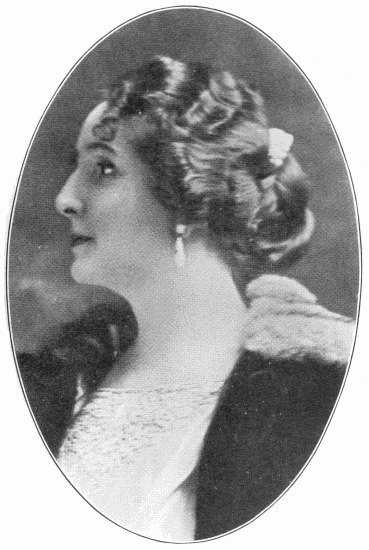
THE OPEN DOOR TO OPERA
MME. FLORENCE EASTON
What is the open door to opera in America? Is there an open door, and if not, how can one be made? Who may go through that door and what are the terms of admission? These are questions which thousands of young American opera aspirants are asking just now.
The prospect of singing at a great opera house is so alluring and the reward in money is often so great that students center their attentions upon the grand prize and are willing to take a chance of winning, even though they know that only one in a very few may succeed and then often at bitter sacrifice.
The question is a most interesting one to me, as I think that I know what the open door to opera in this country might be—what it may be if enough patriotic Americans could be found to cut through the hard walls of materialism, conventionalism and indifference. It lies through the small opera company—the only real and great school which the opera singer of the future can have.
The School of Prime Donne
In European countries there are innumerable small companies capable of giving good opera which the people enjoy quite as thoroughly as the metropolitan audiences of the world enjoy the opera which commands the best singers of the times. For years these small opera companies have been the training schools of the great singers. Not to have gone through such a school was as damaging an admission as that of not having gone through a college would be to a college professor applying for a new position. Lilli Lehmann, Schumann-Heink, Ruffo, Campanini, Jenny Lind, Patti, all are graduates of these schools of practice.
In America there seems to have existed for years a kind of prejudice, bred of ignorance, against all opera companies except those employing all-star casts in the biggest theatres in the biggest cities. This existed, despite the fact that these secondary opera companies often put on opera that was superior to the best that was to be heard in some Italian, German and French cities which possessed opera companies that stood very high in the estimation of Americans who had never heard them. It was once actually the case that the fact that a singer had once sung in a smaller opera company prevented her from aspiring to sing in a great opera company. America, however, has become very much better informed and much more independent in such matters, and our opera goers are beginning to resemble European audiences in that they let their ears and their common sense determine what is best rather than their prejudices and their conventions regarding reputation. It was actually the case at one time in America that a singer with a great reputation could command a large audience, whereas a singer of far greater ability and infinitely better voice might be shut out because she had once sung in an opera company not as pretentious as those in the big cities. This seemed very comic indeed to many European singers, who laughed in their coat sleeves over the real situation.
In the first place, the small companies in many cities would provide more singers with opportunities for training and public appearances. The United States now has two or three major opera companies. Count up on your fingers the greatest number of singers who could be accommodated with parts: only once or twice in a decade does the young singer, at the age when the best formative work must be done, have a chance to attain the leading rôles. If we had in America ten or twenty smaller opera companies of real merit, the chances would be greatly multiplied.
The first thing that the singer has to fight is stage fright. No matter how well you may know a rôle in a studio, unless you are a very extraordinary person you are likely to take months in acquiring the stage freedom and ease in working before an audience. There is only one cure for stage fright, and that is to appear continually until it wears off. Many deserving singers have lost their great chances because they have depended upon what they have learned in the studio, only to find that when they went before a great and critical audience their ability was suddenly reduced to 10 per cent., if not to zero. Even after years of practice and experience in great European opera houses where I appeared repeatedly before royalty, the reputation of the Metropolitan Opera House in New York was so great that at the time I made my début there I was so afflicted by stage fright that my voice was actually reduced to one-half of its force and my other abilities accordingly. This is the truth, and I am glad to have young singers know it as it emphasizes my point.
Imagine what the effect would have been upon a young singer who had never before sung in public on the stage. Footlight paralysis is one of the most terrifying of all acute diseases and there is no cure for it but experience.
The Best Beginning
In the Moody Manners Company in England, the directors wisely understood this situation and prepared for it. All the singers scheduled to take leading rôles (and they were for the most part very young singers, since when the singer became experienced enough she was immediately stolen by companies paying higher salaries) were expected to go for a certain time in the chorus (not to sing, just to walk off and on the stage) until familiar with the situation. Accordingly, my first appearance with the Moody Manners Company was when I walked out with the chorus. I have never heard of this being done deliberately by any other managers, but think how sensible it is!
Again, it is far more advantageous for the young singer to appear in the smaller opera house at first, so that if any errors are made the opera goers will not be unforgiving. There is no tragedy greater than throwing a young girl into an operatic situation far greater than her experience and ability can meet, and then condemning her for years because she did not rise to the occasion. This has happened many times in recent years. Ambition is a beautiful thing; but when ambition induces one to walk upon a tight rope over Niagara, without having first learned to walk properly on earth, ambition should be restrained. I can recollect several singers who were widely heralded at their first performances by enthusiastic admirers, who are now no longer known. What has become of them? Is it not better to learn the profession of opera singing in its one great school, and learn it so thoroughly that one can advance in the profession, just as one may advance in every other profession? The singer in the small opera company who, night after night, says to herself, "To-morrow it must be better," is the one who will be the Lilli Lehmann, the Galli-Curci, or the Schumann-Heink of to-morrow; not the important person who insists upon postponing her début until she can appear at the Metropolitan or at Covent Garden.
Colonel Henry W. Savage did America an immense service, as did the Aborn Brothers and Fortune Gallo, in helping to create a popular taste for opera presented in a less pretentious form. America needs such companies and needs them badly, not merely to educate the public up to an appreciation of the fact that the finest operatic performances in the world are now being given at the Metropolitan Opera House, but to help provide us with well-schooled singers for the future.