GREAT SINGERS ON THE ART of SINGING (continued 4)
Reading edition
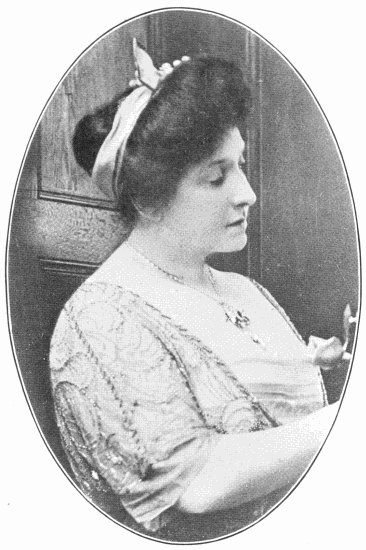
Dame Nellie Melba.
COMMON SENSE IN TRAINING AND PRESERVING THE VOICE
DAME NELLIE MELBA
How Can a Good Voice be Detected?
The young singer's first anxiety is usually to learn whether her voice is sufficiently good to make it worth while to go through the enormous work of preparing herself for the operatic stage. How is she to determine this? Surely not upon the advice of her immediate friends, nor upon that of those to whom she would naturally turn for spiritual advice, medical advice or legal advice. But this is usually just what she does. Because of the honored positions held by her rector, her physician, or her family lawyer, their services are all brought to bear upon her, and after an examination of her musical ability their unskilled opinion is given a weight it obviously does not deserve. The only one to judge is a skilled musician, with good artistic taste and some experience in voice matters. It is sometimes difficult to approach a singing teacher for this advice, as even the most honest could not fail to be somewhat influenced where there is a prospect of a pupil. I do not mean to malign the thousands of worthy teachers, but such a position is a delicate one, and the pupil should avoid consulting with any adviser except one who is absolutely disinterested.
In any event the mere possession of a voice that is sweet and strong by no means indicates that the owner has the additional equipment which the singer must possess. Musical intelligence is quite as great an asset as the possession of a fine voice. By musical intelligence I mean something quite different from general intelligence. People seem to expect that the young person who desires to become a fine pianist or a fine violinist, or a fine composer, should possess certain musical talents. That is, they should experience a certain quickness in grasping musical problems and executing them. The singer, however, by some peculiar popular ruling seems to be exempted from this. No greater mistake could possibly be made. Very few people are musically gifted. When one of these people happens to possess a good voice, great industry, a love for vocal art, physical strength, patience, good sense, good taste and abundant faith in her possibilities, the chances of making a good singer are excellent. I lay great stress upon great determination and good health. I am often obliged to sing one night, then travel a thousand miles to sing the next night. Notwithstanding such journeys, the singer is expected to be in prime condition, look nice, and please a veritable multitude of comparative strangers all expecting wonderful things from her. Do you wonder that I lay stress upon good health?
The youthful training of the singer should be confined quite strictly to that of obtaining a good general and musical education. That is, the vocal training may be safely postponed until the singer is seventeen or eighteen years of age. Of course there have been cases of famous singers who have sung during their childhood, but they are exceptions to all rules. The study of singing demands the direction of an intelligent, well-ordered mind. It is by no means wholly a matter of imitation. In fact, without some cultivation of the taste, that is, the sense of discriminating between what is good and bad, one may imitate with disastrous results.
What Work Should the Girl Under Eighteen Do?
I remember well an incident in my own youth. I once went to a concert and heard a much lauded singer render an aria that was in turn vociferously applauded by the audience. This singer possessed a most wonderful tremolo. Every tone went up and down like the teeth of a saw. It was impossible for her to sing a pure even tone without wobbling up and down. But the untrained audience, hungry to applaud anything musical, had cheered the singer despite the tremolo. Consequently I went home and after a few minutes' work I found that it was possible for me to produce a very wonderful tremolo. I went proudly to my teacher and gave an exhibition of my new acquirement. "Who on earth have you been listening to?" exclaimed my teacher. I confessed and was admonished not to imitate.
The voice in childhood is a very delicate organ despite the wear and tear which children give it by unnecessary howling and screaming. More than this, the child-mind is so susceptible to impressions and these impressions become so firmly fixed that the best vocal training for the child should be that of taking the little one to hear great singers. All that the juvenile mind hears is not lost, although much will be forgotten. However, the better part will be unconsciously stowed away in the subconscious mind, to burst forth later in beautiful song through no different process than that by which the little birds store away the song of the older birds. Dealers in singing birds place them in rooms with older and highly developed singing birds to train them. This is not exactly a process of imitation, but rather one of subconscious assimilation. The bird develops his own song later on, but has the advantage of the stored-up impressions of the trained birds.
A General Musical Training
I have known many singers to fail dismally because they were simply singers. The idea that all the singer needs to know is how to produce tones resonantly and sweetly, how to run scales, make gestures and smile prettily is a perfectly ridiculous one. Success, particularly operatic success, depends upon a knowledge of a great many things. The general education of the singer should be as well rounded as possible. Nothing the singer ever learns in the public schools, or the high schools, is ever lost. History and languages are most important. I studied Italian and French in my childhood and this knowledge was of immense help to me in my later work. When I first went to Paris I had to acquire a colloquial knowledge of the language, but in all cases I found that the drill in French verbs I had gone through virtually saved me years of work. The French pronunciation is extremely difficult to acquire and some are obliged to reside in France for years before a fluent pronunciation can be counted on.
I cannot speak too emphatically upon the necessity for a thorough musical education. A smattering is only an aggravation. Fortunately, my parents saw to it that I was taught the piano, the organ, the violin and thoroughbass. At first it was thought that I would become a professional pianist; and many were good enough to declare that I was the finest amateur pianist in Melbourne. My Scotch-Presbyterian parents would have been horrified if they had had any idea that they were helping me to a career that was in any way related to the footlights. Fortunately, my splendid father, who is now eighty-five years old, has long since recovered from his prejudices and is the proudest of all over my achievements. But I can not be too grateful to him for his great interest in seeing that my early musical training was comprehensive. Aside from giving me a more musicianly insight into my work, it has proved an immense convenience. I can play any score through. I learn all my operas myself. This enables me to form my own conception, that is, to create it, instead of being unconsciously influenced by the tempos and expression of some other individual. The times that I have depended upon a repititeur have been so few that I can hardly remember them. So there, little girl, when you get on your mother's long train and sing to an imaginary audience of thousands, you will do better to run to the keyboard and practice scales or study your études.
The First Vocal Practice
The first vocal practice should be very simple. There should be nothing in the way of an exercise that would encourage forcing of any kind. In fact the young singer should always avoid doing anything beyond the normal. Remember that a sick body means a sick voice. Again, don't forget your daily outdoor exercise. Horseback riding, golf and tennis are my favorites. An hour's walk on a lovely country road is as good for a singer as an hour's practice. I mean that.
In avoiding strain the pupil must above all things learn to sing the upper notes without effort or rather strain. While it is desirable that a pupil should practice all her notes every day, she should begin with the lower notes, then take the middle notes and then the so-called upper notes or head notes which are generally described as beginning with the F sharp on the top line of the treble staff. This line may be regarded as a danger line for singers young and old. It is imperative that when the soprano sings her head notes, beginning with F sharp and upward, they shall proceed very softly and entirely without strain as they ascend. I can not emphasize this too strongly.
Preserving the Voice
Let me give you one of my greatest secrets. Like all secrets, it is perfectly simple and entirely rational. Never give the public all you have. That is, the singer owes it to herself never to go beyond the boundaries of her vocal possibilities. The singer who sings to the utmost every time is like the athlete who exhausts himself to the state of collapse. This is the only way in which I can account for what the critics term "the remarkable preservation" of my own voice. I have been singing for years in all parts of the musical world, growing richer in musical and human experience and yet my voice to-day feels as fresh and as dear as when I was in my teens. I have never strained, I have never continued rôles that proved unsuited to me, I have never sung when I have not been in good voice.
This leads to another very important point. I have often had students ask me how they can determine whether their teachers are giving them the kind of method or instruction they should have. I have always replied, "If you feel tired after a lesson, if your throat is strained after a little singing, if you feel exhausted, your teacher is on the wrong track, no matter what he labels his method or how wonderful his credentials are."
Isn't that very simple? I have known young girls to go on practicing until they couldn't speak. Let them go to a physician and have the doctor show them by means of a laryngoscope just how tender and delicate their vocal organs are. I call them my "little bits of cotton"; they seem so frail and so tiny. Do you wonder that I guard them carefully? This practice consists of the simplest imaginable exercises—sustained scales, chromatic scales and trills. It is not so much what one practices, but how one practices.
Is the Art of Singing Dying Out?
We continually hear critics complain that the art of singing is dying. It is easy enough to be a pessimist, and I do not want to class myself with the pessimists; but I can safely say that, unless more attention is paid to the real art of singing, there must be a decadence in a short time. By this I mean that the voice seems to demand a kind of exercise leading to flexibility and fluent tone production that is not found in the ultra-dramatic music of any of the modern composers. Young singers begin with good voices and, after an altogether inadequate term of preparation, they essay the works of Strauss and Wagner. In two years the first sign of a breakup occurs. Their voices become rough,—the velvet vanishes and note after note "breaks" disagreeably. The music of the older Italian composers, from Scarlatti or Carissimi to Donizetti and Bellini, despite the absurd libretti of their operas, demanded first of all dulcet tones and limpid fluency. The singers who turned their noses up at the florid arabesques of old Italy for the more rugged pageantry of modern Germany are destined to suffer the consequences. Let us have the masterpieces of the heroic Teutons, by all means, but let them be sung by vocalists trained as vocalists and not merely by actors who have only taken a few steps in vocal art.
The main point of all operatic work must be observed if opera is to continue successfully. Delibes chose me to sing a performance of his Lakmé at Brussels. It was to be my début in French. I had not then mastered the French pronunciation so that I could sing acceptably at the Paris Grand Opera, the scene of my later triumphs. Consequently I was permitted to sing in Brussels. There the directors objected to my pronunciation, calling it "abominable." Delibes replied, "Qu'elle chante en chinois, si elle veut, mais qu'elle chante mon opera" ("Even if she sang in Chinese, I would be glad to have her sing my opera").
I am asked what has been my greatest incentive. I can think of nothing greater than opposition. The early opposition from my family made me more and more determined to prove to them that I would be successful. If I heard some singer who sang successfully the rôles I essayed, then I would immediately make up my mind to excel that singer. This is a human trait I know; but I always profited by it. Never be afraid of competition or opposition. The more you overcome, the greater will be your ultimate triumph.
MME. BERNICE DE PASQUALI
Biographical
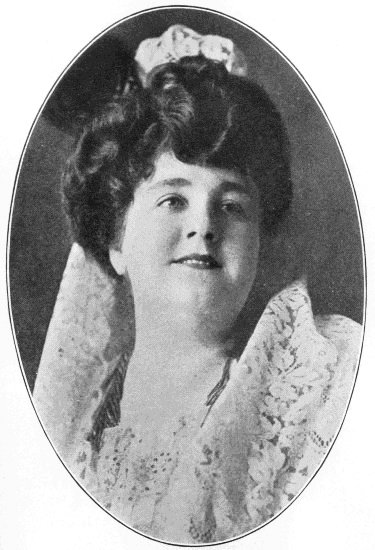
Mme. Bernice de Pasquali, who succeeded Marcella Sembrich as coloratura soprano at the Metropolitan Opera House in New York City, is not an Italian, as her name suggests, but an American. She was born in Boston and is a member of the Daughters of the American Revolution. Practically all of her musical training was received in New York City where she became a pupil of Oscar Saenger. Her successes, however, are not limited to America as she has appeared in Mexico, Cuba, South Africa and Europe, in many places receiving great ovations. Her voice is a clear, high, flexible soprano, equally fine for concert or opera. Her husband, Signor Pasquali, made a lifetime study of the principles of the "Bel Canto" school of singing, and the following conference is the result of long experiment and study in the esthetic, philosophical and physiological factors in the most significant of the so-called methods of voice training.
Mme. Bernice de Pasquali.
SECRETS OF BEL CANTO
MME. BERNICE DE PASQUALI
Centuries of Experimental Experience
In no land is song so much a part of the daily life of the individual as in Italy. The Italian peasant literally wakes up singing and goes to bed singing. Naturally a kind of respect, honor and even reverence attaches to the art of beautiful voice production in the land of Scarlatti, Palestrina and Verdi, that one does not find in other countries. When the Italian singing teachers looked for a word to describe their vocal methods they very naturally selected the most appropriate, "Bel Canto," which means nothing more or less than "Beautiful Singing."
Probably no words have been more abused in music teaching than "bel canto," and probably no words have a more direct meaning or a wider significance. What then is "good singing" as the Italians understand it? Principally the production of a perfectly controlled and exquisitely beautiful tone. Simple as this may seem and simple as it really is, the laws underlying the best way of teaching how to secure a beautiful tone are the evolution of empirical experiences coming down through the centuries.
It is a significant fact that practically all of the great singers in Wagner rôles have first been trained in what is so loosely termed "bel canto" methods. Lilli Lehmann, Schumann-Heink, Nordica and others were capable of singing fine coloratura passages before they undertook the works of the great master of Beyreuth.
The Secret of Conserving the Voice
In the mass of traditions, suggestions and advice which go to make the "bel canto" style, probably nothing is so important to American students as that which pertains to conserving the voice. Whether our girls are inordinately fond of display or whether they are unable to control their vocal organs I do not know, but one is continually treated to instances of the most ludicrous prodigality of voice. The whole idea of these young singers seems to be to make a "hit" by shouting or even screeching. There can be no milder terms for the straining of the tones so frequently heard. This prodigality has only one result—loss of voice.
The great Rubini once wrote to his friend, the tenor Duprez, "You lost your voice because you always sang with your capital. I have kept mine because I have used only the interest." This historical epigram ought to be hung in all the vocal studios of America. Our American voices are too beautiful, too rare to be wasted, practically thrown away by expending the capital before it has been able to earn any interest.
Moreover, the thing which has the most telling effect upon any audience is the beauty of tone quality. People will stop at any time to listen to the wonderful call of the nightingale. In some parts of Europe it is the custom to make parties to go at nights to the woods to hear that wonderful singer of the forests. Did you ever hear of any one forming a party for the express purpose of listening to the crowing of a rooster? One is a treat to the ear, the other is a shock. When our young singers learn that people do not attend concerts to have their ears shocked but to have them delighted with beautiful sound, they will be nearer the right idea in voice culture.
The student's first effort, then, should be to preserve the voice. From the very first lesson he must strive to learn how to make the most with little.
How is the student to know when he is straining the voice? This is simple enough to ascertain. At the very instant that the slightest constriction or effort is noticed strain is very likely to be present. Much of this depends upon administering exactly the right amount of breath to the vocal cords at the moment of singing. Too much breath or too little breath is bad. The student finds by patient experiment under the direction of the experienced teacher just how much breath to use. All sorts of devices are employed to test the breath, but it is probable that the best devices of all are those which all singers use as the ultimate test, the ear and the feeling of delightful relaxation surrounding the vocal organs during the process of singing.
Courage in Singing
Much of the student's early work is marred by fear. He fears to do this and he fears to do that, until he feels himself walled in by a set of rules that make his singing stilted. From the very start the singer, particularly the one who aspires to become an operatic singer, should endeavor to discard fear entirely. Think that if you fail in your efforts, thousands of singers have failed in a similar manner in their student days. Success in singing is at the end of a tall ladder, the rungs of which are repeated failures. We climb up over our failures to success. Learn to fear nothing, the public least of all. If the singer gives the audience the least suspicion that she is in fear of their verdict, the audience will detect it at once and the verdict will be bad. Also do not fear the criticism of jealous rivals.
Affirm success. Say to yourself, "I will surely succeed if I persevere." In this way you will acquire those habits of tranquillity which are so essential for the singer to possess.
The Reason for the Lack of Well-Trained Voices
There are abundant opportunities just now for finely trained singers. In fact there is a real dearth of "well-equipped" voices. Managers are scouring the world for singers with ability as well as the natural voice. Why does this dearth exist? Simply because the trend of modern musical work is far too rapid. Results are expected in an impossible space of time. The pupil and the maestro work for a few months and, lo and behold! a prima donna! Can any one who knows anything about the art of singing fail to realize how absurd this is? More voices are ruined by this haste than by anything else. It is like expecting the child to do the feats of the athlete without the athlete's training. There are singers in opera now who have barely passed the, what might be called, rudimentary stage.
With the decline of the older operas, singers evidently came to the conclusion that it was not necessary to study for the perfection of tone-quality, evenness of execution and vocal agility. The modern writers did not write such fioratura passages, then why should it be necessary for the student to bother himself with years of study upon exercises and vocalises designed to prepare him for the operas of Bellini, Rossini, Spontini, Donizetti, Scarlatti, Carissimi or other masters of the florid school? What a fatuous reasoning. Are we to obliterate the lessons of history which indicate that voices trained in such a school as that of Patti, Jenny Lind, Sembrich, Lehmann, Malibran, Rubini and others, have phenomenal endurance, and are able to retain their freshness long after other voices have faded? No, if we would have the wonderful vitality and longevity of the voices of the past we must employ the methods of the past.
The Delicate Nature of the Human Voice
Of all instruments the human voice is by far the most delicate and the most fragile. The wonder is that it will stand as much "punishment" as is constantly given to it. Some novices seem to treat it with as little respect as though it were made out of brass like a tuba or a trombone. The voice is subject to physical and psychical influences. Every singer knows how acutely all human emotions are reflected in the voice; at the same time all physical ailments are immediately active upon the voice of the singer.
There is a certain freshness or "edge" which may be worn off the voice by ordinary conversation on the day of the concert or the opera. Some singers find it necessary to preserve the voice by refraining from all unnecessary talking prior to singing. Long-continued practice is also very bad. An hour is quite sufficient on the day of the concert. During the first years of study, half an hour a day is often enough practice. More practice should only be done under special conditions and with the direction of a thoroughly competent teacher.
Singing in the open air, when particles of dust are blowing about, is particularly bad. The throat seems to become irritated at once. In my mind tobacco smoke is also extremely injurious to the voice, notwithstanding the fact that some singers apparently resist its effects for years. I once suffered severely from the effects of being in a room filled with tobacco smoke and was unable to sing for at least two months. I also think that it is a bad plan to sing immediately after eating. The peristaltic action of the stomach during the process of digestion is a very pronounced function and anything which might tend to disturb it might affect the general health.
The singer must lead an exceedingly regular life, but the exaggerated privations and excessive care which some singers take are quite unnecessary. The main thing is to determine what is a normal life and then to live as close to this as possible. If you find that some article of diet disagrees with you, remember to avoid that food; for an upset stomach usually results in complete demoralization of the entire vocal system.
Some Practice Suggestions
No matter how great the artist, daily practice, if even not more than forty minutes a day, is absolutely necessary. There is a deep philosophical and physiological principle underlying this and it applies particularly to the vocal student. Each minute spent in intelligent practice makes the voice better and the task easier. The power to do comes with doing. Part of each day's practice should be devoted to singing the scale softly and slowly with perfect intonation. Every tone should be heard with the greatest possible acuteness. The ears should analyze the tone quality with the same scrutiny with which a botanist would examine the petals of a newly discovered specimen. As the singer does this he will notice that his sense of tone color will develop; and this is a very vital part of every successful singer's equipment. He will become aware of beauties as well as defects in his voice which may never have been even suspected if he will only listen "microscopically" enough.
Much of the singer's progress depends upon the mental model he keeps before him. The singer who constantly hears the best of singing naturally progresses faster than one surrounded by inferior singing. This does not recommend that the student should imitate blindly but that he should hear as much fine singing as possible. Those who have not the means to attend concerts and the opera may gain immensely from hearing fine records. Little Adelina Patti, playing as a child on the stage of the old Academy of Music in New York, was really attending the finest kind of a conservatory unawares.
The old Italian teachers and writers upon voice, knowing the florid style in which their pupils would be expected to sing, did not have much to do with fanciful exercises. They gave their lives to the quest of the "bel canto"; and many of them had difficulty in convincing their pupils that the simplest exercises were often the hardest. Take for instance this invaluable scale exercise sung with the marks of expression carefully observed.
This exercise is one of the most difficult to sing properly. Nevertheless, some student will rush on to florid exercises before he can master this exercise. To sing it right it must be regarded with almost devotional reverence. Indeed, it may well be practiced diligently for years. Every tone is a problem, a problem which must be solved in the brain and in the body of the singer and not in the mind of any teacher. The student must hold up every tone for comparison with his ideal tone. Every note must ring sweet and clear, pure and free. Every tone must be even more susceptible to the emotions than the expression upon the most mobile face. Every tone must be made the means of conveying some human emotion. Some singers practice their exercises in such a perfunctory manner that they get as a result voices so stiff and hard that they sound as though they came from metallic instruments which could only be altered in a factory instead of from throats lined with a velvet-like membrane.
Sing with great attention to intonation.
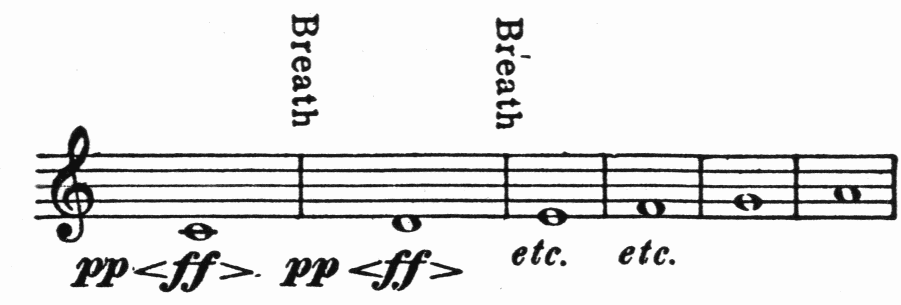

Flexibility, mobility and susceptibility to expression are quite as important as mere sweetness. After the above exercise has been mastered the pupil may pass to the chromatic scale (scala semitonata sostenuto); and this scale should be sung in the same slow sustained manner as the foregoing illustration.
MME. MARCELLA SEMBRICH
Biographical
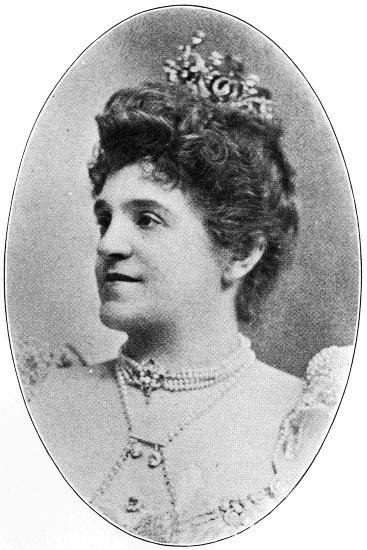
Mme. Marcella Sembrich (Praxede Marcelline Kochanska) was born in Wisnewczyk, Galicia, February 15, 1858. Sembrich was her mother's name. Her father was a music teacher and she tells with pleasure how she watched her father make a little violin for her to practice upon. At the age of seven she was taken to Wilhelm Stengel at Lemberg for further instruction. Later she went to study with the famous pedagogue, Julius Epstein, at Vienna, who was amazed by the child's prodigious talent as a pianist and as a violinist. He asked, "Is there anything else she can do?" "Yes," replied Stengel, "I think she can sing." Sing she did; and Epstein was not long in determining that she should follow the career of the singer. Her other teachers were Victor Rokitansky, Richard Lewy and G. B. Lamperti and a few months with the elder Francesco Lamperti. Her début was made in Athens in 1877, in I Puritani. Thereafter she toured all of the European art centers with invariable success. Her first American appearance was in 1883. She came again in 1898 and for years sang with immense success in all parts of America. America has since become her home, where she has devoted much time to teaching.
Mme. Marcella Sembrich. © Dupont.
HOW FORTUNES ARE WASTED IN VOCAL EDUCATION
MME. MARCELLA SEMBRICH
Every One Who Can Should Learn to Sing
Few accomplishments are more delight-giving than that of being able to sing. I would most enthusiastically advise anyone possessing a fair voice to have it trained by some reliable singing teacher. European peoples appreciate the great privilege of being able to sing for their own amusement, and the pleasure they get from their singing societies is inspiring.
If Americans took more time for the development of accomplishments of this kind their journey through life would be far more enjoyable and perhaps more profitable. I believe that all should understand the art of singing, if only to become amateurs.
That music makes the soul more beautiful I have not the least doubt. Because some musicians have led questionable lives does not prove the contrary. What might these men have been had they not been under the benign influence of music?
One has only to watch people who are under the magic spell of beautiful music to understand what a power it has for the good. I believe that good vocal music should be a part of all progressive educational work. The more music we have, the more beautiful this world will be, the more kindly people will feel toward each other and the more life will be worth living.
Wrong to Encourage Voiceless Aspirants
But when I say that everyone who possesses a voice should learn to sing I do not by any means wish to convey the idea that anyone who desires may become a great singer. That is a privilege that is given to but a very few fortunate people. So many things go together to make a great singer that the one who gives advice should be very circumspect in encouraging young people to undertake a professional career—especially an operatic career. Giving advice under any conditions is often thankless.
I have been appealed to by hundreds of girls who have wanted me to hear them sing. I have always told them what seemed to me the truth, but I have been so dismayed at the manner in which this has been received that I hesitate greatly before hearing aspiring singers.
It is the same way with the teachers. I know that some teachers are blamed for taking voiceless pupils, but the pupils are more often to blame than the teacher. I have known pupils who have been discouraged by several good teachers to persist until they finally found a teacher who would take them.
Most teachers are conscientious—often too conscientious for their pocketbooks. If a representative teacher or a prominent singer advises you not to attempt a public career you should thank him, as he is doubtless trying to save you from years of miserable failure. It is a very serious matter for the pupil, and one that should be given almost sacred consideration by those who have the pupil's welfare at heart.
Wise, indeed, is the young singer who can so estimate her talents that she will start along the right path. There are many positions which are desirable and laudable which can be ably filled by competent singers. If you have limitations which will prevent your ever reaching that "will-o'-the-wisp" known as "fame," do not waste money trying to achieve what is obviously out of your reach.
If you can fill the position of soloist in a small choir creditably, do so and be contented. Don't aspire for operatic heights if you are hopelessly shackled by a lack of natural qualifications.
It is a serious error to start vocal instruction too early. I do not believe that the girl's musical education should commence earlier than at the age of sixteen. It is true that in the cases of some very healthy girls no very great damage may be done, but it is a risk I certainly would not advise.
Much money and time are wasted upon voice training of girls under the age of sixteen. If the girl is destined for a great career she will have the comprehension, the grasp, the insight that will lead her to learn very rapidly. Some people can take in the whole meaning of a picture at a glance; others are obliged to regard the picture for hours to see the same points of artistic interest. Quick comprehension is a great asset, and the girl who is of the right sort will lose nothing by waiting until she reaches the above age.
Piano or Violin Study Advisable for all Singers
Ambition, faithfulness to ideals and energy are the only hopes left open to the singer who is not gifted with a wonderfully beautiful natural voice. It is true that some singers of great intelligence and great energy have been able to achieve wide fame with natural voices that under other conditions would only attract local notice. These singers deserve great credit for their efforts.
While the training of the voice may be deferred to the age of sixteen, the early years should by no means be wasted. The general education of the child, the fortification of the health and the study of music through the medium of some instrument are most important. The young girl who commences voice study with the ability to play either the violin or the piano has an enormous advantage over the young girl who has had no musical training.
I found the piano training of my youth of greatest value, and through the study of the violin I learned certain secrets that I later applied to respiration and phrasing. Although my voice was naturally flexible, I have no doubt that the study of these instruments assisted in intonation and execution in a manner that I cannot over-estimate.
A beautiful voice is not so great a gift, unless its possessor knows how to employ it to advantage. The musical training that one receives from the study of an instrument is of greatest value. Consequently, I advise parents who hope to make their children singers to give them the advantage of a thorough musical training in either violin study or the piano. Much wasted money and many blasted ambitions can be spared by such a course.
A Good General Education of Vast Importance
The singer whose general education has been neglected is in a most unfortunate plight. And by general education I do not mean only those academic studies that people learn in schools. The imagination must be stimulated, the heartfelt love for the poetical must be cultivated, and above all things the love for nature and mankind must be developed.
I can take the greatest joy in a walk through a great forest. It is an education to me to be with nature. Unfortunately, only too many Americans go rushing through life neglecting those things which make life worth living.
Musical Advance in America
There has been a most marvelous advance in this respect, however, in America. Not only in nature love but in art it has been my pleasure to watch a wonderful growth. When I first came here in 1883 things were entirely different in many respects. Now the great operatic novelties of Europe are presented here in magnificent style, and often before they are heard in many European capitals.
In this respect America to-day ranks with the best in the world. Will you not kindly permit me to digress for a moment and say to the music lovers of America that I appreciate in the deepest manner the great kindnesses that have been shown to me everywhere? For this reason, I know that my criticisms, if they may be called such, will be received as they are intended.
The singer should make a serious study of languages. French, German, English and Italian are the most necessary ones. I include English as I am convinced that it is only a matter of a short time when a school of opera written by English-speaking composers will arise. The great educational and musical advance in America is an indication of this.
As for voice exercises, I have always been of the opinion that it is better to leave that matter entirely to the discretion of the teacher. There can be no universal voice exercise that will apply to all cases. Again, it is more a matter of how the exercise is sung than the exercise itself.
The simplest exercise can become valuable in the hands of the great teacher. I have no faith in the teachers who make each and every pupil go through one and the same set of exercises in the same way. The voice teacher is like the physician. He must originate and prescribe certain remedies to suit certain cases. Much money is wasted by trying to do without a good teacher. If the pupil really has a great voice and the requisite talent, it is economical to take her to the best teacher obtainable.
American women have wonderful voices. Moreover, they have great energy, talent and temperament. Their accomplishments in the operatic world are matters of present musical history. With such splendid effort and such generosity, it is easy to prophesy a great future for musical America. This is the land of great accomplishments.
With time Americans will give more attention to the cultivation of details in art, they will acquire more repose perhaps, and then the tremendous energy which has done so much to make the country what it is will be a great factor in establishing a school of music in the new world which will rank with the greatest of all times.
MME. ERNESTINE SCHUMANN-HEINK
Biographical
Mme. Ernestine Schumann-Heink (née Roessler) was born near the city of Prague, July 15, 1861. She relates that her father was a Czech and her mother was of Italian extraction. She was educated in Ursuline Convent and studied singing with Mme. Marietta von Leclair in Graz. Her first appearance was at the age of 15, when she is reported to have taken a solo part in a performance of the Beethoven Ninth Symphony, at an important concert in Graz. Her operatic début was made at the Royal Opera, Dresden, in Trovatore. There she studied under Krebs and Franz Wüllner. It is impossible to detail Mme. Schumann-Heink's operatic successes here, since her numerous appearances at the leading operatic houses of the world have been followed by such triumphs that she is admittedly the greatest contralto soloist of her time. At Bayreuth, Covent Garden, and at the Metropolitan her appearances have drawn multitudes. In concert she proved one of the greatest of all singers of art songs. In 1905 she became an American citizen, her enthusiasm for this country leading her to name one of her sons George Washington. During the great war (in which four of her sons served with the American colors) she toured incessantly from camp to camp, giving her services for the entertainment of the soldiers and winning countless admirers in this way. Her glorious voice extends from D on the third line of the bass clef to C on the second leger line above the treble clef.
Mme. Ernestine Schumann-Heink.
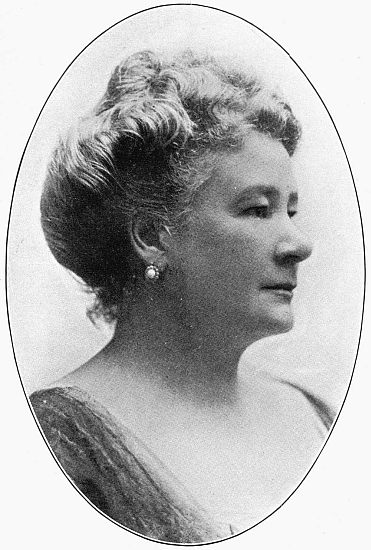
KEEPING THE VOICE IN PRIME CONDITION
MME. ERNESTINE SCHUMANN-HEINK
The Artist's Responsibility
Would you have me give the secret of my success at the very outstart? It is very simple and centers around this subject of the artist's responsibility to the audience. My secret is absolute devotion to the audience. I love my audiences. They are all my friends. I feel a bond with them the moment I step before them. Whether I am singing in blasé New York or before an audience of farmer folk in some Western Chautauqua, my attitude toward my audience is quite the same. I take the same care and thought with every audience. This even extends to my dress. The singer, who wears an elaborate gown before a Metropolitan audience and wears some worn-out old rag of a thing when singing at some rural festival, shows that she has not the proper respect in her mind. Respect is everything.
Therefore it is necessary for me to have my voice in the best of condition every day of the year. It is my duty to my audience. The woman who comes to a country Chautauqua and brings her baby with her and perchance nurses the little one during the concert gets a great deal closer to my heart than the stiff-backed aristocrat who has just left a Pekingese spaniel outside of the opera house door in a $6000.00 limousine. That little country woman expects to hear the singer at her best. Therefore, I practice just as carefully on the day of the Chautauqua concert as I would if I were to sing Ortrud the same night at the Metropolitan in New York.
American audiences are becoming more and more discriminating. Likewise they are more and more responsive. As an American citizen, I am devoted to all the ideals of the new world. They have accepted me in the most whole-souled manner and I am grateful to the land of my adoption.
The Advantage of an Early Training
Whether or not the voice keeps in prime condition to-day depends largely upon the early training of the singer. If that training is a good one, a sound one, a sensible one, the voice will, with regular practice, keep in good condition for a remarkably long time. The trouble is that the average student is too impatient in these days to take time for a sufficient training. The voice at the outstart must be trained lightly and carefully. There must not be the least strain. I believe that at the beginning two lessons a week should be sufficient. The lessons should not be longer than one-half an hour and the home practice should not exceed at the start fifty minutes a day. Even then the practice should be divided into two periods. The young singer should practice mezza voce, which simply means nothing more or less than "half voice." Never practice with full voice unless singing under the direction of a well-schooled teacher with years of practical singing experience.
It is easy enough to shout. Some of the singers in modern opera seem to employ a kind of megaphone method. They stand stock still on the stage and bawl out the phrases as though they were announcing trains in a railroad terminal. Such singers disappear in a few years. Their voices seem torn to shreds. The reason is that they have not given sufficient attention to bel canto in their early training. They seem to forget that voice must first of all be beautiful. Bel canto,—beautiful singing,—not the singing of meaningless Italian phrases, as so many insist, but the glorious bel canto which Bach, Haydn and Mozart demand,—a bel canto that cultivates the musical taste, disciplines the voice and trains the singer technically to do great things. Please understand that I am not disparaging the good and beautiful in Italian masterpieces. The musician will know what I mean. The singer can gain little, however, from music that intellectually and vocally is better suited to a parrot than a human being.
Some of the older singers made bel canto such an art that people came to hear them for their voices alone, and not for their intellectual or emotional interpretations of a rôle. Perhaps you never heard Patti in her prime. Ah! Patti—the wonderful Adelina with the glorious golden voice. It was she who made me ambitious to study breathing until it became an art. To hear her as she trippingly left the stage in Verdi's Traviata singing runs with ease and finish that other singers slur or stumble over,—ah! that was an art!
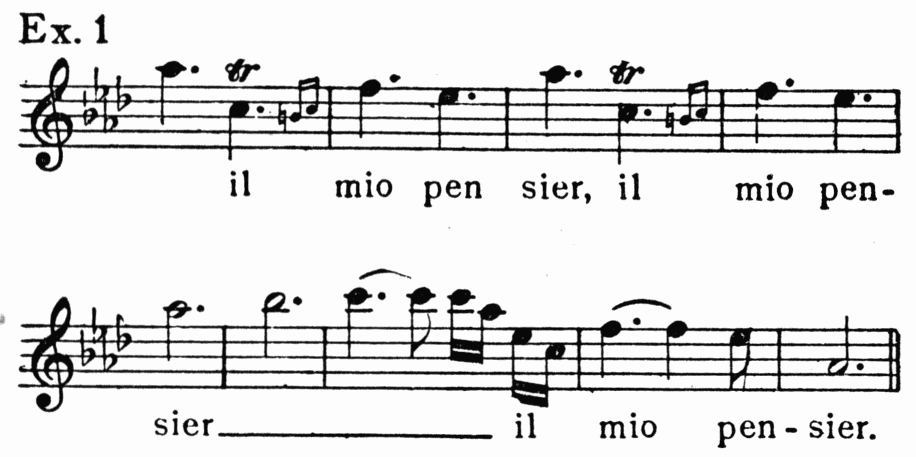
Volumes have been written on breathing and volumes more could be written. This is not the place to discuss the singer's great fundamental need. Need I say more than that I practice deep breathing every day of my life?
The Age for Starting
It is my opinion that no girl who wishes to keep her voice in the prime of condition all the time in after years should start to study much earlier than seventeen or eighteen years of age. In the case of a man I do not believe that he should start until he is past twenty or even twenty-two. I know that this is contrary to what many singers think, but the period of mutation in both sexes is a much slower process than most teachers realize, and I have given this matter a great deal of serious thought.
Let Everybody Sing!
Can I digress long enough to say that I think that everybody should sing? That is, they should learn to sing under a good singing instructor. This does not mean that they should look forward toward a professional career. God forbid! There are enough half-baked singers in the world now who are striving to become professionals. But the public should know that singing is the healthiest kind of exercise imaginable. When one sings properly one exercises nearly all of the important muscles of the torso. The circulation of the blood is improved, the digestion bettered, the heart promoted to healthy action—in fact, everything is bettered. Singers as a rule are notoriously healthy and often very long lived. The new movement for community singing in the open air is a magnificent one. Let everybody sing!
A great singing teacher with a reputation as big as Napoleon's or George Washington's is not needed. There are thousands and thousands of unknown teachers who are most excellent. Often the advice or the instruction is very much the same. What difference does it make whether I buy Castile soap in a huge Broadway store or a little country store, if the soap is the same? Many people hesitate to study because they can not study with a great teacher. Nonsense! Pick out some sensible, well-drilled teacher and then use your own good judgment to guide yourself. Remember that Schumann-Heink did not study with a world-famed teacher. Whoever hears of Marietta von Leclair in these days? Yet I do not think that I could have done any more with my voice if I had had every famous teacher from Niccolo Antonio Porpora down to the present day. The individual singer must have ideals, and then leave nothing undone to attain those ideals. One of my ideals was to be able to sing pianissimo with the kind of resonance that makes it carry up to the farthest gallery. That is one of the most difficult things I had to learn, and I attained it only after years of faithful practice.
The Singer's Daily Routine
To keep the voice in prime condition the singer's first consideration is physical and mental health. If the body or the mind is over-taxed singing becomes an impossibility. It is amazing what the healthy body and the busy mind can really stand. I take but three weeks' vacation during the year and find that I am a great deal better for it. Long terms of enforced indolence do not mean rest. The real artist is happiest when at work, and I want to work. Fortunately I am never at loss for opportunity. The ambitious vocal student can benefit as much by studying a good book on hygiene or the conservation of the health as from a book on the art of singing.
First of all comes diet. Americans as a rule eat far too much. Why do some of the good churchgoing people raise such an incessant row about over-drinking when they constantly injure themselves quite as much by over-eating? What difference does it make whether you ruin your stomach, liver or kidneys by too much alcohol or too much roast beef? One vice is as bad as another. The singer must live upon a light diet. A heavy diet is by no means necessary to keep up a robust physique. I am rarely ill, am exceedingly strong in every way, and yet eat very little indeed. I find that my voice is in the best of condition when I eat very moderately. My digestion is a serious matter with me, and I take every precaution to see that it is not congested in any way. This is most important to the singer. Here is an average ménu for my days when I am on tour:
BREAKFAST Two or more glasses of Cold Water (not ice water) Ham and Eggs Coffee Toast. MID-DAY DINNER Soup Some Meat Order A Vegetable Plenty of Salad Fruit. SUPPER A Sandwich Fruit.
Such a ménu I find ample for the heaviest kind of professional work. If I eat more, my work may deteriorate, and I know it.
Fresh air, sunshine, sufficient rest and daily baths in tepid water night and morning are a part of my regular routine. I lay special stress upon the baths. Nothing invigorates the singer as much as this. Avoid very cold baths, but see to it that you have a good reaction after each bath. There is nothing like such a routine as this to avoid colds. If you have a cold try the same remedies to try to get rid of it. To me, one day at Atlantic City is better for a cold than all the medicine I can take. I call Atlantic City my cold doctor. Of course, there are many other shore resorts that may be just as helpful, but when I can do so I always make a bee line for Atlantic City the moment I feel a serious cold on the way.
Sensible singers know now that they must avoid alcohol, even in limited quantities, if they desire to be in the prime of condition and keep the voice for a long, long time. Champagne particularly is poison to the singer just before singing. It seems to irritate the throat and make good vocal work impossible. I am sorry for the singer who feels that some spur like champagne or a cup of strong coffee is desirable before going upon the stage.
It amuses me to hear girls say, "I would give anything to be a great singer"; and then go and lace themselves until they look like Jersey mosquitoes. The breath is the motive power of the voice. Without it under intelligent control nothing can be accomplished. One might as well try to run an automobile without gasoline as sing without breath. How can a girl breathe when she has squeezed her lungs to one-half their normal size?
Preparation for Heavy Rôles
The voice can never be kept in prime condition if it is obliged to carry a load that it has not been prepared to carry. Most voices that wear out are voices that have been overburdened. Either the singer does not know how to sing or the rôle is too heavy. I think that I may be forgiven for pointing out that I have repeatedly sung the heaviest and most exacting rôles in opera. My voice would have been shattered years ago if I had not prepared myself for these rôles and sung them properly. A man may be able to carry a load of fifty pounds for miles if he carries it on his back, but he will not be able to carry it a quarter of a mile if he holds it out at arm's length from the body, with one arm. Does this not make the point clear?
Some rôles demand maturity. It is suicidal for the young singer to attempt them. The composer and the conductor naturally think only of the effect at the performance. The singer's welfare with them is a secondary consideration. I have sung under the great composers and conductors, from Richard Wagner to Richard Strauss. Some of the Strauss rôles are even more strenuous than those of Wagner. They call for great energy as well as great vocal ability. Young singers essay these heavy rôles and the voices go to pieces. Why not wait a little while? Why not be patient?
The singer is haunted by the delusion that success can only come to her if she sings great rôles. If she can not ape Melba in Traviata, Emma Eames as Elizabeth in Tannhäuser or Geraldine Farrar in Butterfly, she pouts and refuses to do anything. Offer her a small part and she sneers at it. Ha! Ha! All my earliest successes were made in the smallest kinds of parts. I realized that I had only a little to do and only very little time to do it in. Consequently, I gave myself heart and soul to that part. It must be done so artistically, so intelligently, so beautifully that it would command success. Imagine the rôles of Erda and Norna, and Marie in Flying Dutchman. They are so small that they can hardly be seen. Yet these rôles were my first door to success and fame. Wagner did not think of them as little things. He was a real master and knew that in every art-work a small part is just as important as a great part. It is a part of a beautiful whole. Don't turn up your nose at little things. Take every opportunity, and treat it as though it were the greatest thing in your life. It pays.
Everything that amounts to anything in my entire career has come through struggle. At first a horrible struggle with poverty. No girl student in a hall bedroom to-day (and my heart goes out to them now) endures more than I went through. It was work, work, work, from morning to night, with domestic cares and worries enough all the time to drive a woman mad. Keep up your spirits, girls. If you have the right kind of fight in you, success will surely come. Never think of discouragement, no matter what happens. Keep working every day and always hoping. It will come out all right if you have the gift and the perseverance. Compulsion is the greatest element in the vocalist's success. Poverty has a knout in its hand driving you on. Well, let it,—and remember that under that knout you will travel twice as fast as the rich girl possibly can with her fifty-horse-power automobile. Keep true to the best. Muss—"I MUST," "I will," the mere necessity is a help not a hindrance, if you have the right stuff in you. Learn to depend upon yourself, and know that when you have something that the public wants it will not be slow in running after you. Don't ask for help. I never had any help. Tell that to the aspiring geese who think that I have some magic power whereby I can help a mediocre singer to success by the mere twist of the hand.
Daily Exercises of a Prima Donna
Daily vocal exercises are the daily bread of the singer. They should be practiced just as regularly as one sits down to the table to eat, or as one washes one's teeth or as one bathes. As a rule the average professional singer does not resort to complicated exercises and great care is taken to avoid strain. It is perfectly easy for me, a contralto, to sing C in alt
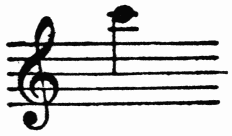
but do you suppose I sing it in my daily exercises? It is one of the extreme notes in my range and it might be a strain. Consequently I avoid it. I also sing most of my exercises mezza voce.
There should always be periods of intermission between practice. I often go about my routine work while on tour, walking up and down the room, packing my trunk, etc., and practicing gently at the same time. I enjoy it and it makes my work lighter.
Of course I take great pains to practice carefully. My exercises are for the most part simple scales, arpeggios or trills. For instance, I will start with the following:

This I sing in middle voice and very softly. Thereby I do not become tired and I don't bother the neighborhood. If I sang this in the big, full lower tones and sang loud, my voice would be fatigued rather than benefited and the neighbors would hate me. This I continue up to D or E flat.
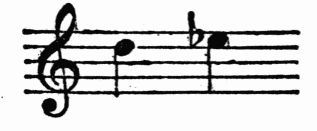
Above this I invariably use what is termed the head tone. Female singers should always begin the head tone on this degree of the staff and not on F and F♯, as is sometimes recommended.
I always use the Italian vowel ah in my exercises. It seems best to me. I know that oo and ue are recommended for contraltos, but I have long had the firm conviction that one should first perfect the natural vocal color through securing good tones by means of the most open vowel. After this is done the voice may be further colored by the judicious employment of other vowels. Sopranos, for instance, can help their head tones by singing ee (Italian i).
I know nothing better for acquiring a flexible tone than to sing trills like the following:
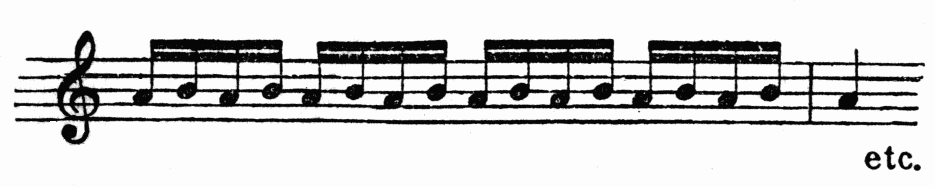
and at the same time preserve a gentle, smiling expression. Smile naturally, as though you were genuinely amused at something,—smile until your upper teeth are uncovered. Then, try these exercises with the vowel ah. Don't be afraid of getting a trivial, colorless tone. It is easy enough to make the tone sombre by willing it so, when the occasion demands. You will be amazed what this smiling, genial, liebenswürdig expression will do to relieve stiffness and help you in placing your voice right. The old Italians knew about it and advocated it strongly. There is nothing like it to keep the voice youthful, fresh and in the prime of condition.
The Singer Must Relax
Probably more voices are ruined by strain than through any other cause. The singer must relax all the time. This does not mean flabbiness. It does not mean that the singer should collapse before singing. Relaxation in the singer's sense is a delicious condition of buoyancy, of lightness, of freedom, of ease and entire lack of tightening in any part. When I relax I feel as though every atom in my body were floating in space. There is not one single little nerve on tension. The singer must be particularly careful when approaching a climax in a great work of art. Then the tendency to tighten up is at its greatest. This must be anticipated.
Take such a case as the following passage from the famous aria from Saint-Saëns' Samson et Delila, "Mon coeur s'ouvre à ta voix." The climax is obviously on the words "Ah!—verse moi." The climax is the note marked by a star (f on the top line).
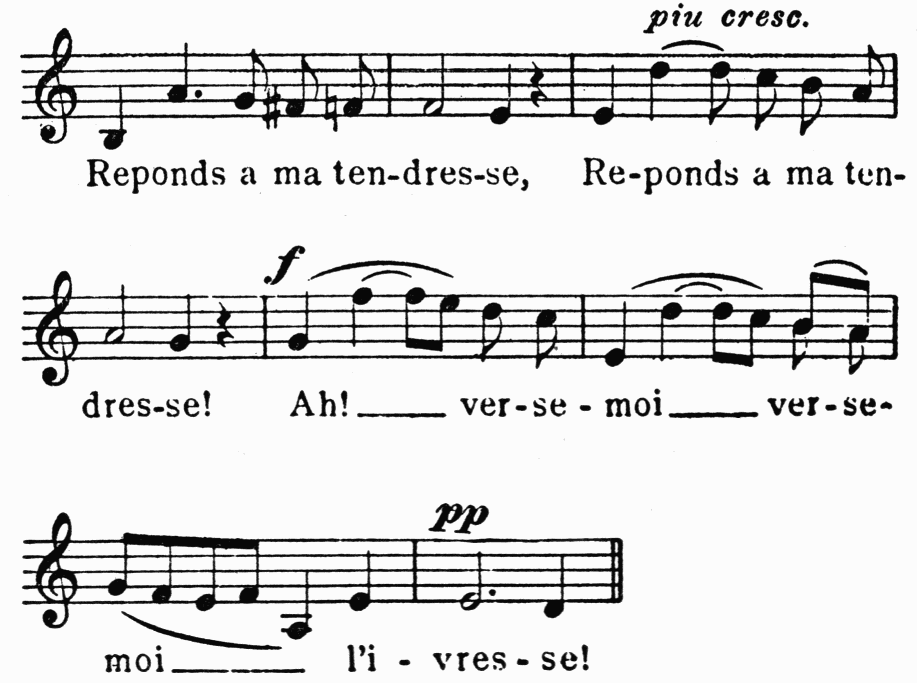
When I am singing the last notes of the previous phrase to the word "tendresse," anyone who has observed me closely will notice that I instinctively let my shoulders drop,—that the facial muscles become relaxed as when one is about to smile or about to yawn. I am then relaxing to meet the great melodic climax and meet it in such a manner that I will have abundant reserve force after it has been sung. When one has to sing before an audience of five or six thousand people such a climax is immensely important and it requires great balance to meet it and triumph in it.
ANTONIO SCOTTI
Biographical
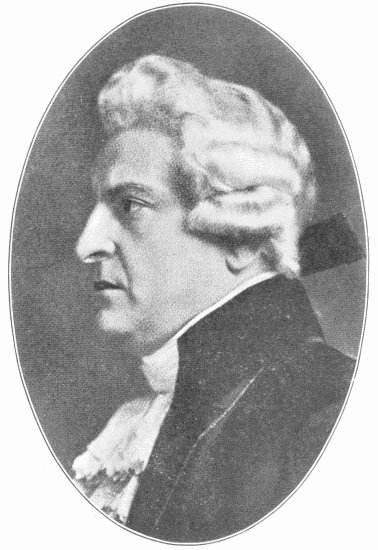
Antonio Scotti was born at Naples, Jan. 25, 1866, and did much of his vocal study there with Mme. Trifari Paganini. His début was made at the Teatro Reale, in the Island of Malta, in 1889. The opera was Martha. After touring the Italian opera houses he spent seven seasons in South America at a time when the interest in grand opera on that continent was developing tremendously. He then toured Spain and Russia with great success and made his début at Covent Garden, London, in 1899. His success was so great that he was immediately engaged for the Metropolitan in New York, where he has sung every season since that time. His most successful rôles have been in La Tosca, La Bohême, I Pagliacci, Carmen, Falstaff, L'Oracolo and Otello. His voice is a rich and powerful baritone. He is considered one of the finest actors among the grand opera singers. During recent years he has toured with an opera company of his own, making many successful appearances in some of the smaller as well as the larger American cities.
Portrait of Antonio Scotti in the Costume of His Most Famous Rôle, Scarpia, in "La Tosca," by Puccini.
ITALIAN OPERA IN AMERICA
ANTONIO SCOTTI
So closely identified is Italy with all that pertains to opera, that the question of the future of Italian opera in America is one that interests me immensely. It has been my privilege to devote a number of the best years of my life to singing in Italian opera in this wonderful country, and one cannot help noticing, first of all, the almost indescribable advance that America has made along all lines. It is so marvelous that those who reside continually in this country do not stop to consider it. Musicians of Europe who have never visited America can form no conception of it, and when they once have had an opportunity to observe musical conditions in America, the great opera houses, the music schools, the theatres and the bustling, hustling activity, together with the extraordinary casts of world-famous operatic stars presented in our leading cities, they are amazed in the extreme.
It is very gratifying for me to realize that the operatic compositions of my countrymen must play a very important part in the operatic future of America. It has always seemed to me that there is far more variety in the works of the modern Italian composers than in those of other nations. Almost all of the later German operas bear the unmistakable stamp of Wagner. Those which do not, show decided Italian influences. The operas of Mozart are largely founded on Italian models, although they show a marvelous genius peculiar to the great master who created them.
Operatic Tendencies
The Italian opera of the future will without doubt follow the lead of Verdi, that is, the later works of Verdi. To me Falstaff seems the most remarkable of all Italian operas. The public is not well enough acquainted with this work to demand it with the same force that they demand some of the more popular works of Verdi. Verdi was always melodious. His compositions are a beautiful lace-work of melodies. It has seemed to me that some of the Italian operatic composers who have been strongly influenced by Wagner have made the mistake of supposing that Wagner was not a master of melody. Consequently they have sacrificed their Italian birthright of melody for all kinds of cacophony. Wagner was really wonderfully melodious. Some of his melodies are among the most beautiful ever conceived. I do not refer only to the melodies such as "Oh, Thou Sublime Evening Star" of Tannhäuser or the "Bridal March" of Lohengrin, but also to the inexhaustible fund of melodies that one may find in most every one of his astonishing works. True, these melodies are different in type from most melodies of Italian origin, but they are none the less melodies, and beautiful ones. Verdi's later operas contain such melodies and he is the model which the young composers of Italy will doubtless follow. Puccini, Mascagni, Leoncavallo, and others, have written works rich in melody and yet not wanting in dramatic charm, orchestral accompaniment and musicianly treatment.
Opera the Natural Genius of Italy's Composers
When the Italian student leaves the conservatory, in ninety-nine cases out of a hundred his ambitions are solely along the line of operatic composition. This seems his natural bent or mould. Of course he has written small fugues and perhaps even symphonies, but in the majority of instances these have been mere academic exercises. I regret that this is the case, and heartily wish that we had more Bossis, Martuccis and Sgambattis, but, again, would it not be a great mistake to try to make a symphonist out of an operatic composer? In the case of Perosi I often regret that he is a priest and therefore cannot write for the theatre, because I earnestly believe that notwithstanding his success as a composer of religious music, his natural bent is for the theatre or the opera.
The Composers of To-day
Of the great Italian opera composers of to-day, I feel that Puccini is, perhaps, the greatest because he has a deeper and more intimate appreciation of theatrical values. Every note that Puccini writes smells of the paint and canvas behind the proscenium arch. He seems to know just what kind of music will go best with a certain series of words in order to bring out the dramatic meaning. This is in no sense a depreciation of the fine things that Mascagni, Leoncavallo and others have done. It is simply my personal estimate of Puccini's worth as an operatic composer. Personally, I like Madama Butterfly better than any other Italian opera written in recent years. Aside from Falstaff, my own best rôle is probably in La Tosca. The two most popular Italian operas of to-day are without doubt Aïda and Madama Butterfly. That is, these operas draw the greatest audiences at present. It is gratifying to note a very much unified and catholic taste throughout the entire country. That is to say, in Chicago, San Francisco, Boston and Philadelphia one finds the public taste very similar. This indicates that the great musical advance in recent years in America has not been confined to one or two eastern cities.
The Influence of the Star System
It is often regretable that the reputation of the singer draws bigger audiences in America than the work to be performed. American people go to hear some particular singer and not to hear the work of the composer. In other countries this is not so invariably the rule. It is a condition that may be overcome in time in America. It often happens that remarkably good performances are missed by the public who are only drawn to the opera house when some great operatic celebrity sings.
The intrinsic beauties of the opera itself should have much to do with controlling its presentation. In all cases at present the Italian opera seems in preponderance, but this cannot be said to be a result of the engagement of casts composed exclusively of Italian singers. In our American opera houses many singers of many different nationalities are engaged in singing in Italian opera. Personally, I am opposed to operas being sung in any tongue but that in which the opera was originally written. If I am not mistaken, the Covent Garden Opera House and the Metropolitan Opera House are the only two opera houses in the world where this system is followed. No one can realize what I mean until he has heard a Wagner opera presented in French, a tongue that seems absolutely unfitted for the music of Wagner.
The Possible Influence of Strauss and Debussy
I do not feel that either Strauss or Debussy will have an influence upon the music of the coming Italian composers similar to that which the music of Wagner had upon Verdi and his followers. Personally, I admire them very much, but they seem unvocal, and Italy is nothing if not vocal. To me Pelleas and Melisande would be quite as interesting if it were acted in pantomime with the orchestral accompaniment. The voice parts, to my way of thinking, could almost be dispensed with. The piece is a beautiful dream, and the story so evident that it could almost be played as an "opera without words." But vocal it certainly is not, and the opportunities of the singer are decidedly limited. Strauss, also, does not even treat the voice with the scant consideration bestowed upon it in some of the extreme passages of the Wagner operas. Occasionally the singer has an opportunity, but it cannot be denied that to the actor and the orchestra falls the lion's share of the work.
Operatic Centers in Italy
Americans seem to think that the only really great operatic center of Italy is Milan. This is doubtless due to the celebrity of the famous opera house, La Scala, and to the fact that the great publishing house of Ricordi is located there, but it is by no means indicative of the true condition. The fact is that the appreciation of opera is often greater outside of Milan than in the city. In Naples, Rome and Florence opera is given on a grand scale, and many other Italian cities possess fine theaters and fine operatic companies. The San Carlos Company, at Naples, is usually exceptionally good, and the opera house itself is a most excellent one. The greatest musical industry centers around Milan owing, as we have said, to the publishing interests in that city. If an Italian composer wants to produce one of his works he usually makes arrangements with his publisher. This, of course, brings him at once to Milan in most cases.
More New Operas Should be Produced
It is, of course, difficult to gain an audience for a new work, but this is largely the fault of the public. The managers are usually willing and glad to bring out novelties if the public can be found to appreciate them. Madama Butterfly is a novelty, but it leaped into immediate and enormous appreciation. Would that we could find a number like it! Madama Butterfly's success has been largely due to the fact that the work bears the direct evidences of inspiration. I was with Puccini in London when he saw for the first time John Luther Long's story, dramatized by a Belasco, produced in the form of a one-act play. He had a number of librettos under consideration at that time, but he cast them all aside at once. I never knew Puccini to be more excited. The story of the little Japanese piece was on his mind all the time. He could not seem to get away from it. It was in this white heat of inspiration that the piece was moulded. Operas do not come out of the "nowhere." They are born of the artistic enthusiasm and intellectual exuberance of the trained composer.
America's Musical Future
One of the marvelous conditions of music in this country is that the opera, the concert, the oratorio and the recital all seem to meet with equal appreciation. The fact that most students of music in this land play the piano has opened the avenues leading to an appreciation of orchestral scores. In the case of opera the condition was quite different. The appreciation of operatic music demands the voice of the trained artist and this could not be brought to the home until the sound reproducing machine had been perfected. The great increase in the interest in opera in recent years is doubtless due to the fact that thousands and thousands of those instruments are in use in as many homes and music studios. It is far past the "toy" stage, and is a genuine factor in the art development and musical education of America. At first the sound reproducing machine met with tremendous opposition owing to the fact that bad instruments and poorer records had prejudiced the public, but now they have reached a condition whereby the voice is reflected with astonishing veracity. The improvements I have observed during the past years have seemed altogether wonderful to me. The thought that half a century hence the voices of our great singers of to-day may be heard in the homes of all countries of the globe gives a sense of satisfaction to the singer, since it gives a permanence to his art which was inconceivable twenty-five years ago.
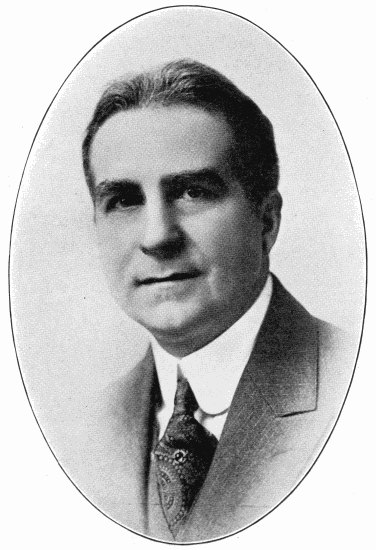
Henri Scott.
HENRI SCOTT
Biographical
Henri Scott was born at Coatesville, Pa., April 8, 1876. He was intended for a business career but became interested in music, at first in an amateur way, in Philadelphia. Encouraged by local successes he went to study voice with Oscar Saenger, remaining with him for upward of eleven years. He was fortunate in making appearances with the "Philadelphia Operatic Society," a remarkable amateur organization giving performances of grand opera on a large scale. With this organization he made his first stage appearances as Ramphis in Aïda, in 1897. He had his passage booked for Europe, where he was assured many fine appearances, when he accidentally met Oscar Hammerstein, who engaged him for five years. Under this manager he made his professional début as Ramphis at the Manhattan Opera House in New York, in 1909. Hammerstein, a year thereafter, terminated his New York performances by selling out to the Metropolitan Opera Company. Mr. Scott then went to Rome, where he made his first appearance in Faust, with great success. He was immediately engaged for the Chicago Opera Company where, during three years, he sang some thirty-five different rôles. In 1911 he was engaged as a leading basso by the Metropolitan, where he remained for many seasons. He has sung on tour with the Thomas Orchestra, with Caruso and at many famous festivals. He has appeared with success in over one hundred cities in the United States and Canada. In response to many offers he went into vaudeville, where he has sung to hundreds of thousands of Americans, with immense success. Mr. Scott is therefore in a position to speak of this new and interesting phase of bringing musical masterpieces to "the masses."
THE SINGER'S LARGER MUSICAL PUBLIC
HENRI SCOTT
Like every American, I resent the epithet, "the masses," because I have always considered myself a part of that mysterious unbounded organization of people to which all democratic Americans feel that they belong. One who is not a member of the masses in America is perforce a "snob" and a "prig." Possibly one of the reasons why our republic has survived so many years is that all true Americans are aristocratic, not in the attitude of "I am as good as everyone," but yet human enough to feel deep in their hearts, "Any good citizen is as good as I."
Why Grand Opera is Expensive
Music in America should be the property of everybody. The talking machines come near making it that, if one may judge from the sounds that come from half the homes at night. But the people want to hear the best music from living performers "in the flesh." At the same time, comparatively, very few can pay from two to twenty dollars a seat to hear great opera and great singers. The reason why grand opera costs so much is that the really fine voices, with trained operatic experience, are very, very few; and, since only a few performances are given a year, the price must be high. It is simply the law of supply and demand.
There are, in America, two large grand opera companies and half a dozen traveling ones, some of them very excellent. There are probably twenty large symphony orchestras and at least one hundred oratorio societies of size. To say that these bodies and others purveying good music, reach more than five million auditors a year would possibly be a generous figure. But five million is not one-twentieth of the population of America. What about the nineteen-twentieths?
On the other hand, there are in America between two and three thousand good vaudeville and moving picture houses where the best music in some form is heard not once or twice a week for a short season, but several times each day. Some of the moving picture houses have orchestras of thirty-five to eighty men, selected from musicians of the finest ability, many of whom have played in some of the greatest orchestras of the world. These orchestras and the talking machines are doing more to bring good music to the public than all the larger organizations, if we consider the subject from a standpoint of numbers.
A Revolution in Taste
The whole character of the entertainments in moving picture and vaudeville theaters has been revolutionized. The buildings are veritable temples of art. The class of the entertainment is constantly improving in response to a demand which the business instincts of the managers cannot fail to recognize. The situation is simply this: The American people, with their wonderful thirst for self-betterment, which has brought about the prodigious success of the educational papers, the schools and the Chautauquas, like to have the beautiful things in art served to them with inspiriting amusement. We, as a people, have been becoming more and more refined in our tastes. We want better and better things, not merely in music, but in everything. In my boyhood there were thousands of families in fair circumstances who would endure having the most awful chromos upon their walls. These have for the most part entirely disappeared except in the homes of the newest aliens. It is true that much of our music is pretty raw in the popular field; but even in this it is getting better slowly and surely.
If in recent years there has been a revolution in the popular taste for vaudeville, B. F. Keith was the "Washington" of that revolution. He understood the human demand for clean entertainment, with plenty of healthy fun and an artistic background. He knew the public call for the best music and instilled his convictions in his able followers. Mr. Keith's attitude was responsible for the signs which one formerly saw in the dressing rooms of good vaudeville theaters, which read:
Profanity of any kind, objectionable or suggestive remarks, are forbidden in this theater. Offenders are liable to have the curtain rung down upon them during such an act.
Fortunately these signs have now disappeared, as the actors have been so disciplined that they know that a coarse remark would injure them with the management.
Vaudeville is on a far higher basis than much so-called comic opera. Some acts are paid exceedingly large sums. Sarah Bernhardt received $7000.00 a week; Calve, Bispham, Kocian, Carolina White and Marguerite Sylvia, accordingly.
Dorothy Jordan, Bessie Abbott, Rosa Ponselle, Orville Harold and the recent Indian sensation at the Metropolitan, Chief Caupolican, actually had their beginnings in vaudeville. In other words, vaudeville was the stepping-stone to grand opera.
Singing for Millions
Success in this new field depends upon personality as well as art. It also develops personality. It is no place for a "stick." The singer must at all times be in human touch with the audience. The lofty individuals who are thinking far more about themselves than about the songs they are singing have no place here. The task is infinitely more difficult than grand opera. It is far more difficult than recital or oratorio singing. There can be no sham, no pose. The songs must please or the audience will let one know it in a second.
The wear and tear upon the voice is much less than in opera. During the week I sing in all three and one-half hours (not counting rehearsals). When I am singing Mephistopheles in Faust I am in a theater at least six hours—the make-up alone requires at least one and one-half hours. Then time is demanded for rehearsals with the company and with various coaches.
The Art of "Putting it Over"
Thus the vaudeville singer who is genuinely interested in the progress of his art has ample time to study new songs and new rôles. In the jargon of vaudeville, everything is based upon whether the singer is able "to put the number over." This is a far more serious matter than one thinks. The audience is made up of the great public—the common people, God bless them. There is not the select gathering of musically cultured people that one finds in Carnegie Hall or the Auditorium. Therefore, in singing music that is admittedly a musical masterpiece, one must select only those works which may be interpreted with a broad human appeal. One is far closer to his fellow-man in vaudeville than in grand opera, because the emotions of the auditors are more responsive. It is intensely gratifying to know that these people want real art. My greatest success has been in Lieurance's Indian songs and in excerpts from grand opera. Upon one occasion my number was followed by that of a very popular comedienne whose performance was known to be of the farcical, rip-roaring type which vaudeville audiences were supposed to like above all things. It was my pleasure to be recalled, even after the curtain had ascended upon her performance, and to be compelled to give another song as an encore. The preference of the vaudeville audience for really good music has been indicated to me time and again. But it is not merely the good music that draws: the music must be interpreted properly. Much excellent music is ruined in vaudeville by ridiculous renditions.
How to Get an Engagement
Singers have asked me time and again how to get an engagement. The first thing is to be sure that you have something to sell that is really worth while. Think of how many people are willing to pay to hear you sing! The more that they are willing to pay, the more valuable you are to the managers who buy your services. Therefore reputation, of course, is an important point to the manager. An unknown singer can not hope to get the same fee as the celebrated singer no matter how fine the voice or the art. Mr. E. Falber and Mr. Martin Beck, who have been responsible for a great many of the engagements of great artists in vaudeville and who are great believers in fine music in vaudeville, have, through their high position in business, helped hundreds. But they can not help anyone who has nothing to sell.
The home office of the big vaudeville exchange is at Forty-seventh and Broadway, N.Y., and it is one of the busiest places in the great city. Even at that, it has always been a mystery to me just how the thousands of numbers are arranged so that there will be as little loss as possible for the performers; for it must be remembered that the vaudeville artists buy their own stage clothes and scenery, attend to their transportation and pay all their own expenses; unless they can afford the luxury of a personal manager who knows how to do these things just a little better.
The singer looking for an engagement must in some way do something to gain some kind of recognition. Perhaps it may come from the fact that the manager of the local theater in her town has heard her sing, or some well-known singer is interested in her and is willing to write a letter of introduction to someone influential in headquarters. With the enormous demands made upon the time of the "powers that be," it is hardly fair to expect them to hear anyone and everyone. With such a letter or such an introduction, arrange for an audition at the headquarters in New York. Remember all the time that if you have anything really worth while to sell the managers are just as anxious to hear you as you are to be heard. There is no occasion for nervousness.
Excellent Conditions
Sometimes the managers are badly mistaken. It is common gossip that a very celebrated opera singer sought a vaudeville engagement and was turned down because of the lack of the musical experience of the manager, and because she was unknown. If he wanted her to-day his figure would have to be several thousand dollars a week.
The average vaudeville theater in America is far better for the singer, in many ways, than many of the opera houses. In fact the vaudeville theaters are new; while the opera houses are old, and often sadly run down and out of date. Possibly the finest vaudeville theater in America is in Providence, R. I., and was built by E. F. Albee. It is palatial in every aspect, built as strong and substantial as a fort, and yet as elegant as a mansion. It is much easier to sing in these modern theaters made of stone and concrete than in many of the old-fashioned opera houses. Indeed, some of the vaudeville audiences often hear a singer at far better advantage than in the opera house.
The singer who realizes the wonderful artistic opportunities provided in reaching such immense numbers of people, who will understand that he must sing up to the larger humanity rather than thinking that he must sing down to a mob, who will work to do better vocal and interpretative thinking at every successive performance, will lose nothing by singing in vaudeville and may gain an army of friends and admirers he could not otherwise possibly acquire.
EMMA THURSBY
Biographical
Emma Thursby was born in Brooklyn, N. Y., and studied singing with Julius Meyers, Achille Errani, Mme. Rudersdorf, Lamperti (elder), San Giovanni and finally with Maurice Strakosch. She began her career as a church singer in New York and throngs went to different New York churches to hear her exquisitely mellow and beautiful voice. For many years she was the soprano of the famous Plymouth Church when Henry Ward Beecher was the pastor. Her voice became so famous that she went on a tour with Maurice Strakosch for seven years, in Europe and America, everywhere meeting with sensational success. Later she toured with the Gilmore Band and with the Thomas Orchestra. She became as popular in London and in Paris as in New York. Her fame became so great that she finally made a tour of the world, appearing with great success even in China and Japan.
Emma Thursby.
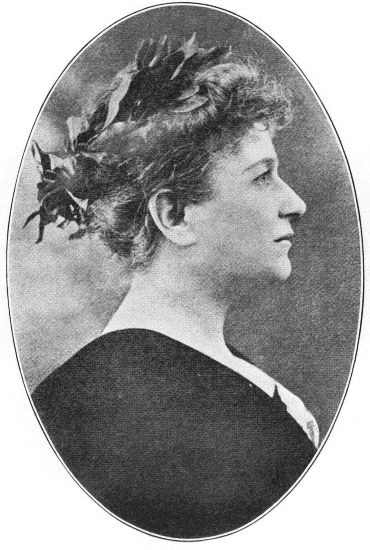
SINGING IN CONCERT AND WHAT IT MEANS
EMMA THURSBY
Although conditions have changed very greatly since I was last regularly engaged in making concert tours, the change has been rather one of advantage to young singers than one to their disadvantage. The enormous advance in musical taste can only be expressed by the word "startling." For while we have apparently a vast amount of worthless music being continually inoculated into our unsuspecting public, we have, nevertheless, a corresponding cultivation of the love for good music which contributes much to the support of the concert singer of the present day.
The old time lyceum has almost disappeared, but the high-class song recital has taken its place and recitals that would have been barely possible years ago are now frequently given with greatest financial and artistic success. Schumann, Franz, Strauss, Grieg and MacDowell have conquered the field formerly held by the vapid and meaningless compositions of brainless composers who wrote solely to amuse or to appeal to morbid sentimentality.
The conditions of travel, also, have been greatly improved. It is now possible to go about in railroad cars and stop at hotels, and at the same time experience very little inconvenience and discomfort. This makes the career of the concert artist a far more desirable one than in former years. Uninviting hotels, frigid cars, poorly prepared meals and the lack of privacy were scarcely the best things to stimulate a high degree of musical inspiration.
Health
Nevertheless, the girl who would be successful in concert must either possess or acquire good health as her first and all-essential asset. Notwithstanding the marvelous improvement in traveling facilities and accommodations, the nervous strain of public performance is not lessened, and it not infrequently happens that these very facilities enable the avaricious manager to crowd in more concerts and recitals than in former years, with the consequent strain upon the vitality of the singer.
Of course, the singer must also possess the foundation for a good natural voice, a sense of hearing capable of being trained to the keenest perception of pitch, quality, rhythm and metre, an attractive personality, a bright mind, a good general education and an artistic temperament—a very extraordinary list, I grant you, but we must remember that the public pays out its money to hear extraordinary people and the would-be singer who does not possess qualifications of this description had better sincerely solicit the advice of some experienced, unbiased teacher or singer before putting forth upon the musical seas in a bark which must meet with certain destruction in weathering the first storm. The teacher who consciously advises a singer to undertake a public career and at the same time knows that such a career would very likely be a failure is beneath the recognition of any honest man or woman.
The Singer's Early Training
The education of the singer should not commence too early, if we mean by education the training of the voice. If you discover that a child has a very remarkable voice, "ear" and musical intelligence you had better let the voice alone and give your attention to the general musical education of the child along the lines of that received by Madame Sembrich, who is a fine violinist and pianist. So few are the teachers who know anything whatever about the child-voice, or who can treat it with any degree of safety, that it is far better to leave it alone than to tamper with it. Encourage the child to sing softly, sweetly and naturally, much as in free fluent conversation, telling him to form the habit of speaking his tones forward "on the lips" rather than in the throat. If you have among your acquaintances some musician or singer of indisputable ability and impeccable honor who can give you disinterested advice have the child go to this friend now and then to ascertain whether any bad and unnatural habits are being formed. Of course we have the famous cases of Patti and others, who seem to have sung from infancy. I have no recollection of the time when I first commenced to sing. I have always sung and gloried in my singing.
See to it that your musical child has a good general education. This does not necessarily mean a college or university training. In fact, the amount of music study a singer has to accomplish in these days makes the higher academic training apparently impossible. However, with the great musical advance there has come a demand for higher and better ordered intellectual work among singers. This condition is becoming more and more imperative every day. At the same time you must remember also that nothing should be undertaken that might in any way be liable to undermine or impair the child's health.
When to Begin Training
The time to begin training depends upon the maturity of the voice and the individual, considered together with the physical condition of the pupil. Some girls are ready to start voice work at sixteen, while others are not really in condition until a somewhat older age. Here again comes the necessity for the teacher of judgment and experience. A teacher who might in any way be influenced by the necessity for securing a pupil or a fee should be avoided as one avoids the shyster lawyer. Starting vocal instruction too early has been the precipice over which many a promising career has been dashed to early oblivion.
In choosing a teacher I hardly know what to say, in these days of myriad methods and endless claims. The greatest teachers I have known have been men and women of great simplicity and directness. The perpetrator of the complicated system is normally the creator of vocal failures. The secret of singing is at once a marvelous mystery and again an open secret to those who have realized its simplicity. It cannot be altogether written, nor can it be imparted by words alone. Imitation undoubtedly plays an important part, but it is not everything. The teacher must be one who has actually realized the great truths which underlie the best, simplest and most natural methods of securing results and who must possess the wonderful power of exactly communicating these principles to the pupil. A good teacher is far rarer than a good singer. Singers are often poor teachers, as they destroy the individuality of the pupil by demanding arbitrary imitation. A teacher can only be judged by results, and the pupil should never permit herself to be deluded by advertisements and claims a teacher is unable to substantiate with successful pupils.
Habits of Speech, Poise and Thinking
One of the deep foundation piers of all educational effort is the inculcation of habits. The most successful voice teacher is the one who is most happy in developing habits of correct singing. These habits must be watched with the persistence, perseverance and affectionate care of the scientist. The teacher must realize that the single lapse or violation of a habit may mean the ruin of weeks or months of hard work.
One of the most necessary habits a teacher should form is that of speaking with ease, naturalness and vocal charm. Many of our American girls speak with indescribable harshness, slovenliness and shrillness. This is a severe tax upon the sensibilities of a musical person and I know of countless people who suffer acute annoyance from this source. Vowels are emitted with a nasal twang or a throaty growl that seem at times most unpardonable noises when coming from a pretty face. Consonants are juggled and mangled until the words are very difficult to comprehend. Our girls are improving in this respect, but there is still cause for grievous complaint among voice teachers, who find in this one of their most formidable obstacles.
Another common natural fault, which is particularly offensive to me, is that of an objectionable bodily poise. I have found throughout my entire career that bodily poise in concert work is of paramount importance, but I seem to have great difficulty in sufficiently impressing this great truth upon young ladies who would be singers. The noted Parisian teacher, Sbriglia, is said to require one entire year to build up and fortify the chest. I have always felt that the best poise is that in which the shoulders are held well back, although not in a stiff or strained position, the upper part of the body leaning forward gently and naturally and the whole frame balanced by a sense of relaxation and ease. In this position the natural equilibrium is not taxed, and a peculiar sensation of non-constraint seems to be noticeable, particularly over the entire area of the front of the torso. This position suggests ease and an absence of that military rigidity which is so fatal to all good vocal effort. It also permits of a freer movement of the abdominal walls, as well as the intercostal muscles, and is thus conducive to the most natural breathing. Too much anatomical explanation is liable to confuse the young singer, and if the matter of breathing can be assisted by poise, just so much is gained.