Volume 7 — ARTISTS AND AUTHORS (continued 6)
Reading edition
In 1813 Carlyle's attendance at the Arts course in Edinburgh University came to an end, and he began formal, though fitful, preparation for the ministry of the Church of Scotland by enrolling himself, on November 16th of the same year, as a student at its Divinity Hall. In the summer of 1814 he competed successfully at Dumfries for the mathematical mastership of Annan Academy. The post was worth only between £60 and £70 a year; but it enabled Carlyle, who was as frugal as his parents, to relieve his father of the expense of his support, and to save a few pounds. Meanwhile he read widely, and wrote of his reading at great length, and with considerable power of satiric characterization, to some of his college friends. But he found himself "abundantly lonesome, uncomfortable, and out of place" in Annan, and from the first disliked teaching; while his "sentiments on the clerical profession" were "mostly of the unfavorable kind."
In 1816 Carlyle accepted the post of assistant to the teacher of the parish (or grammar) school of Kirkcaldy, with "an emolument rated about a hundred a year," and all actual scholastic duties to perform. This change brought him into intimate relations with Edward Irving, who, having acquired a reputation as a teacher in Haddington, had been induced by the patrons of an adventure school, in Kirkcaldy, to undertake the management of it. The two, though professionally rivals, became fast friends, and read and made excursions into different parts of Scotland together. Carlyle was also introduced by Irving to various Kirkcaldy families, including that of Mr. Martin, the parish minister, one of whose daughters his friend subsequently married. He himself became attached to an ex-pupil of Irving's, a Miss Margaret Gordon, with some of whose graces he afterward endowed the dark and fickle Blumine, of "Sartor Resartus." She reciprocated Carlyle's affection, but the aunt with whom she lived put a stop to some talk of an engagement.
Carlyle found the people of Kirkcaldy more to his mind than those of Annan; but in two years the work of teaching became altogether intolerable to him, although he did it conscientiously. Successful opposition sprung up to Irving and himself, moreover, in the shape of a third school. Irving resolved to leave Kirkcaldy, and, in September, 1818, Carlyle wrote to his father, who had now given up business in Ecclesfechan and taken the farm of Mainhill, about two miles distant, that, having saved about £70, he purposed removing to Edinburgh, where he thought he "could," perhaps, find private teaching to support him, till he could fall into some other way of doing. He had now totally abandoned all thoughts of entering the ministry.
Carlyle removed to Edinburgh in November, 1818. His prospects were for some time dubious; he even entertained the idea of emigrating to America. Ultimately, however, he obtained fairly regular and well-paid private teaching. An introduction to Dr. (afterward Sir David) Brewster, the editor of the "Edinburgh Encyclopædia," led to his writing articles, chiefly biographical and geographical, for that work, at "bread-and-butter wages," and subsequently to his translating Legendre's "Elements of Geometry" from the French for £50. At the beginning of the session of 1819, he enrolled in the class of Scots Law, with the intention of becoming an advocate. But he found law as uncongenial a study as divinity. Till 1822 he lived in various lodgings in Edinburgh, finding his chief relief from tutorial drudgery in visits to his parents in Dumfriesshire. His health, which had suffered from too close application to study, was at times "most miserable;" he was in a low fever for two weeks, "was harassed by sleeplessness," and began to be tortured by his life-long foe, dyspepsia. At the same time his mind was perplexed with doubt on religious matters, regarding which he seems to have unburdened himself solely to Irving, who was then assistant to Dr. Chalmers, in Glasgow. For a period he was "totally irreligious." This struggle terminated in June, 1821, "all at once," and when he was walking along Leith Walk (the Rue St. Thomas de l'Enfer of "Sartor Resartus"), in what he regarded as his "spiritual new birth." He was now absorbed in German literature, especially the writings of Schiller and Goethe. The latter, indeed, had a more abiding influence on him than any other author.
In June, 1821, also, occurred his introduction, through Irving, to Miss Jane Baillie Welsh (1801-66), only daughter of Dr. John Welsh, medical practitioner in Haddington, who had died two years before, leaving his daughter sole heiress of the small estate of Craigenputtock, sixteen miles from the town of Dumfries. Miss Welsh, who was descended through her father from John Knox, was then living in Haddington with her mother, who claimed kindred with the patriot Wallace, and, according to Carlyle, "narrowly missed being a woman of genius." Miss Welsh had been the private pupil of Irving when he was a teacher in Haddington, and the result of the acquaintance thus brought about was a passionate attachment. They would, indeed, have been married, but for Irving's engagement to Miss Martin. The introduction of Carlyle to Miss Welsh, then twenty years of age, led to a correspondence between them on literary matters. After a time, Carlyle attempted to adopt the tone of a lover. This, however, she peremptorily forbade, although she refused other suitors.
Early in 1822, Irving, who was on the point of entering on the pastorate of the Caledonian Chapel, in Hatton Garden, London, recommended Carlyle as tutor to the three sons of Mr. Buller, a retired Anglo-Indian. The salary offered was £200 a year. Carlyle, who had previously declined the editorship of a Dundee newspaper, accepted the offer; and two of the three, Charles Duller and Arthur, came to Edinburgh in the spring, to be under his care while attending classes at the university. Carlyle found his duties pleasant, and was now able to give substantial pecuniary aid to his family, particularly as regarded the education of his younger brother John, who subsequently became a physician, but is better known as the translator of Dante's "Inferno" (1849). Carlyle, after contemplating a history of the British commonwealth, and a novel in association with Miss Welsh, arranged to write a "Life of Schiller" for Mr. Taylor, the proprietor of the London Magazine, and a translation of the "Wilhelm Meister" of Goethe for Mr. Boyd, an Edinburgh publisher. These two enterprises fully occupied his leisure while he was engaged as a tutor to the Bullers, whose parents, after spending the winter of 1822 in Edinburgh, removed in the following spring to Kinnaird House, near Dunkeld, on the Tay.
Carlyle paid his first visit to London in June, 1824, whither the Bullers had gone, and although his engagement with them was abruptly broken off, he remained there till March, 1825, superintending the publication in book form of his "Life of Schiller." At this time he received the first of a series of letters from Goethe and made the acquaintance of Coleridge, Thomas Campbell, Allan Cunningham, Proctor, and other literary notabilities. On March 26, 1825, he removed to the farm of Hoddam Hill, about two miles from Mainhill, which he had leased; his brother Alexander doing the practical work of farming, while he himself translated German romances. Miss Welsh now consented to become his wife, after a lengthened correspondence. In 1826 he quarrelled with his landlord, his father gave up his farm, and both removed to Scotsbrig, another farm in the vicinity of Ecclesfechan. The marriage between Carlyle and Miss Welsh took place on October 17, 1826, at her grandfather's house at Templand, Dumfriesshire, and they at once settled in 21 Comely Bank, Edinburgh. Here Carlyle completed four volumes of translations from Tieck, Musaeus, and Richter, which were published under the title of "German Romance," and commenced a didactic novel, but burned his manuscript. An introduction from Proctor to Jeffrey led to his becoming a contributor to the Edinburgh Review, his first article, on Jean Paul Richter, appearing in June, 1827. The same year he failed in his candidature for the chair of moral philosophy in the University of St. Andrews, in succession to Dr. Chalmers. Various subsequent attempts to obtain an academic position for Carlyle met with no better success.
In May, 1828, the Carlyles removed to Mrs. Carlyle's little property of Craigenputtock, which, in a letter to Goethe, he described as "the loneliest nook in Britain, six miles removed from anyone likely to visit me," and there they lived for about six years. Carlyle subsisted during this period by writing for a number of reviews, including the Edinburgh, the Westminster, the Foreign Quarterly, and Fraser's Magazine. The chief of the essays which he produced at Craigenputtock are those on Burns, Samuel Johnson, Goethe, Voltaire, Diderot, and Schiller. He also wrote a "History of German Literature," the best parts of which were subsequently published in the form of essays; and in 1833-34 there appeared, by instalments in Fraser's Magazine, "Sartor Resartus," his most characteristic work, the fantastic hero of which, Diogenes Teufelsdröckh, illustrates in his life and opinions the mystical and grotesque "Philosophy of Clothes." "Sartor Resartus" is notable in the literary history of Carlyle as revealing the Germanization of his mind, and his abandonment of the comparatively simple diction of his earlier essays for the thoroughly individual style of his later works—eruptive, ejaculatory, but always powerful, and often rising to an epic sublimity. Life at Craigenputtock was varied on the part of Carlyle by occasional visits to Edinburgh, in one of which the idea of writing his "French Revolution" occurred to him; by a residence of six months in London, during which he made the acquaintance of John Stuart Mill and John Sterling; and by visits from old friends like Jeffrey, and new admirers like Emerson. In 1830 Carlyle was reduced to great straits; and he had to borrow £50 from Jeffrey for the expenses of his journey to London, although he declined to accept an annuity of £100 from the same source.
Having by 1834 again saved £200, Carlyle resolved to try his fortune in London, and on June 10th established himself in the house, 5 Cheyne Row, Chelsea, in which he lived till the day of his death. Here he settled down to the writing of his "French Revolution," which appeared in 1837. This enterprise was also put an end to in 1835, owing to the destruction, by a servant-girl, of all but four or five leaves of the manuscript of the first volume, which had been lent to John Stuart Mill. Carlyle accepted £100 from Mill as compensation for his loss.
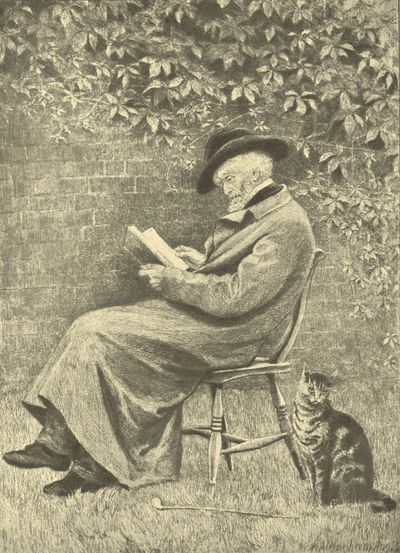
Carlyle at Chelsea.
In the years 1837, 1838, 1839, and 1840, Carlyle lectured to considerable, yet select, audiences on "German Literature," "The Successive Periods of European Culture," "The Revolutions of Modern Europe," and "Heroes, Hero-worship, and the Heroic in History." Carlyle's yearly earnings from these lectures, the last series of which had been published, varied between £135 and £300, and maintained him and his wife till the "French Revolution" not only established his reputation as a literary genius of the highest order, and as, in Goethe's phrase, "a new moral force," but placed him beyond the possibility of want. Yet, until late in life, his annual income from literature was not more than £400. In 1838 appeared "Sartor Resartus" in book form, and the first edition of his "Miscellanies." The following year, Carlyle, who was at one time averse to the idea of becoming a personal force in politics, published the first of a series of attacks on the shams and corruptions of modern society, under the title of "Chartism." This he followed in 1843 with "Past and Present," and in 1850 with "Latter-day Pamphlets," which proved among other things that, if he did not quite approve of slavery, he disapproved of the manner in which it had been abolished in the British dominions. In 1845 appeared "Cromwell's Letters and Speeches," perhaps the most successful of all his works, inasmuch as it completely revolutionized the public estimate of its subject. In 1851 he published a biography of his friend, John Sterling. From this time Carlyle gave himself up entirely to his largest work, "The History of Frederick II., commonly called Frederick the Great," the first two volumes of which were published in 1858, and which was concluded in 1865. The preparation of this book led Carlyle to make two excursions to the Continent, which, with a yachting trip to Ostend, two tours in Ireland (on which he intended to write a book based on a diary that was published after his death), and regular visits to his kindred and friends in Scotland, formed the chief distractions from his literary labors. Among the few public movements with which Carlyle identified himself was that which resulted in the establishment of the London Library, in 1839. In August, 1866, he also allowed himself to be elected chairman of the committee for the defence of Mr. Eyre, who had been recalled from his post of Governor of Jamaica on the ground of his having shown unnecessary severity in suppressing a negro insurrection which had broken out in October of the previous year, or, as Carlyle put it, for having "saved the West Indies and hanged one incendiary mulatto, well worth the gallows."
On November 11, 1865, Carlyle was elected lord rector of Edinburgh University, by a majority of 657 votes over 310 recorded for Mr. Disraeli. On April 2, 1866, the ceremony of his installation took place amid extraordinary demonstrations of enthusiasm, when he delivered an address in which he embodied his moral experiences in the form of advice to the younger members of his audience. The success attending this visit to Edinburgh was quite obliterated by the news, which reached him in Dumfries, of the death, on April 21st, of Mrs. Carlyle, as she was driving in her carriage in Hyde Park. Carlyle's grief developed into remorse when he discovered, from certain of her letters, and from a journal which she kept, that during a period of her married life his irritability of temper and unconscious want of consideration for her wishes, had caused her much misery and even ill-health, which she studiously concealed from him. It has also been demonstrated, by the letters and memorials of Jane Welsh Carlyle, that in the years 1855 and 1856 they were somewhat estranged, owing to Carlyle's liking for the society of Harriet, Lady Ashburton. After the death of Lady Ashburton, there were no differences between them, except such as might be expected in the case of two persons of irritable and high-strung natures, and of uncompromising veracity. These memorials are also of note as proving Mrs. Carlyle to have been one of the keenest critics, most brilliant letter-writers, and most accomplished of women of her time.
Carlyle wrote no important work after his wife's death, although after a visit to Mentone in 1867, where he partially composed his "Personal Reminiscences," he settled down to his old life in London. In August, 1867, there appeared in Macmillan's Magazine his view of British democracy, under the title of "Shooting Niagara." He prepared a special edition of his collected works, and added to them, in 1875, a fresh volume containing "The Early Kings of Norway" and an essay on the "Portraits of John Knox." On November 18, 1870, he wrote a letter to the Times on the "Franco German Question," defending the attitude of Germany. He expressed privately strong opposition to the Irish policy of Mr. Gladstone. In February, 1874, he was offered and accepted the Prussian Order of Merit in recognition of his having written the "Life of Frederick the Great," who founded the Order. Toward the end of the same year Mr. Disraeli offered him the Grand Cross of the Bath (with the alternative of a baronetcy) and a pension of "an amount equal to a good fellowship," but he declined both.
His eightieth birthday, December 4, 1875, brought Carlyle many tributes of respect, including a gold medal from a number of Scottish admirers, and "a noble and most unexpected" note from Prince Bismarck. On May 5, 1877, he published a short letter in the Times, referring to a rumor that Mr. Disraeli, as Premier, meditated forcing on a "Philo-Turk war against Russia," and protesting against any such design. This was his last public act. On February 5, 1881, he died at his house in Chelsea. A burial in Westminster Abbey was offered, but in accordance with his own wish, he was laid in the churchyard of Ecclesfechan, beside his kindred.
The time has not yet come for the passing of a final judgment on Carlyle's position in British literature. He was, above all things, a prophet in the guise of a man of letters, who predicted the reverse of smooth things for his country and for the world; and it has yet to be seen if his predictions will be fulfilled. But it may be said even now, and without risk of contradiction, that, for good or evil, he exerted a greater influence on British literature during the middle of the nineteenth century, and, through that literature, on the ethical, religious, and political beliefs of his time, than any of his contemporaries; that, as a humorist, using humor seriously and as a weapon for the enforcement of his opinions, he has no superior, combining in himself what is best in Dunbar, Burns, Rabelais, and Swift; that, as a master of the graphic in style, he has no rival and no second—showing an equal facility in photographing nature, and in grasping and presenting in appropriate phraseology the salient points of personal character as exhibited in expression, habits, features, build, and dress.
Of Carlyle as a man, it is also permissible to say that, irritable, impatient, intolerant, fiercely proud, occasionally hasty in his judgments though he was, preserving to the last, nor caring to get rid of, certain Scottish and Annandale rusticities of manner and mental attitude, no one was ever more essentially self-controlled, patient, and humble than he, or ever faced the real misfortunes of life with a calmer courage; that he was as incapable of conscious injustice, unkindliness, or vindictiveness, as he was of insincerity or impurity; that in pecuniary straits, even in despair, he never wrote a line that he did not believe, never swerved by a hair's breadth from the noble purposes which dominated his life and extinguished all selfish ambition.
The following letter was written by Carlyle, in 1876, to a young man who had asked his advice on the choice of a profession:
"Dear Sir,—I respect your conscientious scruples in regard to choosing a profession, and wish much I had the power of giving you advice that would be of the least service. But that, I fear, in my total ignorance of yourself and the posture of your affairs, is pretty nearly impossible. The profession of the law is in many respects a most honorable one, and has this to recommend it, that a man succeeds there, if he succeeds at all, in an independent and manful manner, by force of his own talent and behavior, without needing to seek patronage from anybody. As to ambition, that is, no doubt, a thing to be carefully discouraged in oneself; but it does not necessarily inhere in the barrister's profession more than in many others, and I have known one or two who, by quiet fidelity in promoting justice, and by keeping down litigation, had acquired the epithet of the 'honest lawyer,' which appeared to me altogether human and beautiful.
"Literature, as a profession, is what I would counsel no faithful man to be concerned with, except when absolutely forced into it, under penalty, as it were, of death. The pursuit of culture, too, is in the highest degree recommendable to every human soul, and may be successfully achieved in almost any honest employment that has wages paid for it. No doubt, too, the church seems to offer facilities in this respect; but I will by no means advise you to overcome your reluctance against seeking refuge there. On the whole, there is nothing strikes me likelier for one of your disposition than the profession of teacher, which is rising into higher request every day, and has scope in it for the grandest endowments of human faculties (could such hitherto be got to enter it), and of all useful and fruitful employments may be defined as the usefullest, fruitfullest, and also indispensablest in these days of ours.
"Regretting much that I can help you so infinitely little, bidding you take pious and patient counsel with your own soul, and wishing you with great truth a happy result, I remain, dear sir,
"Faithfully yours,
"T. Carlyle."[Back to Contents]
VICTOR HUGO By Margaret O. W. Oliphant (1802-1885)
The greatest of literary Frenchmen, the greatest man of genius whom this century has known, the Altissimo Poeta, the most splendid romancist of his age, has accomplished his great career. He was the last survivor of a great period in French literature—the last member of one of the greatest literary brotherhoods which has ever existed; and he carried with him to the very portals of the grave a lamp of genius scarcely dimmed, and a personal power and influence which every year increased. Not very long ago, all Europe gathered round him to offer congratulations on his hale and hearty old age; since then, with more than the hands full of flowers of the classic tradition, with honors and praises from every quarter of the earth, he has been carried to his grave. The very sight of a man so distinguished, the consciousness of his honored existence as the representative of the noblest and most all-embracing of the arts—that which depends for its effects upon the simplest and most universal of instincts—was an advantage to the world. The extravagances of hero-worship are inevitable, and in nothing is the ridiculous so tremblingly near to the sublime; but allowing for all that, and for what is worse, the almost equally inevitable foolishness which adulation creates, the position of Victor Hugo was of itself an advantage to the world. In a soberer pose altogether, and with a noble modesty which we may claim as belonging to our race, Walter Scott occupied a somewhat similar position—which would have been all the greater had he lived to Hugo's age, an element which must necessarily be taken into consideration; but, save in this one case, there has been no parallel to the eminence of the great Frenchman in the estimation of his country and of the world.
It is not now that the critic requires to step forth to establish the foundations of this great fame, or decide upon its reality or lasting character. This has been done in the poet's lifetime by a hundred voices, favorable and otherwise; no need to wait for death to give the final decision, as in some cases has been necessary. It is scarcely possible to imagine that, after so long a time, any discovery can be made, or any change of taste occur, which would interfere with the supreme position of Victor Hugo. A new generation has been born in the faith which to their elders is a matter of assured and triumphant conviction. But it is a grateful office to go over again some of the noblest productions which human genius has ever given forth, and to contemplate in their unity the many works of a life as much longer than that of ordinary men as its inspiration was above theirs.
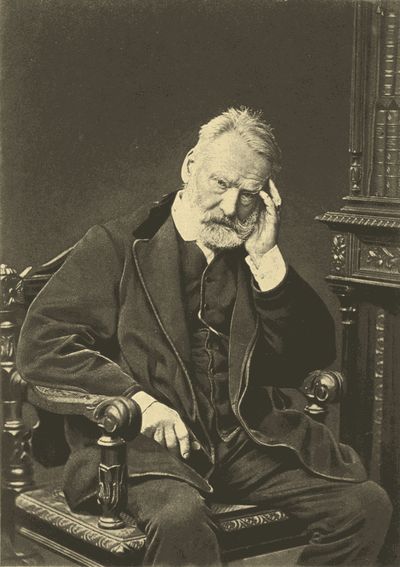
Victor Hugo.
It seems sad and strange, as well as laughable and ludicrous, that the great poet should be regarded by a vast number of his countrymen, and perhaps by the majority of the Paris mob which paid him the last honors in so characteristic a way, as a revolutionary politician and a democratic leader. We will take the privilege of the foreigner to leave out that side of his life as much as may be practicable. "Napoléon le Petit" and the "Histoire d'un Crime" are works but little worthy of his genius. Political animosities, sharpened by personal grievances, have in many cases an immense immediate effect in literature, but they pay for this easy success by speedy collapse; and scarcely even the magnificent rhetoric and splendid vituperation of "Les Châtiments" will keep them living when the world has forgotten the lesser Napoleon, as it already begins to do. His patriotic fury, the impassioned utterances of his exile, the tremendous force of feeling with which he flung himself into the struggles of France, took up a large share of Victor Hugo's life, and will procure him a certain place in the historical records of his period. But when all the commotion and the din have died away, as indeed in a great measure they have already done, these fiery diatribes, these burning lava-streams, will be of little more importance than the dustiest "mémoires pour servir"—materials from which the historian, with much smoothing down and apologies for the pyrotechnics of a past age, will take here and there a vivid touch to illustrate his theories or brighten his narrative. They will retain, too, a certain importance as autobiography. But fortunately the great mass of the work which Victor Hugo has left behind him can be separated from the polemics of his troubled age and fiery temper. It is not in any sense a peaceful literature. Conflict is its very inspiration. The struggle of human misery with all the confusing and overbearing forces of life; of poverty with the requirements and oppressions of wealth; of the small with the great; of the people with tyrants; of Man with Fate—these are his subjects, and he is never an impartial historian. He is on the side of the weak in every combat, the partisan of the oppressed. But this does not detract from his work when his opponents are the oppressors of the past, or the still more subtle, veiled, and unassailable forces of Destiny. The poet's region is there: he is born, if not to set right the times which are out of joint, at least to read to the world the high and often terrible lesson of the ages. But it vulgarizes his work when he is seen, tooth and nail, in violent personal conflict with foemen unworthy of his steel, embalming in poetry the trivial or the uncompleted incidents of contemporary warfare. It becomes almost ludicrous, indeed, when we find him pouring forth page after page of vehement and burning complaint in respect to the personal sufferings inflicted on himself, when we know that throughout his career Hugo never knew what the cold shock of failure was, and that, from the moment when Chateaubriand adopted him into the ranks of the poets as l'enfant sublime, until the moment when all Paris conducted him to his last resting-place, no man has had a more enthusiastic following, or accomplished a more triumphant career.
Victor Hugo was a son of the Revolution. He was born, as it were, between the two camps, at a moment when France was the theatre of the greatest popular struggle in modern history, of a mother who was a Breton and a Legitimist, and a father who was a Republican general—an extraordinary combination. This does not seem, however, to have made, as we might think, family life impossible, for Madame Hugo and her children followed the drum, and, notwithstanding all differences of opinion, found it possible to keep together. He was educated, it would appear, under his mother's influence rather than that of the soldier-father, and did not, till his mind was quite mature, throw himself into the revolutionary opinions which afterward influenced him so greatly. A Royalist in the Restoration period, an observant but not excited spectator of public affairs from 1830 to 1848, it was not till the coup d'état and the beginning of the reign of the third Napoleon that he was seized with the passion of political life. That great betrayal seems to have stung him to a frenzied resistance and put poison in his veins. His country was cheated and betrayed; the liberty for which she had made so many exertions, both heroic and fantastical, taken from her; and his own personal liberty and safety threatened. Victor Hugo's soul then burst into feu et flamme. He caught fire like a volcano long silent, a burning mountain that had simulated quiet unawares, and clothed itself with vineyards and villages. In the tranquil days when Louis-Philippe plotted and pottered, and France lay dormant, amusing her restrained spirit with the outbreak of the romantic against the classical, and taking pleasure in the burst of genius which had arisen suddenly and unawares in her midst, the poet was so little dissatisfied with the bourgeois régime that he accepted the title of "pair de France." Montalembert had received it some time before. There must have been something soothing, not inharmonious to the poetical mind, in the slumbrous reign which gradually became intolerable to the commonalty and got itself into contempt with all the world. The young poets of the time were peaceful, not discontented. Full of energy as they were, they took no part in the gathering storm. Hugo, a peer, tranquil in the superior chamber; young De Musset, a courtier of the Duke of Orleans, and hoping for the king's notice of his verses. The eruption was preparing, the subterranean fires alight; but the sons of genius took no notice. When the tremendous awakening came, it must, in the case of Hugo at least, have gained additional force from the long restraint. He was in the height of life, a man of forty-six, the leader of the romantic school, which by that time had overcome opposition and won the freedom for which it contended, the author of "Hernani" and the other great plays which form one of his chief titles to fame, and of volumes of lyrics which had taken the very heart of the French people, and given a new development to the language. And it was also during this peaceful period that he had taken in another direction a first step of unexampled power and brilliancy in the romance of "Notre Dame." Even among men of acknowledged genius, few have done so much in a lifetime as Victor Hugo had done up to this break in his career. We are so accustomed to the attitude of demagogue which he took afterward, to the violent revolutionary, the furious exile, the denunciatory prophet of the "Châtiments," that it is strange to realize that his later aspect was prefaced by a long, peaceful, and prosperous beginning. France had never seen a more magnificent band than that which surrounded him, and which has made the reign of the Roi-bourgeois illustrious in spite of itself; and it is curious to mark that these great intelligences did not object to their ruler nor to his ways, but lived like good citizens, with but an occasional fling at semi-sentimental politics. Hugo was the champion of abstract right in all the discussions in which he took part. He it was who proposed, among other things, that the Bonaparte family should be permitted to return to France. Perhaps, had he been less abstract and logical, and more moved by the laws of expediency, it might have been better both for France and for himself.
The plays which he produced in this time of prosperous calm and apparent peace are without question the most remarkable dramatic works of this century, and several of them will, we have no doubt, take their place permanently among the few of all ages and countries which the world will not willingly let die.
While these plays were being written, and the mind of their author reaching its full development, the fountains of pure poetry, those outbursts of song which are often the most delightful and dear of all the utterances of the poet, were flowing forth, refreshing and fertilizing French literature, and giving a noble utterance to the new thought and rising energy of the times. His youth gave forth some uncertain notes, his fancy roaming from Bourbon to Bonaparte. But that his imagination should have been seized by the recollection of the great Napoleon is so natural, so inevitable, one would suppose, for every young Frenchman, and especially for the son of a Bonapartist general, that there would have been something lacking in him had he escaped that enthusiasm. Apart from these waves of national sentiment, and from the vague music of the "Orientales" and other such preludes and symphonies, there is poetry enough in the various volumes which followed each other at uncertain intervals, to have fully furnished one man of genius with fame enough for what we call immortality. Hugo has enough and to spare for all subjects that occurred to him. A sunset, a landscape, a love song, alternate in his pages with a philosophical discussion, or a brief and brilliant scene snatched from history, from contemporary life, from his own inner existence, all clothed in the noblest verse of which the French language is capable. His power over that language is boundless, the wealth of an utterance which never pauses for a word, which disregards all rules yet glorifies them, which is ready for every suggestion, and finds nothing too terrible, nothing too tender for the tongue which, at his bidding, leaps into blazing eloquence, or rolls in clouds and thunder, or murmurs with the accent of a dove. Never had there been so great a gamut, a compass so extended.
It is not, however, upon his poetry, either in the form of drama, lyric, or narrative, that his fame out of France, or at least in England, is founded. There is no more usual deliverance of superficial criticism than that which declares French poetry in general to be either nought—which is still a not uncommon notion—or at least not great enough to be worth the study which alone could make it comprehensible. There are many good people who dare to say this, yet live, audacious, and unconscious of their folly. We have, however, to consider Victor Hugo on a ground which no one ventures to dispute. The great romances—for which we should like to invent another name—which we cannot call novels, and which are too majestic even for the title of romance, though that means something more than the corresponding word in English—are in their kind and period the greatest works produced in his time.[Back to Contents]
RALPH WALDO EMERSON By Moncure D. Conway (1803-1882)
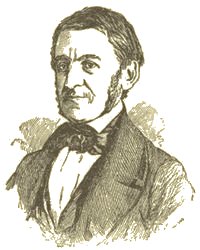
On the 30th day of April, 1882, Ralph Waldo Emerson was "gathered to his fathers," at Concord, Mass. The simple Hebrew phrase was never more appropriate, for his ancestors had founded the town and been foremost at every period of its remarkable history. More than two hundred and fifty years ago John Eliot, who had gone from the University of Cambridge, England, to be the "Apostle of the Indians," found on the banks of the Musketaquid a settlement of natives, into whose language he translated the New Testament. In 1634, the Rev. Peter Bulkeley, of Bedfordshire, whose Puritan proclivities brought him under the ban of Laud, migrated with a number of his parishioners to New England; these settled themselves at Musketaquid, which they named Concord. In the next year went, from County Durham probably, Thomas Emerson, whose son married a Bulkeley, and his grandson Rebecca Waldo, descendant of a family of the Waldenses. It was at Concord that the soldiers of George III. first met with resistance. Along the road where many Englishmen have walked with Emerson and Hawthorne, the retreat took place, and wounded soldiers were taken into homes they had invaded to learn the meaning of love to enemies. Some of these brave men never again left the village where they were so kindly nursed. Concord, with its thirteen hundred inhabitants, supplied Washington's army with wood and hay, and suffering Boston with grain and money, with a generosity that shines in American annals. Washington's headquarters were at Craigie House, so long the home of Longfellow, and the Harvard buildings being used as barracks, the university was transferred to Concord.
No mere literary estimate of Emerson's writings can adequately report the man or his work. The value placed upon him by Americans appears strangely exaggerated beside the contemporary English criticism. It were, indeed, easy to cite from European thinkers—Carlyle, Quinet, John Sterling, Arthur Clough, Tyndall, Herman Grimm—words concerning Emerson glowing as those of Margaret Fuller, Hawthorne, Curtis, Lowell, and other American authors; but if such tributes from individual minds are universally felt in America alone, to be simplest truth and soberness, it is because Emerson cannot be seen detached from the cumulative tendencies summed up in him, and from the indefinable revolution in which they found, and still find, expression.
The father of Emerson was a Unitarian preacher of fine culture, melodious voice, handsome person, and especially noted for his paramount interest in the ethical and universal element of religion. He died in 1811, at the age of forty-two, leaving his five sons, of whom Waldo, then eight years old, was the second, to the care of his young wife, who had been Ruth Haskins, of Boston. Emerson's early growth was under the fostering care of good and refined women. His mother has been described by one who knew her, the late Dr. Frothingham, as "of a discerning spirit, and a most courteous bearing; one who knew how to guide the affairs of her own house, as long as she was responsible for that, with the sweetest authority. Both her mind and character were of a superior order, and they set their stamp upon manners of peculiar softness and natural grace and quiet dignity." She was assisted in bringing up her family by her sister-in-law, Mary Emerson, a scholarly woman, well read in theology and philosophy, whose original ideas and sayings marked her as "a character." Another woman who exercised a great influence upon him was Sarah Bradford, afterward married to his relative, Samuel Ripley. She was as thorough a Greek scholar as any person in America, a good mathematician, and a diligent student of science. Many a Harvard student has she coached in that Old Manse where she resided until her death (1867), and where the writer of this has often listened with admiration to her extraordinary conversation. At the same time nothing could have exceeded the practical wisdom and tact with which her household was regulated. "She was absolutely without pedantry," said Emerson. "Nobody ever heard of her learning until a necessity came for its use, and then nothing could be more simple than her solution of the problem proposed to her." At eleven years of age, when Emerson was in the Latin school at Boston, he used to send his translations, generally poetic, to Sarah Bradford for criticism. The "Fates" of Michael Angelo, a large copy of which hung in Emerson's study, must sometimes have softened to the faces of the Ruth and Mary and Sarah, who spun for him the fine golden thread of destiny. Mrs. Emerson had the happiness of seeing four of her sons distinguished for their ability; indeed, it seemed for a time doubtful whether William, Waldo, Edward, or Charles promised the more brilliant career. When the two elder had graduated at Harvard University, they taught at school in order to aid the two younger in completing their course; but these two died prematurely. William was to have been the preacher of the family, but, while pursuing his studies in Germany, he found that he could not honestly follow his father's profession—albeit Goethe, whom he knew, sought to persuade him otherwise. He afterward became an eminent lawyer. His mother's disappointment at this probably led to Emerson's adoption of the profession that his brother had declined. He graduated at eighteen, with a reputation for classical knowledge, general literary culture, and elocution. He had won the Boylston prize for "declamation," and was chosen by his class to deliver the usual poem at graduation. I have heard him say that it was then his ambition to become a teacher of elocution, and that he still regarded it as a less humble aspiration than it might seem. Those who have sat under the spell of Emerson's discourse would certainly never associate anything commonly called rhetoric with him; but I derived, from conversation with him, that his discontent with conventionalisms of thought first took this form of dissatisfaction with the conventional oratory. He thought there might be taught an art of putting things so that they could not be gainsaid. But a man must really hold that which he is to state successfully. He startled me by saying, "I believe that a really eloquent man, though an atheist, or whatever his opinions, would be listened to by any educated congregation in Boston." No one, he said, could discover the charm of Channing's preaching by reading his sermons; there was the heart that rose up to meet him: here was something sufficient, and the multitude went off radiant, fed, satisfied. But Emerson was to teach the new art of eloquence by example.
In 1823, now twenty years of age, Emerson began his studies in theology. Though often attending lectures in Harvard Divinity College he never regularly entered there, but still sat at the feet of Channing, who took a deep personal interest in him. He was "approbated" by the Ministers' Association in 1826. His health having suffered by overwork he passed a winter in the South, and in the following year preached several Sundays at New Bedford, Mass., where he found some friends among the Quakers. He also preached for a time in Concord. In 1829 he was chosen minister of a large congregation in Boston. A venerable minister gave me an account of a sermon he heard from Emerson in those days, impressed on his memory by the vitality it infused in an old theme, and the simplicity with which it was delivered. The text was, "What is a man profited if he shall gain the whole world and lose his own soul?" The emphasis was on the word "own;" and the general theme was, that to every man the great end of existence was the preservation and culture of his individual mind and character. Each man must be saved by his own inward redeemer; and the whole world was for each but a plastic material through which the individual spirit was to realize itself. Aspiration and thought become clear and real only by action and life. If knowledge lead not to action, it passes away, being preserved only on the condition of being used. "The last thing," said my informant, "that any of us who heard him would have predicted of the youth, whose quiet simplicity and piety captivated all, was that he would become the religious revolutionist of America."
And, indeed, so softly did the old religious forms slip away from Emerson, that when he informed his congregation that he could not longer administer the sacrament to them, they could not associate any formidable heresy with his position. They were loath to part with him. In the three years of his ministry he had reflected honor upon their pulpit. He had been active in the philanthropic work of Boston, was chaplain of the Legislature, and on the School Board. A few months after his settlement in Boston he had married Ellen Louisa Tucker and a few months before he gave up his pulpit she died. Under these circumstances of depression Emerson came on his first visit to Europe. The record of his pilgrimage to Coleridge's house at Highgate, to Rydal Mount, and to Craigenputtock, is given in Emerson's "English Traits." He came, hoping to find light upon more serious questions than any that had arisen between him and his Boston congregation; he returned with but one thing made clearer, namely that he had begun an ascent which each must climb alone.
The Old Manse was built in 1767 for Emerson's grandfather, who had become minister of Concord church. Emerson's father was the first child born in it, and used to claim that he was "in arms" on the field when the British were repulsed, being six years old when the fight occurred close to the windows. In this house we now find Emerson, at the age of thirty-one, studying Plato and Plotinus, and the English mystics, but also, with Sarah Ripley, studying Goethe and savants of the new school, like Geoffrey Saint-Hilaire. Here was conceived his first book, "Nature." This essay was published in 1836, the same year in which he wrote the Concord hymn, since annually sung, with its line about "the shot heard round the world." The little book was not at once heard so far, but it proved also the first shot of a revolution. A writer in the Saturday Review speaks of "the great men whom America and England have jointly lost"—Emerson and Darwin—and remarks that "some of those who have been forward in taking up and advancing the impulse given by Darwin, not only on the general ground where it started, but as a source of energy in the wider application of scientific thought, have once and again openly declared that they owe not a little to Emerson." This just remark may be illustrated by Dr. Tyndall's words, in 1873: "The first time I ever knew Waldo Emerson was when, years ago, I picked up at a stall a copy of his 'Nature'; I read it with such delight, and I have never ceased to read it; and if anyone can be said to have given the impulse to my mind it is Emerson; whatever I have done the world owes him." But there is still more significance in this matter. In 1836, when Darwin returned from his voyage round the world, Emerson's "Nature" appeared, in which the new world discovered by the Englishman was ideally recognized by the American.
In 1835 Emerson was married to Lidian Jackson, sister of the late Dr. C. T. Jackson, well known in connection with the discovery of anæsthetics. The Concord house and farm were now purchased, and Emerson's mother came to reside with him. The first works of Emerson brought to his doors those strange pilgrims whom Hawthorne has described in his "Mosses from an old Manse." Lover of solitude as he was, the new teacher had never the heart to send empty from his door anyone of those dejected people groping for the light who sought him out. Mrs. Emerson, a lady of refined sensibilities and profoundly religious nature, must often have been severely tried by these throngs, but not even delicate health prevented her from exercising a large and beautiful hospitality to these spiritually lame, halt, and heart-sick who came to receive a healing touch. Though never ruffled, Emerson was not defenceless before boorish intruders. On one occasion a boisterous declaimer against "the conventionalities," who kept on his hat in the drawing-room after invitation to lay it aside, was told, "We will continue the conversation in the garden," and was genially taken out of doors to enter them no more. Few were the sane, as he told me, who visited him in those earlier days, but the unsane were pretty generally those whose first instinct under any new light is to get it into a tabernacle. Fortunately for Emerson and his household, some of his ablest friends conceived the idea of founding a new society on his principles at Brook Farm, near Boston; but, unfortunately for that community, the unsane folk flocked to it, and it was speedily brought to nought. Some able men, like George Ripley, George Curtis, and Charles Dana, belonged to that community in their youth, but probably Hawthorne wrote the experience of all of them when, just after leaving it, he entered in his note-book (1841), "Really I should judge it to be twenty years since I left Brook Farm.... It already looks like a dream behind me. The real Me was never a member of the community; there had been a spectral appearance there, sounding the horn at daybreak, and milking the cows, and hoeing the potatoes, and raking hay, toiling in the sun, and doing me the honor to assume my name. But this spectre was not myself." The Transcendental Club, too, which preceded this, and which met a few times at the house of Dr. Channing (who tried to comprehend the new ideas, and was always the friend of Emerson), failed. The quarterly magazine that was started, the Dial, did more. Four volumes of it appeared, and to this day they are so interesting that it is a wonder they have not been reprinted; but the serene hours thereon marked were speedily succeeded by days of strife and storm, in which the writers of that periodical were summoned to be leaders. Emerson remained in his home. He now and then visited Brook Farm, but was shrewd enough to foresee its catastrophe from the first. The child who sought her lost butterfly with tears, not knowing that it was softly perched upon her head, had a counterpart in the many enthusiasts, who continued to seek in communities or new sects the beauty which had floated before their eyes; but some there were who made the happier discovery that a quiet New England village, with its cultivated families, in whose Town Hall Emerson taught, was ideal enough. Gradually Prospero drew around him the spirits to which he was related, and Concord became the intellectual centre of the country.
Emerson, as has been stated, at the beginning of his career had assumed the truth of evolution in nature. More and more this idea became fruitful to him. His friend Agassiz, on the appearance of "The Vestiges of Creation," had committed himself warmly against it, but Emerson felt certain that the future of science belonged to that principle, which he had reached by his poetic intuition. Nearly thirty years ago, when I was a member of Divinity College, the theology taught was still a slightly rationalistic Unitarianism and the science qualified by it (though Agassiz would not admit miracle). Some of the students were finding their real professor in Concord. On one evening we went out, travelling the seventeen miles in sleighs, to hear a lecture that was to have been given by him; it had been unavoidably postponed, but Emerson, hearing of our arrival, invited us to his house, and we had no reason to feel any disappointment. Nevertheless, Emerson wrote me that if I would make the preparations he would read an essay in my room. On that occasion Emerson read a paper on "Poetry," in which he stated fully and clearly the doctrine of evolution. This was five years before the appearance of the papers of Darwin and Wallace in the journal of the Linnæan Society (1858), though I find in Emerson's essay as published ("Letters and Social Aims," Chatto & Windus, 1876) that Darwin is mentioned; otherwise that essay is precisely the same that was read to us in 1853. I well remember how we were startled that afternoon by Emerson's emphatic declaration—"There is one animal, one plant, one matter, and one force." He said also: "Science does not know its debt to imagination. Goethe did not believe that a great naturalist could exist without this faculty. He was himself conscious of that help, which made him a prophet among doctors. From this vision he gave grave hints to the geologist, the botanist, and the optician." The name of Emerson would now be set beside that of Goethe by every man of science in America. While as yet "The Vestiges of Creation" was trampled on by preachers and professors, Emerson affirmed its principle to be true, and during some years, in which no recognized man of science ventured to accept Darwin's hypothesis, he sustained its claim by references to the scientific authorities of Europe. For the rest, this essay, read to us at Divinity College, did for some who heard it very much the same that the generalization of Darwin has done for vast numbers of minds. The harmony of nature and thought was in it, clouds floated into light, and though poets were present, it appeared the truest New World poem that we were gathered there around the seer in whose vision the central identity in nature flowed through man's reason, gently did away with discords through their promise of larger harmonies. That which the Brahmans found in the far East, our little company there in the West knew also—"From the poisonous tree of the world two species of fruit are produced, sweet as the waters of life: Love, or the society of beautiful souls, and Poetry, whose taste is like the immortal juice Vishnu." When Emerson had finished there was a hush of silence, the usual applause of his listeners; it seemed hardly broken when Otto Dresel performed some "songs without words."
Emerson was the first man of high social position in America who openly took the anti-slavery position. On May 29, 1831, he admitted an abolitionist to lecture on the subject in his church, six years before even Channing had committed himself to that side. Garrison was at that time regarded as a vulgar street-preacher of notions too wild to excite more than a smile. The despised group on Boston Common was first sheltered by Emerson, and this action was more significant because Emerson was chaplain of the Massachusetts Legislature. Emerson first drew the sympathy of scholars to that side. The voices of the two popular orators, Channing and Phillips, soon followed, and Longfellow began to write the anti-slavery poems collected in 1842. Emerson could not throw himself into any organization, nor did he encourage the scholars around him to do so; he believed that to elevate character, to raise the ethical standard, to inspire courage in the intellect of the country, would speedily make its atmosphere too pure for a slave to breathe. Fearless in vindicating those whose convictions led them to enlist for this particular struggle, Emerson saw in slavery one among many symptoms of the moral disease of the time. "The timidity of our public opinion," he said, "is our disease; or, shall I say, the absence of private opinion. Good nature is plentiful, but we want justice with heart of steel to fight down the proud. The private mind has the access to the totality of goodness and truth, that it may be a balance to a corrupt society; and to stand for the private verdict against popular clamor is the office of the noble. If a humane measure is propounded in behalf of the slave, or of the Irishman, or the Catholic, or for the succor of the poor, that sentiment, that project, will have the homage of the hero. That is his nobility, his oath of knighthood, to succor the helpless and oppressed; always to throw himself on the side of weakness, of youth, of hope, on the liberal, on the expansive side; never on the conserving, the timorous, the lock-and-bolt system. More than our good-will we may not be able to give. We have our own affairs, our own genius, which chain us to our proper work. We cannot give our life to the cause of the debtor, of the slave, or the pauper, as another is doing; but to one thing we are bound, not to blaspheme the sentiment and the work of that man, not to throw stumbling-blocks in the way of the abolitionist, the philanthropist, as the organs of influence and opinion are swift to do." Emerson had as much practical sagacity as genius; when he spoke these words (in a lecture on "The Young American," in Boston, 1844) he had reached a commanding position, carrying with it gravest responsibilities; the destinies of hundreds of young men and women were determined by his lectures. But with reference to the anti-slavery movement, he did more than he exacted from others, and recognized it as a far more important reform than others When, in 1835, Harriet Martineau was nearly mobbed in Boston, personal violence being threatened and no prominent citizen venturing to her side, Emerson and his brother Charles hastened to her defence. "At the time of the hubbub against me in Boston," she writes in her autobiography, "Charles Emerson stood alone in a large company in defence of the right of free thought and speech, and declared that he had rather see Boston in ashes than that I, or anybody else, should be debarred in any way from perfectly free speech. His brother Waldo invited me to be his guest in the midst of my unpopularity."
In 1844, when Massachusetts citizen negroes had been taken to prison from ships in southern ports, Emerson delivered an oration on the anniversary of West Indian emancipation, and spoke sternly on the matter. "If such a damnable outrage can be committed on the person of a citizen with impunity, let the Governor break the broad seal of the State; he bears the sword in vain. The Governor of Massachusetts is a trifler, the State-House in Boston is a play-house; the General Court is a dishonored body, if they make laws which they cannot execute. The great-hearted Puritans have left no posterity." He demanded that the representatives of the State should demand of Congress the instant release, by force if necessary, of the imprisoned negro seamen, and their indemnification. As for dangers to the Union from such demands—"the Union is already at an end when the first citizen of Massachusetts is thus outraged." This address was a bugle, and it filled the anti-slavery ranks with fresh courage. The Herald of Freedom, reporting it at the time, says their eyes were filled with tears as this leader of New England literature came from his poetic solitude to join hands with them.
The service which students and literary men could render in those days was often the subject of anxious consultation, and Emerson never failed to counsel sacrifices for the public duty.
"When the ship is in a storm," he used to say, "the passengers must lend a hand, and even women tug at the ropes." When the Southern States began to secede, some frightened compromisers in the North hoped to soothe them by silencing the abolitionists; roughs were employed to fill the anti-slavery halls and drown every voice. Sometimes there was personal violence. During the war, in which many of his friends were slain, and his only son wounded, no man did better service than Emerson, with voice, pen, and means; and when it ended his counsels were of the utmost importance.
Emerson had a happy old age, and lived to see his golden sheaves around him. In the "Address" (1837), now historical, which brought the fulminations of the Unitarian pulpit and university upon him, in his thirty-fourth year, he admonished the American scholar that, "if the single man plant himself indomitably on his instincts, and there abide, the huge world will come round to him." And now America has, in his own history, the impressive confirmation of his faith. In just twenty-nine years from the time that sentence was uttered, the university which repudiated him made him an overseer and a doctor of laws, and a lecturer to the students, and he was the most universally beloved and honored man in America. Where he singly opened his church to abolitionists, he lived to see all churches anti-slavery and the slave set free. The white-robed sage lay in the church founded by his Puritan ancestors, enlarged by his own thought, above whose pulpit was a harp made of golden flowers, and on it an open book made of pinks, pansies, roses, with the word "Finis." Flowers were never more truly symbolical. His effective weapons against error and wrong were like those roses with which the angels, in Goethe's "Faust," drove away the demons, and his sceptre was made known by blossoming in his hand.
The following extract from a letter written by Emerson to one of his children, is reprinted from Cabot's "A Memoir of R. W. Emerson," by permission of the publisher, G. W. Dillingham.
"You are bound to be healthy and happy. I expect so much of you, of course, and neither allow for nor believe any rumors to the contrary. Please not to give the least countenance to any hobgoblin of the sick sort, but live out-of-doors and in the sea-bath and the sail-boat, and the saddle, and the wagon, and, best of all, in your shoes, so soon as they will obey you for a mile. For the great mother Nature will not quite tell her secret to the coach or the steamboat, but says, 'One to one, my dear, is my rule also, and I keep my enchantments and oracles for the religious soul coming alone, or as good as alone, in true love.'"[Back to Contents]
HENRY WADSWORTH LONGFELLOW[15] By Hezekiah Butterworth (1807-1882)
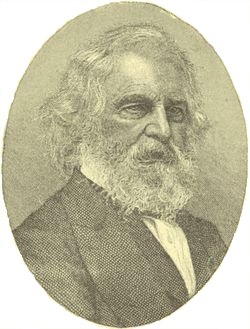
That was a memorable scene in the Poet's Corner of Westminster Abbey, when the veil was lifted from the bust of Henry Wadsworth Longfellow, the first American upon whom England had conferred such distinguished honor. James Russell Lowell was there, and made the eulogy, and left in all minds the impression of these simple words; "The most beautiful character that I have ever known." Mr. Lowell knew men, and among the great spirits of the age with whom he had been associated, he perhaps had known no literary man more intimately than Longfellow. The original families of Lowell and Longfellow in America had grown side by side on the banks of the Merrimac. The younger poet had succeeded the elder in the professorship of literature at Harvard College; the two had lived side by side in historic houses in the old Cambridge neighborhood on the Charles, and there had shared the amenities of suburban life and had studied the world together. It was said that Longfellow came to live in a house "on the way to Mt. Auburn;" Lowell lived in a house on the same road, and the two poets sleep together there now in the loving shadows of Boston's "Field of God."
Since the days of Horace, friendship has found no more sympathetic and beautiful expression in verse than in the lines inscribed by Lowell to Longfellow and in the poems written by Longfellow in reference to Lowell.
Says Lowell in his lines to H. W. L——:
"Long days be his, and each as lusty-sweet As gracious natures find his song to be; May age steal on with softly-cadenced feet Falling in music, as for him were meet Whose choicest verse is harsher-toned than he!"
Says Longfellow of Lowell in the "Herons of Elmwood:"
"Sing to him, say to him, here at his gate, Where the boughs of the stately elms are meeting, Some one hath lingered to meditate, And send him unseen this friendly greeting;
"That many another hath done the same, Though not by a sound was the silence broken; The surest pledge of a deathless name Is the silent homage of thoughts unspoken."
The matchless lines in "The Two Angels," a poem that commemorates the events of the birth of a child to Longfellow and the death of the beautiful wife of Lowell on the same night, in which the poet sees an angel with amaranths go to the door of his neighbor, while an angel with asphodels comes to his own door, strikes the tenderest chords of life.
Longfellow was the poet of friendship, and he carried his heart friends wherever he went. The river Charles in his fancy made the letter C in its windings in the Brighton meadows before his door, and ever recalled three friends who had borne that name. One of the masterpieces of the work of his fading years is "Three Friends of Mine," in which he pictures Felton and Agassiz and the midnight parting with Charles Sumner at his door, and represents himself as one left to cover up the embers.
Henry W. Longfellow, the poet of "Hope, Home, and History," was a descendant of the family of William Longfellow, who came from England to Newbury, Mass., in 1675, and a son of Stephen Longfellow, an eminent lawyer and public man. He was born in Portland, Me., February 27, 1807. The family consisted of eight children, of which he was the second, and of which two were poets, the other being the Unitarian hymn writer, Rev. Samuel Longfellow.
He grew up a pure, loving boy in the schools of Portland, Me., fond of the woods, the hills, and the sea. "My Lost Youth" furnishes a delightful picture of this period of his life. It is said that his childhood fancy first found expression in the following rhymes:
"Mr. Finney had a turnip That grew behind the barn, And it grew and it grew, But never did any harm."
A member of the Longfellow family has denied that these luminous but not very promising lines were the first offering of his muse. If the anecdote be apocryphal, the boy Longfellow yet began to love poetry and to write it, and he became a newspaper poet, one of those common soldiers of literature, while a student. He read Irving at twelve, and was charmed with the matter and style of "Rip Van Winkle." He felt the charm of Horace a little later, and probably learned his first lesson in eloquent literature from the "Poetic Art" of the Augustine age of Rome in her glory. Says Horace: "He who writes what is useful with what is agreeable wins every vote: his book crosses the sea; it will enrich the booksellers, and win for him imperishable fame."
Longfellow learned to make what is useful, agreeable, and this principle was one of the great secrets of his success in literary life. His early poems that did useful and agreeable service in the poet's corner of the newspapers of the time were, so far as we know, never collected. A few of them, however, survive, among them "The Spirit of Poetry," "Sunrise on the Hills," and "The Hymn of the Moravian Nuns."
At the age of fourteen he was prepared for Bowdoin College, which he entered a year later as a sophomore, and became a member of one of the most distinguished classes in American history. Among his fellow-students were Nathaniel Hawthorne, his personal friend, John S. C. Abbott, George B. Cheever, William Pitt Fessenden, John P. Hale, Calvin E. Stone, and Franklin Pierce, afterward President of the United States. He was graduated the fourth in his class.
The ambition for authorship came to him among the shades of Bowdoin. He said while there, thus anticipating in prose the "Psalm of Life:" "Whatever I study I ought to engage in with all my soul, for I will be eminent in something."
His poems published in the newspapers, principally in the Boston Literary Gazette, during his college life made for him a name, and he was offered the professorship of modern languages in Bowdoin College, soon after his graduation. To better prepare himself for the chair he went abroad, in 1826, in his twentieth year. He studied in France, Spain, Italy, and Germany. He made himself master of the French, Spanish, German, and Italian languages and literature, and returned to America in the late summer of 1829, and entered upon the duties of his professorship at Bowdoin in the autumn. He married Miss Mary Potter, of Portland, Me., and went to live in an old house, which was shaded by a single great elm, the site of which is still shown, on a salary of $1,000 per year. He published "Outre Mer," and taught and wrote with such distinguished success that, on the resignation of George Ticknor, he was offered the chair of modern languages at Harvard. For the larger preparation which he found necessary for his work, he went to Europe again in 1835. In his first visit to Europe he had met Washington Irving in Spain; he now made the acquaintance of Carlyle and Browning. His wife died in Germany.
He became a professor in Harvard in the fall of 1836, making his residence at the Cragie House, an old colonial mansion, shaded by trees, which Washington had used for his headquarters in 1775-1776. He married a most beautiful and accomplished lady, a daughter of Hon. Nathan Appleton, of Boston, whom he had met abroad, and who is supposed to be described in his romance "Hyperion." Here, happy in his domestic life, surrounded by the most scholarly men of America, his literary life ripened, his fame as a poet grew, and his sympathy with life as expressed in his works won all hearts. His "Voices of the Night" made him the poet of the home; "Evangeline," which is the American book of Ruth, made him the singer of the fidelity of holy affections, and "Hiawatha," the voice of the dying traditions of the Indian race.
He was a lover of his family, and a great affliction came to him in the summer of 1861. One July day his wife was playing with some sealing-wax with her children, when her dress caught fire, and she was enveloped in the flames, and burned to death. The poet is said to have suddenly changed from a young man to an old man under his weight of grief; he appeared in the streets of Cambridge again, in a few weeks, but unlike his former self. His affection for his dead wife in his widowerhood is expressed in the "Cross of Snow," written many years after her death:
"In the long, sleepless watches of the night, A gentle face—the face of one long dead— Looks at me from the wall, where round its head The night-lamp casts a halo of pale light. Here in this room she died; and soul more white Never through martyrdom of fire was led To its repose; nor can in books be read The legend of a life more benedight. There is a mountain in the distant West That, sun-defying, in its deep ravines Displays a cross of snow upon its side. Such is the cross I wear upon my breast These eighteen years, through all the changing scenes And seasons, changeless since the day she died."
He would take a dear friend into the room where her portrait hung, point to it, and say "my dear wife," and turn away to weep. His loving dream of his first wife is pictured in "The Footsteps of Angels:"
"And with them the Being Beauteous, Who unto my youth was given, More than all things else to love me, And is now a saint in heaven.
"With a slow and noiseless footstep Comes that messenger divine, Takes the vacant chair beside me, Lays her gentle hand in mine.
"And she sits and gazes at me With those deep and tender eyes. Like the stars, so still and saint-like. Looking downward from the skies.
"Uttered not, yet comprehended, Is the spirit's voiceless prayer. Soft rebukes, in blessings ended. Breathing from her lips of air.
"Oh, though oft depressed and lonely All my fears are laid aside, If I but remember only Such as these have lived and died."
In 1868 he went to England with his family. His fame in England was as great now as that of any English poet. He was received in London with the greatest love and hospitality; he met the queen, and received a doctor's degree from the Universities of Oxford and Cambridge. His reception by the literary classes was not more warm than the appreciative interest which was shown by the people. He had become the poet of the English homes, and was as greatly read as the Laureate.
I met the poet under most pleasant circumstances, in the beginning of his beautiful old age. I was a young editor; I was called to make an address before a church literary society on the historic places of Boston, and I wrote to Professor Longfellow in regard to the history of the poem "I Stood on the Bridge at Midnight." I received a note from him in his well-known hand, saying that if I would visit him some evening at his home, it would give him pleasure not only to give me the history of the writing of this poem, but of any of his poems in which I might take an interest. I accepted the invitation, and one misty February night found me at his door, feeling as poor Phillis Wheatly must have felt when she stood at the same door after the invitation from Washington.
I well recall the night. The slow opening of the door by the quiet servant, the dim hall that seemed haunted by the shadows of the past, the great reception-room walled with books and pictures!
The poet was alone—he was a lonely man in his old age. He rose from his table, and came to meet me, a kindly light in his face, his flowing hair as white as snow. He saw that I was awed by his presence, and his gracious dignity changed at once into a friendly sympathy. "I have here some things that may interest you," he said; "here is Coleridge's inkstand; there is Tom Moore's waste-paper basket; and there," he added, in a reverent tone, "is a piece of Dante's coffin." The last relic was enclosed in a solid glass, and he proceeded to tell the story of how he had received it.
"You express a kindly interest in the origin of my poems," he added, in substance. "I will tell you something about the writing of some of them. You see the screen yonder; it is Japanese; there is written upon it the 'Psalm of Life.' The poem was written at Cambridge when the orchards were bright with buds and blossoms, and the days were in the full tide of the year. I did not write it for publication but for myself. I felt an inspiration to express in words my one purpose in life. I carried it about with me for a long time, when I was asked for a poem for the Knickerbocker Magazine, then a popular periodical, and I sent it to the editor without any expectation of its success with the people. It has been translated into nearly all languages that have a literature.
"In London I received an invitation to visit the queen. On returning from the palace, the coach was stopped by the crowd of vehicles in the street. There stepped before the door of the carriage an English workman. 'Are you Mr. Longfellow?' he asked. 'I am,' I answered. 'Did you write the "Psalm of Life"?' 'I wrote that poem, my friend.' 'Pardon me, but would you be willing to take the hand of a workingman?' 'Certainly, my friend; it would give me pleasure.' He put his hand through the carriage window, and I shook hands with him. That," said Mr. Longfellow, with emphasis and feeling, "was the best compliment that I ever received in my life."
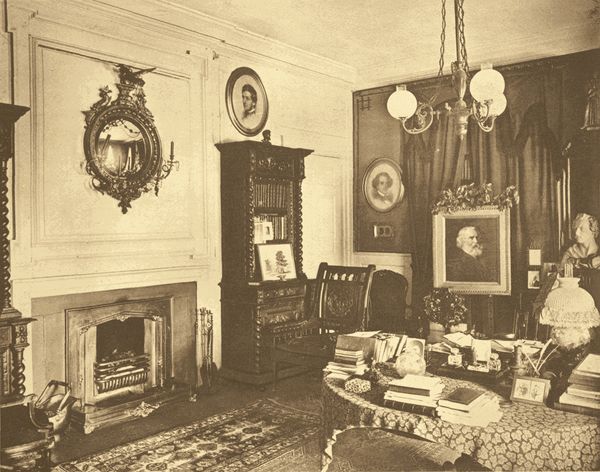
Longfellow's Study.
The last declaration, in which we think that we have quoted the poet's exact words, shows the heart and character of the man. It is a photograph of his soul.
He said that the poem "I Stood on the Bridge at Midnight" was written in the lonely hours of his widowerhood, when he used to visit Boston evenings and return over the bridge of the Charles. The bridge grew still as the night wore on, and the procession of the day became thin. There was a furnace at Brighton at that time, and the reflection of the red fire fell across the dark river. The bridge over the Charles is nearly the same now as then; it has been somewhat reconstructed, but the wooden piers are there; the drifting seaweed, the odor of the brine, and the processions of "care-encumbered men" vanishing into the night. An English nobleman who is a literary critic has pronounced this poem the most sympathetic in the language. Its popularity probably is due to the night scene and the spirit of self-renunciation. It is one of the most beautiful songs of the age as set to music by two English composers. We never tire of the message of sympathy.
"Excelsior," which has been greatly parodied, expresses in a simple way what Browning has more artistically illustrated in "Childe Roland to the Dark Tower Came." It was written one evening after the poet had received a letter from his beloved friend, Charles Sumner, full of lofty sentiments, expressed in the classic rhetoric of the time. As he dropped the letter the word "Excelsior" caught his eye, and the inspiration and the vision of the poem came. He wrote it on the back of the letter which contained the magic word.
It is said that the words "Cumnor Hall," in Meckle's ballad, so haunted the mind of Sir Walter Scott as to compel him to write "Kenilworth." "I was led, I think," said Longfellow, "to write the 'Wreck of the Hesperus' by the words 'Norman's Woe' I had been reading one dreary night of the disasters that had befallen the Gloucester fishing fleet, and my eye met the words 'Norman's Woe.' I went to bed, but the story haunted me. I arose and began to write, and the poem came to me in whole stanzas."
"The Old Clock on the Stairs" was suggested by an old farmhouse timepiece at the country house of Mr. Appleton, his father-in-law. While the house described was in the country, the description answers well to the poet's own residence, which also contained an eight-day clock which reached from floor to ceiling. Many people never so much as doubted that the Cragie House and its clock were meant in the poem. The clock in the Cambridge house was so old and antique that most visitors fancied that they saw in it the real "old clock on the stairs." The refrain was suggested by the French words "Toujours jamais, jamais toujours" in an elegant French quotation.
"Hiawatha" was pictured to the poet by the story which Abraham le Fort, an Onondaga chief, gave to Schoolcraft. The musical vocabulary in which the Indian words suggest their own meaning may be found in Schoolcraft. It is the one poem which commemorates the legends of the Indian races; it will doubtless outlive those races, and be their tradition in future ages. The Indian words, as in the instance of "Norman's Woe," must have suggested in many cases the scenes and incidents of the poet's creative fancy.
"The March of Miles Standish," which followed, repeats the old apocryphal Puritan story, which no one but a critic would care to question. We think, however, that the ancient fable of Europa is likely to have suggested the ride to Duxbury on the back of the bull, for at that time there were few cattle in the colonies.
"'The Tales of a Wayside Inn,'" said Mr. Longfellow, "received that name merely to give them locality. I had never been in the Wayside Inn, but once." (We think that he stopped there on his first return from Europe when travelling from Albany to Boston, on which road there were the White Horse, Red Horse (Wayside), and Black Horse Inns.) "I had written the stories in verse, and I wished to connect them with a sympathetic place and a company of story-tellers. My friends were accustomed to dine occasionally at the Wayside Inn, and it seemed a pleasing fancy to place my story-tellers there." The Poet of the company was Mr. Parsons, the Dante scholar; the Theologian, Mr. Wales; the Sicilian, Luigi Monte, an exile from Sicily, whom President Lincoln sent back in an official capacity, under the influence of Charles Sumner, when Sicily became free during the Italian revolution; the Jew was Edrika, an accomplished Boston merchant.
"Paul Revere's Ride" is perhaps the most popular, and the "Vision Beautiful" the most philosophical, of these many tales. The story of "Lady Wentworth" is a most charming story of old New England folk-lore, and wears the quaint and sympathetic colorings of colonial times.
"I have given up the theory," said Mr. Longfellow, "that the old stone tower at Newport is to be connected with the Norsemen. I feel certain now that it is merely a windmill. I have a model of just such a mill, which was a common sight on the coasts of the North Sea." His residence in Scandinavia as a student gave him a love of the literature of the North, and hence his tales from the Sagas.
The melodious and sympathetic qualities of Longfellow's verse meet well the wants of the composer. The songs of the poet are more and more being wedded to music. "The Bridge," "The Rainy Day," "The Day is Done," "The Legend of the Crossbill," "The Silent Land," "Allah," "The Sea Hath its Pearls" (translation), and many other poems have found expression in musical art as inspired and beautiful as themselves, and thus winged will long go singing through the world. The English composers have thus far been the best interpreters of his songs.
His view of literature at that time, when he had made his fame and stood in the ripeness of the harvest, was expressed in the words of Fitz Greene Halleck, which he quoted: "A little well written is immortality." He had always acted on Horace's advice as given in the "Poetic Art," and had chosen subjects that waited a voice, and made what was useful, agreeable. Every poem, even though an inspiration, had been carefully revised, until the best and most sympathetic, picturesque, and worthy expression was found. His poems grew in art with years. One of his earliest volumes was "Outre Mer," which was followed by "Hyperion" after some years; both prose works were filled with the spirit of poetry. In 1839 he published his first popular volume of verse under the title of "Voices of the Night;" in 1841, "Ballads and other Poems;" in 1842, "Poems on Slavery;" in 1843, "The Spanish Student;" in 1846, "The Belfry of Bruges;" and in 1847, "Evangeline," which established his fame. His other works were published after intervals of two or three years, with a long silence after the death of his wife in 1861. The last of his great poems was "Morituri Salutamus," read by him at the fiftieth reunion of his class at Bowdoin College. One of his most perfect poems, and perhaps the most elegant of its kind in any language, was produced at this period of the beginning of life's winter, "Three Friends of Mine."
One March day in 1882, a lad from one of the Boston schools came to me, and said that some pupils from the school wished to call on the poet, and asked me if I supposed that he would receive them and give them his autograph. I recalled that Longfellow had said to me that he always answered applications for autographs, adding, "Would it not be discourteous in me to refuse my name to one who took such an interest in anything which I had written as to write me for such a favor?" I replied that I had no doubt but that the poet would receive them kindly; that he loved young people, and advised them to make the call.
He received the lads with his usual kindness, showed them the historic associations of the old house, and then in their company looked over on the Brighton meadows and the Charles River with its now icy C, for the last time. The day was declining, the last March day that he would ever see in health. Illness came soon after this visit from the school-boys, and soon he who had lived on the way to Mt. Auburn, was borne to the calm city of the dead. His grave is near Spurzheim's, not far from the gate, on a beautiful knoll, and is marked by a simple stone with a plain inscription.
Longfellow was the poet of humanity and eternal hope, and his poetic scriptures are always sought and always will be by spirits seeking sympathy. He doubtless will live as the poet of the heart long after greater rhetoricians and more philosophical poets have lost their influence. It is the poet that is most human that has the greatest influence and the most enduring fame.
As the poet of eternal hope, his horizons ever lift. He could not have written Browning's "Lost Leader." His characters are all happy in the end; his ships of song all come to blue harbors and happy ports. Poems like Lowell's "Rhœcus," where opportunity is lost forever, find no expression in his muse, but rather the rainbow always that shines in the "Legend Beautiful." His Sordellos do not fail; they attain; the people of his fancy overcome even their sins and mount on them like ladders to heaven. Even old age in his view is full of opportunity, and all experiences have their kindly helps and opportunities. Though a translator of Dante, his own muse had no "Inferno," hut only a "Purgatorio."
He is the most loved poet of our own or of any age; the American Horace, whose pictures of all that is best in our early history will ever remain. To study him is to grow. He never gave to the world a soiled thought, or planted a seed in any mind whose flower and fruit were not good. "The most beautiful character I ever knew," said Lowell amid the shadows of the royal tombs of the Abbey, as his white bust was placed among the ghosts; and so felt those who laid him down to rest in the kindly earth of Mt. Auburn's fields and flowers, on the banks of the calm, rippling Charles; and so feel those who visit that simple spot, and rest in thought there amid the vines and roses under the trees.
He touched all life to make it better, and humanity will ever be grateful to the Heavens that he lived and sang.[Back to Contents]

ALFRED TENNYSON[16] By Clarence Cook (1809-1892)
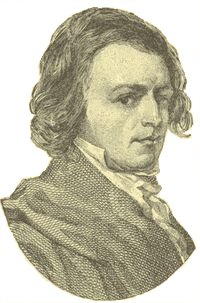
Few of the world's great poets have woven into their verse so much autobiographical material as the late Lord Tennyson, Poet Laureate of England. All his early poetry is suffused with tints, sombre or bright, and breathes of sounds that recall the landscape of the Lincolnshire in whose sunniest spot he was born, but in near neighborhood to "the level waste, the rounding gray" of "the dark fen," and within sight and sound of the "sandy tracts" and "the ocean roaring into cataracts." Later, we find in some of the poems that have made for themselves a place in the heart of all English-speaking people, vivid pictures in words or phrases, recalling his travels in Italy and Greece; and in the latter half of his life we follow him to the southern part of England, to Surrey and the Isle of Wight, where we find him in his "careless-ordered garden, close to the edge of a noble down," or "hear the magpie gossip garrulous under a roof of pine." But, to quote the lines that illustrate this autobiographic element in Tennyson's poetry, or that show his happy way of making use of his actual experiences, by which again we are able to get an impression of his way of life, and of the manner of man he was, would be to transfer a goodly portion of his verse to these pages.
Alfred Tennyson was born August 5, 1809, at Somersby, Lincolnshire, and was the third son in a family of five sons and seven daughters born to the Reverend George Clayton Tennyson, who was rector of Somersby, and held, besides, the livings of Beg-Enderby and Great Grimsby.
Tennyson's father was a man of various tastes and accomplishments, dabbling in poetry, painting, architecture, music, the study of language and mathematics, but doing nothing of note in any of these things. Even as a preacher he seems to have made but little impression, if we may judge by the answer made by one of his old parishioners to the question: "What sort of sermons did Mr. Tennyson preach?" "Eee read um from a paäper, an I didn't knaäw what um meant." But the father's versatility doubtless did his children good service; for in such a village as Somersby, the opportunities for general culture were few. Up to the age of seven, when he was sent to the grammar-school at Louth, Alfred was taught at home by his father. We are told that in the case of each of his boys, Mr. Tennyson was in the habit, before presenting them at the grammar-school, of making them commit to memory and recite every day one of the Odes of Horace, beginning with the Ode to Mæcenas and ending with the "In Praise of Augustus"—the last Ode of the four Books. Alfred went to Louth, entering the grammar-school the Christmas after the battle of Waterloo. His brother Charles was already there, and the whole family moved to Louth from Somersby in order to make a home for the boys. In 1820, at the age of eleven, Alfred left the school, and returned with his family to the parsonage at Somersby. In 1828 he went to Cambridge, and the years that elapsed between his leaving the grammar-school and his entering the university were among the most important in the youth of the poet. His further instruction in preparation for college was carried on at home; but on the whole the teaching was desultory; although, judging from the results, what was done in the way of direct instruction was done thoroughly. As Mr. Graham tells us, there was not a clever man in the county who was not asked to give his assistance in the task. One tutor drilled Alfred in mathematics; another in music; and a Roman Catholic priest taught him and his brother linguistics with a view to the university; and Alfred was allowed to spend much time in wandering about the moors, or in the woods that covered the hills on whose skirts the village of Somersby stood. Carlyle writes to Emerson: "You see in Tennyson's verse that he is a native of moated grange and green flat pastures, not of mountains and their torrents," and this is true in part; but Mr. Graham tells us that the country about Somersby is not flat, but broken and hilly, and that the place is named Somersby, i.e., summer's town, because it abounds in birds and flowers; and, indeed, one may know by the frequent allusions to flowers and birds and the nice observation shown in these allusions, that these things must have made a strong impression on the youthful mind of the poet. He learned nature at first hand, and had his lesson by heart, unconsciously imbibing it from his walks alone, or with his dearly loved elder brother, Charles—elder by five years—over all the country-side; and there is no doubt that the wild and dreary side of that region, the flat expanse of the fens slowly rescuing from the ever threatening and invading sea, the long line of the coast with its beaches and ridged mounds of sand built by the winds, and strengthened by the bird-sown seeds of grass to be barriers against the ocean—that all these scenes made an impression on his mind strong to balance the sweet woodland pastoral note of the Somersby brooks and flowery hollows, no one can doubt who knows Tennyson's poetry. He had little love for the hardier sports of boys, but was not a retiring child either, nor over-contemplative, although he was described by one of the old Northern Farmers he has immortalized, as a boy who would "sit for hours on a gate gawmin about him!" But this indolence was a trait that he had in common with many men destined to greatness, and it clung to him all his life. It was no sign of an indolent mind, but rather evidence of, perhaps, an over-active one. His earliest volume of poems—made up of his own with contributions from his brothers, Charles and Frederick, and published when he was eighteen—though written all along the track of the preceding years, bears evidence of much youthful wrestling with the problems of life, mingled with much that witnesses to the boy's pure joy in living. He began to write poetry at a very early age, and he found in his family an audience by no means at one in their appreciation of his talent. After hearing some of his verses, his grandfather gave him a half-guinea, and prophesied that it would prove the first and the last of his earnings by that trade. Whether or not the old gentleman lived to hear of his getting a whole guinea a line for some of his work, as we think we remember to have heard was the case with "Sea Dreams," we do not know; but, with his probable taste in poetry, supposing him to have cared for the poetry of his time, he would doubtless have looked upon Alfred's success as another sign of the degeneracy of the age. As has been hinted, Mr. Tennyson was very careful of his money, and his boys were not allowed much spending money. Alfred and his brother Charles had the natural youthful desire to see their poetry in print, but they could not with all their savings raise the money to meet the expense of publication. An old nurse of the family, the wife of the coachman, is authority for the statement that it was her husband who first showed the boys a way out of the difficulty. "Why don't you make a book of some of these poems you are all the time writing, and sell it to a publisher?" Acting on this hint the boys offered their small collection to a publisher, who doubtless thinking that two families so well-placed in the county as the Tennysons and the Fytches would insure the success of their young offshoots' venture, assumed the expense of printing, and gave the budding poets ten pounds to boot. The "Poems by two Brothers" appeared in 1827. The news of its publication was greeted by one of the uncles with the remark: "I hear that my nephew has made a book. I wish it had been a wheelbarrow!" The thin volume has long ago passed into the domain of "books not to be had," and when by any chance a copy is brought to light the price it brings in the open market would have taken the uncle's breath away. The book has lately been reprinted, and in this form is now accessible.
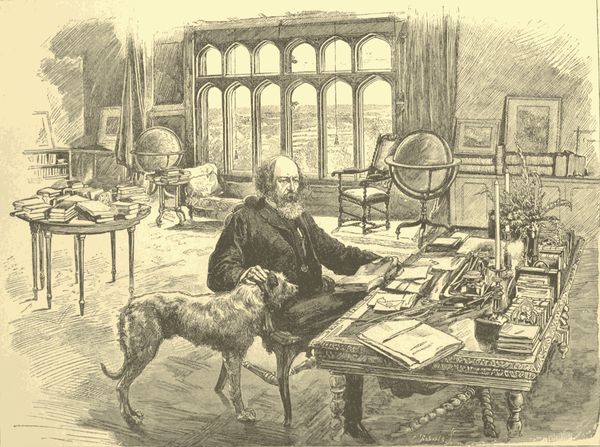
Tennyson in his Library.
At Cambridge, Tennyson entered Trinity College, and while there made the acquaintance of Arthur Henry Hallam, which soon ripened into the friendship that has been made immortal in the poem "In Memoriam." The only distinction Tennyson would seem to have gained at Cambridge was the Chancellor's gold medal awarded for the prize-poem "Timbuctoo," a curious production long consigned to oblivion but now included in the authorized edition of the poet's collected work.
In 1811 the Rev. Mr. Tennyson died, and on leaving Cambridge, Alfred returned to Somersby and lived with his mother and sisters. In 1830 he published "Poems chiefly Lyrical," in 1832 "Poems," and in 1842 "Poems," in two volumes, which first opened the eyes of the English public to the fact that a new planet had appeared in the heaven of poetry, and Tennyson's name soon became a household word. In 1845 he was awarded a pension of £200 per annum from the Civil List, and in 1850 he was made Poet Laureate, on the death of Wordsworth. In the same year he married Miss Emily Sellwood, whom he had long known at Somersby, the daughter of a lawyer, and niece of Sir John Franklin. In 1855 he received the honorary degree of Doctor of Civil Law from Oxford and in 1884, being then in his seventy-fifth year, he was raised to the peerage under the title of Baron Tennyson of Aldworth and Farringford.