Volume 7 — ARTISTS AND AUTHORS (continued 3)
Reading edition
After fifteen months of absence, Milton found himself again in London at a crisis of unusual interest. The king was on the eve of his second expedition against the Scotch; and we may suppose Milton to have been watching the course of events with profound anxiety, not without some anticipation of the patriotic labor which awaited him. Meantime he occupied himself with the education of his sister's two sons, and soon after, by way of obtaining an honorable maintenance, increased the number of his pupils.
In 1641 he conducted his defence of ecclesiastical liberty, in a series of attacks upon episcopacy. These are written in a bitter spirit of abusive hostility, for which we seek an insufficient apology in his exclusive converse with a party which held bishops in abhorrence, and in the low personal respectability of a large portion of the episcopal bench.
At Whitsuntide, in the year 1643, having reached his thirty-fifth year, he married Mary Powell, a young lady of good extraction in the county of Oxford. In 1644 he wrote his "Areopagitica, a speech for the liberty of unlicensed printing." This we are to consider in the light of an oral pleading, or regular oration, for he tells us expressly [Def. 2] that he wrote it "ad justæ orationis modum." It is the finest specimen extant of generous scorn. And very remarkable it is, that Milton, who broke the ground on this great theme, has exhausted the arguments which bear upon it. He opened the subject: he closed it. And were there no other monument of his patriotism and his genius, for this alone he would deserve to be held in perpetual veneration. In the following year, 1645, was published the first collection of his early poems; with his sanction, undoubtedly, but probably not upon his suggestion. The times were too full of anxiety to allow of much encouragement to polite literature; at no period were there fewer readers of poetry. And for himself in particular, with the exception of a few sonnets, it is probable that he composed as little as others read, for the next ten years; so great were his political exertions.
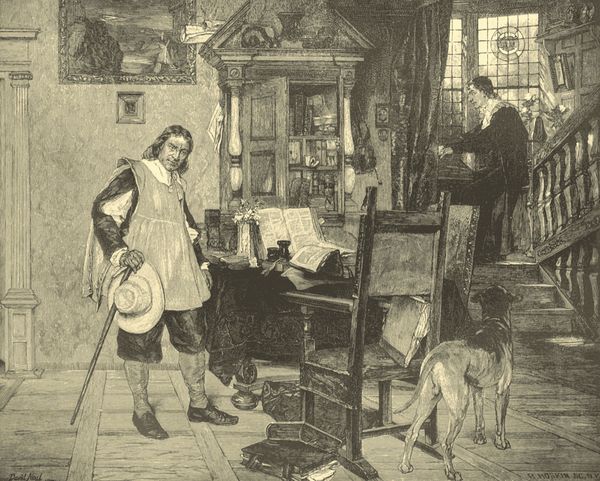
Oliver Cromwell visits Milton.
In 1649, soon after King Charles was put to death, the Council of State resolved to use the Latin tongue in their international concerns, instead of French. The office of Latin Secretary, therefore, was created, and bestowed upon Milton. His hours from henceforth must have been pretty well occupied by official labors. He was one of the most prominent men in his party, a close friend to Cromwell, who frequently visited him; and his advice was sought on all questions of importance. Yet at this time he undertook a service to the state, more invidious, and perhaps more perilous, than any in which his politics ever involved him. On the very day of the king's execution, and even below the scaffold, had been sold the earliest copies of a work admirably fitted to shake the new government, and for the sensation which it produced at the time, and the lasting controversy which it has engendered, one of the most remarkable known in literary history. This was the "Eikon Basilike, or Royal Image," professing to be a series of meditations drawn up by the late king, on the leading events from the very beginning of the national troubles. Appearing at this critical moment, and co-operating with the strong reaction of the public mind, already effected in the king's favor by his violent death, this book produced an impression absolutely unparalleled in any age. Fifty thousand copies, it is asserted, were sold within one year; and a posthumous power was thus given to the king's name by one little book, which exceeded, in alarm to his enemies, all that his armies could accomplish in his lifetime. No remedy could meet the evil in degree. As the only one that seemed fitted to it in kind, Milton drew up a running commentary upon each separate head of the original; and as that had been entitled the king's image, he gave to his own the title of "Eikonoclastes, or Image-breaker," "the famous surname of many Greek emperors, who broke all superstitious images in pieces."
This work was drawn up with the usual polemic ability of Milton; but by its very plan and purpose it threw upon him difficulties which no ability could meet. It had that inevitable disadvantage which belongs to all ministerial and secondary works: the order and choice of topics being all determined by the "Eikon," Milton, for the first time, wore an air of constraint and servility, following a leader and obeying his motions, as an engraver is controlled by the designer, or a translator by the original. It is plain, from the pains he took to exonerate himself from such a reproach, that he felt his task to be an invidious one. The majesty of grief, expressing itself with Christian meekness, and appealing as it were, from the grave to the consciences of men, could not be violated without a recoil of angry feeling, ruinous to the effect of any logic or rhetoric the most persuasive. The affliction of a great prince, his solitude, his rigorous imprisonment, his constancy to some purposes which were not selfish, his dignity of demeanor in the midst of his heavy trials, and his truly Christian fortitude in his final sufferings—these formed a rhetoric which made its way to all hearts. Against such influences the eloquence of Greece would have been vain. The nation was spellbound; and a majority of its population neither could nor would be disenchanted.
Milton was ere long called to plead the same great cause of liberty upon an ampler stage, and before a more equitable audience; to plead not on behalf of his party against the Presbyterians and Royalists, but on behalf of his country against the insults of a hired Frenchman, and at the bar of the whole Christian world. Charles II. had resolved to state his father's case to all Europe. This was natural, for very few people on the continent knew what cause had brought his father to the block, or why he himself was a vagrant exile from his throne. For his advocate he selected Claudius Salmasius, and that was most injudicious. Salmasius betrayed in his work entire ignorance of everything, whether historical or constitutional, which belonged to the case.
Having such an antagonist, inferior to him in all possible qualifications, whether of nature, of art, of situation, it may be supposed that Milton's triumph was absolute. He was now thoroughly indemnified for the poor success of his "Eikonoclastes." In that instance he had the mortification of knowing that all England read and wept over the king's book, while his own reply was scarcely heard of. But here the tables were turned; the very friends of Salmasius complained that while his defence was rarely inquired after, the answer to it, "Defensio pro Populo Anglicano," was the subject of conversation from one end of Europe to the other. It was burned publicly at Paris and Toulouse; and, by way of special annoyance to Salmasius, who lived in Holland, was translated into Dutch.
In 1651 Milton's first wife died, after she had given him three daughters. In that year he had already lost the use of one eye, and was warned by the physicians that if he persisted in his task of replying to Salmasius he would probably lose the other. The warning was soon accomplished, according to the common account, in 1654; but upon collating his letter to Phalaris the Athenian, with his own pathetic statement in the "Defensio Secunda," we are disposed to date it from 1652. In 1655 he resigned his office of secretary, in which he had latterly been obliged to use an assistant.
Some time before this period he had married his second wife, Catherine Woodcock, to whom it is supposed that he was very tenderly attached. In 1657 she died in child-birth, together with her child, an event which he has recorded in a very beautiful sonnet. This loss, added to his blindness, must have made his home, for some years, desolate and comfortless. Distress, indeed, was now gathering rapidly upon him. The death of Cromwell, in the following year, and the imbecile character of his eldest son, held out an invitation to the aspiring intriguers of the day, which they were not slow to improve. It soon became too evident to Milton's discernment that all things were hurrying forward to restoration of the ejected family. Sensible of the risk, therefore, and without much hope, but obeying the summons of his conscience, he wrote a short tract on the ready and easy way to establish a free commonwealth, concluding with these noble words: "Thus much I should perhaps have said, though I were sure I should have spoken only to trees and stones, and had none to cry to, but with the Prophet, Oh earth! earth! earth! to tell the very soil itself what her perverse inhabitants are deaf to. Nay, though what I have spoken should happen [which Thou suffer not, who didst create free, nor Thou next who didst redeem us from being servants of men] to be the last words of our expiring liberty."
What he feared was soon realized. In the spring of 1660 the Restoration was accomplished amid the tumultuous rejoicings of the people. It was certain that the vengeance of government would lose no time in marking its victims; and some of them in anticipation had already fled. Milton wisely withdrew from the first fury of the persecution which now descended on his party. He secreted himself in London, and when he returned to the public eye in the winter, found himself no farther punished than by a general disqualification for the public service, and the disgrace of a public burning inflicted on his "Eikonoclastes," and his "Defensio pro Populo Anglicano."
Apparently it was not long after this time that he married his third wife, Elizabeth Minshul, a lady of good family in Cheshire. In what year he began the composition of his "Paradise Lost" is not certainly known; some have supposed in 1658. There is better ground for fixing the period of its close. During the plague of 1665 he retired to Chalfont, and at that time Elwood, the Quaker, read the poem in a finished state. The general interruption of business in London, occasioned by the plague, and prolonged by the great fire in 1666, explain why the publication was delayed for nearly two years. The contract with the publisher is dated April 26, 1667, and in the course of that year the "Paradise Lost" was published. Originally it was printed in ten books; in the second and subsequent editions, the seventh and tenth books were each divided into two. Milton received only £5 in the first instance on the publication of the book. His farther profits were regulated by the sale of the first three editions. Each was to consist of fifteen hundred copies, and on the second and third, respectively, reaching a sale of thirteen hundred, he was to receive a farther sum of £5 for each, making a total of £15. The receipt for the second sum of £5 is dated April 26, 1669.
In 1670 Milton published his "History of Britain," from the fabulous period of the Norman Conquest. And in the same year he published in one volume "Paradise Regained" and "Samson Agonistes." It has been currently asserted that Milton preferred the "Paradise Regained" to "Paradise Lost." This is not true; but he may have been justly offended by the false principles on which some of his friends maintained a reasonable opinion. The "Paradise Regained" is inferior by the necessity of its subject and design. In the "Paradise Lost" Milton had a field properly adapted to a poet's purposes; a few hints in Scripture were expanded. Nothing was altered, nothing absolutely added; but that which was told in the Scriptures in sum, or in its last results, was developed into its whole succession of parts. Thus, for instance, "There was war in heaven," furnished the matter for a whole book. Now for the latter poem, which part of our Saviour's life was it best to select as that in which paradise was regained? He might have taken the crucifixion, and here he had a much wider field than in the temptation; but then he was subject to this dilemma: if he modified, or in any way altered, the full details of the four evangelists, he shocked the religious sense of all Christians; yet, the purposes of a poet would often require that he should so modify them. With a fine sense of this difficulty, he chose the narrow basis of the temptation in the wilderness, because there the whole had been wrapped up in the Scriptures in a few brief abstractions. Thus "he showed him all the kingdoms of the earth," is expanded, without offence to the nicest religious scruple, into that matchless succession of pictures, which bring before us the learned glories of Athens, Rome in her civil grandeur, and the barbaric splendor of Parthia. The actors being only two, the action of "Paradise Regained" is unavoidably limited. But in respect of composition, it is, perhaps, more elaborately finished than "Paradise Lost."
His subsequent works are not important enough to merit a separate notice. His end was now approaching. In the summer of 1674 he was still cheerful, and in the possession of his intellectual faculties. But the vigor of his bodily constitution had been silently giving way, through a long course of years, to the ravages of gout. It was at length thoroughly undermined; and about November 10, 1674, he died with tranquillity so profound that his attendants were unable to determine the exact moment of his decease. He was buried, with unusual marks of honor, in the chancel of St. Giles at Cripplegate.[Back to Contents]
JOHN BUNYAN By John Greenleaf Whittier (1628-1688)
"Wouldst see A man i' the clouds, and hear him speak to thee?"
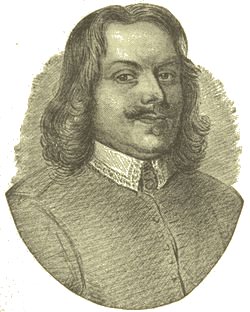
Who has not read "Pilgrim's Progress?" Who has not, in childhood, followed the wandering Christian on his way to the Celestial City? Who has not laid at night his young head on the pillow, to paint on the walls of darkness pictures of the Wicket Gate and the Archers, the Hill of Difficulty, the Lions and Giants, Doubting Castle and Vanity Fair, the sunny Delectable Mountains and the Shepherds, the Black River and the wonderful glory beyond it; and at last fallen asleep, to dream over the strange story, to hear the sweet welcomings of the sisters at the House Beautiful, and the song of birds from the window of that "upper chamber which opened toward the sunrising?" And who, looking back to the green spots in his childish experiences, does not bless the good Tinker of Elstow?
And who, that has reperused the story of the Pilgrim at a maturer age, and felt the plummet of its truth sounding in the deep places of the soul, has not reason to bless the author for some timely warning or grateful encouragement? Where is the scholar, the poet, the man of taste and feeling who does not with Cowper,
"Even in transitory life's late day, Revere the man whose Pilgrim marks the road And guides the Progress of the soul to God!"
We have just been reading, with no slight degree of interest, that simple but wonderful piece of autobiography entitled "Grace Abounding to the Chief of Sinners," from the pen of the author of "Pilgrim's Progress." It is the record of a journey more terrible than that of the ideal Pilgrim; "truth stranger than fiction;" the painful upward struggling of a spirit from the blackness of despair and blasphemy, into the high, pure air of Hope and Faith. More earnest words were never written. It is the entire unveiling of a human heart, the tearing off of the fig-leaf covering of its sin. The voice which speaks to us from these old pages seems not so much that of a denizen of the world in which we live, as of a soul at the last solemn confessional. Shorn of all ornament, simple and direct as the contrition and prayer of childhood, when for the first time the Spectre of Sin stands by its bedside, the style is that of a man dead to self gratification, careless of the world's opinion, and only desirous to convey to others, in all truthfulness and sincerity, the lesson of his inward trials, temptations, sins, weaknesses, and dangers; and to give glory to Him who had mercifully led him through all, and enabled him, like his own Pilgrim, to leave behind the Valley of the Shallow of Death, the snares of the Enchanted Ground, and the terrors of Doubting Castle, and to reach the land of Beulah, where the air was sweet and pleasant, and the birds sang and the flowers sprang up around him, and the Shining Ones walked in the brightness of the not distant heaven. In the introductory pages he says: "I could have dipped into a style higher than this in which I have discoursed, and could have adorned all things more than here I have seemed to do; but I dared not. God did not play in tempting me; neither did I play when I sunk, as it were, into a bottomless pit, when the pangs of hell took hold on me; wherefore, I may not play in relating of them, but be plain and simple, and lay down the thing as it was."
This book, as well as "Pilgrim's Progress," was written in Bedford prison, and was designed especially for the comfort and edification of his "children, whom God had counted him worthy to beget in faith by his ministry." In his introduction he tells them, that, although taken from them and tied up, "sticking, as it were, between the teeth of the lions of the wilderness," he once again, as before, from the top of Shemer and Hermon, so now, from the lion's den and the mountain of leopards, would look after them with fatherly care and desires for their everlasting welfare. "If," said he, "you have sinned against light; if you are tempted to blaspheme; if you are drowned in despair; if you think God fights against you, or if heaven is hidden from your eyes, remember it was so with your father. But out of all the Lord delivered me."
He gives no dates; he affords scarcely a clew to his localities; of the man, as he worked and ate and drank and lodged, of his neighbors and contemporaries, of all he saw and heard of the world about him, we have only an occasional glimpse, here and there, in his narrative. It is the story of his inward life only that he relates. What had time and place to do with one who trembled always with the awful consciousness of an immortal nature, and about whom fell alternately the shadows of hell and the splendors of heaven? We gather, indeed, from his record that he was not an idle on-looker in the time of England's great struggle for freedom, but a soldier of the Parliament in his young years, among the praying sworders and psalm-singing pikemen, the Greathearts and Holdfasts whom he has immortalized in his allegory; but the only allusion which he makes to this portion of his experience is by way of illustration of the goodness of God in preserving him on occasions of peril.
He was born at Elstow, in Bedfordshire, in 1628; and, to use his own words, his "father's house was of that rank which is the meanest and most despised of all the families of the land." His father was a tinker, and the son followed the same calling, which necessarily brought him into association with the lowest and most depraved classes of English society. The estimation in which the tinker and his occupation were held in the seventeenth century, may be learned from the quaint and humorous description of Sir Thomas Overbury. "The tinker," saith he, "is a movable, for he hath no abiding in one place; he seems to be devout, for his life is a continual pilgrimage, and sometimes, in humility, goes bare-foot, therein making necessity a virtue; he is a gallant, for he carries all his wealth upon his back; or a philosopher, for he bears all his substance with him. He is always furnished with a song, to which his hammer, keeping tune, proves that he was the first founder of the kettle drum; where the best ale is, there stands his music most upon crotchets. The companion of his travel is some foul, sunburnt quean, that, since the terrible statute, has recanted gypsyism, and is turned pedlaress. So marches he all over England, with his bag and baggage; his conversation is irreprovable, for he is always mending. He observes truly the statutes, and therefore had rather steal than beg. He is so strong an enemy of idleness, that in mending one hole he would rather make three than want work; and when he hath done, he throws the wallet of his faults behind him. His tongue is very voluble, which, with canting, proves him a linguist. He is entertained in every place, yet enters no farther than the door, to avoid suspicion. To conclude, if he escape Tyburn and Banbury, he dies a beggar."
Truly, but a poor beginning for a pious life was the youth of John Bunyan. As might have been expected, he was a wild, reckless, swearing boy, as his father doubtless was before him. "It was my delight," says he, "to be taken captive by the devil. I had few equals, both for cursing and swearing, lying and blaspheming." Yet, in his ignorance and darkness, his powerful imagination early lent terror to the reproaches of conscience. He was scared, even in childhood, with dreams of hell and apparitions of devils. Troubled with fears of eternal fire and the malignant demons who fed it in the regions of despair, he says that he often wished either that there was no hell, or that he had been born a devil himself, that he might be a tormentor rather than one of the tormented.
At an early age he appears to have married. His wife was as poor as himself, for he tells us that they had not so much as a dish or spoon between them; but she brought with her two books on religious subjects, the reading of which seems to have had no slight degree of influence on his mind. He went to church regularly, adored the priest and all things pertaining to his office, being, as he says, "overrun with superstition." On one occasion a sermon was preached against the breach of the Sabbath by sports or labor, which struck him at the moment as especially designed for himself; but by the time he had finished his dinner he was prepared to "shake it out of his mind, and return to his sports and gaming."
One day, while standing in the street, cursing and blaspheming, he met with a reproof which startled him. The woman of the house in front of which the wicked young tinker was standing, herself, as he remarks, "a very loose, ungodly wretch," protested that his horrible profanity made her tremble; that he was the ungodliest fellow for swearing she had ever heard, and able to spoil all the youth of the town who came in his company. Struck by this wholly unexpected rebuke, he at once abandoned the practice of swearing; although previously he tells us that "he had never known how to speak, unless he put an oath before and another behind."
His account of his entering upon the solemn duties of a preacher of the gospel is at once curious and instructive. He deals honestly with himself, exposing all his various moods, weaknesses, doubts, and temptations. "I preached," he Says, "what I felt; for the terrors of the law and the guilt of transgression lay heavy on my conscience. I have been as one sent to them from the dead. I went, myself in chains, to preach to them in chains, and carried that fire in my conscience which I persuaded them to beware of." At times, when he stood up to preach, blasphemies and evil doubts rushed into his mind, and he felt a strong desire to utter them aloud to his congregation; and at other seasons, when he was about to apply to the sinner some searching and fearful text of scripture, he was tempted to withhold it, on the ground that it condemned himself also; but, withstanding the suggestion of the tempter, to use his own simile, he bowed himself, like Samson, to condemn sin wherever he found it, though he brought guilt and condemnation upon himself thereby, choosing rather to die with the Philistines than to deny the truth.
Foreseeing the consequences of exposing himself to the operation of the penal laws by holding conventicles and preaching, he was deeply afflicted at the thought of the suffering and destitution to which his wife and children might be exposed by his death or imprisonment. Nothing can be more touching than his simple and earnest words on this point. They show how warm and deep were his human affections, and what a tender and loving heart he laid as a sacrifice on the altar of duty.
"I found myself a man compassed with infirmities; the parting with my wife and poor children hath often been to me in this place as the pulling the flesh from the bones; and also it brought to my mind the many hardships, miseries, and wants, that my poor family was like to meet with, should I be taken from them, especially my poor blind child, who lay nearer my heart than all beside. Oh, the thoughts of the hardships I thought my poor blind one might go under would break my heart to pieces. Poor child! thought I, what sorrow art thou like to have for thy portion in this world! thou must be beaten, must beg, suffer hunger, cold, nakedness, and a thousand calamities, though I cannot now endure the wind should blow upon thee. But yet, thought I, I must venture you all with God, though it goeth to the quick to leave you. Oh! I saw I was as a man who was pulling down his house upon the heads of his wife and children; yet I thought on those 'two milch kine that were to carry the ark of God into another country, and to leave their calves behind them."
"But that which helped me in this temptation was divers considerations: the first was, the consideration of those two Scriptures, 'Leave thy fatherless children, I will preserve them alive; and let thy widows trust in me;' and again, 'The Lord said, Verily it shall go well with thy remnant; verily I will cause the enemy to entreat them well in the time of evil.'"
He was arrested in 1660, charged with "devilishly and perniciously abstaining from church," and of being "a common upholder of conventicles." At the Quarter Sessions, where his trial seems to have been conducted somewhat like that of Faithful at Vanity Fair, he was sentenced to perpetual banishment. This sentence, however, was never executed, but he was remanded to Bedford jail, where he lay a prisoner for twelve years.
Here, shut out from the world, with no other books than the Bible and Fox's "Martyrs," he penned that great work which has attained a wider and more stable popularity than any other book in the English tongue. It is alike the favorite of the nursery and the study. Many experienced Christians hold it only second to the Bible; the infidel himself would not willingly let it die. Men of all sects read it with delight, as in the main a truthful representation of the Christian pilgrimage, without indeed assenting to all the doctrines which the author puts in the mouth of his fighting sermonizer, Greatheart, or which may be deduced from some other portions of his allegory. A recollection of his fearful sufferings, from misapprehension of a single text in the Scriptures, relative to the question of election, we may suppose gave a milder tone to the theology of his Pilgrim than was altogether consistent with the Calvinism of the seventeenth century. "Religion," says Macaulay, "has scarcely ever worn a form so calm and soothing as in Bunyan's allegory." In composing it, he seems never to have altogether lost sight of the fact, that, in his life-and-death struggle with Satan for the blessed promise recorded by the Apostle of Love, the adversary was generally found on the Genevan side of the argument.
Little did the short-sighted persecutors of Bunyan dream, when they closed upon him the door of Bedford jail, that God would overrule their poor spite and envy to His own glory and the world-wide renown of their victim. In the solitude of his prison, the ideal forms of beauty and sublimity which had long flitted before him vaguely, like the vision of the Temanite, took shape and coloring; and he was endowed with power to reduce them to order, and arrange them in harmonious groupings. His powerful imagination, no longer self-tormenting, but under the direction of reason and grace, expanded his narrow cell into a vast theatre, lighted up for the display of its wonders.
Few who read Bunyan nowadays think of him as one of the brave old English confessors, whose steady and firm endurance of persecution baffled, and in the end overcame, the tyranny of the Established Church in the reign of Charles II. What Milton and Penn and Locke wrote in defence of liberty, Bunyan lived out and acted. He made no concessions to worldly rank. Dissolute lords and proud bishops he counted less than the humblest and poorest of his disciples at Bedford. When first arrested and thrown into prison, he supposed he should be called to suffer death for his faithful testimony to the truth; and his great fear was, that he should not meet his fate with the requisite firmness, and so dishonor the cause of his Master. And when dark clouds came over him, and he sought in vain for a sufficient evidence that in the event of his death it would be well with him, he girded up his soul with the reflection that, as he suffered for the word and way of God, he was engaged not to shrink one hair's breadth from it. "I will leap," he says, "off the ladder blindfold into eternity, sink or swim, come heaven, come hell. Lord Jesus, if thou wilt catch me, do; if not, I will venture in thy name!"
The English revolution of the seventeenth century, while it humbled the false and oppressive aristocracy of rank and title, was prodigal in the development of the real nobility of the mind and heart. Its history is bright with the footprints of men whose very names still stir the hearts of freemen, the world over, like a trumpet peal. Say what we may of its fanaticism, laugh as we may at its extravagant enjoyment of newly-acquired religious and civil liberty, who shall now venture to deny that it was the golden age of England? Who that regards freedom above slavery, will now sympathize with the outcry and lamentation of those interested in the continuance of the old order of things, against the prevalence of sects and schism, but who at the same time, as Milton shrewdly intimates, dreaded more the rending of their pontifical sleeves than the rending of the Church? Who shall now sneer at Puritanism, with the "Defence of Unlicensed Printing" before him? Who scoff at Quakerism over the "Journal" of George Fox? Who shall join with debauched lordlings and fat-witted prelates in ridicule of Anabaptist levellers and dippers, after rising from the perusal of "Pilgrim's Progress?" "There were giants in those days." And foremost amid that band of liberty-loving and God-fearing men,
"The slandered Calvinists of Charles's time, Who fought, and won it, Freedom's holy fight,"
stands the subject of our sketch, the "Tinker of Elstow." Of his high merit as an author there is no longer any question. The Edinburgh Review expressed the common sentiment of the literary world, when it declared that the two great creative minds of the seventeenth century were those which produced "Paradise Lost" and the "Pilgrim's Progress."[Back to Contents]
DANIEL DEFOE[2] By Clark Russell (1661-1731)
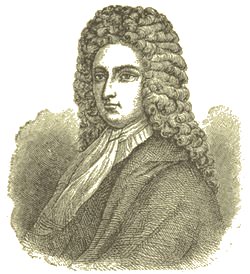
Daniel Defoe, whose "Robinson Crusoe" remains, at the end of two centuries, the most popular work of fiction in a literature abounding in imaginative works of superlative excellence, was born in London in 1661. His father was plain Mr. Foe, a butcher, of St. Giles, Cripplegate. Though Defoe speaks gratefully and respectfully of his father, he implies here and there in his writings a pride of birth which probably did not induce him to talk freely of the parental calling. He must needs be of Norman extraction, and go back with the best of those whose family claims he sneers at; and that posterity might be in no doubt of the antiquity of his descent, he, at the age of about forty, changed the plain sturdy name of Foe into De Foe; but the accepted name is as it is spelt in this contribution.
His father wished to make a Dissenting teacher of him, and sent him to Morton's Academy, in Newington Green. Morton thoroughly grounded him in knowledge of a practical and useful sort; and Defoe claimed for his preceptor's system of education that the pupils became masters of the English tongue. But language is a genius. No teacher could make a writer of a boy who was without the talent of words. In after years Defoe appears to have picked up several tongues, as may be judged by his challenge to John Tutchin, to translate with him any Latin, French, or Italian author for twenty pounds each book; one sees his proficiency also in the character he gives of himself in a paper in Applebee's Journal. But at the very heart of the genius of Defoe lay the spirit of the tradesman. It burns like a farthing rushlight in the midst of a richly furnished room. Whoever wants to understand Defoe must study his mind by this light. He declined to fill a pulpit because, in the language of the shop, "it did not pay." Already, that is when he was about two-and-twenty years old, he was writing pamphlets on Protestantism, on Popular Liberties, and the like, and he also appears to have taken part in the Duke of Monmouth's rising.
In 1685 he opened a shop as a hosier in Freeman's Court, Cornhill. There is nothing memorable to record of him while he was in this line of trade, saving that in 1688, at the Revolution, he made haste to accentuate his adhesion to William III. by joining a company of volunteer horse, a royal regiment made up of the principal citizens of London: these men, gallantly mounted and richly accoutred, with Defoe in their midst and the Earl of Monmouth at their head, guarded the king and queen to a banquet at Whitehall. His prosperity as a hosier ended in 1692, in which year he fled to Bristol, a bankrupt, with debts, according to his own showing, amounting to seventeen thousand pounds. He did not, however, long lie in hiding. In recognition of his services as a pamphleteer, the post of accountant to the Commissioners of the Glass Duty was given to him. We then find him prospering again. He started a brick-making manufactory at Tilbury, and set up a coach and a pleasure-boat. His pen, moreover, was ceaselessly employed; the titles of the productions of a single month would more than fill the slender space allotted me. He fought for Non-conformity till 1698, then broke with the Dissenters because of their practice of occasional conformity, which, he pretends, disgusted him. His argument was, let a man be wholly a Dissenter, or wholly a Churchman. But don't let him go to chapel one Sunday and church the next. He can never be taken seriously, however, in these short flights any more than in his long novels. There is no consistency in his writings, because there is no conscience in his opinions. In his "The Shortest Way with the Dissenters," he faces about, and the man who was at war with Howe, the most eloquent of Non-conformist divines, second only to Jeremy Taylor in richness of thought and splendor of diction, is, on the merits of that piece of irony, accepted by posterity as the foremost champion of Dissent.
Defoe's loyalty to King William, however, must pass unquestioned. "The True Born Englishman" procured him the notice of the king, whose confidence he claims to have been honored with. His real character as a journalist and publicist grows quickly visible after the death of William III. His genius as a "trimmer" makes sheer irony of his most appealing and eloquent pieces. Swift says of himself that he wrote that reputation might stand him in the room of a title and coach and six; Defoe flourished his pen as a tradesman, for money. Swift claims to have been the greatest master of irony of his day, nay, to have invented that form of writing. But Defoe surely is his equal, and in "The Shortest Way" out and away his superior. The writer's gravity completely deceived the world. When it was known who was the author, the Dissenters were hardly less indignant than the High Churchmen. The satiric recommendations were indeed in the highest degree alarming. The Tory party had approved with complacency while they thought the piece a serious proposal. When they found out Defoe wrote it, they hunted him down and forced him to surrender himself. A hue-and-cry advertisement in the papers while he was a fugitive, survives as one of the best pen-and-ink sketches in the language: "He is a middle-aged, spare man, about forty years old, of a brown complexion and dark brown coloured hair, but wears a wig: a hooked nose, a sharp chin, gray eyes, and a large mole near his mouth." "The Shortest Way" was ordered to be burnt, and Defoe sentenced to pay a fine of 200 marks to Queen Anne, to stand three times in the pillory, to be imprisoned during the queen's pleasure, and to find sureties for his good behavior for seven years.
The genius of Eyre Crowe has given a wonderful life and color to this memorable incident. This dead thing seems charged with a very passion of vitality in the charming illustration that accompanies this sketch. It is impossible to recur to the degradation of one of Great Britain's finest geniuses, at the instance of men of no more importance to posterity than the worms which have eaten them up, without wrath and disgust. But he was popular, and the crowd used him handsomely. They pelted him with flowers and drank his health. Pope, in a famous line, speaks of the London Monument that, like a tall bully, lifts its head and lies, because of the inscription upon it that charged the Papists with causing the great fire. The malignant little hunchback, as malevolent as an ape for all his genius, could tell lies as great as any the chisel could grave, and unfortunately, infinitely more lasting. When he wrote: "Earless on high stands unabash'd Defoe," he knew he lied. Defoe did not lose his ears. He was pilloried simply, and for three days successively, stood in Cornhill, in Cheapside, and at Temple Bar, where our illustration exhibits him. He went to Newgate; the government dared not hinder him from writing, and it was while a prisoner that he heroically started "The Review," at first a weekly, and afterward a bi-weekly, issue. It was also in Newgate that he learnt much of those secrets of the prison-house which, translated into "Moll Flanders" and "Colonel Jack," are transcripts so exquisitely faithful that one knows not how to parallel them in art save by the paintings of Hogarth. He had a wife and six children at this time, and it is difficult to guess how he provided for them. His works at Tilbury were a failure: it may be supposed that his pen was his sole resource.
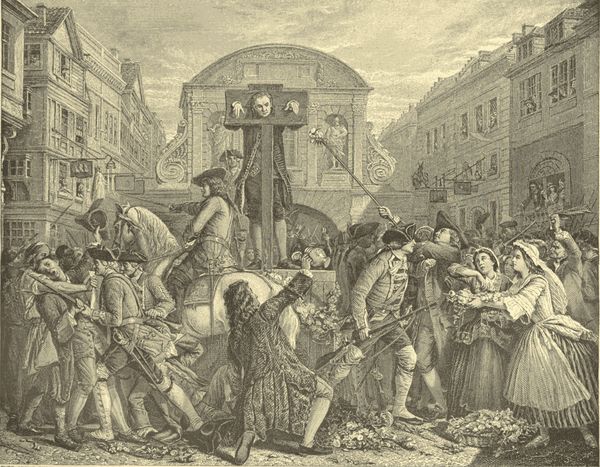
Defoe in the Pillory.
The Earl of Nottingham resigned office in 1704, and was succeeded by Robert Harley, afterward Earl of Oxford. Harley, who had a high sense of Defoe's genius, sent a messenger to the author lying in jail to inquire what he could do for him. This was in May, yet it does not seem that he was released until August. The government forthwith employed him. His career from this period, whether as a journalist, or whether as a government hireling employed on secret services, is, to say the least, dishonest. In short he was a needy man, willing to write for anybody and say anything for money. In 1706 he was sent as a spy to Scotland. Nothing was then talked about but the union of the two kingdoms; on both sides of the Tweed the masses of the people were crazy with the excitement of the subject. Of what value Defoe's services were, it is hard now to imagine. Professor Minto supposes that his business "was to ascertain and report the opinions of influential persons, and keep the government informed as far as he could of the general state of feeling." When Harley fell, Godolphin continued to employ Defoe as a government secret emissary and writer. He was again sent to Scotland in 1708, in relation to the suspected invasion of that country by the French; but he found time to keep his "Review" going. We see him "trimming" afresh, with masterly disregard to every appeal save that of his purse, when Godolphin surrendered the treasurer's staff, and Harley once more became prime minister. "My duty," says he, with that wonderful countenance of gravity, and that fine air of outraged honor, which express him in his political writings certainly, as the very prince of humbugs, "was to go along with every ministry, so far as they did not break in upon the constitution and the laws and liberty of my country." At what price did he value the constitution? And how much, leaning across the counter of his literary calling would he ask for the laws and liberties of his country? Both Godolphin and Harley, no doubt, exactly knew.
But enough in this brief sketch has been said of him as politician, journalist, controversialist, spy. He heaped pamphlet upon pamphlet, volume upon volume, and in July, 1715, was found guilty of what was called a scandalous libel against Lord Anglesea. Sentence was deferred, but he was never brought up for judgment. His representations of ardent devotion to the Whig interest seem to have procured his absolution. Be this as it may, it is extraordinary to reflect that he should live to be fifty-eight years of age before he could find it in him to produce that masterpiece of romance, "Robinson Crusoe," the delight, I may truly call it, of all reading nations. The fiction is based upon the experiences of Alexander Selkirk. He had read Steele's story of that man lonely in the South Sea island, and Woodes Roger's account of the discovery of him. Sir Walter Scott has pointed out that Defoe was known to the great circumnavigator Dampier, and he assumes with good reason that he drew many hints from the conversation and recollections of that fine seaman. He was a prosperous man when he wrote "Robinson Crusoe," had built a house at Stoke Newington, and drove in his own coach. This had come about through his successful connection with certain journals; he was also rapidly producing, and nearly all that he wrote sold handsomely. Almost as many fine things have been said about "Robinson Crusoe" as about Niagara Falls, or sunrise and sunset. The world has decided to consider it Defoe's masterpiece, and to neglect all else that he wrote for it. Nor can the world be blamed. The deliberate and dangerous lewdness of Defoe is one of the most deplorable things in letters. We shelve much of Smollett, much of Fielding, without great regret, but it is lamentable that works of powers and perceptions so supreme as "Moll Flanders" and "Colonel Jack" should be found unfit and unreadable, infinitely more perilous to the young than the coarser, but honester, freedoms of Smollett and Fielding, because of Defoe's base tradesman-like trick of representing in colors as tempting as possible the sins which with formal, pulpitic, hypocritical gravity he entreats you to avoid. "Robinson Crusoe" is wholesome: one can see one's daughter with that book in her hand and feel easy. Yet it has not the strength nor the art of "Roxana," "Colonel Jack," and "Moll Flanders." In fact, it may be said that when Defoe set about to write this book he had no thoughts whatever of art in his head. He was to relate what happened to a castaway, and the skill shown is that of a sailor who writes up his log-book. No one could have been more astonished by the success of the book than Defoe himself. He afterward went to work to communicate a needless significance to the narrative, whose charm is its eternal grace of freshness and simplicity, by writing the "Serious Reflections of Robinson Crusoe," in which he would have us believe that Crusoe's story is an allegory based on Defoe's own life. This is accepted by some even in our own time. It is easy to understand that Defoe should lose no opportunity to recommend his works by every species of advertisement; no man could lie in a literary sense with more self-complacency, and a clearer conception of the business value of the falsehood; but it is wonderful to find people choosing to travesty the palpably obvious, sooner than accept the plain truth as it lies naked on the face of the printed page.
But if Defoe had never written a line of "Robinson Crusoe," we should know him to be a great genius and a fine artist by the opening pages of "Colonel Jack." All about the lives of the three boys, their sleeping in glass houses, their picking of pockets, the loss of the money in the hollow tree, and then the recovery of it, is in its kind matchless in fiction. Wonderfully fine too are many of the touches in "Moll Flanders": the whole story of her descent from the honesty of a simple serving-maid to the horrors of Newgate and transportation, is so masterful, the art is so consummate, the impersonation by Defoe of the character of a subtle trollop full of roguish moralizings and thin sentimentalities, is so extraordinary, that one can never cease to deplore that, not the subject of the book, but Defoe's indecent handling of it, should compel the world virtually to taboo it. "Roxana" is also on the condemned list for the same reason. But literature could sooner spare this book than the other two. It was completed by another hand, and Defoe's own share might have very well been the work of the person who wrote the sequel.
Another masterpiece is his "History of the Plague." This shows his imagination at its highest, and it is not impossible but that its composition may have cost him more trouble than "Robinson Crusoe" itself. There is no space left to deal with his other works. Reference can only be made to "Captain Singleton," "A System of Magic," "A History of the Devil," "The Family Instructor," "The Plan of English Commerce," "A New Voyage Round the World," etc. In naming these I abbreviate the titles. Most of Defoe's title-pages epitomize his works, and merely as a list would fill a stout volume.
It has been suggested that Defoe in his old age became insane, and hid himself from his family for no discoverable reasons. It is certain that in September, 1729, he mysteriously removed from his house, and went into hiding in the neighborhood of Greenwich. From his secret retreat he addressed letters to his son-in-law Baker, complaining of his having been inhumanly ill-used by someone whom Mr. Lee, one of his biographers, conjectures was Mist, the proprietor of Mist's Journal, with whom Defoe had been associated in business. Other biographers seem to think that Defoe was merely hiding from the pursuit of his creditors, and dodging in his old dexterous manner the obligation of making over property to his daughter Hannah, who was married to Baker. For two years he was homeless and fugitive; it is not asserted, however, that he was in actual distress at the time of his death. He died in a lodging in a then respectable neighborhood called Ropemaker's Alley, Moor Fields, April 26, 1731, in his seventieth year.[Back to Contents]
DEAN SWIFT By Samuel Archer (1667-1745)
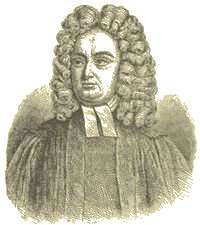
Jonathan Swift's father died before the boy was born, and the care of his education was kindly undertaken by Mr. Godwin Swift, his uncle, a very eminent attorney at Dublin, who likewise took his mother and his sister under his protection, and thus became a guardian to the family. When his nephew was six years of age he sent him to school at Kilkenny, and about eight years afterward he entered him a student of Trinity College in Dublin, where Swift lived in perfect regularity and in an entire obedience to the statutes; but the moroseness of his temper often rendered him unacceptable to his companions, so that he was little regarded and less beloved; nor were the academical exercises agreeable to his genius.
He held logic and metaphysics in the utmost contempt, and he scarcely attended at all to mathematics and natural philosophy, unless to turn them into ridicule. The studies which he chiefly followed were history and poetry, in which he made great progress; but to other branches of science he had given so very little application, that when he appeared as a candidate for the degree of bachelor of arts, after having studied four years, he was set aside on account of insufficiency, and at last obtained his admission speciali gratiá, a phrase which in that university carries with it the utmost marks of reproach. Swift was fired with indignation at the treatment he had received in Ireland, and therefore resolved to pursue his studies at Oxford. However, that he might be admitted ad eundem, he was obliged to carry with him a testimonial of his degree. The expression speciali gratiá is so peculiar to the university of Dublin, that when Mr. Swift exhibited his testimonial at Oxford, the members of the English university concluded that the words speciali gratiá must signify a degree conferred in reward of some extraordinary diligence and learning. He was immediately admitted ad eundem, and entered himself at Hart Hall, now Hartford College, where he constantly resided (some visits to his mother, at Leicester, and to Sir William Temple, at Moose Park, excepted) till he took his degree of master of arts, which was in the year 1691. And in order to recover his lost time he now studied eight hours daily for seven years.
Swift, as soon as he had quitted the University of Oxford, lived with Sir William Temple as his friend and domestic companion. When he had been about two years with Sir William, he contracted a very long and dangerous illness by eating an immoderate quantity of fruit. To this surfeit he was often heard to ascribe that giddiness in his head which, with intermissions sometimes of longer and sometimes of shorter continuance, pursued him to the end of his life.
In compliance with the advice of physicians, when he was sufficiently recovered to travel, he went to Ireland, to try the effects of his native air; but finding the greatest benefit arose from the exercise of travelling, he followed his own inclination. He soon returned into England, and was again received in a most affectionate manner by Sir William Temple, who was then settled at Shene, where he was often visited by King William.
Here Swift had frequent conversations with that prince, in some of which the king offered to make him a captain of horse, which offer, in splenetic dispositions, he always seemed sorry to have refused; but at the time he had resolved within his own mind to take orders: and during his whole life his resolutions, when once fixed, were ever after immovable.
About this time he assisted Sir William Temple in revising his works. He likewise corrected and improved his own "Tale of a Tub," a sketch of which he had drawn up while he was a student at Trinity College, Dublin. Sir William's conversation naturally turned upon political subjects, and Swift improved the frequent opportunities he had of acquiring from this able statesman a competent knowledge of public affairs. But at length he suspected that Sir William neglected to provide for him, merely that he might keep him in his family; and he resented this so very warmly that a quarrel ensued, and they parted in the year 1694, and he went to Ireland, where he took orders.
Sir William, however, notwithstanding the differences between them, recommended him in the strongest terms to Lord Capel, then lord-deputy, who gave him a prebend, of which the income was about £100 a year. Swift soon grew weary of his preferment: it was not sufficiently considerable, and was at so great a distance from the metropolis that it absolutely deprived him of that conversation and society in which he delighted. He had been used to different scenes in England, and had naturally an aversion to solitude and retirement. He was glad, therefore, to resign his prebend in favor of a friend, and to return to Shene, to Sir William Temple, who was so much pleased with his return, which he considered as an act of kindness to him in the close of life, that a sincere reconciliation took place, and they lived together in perfect harmony till the death of Sir William. By his will he left him a considerable legacy in money, and the care, trust, and emolument of publishing his posthumous works. During Swift's residence at Shene he became intimately acquainted with Miss Johnson, who was the daughter of Sir William's steward, and who was afterward so distinguished and so much celebrated in Swift's works under the name of Stella.
Soon after the death of his patron, Swift came to London, and took the earliest opportunity of transmitting a memorial to King William, under the claim of a promise made by his majesty to Sir William Temple, "that Mr. Swift should have the first vacancy that happened among the prebends of Westminster or Canterbury." The memorial had no effect; and, indeed, Swift himself afterward declared that he believed the king never received it. After a long and fruitless attendance at White Hall, Mr. Swift reluctantly gave up all thoughts of a settlement in England. In the year 1701 he took his doctor's degree; and toward the latter end of that year King William died.
On the accession of Queen Anne, Dr. Swift came to England. It cannot be denied that the chief ministers of the queen, whether distinguished under the titles of Whigs or Tories, of high-church or of low-church, were from the beginning to the end of her reign encouragers of learning and patrons of learned men. The wits of that era were numerous and eminent. Amid the crowd, yet superior to the rest, appeared Dr. Swift. In a mixture of those two jarring parties called Whig and Tory, consisted the first ministry of Queen Anne; but the greater share of the administration was committed to the Whigs, who soon engrossed the whole. The queen, whose heart was naturally inclined toward the Tories, remained an unwilling prisoner several years to the Whigs, till Mr. Harley at length took her majesty out of their hands, and during the remainder of her life surrounded her with a set of Tories, under the conduct of the Duke of Ormond and himself.
Dr. Swift was known to the great men of each denomination. It is certain that he was bred up and educated with Whigs, at least with such as may be found ranged under the title. His motives for quitting Whigism for Toryism appear throughout his works. He had commenced as a political author in 1701, when he published "A Discourse on the Contests and Dissensions between the Nobles and Commons in Athens and Rome, with the Consequences they had upon both States." This was written in defence of King William and his ministers against the violent proceedings in the House of Commons. But from this time to the year 1708, Lord Orrery informs us, he did not write any political pamphlet. From this year to 1710 he worked hard to undermine the Whigs and to open a way for the Tories to come into power. His intimacy with Harley commenced, as may be deduced from his works, in October, 1710. It seems undeniable that a settlement in England was the constant object of Dr. Swift's ambition; so that his promotion to a deanery in Ireland was rather a disappointment than a reward, as appears by many expressions in his letters to Mr. Gay and Mr. Pope.
The business which first introduced him to Harley was a commission sent to him by the primate of Ireland to solicit the queen to release the clergy of that kingdom from the twentieth-penny and first-fruits. As soon as he received the primate's instructions, he resolved to wait on Harley; but before the first interview he took care to get himself represented as a person who had been ill used by the last ministry, because he would not go such lengths as they would have had him. The new minister received him with open arms, soon after accomplished his business, bade him come often to see him privately, and told him that he must bring him to the knowledge of Mr. St. John (Lord Bolingbroke). Swift presently became acquainted with the rest of the ministry, who appear to have courted and caressed him with uncommon assiduity.
From this era to the death of Queen Anne we find him fighting on the side of the ministers and maintaining their cause in pamphlets, poems, and weekly papers. But notwithstanding his services to the ministry, he remained without preferment till the year 1713, when he was made Dean of St. Patrick's. In point of power and revenue such a deanery might appear no inconsiderable promotion; but to an ambitious mind whose perpetual aim was a settlement in England, a dignity in any other kingdom must appear only an honorable and profitable banishment. There is great reason to imagine that the temper of Swift might occasion his English friends to wish him happily and properly promoted at a distance. His spirit was ever untractable, the motions of his genius irregular. He assumed more the airs of a patron than a friend. He affected rather to dictate than advise, and was elated with the appearance of enjoying ministerial confidence.
Dr. Swift had little reason to rejoice in the land where his lot had fallen: for upon his arrival in Ireland to take possession of his deanery, he found the violence of party reigning in that kingdom to the highest degree. The common people were taught to look upon him as a Jacobite, and they proceeded so far in their detestation as to throw stones at him as he passed through the streets. The chapter of St. Patrick's, like the rest of the kingdom, received him with great reluctance. They thwarted him in every particular he proposed. He was avoided as a pestilence, opposed as an invader, and marked out as an enemy to his country. Such was his first reception as Dean of St. Patrick's. Fewer talents and less firmness must have yielded to such violent opposition. But so strange are the revolutions of this world that Dean Swift, who was then the detestation of the Irish rabble, lived to govern them with absolute sway.
He made no longer stay in Ireland than was requisite to establish himself a dean, and in the beginning of the year 1714, returned to England. He found his great friends at the helm much disunited among themselves. He saw the queen declining in health and distressed in situation. The part which he had to act upon this occasion was not so difficult as it was disagreeable; he exerted all his skill to reunite the ministers. Finding his endeavors fruitless, he retired to a friend's house in Berkshire, where he remained till the queen's death, an event which fixed the period of his views in England and made him return as fast as possible to his deanery in Ireland, oppressed with grief and discontent.
His works from the year 1714 to the year 1720 are few in number and of small importance. "Poems to Stella" and "Trifles to Dr. Sheridan" fill up a great part of that period. But during this interval, Lord Orrery supposes, he employed his time in writing "Gulliver's Travels." His mind was likewise fully occupied by an affecting private incident. In 1713 he had formed an intimacy with a young lady in London, to whom he became a kind of preceptor; her real name was Vanhomrigh, and she was the daughter of a Dutch merchant who settled and died at Dublin. This lady was a great admirer of reading, and had a taste for poetry. This increased her regard for Swift till it grew to affection, and she made him an offer of marriage, which he refused, and upon this occasion he wrote his little poem of "Cadenus and Vanessa." The young lady from this time was called Vanessa; and her mother dying in 1714, she and her sister followed the dean to Ireland, where he frequently visited them; and he kept up a literary correspondence with Vanessa until her death, which followed closely on a bitter quarrel with him.
In the year 1720 he began to reassume the character of a political writer. A small pamphlet, in defence of the Irish manufactories, was supposed to be his first essay, in Ireland, in that kind of writing; and to that pamphlet he owed the turn of the popular tide in his favor. The pamphlet recommended the universal use of the Irish manufactures within the kingdom. Some little pieces of poetry to the same purpose were no less acceptable and engaging; nor was the dean's attachment to the true interest of Ireland any longer doubted. His patriotism was as manifest as his wit; he was looked upon with pleasure and respect as he passed through the streets, and had attained to so high a degree of popularity as to become the arbitrator in disputes among his neighbors.
But the popular affection which the dean had hitherto acquired, may be said not to have been universal until the publication of the Drapier's Letters, in 1724, which made all ranks and professions universal in his applause. These letters were occasioned by a patent having been obtained by one William Wood, to coin £180,000 of halfpence for the use of Ireland. The dean, in character of a draper, wrote a series of letters to the people, urging them not to receive this money; and Wood, though powerfully supported, was compelled to withdraw his patent, and his money was totally suppressed. Never was any name bestowed with more universal approbation than the name of the Drapier was bestowed upon the dean, who had no sooner assumed it than he became the idol of Ireland, even to a degree of devotion; and bumpers were poured forth to the Drapier, as large and as frequent as to the glorious and immortal memory of King William III. Acclamations and vows for his prosperity attended him wherever he went, and his portrait was painted in every street in Dublin.
The dean was consulted in all points relating to domestic policy in general, and to the trade of Ireland in particular; but he was more immediately looked on as the legislator of the weavers, who frequently came to him in a body to receive his advice in settling the rates of their manufactures, and the wages of their journeymen. When elections were pending for the city of Dublin, many of the companies refused to declare themselves till they had consulted his sentiments and inclinations.
In 1727 died his beloved Stella, in the forty-fourth year of her age, regretted by the dean with such excess of sorrow as only the keenest sensibility could feel, and the most excellent character excite. After the death of Stella his life became very retired, and the austerity of his temper increased; his public days for receiving company were discontinued, and he even shunned the society of his most intimate friends.
We have now conducted the dean through the most interesting circumstances of his life, to the fatal period wherein he was utterly deprived of his reason, a loss which he often seemed to foresee, and prophetically lamented to his friends. The total deprivation of his senses came upon him by degrees. In the year 1736 he was seized with a violent fit of giddiness: he was at that time writing a satirical poem, called the "Legion Club;" but he found the effects of his giddiness so dreadful that he left the poem unfinished, and never afterward attempted a composition of any length, either in verse or prose. However, his conversation still remained the same, lively and severe; but his memory gradually grew worse and worse, and as that decreased he grew every day more fretful and impatient. From the year 1739 to the year 1744 his passions grew so violent and ungovernable, his memory so decayed, and his reason so depraved, that the utmost precautions were taken to prevent all strangers from approaching him, for till then he had not appeared totally incapable of conversation. He now, however, grew rapidly worse, and died in 1745. He had willed all his fortune to be used in founding a home for incurable madmen.[Back to Contents]
ALEXANDER POPE[3] By Austin Dorson (1688-1744)
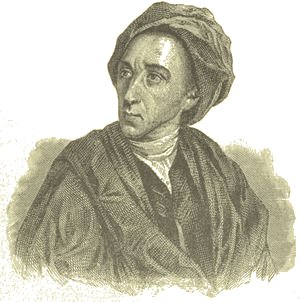
More than two hundred years ago, on May 21, 1688, was born in Lombard Street, London, a poet whose influence, for nearly a century, reigned paramount in English verse. He had not been long dead, it is true, when his supremacy was contested, but to so little purpose that two decades passed away before his overbold assailant mustered courage to follow up his first attack. Then, after an interval, the challenge was renewed, and for a long period the literary world rang with the blows of the opposing champions. Was Alexander Pope a great poet or was he not? It was Thomas Warton who first put that question, and it was William Bowles who repeated it. Against Warton was Warburton; against Bowles were Byron and Campbell and Roscoe, with a host of minor combatants. When at last the contest seemed to droop it was only to begin again upon a new issue; and the lists shook beneath the inroad of De Quincey and Macaulay. Was Pope a "correct" poet? The latter-day reader, turning cautiously—it may be languidly—the records of that ancient controversy, wonders a little at the dust and hubbub. If he trusts to his first impression, he will, in all probability, be content to waive discussion by claiming for Pope a considerably lower place than for Shakespeare or for Milton; and upon the point of his "correctness" will decide discreetly, in the spirit of the immortal Captain Bunsby, that much depends upon the precise application of the term. But let him have a care. The debate is an endless one, eternally seductive, irrepressibly renascent, and hopelessly bound up with the ineradicable oppositions of human nature. Sooner or later he will be drawn into the conflict and cry his slogan with the rest. If, in the ensuing pages, their writer seems to shun that time-honored discussion, as well as some other notable difficulties of Pope's biography, he does so mainly lest they should, in Bunyan's homespun phrase,
"—prove ad infinitum and eat out The thing that he already is about,"
to wit, the recalling of Pope's work and story.
Pope's father was a London linen-merchant, who, according to Spence, "dealt in Hollands wholesale." His mother was of good extraction, being the daughter of one William Turner, of York. Both were Roman Catholics, at a time when to be of that faith in England was to suffer many social disabilities; and it was perhaps in consequence of these that, about the time of the Revolution, the elder Pope bought a small house at Binfield, on the skirts of Windsor Forest. Here he lived upon his means and cultivated his garden, a taste which he transmitted to his son, who, under the care of his mother and a nurse named Mary Beach, grew from a sickly infant into a frail, large-eyed boy with a sweet voice, an eager, precocious temperament, and an inordinate love of books, from copying the type of which he first learned to write. Like his father, he was slightly deformed, while from his mother he derived a life-long tendency to headache. His early education was of a most miscellaneous character. After some tuition from the family priest, he passed to a school at Twyford, where he is said to have been flogged for lampooning the master. Thence he went to a second school, where he learned but little. As a boy, however, he had tried his hand at translating, and had tacked together, from reminiscences of Ogilby, a kind of Homeric drama to be acted by his playmates, with the gardener for Ajax. But his real education began at Binfield, where, when between twelve and thirteen, he resolutely sat down to teach himself Latin, French, and Greek. Between twelve and twenty he must have read enormously and written as indefatigably. Among other things, he composed an epic of Alexander, Prince of Rhodes, which is said to have extended to four thousand lines, and its versification was so finished that he used some of the couplets long afterward for maturer work. His earliest critic was his father, who would sit in judgment on his son's performances, ruthlessly "sending him down" when the Muse proved unusually stubborn, "These be good rhymes," he would say when he was pleased.
The quiet, orderly household in Windsor Forest received but few visitors, and those chiefly of the family faith. Such, for example, were the Carylls of West Grinstead, and the Blounts of Mapledurham, where there were two bright-eyed daughters of Pope's own age, the "fair-hair'd Martha and Teresa brown," whose names, linked in Gay's dancing-verse, were afterward to be indissolubly connected with that of their Binfield neighbor. At this date, however, they must have been school-girls at Hammersmith, under some pre-Thackerayan Miss Pinkerton, or else were being "finished" at that Paris establishment whence they derived the foreign cachet which is said to have been part of their charm. Another friend was the ex-statesman and ambassador, Sir William Trumbull of East Hampstead, who compared artichokes with the father and read poetry with the son. To Trumbull Pope submitted some of his earliest verses, and from him, it seems, received much valuable advice, including a recommendation to translate Homer. Another acquaintance was the minor poet and criticaster, William Walsh, who gave his young friend that memorable (and somewhat ambiguous) injunction to "study the ancients" and "be correct." He had been introduced to Walsh by another man of letters, whose acquaintance he must have made during one of his brief excursions to London, the whilom dramatist Wycherley—now a broken septuagenarian, but still retaining a sort of bankrupt bel air. To Wycherley, who could not tear himself from his favorite St. James's, the youthful Pope wrote literary letters, being even decoyed into patching and revising the old beau's senile verses. Another of his correspondents was Henry Cromwell—Gay's "honest, hatless Cromwell, with red breeches," who at this time was playing the part of an elderly Phaon to the Sappho of a third-rate poetess, Mrs. Elizabeth Thomas. The epistles of the boy at Binfield to these battered men about town, when not discussing metres and the precepts of M. the Abbé Bossu, in a style modelled upon Balzac and Voiture, are sometimes sorry reading. But both Wycherley and Cromwell were wits and men of education, and it is not difficult to pardon that morbid, over-active mind for occasional vagrancy in its efforts after some congenial escape from the Tory fox-hunters of Berkshire and the ribald drinking songs of Durfey.
By 1711, when Pope was three-and-twenty, his intercourse with Wycherley and Cromwell had practically ceased, and "knowing Walsh" was dead. But he had already obtained a hearing as a poet. He had written a series of "Pastorals" in the reigning taste, a taste which, under guise of imitating Theocritus and Virgil, not only transferred to our bleaker shores the fauna and flora of Italy and Greece, but brought along with them the light-clad (and somewhat embarrassed) Delias and Sylvias of those sunnier lands. Pope, indeed, partly modified this. He drew the line at wolves, for instance, though (as Mr. Leslie Stephen suggests) this mattered little when altars and milk-white sacrificial bulls were still "perpetually retained." But the main feature of the "Pastorals" was less their subject than their versification, which in these earliest efforts was already as finished and as artful as anything Pope ever wrote, and was far above the work of his contemporaries. Lansdowne ("Granville the polite"), Congreve, Garth, Halifax, and others praised them warmly in MS., and left-legged Jacob Tonson came cap in hand to solicit them for the sixth part of his "Miscellany," where they ultimately wound up that volume, balancing (or rather over-balancing) the "Pastorals" of Ambrose Philips, which began it. To the same collection Pope contributed an imitation of Chaucer, and an episode from the "Iliad." The immediate success of these performances seems to have set him upon his next poem, the "Essay on Criticism," which was published by Lewis in 1711. His mastery over his medium was still more noticeable than the originality of his thought. But this cento of exquisitely chiselled critical commonplaces goes far toward being a chef d'œuvre of mere manipulative skill; and we are still, by our daily use of some of its lines, justifying the truth of Addison's dictum, that "Wit and fine Writing doth not consist so much in advancing Things that are new as in giving Things that are known an agreeable Turn."
To the "Essay on Criticism" succeeded one of Pope's most brilliant poems, the famous "Rape of the Lock." In its first form it appeared, together with some minor poems and translations, in a volume of "Miscellanies" published by Tonson's rival, Lintot. Its motif was the theft by a certain Lord Petre of one of the tresses of Miss Arabella or "Belle" Fermor, and this venial larceny having somewhat strained the relations of the two families concerned, Pope was invited to compose matters by invocation of the Muse. The poem in its first "Miscellany" form consisted of no more than two cantos; but Pope, confident of his powers, and certainly with a better knowledge of his own method than his critics could have possessed, boldly took advantage of its success to expand it into five cantos by the addition of a Rosicrucian machinery of sylphs and gnomes. This apparently hazardous experiment was perfectly successful, and the "Rape of the Lock" became what it remains, the typical example of raillery in English verse—the solitary specimen of sustained and airy grace. If it has faults, they are the faults of the time, and not of the poem, the execution of which is a marvel of ease, good humor, and delicate irony. Another of Pope's efforts at this date was "Windsor Forest," a theme which, assuming that to be the best which lies nearest, should have afforded material for another enduring success. But Pope, with a matchless eye for manners, looked at nature with the unpurged vision of his generation, and the poem, though not without dignity and beauty of versification, is, to the modern reader, cold and conventional.
To the reader under Anne it was otherwise, for to him "verdant isles" and "waving groves" and the whole farrago of gradus epithets were not only grateful but indispensable. "Mr. Pope," wrote Swift to Stella under date of March, 1713, "has published a fine poem called 'Windsor Forest.' Read it." This is the only time Pope is mentioned in that memorable journal (now nearing its closing pages) and it scarcely points to any close relations. But, by and by, when Swift came back from his Irish deanery to reconcile Oxford and Bolingbroke, he seems to have made Pope's personal acquaintance, and to have begun the correspondence which lasted so long. By Swift, Pope was introduced to Oxford, to his later "guide, philosopher, and friend," Bolingbroke, to the gentle and humane Atterbury, Bishop of Rochester, to Prior and Parnell, to Arbuthnot, best of men and physicians—some of whom he mentions in the "Prologue to the Satires." Swift, he says:
"endur'd my rays; The courtly Talbot, Somers, Sheffield read; Ev'n mitred Rochester would nod the head, And St. John's self (great Dryden's friends before) With open arms receiv'd one Poet more."
Closely connected with the group of Pope's connections at this time was the famous literary association known as the "Scriblerus Club," the avowed object of which was to satirize the abuses of human learning. The dispersal of its members at the death of Anne interrupted this enterprise, which never extended beyond a first book—a fragment which must, however, be held to have been unusually pregnant in suggestion, since it contained the germs of "Gulliver's Travels" and the "Dunciad." But Pope's life at this point grows too complicated to be pursued in detail, and it will be impossible henceforth to do more than note briefly its chief incidents. Trumbull's counsel to him to translate Homer, and his first essay in Tonson's "Miscellany," have already been mentioned. In a later volume of "Miscellany" poems edited by Steele, he had printed some specimens from the "Odyssey," and in the following year he embarked in the great work of his middle life, the translation of the "Iliad." By 1715 the first volume, containing four books, was issued to the subscribers, whose roll, ennobled by the patronage of Oxford and Bolingbroke, and extended by the imperious advocacy of Swift, included almost everyone of importance. The only blot upon its brilliant success is the unfortunate quarrel with Addison, which led to the portrait of Atticus.
Early in 1716, not long after the death of Wycherley, Pope moved from Binfield to Chiswick. His house, in what was then known as the "New Buildings," but is now Mawson's Row, still exists down a turning off the Mall, not very far from the old Church where Hogarth lies buried, and from Chiswick House, the mansion of Lord Burlington, under whose wing Pope describes himself as residing. Here, for a couple of years, were delivered those letters, upon whose backs or envelopes, piously preserved in the British Museum, the "paper-sparing" poet penned his daily tale of Homeric translation, completing two more volumes of the "Iliad" during his sojourn in Mawson's Row. At this time he was twenty-eight, and may therefore be assumed to be accurately represented in the portrait painted by Kneller in 1716, and mezzotinted a year later by Smith. Here he appears as a slight, delicate young man, wearing a close-fitting vest or tunic, and, in lieu of a wig, the dressing or "night-cap" which took its place. His keen, shaven face is already worn by work and ill-health, and conspicuous for the large and brilliant eyes to which he refers, in his "Epistle to Arbuthnot," as one of his noticeable features.
Besides the poems already mentioned, he had, in 1715, produced another imitation of Chaucer, the "Temple of Fame," an effort which has never taken high rank among his works. But while at Chiswick he published, in addition to instalments of the "Iliad," two pieces of considerable merit, although they are scarcely regarded by the critics of this age with the enthusiasm they excited in Pope's earliest admirers. One is the celebrated "Elegy to the Memory of an Unfortunate Lady," which perhaps owes some of its reputation to the difficulty experienced in identifying the "ever injur'd Shade" intended. She is now understood to have been a much-persecuted Mrs. Weston, who, although she suffered many griefs, did not (as her poet implies) put an end to her own life in consequence. The other, under the title of "Eloisa to Abelard," versifies the Latin letters of that distinguished amorist to her lover. It is impossible to deny to both these works the utmost amount of artful development and verbal finish. All that skill can do in the simulation of sincerity Pope has done. "The Epistle of Eloisa," he tells a correspondent, "grows warm, and begins to have some breathings of the heart in it, which may make posterity think I was in love." With all submission, this is precisely the illusion which is absent, and it is perfectly possible for the most sympathetic reader to peruse the balanced outpourings of "Fulbert's niece" without the slightest tendency to that globus hystericus which all persons of sensibility must desire to experience. Yet it must nevertheless be admitted that these poems are the best examples of a vein which is not native to their writer, and that, in them, Pope comes nearer to genuine pathos than in any other of his works. Next to these, the only literary event of this portion of his career is his connection with the deplorable "Three Hours after Marriage," a farce in which he was assisted by Arbuthnot and Gay, the latter of whom bore the blame of the play's failure. Pope's old enemy Dennis, was caricatured in it as Sir Tremendous; but it had also the effect of adding another and abler foe to the list of his opponents, the player and manager, Colley Cibber, whose open ridicule of a part of this ill-judged jeu d'esprit began the feud which ultimately secured for him the supreme honors of the "Dunciad."
But although Pope's militant nature never feared to make an enemy, his friends were still in the majority. His "Homer," with its magnificent subscription list, had opened a wider world to him; and his new associates seem for the time to have partially seduced him from his valetudinarian régime and ten hours daily study. In his varied and alembicated correspondence we track him here and there, at Oxford or at Bath, studying architecture with my Lord Burlington and gardening with my Lord Bathurst or "beating the rounds" (probably only in metaphor) with wilder wits such as my Lord of Warwick and Holland. One of the prettiest of Pope's missives (some of them are not pretty) to "Mademoiselles de Maple-Durham," as he styles the Blounts, describes a visit he had paid to Queen Caroline's maids of honor at Hampton Court, the Bellenden and Lepel of his minor verses. He dilates upon their monotonous life of hunting, etiquette, and Westphalia ham, and then, not (as Carruthers suggests) without oblique intention of lighting a spark of jealousy in the fair Martha's bosom, records how he walked for three or four mortal hours by moonlight with Mrs. Lepel, meeting never a creature of quality but his Majesty King George I., giving audience to his Vice Chamberlain "all alone under the garden wall." Another epistolary idyl to Martha Blount, of which there are at least four replicas, relates the sentimental death by lightning of the two haymakers at Stanton Harcourt. Did Pope write this letter? or did Gay? Or did they write it both together? This is a question which Pope's editors have failed to settle. At all events, a similar composition went to another of Pope's flames, the brilliant Lady Mary Wortley Montagu, now absent from England with her husband, who was ambassador at Constantinople. Clever Lady Mary, however, entirely declined to be subjugated by the pathetic fallacy, and sent back a matter-of-fact epitaph for John Hewet and Sarah Drew, which, though it wound up with a compliment to her correspondent, can hardly have gratified him. But there is one letter of this time the sincerity of which is undoubted. It is Pope's announcement to Martha Blount of his father's death. "My poor Father dyed last night," it says. "Believe, since I don't forget you this moment, I never shall. A. Pope." The antithetical touch shows how art had become a second nature with the writer; but his attachment and devotion to his parents is not one of the disputed points in his story.
Alexander Pope the elder died in October, 1717. Not very long after, the poet moved with his mother to a little villa, or "villakin" as Swift called it, on the banks of the Thames at Twickenham, close to the grotesque Gothic jumble known as Radnor House. At Twickenham or, as he called it, "Twitnam," Pope continued to reside until his death, his permanent house-mates being his old nurse, Mary Beach, to whom there is a tablet on the outer wall of Twickenham Church, and his mother, who survived her husband until 1733, only preceding her famous son by eleven years. Pope tended her with exemplary care—a care rendered daily more imperative by her increasing infirmities. Many references to her occur in his correspondence, and the sedulous inquiries made by his friends as to her health are earnest of her son's unwearied solicitude. One or two of the old lady's simple, homely letters to him have been preserved, with their fond messages and faulty spelling. Now and then, it is recorded, he would gratify her by setting her to transcribe his "Homer," an assistance of which the advantages must have been debatable.
Many friends came and went at the pleasant little villa by the Thames, "flanked by its two Courts" of Hampton and Kew, and often, no doubt, the London stage, starting from the Chequers in Piccadilly, brought to it guests bearing names familiar in the annals of the time. There are three of his intimates who cannot be neglected in any record, however brief. When Lady Mary came back to England she took up her residence at Twickenham, and the hitherto epistolary adoration of the poet became a practical fact. According to a story popularized by the pencil of Frith, Pope at length so far forgot himself as to make a declaration in form, to which she returned no reply but that most exasperating of all replies, ungovernable laughter. Whether this tradition be true or not, it is plain that she seems always to have remembered their difference of rank, and to have been rather cold than encouraging. The issue of the acquaintance is a sorry one. Pope revenged himself for her scorn in his worst and most unmanly fashion of innuendo; she, on her side, retorted with lampoons and satire as cruel. One feels glad that she finally left England and that further bickering was impossible. The other two persons were the already mentioned Blounts, each of whom seems at first to have by turn
"—blossomed in the light Of tender personal regards;"
Teresa, the elder and handsomer, becoming by degrees the acknowledged favorite. But whether, like the lover in Prior's song, Pope "convey'd his treasure in a borrowed name," or merely changed his mind, it is certain that, at a later period, the younger, Martha, had proved the "real flame," to the permanent displacement of her sister. As time went on, Pope's attachment for Martha Blount continued to increase until she became almost an inmate of his house. For more than fifteen years, he told Gay in 1730, he had spent three or four hours a day in her company; and he seems to have loved her with an affection as genuine and as watchful as that which he showed to his parents. Like all his connections, this, too, was marred by strange pettinesses and curious contradictions; but one can scarcely grudge to his sickly sensitive nature the anodyne of feminine sympathy. Why so close and tender a friendship never ripened into marriage is an inquiry that may be consigned to the limbo of questions insoluble. It is enough that in the checkered chronicle of the loves of the poets, "blue-eyed Patty Blount" has an immortality almost as secure as that of Esther Johnson.
To return to Pope's works. In the first years of his Twickenham residence the "Iliad" was finished triumphantly, and Pope was invited by the booksellers to edit Shakespeare. The task was one for which he had few qualifications, and his execution of it at once laid him open to a new attack from a fresh opponent, Lewis Theobald, afterward the Tibbald of the "Dunciad" and the "Satires." Then he followed up the "Iliad" by the "Odyssey," in which he was assisted by Fenton and Broome. Toward 1725 Bolingbroke settled at Dawley, and in the succeeding year Swift paid a long visit to Pope at Twickenham. These two influences may be traced in most of Pope's remaining works. In 1726, "Gulliver's Travels" saw the light, and in 1727 were issued those joint volumes of "Miscellanies" which contained the "Treatise on the Bathos," a prose satire, to be supplanted in brief space by the terrible "Dunciad." In this last, Pope entered upon a campaign against the smaller fry of the pen with a vigor, a deadly earnestness, and a determination to wound, unparalleled in the history of letters. One of the most gifted of his critics, the late Rector of Lincoln College, speaks of the "Dunciad" roundly as "an amalgam of dirt, ribaldry, and petty spite," and M. Taine brought against it the more fatal charge of tediousness. But even if one admits the indiscriminate nature of that onslaught which confuses Bentley with such creatures of a day as Ralph and Oldmixon, it is impossible not to admire the surpassing skill of the measure; and it is probable that, in spite of the "higher criticism," the "Dunciad," swarming as it does with contemporary allusions, will continue to hold its own with the antiquary and the literary historian, though it has ceased to be regarded as one of the desirable masterpieces of its class.
If Swift, who encouraged Pope in his war against Dulness, must be held to be indirectly responsible for the attack upon its strongholds, it was Bolingbroke who suggested the once popular epistles which Pope dedicated to him under the title of the "Essay on Man," a work which has this in common with the earlier "Essay on Criticism," that it is a versification of a given theme. But Pope understood the precepts of Rapin and Bossu better than the precepts of Leibnitz and St. John, and the "Essay on Man," bristling as it does with axiomatic felicities and "jewels five words long," has long been discredited as a philosophical treatise. It is to another hint from the sage of Dawley that we owe its author's most individual work. A chance remark of Bolingbroke set him upon the imitations of Horace that grew into the "Satires and Epistles." In these and the cognate "Moral Essays," which belong to his ripest period of production, Pope's unmatched mastery over heroics, perfected by the long probation of his Homeric translations, and his equally unrivalled powers of satire, let loose and emboldened by the brutalities of the "Dunciad," found their fitting field. Aimed at the old eternal vices and frailties of humanity, they assail them with a pungency, a force, a wit, and a directness which, in English verse, have no parallel. Indeed it may be doubted whether the portraits of Bufo and Sporus, of Atossa and Atticus, have been excelled in any language whatsoever.
The first of the Dialogues known as the "Epilogue to the Satires" was published in 1738, on the same morning as Johnson's "London," thus (in Boswell's view) providing England simultaneously with its Horace and its Juvenal. The second part followed in the same year. Besides these there is little which is material to be added to the record of Pope's work but the revised "Dunciad," in which, to gratify an increased antipathy, he displaced its old hero, Theobald, in favor of Colley Cibber, who, whatever his faults, was certainly not a typical dunce. Toward the close of his life those infirmities at which Wycherley had hinted in his youth grew upon him, and he became almost entirely dependent upon nurses. He had not, to use De Quincey's words, drawn that supreme prize in life, "a fine intellect with a healthy stomach," and his whole story testifies to that fact. As years went on his little figure, in its rusty black, was seen more rarely in the Twickenham lanes, and if he took the air upon the Thames, it was in a sedan-chair that was lifted into a boat. When he visited his friends his sleeplessness and his multiplied needs tired out the servants; while in the day-time he would nod in company, even though the Prince of Wales was talking of poetry. He was a martyr to sick headaches, and in the intervals of relief from them would be tormented by all sorts of morbid cravings for the very dietary which must inevitably secure their recurrence. This continued battle of the brain with the ignobler organs goes far to explain, if it may not excuse, much of the less admirable side of his character. His irritability, his artifice, his meannesses even, are more intelligible in the case of a man habitually racked with pain, and morbidly conscious of his physical shortcomings, than they would be in the case of those "whom God has made full-limbed and tall;" and, in the noble teaching of Arthur's court, his infirmities should entitle him to a larger charity of judgment.
Nothing in his life is more touching than the account of his last days, when he lay wasted with an intolerable asthma, waiting serenely for the end, but full of kindness and tender thoughtfulness for the friends who came and went about his bed. Bolingbroke was often there from Battersea, stirred to philosophic utterances and unphilosophic tears, and grave Lyttleton, and kind Lord Marchmont, and faithful Joseph Spence. Martha Blount, too, was not absent, and "it was very observable," said the spectators, how the sick man's strength and spirits seemed to revive at the approach of his favorite. "Here I am dying of a hundred good symptoms," he said to one of his visitors. What humiliated him most was his inability to think. "One of the things that I have always most wondered at (he told Spence) is that there should be any such thing as human vanity. If I had any, I had enough to mortify it a few days ago, for I lost my mind for a whole day." A little later Spence is telling Bolingbroke how, "on every catching and recovering of his mind," Pope is "always saying something kind either of his present or absent friends," and that it seems "as if his humanity had outlived his understanding." But the vital spark still continued to flicker in its socket, and only a day or two before his death he sat for three whole hours in his sedan-chair, in the garden he loved so well, then filled with the blossoms of May and smelling of the summer he was not to see. On the 29th he took an airing in Bushy Park, and a little later received the sacrament. On the evening of the following day he passed away so softly and painlessly that those who stood by knew not "the exact time of his departure." He had lived fifty-six years and nine days, and he was buried near to the monument of his father in the chancel of Twickenham Church. Seventeen years afterward Bishop Warburton erected a tablet to him in the same building, with an epitaph as idle as that which disgraces the tomb of Gay in Westminster Abbey. It is possible that Pope may at some time have written it, but the terms of his will prove conclusively that he never intended it to be used.