Volume 7 — ARTISTS AND AUTHORS (continued 5)
Reading edition
He was a precocious boy, and his father and mother both observed his remarkable abilities. There was no lack of good teachers in Frankfort, and he was well trained in the classics in early life. He also studied Hebrew at the same time, having the advantage of the instruction of learned Jews who lived in Frankfort. There never was any question but that he should go to the university. His father's wish was that he should enter upon the career of what he would have called jurisprudence. With this view some of the younger Goethe's earlier studies were conducted. But, before he was old enough to take any very decided steps in the profession of law, his determination to follow a wider literary career became so evident that the plan of jurisprudence was eventually entirely abandoned.
When he was sixteen years old he went to Leipsic, and entered at the university there, in the month of October, 1765. The university was classed in the "Four Nations," as they were called—the Misnian, the Saxon, the Bavarian, and the Polish. Goethe was from Frankfort, and was classed as a Bavarian. His father left him wide freedom in the choice of subjects and teachers, and though he attended some lectures which bore on subjects of jurisprudence, he was more interested in the wider range of natural science and of general literature. It would seem that he learned more from the people around him in whose society he was intimately thrown than from his professors. He tried his hand in fine art, occupied himself in drawing, and even in engraving. Although the three years spent in Leipsic show but little which is remarkable in any scientific course of study, it is quite clear that he laid foundations here which were of use to him in all his future life. But at the end of three years his health was seriously affected. He was depressed in hypochondria, and was physically ill. He was "destitute of faith, yet terrified at scepticism," and he returned to his home in 1768, discouraged and physically broken down.
But a year and a half of the regularity of home life, quite different from his Bohemian courses at the university—a life inspired by his mother's and his sister's love—and a physical life sustained by a home diet which was so much better than a student's fare, wholly restored him, and in April, 1770, he went to the University of Strasburg, not far from Frankfort, now with the real purpose of studying jurisprudence. He was nearly twenty-one years old, in stature rather above the middle size, and because his presence was imposing he was generally spoken of as tall; but he was not really a tall man, but gave this impression by his erect carriage and because his bust was large. Long before he was celebrated, he was called an Apollo.
At Leipsic he had led the life of a boy. At Strasburg he knew men and entered on the interests of a man. Herder was there, whose reputation as a man of letters and a scholar, in after times, was to be in that great second class which would have been the first class but that there Goethe reigned alone. Herder was at Strasburg to undergo an operation for the benefit of his eyes. Goethe made his acquaintance, which ripened into friendship, and Herder's influence on the young Apollo was of the very best. Goethe remained in Strasburg from April, 1770, till August, 1771. He made the acquaintance of Frederike Brion, whose father was pastor of the little village of Sesenheim. Frederike was a fair, sweet girl of sixteen, and Goethe was for the time deeply interested in her; but she was to him little more than a child, and when he left Strasbourg she was soon forgotten. But she never forgot, and years after died unwedded. Goethe was now writing, with the versatility and the enthusiasm which marked all his literary work. Something or somebody acquainted him with the history of Goetz von Berlichingen, a name then little known, to which this young student has given its distinction.
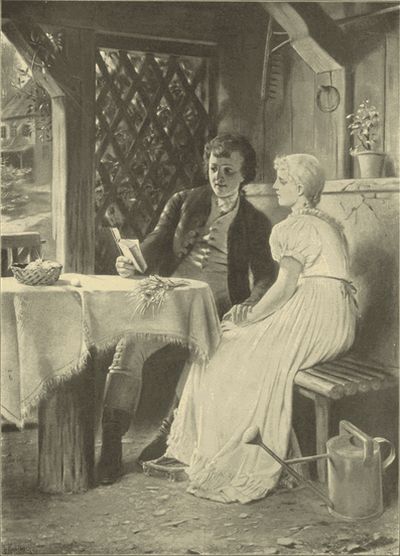
Goethe and Frederike.
In the years which we are following, the young men of America were solving the political questions and preparing for the military struggles of the American Revolution. France was in the glow of hope which made even Louis XVI. himself suppose that a golden age was come again for Frenchmen. In England the protest against form and authority showed itself in signs as easily read as the letters of Junius and the Wilkes riots in London. The autocracy attempted by poor George III., in an attempt which cost him America, was only the most absurd imitation of the despotism of Louis XIV. In Germany, the revolt against the traditions of the past showed itself in the new outburst of national literature. Young men were sick of the sway of France and the French language, to which Frederick even had been so subservient. In all senses Frederick was now a very old lion—and there were those who said he had lost his teeth. To be German, to write and read German, to recall German memories, and to throw off conventional restraints of whatever kind—such was the drift and determination of the movement which received the excellent title of the "Sturm und Drang."
Soon after Goethe left Strasburg he printed his play of "Goetz von Berlichingen." The hero is a true character of history. He was born about the year 1480 and died in 1562. His life had been published in 1731, and Goethe made the drama on the lines of the true history. The play defies all the "unities" of the French drama, like the plays of Shakespeare, whom all the young Germans were reading with enthusiasm; and the action passes from place to place, and from year to year, just as the author chooses. The whole tendency of the drama is revolutionary, and as Goetz dies, his last words are: "Freedom! Freedom!" His wife cries, "Only above, above with thee! The world is a prison-house." His sister says, "Gallant and gentle! Woe to this age that has lost thee!" And the last words of the play are: "And woe to the future that cannot know thee."
With such an appeal to all the fresh young life of Germany, the young author comes before the world. His play is received with enthusiasm and, at the first step, his genius is recognized by his countrymen.
Before it was published, he had returned to Frankfort, having in a way satisfied his father's wishes by his legal studies, and his career for his future calling is to begin in a residence at Weslar. This was the seat of the Court of Appeal of the old German Empire. How far justice was really promoted, may be seen from the single statement that, while the docket of cases was twenty thousand behindhand in 1772, only sixty decisions were made in a year. In what was called praxis or practice, the young Goethe was placed in a "circumlocution office" like Weslar. There is something ludicrous in the position, so absurd is it. To take Schiller's capital figure, it is indeed Pegasus in harness.
It happened that in this formal residence, he became intimately acquainted with Charlotte Buff and a young man named Kestner, to whom she was betrothed. They were fond of him, he of them, and he shared in the hospitalities of their new home after they were married. In the simple life of Kestner and Charlotte Buff and in the suicide of a young man named Jerusalem, whom they all knew, he found the details for the picture of life described in his celebrated novel called the "Sorrows of Young Werther," the novel most remarkable perhaps of modern times, if its influence on literature and society be regarded.
In the characters of the book, Werther, Lotte, and Albert show traits which were at once recognized as belonging to Goethe, Charlotte Buff, and Kestner. But it must not be understood that the intricate "elective affinities" of the novel really describe the personal relations of the three. To young readers it may be said that the transfer of the scientific term "elective affinity," from the new chemistry of that time, to the language of the affections, was first made in this book. It was afterward dwelt upon in the novel called "Elective affinities." The phrase has long since been used, now in ridicule and now seriously, quite as much in discussions of the working of the human heart as to express the relations of acids and alkalies.
It would be very hard to persuade the young people of to-day to read "The Sorrows of Werther." It would be hard to make them understand that for a generation of men, from 1774, when it was published, until this century was well advanced, people of sense and real feeling regarded it as a central and important book, which they valued because it had awakened them and given them strength. The English critics, when at last they found there was such a book, were content to laugh at its exaggerated sentiment. In truth, as Carlyle has well said, "'Werther' expressed the dim-rooted pain under which thoughtful men were languishing." Europe responded to "Werther," because, even in its sentimental languishing, it expressed this pain. America was finding another method of expressing her dissatisfaction in 1774. And it may be doubted whether from that day to the end of the century, a copy of the "Sorrows of Werther" was heard of in the United States, unless indeed the Baroness Riedesel soothed with it the more physical sorrows of the bivouacs of Saratoga, or the barracks of her captivity.
"Goetz von Berlichingen" and "Werther" made the young Goethe one of the foremost men in German literature. That theory of his boyhood, that he was to be a lawyer or jurisconsult, could be maintained no longer even by his father. The distinguished men of letters of Germany made his acquaintance, and it may be said that their company lifted him, very fortunately, from the petty society of persons inferior to him, among whom he was a dictator. As early as 1774 Goethe had conceived the idea of "Faust," and when Klopstock visited him at Frankfort, in that year, Goethe read to him some fragments of that poem.
The popularity of "Werther" was such that it was read by people of all ranks. Among the rest, the young Duke of Saxe-Weimar, Karl August, then only nineteen years old, conceived a great admiration for Goethe, and in 1774, on a visit to Frankfort, with his bride, he invited the young author to his little court at Weimar. Johann Goethe, the father, had the pride of a magistrate of a free city, and had no fancy for a part so poor as that which Voltaire had played, within his memory, at the court of King Frederick. But the office was tempting to the young author, and he accepted the invitation. This ended in his receiving from the duke a home at Weimar and recognized position. To those who study the inducements and encouragements of authorship, it is interesting to know that through all the success, before the public and with the booksellers, of "Goetz von Berlichingen" and "Werther," neither book had paid back to Goethe the money he had spent for their publication. Fame, and fame only, had been, thus far, his reward.
He went to Weimar as the friend of its young sovereign, who was just entering on a career which may fairly be called illustrious. Weimar was and is "more like a village bordering a park than a capital with a court, having all courtly environments." The representation it gave of the formalities, the "fuss and feathers" of a court, was on the most minute scale. But with a certain pride, well understood, a German historian has said, that after Berlin there is no one of the countless courts of Germany of which the nation is so proud. Such pride is born from the distinction which this grand duke, Karl August, gave to it, by calling into what was called his service, such men as Klopstock, Wieland, Goethe, and Schiller. This grand duke was himself a remarkable man for one "in his unfortunate position." He now owes all the place he has in history to the fortunate decision by which he offered to Goethe a home in the little city of Weimar, when he was himself a boy.
After a gay, not to say wild, introduction to the little social circle of this funny little court, Goethe settled down quite seriously to the work which belonged to a member of the administration. He had accepted the post of Counsellor of the Home Department, with a seat in the council. This carried with it a yearly salary of about nine hundred of our dollars. And in the modest habits of that little court this seems to have been regarded as a competency. With this income it is certain that Goethe kept house, fulfilled the demands which etiquette made on his position, and remitted a sixth part of his money to a poor, broken-winded, and apparently worthless author, whose very name is unknown, who maintained with him a begging correspondence.
Goethe proved himself a thorough man of business in the discharge of his official duties. His interest in science made him study the administration of the mines of the duchy with care and in detail, and when, afterward, he gave up other official cares, he retained the administration of the Department of the Mines. To persons studying his style it is worthy of remark, that the best habits of a man of affairs may be noted all through his work, whether scientific, speculative, poetical, or indeed, in whatever form it takes. There is never anything which a critic of our time would call "gush," or "padding," or "slip-slop." He advances on his purpose, whatever that purpose is, with the directness of an engineer pressing the attack of a fortress, or of an architect making the specifications for a building.
Meanwhile, for the relaxation or diversion of life, there was a passion, more or less real, which bound him to the Baroness von Stein, the wife of the Master of the Horse; there was the direction of the theatre and music of the court, and occasional journeys, generally incognito, with the Duke Karl August. A favorite entertainment was in private theatricals, which were indeed the rage in the little circle. The duchess acted, and everybody, even of the highest rank, was glad to be enrolled in the troupe, which was directed by Goethe. Eager for the applauses of other audiences than the favored circle at Weimar, the company went about, almost like a troupe of gypsies, from one to another of the country homes of the neighborhood. In all our modern ridicule of the Duchy of Pompernickel, and the like, it is hard to find anything more absurd than these accounts of the best way which the leaders of the state found for the occupation of their time, and for the edification of their people. The private theatricals of this court, however, will be long remembered, because the rollicking experiences of these parties, which were a sort of picnics in a courtly style, give the framework, or machinery for the story of "Wilhelm Meister."
This famous and remarkable book was begun soon after Goethe went to Weimar. But it was not published until 1795, after Goethe had spent more than a year in Italy, a period which marked a crisis in his life. In ten months' hard study of painting in Rome, he satisfied himself, at last, that he should never be a painter. It seems strange now to say, that until then, he had diligently nursed the hope that as a painter he should achieve great success. In Italy he looked at the petty court of Weimar from a point distant enough to see it in its true relations and perspective. He measured his own powers as a man does who is removed from the petty detail of small official duty. And he returned to Weimar in 1788, determining wisely to give the rest of his life to science and literature. The "determination" proved to be a determination. And from this time, his life as a master of the thought of his time may be said to begin.
He had received from the grand duke a title of nobility, and from that time he is "von Goethe," instead of "Goethe" simple, without that prefix of dignity. On his return from Italy he gave up all his official work, except the direction of the mines and of the theatre. It is interesting to remember that Goethe thus directed the work of the mines in which Luther's father had been a workman. His interest in natural science made him hold this position; and his charge of the theatre was almost a matter of course in such a court as that of Weimar. He was, however, relieved from the presidency of the council and from the direction of the War Department. The duke retained for him a place in the council "whenever his other affairs allowed him to attend." It must be remembered that all such appointments were made wholly at the wish of the duke, who was the absolute monarch of this little state, until he gave to his people a liberal constitution in 1816.
It will be convenient to American readers to remember that the size of the duchy is about the same as that of the State of Rhode Island—about fourteen hundred square miles. In Goethe's time, the population was less than a million. The city of Weimar had about ten thousand inhabitants. To Weimar Goethe returned, resolved to give his life, from that time forward, to science and literature. Before the Italian journey he had done so in large measure. But after his return, relieved from almost all duties of administration, he brings forward finished works, with untiring enthusiasm, on many different lines, many of which are among the masterpieces of the time. Schiller had come to Weimar in 1794. Goethe and he had met before. There were differences between these men so great that in some lines they had no sympathy. All the more is it to the credit of both, that each appreciated the other and that they lived and worked together as friends. When Schiller proposed the literary journal called The Hours, Goethe co-operated in the plan most cordially. And so long as Schiller lived, their friendship was to each a great blessing. Their statues, representing them hand in hand, commemorate this friendship to this day.
The closing books of "Wilhelm Meister" were written in Italy, and after Goethe's return, and the book was published in 1795. Goethe had long since outlived the extravagance of sentimentalism which overflowed in "Werther." He had himself ridiculed it in a little farce, much laughed at at the time. And if "Wilhelm Meister" were taken merely as a story, it would be found quite free from such extravagances. The story, however, is simply the framework for criticism on art, on literature, and especially for what may be called studies on education. The criticism on "Hamlet" has been called the best of the thousands upon thousands of which "Hamlet" has been the subject. No book of Goethe's has had, or has held, the interest of the great world of "general readers," as "Wilhelm Meister," "Faust" not excepted.
"Hermann and Dorothea" appeared in 1797, and was one of the most serious of the efforts by which Goethe and Schiller both gave themselves to create a German drama worthy of the German people. In 1790 a new theatre had been built at Weimar, and Goethe became in fact the manager. He was not satisfied with writing plays to be performed there; he actually supervised the performances, and gave to the detail of such management much of his time for many years. So long as Schiller lived the two were closely connected in all such enterprises, and Goethe's practical connection with the theatre led him, perhaps, to attempt the dramatic form of composition more often than he would otherwise have done.
In 1799 Walter Scott, then only twenty-five years of age, published in Edinburgh his translation of "Goetz von Berlichingen."
It must be remembered that all this time Goethe is pursuing his studies of Physical Science. His little book called "Morphologie," published in 1788, immediately after his return from Italy, is a simple, unaffected, practical, statement of the law of growth of plants, which, though suggested before, had quite escaped the attention of the botanists of repute. When it was published, it seems to have been pushed aside as the fanciful dream of a poet. In truth, it is a book which might be given to-day to a learner, as one of the most elegant and simple illustrations of what is now meant by evolution in nature. From the humble resources of a common garden Goethe finds material to show how whorls of leaves appear as blossoms; how calyx passes into corolla; how leaves of the corolla become stamens and pistils. After a generation the botanists were willing enough to accept the statement, and Goethe lived long enough to see it accepted as the foundation of the Botanical Science of his time.
The critics are apt to call "Faust" his greatest work. The first part was published in 1805, the second in 1831. Quite too much finesse has been wasted on endeavors to discover his purpose in the poem. It will live, not from any discovery of his purpose, but because of the intensity with which it presents the different characters. It will command and control men all the more, because they do not find in it the skeleton of what is called an artistic or scientific literary plan. It is impossible, in the limited range of this article, even to name the several works, many of them of great importance, of the last half of his life. With his assiduous industry, so assiduous that he was never satisfied, perhaps, unless he was at work, he edited an art journal, Kunst und Alterthum, from 1816 to 1828. In a thousand methods of publication he sent out poems, dramas, novels, and pamphlets. He had the satisfaction of knowing that Europe and America regarded him as the first author of his time.
Goethe married, in 1806, Christiana Vulpius, who had been employed as a servant in his family. She died in the year 1816. He seems to have really lamented her death.
His old age was serene. The jubilee of his arrival in Weimar was celebrated with great enthusiasm, on November 7, 1825. All through the last years of his life he was receiving tokens of admiration from all parts of the world. They gratified his vanity, and satisfied his pride.
He died on March 22, 1832. His last words have been well remembered; "More light!"[Back to Contents]

SIR WALTER SCOTT By W. C. Taylor, LL.D. (1771-1832)
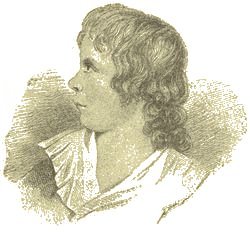
The life of an author who took no active part in public affairs, but sent forth from his own fireside those marvels of imagination which have afforded delight and instruction to millions, furnishes interest of a different kind from the biographies of those whose names are associated with great events. We look more to the man than to his age; we endeavor to trace the circumstances by which his mind was moulded and his tastes formed, and we feel anxious to discover the connection between his literary and his personal history and character. There have been few authors in whose career this connection was more strongly apparent than in Sir Walter Scott; his life is, to a great extent, identified with his writings, and this appears to be the source of that feeling of truth and reality which is forced upon us while perusing his fictions. He was born at Edinburgh, August 15, 1771. His father was one of that respectable class of attorneys called, in Scotland, writers to the signet, and was the original from whom his son subsequently drew the character of Mr. Saunders Fairford, in "Redgauntlet." His mother was a lady of taste and imagination. An accidental lameness and a delicate constitution procured for Walter a more than ordinary portion of maternal care, and the influence of his mother's instructions was strongly impressed on his character. In early childhood he was sent for change of air to the country seat of his maternal grandfather, where he first developed his extraordinary powers of memory by learning the traditionary legends of border heroism and chivalry, which used to be recited at the fireside on a winter's evening. His early taste for the romantic was a little checked when he returned to Edinburgh, in his eighth year, for his father was rather a strict adherent to forms, and looked upon poetry and fiction as very questionable indulgences. The discovery of a copy of Shakespeare, and an odd volume of Percy's "Relics," enabled him to resume his favorite pursuits, though the hours he devoted to them were stolen from sleep. He was sent at an early age to the high-school of Edinburgh, but was not particularly distinguished in the regular course of study. His companions, however, soon discovered his antiquarian tastes, and his passionate love for old tales of chivalry and old chronicles scarcely less romantic; he became noted, too, for reciting stories of his own invention, in which he introduced a superabundance of the marvels of ancient superstition, with a plentiful seasoning of knight-errantry. He even pursued his favorite subject into the continental languages, and by his own exertions enabled himself to peruse the works of Ariosto and Cervantes in their original form.
After a brief residence at the university he was indented as an apprentice to his father in 1786. Though the daily routine of drudgery in an attorney's office must have been painful to a young man of ardent imagination, he did not neglect any of the tasks which his father imposed, and he thus formed habits of method, punctuality, and laborious industry, which were important elements of his future success. But in the midst of these duties he did not lose sight of the favorite objects of his study and meditation. He made frequent excursions into the lowland and highland districts in search of traditionary lore; his investigations led him to the cottage of the peasant as frequently as to the houses of the better class, and his frank manners secured him a favorable reception from all.
In 1792 he changed his profession for that of an advocate, but did not obtain much practice at the Scottish bar. His first publication was a translation from the German; Bürger's wild romantic ballads captivated his youthful imagination, and his version of them proved that he entered deeply into the spirit of the original. Soon afterward he contributed some pieces to Lewis' "Tales of Wonder," which are almost the only fragments of that work which have escaped oblivion. At last, in 1802, he gave to the world the two first volumes of his "Border Minstrelsy," printed by his old schoolfellow, Ballantyne; its literary merits were enhanced by the beauty of its typographical execution, and its appearance made an epoch in Scottish literary history. The ballads of this collection had been very carefully edited, while the notes contained a mass of antiquarian information relative to border life, conveyed in a beautiful style, and enlivened with a higher interest than poetic fiction. This work at once obtained an extensive sale, and its popularity was increased by the appearance of the third volume, containing various imitations of the old ballad by Mr. Scott, in which the feelings and character of antiquity were faithfully preserved, while the language and expression were free from the roughness of obsolete forms. The copyright of the second edition was sold to the Messrs. Longman for £500, but the great extent of the sale made the bargain profitable.
Three years elapsed before he again took the field as an author; but the poem which he then produced, at once placed him among the great original writers of his country. "The Lay of the Last Minstrel" was a complete expansion of the old ballad into an epic form. "It seemed," says Prescott, "as if the author had transferred into his page the strong delineations of the Homeric pencil, the rude but generous gallantry of a primitive period, softened by the more airy and magical inventions of Italian romance, and conveyed in tones of melody such as had not been heard since the strains of Burns." Its popularity was unprecedented, and its success determined the course of his future life.
Scott's position enabled him to encounter the hazards of literary life with comparative safety. He held two offices, that of Sheriff of Selkirk, and Clerk of the Court of Sessions, which yielded him a competent income. He received some accession to his fortune on his marriage, and the tastes of his lady prevented her from indulging in any of the extravagance of fashionable life. Domestic happiness and rural retirement were favorable to literary exertion. He soon produced a second poem, "Marmion," which many critics prefer to all his other poems. It was, however, rather harshly attacked in the Edinburgh Review on its first appearance, which the author felt keenly, as he had been himself a contributor to that journal. This was the origin of the Quarterly Review, which was established mainly in consequence of his exertions. About the same time he established a new Annual Register, and became a silent partner in the great printing establishment of the Ballantynes. This last step involved him in grievous embarrassments, but it stimulated him to exertions such as none but a man of his prodigious powers could attempt. His biographical, historical, and critical labors, united with his editorial toils, were of appalling magnitude, but in all his works he proved himself to be vigorous and effective. "Poetry," he says in one of his letters, "is a scourging crop, and ought not to be hastily repeated. Editing, therefore, may be considered as a green crop of turnips or peas, extremely useful to those whose circumstances do not admit of giving their farm a summer fallow."
The "Lady of the Lake" was his next poem; it appeared in 1811, and soon outstripped all his former productions in fame and popularity. More than fifty thousand copies of it were sold, and the profits of the author exceeded two thousand guineas. It may be noticed as a curious proof of the effect it produced on the public mind, that the post-horse duty rose to an extraordinary degree in Scotland, from the eagerness of travellers to visit the localities described in the poem. He was now at the zenith of his fame. The sale of his next poem, "Rokeby," showed that his popularity had declined, and when this was followed by the comparative failure of the "Lord of the Isles," he resolved to abandon the field of poetry, and seek for fame in another form of composition.
Ten years before this period he had commenced the novel of "Waverley," and thrown the manuscript aside; having accidentally discovered the unfinished romance amid the old lumber of a garret, he completed it for the press in 1814, and published it anonymously. Its appearance created a greater sensation and marks a more distinct epoch in literary history than that of his poetry. It was the great object of his ambition to become a land-owner and to hold a high rank, not among the literary characters, but the country gentlemen of Scotland, and this was one of the causes of his being anxious to keep the authorship of his novels a profound secret. The same ambition stimulated him to exertion. He produced in rapid succession "Guy Mannering," "The Antiquary," "Rob Roy," and the "Tales of my Landlord" in three series, and at the same time published several pieces in his own name to increase the mystification of the public. But his incognito was soon detected; long before he avowed his romances, the world generally had found out his secret; indeed, when he was created a baronet in 1820, it was universally understood that this honor was conferred on him as author of the Waverley Novels.
It is not necessary to enumerate all the fictions that emanated from the brilliant imagination of the Northern Enchanter; the list would be too long, but we must not omit to notice the energy with which he labored. Even illness, that would have broken the spirits of most men, as it prostrated the physical energies of Scott, opposed no impediment to the progress of his compositions. When he could not write he could dictate; and in this way, amid the agonies of a racking disease, he composed "The Bride of Lammermoor," "The Legend of Montrose," and a great part of the most fascinating of his works, "Ivanhoe." Never, certainly, did mind exhibit so decisive a triumph over physical suffering. "Be assured," he remarked to Mr. Gillies, "that if pain could have prevented my application to literary work, not a page of 'Ivanhoe' would have been written. Now, if I had given way to mere feelings and ceased to work, it is a question whether the disorder would not have taken deeper root and become incurable."
The crowds of visitors that flocked to his baronial mansion at Abbotsford, from all quarters, greatly added to the expenses which the hospitable owner had to meet; but the unbounded popularity of his novels appeared to him and to his publishers a never-failing source of funds; and the Messrs. Constable accepted his drafts, to the amount of many thousand pounds, in favor of works which were not only unwritten, but even unimagined. Unfortunately, Scott, in return, could not refuse to indorse the drafts of his publishers, and thus an amount of liabilities was incurred which would appear quite inexplicable, if experience had not shown that the dangerous facilities of accommodation bills lead men on to an extent that they never discover until the crash comes. In the great commercial crisis of 1825 Constables' house stopped payment; the assets proved to be very trifling in comparison with the debts, and Sir Walter Scott was found to be responsible to the startling amount of one hundred thousand pounds!
His conduct on this occasion was truly noble; he put up his house and furniture in Edinburgh to auction, delivered over his personal effects—plate, books, furniture, etc.—to be held in trust for his creditors (the estate itself had been settled on his eldest son when he married), and bound himself to discharge annually a certain amount of the liabilities of the insolvent firm. He then, with his characteristic energy, set about the performance of his herculean task. He took cheap lodgings, abridged his usual enjoyments and recreations, and labored harder than ever. The death of his beloved lady increased the gloom which the change of circumstances produced, but though he sorrowed he did not relax his exertions. One of his first tasks was the "Life of Bonaparte," which he completed in the short space of thirteen months. For this he received from the publishers the sum of £14,000, and such was its great circulation that they had no reason to repent of their bargain. In the same year that this work appeared, he took an opportunity of publicly avowing his authorship of the Waverley Novels, declaring "that their merits, if they had any, and their faults were entirely imputable to himself."
Sir Walter Scott's celebrity made everything that he produced acceptable to the public. He did not allow these favorable impressions to fade for want of exercise, and the list of the works, great and small, which he produced to satisfy his creditors, is an unexampled instance of successful labors. No one of these enterprises was so profitable as the republication of his novels in a uniform series, with his own notes and illustrations. It was not given to Sir Walter Scott to see the complete restoration of his former position; his exertions were too severe and pressed heavily on the springs of health, already deprived by age of their elasticity and vigor. In the short space of six years he had, by his sacrifices and exertions, discharged more than two-thirds of the debt for which he was responsible, and he had fair prospects of relieving himself from the entire sum. But in 1831 he was seized with a terrible attack of paralysis, to which his family had a constitutional tendency, and he was advised to try the effect of a more genial climate in Southern Europe. The British Government placed a ship at his disposal to convey him to Italy; and when he came to London, men of every class and party vied with each other in expressing sympathy for his sufferings and hopes for his recovery.
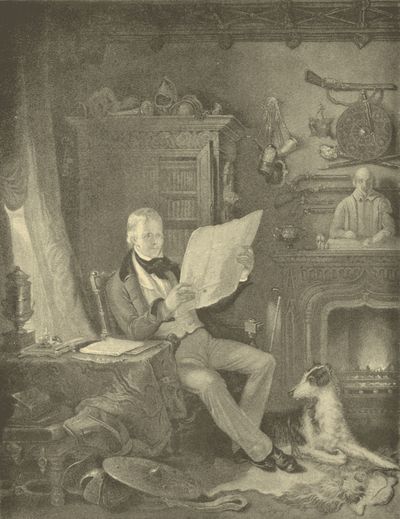
Sir Walter Scott at Abbotsford.
In Italy he was received with the greatest enthusiasm, and under the influence of its sunny skies he seemed, for a while, to be recovering. But his strength was gone, his heart was in his own home at Abbotsford, and, almost an imbecile, he returned there. He died September 20, 1832.
The following letter was written by him to his son Walter, in 1819, soon after the young man had entered the army. It illustrates at once his strong affections and his knowledge of the world.
"Dear Walter.
"... I shall be curious to know how you like your brother officers, and how you dispose of your time. The drills and riding-school will, of course, occupy much of your mornings for some time. I trust, however, you will keep in view drawing, languages, etc. It is astonishing how far even half an hour a day, regularly bestowed on one object, will carry a man in making himself master of it. The habit of dawdling away time is easily acquired, and so is that of putting every moment either to use or to amusement.
"You will not be hasty in forming intimacies with any of your brother officers, until you observe which of them are most generally respected and likely to prove most creditable friends. It is seldom that the people who put themselves hastily forward to please are those most worthy of being known. At the same time you will take care to return all civility which is offered, with readiness and frankness. The Italians have a proverb, which I hope you have not forgot poor Pierrotti's lessons so far as not to comprehend—'Volto sciolto e pensieri stretti.' There is no occasion to let any one see what you exactly think of him; and it is the less prudent, as you will find reason, in all probability, to change your opinion more than once.
"I shall be glad to hear of your being fitted with a good servant. Most of the Irish of that class are scapegraces—drink, steal, and lie like the devil. If you could pick up a canny Scot it would be well. Let me know about your mess. To drink hard is none of your habits, but even drinking what is called a certain quantity every day hurts the stomach, and by hereditary descent yours is delicate. I believe the poor Duke of Buccleuch laid the foundation of that disease which occasioned his premature death in the excesses of Villar's regiment, and I am sorry and ashamed to say, for your warning, that the habit of drinking wine, so much practised when I was a young man, occasioned, I am convinced, many of my cruel stomach complaints. You had better drink a bottle of wine on any particular occasion, than sit and soak and sipple at an English pint every day.
"All our bipeds are well. Hamlet had an inflammatory attack, and I began to think he was going mad, after the example of his great namesake, but Willie Laidlaw bled him, and he has recovered. Pussy is very well. Mamma, the girls, and Charlie join in love. Yours affectionately,
"W. S.
"P.S.—Always mention what letters of mine you have received, and write to me whatever comes into your head. It is the privilege of great boys when distant, that they cannot tire papas by any length of detail upon any subject."[Back to Contents]
WILLIAM WORDSWORTH (1770-1850)
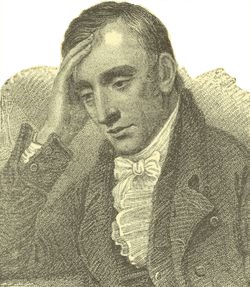
William Wordsworth, the poet, was born at Cockermouth, on the Derwent, in Cumberland, on April 7, 1770. His parentage offers a curious parallel to Scott's; he was the son of an attorney, law-agent to the Earl of Lonsdale, a prosperous man in his profession, descended from an old Yorkshire family of landed gentry. On the mother's side, also, Wordsworth was connected with the middle territorial class; his mother, Anne Cookson, was the daughter of a well-to-do mercer in Penrith; but her mother was a Crackanthorpe, whose ancestors had been lords of the manor of Newbiggin, near Penrith, from the time of Edward III. He was thus, as Scott put it in his own case, come of "gentle" kin, and, like Scott, he was proud of it, and declared the fact in his short fragment of prose autobiography. The country squires and farmers whose blood flowed in Wordsworth's veins were not far enough above local life to be out of sympathy with it, and the poet's interest in the common scenes and common folk of the North Country hills and dales had a traceable hereditary bias.
Though his parents were of sturdy stock, both died prematurely, his mother when he was five years old, his father when he was thirteen, the ultimate cause of death in his mother's case being exposure to cold in "a best bedroom" in London; in his father's, exposure on a Cumberland hill, where he had been befogged and lost his way. At the age of eight Wordsworth was sent to school at Hawkshead, in the Esthwaite Valley, in Lancashire. His father died while he was there, and at the age of seventeen he was sent by his uncle to St. John's College, Cambridge. He did not distinguish himself in the studies of the university, and for some time after taking his degree of B.A., which he did in January, 1791, he showed what seemed to his relatives a most perverse reluctance to adopt any regular profession. His mother had noted his "stiff, moody, and violent temper" in childhood, and it seemed as if this family judgment was to be confirmed in his manhood. After taking his degree he was pressed to take holy orders, but would not; he had no taste for the law; he idled a few months aimlessly in London, a few months more with a Welsh college friend, with whom he had made a pedestrian tour in France and Switzerland, during his last Cambridge vacation; then, in November of 1791, he crossed to France, ostensibly to learn the language, made the acquaintance of revolutionaries, sympathized with them vehemently, and was within an ace of throwing in his lot with the Brissotins, to give them the steady direction that they needed. When it came to this his relatives cut off his supplies, and he was obliged to return to London toward the close of 1792. But still he resisted all pressure to enter any of the regular professions, published "An Evening Walk" and "Descriptive Sketches," in 1793, and in 1794, still moving about to all appearance in stubborn aimlessness among his friends and relatives, had no more rational purpose of livelihood than drawing up the prospectus of a periodical of strictly republican principles, to be called The Philanthropist. At this stage, at the age of twenty-four, Wordsworth seemed to his friends a very hopeless and impracticable young man.
But all the time from his boyhood upward a great purpose had been growing and maturing in his mind. Nature was little more than a picture-gallery to him; the pleasures of the eye had all but absolute dominion; and he
"Roamed from hill to hill, from rock to rock, Still craving combinations of new forms, New pleasures, wide empire for the sight, Proud of her own endowments, and rejoiced To lay the inner faculties asleep."
But, though he had not yet found his distinctive aim as a poet, he was inwardly bent, all the time that his relatives saw in him only a wayward and unpromising aversion to work in any regular line, upon poetry as "his office upon earth."
In this determination he was strengthened by his sister Dorothy, who with rare devotion consecrated her life henceforward to his service. A timely legacy enabled them to carry their purpose into effect. A friend of his, whom he had nursed in a last illness, Raisley Calvert, son of the steward of the Duke of Norfolk, who had large estates in Cumberland, died early in 1795, leaving him a legacy of £900. And here it may be well to notice how opportunely, as De Quincey half-ruefully remarked, money always fell in to Wordsworth, enabling him to pursue his poetic career without distraction. Calvert's bequest came to him when he was on the point of concluding an engagement as a journalist in London. On it and other small resources he and his sister, thanks to her frugal management, contrived to live for nearly eight years. By the end of that time Lord Lonsdale, who owed Wordsworth's father a large sum for professional services, and had steadily refused to pay it, died, and his successor paid the debt with interest. His wife, Mary Hutchinson, whom he married in 1802, brought him some fortune; and in 1813, when, in spite of his plain living, his family began to press upon his income, he was appointed stamp-distributor for Westmoreland, with an income of £500, afterward nearly doubled by the increase of his district. By this succession of timely godsends, Wordsworth, though he did not escape some periods of sharp anxiety, was saved from the necessity of turning aside from his vocation.
To return, however, to the course of his life from the time when he resolved to labor with all his powers in the office of poet. The first two years, during which he lived with his self-sacrificing sister at Racedown, in Dorset, were spent in half-hearted and very imperfectly successful experiments—satires in imitation of Juvenal, the tragedy of "The Borderers," and a poem in the Spenserian stanza, the poem now entitled "Guilt and Sorrow." How much longer this time of doubtful, self-distrustful endeavor might have continued is a subject for curious speculation; an end was put to it by a fortunate incident, a visit from Coleridge, who had read his first publication, and seen in it, what none of the public critics had discerned, the advent of "an original poetic genius." It would be impossible to exaggerate the importance for Wordsworth of the arrival of this enthusiastic Columbus. Under his sister's genial influence he was groping his way doubtfully out of the labyrinth of poetic conventions, beginning to see a new pathos and sublimity in human life, but not yet convinced, except by fits and starts, of the rightness of his own vision. Stubborn and independent as Wordsworth was, he needed some friendly voice from the outer world to give him confidence in himself. Coleridge rendered him this indispensable service. He read to his visitor one of his experiments, the story of the ruined cottage, afterward introduced into the first book of "The Excursion." Coleridge, who had already seen original poetic genius in the poems published before, was enthusiastic in his praise of them as having "a character by books not hitherto reflected," and his praise gave new heart and hope to the poet, hitherto hesitating and uncertain.
June, 1797, was the date of this memorable visit. So pleasant was the companionship on both sides that, when Coleridge returned to Nether Stowey, in Somerset, Wordsworth, at his instance, changed his quarters to Alfoxden, within a mile and a half of Coleridge's temporary residence, and the two poets lived in almost daily intercourse for the next twelve months. During that period Wordsworth's powers rapidly expanded and matured; ideas that had been gathering in his mind for years, and lying there in dim confusion, felt the stir of a new life and ranged themselves in clearer shapes under the fresh, quickening breath of Coleridge's swift and discursive dialect. The radiant restless vitality of the more variously gifted man stirred the stiffer and more sluggish nature of the recluse to its depths, and Coleridge's quick and generous appreciation of his power gave him precisely the encouragement that he needed.
It is interesting to compare with what he actually accomplished, the plan of life-work with which Wordsworth finally settled at Grasmere, in the last month of the eighteenth century. The plan was definitely conceived as he left the German town of Goslar, during a trip on the Continent, in the spring of 1799. Tired of the wandering, unsettled life that he had led hitherto; dissatisfied also with the fragmentary, occasional, and disconnected character of his lyrical poems, he longed for a permanent home among his native hills, where he might, as one called and consecrated to the task, devote his powers continuously to the composition of a great philosophical poem on Man, Nature, and Society. The poem was to be called "The Recluse." He communicated the design to Coleridge, who gave him enthusiastic encouragement to proceed. In the first transport of the conception he felt as if he needed only solitude and leisure for the continuous execution of it. But, though he had still before him fifty years of peaceful life amid his beloved scenery, the work in the projected form at least was destined to remain incomplete. Doubts and misgivings soon arose, and favorable moments of felt inspiration delayed their coming. To sustain him in his resolution he thought of writing as an introduction, or, as he put it, an antechapel to the church which he proposed to build, a history of his own mind up to the time when he recognized the great mission of his life. It appears from a letter to his friend, Sir George Beaumont, that his health was far from robust, and in particular that he could not write without intolerable physical uneasiness. We should probably not be wrong in connecting his physical weakness with his rule of waiting for favorable moments. His next start with "The Prelude," in the spring of 1804, was more prosperous; he dropped it for several months, but, resuming again in the spring of 1805, he completed it in the summer of that year. But still the composition of the great work to which it was intended to be a portico proceeded by fits and starts. It was not till 1814 that the second of the three divisions of "The Recluse," ultimately named "The Excursion," was ready for publication; and he went no further in the execution of his great design.
We shall speak presently of the reception of the "The Excursion." Meantime, we must look elsewhere for the virtual accomplishment of the great design of "The Recluse." The purpose was not, after all, betrayed; it was really fulfilled, though not in the form intended, in his various occasional poems. In relation to the edifice that he aspired to construct, he likened these poems to little cells, oratories, and sepulchral recesses; they are really the completed work, much more firmly united by their common purpose than by any formal and visible nexus of words. Formally disconnected, they really, as we read and feel them, range themselves to spiritual music, as the component parts of a great poetic temple, finding a rendezvous amid the scenery of the district where the poet had his local habitation. The Lake District, as transfigured by Wordsworth's imagination, is the fulfilment of his ambition after an enduring memorial. The Poems, collected and published in 1807, compose in effect "a philosophical poem on Man, Nature, and Society," the title of which might fitly have been "The Recluse," "as having for its principal subject the sensations and opinions of a poet living in retirement." As a realization of the idea of "The Recluse," these poems are, from every poetical point of view, infinitely superior to the kind of thing that he projected and failed to complete.
The derisive fury with which "The Excursion" was assailed upon its first appearance has long been a stock example of critical blindness, conceit, and malignity. And yet, if we look at the position now claimed for "The Excursion" by competent authorities, the error of the first critics is seen to be not in their indictment of faults, but in the prominence they gave to the faults, and their generally disrespectful tone toward a poet of Wordsworth's greatness. Jeffrey's petulant "This will never do," uttered, professedly, at least, more in sorrow than in anger, because the poet would persist, in spite of all friendly counsel, in misapplying his powers, has become a byword of ridiculous critical cocksureness. But the curious thing is that "The Excursion" has not "done," and that the Wordsworthians who laugh at Jeffrey are in the habit of repeating the substance of his criticism, though in more temperate and becoming language.
There can be little doubt that adverse criticism had a depressing influence on Wordsworth's poetical powers, notwithstanding his nobly expressed defiance of it, and his determination to hold on in his own path undisturbed. Its effect in retarding the sale of his poems, and thus depriving him of the legitimate fruits of his industry, was a favorite topic with him in his later years; but the absence of general appreciation, and the ridicule of what he considered his best and most distinctive work, contributed in all probability to a still more unfortunate result—the premature depression and deadening of his powers. He schooled himself to stoical endurance, but he was not superhuman, and in the absence of sympathy not only was any possibility of development checked, but he ceased to write with the spontaneity and rapture of his earlier verse. His resolute industry was productive of many wise, impressive, and charitable reflections, and many casual felicities of diction, but the poet very seldom reached the highest level of his earlier inspirations.
Wordsworth was appointed poet-laureate on the death of Southey, in 1843. His only official composition was an ode on the installation of the prince consort as chancellor of Cambridge University, in 1847. This was his last writing in verse. He died at Rydal Mount, after a short illness, on April 23, 1850, and was buried in Grasmere Churchyard.[Back to Contents]
WASHINGTON IRVING (1783-1859)
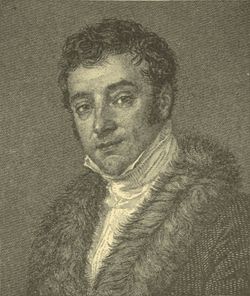
Washington Irving, the first American who obtained a European reputation merely as a man of letters, was born at New York, April 3, 1783. Both his parents were immigrants from Great Britain, his father, originally an officer in the merchant service, but at the time of Irving's birth a considerable merchant, having come from the Orkneys and his mother from Falmouth. Irving was intended for the legal profession, but his studies were interrupted by an illness necessitating a voyage to Europe, in the course of which he proceeded as far as Rome and made the acquaintance of Washington Allston. He was called to the Bar upon his return, but made little effort to practice, preferring to amuse himself with literary ventures. The first of these of any importance, a satirical miscellany entitled "Salmagundi," written in conjunction with his brother William and J. K. Paulding, gave ample proof of his talents as a humorist. These were still more conspicuously displayed in his next attempt, "Knickerbocker's History of New York" (1809). The satire of "Salmagundi" had been principally local, and the original design of "Knickerbocker's History" was only to burlesque a pretentious disquisition on the history of the city in a guide-book by Dr. Samuel Mitchell. The idea expanded as Irving proceeded, and he ended by not merely satirizing the pedantry of local antiquaries, but by creating a distinct literary type out of the solid Dutch burgher whose phlegm had long been an object of ridicule to the mercurial Americans. Though far from the most finished of Irving's productions, "Knickerbocker" manifests the most original power and is the most genuinely national in its quaintness and drollery. The very tardiness and prolixity of the story are skilfully made to heighten the humorous effect. The next few years were unproductive. Upon the death of his father, Irving had become a sleeping partner in his brother's commercial house, a branch of which was established at Liverpool. This, combined with the restoration of peace, induced him to visit England in 1815, when he found the stability of the firm seriously compromised. After some years of ineffectual struggle it became bankrupt. This misfortune compelled Irving to resume his pen as a means of subsistence. His reputation had preceded him to England, and the curiosity naturally excited by the then unwonted apparition of a successful American author procured him admission into the highest literary circles, where his popularity was insured by his amiable temper and polished manners. As an American, moreover, he aroused no jealousy and no competition, and stood aloof from the political and literary disputes which then divided England. Campbell, Jeffrey, Moore, Scott were counted among his friends, and the last-named zealously recommended him to the publisher Murray, who, after at first refusing, consented (1820) to bring out "Geoffrey Crayon's Sketch-book," which was already appearing in America in a periodical form. The most interesting part of this work is the description of an English Christmas, which displays a delicate humor not unworthy of the writer's evident model, Addison. Some stories and sketches on American themes contribute to give it variety; of these Rip Van Winkle is the most remarkable. It speedily obtained the greatest success on both sides of the Atlantic. "Bracebridge Hall," a work purely English in subject, followed in 1822, and showed to what account the American observer had turned his experience of English country life. The humor is, nevertheless, much more English than American. "Tales of a Traveller" appeared in 1824, and Irving, now in comfortable circumstances determined to enlarge his sphere of observation by a journey on the Continent. After a long course of travel he settled down at Madrid, in the house of the American consul, Rich. His intention at the time was to translate Navarrete's recently published work on Columbus. Finding, however, that this was rather a collection of valuable materials than a systematic biography, he determined to compose a biography of his own by its assistance, supplemented by independent researches in the Spanish archives. His work appeared in 1828 and obtained a merited success. It is a finished representation of Columbus from the point of view of the nineteenth century, affecting neither brilliancy nor originality, but a model of tasteful elegance, felicitous in every detail and adequate in every respect. "The Companions of Columbus" followed; and a prolonged residence in the south of Spain gave Irving materials for two highly picturesque books, "The Conquest of Granada," professedly derived from the MSS. of an imaginary Fray Antonio Agapida, and "The Alhambra." Previous to their appearance he had been appointed secretary to the embassy at London, an office as purely complimentary to his literary ability as the legal degree which he about the same time received from the University of Oxford. Returning to the United States in 1832, after seventeen years' absence, he found his name a household word, and himself universally honored as the first American who had won for his country recognition on equal terms in the literary republic. After the rush of fêtes and public compliments had subsided, he undertook a tour in the Western prairies, and returning to the neighborhood of New York built for himself a delightful retreat on the Hudson, to which he gave the name of Sunnyside. His acquaintance with the New York millionaire, John Jacob Astor, prompted his next important work, "Astoria," a history of the fur-trading settlement founded by Astor in Oregon, deduced with singular literary ability from dry commercial records, and, without labored attempts at word-painting, evincing a remarkable faculty for bringing scenes and incidents vividly before the eye. "Captain Bonneville," based upon the unpublished memoirs of a veteran hunter, was another work of the same class. In 1842 Irving was appointed ambassador to Spain. He spent four years in the country, without this time turning his residence to literary account; and it was not until two years after his return that Forster's "Life of Goldsmith," by reminding him of a slight essay of his own which he now thought too imperfect by comparison to be included among his collected writings, stimulated him to the production of his own biography of his favorite author. Without pretensions to original research, the book displays an admirable talent for employing existing material to the best effect. The same may be said of "The Lives of Mahomet and his Successors," published two years subsequently. Here, as elsewhere, Irving has correctly discriminated the biographer's province from the historian's, and leaving the philosophical investigation of cause and effect to writers of Gibbon's calibre, has applied himself to represent the picturesque features of the age as embodied in the actions and utterances of its most characteristic representatives. His last days were devoted to a biography of Washington, undertaken in an enthusiastic spirit, but which the author found exhausting and his readers tame. His genius required a more poetical theme, and indeed the biographer of Washington must be at least a potential soldier and statesman. Irving just lived to complete this work, dying of heart disease at Sunnyside, on November 28, 1859.
Although one of the chief ornaments of American literature, Irving is not characteristically an American author. Like most of the transatlantic writers of his generation, he disappointed expectation by a scrupulous conformity to acknowledged European standards. The American vine had not then begun to produce the looked-for wild grapes. Irving, however, is one of the few authors of his period who really manifests traces of a vein of national peculiarity which might under other circumstances have been productive. "Knickerbocker's History of New York," although the air of mock solemnity which constitutes the staple of its humor is peculiar to no literature, manifests nevertheless, a power of producing a distinct national type. Had circumstances taken Irving to the West and placed him amid a society teeming with quaint and genial eccentricity, he might possibly have been the first Western humorist, and his humor might have gained in depth and richness. In England, on the other hand, everything encouraged his natural fastidiousness; he became a refined writer, but by no means a robust one. At the same time he is too essentially the man of his own age to pass for a paler Addison or a more decorous Sterne. He has far more of the poet than any of the writers of the eighteenth century, and his moralizing, unlike theirs, is unconscious and indirect. The same poetical feeling is shown in his biographies; his subject is invariably chosen for its picturesqueness, and whatever is unessential to portraiture is thrown into the background. The result is that his biographies, however deficient in research, bear the stamp of genuine artistic intelligence, equally remote from compilation and disquisition. In execution they are almost faultless; the narrative is easy, the style pellucid, and the writer's judgment nearly always in accordance with the general verdict of history. They will not, therefore, be easily superseded, and indeed Irving's productions are in general impressed with that signet of classical finish which guarantees the permanency of literary work more surely than direct utility or even intellectual power. This refinement is the more admirable for being in great part the reflection of his own moral nature. Without ostentation or affectation, he was exquisite in all things, a mirror of loyalty, courtesy, and good taste in all his literary connections, and exemplary in all the relations of domestic life which he was called upon to assume. He never married, remaining true to the memory of an early attachment blighted by death.[Back to Contents]
JAMES FENIMORE COOPER[12] By President Charles F. Thwing (1789-1851)
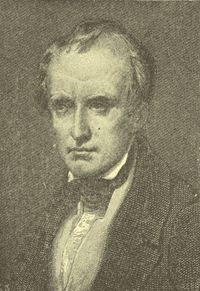
In the churchyard of Christ's Church, in the town bearing his name, in the State of New York, rests all that is mortal of James Fenimore Cooper. It is now more than two score of years since he died. The spot is marked by a simple slab of marble. In the public cemetery of Cooperstown stands a noble monument to Leather Stocking. It is crowned with a figure of this immortal character. The personality of Cooper himself must, like the human body, gradually fade away; but certain personalities which he brought into literature are lasting. Cooper the man dies; Cooper the novelist lives.
Cooper the man and Cooper the author are singularly united and yet singularly distinct. His boyhood was spent in scenes which figure in his novels, and certain of the novels seem in certain respects to be only the projection of early experiences through which he passed or of which he constantly heard. Yet there are many qualities manifest in his writings which do not seem to belong to his personality and many elements exhibited in his personality which are not suggested by his stories.
In the autumn of 1806, at the age of seventeen, Cooper found himself a seaman before the mast in the ship Sterling, endeavoring to secure the training necessary for entering the United States Navy; for to this career it was decided he should devote himself. His entrance to the navy as midshipman in 1808, his marriage to a Miss De Lancey at Mamaroneck, Westchester County, N. Y., in 1811, his retirement from the navy a few months after his marriage, and a somewhat migratory life distinguished by a "gentlemanly" and unprofitable pursuit of agriculture for eight years, represent the chief facts and conditions of his career from the age of nineteen to the age of thirty. Describing the last years of this period Professor Lounsbury says: "His thoughts were principally directed to improving the little estate that had come into his possession. (His father died in 1809.) He planted trees, he built fences, he drained swamps, he planned a lawn. The one thing which he did not do was to write."
On November 10, 1820, in New York, was published a novel in two volumes, bearing the title "Precaution." Its author was James Fenimore Cooper. He was thirty-one years old. He had had no special literary training. But this novel was the beginning of the career of one of the most prolific of American authors. Accident brought this career to this apparently rather unsuccessful man. Reading to his wife one day a novel dealing with English society, and displeased by it, he made the remark, "I believe I could write a better story myself." His wife challenged him; the challenge he accepted; the book followed.
There were no novelists at the close of the second and the beginning of the third decade of our century. Hawthorne was a shy youth fitting for college. John P. Kennedy, by whose side Cooper appears in the picture of Washington Irving and his friends, was entering the Maryland House of Delegates, and twelve years were to elapse before the issue of his story of Virginia country life, "Swallow Barn." Irving and Paulding were writing sketches. Charles B. Brown was dead. Cooper was alone as a novelist.
Destiny thus found Cooper rather than Cooper his destiny. In the next thirty years he wrote no less than seventy books, or important review articles, and not a few of the books were published in two volumes. So prolific a power of authorship is unique enough, and when considered in the light of the absence of literary associations of the first half of his life seems absolutely unique in the history of men of letters. It is, of course, in and through this latter half of his life that Cooper, both as a man and as an author, made his contribution to the common possessions of mankind.
The larger part of this period he lived in either New York or Cooperstown. Seven years of it (1826-1833), however, were spent in Europe with his family. The whole of it was, till at least the last years, a pretty stormy time to Cooper personally, as well as a busy one in his writing. From the memory of most people now living the recollection of the lawsuits in which Cooper became involved has faded. They were about as numerous as the books he wrote, and they were of an irritating character which would have wearied out a man less bold and enduring. Of this sort of defence and offence he had had a foretaste during his European residence, when he was often called on to defend his native country from an ignorant and depreciative criticism, which was sixty years ago far more common than now. But he who was the defender of his country when abroad, seems to have become the severe critic of his country when at home. "Condescension in foreigners" is bad enough, but condescension in a native who has lived abroad is far worse. On returning Cooper found an America, as he believed, vastly deteriorated. Morals had become base; manners coarse; commerce fallen into speculation. He was not the man to keep his sentiments locked up in his heart. He wrote, and wrote with fulness and severity of his country and of his countrymen. Thurlow Weed, in 1841, wrote of him: "He has disparaged American lakes, ridiculed American scenery, burlesqued American coin, and even satirized the American flag." He also was so foolish as to reply to certain adverse criticisms made on "The Bravo," and in seeking to bring down the lightning on the head of his reviewer, he brought down both thunder and lightning on his own head and about his ears. It must be added, too, that he did not live at peace with his neighbors. Discussion and litigation as to a piece of land which the people of Cooperstown believed had been given by Cooper's father for public uses was peculiarly exasperating. The citizens, in a public meeting, resolved, "That we recommend and request the trustees of the Franklin Library, in this village, to remove all books of which Cooper is the author from said library." That Cooper was legally right did not at all lessen the bitterness. He attacked the newspapers and the newspapers attacked him. Libel suits followed, which, too, he usually won. Criticism of his "History of the United States Navy" aroused his indignation, and a trial which is a cause célèbre was the result. A time of storm all these years were for Cooper.
All this gives the impression of a man who was constantly "spoiling for a fight." The impression is hardly just, however. He was not quarrelsome; but he was proud, possessed of strong passions and of a deep sense of his own rights. Whenever, therefore, what he regarded as his rights were struck at, he struck back. For one blow received another was given, till what was simply a continued litigation seemed to be his normal condition. But these troublesome scenes have to be read in the books, and are not lingering in the minds of his few remaining contemporaries.
In this period he was constantly engaged in writing. Not only was the number of volumes he produced great, but the variety of subject and treatment was no less great. He even wrote a drama. Yet it is to his novels that one turns as the most precious result of these years. Cooper is, above all other Americans, the writer of the novel of adventure. In his own day, at home and abroad, he was often called the American Scott. The metaphor is true in several senses, besides the one point of both the American and the Scotchman standing for the story of objective life and daring. Like Scott, Cooper wrote a tremendous amount; like Scott, he wrote with great rapidity; like Scott, he burdened his books with long introductions; like Scott, he was careless in literary expression; like Scott, too, into the novel of adventure he put a mighty literary power. It must be said that, unlike the Waverley Novels, Cooper's romances have little of development, and that to the cultivated reader Scott is more attractive. One cannot forbear saying that the women of Cooper's creation are far inferior to Scott's—they are women usually narrow in knowledge, weak in brain and heart, and gentle, if not even insipid, in character. They are as proper as well-draped statues, and almost as lifeless. When Cooper, however, passes from this point of weakness to nature herself, he shows himself a master. His descriptions of nature represent his finest work, and are among the finest to be found anywhere. His sea tales are properly named; they are rather tales of the sea than tales of seamen. The closer, too, is the association of his characters with the scenes of nature the more life-like are they. No one has painted the Indian character, with all its varieties of intellectual and emotional contrasts, with its honor and shame, its tenderness and its severity, as has the author of "The Last of the Mohicans." No one has created a character in American fiction more original, more certain of immortality, or combining more elements worthy of the novelist's best skill than Leather-Stocking.
Among his many stories is large range of excellence. It is usually considered that of his sea tales "The Red Rover" is the best, the product of his early career, and that of the Indian stories "The Pathfinder" and "The Deerslayer" represent his highest achievement, as they are the work of the last years. But in thus distinguishing certain books, no one can forget that in "The Spy," his second work, or "The Pioneers," or "The Pilot," or "The Last of the Mohicans," Cooper has written books which are among the most popular and most powerful of their kind.
James Fenimore Cooper, both as a man and as an author, has entered largely into American life and literature. He was thoroughly human. He was strong, and strength with eccentricities—and Cooper had these—is more attractive and moving than mild weakness attended by the graces of propriety. He was proud without vanity; a good hater, yet beloved to devotion in his home; severe, yet holding himself to a high standard of justice; of mighty passions, yet also of mighty will for their control; loyal to what he would esteem right principle; patriotic though the severest critic of his country; a Puritan in character though condemning the Puritan character of New England; frank, fearless, truthful. He lacked tact, and for the lack he paid the penalty of obloquy; there was little of the compromising or conciliatory in his nature. But he had what men of tact are in peril of lacking—the heroic qualities of mind and heart and will and conscience. He was a faithful husband, a loving father. So scrupulously careful was he of the interests of his children that his own daughter says she was not permitted to read her father's books before she was eighteen. His influence is ever in favor of simple truth and simple righteousness. As Mr. James Russell Lowell says: "I can conceive of no healthier reading for a boy, or girl either, than Scott's novels, or Cooper's, to speak only of the dead. I have found them very good reading, at least, for one young man, for one middle-aged man, and for one who is growing old. No, no—banish the Antiquary, banish Leather-Stocking, and banish all the world! Let us not go about to make life duller than it is."[Back to Contents]

WILLIAM CULLEN BRYANT[14] By Richard Henry Stoddard (1794-1878)
The life of William Cullen Bryant covers what to me is the most interesting period in the history of American letters. We cannot be said to have had a literature when he was born (certainly nothing worthy of the name), and if we have one now, we owe whatever is of value therein to three or four writers, among whom he will always stand first. We were waiting for it, as the English were waiting for a new-growth in their literature, and it came at last, though later to us than to them. The same seed blossomed in both countries, only it was native there, being first sown in "Percy's Reliques," while here it was transplanted at second-hand from the pages of a new race of English poets, particularly Wordsworth. They returned to nature in literature; we, who had no literature, discovered it in nature. That both the English and ourselves have gone astray after other gods is certain, but all is not lost yet; Greek atheism will no more satisfy them forever, than the "barbaric yawp" of the rough will satisfy us.
William Cullen Bryant was born at Cummington, Mass., on November 3, 1794. He was happy in his parentage, his father, who was a physician, being a studious and thoughtful man, while his mother was a woman of strong understanding. The infant poet is said to have been remarkable for an immense head, which was not pleasing in the sight of his father, who ordered him to be ducked every morning in a spring near the house. He resisted the treatment, as what child of tender years would not? but to no purpose—he was predestined to be ducked. Whether the cold water arrested the cerebral development, we are not told, but it strengthened his frail physique, and made him a hardy little lad. He began early to write verses, a pursuit in which he was encouraged by his father, who directed him to what were then considered the best models, taught him the value of correctness of expression and condensation of statement, and pointed out the difference between true and false eloquence in verse. The father of Pope is said to have performed the same good offices for his rickety little son: "These be good rhymes, Alexander;" or the reverse, when his couplets were unfinished. Allibone states that Master Bryant's first effusions were translations from some of the Latin poets, but, as these were written and printed in his tenth year, the account is scarcely credible. He began at ten years of age to write verses (says another authority), which were printed in the Northampton newspaper of that day—the Hampshire Gazette.
When he was fourteen he had verse enough on hand to make a little pamphlet volume, which was published (we are not told where) in 1808. A second edition, corrected and enlarged, was brought out at Boston in the ensuing year. It was entitled "The Embargo; or, Sketches of the Times—a Satire," and is described as being a reflection, in heroic measure, of the anti-Jeffersonian Federalism of New England. "If the young bard," said the Aristarchus of the Monthly Anthology for June, 1808; "if the young bard has received no assistance in the composition of this poem, he certainly bids fair, should he continue to cultivate his talents, to gain a respectable station on the Parnassian mount, and to reflect credit on the literature of his country." Besides the "Embargo," the volume contained an "Ode to Connecticut," and a copy of verses entitled "Drought," written in his thirteenth year.
In 1810 the young poet entered Williams College, a sophomore, and remained two years. He is said to have distinguished himself greatly, and we can readily believe it. We can believe anything of the youth who conceived "Thanatopsis." When this noble poem was written is variously stated; one account says in 1812, and another 1813. It is of no great consequence, however, whether Bryant was eighteen or nineteen at the time. No other poet ever wrote so profound a poem at so early an age. In whatever light we consider it, "Thanatopsis" is without a parallel in the history of literature. The train of thought it awakens is the most universal with which the soul of man can be touched, belonging to no age and no clime, but to all climes and ages, and embracing all that pertains to him on earth. It is his life-hymn and his death-anthem. It is mortality. Poets from immemorial time have brooded over life and death, but none with the seriousness and grandeur of this young American. There are moments in the life of man when he stands face to face with nature, and sees her as she is, and himself as he is, and the relation of everything in the universe. Such a moment is fixed for all time in "Thanatopsis."
It would be interesting to know what authors the youthful student read with most avidity and attention. The influence of Pope is visible in "The Embargo," as the influence of Wordsworth is visible in "Thanatopsis." But between the writing of these poems—a space of four or five years—other poets than those named must have stimulated his thoughts and colored his style. Cowper, we imagine, was one, and Akenside, perhaps, another. He may have read Scott, and Southey, and Coleridge, although there are no traces of either in anything that he has written. That Wordsworth was more to him at this period than any other English poet, we have the testimony of the elder Dana. "I shall never forget," he writes, "with what feeling my friend Bryant, some years ago, described to me the effect upon him of his meeting for the first time with Wordsworth's ballads. He lived, when quite young, where but few works of poetry were to be had; at a period, too, when Pope was still the great idol of the Temple of Art. He said that, upon opening Wordsworth, a thousand springs seemed to gush up at once in his heart, and the face of nature, of a sudden, to change into a strange freshness and life." Wordsworth may have been the master of Bryant, but it was only as Ramsay was the master of Burns, and Chaucer of Keats, and Keats himself of Tennyson. That is to say, the disciple found in the master a kindred spirit. The eyes with which Bryant looked on nature were his own. Wordsworth never imparted to him "the vision and the faculty divine." It should be observed, also, that he was favorably situated in his youth; not like so many poets, in the heart of a great city, but in the quiet of the country, amid green fields and woods, in sight of rivers and mountains, and beneath a sky which was nowhere obstructed by man. The scenery around Cummington is said to be beautiful, and, immediately around the Bryant homestead, of a rich pastoral character. It haunted him like a passion from the beginning, and appeared again and again in his poetry, always with a fresh and added charm.
After leaving Williams College, Mr. Bryant studied law, first with Judge Howe, of Washington, and afterward with Mr. William Baylies, of Bridgewater. Admitted to the bar at Plymouth in 1815, he practised one year at Plainfield, and then removed to Great Barrington, where, in 1821, he married Miss Frances Fairchild. Of this lady, who survived until within a few years, there are several graceful and touching memorials in the poetry of her husband. She was the ideal celebrated in the poem beginning, "Oh, fairest of the rural maids;" and it is to her that "The Future Life" and "The Life that Is" are addressed. Whether Mr. Bryant was a successful lawyer, we are not told; but, as he lived at Great Barrington nine years in the practice of law, it is to be supposed that he was. However this may be, he still cultivated his poetry, which was now bringing him into notice. "Thanatopsis" was published in 1816 in the North American Review, though not precisely as we have it now; as was also the "Inscription for the Entrance to a Wood"—a study from nature, at Cummington, and the well-known lines "To a Water-fowl," which were written while he was studying his profession at Bridgewater.
The next four or five years of Mr. Bryant's life were comparatively unproductive; at least, we hear of nothing from his pen until 1821, when he delivered "The Ages" before the Phi Beta Kappa Society at Cambridge. It was published there during the same year, at the suggestion of some of his friends, in a little volume which contained, in addition to the three poems already mentioned, the pleasant pastoral, "Green River," previously contributed to Dana's "Idle Man." That law had by this time become distasteful to him, we gather from its concluding stanza:
"Though forced to drudge for the dregs of men, And scrawl strange words with the barbarous pen."
In 1824 we find him writing for the Literary Gazette, a favorite weekly published at Boston, and edited by Theophilus Parsons. His contributions to this journal were "The Murdered Traveller," "The Old Mans' Funeral," "The Forest Hymn," and the spirited lyric "March." The next year he removed to New York, and became one of the editors of the New York Review and Athenæum Magazine. It was the wisest step that he could have taken, although New York, at that time, was of less importance in the literary world than Boston or Philadelphia. The Review was not a success, so it was merged, in 1826, in a work of similar character, The United States Review and Literary Gazette, which closed with the second volume in September, 1827. Mr. Bryant's brief residence in New York had enlarged his circle of friends, among whom were Robert C. Sands, who was associated with him in the New York Review, Fitz-Greene Halleck, Gulian C. Verplanck, and others; and it had added to his popularity as a writer, the excellence and variety of his poems embracing a wider range of subjects than he had hitherto chosen. The most noticeable of these were "The African Chief," "The Disinterred Warrior," "The Indian Girl's Lament," and "The Death of the Flowers." It is not too much to say of the last that it is the most exquisite poem of the kind in the language—as perfect, in its way, as Keats' "Ode to Autumn," which it resembles in grace and delicacy of conception, and surpasses in fidelity and picturesqueness of description. It is interesting, also, from the light which it sheds upon a painful incident in the life of the poet—the early death of a beloved and beautiful sister:
"In the cold, moist earth we laid her, when the forests cast the leaf, And we wept that one so lovely should have a life so brief: Yet not unmeet it was that one, like that young friend of ours, So gentle and so beautiful, should perish with the flowers."
There are other allusions to this "fair, meek blossom" in Mr. Bryant's poems. The sonnet, "Consumption," was addressed to her; and she mingled with his solemn musings in "The Past."
The United States Review ceased, as we have seen, in 1827. Its editor seems to have foreseen its fate in advance, and provided for it; for, before it happened, he had become connected with the Evening Post. This was in 1826, from which time dates Mr. Bryant's connection with American journalism—a connection which he never relinquished, and which, while it may have lessened his poetic productiveness, undoubtedly added largely to his influence with his countrymen. The Evening Post had just completed the first quarter of a century of its existence, and stood foremost among the journals of New York. Perhaps it was the foremost, all things considered. But, however this may be, it was a journal for which a gentleman could write. It was respectable and dignified, and it was able and sarcastic. The age of personalities, through which the American press is now passing, had not commenced. Editors were neither horsewhipped in the streets, nor deserved to be, and that impertinent eavesdropper and babbler, the interviewer, was unknown. Happy age for editors—and readers!
The lives of editors, like the lives of most men of letters, are not very interesting to the world, whatever they may be to themselves and their friends. They are passed in a routine from which there is no escape, and, if they are now and then enlivened by warfare, it is not usually of the kind to attract the sympathy of indifferent spectators. For the most part, the life editorial is a waste of the brain, and a weariness of the flesh. That it did not prove so in Mr. Bryant's case is owing, no doubt, to his love of literature, an inherent and unconquerable love, which never forsook him, even in the busiest years of journalism. While still a young man, and we may suppose not an affluent one, for his first position on the Evening Post was that of assistant editor, he wrote largely for The Talisman, the entire contents of which were furnished by himself and his friends Sands and Verplanck. It was the best annual ever brought out in America, equal, it is said, to the best of the English annuals, which is not saying much of those of a later date, but is high praise as regards the earlier volumes, to which even Scott did not disdain to contribute. Besides editing and writing for The Talisman, which was published for three years (1827-29-30), Mr. Bryant furnished several papers for "Tales of the Glauber Spa," a collection of entertaining stories, the work of Sands, Verplanck, Paulding, Leggett, Miss Sedgwick, and himself. This was published in 1832, as was also the first collected edition of his poems. In 1834 he took a vacation from his editorial labors, and sailed with his family for Europe, leaving the Evening Post in charge of Leggett. He resided in Italy and Germany, which were not so overrun with travelling Americans as at present, and were all the more pleasant to a quiet family on that account. It was his intention to remain abroad three years, but the sudden illness of Leggett, which threatened to result disastrously to the Evening Post, compelled him to return in 1836.
In 1840 Mr. Bryant published a new collection of his poetical writings—"The Fountain, and other Poems," and, during the next year, visited the Southern States, and lived for a time in East Florida. "The White-footed Deer, and other Poems," appeared in 1844. A year later, he visited England and Scotland for the first time. That the mother-land impressed him, we may be sure; yet it is worthy of remark that nothing which he saw there—no place which he visited, and no association it awakened—is recorded in his verse. We have Italian poems from him, or poems in which Italian localities are indicated, and we have, if not German poems, several spirited translations from German song. But we recall nothing, in his verse, of which England alone was the inspiration. Yet he was, and is, admired in the land of his fathers. A proof of this fact is contained in the second volume of Beattie's "Life of Campbell." "I went with him one evening," says the writer (May 29, 1841), "to the opening of the Exhibition, in Suffolk Place. It had been arranged that he should read something, and he chose the 'Thanatopsis' of Bryant. A deep silence followed; the audience crowded round him; but when he came to the closing paragraph, his admiration almost choked his voice: 'Nothing finer had ever been written!'"
The first illustrated edition of Mr. Bryant's poetical works was published in 1846, at Philadelphia. It was a creditable piece of art work, considering the then condition of art in America—the designs being drawn by Leutz, an accomplished academician of the Düsseldorf school, who strove to make up in vigor and picturesqueness what he lacked in sentiment and feeling. A second illustrated edition was issued a few years later in New York. The illustrations were drawn on wood, many by Birket Foster, and the engraving and printing were done in England. This method of producing a fine edition of a favorite American writer would hardly suit a protectionist, but, then, Mr. Bryant was not a protectionist—as who is in literature?
The last twenty-five years of Mr. Bryant's life differed but little from those which preceded them. That is to say, they were spent in journalism, diversified, now and then, by the publication of a new volume of poems, and by several journeys on the Continent. The result of these journeys was given to the public in the shape of letters in the Evening Post, which letters have been collected in two or three volumes. Mr. Bryant's prose is admirable—a model of good English, simple, manly, felicitous. That its excellence has not been universally recognized and—what generally follows recognition in this country—imitated, is owing to several circumstances; as that it originally appeared in the crowded columns of a daily journal; that the American's appetite for works of travel demands more stimulating food than Mr. Bryant chose to give it, and that his poetry has overshadowed everything else that he did. Few believe that a poet can write well in prose, and those who do, prefer his poetry to his prose. The preference is a just one, but it proves nothing, for literary history shows that a good poet is always a good prose-writer.
Mr. Bryant's last great labor—it is almost superfluous to state—was a new translation of Homer. The task was worthy of him; for, though it has been performed many times, it has never been performed so well before. Scores have tried their hands at it, from Chapman down; but all have failed in some important particular—Pope, perhaps, most of all. Lord Derby's version of the "Iliad" was the best before Mr. Bryant's; it is second best now, and will soon be as antiquated as Pope's, or Cowper's, or Chapman's. No English poet ever undertook and performed so great a task as this of Mr. Bryant's so late in life. It is like Homer himself singing in his old age.[Back to Contents]
THOMAS CARLYLE By W. Wallace (1795-1881)
Thomas Carlyle was born December 4, 1795, at Ecclesfechan, in the parish of Hoddam, Annandale, Dumfriesshire, a small Scottish market-town, the Entipfuhl of "Sartor Resartus," six miles inland from the Solway, and about sixteen by road from Carlisle. He was the second son of James Carlyle, stone-mason, but his first son by his second wife, Margaret Aitken. James Carlyle, who came of a family which, although in humble circumstances, was an offshoot of a Border clan, was a man of great physical and moral strength, of fearless independence, and of, in his son's opinion, "a natural faculty" equal to that of Burns; and Margaret Aitken was "a woman of the fairest descent, that of the pious, the just, and the wise." Frugal, abstemious, prudent, though not niggardly, James Carlyle was prosperous according to the times, the conditions of his trade, and the standard of Ecclesfechan. He was able, therefore, to give such of his sons (he had a family of ten children in all, five sons and five daughters) as showed an aptitude for culture an excellent Scottish education. Thomas seems to have been taught his letters and elementary reading by his mother, and arithmetic by his father. His home-teaching was supplemented by attendance at the Ecclesfechan school, where he was "reported complete in English" at about seven, made satisfactory progress in arithmetic, and took to Latin with enthusiasm. Thence he proceeded, in 1805, to Annan Academy, where he learned to read Latin and French fluently, "some geometry, algebra, arithmetic thoroughly well, vague outlines of geography, Greek to the extent of the alphabet mainly." His first two years at Annan Academy were among the most miserable in his life, from his being bullied by some of his fellow-pupils, whom he describes as "coarse, unguided, tyrannous cubs." But he "revolted against them, and gave them shake for shake." In his third year, Carlyle had his first glimpse of Edward Irving, who was five years his senior, and had been a pupil at Annan Academy, but was then attending classes at Edinburgh University. In November, 1809, Carlyle himself entered that university, travelling on foot all the way, a hundred miles, between Ecclesfechan and the Scottish capital. Except in one department, Carlyle's college curriculum was not remarkable. In "the classical field" he describes himself "truly as nothing," and learned to read Homer in the original with difficulty. He preferred Homer and Æschylus to all other classical authors, found Tacitus and Virgil "really interesting," Horace "egotistical, leichtfertig," and Cicero "a windy person, and a weariness." Nor did he take much to metaphysics or moral philosophy. In geometry, however, he excelled, perhaps because Professor (subsequently Sir John) Leslie, "alone of my professors had some genius in his business, and awoke a certain enthusiasm in me." But even in the mathematical class he took no prize.