Volume 7 — ARTISTS AND AUTHORS (continued 4)
Reading edition
What is Pope's position as a poet? Time, that great practitioner of the exhaustive process, "sifting alway, sifting ever," even to the point of annihilation, has already half answered the question. No one now, except the literary historian or the student of versification, is ever likely to consult the "Pastorals" or "Windsor Forest;" and men will, in all probability, continue to quote "Hope springs eternal in the human breast" and "A little learning is a dangerous thing," without the least suspicion that the one comes from the seldom-read "Essay on Criticism" and the other from the equally seldom-read "Essay on Man." Here and there a professor like the late Professor Conington will praise the "unhasting unresting flow" of the translations from Homer; but the next generation will read its "Iliad" in the Greek, or in some future successor to Mr. William Morris or Mr. Way. Few now re-echo the praises which the critics of fifty years ago gave to the "Elegy on an Unfortunate Lady" and "Eloisa to Abelard;" nor do any but the habitual pilgrims of the by-ways of literature devote their serious attention to the different versions of the "Dunciad." But there is no reason why the "Rape of the Lock" should not find as many admirers a hundred years hence as it does to-day, or why—so long as men remember the poems of the friend of Mæcenas—the "Satires and Epistles" should fail of an audience. In these Pope's verse is as perfect as it is anywhere; and his subject is borrowed, not from his commonplace book, but from his own experiences. He wants, it is true, the careless ease, the variety, the unemphatic grace of the Roman writer. But he has many of the qualities of his master; and it is probable that only when men weary of hearing how Horace strolled down the Sacred Way and met an intolerable Bore—only then, or perhaps a little earlier, will they cease to hearken how Alexander Pope bade John Searle bar the door at Twickenham against the combined inroad of Bedlam and Parnassus.[Back to Contents]

VOLTAIRE[4] By M. C. Lockwood, D.D. (1694-1778)
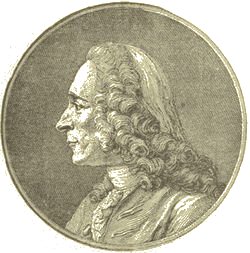
In order to justly estimate the life, character, and genius of a man it is necessary to possess some knowledge of the environments and heredity which generated him. Any study of Voltaire which ignores these influences will fail not only in doing him justice, but in comprehending his unique and exceptional place in history. The most careful examination of these, together with the voluminous bibliography relating to Voltaire provided by French, German, and English literature, still will leave him something of an enigma.
The stage properties and scenery were prepared for the great Frenchman long before he appeared, as is always the case with the famous actors in the drama of history. The time in which he was born was that of Louis XIV., king by divine right, whose history is that of one who was more the tinsel-robed actor, strutting in the semblance of royalty, and less the king than many
"A poor player Who struts and frets his hour upon the stage, And then is heard no more."
Louis XIV. wore all the outward guise of regal office, in his bearing, politeness, address, magnificence, and high-heeled dignity, but he was sensual, ferocious, ignorant, profligate, and superstitious. His greatness was fictitious, his splendor superficial, and his character false. The king was the state, but his mistresses governed. A court thus constituted led the fashions and formed the manners of the people. It stamped the age with that type of character which belongs to the adventurer and devotee. The splendors of the court were maintained at the expense of the people. The glory of Versailles rose above the darkness of the nation. The voluptuous and luxurious pleasures of the nobility were the measure of the poverty and suffering of the people. The aristocracy enjoyed life as if it were a prolonged comedy, while the nation was moving toward the enactment of its greatest tragedy.
Religion was reduced to superstition, theology was divorced from ethics, ritual performances were substituted for moral obligations, and zeal for God manifested by cruelty to man—conditions which are invariably concomitant in religious history. The Mephistopheles evoked by the German Reformation was abroad, and had announced himself to others besides Dr. Faustus, saying, "I am the Spirit who denies." Freedom of thought involves a liberty to think wrongly as well as rightly. Technical learning, in possession of the Jesuits, might content a religious devotee; but philosophy and the new science opened paths which led away from traditions and authoritative decretals; paths which neither priest nor king could close, for they followed the stars in their courses. The waymarks had been blazed by the genius of Galileo and Copernicus. Those who dared to venture into this new territory found institutions and systems of theology arrayed against them, armed with the power of present persecution, more to be feared than threats of future damnation. Public life was venal, the Church simoniacal, and society licentious. In such an age Voltaire was born.
The family of Arouet was ancient and respectable, representing the middle class of society. Voltaire's grandfather settled in early life in Paris, and retired on a comfortable fortune made by selling cloth. His father, François Arouet, was a successful notary of Paris, an honorable profession, which included all that is now done among us by lawyers, brokers, life-insurers, and administrators of estates. Many of the characteristics which we discover in his father, and, indeed, in all the Arouets, survive in Voltaire. They are vivacity, thrift, irritability, and withal a pleasing and generous disposition.
François Marie Arouet was the youngest child of a too prolific mother. He was born November 21, 1694, a weakly, feeble babe whose life was despaired of during the first year. The child was abandoned to the care of a nurse, his mother being an invalid. She died when he reached the age of seven. By the time the infant was two years old he began to thrive, and grew into an active, healthy child. Not robust, he was, nevertheless, wiry, and endowed with nervous energy.
His earliest instruction was from the Abbé de Châteauneuf, who taught him belles lettres and deism. At a very early age the little lad exhibited a precocious talent for versification. When ten years old he was sent to the Collége Louis-le-Grand. Here he remained until he was seventeen, receiving an education which, though always depreciated by him, provided the basis of a wide and varied knowledge. The Jesuits, who were the instructors at this college, retained the methods of the schools of the Renaissance, in which plays in Latin and French were enacted by the scholars. This may explain his life-long devotion to the drama.
His remarkable poetic talent led to an introduction, when he was but eleven years old, to Ninon de l'Enclos, who, in her nineteenth year, was the leader of a brilliant coterie of society. This unaccountable and marvellous woman was so pleased with the lad that she left him a legacy of two thousand livres "to buy books with."
When his college days were ended his troubles began. His father had determined to make him a notary. The youth wanted to follow literature, which the father regarded as equal to no profession at all. The father triumphed in so far as securing the young man's consent to begin the study of law. He began but never proceeded, and gave himself to everything but the pursuit of legal lore. The Abbé de Châteauneuf, the godfather of Voltaire, died before the boy's college days were over, but before his death he introduced his pupil to the celebrated society of the Epicureans of the Temple. Here the youth gathered the vast mass of historical gossip which served him so well in later years. His father was disgusted with his son's pursuits, and, alarmed at his association with princes and philosophers, he sent him away to the ancient Norman city of Caen. This did not effect a cure. The notary sent word to his son that if he would settle down and finish his studies he would purchase for him a commission as counsellor to the Parliament of Paris. "Tell my father," he answered, "that I do not desire any place which can be bought. I shall know how to make one for myself that will cost nothing."
Voltaire had a brother, named Armand, who was a Jansenist and bigot. Their father commented on his two sons by saying, "I have a pair of fools for sons, one in verse and the other in prose."
In the year 1713 the Marquis de Châteauneuf, a brother of the Abbé, appointed Voltaire to the office of page in his diplomatic corps. The marquis was Ambassador to The Hague. Here the young man fell desperately in love with Olympe Dunoyer, a young woman about twenty-one years of age, and the daughter of a woman who had separated from her husband, and supported herself by writing disreputable scandal and gossip. This love affair was violently opposed by the mother and resulted in the young man's being sent back to Paris. For a brief time he gladdened the heart of his father by resuming the study of law, but soon manifested his peculiar facility for getting into trouble.
Defeated in securing an award from the French Academy for a poem, he turned his wit against the successful candidate, and also the poet La Motte, who had decided the competition. A large part of his attack was harmless fun, but a short and very savage satire aimed at La Motte was dangerous to its author, so his father was glad of the opportunity to send his scapegrace to the Château de St. Ange, in company with De Camartin, nephew of the Marquis de Saint Ange. The old marquis was a just and brilliant magistrate, a man familiar with the history of France, and who knew the genealogies of the French court, and all the rare anecdotes of the period included by the reigns of Henry IV. and Louis XIV. That Voltaire improved these days at St. Ange is undoubted.
He returned to Paris at the time of the death of the king. This time he was admitted to the famous "court of Sceaux," over which reigned the brilliant Duchesse du Maine. It is charged that he assisted the duchess in composing lampoons on the Duke of Orleans, then Prince Regent. Accused of writing two libels, he was arrested, May 16, 1717, and sent to the Bastile, in which prison he spent eleven months. While here he gave himself to serious literary labor. At this time he changed his name, and was henceforth known as Arouet de Voltaire. The origin of the new name is one of the disputed problems of biography.
Released from the Bastile, he was, according to custom, ordered into exile, being permitted to go to a place owned by his father in the village of Châtenay. In October, 1718, he was permitted formally to return to Paris. In the spring of the following year he was suspected of having written the "Philippiques," and was banished informally from Paris. Most of this period he spent with Marshal Villars, and gathered more of those reminiscences, which he used with so much skill later in his career, besides making harmless love to the duchess, the wife of his host. In 1721 his father died, leaving him an income of about four thousand livres a year, and this was further increased by a pension of two thousand livres a year from the Regent in recognition of his ability as a dramatic writer.
Several years were spent in Paris in literary labors and in acquiring powerful friends and more powerful enemies; among the latter was the Chevalier de Rohan, who insulted Voltaire on different occasions, which led to sharp replies from the caustic youth. The chevalier hired some roughs to give him a caning. Voltaire could get no one to take his part, so he challenged the chevalier to a duel. The challenge was accepted, but on the morning of the day appointed for the meeting the Government interfered by kindly arresting Voltaire and putting him again in the Bastile.
After fifteen days of imprisonment he was released on condition that he would go to England. The chief turnkey of the Bastile was instructed to go as far as Calais with the troublesome prisoner, in order to be sure that he was forwarded to his destination. Nothing in Voltaire's history did more to form his career than his visit to England. He made a good deal of money there, and it is said, laid the foundations of his fortune. He formed acquaintances among the foremost literary men of that nation, such as the Walpoles, Bubb Doddington, Bolingbroke, Congreve, Sir Everard Falkener, and the poet Pope. The effect of these associations in the literary career of Voltaire is marked. They deepened and broadened his mind, and reduced the flippancy of method, which is the bane of French literature, to its minimum.
He suffered an exile of three years, a long term for the offence he had committed. In 1729 he was permitted to return to Paris. That year, by a lottery speculation, in which he was a sure winner, he secured enough money, when added to what he already possessed, to render him independent of all patronage. From this time on he never knew the want of money, nor permitted an opportunity to pass by which he could increase his riches.
The next few years were mainly devoted to the production of poems, plays, and English letters. During these years his pen continually brought him into difficulty. Some of his productions he denied. At last, in 1734, when a pirated edition of his English letters appeared, containing also a criticism upon the fanaticism of the saintly Pascal, full of heresy, good sense, and keen satire, the fury of the storm broke upon him again. A warrant was immediately issued for his arrest; the officer charged with the duty of capturing him found that Voltaire had left the Château at Monjeau, where he had been in attendance at the wedding of the Duke de Richelieu, so the arrest was not made.
We now find him at the Château of Madame du Châtelet. His relations with this woman will not bear scrutiny. The most charitable construction which can be put upon the fifteen years during which Voltaire lived with her is, that she, like himself, was morally the product of the age. If, however, it is urged against them that there were pure women and honorable men in France at that time, it may be asserted that such were men and women who had not been surrounded from childhood with the influences and social customs in which Voltaire and Madame du Châtelet lived, moved, and had their being.
When this woman died Voltaire found himself in a very unsettled condition. During his life at the Château de Cirey he had received letters from Prince Frederick of Prussia. Now the prince is king, and he asks Voltaire to be his guest, and find with him a refuge and a home. The "respectable Emily" being dead, Voltaire, after considerable haggling about money matters with Frederick, who behaved generously, at last consented.
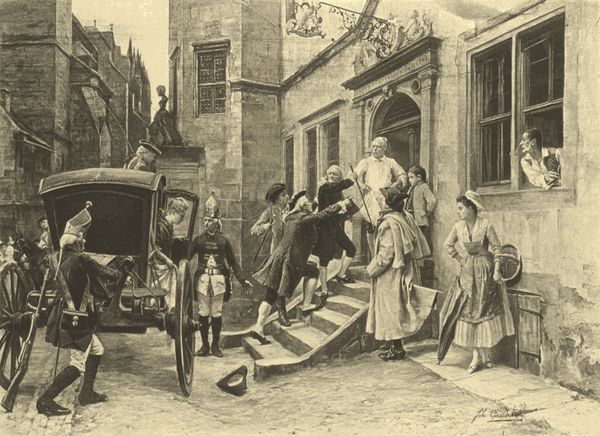
The Arrest of Voltaire and his Niece by Frederick's Order.
In the year 1751 the French author reached Berlin. Frederick treated him in a right kingly way. From the very first Voltaire behaved like a marplot, rather than as the guest of a king. Quarrel succeeded quarrel. Most of his embroilments with the king were of less credit to Voltaire than to Frederick. The former was as full of tricks as Puck, and impish in his mischief. Frederick was overbearing and tyrannical. Having a rude sense of justice, being German, he would grant no license to the stinging, envious satires of the jealous, envious Frenchman. They managed to get on with each other for about three years. Voltaire disgusted Frederick by getting into a lawsuit with a Jewish banker named Hirsch about a discreditable speculation in Saxony money. Finally he began a violent controversy with Maupertuis, president of the Berlin Academy. He libelled this boorish but able scholar, who held his office by appointment of Frederick. He lied to the king concerning one of the most cutting satires in literature, which was aimed at the president. He tricked the king in the shabbiest manner. He had succeeded in getting into difficulty with his usual facility.
He asked for permission to leave the court of Frederick, pleading business at Paris, and also that his health required him to visit Plombières, in order to drink of its waters. Frederick gave him leave to go. On the eve of going, in utter disregard of his promise to the king, he fired a parting shot at Maupertuis, in the shape of a supplement to the attack he had already made, then travelled leisurely on his way. Frederick waited until he reached Frankfort; there he was detained by order of the king on the charge of having some verses written by Frederick in his possession. The resident at Frankfort was as stupid and clumsy as a German official can be, and managed the affair in a most rude and indelicate manner. Exasperated at the delay, Voltaire committed the folly of undertaking to steal away. He and his niece were arrested and imprisoned in an inn, where they were subjected to very unpleasant treatment. The action of Frederick was unworthy of a king. Its meanness was intensified by the bungling stupidity of the resident. The people of Frankfort grew indignant, and the burgomaster began to show resentment, for Frankfort was a free city and the King of Prussia had no right to trespass upon its privileges. It was mean in a monarch to strike this foul blow because he had been pricked with a sharp pin.
From this time forth Voltaire entered upon a life of complete independence, free from all incumbrances of mistresses, royal patrons, or aristocratic friends. He tried residence in Geneva and Lausanne, but while he found political liberty, he was not accorded by the pious Swiss the social freedom to which he was accustomed in France. Finally he purchased a place at Ferney. His home here became the Mecca to which the literary celebrities of Europe made pilgrimages. At Ferney he established watch-manufacturing, competing with the Swiss; here also he built a church, inscribing upon it "Deo crexit Voltaire." In pure mischievousness he entered upon an indecent controversy with the bishop of the diocese, who was a good though foolish man. He also managed to quarrel right and left with all sorts of people, while slowly and imperceptibly old age crept upon him. Much of the noblest work of his life was done here. It was while at Ferney that he adopted a young girl of noble but poor family, rescuing her from a convent and marrying her to the Marquis de Villete. She contributed to making many of his declining years bright with her presence. His pet name for her was "Belle et Bonne."
For some of his work done at Ferney he has won the respect and admiration of mankind. Such were his noble defence of the Calas family, his successful attack upon the outrages committed upon Sirven and his family, securing the liberation of Espinasse from the galleys, the vindication of General Lally, and the brave battle for D'Etalonde and La Barre, together with many other cases in which his powerful pen proved its strength in defence of the weak against the oppression of civil and ecclesiastical tyranny.
This part of his career provides the staple material for his eulogists, as it is not without genuine value. With the death of Louis XV., Voltaire evidently expected that he would be invited to return to Paris, but the government did not give him any encouragement. By the beginning of 1778 he had finished a tragedy entitled "Irene," and on February 10th he arrived in Paris after an absence of twenty-eight years. Though not received very cordially by the ministry, he was heartily welcomed by the Academy and all the foreign celebrities at the capital, among them the American minister, Dr. Benjamin Franklin, to whom he said, "If I were only forty years old I would immediately go and settle in your happy country." An hour after Franklin left, the English ambassador called, to whom he made himself equally agreeable.
The prolonged excitement of the continuous attention paid him, at last brought on a severe illness. In order to secure the right of burial in consecrated ground he professed conversion. Recovering temporarily, he scoffed at himself, saying, "It is necessary for a man to die in the religion of his fathers. If I lived on the banks of the Ganges I should wish to die with a cow's tail in my hand." Before he died his secretary, Wagniere, entreated him to state precisely his "way of thinking" concerning religion. Voltaire asked for paper and ink and then wrote and signed the following, which is now to be seen in the National Library at Paris: "I die adoring God, loving my friends, not hating my enemies, and detesting superstition. Feb. 28th, 1778. Voltaire."
His play "Irene" was first given on March 16th. By the 30th of the month he was able to attend, and that night, in the theatre, received an ovation unequalled in history. Shortly after, his illness returned, in which he lingered until May 30, 1778, dying at the age of eighty-three years and six months. There was difficulty in securing a permit for his burial, and not until 1791 did his body find a resting-place in the Pantheon.
As a dramatist he ranks next to Racine and Corneille, but as an epic poet he is a failure. His romances are probably the best evidences of his versatile and wonderful powers. They embody all the hate and really noble anger of his soul against the evils which were crushing the life of the French people. Their wit never fails, and they flash and sparkle with his matchless brilliancy of satire. As a writer of history he has never been regarded as possessing very great merit, for two reasons: First, he was totally lacking in any grasp of the philosophy of history; second, he was not careful as to accuracy in stating facts. His philosophical works are largely covert attacks upon the religious and ecclesiastical systems of his day. These are interesting reading matter if one does not regard the absurdity of any permanent claims to physics or metaphysics which they contain.
His criticisms and miscellaneous works reveal all the characteristics of his other writings—pungent, witty, sharp; indicating, however, more of the skill of the journalist than of the great author. He has not left a single line which embodies a great thought. He was a man of supernatural brilliancy rather than of great genius. Had his work been less witty and bright, he would be charged with superficiality; that which saves him from the accusation is the marvellous display of mental acuteness and a perfect mastery of the French language. The thought in his productions is as ephemeral as that in a morning newspaper; but his composition will serve to this day as a model of the possibilities of the French tongue. In this respect he is unrivalled.
Popular conceptions of Voltaire are in some respects erroneous. He is regarded as an arch infidel and bitter foe of religion. On the contrary, he was always a deist. He never assails "The Sermon on the Mount," nor can one who reads him carefully believe that there would not have been a subtle sympathy between him and the best religious minds of later days. He never mocked men who lived good lives, nor opposed with any bitterness those who were the friends of liberty of conscience.[Back to Contents]

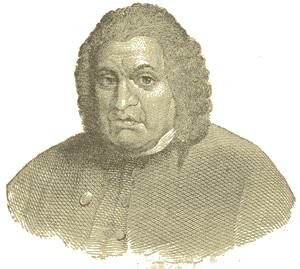
SAMUEL JOHNSON[5] By Lord Macaulay (1709-1784)
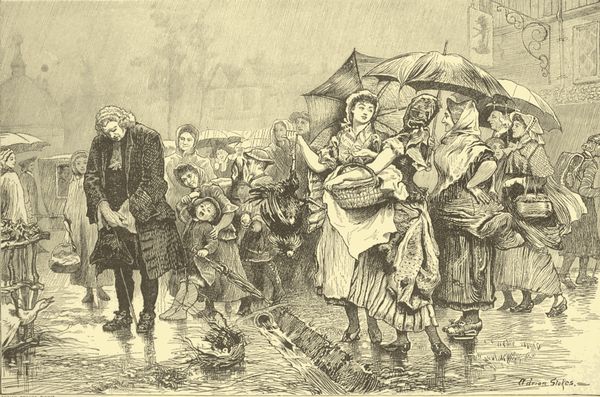
Dr. Johnson's Penance.
While he was thus irregularly educating himself, his family was sinking into hopeless poverty. Old Michael Johnson was much better qualified to pore upon books, and to talk about them, than to trade in them. His business declined; his debts increased; it was with difficulty that the daily expenses of his household were defrayed, it was out of his power to support his son at either university; but a wealthy neighbor offered assistance; and, in reliance on promises which proved to be of very little value, Samuel was entered at Pembroke College, Oxford. When the young scholar presented himself to the rulers of that society, they were amazed not more by his ungainly figure and eccentric manners than by the quantity of extensive and curious information which he had picked up during many months of desultory, but not unprofitable study. On the first day of his residence he surprised his teachers by quoting Macrobius; and one of the most learned among them declared, that he had never known a freshman of equal attainments.
At Oxford Johnson resided during about three years. He was poor, even to raggedness; and his appearance excited a mirth and a pity which were equally intolerable to his haughty spirit. He was driven from the quadrangle of Christ Church by the sneering looks which the members of that aristocratical society cast at the holes in his shoes. Some charitable person placed a new pair at his door; but he spurned them away in a fury. Distress made him, not servile, but reckless and ungovernable. No opulent gentleman commoner panting for one-and-twenty could have treated the academical authorities with more gross disrespect. The needy scholar was generally to be seen under the gate of Pembroke, a gate now adorned with his effigy, haranguing a circle of lads, over whom, in spite of his tattered gown and dirty linen, his wit and audacity gave him an undisputed ascendancy. In every mutiny against the discipline of the college he was the ringleader. Much was pardoned, however, to a youth so highly distinguished by abilities and acquirements. He had early made himself known by turning Pope's "Messiah" into Latin verse. The style and rhythm, indeed, were not exactly Virgilian; but the translation found many admirers, and was read with pleasure by Pope himself.
The time drew near at which Johnson would, in the ordinary course of things, have become a Bachelor of Arts; but he was at the end of his resources. Those promises of support on which he had relied had not been kept. His family could do nothing for him. His debts to Oxford tradesmen were small indeed, yet larger than he could pay. In the autumn of 1731 he was under the necessity of quitting the university without a degree. In the following winter his father died. The old man left but a pittance; and of that pittance almost the whole was appropriated to the support of his widow. The property to which Samuel succeeded amounted to no more than twenty pounds.
His life, during the thirty years which followed, was one hard struggle with poverty. The misery of that struggle needed no aggravation, but was aggravated by the sufferings of an unsound body and an unsound mind. Before the young man left the university his hereditary malady had broken forth in a singularly cruel form. He had become an incurable hypochondriac. He said long after that he had been mad all his life, or at least not perfectly sane; and, in truth, eccentricities less strange than his have often been thought grounds sufficient for absolving felons and for setting aside wills. His grimaces, his gestures, his mutterings, sometimes diverted and sometimes terrified people who did not know him.
With such infirmities of body and of mind this celebrated man was left, at two-and-twenty, to fight his way through the world. He remained during about five years in the Midland Counties. At Lichfield, his birthplace and his early home, he had inherited some friends and acquired others. He was kindly noticed by Henry Hervey, a gay officer of noble family, who happened to be quartered there. Gilbert Walmesley, registrar of the ecclesiastical court of the diocese, a man of distinguished parts, learning, and knowledge of the world, did himself honor by patronizing the young adventurer, whose repulsive person, unpolished manners, and squalid garb moved many of the petty aristocracy of the neighborhood to laughter or to disgust. At Lichfield, however, Johnson could find no way of earning a livelihood. He became usher of a grammar-school in Leicestershire; he resided as a humble companion in the house of a country gentleman; but a life of dependence was insupportable to his haughty spirit. He repaired to Birmingham, and there earned a few guineas by literary drudgery. In that town he printed a translation, little noticed at the time, and long forgotten, of a Latin book about Abyssinia. He then put forth proposals for publishing by subscription the poems of Politian, with notes containing a history of modern Latin verse; but subscriptions did not come in and the volume never appeared.
While leading this vagrant and miserable life Johnson fell in love. The object of his passion was Mrs. Elizabeth Porter, a widow, who had children as old as himself. To ordinary spectators the lady appeared to be a short, fat, coarse woman, painted half an inch thick, dressed in gaudy colors, and fond of exhibiting provincial airs and graces which were not exactly those of the Queensberrys and Lepels. To Johnson, however, whose passions were strong, whose eyesight was too weak to distinguish ceruse from natural bloom, and who had seldom or never been in the same room with a woman of real fashion, his Titty, as he called her, was the most beautiful, graceful, and accomplished of her sex. That his admiration was unfeigned cannot be doubted; for she was as poor as himself. She accepted, with a readiness which did her little honor, the addresses of a suitor who might have been her son. The marriage, however, in spite of occasional wranglings, proved happier than might have been expected. The lover continued to be under the illusions of the wedding-day till the lady died, in her sixty-fourth year. On her monument he placed an inscription, extolling the charms of her person and of her manners; and when, long after her decease, he had occasion to mention her, he exclaimed, with a tenderness half ludicrous, half pathetic, "Pretty creature!"
His marriage made it necessary for him to exert himself more strenuously than he had hitherto done. He took a house in the neighborhood of his native town and advertised for pupils. But eighteen months passed away, and only three pupils came to his academy. Indeed, his appearance was so strange, and his temper so violent, that his school-room must have resembled an ogre's den. Nor was the tawdry, painted grandmother whom he called his Titty well qualified to make provision for the comfort of young gentlemen. David Garrick, who was one of the pupils, used, many years later, to throw the best company of London into convulsions of laughter by mimicking the endearments of this extraordinary pair.
At length Johnson, in the twenty-eighth year of his age, determined to seek his fortune in the capital as a literary adventurer. He set out with a few guineas, three acts of the tragedy of "Irene" in manuscript, and two or three letters of introduction from his friend Walmesley.
Some time appears to have elapsed before Johnson was able to form any literary connection from which he could expect more than bread for the day which was passing over him. He never forgot the generosity with which Hervey, who was now residing in London, relieved his wants during this time of trial. "Harry Hervey," said the old philosopher, many years later, "was a vicious man; but he was very kind to me. If you call a dog Hervey, I shall love him." At Hervey's table Johnson sometimes enjoyed feasts which were made more agreeable by contrast. But in general he dined, and thought that he dined well, on sixpenny-worth of meat and a pennyworth of bread at an ale-house near Drury Lane.
About a year after Johnson had begun to reside in London he was fortunate enough to obtain regular employment from Cave, an enterprising and intelligent bookseller, who was proprietor and editor of the Gentleman's Magazine.
A few weeks after Johnson had entered on these obscure labors he published a work which at once placed him high among the writers of his age. It is probable that what he had suffered during his first year in London had often reminded him of some parts of that noble poem in which Juvenal had described the misery and degradation of a needy man of letters, lodged among the pigeons' nests in the tottering garrets which overhung the streets of Rome. Pope's admirable imitations of Horace's "Satires and Epistles" had recently appeared, were in every hand, and were by many readers thought superior to the originals. What Pope had done for Horace, Johnson aspired to do for Juvenal. The enterprise was bold, and yet judicious. For between Johnson and Juvenal there was much in common—much more, certainly, than between Pope and Horace.
Johnson's "London" appeared, without his name, in May, 1738. He received only ten guineas for this stately and vigorous poem; but the sale was rapid and the success complete. A second edition was required within a week. Those small critics who are always desirous to lower established reputations ran about proclaiming that the anonymous satirist was superior to Pope in Pope's own peculiar department of literature. It ought to be remembered, to the honor of Pope, that he joined heartily in the applause with which the appearance of a rival genius was welcomed. He then made inquiries about the author of "London." Such a man, he said, could not long be concealed. The name was soon discovered; and Pope, with great kindness, exerted himself to obtain an academical degree and the mastership of a grammar-school for the poor young poet. The attempt failed, and Johnson remained a bookseller's hack.
The fame of his abilities and learning continued to grow. Warburton pronounced him a man of parts and genius; and the praise of Warburton was then no light thing. Such was Johnson's reputation that, in 1747, several eminent booksellers combined to employ him in the arduous work of preparing a dictionary of the English language, in two folio volumes. The sum which they agreed to pay him was only fifteen hundred guineas; and out of this sum he had to pay several poor men of letters who assisted him in the humbler parts of his task.
Johnson had flattered himself that he should have completed his dictionary by the end of 1750, but it was not till 1755 that he at length gave his huge volumes to the world. During the seven years which he passed in the drudgery of penning definitions and marking quotations for transcription, he sought for relaxation in literary labor of a more agreeable kind. In 1749 he published the "Vanity of Human Wishes," an excellent imitation of the Tenth Satire of Juvenal. It is, in truth, not easy to say whether the palm belongs to the ancient or to the modern poet.
About a year after the representation of "Irene" he began to publish a series of short essays on morals, manners, and literature. This species of composition had been brought into fashion by the success of The Tattler, and by the still more brilliant success of The Spectator. A crowd of small writers had vainly attempted to rival Addison. The Lay Monastery, The Censor, The Freethinker, The Plain-Dealer, The Champion, and other works of the same kind, had had their short day. None of them had obtained a permanent place in our literature, and they are now to be found only in the libraries of the curious. At length Johnson undertook the adventure in which so many aspirants had failed. In the thirty-sixth year after the appearance of the last number of The Spectator appeared the first number of The Rambler. From March, 1750, to March, 1752, this paper continued to come out every Tuesday and Saturday.
From the first The Rambler was enthusiastically admired by a few eminent men. Richardson, when only five numbers had appeared, pronounced it equal if not superior to The Spectator. Young and Hartley expressed their approbation not less warmly. Bubb Dodington, among whose faults indifference to the claims of genius and learning cannot be reckoned, solicited the acquaintance of the writer. In consequence probably of the good offices of Dodington, who was then the confidential adviser of Prince Frederick, two of his Royal Highness's gentlemen carried a gracious message to the printing-office, and ordered seven copies for Leicester House.
The last Rambler was written in a sad and gloomy hour. Mrs. Johnson had been given over by the physicians. Three days later she died. She left her husband almost broken-hearted. Many people had been surprised to see a man of his genius and learning stooping to every drudgery and denying himself almost every comfort, for the purpose of supplying a silly, affected old woman with superfluities which she accepted with but little gratitude. But all his affection had been concentrated on her. He had neither brother nor sister, neither son nor daughter. To him she was as beautiful as the Gunnings, and witty as Lady Mary. Her opinion of his writings was more important to him than the voice of the pit of Drury Lane Theatre, or the judgment of the Monthly Review. The chief support which had sustained him through the most arduous labor of his life was the hope that she would enjoy the fame and the profit which he anticipated from his Dictionary. She was gone; and in that vast labyrinth of streets, peopled by eight hundred thousand human beings, he was alone. Yet it was necessary for him to set himself, as he expressed it, doggedly to work. After three more laborious years the Dictionary was at length complete.
In the spring of 1758 Johnson put forth the first of a series of essays entitled The Idler. During two years these essays continued to appear weekly. They were eagerly read, widely circulated, and, indeed, impudently pirated while they were still in the original form, and had a large sale when collected into volumes. The Idler may be described as a second part of The Rambler, somewhat livelier and somewhat weaker than the first part.
While Johnson was busied with his Idlers, his mother, who had accomplished her ninetieth year, died at Lichfield. It was long since he had seen her; but he had not failed to contribute largely out of his small means to her comfort. In order to defray the charges of her funeral, and to pay some debts which she had left, he wrote a little book in a single week, and sent off the sheets to the press without reading them over. A hundred pounds were paid him for the copyright; and the purchasers had great cause to be pleased with their bargain, for the book was "Rasselas."
By such exertions as have been described Johnson supported himself till the year 1762. In that year a great change in his circumstances took place. He had from a child been an enemy of the reigning dynasty. His Jacobite prejudices had been exhibited with little disguise both in his works and in his conversation. Even in his massy and elaborate Dictionary he had, with a strange want of taste and judgment, inserted bitter and contumelious reflections on the Whig party. The excise, which was a favorite resource of Whig financiers, he had designated as a hateful tax. He had railed against the Commissioners of Excise in language so coarse that they had seriously thought of prosecuting him. He had with difficulty been prevented from holding up the Lord Privy Seal by name as an example of the meaning of the word "renegade." A pension he had defined as a pay given to a state hireling to betray his country; a pensioner as a slave of state hired by a stipend to obey a master. It seemed unlikely that the author of these definitions would himself be pensioned. But that was a time of wonders. George the Third had ascended the throne, and had, in the course of a few months, disgusted many of the old friends, and conciliated many of the old enemies of his house. The city was becoming mutinous. Oxford was becoming loyal. Cavendishes and Bentincks were murmuring. Somersets and Wyndhams were hastening to kiss hands. The head of the treasury was now Lord Bute, who was a Tory, and could have no objection to Johnson's Toryism. Bute wished to be thought a patron of men of letters, and Johnson was one of the most eminent, and one of the most needy men of letters in Europe. A pension of three hundred a year was graciously offered, and with very little hesitation accepted.
This event produced a change in Johnson's whole way of life. For the first time since his boyhood he no longer felt the daily goad urging him to the daily toil. He was at liberty, after thirty years of anxiety and drudgery, to indulge his constitutional indolence, to lie in bed till two in the afternoon, and to sit up talking till four in the morning, without fearing either the printer's devil or the sheriff's officer.
But though his pen was now idle, his tongue was active. The influence exercised by his conversation, directly upon those with whom he lived, and indirectly on the whole literary world, was altogether without parallel. His colloquial talents were indeed of the highest order. He had strong sense, quick discernment, wit, humor, immense knowledge of literature and of life, and an infinite store of curious anecdotes. As respected style, he spoke far better than he wrote. Every sentence which dropped from his lips was as correct in structure as the most nicely balanced period of The Rambler. But in his talk there were no pompous triads, and little more than a fair proportion of words in osity and ation. All was simplicity, ease, and vigor. He uttered his short, weighty, and pointed sentences with a power of voice, and a justness and energy of emphasis, of which the effect was rather increased than diminished by the rollings of his huge form, and by the asthmatic gaspings and puffings in which the peals of his eloquence generally ended. Nor did the laziness which made him unwilling to sit down to his desk prevent him from giving instruction or entertainment orally. To discuss questions of taste, of learning, of casuistry, in language so exact and so forcible that it might have been printed without the alteration of a word, was to him no exertion, but a pleasure. He loved, as he said, to fold his legs and have his talk out. He was ready to bestow the overflowings of his full mind on anybody who would start a subject, on a fellow-passenger in a stage-coach, or on the person who sat at the same table with him in an eating-house. But his conversation was nowhere so brilliant and striking as when he was surrounded by a few friends, whose abilities and knowledge enabled them, as he once expressed it, to send him back every ball that he threw.
On Easter eve, 1777, some persons, deputed by a meeting which consisted of forty of the first booksellers in London, called upon Johnson. Though he had some scruples about doing business at that season, he received his visitors with much civility. They came to inform him that a new edition of the English poets, from Cowley downward, was in contemplation, and to ask him to furnish short biographical prefaces. He readily undertook the task, a task for which he was pre-eminently qualified. His knowledge of the literary history of England since the Restoration was unrivalled. That knowledge he had derived partly from books, and partly from sources which had long been closed; from old Grub-Street traditions; from the talk of forgotten poetasters and pamphleteers who had long been lying in parish vaults; from the recollections of such men as Gilbert Walmesley, who had conversed with the wits of Button; Cibber, who had mutilated the plays of two generations of dramatists; Orrery, who had been admitted to the society of Swift; and Savage, who had rendered services of no very honorable kind to Pope. The biographer, therefore, sat down to his task with a mind full of matter. He had at first intended to give only a paragraph to every minor poet, and only four or five pages to the greatest name. But the flood of anecdote and criticism overflowed the narrow channel. The work, which was originally meant to consist only of a few sheets, swelled into ten volumes—small volumes, it is true, and not closely printed. The first four appeared in 1779, the remaining six in 1781.
When at length the moment, dreaded through so many years, came close, the dark cloud passed away from Johnson's mind. His temper became unusually patient and gentle; he ceased to think with terror of death, and of that which lies beyond death; and he spoke much of the mercy of God, and of the propitiation of Christ. In this serene frame of mind he died, on December 13, 1784. He was laid, a week later, in Westminster Abbey, among the eminent men of whom he had been the historian—Cowley and Denham, Dryden and Congreve, Gay, Prior, and Addison.[Back to Contents]
THOMAS CHATTERTON[7] By Colonel Richard Malcolm Johnston (1752-1770)
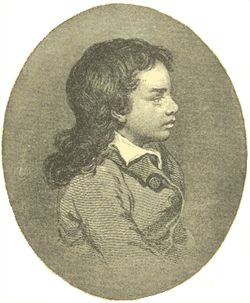
Thomas Chatterton, whose career among all those of English men of letters was the most eccentric, was a posthumous son of a poor man who, besides being a choir-singer, kept the Pyle Street School in the city of Bristol, England. In a small tenement-house near by he was born, November 20, 1752. The mother maintained her two children, Thomas and a daughter two years older, by keeping a small school for girls. At the age of five years the boy was sent to the Pyle Street School, where the master, unable to teach him anything and deciding that he was an idiot, dismissed him. For a year and a half afterward he was so regarded. During this time he was often subjected to paroxysms of grief which were expressed generally in silent tears, but sometimes in cries continued for many hours. By many an expedient of a parent who understood him not, from frequent serious affectionate remonstrance to an occasional blow upon his face, he was led or forced along. One day this parent, while about to destroy an old manuscript in French, noticed the child looking with intense interest at the illuminated letters upon its pages. Withholding the paper from its threatened destruction she briefly succeeded in teaching him therefrom the alphabet, and in time from a black-letter Bible he learned to read. Not long afterward the family removed to a house near the Church of St. Mary Redcliffe, one of the oldest and noblest among the parochial structures in England. In a room called the Treasury House, over one of the porches of this church, was a pile of ancient documents, muniments of title, parish registers, and other things, which had been removed by the latest Chatterton, and which were kept in the house now occupied by the family. The boy when eight years old was sent to the Blue Coat, a charity school, where he learned with rapidity the elements taught thereat. The time not occupied with school tasks he devoted to reading whatever books he could borrow or obtain from a circulating library. While engaged in study he seemed unaware of everything passing around him. At twelve years of age he probably had read a larger number of books than any child who ever lived.
It is curious to study how the genius of some persons is developed and their destiny determined by the conditions of their childhood. The Chattertons for a hundred and fifty years had been sextons in St. Mary Redcliffe, the last being John, uncle of the poet. Whatever might have been in the transmission through several generations of ghostly interest in this monument of the Middle Ages, it is known that to Thomas Chatterton it was of all earthly objects the one most interesting. For the sports of other lads he had no heart; his leisure time was spent in the church, and in the study of its history and its varied quaint literature. In time he began to imitate the ancient manuscripts now in his mother's house, and with ochre, charcoal, and black lead, his success in that line was marvellous. These habits induced others kindred, among them absence of mind, under whose influence, sometimes, when in the company of others, he gazed silently at and about them with dreaminess, as if he was thinking how to connect contemporary things strange to him with those, his only familiars, two centuries before. It seems a pity for such a spirit to be without other guides than a weak, toiling mother, and a teacher dull and despotic as the head-master of the Blue Coat School. Of other things than books he had opportunities to learn little. The sense of honorable duty, either he had not been taught or its principles had been inculcated in ways too meaningless to make enduring impression upon his being. Under influences more benign he might have made a career, if not more brilliant, more felicitous. At the age of ten years he wrote some verses entitled "On the Last Epiphany," which, printed in Farley's Journal, showed that he had, if not high poetic genius, at least extraordinary sensibility of rhythm. Unfortunately his mind conceived for most of what he saw around him a hostility which drove him to express it in satirical phrase. A church-warden, whose name of Joseph Thomas would not have survived but for Chatterton's verses, was made immortal for the changes made by him while intent upon destroying ancient monuments, interfering with his own ideas of churchyard regularities. Some of the levellings of this man, particularly of an ancient cross mentioned by William of Worcester three centuries back, were scourged with a lash much imitating that of Alexander Pope, perhaps the only really existing poet whom he sought to imitate. Praises accorded to him inspired the feeling that if he could meet opportunities entirely favorable, he could become illustrious; and it is touching to note that in this ambition his leading thought was to be able to lift his mother and sister far above their lowly estate. Insufficiently taught in principles of personal rectitude, persuaded that greatest possessions were obtainable mainly through fraud, he commenced that strange career which none but a mind so little instructed could have failed to see must end in disaster. There can hardly be a doubt that insanity, if not born with him, was settling upon his understanding and that no degree of careful guidance or successful venture would have imparted entire relief.
In his fifteenth year he was apprenticed to John Lambert, an attorney of Bristol, by whom he was set to copying legal documents, an employment that lent many hours of leisure, which he devoted to study in heraldry and Old English. With these he became familiar, and then he began those impostures that were the bane of his short remnant of life. The first of these had for its victim, one Burgum, a pewterer, whose ignorance and vanity exposed him to the lad's designs to obtain money from him by flattery. Like many others in such conditions, the pewterer had eager desire to be thought a descendant of ancestry formerly of high lineage. One day he was told by Chatterton that among the ancient parchments appertaining to Saint Mary Redcliffe, he had discovered one with blazon of the De Bergham arms, and he intimated that from that noble family he, the pewterer, may have descended. The document was made out wholly by Chatterton. Investigation satisfied Burgum fully, and in return for the discovery he gave the boy a crown-piece. This compensation seemed so inadequate that the discoverer afterward celebrated it thus:
"Gods! What would Burgum give to get a name And snatch the blundering dialect from shame? What would he give to hand his memory down To time's remotest boundary? A crown!"
A year afterward, on occasion of the completion of the new bridge over the river Avon, he astonished the whole town by a paper printed in the Bristol Weekly Journal, with the signature of "Dunelmus Bristoliensis," which was pretended to have been discovered among those multitudinous papers of the Treasury House, and which gave account of the city mayor's first passage over the old bridge that had been dedicated to the Assumption of the Blessed Virgin by King Edward III. and his queen, Philippa. Search for the sender was expedited by his offer of further contributions on the same line, and wonderful was the success attending his devices. No less than the other citizens was misled William Barrett, a learned surgeon and antiquary then engaged upon a history of Bristol. This man, who had been signally kind to the orphan, availed himself freely of his pretended findings, paid for them liberally, and used them in the preparation of his book. What pleased him most was the discovery that Bristol, among other notables two centuries back, had a great poet in the person of Thomas Rowlie, a priest, who, among other things, had written a great poem entitled "The Bristowe Tragedie; or, the Dethe of Syr Charles Bawdin," founded upon the execution of Sir Baldwin Fulford, in 1461, by order of Edward IV. This was indeed a great poem. The muse of tragedy had inspired the young maniac with much of her consuming fervor. The verses containing the intercession of Canynge mayor of Bristol, and his ideas of the chiefest duties of a monarch are among the most touching and noble among their likes in all literature.
As a contributor to the Town and Country Magazine he obtained many a shilling, but far less often than what would have satisfied his eager wants, foremost among which was to see his mother and sister established in fine vestments and living in luxury. In time he grew to feel contempt for the Bristol people, high and low, and then he turned his eyes upon London. Application to Dodsley, the leading publisher, was discouraged for want of acquaintance with his condition and responsibility. He then essayed Horace Walpole, sending an ode on King Richard I. for his work "Anecdotes of Painting," and undertaking to furnish the names of several great painters, natives of Bristol. This application was signed "John Abbot of St. Austin's Minster, Bristol." In the letter he drew attention to the "Bristowe Tragedie" and other Rowlie poems. Walpole, who was as cold as urbane, expressed some curiosity to see these productions, which, when sent, he referred to Gray and Mason. These pronounced them forgeries. Whereupon Walpole, in the meantime informed of the real author and his condition, paid no further attention to the papers for a while, even to the request to return them. Enraged but undaunted by this failure he continued his work, both in old and contemporary English speech, producing "Aella," "Goddwyn," "Battle of Hastings," "Consuliad," "Revenge," etc. At length he grew restless to a degree beyond endurance. With the few acquaintances of his own age he talked of suicide. Feeling himself a stranger in that society, often spending whole nights in wakeful dreams instead of restful sleep, incensed with limitless ambition, he did indeed meditate upon making an end of himself. Among the papers on his desk one day was found his will, a singular document, containing among other things most incoherent bequests to several acquaintances, as of his "vigor and fire of youth" to George Catcall, the schoolmaster; "his humility" to the Rev. Mr. Camplin; his "prosody and grammar" and a "moiety" of his "modesty" to Mr. Burgum; concluding with directions to Paull Farr and John Flower, "at their own expense" to erect a monument upon his grave with this inscription: "To the memory of Thomas Chatterton. Reader, judge not. If thou art a Christian, believe that he shall be judged by a Supreme Power; to that power alone is he now answerable."
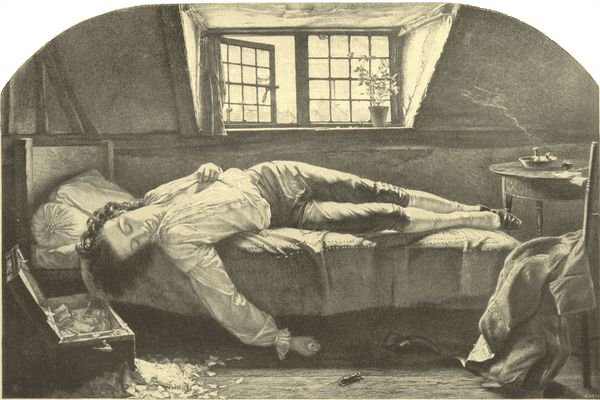
The Death of Chatterton, the Young Poet.
This document led to his dismissal by the attorney, who, in April 1770, returned to him his indentures. He at once set out for London with his manuscripts and a small sum of money raised by a few persons in Bristol. Through the help of a female relative he got board at the house of one Walmsley, a plasterer, in Shoreditch. In the history of literature nothing can be found so much to be compassionated as the life led by him during those summer months in the great city. Plodding the streets from day to day with his manuscripts, living mainly upon bread and water, not retiring to bed at night until near the morning, and then seldom closing his eyes, yet in this time guilty of no sort of known immorality, sending home frequent letters abounding in expressions of most fervid hopes and in promises of silks and other fine things to the objects of his affection, few cases could have appealed more piteously for help. The wits who might have succored were out of town. Goldsmith lamented that he had not known him. Johnson, with his stern kindness, if such a thing had been possible, could have saved him from despair. His deportment in the family with whom he lived was without exception of decorum, although he showed that any movement toward familiarity with him was offensive. In his sore stress he began to write papers upon politics, which were accepted by the partisan press. It was at the time when the arbitrary encroachments of George III. were met by the audacious courage of Mayor Beckford. Chatterton attached himself to the popular side; yet he seemed to have regret for the mistake in so doing, because of the comparative want of money in that party. In a long letter written to his sister, most of which is occupied with his great undertakings, he spoke thus of his political works:
"But the devil of the matter is, there is no money to be got on this side of the question. Interest is on the other side. But he is a poor author who cannot write on both sides. I believe I may be introduced (and if not I'll introduce myself) to a ruling power in the court party. I might have a recommendation to Sir George Colebrook, an East India director, as qualified for an office by no means despicable; but I shall not take a step to the sea whilst I can continue on land." In the midst of this struggle Beckford, the champion of popular rights, died suddenly, and the Walmsleys afterward testified that this event put Chatterton "perfectly out of his mind."
Soon after this he removed to Brook Street, Holborn, and became a boarder in the house of one Angell, a sack-maker. Here he continued to work day and night until desperation, long threatened, seized upon him. Court journals grew tired of articles showing little talent for political discussion, and he became ragged and almost shoeless. In the only despondent letter ever sent to his mother, he wrote of having stumbled into an open grave one day while walking in St. Pancras's Churchyard. The Angells, touched with his poverty and distress, kindly offered him food, which, except in one instance, he declined. One night after sitting with the family, apparently given over to despondency, he took affectionate leave of his hostess and the next morning was found dead from a dose of arsenic.
It was singular that the Rowlie writings were so far superior to his productions in modern English. The latter were commonplace, the former indicative of much genius. Indeed, one of the strongest evidences against their genuineness was the moral impossibility of their production in the age to which he assigned them. The imitation was as pathetic as it was audacious, attempted thus in honor of a model that never had existed.[Back to Contents]
ROBERT BURNS[8] By Will Carleton (1759-1796)
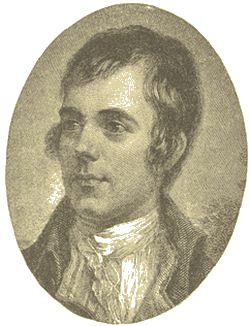
Robert Burns, the great lyric poet of Scotland, was born January 25, 1759, near the sea coast town of Ayr. His father, William Burness, had all he could do to support a family of children, of whom Robert was the eldest. The boy soon became a stalwart toiler and could turn a furrow and reap a swath with the best of his comrades; but his mind meanwhile grasped strongly and passionately all the literature to which it could get access. This was limited in extent; the books in his father's humble cottage were very few. He devoured, besides, everything in prose and verse that he could buy or borrow; and there were soon aroused in him all the longings of repressed genius and unemployed ambition.
Many of Burns's poems have had music set to them; but he began his rhythmical career by fitting poetry to music. A girl friend often worked beside him in the fields, as was the custom in that locality. She was a beautiful songstress, or at least seemed so to the untutored peasant-boy, and Robert soon learned to put new words to many of her tunes, not forgetting to include in them due commendations of the young lady herself. These efforts naturally received more or less applause; and the youth found his mind more and more drawn toward poetic effort.
His first few years seem to have been spent in a half-happy, half-careless boyhood; in them he had all the experiences of a poor but healthy Scotch peasant-lad, toiling in the fields, catching now and then a few weeks or months at school, coquetting with neighboring lasses, but with poverty and lack of social position always barring the way to his advancement.
Through all this, poetry was his solace and amusement; at the age of fifteen he had written many verses which, although crude, contained the promise of his subsequent career; but of course at that time they were admired only by a limited circle of his neighbors and friends. He also unhappily contracted certain convivial habits, which lasted in a greater or less degree all through his life, which no one regretted more than he did at times, and which greatly impaired and finally put an early end to a brilliant career.
When Robert was twenty-five years old his father, the good William Burness, died, and the family, who had kept well together, took a farm about eight miles distant from the old home, near Ayr. Here the young farmer-poet undertook to become a thorough and industrious husbandman. He turned his attention toward the literature of the farm; he tried to bend his powerful though dreamy mind toward the prosaic and the practical. But the venture did not thrive; some of the thousand-and-one casualties that are always besetting crops and crop-growers came his way, and the brave venture which he and his brother Gilbert had undertaken together, proved scant of success.
He, however, may be said to have done the greatest work of his life upon that farm. It was while one day weeding the "kailyard," or garden, with his brother, that he first decided, after they had talked it carefully over, to be an author, and to write verses that would "bear publishing." It is to be noticed that from this hour he became more methodical with his muse and seemed to work toward a purpose; and that within a short time after this resolve he wrote most of the poems that have made his name immortal.
In 1786 it was definitely decided that the farm was not going "to pay," and that his efforts as an agriculturist had failed. But these were not the only troubles that were gathering in the young poet's path. In 1785 he became engaged to his "Highland Mary." If we may judge by his poems, this was the one among his numerous love affairs in which his heart was most deeply enthralled; but there was another in which he was inextricably and fatally entangled. It was with a young girl, Jean Armour, to whom he seems to have been as sincerely attached as his headlong, susceptible nature would allow him to be to anyone. He made the best amends he could to "the bonnie lass" by giving her his written acknowledgment of marriage—a process perfectly legal in Scotland, though irregular—but her father still hoped for a more advantageous alliance for his daughter, and refused her to the poor poet; a sentiment in which the daughter, to all appearances, heartily joined.
It is interesting to think of this poverty-stricken family rejecting Burns, even after matters had gone thus far, on account of his lack of wealth, when he had at that very time, in his little desk, poems for which the world has since paid millions of pounds. But the future is often unseen, even by those highest in learning and deepest in wit; and it is little wonder that the unsophisticated family were unable to know even the pecuniary value of our young ploughman's brain.
Discouraged and depressed the young poet resolved on emigrating to Jamaica, as book-keeper of a wealthy planter. In order to procure the money with which to pay the expenses of his journey, and no doubt partly in pursuance of the plan made that day in the garden, he decided to publish a small volume, by subscription, which he did, at Kilmarnock, in July, 1786, having as the title-page of the book, "Poems, Chiefly in the Scottish Dialect; by Robert Burns." It will be seen that he now dropped the fifth and sixth letters from the name inherited of his father, and the boy Burness became the man Burns.
This book achieved immediate and unexpected success; and having realized a few pounds from its profits, Burns set out for Greenock, where he was to take ship for his new West Indian home. But his poems had attracted so much attention, and had been the cause of such commendation, that he was finally encouraged to stay and enjoy some of the fruits of his genius, which the world was now beginning to discover.
In November of the same year, encouraged by verbal praises and written commendations, some of them all the way from the literary centre of Edinburgh, he journeyed to that city, where he was received with great cordiality by many of the leading people, and urged to issue a second edition of his poems, which he did in April of the ensuing year. It was sold, like the first one, by subscription, and netted the author a much larger sum; while it procured him fame, all through the country, as "The Ploughman Poet."
During this year he took several tours in different parts of his native Scotland, in company with congenial spirits, once going a very little way into England. He was received gladly and hospitably everywhere by those who had read and admired his poems. His journals and letters during that period, probably upon the whole the most happy in his life, teem with accounts of courtesies, hospitalities, merry-makings, and gallantries, which he mentions as taking place all along the route. His poetic pen never seems to have remained idle very long at a time; and albums, fly-leaves, note-books, letters, and sometimes windowpanes, received in turn his quaint and fiery verses.
In October he returned to Edinburgh, where he remained for some time, filling social engagements, entangling himself in certain affairs of the heart, and endeavoring to get a settlement with his publisher, whom he considered as owing him the immediate payment of a considerable sum of money. He also assisted a compiler in making collections of old Scottish songs, and in furnishing new words to old airs. It is a singular fact, that while Burns was willing to earn money with the regular edition of his poems, he steadfastly declined remuneration for his songs, claiming that he did the work for love.
With the natural Scotch thrift of his fathers, he soon decided that he must have some more substantial occupation than that of a poet, and he applied for and received a position in the Excise. To add to his income he, in 1788, leased a farm on the river Nith, about twelve miles from Dumfries. The place contained one hundred acres, and was stated to be "more the choice of a poet than of a farmer." Its fine situation and beautiful views compensated, perhaps, in Burns's mind, for its sterility.
Here he brought his wife, Jean Armour, whom he had married under such unpleasant circumstances a few years before, and to whom he was drawn again as much by pity as by love, her parents having turned her out of doors. It is hardly necessary to say that the parents received him with open arms, now that he came with some signs of prosperity; and he no doubt entered anew upon married life with their sincere, if somewhat tardy, blessing.
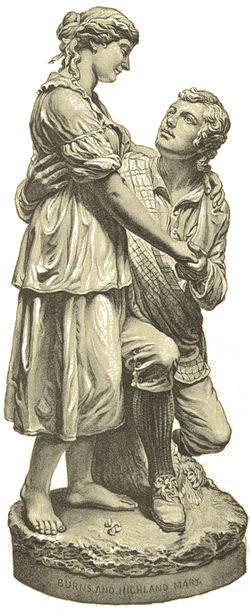
Burns and Highland Mary.
Upon this farm of "Ellisland" Burns lived three years, and during that time he had three occupations—farmer, poet, and excise officer. In the last-named he was in the habit of riding two hundred miles per week, to different points throughout the county. He wrote considerably, but perhaps not so well as if he had not been hurried and worried by practical affairs. As an officer he is generally admitted to have been thorough, correct, and at the same time humane; as a farmer, he again failed, and in 1791 sold back the lease of his place, pocketed, it is said, a loss of £300, and moved with his family to Dumfries. Here he took up the plan of living entirely upon his salary from the Government—£70 per annum. This would seem a meagre stipend now; but it would at that time have enabled Burns to support his family in comfort, though not in the way his abilities entitled him to do. His position gave him some perquisites, and he had the hope of an advance in his salary, which would follow a looked-for promotion to the office of supervisor. He spent his time in the performance of his duties, in collecting and writing songs for the above-mentioned compilation of Scottish melodies, and in meeting and conversing with the many friends whom his genius and geniality drew around him.
But his hopes and his health gradually failed together. Dumfries was on one of the great stage lines that led to and from London, and it was often invaded by tourists who were intent on "making a night of it" with the well-known peasant-poet. In these bouts, in which he was generally willing to recite his poems and sing his songs, he received much pleasure and applause, but nothing else, save the wear and tear of dissipation. His habit of outspoken opinion, in political and other matters, proved obstacles to his advancement in the public service; he fell gradually into debt, despondency, and disease—a mournful trio of companions for the most brilliant of Scottish poets! "An old man before his time," he lay down to die, in 1796, having lived, as time is counted, only thirty-seven short years.
The fame of this great and unfortunate poet has increased since his death; Scotchmen everywhere thrill with pride when Burns's magic name is spoken, and the world in general has a sincere love for the warm-hearted, plain-spoken bard, who turned his own soul to the gaze of his fellow-beings, that they might the better know their own. The space of this article will not permit even an enumeration of his wonderful poems; the world may almost be said to know them by heart. His "Cotter's Saturday Night," "Tam O'Shanter," "Bonnie Doon," "Auld Lang Syne," "Bruce's Address," "A Man's a Man for a' That," and many others that might be named, are likely to live for generation after generation; and his character as a man, although subject in many respects to severe criticism, can always be covered with a mantle of loving charity, when we remember his generosity of heart, his manly independence of spirit, his natural nobility of mind, and consider the difficult circumstances and terrible temptations that encompassed his stormy life.[Back to Contents]

SCHILLER[9] By B. L. Farjeon (1759-1805)
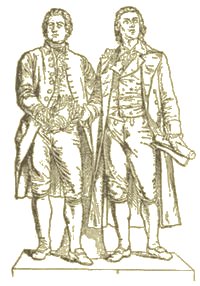
It is a common belief, and a common error, that clever children seldom became illustrious, and though we have instances of youthful dullards who have ripened into fame, they are rare in comparison with those who in early youth have given some indications of future renown. Of these last Germany's favorite bard is one. Born in the little village of Marbach, in the duchy of Würtemberg, on November 10, 1759, he, when a child, evinced proofs of remarkable imaginative and creative power. At as early an age as six he showed that he possessed a fearless nature and an inquiring mind. A terrific storm was raging, and his parents searched for him in vain; the vivid lightning and the crashing thunder increased their anxiety, but they could find no trace of the child. At length, when the storm was over, he was seen to descend from the topmost branches of a great lime-tree near the house. They rushed toward him and inquired why he had selected so dangerous a refuge. "I wanted to see," he replied, with an intrepid air, "where all the fire came from." Even at this period he found his favorite reading in the prophetic books of the Old Testament, and it was probably from Ezekiel that he derived his inspiration for Franz Moor's dream in "The Robbers." His mother taught him to read, and the stories she related to him were listened to with avidity; she was his closest companion and friend, and from her he inherited the gifts which made his name a household word in every home in Germany. He was brought up in a religious and scholarly household. Prayers twice a day, regular attendance at church, the study of Greek and Latin already commenced—these were his principal occupations at seven years of age, when other lads were playing about the fields. From his father he also inherited the literary instinct. The elder Schiller, at the time his son was born, was a lieutenant in the service of the dissolute and tyrannical Duke of Würtemberg, and was subsequently appointed governor of the palace of Solitude. He was a struggling man, and often felt the pinch of poverty. Nine books composed his library, among them "Erkenntniss Sein Selbst" and a Würtemberg "Hymnal." During the performance of his duties in Solitude he wrote a treatise on the cultivation of trees, which was very favorably received. Young Schiller's poetic instinct displayed itself on his tenth New-Year, when he greeted his father in German verse, to which he attached a translation in Latin. His taste for the stage also found early vent in the construction of a mimic theatre and cardboard characters, with which he used to play till he was fourteen, when the important question of his future education was discussed in family council. His mother wished him to be placed in a private school at Tübingen, and his father was not averse; but the question was decided by the despotic Duke Carl, who insisted that the lad should be educated in the military academy he had established upon his estate, a few miles from Ludwigsburg, and which, two or three years afterward, was transferred to Stuttgart. Thither, therefore, Schiller was sent to study and prepare himself for the battle of life, and it was there he imbibed that contempt for servile obedience to military authority which, in "The Robbers," gave so extraordinary an impetus to revolutionary ideas in his native country, especially in the minds of the young. Slavish discipline was the law in the academy; the scholars wore a military uniform; they were soldiers, and were taught to obey the word of command; the sword and the drum were the symbols of authority; there were stated minutes and hours not only for important duties, but for the smallest observances and pleasures. The drum heralded the pupils to church, summoned them to their meals, announced when they were to begin to play and when to leave off, dismissed them to bed, commanded them to rise.
Schiller writhed under this discipline, which, to those who yielded patiently and uncomplainingly, might have been a death-blow to personal independence. In one of his letters to a young friend he wrote, "Do not imagine that I shall bow to the yoke of this absurd and revolting routine. So long as my spirit can assert its freedom it will not submit to fetters. To the free man the sight of slavery is abhorrent; to calmly survey the chains by which he is bound is not possible. My soul often revolts at the anticipation of punishment in cases where I am satisfied that my actions are reasonable." The masters of the academy had a difficult task to subdue the spirit of such a youth, and it was fortunate for literature that they did not succeed. The poet's wings would not be clipped, and in spite of the restrictions by which he was surrounded, Schiller pursued his imaginative course, and found time to feed upon the poetry he adored. To Klopstock's works he was specially indebted; that poet's "Messiah" and Virgil's "Æneid" may be said to have been the first solid stones in the foundation upon which his fame was to rest. There were, it is true, but slight traces of originality in a poem he wrote at this period, the hero of which was the prophet Moses, and it was due to the religious sentiment by which he was powerfully affected through Klopstock's works, that he chose such a subject. It had been decided that the church was to be his career, but he soon abandoned the idea, and transferred his affections to medicine, which he studied assiduously, without neglecting the groove to which his genius was leading him by slow but sure steps. Gerstenberg's great tragedy, "Ugolino," fell by chance into his hands, and gave him a new impetus; "Goetz von Berlichingen" fascinated him; and then came a revelation from a greater poet than all. Shakespeare, whose works he loved and revered with passionate ardor, and to emulate whom was perhaps the greatest ambition of his life. He was seventeen when he first saw himself in print. He wrote a poem called "Evening," which he sent to Haug's "Swabian Magazine;" it possessed no particular merit, and was chiefly remarkable for its resemblance to the works he had read and admired; but the editor spoke of it in terms of praise, and predicted that its author would become an honor to Germany. He wrote in secret, and was already busy sketching "The Robbers," and writing scenes in that famous drama; he and his young friends used to meet clandestinely and declaim their compositions, concealing their manuscripts when their rooms were searched and inspected by the ushers and masters. He suffered intensely in his friendships, and his letters breathed rather the spirit of a man who had lived to see his fondest idols shattered, than that of a youth who had scarcely reached his spring-time. In his criticisms upon himself he was unsparingly harsh, and long after "The Robbers" had been declared to be a work of the highest genius, he penned the following remarkable condemnation of the play: "An extraordinary mistake of nature doomed me, in my birthplace, to be a poet. An inclination for poetry was an offence against the laws of the institution in which I was educated. For eight years my enthusiasm had to struggle with military discipline; but a passion for poetry is strong and ardent as first love. It only served to inflame what it was designed to extinguish. To escape from things that were a torment to me my soul expatiated in an ideal world; but, unacquainted with the real world, from which I was separated by iron bars—unacquainted with mankind, for the four hundred fellow-creatures around me were but one and the same individual, or rather faithful casts from the same model which plastic nature solemnly disowned—unacquainted with the passions and propensities of independent agents, for here only one arrived at maturity (one that I shall not now mention)—unacquainted with the fair sex, for it is well known that the doors of this institution are not open to females, except before they begin to be interesting and when they have ceased to be so—my pencil could not but miss that middle line between angels and devils, and produce a monster, which fortunately had no existence in the world, and to which I wish immortality merely that it may serve as a specimen of the issue engendered by the unnatural union of subordination and genius. I allude to 'The Robbers.' The whole moral world had accused the author of high treason. He has no other excuse to offer than the climate under which this piece was born. If any of the numberless censures launched against 'The Robbers' be just, it is this, that I had the presumption to delineate men two years before I knew anything about them." He was but twenty-one when The "Robbers" appeared in print and was produced upon the stage, and while he was hailed on all sides as the German Shakespeare, he lived in want and extreme privation.
Duke Carl was deeply incensed by the patriotic and independent sentiments of the poet, and he sent an official mandate to Schiller, ordering him to discontinue all further literary work and composition. To disobey the despotic command and to remain in the Duke's service, would have entailed imprisonment. He resolved upon flight from Solitude, and on the night following that on which "The Robbers" was being enacted for the first time in Hamburg to a crowded and enthusiastic audience, he fled, with a friend, from his fatherland to pursue his eventful and turbulent career. A description of his appearance at this period is extant: "He was cramped into a uniform of the old Prussian cut, that on army surgeons had an even uglier, stiffer look; his little military hat barely covered his crown, behind which hung a long queue, while round his neck was screwed a horse-hair stock several sizes too small. More wondrous, however, was the nether part of him. Owing to the padding of his long, white gaiters, his legs seemed thicker at the calf than at the thigh. Moving stiffly about in these blacking-stained gaiters, with knees rigid and unbent, he reminded one irresistibly of a stork." Freed now by his own bold act from military slavery, Schiller entered Mannheim with joyful hopes. With the manuscript of "Fiesco" under his arm, he called upon the régisseur, Meyer, in whose house he read two acts of the play before a company of actors. His hopes were speedily dashed to the ground; when he finished reading the second act every actor but one had left the room, and Meyer thrust a dagger into the poet's heart by declaring that "Fiesco" was nothing but high-flown rubbish. Having, however, heard but two acts of the play, and probably stirred to compassion by Schiller's mournful countenance, the régisseur requested that the manuscript should be left with him; and the following morning the poet was compensated for the intervening night of misery, by hearing Meyer proclaim that "Fiesco" was a masterpiece, and that the bad effect it had produced was due to the villainous manner in which Schiller had read his verse. Notwithstanding this favorable opinion, which was endorsed by others who read the play, it was with great difficulty that Schiller succeeded in obtaining a publisher for the drama, and then he was in an agony to see the public criticisms upon it. Meanwhile he was working at fever heat on "Marie Stuart" and "Don Carlos." Into this last work he threw all his heart and soul, spurred on, doubtless, by the passion of love, which now for the first time possessed him. The object of his affections was Charlotte von Wolzogen, whom he had met in Stuttgart, and into whose society he was now thrown. He experienced all an ardent lover's joys and tortures. "It is fearful," he wrote, "to live apart from humanity, without some sympathizing soul; yet no less fearful is it to cling to some kindred heart from which, sooner or later, in a world where nothing stands sure, one must wrench oneself, bleeding, away." On January 10, 1784, he was elected a member of the Deutsche Gesellschaft, and on the following day "Fiesco" was produced. Its first representation was but a partial success. It met with more favor on its second performance on the 18th. Its third representation was less favorable, and then it was quietly laid aside. His suit with Charlotte did not prosper, and he relinquished the hope of winning her. He was despondent and in debt. He owed money to Charlotte's mother and to his father; but he struggled on, and in the latter part of the year he issued a prospectus of a new journal, "Thalia," which was to make his fortune—an anticipation which was not realized. The journal was to be published six times a year; philosophy, biography, literary reviews, and dramatic criticisms were to be its leading features; and he threw himself into the task with enthusiasm. The difficulties he encountered were tremendous; these, with his love affairs (for Charlotte von Wolzogen was not the only woman upon whom he set his affections), the labor entailed by "Thalia," and the numberless ideas for fresh romance with which his brain was teeming, would have broken down most men; but though he repined at reverses, he rose continually superior to them. Long before "Don Carlos" was finished he commenced "The Ghostseer," in which he intended to develop an idea which had originally formed the scheme of "Friedrich Imhof." His life was a kind of fever; with his ardent friendships, his susceptible passions, his pecuniary anxieties, and his fertile brain forever at work, he knew no rest. He had removed to Jena, the capital of Saxe-Weimar, and at that time the literary centre of Germany. The Prince Charles Augustus and his famous mother, the Princess Amalia, made him welcome and encouraged him. A gleam of sunshine now shone upon him; and he saw a prospect of domestic happiness. He fell in love with Charlotte von Lengenfeld, and in 1789 they were engaged. On February 22, 1790, the fond couple were married at the little village church of Wenigen-Jena. It was a simple wedding. "We spent the evening in quiet talk over our tea," wrote Lotte, sixteen years after, when she was a widow. It was a happy union, and the honeymoon was short, for Schiller had no time for idleness. This year he wrote his "History of the Thirty Years' War," and had the satisfaction of hearing it highly praised in influential quarters. He had never enjoyed such happiness as now, his only sorrow in the early months of his marriage arising from a brief separation from his wife, who had to go to Rudolstadt for her mother's birthday.
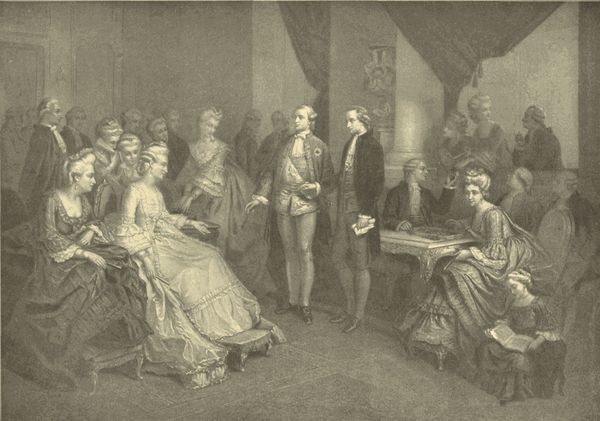
Schiller presented to the Princess of Saxe-weimar.
In one of his letters to her he says, "Your dear picture is ever before me; all seems to speak to me of where the little wife walked, and My Lady Comfort" (Lotte's sister, Caroline) "sat enthroned. And to feel that my hand can always reach what my heart would have near it, to feel that we are inseparable, that is a sense which I unceasingly foster in my bosom, finding it exhaustless and ever new." Recognition of his genius came from all sides, from Goethe, Wieland, Körner; and by the press he was hailed as the Shakespeare of Germany. He needed some such encouragement, for he was attacked by a dangerous illness, which was aggravated by pecuniary troubles; had it not been for his wife's tender care he could scarcely have recovered, and it was well for him and for his country that there came to him at this crisis an offer from the Hereditary Prince and Count von Schimmelmann, of a thousand thalers per annum for three years, in order that he might obtain the rest needed for his restoration to health. "I am freed for a long time," he wrote joyfully to his dear friend Körner, "perhaps forever, from all care." To the generous donor he said, "I have to pay my debt, not to you, but to mankind. That is the common altar where you lay down your gifts and I my gratitude." The method he adopted to recruit his health was to begin to work again. The French National Assembly conferred upon several celebrated foreigners the right of citizenship, and at this distance of time it is strange to read the name of the German Schiller among them. Though seldom free from suffering, which was frequently so acute that he spoke of it as torture, it was a proof of his indomitable spirit that during his last decade he achieved his most memorable triumphs; and yet, in the height of his powers, his youthful dread returned to him, and he expressed a doubt whether he had not mistaken his vocation. The encouragement of Goethe went far to sustain him; between these two great poets existed a warm friendship, and Goethe showed his confidence in Schiller by asking him to correct "Egmont" for the stage. But still he desponded, and it was not till he read Goethe's "Wilhelm Meister" that the full force of poetic fervor awoke within him. "Wallenstein" had been laid aside; he took it up again with glowing feelings; he wrote "The Glove" and "The Ring of Polycrates;" he revised "The Ghostseer" for a new edition, and later on he had the joy of witnessing a masterly performance of the part of Wallenstein by the fine actor, Graff. Following his great dramatic trilogy, "The Camp of Wallenstein," "The Piccolomini," and "The Death of Wallenstein" (the English rights in which he sold to Bell, the publisher, for £60). Schiller now devoted himself to "Mary Stuart" and "Macbeth," and still farther undermined his health by regularly burning the midnight oil. On May 14, 1790, "Macbeth" was performed, and received with tumultuous applause; three days before this performance he had read to the players the first four acts of "Mary Stuart," and when the last and fifth act was written he said to Körner, "I am only now beginning to understand my trade." Following "Mary Stuart," he wrote "The Maid of Orleans," and then he was absorbed in what is perhaps the greatest of his works, "William Tell," the first reading of which took place in Goethe's house on March 6, 1804. On the 9th it was rehearsed at the theatre, and on the very next day he commenced a new drama, "Demetrius, or, The Bloody Bridal of Moscow," thus following out, as indeed he had done throughout the whole of his career, his axiom that life without industry was valueless. "William Tell" was a triumphant success, and may be said to have been the last leaf in his laurel wreath, for he was destined not to live long after this great triumph. On May 9, 1805, he died, at the early age of forty-six, and all Germany mourned the loss. "Dear good one!" he said to his devoted wife, fondling her hand and kissing it the day before his death. It is recorded that in his last hours he spoke of hearing in his dreams the pealing of a bell. It may be that his own beautiful poem, "The Song of the Bell," was in his mind, and that, with the conviction that death was nigh, the fancy was inspired by the lines in his poem:
"And as the strains die on the ear That it peals forth with tuneful might, So let it teach that nought lasts here, That all things earthly take their flight."[Back to Contents]
GOETHE[10] By Rev. Edward Everett Hale (1749-1832)
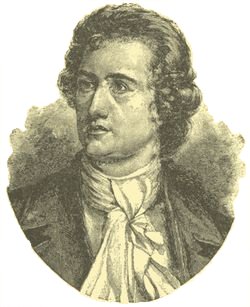
Johann Wolfgang Goethe was born on August 28, 1749, at Frankfort-on-the-Main, one of the free cities of Germany. He died in Weimar, in Saxony, at the age of eighty-two, on March 22, 1832.
In any classification of the men of his time it is impossible to rank him, especially, among men of letters generally, or as a poet, or as a naturalist. He is especially what our time is fond of calling "an all-round man." But he differs from most men who are thus praised, because he is the acknowledged leader of the thought of the first half of the century. He does equally well all that he does. If in the year 1850 anyone had asked who was the first poet of the preceding half century, Goethe would have been named by almost all who answered. If you had asked who was the first man of letters, he would have been named by all. It was certain that his philosophy of human life affected the thought of the students and scholarly people of Europe and America more than that of any other author of his time. Indeed, to this hour, many an humble listener or reader receives suggestions, from the pulpit or the newspaper, of which he does not know the origin, but which are in truth born from some suggestion of Goethe.
It is natural to attempt to account for so remarkable a man, in a measure at least, by tracing back his genealogy. Goethe himself gave some attention to the study of his ancestry, and his biographers have worked at it faithfully. But their work gives no confirmation to the doctrines of heredity which are so well supported in other lives. His father, Johann Caspar Goethe, was a respectable member of the city government of Frankfort, with the title of imperial councillor. He had a craving for knowledge, a delight in communicating it, a love of order, and a certain stoicism, which appear in his son. But there is no ray of genius apparent in him. His father was a respectable tailor in the city of Frankfort, named Frederick. Frederick's father was a farrier or blacksmith in Thuringia, named Hans Christian Goethe. In neither of these ancestors is found any germ of the poet's genius.
On the other hand, the successful life of Wolfgang von Goethe is one more instance, in a large number afforded in the history of the last two centuries, which show that a good education under prosperous circumstances, with the appliances which tend to health of body, mind, and soul, is a very fortunate help to native genius, when native genius finds itself in such surroundings. In the imperial councillor's house his son had every comfort. He was surrounded by pictures books, medals, and other works of art. His reasonable wishes could all be gratified. And he knew none of the hardships which, if they are sometimes the stimulus of genius, more often make its penance.
To his mother he seems to have owed more of the qualities which have made him distinguished. He says himself that his love of story-telling came from her, and his happy disposition. She taught him how he could find the good which is in everyone, and her own habit was to leave people's vices to the God who made them. Much more than this, Goethe had at home the blessing, which cannot be overestimated, of the presence of a sister who shared in his tastes, who joined in his studies, and whom he loved with a passionate affection. He could pour out his enthusiasms to her; she poured out hers to him. So that both of them were blessed through their childhood in that greatest of blessings, a happy home.