Chapter VI
Reading edition
Ellison had been in D—— three months, and was about leaving for Cincinnati, when his lawyer called on him, and stated that he was authorized by the opposing counsel to say, that the plaintiffs in the case were willing to withdraw their suit if one hundred acres of the land in question were relinquished.
“At the same time,” remarked the lawyer, in giving this information, “it is but right for me to state my belief that the offer comes as the result of a conviction that the claim urged for the ownership of the property has no chance of a favorable termination.”
“Yet the suit may be continued for two or three years,” said Ellison.
“Yes, and they can put you to a great deal of trouble and expense.”
“And there is at least a doubt resting on the issue.”
“There is upon all legal issues.”
“Then I think we had better accept the compromise.”
“You must decide that for yourself,” said the lawyer.
“How long will the question be open?”
“For some days, I presume.”
“Very well. I will see you about it to-morrow, or at latest on the day after.”
Clara, on being informed of the new aspect the case had assumed, fully agreed with her husband that the offer of a settlement had better be met affirmatively; and this being done, the suit was withdrawn, and they were left in the peaceable possession of some four hundred acres of excellent land. The costs were nearly two hundred dollars. This made it necessary to part with more of their stock, which was effected through their agent at the East. Five more shares were sold.
The termination of this suit wrought an entire change in the views and purposes of Ellison. A residence in the West of three months had brought him in contact with people of various characters and pursuits, all eagerly bent on money-making. Towns were springing up as if by magic, and men not worth a dollar to-day were counting their thousands to-morrow. The spirit of enterprise was all around him; and it was hardly possible for him to remain unaffected by what was in the very atmosphere that he was breathing.
“Let me congratulate you on the happy termination of your suit,” said an individual with whom Ellison had some acquaintance, a day or two after all was settled. “You have now as handsome a tract of land as there is in the state; and if you manage it aright, will make out of it an independent fortune.”
This language sounded very pleasant in the ears of Ellison.
“You know the tract?” said he.
“Oh yes! Like a book. I’ve traveled over every foot of it. There is a hundred thousand dollars worth of timber on it.”
“Not so much as that.”
“There is, every dollar of it. Not as fire-wood, of course.”
“In lumber, you mean.”
“Exactly.”
The man’s name was Claxton. He had come to D——, about a year previously, with some six thousand dollars in cash, and as full of enterprize and money-loving ambition as a man could well be. The town was growing fast, and the supply of lumber, which a saw-mill of very limited capacity was turning out, so poorly met the demand, that prices ranged exceedingly high. A large landholder, whose interests were seriously affected by this high rate of lumber, made Claxton believe that he had only to erect a steam saw-mill, capable of turning out, per day, a certain number of feet of boards and scantling, and his fortune was made. Without stopping to investigate the matter beyond a certain point, and taking nearly all the statements made by the individual we have named for granted, Claxton ordered a steam-engine from Pittsburg, rented a lot of ground on the bank of the river, and forthwith commenced the erection of his mill. As soon as the citizens of D—— understood what he was about, there were enough of them to pronounce his scheme a foolish one, in which he would inevitably lose his money. But he had made all the calculations—had anticipated, like a wise man, all the difficulties; and knew, or thought he knew, exactly what he was about. It was nearly a year before he had his mill ready. By this time he was not only out of funds, but out of confidence in his scheme for making a fortune. In attempting to put his mill in operation, some of the machinery gave way, and the same result happened at the next trial. Thus expense was added to expense, and delay to delay. In the mean time, the owner of the other mill had been spurred on by the approaching competition, to increase its capacity, and was turning out lumber so fast as to cause a reduction in the price.
So soon as Claxton became aware of the fact that Ellison’s suit had come to a favorable termination, he conceived the idea of getting off upon the young artist his bad bargain with as little loss to himself as possible, and he had this purpose in his mind when he congratulated him so warmly on his release from the perplexity and uncertainty of the law.
“Trees standing in the forest, and lumber piled up ready for use in building,” said Ellison, in reply to Claxton’s suggestion, “are very different things.”
“Any man knows that. But, in the conversion of the trees into lumber, lies the means of wealth. There is not an acre of your land that will not yield sufficient lumber to bring three hundred dollars in the market.”
“Are you certain of that?” inquired Ellison.
“I know it. The tract is very heavily timbered.”
“Three hundred dollars to the acre,” said Ellison, musing; “four hundred acres—three times four are twelve. That would make the lumber on the whole four hundred acres worth over a hundred thousand dollars!”
“I know it would. And you may rest assured that the estimate is not high. I only wish I had your chances for a splendid fortune.”
“How is this lumber to be made available?” asked Ellison.
“Cut and manufacture it yourself. You’ll find that a vast deal more profitable than painting pictures. You can see that this is one of the best situated towns in the West. The supply of lumber has always been inadequate for building purposes, and, in consequence, its prosperity has been retarded. Reduce the price by a full supply, and houses will go up as by magic, and the value of property rise in all directions. At present, you could not get over fifteen dollars an acre for your land if you were to throw it into market. But go to work and clear it gradually, sawing up the timber into building materials, and, in ten years, such will be the prosperity of the place, growing out of the very fact of a full supply of cheap lumber, that every acre will command fifty dollars.”
The mind of the young man caught eagerly at this suggestion. He held long interviews with Claxton, who made estimates of various kinds for him, and gave him mathematics for every thing. They rode out to the land together, and there it was demonstrated, to a certainty, that at least seven hundred dollars worth of timber, instead of three hundred, could be obtained from every acre. Ellison saw himself worth his hundred thousand dollars, and as happy as such a realization of his hopes could make him. He went with Claxton to his mill, where the operation of every thing was fully explained to his most perfect satisfaction. Even in this enterprise a fortune was to be made, notwithstanding Claxton had no land of his own heavily timbered, and would have to pay at least two dollars for every log brought to his mill, which stood on the river bank. This site had been chosen because of the facilities it afforded for getting the raw material which could be floated down from above.
Of all this the young man talked constantly to his wife, and with a degree of confidence and enthusiasm that half won her cooler and less sanguine mind over to his views. She did not, however, like Claxton. Her woman’s true instinct perceived the quality of his mind; and she therefore had little confidence in him. In suggesting this, her husband’s reply was,
“I don’t take any thing on his recommendation. I look at facts and figures, and they cannot lie.”
There was something unanswerable in this; yet it did not satisfy the mind of Clara.
When Ellison talked to others of what was in his mind, some listened to what he said in silence; some shrugged their shoulders, and some said it wouldn’t do. He had been forewarned of this skepticism by Claxton, and was therefore prepared for it. He well understood that the people lacked true, far-seeing enterprise; were, in fact, half asleep! All objections, therefore, that were urged, rebounded from his mind without producing any rational impression.
He had already picked out a spot for the location of his mill, and was obtaining estimates for its construction, when Claxton called on him one day, with a letter in his hand, which he said he had just received from Cincinnati. It was from a brother who was engaged in the river trading business, and who owned three large steamboats. He had already made a fortune. But ill health had come upon him, and he found it necessary to retire in part from the active duties which had absorbed his attention for years. To his brother he offered most tempting inducements to give up his saw-mill scheme, unite with him, and take the active control of every thing. “If,” said the letter, “you have any difficulty in finding a person in your stupid place with enterprise enough to take your mill off of your hands, I know a man here who will relieve you; but he will want time on nearly the whole amount of the purchase. He is perfectly safe, however, possessing a large amount of property.”
Of course, Mr. Claxton, having taken a particular fancy to Ellison, and being anxious to put him fairly in the road to fortune, offered him the mill at cost; and Ellison, without asking the advice of any one—being fully impressed with the belief that he knew his own business, and had sense enough to understand a plain proposition when presented, immediately closed with the offer. The price asked was exactly cost, and to determine what this was, the bills for every thing were exhibited and taken as the basis of valuation. According to these the mill had cost six thousand dollars. And for this sum, Claxton generously consented to sell the entire concern, with all prospective benefits, to his young friend. The amount of cash to be paid down was three thousand dollars, and for the balance, notes of six, nine, and twelve months were to be given, secured by mortgage on the four hundred acres of land.
When matters assumed this aspect, Clara, who, strangely enough to the mind of Alfred, appeared to like Claxton less and less every day, suggested many doubts, and proposed that the matter should be submitted to three old residents of the place, and their advice taken as conclusive. But Alfred objected to this. They were plodders, he said, in an old beaten track, where, like horses in a mill, they had gone round and round until they were blind. They would, of course, suggest a thousand doubts and difficulties, all of which he had already solved. There was no aspect of the case in which he had not viewed it, and he understood all the bearings better than any one else.
“He is a poor sort of a man who cannot lay his course in life, and steer safely by force of his own intelligence,” said the young man, proudly.
Clara, however, was not satisfied; but having had some experience in regard to her husband’s sensitiveness when any question touching their property came up, she was afraid to say a great deal in opposition to a purpose that was so fully formed as to admit of no check without painful disturbance. So she permitted him to take his own way, neither approving nor objecting.
Alfred understood, however, from his wife’s manner, that she had little confidence in the new business upon which he was about entering.
“Happily, I will disappoint her fears,” was his consoling and strengthening reflection. “When her little property has swelled in value to fifty or sixty thousand dollars, how different will be her feelings! She will then understand the character of her husband better—will know that he is no common man.”
With a presentiment of coming trouble, Clara saw their stock sold, and three thousand dollars paid over to Claxton; but she appeared to acquiesce in the transaction so entirely, that Alfred was deceived as to her real feelings.
[To be continued.
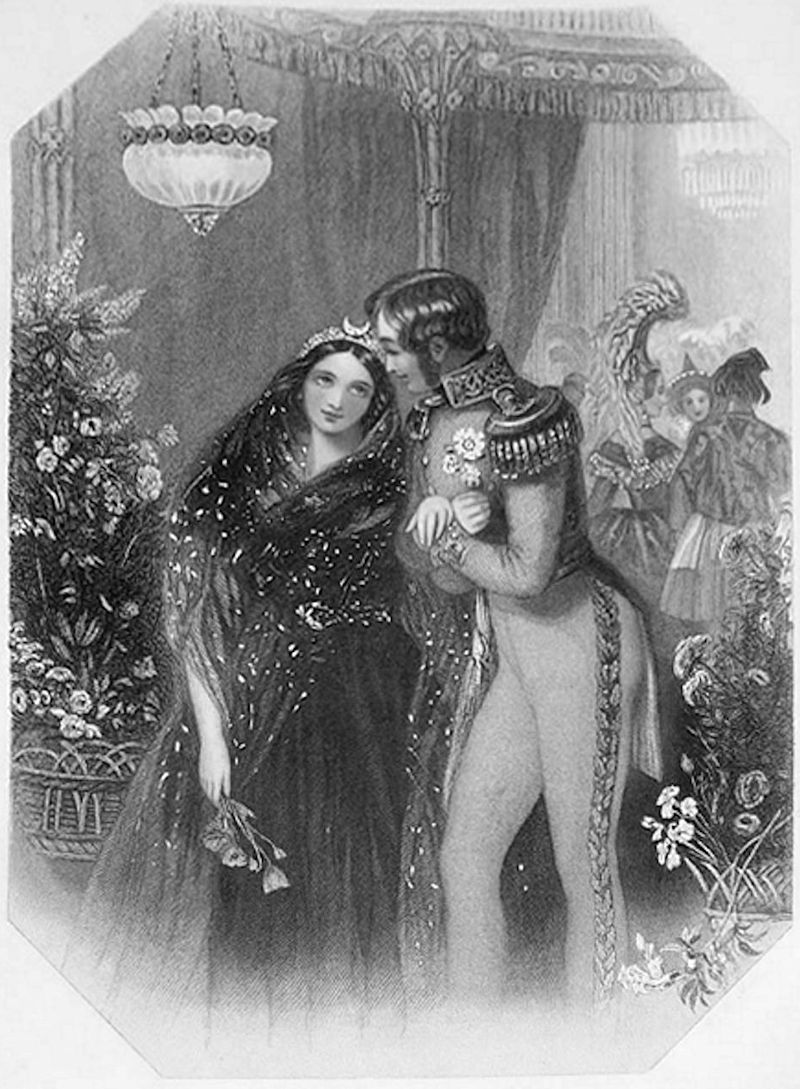
THE PRIZE SECURED. Engraved expressly for Graham’s Magazine