BALLADS OF THE CAMPAIGN IN MEXICO.
Reading edition
———
BY HENRY KIRBY BENNER, U. S. A.
———
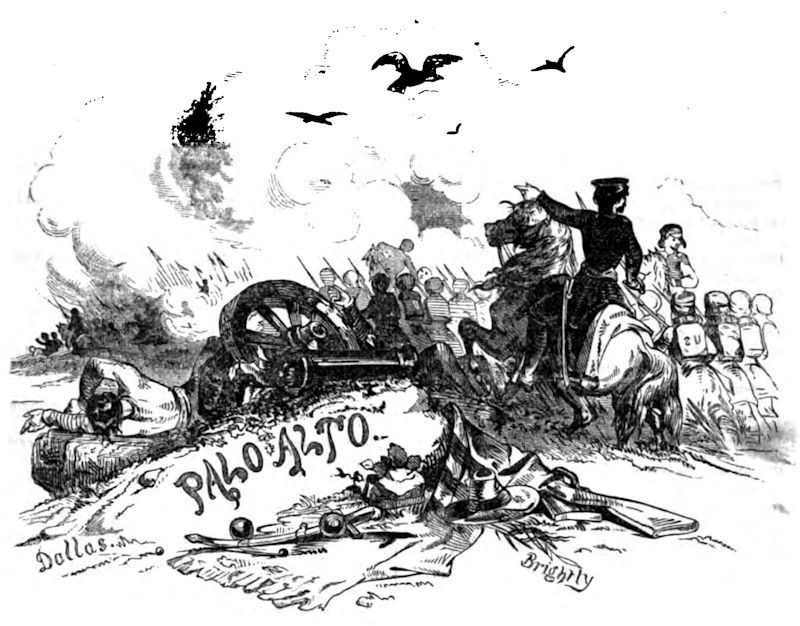
PALO ALTO.
The army lay in quiet rest: for many a weary league
Had we marched in battle order, combating with fatigue;
But when Point Isabel arose between us and the sun,
And the evening gun exploded, we felt our toil was done,
And we laid us down in silence, and we slept without alarm,
Each soldier resting on the ground, with his head across his arm.
But when the gray of morning made twilight in the east,
Like shadows, from the prairie arose both man and beast;
And the soldiers stretched their arms, and the steeds with neigh and stamp,
With the rattling rolling reveillé put motion in the camp;
And the sunrise-gun boomed loudly, when, as its sound declined,
A dull, funereal response rolled heavily down the wind.
The soldiers paused and listened, each with questions in his eyes,
As round and red the tropic sun walked, Mars-like, up the skies; —
It was no echo; never yet made echo sound like that,
For echo lives in the mountain glen, and not on the prairie flat:
We clasped our muskets closer as we hurried to parade,
Our beating hearts replying to the distant cannonade.
Not a word had yet been spoken, though, still, the cumbrous sound
Came rolling, like a tumbril, over the damp and dewy ground;
But beetling brows and heaving breasts and half-suspended sighs
Spoke the anger of the passionate hearts whose lightning lit our eyes;
Then a murmur rose along our ranks no discipline could drown,
And the burthen of the chorus was the syllables—“Fort Brown!”
Just then our gallant general, on his favorite white horse,
Rode slowly and serenely, like a father, through his force;
But as the ranks “presented arms,” another murmur ran —
“God bless old Rough and Ready,” loud and deep, from man to man.
The brave old heart looked gratified, but his eyes sunk slowly down,
For he thought of his companions who were battling at Fort Brown.
But scarcely had they fallen, when the air became so still
We heard the campanero[2] cry a league off, on the hill.
The old man’s gray eyes glistened, and his horse reversed his ears,
And stamped his hoofs, and neighed aloud, as laughing at our fears:
We stood like statues, listening, when Taylor made a sign,
And Walker left his Rangers, riding quickly down the line.
That night the Texan hero was missed by all our men;
But we smiled, for well we knew that he soon would come again,
For a braver, or a better, or a more chivalrous knight
Never put his lance in rest in the days when might was right;
And he had the fox’s cunning, and the eagle’s restless eye,
With his courage, to see danger, and that danger to defy.
Two days passed by, and hour by hour the army moved, with gloom
On heart and soul, as though each man stood gazing on his tomb;
But all at once a sudden cry!—our hearts sprung, like a steed
Who sees the flash and hears the gun, then headlong ploughs the mead —
Then Walker’s name—another shout!—and each one, with content
In breast and brain, accoutred, rushed delighted from his tent.
We all knew what was coming, when at the reveillé,
We saw the Texan head his men, and heard the laugh of May,
For all had learned the news, and knew, that ere two suns went down
Our army would be rolling, like a tempest, on Fort Brown;
And that the foe in thousands were gathering in our way —
Human panthers, couched in silence, expectant of their prey.
At last we heard the order, and along the grassy plain
Our army, like a sparkling snake, uncoiled its glittering train,
And silently, but earnestly, we marched from dawn till night,
And then laid down in silence till the breaking of the light:
No fires disturbed the darkness, no sound betrayed our camp,
Save, at intervals the countersign, with the sentinel’s measured tramp.
Next morning we pursued our march: it was a sultry day;
The sunlight flickered like a flame along our sandy way;
But no one lingered, for we knew our foemen were before,
And, like blood-hounds howling on the scent, we trailed the distant gore;
For we thought of our associates, and the thought had power to drown
All human feelings, for we heard the cannon at Fort Brown.
For twelve miles unmolested had we marched, when brazen noon
Beheld the enemy deploy along the green lagoon:
Our hearts beat high, for we were few, and scarcely one before
Had fleshed his sword in battle, or had heard the cannon’s roar;
But Lexington and Concord and Bunker-Hill beheld
Just such recruits victorious in the iron days of old.
And now the word was passed—to halt, and each, in turn, was seen
To stoop beside the limpid lake and fill his hot canteen;
And then the order came to march; and now our foemen lay
A musket shot before us, a barrier in our way,
When, like a Paladin of old, Blake, brave as brave could be,
Sprung from the lines, and spurred his steed along the grassy lea.
We saw him gallop toward the foe, and our passions thrilled us, when
We viewed him ride along their lines and coolly count their men,
And turn and gallop backward, and grasp our general’s hand,
Then silently resume his place, and head his little band:
We paused, when, rushing, roaring, whirling, whistling, wildly by,
Came the iron rain of Battle, while his thunder shook the sky.
Like a cloud the smoke closed round, and like steeds to frenzy lashed
The black eyes of our batteries their deadly fury flashed:
We were maniacs; we were furies; we were fiends, not mortal men,
And each one fought as if his arm contained the strength of ten;
But the smoke grew denser round us, for, like a funeral pyre,
The prairie blazed before our eyes—a sea of surging fire.
It was a fearful sight, but we fought for life and fame,
And incessantly and dauntlessly we answered flame with flame,
When, breaking from the enemy’s left, a thousand lancers dashed,
A human avalanche, on us; but our batteries fiercely flashed,
And we drove them back like deer; but our brains went round and round,
When Ringold, staggering on his steed, fell, dying, to the ground!
But Ridgely took the hero’s place, and, wheeling to the right,
Plunged with his light artillery in the thickest of the fight;
And Duncan, wheeling to the left, poured in his shot like rain,
While our never-ceasing muskets, like a hurricane swept the plain.
One moment, like a herd of wolves, they stood, then broke and fled,
As our army dashed in swift pursuit o’er the dying and the dead!
But the sun was setting fast, and darkness slowly fell,
Like a pall, above the fallen who had fought so long and well;
And we heard our leader’s summons, and our trumpets, call us back,
To refreshment and repose in our lonely bivouac;
And we laid us down in silence, surrounded by the slain,
And slept the sleep of conquerors on Palo Alto’s plain.