HISTORY OF THE COSTUME OF MEN,
Reading edition
DURING THE EIGHTEENTH AND THE BEGINNING OF THE NINETEENTH CENTURY.
———
BY FAYETTE ROBINSON.
———
(Concluded from page 266.)
When Parisian society had passed the dread ordeal which bears the name of the Reign of Terror, through continual scenes of blood and tears, it seemed by a strange and almost unaccountable impulse to be impelled to mirth and festivity. On the day after the disappearance of the guillotine French frivolity resumed its sway with a thousand whims and vagaries, to which the stern muse of history would pay no attention, but to which, in this sketch of the follies of humanity, we may aptly attend. One of the whimsicalities peculiar to the day is that in memory of the sad toilette of the guillotine, when the hair was cropped by the shears of the executioner, a similar coiffure was the mode. Women laid aside their luxuriant locks for a coiffure à la victime, and wore a band of blood-red velvet around the neck, as if in derision of the fall of the axe. This fashion, emanating in France, where recklessness had been produced by the constant presence of danger, went the round of the world, and the coiffure à la victime was worn by both sexes in quiet neighborhoods, which had learned only by report of the fearful atrocities committed in the capital of civilization. Balls à la victime also became the vogue, and none were at first admitted to them except those who had lost relations on the scaffold. To some of these balls it was requisite not to have lost collaterals only, but a parent, or brother, sister, husband or wife. There were exclusives even there, and a new nobility of the scaffold was created. This was the era of corsets à la justice and bonnets à la humanité.
Away with care! Bring in the violin and minstrels! was the cry. A mania for the dance pervaded all society. High and low, aristocrats and people, antiques and moderns all danced. The chapel of the old Carmelite convent became a ballroom, and the Jesuits’ college a place of festivity, as did also the convents of Saint-Sulpice of the Filles de Saint-Marie. In the guinguettes and in the most elegant society all danced. “If the traces of crime and degradation were seen every where else,” says a writer of that age, “a man of taste had at least the consolation to find in these brilliant assemblages society not unlike that which made Paris once the wonder of the world. The winter-balls are the asylum of good taste, elegance and propriety. In them a young man may purify himself by the spectacle of triumphant Virtue.” Yet the only requisite to admission to these balls was a subscription of 96 francs, (about $19.20.) A cotemporary thus describes one of the most celebrated of these reunions, that at the Hotel Richelieu, in a manner to make us skeptical about the virtue. “It is,” says he, “an arch of transparent robes of lace, head-dresses of gold and diamonds. A subscription is required, and the visiter is ushered into the society of perfumed goddesses, crowned with flowers, who float about in Athenian robes, and receive the lisping flattery of the incroyables, who prate of their parole d’honneur.” It need not be said this is a mere phase of Parisian society, fortunately not reflected by the rest of the world.
The ball of the Opera was revived, and to it we must look for the most striking specimens of costume. The plain black domino exclusively worn at such places during the monarchy had disappeared, and was replaced by a similar garment of the most striking colors. Turks, Chinese and the old traditional characters were exiled to the places of popular amusement, and the great room of the Opera was filled with Caius Marius, Dentatus, Cicero, Mutius Scævola, Pericles, Lycurgus, Cymon and Herodotus. The charm, however, was gone; the new society had no traditions; the people composing it were almost ignorant of each other, and the playful badinage of which the old balls had been the scene was lost forever. The Jeunesse Dorée, as the courtiers of the Directory and Consulate were called, frequented these balls most faithfully, but the old prestige was destroyed, and families were not seen as they had been in the days of old.
It is strange with what rapidity from the epoch of the Directory a taste for luxury and pleasure sprung up in the minds of the people. Music again resumed its sway, and a hundred places of public amusement were opened. One of the most significant evidences that the late or present French Revolution is not yet over, is the fact that as yet public amusements do not thrive, and that the people look elsewhere for excitement than to the stage and concert. The most curious of all spectacles is the stormy deliberation of the Assembly, and the artistes of the Executive power the most attractive of all performers.
Gradually a disposition to make a figure inoculated society. As the Revolution became distant luxury increased. Yet it was not the faste of old monarchy, but a new splendor, which the persons left on the surface of society by the bouleversement of all orders threw around them. The women in the lowness of the bosoms of their dresses descended below even the modesty required by the Regency, and the incroyables became more fantastic than the marquis. The following was the costume they adopted, and a more tasteless one can scarcely be conceived:
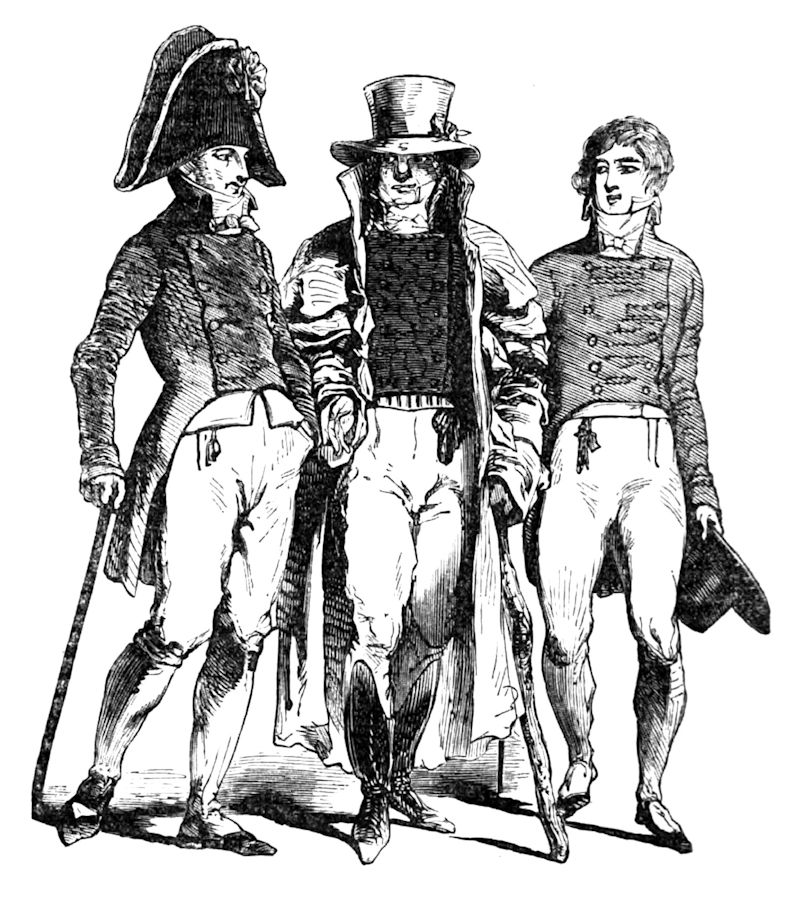
They were not so richly dressed as their predecessors, nor were they so elegant and graceful, but their manners were quite as affected. Then came again the taste for gallant acrostics and love songs, which caused the poetry of the Cheniers to be forgotten for fantasies addressed to the popular actresses. This prodigality was the more criminal because it had a contrast in alarming want. The Revolution did not make France more rich, nor did the hecatombs slain in defence of the liberty of the country make the cornfields and vineyards more fruitful. French prodigality was imitated everywhere, and to this recklessness may we attribute the fact of the great increase of the expense of dress in every grade of society over all the civilized world.
The mode of wearing the hair for men had long become fixed; it was cropped and au naturel, and has thus remained to our own day. The male costume became every day more and more inelegant. Frocks were worn short, loose and broad; pantaloons loose as a sailor’s lasted to a late day of the empire. This costume had but one merit, simplicity, a quality inspection of the following engraving will show it to have possessed in a great degree.
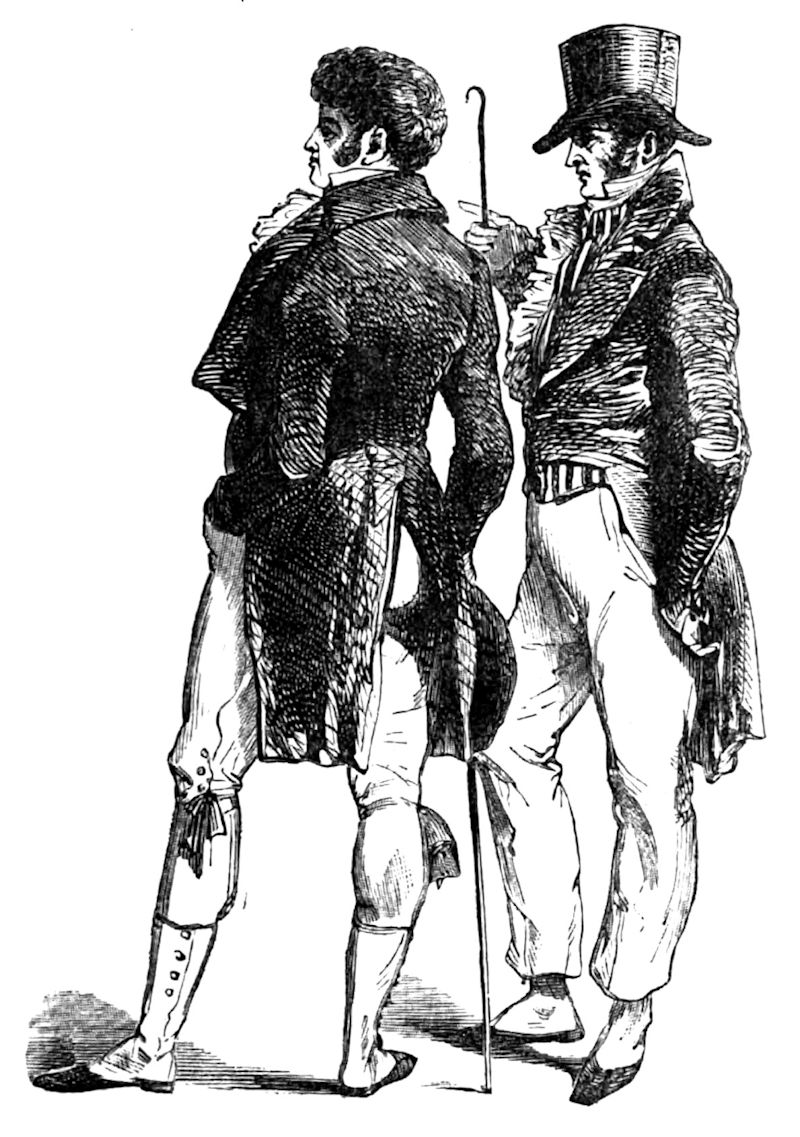
All embroidery was abandoned. In 1803 the coat had taken its definite form, where there is every prospect that it will remain permanent. It had an immense collar and was very short before, but it was yet a coat. Pantaloons were by no means what they are now, yet still the garment is unchanged. The hat had become round, and the cravat was stationary.
This brings us to the end of our subject. From the doublet of Louis XIV. costume has been traced to our time, and an impartial observer will be satisfied we have lost nothing by the change; for none who compare the garments of the schneiders of our own era with those of the Latours or Justins of old, will think good taste has retrograded, or dream of comparing the bucket-like things which once were worn on the head, with the tasteful and artistic hats of Oakford. Thus ends this disquisition on dress, which, believe me, is no trifle; and the evidence of it is, that nothing more ridiculous can be conceived, than would be a President, a Senate, or a Supreme Court in puris naturalibus.