GOING AROUND THE HORN.
Reading edition
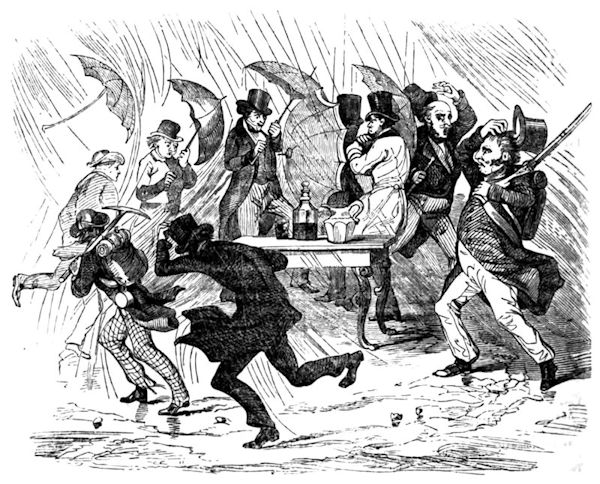
THE DIRECT ROAD TO FORTUNE.
The search after the philosopher’s stone, after having vexed the crucibles, and puzzled the brains of alchemists for ages, is about to be rewarded with success. The New Eldorado promises wonders as great, and riches as abundant, as the most vigilant of dreamers could imagine. The phrase “untold gold” is meaningless now, for nothing but gold is talked of, and the wealth, which was significant of immensity, when coupled with “iron chests,” and “bank vaults,” is sicklied over, and feeble, when contrasted with the fields of gold which glitter over thousands of square miles. The very idea of “10,000 a year” has become paltry—it is but the cost of a dish of bean-soup in California—suggestive of utter poverty—the daily scrapings of the poorest and most indigent digger, self-sold into slavery at the mines. The man who owns a square of brick houses is nobody; an empty braggart, beside him who sits upon golden rocks, with a cigar in his mouth, overlooking acres of the shining metal. The very millionaire who used to strut about consequentially, with his hands thrust into his pockets significantly, may be hooted now by the veriest sweep in California, as a vulgar ragamuffin, who would scarce have money enough to pay his board there on Saturday night, and would be utterly at the mercy of his landlady.
Girard College, as a building, is very well, too, in its way, as reminding us of an old gentleman who spent half a century in picking up gold flakes, one at a time, with his fingers; a plodding, careful old chap, who lacked the creative faculty altogether, and had no idea of cradles and basins. His school-house on the Ridge Road will do very well as a specimen of primitive architecture, and might answer very well as a sort of outhouse to the palaces that we will have in California—a very good stable for the Master of Hounds to Col. Mason, or some other grandee—but as it stands, it is now a shocking evidence of parsimony, utterly disgraceful to the spirit of the age. A sort of lame and impotent conclusion to a long life foolishly spent.
The far-famed Genoese must have been a dull fellow, or he would have cast anchor in the Pacific, near San Francisco, instead of sailing about to no purpose. It is a wonder, too, how he could have been so stupid, when there are so many routes to this desirable haven. He certainly must have been a bad navigator, too, or he would have got around the Horn, some how, at some time. But it was reserved for the adventurous sons of Jonathan to make the successful voyage, and with the sword to cut the way to fortune; and instead of diverging like radii from a common centre, to take the outermost limit, and to claim as his own all that he walked around and into. Showing conclusively that instead of bothering one’s brain about getting on the right side of a question, the safest plan is to get around it, and capture it by force of arms, as the Irish policeman did with the mob. It saves a vast deal of hair-splitting, in argument, and of irrelevant discussion, first to knock down your man, and then pinion him. Or like the Cockney sportsman, who winged the farmer’s goose, to say that you “only came out for the sport, and now that you have hit the bird, you have no objection to buy him.” Jonathan in this case, and in this way, seems to have bagged the one that laid the golden eggs, which we used to read of in the nursery, and a whole army of his sons are now rifling her nest. She must have left behind her a prolific brood if she satisfies the whole of them. The veriest “madness of the moon,” must impart a feeble pulse, compared with the fever which Jonathan’s lucky hit has created in the whole family. Homeopathy is totally at fault in this disease. Nothing but very violent depletion will answer.
The whole body of family physicians, and nurses of the body politic, have their hands full, and the multifarious practice sets at naught the popular idea of perfection, as a necessary consequence. It is gratifying to know, however, that in the absence of consistent and regular treatment, the popular remedy applied in its early stages is conducive to longevity and temperance—those who suffer severely from the fever here, and become exceedingly dry in consequence, are cured effectually by Going around the Horn. Lying water-logged under the Tropics being rather a different thing from “getting up a breeze” at home, and being eminently suggestive of sobriety of thought, and of taking their cue from facts, and not from “Q Brandy” continually. Young gentlemen whose systems were here so relaxed, that nothing but taking a horn two or three times before dinner could impart to them sufficient energy to attend to out-of-door business, go around it, and give it a wide berth in the hot latitudes—shut their ears to all hints about the nervous system, and with a hardihood and self command, acquired within view of sharks and yellow fever, brave danger without stimulus, and fatigue without “having a gale.”
Under the tropics, too, young men, who have at home found no difficulty in getting three sheets in the wind, have rather an aerial difficulty in getting a flowing sail, and with plenty of steam on board, in the absence of propellers, decline all invitation to steam it, “to drive dull care away”—the trouble greatest, for the time, being to get away themselves. The boys who often declared in the hours of midnight that they were the particular individuals who feared no noise, and who would not go home till morning, wish themselves very quietly dozing there, and are perfectly subdued and indolent under the Equator in a three days’ calm, and do not insist upon “three more—and again,” so that they have an opportunity of candid inquiry and sober reflection, which may be serviceable—promotive of a thirst for cold water, and an abhorrence of dark brandy, in a “sunny” clime. We do not see why something cannot be done for Temperance in this way, as well as not. People talk very disparagingly about “whipping the devil round the stump,” but so that the old scoundrel gets soundly thrashed at last, I never could see that the modus operandi is so particularly important.
Now, without pursuing this question, or glancing at the disappointment of the adventurer—the long days of toil in unhealthy waters—the burning heat of the sun—the chilling nights on a dreary soil—the fevers of the mind as well as of the body—the hope deferred—the horror of being mixed with such society—the desolation of all good that he must see around him, mingling with the memory of the calm delights, the peaceful repose, the joys and purity of home—the glad eyes of sister or mother left behind, but now seemingly looking out sadly upon the scene—the longings for that paradise once more, where in boyhood he put up a prayer at the parental knee:—Without speaking of all this, is the reward, reader, worthy of your sacrifice or of mine, of present comforts and present friends. I think not. The road to fortune, to honorable advancement, is open and plainly marked here, and beaten as it is, with the tread of many feet, it offers far greater chances of success than all the sparkling sands of California, mixed as they are with all that is vile and unworthy. In that immense crowd of adventurers, which is pouring in from every clime, virtue and goodness will be but as pearls dropped into the sea—selfishness unmitigated, vice unabashed, and even red-handed murder, will rear aloft their hideous forms, overawing all decency, and setting at naught “all law, all precedent, all right.” The very absence of all female restraint, their tender charities, and gentle generosities and affections, and noble self sacrifices, which knit the bands of society together and render man human, will there cause to be let loose all the savage passions and instincts of our natures, and a vast army of unprincipled men, fierce in the pursuit of wealth, unrelenting in their towering selfishness as the grave, will make California a second Pandemonium. What is all the gold of the earth, in a land of wrong and violence, and that smells of blood heaven-high, with the whole atmosphere below tainted with its appalling odor?
No! let us stay at home, and cultivate habits of industry, economy and temperance. With a vigilant eye and a steady step pursue the path which has been marked out for us to tread through life—never swerving from our duty to the allurements of pleasure—or by the discouragements of defeat—but up and on! fearless, determined, brave; looking all danger manfully in the face; grappling with all difficulties, if not with the strength, with the determination of giants to overcome; never growing faint or weary in well doing—and my life for it, in ten years you will not exchange places with the proudest aristocrat in California, whose heart and brain have been seared in the acquisition of wealth. Above all things, let those of us who stay behind imitate the self command of the adventurers who have gone, and go boldly and resolutely “Around the Horn” here, and depend upon it, we shall find that the true philosopher’s stone—the real Eldorado—the place where we may truly enjoy the horn of Plenty and the cup of Peace, IS AT HOME—AROUND OUR OWN HEARTH-STONE—where the light of kind eyes, and the prayers of warm and true hearts ascend to heaven with our own, for guidance and protection.
G. R. G.
——