THE GAME OF THE MONTH.
Reading edition
———
BY HENRY WILLIAM HERBERT, AUTHOR OF “FRANK FORESTER’S FIELD SPORTS,” “FISH AND FISHING,” ETC.
———
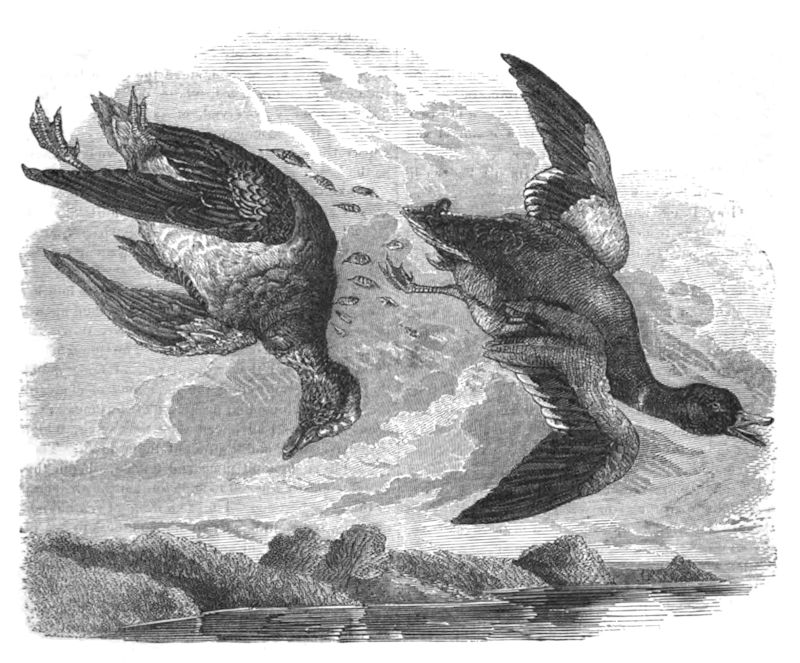
THE MALLARD. Anas Boschas. Green-head, Gray-duck. THE AMERICAN WIDGEON. Anas Americana. Bald-pate.
Both these beautiful ducks, perhaps, with the exception of the lovely Summer Duck, or Wood Duck, Anas Sponsa, the most beautiful of all the tribe, are along the seaboard of the Northern States somewhat rare of occurrence, being for the most part fresh water species, and when driven by stress of weather, and the freezing over of the inland lakes and rivers which they frequent, repairing to the estuaries and land-locked lagoons of the Southern coasts and rivers, as well as to the tepid pools and warm sources of Florida, the Carolinas, Georgia, Alabama and Louisiana, in all of which States they swarm during the summer months.
On many of the inland streams and pools of New York, New Jersey, Pennsylvania and the Far West in general, including all the bays, shallows and tributaries of the Great Lakes, as well as all the lovely smaller lakes of New York, especially where the wild-rice, or wild-oat, zizania aquatica, is plentiful, they are found in very great numbers, especially in the spring and summer time, nor are they unfrequently killed on the snipe-grounds of New Jersey, around Chatham, Pine-brook, and the Parcippany meadows on the beautiful Passaic, and on the yet more extensive grounds on the Seneca and Cayuga outlets, in the vicinity of Montezuma Salina, and the salt regions of New York.
In the shallows of the lake and river St. Clair, above Detroit, on the rivière aux Canards, and the marshes of Chatham in Canada East, all along the shores of Lake Erie on the Canadian side, especially about Long Point, and in the Grand River, they literally swarm; while in all the rivers, and shallow rice-lakes on the northern shores of Lake Huron, which are the breeding-places of their countless tribes, they are found, from the breaking up of the ice to the shutting up of the bays and coves in which they feed, in numbers absolutely numberless.
The Mallard is generally believed to be the parent and progenitor of the domestic duck, which, although far superior in beauty of plumage and grace of form and deportment, it very closely resembles; yet when or where it was domesticated, is a question entirely dark and never to be settled. It is certain that the domestic duck was unknown to the Greeks and Romans, so late as to the Christian era, although the paintings in the Egyptian tombs demonstrate beyond a peradventure that it was familiar to that wonderful people from a very remote period; as it is also known to have been among the Chinese, who rear and cultivate them to a very great extent. Indeed, it is I think in the highest degree probable that the Duck, in its domestic state, is an importation into Europe from the East, where, as I believe in every quarter of the globe, the Mallard is a common and indigenous native of the fresh waters.
The Mallard, or wild drake, commonly known in the Eastern States as the Green-head, westward as the Gray Duck, and in Alabama as the English Duck, weighs from thirty-six to forty ounces, and measures twenty-three inches in length, by thirty-five in breadth.
The bill is of a yellowish-green color, not very flat, about an inch broad, and two and a half long from the corners of the mouth to the tip of the nail; the head and upper half of the neck are of a deep, glossy, changeable green, terminated in the middle of the neck by a white collar, with which it is nearly encircled; the lower parts of the neck, breast and shoulders are of a deep, vinous chestnut; the covering scapular feathers are of a kind of silvery-white, those underneath rufous, and both are prettily crossed with small, waved threads of brown. Wing coverts ash, quills brown, and between these intervenes the speculum, or beauty spot, common in the duck tribe, which crosses the wing in a transverse, oblique direction. It is of a rich, glossy purple, with violet or green reflections, and bordered by a double streak of sooty black and pure white. The belly is of a pale gray, delicately crossed and penciled with numberless narrow, waved, dusky lines, which on the sides and long feathers that cover the thighs are more strongly and distinctly marked. The upper and under tail coverts, lower part of the back and rump, are black, the latter glossed with green; the four middle tail feathers are also black, with purple reflections, and, like those of the domestic duck, are stiffly curled upward. The rest are sharp-pointed, and fade off to the exterior edges from brown to dull white. Iris of the eye bright yellow, feet, legs and webs reddish-orange, claws black.
The female, and young male until after the first moult, is very different in plumage from the adult drake, partaking none of his beauties, with the exception of the spot on the wings. All the other parts are plain brown, marked with black, the centre of every feather being dark and fading to the edges. She makes her nest, lays her eggs—from ten to sixteen in number, of a greenish white—generally in the most sequestered mosses or bogs, far from the haunts of man, and hidden from his sight among reeds and rushes. To her young, helpless, unfledged family, and they are nearly three months before they can fly, she is a fond, attentive and watchful parent, carrying or leading them from one pool to another, as her fears or inclinations direct her, and she is known to use the same wily stratagems, in order to mislead the sportsman and his dog, as those resorted to by the ruffed grouse, the quail and the woodcock, feigning lameness, and fluttering, as if helplessly wounded, along the surface of the water, until she has lured the enemy afar from her skulking and terrified progeny.
The Mallard is rarely or never shot to decoys, or stools as they are termed, since these are but little used except on the coast, where this duck is, as I have previously observed, of rare occurrence, although it is occasionally found in company with the Dusky Duck, anas obscura, better known to gunners as the Black Duck.
“Like the Dusky Duck,” says Mr. Giraud, in his very clever and agreeable manual on the birds of Long Island, “when pursued by the sportsman, it becomes shy and feeds at night, dozing away the day out of gun-shot from the shore.
“Early in the month of July, 1837, while hunting over the meadows for smaller game, I came upon a pair of Mallard Ducks, moving slowly down the celebrated ‘Brick-house creek.’ The thought occurred to me that they were a pair of tame ducks that had become tired of the monotony of domestic life, and determined on pushing their fortunes in the broad bay. As I advanced they took wing, which undeceived me, and I brought them down. They proved to be an adult male and female. From this circumstance I was led to suppose that they had bred in the neighborhood. I made a diligent search, and offered a sufficient bounty to induce others to search with me—but neither nest nor young could be found. Probably when migrating, they were shot at and so badly wounded as to be unable to perform their fatiguing journey, perhaps miles apart, and perchance only found companions in each other a short time before I shot them.”
When the young birds are about three-fourths grown, and not as yet fully fledged or able to fly strongly, at which age they are termed flappers, they afford excellent sport over water-spaniels, when they are abundant in large reed beds along the brink of ponds and rivers. When full grown, moreover, when they frequent parts of the country where the streams are narrow and winding, great sport can be had with them at times, by walking about twenty yards wide of the brink and as many in advance of an attendant, who should follow all the windings of the water and flush the birds, which springing wild of him will so be brought within easy range of the gun.
The Mallard is wonderfully quick-sighted and sharp of hearing, so that it is exceedingly difficult to stalk him from the shore, especially by a person coming down wind upon him, so much so that the acuteness of his senses has given rise to a general idea that he can detect danger to windward by means of his olfactory nerves. This is, however, disproved by the observations of that excellent sportsman and pleasant writer, John Colquhoun of Luss, as recorded in that capital work, “The Moor and the Loch,” who declares decidedly, that although ducks on the feed constantly detect an enemy crawling down upon them from the windward, will constantly, when he is lying in wait, silent and still, and properly concealed, sail down upon him perfectly unsuspicious, even when a strong wind is blowing over him full in their nostrils.
For duck shooting, whether it be practiced in this fashion, by stalking them from the shore while feeding in lakelets or rivers, by following the windings of open and rapid streams in severe weather, or in paddling or pushing on them in gunning-skiffs, as is practiced on the Delaware, a peculiar gun is necessary for the perfection of the sport. To my taste, it should be a double-barrel from 33 to 36 inches in length, at the outside, about 10 gauge, and 10 pounds weight. The strength and weight of the metal should be principally at the breech, which will answer the double purpose of causing it to balance well and of counteracting the call. Such a gun will carry from two to three ounces of No. 4 shot, than which I would never use a larger size for duck, and with that load and an equal measure of very coarse powder—Hawker’s ducking-powder, manufactured by Curtis and Harvey, is the best in the world, and can be procured of Mr. Brough, in Fulton Street, New York—will do its work satisfactorily and cleanly at sixty yards, or with Eley’s green, wire cartridges, which will permit the use of shot one size smaller, at thirty yards farther. The utility of these admirable projectiles can hardly be overrated, next to the copper-cap, of which Starkey’s water-proof, central-fire, is the best form, I regard them as the greatest of modern inventions in the art of gunnery.
Such a gun as I describe can be furnished of first-rate quality by Mr. John Krider of Philadelphia, Mr. John, or Patrick Mullin of New York, or Mr. Henry T. Cooper of the same city, ranging in price, according to finish, from one hundred to one hundred and fifty dollars, of domestic manufacture; and I would strongly recommend sportsmen, requiring such an implement, to apply to one of these excellent and conscientious makers, rather than even to import a London gun, much more than to purchase at a hazard the miserable and dangerous Birmingham trash, manufactured of three-penny skelp or sham drawn-iron, got up in handsome, velvet-lined mahogany cases, and tricked out with varnish and gimcrackery expressly for the American market, such as are offered for sale at every hardware shop in the country.
The selling of such goods ought to be made by law a high misdemeanor, and a fatal accident occurring by their explosion should entail on the head of the sender the penalty of willful murder.
The Mallard is found frequently associating in large plumps with the Pintail, or Sprigtail, another elegant fresh water variety, the Dusky-Duck on fresh waters, the Greenwinged Teal in winter to the southward, and with the Widgeon on the western waters.
On the big and little pieces—two large moist savannas on the Passaic river in New Jersey, formerly famous for their snipe and cock grounds, but now ruined by the ruthless devastations of pot-hunters and poachers—I have shot Mallard, Pintail, and Black Duck, over dead points from setters, out of brakes, in which they were probably preparing to breed, during early snipe-shooting; but nowhere have I ever beheld them in such myriads as in the small rice-lakes on the Severn, the Wye, and the cold water rivers debouching into the northern part of lake Huron, known as the Great Georgian Bay, and on the reed-flats and shallows of Lake St. Clair, in the vicinity of Alganac, and the mouths of the Thames and Chevail Ecarté rivers.
I am satisfied that by using well made decoys, or stools, and two canoes, one concealed among the rice and reeds, and the other paddling to and fro, to put up the teams of wild fowl and keep them constantly on the move, such sport might be had as can be obtained in no other section of this country, perhaps of the world; and that the pleasure would well repay the sportsman for a trip far more difficult and tedious, than the facilities afforded by the Erie Rail-road and the noble steamers on the lakes now render a visit to those glorious sporting-grounds.
The American Widgeon, the bird which is represented as falling headforemost with collapsed wings, shot perfectly dead without a struggle, in the accompanying woodcut, while the Mallard goes off safely, quacking at the top of his voice in strange terror, though nearly allied to the European species, is yet perfectly distinct, and peculiar to this continent.
It is thus accurately described by Mr. Giraud, although but an unfrequent visitor of the Long Island bays and shores:
“Bill short, the color light grayish blue; speculum green, banded with black. Under wing coverts white. Adult male with the coral space, sides of the head, under the eye, upper part of the neck and throat brownish white, spotted with black. A broad band of white, commencing at the base of the upper mandible, passing over the crown.” It is this mark which has procured the bird its general provincial appellation of “Baldpate.” “Behind the eye a broad band of bright green, extending backward on the hind neck about three inches; the feathers on the nape rather long; lower neck and sides of the breast, with a portion of the upper part of the breast reddish brown. Rest of the lower parts white, excepting a patch of black at the base of the tail. Under tail coverts the same color. Flanks brown, barred with dusky; lower part of the hind neck and fore part of the back undulated with brownish and light brownish red, hind part undulated with grayish white; primaries brown; outer webs of the inner secondaries black, margined with white—inner webs grayish brown; secondary coverts white, tipped with black; speculum brilliant green formed by the middle secondaries. Length twenty-one inches, wing ten and a half. Female smaller, plumage duller, without the green markings.”
The Widgeon breeds in the extreme north, beyond the reach of the foot of civilised man, in the boundless mosses and morasses, prodigal of food and shelter, of Labrador, and Boothia Felix, and the fur countries, where it spends the brief but ardent summer in the cares of nidification, and the reproduction of its species.
During the spring and autumn, it is widely distributed throughout the Union, from the fresh lakes of the northwest to the shores of the ocean, but it is most abundant, as well as most delicious where the wild rice, Zizania pannicula effusa, the wild celery, balisneria Americana, and the eel-grass, Zostera marina, grow most luxuriously. On these it fares luxuriously, and becomes exceedingly fat, and most delicate and succulent eating, being almost entirely a vegetable feeder, and as such devoid of any fishy or sedgy flavor.
In the spring and autumn it is not unfrequently shot in considerable numbers, from skiffs, on the mud banks of the Delaware, in company with Blue-winged Teal; and in winter it congregates in vast flocks, together with Scaups, better known as Bluebills, or Broadbills, Redheads, and Canvasbacks, to which last it is a source of constant annoyance, since being a far less expert diver than the Canvasback, it watches that bird until it rises with the highly-prized root, and flies off with the stolen booty in triumph.
The Widgeon, like the Canvasback, can at times be toled, as it is termed, or lured within gunshot of sportsmen, concealed behind artificial screens of reeds, built along the shore, or behind natural coverings, such as brakes of cripple or reed-beds, by the gambols of dogs taught to play and sport backward and forward along the shore, for the purpose of attracting the curious and fascinated wild fowl within easy shooting distance. And strange to say, so powerful is the attraction that the same flock of ducks has been known to be decoyed into gunshot thrice within the space of a single hour, above forty birds being killed at the three discharges. Scaups, or Blackheads, as they are called on the Chesapeake tole, it is said, more readily than any other species, and next to these the Canvasbacks and Redheads; the Baldpates being the most cautious and wary of them all, and rarely suffering themselves to be decoyed, except when in company with the Canvasbacks, along with which they swim shoreward carelessly, though without appearing to notice the dog.
These birds, with their congeners, are also shot from points, as at Carrol’s Island, Abbey Island, Maxwell’s Point, Legoe’s Point, and other places in the same vicinity about the Bush and Gunpowder rivers, while flying over high in air; and so great is the velocity of their flight when going before the wind, and such the allowance that must be made in shooting ahead of them, that the very best of upland marksmen are said to make very sorry work of it, until they become accustomed to the flight of the wild fowl. They are also shot occasionally in vast numbers at holes in the ice which remain open when the rest of the waters are frozen over; and yet again, by means of swivel guns, carrying a pound of shot or over, discharged from the bows of a boat, stealthily paddled into the flocks at dead of night, when sleeping in close columns on the surface of the water. This method is, however, much reprobated by sportsmen, and that very justly, as tending beyond any other method to cause the fowl to desert their feeding-grounds.
In conclusion, we earnestly recommend both these beautiful birds to our sporting readers, both as objects of pleasurable pursuit and subjects of first rate feeds. A visit at this season to Seneca Lake, the Montezuma Meadows, or that region, could not fail to yield rare sport.