MAY MORNING.
Reading edition
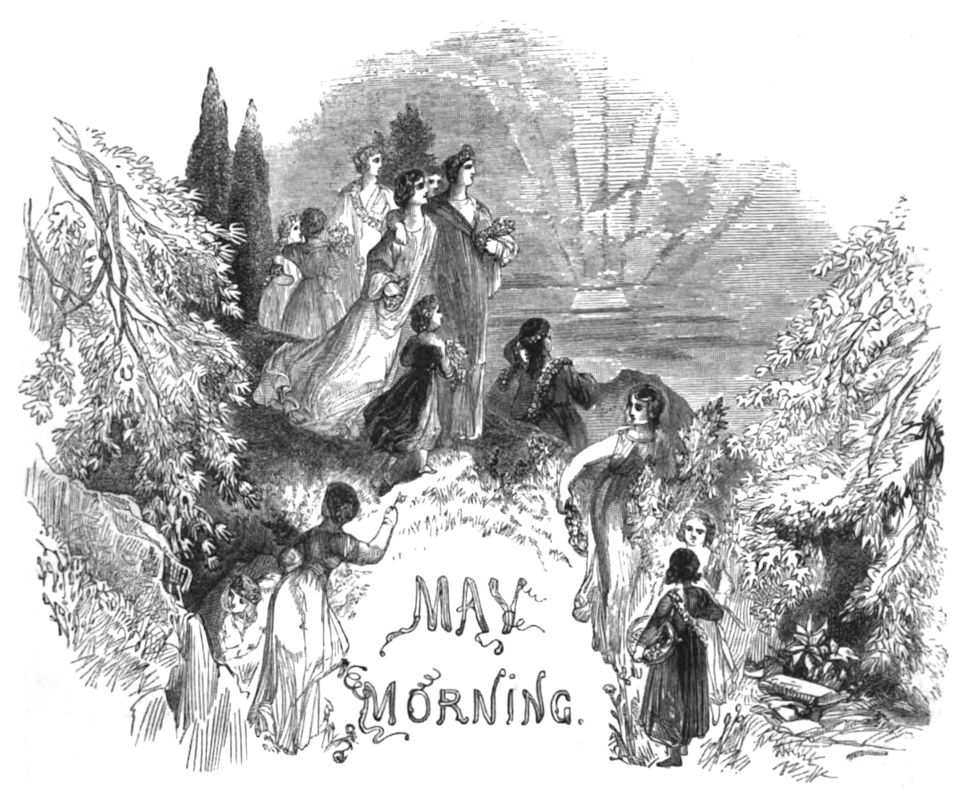
May has ever been the favorite month of the year in poetical description; but the praises so lavishly bestowed upon it took their rise from climates more southern than ours. In such, it really unites all the soft beauties of Spring with the radiance of Summer, and has warmth enough to cheer and invigorate, without overpowering.
May, sweet May, again is come,
May that frees the land from gloom;
Children, children! up and see
All her stores of jollity.
On the laughing hedgerow’s side
She hath spread her treasures wide;
She is in the greenwood shade,
Where the nightingale hath made
Every branch and every tree
Ring with her sweet melody:
Hill and dale are May’s own treasures,
Youths rejoice! in sportive measures
Sing ye! join the chorus gay!
Hail this merry, merry May!
Up, then, children! we will go,
Where the blooming roses grow;
In a joyful company,
We the bursting flowers will see;
Up, your festal dress prepare!
Where gay hearts are meeting, there
May hath pleasures most inviting,
Heart, and sight, and ear, delighting;
Listen to the bird’s sweet song,
Hark! how soft it floats along.
Courtly dames! our pleasures share;
Never saw I May so fair:
Therefore, dancing will we go,
Youths rejoice! the flow’rets blow!
Sing ye! join the chorus gay!
Hail this merry, merry May!
Book of the Months.
We give some further extracts, which poets, at different periods, have sung in praise of the merry month of May:
Happy the age, and harmless were the dayes
(For then true love and amity was found)
When every village did a May-pole raise,
And Whitsun-ales and May-games did abound:
And all the lusty younkers in a rout,
With merry lasses daunced the rod about;
Then friendship to their banquet bid the guests,
And poore men fared the better for their feasts.
Pasquil’s Palinodia, 1634.
From the moist meadow to the withered hill,
Led by the breeze, the vivid verdure runs,
And swells, and deepens, to the cherished eye.
The hawthorn whitens; and the juicy groves
Put forth their buds, unfolding by degrees,
Till the whole leafy forest stands displayed
In full luxuriance.
Thomson.
Each hedge is covered thick with green,
And where the hedger late hath been,
Young tender shoots begin to grow,
From out the mossy stumps below.
But woodmen still on Spring intrude,
And thin the shadow’s solitude,
With sharpened axes felling down,
The oak-trees budding into brown;
Which, as they crash upon the ground,
A crowd of laborers gather round,
These mixing ’mong the shadows dark,
Rip off the crackling, staining bark;
Depriving yearly, when they come,
The green woodpecker of his home;
Who early in the Spring began,
Far from the sight of troubling man,
To bore his round holes in each tree,
In fancy’s sweet security;
Now startled by the woodman’s noise,
He wakes from all his dreamy joys.
Clark.
The sun is up, and ’tis a morn of May
Round old Ravenna’s clear-shown towers and bay—
A morn, the loveliest which the year has seen,
Last of the Spring, yet fresh with all its green;
For a warm eve, and gentle rains at night,
Have left a sparkling welcome for the light;
And there’s a crystal clearness all about;
The leaves are sharp, the distant hills look out,
A balmy briskness comes upon the breeze,
The smoke goes dancing from the cottage trees;
And when you listen you may hear a coil
Of bubbling springs about the grassy soil;
And all the scene, in short—sky, earth and sea,
Breathes like a bright-eyed face that laughs out openly.
Leigh Hunt.
I know where the young May violet grows,
In its lone and lowly nook,
On the mossy bank where the larch tree throws
Its broad dark boughs in solemn repose,
Far over the silent brook.
Bryant.