EMINENT YOUNG MEN.—NO. II.
Reading edition
STEWART ADAIR GODMAN.
———
BY CHARLTON H. WELLS, M. D.
———
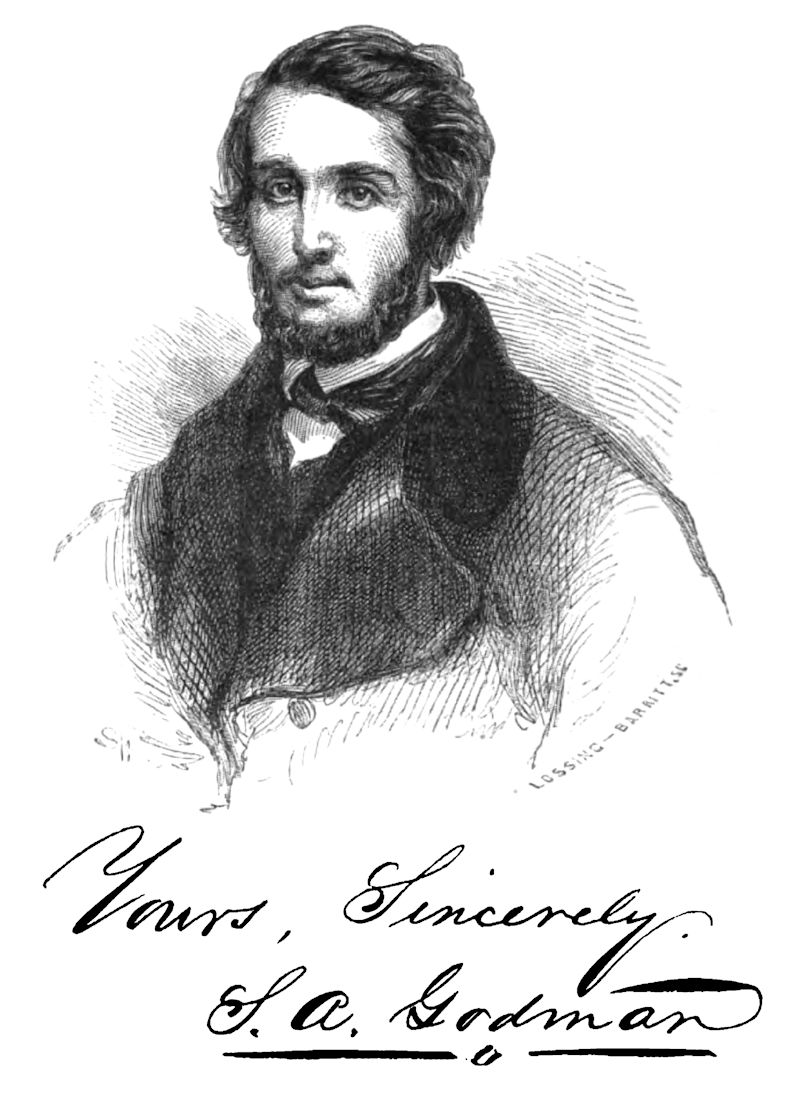
Emphatically is this, the nineteenth century, the age of intellectuality. Never before has mind exercised such direct, positive and appreciable influence as it now does; for never before, in the history of the world, has there existed such an amount of mental cultivation, of general education, of desire for moral improvement, as is now manifested throughout the entire extent of the civilized globe. Spiritual trains, as it were, are ready laid in every direction; and those minds endowed by the Creator with the fire of genius, that electrical energy which will find vent, enkindle those trains, and at once produce excitement, commotion, action, in the myriad magazines of thought to which they lead.
The days of brute force are amongst the things that were; engulfed by the irresistible, ever-advancing ocean of time, they are only remembered among the legends of the barbarous Past. Intellect rules the world—words are recognized as things—men are venerated in proportion to the amount of mind, soul and spirit they possess: in the ratio of the manifestation of their diviner essence—and not for those qualities, merely physical or adventitious, which make them of kin to the brutes that perish.
Nothing, therefore, is more eagerly sought after by the public, than biographical sketches and portraits of those favored children of nature who are recognized as the possessors of this inestimable inheritance—mind; this priceless treasure—genius. Consequently, we feel assured, that the following brief sketch of one of the most powerful and popular writers of the day, of one, who, descended from a line of talented and patriotic ancestors, has inherited their distinguishing characteristics—stern integrity of purpose, indomitable energy, untiring industry and brilliant genius in an eminent degree—and who, though yet in the first flush of manhood, has already achieved a name and earned a reputation, of which even the aged might be proud—will be gladly perused by the readers of Graham.
Captain Samuel Godman, the paternal grandfather of Stewart A. Godman, was born and educated in Virginia; he was the son of a planter who was by marriage the uncle of Thomas Jefferson. He married, soon after he had attained his majority, and removed to the city of Baltimore, Maryland, where he engaged extensively in the shipping and tobacco business; at that time the heaviest and most lucrative traffic of the place. Here he remained several years, and having accumulated quite a handsome fortune, he removed to the city of Annapolis, where he resided until his death, in 1795. At the breaking out of the Revolutionary struggle, Captain Godman, promptly and with characteristic energy espoused the cause of liberty, and with the assistance of his two brothers, at once raised a company of which he was unanimously elected captain, and tendered their services to his suffering country. This company was gladly accepted, and formed a part of the well-known regiment of the “Maryland Line,” which upheld the honor of the struggling colonies and covered itself with so much glory throughout our ever memorable contest for Independence. During the whole war was Captain Godman true to his responsibility, sharing in every battle in which his regiment took part, and making a liberal use of his private means in supplying the necessities of his command. At the memorable battle of the Cowpens, in Spartanburg district, South Carolina, he was severely wounded, by a musket ball, in the leg, which disabled him for awhile; but he soon, even before the wound had healed, resumed his post at the head of his company, and continued with them until peace was declared, the end had been accomplished and his beloved land was free.
John D. Godman, M. D., the father of Stewart, was born at Annapolis in 1796. Before he was two years of age he had the misfortune to lose both of his parents, and was subsequently defrauded by his father’s executor of his inheritance; thus was he thrown, at an early age, entirely upon his own resources. He also, while yet a boy, served his country: being on board the flotilla during the bombardment of Fort McHenry by the British, in the war of 1812. At the close of the war he commenced the study of medicine. As a student, he was diligent, energetic and persevering, and as an evidence of his proficiency and distinguished attainments, he was called to the chair of Anatomy in the University of Maryland (vacated by an accident to the Professor.) and for several weeks before he graduated, filled this situation with so much propriety as to gain universal applause. After his graduation, he entered upon the active duties of his profession with the same energy and diligence which had distinguished him while a pupil. He filled the chair of Anatomy in the Medical College of Ohio, and subsequently, in 1826, was called to the same chair in Rutger’s Medical College in the city of New York. In these situations he acquired a popularity almost unparalleled. But his professional duties, together with his other scientific pursuits, proved too arduous, in that climate, for a constitution already subdued by labor and broken by disease, and he was compelled to seek a more genial clime. From this time his disease steadily progressed, so as to leave no hope for his final recovery, but he still continued to labor in the field of Science and Literature almost to the last week of his life. He died in the thirty-fourth year of his age. The following merited tribute to the memory of Dr. Godman, we take from an address delivered on that occasion before the Medical Faculty and Students of Columbian College.
“There has recently appeared among us a man so remarkable for the character of his mind, and the qualities of his heart—one whose life, though short, was attended with such brilliant displays of genius, with such distinguished success in the study of our profession and the kindred sciences, that to pass him by without tracing the history of his career, and placing before you the prominent traits of his character, as exhibited in the important events of his life, would alike be on act of injustice to the memory of eminent worth, and deprive you of one of the noblest examples of the age.” To specify the numerous and admired productions of Dr. Godman would occupy too much of our limited space, but they have been before the public for a considerable time, and have been received with high approbation, and several have been republished in foreign countries.
The mother of S. A. Godman was the second daughter of Rembrant Peale, Esq., the celebrated artist—who, still living, is the oldest and the best painter of whom America can boast—his splendid allegorical painting of “The Court of Death,” and his admirable likeness of Washington, painted from an original portrait taken by him of the Father of his Country, which hangs over the Vice-President’s seat in the United States’ Senate Chamber—are familiar to thousands of your readers. Mrs. Godman is a remarkable woman—possessing all the amiable traits that most adorn the gentler sex, combined with an amount of energy and decision of mind seldom to be met with—both developed and improved by a thorough course of education in a celebrated seminary abroad.
Dr. Godman left three children, then too young to appreciate the full extent of their loss—one, a daughter, now married to Dr. W. W. Goldsmith, of Kentucky, is a most gifted and lovely lady; the others were boys, the elder of whom is the subject of the present sketch—the other, Harry R. Godman, M. D., is already known to the reading public, and by the purity and depth of feeling, expressed with so much ease and beauty in his writings, is winning for himself, surely and deservedly, a reputation as one of the best of the younger poets of our country.
Stewart A. Godman was born in Cincinnati, Sept. 8th, 1822, a few weeks before his father resigned his professorship in the Medical College of Ohio; and at the early age of six weeks he commenced his wanderings—being carried by his parents to the city of Baltimore.
It appears to be a provision of nature, and it is doubtless a wise one, that, no matter what may be the surrounding circumstances, every man destined to produce an impression upon his fellows, and to leave his “footprints on the sands of time,” must, in his earlier years, encounter a series of changes and difficulties, preparing him, as it were perforce, for the position he is to occupy. The inborn, inherent energy that is in them, produces a restlessness and a desire for something, they know not what, that keeps them ever shifting from purpose and pursuit, until at last they find the field and make the opening in which they are fitted to shine. This want of stability, as it seems, and dislike to plod along contentedly in whatever road circumstances have placed them, subjects them oftentimes to the charge of fickleness, and it is only when they have found their natural sphere—and true genius ever will force a path to its legitimate position—is it admitted by lookers-on that it was the resistless cravings of the governing, controlling spirit eagerly seeking its own, that actuated them—instead of fickleness.
This fate was not escaped by young Godman, for, although still comparatively a young man, he has experienced vicissitudes, changes and trials—mental, physical and pecuniary—greater than most persons have to encounter who live to the allotted age of three score years and ten. Naturally of an energetic and bold disposition, averse to restraint, and deprived at the early age of eight years, by death, of his father—a loss in any case so great, but in his, with such a parent, how irreparable—his life has been checkered by the changing phases that ever accompany the life-struggle of each man who strives to attain an eminent position by paths novel and self-suggested. Blessed in an unusual degree with friends, able, willing, indeed anxious, to assist him, he would have had only to follow either of the many openings and advantages that were freely tendered, to have attained certain wealth and station at an early age. The natural independence of his character, however, combined with his strong innate feeling of self-reliance, caused him to undervalue and neglect the many easy roads to success, that by the influence of his father’s numerous friends and admirers were offered—and to prefer the more hazardous and difficult plan of carving out his own road, of being the architect of his own fortune.
His primary education was most thorough; for quick, keen, inquiring and industrious, and having the very best instructors, he made rapid progress in every branch. At a very early age, when the brilliancy of his mind and the promise he gave of doing credit to his preceptors were already apparent, anxious to mingle in the real bustle and business of life, he determined to leave school. At this time he was at the Baltimore College, then under the charge of that finished scholar and accomplished gentleman, John Prentiss, Esq., and despite the persuasions of his friends and teachers he persisted in his determination. Removing then from Baltimore to Philadelphia, he entered the large establishment of that well-known merchant, David S. Brown, Esq., where he remained for three years, and earned a reputation for business tact and ability such as is seldom awarded a youth of his years. Not finding in the details of commerce that mental satisfaction he sought, and unheeding altogether the unusually advantageous prospects before him, much against the advice of Mr. Brown, he resolved to try the profession of medicine. Returning to Baltimore, to which place he was invited by Dr. R. S. Stewart (after whom he was named) then one of the largest practitioners in the Monumental City, but now retired with an ample fortune—he attended one course of lectures at the University of Maryland. Here he stood first among his classmates—but disgusted with the details of hospital practice, at the end of the first winter he found that medicine was not the path he wished to pursue.
His uncle, Thomas Jefferson Godman, residing in Madison, Indiana, was anxious to have young Godman study law, and at his earnest solicitation he went to Madison, and entered as a student the office of the Hon. Jesse D. Bright, now United States Senator. Law, however, was not more congenial to his spirit than medicine; and after three months hard study, he threw aside Blackstone, Chitty, and their compeers, and applied for admittance into the United States Navy, as a midshipman. Although, at the time of his application, which was made directly to the President, there was a very large number of applicants on record for warrants, young Godman received his at once—“in consideration,” as was written in the letter containing the warrant, “of the distinguished services of his grandfather during the Revolution,” and for which neither pension nor remuneration had ever been asked. Only about eighteen months did Godman remain in the navy; at first the glitter, pomp, and excitement of the service pleased, but he soon found that it was no place to rise—for time, not merit, graduated promotion—so quitting the navy, he entered the merchant service, and after making a couple of short voyages, he returned home. His friends, fearful that he would never settle down to regular business, opposed his again going to sea, and persuaded him to re-enter the mercantile business. He then determined to go to Charleston, where, through the influence of a distinguished friend of his father, Dr. E. Geddings, he at once obtained a situation in one of the largest stores in the city. He remained there some eight months, when his independent spirit having been wounded, in consequence of some misunderstanding with his employer, about a leave of absence during the holydays, he relinquished his situation, and again went to sea, as mate of a merchantman. A wanderer, did he thus continue, until almost twenty-one, when an accident, seemingly the most trivial, changed the entire course of his life.
He had just returned to Charleston from a voyage, and had fully determined, having made all his arrangements, to go to China and settle among the inhabitants of the Celestial Empire, when the suggestion of a casual acquaintance caused him to reflect seriously upon the manner in which he was squandering his life and talents; and he at once determined to go into the country for a couple of years, and in the quiet of rural life, to settle his mind, and chalk out a course for the future. Acting upon this resolution, he went to Abbeville District, South Carolina, where, as money was not his object, further than as a means of subsistence for the present, he took a situation in a country store. Whilst here, he became acquainted with and attached to Miss A. R. Gillam, to whom, before he was twenty-two, he was united in marriage. This event necessarily brought about a change in his plans, and induced him to remain in the up-country of South Carolina. His wife died about two years after their union. In 1848 he married Miss M. E. Watts, of Laurens District. A short time previous to this marriage, Godman bought the Laurensville Herald—a small country paper, having only three hundred and fifty subscribers. To this he devoted all his energies, and after having made for it an enviable reputation, he sold it at the expiration of a little more than two years with a subscription list of nearly two thousand. Seeing the necessity that existed for a Southern Literary Newspaper of high standing, he last fall determined to establish such a journal; and the great success and universal popularity of the paper which he is now publishing, “The Illustrated Family Friend,” clearly attests the tact, talent, energy and business qualifications of its editor.
Inheriting the brilliant parts of his father, from his temperament necessarily a hard student and deep thinker, with all the advantages that an extensive and thorough knowledge of the world, which a keen, inquiring, analytical mind must acquire, from close communion with mankind under almost every phase of life—the unexampled success and universal popularity that has been obtained by Godman, as a writer, are not astonishing, though they are remarkable. Philosophic imagination, vividness of conception, energy, and a conscientious endeavor to make all that he does tend to some practical and useful purpose, are his distinguishing mental traits. Although he writes rapidly, his style is easy, graceful, natural, whilst at the same time, it is always bold, vigorous, original, and worthy of all commendation for its elevated moral tone. Should his life be spared, we are certain that he will win for himself a reputation second to no author of whom America can boast; for already, since the demise of the lamented Cooper, he has attained the enviable distinction of being one of the best, if not the best writer of Nautical Romances now living.
Socially, Stewart A. Godman enjoys an unusual degree of personal popularity, and is respected and esteemed by all who know him; in his deportment he is affable and polite to all; in conversation fluent, though unstudied. With a mind stocked with a vast fund of anecdote, and a vivid imagination to point the varied scenes through which he has passed, he is always listened to with interest, while at the same time he imparts knowledge to his friends, who esteem it a privilege to cluster around him in his moments of leisure.