OPTICAL PHENOMENA.
Reading edition
———
BY THOMAS MILNER, M. A.
———
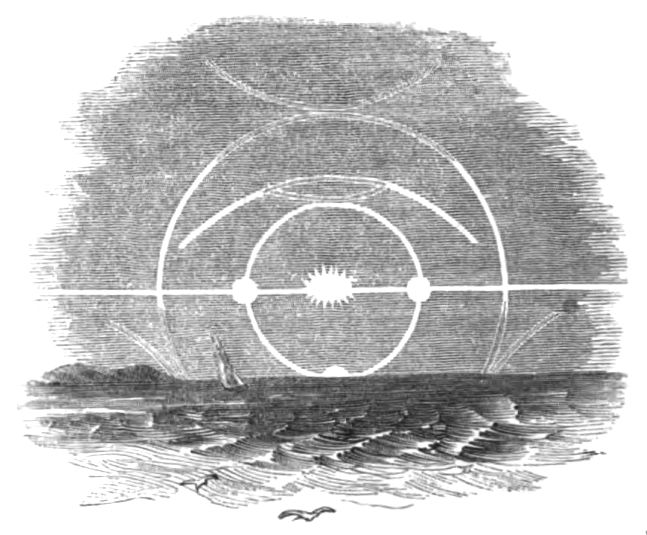
Parhelia.
Parhelia. Mock suns, in the vicinity of the real orb, are due to the same cause as haloes, which appear in connection with them. Luminous circles, or segments, crossing one another, produce conspicuous masses of light by their united intensities, and the points of intersection appear studded with the solar image. This is a meteorological rarity in our latitude, but a very frequent spectacle in the arctic climes. In Iceland, during the severe winter of 1615, it is related that the sun, when seen, was always accompanied by two, four, five, and even nine of these illusions. Captain Parry describes a remarkably gorgeous appearance, during his winter sojourn at Melville Island, which continued from noon until six o’clock in the evening. It consisted of one complete halo, 45° in diameter, with segments of several others, displaying in parts the colors of the rainbow. Besides these, there was another perfect ring of a pale white color, which went right round the sky, parallel with the horizon, and at a distance from it equal to the sun’s altitude; and a horizontal band of white light appeared passing through the sun. Where the band and the inner halo cut each other, there were two parhelia, and another close to the horizon, directly under the sun, which formed the most brilliant part of the spectacle, being exactly like the sun, slightly obscured by a thin cloud at his rising or setting. A drawing of this parhelion is given by Captain Parry, who remarks upon having always observed such phenomena attended with a little snow falling, or rather small spicula or fine crystals of ice. The angular forms of the crystals determine the rays of light in different directions, and originate the consequent visual variety. We have various observations of parhelia seen in different parts of Europe, which in a less enlightened age excited consternation, and were regarded as portentous. Matthew Paris relates in his history:—“A wonderful sight was seen in England, A. D. 1233, April 8, in the fifth year of the reign of Henry III., and lasted from sunrise till noon. At the same time on the 8th of April, about one o’clock, in the borders of Herefordshire and Worcestershire, besides the true sun, there appeared in the sky four mock suns of a red color; also a certain large circle of the color of crystal, about two feet broad, which encompassed all England as it were. There went out semicircles from the side of it, at whose intersection the four mock suns were situated, the true sun being in the east, and the air very clear. And because this monstrous prodigy cannot be described by words, I have represented it by a scheme, which shows immediately how the heavens were circled. The appearance was painted in this manner by many people, for the wonderful novelty of it.”
Paraselenæ. Mock moons, depending upon the causes which produce the solar image, or several examples of it, as frequently adorn the arctic sky. On the 1st of December, 1819, in the evening, while Parry’s expedition was in Winter Harbor, four paraselenæ were observed, each at the distance of 21½° from the true moon. One was close to the horizon, the other perpendicular above it, and the other two in a line parallel to the horizon. Their shape was like that of a comet, the tail being from the moon, the side of each toward the real orb being of a light orange color. During the existence of these paraselenæ, a halo appeared in a concentric circle round the moon, passing through each image. On the evening of March 30, 1820, about ten o’clock, the attention of Dr. Trail, at Liverpool, was directed by a friend to an unusual appearance in the sky, which proved to be a beautiful display of paraselenæ. The moon was then 35° above the southern horizon. The atmosphere was nearly calm, but rather cloudy, and obscured by a slight haze. A wide halo, faintly exhibiting the prismatic colors, was described round the moon as a centre, and had a small portion of its circumference cut off by the horizon. The circular band was intersected by two small segments of a larger circle, which if completed would have passed through the moon, and parallel to the horizon. These segments were of a paler color than the first mentioned circle. At the points of intersection appeared two pretty well defined luminous discs, equaling the moon in size, but less brilliant. The western paraselenæ had a tail or coma, which was directed from the moon, and the eastern also, but less clearly-defined.
The Rainbow. The most glorious vision depending upon the decomposition, refraction, and reflection of light, by the vapor of the atmosphere reduced to fluid drops, is the well-known arch projected during a shower of rain upon a cloud opposite to the sun, displaying all the tints of the solar spectrum. The first marked approximation to the true theory of the rainbow occurs in a volume entitled De Radiis Visus et Lucis, written by Antonius de Dominis, Archbishop of Spalatro, published in the year 1611 at Venice. Descartes pursued the subject, and correctly explained some of the phenomena; but upon Newton’s discovery of the different degrees of refrangibility in the different colored rays which compose the sunbeam, a pencil of white or compounded light, the cause of the colored bands in the rainbow, of the order of their position, and of the breadth they occupy, was at once apparent. The bow is common to all countries, and is the sign of the covenant of promise to all people, that there shall no more be such a wide-spread deluge as that which the sacred narrative records.
“But say, what mean those colored streaks in heaven
Distended, as the brow of God appeased?
Or serve they, as a flowery verge to bind
The fluid skirts of that same watery cloud,
Lest it again dissolve, and shower the earth?
To whom the Archangel: Dexterously thou aim’st;
So willingly doth God remit his ire—
That he relents, not to blot out mankind;
And makes a covenant never to destroy
The earth again by flood; nor let the sea
Surpass its bounds; nor rain to drown the world,
With man therein, or beast; but when he brings
O’er the earth a cloud, will therein set
His triple-colored bow, whereon to look,
And call to mind his covenant.”
It is happily remarked by Mr. Prout, in his Bridgewater Treatise, that no pledge could have been more felicitous or satisfactory; for, in order that the rainbow may appear, the clouds must be partial, and hence its existence is absolutely incompatible with universal deluge from above. So long, therefore, as “He doth set his bow in the clouds,” so long have we full assurance that these clouds must continue to shower down good, and not evil, to the earth.
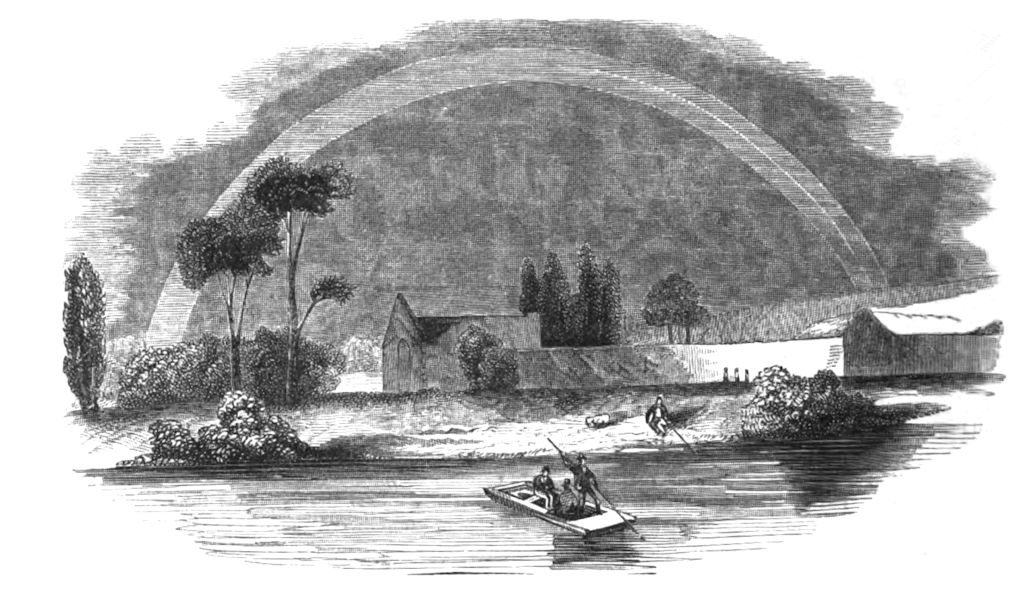
Rainbow.
When rain is falling, and the sun is on the horizon, the bow appears a complete semicircle, if the rain-cloud is sufficiently extensive to display it. Its extent diminishes as the solar altitude increases, because the colored arch is a portion of a circle whose centre is a point in the sky directly opposite to the sun. Above the height of 45° the primary bow is invisible, and hence, in our climate, the rainbow is not seen in summer about the middle of the day. In peculiar positions a complete circle may be beheld, as when the shower is on a mountain, and the spectator in a valley; or when viewed from the top of a lofty pinnacle, nearly the whole circumference may sometimes be embraced. Ulloa and Bouguer describe circular rainbows, frequently seen on the mountains, which rise above the table-land of Quito. When rain is abundant, there is a secondary bow distinctly seen, produced by a double reflection. This is exterior to the primary one, and the intervening space has been observed to be occupied by an arch of colored light. The secondary bow differs from the other, in exhibiting the same series of colors in an inverted order. Thus the red is the uppermost color in the interior bow, and the violet in the exterior. A tertiary bow may exist, but it is so exceedingly faint from the repeated reflections, as to be scarcely ever perceptible. The same lovely spectacle may be seen when the solar splendor falls upon the spray of the cataract and the waves, the shower of an artificial fountain, and the dew upon the grass. There is hardly any other object of nature more pleasing to the eye, or soothing to the mind, than the rainbow, when distinctly developed—a familiar sight in all regions, but most common in mountainous districts, where the showers are most frequent. Poetry has celebrated its beauty, and to convey an adequate representation of its soft and variegated tints, is the highest achievement of the painter’s art. While the Hebrews called it the Bow of God, on account of its association with a divine promise, and the Greeks the Daughter of Wonder, the rude inhabitants of the North gave expression to a fancy which its peculiar aspect might well create, styling it the Bridge of the Gods, a passage connecting heaven and earth.
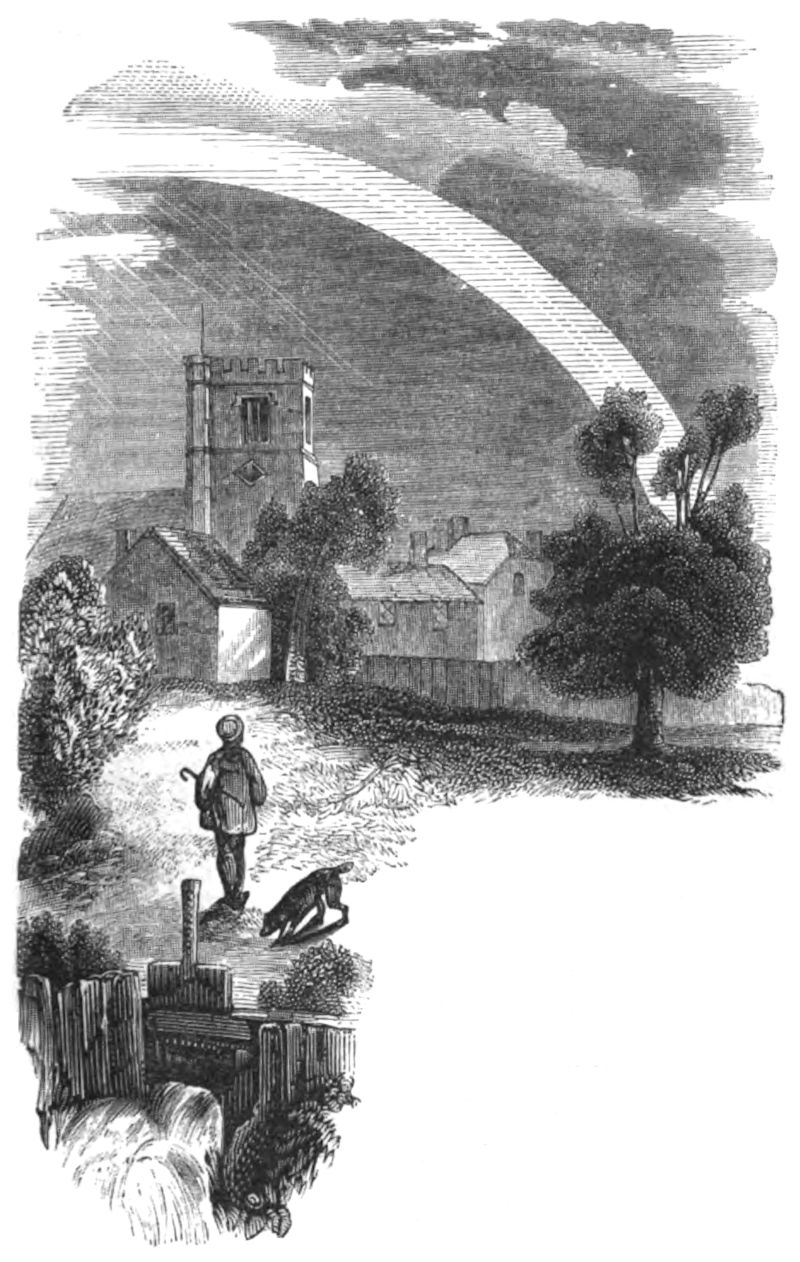
Lunar Rainbow.
The principles which account for the formation of the rainbow explain the appearance of beautiful irridescent arches which have occasionally been observed during the prevalence of mist and sunshine. Mr. Cochin describes a spectacle of this kind, noticed from an eminence that overlooked some low meadow-grounds, in a direction opposite to that of the sun, which was shining very brightly, a thick mist resting upon the landscape in front. At about the distance of half a mile from each other, and incurvated, like the lower extremities of the common rainbow, two places of peculiar brightness were seen in the mist. They seemed to rest on the ground, were continued as high as the fog extended, the breadth being nearly half as much more as that of the rainbow. In the middle between these two places, and on the same horizontal line, there was a colored appearance, whose base subtended an angle of about 12°, and whose interior parts were thus variegated. The centre was dark, as if made by the shadow of some object resembling in size and shape an ordinary sheaf of corn. Next this centre there was a curved space of a yellow flame color. To this succeeded another curved space of nearly the same dark cast as the centre, very evenly bounded on each side, and tinged with a faint blue green. The exterior exhibited a rainbow circlet, only its tints were less vivid, their boundaries were not so well defined, and the whole, instead of forming part of a perfect circle, appeared like the end of a concentric ellipsis, whose transverse axis was perpendicular to the horizon. The mist lay thick upon the surface of the meadows; the observer was standing near its margin, and gradually the scene became fainter, and faded away, as he entered into it. A similar fog-bow was seen by Captain Parry during his attempt to reach the North Pole by means of boats and sledges, with five arches formed within the main one, and all beautifully colored.
The iris lunaris, or lunar rainbow, is a much rarer object than the solar one. It frequently consists of a uniformly white arch, but it has often been seen tinted, the colors differing only in intensity from those caused by the direct solar illuminations. Aristotle states that he was the first observer of this interesting spectacle, and that he only saw two in the course of fifty years; but it must have been repeatedly witnessed, without a record having been made of the fact. Thoresby relates an account received from a friend, of an observation of the bow fixed by the moon in the clouds, while traveling in the Peak of Derbyshire. She had then passed the full about twenty-four hours. The evening had been rainy, but the clouds had dispersed, and the moon was shining very clearly. This lunar iris was more remarkable than that observed by Dr. Plot, of which there is an account in his History of Oxford, that being only of a white color, but this had all the hues of the solar rainbow, beautiful and distinct, but fainter. Mr. Bucke remarks upon having had the good fortune to witness several, two of which were perhaps as fine as were ever witnessed in any country. The first formed an arch over the vale of Usk. The moon hung over the Blorenge; a dark cloud was suspended over Myarth; the river murmured over beds of stones, and a bow, illumined by the moon, stretched from one side of the vale to another. The second was seen from the castle overlooking the Bay of Carmarthen, forming a regular semicircle over the river Towy. It was in a moment of vicissitude; and the fancy of the observer willingly reverted to the various soothing associations under which sacred authority unfolds the emblem and sign of a merciful covenant vouchsafed by a beneficent Creator.