Front matter
Reading edition
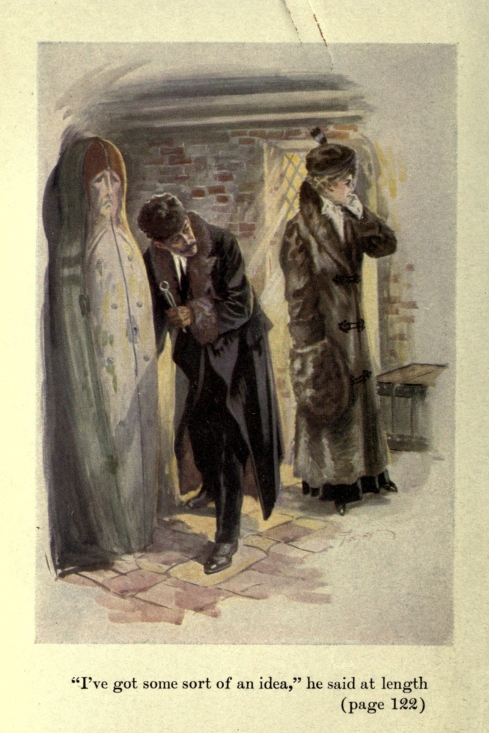
"I've got some sort of an idea," he said at length (page 122)
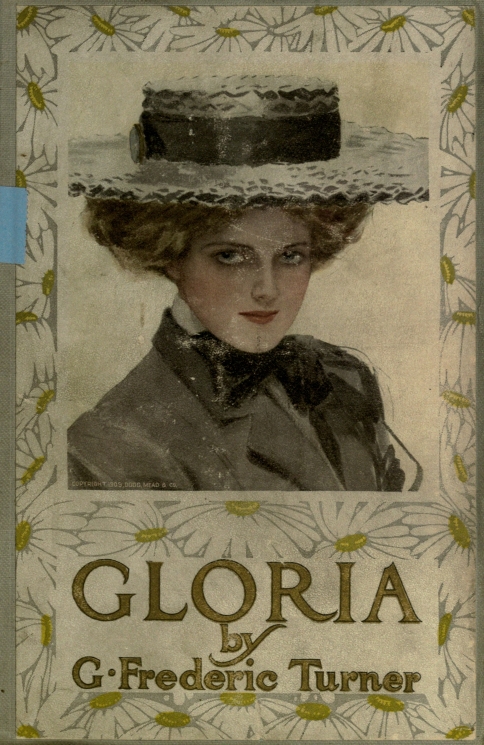
GLORIA
BY
G. FREDERIC TURNER, M.A.
WITH ILLUSTRATIONS IN COLOUR
BY C. M. RELYEA
NEW YORK DODD, MEAD AND COMPANY 1910
COPYRIGHT, 1910, BY DODD, MEAD AND COMPANY Published, March, 1910
CONTENTS
CHAPTER
I The Patient and His Doctor II The City of the Plain III A Proposition IV The Thiergarten V The King's Cup VI "Wein, Weib, und Gesang" VII Confidences in a Wine-Shop VIII The Bargain IX The King's Breakfast X A Ski-ing Expedition XI The Iron Maiden XII The Simple Policy XIII On the Warpath XIV Music and the Mob XV The Temptation of Ulrich XVI King and Canaille XVII "Captain" Trafford XVIII The First Council XIX The Chapel Royal XX Bernhardt Disturbed XXI Dreams XXII The War on the Wine-Shop XXIII The "Bob" Run XXIV Rival Influences XXV The Opening Bars XXVI The Parley XXVII Trafford and the Trench XXVIII Meyer at Work XXIX News from the Capital XXX Recruits XXXI "A Surprise" XXXII The Conquering King XXXIII The Lost Sheep Epilogue
ILLUSTRATIONS
"I've got some sort of an idea," he said at length (page 122) ... Frontispiece
"The lady wants to be seen home—and I'm going to do it if I swing for it!"
"If I see so much as an inch of blade, this little hand-grenade of mine will play havoc with your handsome features"
"I drink to our success to-night, I drink to the devil in the devil's own tipple"
CHAPTER ONE THE PATIENT AND HIS DOCTOR
Christmas Eve in New York! Broadway crowded with happy playgoers, gay promenaders, and belated shoppers! Fifth Avenue resplendent with an abundance of commercially-conceived festivity in the overstocked windows of its fashionable shops! In other and less pretentious localities, gaunt lines of assassinated turkeys exhibiting their sallow nudities in indecent profusion to a steady stream of ever-changing faces! In short, everywhere throughout the big city, the people holding high carnival—even cynicism forgetting itself in the prospect of gallinaceous food and crude sweetmeats. And Central Park West and the Circle, in particular, scintillating with electrical display and wreaths of red-ribboned holly.
In the New Theatre a gala performance of Antony and Cleopatra was nearly over; the last lines of the tragedy were being spoken. Yet, notwithstanding the fact that in another moment the folds of the red velvet curtains would descend on the Egyptian scene, an occupant of one of the stalls, no longer able to control his impatience, hastily left his seat and started up the adjoining aisle.
To say that this young man gave every physiognomical indication of being a soul in distress would be putting it not a bit too strongly. Nor would it have required exceptionally brilliant intuitive faculties to conjecture that someone—presumably in a box across the theatre, on which, all through the evening, his eyes had been riveted—had shamelessly robbed him of his heart. Moreover, judging from his evident haste and the keen anxiety with which all the way up the aisle he followed every movement of the parties in the box, it would seem that he had determined to intercept them on their way out. And, indeed, such was his determination. Life had concentrated itself into a question of hearing from the lips of the woman,—the woman to whom he had offered, and who had refused, the worship of a life,—a word that he could interpret as meaning that there was still a faint possibility of her changing her mind.
To his vexation, however, he found that others likewise had left their seats. In fact, the general exodus had already set in before, even, he had reached the top of the aisle. And yet, despite his being thoroughly aware that any attempt to pass from one side of the house to the other was sure to be resented,—so delirious is the haste in which a metropolitan audience takes leave of the theatre for the invariable restaurant-supper after the play,—he continued to make strenuous efforts to cut his way through, until realising, finally, that it was useless, he let himself be borne along by the crowd. But his chance came when the carriage-vestibule on Sixty-Fifth Street was reached. And there, quick to take advantage of an almost imperceptible cessation of the onward movement—consequent upon the people searching the ingeniously-devised board to ascertain whether the desired motors or carriages headed the long line—he again started in to elbow his way through the crush; and so successfully this time that presently comparatively few persons separated him from an undeniably blond and dashing young woman, in a magnificent opera-cloak of Russian sables, who was laughing and chatting with half a dozen or more vapid youths while following the lead of a portly and somewhat red-faced old gentleman.
Now, though unusual—for want of a better word—as was the young man's behaviour, few people in this scene of orderly confusion, babel of voices and distant humming of motors, gave more than momentary attention to it except the young woman's escort. To these wondrous wise young gentlemen, however, the meaning of his frantic exertions to reach her side was all too plain, no less her feelings towards him; and, exchanging significant glances, they began to nudge one another to watch for the dénouement of the little comedy which was rapidly developing before their eyes.
But alas for the futility of his brave resolutions...!
So far his task had been easy enough. But at the fateful moment, face to face with his divinity, and doubtless for the first time perceiving that no relenting glance softened the faultless contours of her carven features, that no spark of warmth glinted in her big, blue eyes,—eyes that, on the contrary, were brimful of scornful laughter,—his indomitable spirit failed him utterly, was crushed, for once, at least, and he stood gaping at her, to everyone's surprise, more like a country yokel than the man-of-the-world that he undoubtedly was. For the briefest of intervals he remained thus. And then, apparently pulling himself together, he suddenly wheeled round on his heel, and shouldering his way through the press,—heedless alike of a friendly hail, which came in an unmistakably English accent from someone back in the crowd, and of the protesting looks, if not words, of the people he jostled,—he left an ostentatiously, almost vulgarly, ornate limousine to slam its door and move rapidly away with its fair occupant and her admirers.
Into Central Park West the young man turned and walked north. Despite a heavy fur overcoat, his gait was extraordinarily fast, and his face appeared white, almost ghastly, in the thin, yellow fog that was pushing its way under his eyelids, into the penetralia of nose and ears, and depositing superfluous matter on his lungs, larynx, and reckless expanse of linen. A few blocks above the theatre he came to a small apartment-hotel, mounted at a run to the first floor, and quickly entering the sitting-room of the suite, he carelessly tossed his irreproachable high hat on to a lounge. Then he went over to a window and stood gazing out at the sea of fog before drawing the curtain against the gamboge of the December evening. And his countenance was at once savage and inexpressibly sad.
This savageness was habitual, the resultant of bold features: a straight nose which made a sharp angle with the steep brow, bushy eyebrows and a wiry, brush-backed moustache that sprouted aggressively from his upper lip. Strictly speaking it was not a handsome face, though, perhaps, a striking one. Nor in other respects was there anything remarkable about George Trafford—"Nervy" Trafford they had called him at Harvard, and the appellation had always clung to him. As to occupation he had none. Inheriting a modest fortune at an early age, his life had differed little from that of the majority of young Americans in like circumstances, if we except the fact that—before he took up the difficult task of killing time—he had added an Oxford degree to that of Harvard.
Throwing off his coat, Trafford fumbled in his waistcoat for a key. A moment later he was opening a small mahogany medicine-cupboard that was fixed against the wall over his book-case. His searching hand groped about in its recesses and then brought out—something. For a second he held this "something" at arms length, conning it with curious eyes, as a dilettante might study a precious cameo, or a bit of rare porcelain.
Then he put it carefully on the table. The electric light shone on a small, compact object, dark of colour and sinister of shape—a revolver!
Nervy Trafford took pen and paper and wrote; and as he wrote the curious light grew in his wild eyes, and a sad smile played about his sensitive mouth.
"Dearest," he began:—"You say you can never love me. I say that I can never cease to love you. You have spoken a lie, even as I have spoken the truth, for when the mists of life are dispelled by the glorious radiance beyond the grave, you will love me as I love you, perfectly, entirely, with the triple majesty of soul, mind and spirit. Till then, farewell.
Yours, as you are mine, GEORGE TRAFFORD."
Having read this curious epistle twice, he put it in an envelope and addressed it to Miss Angela Knox, St. Regis Hotel. A moment later he took up the object from the table, looking into vacancy as he did so.
So this was to be his end!—an ending, he well knew, that none of his friends had ever dreamed of. A man on whom advice was thrown away, who seldom if ever thought twice, in other words, a creature of impulse, yes—they would admit all that; but on the other hand would they not recall many instances of his extricating himself from tight places through nothing else but this very impulsiveness and nerve of his? Inevitably, then, they would refuse to believe that a man like that, however hopeless his infatuation, would take his own life. All of which merely goes to show how ridiculous it is for our best friends to scoff at the notion that an affair of the heart may be taken seriously.
Trafford's face was literally bloodless; his pupils infinitesimal black dots, gazing searchingly through the walls of his room into the great beyond, where all questions are answered, all doubts set at rest. For a moment he stood thus in vibrant silence. Then,—as if his mute searching had received its dumb response,—his lips breathed a woman's name, the muzzle of the revolver was raised head high, there was a click—and nothing more than a click!
Trafford's arm fell limp to his side, and a look of sick pain shuddered across his face. Then, an idea, a wafted air of recollection, fanned the light of understanding into his dull eyes. A ghost of a smile hovered at the corner of his lips, and again the cold hand raised the deadly mechanism to his pulsing temple. Even as it did so the door of his room was opened, and with a gesture of annoyance Trafford tossed the unused weapon on to the table and facing the intruder burst out with:
"Who on earth——"
"Hullo, Nervy, old chap!" was the familiar greeting that came from a big and genial man, clean-shaved, about thirty years of age, and dressed seasonably in a dark, astrachan-trimmed overcoat. In a word, the speaker was a faultlessly attired Englishman, whose great frame and smiling features seemed to bring into the tragic atmosphere a most desirable air of commonplace.
"Bob Saunders!" ejaculated Trafford.
"The same," affirmed the other, throwing off his overcoat and sinking lazily into the most comfortable chair he could find; "Robert Saunders, old cricket blue, devoted husband of a peerless wife, the friend of kings and the king of friends—voila!"
By this time Trafford had composed himself sufficiently to ask:
"What in the deuce are you doing over here? How did you find——"
"Been camping on your trail, old man,—as you Yankees say," interrupted the Englishman. "In the first place, the wife and I have been doing the States. To-night, as we were leaving the New Theatre, I caught sight of you—sung out to you—but you were off like a shot. I put Mrs. Saunders—divine creature!—into a taxi and sent her to the hotel. Then I gave chase. I tracked you here, and your door being open, took the liberty to walk in. But you don't look well, old chap!" he went on, noticing at length the exceptional pallor of his friend's face. "You look rotten! What's up, Nervy? Liver? Money?"
Trafford pointed silently to the table; at the sight of the revolver Saunders' face grew grave.
"As bad as that?" he asked. He was genuinely shocked, but his tone was commonplace, almost casual.
"As bad as that," breathed Trafford.
Saunders caught sight of the envelope, glanced at the address and at once proceeded to open it.
"Stop!" cried Trafford imperiously. "That is not for your eyes."
"Oh, yes it is," returned Saunders bluntly, extracting the letter from its envelope. "Sit down, sick man, and wait until I have diagnosed your case."
Trafford watched the Englishman with fascinated eyes. In his hour of deep darkness this smiling, confident, almost too well-dressed embodiment of prosperity seemed strangely comforting and reposeful. For the briefest of moments his present surroundings were blotted out, and his mind rushed back through the intervening years to the glorious days when they were both undergraduates at Oxford. But the illusion was of short duration, the awakening bitter. For as Saunders read, a smile eloquent of contemptuous astonishment spread over his face.
"Angela Knox!" he exclaimed. "My dear, demented friend, what a bétisse!"
"The purest, most perfect specimen of womanhood——"
"Angela Knox!" repeated Saunders cruelly. "Ye gods! Oh, yes, I know the lady. We met her at Newport—a big, buxom blonde, with the intellect of a sparrow. Tissue, tissue, my boy, and no soul! Features, millions also, I concede, but no sense of humour. In six weeks she would bore you; in six months you would bore her; in a year the machinery of the law—your obliging American divorce courts——"
"Silence!" roared Trafford. "You would poke fun at the holiest corner of a man's heart. I tell you, Bob, I so love this woman that had it not been for a miracle, I should have died five minutes ago with her name on my lips."
"And I'm the miracle?" questioned Saunders, tapping himself lightly on his faultless waistcoat.
"Miracle number two," replied the American, sinking into a chair. "That gun was kept for burglars. To preclude the possibility of an accident through some fool of a servant's mishandling, I kept the first chamber empty. Idiot that I am!—I forgot the precaution. But a second and doubtless more conclusive attempt would have been made had not you butted in——"
"And for Angela Knox!" cried Saunders with an unfeeling grin. "Now had it been a brunette——"
"This is no joking matter. For Heaven's sake, do be serious!"
Saunders brushed a speck of mud off his patent-leather boots.
"So I'm to take you seriously, Nervy? Well, then, listen, my dear, irresponsible, melodramatic friend. Love is a wonderful thing. It is rightly considered the beginning and the end of all things. I say so, moi qui vous parle, though I've been married nearly two years. But this infatuation—this calf-love of yours for a hypertrophied blonde with the conversational powers of a turnip, is, ipso facto, ridiculous. You will love some day, friend of my youth, but if your love is unrequited you will not turn to the revolver for solace."
"What are you letting me in for?" asked the bewildered Trafford. A powerful reaction had left him weak—weak in voice and weak in spirit.
"I mean," went on Saunders with slow emphasis, "that if you demand what your heart really desires and the response is 'no,' you will, in the words of the prehistoric doggerel, try, try again. Love that accepts defeat is an unhealthy passion; Love that tries to find relief in death is a disease. You are diseased, cher ami. Buck up! and listen to the words of your good doctor."
"I'm listening," said Trafford somewhat sheepishly.
"Good! To begin with, you are sound physically. Muscles firm, energy splendid, and your tongue would probably shame a hot-house geranium. But your psychic self is out of gear. Wheels are racing in your poor old brain! Little troubles become great tragedies! Vital things seem small and insignificant! You need a potent remedy."
"Let it come over speedy then!" the American replied with some show of interest.
For a moment the Englishman looked mystified. Presently he answered:
"You need to live in the open—plenty of sunshine and perfect air."
"All kibosh—buncombe!" broke forth Trafford petulantly.
"No, not buncombe, but Grimland—a little country on the borders of Austria and Russia. Visit it," went on Saunders in rousing tones. "Its highlands furnish the finest scenery in Europe. The air of its mountains is sparkling champagne! Its skies are purest sapphire, its snows whiter than sheets of finest lawn! To dwell there is to be a giant refreshed with wine, a sane man with a sane mind, and a proper contempt for amorous contretemps. Come, pack up your traps to-night and catch the Lusitania to-morrow. What's more, I do not advise, I command."
The American appeared half persuaded by the other's mastery. He sat upright, and looked more or less alive again.
"But I should be bored to death," he objected feebly.
"Not a bit of it! Why, old man, you'll forget the very meaning of the word boredom. You're a skater?—well, then, why not enter for the King's Cup which is skated for on the King's birthday—the second Saturday of the New Year at Weidenbruck. If you're beaten, as is probable,—for the Grimlanders are a nation of skaters,—there is tobogganing, curling, ski-ing and hockey-on-the-ice to engross your mind. All are exhilarating, most are dangerous. Furthermore, you will have my society—as my wife and I will be guests of King Karl at the Neptunberg. However, for you, since you have not my advantages, I recommend the Hôtel Concordia. You will sail with us to-morrow?" he wound up confidently.
Trafford made a gesture of impatience.
"Honestly," he said, ignoring the question, "when the hammer of that gun clicked against my forehead, something also seemed to click inside my brain. Up to that point I had love framed up as all there was to this world and the next. Now I feel there is no meaning in anything."
"Wait till you've got a pair of skates on your feet and the breath of zero air in your nostrils! Wait till you've had a toss or two ski-ing, and a spill on the 'Kastel' toboggan run! There will be meaning enough in things then."
"It's a go, then!" declared Trafford, but without enthusiasm. "I'll make a getaway."
Saunders rose, a look of genuine relief on his face.
"The Lusitania to-morrow," he said in far heartier tones than he had yet employed. "Till then——" He held the other's hand in a long grip.
"And you don't balk at leaving me with that?" Trafford pointed with a pale smile at the revolver on the table.
"Not in the least," laughed Saunders. "Take it abroad with you. Only, get out of the habit of leaving the first chamber empty. Such a practice might be fatal in Grimland."
CHAPTER TWO THE CITY OF THE PLAIN
"I can't see that this is such a vast improvement on little old New York!" was Trafford's growling comment as he strolled the streets of Weidenbruck the evening of his arrival.
"Ah, but Weidenbruck is the city of the plain!" returned Saunders, who was accompanying him in his perambulations. "As soon as this skating competition is over——"
"It will be back to Broadway for mine, I think!" interrupted the American, and then went on with despondent logic: "If it is cold here, what will it be five thousand feet higher up?"
"Hot," retorted the other. "At Weissheim the sun shines unobscured by mist. The air there is dry and bracing. The thermometer may stand at zero, but your warm gloves will be a mockery, your great coat an offence."
A gust from a side street blew a whirl of powdered snow in the faces of the two men. Trafford buried his chin in the warm collar of his overcoat; he swore, but without undue bitterness. The cold indeed was poignant, for the unfrozen flood of the Niederkessel lent the atmosphere a touch of moisture that gave malice to the shrill frost, a penetrating venom to the spiteful breeze that swept the long length and broad breadth of the straight, prosaic Bahnofstrasse. The trams that rushed noisily up and down this thoroughfare were the only things that still moved on wheels. Cabs, carriages, omnibuses, perambulators even, had discarded wheels in favour of runners; and arc-lamps shone coldly from an interminable line of iron masts, while a cheerier glow blazed from the windows of innumerable shops which still displayed their attractive wares for the benefit of the good citizens of Weidenbruck, who have raised the science of wrapping up to the level of a fine art.
"But then why come to this cellar of a town?" grunted Trafford.
Saunders shot a glance at his companion. He was genuinely fond of Trafford, had been genuinely shocked at the narrowness of his escape from tragic ruin, and was genuinely glad when his morbid companion began to take intelligent interest in his surroundings,—even though that interest manifested itself in irritable comments and deprecatory grunts. The Englishman had chaffed the would-be suicide, had poured cruel scorn on his inamorata, and preached the cold gospel of worldliness and selfish pleasure; but if he had spoken cynically it had been because cynicism had seemed the right remedy, rather than because his own nature was bitter. Beyond having a rather high opinion of his own abilities and a predilection for new clothes, Saunders was a man of much merit.
"Because this skating competition happens to be held here," he answered, "and the King's Cup is the important event in the sporting calendar of Grimland. The winner—who may be yourself—is looked upon as a king among men, a demi-god to be honoured with the burnt offerings of the rich and the bright glances of the fair."
"The latter I can dispense with. Cut it out!" the American exclaimed with much bitterness, and then went on: "I did not come to Grimland merely for sport, as you well know, but because you hinted at political troubles. Moreover, I have taken your advice literally, and have brought my gun along."
"Keep it loaded then," said Saunders curtly. "I hear Father Bernhardt has returned."
"Who in thunder is Father Bernhardt?"
"A renegade priest. In the troubles of 1904 he eloped with the Queen, who had been plotting her husband's downfall with the Schattenbergs."
"His Majesty's opposition," put in Trafford, who knew something of the country's turbid history.
"Yes, kinsmen of King Karl's who have always cherished a secret claim to the throne. They very nearly made their claim good, too, in 1904."
"Only one Robert Saunders intervened," interjected Trafford with an envious glance at his companion.
"Providence upheld the ruling dynasty with a firm hand," Saunders went on to explain, "and the rebellious family, the Schattenbergs, were pretty well wiped out in the process. Two alone survived:—Prince Stephan,—who was too young to participate in the trouble, and who subsequently died of diphtheria at Weissheim,—and the Princess Gloria,—a girl of one-and-twenty, who escaped over the Austrian frontier."
"And what is she doing?" inquired Trafford with some approach to curiosity.
"No one exactly knows. Unless she has altered in three years, she is a beautiful young woman. She lives in the public imagination partly because she is a possible alternative to King Karl, who has the demerit of being a respectable middle-aged man. If,—as is rumoured,—she is in alliance with Father Bernhardt, there will certainly be trouble, for the ex-priest is a man of energy and resource. Moreover, he was once a religious man, and believed himself damned when he ran away with King Karl's fickle consort; and a man who is looking forward to eternal damnation is as dangerous in his way as a Moslem fanatic seeking Paradise."
Trafford said nothing, but breathed a silent prayer that the renegade priest might indeed be in Grimland. For Trafford was one of those curiously constituted people—rarer now than they used to be—who value excitement without counting the cost. At Oxford he had always regarded Saunders with a deep, if unmalicious envy. The Englishman had captured the highest honours, had won his cricket blue, performing prodigies at Lord's before enthusiastic men and women; and, later, had played a conspicuous, almost heroic, part in the Grimland troubles of 1904. On the other hand, he, Trafford—Nervy Trafford—had to be content both at Harvard and Oxford with only limited athletic successes, these being achieved by sheer pluck and infectious energy. But men had always loved him, for he could sing a rousing song, dance a spirited war-dance, and kindle bonfires in unexpected places with the most expensive furniture. In a word, his was an ardent, effervescent nature, and now that the tragedy of a tumultuous but misplaced passion had robbed life of its normal interest and savour, his ideas of a diverting holiday were of a distinctly reckless nature.
Wandering down the Bahnhofstrasse they purchased a few picture-postcards at a stationer's, a meerschaum pipe at an elegant tobacconist's where they sold Hamburg cigars in Havana boxes, and finally halted before a big corner shop where all the paraphernalia appertaining to winter sports were displayed in interesting and attractive profusion.
"I thought you had a good pair of skates," said Saunders.
"So I have," returned the other. "But there are two styles of skating, the English and the continental; and I am one of those rarely gifted Americans who can skate both styles equally well,—a fact I intend to take advantage of at this competition. But I need a different pair of skates for each style."
"Do you think you're really any good?" asked Saunders, smiling. He was accustomed to refer to his own abilities in eulogistic terms, but was not used to his companion doing so.
"If you were to ask that question in Onondaga, New York, U.S.A.,—where I was born and bred,—they'd laugh at you," was Trafford's serious reply.
"All right, let's go in and buy something from Frau Krabb," said Saunders, leading the way into the shop.
Within was a jumble of wooden luges, steel-framed toboggans, and granite curling stones; from the low ceiling hung numberless pairs of skis, like stalactites from a cavern roof; while bunches of skates adorned the balusters of the deep staircase leading to the upper floor.
Frau Krabb, the proprietress, was being accosted by another customer. The customer in question was a young officer in the shiny shako and a fine fur-trimmed sur-coat of grey-blue, frogged with black. He was a sufficiently attractive object in his picturesque uniform, but though his carriage was energetic and manly, the face that showed beneath the military headgear was by no means that of a typical soldier. It was a dark, oval face with a wisp of a black moustache, big lustrous eyes, and a small, pretty mouth, adorned with the whitest and most regular of teeth. It was a proud, sensitive face, more remarkable for its beauty than its strength, but for all that, good to behold for its intelligence, refinement, and glow of youthful health.
"Good-evening, Frau Krabb," began the soldier, genially saluting. "Are my skates ready yet?"
"They were ready at four o'clock, as promised, Herr Captain," replied the woman, a plump person with more fat than features.
The Captain passed his finger critically along the edge of the newly-ground blades, and expressed himself satisfied.
"And you will win the King's Cup, Herr Captain, of course?" continued Frau Krabb, smiling a fat smile into her customer's face.
"I'm going to have a good try at it," was the guarded reply. "I'd sooner win the King's Cup than the Colonelcy of the Guides. No one has practised his 'rocking turns' and 'counters' so assiduously as I, and I'm feeling as fit as a fiddle—which counts for more than a little in a skating competition."
"You look it," said the woman admiringly.
"I've got to meet Franz Schmolder of Wurzdorf," went on the soldier musingly, "and Captain Einstein of the 14th, so it does not do to be too confident. There's an American, too, competing; but I don't fear him. He doubtless skates only in the English fashion, and their style of skating is too stiff and stilted to be of any use in elaborate figures, though it is pretty enough for big, simple movements and combined skating. Schmolder's the man I fear, though Einstein's a big and powerful skater, with the nerve of a demon."
"Herr Schmolder has a strained knee," said the woman, "and Captain Einstein's nerve is not so good as it was. He is too fond of Rhine wine and Kirschwasser, and though he has a big frame it is not full of the best stuffing."
"I'd like to win better than anything in the world," said the young officer in tones of the deepest earnestness, his eyes lighting up wonderfully at the golden prospect.
"You will win," said Frau Krabb simply; "I have two kronen with my man on you, and you have my prayers."
"God answer them!" said the soldier piously. Then in a moment of enthusiasm he bent down and kissed the comical upturned face of the old shopwoman. "Pray for me with all your soul," he said, "for I want that cup, Mother of Heaven! I must have that cup." And, slinging his skates over his shoulder the officer was about to leave the shop, when Saunders accosted him.
"Hullo, Von Hügelweiler!" said the latter.
The soldier's eyes brightened with recognition. He had met the Englishman at Weissheim a few years previously, and was proud of the acquaintance, for Saunders was a name to conjure with in Grimland.
"Herr Saunders!" he cried, "I am charmed to meet you again. You are his Majesty's guest, I presume."
"I am at the Neptunburg, yes. Permit me to present my friend, Herr Trafford, of New York. Trafford, my friend, Ulrich Salvator von Hügelweiler, Captain in his Majesty's third regiment of Guides."
The two shook hands.
"Delighted to make your acquaintance," said the Grimlander. "But what are you requiring at Frau Krabb's?"
"Some skates for to-morrow's competition," replied Trafford.
"Himmel!" ejaculated Hügelweiler, "so you are the American competitor. You had better not ask me to choose your skates, or I should certainly select a faulty pair."
Trafford laughed.
"You are indeed a dangerous rival," he said.
"I wish to succeed," said the soldier simply. "Perhaps success means more to me than to you; but I don't think I am a bad sportsman."
"I will not tempt your probity," said Trafford. "I will select my own wares."
Von Hügelweiler waited till the purchase was complete,—expressing his approval of the other's choice,—and then the three men sallied forth into the nipping air of the Bahnhofstrasse.
"Where are you going?" asked Saunders of the Grimlander.
"Back to barracks," replied the Captain. "Will you accompany me?"
Saunders consulted his watch.
"Trafford and I are dining in an hour's time," he said, "but we will walk part of the way with you. I wish to show my friend a bit of the town."
Turning to the left, they entered one of the numerous lanes which proclaim the city's antiquity with gabled front and mullioned window. Ill-lit, ill-paved under the trampled snow, and smelling noticeably of garlic, bouillon, and worse, the thoroughfare—the Schugasse—led to the spacious Soldatenplatz, wherein was situated the fine barracks of the King's Guides. They had been walking but a few minutes, when a tall figure, heavily muffled in a black coat, strode rapidly past them. Trafford had a brief vision of piercing eyes shifting furtively under a woollen cap, as the man cast a lightning glance behind him. Then as the figure vanished abruptly into a mean doorway, Saunders and Von Hügelweiler exchanged glances.
"So he is back," said the former. "Then there is certain to be trouble."
"Nothing is more certain," said the Captain calmly.
"Who is back?" demanded the puzzled Trafford.
"Father Bernhardt," replied his friend.
And the American heaved a sigh of thankfulness.
CHAPTER THREE A PROPOSITION
When the two friends left him, Captain von Hügelweiler fell into something of a reverie. He had told Frau Krabb that he desired to win the King's Cup more than anything on earth. That was not, strictly speaking, the case, for there was one thing that he desired even more than the coveted trophy of the skating rink. Yet that thing was so remote from reach that it was more of a regret now than a desire. Years ago,—when he was a sub-lieutenant stationed at Weissheim,—he had fallen desperately in love with the youthful Princess Gloria von Schattenberg. Her high spirits and ever-ready laughter had captivated his poetic but somewhat gloomy temperament, and he had paid her a devotion which had been by no means unreciprocated by the romantic young Princess. And the courtship was not so impossible as might appear, for Ulrich von Hügelweiler belonged to the old aristocracy of Grimland, and his father owned an ancient Schloss of considerable pretensions, and a goodly slice of valley, vineyards, and pine forests fifty miles northwest of Weidenbruck. But the Princess's father,—the Grand Duke Fritz,—was an ambitious man, already seeing himself on the throne of Grimland, and poor Hügelweiler had been sent about his business with great celerity and little tact. To the young officer the blow had been a crushing one, for his whole heart had been given, his whole soul pledged, to the vivacious Princess, and,—though years had rolled by,—time had done little to soften the bitterness of his deprivation. To his credit, be it said, that he had never sought consolation elsewhere; to his discredit, that he regarded his misfortune as a personal slight on the part of a malicious and ill-natured fate. For his was a self-centred nature that brooded over trouble, never suffering a bruise to fade or a healthy scar to form over an old wound. Even now his excitement at the glorious prospect of winning success and fame on the skating rink was marred and clouded by the hideous possibility of defeat. He desired,—with the intense desire of an egotistical mind,—to win the Cup, but he feared to lose almost more than he hoped to win.
On arriving at his modest quarters in the huge building in the Soldatenplatz, the Captain was surprised at seeing a visitor seated and awaiting his arrival. A man of medium height was reclining comfortably in his big armchair; his legs, high-booted and spurred, were thrust out in negligent repose, an eyeglass was firmly fixed in his right eye, a half-consumed cigarette smouldered beneath his coldly smiling lips. Von Hügelweiler drew himself up to the salute. His visitor was no less a personage than the Commander-in-Chief of the Army of Grimland, General Meyer, the most intimate friend of his Majesty King Karl.
"Your cigarettes are excellent, Captain," began the General.
Von Hügelweiler regarded the cynical Jewish face in silence. General Meyer was a man whom few understood and many feared. The greatcoat,—thrown open at the breast,—half revealed a number of famous Orders, none of them won by prowess on the field of battle. The spurred boots and the riding whip that occasionally flicked them suggested the horseman, though all knew that General Meyer was never so ill at ease as when on horseback. The dreamy eye, the slothful pose, the drawled speech, suggested anything but the ruler of a fiery soldiery, but for all that Meyer had won his way and held his post by something more formidable than a courtly tongue and a capacity for epigrammatic badinage. Those who served Meyer well were served well in return; those who flouted the Jew,—even in secret,—had a curious habit of being superannuated at an early period in their career.
"Pray be seated, Captain," pursued the visitor suavely.
Von Hügelweiler drew up a chair, and sat stiffly thereon, awaiting developments.
"You are competing for the King's prize on the Rundsee to-morrow?"
"Yes, General."
"Ah! I happen to be judge of the competition."
To this the Captain offered no comment. He was wondering what on earth was coming.
"You are exceedingly keen, of course, on winning this very important trophy?" pursued the elder man, with a swift glance.
"Yes, General—exceedingly keen," admitted Von Hügelweiler.
"As a lad," went on the Commander-in-Chief dreamily, "I once entered an examination for horsemanship at the military school at Gleis. My uncle knew the officer who was examining the candidates, and thoughtfully sent him a dozen of champagne and a box of cigars on the eve of the examination. The champagne was,—if I mistake not,—Perrier Jouet of a vintage year, and the cigars the finest that are grown in the island of Cuba. I was not a particularly good horseman in those days, but I passed the examination—with honours."
The Captain received the information in stolid silence. The history of the remote and somewhat disgraceful episode did not particularly interest him. The General deposited his finished cigarette in a porcelain tray, and extracted a fresh one from a tin box on the table.
"Your cigarettes are really excellent, Captain," he mused. "Pray keep me company."
Von Hügelweiler acceded to the invitation.
"You draw, I presume, certain inferences from the incident I have just mentioned?" the Commander-in-Chief went on.
"No, General."
"None whatever?"
Von Hügelweiler smiled.
"None," he said, "unless you suggest that I should be wise to send you a dozen of champagne and a box of cigars."
The General vouchsafed no answering smile to his subordinate's facetious suggestion. He merely shook his head in pensive silence.
"I am a rich man," he said insinuatingly, "and my cellars are the best stocked in Weidenbruck—not excepting his Majesty's. You cannot help me that way."
Again there was silence, and slowly it was borne in on Von Hügelweiler that he was being tempted. The situation horrified him. However much he desired to win the King's Cup, he desired to win it fairly. On the other hand, he neither wished to offend his Commander-in-Chief nor ruin his prospects of success in the competition. He began to be angry with Fate for placing him in a dilemma, before he knew exactly what the dilemma was.
Suddenly the Commander-in-Chief sat bolt upright, and in a voice of great earnestness demanded:
"Von Hügelweiler, do you know that there is a firebrand in Weidenbruck?"
"Weidenbruck is a cold place, General, but it usually contains a firebrand or two."
"I know; but I speak of no common incendiary. Father Bernhardt is here."
Von Hügelweiler nodded.
"At number 42, Schugasse," he supplemented.
"You know that?" demanded the General eagerly.
"He passed me a quarter of an hour since. He was being followed, I think."
"Good!" ejaculated General Meyer. "I want him. Captain, I asked you just now if you wanted to win the King's prize. I learn that you are the most promising competitor for this important affair. The winner of the King's prize is sure of the personal interest of his Majesty. Grimland,—especially female Grimland,—loves the successful athlete. Official Grimland smiles on him. Skating may not be the most useful accomplishment for a soldier, but proficiency in sport connotes, at any rate, physical fitness and a temperate life. There is no reason why you should not gain this trophy, and there is no reason why the gainer should not go far."
Von Hügelweiler's dark eyes flamed at the words, and his handsome, sombre face glowed involuntarily at the other's suggestion.
"As I am to be the judge," continued the General calmly, "there is no reason why your victory should not be a foregone conclusion."
Slowly the Captain's face hardened to a mask, and his eyes became points of steel.
"I do not follow, General," he said stiffly.
"You are a shade dense, my young friend," said Meyer, leaning forward and tapping the other's knee. "You want the King's prize; I want the King's enemy."
"But I cannot give him to you," protested the Captain.
"You know where he is housed; you have a sword."
"You wish me to effect his arrest, General? You have but to command."
"I do not desire his arrest in the least," said General Meyer, sighing wearily at the other's non-comprehension, and reclining again in the depths of his arm-chair. "If I wished his arrest I should go to Sergeant Kummer of our estimable police force. Father Bernhardt is a dangerous man, and a more dangerous man arrested than at large. He has the fatal gift of touching the popular imagination. The ex-Queen is a woman of no strength, the exiled Princess Gloria is but a figure-head, a very charming figure-head it is true, but still only a figure-head. Father Bernhardt is a soldier, statesman, and priest in one inflammatory whole. He has a tongue of fire, a genius for organisation, the reckless devotion of an âme damnée. His existence is a menace to my royal master and the peace of Grimland. He had the misfortune to cause me a sleepless night last night. Captain von Hügelweiler, I must sleep sound to-night."
The Captain rose to his feet.
"If you give your orders, General, they shall be obeyed," he said, in a voice that bespoke suppressed emotion.
The General yawned slightly, and then contemplated his companion with an ingratiating smile.
"My dear young man," he remarked blandly, "for the moment I'm not a general, and I am giving no orders. I am the judge of the skating competition which is to be held to-morrow, and in order that I shall be able to do full justice to your merits it is necessary that I should sleep well to-night. Do I make my meaning clear?"
"Diabolically so," the words slipped out almost involuntarily.
"I beg your pardon," said the Commander-in-Chief stiffly.
But Von Hügelweiler's temper was roused. He had been prepared, if necessary, to compromise with his conscience. He had argued,—with the easy morality of the egotist,—that he probably desired the King's prize more than any of his competitors, and probably deserved it more. Had Meyer demanded a little thing he might have granted it. But the thing asked was not little to a sensitive man with certain honourable instincts.
"I am a soldier, General," he declared, "and I am accustomed to accepting orders, not suggestions. If you order me to arrest this man I will take him dead or alive. If you suggest that I should murder him as a bribe to the judge of this skating competition, I refuse."
Von Hügelweiler's words rang high, and it was plain that his indignation was perilously near mastering his sense of discipline. But General Meyer's cynical smile never varied a hair's breadth, his pose never lost a particle of its recumbent indolence.
"Very well, Captain," he said at length. "Then I must take other means. Only do me the justice of confessing that I asked a favour when I might have commanded a service. Remember that all Grimlanders are not so dainty as yourself, and remember that murder is an ugly word and hardly applicable to the destruction of vermin. If this cursed priest is brought to trial there will be trouble in the city, street-fighting perhaps, in the narrow lanes round the cattle-market; any way, more bloodshed and misery than would be caused by an infantry sword through a renegade's breast-bone."
"But is an open trial a necessity?" demanded the Captain, his anger vanishing in the chilling certainty that the King's prize would never be his.
But the Commander-in-Chief had had his say.
"Well," he said, rising to his feet, "if you will not do what is required, someone else must. No, don't salute me. I'm only an old Jew. Permit me to honour myself by shaking the hand of an honest man."
For a half-moment the generosity of the words rekindled the dying hopes in the Captain's breast. General Meyer was a strange man—was it possible that he respected scruples he did not himself possess? But as Von Hügelweiler gazed into the old Jew's face, and scanned the mocking light in the cold eyes, the cynical smile about the mobile lips, his rising hopes were succeeded by a deeper, deadlier chill. With a slight shrug of the shoulders and a smooth-spoken "Good-night, Captain," the Commander-in-Chief left the room.
Von Hügelweiler stood gazing at the closed door in silence. Then his face grew dark, and he shook his fist after his departed visitor with a gesture of uncontrolled rage. His lips twitched, his features worked, and then covering his face dramatically with his hands, he sank into a chair. For a bitterness, totally disproportionate to his worst fears, had entered his childish heart.
CHAPTER FOUR THE THIERGARTEN
The competition for the King's Cup had no terror for Nervy Trafford, nor did the fact that he was lamentably short of practice affect his peace of mind. When a man has lost his heart's desire, has faced the barrel of his own revolver, the prospect of gyrating on skates before a critical audience becomes a matter of casual importance. When he left Harvard—to the vast regret of his fellow-undergraduates and the infinite relief of the much-enduring dean—he had not known in what direction to bend his superabundant energies. To one who had an innate craving for an electrically-charged atmosphere and the employment of explosives, and who was not of the dollar-hunting kind, office work was out of the question. So he had gone to Oxford. But sport there—the sport of the English shires—was too stereotyped and too little dangerous to appeal to his ardent spirit. Back again in the United States, he had commenced a military career, but it is a platitude that a soldier must learn to obey before he can command; and Trafford had stumbled badly on the lowest rung of the military ladder. After that he had wandered. He had seen men and cities, and had come to the conclusion that there was only one city, and in that city but one person. Whither that conclusion had led him we have already seen. Briefly, he was an unsettled and rather a dangerous person in such an inflammatory country as he was now visiting. It is little wonder, therefore, that the competition on the Rundsee caused him little anxiety, either as a trial of nerves or as a matter of vital importance in his cosmic outlook.
The Rundsee, where the contest was to take place, was an artificial piece of water, circular of shape, situated in the Thiergarten, the public park on the outskirts of Weidenbruck. At half-past two in the afternoon its frozen surface was crowded with a vast number of human beings, who had come to see the great annual competition for the King's prize. On one side a big pavilion, garnished with small flags and red cloth, had been erected for the benefit of the King and the favoured few. The majority of the throng were crowded behind ropes, leaving a sufficient area for the evolutions of the competitors. There was no question of the ice bearing so great a crowd, for the ice of the Rundsee was as hard as a London pavement, and many times as thick. A battery of elephant guns would have traversed it without inflicting a crack on its adamantine surface.
The scene was a gay one, for the winter sun had sucked up the morning mist and turned the dull grey sky to turquoise, and the snowy covering of the great trees into a bejewelled mantle of sparkling purity. A feeling of pent expectancy held the well-wrapped throng, a feeling which found outlet in rousing cheers when, with a cracking of whips and jingling of bells, a sleigh and four horses came rapidly down a broad avenue and halted at the back of the wooden pavilion.
It was the King—King Karl XXII., fat, smiling, smoking, wrapped luxuriously in magnificent furs, and accompanied by his favourites, General Meyer and Robert Saunders.
The Grimlanders,—to do them justice,—never received their monarch without noise. They might hoot or they might cheer, they might throw garlands of flowers or nitro-glycerine bombs, but royalty is royalty, whether its representative be hero or villain, and it was never received in the silence of indifference. And at the present moment the throng was benevolent. The day was fine, the occasion interesting, and in the love of sport the Grimland public forgot its antipathy to permanent institutions.
"By the way," asked the King of General Meyer, when they had found their way to the royal enclosure overlooking the Rundsee, "did you secure our friend Bernhardt last night?"
General Meyer shook his head.
"We had a failure," he replied, "another failure."
The King received the news without any outward sign of displeasure. Only one who knew him well would have read the deep disappointment of his placid silence.
"I thought you had discovered where he lodged," he said at length.
"I had discovered the fox's earth," said Meyer, "but my hounds had not strong enough teeth to inconvenience him. I approached a certain Captain of the Guides, a young man of good family and approved courage. I offered substantial rewards, but the work was too dirty for his aristocratic fingers."
"Perhaps it would have been wiser to have approached someone of humbler birth," said the King drily.
"I was forced to that conclusion myself," sneered the General, "and I requisitioned the services of two of the biggest scoundrels who enjoy the privilege of being your Majesty's subjects. Their consciences were un-tender, but they failed, as canaille will, when they come to hand-grips with a brave man."
"In other words," said the King, "two armed ruffians are incapable of tackling one priest. Next time I should try four."
"That is what I propose doing to-night, sire," said the General impassively.
The King turned to Saunders, who was seated on his left.
"What does the Englishman advise?" he asked.
"A company of Guards and a squadron of Dragoons," said Saunders curtly.
"An open arrest?" demanded his Majesty.
"Yes, and an open trial," affirmed Saunders. "After all, simplicity has its charms, and Father Bernhardt's popularity is so great that it can hardly be enhanced by a visit to the picturesque prison in the Cathedral Square."
"The Strafeburg!" said Meyer, naming the prison in question. "I fear the good citizens might essay a rescue."
"They certainly would," conceded Saunders, "but the Strafeburg was not erected by a speculative builder. It is made of stone, not papier-maché, and the gentlemen who keep guard over it are not armed with pea-shooters."
The General nodded sagely.
"You mean you would risk bringing things to a head?" he said.
"That is my advice," said Saunders. "I have only been in Weidenbruck twenty-four hours, but have been here long enough to see the need of strong measures."
"You are right," said the King with some bitterness; "the woman who was once my wife and who hates me more than anything on earth, is seen at large unmolested in my capital. The Princess Gloria,—a charming young lady, who would like to see me guillotined in order that she may sit more comfortably in my seat,—is waiting her opportunity to cross the frontier and take up her quarters here, if she has not done so already. The music-halls resound with incendiary ditties! There is one in particular, the Rothlied,—a catchy melody with a most inspiriting refrain,—which frankly and courageously advocates my removal to a better world. I am a patient man, God knows, and I desire peace at almost any price; but there are limits to my forbearance. Yet, when I put in a plea for action, I am told that a rash step would precipitate a revolution. I am beginning to think that my friend Saunders here is my best counsellor, and that simplicity is the best policy."
A roar of cheering from the crowd betokened the presence of the competitors on the ice. General Meyer rose from his seat.
"The best policy is generally simple," he said, "and so is the worst. But with your Majesty's permission I will withdraw. My services are required below."
Hardly had Meyer left when Mrs. Saunders was ushered into the royal enclosure. She was a tall, fair woman with a cold, correct profile and unemotional grey eyes. Her manner was usually reserved, and her speech mocking. She possessed, however, a keen, if caustic, sense of humour, and those few people who were privileged to know her well were wisely proud of the privilege. The King rose from his chair, his gaze resting admirably on the tall, athletic figure in its neat Chinchilla coat and smart fur toque.
"Enter the Ice Queen!" said his Majesty, offering her the chair vacated by the Commander-in-Chief.
"Has the skating begun?" the lady thus addressed inquired animatedly.
"Not yet," her husband answered, "the competitors are having a little preliminary exercise while Meyer is putting on his skates. But you come at an opportune moment, my dear. We were indulging in a political discussion. I was advocating bold measures; Meyer, masterly inactivity. I desire your support for my arguments."
"Meyer says we can't trust the army," put in the King.
"Of course you can't trust the army," said Mrs. Saunders; "for it is not commanded by a soldier. General Meyer is an excellent judge of skating and champagne, but he is more of a policeman than a warrior. I should send him on a diplomatic mission to a remote country."
"And whom would you make Commander-in-Chief in his place?" asked the King smiling.
"One of the competitors to-day."
"What!" exclaimed the King, mystified. "Who?"
"Why, my husband's friend—George Trafford, the American!"
The King roared with laughter.
"Why not appoint your husband to the post?" he demanded.
"Because my husband has a young and beautiful wife," retorted Mrs. Saunders smilingly.
"Whereas this Mr. Trafford——?"
"Is a broken-hearted bachelor. He is prepared to seek the bubble reputation even at the cannon's mouth. He has more imagination than Robert. Besides, I don't mind so much his being killed."
Saunders laughed loudly, while the King's sunburned face beamed with genuine amusement.
"I have to thank Mrs. Saunders for a cheerful moment," he said, "a rare thing these troublous times. I'm forty-five years of age, my dear lady," he went on, "and I've been on the throne fifteen years. Sometimes I feel as if I had reigned as long as Rameses II., and sometimes I feel every bit as old and dried-up as that mummied old gentleman in the British Museum. At the same time, as you see, I have my cheerful moments, and in those cheerful moments I see Father Bernhardt in one cell of the Strafeburg and the ex-Queen in another—the latter in a particularly damp cell, by the way."
"And the Princess Gloria von Schattenberg?" asked Saunders.
"Is too young and pretty for a cell," replied the King with a smile. "She is popular and dangerous, but I have a soft corner in my heart for her. I must fight her, of course, if she persists, but I've certain sunny memories of a little girl at Weissheim, all fun and laughter and enthusiasm for winter games, and I find it hard to take her seriously or wish her harm. But for the others," he went on, hardening his voice, "I'd have no mercy. They are playing with fire, and they are old enough to know that fire burns. Arrest them openly, I say, try them openly, I say, and if the proletariat objects—shoot them openly."
"Hear, hear," said Mrs. Saunders impassively, putting up her glasses and studying the faces of the different competitors on the Rundsee.
"Meyer wants one more chance of nobbling Father Bernhardt," said Saunders in a low voice.
"He shall have it," said the King; "and I hope and pray he will succeed. That priest's the heart and soul of the whole trouble. Once he is safe under lock and key, where can the Princess Gloria find another with such cunning, such resource, such heedless daring, to fight her battles and build her up a throne? Hullo, more cheering! What's that for? Ah, one of the competitors doing a bit of fancy skating to keep himself warm. A fine skater, too, by St. Liedwi,* a powerful skater, but a shade reckless, eh?"
* The patron saint of skating.
"That is our friend, George Trafford," said Saunders; "a fine skater, a powerful skater, but, as you say, distinctly reckless."
CHAPTER FIVE THE KING'S CUP
As the cheers which greeted the American's essay on the Rundsee died down, General Meyer, shod with a pair of high-laced boots fitted with fine steel blades, sallied forth to the ice, and shook each of the competitors in turn by the hand. Von Hügelweiler fancied he read malice in the Commander-in-Chief's eye, but his spirits had sunk too low to be further depressed by such omens of his imagination. He had determined to go through with the contest, trusting dimly that his merits might so far exceed those of his rivals that it would be morally impossible to withhold the prize from him. But he was anything but sanguine, for though he believed himself the best skater present, he felt sure that both his countrymen would run him close, and that Meyer would award the prize to anyone but himself, if he could reasonably do so.
The competition,—like most skating competitions,—was divided into two parts. In the first, the performers had to skate in turn a number of set figures; in the second they had to skate for a period of five minutes any figures of their own choosing. In one important respect the competition differed from others held on the Continent—it was not held under the auspices of the International Skating Union.
It is generally accepted that there are two styles of skating, the English style and the Continental, or, as it is sometimes termed, the International style. The characteristics of the English school are an upright carriage, a straight knee, and a general restraint and rigidity of pose, discountenancing any unnecessary movement of the arms or the unemployed leg. The Continental style is skated with a slightly bent knee, with the unemployed leg trailing behind the body, and considerable gesticulation of the arms. The exponents of the latter claim a greater gracefulness of execution, a freer and more beneficial exercise of the muscles, and a wider scope of possible evolutions. The English stylists claim dignity, severity, and the capacity of doing difficult things without apparent effort. Both have their merits and their advocates,—but it is generally accepted that to skate at all one must employ one of these two distinct methods,—and practically all skating competitions are held under the auspices of one or the other school. In Grimland, however, under General Meyer's influence, a third school had arisen. In this an effort had been made to combine the speed and steadiness of the English skaters with the wonderful scope for brilliant and daring evolutions afforded by the Continental method. In Grimland competitions, therefore, marks were awarded for the scale on which figures were described, and the pace at which they were performed; while, at the same time, reward was offered for those exhilarating tours de force which are impossible of execution under English methods. To put it differently, no marks were awarded for style qua style, but for such things as accuracy, speed, boldness, and elegance, quite apart from the mechanical methods by which such excellences were attained.
The first competitor to attempt the set figures was Herr Franz Schmolder,—a lithe little athlete, who skated with great power and elegance. On one or two occasions, however, he failed to hold his edge firmly after a difficult turn, and it was obvious to Von Hügelweiler that the strained knee which Frau Krabb had made mention of was bothering him more than a little.
Captain Einstein was the second of the four aspirants, and if,—as Frau Krabb had insinuated,—his big frame was filled with an undue proportion of alcoholic nourishment, it did not seem to have impaired his "back brackets" or spoiled his "rocking turns."
"There's a dash about that fellow that's fine!" remarked Trafford to Von Hügelweiler, who was standing near him, wrapped during inaction in a big military ulster.
The Captain of the Guides had already in his own mind ruled Schmolder out of the competition, exaggerating his faults to himself with egotistical over-keenness. Einstein, however, was skating so brilliantly that Von Hügelweiler was beginning to experience the deepest anxiety lest he should prove the ultimate winner of the coveted trophy. The anxiety indeed was so deep that he refused to admit it even to himself.
"Wait till we come to the second part of the competition—the free-skating," he retorted. "Free-skating requires great nerve, great endurance, and absolute fitness. It is there that Einstein will fail."
When Einstein had finished his compulsory figures amid a round of applause, Von Hügelweiler slipped off his long ulster. For a moment a bad attack of stage-fright assailed him,—for there is nothing quite so nerve-racking as a skating competition before a critical judge and an equally critical audience,—and his heart was turned to water and his knees trembled with a veritable ague; but a cheer of encouragement restored him to himself, and he struck out for glory. With head erect, expanded chest, arms gracefully disposed, and knee slightly bent, he was about as pretty an exponent of Continental skating as one could wish to see. He travelled rapidly and easily on a firm edge, his turns were crispness itself, the elegance of his methods was patent to the least initiated.
General Meyer following slowly with note-book in hand, smiled appreciatively, as he jotted down the marks gained from time to time by his brilliant "counters," "brackets," and "rocking turns." The crowd roared their applause, and in the music of their cheers, Von Hügelweiler's depression vanished, and his heart sang an answering pæan of jubilee. Like most nervous, self-centred men, he most excelled before an audience when once the initial fear had worn off. And now he was skating as he had never skated before, with a dash, energy, and precision that drew redoubled cheers from the spectators and audible applause from the royal box. Even Meyer, he reflected, with all his malice, could hardly dare to give another the prize now; to do so would be not merely to violate justice, but to insult the intelligence of every man and woman on the ice.
At the conclusion of his effort, Trafford congratulated the Captain warmly on his performance. Von Hügelweiler's dark eyes shone bright with pleasure. Already he saw himself crowned with the invisible laurels of undying fame, receiving the massive silver trophy from the royal hands.
"Thanks, my American friend," he said, heartily, "go on and prosper."
With a few bold strokes Trafford started on his attempt to do superbly what others had done faultlessly. His style instantly arrested attention. Here was no lithe figure full of lissom vitality and vibrant suppleness; no graceful athlete whose arms and legs seemed ever ready to adopt fresh and more elegant poses. But here was an exponent of the ultra-English school, a rigid, braced figure travelling over the ice like an automaton on skates, an upright, inflexible form, sailing along on a perfect edge at an amazing speed, with a look of easy contempt on his face alike for the difficulties of his art and the opinion of his watchers.
Ever and again there was an almost imperceptible flick of the ankle, a slight shifting of the angle of the shoulders, and some difficult turn had been performed, and he was travelling away in a slightly different direction at a slightly increased rate of speed. The crowd watched intently, but with little applause. They felt that it was wonderful, but they did not particularly admire.
To Von Hügelweiler,—trained as he was in the theory and practice of the "Continental" school,—the performance seemed stiff and ugly.
"Mein Gott," cried Einstein, "at what a speed he travels!"
"He wants a bigger rink than the Rundsee!" exclaimed Schmolder. "A man like that should have the Arctic Ocean swept for him."
Von Hügelweiler was less complimentary.
"I don't think we need fear the American, my friends," he said. "He skates his figures fast and big, but with the grace of a dummy. Such stiffness is an insult to the Rundsee, which is the home of elegant skating. See with what a frowning face General Meyer follows this American about!"
"If you can learn anything from Meyer's face," said Captain Einstein drily, "you should give up the army and go in for diplomacy."
"Wait till he comes to the free-skating!" went on Von Hügelweiler. "That needs a man with joints and ligaments—not a poker. Our friend will find himself placed last, I fear; and I am sorry, for he has come a long way for his skating, and he seems an excellent fellow. I will say a few words of encouragement to him."
But Trafford had just then momentarily retired from the rink. He was changing his skates for the pair he had bought at Frau Krabb's the previous evening.
At the free-skating, which followed, Franz Schmolder broke down altogether. His knee failed him when he had performed for three minutes instead of the necessary five. Einstein, who followed, did well up to a point. But five minutes' free-skating is a fairly severe test of condition, and the big, burly soldier did not finish with quite the dash and energy he had begun with. Von Hügelweiler, however, gave another splendid display of effective elegance, and again drew resounding cheers for his vigorous and attractive performance. He himself made no doubt now that he was virtually the winner of the King's Cup. He had worked hard for his success, and was already beginning to feel the glow that comes from honourable effort generously rewarded. Meyer would doubtless be sorry to have to place him first, but in the face of Einstein's and Schmolder's comparative failure, and the American's stiffness, no other course would be open to him. Von Hügelweiler, however, watched Trafford's free-skating with interest, dreading, with an honest and generous dread, lest his amiable rival should disgrace himself. To his astonishment, Trafford was no longer a petrified piece of anatomy skating with frozen arms and arthritic legs. He beheld instead an exponent of the Continental school, who seemed to have in his repertoire a whole armoury of fanciful figures and astounding tours de force. Trafford was as free and unrestrained now as he had been severe and dignified before. Graceful, lissom, filled with an inexhaustible, superabundant energy, he performed prodigies of whirling intricacy, dainty pirouettings, sudden bold leaps, swift changes of edge, all with such masterful daring and complete success that the whole ring of spectators cheered itself hoarse with enthusiasm.
"Bravo! bravo!" cried Von Hügelweiler, clapping him heartily on the back at the conclusion of his effort. "It is good to see skating like that! If you had skated the preliminary figures with the same zeal you have displayed just now, we Grimlanders would have to deplore the departure of a national trophy from our native land."
Trafford accepted the left-handed compliment in silence, lighting a cigarette while General Meyer totted up the amount of marks he had awarded to the several competitors. After a few minutes' calculation,—and after his figures had been checked by a secretary,—the General skated back to the front of the royal box and announced his decision to the King. Then, at a word from his Majesty, a gentleman in a blue and yellow uniform placed a gigantic megaphone to his lips, and turning it to the various sections of the crowd, announced:—
"The King's Prize: the winner is Herr George Trafford; second, Captain Ulrich Salvator von Hügelweiler."
The American received the announcement with complete outward calmness. And yet those hoarsely spoken words had touched a chord in his heart that he had believed snapped and irrevocably broken. For a moment he lived, for a moment the cheers of his fellow men had galvanised into healthy activity the dead brain that had lost interest in all things under the sun. The success itself was a trivial affair, yet in a magic moment he had become reconciled to life and its burden, vaguely thankful that he had kept the first barrel of his revolver free from powder and ball.
"Congratulations, Herr Trafford," said General Meyer, who now approached him with proffered hand. "Escort me, I beg, to his Majesty, who will present you with the cup. You will also receive a royal command to dine to-morrow night at the Palace."
"Congratulations, Herr Trafford," said another voice.
Trafford looked round and beheld the competitor who had been placed second. The tone of the felicitation was one of undisguised bitterness, the face of the speaker was the ashen face of a cruelly disappointed man. And Von Hügelweiler, honestly believing himself cheated of his due,—and not bearing to see another receive the prize which he felt should have been his,—slunk from the scene with hate and misery and all uncharitableness in his tortured soul. Then, as he took off his skates, the cheering broke out again, and told that the American was receiving the trophy from the King's hand. An ejaculation of bitterness and wrath burst from his lips.
Hardly had he breathed his angry word into the frosty air when a small hand plucked at his fur-lined coat, and looking round he perceived a charming little face gazing into his own.
"Why so cross, Captain?'" asked the interrupter of his execration.
Captain von Hügelweiler's hand went up to the salute.
"Your Royal High——"
"Hush! you tactless man," said the Princess Gloria, for it was no other. "Do you want to have me arrested? For the sake of old times," she went on, putting her arm in his, "I claim your protection."
But Hügelweiler had not thought of delivering the exiled Princess to the authorities! For one thing, his mind was too occupied with self-pity to have room for State interests; secondly, he was still in love with the fascinating creature who looked up at him so appealingly, that he would sooner have killed himself than betrayed the appeal of those wondrous eyes.
They were strolling away from the Rundsee in the direction of the town, and a straggling multitude of the spectators was streaming behind them in the snowy Thiergarten.
Von Hügelweiler's lips trembled a little.
"It is good to see you again, Princess," he whispered. "It is comforting, just when I need comfort."
"Comfort!" echoed his companion with a grimace. "You were swearing, Ulrich! You are a good sportsman, you should take defeat with better grace."
"I can accept open defeat, Princess, like a man, though I had set my heart on the prize. But I was not fairly beaten. The American skated his figures as ungracefully as they could be skated."
"Why, he skated marvellously," declared the Princess enthusiastically. "I never saw such speed and daring on the ice. The man must have been born with skates on. I never saw a finer——"
"Nonsense!" broke in the irate Captain, forgetting both manners and affection in the extremity of his wrath. "He won because General Meyer had a grudge against me. He asked me last night to do a dirty piece of work. In the name of loyalty he wished me to murder a civilian; but I am a Von Hügelweiler, not an assassin, and I refused, though I knew that by so doing I was ruining my chances of success to-day."
The Princess Gloria pressed his arm sympathetically.
"The King's service frequently involves dirty work," she said, looking at him out of the corner of her eyes.
"So it appears!"
"Why not embrace a service that calls for deeds of valour, and leads to high honour?"
Von Hügelweiler looked at the bright young face that now was gazing into his so hopefully. A thousand memories of a youthful ardour, born amidst the suns and snows of Weissheim, rushed into his kindling heart. He had lost the King's Cup; might he not wipe out the bitter memory of defeat by winning something of incomparably greater value? There was a price, of course; there always was, it seemed. Last night it was the honour of a clean man; to-day it was loyalty to his King. But how much greater the present bribe than that offered by the Commander-in-Chief! The intoxication of desire tempted him, tempted him all the more shrewdly because of his recent depression. What had he to do with a career that was tainted with such a head as the scheming Jew, Meyer? What loyalty did he owe to a man served by such officers and such method as was Karl? The Princess's eyes repeated their question, and their silent pleading shook him as no words could have done.
"What service?" he asked falteringly.
"My service," was the hushed retort.
"And the reward?" he demanded.
"Honour."
"And—love?"
There was silence momentary, but long enough for the forging of a lie.
"Perhaps," she breathed, looking down coquettishly.
A great light shone in the Captain's eyes, and the sombre beauty of his face was illumined by a mighty joy.
"Princess Gloria," he cried, "I am yours to the death!"
CHAPTER SIXTH "WEIN, WEIB, UND GESANG"
That evening Mr. and Mrs. Robert Saunders were George Trafford's guests in a private room of the Hôtel Concordia. In the centre of the dining table stood a big silver trophy of considerable value and questionable design. As soon as the soup had been served, Trafford solemnly poured out the contents of a champagne bottle into its capacious depths. He then handed it to Mrs. Saunders.
"Felicitations," she said, taking the trophy in both hands, "I drink to St. Liedwi, the patron saint of skaters, coupled with the name of George Trafford, winner of the King's Cup."
Saunders was the next to take the prize in his hands.
"I drink a health unto their Majesties, King Edward of England and King Karl of Grimland, and to the President of the United States," he said; and then bowing to his host, "Also to another good sportsman, one Nervy Trafford. God bless 'em all!"
Trafford received the cup from Saunders, his lips muttered something inaudible, and tossing back his head he drank deep.
"What was your toast, Mr. Trafford?" demanded Mrs. Saunders quietly.
The winner of the cup shook his head sagely.
"That is a secret," he replied.
"A secret! But I insist upon knowing," returned the lady. "Tell me, what was your toast?"
Trafford hesitated a moment.
"I toasted 'Wein, Weib, und Gesang,'" he announced at length.
"Wine, woman, and song!" repeated Mrs. Saunders. "A mere abstract toast, which you would have confessed to at once. Please particularise?"
"The 'wine,'" said Trafford, "is the wine of champagne, which we drink to-night, '89 Cliquot. 'Woman,' is Eve in all her aspects and in all countries—Venus victrix, sea-born Aphrodite, Astarte of the Assyrians, Kali of the Hindoos. God bless her! God bless all whom she loves and all who love her!"
"And the song?" demanded Saunders.
"The song is the one I have heard one hundred and fifty times since I have been here," replied Trafford. "Its title is unknown to me, but the waiters hum it in the passages, the cabmen chant it from their box seats, the street-boys whistle it with variations in the Bahnhofstrasse."
"That sounds like the Rothlied," said Saunders. "It is a revolutionary air."
"I like it enormously," said Trafford.
"Of course you would," said Saunders. "You have the true Grimlander's love of anarchy. But if you wish, we will subsequently adjourn to the Eden Theatre of Varieties in the Karlstrasse. I am told that the Rothlied is being sung there by a beautiful damsel of the aristocratic name of Schmitt."
"I have seen her posters," said Trafford, "and I should like, I confess, to see the original. But what of Mrs. Saunders? Is the 'Eden' a respectable place of entertainment?"
"It is an Eden of more Adams than Eves," said Mrs. Saunders. "No, I do not propose to follow you into its smoky, beer-laden atmosphere. I am going to accompany Frau generalin von Bilderbaum to the opera to hear 'La Bohême.' But before I leave I want further enlightenment on the subject of your toast. 'Wein' is all right, and 'Gesang' is all right, but what about 'Weib'? I thought you had sworn off the sex."
"Sworn off the sex!—Never! True, I offered to one individual my heart, and hand, and soul; but the individual deemed the offering unsatisfactory. I now offer to the whole female race what I once offered to one member of it."
"Polygamist!" laughed Saunders.
"No," explained Trafford, "it's a case of first come, first served."
"You are offering your heart and hand and soul to the first eligible maiden who crosses your path?" asked Mrs. Saunders, with upraised brows.
"My heart and hand," corrected Trafford with great dignity.
"Come, come," Saunders broke forth, "it's time we were off!"
* * * * *
The auditorium of the Eden Theatre was a long oblong chamber, with a crude scheme of decoration, and no scheme of ventilation worth speaking about. It possessed, however, a good orchestra, an excellent brew of lager beer, and usually presented a tolerably attractive show to the public of Weidenbruck. For the sum of four kronen per head Saunders and Trafford obtained the best seats in the building. For the expenditure of a further trivial sum they obtained long tumblers of the world-famed tigerbräu.
"A promising show this," said Trafford, lighting a large cigar. An exceedingly plump lady in magenta tights, was warbling a patriotic ditty to the tune of "Won't you come home, Bill Bailey?"
"More quantity than quality," commented Saunders cynically. "Personally,—not being possessed of your all-embracing enthusiasm for womanhood at large,—I find myself looking forward to the next item on the programme."
"What's that? The 'Rothlied'?"
"No. Midgets."
Trafford uttered an exclamation of disgust.
"Little things amuse little minds," he said rudely. "Give me a strong man or a giant, and I will watch with interest."
At this point the curtain descended on the plump warbler, and a powdered attendant in plush knickerbockers removed the number 7 from the wings, and substituted the number 9.
"Oh, it isn't the midgets yet, after all," said Saunders, consulting his programme. "It's the Schöne Fräulein Schmitt—the beautiful Miss Smith. I wonder if she's as lovely as her posters."
As the curtain drew up again, a young girl tripped lightly on to the middle of the stage, and it was at once manifest that the epithet "schone" was no mere advertising euphemism.
Her black skirt was short, her black bodice low, and her black picture hat exceedingly large, but her limbs were shapely, her eyes marvellously bright though small, and there was a vivacity and grace in her movements that put her predecessor to shame. When she sang, her voice proved to be a singularly pure soprano, and,—what was more remarkable,—gave evidence of considerable taste and sound training. The song was a dainty one, all about a young lady called Nanette, who conquered all hearts till she met someone who conquered hers. And then, of course, Nanette lost her art, as well as her heart, and could make no impression on the only man who had really touched the deeps of her poor little soul. The last verse, naturally, was a tragedy,—the usual tragedy of the smiling face and the aching bosom. The idea was not exactly a novel one, but the air was pretty, and the singer's personality won a big success from the commonplace theme. Anyway, the audience rose to her, and there was much clapping of hands, clinking of beer glasses, and guttural exclamations of enthusiasm.
"Bravo!" cried Trafford ecstatically, "Bravo! Bravissimo! Behold an artist among artistes, a fairy of the footlights! Bravo! Well done, beautiful Miss Schmitt!"
"Charming," agreed Saunders more calmly, "and, strangely enough, extraordinarily like a young lady I met a few years ago."
"Perhaps it is the young lady," suggested Trafford. "I noticed she fixed her beady black eyes on you during the last verse."
"I think not," said Saunders drily. "The young lady I was referring to was a somewhat more exalted personage than Fräulein Schmitt."
The fascinating songstress re-appeared for her encore, and this time the orchestra struck up a martial air with a good deal of rolling drums in it.
"My 'Gesang,'" whispered Trafford excitedly.
"The 'Rothlied,'" said Saunders.
Again the Fräulein sang, and now the burthen of her song was of battlefields and war's alarms. The tune was vastly inspiriting, and the audience knew it well, taking up the chorus with infectious enthusiasm.
"It's great!" muttered Trafford, twirling excitedly at his moustaches. "By the living Jingo, it's great!"
And of a truth the air was an intoxicating one. There was gunpowder in it, musketry and cold steel, reckless charges and stern movements of advance. One caught the thunder of hoofs and the blare of bugles. Its infection became imperious, maddening even,—for the audience forgot their pipes and their tigerbräu, and beat time to the insistent rhythm, till the chorus gave them a chance of imparting their enthusiasm to the roaring refrain. The girl herself seemed the embodiment of martial ardour. She trod the stage like a little war-horse, her eye sought the gallery and struck fire from the beer-loving bourgeoisie. For a second her gaze seemed to fall upon Saunders mockingly, and with an air of challenge. Then she glanced round the crowded house, held it spellbound, lifted it up, carried it to high regions of carnage, self-sacrifice, and glory. The audience roared, clapped, screamed with exuberant acclaim. Their state was frénétique—no other word, French, English, or German, well describes it.
"By George, she's a witch!" said Trafford. "She's as dangerous as a time fuse. I'll be hanged if I don't want to fight someone!"
The encore verse was more pointed, more sinister, less general in its application. It spoke of wrongs to be righted, tyranny to be overcome, freedom to be gained. It hinted of an uplifting of the proletariat, of armed citizens and frenzied women, of tumult in square and street; it breathed of barricades and civic strife, the vast upheaval of a discontented people determined to assert their rights. Men looked at each other and stirred uneasily in their seats, and then glanced round in apprehension,—as if expecting the entrance of the police. The song was a veritable "Marseillaise," a trumpet call to revolution, a match in a barrel of gunpowder; and with the final chorus and the stirring swing of the refrain, all remnants of prudence and restraint were cast to the winds. The house rose en masse; men mounted their seats and waved sticks and umbrellas aloft; a party of young officers drew their swords and brandished them with wild insurgent cries. Forbidden names were spoken, cheers were raised for popular outlaws and suspects, groans for unpopular bureaucrats and the King's favourites. It was an intoxicating moment,—whatever one's sympathies might be,—and it was obvious enough that the temper of the people was frankly revolutionary, and that the authorities would be quite justified,—from their point of view,—in arresting the audience and the management en bloc.
"We'd better clear out," suggested Saunders; "there's going to be trouble."
"If there's a row," announced Trafford grimly, "I'm going to be in it. You've seen stirring times over here before, but I'm a novice at it, and I want blooding. Shall we raise three cheers for Karl and fight our way out?"
"Not if you want to keep your thick skull weather-proof," was the sensible retort. "There's always discontent in Grimland, but there's a big sea running just now, and it isn't wise to fight the elements. Sit tight, my friend, and you'll live to see more exciting things than a noisy night at the Eden Music-Hall."
The curtain was down again now, but the audience still roared for the re-appearance of their favourite, still clamoured for another verse of the intoxicating song.
"Hullo! what's this?" cried Trafford. An attendant had edged her way up to Saunders, and was offering him a folded note on a tray. "If you have any pleasant memories of the winter of 1904, come round to the stage door and ask for Fräulein Schmitt." That was the purport of the note, and after reading it, Saunders handed it to Trafford.
"Then it must be your lady friend, after all," maintained the latter, smiling at his friend.
"It must indeed," acquiesced Saunders with a frown. "Come round with me now."
"Why not go by yourself?"
"Because I am a married man," replied Saunders, "and I want a chaperon." And together the two men left the still noisy house and made their way to the stage door.
Under the guidance of a pale youth in a shabby pony coat, they entered a gloomy passage, ascended a steep flight of stone steps, and halted before a door, which had once been painted green.
The pale one knocked, and a clear musical voice gave the necessary permission to enter.
A naturally bare and ugly room had been rendered attractive by a big stove, several comfortable chairs, and an abundance of photographs, unframed sketches and artistic knick-knacks. It had been rendered still more attractive by the presence of a charming young lady, who was engaged—with the assistance of her dresser—in removing all traces of "make-up" from her comely lips and cheeks.
The lady in question came forward with an air of pleasurable excitement, and smiling a warm welcome to the Englishman, cried:
"So you have come, Herr Saunders! You have not, then, altogether forgotten the winter of 1904?"
Saunders took the small hand which had been extended to him and bowed low over it.
"Heaven forbid, my dear Princess—or must I call you Fräulein Schmitt, now? No, indeed, so long as I have memory cells and the power to consult them, I shall never forget the winter of 1904. It gave me an angel for a wife, a king for a friend, and—must I say it—a princess for an enemy. That fierce enmity! It is by no means my least pleasurable remembrance. There was so much fun in it, such irresponsible laughter, that it all seems now more like the struggle of children for a toy castle than anything else."
"Ah, but you forget that I lost a dear father and a loved brother in the struggle for that toy castle!" There was almost a life-time of sorrow in the young girl's voice.
Again Saunders bent his head.
"Pardon me, Princess," he said, "I did not forget that, nor the fact that you nearly lost your life, and I mine. But my memory loves rather to linger on the bob-sleighing excursions, the tea-fights at Frau Mengler's, the frivolous disputations and serious frivolities—all with such a delicious substratum of intrigue."
"You have a convenient memory, mein Herr," she said quietly. "You remember the bright things, you half remember the grey, the black you entirely forget."
Saunders' smile faded, for there was still a touch of sadness in the girl's words. Under the circumstances it was not unnatural, but he thought it more considerate to keep the interview from developing on serious lines.
"The art of living is to choose one's memories," he said lightly. "He who has conquered his thoughts, has conquered a more wonderful country than Grimland."
"And so marriage has made of you a philosopher, Herr Saunders?" she returned, her soft lips curling a trifle contemptuously. "Well, perhaps you are right—if we take life as a jest, death, then, is only the peal of laughter that follows the jest." And then, turning to the American, she chided Saunders with: "But you have not presented your friend!"
"I must again crave pardon—I had quite forgotten him," apologised Saunders. "Your Highness, may I present my very good friend, Mr. George Trafford of New York—the winner of the King's Cup."
The American bowed low before this exquisite creature; then uplifting his head and shoulders and twirling his moustache—a habit he had when his emotions were at all stirred—he asked with true American directness:
"Am I speaking to a princess of the blood royal or to a princess of song?"
The princess and the Englishman quickly exchanged amused glances, and a moment later there came from the girl a ringing laugh, a delightful laugh bubbling over with humour, with not a hint of the sorrow or the bitterness of a few moments before, while Saunders hastened to say:
"Both, my American friend! You are addressing the high-born Princess Gloria von Schattenberg, cousin to his Majesty King Karl of Grimland!"
"Then I congratulate the high-born princess less on her high birth than on her inimitable gift of song," said the American gallantly.
The Princess acknowledged the felicitation with a bewitching smile.
"Thank you, Herr Trafford," she said simply. "It is better to be a music-hall star in the ascendant than a princess in exile—it is far more profitable, isn't it?" No answer was expected, and in a trice her mood changed again. "When I fled the country three years ago, Herr Trafford," she continued, "I was penniless—my father dead, and his estates confiscated. True, an allowance—a mere pittance—might have been mine had I returned and bowed the knee to Karl." She stopped, her feelings seemingly too much for her; in a moment, however, she had mastered them. "But I was a Schattenberg!" she cried, with a little toss of her head. "And the Schattenbergs—as Herr Saunders will testify—are a stiff-necked race. There was nothing to be done," she went on, "but develop the gifts God had given me. Under an humble nom de guerre I have achieved notoriety and a large salary. Germany, France, Belgium, I have toured them all—and my incognito has never been pierced. So when I got hold of a splendid song I lost no time in hastening to Weidenbruck, for I knew it would go like wildfire here."
"A most dangerous step." The comment came from the American, but there was a light of frank admiration in his eye.
"Oh, no!" she protested, a faint touch of colour in her cheek, denoting that his approving glance had not escaped her. "It is years since I was in this place." And smiling at the Englishman, now, she added naïvely: "My features are little likely to be recognised."
"Indeed!" voiced Saunders, a touch of satire in his tone. "Photographs of the exiled Princess Gloria are in all the shop-windows, her personality is more than a tolerably popular one. When they are placed in conjunction with those of the equally popular Fräulein Schmitt, will not people talk?"
"I hope they will do more than that," confessed the Princess, growing excited.
"You want——?"
"I want Grimland," interrupted the Princess; and added loftily: "nothing more and nothing less. You will have me arrested?"
"Not yet!" declared Saunders with his brightest smile. "The night is cold—your dressing-room is cosy. No, my fascinating, and revolutionary young lady, the truce between us has been so long unbroken that I cannot rush into hostilities in this way. Besides, we are not now in 1904, and——"
"Oh, for 1904!" cried the Princess, her eyes ablaze with the light of enthusiasm. "Oh, for the sweets of popularity, the ecstasy of rousing brave men and turning their blood to wine and their brains to fire! I want to live, to rule, to be obeyed and loved as a queen!"
In an instant Trafford felt a responsive glow; he started to speak but Saunders already was speaking.
"Princess," the Englishman was saying coldly, "popularity is champagne with a dash of brandy in it. It is a splendid pick-me-up. It dispels ennui, migraine, and all the other troubles of a highly-strung, nervous system. Only, it is not what medical folk call a 'food.' It does not do for breakfast, luncheon and dinner. After a time it sickens."
"Popularity—the adulation of my people would never pall on me," returned the Princess, gazing off for the moment, absorbed in a realm of dreams.
"No, but the police might take a hand," intimated Saunders grimly. "There is a castle at Weidenbruck called the Strafeburg. As its name implies, it is intended otherwise than as a pleasure residence. It is a picturesque old pile, but, curiously enough, the architect seems to have neglected the important requirements of light and air. You would get very tired of the Strafeburg, my Princess!"
"The people of Paris got very tired of the Bastille," retorted the Princess hotly and flashing a defiant look at the Englishman. Trafford's hand clinched in sympathy for her. Never was maid so splendidly daring and reckless and fascinating! "They got very tired of Louis XVI.," the voice was still going on, "and the people of Weidenbruck are very tired of the Strafeburg."
To Trafford's astonishment the Princess's eyes showed danger of filling upon uttering these last words. Her perfect mouth quivered, and of a sudden, she seemed to him younger—certainly not more than nineteen. Again he was tempted to interfere in her behalf, but again Saunders was before him.
"They got tired of a good many people in Paris," the Englishman said slowly. "Ultimately, even of Mére Guillotine. But supposing this country rose, pulled down the Strafeburg and other interesting relics, and decapitated my excellent friend, the King; supposing after much cutting of throats, burning of buildings, and shootings against the wall, a certain young lady became Gloria the First of Grimland, do you imagine she would be happy? No—in twelve months she would be bored to death with court etiquette, with conflicting advice, and the servile flattery of interested intriguers. Believe me, she is far happier enchanting the audiences of Belgium and Germany than she would be in velvet and ermine and a gold crown that fell off every time she indulged in one of her irresponsible fits of merriment."
"I might forget to laugh," said the Princess sadly. "But no, I cannot, will not, take your advice! Do you not suppose that nature intended me to fill a loftier position than even the high firmament of the Café Chantant? No, a thousand times no, Herr Saunders—I am a Schattenberg and I mean to fight!"
The American could not restrain himself an instant longer.
"Bravo!" burst out Trafford enthusiastically. "There's a ring in that statement that warms my heart tremendously!"
A swift frown clouded Saunders' brow. It was plain to see that the Englishman was much annoyed at the American's outspoken approval of the Princess's purpose; but she broke into the laughter of a mischief-loving child.
"And you—are not you a friend of King Karl?" she inquired of Trafford, while a new light shone in her eyes.
The American gave a furious twist to his moustache before answering.
"Mrs. Saunders, I believe, has recommended me as his Commander-in-Chief," he said with mock gravity, "but the appointment has not yet been confirmed. 'Till then my services are at the disposal of the highest bidder."
"My American friend's services are of problematic value," put in Saunders, recovering his temper. "He is an excellent skater, but a questionable general. He has had an exciting day and a superb dinner. With your permission I will take him back to his bed at the Hôtel Concordia."