Front matter (continued 5)
Reading edition
So Saunders,—watching the course of operations from a lofty tower,—perceived imposing bodies of Infantry approaching against him on three sides. On they came on their skis over the soft snow—Guides in extended order to the right, Sharpshooters cresting a low bluff to the left, and throwing up a hasty entrenchment of snow with the evident intention of holding the hill against any retaliatory turning movement on the part of the garrison; and in the centre,—clinging to the wooded ground,—came a powerful force of Guards in their winter fighting garb of white. In the extreme rear was Gloria with the reserve, guarding the ammunition sleighs and a battery of field guns.
Between the invaders and the Schloss lay the bob-sleigh run, and Saunders,—expecting a bombardment of the Marienkastel,—had filled the track with a strong advance guard of his men. The bob-run made an excellent trench, and fortunately at this point had but a very slight declivity, so that the men found no difficulty in retaining their position on its glassy surface. The track indeed started high up by the Marienkastel, just above Major Flannel's curling-rink, and began with a tremendously steep S-shaped curve, known as "The Castle Leap"; then it went straight for a bit and almost level, then wound round again with gradually increasing steepness, and so on in a succession of curves and bends till it joined the main road some thousand feet below, near the hamlet of Riefinsdorf.
But before a shot was fired against the castle a small party was seen approaching under a white flag. Through his field-glasses Saunders detected the form of his friend Trafford accompanied by a couple of officers, all on skis. Instantly Saunders sent out a corresponding party, also under the white flag. Trafford, having expressed a desire to see the officer commanding the Schloss, was blindfolded, together with his two satellites, and conducted through the lines of the defence to the enceinte of the Marienkastel.
"You are in the presence of the Commander," said the officer who had conducted him to the courtyard, where Saunders was awaiting him. "What is it you have to say?"
"My message is brief," said Trafford, speaking in German, and saluting his unseen adversary. "It can be framed in one word—surrender!"
"And it can be answered in one word," replied the Commander of the Marienkastel, also in German. "And in a good English word—'No.'"
"Saunders, by all that's wonderful!" ejaculated Trafford.
"The same, dear disturber of the peace."
"Then that makes things much easier. I am a humane man, as you know, and I have no particular desire to kill or be killed. We are in a position to take this eligible chateau, which belongs of right to the lady I am privileged to call Queen. But in the taking you will probably hurt a few of my loyal and trusty followers, and we shall certainly damage some of yours. My suggestion is, that you should evacuate with the full honours of war, retaining all arms and standards, and playing any drums, bugles, or other instruments of military music you may chance to possess."
"And in return for our obliging courtesy?"
"We will give a free amnesty to all who have taken part against her gracious Majesty Queen Gloria. As for one Karl, styling himself King of Grimland, he can live anywhere he likes outside the territories, possessions, and dependencies of the aforesaid Gloria, and he will be granted a revenue of one hundred thousand kronen per annum from the royal treasury."
"The proposition is dazzlingly attractive," returned Saunders. "But I regret that I must refuse. My orders leave me no alternative."
"Nonsense!" said Trafford warmly: "Here are we, two Anglo-Saxons in the middle of a host of benighted foreigners ready to fly at each others' throats! What nobler or more dignified proceeding than to make terms over their heads, prevent bloodshed, establish peace, and inaugurate an era of good-will and prosperity?"
"A most ennobling idea," agreed Saunders, "and one which can easily be carried out by your renouncing your schemes of robbery and usurpation. If you agree to lay down your arms, and throw yourself on the mercy of my royal master, I will use my influence with him—which is considerable—to grant a full amnesty to all traitors, rebels, and discontents, including yourself."
"Enough jesting!" cried Trafford. "Gloria owns nine-tenths of the country, and we have a sufficient force with us to take Weissheim two or three times over. I want to save life—she wants to save life. We have no time to waste. Will you surrender—yes or no?"
"No!"
Trafford stretched out his hand blindly in the direction of his friend.
"Good-bye!" he said soberly. "In ten minutes we shall be potting at each other. I hope it won't be our misfortune to hit each other."
"Good-bye!" replied Saunders, gripping his enemy's hand with a strong pressure. "I share your wish to the full. I regret that circumstances do not find us on the same side, but the fault is none of my making."
There was a momentary silence and in that silence was audible a peculiar humming, grinding roar, the penetrating music of granite bowls gliding over thick ice.
"What's that?" asked Trafford.
"Curling," replied Saunders. "A match on Major Flannel's rink."
"Where's that?" As much of Trafford's face as was visible under the bandage looked thoughtful.
"Two hundred yards above us in a hollow near the start of the bob-run. Why?"
"Nothing," said Trafford. "Only they ought to be warned that they are playing a dangerous game. A chance shot might convert a pleasant pastime into a black tragedy."
"I sent to warn them half an hour ago," replied Saunders, "but the sole reply was that they were having a most interesting match, and that they hoped I should have equally good sport."
Trafford laughed and gave his friend a final hand-grip.
"Good-bye, again," he said. "I respect your decision to stick to your post—but it is a pity,—a great pity."
CHAPTER TWENTY-SEVEN TRAFFORD AND THE TRENCH
Bernhardt himself was directing the movement against the Marienkastel. He dominated the whole force as completely as though he had been trained to the art of war instead of the services of the Church. All felt that success depended on one man, and that man was the keen-eyed enigma who seemed to blend a strain of genius with the taint of madness in his seething brain.
"Their answer?" he demanded of Trafford, on the latter's return from his fruitless parley.
"See us d——d first," replied the American.
"Ha! That sounds like Saunders," said Bernhardt with a laugh.
"It was Saunders. I'm sorry we couldn't come to terms, but my friend is a pig-headed gentleman, and he won't shift till we poke our rifles through the castle windows."
"Dear Saunders!" exclaimed Bernhardt. "How like him to give us a good fight! We'll rush a couple of hundred men up for a frontal attack, and see what happens. Let it be the Guards under Captain Zacchari. Give the order now, if you please."
The charge sounded, and the men advanced in open order, only to be met with a withering fire from the advance guard entrenched in the bob-sleigh run. A good few dropped, and Bernhardt having learned what he required, gave the command to halt. The men accordingly flung themselves prone in the deep snow, occasionally sniping as a head showed itself above the ice bank of the toboggan track.
"We must enfilade that trench," said Bernhardt to Trafford, who had joined him. "How long will it take to get our guns up to the top of the run?"
"Two hours, if the enemy don't interfere. Two years, if they do. It's a steep bit of hill, and this sun is making the snow soft on the surface."
"True," agreed Bernhardt. "Then we must advance all along the line. It will be costly, but we'll give them a hot time when we get to close quarters."
"We shall lose at least a hundred men," objected Trafford.
"More, I think," said Bernhardt coolly; "but we shall take the Marienkastel."
"I've got an idea," said Trafford musingly.
"Out with it!"
"Give me twenty men and twenty minutes, and I'll turn those fellows out of the bob-run—or my name's not George Trafford."
"Choose your men and choose your moment," he said, flashing a glance at his companion, "but remember that time presses."
"I am ready now," said Trafford, his face alight with enthusiasm. "Any twenty men will do, provided they are good ski-ers and know which end of a rifle goes off."
Bernhardt gave the order for twenty men of the Guides to attach themselves under Trafford.
"When you hear a bugle-call push on with all your strength," said the latter; "and if you take Saunders prisoner deal gently with him."
Making a detour in order to take all available cover, Trafford led his men towards the starting point of the bob-sleigh run. His movement,—hidden by the configuration of the ground,—was unnoted by the garrison, nor did he meet with any opposition on his way. The hum of the curling-stones led him on, and as he drew nearer the stentorian shouts of the "skippers," as they sung out encouragement to the different members of their sides. When he reached the top of the hill where the run commenced he found himself looking down on to a frozen pond, whereon a number of sunburnt men were plying brooms in front of a slithering curling-stone.
"Sweep, boys, sweep!" yelled out Major Flannel. "Bring it all the way! It'll be a 'Jimmy Hobbs' when it stops. Up besoms, lads! It's drawn the port! Thank you, Hobbs—it's a beauty—right on the pot lid. Man, you're a curler!"
"I beg your pardon," Trafford interrupted, descending on to the ice, and saluting. "I am sorry to interrupt your pastime."
Major Flannel looked up and surveyed the intruder, whose approach had been completely unnoticed by the engrossed enthusiasts.
Trafford was in a dark-green uniform with a sword at his side. In one hand he bore a bugle, and in the other a ski-ing pole.
What this warlike figure was doing on the curling-rink, and why it should address him in faultless English was a mystery to the worthy Major. Then he noticed that the high snow bank behind the rink was crowned with a score of riflemen. The game was suspended, and the curlers gathered round the intruder.
"Are we in the way of the fighting?" asked "Sandy" Fraser.
"Not in the least," replied Trafford, with a smile: "but all the same it is my painful duty to interrupt your game."
"But we don't mind war risks," objected the Scot.
"So I have been told," said Trafford; "but the fact is we want to borrow your curling-stones."
Mystification of the profoundest nature showed itself on the faces of the curling fraternity.
"You're a humourist, sir," said Fraser at length.
"Among other things, yes," agreed Trafford; "but at the present moment I'm in deadly, sober earnest. We're trying to take the Marienkastel, but Karl's men are holding the run, and unless we can dislodge them it'll be a bloody business capturing the place. I'm sorry to spoil sport, but I must annex your curling-stones in the name of Queen Gloria—you'll see why in a minute."
And so saying, Trafford gave a command in German to his men. Instantly they jumped down on to the ice.
"Each man take a stone and carry it up to the top of the toboggan run!" he called out.
There were only sixteen stones to the twenty men, so four men were perforce inactive. The others proceeded to carry out the command with unquestioned discipline.
"Man, man," expostulated "Sandy" Fraser sorrowfully, "you're spoiling a gran' match."
But Major Flannel took a fiercer line of protest.
"What the blazes are you doing, sir?" he spluttered, red with indignation. "This is my rink, and these stones are mine and my guests'."
The four soldiers who had had no stones allotted them began to handle their rifles expectantly. Trafford, however, checked any untoward action on their part with a curt gesture and a quick-flung command.
"Force is an ugly kind of argument, gentlemen," he said, turning to the two "skippers." "It grieves me exceedingly to have to appeal to it. Please do not make my position any harder. It is bad enough to spoil the sport; it would be cruel if I had to spoil the sportsmen."
Slowly and dimly, but nevertheless surely, the Major began to perceive the hopelessness of arguing the rights and wrongs of the situation. He had a profound contempt for any soldiers except those of his own country, but a saving spark of common sense rescued him from the tragic folly of resistance.
"I'd never built up a better 'house' in my life," he said petulantly. "We were lying 'two stones' and with another shot to play might easily have been three."
"Be careful of the pink stones with the blue ribbon on the handle!" Fraser called out in exaggerated trepidation. "My mother's just sent them to me as a Christmas present from Aberdeen."
A laugh followed this sally—good-humour was restored.
"Gentlemen," called out Trafford, "mount this snow bank here with me, and you will see a sight that will more than recompense you for a ruined game and the possible loss of your curling-stones!"
So saying, Trafford himself mounted the snow bank at the commencement of the bob-sleigh run. The curlers followed, one or two grumbling still, others with a belated interest in the fortunes of the day.
"Now, then," cried Trafford in German, to his command, "when I say 'go,' hurl those stones down the toboggan-run! All together, now—one, two, three,—go!"
The men swung back their granite burdens and then hurled them with all their force on to the shining surface of the icy track. Swiftly the stones glided down the sharp incline, gathering pace at every yard of their downward course. Round the first bend they swept, banging against each other in a jostling rush of irresistible momentum.
"That's one way of enfilading a trench," said Trafford to the Major, as the last stone,—a pink one with a blue ribbon,—swept out of sight. "Shrapnel's not in it with—Aberdeen granite;" and raising his bugle to his lips he sounded the "charge," clear and true.
Then it was that the curlers had compensation for their spoiled sport. The whole line of the attack, Guides, Sharpshooters, and Guards, seemed to spring into being out of the snow, and hurl themselves in a parallel rush towards the Marienkastel. Bugles blew wild music from their brazen throats; "Forwards!" cried officers with drawn swords to their men, and "Forwards!" the men cried back to them with the deep-throated joy of battle.
"Forwards!" shouted Bernhardt, pressing with the van, reckless of personal danger, conscious only of the possible fear of others, and of the supreme importance of pushing home the present attack at all costs.
A spluttering volley rang out from the enemy's entrenchment, but scarce a man of the attack dropped. Nor was this to be wondered at: Saunders' men were in confusion. A curling-stone weighs about sixteen pounds, and when it is travelling at a rate of forty miles an hour is almost as deadly as a cannon-ball; nay, they were more alarming than ordinary shot or shell, for they were visible, and the men who might have faced the unseen death struggled frantically to avoid the visual peril of the granite avalanche. There was much breaking of bones and crushing of ribs, cries of agony and groans of tribulation. Rifles went off at various angles, friends grappled with friends, and many, pushed on by the weight of the accumulated stones and the press of writhing limbs, began to slither down the toboggan track,—even as Frau von Bilderbaum and Von Hügelweiler had done two days before. It was a moment of torment and confusion, a moment when loyalty and discipline were helpless and unavailing, a moment, indeed, when a much less determined attack would have prevailed against such twisted chaos and dismay.
"The Kastel's ours!" cried Trafford enthusiastically, as Bernhardt's force swept irresistibly over the toboggan run and pressed furiously to the walls of the Schloss.
"Heaven help Saunders now!" he added, a swift fear crossing his brain. "By gad, they're bolting!" he cried in glad surprise, as the garrison of the castle streamed out and away with scarce a backward glance, and never a backward shot at the triumphant enemy.
"That's not like Robert Saunders—but I'm glad, devilish glad."
"Congratulations, sir!" said Major Flannel, shaking Trafford warmly by the hand. "I've seen a bit of fighting in my day, and I've seen a bit of sport, but I've never seen the two things blended so harmoniously before in the whole course of my existence."
Trafford returned the hand-grip, but waited for no further compliments from the enthusiastic Major. Down beneath him, riding on a gun-carriage pulled by a score of soldiers, Gloria van Schattenberg was mounting the slope towards the long-forfeited home of her ancestors. And with bent knees and trailing pole Trafford ski-ed down the incline, to be the first to offer her congratulations on her victory.
CHAPTER TWENTY-EIGHT MEYER AT WORK
Meyer had not disliked the battle quite so much as he had expected. Karl's winter palace, the Brunvarad,—where he had taken up his headquarters,—was sufficiently remote from the danger zone to allow his mind to work coolly and collectedly on his master's behalf. And on the whole he almost enjoyed it. Karl was with him, silent, almost sulky in the enforced inactivity Fate and his councillors assigned him. He would have been happier in the trenches handling a rifle, or sighting one of the big Creusot guns that barked defiance at his foes. But for the moment circumstances held him in the little room where Meyer,—with a big map spread before him, and a telephone receiver at his ear,—issued the brief messages or despatched the brief notes that meant so much to the issues of the day.
"War has been compared to the game of chess," remarked Meyer during a brief pause when the telephone bell was silent, and no aide-de-camp rushed in with his vital message from the front; "and if the simile is trite and commonplace, it is certainly especially applicable in this case. One sacrifices piece for piece, a pawn for a knight, a knight for a castle, and so forth, and he who ultimately has the best of the exchange has an easy victory at the finish. In our case we are sacrificing a castle—the Marienkastel—for a Queen. When the enemy's Queen is hors-de-combat they can make but a poor bid for victory."
"The simile will bear pressing even closer," said Karl surlily, "for by the rules of the game the king can only move one step in any direction." And with a wave of his hand the discontented monarch indicated the four walls which confined his activities.
"It is our duty to prevent you from being checkmated, sire," returned the Commander-in-Chief. "Personally, I hold fighting a coarse sport, and am well content to do the intellectual part at the end of the telephone."
The ringing of the instrument punctuated his remark with singular appropriateness.
"Well, who are you and what is it?" he demanded.
"I'm Saunders," returned a voice; "I'm in the abatis in the churchyard."
Meyer glanced round at the clock. It pointed to the hour of twelve.
"Then you're there half an hour too soon," he returned.
"Not a moment, I assure you," came the reply. "Trafford sent Major Flannel's curling-stones hurtling down the bob-run, and spoilt the formation of my advance guard. In the confusion they rushed us, and,—as I understood you did not want us to be wiped out,—we bolted manfully for the abatis. Here we are, and here we'll remain as long as you wish."
"And what's happening in the Marienkastel?" asked the Commander-in-Chief.
"Bernhardt's holding it in force."
"And his guns?"
"Are being slowly dragged up the snow slope."
"How long will it take to get them in position?"
"At least an hour. The sun has made the snow soft."
"Thank you," said Meyer. "Stay where you are, please, till further orders," and replacing the receiver he rose to his feet.
"Now, sire," he said, "the King can move more than one step at a time."
"In what direction?"
"The Marienkastel."
They left the Brunvarad, Karl leading, by the great doorway at the base of the armoury tower. Here a couple of horses were awaiting them—big, yellow, maize-fed brutes, raw-boned and angular, but serviceable steeds on a rough path or a frozen highway.
"I should feel a little happier if you would take me into your complete confidence," said Karl as they rode out of the palace courtyard. "So far, I have listened to one-sided conversations on the telephone, and brusque orders to breathless aides-de-camp, but I hardly know what portions of Weissheim are still mine and which are Gloria's."
"The enemy have taken the Marienkastel, as we intended they should, but—they have taken it three-quarters of an hour too soon. The insufferable Trafford,—who saved your life and rent your kingdom,—has the subtlety of the serpent without the harmlessness of the dove. He enfiladed Saunders' trench in the bob-sleigh run with curling-stones, and in the confusion Bernhardt rushed the Schloss."
"Cannot we re-capture it?" asked Karl. "I should not mind leading the forlorn hope."
"As my place is by my royal master's side," responded Meyer drily, "I must veto the suggestion with all the authority I possess."
"Then what are we to do?"
"Employ the enthusiasm of others, repress our own. Von Hügelweiler, who hates Trafford and loves Gloria,—and therefore would like to destroy them both,—is waiting in Drechler's farm at the top of Sanatorium Hill with a park of howitzers. When he gets the order the mortars will talk. The distances have been carefully measured, and the Marienkastel may already be numbered among the disappearing relics of old Grimland."
"And the Princess Gloria?" asked Karl.
"Will cease to be an effective factor in Grimland politics."
Karl frowned. He had been ruthless enough in 1904, but then he was fighting against men. He was no sentimentalist, and he meant holding his own, though regiments were decimated in the process, and the snows of his beloved Weissheim were stained scarlet with good blood. But he had ever had a soft corner in his heart for the laughter-loving Princess, and his spirits sank at the prospect of her bright young life being sacrificed to the brutal, senseless Moloch of civil strife. The rough, fierce men who held the uplands for him were fair game for powder and shot, the levies of the plain were chair a cannon, maybe; but Gloria von Schattenberg was a creature of too delicate flesh to be maimed by live shell or splintering masonry, and his manhood revolted at the gruesome prospect.
"We must try and save the Princess," he said after a minute's silence.
Meyer said nothing. The nearer they advanced to the scene of action the lower his spirits fell. The sun was high in the cloudless heavens, and the distant mountains reared their snowy crests against a blue that was astounding in its intensity. A purple haze swam in the hollows of the hills; the buntings twittered in cheerful chorus amidst the dripping pine trees, now that their song was broken no longer by the crude music of the cannons' roar. For the moment Nature spoke of peace, but Meyer knew that there was no peace. There was a pause in the struggle, a lull before the storm, a moment when, by mutual consent, the hand-grip was relaxed, preparatory to the final struggle when one combatant or the other would be forced ruthlessly to his knees. And Meyer in his room, directing movements from a distance, was a very different person from Meyer within striking distance of a mobile foe. The man had no stomach for fighting. His mouth was dry and his pulses drumming a craven melody in his ears. He was afraid, and he was painfully conscious of his fear; but although his suffering was acute his brain was working tolerably well behind the half-shut eyes.
There is a kind of cowardice that never loses its self-control at a crisis, just as there is a kind of bravery that never keeps it.
A turn of their path brought them into the main road running between the town of Weissheim and the Marienkastel; and if there had been peace in the outlook over the matchless valley of the Niederkessel and amidst the high sanctuaries of the mountains, there was war here in stern evidence and grim reality. Upward pressed the troops who had held the redoubts of the lower town, and whose presence was now needed on higher ground. Downward, on sleighs painted with the red cross of mercy, progressed those who had suffered in the brief defence of the Marienkastel. Karl and his General saluted, the latter with no softening of his cynical features, but a strange numbness of his breast that was fear tempered, perhaps, with mercy, certainly with horror. A couple of hundred yards up the road they halted; here, within easy range of the Marienkastel, but protected by the banked-up snow at the side of the road, were gathered a considerable number of soldiers under the eye of General von Bilderbaum. The latter advanced and saluted as soon as he saw his Sovereign.
"How are matters progressing, General?" asked the King.
"They are not progressing, sire," replied the General bluntly. "We are doing nothing, while the enemy is doing much. In forty minutes their guns will be in position, and the loyal town of Weissheim will be wiped off the map."
"Meyer does not seem to have bestowed his confidences very widely," returned Karl. "I have only just learned that there is a battery of howitzers waiting to pound the Marienkastel into brick-dust. Why they do not commence pounding is known only to my intelligent Commander-in-Chief."
"When one destroys a wasps' nest," said Meyer smiling, "it is wise to protect oneself against the inmates. When the castle becomes untenable Bernhardt and his men will buzz out in a thoroughly bad temper. Unless this road, where we now are, is held strongly, there is nothing to prevent them taking their afternoon tea in the Brunvarad."
Karl nodded; despite his present irritability he had considerable faith in his Commander-in-Chief. Not so old Bilderbaum.
"What about these howitzers?" he asked scornfully. "What is there to prevent Bernhardt rushing them? Where are they?"
"They are in a very safe place," said Meyer with a wave of his hand to the right. "If Bernhardt means to storm them he'll have to face six quick-firers and two hundred riflemen on either flank; also he'll have to climb a quarter of a mile of soft snow without a stick of cover for his men. Anyone who can reach those howitzers may keep them as a memento of a warm afternoon."
"And who is in command?" asked the still unconvinced General.
"Von Hügelweiler," replied Meyer.
General Bilderbaum uttered a sonorous oath that was more like a roar than an expletive.
"Hügelweiler!" he cried. "I wouldn't trust him with a corporal's guard. He's a liar and a traitor on his own confession."
"He is probably both," agreed Meyer, "and he is also a bitterly disappointed man. The gentleman for whom his hatred is being nursed is now in the Marienkastel, and I don't think you need have any anxiety as to the accuracy of Von Hügelweiler's guns."
For a moment Meyer's calm assurance won silence. The troops continued to arrive from the lower town and take their appointed positions on the road that led to Weissheim. The Commander-in-Chief might be making mistakes, but if so they were not the errors of a stupid mind. Karl began for the first time to appreciate the true merits of the Jew's scheme. When the invaders' position in the castle was rendered untenable they would have no path open to them but the one by which they had come. Then, doubtless having frittered away their strength in vain efforts to break through to Weissheim, Meyer would deliver a crushing counter attack as they drew off, spent and shattered, down the hillside. Von Bilderbaum, however, failed to see things with the same eye of faith.
"Why doesn't Von Hügelweiler open fire now?" he demanded.
"Because he has not received the order to do so," Meyer replied.
"Why not?" persisted Bilderbaum.
Meyer's eyes contracted. He had the air of a wise man dealing with a foolish one; and when he spoke it was with more than a touch of impatience.
"The enemy's guns are now half-way up the hill," he said. "When they have kindly brought them the whole way we shall have something to say to them."
"And they may have something to say to us," retorted the General.
Meyer shrugged his shoulders, as if convinced of the hopelessness of trying to instil intelligence into the other's skull.
"If I were you," went on Bilderbaum, "I should send a couple of regiments full pelt against those guns. We might bring off a very effective ski-charge down the slope."
"And lose fifty or sixty men," sneered Meyer.
"It would at any rate be fighting. At the present moment we're lowering the morale of our troops by palsied inaction."
"If General von Bilderbaum were in supreme command of his Majesty's forces," said Meyer, "I have no doubt that the battle would be short, sharp, and decisive—only the decision would not be in our favour."
Von Bilderbaum flushed scarlet. He was essentially a fighting man, with the fighting man's contempt of the Jew, and his calculated inactivity.
Meyer's gentle gift of rudeness pierced his thick skin with inflaming venom. A sense of discipline and the presence of the enemy alone restrained him from violence. In despair he turned to his Sovereign.
"Have I your permission to head a charge against the guns, sire?" he asked.
But Karl's face had taken on a new look of decision.
"You have not," he replied firmly. "Any fool can head a charge. I suggested doing so myself half an hour ago. In theory I am a King and you a General; in practice we are pawns in Meyer's game. It is wisest to accept our limitations, and only to move when and where we are told. If I can submit, Von Bilderbaum, surely you can, too."
"Your Majesty's words are very touching," said Meyer in his colourless tones, which might have concealed the profoundest contempt or the most genuine feeling. "This is the hour of the savant, of the professor of 'Kriegspiel,' of the man whose brain is unaffected by the glamour of heroism or the poetry of shock tactics. The hour of the fighting man will come later—your hour, Von Bilderbaum—the hour of big deeds and little cunning, of personal glory and the primordial joy of destruction. Believe me, General, I envy you your hour more than you grudge me mine. It is better to be a fighting dog than a pusillanimous old fox."
Bilderbaum looked his superior squarely between the eyes.
"You were a fighting dog, yourself, in 1904," he retorted.
"For ten minutes," sneered the Commander-in-Chief.
"For ten very useful and strenuous minutes," maintained the General. "I am not sure that I am not proud of serving under you. I am quite sure that it is a good thing for his Majesty that you are not serving under me."
Meyer ignored the honourable concession. He was gazing through his field-glasses at the distant guns, which were now three parts of the way up the hill.
"The secret of military success," he murmured, extracting his notebook and scribbling something in it, "is to strike when the iron's hot—not before. Give that to your A.D.C., General," he went on, tearing out the leaf and folding it, "and tell him to take it instantly to the officer in command of the howitzer battery on Sanatorium Hill. The moment has arrived for destroying the wasps' nest."
CHAPTER TWENTY-NINE NEWS FROM THE CAPITAL
The battle of Weissheim was a very small affair, viewed from an European standpoint. The forces engaged on either side were trivial, and the issues at stake of comparative indifference to all save those directly concerned; and yet it was not devoid of picturesqueness in its incidents, nor even of academic interest to those who study the conduct of military operations in the high regions of deep snow and zero frosts. The bombardment of the Marienkastel was an excellent example of concentrated artillery fire on a mediæval building, of the efficacy of modern explosives on ancient masonry, of the superiority of iron and melinite to stone and concrete. Bernhardt's gallant attempt to storm the destructive battery was as noble in its way as the heroic charge at Balaclava; its failure was even more pronounced. He returned from that spirited enterprise with half his men and a rifle bullet in his dangling left arm, but with an unbroken spirit and untamed energy.
The Marienkastel existed no longer as a building. Its halls were unroofed, its great tower but dwarf piers of splintered masonry. The position,—which had been captured with such skill and gallantry,—had been but a bait in the enemy's trap. The Marienkastel, indeed, commanded Weissheim, but Sanatorium Hill commanded the Marienkastel. The ex-priest's local knowledge had been inferior to Meyer's, and that inferiority spelt the difference between winning and losing the battle.
During Bernhardt's absence on his desperate effort to spike Von Hügelweiler's mortars, Trafford had been left in command of the castle. Finding his position untenable and his losses increasing at an appalling rate, he drew off to the sheltered ground by Major Flannel's curling-rink. Here they were safe from attack, and at the same time powerless for purposes of aggression. Gloria was with him, bitter at the destruction of her home, sick at the loss of her followers, anxious to do some desperate action which should win back their lost advantage.
The day which had opened with triumph seemed destined to close in shame. A man's courage was in her heart, a stubborn pride in her vigorous blood, but the sight of the wounded,—sufferers for her ambition,—won a softer mood, and she hastened to give comfort where she could no longer arouse enthusiasm. At about three o'clock in the afternoon Bernhardt and his remnant entered the hollow, which Trafford had now put in a position of defence. The ex-priest looked round at the entrenched riflemen and the guns in their snow embrasures, and laughed mockingly.
"On what can you train your guns here?" he asked, attempting to bind his wounded arm with the aid of his uninjured member and his strong teeth.
"On anyone who wants to play a game on Major Flannel's rink," Trafford replied, tendering his assistance for the stricken limb. "Our motto for the moment is 'defence not defiance.' We cannot hurt the enemy, and the next best thing is not to let him hurt us."
"And you are content with that?" asked Bernhardt with scorn.
"I have a beautiful nature," the American replied quietly, "and I accept the decrees of Providence in a chastened spirit. We came to capture a town and a king, and we have captured—a curling-rink! Unfortunately we have sent the curling-stones down the bob-sleigh run, so we are unable to derive much benefit from our achievement."
Bernhardt looked wonderingly at the other.
"And men call me mad," he said after a pause.
"And with reason," retorted Trafford. "You are a Napoleon in parvo, a man who desires big things quite apart from their intrinsic value. You want a kingdom for your playground, and princes for your playthings; that is what scientists call megalomania, and I, bad taste. There are better things at hand for the normal man: a wife and children and a good conscience."
"A coward's creed!" was Bernhardt's comment.
"Maybe, but mine."
Bernhardt tossed his head in despairing amazement.
"To think that you of all men should sink so hopelessly at our first rebuff!—Trafford, the hero of the revolution, is no better than a craven!"
"There is more than one kind of cowardice, Bernhardt," rejoined Trafford without heat; "and I admit I was a coward in the Marienkastel, when the shells dropped and buried men alive under tottering walls. I don't think I was ever afraid before, but then I had never been in action with—with a woman."
"But 'perfect love casteth out fear,'" mocked Bernhardt.
"Then is my love very far from perfect," came the ready answer. "I was in a very torment of anxiety. A good man groaning out his life with a lump of lead in his breast, and a broken wall across his legs, is bad enough, but she"—and Trafford pointed to Gloria, who was engaged in tending a poor, disfigured wretch who had been moved from the stricken castle—"my God, Bernhardt, I was a coward!"
"Women don't feel pain as much as men," said Bernhardt brutally. "Our anxiety on their account is a purely selfish sentiment based on the lowest instincts."
"Your theory would be preposterous even if we were animals," replied Trafford. "As applied to humanity it is blasphemy. I fancy your wound hurts you."
"Aye, my wound hurts me—not the wound in my arm—I don't feel that—but the wound in my spirit. I am not one to sit down under defeat."
"Then what do you propose to do?"
"Push on to the Brunvarad!"
"And play Meyer's game for him! The road is held with every rifle and quick-firer they can cram into it."
"We can get through at a price," said Bernhardt between his teeth.
"I don't think we could get through at any price," rejoined Trafford with conviction. "If we go on we are beaten men; if we stay here we may make a draw of it."
Bernhardt uttered an exclamation of contempt.
"There is no such word in Grimland," he said. "We either win victory or we drain the cup of defeat to its dregs. Are we to return to the good loyal town of Weidenbruck and say, 'We have lost three hundred men and a dozen guns; we have not captured Weissheim, nor taken Karl, but we have made a draw of it? Strew garlands in our path and deck your houses with bunting, for we have escaped total destruction!'
"I was not suggesting returning to Weidenbruck," said Trafford.
"Can we stay here? What are we to eat? Where are we to sleep? The nights are far from warm at these altitudes. To sleep out of doors at Weissheim; is to sleep the sleep that knows no waking. If we cannot go forward we must fall back on our communications at Wallen. The hospitality of Major Flannel's curling-rink is not one to be accepted permanently."
Trafford was silenced. Events had landed them in an impasse, and to curse the whole folly of the expedition was alike ignoble and unprofitable.
It might have been wiser,—as he had advocated at Wallen,—to have abandoned the scheme of conquest, to have sought the joys of life in quiet retirement from the scene of clashing ambitions and frenzied upheavals; but the expedition had gone on to its fate and he had gone, consenting, with it. And things being as they were, Bernhardt's logic was relentlessly true. To go back with their purpose unfulfilled was to test the brittle fabric of the sullen Weidenbruckers' allegiance with too shrewd a strain. And if they could not go forward they must go back. In grim perplexity he called to Gloria.
"Is it worth while trying to force the road to Weidenbruck?" he asked her.
"If you had been tending wounded men, you would not ask such a question," she replied quietly.
"I thought the Schattenbergs rose to great heights in great difficulties," sneered Bernhardt. "If we are shirk our butcher's bill——"
"We have made our mistakes," she interrupted. "Our only chance is for them to make theirs. If we stay here they may attack us."
"Meyer doesn't make mistakes," said the ex-priest, "and if he did it would not be a mistake of that kind. If we stay here the only foes that will attack us will be General Frost and Brigadier Hunger; against such we have no defence."
"It seems to me," said Trafford, "that to go forward is madness, to go back madness, to stay here is madness; and as we must do one of these three things, madness is our portion. Now the most effective kind of lunacy seems to me to stay here till night-fall."
"And then hazard a night attack?" questioned Gloria hopefully.
"Not an attack," rejoined Trafford. "Meyer has very sound theories of defence, and his searchlights are sure to be in excellent working order. No; we must drop the soldier and become burglars. Where a thousand, or even a hundred, would fail, half a dozen may succeed; and the object of our burglary must be Karl. If we can secure his person and return with it to the capital, we shall have done all,—or nearly all,—we attempted. Weissheim is loyal to an individual not a dynasty, and Karl in the Strafeburg would be a much less attractive person than Karl in the Brunvarad."
Bernhardt laughed softly.
"I begin to have hopes of you again," he said.
Gloria clapped her hands excitedly.
"I knew you would find some way out of the difficulty!" she cried. "There is no such thing as despair with you in our counsels."
"I am fighting for a high stake," Trafford replied. "If I can win success out of the tangled disorder of our fortunes you——"
"If you can capture Karl," she interrupted, "I am sure there will be no political objection to your being—being my consort."
"Only personal objections?" he hazarded.
"There will be none," she said, "I swear it. You are a most gallant and resourceful gentleman, and I might search my kingdom over for your equal."
Trafford noted the genuine enthusiasm of her tones, and nodded grimly.
"You are what they call a 'throw-back,' your Majesty," he said. "You should have lived five hundred years ago, in the age of joust and tourney, when men won their wives by driving enormous spears through the breastbones of their less muscular rivals."
"And you are of the Middle Ages too," she countered; "your ideals, like mine, go back to the early days of chivalry."
"The days of the rack and the Iron Maiden? No, I assure you that with all my faults I am more up-to-date than that. Romance is a fine thing on paper, but in my heart of hearts I would win my soul's desire with a gentle wooing. But to return to our moutons: does the plan I have outlined commend itself to my friend Bernhardt?"
"If your proposal had been to put a bullet through Karl's cranium I should say that it bordered on sanity," replied Bernhardt. "But even that would be difficult. Meyer stands or falls by Karl's supremacy—and the Jew is not a man to let his position be forfeited for want of forethought. He will watch over Karl's sacred person as a mother watches over her first-born. Still, we might scheme an attempt for stalking the royal stag."
"I suggested turning burglar," said Trafford. "I consider that a sufficient descent in the social scale, without turning murderer."
"You have not the advantage of being an absintheur," was Bernhardt's rejoinder. But at this point the conversation was interrupted; an officer of the Guides had approached and was standing at the salute.
"A man to see your Excellency," he began, to Bernhardt.
"Where from?"
"Weidenbruck."
"His name?"
"Dr. Matti."
Bernhardt whistled.
"His business?" he demanded.
"Private and confidential."
"Hum! Conduct him here, please."
A moment later the doctor stood before them. He was arrayed in a woollen jersey, with a Jäeger scarf around his neck. Grey-green knickerbockers and yellow putties veiled his nether limbs. He was wearing smoked glasses, and his feet were shod with skis. His head was bare, and his hair wet and tangled, as though it had had intimate acquaintance with the snow.
"What are you doing here?" demanded the ex-priest.
"I come as a messenger and a fugitive," replied the doctor.
"Your news?"
"Weidenbruck is in a condition of anarchy. You left me as a dictator, but you deprived me of a dictator's only argument—force. You drained the city of troops, and you expected me to impose my will on that turbulent and sinful community. My will was to purify the stadt. My men raided the gambling-houses round the Goose-market; they harried the infamous dens of the Hahngasse. I closed the Mailand Kurhaus and that other haunt of immorality, the Augustus Café. For forty-eight hours virtue triumphed, and the worst features of my native town began to disappear with exhilarating rapidity. Then the forces of sin and debauchery put their evil heads together, and the reaction began. My police were suborned. The cry was raised that a worse tyranny than Karl's had been inaugurated. Rumours that Karl was holding his own and more began to be disseminated in the capital. It was whispered that guilty relations had been established between the young Queen and the accursed American. There was a riot. I called out the soldiers, but they were too few and not over willing. The people who had hounded Karl from his throne cheered his name in the same streets where they had sought his blood. I am no coward, but I was appalled. To calm the tempest would have needed an army corps."
"Or Father Bernhardt," interrupted Trafford.
"Anyway, I fled," the doctor resumed, "because I saw how imperative it was that you should return as soon as you had won your victory."
"And left the city to anarchy?" put in Gloria.
"I left the sons of worthlessness to their own confusion."
"Dr. Matti," said Bernhardt, "you are one of those amiable beings who have theories. If you had amused the Weidenbruckers,—or even let them amuse themselves,—all might have been well. Instead, however, you tried to turn them into angels,—a role which Providence has not assigned to any community east of Berlin."
"I meant well——"
"That is what I complain of," interrupted Bernhardt.
"But the situation is only temporarily serious," interposed the hapless doctor. "When you have captured Weissheim——"
"When we have captured Weissheim," said Trafford. "Unfortunately we are about a quarter of a mile further from Weissheim than we were two hours ago. And two hours hence we shall very probably be further still."
"Good heavens! You——"
"We are like you, Dr. Matti," went on Trafford. "We have had a failure; like you, we over-rated our own skill and under-rated our enemies'. The situation is bad."
Matti was silent, but his big, plebeian features showed plainly the disappointment and consternation of his mind. The short winter day was winning to its close. Already the sun was falling behind the great wall of the distant mountains; already the snows of the Klauigberg were flushing rose-pink against the greening turquoise of the cloudless sky. A chill had crept into the air, the surface of the curling-rink,—which had been wet under the sun's mid-day power,—was now as slippery as a polished mirror. In an hour it would be dark, and with the dark would come the intense cold that meant death to all that failed to find a night's shelter.
"It is time we fell back towards Wallen," said Bernhardt to Gloria. "I and Trafford will stay behind with a few trusty spirits. If all goes well we will join you to-morrow morning."
"I am going to stay behind too," said Gloria quietly. "Colonel Schale can conduct the retreat."
"I too will stay behind," said Dr. Matti. "I am further from Weidenbruck here than at Wallen."
Bernhardt looked at the doctor's heavy, determined features, and nodded.
"We four," he muttered. "It is enough! My wound burns like fire; the cold has got into it, and it will mortify. To-morrow Dr. Matti can remove the gangrened limb."
Matti's professional instincts were roused by the last words.
"You are wounded?" he said. "You had best let me remove the bullet at once." He produced from his person a small bottle containing a colourless fluid. "I was prepared for emergencies of this nature. A whiff of chloroform——"
"To the devil with your anæsthetics!" cried Bernhardt hotly. "My brain is wanted to-night; my brain, Herr Doctor, not a fuddled mass of drugged cells and inert tissue! Take out the bullet if you will, but don't imagine I shall flinch under the knife. There is no pain that I can feel but the pain of disappointment."
"But a mere whiff," began the worthy doctor.
"Do as he bids," said Trafford, taking the bottle from Matti's hand and putting it for safety into his pocket. "That may come in useful later. But I should take out the bullet, if you can," he whispered; "there is a queer look in his eyes, and I fancy the pain is making him light-headed."
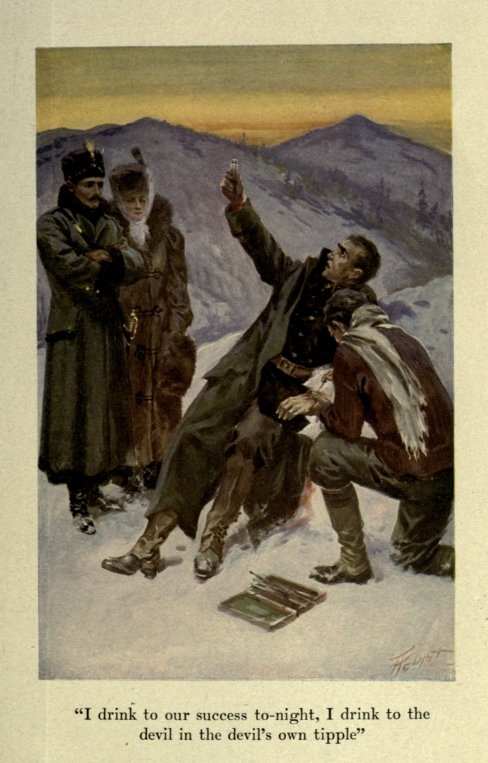
"Come, cut out the little lump of lead, doctor," said Bernhardt, "the little messenger that meant so much harm and achieved so little. Cut deep, Matti, and do not stint the knife. Only leave me my right arm and my brain; for to-night there will be great doings between the dusk and the dawn. Aye, Bernhardt," he went on, talking to himself, "you must rise to great heights. There will be friends to help you—a mad Yankee, a Puritan doctor, and the last of the Schattenbergs. A strange trinity! Nor must I forget my good councillor Archmedai. He must be very near me to-night. Herr Trafford, I have a flask at my belt; it is difficult for me to undo it with one hand. Kindly assist me. A thousand thanks! I drink to our success to-night, I drink to the devil in the devil's own tipple. Death to Karl! Joy to Trafford and his bride! And to Bernhardt——" he tossed down a full measure of his beloved absinthe—"to Bernhardt I drink"—his speech thickened and his eyes wandered vaguely over the group. He drank again—"To Bernhardt I pledge—the great unknown!"
"I drink to our success to-night, I drink to the devil in the devil's own tipple"
CHAPTER THIRTY RECRUITS
By the fireplace of the great hall of the Brunvarad, Karl was standing with his two Generals, Meyer and Von Bilderbaum. It was six o'clock, and with the falling of night a thin haze of clouds had swept up from Austria, and a mist of fine snow was descending with silent persistence on hill and roof, rink and run, on the inviolate forts of Meyer's planning, and on the battered remains of the Marienkastel. Within the palace abundant electric light and blazing logs lent cheerfulness to the great stone walls of the chamber, and the huge dark beams that spanned them. On the men's coats were rapidly diminishing tokens of the storm without.
"I have to thank you for your congratulations," Karl was saying as he shook the snow from his cap into the spluttering flame, "and to thank you more especially for the efforts which have rendered those congratulations applicable."
Von Bilderbaum tugged nervously at his huge white moustache.
"I had so little to do, sire," he protested. "If I had headed a ski charge——"
"You would probably not be here to receive my thanks," interrupted Karl with a kindly laugh and a hand laid roughly on the old General's shoulder. "I'm sure Frau von Bilderbaum will agree with me, that Meyer's tactical passivity was superb. Meyer, again I thank you. You have served me well."
"My motives for doing so were so obvious," drawled the Commander-in-Chief. "Had Bernhardt won I should probably have been shot; certainly exposed to danger and hardships. As it is, I shall sleep well to-night in a comfortable room, with the pleasing conviction that your Majesty's gratitude will ultimately take a tangible form."
Karl laughed heartily. His eye was very bright, and the burden of many years seemed taken off his wide shoulders.
"Upon my word," he said, "I sometimes pity my dear cousins of Germany and England, who rule over united and contented kingdoms. I have my anxieties, God knows, but I also have my compensations. Fair weather is a pleasant thing, but it is the storm that distinguishes the friend from the parasite."
The great bell of the Brunvarad clanged, and a minute later Bomcke announced Robert Saunders and his wife.
"We come to offer your Majesty our congratulations," said Saunders.
Karl took the Englishman's hand, and held it in a firm grasp.
"You are a lucky man," he said with a glance at Mrs. Saunders' radiant cheeks. "You possess the silver of friendship and the gold of love. I have only friendship, and therefore I prize the lesser metal at great value. If this day is the turning-point of my fortunes, and I become King again of a whole country, I shall not esteem my happiness complete unless my friend, Robert Saunders, is my right-hand man."
"Your Majesty's fortunes are assured," said Saunders. "The enemy is half-way back to Wallen by now."
"And is being pursued?" asked Karl.
"Von Hügelweiler begged leave to harry them," said Meyer, "and he is harrying them to such purpose that they have shed their guns one by one in their flight. Had it not been for the snow-storm he might have captured a hundred or two prisoners."
"I think," said Karl, "we will not push our victory further. We have won the day, and there has been sufficiency of bloodshed. To-night I am a happy man, and I wish no one ill. Meyer, give orders for Von Hügelweiler to be recalled. He has done his work well, and he shall have his reward."
Meyer withdrew with a shrug to the room where the telephone was installed.
"It is good to see your Majesty happy," said Mrs. Saunders in the silence that followed Meyer's departure. "There has sat a cloud on your brow ever since we have been in Grimland. And to-night for the first time the cloud is gone, and there is sunshine—the old sunshine of 1904—in your face."
"Aye, I am happy," assented Karl with a smile, "happy in my friends."
"Here comes another happy person," said Saunders with an upward glance to the staircase, down which the spacious person of Frau von Bilderbaum was slowly descending.
"Truly spoken," said Karl, for as the ex-maid-of-honour caught sight of her lord and master she quickened her footsteps to a bovine canter, and hurled herself enthusiastically on to the General's breast.
"My brave, brave Heinrich!" she gasped.
"Not at all, at all!" murmured the warrior, disengaging himself gently from the overpowering embrace. "I have done literally nothing. Now, if there had been a ski-charge——"
At this moment Meyer returned from the telephone.
"I have sent to recall Hügelweiler," he said; "but I must say I think the policy of mercy is being over-done. My forbears of Palestine were not half so kind when they got the Amalekites on the run."
"We are not dealing with Amalekites," said Karl, "but with Grimlanders, who happen to be our fellow-countrymen. But come, ladies and gentlemen, let us eat, drink, and be merry, for the storm is over and the sun is already gleaming through the thin edges of the cloud-wrack."
"I am not a weather prophet," said Meyer, "nor did Providence assign to me a sanguine temperament. We have hit the enemy hard, and we have drawn most of his teeth, but until Bernhardt's dead body is discovered stiffening in the snow I have no intention of celebrating a decisive victory."
"Don't do so, then, dear raven," laughed Karl, "but at least take food for your strength's sake. At any rate, I hear that Bernhardt was wounded in the attack on Sanatorium Hill."
"A wounded tiger is not a particularly innocuous beast," returned the Commander-in-Chief, "and there is a certain friend of Herr Saunders who has the unpleasant gift of rising superior to difficulties, and whom I fear is not even wounded."
The meal at the Brunvarad was neither very long nor very festive. Meyer's taciturn refusal to admit premature victory had a distinctly damping effect on the spirits of the company. Noises of revelry and jubilation were audible from the world without, feux de joie, rockets, songs of carousal and bursts of cheering broke in on the desultory conversation that flowed fitfully round the royal dining-table. But these sounds of jubilation only brought a deeper frown to the features of Von Bilderbaum, an added sneer to the lips of the Commander-in-Chief; even the King began to lose the exaltation that had so illumined his countenance.
"The Weissheimer is in his element to-night," said Meyer. "He believes himself a hero, and will get most heroically drunk. If Bernhardt's retreat is only a ruse,—as I suspect,—he will return in the small hours and capture a town guarded by fuddled swine."
"Is there no discipline in my army?" asked Karl irritably.
"Very little just at present," was Meyer's cool reply. "Our friends have stood by us at a pinch; it is too much to expect them to keep sober when the danger is apparently over."
Karl rose angrily to his feet.
"And are we to assume," he demanded, "that the garrisons of our redoubts are drunk at their posts?"
"Certainly not," said Meyer; "they are drunk in the streets and taverns of Weissheim."
"Then I am going where my men ought to be," said Karl. "If we can gather a sufficient body of sober men to hold Redoubt A, we can at least foil any attempt of Bernhardt's to rush the town in the dead of night."
"An admirable idea," said Meyer rising with the others, "and one which I was going to suggest myself. I can manage a searchlight, and Von Bilderbaum can train a mitrailleuse, and Herr Saunders can order a company of riflemen—if he can find them."
"Come," said Karl, making towards the door, "let us waste no time!"
"Your Majesty," said Mrs. Saunders, speaking with some hesitation, "this morning I asked my husband to let me accompany him to the Marienkastel. He refused, and with reason. But there is no danger in your quest to-night. I am not asking you to let me help guard the redoubts, but to use a woman's influence in obtaining recruits for your garrison."
"Bravely spoken!" said Karl. "Wrap yourself well in furs, dear lady, and come with us. Bilderbaum can swear, and Meyer can sneer, but a beautiful woman can compel by surer means."
"If Frau Saunders goes, I will go too," said the wife of General Bilderbaum. "I will shake these drunken soldiers into a sense of discipline, or I am not the wife of the bravest soldier in your Majesty's army."
The party of six sallied forth into the night. The snow had ceased falling, and the haze of clouds had drifted southwards, leaving the black dome of night clean and clear and jewelled with the steely brilliance of the winter stars. Through the courtyard they strode, over the squeaking snow, past the sentinels in their black and yellow boxes with their charcoal braziers, past the great piers of the entrance with their fantastic caps of overhanging snow, and as they went the sounds of revelry assailed their ears with louder note.
"Dissipation is the better part of valour," was Meyer's sneering comment, as the refrain of riotous song floated on the thin air. "It is so easy to be brave when the red wine is well within range, and the ammunition of the bier-halle is inexhaustible."
In the road were groups of men, soldiers and civilians, with linked arms, reeling gait, and a gift for making the night hideous with tuneless song.
Within fifty yards of the palace a bonfire had been kindled, and round its ruddy flames a wild dance, a veritable carmagnole of drunken triumph, was in progress. Here the royal party stopped to watch, and in a few minutes they were recognised.
"Hail, Karl the Twenty-second of Grimland!" cried a big-bearded man in a military overcoat. "Long live our gallant King!"
"Three cheers for Karl!" cried another, a burly form well muffled in a gigantic green ulster. "Death to the revolutionaries!"
Karl saluted gravely.
"Your sentiments are admirable, sirs," he said. "It would be perhaps even nobler if you put them into practice."
"I have been in the firing-line all day," answered the first speaker, "and Bernhardt and his men are two leagues from here by now."
"They may not be so in the small hours of the morning," said Meyer. "If they take it into their heads to return, they will have an easy task to overcome an army of sots."
The dance had ceased for the moment. The majority stood at a little distance from the royal party, ashamed to pursue their orgy, but resentful of its interruption. Two other figures, however, arm in arm,—as if to steady their unruly footsteps,—joined the group. One of them,—a small man with a big blonde moustache,—was clad in the uniform of a private. The other was wrapped in a sheepskin overall and had a woollen helmet pulled down over his ears and chin. The latter raised a guttural voice in husky protest.
"It is hard if we cannot celebrate your Majesty's victory in our own way!" he hiccupped. "A glass or two of wine hurts no man on a cold night like this." He steadied himself against the small soldier.
"Frantz will be all right in half an hour," said the bearded one confidently. "He has had but two or three cups of Kurdesheim, and his head is not over-strong. A few more dances round the bonfire and he will be as sober as any of us."
"Look here, my merry gentlemen," said Meyer. "You seem to me to be only partially drunk, and a brisk walk down to the forts would probably render you tolerably sober. If you will stand by us to-night and help us guard the town till daylight you shall be drunk for a week on end at the King's expense—I swear it on the honour of a Jew."
"That's well spoken," said the bearded man pensively. "I like to get jolly now and again, but I don't want to see those d——d Weidenbruckers stealing a march on us when we're in our cups. I'm for the King, I am, and to the devil with the Schattenbergs!"
"But to-morrow there will be no sport afoot," objected the man in the green ulster, "and to-night there will be grand fun in the 'Drei Kronen' and outside the Meierei."
A murmur of agreement came from the others.
"They say they're going to burn Father Bernhardt in effigy," said the fellow in the woollen helmet, "and that there will be free beer at the 'Drei Kronen.' The beer at the 'Drei Kronen' is good—very good."
It was Mrs. Saunders who spoke next.
"I think these men are quite right," she said coolly. "They have probably seen a little fighting from a distance, and are quite satisfied with that. They evidently prefer the smell of beer to the smell of gunpowder, and would be quite useless if there was serious work to do in the forts."
"What's that?" demanded the bearded man, in a sudden access of indignation. "We afraid! My father was a soldier, and so was my grandfather, and I have served his Majesty twelve years come Michaelmas, and one doesn't serve twelve years in the army of Grimland without learning something about ball cartridges. Afraid! Bah! I'd sooner spend a night in the trenches potting at old Bernhardt and his friends than drink the best brandy in the cellars of the Brunvarad."
"An admirable sentiment," said Meyer, "but one not apparently shared by your comrade in the green ulster."
"Oh, I like fighting well enough," replied the individual in question, "only it is cold work doing sentry-go when there's no enemy within six miles of you."
"For shame!" cried Mrs. Saunders. "Is your idea of military service the mere excitement of fine-weather fighting? Is not duty among your ideals as well as glory? We so far mistrust this retreat of Bernhardt's that we are going to Redoubt A to watch against any return of the rebuffed Weidenbruckers. Must we go alone,—four men who are wearied with long hours of anxiety and ceaseless activity, and two women who have never handled a rifle in their existence? Is that your creed of loyalty, your standard of a soldier's honour?"
"Rudolf," said the man in the ulster to the gentleman with the beard, "we must accompany our good sovereign and his friends to the fort. The lady is right. Duty is duty, and the beer of the 'Drei Kronen' can wait. I would have liked a dance outside the Meierei, but——" here he wiped an eye with the sleeve of his ulster—"I am a man of honour—and the beer will keep."
"Forward then!" said Meyer, striking while the iron was hot. "Down the hill to Redoubt A, and gather what recruits we can in the name of duty—and postponed beer."
CHAPTER THIRTY-ONE "A SURPRISE"
Onward they tramped in silence down the road towards the lower town, and as they went the half-moon pushed its gleaming disc through the melting curtain of cloud, and made of the night a frozen picture of fantastic beauty. To their right the snows of the Trau-altar and Eizenzahn streamed in silver floods towards the glistening plain, where, a full thousand feet below, the village of Riefinsdorf proclaimed itself with cheerful points of golden light.
The sounds of revelry grew distant, and the silence of the sleeping hills made itself felt. It was a prospect of unreal beauty, a duo-tone of violet-black and fairy silver, an impression of eerie shadows and unearthly light.
Saunders and his wife walked hand in hand. The day had brought them very close together, and they were well content. Soon a shuffling sound was heard, and a turn of the road disclosed a body of troops on skis ascending the hill from the opposite direction. The King's party halted in the middle of the way, and Meyer accosted the officer at their head.
"Who are you, sir?" he asked.
"Fifteenth Light Infantry," was the reply. "I am Captain Lexa, and we are returning from pursuing the enemy, according to orders."
Meyer cast his eye over the officer's command. There seemed about a hundred and fifty to two hundred riflemen, of whom a good score bore tokens of recent fighting. A few serious cases were covered with rugs, and were being pulled on small sleighs. A further inspection disclosed a number of prisoners in the centre, with hands roped behind their backs.
"You got into touch, I see," Meyer pursued.
"We pressed them closely," answered the Captain, "and at first so eager was their retreat that they abandoned all their guns one after another. Further away they rallied, and though they continued to retreat, they easily held us at bay, and went off at their own pace."
"Do you think they mean coming back?" asked Karl.
"No, sire. When we got orders to return they were six or seven kilometres beyond Riefinsdorf; and though we waited and watched them for at least half an hour, they continued to increase the distance, till they were lost to sight in the gloom and the snow."
"They're not the right stuff, those Weidenbruckers," said Von Bilderbaum. "They can only play a winning game. I don't think we shall see their faces again this winter."
"But what of Von Hügelweiler?" demanded Meyer. "He was in command of the pursuit. Has he been hit by the enemy?"
"No, sir."
"Then why in heaven's name does he not return with you?" persisted the Commander-in-Chief. "Has he been loyal for long enough to one side? Or does he, like Cato, prefer to espouse the losing side?"
Captain Lexa hesitated.
"I think he was mad," he said at length. "When your aide brought the order of recall, Captain Hügelweiler swore that he had been sent to pursue and would continue to pursue as long as his legs carried his body, and his arms a rifle. The aide backed his orders with the King's name, but Hügelweiler harangued his men and bade all such as loved the good game of war follow him to the bitter end. An impossible position was created, and the aide-de-camp ordered Von Hügelweiler's arrest. Before, however, the order could be put into execution, the mutinous captain was ski-ing down a steep snow slope in the direction of the enemy."
"You should have fired on him," said Bilderbaum.
"I gave the order, sir, but the men hesitated. Some of them had served with him earlier in the day, when he had displayed the most reckless courage. Besides, his refusal to halt, seeming rather an excess of gallantry than an act of mutiny, touched their imagination, and the few shots that rang out left him unscathed. Then the aide-de-camp, losing his patience, snatched a rifle from one of my units, knelt down in the snow, and brought down the Captain with a well-directed shot."
"And was he killed?" asked Saunders not unfeelingly.
"I think so. If not, he is dead by now, for he was badly hit, and the frost does not spare a man when he is bleeding from an open wound."
"Captain Lexa," said Karl, "you seem a capable and zealous officer, but your task is not over yet. It may be,—as you and General von Bilderbaum think,—that the Weidenbruckers have had enough hammering for a season, and have no intention of returning. But Meyer thinks otherwise, nor am I one to leave matters to chance. Bernhardt is a madman who is not subject to the ordinary influences of disaster. His lieutenant, Trafford, is a man of exceptional ability and resource. They are not likely, in my opinion, to acquiesce in a discredited return to the capital."
"They cannot be back at Weissheim for some hours yet, sire," said the Captain.
"I know. But our men are debauched with victory. They are out of hand. They have done their day's work, and they want to enjoy the price of their labours. You, Captain, seem a sober, honest soldier with a firm hold over your command. Can I trust you,—when you have rested your men and seen to their rations,—to return in an hour's time to Redoubt A to watch with us against a surprise attack from our enemies?"
"You may trust me to the death, sire," said the young officer with emotion, "and for every man of my command whom I fail to bring to the redoubt I will forfeit a year's promotion."
"Well spoken, Captain Lexa," said Karl with a smile. "While there are men like you in my army I can never despair of my fortunes."
The King and his little party stood at the edge of the road while the regiment resumed its upward progress. Lithe, sunburned men, untired by the long day's work, they glided swiftly by, one and all saluting as they passed the royal presence, and ultimately breaking into a shrill cheer as they vanished up the zig-zagging road.
"Thank God for brave men!" said Karl simply, when they had gone.
"We shall not need our friends here after all," said Saunders, referring to the quartet they had enticed from the festive bonfire.
"Aye," said the man with the beard. "You may want us yet. They are gallant fellows, those soldier lads, but they will be tempted up yonder, and the true Grimlander ever meets temptation half way."
"They will not fail me," said Karl, whose optimism seemed to have returned in full force. "My fortunes have turned, and I have no fears of their staunchness."
"Still it would be prudent to take these gentlemen with us," said Meyer. "Lexa and his men may be late, and there will be plenty for them to do."
"Oh, we are coming," pursued the bearded man. "I, too, believe Bernhardt means returning, and I would give ten years of my life to put a bullet through his wicked skull. As for the Princess Gloria, I would not spare that wanton little——"
"Hush, man!" interrupted Karl. "The Princess is a relative of mine."
"Aye, and one to be proud of!" went on the man defiantly. "They say that she and the American Trafford——"
"Never mind what they say," said Karl sternly. "The Princess is a wild, irresponsible girl, but she is as free from grossness as the snows of the Eizenzahn."
"They say——"
"Silence!" thundered Karl passionately, raising an arm as if to strike the speaker across the mouth. "I have known her since she was a tiny child, and though she has rebel blood in her veins, she is as clean and wholesome as a Weissheim night."
"Your Majesty is generous," said Von Bilderbaum.
"Maybe," assented Karl, "but I think we all share the same fault where the Princess Irresponsible is concerned. I, who have seen her grow from a beautiful child into a lovely woman, have still a soft corner in my heart for her; even when her schemings were most alarmingly successful I could never summon hate to my aid in my battle against her. And to-night, when fortune smiles upon me, I could wish to take her small hand in mine and read her a lesson on the iniquity of trying to dethrone one's first cousin once removed."
"Your Majesty is sentimental," said Meyer.
"It is natural to be so on such a night as this," was the King's reply. "This still, deep cold should freeze the cynicism even out of your nature. If the Princess fights she must be fought, and she must accept the fortune of war. But when this half-tipsy ruffian casts aspersions on her purity——"
"Hear, hear!" broke in the man in the green ulster. "Shoot the Princess if necessary, but spare her good name. I, in my humble way, am a great admirer of the pretty little Gloria. She has an eye that laughs, and as sweet a pair of lips as a poor carpenter like me may dare clap eyes upon. The devil I want to harry is the American Trafford, who mixes up with matters that don't concern him, and brings fire and sword into a poor country that has plenty of troubles already. We've vermin of our own, goodness knows, but this foreign weasel——"
But Karl was in a mood to hear ill of no man. He was convinced,—as he said,—that his fortunes had turned. His natural generosity was in the ascendant, and the magic of the glorious night had won him to a temper of broad benevolence.
"Oh, Trafford," he laughed, "Providence watches over men like that. They take risks and thrive on them. The bullet is not moulded that will pierce his tough American skin; and I rejoice to think it is so, for he is a most fascinating free lance. He saved me from death in the courtyard of the Neptunburg, and I have not forgotten the debt. Given a state of peace, and I would have him as my guest in the Brunvarad to discuss old battles over my best Tokay."
They had reached the place where the bob-sleigh track crossed the highway,—a point of the run much dreaded by the steersmen of racing crews.
"If we follow the path that borders the run," said the bearded man, "we shall save a quarter of a mile at least."
"That's true," said Meyer, "but the ladies must be careful where they plant their feet. If they step off the beaten track they will be up to their waists in soft snow."
"There is a moon," said the man in the ulster curtly, climbing over the snow bank and leading the way along the firm but narrow track. The others followed in single file, and for a time nothing was heard but the crunching of snow beneath their feet. For a space their progress lay among pine-trees, through whose black trunks and freshly-silvered branches the moonlight streamed in rays of elfish light. With its mysterious shadows and sharp silences the wood seemed a vast natural treasure house, wherein the frost jewels gleamed with rich profusion and the strange radiance of an enchanted dreamland. To walk with open eyes in such scenes was to lose touch with reality, to forget the sway and swirl of things material, the harsh absurdities of Grimland's civic strife. No wonder a silence fell on the pacing line.
The awakening was rude. As they emerged from the many pillared sanctuary of the forest there was a loud cry of "Now!" Someone, a man in a woollen helmet, threw a cloak around Karl's head and shoulders; someone, a man with a thick beard, struck Saunders heavily in the face, so that he fell back from the firm path into the yielding depth of the untrodden snow. At the same moment Von Bilderbaum, hastening to the King's rescue, was tripped up by the man in the green ulster, and measured his length violently on the hard path. Meyer, quick as thought, whipped out a revolver and fired point blank between the shoulders of Bilderbaum's assailant. Frau von Bilderbaum screamed, and in her emotion stepped off the firm path and disappeared backwards into a sea of incohesive crystals. Before Meyer had time to fire again a man was at his throat, a man with a beard hanging grotesquely from one ear, a man with mad passion in his eye and a nameless oath on his lips.
"Bernhardt!" gasped Meyer, fighting with the frenzy of a terror-stricken man. His assailant was his superior in weight and vigour, but fortunately for the Commander-in-Chief had but the use of one arm. Nevertheless, the arm that fought him was a limb of steel, the fingers of the sound member as relentless as the tentacles of a devil fish. The Jew sweated and struggled like a man in a nightmare. For a moment, choked and breathless, he was overborne; then relief came. Bilderbaum had regained his feet; the old soldier's sword was drawn from its scabbard, and the ex-priest hissed his last shuddering blasphemy into the night air.
"Robert, Robert, are you hurt?" asked Mrs. Saunders, in dire distress, of her struggling spouse, who was making heroic efforts to wade through the waist-deep snow to the terra firma of the trodden path.
"Karl—quick!" urged the breathless Englishman, at length making his voice heard now that the struggle was terminated.
They looked where Karl had been—and there was no one. The man in the woollen helmet, too, had disappeared, and the short individual in the private's uniform was likewise nowhere to be seen.
"A bob-sleigh,"—explained Saunders, still short of breath, regaining with assistance the coveted foothold of the path,—"they pushed him on to a bob-sleigh which was anchored to the bough of a fir-tree. The little soldier man took the helm, and the other sat guarding the King with a revolver in one hand and the brake-lever in the other."
"After them!" cried old Bilderbaum excitedly, letting go his wife's hand so that she relapsed again into the treacherous quagmire of mocking powder. "After them!"
"After them!" repeated Meyer scornfully, rubbing his bruised throat. "We might do an heroic eight miles an hour down this slippery path. They will be going forty, at least. We might as well chase the moonbeams!"
"What are we to do?" asked Saunders desperately.
"That is a question that fools always ask themselves when their folly finds them out," returned Meyer bitterly. "Unfortunately there is no answer to it."
CHAPTER THIRTY-TWO THE CONQUERING KING
"Brake!" called a high feminine voice, issuing strangely from the moustached lips of the soldier who steered the abducting bob-sleigh.
The gentleman in the woollen helmet applied the brake, and a sharp turn in the run was negotiated in safety.
"How is Karl?" asked the Princess Gloria, for it was she who was manipulating the wheel at the "bob's" prow.
"Coming to, I think!" Trafford shouted back; "this cold air would restore a corpse."
They were in the straight now, and the pace was terrific. Downward they tore through realms of icy air, while the night wind pushed at their throats, brought floods of moisture to their eyes, and roared a wild melody in their deafened ears. It was an exhilarating experience, and even without the added excitement of their desperate deed would have set the blood racing in their veins. But with the excitement was mingled a very definite sense of shame, in Trafford's case at any rate. Their action had been justified by success, and morally, perhaps, by its absolute necessity in their desperate plight, but it painfully resembled an act of treachery.
"What became of Father Bernhardt and Doctor Matti?" asked Gloria presently.
Trafford leaned forward and answered at the top of his voice:
"They must have been killed! Our weight started the 'bob' before I intended, and we were a hundred yards down the track before I could get my hand to the brake. It was impossible to go back."
"Will they catch us, do you think?"
"Impossible! We are travelling at the rate of an express train. Another twenty minutes of this, and we shall reach the point where Colonel Schale's flying detachment has arranged to wait for us."
For a while they travelled without further speech, save when an imperious "Brake!" from the Princess indicated that the pace must be checked in order for a corner to be rounded without mishap.
Under the stone viaduct of the railway they flew, winding in and out of pine woods, sometimes catching a glimpse of the golden lights of Riefinsdorf, and sometimes of the moonlit ivory of the mighty Klauigberg.
"You are sure that Father Bernhardt and Dr. Matti must have been killed?" asked Gloria at length.
"Without reasonable doubt. They have gone to their long homes, which, according to all theory, should be widely separated. That's as may be. The man I'm sorry for is poor Karl, who was feeling really happy till I clapped the drugged antimacassar over his head."
Trafford waited to hear his sentiments echoed, but Gloria said nothing. Her silence pained him; under the circumstances it seemed ungenerous.
Then occurred something which cannot be verbally described,—so far as the sensations of the three human beings were concerned; for, to be suddenly checked in a lightning descent and hurled incontinently into deep snow, produces a complexity of emotions incapable of being recorded through the medium of ink. What happened to the bob-sleigh is a matter of more precise fact. The front part struck violently against some hard object, the steering runners were wrenched round at right angles to the body of the sleigh, the whole thing skidded viciously on the ice, and finally buried its nose in the flanking wall of snow.
"Are you hurt, Gloria?" called out Trafford from his couch of crystals, as soon as he had sufficient breath to frame the question.
There was no answer. Within a few yards of him Karl was sitting up with an expression of dazed bewilderment that was almost comic to behold. Trafford rose and made his way with infinite difficulty to the run. Discovering his revolver lying by the side of the track, he picked it up and examined it. It was uninjured and the cartridges still undetonated.
"Gloria!" he called.
"Yes—I'm all right," came a voice somewhere from the neighbourhood of Karl. "I'm only a bit shaken. I couldn't answer before. I hadn't—any—breath."
"No bones broken?" he persisted.
"None whatever. What happened?"
Trafford was peering thoughtfully at the track.
"Curling-stones," he answered laconically. "When we enfiladed Saunders' trench we sent Major Flannel's stones on a long journey—but not long enough, it appears. There has been a small avalanche of snow across the track, due, I presume, to the vibration of the guns. This held the stones up in the middle of the fair-way. We might have ploughed through the snow, but the granite smashed us."
"What's to be done?" asked the Princess after a pause.
Trafford stepped over the snow-bank and examined the "bob." The runners were twisted and half wrenched from the wooden framework. The steering-wheel was jammed, and refused to respond to the most strenuous efforts; the brake-lever was snapped off short.
"The midnight express doesn't run any further," he said.
"What on earth are we to do?"
He answered her question with another.
"How's Karl?"
The outraged monarch replied in person.
"I am tolerably well, thank you," he said. "I have been conscious for some time, and have listened with some amusement to your commiserations of my lot. The little catastrophe which has just occurred has dispelled the last lingering fumes of the chloroform with which you rendered me hors de combat."
Trafford said nothing, but knitted his brows in perplexed thought.
"We are face to face with a very serious problem," he said after a full minute's meditation. "Gloria, are you sufficiently recovered to join me on the path here, or shall I come and help you out of the soft snow?"
"I will come to you," she answered, suiting the action to the word, and ploughing her deep way to his side. The blonde moustache had parted company with her fair lips, and her fallen shako had released a charming disorder of dark tresses. In her great overcoat, her nether extremities concealed in the snow, she looked once more what she really was,—a young girl of singularly fascinating aspect.
"We can't stay here all night," she said, when she had won her way to the path, "and we cannot well reach the spot where Colonel Schale is awaiting us."
Trafford shook his head.
"Assuming we could walk so far," he said, "and assuming our friend over there would consent to accompany us, we should be overtaken by the pursuit party they are bound to send after us."
"It's all hopeless," she said wearily.
"You have lost confidence in my ability to help you out of difficulties?" he asked.
"You are resourceful—indomitable almost," she conceded, "but you cannot fight Fate."
"I am not trying to."
"But I am. Had it not been for this wretched mishap everything would have been splendid; we should have returned to Weidenbruck with Karl our prisoner. I should have been firmly established on my throne, and you——" she broke off suddenly and added a little sadly: "As it is, we are checkmated within sight of victory."
"You do not blame me for your disappointment? You concede that I did my best?"
His question was dispassionate. She answered it with generous words, but without enthusiasm.
"You did more than any other man could have done. Indeed, I am not complaining of you; I am complaining of Fate."
"Personally, I have a pathetic and unconquerable confidence in Fate," he retorted.
"You—yes. But what is my position? Bernhardt is dead, Matti is dead, Karl is our prisoner only so long as he consents to be. You and I are alone,—alone in the dead of night, in a land of snow and frost. We must find shelter, or perish. We must creep down to Riefinsdorf for a night's lodging, for the road to Wallen is long and will be traversed, for a certainty, by our pursuers. Do you not see now why I complain of Fate? Lying slander has coupled our names none too pleasantly before; what will it say when it has visual facts instead of idle gossip to build upon?"
"Slander will say a good deal," he replied, "but if we wish to give it the lie, the register of the Chapel Royal can always retort with an unanswerable argument."
Gloria said nothing. Moonlight, which is infinitely more beautifying than sunlight, had put a strange fire into her eyes, and turned her flesh to clearest ivory. Trafford, had he been a heathen, would have bowed down and worshipped, so goddess-like was her still pose, so unearthly the cold, soft shadows that gave roundness to her cheeks. As it was, he held his breath and clenched his hands in a spasm of passionate appreciation. Was ever anything so fair under the stars, he asked himself?—did ever such mystic fire burn in human eyes, or frosty breath issue from such perfectly-shaped lips?
In another instant, however, Trafford unclasped his hands, and his fingers trembled, for a great wrath had suddenly mastered him and was shaking his frame as a winter tempest shakes the dead bough of a blasted tree. Gloria,—his Gloria,—who might have loved, who might have fulfilled the mission of her splendid womanhood, had fought down the promptings of her heart and given herself to ambition and the deadening lust of place and power. He felt an almost overpowering desire to seize her roughly in his arms, to break her in his grasp, to crush the supple limbs in an act of ferocious but just retribution. Fortunately his brain steadied itself in time, the mad impulse was checked, and,—as was the way with him,—the paroxysm gave place to a singularly clear and controlled condition of mind.
"Your Majesty," he called out to Karl, who was still maintaining a recumbent position in the snow, "are you sufficiently recovered from your various mishaps to join us here on the path and discuss the situation?"
For answer Karl struggled to his feet and made towards them. He appeared very pale in the moonlight, but there was the same look in his eyes as when he had faced the rebel throng in the courtyard of the Neptunburg.
"You perceive our difficulties, of course," Trafford began. "A week ago we set out from Weidenbruck to accomplish a certain object: that object was, in plain language, to wipe you off the earth, or bring you back bound to the capital. We employed open force, and failed. We employed the gentle arts of abduction, and succeeded—up to a point."
Karl nodded. "I follow you," he said curtly.
"Our motives were frankly selfish," Trafford went on. "The favour of the good Weidenbruckers had to be retained, and it was necessary to do something notable to obtain permanent possession of their good graces." He paused a moment, toyed with his revolver, and looked fixedly at Gloria and then back again at Karl. Then he went on deliberately: "If we return without having killed or captured one, Karl, styling himself King of Grimland, we shall be returning to a nest of hornets. You see my point?"
Karl eyed the revolver thoughtfully.
"Yes, I see your point," he said; "I saw it long before you put it before me. Having failed to abduct me, only one course is open to you. Here I am, unarmed, alone, scarcely recovered from an anæsthetic, shaken by a fall. The moon gives ample light, and your revolver is loaded."
"Precisely," said Trafford. "My course is so obvious! A pressure of the first finger, a puff of smoke, and a brave man groaning in the snow! There are but two objections: firstly, I am not a butcher; secondly, you took it upon you a little while ago to defend the honour of my wife!"
"Your wife?"
"Yes. The lady who is now more or less disguised as a private of the line, did me the honour of bestowing on me her hand in the Chapel Royal of the Neptunburg. When Bernhardt,—playing his part,—hinted at her shame, your kingly spirit refused to hear ill even of your enemy. For that,—if for no other reason,—I am steering clear of regicide."
Karl passed his hand across his brow, as if the news was too much for his dazed senses.
"You and Gloria von Schattenberg are man and wife?" he gasped.
"On paper," Trafford affirmed, "on paper only. In reality we are nothing to each other, and as events are turning out, never will be anything to each other. But I am a proud man, proud of the secret bond between us, though our vows were meaningless and of no value; and because you took it upon you to defend the honour of my 'paper' spouse, I give you your life and wish you God-speed."
Karl's features twitched in the moonlight, and his breath seemed to come with difficulty.
"You are a generous foeman," he said at length.
"Not more so than yourself," Trafford retorted. "When I,—also playing my part,—swore death to 'the cursed American Trafford,' you vowed you would like me for a guest, with whom to fight old battles over old Tokay. I am fond of Tokay," Trafford went on, "and I am fond of reminiscences; also I know a man when I see one. Karl, King of Grimland, will you give me your hand?"
Karl stretched out his hand and gripped the other's. He seemed searching for words, but no words came.
Trafford read many things in the labouring chest and the dimmed eye, and his heart kindled.
"You call me generous," he went on, "but I am generous with another's property. Grimland is yours or Gloria's; mine it never was. Fate has somehow set me as umpire in a great quarrel; and being holder of the scales I must perforce be impartial. Supposing I trample conscience under foot and do a nameless deed under the moon: suppose we return to Weidenbruck triumphant as Queen and consort, what then? Bernhardt, who understood the temper of the Grimland canaille, who ruled them as a rough huntsman rules a pack of hounds—Bernhardt the apostate, the absintheur, the distorted genius whose counsels could alone have kept us in power—is no more. Matti is dead—Matti who, as city prefect, did more with his reforming zeal to make the name of Schattenberg stink in the nostrils of the citizens than any enemy could have done. Weidenbruck is yours for the asking! The nobility were never against you; the people were ours only in their meaner moments. You left the capital as a fugitive; you will return as conquerer, and the people will cry, as I cry now: 'Long live Karl the Twenty-second, of Grimland!'"
Still Karl maintained his frozen silence; not a muscle of his face moved. Only, there was a gleam in his eyes that seemed to look beyond the stark pine trunks and the barren fields of snow; that seemed to project his vision over forty leagues of hill and plain to the turbulent city on the Niederkessel, where a shouting throng acclaimed him as their King. For a moment his whole face lit up with a wonderful glow, and then his emotion seemed to master him. He was a strong man, but he had been through much, physically and mentally, and the last sudden vicissitude of his fortunes won a sharp reaction. His heart beat in great thuds, and the stiff vertical trunks of the forest pines bent and swayed before his eyes. He leaned against a big tree and covered his face with his hands.
Trafford turned and faced Gloria. He expected reproaches, anger, tears of despair. He had given away her kingdom to her enemy. The strong plant of her ambition he had cut at the very tap-root. He who, by hardening his heart, might have made her a queen, had preferred by an act of mercy to make her a fugitive! He steeled himself against the expected hurricane of bitterness. He looked, and as he looked he rubbed his eyes in amazement. The face of Gloria von Schattenberg was the face he had seen in delirium at the old house at Wallen,—the face of a woman with a loving heart and a soul of flame. The eyes that met his were bright with a splendid joy, overflowing with a great tenderness.