Front matter (continued 2)
Reading edition
The Princess had not taken her eyes off of the American since he had last spoken.
"He has energy," she mused, looking into space now, "also the capacity for inspiring enthusiasm, and I am not at all sure that he has not the instinct of a born tactician."
"But I am," Saunders broke in bluntly. "Princess, we have the honour of wishing you good-night!"
The Princess laid a delicate hand on the Englishman's arm.
"Herr Saunders," she said, "I will ask you to see me home."
Saunders shook his head.
"You must excuse me," he said. "To-night, I am neutral, but neutral only. I am the King's guest and must not aid the King's enemies."
"Good loyal man!" exclaimed the Princess. "Plus royalist que le roi!" And then turning to the American: "And Herr Trafford? He will not refuse to perform a small act of courtesy?"
"Trafford accompanies me!" declared Saunders firmly.
"I'm hanged if he does!" spoke up Trafford. "The lady wants to be seen home—and I'm going to do it if I swing for it!"
"The lady wants to be seen home—and I'm going to do it if I swing for it!"
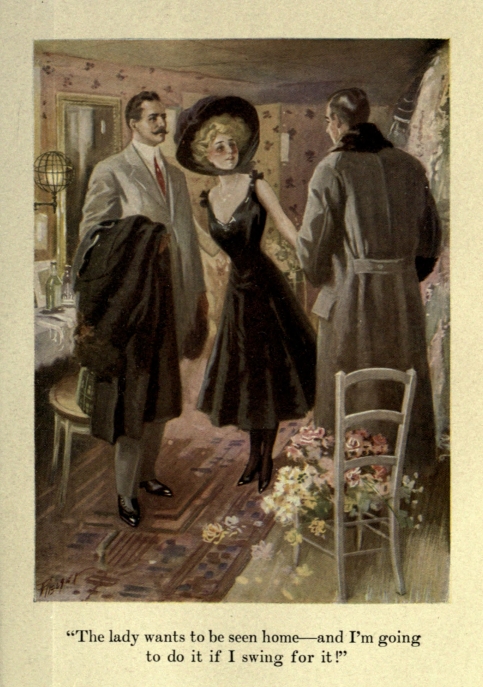
The Princess transferred her hand to Trafford's arm.
"Thank you," she said with a bewilderingly grateful look up into his face.
"Nervy, you're a fool—a bigger fool than ever I believed you to be!" exploded Saunders.
Trafford's only answer was a most complacent grin.
"Good-night, Herr Saunders!" said the Princess in the sweetest of accents. "Remember me kindly to your wife and other Royalists. We may meet again or not—my impression is that we shall.... If so, remember that laughter is not always a symptom of child's play."
"Good-night, Princess!" returned Saunders with an exaggerated low bow. "Forgive me, won't you, if I take the threatened revolution lightly? The possibility of your sitting on the throne of Grimland," he went on with another obeisance, "opens up such delightful prospect that I shall fight against it with only half a heart. Still, I shall fight against it. Good-night, Prin—Your Majesty!"
CHAPTER SEVEN CONFIDENCES IN A WINE SHOP
Nervy Trafford—comfortably covered by a warm rug, seated in an open sleigh next to a young lady of exalted birth, romantic temperament, and unimpeachable comeliness—was almost a happy man. It was not that he had fallen in love at first sight, that he had found swift consolation for his recent disappointment in a rapidly-engendered passion for the fascinating claimant to the throne of Grimland, that he was capable of offering any woman the fine spiritual worship he had accorded to the adorable Angela Knox; but to his temperament admiration came easily—and he had dined well. He had been the auditor of a wildly exciting song, had made the acquaintance of the inimitable singer, and because there was wine and music in his blood, and much beauty by his side, the nightmare of his past depression vanished into the biting air, and his pulses stirred to a Hit of amazing exhilaration.
"By Jove!" he exclaimed to himself, stealing a side glance at his companion's bewitching profile, "Saunders is right—life is too valuable an asset to fling away in a moment's madness. There is a beauty of the body and a beauty of the soul, and if the two are perfectly combined in only one woman in the universe, is that any reason why I should not admire a tip-tilted nose or a curved mouth when Fate puts them within a hand's breadth of my own scrubby cheek?"
"Do you know Weidenbruck, Herr Trafford?" the Princess broke in on his silent philosophising.
"Little beyond the Hôtel Concordia," he replied. "Where are we now?"
"The Domkircheplatz. That is the Cathedral."
They were crossing a big open space, well lit, planted with trees, and adorned in its centre by a big group of statuary. To their right was a huge gothic building—a high ridged intricate structure of red sandstone—with a tangle of fretted pinnacles and flying buttresses, and a couple of lofty towers that stood out black against the starry heaven.
"A fine building!" commented the American.
"That is where I am going to be crowned," said the Princess, and she laughed a fine, free, silvery laugh that thrilled her companion with admiration.
"That's the right spirit," he said gaily; "and what's this depressing-looking place in front of us?"
"That's where I shall probably be confined," was the cheerful retort.
The building in question occupied the entire side of the square, and was as gloomy as it was vast. It was a plain rectangular structure totally devoid of ornament, and constructed of enormous blocks of rough hewn stone; irregularly spaced windows broke its sombre front with narrow slits and iron gratings, and a high-pitched roof of ruddy tiles crowned the grim precipice of enduring masonry.
"That's the Strafeburg," concluded the Princess, "the Bastille of Weidenbruck!"
"I see myself rescuing you from that topmost window," ventured Trafford.
The Princess turned half round and looked at him curiously.
"Thanks," she murmured, "but I shall keep outside as long as I can. As a foreigner you should visit it—as a sight-seer. It is a most depressing place, but there is a very valuable collection of armour and a collection of instruments of torture without its equal in Europe."
"Is it still used as a prison?" asked Trafford.
"They say not." There was a meaning behind her qualified denial and Trafford demanded it. "Between official statements and actual facts there is apt to be a serious discrepancy in this unfortunate land," she replied. "Officially, no one resides in the Strafeburg but the caretaker and his daughter. As a matter of fact, I am told that several political prisoners are still rotting in its dungeons."
Trafford shuddered. He was a very humane man,—despite his explosive temperament. His companion noted keenly the effect of her words, and went on:
"Officially, also, the instruments of torture went out of use one hundred and fifty years ago."
"You mean——"
"I mean," she continued, "that our dear humane monarch does not stick at trifles when his interests are threatened."
Trafford opened his eyes wide, and regarded his companion with amazement. In his curious, excitable brain was a largely developed loathing of cruelty. Hard knocks he was prepared to give or receive in the world's battle, big risks to life and limb he was prepared to incur or inflict with heedless impartiality, but deliberate cruelty, the malicious and intentional infliction of pain on man or brute, always roused him to a frenzy of wrath. The Princess read his look and silence.
"The Archbishop of Weidenbruck, a political opponent of King Karl's, is said to have met a peculiarly terrible end," she said meaningly.
"Impossible!" muttered Trafford.
"Impossible things happen in Grimland. It is impossible, of course, that you should side against your friend, Herr Saunders, and your prospective friend, King Karl——" and she touched his hand with an unconscious impulsive movement,—"and help me in my legitimate ambitions."
Her words were in the nature of a suggestion, almost a question.
Trafford answered them between his teeth.
"That is the sort of impossibility that comes off," he muttered.
"You mean it?" demanded his fair companion, and her eyes were pleading as they had pleaded with Captain von Hügelweiler in the Thiergarten.
Trafford drank deep of their glance, and it intoxicated him.
"When I see these picturesque buildings," he returned, "with their garlands of snow and cornices of icicles, I feel I am in fairyland. And in fairyland, you know, the poor beast is changed into a handsome young man and marries the beautiful Princess." He was not insensible of his boldness, and carried it off with a laugh. "I feel the transmogrifying effects of this fairy kingdom already."
"And you are beginning to feel a handsome young man?" asked the Princess gaily.
"I have felt it this past quarter of an hour, Princess," he answered, twirling at his frozen moustache. "Already wild hopes are stirring in my bosom."
"You are not going to propose, are you?" she asked calmly, but with a most delicious quiver of the lips.
Trafford looked at his fair interrogator steadily a few seconds before replying. If ever encouragement was legible in bright eyes and challenging smile, it was writ clear in the facile features of the Princess von Schattenberg. Again he drank deep of beauty and his brain reeled among the stars.
"Not exactly a proposal, but I'll make you a proposition," he said in a voice typically American in its business-like tone.
They had entered a narrow side street, and the driver was pulling up his horse before a disreputable-looking wine shop. Dismissing the sleigh the Princess led the way into the building through a low, malodorous room—where a number of men were swilling beery smoking, and playing dominoes—and penetrated to inner chamber.
"And is this your home?" inquired Trafford.
"One of them," was the reply. "An outlaw must sleep where she can—it's wise to vary one's abode."
An old man in shirt-sleeves and apron entered the room and demanded their pleasure.
"We want nothing except solitude," said the Princess. "May we have that, Herr Krantz?"
"Most certainly, your High——, gracious lady. You will not be interrupted unless——"
"Thanks, good Herr Krantz, I understand."
The old landlord inclined his bald head and quitted the shabby apartment. The Princess motioned to her companion to be seated, pointing to a chair at a small table, then taking a seat opposite him, she rested her pretty head on her hands, her elbows resting on the table, and surprised him by suddenly popping out:
"And now about that proposition of yours——"
Trafford's countenance indicated that he thought that the bantering note in her voice and words was distinctly out-of-place, but notwithstanding he drew his chair closer and began:
"Princess, we have not known each other long——"
"We have not known each other at all," she quickly interrupted.
"Pardon me," corrected Trafford, with a fierce energy that always possessed him at a crisis. "You diagnosed me admirably in your dressing-room at the Eden Theatre. With equal perspicacity I have diagnosed you on our frosty drive hither. Shall I tell it?—yes? Well, then, a nature ardent but pure, fierce without being cruel, simple without being foolish. I see youth, birth and beauty blended into one exhilarating whole—and I bow down and worship. To a heart like yours, nothing is impossible—not even the capacity of falling in love with an adventurous American. I do not make you a proposal of marriage, but a matrimonial proposition." He paused to note the effect of his words before concluding with: "Now then, if by my efforts I can secure for you the throne of Grimland, will you reward me with your heart and hand?"
The Princess drew in a long breath, half-astonishment, half-admiration.
"That is one of the impossibilities that does not come off—even in Grimland," she told him at last.
"Listen," Trafford went on impetuously, "I shall only ask for my reward in the event of your being crowned in the Cathedral of Weidenbruck, and in the event of your acknowledging of your own free will that I have been mainly instrumental in winning you your sovereignty."
The Princess bit her lips and nodded silently, as if weighing his words. Something, however, impelled her to make the obvious objection.
"In the event of my being crowned Queen of Grimland," she reminded him, "I shall not be permitted to marry whom I will. If I married you without the consent of my counsellors and Parliament the marriage would be, ipso facto, null and void."
"All I ask is your promise to go through the ceremony with the necessary legal and religious forms."
The Princess remained a moment in silent thought. Then she broke out into her merriest laugh.
"We are building castles in the air," she hastened to say. "Yes, I promise—on those conditions. But you perceive the badness of the bargain you are making? A marriage that will be no marriage—a contract that will not be worth the paper it is written on?"
"I will chance its validity."
"In that event and on those conditions you shall have my hand."
The Princess stretched forth her right hand.
Trafford took it and pressed his lips to it.
"And heart?" he demanded.
As in the Thiergarten with Von Hügelweiler, the Princess Gloria hesitated momentarily, but long enough for the framing of a lie. But this time something strangled the conceived falsehood before it passed her lips.
"Alas!" she faltered. "Nature forgot to give me a heart." The words were seriously enough spoken, but somehow they did not ring true to him.
"You are incapable of love?" he asked.
The Princess flushed deeply as slowly she scanned the man who faced her. It was patent that a battle was raging in her heaving bosom. For a full half-minute silence reigned, a silence broken only by faint murmurs and the clink of beer glasses from the outer room. And all the time Trafford's face preserved an expressionless immobility, his eyes a gleam of stern directness. The Princess heaved a deep sigh. The battle was over; something was lost, something was won.
"Herr Trafford," she began in a mechanical voice, "I want to tell you the history of my maiden fancies. At the age of seventeen—when staying at Weissheim, at my father's schloss, the Marienkastel—I fell in love with a young officer in the Guides. He was handsome, aristocratic, a gallant man with a refined nature and a superb athlete as well. He loved me dearly—was more to me than my father, mother or anyone or anything in the kingdom of Grimland. But my infatuation was divined, and we were separated. I wept, I stormed, I vowed nothing would ever comfort me. Nevertheless, in six months I was a happy, laughing girl again with an intense love of life, and only an occasional stab of regret for a heart I had sworn to call my own."
Trafford's face showed his sympathy, but he did not speak.
"Then came the winter of 1904," the Princess went on with the same unemotional tone. "In our unsuccessful rebellion of that fatal winter an Englishman performed prodigies of valor. It was mainly owing to his foresight and daring that King Karl saved his throne—and my father and brother met death instead of the crown that was within their grasp. Later, it is true, this same Englishman saved my life and procured my escape from Grimland. But, even so, would any girl not dowered by Providence with a fickle disposition permit any feeling to dwell in her heart other than hate and horror for such a man? And yet, I was on the point of experiencing something more than admiration for this fearless Englishman, a second conquest of my heart was imminent"—she paused to scrutinise the face of the man at her side, watching keenly for some signs of disapproval—"when it was nipped in the bud, strangled in its infancy, if ever there, by his choosing a mate elsewhere. So, once again I was fancy free. What then is love—my love?" she exclaimed wistfully. "A gust that blusters and dies down, a swift passing thunder-storm, a mocking dream,"—her voice quavered and sank,—"a false vision of a sun that never rose on plain or on mountain."
Trafford met the sadness of her gaze with eyes that twinkled with a strange kindliness. The story of her life had moved him strongly. At the beginning of their interview he had felt like a seafarer listening to the voice of the siren. He had been bartering his strength and manhood for the silken joys of a woman's allurements. His native shrewdness had told him that he was being enticed less for himself than the usufruct of his brain and muscles; but the bait was so sweet that his exalted senses had deemed it more than worthy of the price he paid. Had the Princess Gloria avowed a deep and spontaneous passion for him, he would not have believed her; but he would have been content, and well content, with the agreeable lie. But she had been honest with him,—honest to the detriment of her own interest.
"You don't dislike me, do you?" he blurted out, at length.
"On the contrary," she responded frankly, "I like you well, Herr Trafford."
"It would be sad otherwise," he sighed, "for I like you exceedingly well."
And at that she put her hand bravely on his shoulder and smiled at him.
"Never mind, comrade," she told him, "your heart is big enough and warm enough for two."
"My heart!" he exclaimed in a most lugubrious way, "my heart is several degrees colder than the ice on the Rundsee;" and added with terrible lack of tact: "whatever of warmth and fire it possessed was extinguished last Christmas Eve."
The Princess removed her hand from his shoulder in a manner that should have left no doubt in his mind of the thought behind it.
"Princess," he went blindly on, "you have told me your story, let me tell you mine—it is brevity itself."
The Princess inclined her head.
"I fell in love with a young lady named Angela Knox—an American;"—and his tone was fully as responsible as his words for bringing his companion's eyes back to his with something of the scorn his clumsy love-making deserved;—"the young lady, Angela Knox, refused me. I tried to blow my brains out, but Fate and Saunders willed otherwise. The latter advised Grimland as a hygienic antidote to felo de se. Behold, then," he concluded with a sigh, "an able-bodied man with an icicle in his breast!"
Trafford spread out his hands in an explanatory gesture, and then for the first time he noted the heightened colour in the Princess's cheek, that her eyes were aflame, and that an explosion of some kind was imminent.
"And you had the impudence to make love to me!" she cried in that wonderful voice that had captivated audiences with every intonation, from the angry tones of a jealous grisette to the caressing notes of the ingenue. "To amuse yourself by feigning a pure devotion——" But the Princess's words failed her, and the hand of a Schattenberg was raised so threateningly,—at any rate, so it seemed to Trafford—that in surprise and consternation he rose from his chair, and as he did so, his head came in contact with the electric light, which hung low from the dingy ceiling. Simultaneously the white fire in the glass bulb was extinguished to a thin, dull red line, and in two seconds they were in total darkness.
CHAPTER EIGHT THE BARGAIN
For several seconds Trafford stood silent in the darkness, thinking furiously. What was the correct thing to say or do in such an unusual, almost painful, situation, he had not the faintest idea. But before speech suggested itself to his puzzled brain, his companion—not wholly successful in smothering the merriment that had instantly replaced her affectation of anger—had checked him with a warning "hush!"
Noiselessly the Princess tiptoed to the glazed partition that separated the inner chamber from the wine-shop, and drawing back a curtain gazed cautiously through the chink.
A couple of men—as indigent in appearance as the rest of the throng—had entered the shop and were talking to the landlord. The latter was all civility and smiles, but his customers were regarding the newcomers with glances of deep suspicion and resentment.
After gazing a few seconds, the Princess returned to Trafford, and taking him by the hand led him rapidly through another door into a street at the back.
"Krantz extinguished the light," she whispered. "It was not your head, stupid, that did it! It was the danger-signal agreed upon between us—there are a couple of police agents in the shop."
The touch of melodrama delighted Trafford, and the presence of danger destroyed much of his embarrassment. They were in a narrow lane, lighted at rare intervals, and half choked with snow. A bitter wind blew cheerlessly between lofty houses, but the stars burned clearly in the deep violet of the heavens.
"Where now?" he asked briefly.
"Home," answered the Princess curtly. "I'm going home—good-night!"
Trafford stood irresolute. A hand was offered him in farewell. It might be tactless to enforce his society any longer, but there were reasons—the hour and the gloom of the street if nothing else—why he could not leave her alone.
"I promised to see you home," he protested stubbornly. "I keep my promises."
"You are foolish," she returned, accepting the situation and walking briskly down the street. "This quarter of Weidenbruck is anything but a safe one, despite its present tranquillity. There are queer folk dwelling in these gabled old houses—men who live by the knife and the garote! You would be wise to reseek the civilisation of the Hôtel Concordia."
"Is it necessary to insult me?" bristling.
"Ah, but you found it necessary to insult me!" she retorted.
"In what way?" staring at her in astonishment.
"By making love—such love! You nearly blow your brains out for a silly American girl, and then have the impertinence to ask me—me, the Princess Gloria von Schattenberg—to marry you, informing me casually that your heart is dead and cold."
"But your heart is dead and cold, too," he argued fatuously. "And you were not willing to accept me. It seems that we are in the same boat. We offered too little, and we asked too much."
The Princess was momentarily silenced by his logic; womanlike, however, she refused to let things end in a logical conclusion.
"I am terribly angry with you," she persisted, nevertheless, with what Trafford could have sworn was a veritable wink.
"So I was led to suppose," he replied, rubbing his head.
His words and their accompanying action, tickled the Princess's risibilities, always lying just beneath the surface. She bit her lips in a desperate effort to control, but in a moment her fine, fearless laugh rang out merrily in the deserted street. Trafford gazed in amazement at his volatile companion, and then he laughed, too.
"Don't imagine that I am not angry because I'm laughing," declared the Princess. "I have—unfortunately, perhaps—a painfully acute sense of humour. I very often laugh when I am feeling most deeply."
But Trafford having commenced to laugh, gave way to roars of laughter. He had been accorded such varied treatment, such swiftly-changing moods, that he was quite uncertain as to what the next moment would bring forth; and the atmosphere of political intrigue and romantic adventure—with its picturesque setting of ancient houses and deep snow—lifted him into such regions of pure unreality that he laughed for very joy at the exhilarating absurdity of it all.
"Great Scott! To think I have lived eight-and-twenty years without discovering Grimland!" he exclaimed when able to catch his breath. "Princess, you must indeed forgive me.... It seems, besides dead hearts, we have in common a most lively sense of the ridiculous."
"I'll forgive you when you have seen me home," she replied. "But I absolutely repudiate the bargain we made at Herr Krantz's wine shop. We may have much in common ... but surely you don't suppose that I would marry a man with a dead heart?"
"As to the bargain, I surmised as much when you raised your hand to——" he broke off suddenly, and then added: "I suppose the deal is off, then? Well, perhaps it's just as well for both of us. May I ask where your home is?"
"My home—my home for to-night—is there," said the Princess, pointing across the street to an entrance, which bore the number forty-two.
Trafford looked up at a venerable structure, which raised its steep gable somewhat higher than its neighbours.
Light shone from a window on the second story. Otherwise the façade showed a blank front of closed shutters. Just as they were crossing the snow-encumbered road, a couple of men halted before the door in question, and one of them knocked loudly. The Princess and Trafford stopped automatically. Both scented danger, one from experience, the other from instinct. A friendly archway afforded complete concealment, and there, sheltered alike from gaze and the bitter wind, they awaited developments.
Trafford felt his arm gripped tight by a little hand, either from excitement or from a desire for protection.
"Those are Meyer's men," whispered the Princess.
Trafford nodded in reply. He was humming the Rothlied softly between his teeth. They watched for a silent moment, and then a woman answered the door. After a moment's palaver, the men went in. Simultaneously two more men glided into view from some invisible hiding-place, and took up their positions one on each side of the doorway.
"Are you armed?" asked the Princess in a whisper.
Trafford's eyes were like stars for brightness.
"I have my fists," he answered.
The Princess produced a tiny revolver from a satin handbag, which she pressed on her companion.
Trafford declined it curtly.
"I have my fists," he repeated.
The Princess regarded him with astonishment and a recrudescence of anger.
"They are trying to take my friend," she expostulated in low tones. "They will probably murder him. It is essential to my success that he escapes their clutches."
"He'll escape all right," said Trafford, with the unreasoning confidence of the born optimist; but the Princess stamped with annoyance at his folly.
Suddenly sounds of a struggle were heard from the direction of the lighted window on the second floor—sounds of shifting feet and reeling furniture, but no cry of human throat or crack of firearm.
"I must investigate this," said Trafford, but before he could take action there was a great crash of riven glass, and a dark form fell rolling and clutching from the shattered window into the street. The fall was considerable, but the snow broke its force, and the man stirred where he lay.
"Is it he?" asked the Princess breathlessly. "No, thank God!" she answered herself as the man raised a bearded face from the snow, and groaned in agony.
"Look out!" said Trafford, for there were sounds of men descending a staircase at breakneck speed, and as he spoke a dark form issued from the doorway. As it did so, one of the two men who were waiting without, threw a cloak over the head and arms of the emerging man. Simultaneously the other raised a weapon and struck. A half-second later and another man issued from the house, and leaped like a wild beast on the back of the enmeshed and stricken man.
This was too much for Trafford's tingling nerves. Leaving the Princess where she stood in the archway, he darted across the road with the speed of a football end going down the field under a punt to tackle the opposing fullback. His passage was rendered noiseless by the soft carpet of thick snow, and he arrived unseen and unheard at the scene of the mêlée. The man with the dagger was just about to strike again. He had been making desperate efforts to do so for several moments, but his would-be victim was struggling like a trapped tiger, and the heaving, writhing mass of humanity, wherein aggressors and quarry were inextricably entangled, offered no safe mark for the assassin's steel. However, just as his point was raised aloft with desperate intent, Trafford anticipated his action with a swinging blow on the side of the head. The man fell, dazed and stunned, against the wall. Trafford, with his fighting lust now thoroughly inflamed, turned his instant attention to the other aggressors. Now, however, he had no unprepared victim for his vigorous arm. A vile-looking ruffian, with low brow and matted hair, had extricated himself from the involved struggle, and was feeling for a broad knife that lay ready to hand in his leather belt.
With the swift acumen born of pressing danger, Trafford stooped down, and picking up a lump of frozen snow, dashed it in his enemy's face. A shrewd blow in the midriff followed this tactical success, and further punishment would have befallen the unhappy man had not his original victim, freed from two of his three aggressors, gained his feet, and in his effort to escape, cannoned so violently and unexpectedly into Trafford, that the enterprising American lost his balance and fell precipitately into the soft snow. When he regained his feet he saw a tall form flying rapidly down the street, with two assailants in hot pursuit.
"You've begun well!" said a soft voice in his ear. Trafford turned and faced the Princess.
"Begun well?" he repeated, brushing the snow from his person.
"A good beginning for your work of winning me a throne."
"I don't understand."
"Our bargain is on again," she declared, with suppressed enthusiasm, "unless you wish it otherwise?"
He looked into her fearless eyes, which fell at length before his own.
"We will let it stand," he agreed curtly. "But what of your friend?" he went on, "will he get away?"
"If he wishes," answered the Princess easily. "It would take more than two men to capture Father Bernhardt. I have no further anxiety on his account, but what about me—poor me?"
"About you?" he repeated, without understanding.
"Where am I to spend the night?"
Trafford passed his hand through his ruffled locks, dislodging therefrom several pieces of frozen snow. Then he looked at the man who had staggered under his blow against the wall, and who was eyeing them with a malignancy that bespoke rapid recuperation. The man who had fallen into the street had risen to his knees and was muttering something—a curse or a prayer—and might speedily exchange speech for action. The two pursuers of Father Bernhardt might return,—baffled of their prey and breathing threatenings and slaughter,—at any moment.
Trafford grasped the Princess's hand and dragged her across the street.
"Herr Krantz's wine shop," he insisted.
"Is in the occupation of spies," retorted the Princess.
"Then what——?"
"The Hôtel Concordia," proposed the Princess calmly.
"The Hôtel Concordia!" he echoed.
"Yes. Your sister has just arrived from England and wants a small room at the top of the house. Her luggage, naturally, has gone astray. You are a friend of Herr Saunders, and consequently above suspicion. Do not be alarmed, my friend, I shall leave early and I will pay for my bed and breakfast."
Trafford tugged each moustache violently in turn.
"So be it," he said at length. "It is all part of the bargain. Come, little new-found sister, let us find a sleigh to drive us to the Hôtel Concordia."
CHAPTER NINE THE KING'S BREAKFAST
Like most members of the kingly caste, Karl XXII. was a big eater and an early riser. On the morning following Trafford's adventures in the slums of Weidenbruck, the genial monarch was breakfasting on innumerable fried eggs and abundant grilled ham at the early hour of seven. He was dressed in high, white leggings, stout boots, and a dark brown woollen jersey; and the reason of his athletic attire was a suggested ski-ing expedition in the neighbourhood of Nussheim,—a small village some ten miles distant from the capital. His Majesty was breakfasting alone save for his faithful major-domo, Herr Bomcke, an old gentleman of great dignity and superb whiskers. Bomcke moved noiselessly about the room, with one eye on his royal master's needs, and the other on the doorway, which was guarded by a young officer in a snow-white uniform and glistening steel cuirass. The apartment itself was the moderate-sized chamber where Karl was wont to conduct his private affairs. In one corner stood a satinwood bureau strewn thick with papers; in another a marble bust of his father on a malachite pedestal. Two entire sides of the room were devoted to book-shelves, which contained such diverse treasures as fifteenth-century bestiaries, "Alice in Wonderland," "Moltke's History of the Franco-Prussian War," and the Badminton volume on "Winter Sports." The whole of the apartment had a mellow golden tinge, a soft atmosphere of affluent homeliness and regal respectability.
Just as his Majesty was consuming his fourth roll and honey, there was a whispering in the doorway and Saunders' name was announced in the mellifluous tones of the major-domo.
"Good-morning," began the King. "You are ready for our expedition, I perceive."
"My family motto is semper paratus—always ready," replied Saunders lightly. "But I understand our train does not start for Nussheim till 8 A.M. I came early because I wished to talk over a delicate situation with you."
"Talk away," said the King, attacking another roll, and draining his coffee cup.
"The Princess Gloria is in Weidenbruck."
Karl nodded thoughtfully.
"And her address?" he asked.
"I don't know. I did not want to know, so I refused to see her home last night."
Again the King nodded. He understood his friend's position perfectly.
"The Princess Gloria——" he began, producing an enormous meerschaum pipe, and proceeding to stuff it with some dark tobacco.
"Is being very closely watched," said a voice from the doorway. It was General Meyer, who had entered unannounced, as was his privilege.
"And how about Father Bernhardt?" grunted the King, puffing at his pipe without looking up. "He has been closely watched for some time."
"It was about him that I came to speak," said the General, walking into the middle of the room.
"You have taken him, of course," said the King. "I told you to employ four men."
"I followed your Majesty's advice," said Meyer. "I was wrong. I should have followed Herr Saunders'. He advised, if I remember rightly, a battalion of Guards and a squadron of Dragoons."
"Do you mean to say," demanded the King, with some warmth, "that four armed men were incapable of dealing with one priest?"
"So it appears," returned Meyer calmly. "They say there was some sort of a rescue. That, of course, may be a lie to excuse their failure. Any way, one of them is suffering from a broken thigh, the result of a fall from a window. Another has a dislocated jaw. Two others,—who pursued our friend down the Sichelgasse—were foolish enough to follow him along the banks of the Niederkessel. Fortunately they could both swim."
The King turned with a gesture of impatient weariness to Saunders.
"What do you say?" he demanded.
"Yes, what do you say?" said Meyer, putting up his eyeglass and fixing his glance on the Englishman.
Saunders shrugged his shoulders.
"Oh, I say, that there evidently must have been some sort of a rescue."
"A most determined rescue," added Meyer.
"A most determined and reckless rescue," affirmed Saunders, meeting Meyer's glance without flinching.
"But your advice, Saunders," said the King.
"I gave it you yesterday, sire. Act! Hitherto we have schemed. We have been patting the mad dog on the head, but as he still shows his teeth,—shoot him!"
"Who is the 'him'?" demanded Meyer. "The sort of person who rescues rebels when they are being arrested?"
"By mad dog," explained Saunders, "I meant the snarling, discontented, dangerous element in Weidenbruck. We have had plenty of clever schemes for pacification. What we want is a little stupid brutality."
"Saunders is right," said the King. "In theory I am a Democrat, a Socialist, a believer in the divinity of the vox populi. In practice I am a believer in platoon firing and lettres de cachet. There are only two nations in Europe who are genuinely capable of self-government, and Grimland is not one of them. We have tried the velvet glove, and we must show that it contains a hand of steel, and not a palsied member."
"So be it," said Meyer, with a slight inclination of his head. "We will give the policy of open repression a trial, a fair trial and a full trial, and may the God of Jews and Gentiles teach the loyalists to shoot straight."
Saunders scanned Meyer's face critically. There was no colour in his sunken cheek, no fire in his heavy eye. The man had no stomach for fighting, and his complex nature abhorred straightforward measures. Yet he had proved himself a faithful servant before, and though life meant more to him than to most soldiers, he was not one to purchase personal safety by the betrayal of his sovereign.
Again Herr Bomcke upraised his honeyed tones.
"Captain von Hügelweiler," he announced.
The Captain bowed, and then stood at the salute.
"Good-morning, Captain," said his Majesty. "To what am I indebted for this honour?"
"I wish to send in my papers, sire."
"You wish to resign? What is it? Money troubles?"
The Captain hesitated.
"I am thinking of getting married, sire," he answered at length.
"Young and a bachelor," said the King, "of course you are thinking of getting married. That is very right and proper, but hardly a reason for sending in your papers."
Again Von Hügelweiler was at a loss for words, and a tinge of colour mounted to his olive cheeks.
"I am tired of soldiering," he said, after a long struggle for thought.
"Meyer," said the King, turning to his Commander-in-Chief, "is not this man a Von Hügelweiler?"
"Yes, your Majesty. A member of one of the oldest and most distinguished families in your kingdom?"
"The son of Heinrich Salvator von Hügelweiler, who fought in the trenches in '84?" persisted the monarch.
Again the Commander-in-Chief replied in the affirmative.
"He is tired of my service, Meyer," went on King in a low voice.
Von Hügelweiler's head sank onto his breast, as if weighed down with shame.
"Your Majesty can be served in more ways than one," he murmured.
"But in none so well as by the sword," returned the King. "When an officer resigns his commission on the eve of war we call him by an ugly name, Captain."
"But we are not on the eve of war, sire," expostulated the poor Captain.
"Pardon me," said Karl, "I think otherwise."
"If there is fighting, sire, my sword is at your service."
"There is fighting and fighting," mused the King. "Fighting in the long-drawn firing-line with your nearest comrade ten yards distant, and your nearest foe a mile off; and there is fighting in the narrow street with your company shoulder to shoulder, and the enemy at the end of your swordpoint. The former needs courage, but the latter needs courage and a loyal heart. Do I make myself clear, Captain von Hügelweiler?"
Von Hügelweiler straightened himself. Life's problems seemed very puzzling just now. He had acted from the best motives in tendering his resignation, for if he decided to aid and abet the King's enemies, he preferred not to do so in the King's uniform. But the instincts of a soldier and certain splendid traditions of his family warred hard with his desires.
"I understand my resignation is not acceptable, your Majesty," he said at length.
"I neither refuse it nor accept it," said Karl. "This morning I am going ski-ing to Nussheim. I need protection these troublous times, and I am taking my Commander-in-Chief with me. I am taking Herr Saunders, who is a deadly revolver shot; I am also taking Mrs. Saunders, who has nerves of steel and the heart of an Amazon. Will you make assurance doubly sure and form part of my body-guard to Nussheim?"
Von Hügelweiler's eyes flashed proudly at the honour, and his hand went to the hilt of his sword.
"Your Majesty's safety shall be on my head," he said.
CHAPTER TEN A SKI-ING EXPEDITION
Weidenbruck lies in the wildest part of the valley of the Niederkessel. On either side,—at the distance of several miles—rise mountains of picturesque outline and considerable eminence. Prominent among these stands the Piz Schadel, a grim giant with a fatal fascination for those who affect dangerous rock-climbing. It is on the lower slopes of the Piz Schadel,—snug among its pinewoods, and facing southwards to the sun,—that the tiny village of Nussheim is situated. The little train that plies between the capital and this sunny hamlet was fairly crowded,—despite the earliness of the hour—for ski-running is a favourite amusement of Grimlanders, and the slopes of Nussheim offer an ideal ground for the exercise of that exhilarating pastime. The royal party had a carriage to themselves, and in due course they steamed through the outskirts of Weidenbruck, across the flat, snow-covered plains of the valley, and then mounted by means of a cog-wheel and a centre rail, to the little yellow station that was their objective. A party of tourists in blue glasses and check ulsters—Americans, to judge from the accent and phraseology of their leader, a tall black-bearded man with a Baedeker—got out at Nussheim and proceeded to the local hostelry. The King and his companions repaired to a small chalet, where their skis were awaiting them. Having shod themselves with their long footgear, they sallied forth on to the snow. The sun was just rising above the opposite mountains, and the scene was one of quite extraordinary beauty. The air was still and crisp and invigorating, but so dry on this elevated plateau that there was no sensation of cold, though the thermometer gave a far lower reading than at Weidenbruck. The sky was purest ultra-marine, and in the perfect air every detail of the surrounding hills, forest, crag, and hamlet, stood out with soft distinctness. And everywhere was snow and the silence of the snows; white fields of sparkling purity swelling and falling in smooth stretches of shimmering argent. Above were dun precipices and dark green woods of larch and fir, and above, again, fairy snow-peaks, showing like dabs of Chinese white against the cloudless glory of the sky. It was a day to live and be thankful for life; a day for deep breath and noble thoughts, a day to take one's troubles to Nature and lose them in the splendid silence of her hills and the vastness of her immaculate snows.
The royal party of five shuffled along on their wooden footgear till they came to a long dip with a gentle rise at the end of it. Karl was the first to essay the descent. With knees slightly bent, one foot slightly in front of the other, his burly body noticeably inclined forward, he started on his downward course. For a second or two he moved slowly. Then the pace increased till he was travelling at a sharp speed; then, as the momentum grew, and the angle of the hillside sharpened, he fairly flew through the air in the swift, smooth rush that brings joy to the heart of the ski-runner. At the bottom he got into some soft snow, and after a fruitless struggle with the laws of gravity, the royal equipoise was overcome, and Karl lay prone and buried in the gleaming crystals. A roar of delight burst from his companions above, and a ski-shod foot was waved answeringly in the air in plaintive rebuke at their merriment.
Mrs. Saunders was the next to come down. With perfect balance,—relying not at all on her guiding stick,—she swept down the mountain-side like a Valkyrie. With grey eyes shining with pleasure, wisps of fair hair streaming from under her woollen beret, she seemed the embodiment of graceful and athletic young womanhood. Her course was taking her direct on to the prostrate monarch, but at the critical moment she swung round with a superb Telemark turn, and halted to watch Karl's desperate efforts to regain an upright position.
The others descended in turn with varying elegance but without serious mishap, Von Hügelweiler bringing up the rear and nearly injuring his sovereign whom he had sworn so solemnly to defend. Onward they went again, shuffling along levels, gliding down descents, mounting laboriously sideways, like crabs, when it was necessary to reach higher ground. In the pleasurable absorption of their sport they wandered far, ever gaining fresh joys of swift descent or harmless fall, and winning fresh views of plain and wood and mountain.
"There go the Americans," said the King to Mrs. Saunders. "They have been travelling parallel to us."
The King's party had collected under a mutual desire for rest, by a crop of boulders which broke through the level surface of the snows.
"Parallel to us," agreed Meyer, mopping his humid face, "but I notice that they always manœuvre for the upper ground."
The King frowned at the General's speech. He was enjoying the morning's relaxation from his usual worries, and Meyer's words,—if they had any meaning at all,—suggested personal danger to himself and his friends.
"They are excellent ski-runners," said Mrs. Saunders, watching them as they moved rapidly to a point of the hill above them.
But Meyer was whispering something in the King's ear, and a vague sense of apprehension had taken the party.
Karl nodded, as one convinced against his will, and spoke briefly to the company.
"General Meyer suggests that those people may not be quite so harmless as they seem," he said. "Personally, I think he is over-suspicious, but in order to be on the safe side, I propose doubling back down the hill, and if they turn, too, and follow us, we will assume the worst."
The others received the statement in silence.
The gorgeous splendour of the day and the unmatched loveliness of the scene seemed to mock the timidity of the Commander-in-Chief's imaginings. But all present were too familiar with Grimland politics to question the prudence of the King's decision; and with scarce a backward glance they turned round and followed General Meyer down the hillside. Presently they reached a cliff of brown rock which broke the slope of the mountain with a precipitous drop of some twenty feet. Beneath this and parallel to it Meyer decided to proceed, till the King called a halt for purposes of reconnoitering.
Far below them lay the valley of the Niederkessel, and plainly discernible were the tiny houses and toy churches of the capital. But above them it was impossible to see anything except the golden-brown wall of rock which they were following.
As swiftly as the operation permitted, Meyer slipped off his skis, bidding Von Hügelweiler do the same. The Captain was then told to stand leaning against the cliff, whereupon the Commander-in-Chief clambered bravely on to his shoulders. Then with an agility remarkable for his years, he drew himself up to the ledge of rock from which it was possible to overlook the top of the cliff. He gazed for a moment with peering eyes, the others watching with silent interest. Then he came down in a flash. "Skis on again, Captain," he said, kneeling down and inserting his foot in the shoe of his own ski. "We must run for it."
"Who are they?" demanded the King.
"There are six of them, sire," answered the Commander-in-Chief, tugging viciously at a refractory strap. "They are about five hundred yards up the hillside, and the man in the beard is Father Bernhardt!"
"Father Bernhardt in the beard!" ejaculated the others.
"In a false beard," affirmed Meyer. "He has had a fall, and one side has come unhooked. It's the ex-priest, sure enough, and full of vengeance for his last night's inconvenience. We'd better move at once."
Karl hesitated a moment.
"I don't like running away," he said, glancing at Saunders and Von Hügelweiler.
"I do," retorted Meyer, "when it's six to four in their favour. Come sire, we shall never get a better chance than this. They can't follow us direct, because of this cliff, and while they are making a detour we will push on to some spot on the railway, and hold up a train to take us back to Weidenbruck."
"The General's right," said Saunders, seeing the King hesitate. "We have a lady with us."
"Who is not in the least afraid," added the lady in question.
"That is precisely the trouble," said Saunders.
"Forward, sire!" urged Meyer, making a move. "I will lead the way, and you and Mrs. Saunders will accompany me. Von Hügelweiler and Heir Saunders will bring up the rear."
"The post of honour!" commented the King.
"If you will," said Meyer with a shrug. "I go first because I know the countryside. I am more useful so. Saunders stays behind because he is the best shot."
"A gallant fellow, our Commander-in-Chief," sneered Von Hügelweiler to Saunders, as the three others glided rapidly away down the snow-slope. The crack of a rifle punctuated the Captain's remark. Saunders waited to make sure that neither his wife nor her escort was touched, and then produced a revolver.
"I am glad Meyer has gone on with them," he said. "He is a clever old fox, and he knows every cliff and cranny in the countryside."
Another shot rang out, but this too failed to take effect, and in a twinkling the fugitives had disappeared into the friendly shelter of a pine wood.
Saunders wore a pensive air, in marked contrast to Von Hügelweiler, who was betraying signs of strong excitement.
"Of what are you thinking?" demanded the latter.
"I am thinking that if we follow the others we shall most certainly be shot," replied Saunders.
"That is true," agreed the Captain. "Our enemies must be quite close now. It would be madness to venture out into the open."
"Precisely," said Saunders. "We are left here as a rear-guard, and it is our duty to check the pursuit, not to be killed. Here we are under cover, and here I propose to remain."
"The enemy will make a detour to avoid this cliff," said Von Hügelweiler, "then will come our opportunity to move out."
Saunders shook his head.
"This cliff stretches half a mile at least, in either direction," he said, "and there is broken ground beyond that. No, they won't make a detour, not if they're the good ski-runners I take them for. To a clever ski-laufer, a jump over a cliff like this is no very desperate affair, and it's their only chance of nabbing Karl before he gets back to Weidenbruck."
"Then we wait here and fire at them from behind?" demanded the Captain excitedly, taking his orders from the distinguished Englishman as a matter of course.
"We pot them as they come over—like pheasants," said Saunders.
There was a smile on his face, not at the prospect of taking human life, still less at the chance of losing his own; for Saunders was not one to welcome danger for its own sake, though he could always meet it with coolness and resource. He was thinking, just then, of Trafford, and how willingly his excitable friend would have changed places with them, how jealous and annoyed he would be at learning that he, Saunders, had again the luck to be in the thick of a desperate affair. Von Hügelweiler noted the smile with admiration. Saunders was one who had a big hold on the popular imagination of Grimland, and the Captain was proud to be associated with him in an enterprise of this sort. His divided loyalty to the King and Princess was quite forgotten in the exigencies of the situation. He had a plain duty to perform,—and he hoped to perform it creditably in the eyes of the cool, smiling Englishman who had won such fame in the stirring winter of 1904.
Suddenly there was a slight scuffling sound in the snow above, and a second later something dark came over their heads like an enormous bird. It was one of their pursuers, a braced, rigid figure travelling through the air with the grace and poise of a skilled ski-juniper. Saunders raised a steady hand and fired. Simultaneously the human projectile collapsed into a limp and shapeless mass and fell with a dead plump into a cloud of snow. A second later and another ski-jumper had darkened the heavens above them. He had heard the crack and seen his comrade fall, but it was too late to stop his progress. He turned a swarthy face with black eyes full of terror, and again Saunders' revolver spoke, and with a dull groan the man fell spread-eagled in the snow within a yard of his companion.
"Bravo! Englander," muttered Von Hügelweiler, his eyes bright with excitement, his fingers nervously clutching the butt of his own weapon.
But Saunders' eyes were cast upwards at the jagged edge of the cliff above their heads. After a wait of some moments the face of a man peered over the skyline. Instantaneously Saunders covered it with his revolver. But the face remained, and a voice—the voice of Father Bernhardt—spoke.
"Don't fire, Herr Saunders!"
Saunders remained fixed and tranquil as a statue.
"You have killed two of my men, Englishman," went on the ex-priest.
"I think not," returned Saunders calmly. "The second man was only wounded in the thigh."
"I should be justified in taking your life for this," continued Father Bernhardt.
"Perfectly," agreed Saunders with composure, "but you will find the proceeding difficult and rather dangerous."
A low laugh followed Saunders' words.
"That's the spirit I admire!" cried the outlaw. "There's a dash of the devil about that—and the devil, you know, is a particular friend of mine."
"So I have been led to understand," said Saunders drily.
Again the outlaw laughed.
"Come," he said, "will you make a truce with us? We could probably kill you and your friend there, but we should lose a man or two in the killing. Make truce, and we give you a free return to Weidenbruck, or wherever you choose to go. Your friend Karl has got away safely now,—thanks to your infernal coolness,—so you can make peace with honour."
Saunders shrugged his shoulders.
"If my friend, Captain von Hügelweiler, agrees," he said, "I consent. Only there must be no further pursuit of us or the royal party."
"I give my word," said Bernhardt.
"Can we trust it?" whispered Von Hügelweiler. But the ex-priest overheard, and for answer clambered down the cliff beside them.
Von Hügelweiler was no coward, but something made him give ground before the strange individual who confronted him. A man of medium height and compact build, there was a suggestion of great muscularity about the outlaw's person. But it was the face rather than the body which compelled attention. The clean-carved, aquiline features, the black, bushy eyebrows, the piercing eyes, and the strange, restless light that played in them, made up a personality that set the turbulent rebel as a man apart from his fellows.
"Now, then," he said, thrusting his face into Von Hügelweiler's, "shoot me, and earn the eternal gratitude of your sovereign."
Again the Captain gave ground, though his timidity shamed and irritated him.
"I am not a murderer," he said, flushing. "You come to parley, I imagine."
"I come to shake Saunders by the hand," said the outlaw, turning and stretching out a sudden hand to the Englishman. "He is a man, a stubborn fellow, with a brain of ice and nerves of tested steel. I would sooner have him on my side than a pack of artillery and the whole brigade of Guards."
"You flatter me," said Saunders, taking the proffered hand. "I am a man of peace."
"How lovely are the feet of them that bring us good tidings of peace," said the outlaw with a scornful laugh. "Behold Satan also can quote the Scriptures! When I sold my soul three years ago to the Father of Lies I drove a fine bargain. I took a Queen to wife—such a Queen, such a wife! And my good friends Ahriman, the Prince of Darkness, and Archmedai, the Demon of Lust, have given me strength and health and cunning beyond my fellows, so that no man can bind me or prevail against me. They never leave me long, these good fiends. It was one of them who warned me not to lead the pursuit of Karl over this bit of cliff."
Von Hügelweller shuddered, but Saunders looked the outlaw steadily in the face.
"Your nerves are out of gear, Bernhardt," he said. "Did you ever try bromide?"
"I've tried asceticism and I've tried debauchery," was the leering answer, "and they both vouchsafe visions of the evil one. When I was a priest I lived as a priest: I scourged myself and fasted; but the Prince of Power of the Air was never far from me. And now that I am of the world, worldly, a sinner of strange sins, a blasphemer, and a wine-bibber, Diabolus and his satellites are in even more constant attendance on me. Perhaps I am mad, or perhaps they are there for such as me to see."
"I'd chance the former alternative and see a brain specialist," suggested Saunders. "It might save a deal of wasted blood and treasure to Grimland."
"There is no healing for a damned soul," said Bernhardt fiercely. "I saw strange things before I drank the libidinous cup of Tobit. I see them now. Saint or sinner, my eyes have been opened to the unclean hosts of Beelzebub."
Saunders offered the unhappy man a cigarette.
"Saints and sinners generally do see things," he said dispassionately. "I am neither, and my vision is normal. If you would live a reasonable life for six months you might become a useful member of society instead of a devil-ridden firebrand. Fasting is bad and excess is bad. One starves the brain, the other gluts it. Both lead to hallucinations. Take hold of life with both hands and be a man with normal appetites and reasonable relaxations, and you will have men and women for friends, not the unclean spawn of over-stimulated brain-cells."
A puzzled look crept into Father Bernhardt's eyes. Then he shook his head firmly.
"I won't talk to you any more," he cried angrily. "I hate talking to you. I hate your cursed English common sense. If I saw much of you I'd lose all the savour of life. I'd be a decent, law-abiding citizen, and miss all the thrills and torments of a man fire-doomed."
"A good conscience is not a bad thing," said Saunders, "and a man at peace with himself is king of a fine country. You're a youngish man, Bernhardt, and the world's before you. Give up listening to devils, and the devils will give up talking to you. Go on listening to them and the fine balances of sanity will be overthrown for ever."
"Silence!" cried the ex-priest, thrusting his fingers in his ears. "Would you rob me even of my remaining joys? For such as me there is no peace. I have my mission, and by the devil's aid I must perform it!"
"We all have missions," retorted Saunders. "Mine apparently is to preserve Karl from assassination. I don't boast a body-guard of demons, but I'll back my luck against yours, Father Bernhardt."
The outlaw smiled again at these words.
"Good-bye, Englishman," he said, "I love you for your courage. Go in peace," he went on, shaking him by the hand, but ignoring Von Hügelweiler altogether. "But take heed to yourself, for you are pitting yourself against a man who is neither wholly sane nor wholly mad, and therefore entirely to be feared. Good-bye, and tell the Jew Meyer that to-night I am dwelling in the Goose-market, at the house of Fritz Birnbaum, the cobbler. Let him send to take me and see whether he is stronger than my dear allies, Archmedai and Ahriman."
"I will make a point of doing so," said Saunders, preparing to depart, "and I will lay a shade of odds on the Jew."
CHAPTER ELEVEN THE IRON MAIDEN
While the Englishman was ski-running and saving the King's life, the American had spent an uneventful morning seeing the sights of the capital. Acting on his friend's advice he had visited the Reichs Museum, wherein were housed some extremely old Masters, some indifferent modern sculpture, and a wholly admirable collection of engravings by Albrecht Dürer. But Trafford's mind had wandered from pre-Raphaelite anatomy and marble modernities to a pair of dark eyes, a finely chiselled little nose, and a diminutive mouth, that were utterly unlike anything depicted by Botticelli, Fra Angelo, or the great Bavarian engraver.
Art had never held an important place in his mind, and on this fine January morning it competed feebly with a certain restless longing that had stolen over his ill-balanced nervous system, to the domination of his thoughts and the destruction of his critical faculties. He desired to be out in the open air, and he desired to see, and touch, and speak with a certain young woman who had passed herself off as his sister at his hotel, but who had disappeared into thin air long before he had tasted his petit déjeuner of coffee and rolls. It was not, he told himself, that he was in love. Love,—as he conceived it,—was something akin to worship, a regard pure as the snows, passionless almost in its humility and reverence. For one woman he had felt that marvellous adoration; he would never feel it again for any woman in the world. But beauty appeals even to those who have suffered at beauty's hands, and the Princess Gloria was a maiden of such bewildering moods, so compounded of laughter and fierceness, of such human pathos and relentless purpose, that she was bound to have a disturbing effect on so responsive and sensitive a soul as his. He acknowledged the obsession, for it was patent and paramount. But he told himself that in his regard there were no deeps, certainly no worship; merely a desire to cultivate an attractive young woman whose habitual behaviour was as heedless of the conventions as his own.
But this desire took him out of the long galleries of the Reichs Museum into the slums of Weidenbruck, into the purlieus of the Goose-market and the Grassmarket, and into the network of narrow alleys round about the Schugasse. But the face and figure that were in his mind's eye refused to grace his bodily sight, and so,—having lost himself half a dozen times and gained a magnificent appetite,—he took a sleigh and drove back to the Hôtel Concordia.
In the middle of his meal Saunders arrived, and told him at full length of his morning's adventures. And, as Saunders had expected, Trafford's disappointment at having missed the exhilarating rencontre with Father Bernhardt was palpable and forcibly expressed.
"Confound your beastly luck!" he said. "And, I suppose,—thanks to your brilliant shooting, and tactful diplomacy,—the King got away."
"He got home safely with my wife and General Meyer three-quarters of an hour before I did," replied Saunders, ignoring the sarcasm. "They held up a train on the big stone viaduct, and I and Von Hügelweiler tapped one at a small station called Henduck. It is a pity you were not with us, Nervy."
Trafford ground his teeth. His companion was very irritating.
"What about this afternoon?" he asked despairingly.
"I'm afraid there won't be any excitements this afternoon," replied Saunders blandly. "I've got to accompany Karl to a bazaar in aid of distressed gentle-women. As you are dining to-night at the palace, we shall, of course, meet. Au revoir till then. You might well have another look at those Dürers."
"D—— the Dürers!" said Trafford angrily, as his friend left the dining-room. "And hang Saunders for a selfish brute!" he added to himself. "He lures me out to this infernal country, and then sends me to picture galleries and museums while he shoots people ski-jumping over his head." And with the air of an aggrieved man Trafford kindled an enormous cigar and sauntered forth into the hall.
As he did so, he was approached by the concierge.
"A letter, mein Herr," said the official: "a messenger left it a moment ago."
Trafford took it, and as he read his eyes opened in astonishment, and his mouth in satisfaction.
"Dear Herr Trafford," it ran. "This is to thank you for what you did for me last night. You fight as well as you skate—and that is saying much. If you will meet me at the Collection of Instruments of Torture in the Strafeburg at three o'clock this afternoon, I shall try to be as fascinating as you could wish me—and take back any unkind word I may have spoken."
G.V.S."
Trafford chuckled to himself. After all, he reflected, Saunders was not having all the fun. He had not mentioned his adventures of the previous evening to his friend, because he knew that Saunders would disapprove of his action in abetting Karl's enemies. He, however, was a free lance, and if he was not permitted to save the King's life, he might as well devote his energies to the equally romantic task of protecting the rebel Princess. And in his rapture at the unfolding prospect of unlimited fracas, he chuckled audibly.
Then, turning somewhat abruptly, he bumped into a gentleman, who must have been standing extremely close behind him. Instinctively he thrust his letter into his pocket, realising that the missive was not merely a private but a secret one. He half-feared that the person into whom he had cannoned,—and whose approach he ought to have heard on the marble-paved hall,—might have been covertly reading his letter over his shoulder; nor was he particularly reassured at finding that the individual in question was none other than General Meyer.
"I beg your pardon," began the Commander-in-Chief, "but I was not quite sure that it was you, as I could not see your face while you were reading your letter."
"My fault entirely," said Trafford genially. "Were you looking for me?"
"I was. I came to say that the command which his Majesty graciously issued to you to dine with him to-night is also extended to your sister."
"My sister!" repeated Trafford, in dazed accents.
Meyer smiled at the other's mystification. "I was informed at the bureau that your sister was staying at the hotel with you," he said blandly.
Instantly the fraud of the previous evening returned to Trafford's memory.
"She spent last night at the hotel," he said, "but she left early this morning."
"A brief visit!" was the General's comment.
"Extremely! She is on her way to Vienna. She—she took the opportunity of paying me a flying visit to see me compete for the King's Cup on the Rundsee. She went on by the 8:35 this morning."
Meyer nodded, as if appreciating the other's glibness.
"Would you think me very inquisitive," he went on, "if I asked at what hotel she will be staying in Vienna?"
"She is not going to a hotel," replied Trafford. "She is going to stay with my aunt,—my dear Aunt Martha,—whose address I cannot for a moment recall. I shall doubtless hear from her in a day or so, when I will communicate her whereabouts to you—if you particularly desire it."
"Please do not trouble," said the General, scrutinising his companion closely through his eye-glass. "But there is one further question I would put to you. How is it that Saunders does not even know that you have a sister?" Meyer's tones were of the blandest, but there was something in his look and bearing that bespoke suspicions that had become certainties. Trafford read danger in the mocking voice and smiling lips, and he grew wonderfully cool.
"That's dead easy!—she's only my half-sister," he replied. "We see little of each other. Saunders may well have never chanced to meet her or even hear of her. My half-sister, you know, detests men. In fact, my only fear of her going to Vienna is lest she should at once enter a nunnery and never be seen again."
Meyer dropped his eye-glass in a facial convulsion of admiration.
"Au revoir, Herr Trafford!" he said, with a gracious bow. "We meet at eight o'clock at the Palace to-night. But I am desolated at the idea of not seeing—your half-sister."
Shortly after the Commander-in-Chief's departure, Trafford donned his overcoat and sallied forth on foot to the Strafeburg. The beauty of the day was gone. The mist that had been dispelled by the noonday sun had settled down again on the city. The penetrating cold, born of a low temperature and a moisture-laden atmosphere, nipped and pinched the extremities, and ate its way behind muscles and joints till Trafford,—despite his warm coat,—was glad enough to reach the friendly shelter of the ancient prison-house. A half-krone procured him admission to the show-rooms of the famous building, and a young woman, angular of build and exceptionally tall, took him under her bony wing, and commenced to show him the objects of interest. Trafford had come to see something less forbidding than racks and thumb-screws, but for the moment the object of his visit being nowhere to be seen, he devoted a temporary interest to the quaint and sinister-looking objects displayed on all sides of him. These,—as has already been made clear,—were mainly the ingenious contrivements of filthy minds for the infliction of the utmost possible suffering on human beings. A judiciously-displayed assortment of racks, wheels, water-funnels, and other abominations, soon had the effect of making Trafford feel physically sick. Nor was his horror lessened by the custodian's monotonous and unemotional recital of the various uses to which the different pieces of mechanism could be put. And as his thoughts travelled back across the centuries to the time when men did devil's work of maiming and mutilating what was made in God's own image, a fearful fascination absorbed the American's mind, so that he quite forgot the Princess in a sort of frenzy of horror and wrathful mystification.
In the third room they visited,—a gaunt department of deeply-recessed windows and heavy cross-beams,—was an assortment of especially ferocious contrivements.
"This was used for those who made bad money," went on the long-limbed maiden, in her droning monotone, indicating a gigantic press which was capable of converting the human frame into the semblance of a pancake. "The coiner lay down here, and the weights were put on his chest——"
"Stop! for heaven's sake," ejaculated Trafford, white with emotion. "If I could get hold of one of those mediæval torturers I'd give him a good Yankee kick to help him realise what pain meant."
"I'm sure your kick would be a most enthusiastic one," said a voice at his elbow. A lady in handsome furs and a blue veil—a common protection, in Grimland, against snow-glare—was addressing him. Despite this concealment, however, Trafford did not need to look twice before recognising the Princess Gloria.
"You can leave us, Martha," commanded the Princess to the angular attendant. "I am quite capable of describing these horrors to this gentleman. I am sufficiently familiar with the Strafeburg, and shall quite possibly become more so." Then, as the obedient Martha withdrew her many inches from the room:
"I want to thank you for last night's work," she said to Trafford; "and if I may, to ask——"
"Charmed to have been of service," interrupted the American, and taking the Princess's hand, he bent low and kissed it. As he raised his head again there was a flush in his cheek and a fire in his eye that seemed portents of something warmer than the Platonism of a dead soul. "But don't resume the hospitality of the Concordia," he added. "Meyer suspects, and my lying capacities have been well-nigh exhausted."
"He has been cross-questioning you?"
"Most pertinaciously; but I lied with fluency and fervour."
The Princess laughed gaily.
"You are splendid!" she cried, clapping her hands with girlish excitement. "Do you know," she went on presently, "that the authorities, acting under Herr Saunders' advice, are going to adopt strenuous measures against us?"
"Is that anything new?"
"Not exactly. But they have decided to leave off trying to murder us, and are going to try and take us openly. The ex-Queen,—whose nerves are not very good,—has already crossed the frontier into Austria. Father Bernhardt has found several new hiding-places, and a brace of new revolvers."
"And you?" asked Trafford.
"Have found you," she answered with a frank smile.
"Admirable!" laughed the American. "But tell me, pray, how I can serve you."
"You will be dining at the Palace to-night. Find out all you can and report to me."
Trafford was silent. He was about to dine with the King, and he had certain scruples about the sacredness of hospitality. Quick as a flash the Princess read his silence, and bit her lip.
"Now then," she said, as if to change the subject, "let me play the part of showman. Here we have the famous 'Iron Maiden.'"
Trafford beheld a weird sarcophagus set upright against the wall, and rudely shaped like a human form. On the head were painted the lineaments of a woman's face, and the mediæval craftsman had contrived to portray a countenance of abominable cruelty, not devoid of a certain sullen, archaic beauty. A vertical joint ran from the crown of the head to the base, and the thing opened in the middle with twin doors. The Princess inserted a heavy key,—which was hanging from a convenient nail,—and displayed the interior.
"Now you see the charm of the thing," she went on, as the inside of the iron doors revealed a number of ferocious spikes. "The poor wretch was put inside, and the doors were slowly shut on him. See, there is a spike for each eye, one for each breast, and several for the legs. The embrace of the Iron Maiden was not a thing to be lightly undertaken."
"Of all the fiendish, hellish——"
"It was made by one Otto the Hunchback," pursued the Princess, "and it was so admired in its day, that the reigning monarch of Bavaria had a duplicate made, and it stands in the castle of Nuremberg to this day."
"When was this thing last used?" inquired Trafford in hoarse tones.
"It is said that the late Archbishop of Weidenbruck was killed in this way, three years ago," replied the Princess calmly.
Trafford was white with indignation.
"Who says so?" he demanded fiercely.
"Everybody. The King hated him, and he died of cancer—officially. I was told—and I honestly believe—that he was killed by torture, because when the troubles of 1904 were at an end, he openly incited the people to revolt."
"If that's true," said Trafford, "I shan't make much bones about siding with you against Karl XXII. And it won't worry my conscience reporting to you anything I may accidentally overhear at the dinner to-night."
"We can't fight in kid gloves," said the Princess with a sigh.
A sudden noise in the street without attracted his attention. Light as a bird, the Princess leaped into the embrasure of the window. Trafford followed suit. A company of soldiers was drawn up outside the building, and facing them was a fair-sized mob jeering and cheering ironically. A number of units were detached under an officer to either side of the building, and it was plain that the Strafeburg was being surrounded by the military. A second later there was the dull sound of hoofs on snow, and a squadron of cavalry entered the platz from another direction. Lined up at right angles to the Strafeburg, carbine on knee, they held the threatening mob in hand with the silent menace of ball and gunpowder.
Trafford and the Princess looked at each other in blank and silent amazement.
"This means business," said the latter, pale but composed. "The Guides and the King's Dragoons are not being paraded for nothing. Royalty is going to be arrested with the pomp and circumstance due to the occasion."
"They have discovered your presence here?"
"Obviously. I am caught like a rat in a trap."
Trafford scanned the bloodless but firm countenance, and admired intensely. Here was no hysterical school-girl playing at high treason for sheer love of excitement, but a young woman who was very much in earnest, very much distressed, and at the same time splendidly self-controlled. He stood a moment thinking furiously with knitted brows, hoping that his racing thoughts might devise some scheme for averting the impending tragedy. The room they were in was the last of a series, and possessed of but one door. To return that way was to come back inevitably to the entrance hall,—a proceeding which would merely expedite the intentions of their enemies. He looked hopelessly round the chamber, and he dashed across to the great stone fireplace. It would have formed an admirable place of concealment had not its smoke aperture been barred with a substantial iron grille.
"It's no use," sighed the Princess wearily. "I must face my fate. Perhaps the good burghers will effect a rescue."
"Not if the King's Dragoons do their duty," retorted Trafford grimly. "Mob-heroism is not much use against ball-cartridges."
"Then I must yield to the inevitable."
Trafford shook his head fiercely.
"That is just what you must not do!" he cried. For a moment he stood irresolute, running his hand through his stiff, up-standing hair.
"I've got some sort of an idea," he said at length.
Approaching a table whereon were displayed a number of torture implements, he selected a pair of gigantic pinchers that had been specially designed for tampering with human anatomy, and applied them vigorusly to the nuts which fixed the spikes of the Iron Maiden.
"Otto the Hunchback little knew that his chef d'œuvre would be put to such a benevolent purpose as a refuge," he said, as he loosened and withdrew the spikes one by one from their rusty environment. "Given ten minutes' respite, and I'll guarantee a hiding-place no one in his senses will dream of searching."
"Quick, quick, quick!" cried the Princess in a crescendo of excitement, transformed again from a pale, hunted creature to a gleeful schoolgirl playing a particularly exciting game of hide-and-seek. "I hear them searching the other rooms. Quick!"
Trafford deposited the last spike in the pocket of his overcoat, and motioned to his companion to enter. When she had done so, he closed the doors, locked them, and put the key into his pocket with the spikes.
"Are you all right?" he asked.
"Quite comfy, thanks," answered a muffled voice.
Trafford contemplated the exterior of the Iron Maiden, and was pleased to note air-holes in the Maiden's ears. It had not been the intention of the mediæval tormentor that his victims should die of suffocation.
A few moments later there was the tread of martial steps along the passage, and the door was thrown open. Trafford buried himself in the contemplation of a water-funnel that had served to inconvenience human stomachs with an intolerable amount of fluid.
"Herr Trafford once again!"
The gentleman addressed looked up and beheld the grey-coated figure of General Meyer. Behind him with drawn swords were two officers of the Guides.
"Fancy meeting you again," went on the Commander-in-Chief, putting his eye-glass to his eye, and smiling his most innocent smile.
"Your presence is really more remarkable than mine," returned Trafford. "I am a stranger seeing the sights of Weidenbruck. You apparently are here on sterner business."
"I am here to effect an important arrest," drawled the General. "But perhaps you can aid us in our purpose," he went on in his blandest tones. "Have you by any possible chance seen a young woman hereabouts?"
"I saw one here only a few minutes back."
The General produced a note-book—the same in which he had jotted down the marks of the skating competition.
"This is most interesting," he said. "I need hardly ask you to be precise in your information, as your remarks will be taken down verbatim."
"I will be accuracy itself," said Trafford with mock seriousness.
"Good! When did you see this woman?"
"About a quarter of an hour ago."
"Her name?"
"I am ignorant of it."
"Her age?"
"I am bad at guessing ladies' ages; but I should say between twenty and thirty."
"Dark or fair?"
"Dark."
"I thought so. Her height—approximately?"
"Six foot two."
Meyer stiffened himself indignantly, and the eye-glass dropped from his eye.
"You are trifling, sir," he said angrily.
"Perhaps I have exaggerated," said Trafford calmly, "put down six foot one-and-a-half."
Meyer darted a sidelong glance at the American, and scribbled something in his book.
"Remember," he said, "that you may be called upon to substantiate that statement, and that false information——"
"He must be referring to Martha," broke in one of the attendant officers.
"Martha!" cried Trafford delightedly. "Yes, I believe that was her name. In return for half a krone she told me more in five minutes about instruments of torture than my wildest imagination had conceived possible."
"You have seen no one else?" rapped out the General.
"Till you arrived I have not seen a soul."
Meyer glanced round the room carefully. He looked under the several tables whereon the exhibits were displayed; he put his head up the great stone fireplace; his glance swept past the Iron Maiden, but it rested on it for a fraction of a second only.
"She is not here," he announced decisively, "this gentleman has been speaking the truth."
"A foolish habit of mine, but ineradicable," murmured Trafford ironically.
Meyer readjusted his eye-glass and turned, smiling, to the American.
"You behold in me," he said, "a disappointed man. For the second time in two days I have blundered. It is a coincidence, a strange coincidence. Also it is regrettable, for I am rapidly dissipating a hard-earned reputation for astuteness. Once again, au revoir, my dear Herr Trafford! We shall meet at dinner to-night, and I hope often. Gentlemen of the Guides, vorwarts!"
CHAPTER TWELVE THE SIMPLE POLICY
The royal palace of Weidenbruck—the Neptunburg, as it is called, after a leaden statue of the sea god which stands in its central courtyard—is a Renaissance structure of considerable size and dignity. Its main façade,—a pompous, Palladian affair of superimposed pilasters, stone vases and floral swags,—fronts the Königstrasse, a wide thoroughfare joining the northern suburbs with the Cathedral Square. Internally, there is a fine set of state-rooms, a florid chapel, and the famous muschel-saal, an apartment decorated with shells, coral, pieces of amber, marble, and porphyry, and other semi-precious material. It was into this apartment, scintillating with light and colour, that Trafford found himself ushered on his arrival at the royal domain.
General Meyer, resplendent in a pale blue and silver uniform and sundry brilliant orders, received him and presented him to his wife, a handsome lady of South-American origin and an ultra-Republican love of finery. Saunders was there, also with his wife, the latter beautiful and stately as a statue, in an empire gown of creamy green with red roses at her breast. There was an old gentleman with a billowy white moustache, and a young officer of the Guides. There were the diplomatic representatives of France and England, and a bevy of court ladies with the expensive paraphernalia of plumes, egrets, and voluminous trains. The company was a decorative one, and the setting sumptuous, only needing the sun of the royal presence to gild the refined gold of the exhilarating scene.
Saunders took an early opportunity of drawing Trafford apart.
"Nervy, my boy," the former began, "the King, Meyer, and myself have been having a little private conversation about you."
"A most interesting topic, to be sure."
"Most. The conclusion we arrived at was that you had been making an idiotic ass of yourself."
"Details, dear flatterer?" demanded Trafford.
"This sister business!" expostulated Saunders. "Why, everybody knows you arrived at the Hôtel Concordia by yourself, and without expectation of a visit from any relative."
"Everybody knows it?" queried Trafford blandly.
"By everybody, I mean the police, who study most things, and particularly the visitors' list at the 'Concordia.' The hall-porter of that excellent hotel is one of Meyer's most trusted agents, and there is not the slightest doubt that it was the Princess Gloria who enjoyed the privilege of claiming you as a brother."
"A half-brother," corrected Trafford.
"A half-brother, then," growled Saunders. "Anyhow, it is established beyond a doubt that you have helped the Princess by every means in your power."
"Then we will admit what is universally known," said Trafford coolly. "Only, I don't agree with your description of me as an idiotic ass. I came out here for excitement, and as you don't seem willing to provide me with it, I am finding it for myself. Besides, the Princess is a splendid little person, and to cultivate her society is the act not of an ass, but of a philosopher."
"That sort of philosophy leads to the Strafeburg," retorted Saunders. "Be warned, old friend. I know more about this charming country than you do. You have won the King's Prize. Wrap it in tissue paper and take it by the midnight express to Vienna. There is excellent skating to be had there—and you may come across your half-sister."
"My dear humourist," said Trafford, smiling and twirling his moustache. "I have no further use for—half-sisters."
Saunders started in amazement, not at the words themselves, but at their tone, and the twinkle that accompanied them.
"Nervy, Nervy Trafford," he said solemnly. "Do you suppose a Schattenberg sets her cap at an American! If she wins a throne,—as she may for all I know,—you will be put in a row with other gallant dupes of her witchery, and you will be allowed to kiss her hand every first and second Thursdays. Give it up, man," went on Saunders more heartily. "Give up playing poodle-dog to beauty in distress. You will get plenty of scars and very few lumps of sugar. Moreover, you may take it from me that a sterner policy of suppression is being pursued. There are important arrests impending."
"Important arrests!" echoed Trafford, laughing softly. "Why, I was the means of spoiling one this afternoon. I was in the Strafeburg with the Princess when Meyer turned up with foot and horse to arrest the poor child. Not wishing to witness a pathetic scene, I unscrewed the spikes of the Iron Maiden, and popped Gloria von Schattenberg inside the barbarous contrivance. Needless to say, no one, not even Meyer, thought of looking in such an impossible hiding-place. So you see, my British friend, important arrests sometimes fail to come off."
"Sometimes, but not invariably," said a voice close by the American's ear. Trafford shuddered rather than started, for he recognised the acid tones of General Meyer, and he was getting used to finding that gentleman near him when he believed him far away. But the words depressed him, nevertheless, for they held a note of ruthless certainty that smelled of damp walls and barred windows. He realised that he had made an enemy, a personal enemy, who was not likely to respect the liberty of a young foreigner who baulked his choicest schemes.
"I stepped across the room to warn you of the King's entrance," went on the General suavely. "His Majesty is on the point of entering the chamber."
A door was flung open by liveried and powdered menials. The company drew itself into two lines, and between them, smiling, portly, debonnair, walked the big, half-pathetic, half-humorous figure of the King. He bowed to right and left, murmuring conventional terms of greeting to all and sundry.
To the American he said:
"I congratulate you heartily, Herr Trafford, on winning my skating prize. I am a great admirer of the nation to which you have the privilege to belong."
Trafford bowed, and took the King's hand, which was extended to him.
"To-morrow," went on the monarch, "I am going to Weissheim, land of clean snow, bright suns, and crisp, invigorating air! Farewell, then, to Weidenbruck, with its penetrating chilliness, its vile, rheumatic fogs, and its viler and more deadly intrigues! Then hurrah for ski and skate and toboggan, and the good granite curling-stone that sings its way from crampit to tee over the faultless ice! What say you, Saunders?"
"I say hurrah for winter sport, your Majesty, and a curse on fogs, meteorological and political!"
Dinner was a meal of splendid dulness. Excellent viands, faultless champagne, and a gorgeous display of plate were not in themselves sufficient to counteract the atmosphere of well-bred boredom that sat heavy on the company. The King made desperate efforts to sustain his role of exuberant geniality, but his wonted spirits flagged visibly as the evening wore on, and it was clear that the events of the morning had left him depressed and heart-weary. Saunders, indeed, chatted volubly to Meyer's better-half, a lady who talked politics with a reckless freedom that was palliated by occasional flashes of common sense. Meyer himself,—glass in eye, tasting each dish and sipping each wine with the slow gusto of the connoisseur,—maintained an epigrammatic conversation with Mrs. Saunders, whose ready tongue had nearly as keen an edge as his own. But poor Trafford,—despite a healthy appetite and an appreciation of his high honour,—was enjoying himself but little. The lady whom he was privileged to sit next to,—the Frau Generalin von Bilderbaum, née Fräulein von Helder, formerly maid of honour to the ex-Queen,—was a wife of the General with the snowy moustache, and her sole topic of conversation was her husband. She was a lady of immense proportions and a more than corresponding appetite, and her devotion to her spouse would have been more romantic, had she possessed features as well as contours. During the meal Trafford was much enlightened as to the loyal and devoted career of General von Bilderbaum and the digestive capacities of an ex-maid of honour.
"The General fought with distinction in the trenches at Offen in '84, and he took part also with great distinction in the hill fighting round about Kurdeburg in '86. In '87——" Fortunately for Trafford the flow of the worthy lady's recital was checked. A menial, pompous, in plush and yellow braid, put his powdered head between him and his persecutrix, whispering in his ear: "His Majesty will take wine with you, sir."
Trafford looked up to the end of the table where the King sat. King Karl, with raised glass and a resumption of his genial smile, was endeavouring to catch his eye.
Trafford raised his glass and flushed. It is not given to every man to be toasted by a reigning sovereign, and Trafford felt a sense of pride that surged up in his bosom with no little strength. Then the incongruity of his position struck him. There was he, eating the King's food, and drinking the King's wine, and at the same time pledged to help and abet his most relentless enemy. Nay, more, he had sworn to abuse his hospitality that evening by gleaning any facts which might help the rebellious Princess to continue free to work out her ambitious and subversive propaganda. And now he was signalled out for especial honour, and he blushed, not because the eyes of the ladies regarded him with frank admiration, not because Meyer looked sideways at him with sneering inscrutability, but because his host, the King, regarded him with a glance that was all welcome and good fellowship. And in the emotion and excitement of the moment Trafford recalled Saunders' favourable opinion of King Karl, rather than the Princess Gloria's sinister suggestion of the torture-chamber. But just as, with mixed feelings and mantled cheek, he threw back his head to empty his glass, a noise from outside attracted his attention. It was a low, humming noise at first, with sharp notes rising from its depths. But it grew louder, and something in its swelling vibrations checked the glass untasted in his hand. Men and women looked at each other, and the conversation ceased automatically. Louder the noise grew—louder, till it was like the roaring of a great wind or the snarling of innumerable wild beasts. And yet, besides its note of wrath and menace, it held a sub-tone of deep, insistent purpose. Fair cheeks began to blanch, and an air of pained expectancy hung heavy on the throng. For there was no longer any possibility of mistaking its import. It was the hoarse murmur of a mob, wherein the mad fury of beast and element were blended with human hatred, and dominated by human intelligence.
Meyer sipped his wine composedly, but his face was a sickly green. General von Bilderbaum flushed peony, and Trafford felt big pulses beating in different parts of his body. The situation was intolerable in its frozen anxiety. With an oath the King rose to his feet, threw back the great purple curtains that masked the windows, and flung open the tall casements. A redoubled roar of voices flowed in with a stream of icy air. The ladies shuddered in their décolleté gowns, but Trafford,—heedless alike of frost and etiquette,—was on the balcony in an instant by the King's side, looking down on the great street. The other men followed suit immediately, and the sight that met their gaze was a stirring one. The broad Königstrasse, which ran past the palace, was packed with a dense and swaying throng.
In the midst of a bevy of dark-coated police walked a tall figure, handcuffed, bareheaded, his clothes torn as if he had been taken with violence, yet retaining withal an air of fierce scorn and tameless pride. On each side of the police tramped companies of infantry with fixed bayonets. At the head and at the rear of the little procession rode formidable detachments of the King's Dragoons. And surging behind, menacing, furious, determined,—yet held in check by the cold logic of steel and bullet,—pressed and swayed and shouted a great mass of turbulent humanity.
"They are arresting Father Bernhardt," drawled General Meyer, who surveyed the scene through his eye-glass and with a slight smile. "This is an illuminating example of the straightforward policy of repression."
"At any rate, he is being arrested," said the King. "Under your system he was always on the point of being arrested. Once inside the Strafeburg, Father Bernhardt will not derive much assistance from his noisy friends out here."
"Once inside the Strafeburg—yes!" sneered Meyer. "But there is still a quarter of a mile to be traversed; and unless I mis-read the temper of the good Weidenbruckers, there will be some sort of attempt at a rescue in a minute or two."
"Why don't they fire on the mob?" spluttered out General von Bilderbaum, stifling a fine military oath in his billowy moustache.
"Because I ordered the Colonel commanding the Dragoons not to fire unless a rescue was actually being attempted," answered Meyer. "Revolutions are stupid things, and are best avoided when possible."
"I'd fire on the brutes if I were in command," murmured the old General with suppressed fierceness, as the crowd pressed close at the heels of the last file of Dragoons.
Hardly had he spoken when a harsh order rang out above the growling of the mob, the rear rank swung their horses round, and with a click of carbines a volley rang out into the icy air. A bullet struck the stonework of the palace, not far from the King's head, for the soldiers had fired purposely in the air. Karl never even winced. His features wore a look of pained distress that no personal danger could accentuate. General Meyer quietly took cover behind a friendly pilaster, but Trafford,—wildly excited by the novel scene,—watched eagerly the quick panic of the mob. Helter-skelter they ran, tumbling over each other in a frenzied effort to avoid the stern reprisal they had so ruthlessly invited.
"A whiff of grape shot!" said Saunders. "A little firmness, a little sternness even, and a deal of trouble is saved. Another volley in the air, half a dozen executions, and a few sharp sentences of imprisonment, and a desperate situation will give way to normal tranquillity."
"I believe you are right," sighed the King.
"I don't," said Meyer; and as he spoke the crowd came back again, surging and rebellious, shouting with rage and shame and furious determination.