Front matter (continued 3)
Reading edition
"See! a woman is leading them on!" cried the young officer of the Guides.
"So I perceive," said Meyer, turning to Trafford, who stood next him. "It is the young lady whose arrest I strove to bring about this afternoon in the Strafeburg. It would perhaps have been better for her if my purpose had been fulfilled."
Trafford drew in his breath and grasped the hand-rail of the iron balcony with a vise-like grip.
"They won't fire on her!" he said in a choked voice.
"I think so," said Meyer smoothly. "A rescue is certainly being attempted."
For a moment it seemed that the torrent of frenzied humanity would bear down and engulf the thin ranks of soldiery; but once again the rear rank swung their horses round, once again there was a precise ripple of small arms, and once again there was the spluttering crack of levelled carbines.
Trafford, white as a sheet, trembling with suppressed emotion, shut his eyes. When he opened them the compact mass of the crowd had melted into scattered groups fleeing for dear life in every direction. Only, on the trampled snow of the Königstrasse, lay a number of dark and prostrate objects, some feebly moving, some stark still. Trafford turned violently from the balcony and entered the dining-room with the intention of making an instant departure. Wild-eyed, heedless of good manners, court conventions, or everything indeed but a dominating desire to break out into the stricken thoroughfare, he dashed madly through the great room. In the doorway a hand, a cool feminine hand, checked him, and he found himself looking into the unemotional grey eyes of Mrs. Robert Saunders.
"Where are you going?" she asked firmly.
"Into the street."
"Why?"
"Murder has been done. Someone may need succour."
"The wounded will be looked after," said Mrs. Saunders calmly, "and by more capable hands than yours. Your departure now without a formal leave-taking of his Majesty would produce the worst impression. As my husband's friend, your conduct would reflect on him. I must ask you to be prudent."
Trafford's eyes flamed furiously at the maddening check. His whole system was quivering with the excitement of the situation and the intense desire to find relief for tortured nerves in vigorous action. There was a strange pain, too, in his heart, a queer, stabbing sensation that he neither analysed nor understood. All he knew was that the Palace walls cramped him like a narrow cell, that he needed air,—the air of the Königstrasse. And yet nothing short of rude violence could have brushed aside the well-developed young lady who blocked his exit with such exasperating vis inertiæ. With a really fine effort of self-control he mastered himself.
"I will be prudent," he said bitterly.
"Thank you."
"It would never do," went on Trafford ironically, "for your husband to fall out of favour with the humane King Karl. He might wake to find himself in the dungeons of the Strafeburg;" and with a polite bow he returned through the dining-room to the balcony.
"Well," he asked of Saunders, "does peace reign at Weidenbruck?"
"There seems to be trouble in the direction of the Grass-market," replied Saunders, pointing to a quarter from which distant sounds of shouting were faintly audible. Almost as he spoke, a red glare lit up the heavens with a rosy flickering glow.
"Incendiarism!" muttered old General Bilderbaum, feeling instinctively for his sword.
The King whispered something in General Meyer's ear.
The Commander-in-Chief nodded.
CHAPTER THIRTEEN ON THE WARPATH
While Trafford was devouring the enticing viands of the Neptunburg, and listening to the inspiriting conversation of the Frau Generalin von Bilderbaum, a certain captain in the third regiment of Guides was the prey to a whole host of mixed sentiments, divergent ideals, and other troubles of a conscientious egotist. Ulrich von Hügelweiler was sitting in his barrack quarters, smoking hard and thinking harder, and occasionally kicking the legs of the table in an excess of mental indecision.
"I am a loyalist by instinct," he murmured to himself, lighting his fourteenth cigarette. "But to whom? Loyalty is a virtue,—a grand virtue as a rule,—but loyalty to the wrong person is as immoral as worship paid to a false god." And having delivered himself of this platitudinous monologue he kicked another flake of varnish from the leg of his long-suffering table.
He recalled the post of honour that had been assigned him that morning on the slopes of Nussheim, and he longed to prove his worth by the solid arguments of a soldier's sword. And yet ... and yet ... it ought to have been he, not the American, who was the honoured guest at the Neptunburg, that night.
For the memory of his disappointment on the Rundsee rankled intolerably in his retentive brain. Meyer had offered him a dirty task and had cheated him of fame and glory because he had refused to undertake it. He hated Meyer—hated him far more than he loved the King. He hated Trafford, too, for winning the King's Prize. He threw away his last cigarette-end with a gesture of annoyance, and rose impatiently to his feet. He would have liked at that moment to have faced Meyer on even terms with measured swords and stripped body; and having pinked the Jew's bosom, he would like to do the same service to the cursed American, who had come between him and his honourable ambition. But Karl had played no part, so far as he knew, in the dishonourable intrigue which had prevented him being placed first in the skating competition. Karl was a man who had proved his personal courage in the rising of 1904, and who,—despite the ugly rumours which flooded the city,—had an undoubted charm of personality. He repented of having tendered his resignation, for the manner in which that resignation had been deferred touched all that was most soldierly and honourable in his heart. And then into the troubled whirlpool of his thoughts came a vision, so calmly dominating, so unconquerably insistent, so sweetly imperious, that the dictates alike of hate and loyalty grew faint and indecisive before the splendid allure seen of his inward eye. A Princess stood before him, bright eyes looked pleadingly into his own, soft hands caressed the lappet of his coat. A breath sweeter than the spices of Araby was in his nostrils. Conscience, maybe, called one way, but something stronger than conscience called the other. The call of the one was clear and loud; but the call of the other stirred every fibre in his sensuous being.
He sat down again in his arm-chair, and buried his face in his hands, and because his eyes were blinded by the action, the vision of Gloria's youthful beauty and smiling lips grew clearer, more tangible, more seductive. His mind harked back to the dismal moment when he was leaving the Rundsee, a defeated, discredited candidate for the blue ribbon of the skating world. The Princess had appeared to him at a moment when her bright presence had seemed especially dazzling by contrast with the black thoughts that filled his brain. She had appealed to him for assistance, had promised, or at least hinted at, the great reward that would bear him rose-crowned to the stars. That was worth much—everything perhaps—even a soldier's honour. But would his honour inevitably be sacrificed by placing his sword at the Princess's disposal? He had reasons for being dissatisfied with his present service, he argued. Karl—well, he could not bring himself to dislike Karl, but he was certainly a man of whom much ill was spoken. His Commander-in-Chief, Meyer, he knew for a scheming and unscrupulous politician rather than an honest soldier. And so, little by little, desire suborned conscience, till he persuaded himself,—as self-centred men habitually do,—that the path of pleasure was the path of duty.
The blare of a bugle broke rudely on his meditations. Rising and looking out of the window, he saw his men hurriedly mustering in the barrack-yard. A second later his door burst open and his Colonel entered.
"Captain Hügelweiler, proceed instantly with a full company and fifty rounds of ball-cartridges to the Domkircheplatz," came the sharp command. "There is trouble outside the Strafeburg, and your orders are to restore tranquillity at all costs."
* * * * *
When the party at the Neptunburg broke up abruptly, as it did soon after the glare of incendiarism had flushed the sky to a threatening crimson, Trafford paid a hasty leave-taking of his Majesty, and hastened down the great staircase to the entrance hall. Here stood Saunders in close consultation with General Meyer.
"Nervy," said the former, "if I were you I should stay here. There is no necessity to go, and if you come up to my room we can watch things comfortably from my window."
"Thanks," said Trafford curtly, "I am not fond of watching things from the window."
"You really must not leave us," said the Commander-in-Chief, with exaggerated politeness.
"I'm afraid I must, though," said the American decisively, buttoning up his coat and putting on his snow boots over his evening shoes.
"We really cannot allow you to depart," persisted Meyer, walking to the hall-door and ostentatiously shooting a massive bolt.
A gleam lighted in Trafford's eye, but his response was politeness itself.
I must insist on tearing myself away," he retorted.
Saunders and Meyer exchanged glances.
"Herr Trafford," said the latter, "when I said you must not go, I meant to couch a command in terms of courtesy. The streets of Weidenbruck are in a dangerous state to-night, and as the person responsible for the public safety I really cannot sanction your departure from the Neptunburg."
Trafford glanced round him. On either side were flunkeys in powdered wigs, knee breeches, and yellow coats. Between him and the street he desired to gain was—an elderly Jew.
"Is your command based solely on a concern for my personal safety?" he asked.
"Solely," was Meyer's sarcastic reply.
"Then I shall disregard it," said Trafford, producing his gun and flourishing it about in reckless fashion, "for I am quite capable of protecting myself, dear General, I assure you."
Meyer flinched violently as the muzzle of the deadly weapon was pointed in all directions, and most frequently at his own person. For a half-moment he hesitated; he had been playing a game of bluff, but he had not appreciated the bluffing capabilities of his opponent. He might call the guard, but he had a nerve-destroying idea that if he did so the mad American would have an accident with the revolver and shoot him through the leg. His half-moment's hesitation was fatal to his scheme for retaining Trafford in the Neptunburg. The latter brushed past him, threw back the bolt, and with a "Good-night, Saunders. Good-night, General," vanished into the street.
Having gained the open, Trafford's first steps were directed hastily to the scene of the late contest between the mob and the soldiers. The roadway was strangely empty,—as though some dominant attraction had lured away all such as could walk or run,—leaving only those whom the recent fracas had robbed of their limbs' use. It was these latter to whom Trafford paid instant and anxious attention. One by one he bent over the prostrate forms with peering eyes and a nameless dread in his heart. There were about a dozen, some dead, some dying, some merely incapacitated.
At the conclusion of his search Trafford heaved a deep sigh of relief, for they were all men, and what he had feared had not happened. Then, just as he was wondering what he could do to alleviate the sufferings of the stricken ones, he saw a party of friars, black-cloaked and hooded, approaching the scene with charitable intent. And so, leaving the task of mercy to better hands than his, he hastened in the direction from which distant sounds of shouting were audible. His ears led him towards the Cathedral Square, and as the noise of turbulence swelled louder and fiercer, and as his own sense of relief at the Princess's escape from danger made itself felt more consciously, a strange exaltation of the spirit took him. His heart sang at the joyous prospect of a disturbance beside which the finest college row on record would seem a small and trivial thing. He quickened his footsteps to a run, for his nerves were taut and tingling with the shrill joy of anarchy. Houses would be burnt instead of furniture, policemen would be assaulted with genuine ferocity, instead of the half-humorous roughness of his undergraduate days. The war-drum was sounding in his ears. The strange brain, that could pity human suffering with a superhuman sympathy, was kindled with the wild flames of primitive pugnacity. The strange heart, that could conceive an ethereal, passionless regard for a woman, was a fierce swirl of troubled waters.
Trafford, Nervy Trafford, the fire-brand of Caius, was on the warpath.
CHAPTER FOURTEEN MUSIC AND THE MOB
When Trafford reached the Cathedral Square he found a vast number of people, a considerable amount of noise, but nothing very stirring in the way of action. The military and the mob seemed to be watching one another in an equipoise of mutual distrust. The King's Dragoons,—who had escorted Father Bernhardt to the Strafeburg,—were patrolling a space before the prison-house, while the portal itself was held by a company of Guides under Captain von Hügelweiler. On one side, indeed, a body of energetic firemen were engaged in pumping exceedingly cold water on to an ignited building, but though the crowd jeered and shouted, the brass-helmets proceeded in their duty, unheeding and unmolested. An air of palpable dejection seemed to oppress the throng, as though they had tried conclusions with the military and come off second best. The situation pleased the American not at all. His own enthusiasm was at boiling-point, and it fretted his high spirit to see a promising revolution fizzling out for want of leaders and concerted action. He edged his way into the outskirts of the crowd, in the dim hope of meeting some kindred spirit, perhaps, even if fortune favoured him, of chancing across the Princess.
"Oh, for five minutes of Father Bernhardt!" murmured a mild-looking individual in spectacles, broadcloth, and a high felt hat. Trafford turned and regarded the gentleman who had voiced that spirited aspiration in such a tone of quiet pathos. He was a very large person, eminently respectable in appearance, and he was seated on a wooden stall intended for the display of merchandise.
"What would Father Bernhardt do?" asked Trafford.
"Do!" echoed the other. "Why he'd turn these dull logs of people into blazing firebrands in five minutes." The tone was one of regret and disappointment, slightly bitter and distinctly reproachful.
"Indeed!" said Trafford, scenting a character, and drawing him out.
"Yes," said the other in rising tones, "with a few of his red-hot sentences fresh from heaven or hell, or wherever it is he draws his inspirations, he'd light a flame that would roast Karl and all his pack of venial favourites and hungry courtesans."
Trafford smiled appreciatively. There were symptoms of a battle-light in those big, grey eyes, a certain rude force and stubborn vigour on those heavy, bovine features.
"Father Bernhardt's in the Strafeburg," said the American.
"Alas, yes," admitted the stranger in a voice of infinite sadness. "He alone held the threads of revolution in his hands. He alone possessed the magic of command, the subtle influence that turns canaille into heroes. Without him we are an army of sheep without a leader."
"Why not attempt a rescue?" suggested Trafford.
The other made a gesture of contempt.
"Look at us," he said, with a wave of his hand. "Do we look the sort of people to pull down six-foot walls in the face of rifle bullets? We've been peppered once to-night, and we didn't like it. Then the firemen turned their hoses on us, and the cold water was worse than the hot fire. Look at my hat!"
Trafford regarded the high felt head-covering, and could not restrain a smile. Its crown was shiny and cockled, and its brim limp and dripping.
"I'm wet through," went on the stranger pathetically, "and I'm going home. I'm a doctor, and if there's not going to be a revolution, I'm not going to undermine my constitution watching these cowards do nothing."
"Nonsense!" said Trafford cheerily, "Something must and will be done. Why, my good man, I've come all the way from New York to see a revolution, and do you suppose I'm going back without seeing one?"
"You'd better make a speech," suggested the stranger sarcastically.
"That's not a bad idea," said Trafford, rubbing his chin thoughtfully, "but I think I've got a better one."
The stranger turned his glance on the American, a spark of interest in his gloomy eye.
"I heard a song the other night at the Eden Theatre," went on Trafford. "I think it was called the 'Rothlied.' Its effect on the audience was remarkable. Old men became boys, women went fighting mad, and officers in uniforms swore death to all. If we could get the 'Rothlied' going we'd have Father Bernhardt out of the Strafeburg in half an hour."
"Young man," said the stranger solemnly, "I'm not sure you're not a genius."
"Neither am I," said Trafford modestly. "Look here—can you sing?"
"I have a powerful baritone—and you?"
"Have the voice of a crow," said Trafford. "Also I don't know the words, and I'm not very sure of the tune."
The other repeated a few lines in Trafford's ear and hummed a few bars of the melody.
"That's all right," said Trafford. "Now then, as loud as you can. One—two—three——
"Tremble tyrants, base and callous, Tremble at the people's cry, See the flaming star of freedom Rise blood-red in the sky."
In a trice the song was taken up by those nearest the two agitators, and in an incredibly short time the whole square was resounding with the swinging chorus of the inflammatory melody. The thing succeeded beyond all expectation. A new temper seemed to come over the entire throng. Wet clothes were forgotten in an access of revolutionary ardour. Men who had seen red wounds and staring death forgot the chill remembrance in the burning music of the "Rothlied." Louder and louder it swelled, fiercer grew the gesticulations of the fermenting mob. The whole mass swayed and surged with the leaven of revived fanaticism.
"We've got something to work on now," said Trafford gleefully. "Give me a pick-a-back, Herr Doctor, and I'll make a speech."
The doctor bent his massive back, and Trafford climbed up on to the broad shoulders.
"Into the thick of them, good doctor horse!" he cried, and the doctor struggled on manfully under his burden,—albeit he lost his high felt hat in the press, and the cold wind chilled the perspiration on his benevolent brow. And Trafford addressed the populace with fervid words and execrable grammar, and for some inexplicable reason his assurance and manifest energy won him a ready hearing and savage applause.
"Form barricades!" he shouted at the conclusion of his wild address.
"Why?" whispered the doctor.
"Don't you know that there is no such thing as a revolution without barricades," replied the American, "they are a necessary part of the game. Form barricades, my brothers!" he repeated in louder tones.
"With what?" demanded one.
"With snow, son of a crossing-sweeper!" replied Trafford. "Work hard, brothers, and form a rampart breast high, and hold it against all comers."
The tone of command and his imposing position on the big doctor's shoulders, won their way. The doctor, too, was recognised as a prominent burgher of "advanced" tendencies, and the crowd set to work with the utmost energy and determination.
"What on earth are you doing?" asked a soft voice by his side.
Looking down he perceived the Princess Gloria. The girl was evidently under the stress of great excitement; her eyes were unnaturally bright and her bosom was heaving tumultuously under her coat of sables. But when her eyes met Trafford's she laughed; it would not have been the Princess Gloria had she not done so.
"What on earth are you doing on Doctor Matti's shoulders?" she repeated.
"Telling the people to make snow-men for the Dragoons to charge against," he replied.
"But that won't stop them," she objected.
"Of course it won't," he agreed, "but it keeps these fellows warm and busy. The essence of a revolution is to keep things moving. Inaction is the foe to insurrection."
"You talk like a paid agitator," she said, still smiling.
"I am. The highest-paid agitator that ever was. Have you forgotten the agreed price?"
"It will never be earned," said the Princess in a low voice. "Our plans are ruined. Father Bernhardt has been taken, and without him our organisation crumbles to pieces."
"Nil desperandum Tenero duce et auspice Tenero," quoted Trafford softly. "Substitute Trafford for Tenero, and hope is unvanquished."
"You are going to lead us?" asked the Princess, with a note of expectant confidence that ministered strangely to Trafford's pride.
"Certainly," he replied, "but we want a little more enthusiasm."
"But the people are frantic," objected the doctor.
"I was referring to the soldiers," explained Trafford drily. "They lack enthusiasm for the popular cause."
"They are our enemies," said the Princess bitterly; "they have fired on us several times to-night."
"They are Grimlanders," retorted Trafford, "and they only want a slight excuse to forget discipline, and remember their national characteristics."
"I think we shall do well to trust the gentleman on my shoulders," advised Doctor Matti. "It was he who set the 'Rothlied' going, and put fresh courage into the hearts of the people. I believe he possesses a most magnetic personality."
"So do I," agreed the Princess heartily. "Ten minutes ago all was despondency and depression. From the time the prison doors were shut on Father Bernhardt all energy and enthusiasm seemed to die. No one appeared to know me. I could not make myself heard. I was lost in a mob of my own partisans. Now the whole throng is in motion. Pressure is put on the soldiers at every point. If this gentleman were to lead a charge all might be won."
Trafford laughed recklessly. The situation was mending with extraordinary rapidity. There was talk now of charges, instead of returning home, and the touching confidence of the Princess in his generalship put the coping stone on his exhilaration.
"Will you do exactly what I tell you?" he asked of the Princess.
"Absolutely," was the sweet reply.
"If the people don't recognise you as the Princess," he went on, "they must recognise you as the Schöne Fräulein Schmitt, of the Eden Theatre. From my point of vantage on this good gentleman's shoulders I see a sleigh not far from us, with a couple of horses, blocked in the crowd. Let us annex it in the name of beautiful Miss Smith."
At Trafford's command the doctor bore him through the surging, singing press towards the sleigh, the Princess following closely in their wake. It was a public vehicle of the cab type, and the driver stood at the horse's head, wondering resignedly when it would be possible to get out of his present impasse.
"Hi! coachman," sung out Trafford; "are you engaged?"
"Engaged! Excellency, I've been here three hours in the midst of these excited gentlemen, and I daren't move, for the temper of the people is none too pleasant to risk an accident."
"That's all right," said Trafford. "I'll charter your cab for the evening. Here's a twenty krone piece." So saying, Trafford leaped on the box-seat and bade Doctor Matti and the Princess enter the vehicle. With a crack of the whip, and a cry of "Make way there for the beautiful Fräulein Schmitt! Way for the singer of the 'Rothlied!'" he forced a slow and dangerous progress through the close-packed multitude. His objective was the neck of the Königstrasse, and somehow he arrived there without injuring life or limb. Between the cordon of infantry and the mob was an open space, up and down which a number of officers walked with drawn swords and a palpable air of nervousness. The crowd was still singing the incendiary song, and the rank and file of the soldiers looked obviously bored with their duties, and longing to join in the chorus. Trafford drew up on the verge of the open space.
"Silence, my friends!" he called out to the crowd, rising to his feet on the box. "Silence for the Schöne Fräulein Schmitt, of the Eden Theatre!"
The Princess rose at his gesture of command. Her face was pale, and her twitching hands betokened intense nervousness, but there was a twinkle in her eye that showed that she added humour to the proverbial courage of her race. And in the intense silence of appreciation her sweet young soprano rang out free and fresh into the cold night air. Confidence came to her with each additional line of the song. The occasion,—which had begun by almost overwhelming her,—served now but to stimulate her highest powers. She put fire into her melody; she added gestures appropriate and warlike; she became not merely a singer, but Bellona herself, young and beautiful and ardent.
"Hurrah for the beautiful Fräulein! Hurrah for freedom!" shouted the crowd.
"The chorus, now!" yelled Trafford, with a special appeal to the soldiers; and, as he had anticipated, the chorus was sung, not by the mob alone, but by the triple line of infantry holding the neck of the Königstrasse. Harsh commands were given by frantic officers, but to no avail. The music had got into the men's blood, and curses and entreaties, blows even, failed signally to check the tide of revolutionary song.
"Well sung, brothers!" cried out Trafford as the song died down. "Three cheers for the beautiful Fräulein Schmitt!"
Three cheers were given by all, and with especial heartiness by the soldiers.
"Now, listen to what I'm going to say," went on Trafford in stentorian tones. "The lady who just sang that song isn't the beautiful Fräulein Schmitt, for there is no such person. The beautiful Fräulein Schmitt is the most noble and high-born Princess Gloria von Schattenberg, whom you are going to set on the throne of Grimland. Behold your Queen who is to be!"
At these words a mighty shout rent the air. No one seemed to doubt the truth of the startling dénouement; the crowd was drunk with its own singing, drunk with the lust of anarchy, its reasoning faculties dulled in a wild orgy of rebellion. The form and features of the Princess Gloria were practically unknown in Weidenbruck, but all the Grimlander's innate love of change had grouped itself beneath the ægis of her name. For years she had been the official figure-head of the revolutionary party. Wild legends and poetic fantasies had been woven round her little-known existence. And now the present dramatic disclosure of her personality,—identified as it was with that of the popular Fräulein Schmitt, the singer of the all-pervading "Rothlied,"—kindled an enthusiasm no bonds could restrain.
"Long live the noble and high-born Princess!" shouted Trafford, but his voice was drowned in the wild confusion of cries that shook the air like thunder. The soldiers broke their ranks and mingled with the crowd; several of the officers joined the swelling stream of insurrection; a few,—neither wholly false nor wholly brave,—slunk off down the Königstrasse, pursued by the jeers of their late subordinates.
Trafford, with the instincts of a true leader, struck hard while the iron glowed.
"To the Strafeburg!" he cried.
"To the Strafeburg!" shouted a hundred responsive voices.
Trafford cracked his whip, and set his horse in motion towards the prison house.
"To the Strafeburg! Make way there! way for the Queen!" he cried. And in a seething unison of struggling limbs and straining throats, the vast crowd of men and women, soldiers and civilians, pressed irresistibly towards the doomed prison house.
CHAPTER FIFTEEN THE TEMPTATION OF ULRICH
Von Hügelweiler,—standing with his paltry hundred men facing the wild throng,—wondered what this new press and surge of human billows might portend. So far he had done his duty loyally and well: hour after hour he had stood at his post watching the varying temper of the people, as it seethed and cooled and then rose suddenly again to more than boiling heat. Nor did this fresh mood of aggression affright him with its terrifying unanimity and savage outburst of song. He was essentially a man of temperament. Egotist, in the sense that he valued his own happiness and well-being above all things, he was no coward. Egotists, in fact, seldom are, for their swollen self-esteem cannot lightly suffer so humiliating a burden as a suspicion of timidity. Moreover, he was young and virile, a scion of a warlike family, and the vibrant roar of a thousand voices served but to string his nerves to the heroic pitch. Had he foreseen the post that was to be assigned him that evening his dark cheek might have blanched at the prospect, and his spirit sickened before the appalling ferocity of the hungering mob. But the actual situation,—serious beyond all expectation,—found him not merely calm and determined, but actually desirous of bringing matters to the touch.
Perhaps the "Rothlied's" wild measure had mounted his brain and made him drunk with its pulsing beat, for he almost wished that these wild men and women who surged towards him so threateningly were his comrades in some task of note or honour. Yet, if they were his foes, he prayed that they would attack at once and give swift scope to his itching sword-arm. So, blade in hand, with bright eye and scornful lip,—no mean figure of a soldier in his grey-blue surcoat,—he stood at the head of his company before the portals of the Strafeburg.
But his astonishment was great when, with a swaying of the mob and a louder note of acclaim, the sleigh driven by Trafford emerged into the open space held by the patrolling Dragoons. He failed for the moment to recognise in the driver his late rival of the Rundsee, but his eye quickly detected the fur-enveloped figure of the Princess on the back seat. For a moment his heart stood still, for the Dragoons were galloping up from the right-hand corner of the building, and he feared that in the shock of the encounter violence or mischance might lay low the fair creature whom he loved more than his honour or his King. But the temper of the people was not to let their new-found heroine be seized or trampled on before their eyes, and a section of the mob, stiffened by the mutinied soldiers, thrust a stout wedge between the Princess and the oncoming cavalry.
Trafford rose to his feet on the summit of the box. Quicker of perception than Von Hügelweiler, he recognised the latter in an instant.
"Good-evening, Herr Captain!" he called out genially; "kindly open the door of the Strafeburg,—your Queen desires it."
Von Hügelweiler's eyes wore a daze of wonderment. What on earth was the American doing on the box of the Princess's sleigh?
"Give your men the order to let us pass," went on Trafford with masterful good humour; "I want to avoid bloodshed! The people mean entering the Strafeburg; they mean rescuing Father Bernhardt!"
Von Hügelweiler laughed scornfully, a rising anger in his heart. How dared this mad foreigner address him in such tones of easy condescension, as if he were a dog to be coaxed aside from a door! What was he doing championing the Princess—his Princess?
"You are a very confident fellow, Herr Trafford!" he called back; "but if you mean forcing this doorway you must do it by your own valour. You have no favourable umpire here, as on the Rundsee."
The allusion passed Trafford by. Nor did he perceive that he was face to face with an angry and excited man.
"Don't waste time, Captain!" he cried. "You see these soldiers here fraternising with the crowd? Ten minutes ago they were holding the Königstrasse for Karl. Do you see those Dragoons over there? Are they forcing a bloody way through the throng to effect our capture? No; the troopers are laughing with the crowd; some of them are singing the 'Rothlied'; even the officers are resigning themselves to the inevitable, and cheering for the Princess."
This was anything but a true description of the real state of affairs, as Trafford could see from his exalted position on the box. To Von Hügelweiler, however,—who could see nothing but a confused mass,—it sounded probable enough. In reality, a pretty stern struggle was going on, the officer commanding the Dragoons desiring above all things to annex the person of the Princess, while at the same time unwilling to embitter the fury of the people by further slaughter. No firearms were used, but the troopers were employing the flats of their swords to considerable purpose, and despite the courage of the people and the support of the mutineers, the protecting wedge between the Princess and the cavalry was being appreciably diminished. Trafford saw that success must come quickly or not at all.
"Let us pass, Captain," he went on. "There's been enough bloodshed to-night. I don't want to hurt a good sportsman like yourself."
But Captain Von Hügelweiler was in no mood to yield to an implied threat.
"To the devil with your kindness!" he cried wildly, brandishing his sword with a defiant gesture. "Drop words and come to hand-grips, schweinhund of an American!"
These words would doubtless have had their effect on the excitable Trafford had not the Princess grasped the vital danger of the moment. In a twinkling she had risen to her feet and thrown out her arms appealingly.
"Ulrich," she implored, "I want your help. The whole city is on my side; will you alone stand between me and my ambition? Help me now, and I can give you rewards beside which the King's Prize you failed to win yesterday will seem a trivial and empty honour."
"I want no bribes," said the Captain between his teeth.
"I will make you captain of my body-guard," pursued the Princess in tones of soft entreaty. "It will be your sacred duty to guard my person day and night. Ulrich, for the sake of the old days at Weissheim, will you let me pass?"
An anarchy of tangled emotions rioted through the Captain's brain. He half-closed his eyes, and his whole form tottered like that of a drunken man.
"Ulrich!" breathed the Princess.
There was a moment's silence, a life-time of twenty seconds, during which the blood left the Captain's face and crowded his bursting heart. Then came the jangling crash of steel on stone. Captain Ulrich von Hügelweiler had thrown his sword on to the steps of the prison-house.
"Soldiers, present arms!" he called out in a hoarse voice; and between the ranks of saluting infantry the Princess and her followers passed into the Strafeburg.
CHAPTER SIXTEEN KING AND CANAILLE
"Where is George Trafford?" asked Mrs. Saunders of her husband.
It was just on ten o'clock, ten minutes, in fact, after Trafford had bluffed an exit from the Neptunburg; and Mrs. Saunders was sitting in the Rubens room in the company of Frau von Bilderbaum. To retire to bed in the present unsettled state of affairs was unthinkable, and the two women,—so unlike in temperament and feature, yet linked by the subtle bond of wifehood,—sat, to their mutual comfort, in the great state-room opening on to the palace courtyard. Disturbances were common things at Weidenbruck, but to-night there was an extra pressure in the atmosphere. The air was full of fever and unrest, pregnant with some issue of decisive import. A dull anxiety was written on the women's faces; their eyes seemed watching, their ears expectantly listening for something. The tension was almost unbearable in its strained silence, and Mrs. Saunders hailed her husband's advent with a sigh of relief.
"Where is George Trafford?" she asked again.
"I don't know," replied Saunders, "but he's not where I intended him to be—locked in my dressing-room with a brandy and soda, and a pack of cards to play patience with."
Saunders had entered from the courtyard, though the chamber possessed two other doors connecting it with the corridors of the Neptunburg. The room itself was of considerable size, rich in works of art, mellow with abundant candle-light and the numerous gold frames that housed some choice products of the old Flemish painters. The fireplace,—by which the two ladies were seated,—was a much carven affair of pale-rose marble with blue-purple markings. The tiles round the huge grate were of old Persian manufacture, holding the rich blue and green tints that modern chemistry strives so unsuccessfully to approximate. In one corner of the room stood a tall, ornate clock, presented to a predecessor of Karl's by the Pompadour: on the mantelpiece reposed a pair of porphyry vases, the gift of the late Czar.
Frau von Bilderbaum was smoking a cigarette in enormous puffs, her wide nostrils dilating spasmodically with the emotion that filled her capacious frame.
"Then you have no idea where this wretched American is?" she demanded in thick tones of pent wrathfulness.
"Not the faintest," replied Saunders. "If I hazarded a guess, I should say in the Strafeburg."
"A prisoner?" questioned Mrs. Saunders quickly. "I hope so."
"I hope so, too," said Saunders, "but I have my doubts; I wish I had never induced the fellow to come to Grimland—he is too much in his element. He is just the sort of lunatic to appeal to the average Weidenbrucker. But talking of lunatics, thank goodness Father Bernhardt is safe under lock and key at last!"
"How do you know?" asked Frau von Bilderbaum.
"A telephone message has just come through from the police-station; it is good news. With that devil-ridden priest at large, and Nervy Trafford fooling about, it's tough work keeping a sane Government on its legs."
"I thought you were not going to let Mr. Trafford leave the Palace?" interjected Mrs. Saunders.
"That was certainly our intention," admitted Saunders, "but he argued otherwise, his argument taking the practical form of a six-chambered revolver, and—well——"
"He threatened you?" interrupted Mrs. Saunders indignantly.
"Not me, perhaps; but Meyer certainly by implication. Anyway, we let him go to his fate. He will quite probably be shot heading a charge against the military. In anything of a disturbance he sees red, and his thinking powers come automatically to a standstill."
"I hate this Mr. Trafford!" exclaimed Frau von Bilderbaum in harsh, guttural tones, and puffing furiously at her cigarette. "Why does not he stay in his own country and wreck that? I hate him!"
"I don't," said Mrs. Saunders quietly; "I rather like him. But I wish my husband had knocked him on the head rather than let him leave the Neptunburg."
At this point the door opened and the King entered, accompanied by General von Bilderbaum. The General's face was scarlet, contrasting effectively with his snowy hair and moustache and the immaculate whiteness of his uniform. His manner,—like that of his wife,—was strongly agitated, and it was evident that the civic tumult had roused his fighting spirit to a point dangerously near apoplexy. The King, in contrast, looked grey and sad, but his face brightened a little as the ladies rose at his entrance.
"Things seem to be quieting down a little in the Domkircheplatz," he said. "I have been talking to my Prefect Kummer on the telephone, and he thinks the square will be empty in half an hour."
"I am glad," said Mrs. Saunders simply.
"I am very glad," echoed Saunders; "I feel some responsibility in the matter. It was I who induced Trafford to come to Weidenbruck. The fellow was in trouble, and I wanted to show him sport; but I did not want him to find his sport at the expense of my host."
Karl laid a kindly hand on Saunders' shoulder.
"My very dear friend," he said, "this morning you saved my life. About this time three years ago you saved it under even more dramatic circumstances and at even greater personal risk. There is no room for apologies from you to me." A silence followed his Majesty's words. Then the King went on: "Besides, this mad American friend of yours is a very small part of my troubles. Were my subjects loyal men and true, his capacity for harm would be nil; as it is, I think we over-rate it. With Father Bernhardt in the Strafeburg we can sleep safe and sound in our beds to-night." His Majesty touched the electric bell. "Let us drink death to anarchy and revolution," he went on, as the major-domo Bomcke appeared. "Bomcke, brandy and cigarettes, if you please."
In a trice the whiskered and stately Bomcke produced the necessary stimulants from a Buhl cupboard, and set the shining glass and silver on the great circular table of Florentine inlay.
The men filled their glasses in turn.
"Death to anarchy, sire!" cried General von Bilderbaum; "and may my sword help to deal its death-blow."
"Death to traitors, cowards, and——" began Saunders, but his speech was checked by the appearance on the scene of General Meyer.
"What news?" demanded his Majesty.
"Good and bad, sire," replied the Commander-in-Chief.
"The good first, please," said Karl.
"The Red Hussars have refused to quit their barracks."
The King's face fell.
"You call that good news?" he said after a pause.
"Distinctly," returned Meyer. "Had they turned out they would undoubtedly have sided with the rioters. I know their admirable Colonel, and the ètat d'âme of his command."
The King put his brandy and soda down untasted on the table.
"Now for the bad news," he said firmly.
"They are singing the 'Rothlied' in front of the Strafeburg, sire," was the Commander-in-Chief's reply.
"Is that all?" demanded his Majesty.
Meyer shrugged his shoulders.
"Your Majesty's subjects are very musical folk," he said drily, "and the 'Rothlied' is a very remarkable melody. I heard it the other day, and it had almost the effect of making me feel heroic. That speaks volumes for its potency."
In the silence which followed these words was heard the distant tinkling of the telephone bell. The King made as though to move towards the door, but changed his mind and remained where he was, signalling to Bomcke to take the call. There were three endless minutes during which no one spoke; on the faces of all might be read in contracted brow and half-open mouth, the sharp dominating expectancy that possessed them, the sickening fear of ill-tidings, and the struggling hope of good. Then the major-domo reappeared, and the struggling hope was extinguished. Bomcke's face, always waxen, was deathly pale, and his suave, smug pomposity had given way to a palsy of agitation.
"Well?" demanded the King; but no answering speech issued from Bomcke's twitching lips.
"Speak, man!" interjected General von Bilderbaum wrathfully, but the major-domo merely bowed unctuously and fumbled stupidly with his white hands.
"What is it, Bomcke?" asked the King, more kindly.
"The—Strafeburg——" said the steward, forming his words with infinite difficulty.
"Go on," said Meyer, almost as bloodless as the invertebrate major-domo.
"The Strafeburg," repeated Bomcke stupidly.
"Yes, yes, yes!" screamed Frau von Bilderbaum, losing all patience. "And what about the Strafeburg?"
The question was never answered; perhaps it never needed an answer, for the stern faces of the King and his Generals showed that they knew the worst. But there was another reason for postponing their interrogations. A distant sound of many voices was audible to the inmates of the Rubens room. It was a sound similar to that which had interrupted the dinner-party at the Neptunburg that evening, a snarling roar of malice and insensate fury. Louder it swelled with amazing rapidity,—and there was a note of reckless triumph in its depths that had something very terrible and disconcerting in it.
"Have I your Majesty's permission?" demanded General von Bilderbaum, drawing his sword and holding it in stiff salute.
"Where is the guard?" asked Karl.
"In the courtyard, sire," replied Meyer, "Captain Traun-Nelidoff is in command."
"Have I your Majesty's permission to take over that command?" persisted Von Bilderbaum.
For a moment the King stood motionless in deep thought.
"I will usurp that position myself," he said at length, going to the door leading on to the courtyard and flinging it open. The roar of the shrieking rabble burst in through the doorway in waves of terrifying sound.
Meyer poured himself out a half-tumblerful of neat brandy, thought better of it, and handed it to the collapsing Bomcke. When he looked up the King had disappeared into the courtyard, with General von Bilderbaum and Saunders in his wake. With a strange grimace and a muttered "Folly!" he followed, too, with leaden steps. For a moment Mrs. Saunders and Frau von Bilderbaum were left alone. Their eyes met, and then their hands. Both asked a silent question, and both returned a silent answer. Then, throwing some loose wraps around their shoulders, they also went out to face the grim menace of the night.
In the courtyard of the Neptunburg a company of soldiers was drawn up before the fountain and leaden statue of the sea-god. On three sides were stone façades of pedimented windows and classic pilasters. On the fourth side, facing the Königstrasse, were wrought-iron gates between high piers of carved masonry, bearing electric arc lamps. Overhead the stars burned clear in the cold heaven; underfoot was the trampled carpet of semestral snow.
"Shall we fire on the mob, sire?" demanded Traun-Nelidoff, a tall, lean officer, whose eyes shone as brightly as his drawn sword.
Karl shook his head. The rabble were pressed against the iron railings in a frenzy of destructive lust. Hands were thrust graspingly between the bars, curses and jeers issued unceasingly from grinning lips; the analogy to terriers outside a rat-trap was irresistible. But Karl was taking stock of the personnel of his enemies. There were low ruffians in abundance, "hooligans," "apaches," "larrikins" (as they are called in different cities), "nightwolves," as they were called in Weidenbruck—men with the narrow, receding foreheads that can only house vile thoughts, the ugly, misshapen mouths that can only utter base words, the long, loose arms that are more fitted for garotting than honest work. Yet there were others: men with hot eyes, indeed, and upraised voices, but clothed in decent garments, burghers of some standing in the Stadt, men with a stake in the country who would not welcome anarchy for its own wild sake. There were soldiers, too, in the throng, and here and there a smart uniform that bespoke an officer of the line. Karl watched, and as he watched the lines deepened on his grey face.
"Traun-Nelidoff," he shouted hoarsely, "open the gates!"
"We are to charge, sire?" came the breathless inquiry.
"No. These are my people; I wish to speak with them."
Traun-Nelidoff protested with a glance, but Karl's face was set like stone.
With slow steps the Captain of the Guard advanced to the palace gates. He laid his hand on the huge key, but it would not budge. He put the point of his sword into the iron ring and used it as a lever, and with a raucous clang the bolt shot back. There was no need to do more. In a twinkling the twin gates were hurled open by the dense pressure of the closely-packed mob, and in a few seconds the stately courtyard was a mass of revolutionaries.
The King and his late companions of the Rubensaal were separated from the Guard by the rush of incomers, but there was no attack made upon their person. For a moment even there was silence; perhaps the unexpectedness of the situation gave the rebels pause; perhaps the dignity of the royal presence shamed their violence. And, in that silence, Karl stepped forward as if to speak, but just at that moment there was a sudden cry of—
"Way there! way for the Queen Gloria!" and with a crack of a whip a sleigh drove through the open gates into the courtyard. The driver was George Trafford! In the body of the car sat the Princess Gloria, pale and softly weeping, but struggling bravely with her tears. On one side of her was Doctor Matti, and on the other Father Bernhardt. But there was something else in the sleigh, something that was neither man nor woman, and yet had the lineaments of a human being. The Iron Maiden had been taken from the captured Strafeburg, and was being borne in triumph to the home of its owner. Ever since the death of the late Archbishop,—and the spreading of the vile legend which ascribed his sudden demise to the embrace of the celebrated Eisenmädchen,—the thing had stood as the symbol of the cruelty and despotism of the twenty-second Karl. So when the tide of revolution had swept into the ancient prison-house, rude hands had plucked the maiden from her home, and set her on the sleigh with the leaders of their emancipation.
The sleigh pulled up before the King.
"I want to avoid bloodshed," began Trafford in English, but even as he spoke the mob re-found its old temper. Cries and curses ruined all prospect of a parley; desperate men and wild women pressed in on the royal party, and clutching hands were thrust even in the King's face. This was too much for General von Bilderbaum. His hand, which had been itching on his sword hilt, flashed the weapon from its sheath and struck down a sallow ruffian who had impinged too recklessly on the King's person. In an instant rough hands were laid on the stout old soldier, and the General's honourable career looked to be near its certain termination. But there was one near him as devoted to the General as the General was to his Sovereign. With the quickness of thought Frau von Bilderbaum hurled her ample person between her husband and his assailants. A plump hand was swung, there was a sounding smack of flesh meeting flesh, and a "night wolf" was lying prostrate and smarting in the snow. The sight of the Amazonian fury standing with dilated nostrils and fiery glance before her lord and master touched the humour of the crowd.
"Well struck, housewife!" shouted one; and for a moment a burst of laughter took the place of fierce cries and yells of derision. But while the incident was taking place, Trafford had descended from his box-seat and engaged in conversation with Saunders. The latter listened with a grave face, looked doubtful, and ultimately nodded. Then, as Trafford remounted to his seat, Saunders in turn whispered earnestly in the King's ear. And almost at once,—so quick are the moods of mobs,—the comic scene was forgotten and the lust of vengeance came uppermost again in the minds of the insurgents.
"Death to the tyrants!" shouted some. "Death to Karl! Away with oppressors of the people's liberty!"
It was a moment of crisis. Things had reached a head, and in a minute unless something was done there would be a hideous massacre.
With upraised hands Karl plunged boldly forward and addressed the crowd. He spoke, but no word was audible. A deafening chorus of jeers and curses stifled his utterance. Pale, leonine, unflinching, he faced the rabid throng. Then suddenly Trafford and Father Bernhardt descended from the sleigh. Between them, and with the help of Doctor Matti, they dragged the Iron Maiden out on to the snow of the courtyard. The Princess bent forward in an agony of entreaty, but the ex-priest silenced her with a word. Then quick as thought Trafford seized the isolated monarch, pushed him inside the Eisenmädchen, and with an apparently great effort shut the doors slowly on his victim. The horror took the crowd by surprise. They had come lusting for blood but not for torture. A low intake of the breath made simultaneously by a hundred throats gave a vast sibilant sound. Men looked at each other in frozen horror. A woman burst into high hysterical laughter. Then with a sudden impulse born of guilty remorse, the huge concourse began to slink away from the scene. At first by twos and threes, then by tens and twenties, then in one universal struggling rush. In a few minutes the only occupants of the courtyard were the royal party, the guard—and the Iron Maiden.
"Close the gates, please, Traun-Nelidoff," ordered Saunders.
Mechanically the officer did as he was bid. General Meyer was looking at his boots with a vacant stare. Beads of perspiration were standing on his brow. Von Bilderbaum was rubbing snow in an absent-minded way on his wife's face, the lady having swooned in his arms.
"You let him do it—you let him do it," muttered Mrs. Saunders reproachfully to her husband.
"Yes, I let him do it," he answered. "It was Trafford's own idea, and shows how near genius lies to madness. You see, there were no spikes in the Iron Maiden; they were all in Trafford's overcoat pocket."
CHAPTER SEVENTEEN "CAPTAIN" TRAFFORD
In his room in the Hôtel Concordia, Nervy Trafford was standing before a long looking-glass, surveying his mirrored image with an ever-recurring smile. Two days had passed since the Strafeburg had fallen, two busy days in the nation's history, and this particular morning found him arrayed in the uniform of a Grimland Staff-Captain.
The dark green tunic with its fur trimming and black braiding suited his face and figure admirably. He twirled his moustaches, and disengaged his sword from between his legs, and his smile broadened to a laugh.
"I only need a false nose," he said to himself, "and I should make a splendid impersonator of Offenbachian opera." And, drawing his sword, he sang with great spirit and much expression, that inimitable air: "Voici le sabre de mon pere—voici le sabre de-e mon pere."
A knock at the door checked his vibrato.
"Herein!" he called.
A boy in a tight brown uniform, adorned with the usual unnecessary buttons, entered.
"A note, Excellency."
Trafford took the missive, which bore the royal seal. It read as follows:
"Neptunburg.
"My Good Friend,
"The procession leaves here at mid-day, when you must be in close attendance on the Royal Person. Lunch at 2 p.m. After lunch, an informal Council in the Throne room. After the Council, make your way to the private apartments. I will give orders for you to be admitted.
Yours very bewildered, G. v. S., I mean G. R."
Trafford read, and at the conclusion he whistled. What did it mean, what could it mean but one thing? The situation presented itself as a syllogism of amazing but irrefutable argument. The Princess was going to be crowned. It was undeniable that he had contributed largely to that consummation. The corollary was a ceremony of marriage between himself and the newly-elected sovereign. No wonder the smile gave place to a frown of deep bewilderment. No wonder he passed his fingers repeatedly through his thick and stubborn hair. The compact that was now disturbing his peace of mind had been entered into with the lightest of light hearts. The night he had first met the Princess he had been a soldier of fortune primed with good wine and the spirit of reckless adventure. But since then things had progressed with him, as with the state of Grimland, rapidly.
The condition of spiritual stagnation in which he had visited Grimland was being slowly but surely overcome by fresh interests and rousing incidents. Three days ago it would have seemed a capital jest to go through the ceremony of marriage with an exceptionally beautiful girl with a kingdom for her dowry. Now it seemed like a piece of wanton blasphemy in the worst possible taste.
He put a cigarette between his lips, and took a match from a heavy glass bowl that did duty as matchbox. He struck it on the ribbed side of the bowl, but the match burned his fingers before even it made acquaintance with the tobacco.
Supposing he went through this ceremony, he reasoned, and supposing in this topsy-turvy country the ceremony was approved and ratified by the State—what then? A queer thrill ran through him at the supposition, but he shook his head fiercely. The more he saw of the Princess the more he liked her, and the more he realised the difference between liking and loving. There were strange ideals still lurking in the recesses of his unconventional brain, and to wed a woman for any less reason than a deep spiritual devotion seemed to him a prostitution of God's choicest gifts. And he could not honestly call his regard for the high-couraged little Schattenberg a deep spiritual devotion. It was clean and healthy as the north wind, and every whit as wholesome and refreshing—but was it even approximately like the sentiment he had entertained for the pedestalled Angela Knox?
He made a second attempt to light his cigarette, and this time with success. He blew out a great puff of blue smoke and gazed earnestly into its unravelling depths. And for a prolonged minute of self-hypnotism he was dematerialised out of the picturesque uniform of a Grimland officer, and was standing, smug and frock-coated, in a New York drawing-room. Before him was a very tall woman with a wonderfully correct profile and an abundance of honey-coloured hair. This was the creature to whom he had offered the worship of his life, the woman whose refusal of his suit had thrust him to the very brink of the grim precipice of which no man knoweth the bottom. He gazed and gazed and even admired—but he was unmoved. Slowly the smoke faded, and the dream in the smoke, and he laughed aloud.
Self-analysis is a difficult game for all, and to one of his complex temperament an altogether hopeless proceeding. And so, as if to blow the crowded thoughts from his brain, he stepped to his high window overlooking the city, and flung open the casement. The bells of the cathedral were pealing joyous music into the winter air. The city was en fête. The flag of Grimland was flying from all public and semi-public buildings.
Shops, private houses, and hotels were gay with bunting and festoons of artificial flowers. And the sun,—as if to honour the new dynasty with its more than royal majesty,—was gilding men's handiwork till tinsel became silver and gold, and every banner a brave thing of joy and colour and heartfelt holiday.
Within two days of the supposed death of Karl the new dynasty was to be inaugurated with all the pomp that State and Church could lend the occasion.
Things had progressed, not at a run, but at a gallop. And for this Father Bernhardt was responsible. The man was a wonder. He may have been mad, but if so his madness was the distortion of a splendid brain, not the aberration of a weak one. He had gathered the reins of government into his own hands with the skill and confidence of a born ruler. There was no anarchy, no confusion, no hiatus in the city's ordering. Men were conciliated whom it was wise to conciliate. Others were over-awed, a few were suppressed. He seemed to know intuitively everyone's sentiments and every man's abilities. Doctor Matti was made Prefect of Police, Von Hügelweiler became Captain of the Guard. Trafford was given an official position on the staff of the Queen's army. Generally speaking, there was little redistribution of existing authorities. The army welcomed the new régime, believing that a change of dynasty might involve a change from the peaceful policy of the twenty-second Karl. Business men and professional men accepted it even when they did not welcome it. There was no alternative. Karl, so they believed, was dead. His son was far away at Weissheim, and was far too young a little person to rule the mad whirlwind of his country's policies. So the fait accompli became the thing accepted, and as the joy bells rang out their message the contagion of their silver tongues turned the hearts, even of the lukewarm, to glad allegiance to the young Queen.
"Poor little Princess," mused Trafford, as he gazed out at the sparkling panorama of white roofs and snow-crested battlements, "what an ordeal lies before you, to-day and to-morrow, and the day after to-morrow! It is the day after to-morrow one fears in Grimland. The sun does not always shine at Weidenbruck, and the cathedral bells are not always instruments of joy."
Another knock at the door interrupted his reverie. This time it was Von Hügelweiler who responded to his "herein."
"Good-morning," said Trafford genially, extending a hand in greeting.
But no answering smile showed on the Captain's stern and gloomy countenance, and instead of grasping Trafford's hand, his own went up in a stiff salute.
Von Hügelweiler was suffering from Trafford on the brain. His natural dislike for the American, born of the latter's triumph on the Rundsee, had been extraordinarily deepened by the events of the past few days. It was Trafford to whom all glory for the capture of the Strafeburg redounded; Trafford who had set the "Rothlied" going, suborned the soldiers, "bossed" everything and everybody as if he were a true born patriot instead of a foreign adventurer with the devil's own luck. Why, next to Father Bernhardt this pig of an American was the most popular man in Weidenbruck! All this, in itself, was a source of considerable annoyance to the sensitive Captain of the Guides; but what touched him on the raw, was the footing on which Trafford seemed to stand with the Princess Gloria. He knew nothing of the true state of their relations, but he perceived at once an ease and understanding between them, which embittered his spirit and spoilt his whole pleasure in life. He, Von Hügelweiler, had forfeited his self-respect, risked all his prospects, his soldier's honour, for the sake of a half-formulated pledge, for the vague shadow of a promise of things unutterably sweet. Were it to be that this sacrifice had been made in vain, that this hated American was the one who had come between him and the heaven of his desire, there would be a heavy price to be paid, a full price, a reckoning in something more precious than gold and silver. And so he had come to Trafford's rooms, not with any definite idea either of eliciting information or forcing a quarrel, but because,—as has been said,—he had Trafford on the brain, and he felt it necessary to keep in touch with him.
"To what do I owe the honour of this visit?" the American went on, getting no response to his greeting.
"I come with commands," said the Captain brusquely. He was mindful of the de haut en bas manner which Trafford had employed towards him that night before the Strafeburg, and he wished to reverse their respective positions once for all. "You have been appointed to the Staff, and I am your superior officer."
"Salaam! Sahib," said Trafford with a facetious bow.
Hügelweiler flushed, and went on in angry tones.
"My orders are that you start with the royal procession from the Neptunburg at mid-day. I, as Captain of the Guard, shall be in close attendance on the Queen. You will bring up the rear with a company of the Kurdeburg Volunteers."
Von Hügelweiler's tone was designedly over-bearing, but Trafford kept his temper marvellously well, as he sometimes could, when occasion demanded.
"Are those your commands or the Queen's?" he asked, tossing the glass matchbox a little way into the air and catching it again. His behaviour irritated Von Hügelweiler inexpressibly.
"They are commands—that is enough for you," he retorted crudely.
"Not nearly enough, I assure you," responded Trafford, with exaggerated blandness. "I have her Majesty's orders to be in close attendance on her royal person. Until I get counter-orders from an equally high source I shall perform the pleasant and honourable duty of being in the closest possible proximity to our dear Sovereign."
Hügelweiler's face became livid with rage.
"Show me your orders!" he demanded harshly.
"They were conveyed in a private note, otherwise I should have much pleasure, my superior officer."
"I command you to show them to me!" cried the Captain, losing all patience; "and for heaven's sake cease tossing that infernal matchbox!"
This was altogether too much for Trafford's sorely-tried self-control. He had held himself in with incalculable patience up to now, but he felt that the moment had arrived for letting himself go—thoroughly.
"If I see so much as an inch of blade this little hand-grenade of mine will play havoc with your handsome features"
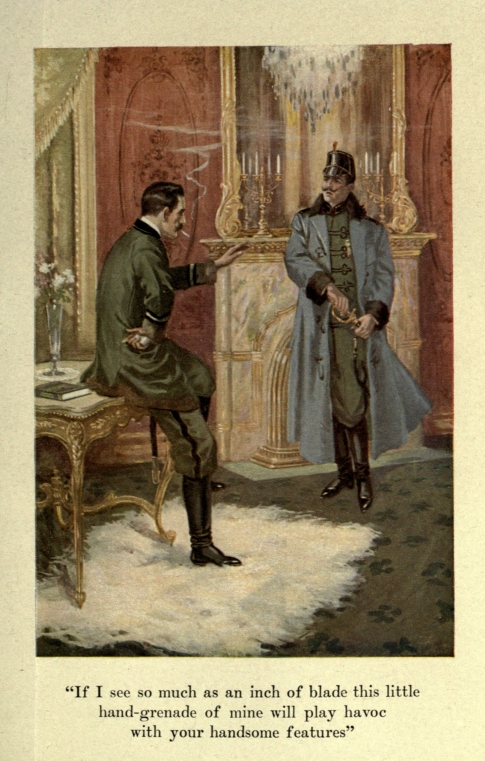
"Von Hügelweiler," he said in peculiarly distinct tones, "we live in stirring times. A King has just lost his throne, a number of high functionaries have been laid low, a mass of—shall I say, scum—has come to the surface. No, Captain, don't draw your sword," he said sternly, as the Captain flushed crimson and made a threatening movement with his sword-arm. "I am not an unarmed man, my brave officer"—poising the substantial matchbox in his right hand, in the manner of an athlete about to put the weight—"and if I see so much as an inch of blade this little hand-grenade of mine will play havoc with your handsome features. That's better," he went on, as the other shrank back furious but cowed before the strange missile which threatened his physical attractions, "that's much better, mon brav. Curse and swear and vow vengeance, but don't play any monkey tricks, or the Guards will want a smarter captain to lead them in the procession to-day. And one more word before you withdraw the sunshine of your presence from the room," he continued, as the other made a movement towards the door with mingled fury and disgust on his countenance. "I have taken a hand in the game which is being played in Grimland. I have thrown in my lot with Gloria von Schattenberg, and as her officer I am prepared to obey as well as command—in reason. But I won't be bullied, Herr Captain. I'm not built that way."
"You shall answer for your insolence!'" came viciously through Von Hügelweiler's white teeth.
"Maybe, but if you can get the Queen to sanction my arrest you're a cleverer man than you look, Von Hügelweiler."
A curse hissed from the Captain's lips, and he half raised his clenched fist in a gesture of intolerable passion. Then his arm dropped limp to his side and a look of suffering came into his eyes, and when he spoke, it was hoarsely and with a break in his voice.
"What is Gloria von Schattenberg to you?" he asked.
"That is the precise question I was asking myself when you came in," was the response. "To answer it I need solitude, and solitude, Captain,—as I need not point out,—is incompatible with your presence here. Captain von Hügelweiler, I have the honour of wishing you good-morning."
CHAPTER EIGHTEEN THE FIRST COUNCIL
At noon precisely a cannon was fired from the tower of the Strafeburg. Simultaneously the royal procession started from the Neptunburg, where the Princess Gloria had taken up her official residence as Sovereign of Grimland! It was a brave sight, for the sky was cloudless and the snow-covered city sparkled into a myriad smiles under the kiss of the winter sun. Every roof wore its gleaming mantle, its shimmering festoons of stainless crystals; and the countless icicles which depended from a thousand eaves glistened like huge diamonds in the vivifying sunlight.
First marched the Guards, their band playing the "Rothlied," which had now become the national anthem. Then came the Red Hussars with their bright uniforms, bay chargers, and gaily-pennoned lances. Then the Guides on skis—a popular contingent, judging from the cheers they drew. Then the Queen's Bodyguard, with Von Hügelweiler at their head. Then the gilt, lumbering State carriage, with its solitary occupant, a pale little figure, bowing to right and left, smiling, nervous, pathetically isolated,—a pearl in a huge gold setting. Next came distinguished personages on horseback, amongst them Trafford on a great chestnut charger, and Father Bernhardt in dead black, seated on a big mare of the same funereal hue. Then Dragoons, then Police with Doctor Matti in dark uniform and cocked hat. More carriages and powdered coachmen; more Dragoons, more Guards, Guides, and Grenadiers, with a strong contingent of Horse Artillery to wind up with.
Nothing was lacking either in the splendour of the procession or the enthusiasm of the onlookers.
Within the cathedral the solemn ceremony of coronation was conducted by the Archbishop of Weidenbruck, who maintained the traditional enmity to Karl exhibited by his predecessor. And the vast Gothic building was crowded with nobles and dignitaries, and a great many others who were very far from being noble or dignified, but who had been admitted lest the many absentees should leave conspicuous gaps on the marble pavement. For there were many of the older families of Grimland to whom the events of the last few days were abhorrent, and who regarded the haste of the coronation as something shameless and indecent. Neither, of course, were there any foreign representatives present. Grimland was not a great power, but its callous condonence of a crime had shocked the moral sense of Christendom. But Bernhardt had insisted on rapidity of action, and for the moment his word was law.
After the ceremony came the State luncheon in the Muschelsaal, an interminable affair of many viands and divers vintages. Trafford,—seated between a Grafinn of aristocratic lineaments and a deputy's wife with plebeian features and a shrill scheme of attire,—ate little and thought much. His eyes were constantly on the white-faced girl who sat on the big gilded chair at the head of the centre table. He wondered if he had ever seen anything so pale and sad in his life. The girl who had faced outlawry and risked arrest with a light heart and laughing lips seemed crushed and smothered by the pomp and circumstance of her present dignity. She talked and smiled and tasted food and drink, but the Princessin Gloria was dead, and a poor substitute sat in her gorgeous coronation robes as Grimland's Queen.
In time the long repast came to its end, the guests departed, and those who were bidden repaired to the Council in the Throne-room.
At this the Queen, Father Bernhardt, Dr. Matti, Von Hügelweiler, and George Trafford were present. The captain of the Guides ignored the American with studied scorn. The latter responded with an almost imperceptible but intensely irritating smile. So far he had triumphed, for he had occupied a post of great honour in the procession, and Von Hügelweiler felt his enemy's insolence like a galling wound.
The men in turn proffered formal congratulations to the freshly-crowned Sovereign. Gloria thanked them with a determined effort at graciousness.
"Most women, my good friends, have one day in their lives," she concluded with the ghost of a smile. "This is mine. I have had my experience. I know what it feels like to drive through a mile and a half of cheering men and women, to sit in a gilded carriage with a myriad eyes focussed on my poor, pale face. I know the solemn moment when the sacred oil is poured on my hair and the golden rim of sovereignty set on my brow. I have dreamed of these things, and the dream was at least as real as the reality. It is a wonderful thing to be a Queen—but—but——"
"But what, madam?" asked Dr. Matti.
The big doctor looked rather more ridiculous as Chief of Police than as a drenched revolutionary in the Cathedral Square. He was the only one present who seemed out of place in the sumptuous Throne-room. Von Hügelweiler was an aristocrat, and a handsome one at that. Bernhardt, despite his wild, black eyes, was a man of breeding and palpable distinction. Trafford, with his bold features, fierce moustache, and picturesque green uniform, might have been a Polish count of bluest blood and innumerable quarterings. But Matti, with his big hands, heavy features, and ungainly figure, was plebeian from the soles of his enormous feet to the tips of his spatulate fingers. The romance of the situation had no appeal for him. He served the Queen, not because she was young and beautiful, but because he honestly believed Karl to have been a cruel and corrupt monarch, and he hoped for a regenerate and better ordered State under his successor. He represented the prose of the revolution, the grim sense of duty which often makes revolutionaries absolutely callous of individual suffering, so long as their concept of human happiness be furthered.
So now he had no sympathy with Gloria's mood of weakness.
"But what, madam?" he repeated.
She laughed a little hysterically.
"I am not sure it is not better fun to be an exile," she sighed.
The doctor winced visibly at her words.
"Life was not meant for fun," he said irritably.
"Mine was, I think," she retorted. "A certain gentleman, by name Herr Saunders, told me I should soon tire of the routine and régime of Queenhood. I laughed him to scorn, but I am beginning to think he knew me better than I knew myself."
"Your position has responsibilities as well as pleasures," pursued the doctor. "For instance, we shall have a stern fight to win the recognition of the foreign powers. The assassination of poor Karl,—a brilliant idea on Herr Trafford's part, and a proceeding of which I thoroughly approve,—will take a little swallowing by the Chanceries of Europe."
"Poor Karl!" Gloria murmured.
"Moreover," the doctor went on, ignoring the comment, "the mere fact of coronation,—important though it may be,—is not necessarily a guarantee of unopposed sovereignty. We have reports from the north-east of Grimland that there is considerable dissatisfaction with the coup d'etat which has just proved fatal to your Majesty's predecessor. They say that the district of Weissheim is in something very like open revolt."
Gloria laughed mirthlessly.
"I am glad to hear of it," she said. "What is the worth to me of the royalty of men who change their allegiance as readily as they change their coats? Karl was a man. He had his faults, his crimes, if report speaks true; but men licked his hand when he was alive, and I honour them if they fight for his memory when he is dead."
"Bravo!" cried Trafford enthusiastically, and heedless of the black looks his interjection drew from Von Hügelweiler and Dr. Matti. "Bravo! That's the spirit I draw my sword for. I liked what I saw of Karl. He seemed to me a gentleman, and a good sportsman. Had I not heard of his cruelty to the late Archbishop, I don't know that I should have cared to take a hand against him."
"The story of his cruelty to the Archbishop was a lie," put in Father Bernhardt. "I ought to know," he went on, in answer to the astonished looks of his hearers, "for I invented it myself. Karl was a humane man and a moral man. Years ago I loved him. Afterwards I loved his wife,—and that made a difference."
Dr. Matti looked deep disgust. He was a family man with strong, not to say Puritan, views on morality. He knew—who did not?—that Bernhardt had eloped some years ago with Karl's consort, but he had always imagined the ex-priest to have been actuated by a disinterested desire to deliver the poor woman from a brutal and tyrannical husband. Bernhardt read the doctor's expression, and laughed.
"The devil tempted me,"—he went on, with a positive delight in shocking the worthy burgher,—"and I fell. The love I had for Karl turned to hatred. I fought against him,—I lied against him,—I swore to effect his downfall, and I effected it; but now that he is dead I wish to clear his memory. Karl was never guilty of inhumanity. He might be stern when occasion warranted. He might be unscrupulous in his methods of suppressing sedition; he would have been a fool had he not been so; but he never stooped to torture. Tell that abroad, my friends. Karl was a clean man, a just man, and if I compassed his ruin it was because that was the price I paid to Satan for the glories of his fellowship."
All were silent at these words, but Gloria put her hands before her eyes and shuddered. Her pallor became, if possible, intensified. She appeared tired out, and as if suffering from a splitting headache.
"It seems we have been fighting under false pretences," she said wearily.
It was Von Hügelweiler who answered her.
"Karl is dead," he said. "I sided against him, not because I hated him, but because I wished to serve the Princessin Gloria von Schattenberg. Long live the Queen!"
"Long live the Queen!" echoed Dr. Matti without enthusiasm. "If Karl was a good man, he is in heaven. Requiescat in pace. We must accept facts, and our first duty is to pacify the country."
"That means an expedition to Weissheim," put in Father Bernhardt. "The district is in a ferment. However, our friends Von Hügelweiler and Herr Trafford, with a few regiments of sharp-shooters, will put that right in a few days."
"More bloodshed!" sighed Gloria.
"The authority of the new Government must be respected," declared Dr. Matti. "We must have no false sentimentality."
Gloria rose from her seat with a look of a new-born resolution on her ashen face.
"There must be no more fighting," she said imperiously. "I am a Schattenberg, I know, and come of a race accustomed to hold life as a little thing. I plotted against Karl, because my father and brother met their death at his hands. But Karl is dead, and his death is a horrible and ghastly memory to me. The men of Weissheim are my subjects, and I will not have their blood on my hands. Our Government must be respected, you say? We will win respect by mercy and tolerance, then, not by the cannon and the shambles!"
Dr. Matti's countenance was a picture of contemptuous irritation. Bernhardt's head sank on his breast, as if he were deep in thought. The silence was broken by a loud rap at the door. Von Hügelweiler strode across the room and opened it.
There was a moment's whispered consultation.
"A messenger with urgent news, your Majesty," said Hügelweiler at length.
"Admit him!"
A man in plain clothes entered. Trafford recognised him as one of the waiters of the Hôtel Concordia.
"Your news, Gottfried, quick," said Bernhardt. "You are interrupting the Council."
The man bowed low to the Queen.
"I am head of the Intelligence Department, your Majesty," he began, "and I have just received news of such import that I felt it necessary to interrupt your Majesty's Council in order to impart it."
"Proceed," said Gloria with a slight inclination of her head.
"Your Majesty, there is much trouble at Weissheim. The burgherschaft has declared against your sovereignty. The troops refuse to take the oath of allegiance, and the young Prince is cheered wherever seen."
"We know all this," said Bernhardt in some irritation.
"Snow forts are being erected at every strategic point," the man went on, "and heavy pieces of ordnance are being put in position."
"Naturally," said Bernhardt. "We did not imagine they would conduct civil war with popguns."
"Is that all?" demanded Von Hügelweiler.
"No, excellency. There is a report,—a strong report,—that the King is not dead; that he escaped with General Meyer and Herr Saunders, and has made his way to the Palace of the Brunvarad at Weissheim. The wires are cut, and the railway has been blown up in three places, including the great viaduct over the Niederkessel at Eselbruck. It is impossible to obtain direct confirmation, but the rumour is gaining ground even here that Karl somehow escaped our clutches and fled to Weissheim."
At a sign from Bernhardt the man bowed and withdrew.
"A ridiculous rumour, as we have reason to know," said Dr. Matti, appealing to the others.
"We cannot produce his corpse," said Trafford.
"No," said Bernhardt; "that was an oversight on our part. After consigning Karl to the embrace of the Iron Maiden we left his body to his friends. We should have occupied the Neptunburg there and then, and drowned old Meyer in the Palace fountain. As it was, our consciences got the better of us, we fled from the scene of our handiwork without completing our task."
"We should never have begun it," cried Gloria. "I shall never forget the moment when Karl stepped forth and faced the shrieking rabble. The man was a lion among wolves. What followed will haunt me to my grave. And now Father Bernhardt tells us that Karl was a humane man and a moral man, and that it is necessary for us to butcher those of his late subjects who are true to his memory."
"We must forget the past and look to the future," said Dr. Matti sternly. "To display weakness now would only be to increase the sum of human suffering. This expedition must start at once."
The Queen turned in despair to Bernhardt.
"You have heard Gottfried's report," said the ex-priest. "There must be no delay. The expedition must start at once."
"The expedition must start at once," echoed Von Hügelweiler.
Gloria turned to Trafford.
"Yes, yes," said that gentleman absent-mindedly. "By all means let the expedition start at once. I will accompany it."
The Queen rose from the throne.
"The expedition shall start at once," she said in tones of unutterable bitterness. "I command that it be so. Gentlemen, I leave you, thanking you for your loyal counsel. This is the day of my life, the dreamed-of day on which I call myself, 'Gloria, Queen of Grimland.'"
CHAPTER NINETEEN THE CHAPEL ROYAL
Nervy Trafford left the Council with the dawning consciousness that he was not a very wise man. There are kings and kings, he reflected, kings to serve, honour and obey, and kings to harass, embarrass and decapitate; but it was best on the whole to leave the choice of treatment to the subjects of the particular monarch to be dealt with. He had sided against Karl from an innate love of excitement and a romantic enthusiasm for the rebel Princess. He had saved Karl from premature death, because he was a well-brought-up American with a sneaking respect for the sixth commandment. The result was, that the revolution,—which had been by no means bloodless,—was likely to be followed by an aftermath of civil war infinitely more sanguinary. Had he not interfered, Karl might still have been on the throne. Had he persisted in his revolutionary policy, logically and relentlessly, Grimland might have found peace and tranquillity under the unopposed banner of Gloria. As it was, Karl was evidently in Weissheim, and the good Weissheimers,—according to Herr Gottfried,—were preparing glacis and grapeshot for those who did not see eye to eye with them in things political.
He found his way to the Rubens room, and seated himself, wondering how long it was necessary to wait before demanding access to the private apartments. The short winter day was well-nigh done, and the great, unlit chamber looked vast and ghostly in the failing light. The shadowed corners, the rich stillness, touched and oppressed his imagination. Great men and proud women had passed in sumptuous pageantry through the walls of that noble chamber; and Trafford felt their presence, and strove to exorcise them with the fumes of a cigarette. But the impalpable dust of centuries seemed to impregnate the air, and by-gone monarchs looked askance at him from their dim gold frames, in a scornful wonder at the American interloper who sat so carelessly in the seat of kings. He rose, impatient of their glances, and walked to the window. Snow was falling. The sun that had graced and greeted the new-crowned Queen had sunk beneath the rugged outline of the encircling mountains; the sky, which had been of no uncertain blue, was a nondescript monotone weeping a white haze of crystalline tears. His thoughts harked back to the ashen face and sad eyes of the new-crowned Queen. Why had she not grasped the fact that Karl's immurement in the Eisenmädchen was a humane act of rescue, not a piece of callous cruelty? She herself had experienced the same hiding-place under the same innocuous conditions, and yet it did not seem to have occurred to her that the spikes might still be reposing at the bottom of his overcoat pocket. That the others should have failed to suspect the truth was only natural. That they would be angry on discovering it, was probable—but for that he cared not one jot.
What troubled his awakening conscience was, that good men and true must go down before peace reigned again in the troubled monarchy of Grimland.
After a few more minutes of such meditation, he made his way through the Rubens-saal in the direction of the private apartments. In the corridor leading to the Queen's chamber stood the officer on guard, and talking to him was no less a personage than Von Hügelweiler.
"My orders are precise," the former was saying. "Her Majesty is resting and will see no one."
"But have the goodness at least to send in my name," Von Hügelweiler returned pettishly.
"It would be no use, Captain," retorted the other. "The Queen is resting and must not be disturbed."
Von Hügelweiler's disappointment showed itself plainly in his crestfallen air.
"I want access to her Majesty," he said doggedly. "It is true that by admitting me you risk offending the Queen, but by not admitting me you offend me for a certainty."
"I am very sorry, Captain," said the officer in a conciliatory manner. He was quite a young man, and he was rather alarmed at having to defy so important a person as Von Hügelweiler had become. Still, he held stoutly to his position in the centre of the corridor.
"You may be sorrier still, if you persist," said the Captain darkly, detecting, as he fancied, symptoms of wavering on the other's part. "We move in strange times, Lieutenant, and my goodwill is better worth having than my enmity."
At this juncture, Trafford,—who had overheard this conversation, and whose approach had been inaudible on the thick carpet of the Palace corridor,—coughed affectedly, and advanced with admirable swagger.
"I wish to see her Majesty," he said, addressing the lieutenant on guard, and completely ignoring Von Hügelweiler.
It was the latter, however, who answered him.
"The Queen is resting, and will see no one," he said roughly.
Trafford paid not the slightest attention to the Captain's words.
"My name is Trafford," he went on, to the officer.
The Lieutenant's face was a picture of puzzled dismay. His orders were to conduct Trafford to the royal apartments as soon as he presented himself. To all others he was to give the message that her Majesty was exceedingly fatigued and would on no account see anyone. After a moment's embarrassed indecision,—during which he felt Von Hügelweiler's eyes absolutely scorching him,—he bade Trafford follow, and turning his back on the furious Captain, led the way down the long corridor. Arriving at a doorway concealed by a heavy curtain, he pushed open a massive oak portal and signalled Trafford to enter.
The chamber in which the latter now found himself was lofty, smelling of incense, and lit by lamps hanging from a frescoed ceiling. At the far end was an altar garnished with many candles and a silver crucifix.
This undoubtedly was the private chapel of the Neptunburg.
"We are awaiting you," said the quiet voice of Gloria.
Trafford advanced towards the new Queen, who was standing before the steps of the altar in the company of a priest. The chapel was dark, for the stained-glass windows shut out most of the remaining light, and the hanging lamps were little more than points of ruby flame. And yet he could see that Gloria's face was still of an even pallor, and that her eyes were red from recent tears.
"I am a woman of my word, you see," she went on in dull tones. "I promised to marry you under certain conditions, and, those conditions being fulfilled, I waste no time."
"You are carrying out the letter of the contract," returned Trafford, "but are you observing the spirit? I did not bargain for a tearful bride."
"The tears are dried and gone."
"But not the cause that made them flow. You wept because you are a woman, and the woman who regards even the formula of marriage as a little matter has yet to see the light of day. And you wept because you are not sure which thing conscience commands—the violation of a contract or the taking of false vows."
"You are strangely wise to-day," she said with a faint smile. "I did not know such intuition lurked in that wild brain of yours."
"I am right, then?"
"I cannot say"—she hesitated. "Yes, the marriage vow is a serious thing, and this wedding,—as I warned you,—can be no more than a solemn mockery. I am Queen of Grimland. You are a brave man and a gentleman—but you are not a prince of blood royal."
"The Traffords are not people of particularly humble origin," he retorted drily.
"Nor would it affect me if they were. But the State would never sanction my marriage with a commoner."
"Then is it worth while going through the mockery?" he demanded.
"I have asked myself that question, and the answer is that you find me here. My word is pledged."
"Your word, but not your heart."
"Ah, but I once told you that I had no heart."
"Then you uttered a falsehood," he insisted. "Your heart,—whose existence you deny,—bled at the thought of Karl's suffering. Your heart, which was disposed to entertain some kindly emotion for me, has cooled towards me because I compassed Karl's cruel demise."
"Go on, wise man!"
"I will not ask you if I am right," pursued Trafford, "for I read acquiescence in those tear-spoiled eyes. But I will say one thing more: as Queen of Grimland your marriage to me will be null and void. What if you are deposed from your sovereignty, and became again Gloria von Schattenberg, the exile?"
"That will not occur just yet," she replied.
"I am not so certain," he mused. "What if those rumours mentioned by Gottfried were true in substance and in fact? What if Karl really escaped with General Meyer and Saunders and others to Weissheim? What if Grimland's King is still in his own country, alive, alert, surrounded by sage counsel and loyal hearts? Is your position then so very sure?"
"But Karl was put into the Eisenmädchen," she protested wonderingly.
"So were you," was Trafford's retort.
"I—yes. But you had unscrewed all the spikes. The Maiden was as harmless as an unfanged snake."
"I put those spikes in my overcoat pocket," said Trafford slowly. "They are still—in my overcoat pocket."
For a dazed moment Gloria stood staring at him. Then she reeled—literally—grasping at the altar rails for support.
"You put him into the Iron Maiden—to save his life?" she gasped.
"That was my rough idea. You see, I am an American, and I hate killing things—especially brave things. There are plenty of men I would kill in the heat of battle—one or two, perhaps, whom I would kill without much heat, but Karl,—whatever his deeds or misdeeds,—was playing the man that night in the Palace yard, and I would sooner have cut off my right hand then have done him an injury. Forgive me, your Majesty, for I served you badly. Providence, which gave me a fair share of muscle and brute courage, was stinting to me in the matter of logic. I should have been logical and replaced the spikes in the Eisenmädchen."
"Herr Trafford!"
A hand was laid on Trafford's arm, and in the scanty light of the shadowy chapel the American found himself looking into eyes bright with tears, but tears not of sorrow or vexation, but of happiness and vast relief.
"Oh, what a weight you have taken from off my heart—it was heavier than I could bear," she murmured. "I felt like a murderess, a guilty creature who had risen through blood to the summit of her base ambitions."
"Then I am forgiven?"
"There is nothing to forgive. You have helped me and served me with your splendid impetuosity and your fearless resource. A Grimlander would have slain Karl, and crowned his service with a deed of shame. You were illogical—and I—I almost love you for your noble lack of logic."
"You almost love me?" he asked in a trance.
"At least as much as I have ever loved——"
She broke off suddenly, and smiling upon him one of her rarest smiles, she added: "Yes, George Trafford, I will marry you, and if the Queen of Grimland cannot wed an American, then I will no longer be Queen of Grimland."
Trafford gazed into the pale, brave face as he had never gazed at any living thing. His breath caught with a short gasp. A strange fire had sprung to quivering life in his bosom; a wild march was pealing in his ravished ears. His feet were no longer on the chequered marble pavement of the Chapel Royal, but somewhere in the fine regions of rolling planets and shimmering nebulae. It was no mere human being who bent over that sweet young face and kissed the warm tears from the drooping eyelids as he breathed the one word "Gloria" in an echo of long-drawn sound, but a demi-god, an heroic anachronism with the passions of Phoebus in his kindling soul.
"I thought love was worship," he said, as he strained the slim form to him. "So it is, and something more—something infinitely and deliciously more."
"We are in church," she remonstrated, gently disengaging herself, "and not alone."
But again he kissed her, and this time gently on the brow.
"I was forgetting all things save one," he said, "and that is that you love me."
"Almost love you," she corrected, with a sigh.
"At least as much as you loved the others," he affirmed.
"And that contents you?" she demanded, raising her eyebrows in well-feigned astonishment.
Her question puzzled him.
"It ought not to, of course," he said with wrinkled brow. "I ought to want all or nothing. But I would be content if it were even less you gave, for in the dim light of this ancient chamber I seem to see the workings of Fate."
"Then you are willing on such a basis to go on with the ceremony?"
"If you are content to do so," he returned gravely, "knowing that Karl is alive and may prevail, and that in that event no Parliament will trouble to undo what the good priest does this afternoon."
Gloria looked him frankly in the face.
"I, too, believe in Fate," she said softly, after a pause; and then, slipping her arm into his, "Father Ambrose, you have been summoned here for a purpose. Fulfil that purpose."
CHAPTER TWENTY BERNHARDT DISTURBED
While the woman whom he had helped to a throne was being secretly married to George Trafford, Father Bernhardt was sitting alone in his private apartments in the Neptunburg. The room he had chosen for his use was a small chamber on the second floor, overlooking the courtyard. The blinds were drawn, the electric light was burning, and the ex-priest was seated in a comfortable arm-chair reading the poems of Paul Verlaine. At his side were a wine-glass and a big carafe containing a pale green viscous fluid. He seemed to be enjoying his relaxation, for a smile constantly flitted across his face, and as some mordant line appealed more especially to his grim humour he would repeat it several times out loud in manifest appreciation. From time to time he sipped the fluid at his elbow, and it was remarkable that each time he did so he cast a quick look behind him as if fully expecting to see someone.