"The Story of an Active Life" (continued 6)
Reading edition
Henty described how he was pulled up on one occasion because a river had to be crossed, and the army had to wait until a bridge then being made was finished. At least half a dozen times did the infantry get under arms and the artillery harness their horses. A more tedious day, he said, he never passed. His tent was packed, he had no place to sit down to write, and his sole amusement was watching the Circassians and Bashi-Bazouks come in laden with plunder.
The selection made by these freebooters had been strange and miscellaneous at first, but as things grew scarce, nothing was considered unworthy of the scoundrels’ notice, for they scraped together trifles that would not have fetched a piastre, and they took not the slightest notice of the ridicule of the regular Turkish soldiers around. These laughed scornfully at the plundering habits of the irregulars, and were not above pointing them out to the English looker-on, exclaiming, “No bono Tcherkess—no bono Bashi-Bazouk!” Henty does not scruple to call these men a disgrace to the Turkish government; but it seems that the army often had to depend upon them for supplies.
And after this fashion the weary war went on. The inexhaustible letters were despatched, each teeming with interest, till rumours began to reach the writer of overtures being made by the Servians to the Turks for peace; but these were only contradicted and followed by a desperate encounter, or the siege of some little stronghold.
Then more rumours of peace; suggestions in the way of news; a short interregnum; then a recrudescence of the war, with Henty once more afoot, following the movements of the Turkish army or some brigade, to be present at an attack or to watch some threatening Servian movement being driven across one or other of the rivers. All the time the quiet, thoughtful correspondent was supplying his columns of interesting material to his messengers. The long chronicle grew and grew, and no mention was made of weariness, cruel suffering, semi-starvation, want of rest, and the difficulty of obtaining the sinews of war to carry on his fight. For no matter how careful the means taken for transmitting funds, the difficulties of cashing orders, and the troubles incident upon the money passing through foreign hands, which closed upon coin and objected to reopen, were often distressing in the extreme.
Now and then, though, a letter gives a hint about the difficulty of the war correspondent’s task—the sort of hint for which one has to read between the lines—and at last, with the year waning and passing into autumn, and while chronicling that difficulties were arising in connection with the army he accompanied, and that Russia, long threatening and working in connection with the politics of Europe, was at last thoroughly taking the field and preparing to give check in the cause of Christianity against the Moslem, Henty touches on his own situation. Now it was, too, that the time arrived for an announcement of the armistice that was to come into force.
At this period, completely worn out, the correspondent writes: “I leave the camp to-morrow for England, with the conviction that the war is over, as it is hardly possible that the European powers can permit it to recommence... But even did I think otherwise, I must most reluctantly have given up my post of correspondent with the Turkish army, for the long-continued indisposition brought on by bad food and hard living has at last overpowered me, and the doctors tell me that it is absolutely necessary for me to have rest, good living, and home comforts. I never quitted an army more reluctantly, for never have I been with one where I have received such uniform kindness, and whose men I had so much reason to like. I defy the most anti-Mohammedan fanatic to stop a month with this army without experiencing a complete change of sentiment, for a more liberal set of men than these quiet, willing, patient, and cheerful soldiers does not exist on the face of the earth. I have been with the troops of most nations of Europe, including, of course, our own, under circumstances of hardship and fatigue, and I can say that none of them can compare with the Turkish troops in point of good humour and patient endurance.”
Henty struggled on, however, to the last, and we read of him in connection with the campaign in the Dobrudscha. Here his health completely broke down, and for some time he was an invalid.
He never did any further war correspondent’s work, but for many years edited the telegrams and letters that came in to the Standard from the younger and more active men who had taken up his work. In fact, he went abroad no more, except on one trip through the United States to see for himself what mining life was like in Omaha, California, and elsewhere, and also to explore the rich copper country of the shores and islands of Lake Superior. No better man could have been found, from his old experience, for the investigation. But this was to him more of a holiday.
Chapter Thirty Seven.
A Busy Convalescence.
Nature had given George Henty plenty of latitude, but now he was compelled to accept her warnings that he must take no more liberties with his health. He was so broken down by hard work and the rough experiences through which he had passed that he had become quite an invalid, with the stern task plainly before him of doing everything possible to restore his health.
As the old epitaph says, “Affliction sore long time he bore”; but physicians were not in vain, for Henty was a man of strong common sense, who knew well the value of self-denial. His ailments, too, were not of his own seeking, for no man knew better than he the value of moderation and attention to hygiene.
He followed out what he knew was due to a man who wished to lead a healthy life, and he supplemented his medical men’s advice by devoting himself more than ever to his favourite pursuit of yachting. He spent almost every hour he could spare on board his little craft, keeping her within easy reach of town and taking a few hours here, a day there, and when work did not enchain him, making his little vacation a week, with the result that he was rapidly restored to health. It is doubtless due to the health-giving, strength-producing breezes that blow around the British shore that he retained the vigour of a carefully-preserved manhood to the very last, so that when his summons came it found him upon his yacht.
If a candid recorder of George Henty’s career is bound to set down all and criticise adversely, he might reasonably say that this man’s one great excess was his indulgence in ink. This fault, however, was not a very black one, for, so to speak, he softened it by using ink of a pleasant violet hue! But, to be matter-of-fact, writing when at home and at rest in his study seems to have been a perfect stimulant, and, combined as it was with his open-air pursuit, a complete recreation, and in no sense a work of toil.
Many men are great readers. Henty, in one acceptation of the term, was a great writer, who, with the assistance for a score of years of his swift-penned amanuensis, Mr Griffith, sat down daily, not to write, but to call upon his wonderful imagination. This he supplemented by what he had seen, and when necessary by the study of history, and literally passed hours of what to him must have been intense enjoyment. Picture after picture of the past at these times floated before his brain as he set his young characters to work performing the manly tasks his brain suggested, otherwise there would never have been the reality, the variety, and above all the long series of entertaining and instructive works which have so largely aided the schoolmaster in Great Britain in the education of our youth.
During the period of Henty’s convalescence he was never idle, though the year 1876 marks the completion of his long career as a war correspondent. Others took up his old duties abroad, but his pen and his knowledge were still of so much value to the journal with which he was connected, that it became his duty, as already indicated, to receive all the telegraphic messages sent in by the Standard’s correspondents in time of war. He carefully read and studied the crabbed and condensed messages that had come over the wire, as well as the communications of Reuter and other agencies from different parts of the world, and rewrote them in the vulgar tongue so that they might be comprehensible to the British public. This placed him, as it were, still at the head of war correspondence, so that when war broke out he was, so to speak, always at the front. Even though his post was his editorial chair in his journal’s office, the wires kept him in touch with everything that was taking place at all points of the compass.
Fate ruled in this restless age that his work should be pretty constant, and the exigencies of this form of historical chronicle kept him tied very tightly to his journalistic duties, the late arrival or expected arrival of fresh telegraphic news forcing him to stay till almost the time of the great newspaper’s going to press in the extremely early hours of the day; and this lasted right down through the troublous times and agitation in England during the Boer War.
Chapter Thirty Eight.
Concerning War Correspondents.
There is a sadness attached to the task of describing Henty’s capabilities as a war correspondent, from the fact that so many of his colleagues and brothers of the pen who knew him well and went to the front have passed away. Some who shared the lot of the brave officers and men, ran the same risks, and died the same deaths. Cameron was shot soon after being at a farewell dinner at his club, where he sat next to the writer of these lines; Pearce, though he lived through the horrors and starvation of the siege of Ladysmith—to see by the strange working of fate his own son ride up in the train of Lord Dundonald with the gallant relief party, as one of the volunteers—came back a mere shadow of his former self and died soon after, weakened by the privations connected with his duties; Archibald Forbes, possibly the hardest worker and most energetic of all, shortened his life in the cause of duty; and the same may be said of Henry Stanley; while of those who might have supplied many recollections or anecdotes, and who knew Henty well, death has claimed a long roll of brothers of the pen and correspondents, including Charles Williams, Godfrey Turner, Walter Wood, and Robert Brown.
One good old friend, active as ever, William Senior, now editor of The Field, gives a genial tribute to Henty’s memory from personal knowledge when he says, that as a special correspondent his readiness to help, and the practical manner in which he set about his work, combined with the thoroughness with which he took care of every small detail, were at once an encouragement and a stimulus to his colleagues.
Fortunately one has at command Henty’s own description of what he considers a special correspondent should be. To begin with, he says that he should be a man capable of supporting hardships and fatigues; that he should possess a certain amount of pluck, a good seat in the saddle such as would enable him to manage any mount whose services he could command; and lastly, that he should have the manners of a gentleman and the knack of getting on well with all sorts and conditions of men. This is a good deal to expect from one man, but without being eulogistic it may rightly be said that Henty possessed all these qualifications.
To a certain extent he was gifted with these qualities by nature, and where he felt himself to be wanting in any one point, his energy urged him to strengthen that weakness and strain every nerve until he had mastered the failing.
Accident has had much to do with the making of war correspondents, as in his own case; but Dr Russell and Wood of the Morning Post had both been connected with the press before being sent to the Crimea. Sometimes, however, military men with a ready gift of writing have offered their services to report on the wars in which their regiments were engaged, as in the case of Captains Hozier and Brackenbury, who made excellent correspondents and still continued in the army. Archibald Forbes, when quite a young man, served in a cavalry regiment, and after leaving the army did a little reporting before going out with a sort of roving commission to the Franco-German War. Thence he sent divers reports to a London newspaper, with the unpleasant result of being recalled, and this, too, at a time when he was primed with news of the most important nature. So special was his information, and of such extreme value, that, without writing a line, as he told the writer, he hurried over to England with all the speed possible, presented himself at the Times office, and asked to see the editor. In most newspaper offices, when the application is made by a perfect stranger, this is a privilege that the busy head of an important paper is rather loath to grant, and a messenger was sent out to Forbes asking his business. Forbes’s reply was that he had come straight from the front with most important news, and he was told, after sending in that message, that if he would write an article containing what he had to communicate, the editor would consider his manuscript, and, if it were approved, use and pay for it. Forbes told me in his sharp military way that he was not going to write and be treated like that, knowing how important was his information; and he said, “I went out from the Times office, walked into Fleet Street, and stood at the edge of the pavement half-way between, hesitating as to whether I should go to the Telegraph office, or down Bouverie Street to the Daily News.”
His hesitation did not last long. He went down the latter street and asked to see the manager. He was shown in at once to the office of my old friend, the late Sir John Robinson (Mr Robinson in those days), who listened to what he had to say, and like the keen man of business that he was, he grasped the value of Forbes’s information, and told him to go into a room which he pointed out and write a column. This he did, and it was put into type as fast as it was written. Soon after it was done he asked to see the manager again, and being shown in once more, Sir John Robinson said, “Have you got any more?”
“Yes,” said Forbes; “plenty.”
“Then go and write another column.”
This was written in turn, and after it was done Forbes, still rather indignant about his previous ill-successes with the press, and not being blessed with Henty’s way of dealing with all sorts and conditions of men, took offence at some words spoken by Sir John, which roused his acerbity and resulted in his being highly offended and leaving the manager’s room in dudgeon. The Daily News “chief” was taken by surprise at the way in which the hot-blooded Scot had quitted him, and, hurrying down the stairs out into Bouverie Street, he overtook the angry ex-dragoon in Fleet Street. Having thus captured him and brought him back to his own room, he explained to him laughingly that he wanted him to go on writing until he had exhausted his information, and then he was to go off back immediately to the front as the representative of the Daily News, with full munitions, and to send over at his discretion all information that he could collect concerning the war.
This was a strange commencement of the important career of one who in the opinion of journalists began at once to make a brilliant name for himself, for this, Forbes’s first literary coup, placed him at one stride in the same rank as William Howard Russell of the Times, the well-known author of My Diary in India. The opinion of the journalistic world was directly endorsed by the British public, who proved it by sending up the circulation of the Daily News to a wonderful extent throughout the war; and this lasted until the day when, passing by the Daily News publishing office in Fleet Street, the writer saw posted up Forbes’s terse telegrams announcing to an astonished world the utter defeat of the French. The rest is familiar history.
Henty states that a good seat upon a horse is one of the valuable qualifications for a war correspondent, for it may come to pass that when at great risk and effort the gleaner of intelligence has obtained his requisite information by following the vicissitudes of the campaign wheresoever the battle rages, he may find himself perhaps thirty or forty miles away from the nearest telegraph station. There is nothing to be done in such a case but for the correspondent to write his valuable despatch as crisply and as carefully as possible, and then ride away at full speed so as to get the message at the earliest moment upon the wires. This task accomplished, he must, after a brief rest, mount once more and return to the front.
Later, it was in this way that, during the Zulu War, Forbes was the first to send home an account of the Battle of Ulundi, bearing with him, so trusted was he, some of the general’s despatches as well as his own report. Where, however, the telegraphic facilities are not within reach, it is necessary for the correspondent to entrust the report he has written to the official post-bag, for he dare not absent himself long from the front, not knowing what events of importance may happen while he is away.
In the Franco-German war another correspondent, Beattie Kingston—polished gentleman, scholar, and able musician, who had been representing the Daily Telegraph in Vienna and elsewhere—was acting as correspondent with the German army; and of other war correspondents it remains to mention the familiar names of Bennett Burleigh and E.F. Knight, the latter of whom distinguished himself by writing the brilliant little account of The Cruise of the “Falcon”, which reads as graphically as if it had come from the pen of Defoe. After Knight had taken up the risky duties of reporting wars, and had been sent to the Pamir to report our little frontier engagement with the restless mountain tribes, he did something more than go to the front, for in one of the engagements he was with a little column whose officers were all shot down, and with the splendid energy and pluck of the fighting penman he dashed into the fighting line, took the place of the fallen leader, and led the men to success.
This struggle—not his own special fight, for he is too simple and modest a man to play the part of Plautus’s braggart captain—he recorded in his work, Where Three Empires Meet. Later, when journalism claimed him again to be the war correspondent and he went out to the Boer War, news came to the little club of which he is one of the most popular members, that he was with the advancing line of the 42nd Highlanders at Magersfontein and had been shot down. He lay with the rest of the unfortunates of that saddening day, trusting for first aid to one of the sergeants of the regiment who knelt down to bandage his shattered arm, panting with excitement to be off the while.
Another sufferer this in the great cause of gathering the freshest news, for E.F. Knight paid dearly for his well-earned fame. He was sent down with another wounded man picked out from about forty hopeless cases, “just to give me a chance,” and though he suffered the complete loss of an arm, he finally recovered, thanks to Sir Frederick Treves. After this he studied and practised the art of writing quickly and clearly with his left hand, and from the Far East sent graphic reports of the Russo-Japanese War. That is the kind of stuff of which George Henty’s friends and companions were made.
Chapter Thirty Nine.
Henty and his Books.
For the benefit of his many boy readers with whom Henty’s stories were most popular, a writer on the staff of Chums paid Henty a visit one day. He described him as a tall man, massive in build, with a fine head and a commanding presence, the lower part of his face adorned with a great flowing beard, and though his hair was almost white, the dark beard was only slightly flecked with silver threads. He had the appearance of a man who had knocked about the world and rubbed shoulders with strange bed-fellows, and looked as though he would be a capital companion and just the sort of person with whom one would like to share the solitude of a desert island. There is no doubt that the writer said this in the full belief that Henty would have been an ideal comrade—a brave man, amiable, happy in temper, straightforward, and ready at a pinch to dare danger to the very death.
The visit paid to him was, primarily, to ask him how he wrote his books. “How does a man write his books?” is a question that calls for a little thought before answering. One man will write them mentally from end to end before putting pen to paper; another will jot down sketchy notes which, after months of thought and labour, represent so many scraps that have to be picked out, set in something like order, and then fitted into shape as if they were pieces of a dissected puzzle; and only then, after much work, do they take form as a comprehensive whole. Again, another will spend years over the construction of a book, sparing no pains, in the full knowledge that he will never be able to write another; and after all it may prove to be not worth the reading, or, if worth the trouble, it may be utterly wanting in that indescribable element which enchains the reader at once and keeps his attention riveted to the very end. Yes, that indescribable something which is given to so few by nature—the few who, somehow, find themselves writing as no man to their knowledge ever wrote before; and so say their readers. For there is a peculiarity in some men’s thoughts when placed on paper in print—a something which attracts, through the soul that is in it, people of all ranks and classes—the highly-cultivated classical scholar, the student of other men’s works, the great criminal or civil judge whose life has been spent in examining the ways, thoughts, and acts of every form of human nature, the best as well as the vilest and worst.
And yet this book which affords such intense delight to its reader, often by its pathos, less often by its mirth—for, strangely enough, one finds that the gift of being humorous is extremely rare—will give as much pleasure to the half-educated child as it does to the man whom poor old Captain Cuttle, Dickens’s simple-hearted child-like creation, described as “chock full of science.” Now, how is this? I, the writer of these lines, have been a reader for seventy years, and I must frankly confess that I don’t know, and my honest belief is that I never shall. But this I do know, that I found all this attraction ready for my reading thirst in a story entitled Rip Van Winkle, in the pages of an old, old magazine called the Queen Bee. This story somehow painted a picture in my young brain of the Catskill Mountains and the Dutchmen playing ninepins, while the roll of the balls resounded and re-echoed like thunder, and the voice that rang out, crying, “Rip Van Winkle! Rip Van Winkle!” sounds, at any time when I think upon it, loud and clear. There is the picture still, like a dream of the photography that I was to live to see in all its present beauty, only clear and bright and better still; for there are the colours of nature which some of us yet may see photographed in the continuation of these wondrous days in which science has given us so much.
There is no saying how a man contrives to write a book; but this is the question that George Henty’s visitor asked, as he sat near a table where closely-written sheets lay in a heap, apparently just as they had been laid together by the writer. There was a half laugh, followed by the rather disconcerting reply: “I do not write any of my books myself. I get a man to do them for me—an amanuensis, of course; it all comes out of my head, but he does all the actual writing. I never see any of my work until it comes to me from the printers in the shape of proof-sheets. My amanuensis sits at the table, and I sit near him, or lie on the sofa, and dictate the stories which I publish.”
So said Henty to his visitor, and he might have added, “and smoke the while,” for nature must have needed something in the way of sedative for the brain so constantly upon the strain.
Then questions were asked by the eager enquirer as to how long this writing went on for so great an output, as a manufacturer would call it, to result. In the words that followed the real secret was explained—and it lay in the quiet, steady, regular application which is seen in the man who is discovered one day, trowel in hand, by a small pile of bricks which he goes on laying in position; he gives each a tap or two and a scrape, and in course of time, lo and behold! as the old writers say, there stands a magnificent house.
“What do I call a good day’s work?” said Henty. “Well, say my man comes at half-past nine in the morning and stays for four hours, till half-past one; we can get through a good deal of work in that space of time. Then perhaps he comes round in the evening for a couple of hours; so in the course of a day I finish a chapter, that is, about six thousand five hundred words. I call that a good day’s work.”
And so would anyone. Six thousand five hundred words of consistent description and conversation, all forming a portion of an interesting tale which will hold a boy’s attention—often a man’s! Think of it! At half-past nine that morning there was nothing; when work was knocked off in the evening there was a chapter that would some day be read with satisfaction—a something made out of nothing save a few flying thoughts. With George Henty that was how a story was written.
Such books as these would average in length from a hundred and thirty to a hundred and fifty thousand words; that is to say, about the length of the old three-volume novel, a class of work at which Henty also tried his hand. One of his first novels, A Search for a Secret, was published by Tinsley Brothers in 1867, and from time to time another was turned out which achieved a fair amount of success; indeed, almost up to the end of his life Henty wrote an occasional novel when a good plot occurred to him and when he felt in the mood. But quite early in his career he was invited by an old club friend, the late Thomas Archer, to contribute a story suitable for the reading of boys to a series of juvenile works that Messrs Blackie and Son were about to produce, and which Mr Archer was to see through the press.
This was the commencement of a long series of boys’ books—a long way on towards a hundred—which achieved universal success, and for the task of writing which their author, in his avocation of war correspondent and descriptive writer, had in a manner passed his life priming himself.
In his choice of subjects, almost from the first, he drew on his old experience, and in one of his earliest essays he, the son of a coal-mine proprietor, naturally enough began upon a story dealing with the perils and dangers (not of the sea where the stormy winds do blow) encountered by the stern-visaged grimy men who gain their daily bread by descending with their lives in their hands into the bowels of the earth. He tells a tale here of the men who, with Davy lamp in hand, go right down among the coal seams, to where the atmospheric pressure is light and the insidious gas can be heard hissing out of the strata. He describes how, weary and tempted by the longing for a pipe, some weak-minded comrade may contrive by the help of a nail to pick the lock of his carefully-secured safety lamp, so as to expose the flame for a pipe to be lit. Then comes the ignition of the gas in one scathing burning blast, the herald of death to the offender and to those nearest the explosion, while for those who are farther away, and who are warned by the thunderous roar, there is the race for life as they tear for the pit’s mouth, to be too often overtaken by the deadly choke-damp, whose poisonous strangling fumes follow the firing of the gas. Others, imprisoned by the falling rock and coal, after fighting hard to escape, have to sit and wait and pray that the help which they know will be trying to reach them as soon as comrades can descend, may not come too late.
This, Facing Death, was Henty’s first story for boys. But a soldier by training, he soon turned to the military element. It speedily dawned upon him that there is nothing a boy likes better than a good description of a fight—with fisticuffs not objected to against some school tyrant—and here, in his descriptions, the writer was thoroughly at home. He knew how his heroes should behave, and in such encounters there was the vraisemblance that added power to his narrative. Then, too, as war correspondent who had seen fighting in the Crimea, in Italy with Garibaldi during the War of Independence, with Lord Napier in Abyssinia, in the Franco-German War and during the Commune, in Russia, in the West Coast forests on the way to Coomassie, in Spain during the Carlist Insurrection, and in the Turco-Servian War, his mind was stored with material and with picturesque backgrounds for stories to come.
Here was a stupendous collection of embryo “copy” for boys’ books on fighting full of reality from beginning to end. From his wide experience he knew and described how fighting should be, and was carried on. When he felt a desire for change, he struck farther back, and enlisted as the years went by various heroes of history whose names have been immortalised. At one time he would be weaving a story about the prowess of our men in India with Clive, at another time following Wellington through the Peninsular War. He was, in imagination, with Roberts at Kandahar, with Kitchener at Khartoum, and with Buller in Natal. He often made a plunge into naval history and dealt with our naval heroes. Unconsciously, too, all this while he was building up a greater success for his boys’ books by enlisting on their behalf the suffrages of that great and powerful body of buyers of presents who had the selection of their gifts. By this body is meant our boys’ instructors, who, in conning the publishers’ lists, would come upon some famous name for the hero of the story and exclaim: “Ha! history; that’s safe.” In this way Henty linked himself with the great body of teachers who joined with him hand in hand; hence it was that the book-writer who kept up for so many years his wonderful supply of two, three, and often four boys’ books a year, full of solid interest and striking natural adventure, taught more lasting history to boys than all the schoolmasters of his generation.
Naturally the works that dealt with his own experience were the simple honest truth; but the same may be said of those in which he had to deal with the past, and therefore had to strengthen and supplement his knowledge by the study of the best works he could get hold of preparatory to writing fiction dealing with some particular epoch. For, following upon the choice of his subject, say the battles of some war through which he carried his heroes, he confessed that he got together a pile of books from one of the big libraries and stored his mind with material for the purpose of the story he was about to weave; so that his fiction was very near akin to fact, though possibly it was highly coloured. No boy dislikes colour, and Henty’s readers did not object to a little blood. His boys were fighting boys, and very manly, full, as he termed it, of pluck; and though he dressed them up and carried them through peril and adventure galore, it was all good honest excitement, even if here and there a little too bright in hue. As to that, he had the example of the famous romanticist of the north, the great Sir Walter, who said that in equipping a character in one of his romances he liked to give him a cocked hat and a walking-stick to add to his appearance.
There was nothing namby-pamby in Henty’s writings, for his adolescent characters were not so much boys as men, saving in this, that he kept them to boy life, and never made his works sickly by the introduction of what an effeminate writer would term the tender passion. “No,” he said, “I never touch on love interest. Once I ventured to make a boy of twelve kiss a little girl of eleven, and I received a very indignant letter from a dissenting minister.”
Men who write books build up for themselves plenty of critics besides the authorised judges to whom their works are sent out by the publishers, and unfortunately the self-constituted censors do not possess the broad knowledge of the genuine critic.
But for outspoken, downright, honest but self-satisfied criticism, no one equals the “cocky” schoolboy who has entered upon the phase when he begins to feel that he can write, and has begun to get over the natural repugnance to express himself in correspondence. Early in life your natural boy only writes as much as he feels bound to set down with pen, ink, and paper. These effusions one may call duty-letters home. The next letters are those relating to his wants; they come more freely, and of course often savour of pocket-money. It is later, when he has taken to reading, and has arrived at the stage when his spelling is more regular, his grammar fairly correct, and his words flow more freely from his pen, that he becomes opinionated, and informs those to whom he writes what he thinks.
Sometimes an author is favoured by these young gentlemen, and more than one communicated with Henty and informed him that he had read his last book, which was, of course, satisfactory; but the criticisms and the points fallen foul of would have been unpleasant only for the fact that they formed food for mirth.
One day, during a chat concerning the success of a well-known magazine that was current some five-and-twenty or thirty years ago, which he edited, Henty laughingly complained to the writer about the way in which boys of this type troubled him with their opinions. One of them—it was in the early days when this corrupt word was beginning to be utilised in boy life as something very forcible and expressive—wrote and asked him why he put such “rot” in his paper. One fancies one can recall at the present moment the grim, half-amused, half-angry expression of the editor’s face as he related the anecdote. But it is only fair to say that such young gentlemen are the exceptions, and when a boy does praise, he can do it with a warmth that makes his favourite author’s cheeks glow with pride, for he feels that the criticism is very honest and true.
And boys can write very very pleasant letters, such as set one thinking that one would like to know the writers. Some of their letters show very plainly what the young correspondents have thought as they read, though they often enough cause much amusement by their naïveté, especially those which come suddenly from the most out-of-the-way places. These are some of the great rewards which come to a writer, and make up for many a long day of drudgery in the cause of duty on days when nature is preaching idleness to a worker, and is calling to him with her myriad voices to leave the pen and desk and come and commune with her while there is time; on days—those rare days—when she is all smiles, and full of suggestions of those bright days of the past, which seem to have become rarer as one has been growing old.
Henty had a little selection of correspondents’ letters sent from out-of-the-way places. One was from an American boy, written with all the quaint naïveté and ignorance of one who was on his travels to see what the world was really like. He writes from Italy, after “doing” England with his father:—
Hotel Europa, Venezia, March 22nd, 1889.
Dear Mr Henty,
I am an American boy, ten years old, travelling in Europe. I read some of your books at home, and enjoyed them so much that, as soon as I arrived in London, I wanted to go to Mr Blackie’s, hoping to see you and all your books. So when I had been to Westminster Abbey and the Tower, my father took me there; but I could not see you, and the books were shut up. But the gentleman was very kind to me, and brought some of them out, and I went home laden. I think The Lion of Saint Mark is splendid. I am reading it here, and am sure Malleo lived in this house. I have been to the very place in the Piazetta where Matteo and Francis had their first conversation.
Yours respectfully, —.
Nothing could be more amusing than the boy’s mingling of shrewdness and innocence respecting the author’s connection with his publisher. There is something in it suggestive of the days of Newbery and Dodsley, with an idea evidently in the boy’s mind that publishers kept authors in stock. But it is the letter of a clever boy notwithstanding, blessed with a father aiming at increasing his boy’s store of knowledge in the wisest way extant.
Such letters come abundantly to a boys’ author; but Henty thought far more highly of those which he received from girls, for where there is a girl in the same family the brothers’ books are generally common stock, and are carefully read, appreciated, and judged. The author declares that girls write more intelligently and evince greater judgment in their criticisms, while those who write, especially American girls, make a point of requesting an answer, and do not shrink from asking for the author’s autograph to add to the collection being made.
At the same time, unconscious of the estimation in which the sister is held by her correspondent, the boy does not fail to write in a half-contemptuous spirit like this: “Dear Mr -, I have read your story, which I and my brother think splendid. Emmie has read it too, and she says it’s delightful; but then, she’s only a girl.”
A propos of the boy seeker for an author’s autograph, there are many of these acquisitive young gentlemen who make applications by post and do not get one, even on days when the author is in his most amiable frame of mind. Possibly this is due to the fact that they are perfectly unconscious of being propagators of a custom which has grown into a heavy tax. Others, more wise in their young generation, make a point of enclosing a carefully-directed and stamped envelope, which places the person addressed in the position of a creditor, whose conscience immediately smites him with the suggestion that it would be churlish and rude not to reply. And somehow almost invariably those young gentlemen obtain the addition to their collection that they have sought.
Boys’ writers most probably do not have more worries than other people, but they have to submit to one nuisance from the selfish and thoughtless which does go very much against the grain. Fancy being a man who feels himself in duty bound to fulfil an engagement to write some four, five, or six thousand words of a story pretty well every day. Is it not extremely probable that when that long tale of words is written he will lay the pen down with a feeling of weariness, almost of loathing and disgust. Imagine his feelings, then, when he finds in his correspondence a letter from some absolute stranger, enclosing a long manuscript which he has written “especially for boys,” with the request that “as the recipient is so clever and knows so well exactly what a boy likes, he will be good enough to read it at once and give his opinion upon its merits”? Now, human nature is human nature, and as a weary writer has a great deal of that sad human nature in his composition, and is prone to be irritable, surely it is not surprising that for a few minutes he falls into a fretful state, and mentally asks this would-be scribe why he does not send his MS to an editor or other practised judge of people’s works for his opinion about the unknown one’s literary production?
Henty uttered his wail to one of his visitors who recorded an interview, and then confessed to being as weak and amiable as many others of his craft, for he says: “I do generally read them, and have helped several men to get publishers; but, of course, the great majority of the stories are hopelessly unfit for boys. One does not like to write back and say that the work is confounded rubbish, although I suppose it would be the most merciful thing to do, as it would prevent the writer from wasting his time. I let them down as lightly as I can.”
There is a well-known old proverb, for which we have to thank one of the old Roman writers, who spread their Latin and their works through the civilised world, that a poet is born, not made, and it applies equally to the story-teller or writer of narrative. Henty was a story-teller from quite early days; for, following up his boyish attempts, the days came when, as a married man, with his children gathering round his fireside, it became a custom for them to come and say the familiar good-night, with the appeal to father to tell them a story. At first the stories were brief of the briefest, and doubtless versions of the old popular nursery tales. These, however, soon began to give way to invention, and these again would be followed by flights of fancy as the young author’s wings grew stronger, till, from being so brief that they only sufficed for one evening, his stories expanded and gradually merged into those which were cut short with, “There, it’s growing too late now. I must finish to-morrow night.” Doubtless invention in the furnishing of these little narratives, composed expressly for the juvenile audience, soon had to give way to study, and their author began to seek his inspiration from some incident in history. Gradually, too, as he realised the interest taken in his narratives by his own children, they began to be more thoughtfully designed, and grew longer, while the idea strengthened that they might prove as attractive to other children as to his own, until by a natural sequence the story-constructing took up more thought, grew more businesslike, and developed, as it were, into a profession.
It is easy, too, to imagine that as some of these stories—which were told for the benefit of his two boys, and the two little girls who were carried off by consumption on the verge of womanhood—ran to a length of four or five nights, they gave their originator the power to compose with fluency and ease. For throughout his life Henty practised storytelling as opposed to story-writing. It is not everyone who finds dictation easy, but for twenty years he dictated all his fiction to his secretary and amanuensis, Mr Griffiths, even down to the very last tale which he finished, prior to his being stricken down by paralysis.
In writing his books Henty was wonderfully practical. He thoroughly enjoyed a quiet evening and a dinner with friends at his club, but, speaking from old experience, he never allowed this to interfere with the work he had on hand. More than once the writer has said to him, “What! going already?” (“already” being almost directly after dinner). “Yes,” he would reply; “I shall perhaps have some telegrams to write up next door,” (“next door” being the Standard office). On other occasions it would be, “Yes; going home. My man will be waiting when I get there,” (“my man” representing his amanuensis, ready for him in his study at Lavender Hill). And in response to the remark, “Rather late to begin when you get home”, “Oh yes, but I daresay I shall get a couple of thousand words done”; and that meant from Henty that the work would be done, for he was a man who meant work, and did it. This would happen usually when he was extra busy preparing some book for the press. He had a quiet, determined way of making hay when the sun shone, for the Standard made great calls upon his time, requiring him to write matters of fact, and at such times fiction had to be laid aside. His long absences from home in times of war interfered greatly with his peaceful avocations, but he treated all these journeys as so many copy-collecting trips. They provided him with material which he would afterwards cleverly utilise, as can be gathered from passage after passage in his many works.
For details of the many stories for the young written by Henty, one is disposed to refer the reader to the publisher’s list; but to follow upon what has been said respecting the correspondence that reaches a writer from his young readers, a letter that has come to hand, written by a Canadian boy some years ago, is very amusing in its admiration of his favourite author. It indicates such an amount of steady reading, it evinces so much ingenuity, and (if it should ever reach the young writer’s eyes and he will take the criticism in the good part in which it is meant) displays so much need for improvement, that one gives it in full as an amusing list of the author’s works from the boy’s point of view.
The little lad calls it “a story.” Well, it is an original story of stories, and, as intimated, emanates from Canada. It is here given in a confidence which suppresses names, and thus cloaks the literary mistakes of the past:—
G.A. Henty, Esq.
Dear Sir,
Hoping you will excuse me for troubling you, but I would like you to read the little story I have made (while staying home from school with the measles). I have read and enjoyed a great many of your books. Following is the story made out of the names of some of the books you have written:—
“Jack Archer”, while travelling “Through Russian Snows”, met “Captain Bayley’s Heir”, who had been “Through the Sikh War” as “One of the 28th” and was “True to the Old Flag”, was swimming “In Greek Waters”, being pursued by “The Tiger of Mysore”, which had come “Through the Fray” “By Sheer Pluck.” All of a sudden along came a man who was “The Bravest of the Brave” while “With Wolfe in Canada” and “With Clive in India”; he also showed valour “At Agincourt”, which was “Won by the Sword” “By England’s Aid”, headed by “A Knight of the White Cross”, who was with “Wulf the Saxon” and “Beric the Briton” in fighting “The Dragon and the Raven”, which were “For the Temple”, met “The Cat of Bubastes”, followed by “The Young Carthaginian”, who was “Condemned as a Nihilist” for killing “The Lion of the North” and “The Lion of Saint Mark”, which were owned by “The Young Colonist” and “Maori and Settler”, who said they were “With Buller in Natal”, and had come to arrest him as “A Jacobite Exile”, with their colours “Orange and Green”, in the name of “Bonnie Prince Charlie.” It happened when on “Saint Bartholomew’s Eve” along came “Saint George for England” “By Right of Conquest.” “In Freedom’s Cause” he was “Held Fast for England” “In the Reign of Terror.” “Under Drake’s Flag” he made “The Dash for Khartoum”, which “With Lee in Virginia” “For Name and Fame” he fought and won “By Pike and Dyke”, assisted by “Redskin and Cowboy.” All this happened “When London Burned.”
Trusting you will let me know if you receive this, and how you like the story, Yours very truly, —.
Doubtless, as was often his custom, George Henty, who was proud of, as well as amused by, the above letter, replied to the young writer. One would be glad to know.
In addition to the three-volume story, A Search for a Secret, mentioned earlier, Henty produced several more, so that he may claim to be one of those who saw out the old days which preceded the six-shilling novel. He concluded his series of novels with another secret—Colonel Thorndykes’—but this, like those which had preceded it, only achieved what the superfine litterateur terms a succès d’estime, which is not the success beloved of the publisher, who has a bad habit of judging an author’s merits by reference to his ledger and counting the number of copies sold.
Henty’s novels were well contrived and thought out, and full of interesting matter, but not one of them seemed to contain that unknown quality which nobody appears as yet to have been able to analyse, but which causes the British public to go reading mad over something which hits the fancy of the time.
As a novelist he was unsuccessful; not that it mattered, for he soon laid the foundation of what was to prove an enduring fame, one which set an enormous clientele of young readers looking forward year by year for his next book or books—one, two, three, or even four per annum—until he had erected a literary column familiar in the bright young memories of thousands upon thousands of readers to whom the names of his works are well known.
In the long list of his other writings, A Story of the Carlist Troubles, another volume more modern and up-to-date, relating to the Sudan when Kitchener was in command, and a romance telling of a search for the treasure of the Peruvian kings, were among his last productions, while editions after editions of his earlier works kept on appearing, and were eagerly read. These new issues of his earlier books of course appealed to a much wider public than before, since the writer’s popularity had gone on increasing with every fresh story from his pen.
As is often the case with a young and enthusiastic writer, Henty in his early days made more than one attempt to publish his productions at his own cost, only to learn the severe lesson that these business transactions are matters of trade, and do not often prosper in the hands of an author.
One of his hardest fights was over the Union Jack, which he edited for some years. It was a boys’ journal, which ought to have succeeded, and over which he worked very hard both as author and editor; but somehow, in spite of the names of the able men whom he enlisted as his literary lieutenants, the sun of prosperity did not shine upon it brightly, and after a last effort, in which he took in new blood, he gave it up in disgust. He must have thought, after the fashion of others before him, that the success of periodicals is a matter of accident. It would be difficult indeed to come to any other conclusion when one sees the way in which clever and scholarly productions, fostered by the best literary ability, struggle into life and hold on to a precarious existence for a few brief weeks or months, and then die from lack of appreciation, while others that are perfect marvels of all that a magazine should not be, rush up into popularity and become, as it were, gold-mines to their proprietors.
So far as Henty was concerned, however, there is the consolation that whatever disappointments he may have had over his early productions, they formed a portion of the literary concrete upon which he raised a structure that made his name familiar to every young reader of his time.
Chapter Forty.
An Appreciation.
Much has been said about the writing of a boys’ book and the changes that have taken place during the present generation or two. It may be taken into consideration that to go back to, say, 1830, there were hardly any books for a boy to read. We had Evenings at Home and Robinson Crusoe, of course, and there were some cheaply-issued stories by Pierce Egan the younger. A very attractive volume, too, was a tremendously thumbed and dog’s-eared Boy’s Country Book, by William Howitt. Marryat’s and Cooper’s works, with a few of Scott’s, however, found plenty of favour with boys, who soon afterwards began to read Dickens, a writer who caught on with them at once. Soon after this Kingston and Ballantyne had the field almost to themselves, while the publishers were shy about publishing exclusively for boys; even to this day the trade, as it is termed, class books written especially for boys as juvenile literature. The term is correct, of course, for our recollections of Latin teach us that juvenile relates to youth; but to a boy the very term seems to suggest a toy-book, untearable, perhaps, with gaudy coloured pictures, and this begets in him a feeling of scorn. He does not want juvenile literature. His aim is to become a man and read what men do and have done. Hence the great success of George Henty’s works. They are essentially manly, and he used to say that he wanted his boys to be bold, straightforward, and ready to play a young man’s part, not to be milksops. He had a horror of a lad who displayed any weak emotion and shrank from shedding blood, or winced at any encounter. The result is shown again and again in his pages, and though some of his readers may object to the deeds of his heroes, no one could look down upon their vigour and determination. The fact is, he painted his own boyhood in all—the boy—the young man as he wished him to be, and the man.
There was a reality and power about Henty’s work which caused many of his characters to be remembered long after the book had been laid aside, though, of course, it was not really characterisation which was his forte, but rather the depicting of historical incidents and brave deeds on the frontiers of the empire. He did a great work for the boy reader in throwing open for him the big doorway of history. There was scarcely a book from his pen, and especially is this the case with the later ones, which did not serve to impress some important period of fighting or diplomatic action upon the mind of the reader. Knowledge thus gained is generally the most useful, for it is imbibed with avidity. Henty came out of long years of exciting work as a chronicler of things seen on the battlefields of the world, and he had the gift of ready portrayal, allied to a retentive and observant mind. Amidst the purple slopes and white walls of Italy he seemed as much at home as on the Venetian lagoons or in the forests of Germany. The entire panorama of the world was his sphere of action, and old-world romance suggestive of forgotten stairways and ancient palaces was, so to speak, a department in which he excelled. He could write as few men could of that mediaeval tramp of crusading hosts, of glinting armour, of all that stirring pageantry of the old, old days which sometimes in the heat of interest makes our own time seem trivial and of poor account; and yet, although he possessed this key to romance, maybe he was really at his best in dealing with the thin red line of modern times. Still, among his older books, The Cornet of Horse stands out as pre-eminently strong and dramatic, and the account of a remarkable adventure during the campaign in the Netherlands, when the commander, who was afterwards cited as “Marlbrouck” to naughty French children, defeated the French at. Oudenarde and Malplaquet, is outlined clearly in the memory; so does the miller near Lille who befriended the young Englishman. The writing was strong, the colour vivid, and the reader had a bird’s-eye view of what was passing at that time when Good Queen Anne was on the throne, and, as a bard put it, sometimes counsel took and sometimes tea, while in France the Grand Monarque ruled as few kings have ever ruled before or since. It was a book that made boys think, giving them a wonderful impression of the time, making John Churchill a real live general, and showing why we went to war with France in defence of the stolid Dutch. Then a story of quite another type is probably still a first favourite, namely, The Young Franc Tireurs, which deals with the Franco-German War in a style to be expected from one who was there. How real is the talk between some German soldiers after the capture of Napoleon the Third!
The merit of these stories is their directness. No nervous under-view, no imagining of things which are not there, but the easy, straightforward writing of a manly Englishman who took things as they were, who disdained the building of structures on flimsy might-have-beens, but liked a solid foundation of fact. His campaigning stories brought the stress of war right home. He imparted a real touch to these with maps and charts. He had been close into so many firing lines that these tales had the ring of absolute truth, while he knew the soldier by heart and could depict him to life without any sham heroics or exaggeration. War’s grim traffic had indeed few mysteries for the pleasant, frank Englishman who could talk of the graver issues of life with distinction and advantage to the listener.
Far less known than his boys’ books are his novels. Yet there is ingenuity and interest in such stories as The Curse of Carnes Hold, while through one and all of his works there is to be found a spirit of bold endeavour and a deep insight into the apparent puzzles of life. It was inevitable that a war correspondent who had had a front seat for years in the great arena of the world’s happenings should know better than most men how events would shape themselves, and what occurrences might be looked for in the largest sphere of politics. Perhaps this acquaintance with the greater issues of life gave him more sympathy. He knew men, knew their failings, their ambitions. You met him in some spring-time in the Strand with its unceasing rumble of traffic and its colour, and the glimpse of green at the end of a street leading to the Embankment Gardens, and you heard that he was just back from “over there”, a long way beyond town and the Silver Streak, maybe from Ashanti or Abyssinia. He had the warrior’s look—the look of one who knows too much ever to be trivial—and the stirring days of European war were all familiar to him. Perhaps this is what gives even his books which deal with the long ago a vital interest. Fashions change; humanity scarcely at all. On the battle-field men are much the same as when Alexander swept southward with his legions to India, or when the great wars of the Middle Ages threatened to obliterate the arts. So it is that his historical books have a deep significance. Pick up one of these, and you are taken back into the dim old past, and realise why men fought, though the reasons for the warfare are now as cold as the watch-fires of then. Here we have the grandeur of the chronicler’s task. His to revive any latent ardour in a nation or an individual by drawing aside the curtain on what men did, and how they acted nobly for God and the king, for truth and the right, in the bygone days. Not in vain these wars, though the map of Europe has changed; and the historical writer who re-creates the best out of the stirring times that have lapsed, who shows in dramatic style why this guage of battle was thrown down, why that edict went out from Versailles, and what really was the inwardness of the long campaigns, which at a casual glance seem only to bewilder the mind, has a task which in importance is second to none. The young generation which has read his books and had its imagination fired will contain, of course, only a small percentage of soldiers, but the sense of grit and the dogged indomitable spirit to be derived from such works will stand in good stead to all, whether the battle be faced in the humdrum of daily life or actually with the forces of the king. Henty’s was a grand influence for good in times of easy belittlement and cheap disparaging criticism of many of those elemental virtues which are nevertheless supreme in the making of a nation. He showed in rugged, graphic style what had been done—on tented field, in grim old mediaeval castle. He recalled deeds which are a lesson for all time, and in his brilliant martial scenes there is the echo of the clash of arms. It does not require a poet to give value and significance to such a retrospect, though in this re-creation of past scenes, of the going and coming, the tramp of armies, the riding in of couriers to unfamiliar cities, there necessarily is much poetry as well as brave and heart-stirring effect, for in the panorama conjured up there is the whole sum of life, its doubt, its passion, and its tears.
As for his soldiers, they are excellent. The soldier is the soldier all the ages through—full of strange oaths, and with a particular view of things. In this connection it may be permissible to refer to the cosmopolitan side of Henty, to his intimate acquaintance with the byways of Europe, and to the undeniable grip he possessed of the European way of looking at matters—a way which is far more excitable than ours. He could talk of the days before the ’70 War which brought the Teuton into Alsace and made of fragmentary Germany a consolidated state; of the times when Bismarck was, comparatively speaking, a young man, and when men were more given to sonorous phrase-making than is the case at present. He had the “behind the scenes” attitude, and with reason, for a war correspondent, like a diplomatist, is the one who is there. He had met the leading men, the statesmen, the Herzog of the Fatherland, the Gospodar of Holy Russia, and the hysterical agitator of Paris who seized the moment of his country’s downfall venomously to compass further ruin, and in a lighter vein he had, too, all that rare anecdotal interest of the man who has met the bold Bulgar in Sofia and knows him an fond, and who has fraternised with the Serb in the questionable security of Belgrade.
Small wonder, indeed, that Henty, who knew of what the world was capable and what men could accomplish, held in light esteem the narrow but loud-talking cult which condemns patriotism, scoffs at civic merit, and would reduce society to an unsatisfactory incoherent brew. He was one of those whose influence makes for the greatness of England, an England which will fight, if duty really calls, at one of those crises in a nation’s life which show which is the true worth and which the base.
His stories reflect the man, and their great and enduring success among boys, who are perhaps the most difficult of all to satisfy, must be looked for in part in the great seriousness with which he went to work. There was no difficulty about his style, which was as smooth-running as the Thames, and no parade, while he pleased his readers especially by a simple, unaffected touch of confidence and certainly attractive suggestion of doing his utmost to satisfy the legion who looked to him for literary fare. With such a character, typical of many, as Signor Polani in The Lion of Saint Mark, he showed his really great skill in portraiture; and though season by season his books were reviewed as boys’ books, there was much that necessarily escaped the notice of the critic, much that was as deeply imaginative and inwardly significant as passages in genre stories which received a larger measure of the critic’s attention. It could not have come as any particular disappointment to Henty when he found that his métier was writing boys’ books rather than novels. We are told that there are many people who can write novels, and maybe with certain qualifications this is true, but there are comparatively few who can write for, and please, the exacting boy. The latter severe, if not absolutely erudite, critic may not be able to define precisely what he wants, but he knows enough to be certain that Henty could and did supply the requisite article. He knew, like a great artist, what to leave out, which knowledge is the prime factor in the making of the greatest works. It was the intuitive perception of where the youthful imagination required to come into play. It was grateful, gracious work this, of supplying boys with literature which held them engrossed and helped them to think, and think well. Youth has its troubles, its little ennuis, its griefs, the same as the rest of the world, and despite disparity in years these phases are not to be considered in miniature, for the imagination is larger and more elastic in early days, and trouble assumes a very extended front. The boy who is plagued by a dead tongue, or the perversity of circumstance, or any other worriment of the flying day, as likely as not picks up his favourite author to help him to forget the suggestion of the presence of black care.
The name of Henty became one to refer to in another sort of literature—the smart afternoon paper with its flippant dialogues referred to him jocularly as the panacea for boys. It was all correct enough. The boys worshipped him; and for years he went on working, pushing as it were into untouched galleries in his mining after fresh subjects—and the simile may be allowed, as even Carlyle speaks of the pursuit of literature as subterranean labour. He never lost a point. No work was too arduous, no preparation too exacting; and as regards many of his books, a vast amount of “prep”, as students dub their preliminary labours, was entailed. He would have accuracy if history had to be dealt with, and through all the years during which he was delving for new treasures in the lumber rooms or cellars of the past, he kept up his custom of carefully studying each phase or epoch before he commenced his romance or made ready his mould. He imbibed many tomes to make one.
It is a great mistake to place any reliance on the glib statements concerning the length of time that a book takes to write. Henty gave an interviewer certain facts, but it must have been with an inward smile, since all such figures are misleading, though not intentionally so. One man will take five months to write a book, another two, and so on, for there is practically no limit one way or the other; but the lay observer who hears such statements as these generally makes a gross misuse of them, and in his calculations as to how many books a man may write a year, absolutely forgets that in writing time is not a very accurate vehicle for arriving at an estimate. The author lays down his pen and goes to his club to dine, but he takes his work with him; it is keeping him close company in the train, and a new situation, or the germ of an additional complication, is woven into the scenery as he is being borne townwards. He cannot escape. Nothing is more pertinacious than an unfinished character; while in the cab as likely as not one of his creations is sitting by him, insisting on his being allowed a little more elbow-room, or a minor satellite peers at him through the judas in the roof. That is to say, there are no early hours, so-called, for writers, no getting away from work and comfortably shutting up the shop. It is not in the nature of things that this should be so. The writer has never done, and practically every thousand words composed by Henty was the result of long and careful prior work and thought.
As regards many of his stories, he admitted starting them on the “go-as-you-please” system; that is to say, events and characters were allowed to shape themselves in their own way; but then it must be remembered that Henty had a good store to work upon, and that he had, moreover, accustomed himself, through many years of press work, to quickness of thought and the swift maturing of the line of reasoning, since in writing for newspapers the man who hesitates is lost, for the master printer takes no denial.
In popularity he may be reckoned to have passed W.H.G. Kingston and R.M. Ballantyne, while he was, as it were, quite level with Captain Mayne Reid and Jules Verne; the last-named writer’s skeleton frameworks rather than romances had deservedly an enormous vogue, partly because of their tremendous scope, and also on account of the fillip they gave to the imagination of the young reader. With such a man as Henty it seems like begging the question to speak of “atmosphere”; but by whatever name that intangible quality is designated, certain it is that Henty possessed himself of it before he started work. Francis Hammond in his gondola in old-world Venice, or Mademoiselle de Pignerol in the days of the Grand Monarque, are all part and parcel of their respective times, and it is this ring of truth which makes his stories prevail. The neurotic was as far from Henty as are the poles asunder; but in giving to boyhood something more substantial to dream about than “the gay castles of the clouds that pass,” in the story of the azure main, of England’s greatness, and the whole stirring, many-coloured panorama of ancient days and battles fought on the other side of uncounted sunsets, it is reasonable to imagine that at times he lived and perhaps almost lost himself in the old world which he re-created. The man who knew the byways of history as he did would be graceless and inconsistent if he did not feel the grandeur of all those things, seen for a flying moment down the winding turret stairway as the curtain is drawn aside. It is as good to regard his masterly treatment of historic themes as it is painful to witness the wretched spectacle of feeble handling of subjects vast as these. Life, as Macbeth said, is but a walking shadow; but there is a good deal of reality in it too, and there was nothing visionary about the people Henty created: they were genial, good-humoured, time-serving, sluggish, magnificent, or Boeotian, as circumstance and occasion warranted, while in delineating a soldier of our time his hand was unerring. His sketch of the linesman or the trooper was as true as that of the mediaeval Spaniard in his shabby cloak, the plump landlady of the inn, the bragging mountebank in questionable buskins, the adventurer ready to sell his sword to the highest bidder, or any other of the sometimes brilliant, sometimes lack-lustre company with whom he had to deal on that broad white route of historical romance which it was given to him to traverse that others might appreciate these things. It is not only a question of boys, for many an old stager whose life now is his club, likes these breezy, healthy stories, and enjoys meeting once more the grave signors who managed the political world in the bygone, and saluting yet once again the kings whose weaknesses and whose grandeur filled a world that has vanished. And his treatment of these legends, or facts, as the case may be, is full of charm, just as his writing is simple and sincere and instinct with the insight of a mind which had that greatest of all gifts—the gift of keeping young.
Chapter Forty One.
Personal Notes.
Henty’s study was an ideal room for a writer, with all kinds of suggestive objects around, such as would be useful to a man who wrote about war’s alarms; for he did not go upon any of his adventurous journeys without keeping in mind the walls of the study, which was practically a museum. It must be quite five-and-twenty years since, after dining with him one evening, Henty took the writer into his den to show and describe (from out of the cloud emitted by a favourite brier-root pipe which he used steadily) the various weapons hanging from the walls, some of which were very beautiful, in spite of the purpose for which they had been formed. One memorable, clumsy-looking, straight, two-edged sword seemed to be about as unsuitable for causing destruction and death as it could have been made. It was Indian, of considerable length, and peculiar in this way. The armourer who made it had so contrived that the hilt was fused, as it were, into a gauntlet for the protection of the knuckles of the man who wielded it, and the handle was exactly the reverse of that joined to an ordinary sword, for the warrior who grasped it would have to take hold at right angles to the course of the blade, in fact, precisely as a gardener would take hold of a spade. To us this seems a curious clumsy fashion, but it is one which we find repeated in many of the Indian knives or daggers, and to some extent in the Malay creese, which, roughly speaking, bears round towards right angles like the butt of a horse pistol.
On commenting upon the peculiarity of the great Indian sword, and the impossibility of a man using it to thrust, or make an adequate cut, Henty rose from his seat and gave the writer an exemplification of how such a weapon would be used by a native foot-soldier in a mêlée. Single-handed, he would rush into a crowd with outstretched arm stiffened by the steel gauntlet-like hilt, and would clear a space all round him by the murderous sweep of the blade which he wielded, turning himself into a sort of human windmill. In fact, in the hands of a strong man it was about the most horrible, butcher-like weapon ever invented for the destruction of human life. By comparison, as the great blade was replaced with its fellows, a far preferable death would have been inflicted by a gracefully-curved, razor-edged, exquisitely forged and grained Damascus blade. This had probably been the pride of some Mahratta chief, some keen, dark, aquiline-nosed soldier whose hands must have been as delicate as a woman’s, for the hilt of this, as well as those of its fellows upon the wall, seemed toy-like in the grip of such a man as Henty.
He possessed quite a museum of such objects as these, and his armoury of trophies went on growing till his death, when he was the possessor of an endless number of choice little treasures. These were considerably added to by his son, Captain C.J. Henty, in the shape of weapons collected during the late Boer War (where he distinguished himself in command of the detachment of volunteers of the London Irish Rifles), and by another son during the latter’s adventurous life in the Wild West.
A treasure of Henty’s own collecting was a beautiful suit of Northern Indian armour, exquisitely damascened and inlaid with gold, the skullcap-like spiked helmet being provided with sliding face-guard and hood of chain mail, while the almost gauze-like steel shirt, with sleeves, breast, and arm-plates of beautiful workmanship, were all perfect. From Abyssinia came a silver shield, massive and brilliantly polished, and trophy after trophy had been garnered in other countries, including weapons from China and Japan. About one and all of these treasures, from the most costly weapons to the spears, arrows, and shields of savage warfare, the owner could discourse eloquently and well, for concerning each he had some history or anecdote to tell.
He was much liked in the little social company he affected, and here his discourse and ways seemed to show how warmly he felt towards his companions; while of his thorough sincerity he unobtrusively gave them most ample proof.
In such coteries of literary and artistic men, workers for the ordinary income as well as for the praise of the world, there are, of course, some who prosper far beyond their highest hopes, and, sad to say, more who, in spite of every effort, only gain disappointment, with its concomitants—poverty and despair. It was in such cases as these that, with evident care that his action should not hurt the feelings of a friend, Henty’s hand, so to speak, glided unseen towards his pocket, to plunge in pretty deeply, and return far better filled than those of his fellows who had taken similar action. And this was not from the possession of wealth, but from true fellow-feeling and generosity of heart.
He numbered fewer friends, perhaps, than others who were his colleagues and fellow-workers, but those whom he classed as intimates were of the more sterling metal, stamped with the brand of solidity, and the most lasting in their wear; while they on their side, possibly from their being the choice of one who, after the long gatherings of experience, was no mean judge of human nature, were no doubt as staunch as he. Certainly they enjoyed the satisfaction of being numbered among his friends.
Washington Irving, in his Knickerbocker Papers, when describing the sages among the old Dutch settlers in the Hudson region, refers to the way in which they were looked up to for their wisdom and for the character they obtained and kept by much smoking and preserving silence, in addition to never being found out. This comes to mind when thinking over Henty’s quiet, stolid way in after-dinner communion at his clubs. He always looked calm, grave, and thoughtful, but, unlike the old Dutch settlers recorded by that charming American writer, he did think; he thought deeply, but spoke little. When he did open his lips though, he was outspoken, plain, straightforward, and to the point.
As a rule he left speaking to those who were gifted, or cursed, with fluency. Debating was a horror to be avoided and denounced; but all the same it was no unusual thing for him to be chosen to preside at a social dinner, or to take the chair at a committee meeting, and when this happened he always distinguished himself.
A fellow-member of one of his clubs supplies the writer with a characteristic anecdote, which carries with it an impression of the downright, straightforward character and outspoken nature of Henty in his utter detestation of sharp practice in every form. The incident occurred during the after-dinner conversation, throughout which the subject of this memoir sat like a modern literary Jupiter in the midst of the clouds of smoke which he had largely helped to evolve. Out of this smoke he could be seen glowering at one of the speakers. This man was a stranger to him, and he had listened to him in silence, quite unaware that he was a city journalist connected with one of the financial papers. The speaker had been making a great and verbose use of his knowledge of his own particular subject, and for a long time Henty had sat and frowned at him. No better term could possibly be found for describing my old friend’s aspect at the time. It suggested a revival of Samuel Johnson visiting his old haunts, and those who knew Henty became silent listeners too, in the full expectation that he would be moved to show his displeasure, and would make some remark upon the revelations about the peculiar ways of transacting business occasionally carried out in the neighbourhood of Throgmorton Street.
But Jupiter was still silent, and the fluent speaker prattled on about bulls and bears, about the great coups that were made, and about the immense profits of some and the heavy losses and ruin of the weak and foolish who, in the fierce race for wealth, were tempted in their folly into city gambling.
Matters went on, and Henty grew more heated. The smoke of his brier pipe rolled out in increased volume; his eyes grew more fierce; but no interruption came, and as he still remained silent, a feeling of disappointment began to grow among those who knew him best. He was only waiting, however, until the financial discourse died out, not for want of material, since, unfortunately, that is always too plentiful, but more probably on account of weariness on the speaker’s part. Then, to the great satisfaction of Henty’s listeners, he growled out: “Well, have you done? Now I will tell you what I think about financial newspapers and their conductors.—They are a set of confounded thieves.”
It is recorded of him that he was upon one occasion called upon to preside at a meeting in which someone was suspected of having been a defaulter in a case in which full confidence had been placed. It was a serious matter, one which had been fully discussed, and at last it fell to Henty’s lot to give something like the casting vote. He had been seated very silently, full of severe earnestness, till with stern, solemn dignity he stood up to speak, his words shaping themselves for some time like those of a prosecuting counsel, till at last he finished by being almost denunciatory in tone, as with grim irony he exclaimed: “And then he told us that lie! Now, why should he have told us such a lie as that, when he knew very well that he must be found out? If he wanted to tell a lie,” he continued, his voice growing more cutting in his bitter sarcasm, “why did he not choose one that we had not a chance of finding out?”
Chapter Forty Two.
Club Life.
Henty was a man who always enjoyed mixing with his fellows, and being constantly associated with members of the fourth estate, it was quite natural that he should join certain clubs. It followed therefore that, as years rolled by in a long life, he had a pretty good list in the way of membership to his name.
He was, of course, a member of various yachting clubs; but coming to literary gatherings, he early became a member of the world-known Savage, which he joined in its old days, and his was a familiar, quiet, thoughtful face at the weekly dinners, while he was a welcome and trusted chairman at the gatherings of the committee. Later, without giving up his membership, he joined, consequent upon some little tiff, the select band of the oldest members, who formed what, if they had been members of Saint Stephen’s, would have been called the Cave of Adullam. Here, however, the little branch or lodge was dubbed the Wigwam, whose cognisance, still printed on the circulars which announce the chairman and the date of the next dinner, is a clever sketch of a Red Indian’s wigwam. This was drawn by a clever artist member, who has passed away almost as these lines are being written—namely, Wallis Mackay. The skin lodge is looped back to display a group of occupants in full war paint, feathers, and blanket, seated smoking. These represent in admirable likeness a few familiar members, numbering, among others, Tegetmeier the naturalist, Henry Lee of Brighton Aquarium and of octopus celebrity, and Ravenstein the geographer, while, glass in eye, raising himself like a look-out from the smoke aperture at the top, there are the unmistakable features of the late J.L. Toole. To name one more, there is the subject of this memoir. It is a playful little skit, with a grim caricature in the distance shaped like a skeleton, suspended from a blasted tree, as if suggestive of the fate of an intruder, while plainly written upon one of the folds of the skin tent is “No admission except on business.”
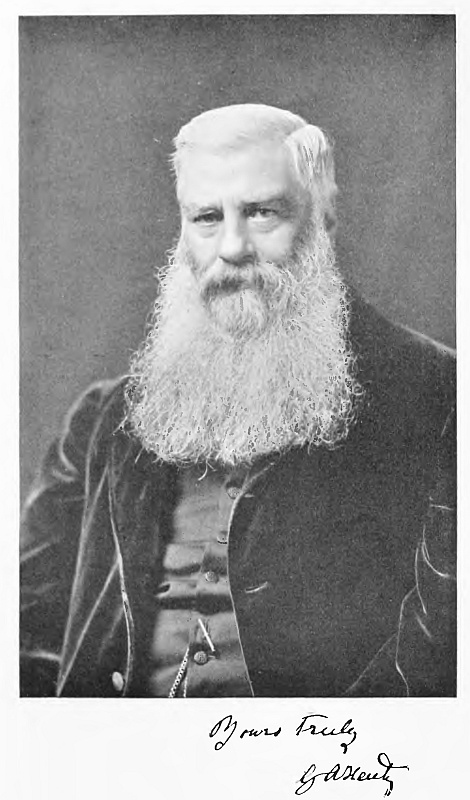
For many years also Henty’s was a face heartily welcomed as a friend and fellow clubman at the quiet little social tavern club known as the Whitefriars, a club at which in its early days politics was tabooed. But as years passed on times altered, and political and social debate became the rule, much to Henty’s annoyance. His idea of a club was that it should be a gathering-place where a few old friends, freed for the time being from quill-driving and thinking out books, leading articles, and other brain-worrying tasks, should meet for a social chat, and where there should be no delivering of speeches, no debates. So soon, therefore, as this debating and speech-delivering became the custom, Henty began to talk to those with whom he was most intimate of withdrawing his name from the club. Such a proceeding, it was pointed out to him, would be depriving his oldest friends of his company. He seemed to see the force of this, and matters went on, and a proposal he had made to a few friends that they should follow the example of the dwellers in the Wigwam and meet together in peace, seemed to have died out. Nevertheless Henty was a man of very strong political feeling, and possessed all the firm attributes of a thoroughly stanch Conservative gentleman, one might say Tory, of the past. If he had taken a motto, his would have been that of the old John Bull newspaper: “God, the Sovereign, and the People.” Throughout his life, though gentle and kindly by nature, he was, when roused by what he looked upon as injustice or cowardice, a fierce and truculent Briton, ready to defy the whole world.
On the whole, though, perhaps from its propinquity to the newspaper world, Henty was most frequently seen at that centre of which the late Andrew Halliday wrote that the qualification for admission was to be “a working-man in literature or art, and a good fellow.” Of course the rendezvous meant is the Savage Club—that place “apart from the chilling splendour of the modern club,”—the club over which so many disputes have taken place amongst its members as to its title, as to whether it borrows it from poor, improvident Richard Savage, or from its supposed Bohemian savagery. Be that as it may, it is certainly the spot where the bow of everyday warfare is unstrung and set aside.
It has long been the custom here to invite to dine at the social Saturday evening gathering pretty well everyone who has become famous, and whose name is upon the public lips, and these invitations have been accepted by warrior and statesman, by our greatest artists and travellers, whether they have sought to discover the Boreal mysteries or to cross the Torrid Zone. Even those who have become great rulers have not disdained to accept “Savage” hospitality, and upon such nights some popular or distinguished member of the club is called upon to take the chair. Now it so happens that there is extant a copy of the menu of a dinner, drawn by one of the cleverest members, which depicts in quaint, characteristic, and light-hearted fashion the imaginary proceedings and post-prandial entertainment connected with the aforesaid unstrung bow. In the case in question Lord Kitchener was the guest, fresh from his victories in the Sudan, and no better chairman could have been chosen than the popular war correspondent, George Henty, whose portrait and that of the famous general occupy the centre of the dinner card represented here.
It would be difficult to over-estimate the interest of such a typical meeting at the club, one which had naturally drawn together a crowded gathering of men who had more or less deeply cut their names upon the column of popularity, if not of fame.
The names of the general and war correspondent attracted to that dinner a distinguished company; the singer possessed of sweet tenor voice or deepest bass; the musician who excelled as pianist or who could bring forth the sweetest tones from the strings; the flautist; the skilful prestidigitator who puzzled the gathering with the latest Egyptian card trick, but who will amuse no more; the clever actor ready to give expression to some recitation, serious or laughable; the delineator of quaint phases of life; the artist whose works have provoked thought and admiration in the picture galleries; the scientist with the secrets of his laboratory gradually developing into life-saving and labour-economising reforms; to say nothing of the keen-visaged diplomatist whose range covers the mysteries of the chancelleries of Europe and cabinets where whispers are sacred and policies are shaped; and the writer to whom the wide world is but the sunning ground of cogitation.
At the club’s improvised concerts and entertainments all are ready to amuse or be amused; even the learned judge and the argumentative counsel who takes his brief from some clever lawyer, now his companion for the evening, meet the eye of physician or surgeon upon common ground.
Later, the deeply-engaged actor, when his part is at an end, comes in straight from the boards, bringing with him the buoyancy and imaginativeness of the strange fantastic realm where he is so popular—a realm so different from all others, although merely divided from the commonplace world by a row of lights.
Here all are friends, gathered by the attractions of music, song, and repartee. Men who have striven greatly all their lives and have gained much, and maybe lost something too, are here in good fellowship. Irksome trammels for the time are cast aside, permitting one and all to partake of what seems to be like a whiff of ozone or a breath from the pine-scented Surrey hills, after the contracted arena of the struggle for life.
On the particular occasion referred to above, supported as he was by those who had shared his past and been his companions and the witnesses of many a deadly battle, Henty was thoroughly at home; and it was a happy choice of a chairman which brought him to preside on that November evening when Kitchener was the special guest.
It was only a few short months after Kitchener’s crowning victory at Omdurman, which had finally crushed the Dervish power and set Slatin and his fellow captives free, and established law and order at Khartoum and through the immense territories which separate that city from Cairo. It was, therefore, a bright idea that inspired Oliver Paque, to give him his nom de plume, in his merry caricature to depict the gallant general as a beau sabreur leading a charge at full gallop and riding in to the feast. He is seen, as the illustration shows, leaping triumphantly through a circus paper hoop supported by a swarthy Sudanese, and the tatters of the paper ingeniously form the map of Africa. Right through Africa he leaps, as it were, into the fire of cheers and applause that greet him—into the smoke of the “Savage” pipe of peace, started by the chairman.
But that memorable night is not so far back in the Hinterland that one has any need to strain the memory assiduously for the leading details of historic incidents sketched in upon the menu card. The tattered indication of a map recalls Major Marchand and his march across desert and through forest and swamp to Fashoda. There are pleasant suggestions, too, in the tribute paid to the chairman by the artist’s pencil, which playfully deals with the fame the chairman had reaped by his books. Boys are shown eagerly reading his thrilling tales of history and adventure, a young mother is depicted admonishing a lad who is engrossed in some stirring work, while the list of titles—A Dash for Khartoum, True to the Old Flag, Through the Fray, By Right of Conquest, Held Fast for England—is alone a tribute to the sturdy chairman, for though titles only they illustrate the feelings of a patriotic man.
The pen-painter of the merry scene, indeed, notwithstanding the grotesqueness of the work, has contrived to suggest by many a happy touch little peculiarities in the individualities of his subjects. Thus he gives a wonderful likeness of such a familiar member as Dan Godfrey, the well-known band-master of the Guards, who is shown leading the concert in heroic bearskin what time Handel’s march of “The Conquering Hero” is blown by one of the most popular humourists of the club. The name of another member—Slaughter—seems by the irony of fate to be singularly apposite at a war correspondent’s banquet, while the drum and cymbals and the tom-tom tell their own tale as beaten by members whose faces are familiar to those behind the scenes. Everything, in short, tended to make this dinner a great success.
Sometimes when taking the chair, however, at one of these club dinners, Henty would fancy that the attendance was not so good as it might have been, and attributing it to a want of popularity, he would turn to the writer and whisper with almost a sigh, “Another frost!” This quaint bit of dramatic slang is, of course, popularly used in the theatrical world when the British public displays a tendency not to throng the seats, and there is a grim array of empty benches to crush all the spirit out of the actors in some clever piece. It was quite a mistake, though, to use it in connection with Henty’s dinners, for he was always surrounded by plenty of warm-hearted friends whose presence and sunshiny aspect were sufficient to set the wintry chill of unsociability at defiance.