"The Story of an Active Life" (continued 5)
Reading edition
“We did not suffer so much from the heat upon this coast as we do in parts of India; but this was because there was always either a sea or a land breeze blowing, which kept down the temperature in the shade to 84 or 85 degrees, which was by no means unpleasant. But when the sun blazed down the heat was really intense. A thermometer placed in the sun upon the wall of the hospital marked over 150 degrees for some hours three or four days during the week, and I should say that the heat of the bush, where there was no shade, was fully as great. Under these circumstances it was not to be wondered at that a certain number of men at the end of each day’s march were found unfit for further work, and had to be sent back in hammocks. Still, the number that fell out was very small indeed, for men struggled to the last rather than give in.”
When the men broke down, the officers noticed the poor fellows’ flushed faces and dull eyes, and said that they could only speak coherently with an effort. These were cases of attacks by the sun, not of sunstroke, for they were not sudden. The doctors called them sun-fever, and the cure adopted was for the poor fellows to be sent back in hammocks to the coast and placed on board ship, where in most cases the sea air restored them to health.
Henty is pretty severe in his description of the Sierra Leone men, the over-civilised and spoilt blacks with whom he came in contact during the advance. He describes them as “the laziest, most discontented, most self-sufficient and most impudent set of rascals the world contains. They are no more,” he says, “to be compared with the Fantis, or any of the other native tribes, than light is to darkness.”
In one case they started a mutiny, refusing to work unless money was paid to them instead of stores; but they had Englishmen to deal with, and when two of the ringleaders offered to strike the Control officers, the latter at once seized them single-handed, forced them apart, and treated them with firmness. Subsequently, as the men grew more threatening and determined in their refusals to work, one of the naval officers of the expedition, Captain Peel, interfered, and in true naval fashion threatened that the first man who refused to obey orders should be had up to the triangles and receive three dozen lashes. If the fellow resisted after this, he declared he would summon his sailors on shore, take him on board ship, and give him five dozen; while, if his companions and fellow-mutineers attempted any violence, he would without hesitation give orders for the sailors to fire. The threat sufficed.
The term “spoiled” has been applied by Henty to the Sierra Leone negro, and he is not the first writer by many who has dealt with the vanity and conceit that inflate the half-educated native. Allusion may be made to the humorous description of Captain Marryat concerning the Badian boy: “King George never fear, sir, long as Badian boy ’tan’ ’tiff.”
The Sierra Leone negro, says Henty, is in his native country lord and master. He believes that he is the white man’s equal in every point, his superior in most. But this game of indolence and insolence did not pay at Cape Coast. The negroes were enlisted in the service of the Queen for six months, and although the work they did was less than that which a Fanti girl of twelve years old would get through, it had to be done without insolence or mutiny.
Night in the jungle produced its memories. After his day’s tramp with the troops and bearers, nine o’clock in the evening saw all but the sentries lying down, and Henty retained for many years very vivid recollections of these nights in the forest on the way to Coomassie—close nights, with scarcely a breath of wind stirring. Somewhere outside the hut where the correspondents sheltered, a native would be demonstrating that chest troubles are not peculiar to our bronchitic, foggy isles, for here in the midst of this tropic heat one of the blacks would keep up a perpetual coughing that made sleep next to impossible; next, a legion of rats could be heard gnawing and scratching, as they tore about the shelters and raced in every direction over those who were seeking for rest; and then there were the insects. The mosquitoes would begin, and it seemed as if they knew the command in the old opera “The Siege of Rochelle”—“Sound the trumpet boldly!” Every now and then, too, upon fell intention bent, they would make a raid from above on some unprotected face, while, to supplement this trouble, a colony of the wretched insects which make their attacks from below—thin, flat, silent, and secretive—carried on their assault, and retired afterwards singularly misshapen, grown, to use the old countrified expression, “quite out of knowledge.”
“Now,” says Henty, “I imagine that here were assembled all the elements which make night horrible, with the exception only of indigestion after a heavy supper. Had I been in any other country, I would have moved my rug outside and slept there, but here such a proceeding would have entailed an attack of fever. Consequently I had nothing to do but lie still till morning.”
Henty relates a sad incident in connection with the encounters with the warlike Ashantis. He tells how the first of their merry party on the screw steamer Ambriz, the vessel on which Sir Garnet Wolseley went out to take up his command, had fallen, and “as usual,” he says, “death had taken one of the most gentle, brave, and kindly spirits from among them.” Lieutenant Wilmot, of the Royal Artillery, had fallen, fighting like a hero, and the news of his death, when it was brought in, produced the keenest regret among those who knew him. A promising young officer, attached to his profession, a zealous worker, and a favourite with all because of his quiet cheerfulness and modest unassuming manner, he was one of the leaders in a reconnaissance that had been thought necessary. The force consisted of a hundred of the West India Regiment, nine hundred native allies, and some of the Hausas with rockets, the last being under the command of the young officer. It seems that when he approached the Ashanti camp an alarm was given, and the fight began at once. The bush was extremely dense, and from out of its shelter the enemy poured a fierce fire, and in those short minutes the British officers had a severe lesson in the amount of confidence that could be placed in the native allies. Out of the nine hundred levies only about a hundred stood firm, and these might, for all the good they did, have followed their king or chief. This “noble” warrior headed the party who took to flight, and he, with his company, did not cease to run until they were safe back at camp, while many did not even stop there, but continued right on till they reached their own villages. Those that did stand fast made use of their muskets in the wildest and most useless manner, in contradistinction to the West India Regiment, which behaved with great steadiness and gallantry, and for two hours kept up a heavy Snider fire at their invisible foes, the Ashantis. Lieutenant Wilmot had dependable men in the Hausas, who had been well trained in the use of rockets, weapons formidable and awe-inspiring to natives; but early in the fight he received a severe wound in the shoulder from one of the Ashanti bullets fired from the bush, and this tore through flesh and muscle and narrowly missed the bone. The wound was bad enough to have necessitated immediate retirement; but it meant the loss of their leader to the Hausas, and in spite of the severity of the wound and the acute pain, he held on to his task, encouraging his men for two long hours, during which time the rockets discharged against the enemy dislodged them again and again from their strongholds. At last, when the gallant young officer’s work was pretty well done, another bullet struck him down, and this time it was no mere painful flesh wound—the missile found its way straight to his heart, and he fell back dead. With the exception of one native, poor Wilmot was the only man killed. But the Ashantis had stood their ground well, and the wounds of the attacking party were many. So vigorous indeed was the defence of the brave savages, that just about the time when Wilmot fell, Colonel Festing, who was in command, and was also hit, seeing that an attempt was being made by the enemy to cut off his retreat, fell back upon the village from which the attack had been made. The many wounds were for the most part very slight; for though put down as severe because received in spots where a rifle bullet wound would have been a serious matter, they were mostly inflicted by slugs from clumsy muskets. These pellets only penetrated a short distance, with the result that the injuries only entailed a day or two’s confinement.
The death of poor young Wilmot moved the whole camp to deep feeling, and the funeral took place at the cemetery of Cape Coast on the following day. Sir Garnet Wolseley and the staff and nearly every officer in the town attended, while the navy was represented by the officers from the fleet. The procession was solemn and impressive, bringing to the minds of many the sad little poem which recounts the burial of Sir John Moore. The body had been brought down from Prospect House, to which it had been first taken, and was placed in a room of the General Hospital. A gun was brought, dragged by a party of marine artillerymen and marines, who, commanded by a naval officer, had come ashore for the purpose. An officer of the Royal Artillery superintended the preparations and followed as chief mourner. As the coffin, covered by a flag, was brought out and placed upon the gun carriage, all the officers saluted their dead comrade, and then fell in behind at a slow march.
“Not a drum was heard, not a funeral note.”
There was no military music, but Henty says: “I think the slow measured tramp was more moving than any pomp or military display could have been. Never before has such a procession of officers been seen on the Gold Coast; and a crowd of natives assembled to look on.”
The road led by the sea, and the dull moan of the surge was more appropriate music than any made by mechanical instruments. A quarter of a mile brought them to the cemetery, and as they stood around and listened to the solemn words, “it is, I trust, no derogation to our manliness to say that many a lip was bitten hard, many a hand dashed across the face to hide that emotion which, however great the cause, Englishmen always strive to conceal.”
“During his month’s stay at Cape Coast, Lieutenant Wilmot had assisted Captain Rait to turn the wild Hausas into steady gunners. He had won all hearts, and among us there was but one feeling—that of deep regret for the unselfish young fellow who had left us but a few days before in high health and spirits, and who was brought back only to be laid in his lonely grave by the never-ceasing surf of the Atlantic Ocean.”
Chapter Thirty.
The March up Country.
The lessons learned in dealing with the native allies in the attack upon the daring savages who had set the British forces at defiance were too sharp to be neglected. There was, of course, something very attractive and cheering about being backed up by some hundreds, or even thousands, of well-armed, fierce-looking, stalwart natives. They were wonderfully skilful in performing upon the tom-tom, or in producing thunder from the war drum—sounds which could be kept up, suggesting dire threats, all through the night, and were often accompanied by yells and shouts such as would send dismay into any enemy’s breast—while, when they were partially drilled and supplied with musket or rifle and cartridge-box, they were looked upon as being invincible, and even believed it themselves. But the proof of the pudding is said to be in the eating, and the flavour of the compôte of native allies proved only to be vile. Indeed, in the opinion of our officers many of the blacks seemed to be only of use for the labour of road-making, preparing stations, and accumulating stores up the country, business, all this, which would have been much better carried on by the women, who had already proved themselves invaluable for carrying loads.
Encounter after encounter had taken place with the Ashantis, in which the native allies had done a great amount of shouting when they stood their ground; but they had more often done this shouting while in full retreat, for they seemed to consider it a duty to alarm everyone in the rear. Hence it was decided to do away with our native army, which had proved itself to be worse than useless; and the police were ordered to arrest all the men belonging to the Cape Coast contingent as they came sneaking in through the bush when the fights were at an end.
Their arms were taken away from them, and orders were given for them to be marched up under a guard to where the road had been commenced towards the interior for a more strenuous attack to be made on the enemy. This was considered to be a move in the right direction, but all wished that the entire force of the allies had come in to be disarmed, for as long as they remained under arms they were a trouble and an anxiety. They had to be fed; they expended ammunition largely; they had to be driven towards the foe, and when they reached his neighbourhood they proved themselves to be more likely to shoot their friends than their enemies. In fact, where the British regiments were strengthened—such was the term—by these native allies, the latter proved to be an immense anxiety and cause of weakness to any troops they accompanied. Even now their measure is not quite taken. They proved to be useless as scouts; they would not go in front; and they were dangerous in the rear. They were unreliable even as watch-dogs, for they would run from their own shadow, and they would blaze away at nothing for half an hour if they heard a night bird flutter in the bush.
But with all these disadvantages and objections to their presence, the leaders of the expedition could not but feel the difficulty of taking such a step as to disarm them en masse. There was the risk of incurring the wrath of the whole population of Cape Coast, as these men, if they could do injury in no other way, might refuse altogether to work or carry loads. There was also the fact that the British had no force which could compel a thousand men to go out and labour on the road. They might have been taken up, of course, under an escort, but no contingent which the little British army could spare could prevent these allies from taking to the bush the first day they went out, and so finding their way down again.
Finding that the men would not come forward to carry loads after the disarmament, it occurred to one of our officers to appeal to the women, as they had proved to be so much better than the men; and this proved to have excellent results, two of the wives of the chiefs going round and haranguing their sisters in very able speeches. They called upon the women to come forward and help the white men by carrying loads up the country. The white men, they said, had come there to protect them from the Ashantis, and the people of Cape Coast ought to help in every way they could. The men, they said, had not done well. They had refused to fight; they had disgraced themselves. Let the women come forward, then, and do their best, and let every one of them go and offer to take a load up the country.
These speeches produced a good deal of talk and excitement among the women, who came to a general agreement that they ought to do as they were asked. Whether they would come forward in any numbers remained to be seen, for, as related by the American humourist, each woman was ready and willing that all her female relations should come forward as carriers, but each was disposed to view her own as an exceptional case. However, after much talk, the assistance of the women did prove valuable, and later, when the Control was much troubled about getting the loads up into the interior for the use of the troops, a brilliant idea occurred to one of the officers of the department. This was, that the services of the children of the place could be utilised, and that by paying half the usual price for the carriage of half the usual load, they might get the troublesome little barrels of provisions taken up the country. The idea was carried out with immense success, for no sooner was it known that boys and girls could get half wages for carrying up light loads, than there was a perfect rush of the juvenile population to the store where the barrels were served out.
Three hundred were sent off the first morning, nearly four hundred the second, and a large number of applicants were told that they must come next day. The glee of the youngsters on being employed was worth watching. They were all accustomed to carry weights, such as great jars of water and baskets of yams, far heavier than those which they had now to take up country, and the fun of the expedition and the satisfaction of earning money proved delightful, while as four hundred boys and girls carried up ten thousand pounds of rice, this addition to the army of carriers was no small help.
The march to Coomassie proved to be a time for carrying out invention. Wants had to be made up for, and in accordance with the proverb that necessity is the mother of invention, our officers appealed pretty largely to that mother.
For instance, during a long halt before making a serious advance, one of the most amusing sights in the town was provided by Captain Rait, of the Royal Artillery. He had a certain number of guns to get to the front, and he very soon discovered that, for purposes of hauling a field-piece through a dense tropical forest, the native black was worse than useless. This discovery, too, was made at a time when there were no Jacks available from the men-of-war to harness themselves on to the limber and run the light pieces up to the front in sailors’ cheery fashion.
But Captain Rait made his plans, knowing as he did that in camp there were a number of young bullocks which had been sent down from Sierra Leone to the contractor who supplied the meat. “Why,” said the gallant officer, “should not these young bullocks be broken in to draw my guns?”
Why, indeed? But here was where the amusing side—amusing to the forces who looked on—came in, for as soon as the attempt was made to yoke or harness the oxen, they began to object.
The heavy dull oxen have never been known to display much understanding, but had they known that the acquirement of the hateful accomplishment in which they were being instructed was saving them from immediate slaughter, they might perchance have become more tractable. The French have a proverb that it is necessary to suffer so as to become beautiful. The oxen were not required to become beautiful, only useful, and, says one of our writers, the useful and the beautiful are one. At any rate, they were called upon to suffer but slightly.
The animals were small, but the weight behind them was not very great—an old-fashioned howitzer weighing, with its cannon and limber, about two hundredweight. The artillery officer acted as driver, and the Hausa gunners ran alongside, leaving the oxen alone when they progressed slowly and steadily, and, when not so disposed, giving them a thrust here and a push there so as to keep the sluggish brutes straight, while others urged the guns along whenever the beasts did not submit readily to the yoke.
So every afternoon for some days the artillery captain drove these peculiar war chariots about the place to the no slight risk of his neck, for the roads were ill-made and intersected by drains, some of which were two feet deep. But the gallant officer faced all this, to the delight of the lookers-on, and he was quite happy and contented, for no accident beyond the occasional breaking of a pole took place. Finally, as a reward for his perseverance Captain Rait had the satisfaction of taking his guns up to the front drawn by these sturdy bullocks, which, though not entirely broken in, were yet sufficiently so to draw their loads in very fair order.
At this time bullocks were being driven regularly up to the front, so as to give the white troops a meal of fresh meat twice a week, and the sailors and marines, who were accustomed to the salt junk served on board, got on very well with an occasional change. “But,” says Henty, “for white men not so used to salt meat, it would be difficult to imagine a more objectionable food for a tropical climate,” and, he continues, once more well launched upon the Commissariat Department, “the preserved meat, which was issued much more frequently than the salt, was no doubt healthier, but men grew very sick of it. Australian meat at the best of times is not an appetising food, but once or twice a week one can eat it without any great effort. Four or five times a week, however, in a climate where the appetite requires a little humouring, it is really a trial; so that the discovery that bullocks could at any rate live for some time up the country, and that they were able to pick up a subsistence for themselves in the old clearings, was an immense benefit for us all.”
Cattle were brought from Sierra Leone, from the Canaries, from Madeira, and even from Lisbon, and in this way an abundant supply was obtained for the use of the white troops. “Had they,” says Henty, “been obliged to subsist solely upon salt and Australian meat during the march up and back again, I believe that the mortality would have been vastly greater than it really was.”
After one of the encounters with the Ashantis, rumour began to reach the British from prisoners and escaped slaves that the enemy had lost a great number of men, and that immediately the action was over they had begun to retreat. But upon the day after the fight the partly-conquered black army was met by reinforcements seven thousand strong, bringing orders from the king that they were not to retreat, but to attack the English and drive them back. This the retreating army refused to do, declaring that they had done all that was possible and that they could do no more. The new-comers, struck by their wretched appearance, and by their tales of misery and distress, which they now heard for the first time, refused to advance alone, and the whole force fell back together. Several slaves now made their escape, and brought the news that the Ashanti army was crossing the river in canoes and on rafts. But such intelligence could not be relied upon, and Sir Garnet Wolseley, after much enquiry, finding it impossible to obtain trustworthy information, called for volunteers to go on ahead and discover whether the Ashantis had really got across. His troops had plenty of pluck, and two men belonging to one of the West India regiments at once undertook the task, which meant an advance alone some twenty-five miles to the river Prah.
They found how severe had been the enemy’s defeat, for all along the whole route of the retreat men were lying dead, while on reaching the banks of the stream it was to find that the survivors of the beaten army and the reinforcements had all crossed.
Elated by their success, the two scouts stopped on the river bank to write their names on a piece of paper and fasten it on a tree to prove that they had been there. This done, in the coolest manner possible they fired their rifles across the stream in the direction of the enemy, as if in contempt for their prowess, and then in the most matter-of-fact way shouldered their pieces and marched back towards their general’s camp to bear their news.
“This feat,” Henty writes, “appears to me one of the most courageous, if not the most courageous, which was performed during the whole campaign. Nothing could have been more trying to the nerves than that long march through the lonely forest, with the knowledge that at any moment some body of Ashantis who had lingered behind the rest might spring upon them, and that, if not killed at once, they were doomed to a lingering death by torture at Coomassie.”
Chapter Thirty One.
The Battle of Amoaful.
At last, after endless hindrances, the expedition was within measurable distance of coming into direct touch with the Ashantis, and Henty records in dramatic style the great decisive battle of the campaign, when, after five hours and a half of stubborn fighting, the Ashantis were completely discomfited. The Battle of Amoaful will long remain a memory in Ashanti, where it is a superstition to swear by the days which have brought misfortune in their train. And the last day of January in that eventful year, or the word Amoaful, will for centuries be the most solemn of words to the Ashanti people—an oath by which kings will be bound; a legend with which children will be awed. But yet there was no shame in the defeat. The Ashantis fought like the brave men they are, and though worsted they added to their reputation, while nothing but admiration can be felt for the manner in which they came on time and again, notwithstanding the fierce musketry fire which was intended to stop their assaults.
On the day of the battle the marching orders came early. The Naval Brigade and the 23rd Regiment had to come from Kiang Bossu. These united at Insafoo with the 42nd, the Rifle Brigade, and the artillery of Captain Rait, the officer who had succeeded so well in his attempt to utilise oxen for hauling the guns up country. At Quarman things were well under weigh at dawn, but it was half-past seven ere the head of the 42nd Regiment entered the village, through which they swung without a halt. Following them came Rait’s artillery, a company of the 23rd, and the Naval Brigade, which included the Marines, eighty in number, who distinguished themselves like their comrades. Henty, in reference to the disappointment that was felt in England at the doings by the Marines not being specially commented upon, rightly points out that it would have been difficult to go into details respecting the deeds of this small body, wholly apart from the force with which they were linked. It was enough that they shared in all the glory of the brigade of the “handy men.”
Wood’s regiment had only three companies and Russell’s four, owing to the garrisons which had necessarily to be left en route, and these regiments took their position in the rear of the naval men, whom they were to follow in the fight.
When the staff reached Quarman, Henty learned that the difficulties of transport were at last surmounted. Colonel Colley proved an excellent transport officer, and had succeeded in amply provisioning Insafoo. Henty proceeded with the staff in the rear of Russell’s regiment, and had not been more than ten minutes on the march ere the brisk rattle of musketry told him that the 42nd were busy at work clearing the village. There was a short pause, and then the firing began again. At this time he was annoyed at the progress being so slow. In front there was much lumber in the way of ammunition and hammocks, which impedimenta was in the charge of a large number of bearers—“somewhat scared and wholly stupid men.” Still, he managed to get a very good panoramic view of the proceedings, and in the course of his exciting narrative he describes accurately the position of all the leaders of our troops, from Sir Garnet downwards. He says that the first shot was fired a few minutes before eight, and it was nearly half an hour later that the troops came out into the open place of Agamassie, a village of six or eight houses. The firing was unceasing, and with bush all round there was heavy work for the engineers in clearing a way for the baggage. The enemy’s fire came from the front and right and left, and the English progress was slow.
At the entrance to Agamassie Captain Buckle, of the Royal Engineers, a brave man and a brilliant officer, was found breathing his last, shot with two slugs just above the heart, while the doctors were hard at work attending to the wounds of several men of the 42nd. Not far away Dr Feagan, of the Naval Brigade, was also busy, having taken up his station under a tree—a tree which Sir Garnet promoted to be his head-quarters.
Here three roads converged, and he was able to receive reports from Colonel McLeod on the left, Sir Archibald Alison in the centre, and Colonel Wood on the right. It seems that the 42nd drove the enemy’s outposts helter skelter out of the village, and then pushed on for nearly a quarter of a mile, when they were checked by a tremendous fire. The undergrowth was dense in the extreme, and the Ashantis contested every inch, while a great difficulty which our men had to face was the risk of firing at friends, in consequence of the intricacy of the bush, which was so bewildering that all idea of the points of the compass was lost. Sir Garnet sent orders to commanding officers to warn their men against this danger, and to prevent it from happening the rear of Colonel Wood’s column was swung round so that it advanced more towards the right. “Five minutes with the Naval Brigade,” Henty says, “showed me sufficiently that I should gain nothing in the way of incidents by remaining there, for no enemy was actually in sight, while I was running a very considerable risk of being knocked over. I therefore returned to the head-quarters at the village.”
It was now ten o’clock; wounded men were coming in fast—42nd Rifles, Naval Brigade, and native allies. On the left the firing had nearly ceased, and a despatch was received from Colonel McLeod saying that all was comparatively quiet on his side. Orders were accordingly sent to him to bear to the north-east until he came in contact with the enemy. In so doing he came upon a partial clearing, where a sharp opposition was experienced. The Hausas carried the clearing at a rush, but the enemy, as usual, opened a heavy fire from the edge of the bush. The Hausas were recalled and a fire was opened with the rockets, which soon drove the Ashantis back. The 42nd were meanwhile in the thick of things, and the men were admirably handled by Major McPherson; but generalship availed nothing in a swamp where the firing was terrific, so the regiment suffered a temporary check. The enemy could not be seen, but every bush had its white puff of smoke, and the air was full of slugs. At this juncture Captain Rait’s guns proved their efficacy. Assisted by Lieutenant Saunders, the Captain advanced boldly in front of the line and poured round after round of grape into the enemy, with the result that their fire slackened and the 42nd were enabled to continue their advance. Through the camp and up the hill they went; and now the effect of the English fire was to be seen, for the dead Ashantis lay in heaps. Beyond the camp upon the hill the bush was thicker than ever, and here, where it was impossible for the white soldier to skirmish, the Ashantis made a last desperate stand. The narrow lane up which alone the troops could pass was torn as if by hail with the shower of slugs, but a large tree which stood nearly in the centre of the path, and caused it slightly to curve, afforded some shelter to our men, and they sent back a storm of bullets in return.
The 42nd suffered greatly, and Major McPherson had been shot in the leg; but he declined to go to the ambulance, and, helped by a stick, still led his men. Eight other officers were wounded, and the total of 104 killed and wounded out of a force of a little over 450, showed plainly enough how hard fought was the day. However, victory was not far off. The Ashantis found the bush a trifle too hot, and had to take to the open, where the Sniders and the guns proved too much for them. From this point the advance was rapid. Led by Sir A. Alison, the 42nd went with a rush up the narrow path and out into the clearing beyond. There was desultory firing from the houses, but the men drove the enemy out of these, and a single shell down the space (hardly a street) which divided the village burst in a group at the farther end, killing eight and completing the work.
It was mid-day then, but the Ashantis were not finally beaten, and throughout Henty has high praise for their courage and tenacity, which was evidenced once again in a determined but abortive attempt to retake the village.
Finally, when Sir Garnet gave orders for the general advance, a number of our allies, who had fought admirably while on the defensive, raised their war-cry and, sword in hand, rushed on like so many panthers let loose, while by their side, skirmishing as coolly as if on parade, were the men of the Rifle Brigade. The latter searched every bush with their bullets, and in five minutes from the beginning of the advance the Ashantis were in full retreat.
Such is the story of the Battle of Amoaful, a battle which reflects as much credit on all engaged in it as many affairs in which the number of combatants have been ten times as large.
“Never,” says Henty, “was a battle fought admitting less of description. It is impossible, indeed, to give a picturesque account of an encounter in which there was nothing whatever picturesque; in which scarcely a man engaged saw an enemy from the commencement to the end; in which there was no manoeuvring, no brilliant charge, no general concentration of troops. The battle consisted simply of five hours of lying down, of creeping through the scrub, of gaining ground foot by foot, and of pouring a ceaseless fire into every bush in front which might conceal an invisible foe.”
The scene in Agamassie after the day had been won was full of interest. In the centre of the village Sir Garnet was busy issuing instructions and making sure that his orders were carried out. Fortunately for the wounded, there was but little sunshine, and Henty has a word of praise for the fortitude of the natives, who submitted to the operation of probing and extracting slugs without a murmur. There were in all 250 casualties, but only fifteen or twenty deaths. One poor fellow of the 42nd, unluckily, was separated from his comrades in the bush and was killed, while when found later he was headless.
It was difficult to estimate the number of natives engaged. The total might be anything from fifteen to twenty thousand. No accurate details could be obtained from the enemy, for the Ashantis seem to be unable to count anything higher than thirty. Beyond that the figures are to them too vast for comprehension. They always carry off their killed and wounded unless extremely hard pressed; but after the Battle of Amoaful their dead lay very thickly together, often in groups of five or six. Henty considered, too, that numbers of the wounded could only have crawled away to die. In and about the village eighty bodies were found, and he estimates the Ashanti loss at two thousand, and these the best fighting men. Ammon Quatia, a famous leader, was among the slain, and Aboo, one of the six great feudal kings, fell also, likewise the king’s chief executioner. The Ashantis were wretchedly armed, and yet for five hours they held out against picked troops who were equipped with the best weapons of precision. The choice of a position, too, was, he considered, admirable.
After the din of the battle the succeeding silence was very strange, but this was soon broken by the rattle of firing to the rear. The Ashantis were still in force along the road, and the first convoys of wounded were forced to return, while Quarman had been attacked—“unpleasant news to a man whose baggage was in that town, and who knew that the garrison was a small one.” Fortunately, a few hours later the village in question was relieved.
Amoaful was found to be a dirty town, capable of housing about two thousand people. It was divided into two parts by the high road, some thirty yards wide, and down this road grew three or four shady trees. Under these officers and men sat in groups, the central tree being left to the officers, just as in a French town one café is tacitly reserved for their use. There was nothing to eat, apart from the limited haversack ration, but everyone was in high spirits. Fortunately an immense supply of grain was found, and this came in usefully to the Control. It was served out to the carriers, who much preferred it to rice.
Bequah, only a mile and a quarter from Amoaful, was the capital of a powerful Ashanti king. Here on the following day the enemy were only dislodged after a severe fight, they being in great force; and Henty attributes this victory in part to the moral effect produced by the proceedings at Amoaful. The place was burned down, which action of course proved a damaging blow to the prestige of the king, though so far as permanent damage went, the houses with their palm-leaf roofs could easily be rebuilt.
The many villages that they passed were much like each other, and the programme of the troops in the course of the march onward to Coomassie was marked by a good deal of repetition—bush dangers, sudden fusillades, and then a searching of the scrub in every direction before camp was formed.
Some of the convoys suffered, and in the Quarman attack several officers lost their kits, and were reduced for the remainder of the campaign to the clothes on their backs. This was in consequence of the action of the cowardly carriers, who threw down their loads and ignominiously ran away.
The native troops fought well, and “rushed” several of the villages in good style; still, the advance was slow, the enemy hanging on the flanks. Here and there, though, in the villages there was evidence of panic—war-drums, horns, chiefs’ stools and umbrellas being scattered broadcast. Up to the time, however, of a message being received from General Sir Archibald Alison to the effect that all the villages save the last were taken, the firing had been going on without cessation, and Sir Garnet himself received a blow on the helmet from a slug.
A pestilential black swamp surrounded Coomassie, and after this was passed and the town had been entered, the General rode up to the troops, who had formed in line, and called for cheers for the Queen.
There was a great deal to be done, and a beginning was made with disarming all the Ashantis possible. The first night in Coomassie was eventful, for fires broke out in several directions, the result of carriers and others plundering. Pour encourager les autres, one man—a policeman, of all people—was hanged at sight. Several others had the lash. The General was much vexed at these fires, as he had asked the king to come in and make peace, stipulating that the town should be spared.
Coomassie was decidedly picturesque, many of its houses resembling Chinese temples. But the great feature was the “fetish.” Everything was fetish. Near the door of each house was a tree, at the foot of which were placed little idols, calabashes, bits of china, bones—an extraordinary medley. Inside there was dust and litter, the result of years of neglect, and the chief apartments were filled with lumber, all kinds of paraphernalia, umbrellas, drums, wooden maces, and what not.
Up to the last it was believed by the Ashantis that the fetish would save the day, and the optimism of the king was shown by the state of the royal palace. It was in all respects exactly as he had left it, except that the gold-dust must have been carried off or buried. The royal bed and couch lay in their places, the royal chairs were in their usual raised positions, only oddly enough they had been turned round and over.
In the palace there was a curious jumble of gold masks, gold caps, clocks, china, pillows, guns, etc. It was rather like a sale-room. There were many great alcoved courts, one containing war-drums ornamented either with skulls or thigh-bones. In two or three there was simply a royal chair upon which his majesty used to sit to administer what passed for justice, and several stools were found covered with thick coatings of recently-shed blood. Henty says that a horrible smell of gore pervaded the whole palace. The nauseating odour was everywhere perceptible; and this was not to be wondered at, for twenty yards from one of the fetish trees was a charnel place where thousands had perished. Here were scores of bodies in various stages of putrefaction.
The palace contained fetishes of all kinds, little dolls, and other articles. The king’s bed-room was ten feet by eight, and the bed had a ledge on the near side, which the monarch had to step over when he sought his pillow. Among other weapons found here was an English general’s sword, inscribed, “From Queen Victoria to the King of Ashanti”, presented to his predecessor.
There is only one term that can be applied to Henty’s work in connection with the march to Coomassie, and that is thorough, for danger seems not to have been considered for a moment. What the troops had to do, he told himself, that he had to see, and self was never spared.
After the desperate fighting was at an end, and the General’s offers to the defeated monarch had been made known, it was anticipated that the king would come in and surrender. But in spite of much waiting and patience on the General’s part nothing happened, and all delay and expectation were ultimately brought to an end by a terrific storm. For now, after much thought, it was decided—and Henty applauded the decision—to mark the visit of the punitive troops by the destruction of the place as a warning and an object-lesson in Britain’s power to the king and the petty chiefs around. For the moment it was anticipated that to fire the place would be impossible after the saturating by the tremendous rains, as this, it was feared, would prevent the thatch from burning; but the engineers went to work with axe, powder, and palm-leaf torch, with the result that the whole fabric of the place was brought down like a piled-up pack of cards. Palm, bamboo, and thatch, as soon as the flames once got hold and began to leap, rapidly disappeared, and it was soon abundantly clear that before long Coomassie would be a city of the past. The royal residence, which was little more than a cemetery, shared in the general destruction, for it was blown up; and then the men cheered, and every heart grew light, for the task was done.
Chapter Thirty Two.
A Carlist War.
Henty’s return from Ashanti in 1874 is memorable to the writer from its being the commencement of his introduction to a good fellowship which lasted till that event which turns all friendships into a memory.
The meeting was in that famous old street named after the little river of such modest and retiring nature that it was only written down as a ditch, though probably in its beginnings, long before it was lost in Father Thames, it was christened Fleet.
It was just outside the Standard office that the acquaintance began with the singular-looking, swarthy, not sun-tanned, but blackened war correspondent freshly arrived from the deadly swamps and black shadows of the West Coast forests.
Scientific writers on the physiology of man and his colouration tell us that the black races have been endowed by nature with a curious black pigment lying beneath the skin, and that this is evidently intended as a protection from the too ardent and otherwise injurious rays of the sun. In the case of Henty, his appearance on his first return from the Coomassie campaign was that of one upon whom nature had begun to bestow some of this strange protection. He did not look embrowned, but blackened; so discoloured, in fact, that there was one who laughingly spoke of the discoloration—which lasted for some considerable time—as making him strongly resemble a chimney-sweep who had been trying hard to wash himself clean for Sunday and had dismally failed.
Henty found time in 1874 to send to the press in book form his account of the West Coast expedition, under the title of The March to Coomassie, a work which ran through two editions. But he was not allowed long for the purpose of resuming the natural tint of an Englishman. Fresh work was looming in the almost immediate future, and, as if fate had ordained that he was to have something to do with nearly every warlike episode that recent history records, the summons came that he should start for that hotbed of revolution and insurrection, Spain. Here he was to busy his pen with his accounts of the long-drawn-out, never-seeming-to-end troubles in connection with the succession, and the long duel between Don Alfonso and Don Carlos to decide which should reign as king. Moreover a short-lived Spanish republic was in these days much to the fore. He had come back from Ashanti looking forward to rest and change. The rest was withheld, but the change came in plenty. Peace had been proclaimed in one part of the world, and one war was at an end, but this other war was in full swing, and so almost immediately he received his orders to start for Spain.
Arrived in the Peninsula, he hurried to head-quarters, where he was received with the greatest courtesy and furnished with the means of following the army before Bilbao. Here he was soon in his element, penning one of his graphic letters, describing the forces and dealing with the fortifications, batteries, and the strategy of the contending armies. There was no waiting here, no want of exciting matter such as would interest his readers at home, and in the pursuit of information he seems to have kept well to the front, meeting the sad traces of battle in the shape of stretcher after stretcher being brought in laden with the dead and wounded.
He never seems to have flinched from the duty that was his, and above all, he never lost sympathy with the wounded, even, as in former cases, making a point of exploring the temporary hospitals that were being filled.
He describes soon after his arrival at the front, and just at the close of one of the encounters, how he went out one night in search of information, stopping by the roadside for the space of a couple of hours. The scene was as striking as it was sad. There was but little moonlight, and by the glare of a few camp fires he saw the long line of stretchers go by bearing officers and men to the ambulances. The procession was watched by the startled uninjured soldiers, whose faces showed that they were gazing for the first time on the victims of a civil war.
Those they looked upon were in a way fortunate, for in the long line that passed Henty, or which he passed by, there were many who had found no bearers, and so had crawled along by the aid of some comrade.
Here and there there were ambulances for dressing the wounds of those who required most attention. Many who had been hit in the neck, arms, or feet, had been temporarily bandaged, and he came upon one poor fellow who had been severely wounded in the neck and shoulder, whose dressing had become disarranged as he struggled onward. At length, forced by his suffering, he was resting by the way, moaning piteously, and after Henty had rearranged the dressing with a handkerchief and the sufferer’s cravat, the man murmured in Spanish his grateful thanks to the young Englishman who had helped him in his need.
It was truly a time of suffering, for hundreds of wounded had passed the night untended upon the ground, and even the dead could not be buried, as neither side dared expose themselves to the severe fire that was kept up.
In Henty’s earlier letters the sympathy above mentioned affected his descriptions, which were sad in the extreme, in fact those of a man who suffered too. All through the period when he was with the Spanish army, in a quiet unobtrusive way the letters constantly showed how often he was placed in circumstances where there were calls made upon his humanity, and invariably he displayed his readiness to join hands with the members of the Red Cross Society and help the wounded sufferers in their distress.
Experience and his own nature generally found him friends, who from day to day were ready to share with him such provision as was to be had, or to accept a portion of his own scanty military rations. Then setting danger at defiance, he was glad to yield to fatigue and prepare himself for the next day’s toil by sleeping anywhere, beneath a shelter if it was to be found, if not, rolled in a waterproof, one of his principal cares always being the protection of his writing-case and pens. Here, however, in spite of his care, he was called upon to suffer the war correspondent’s great difficulty. It is comparatively easy for an energetic man, supplied with proper credentials, to gather enough stirring facts in the progress of a war to form an interesting article for his paper, but after hurrying to the nearest shelter where he could write and finish his letter, there would always come the difficulties of despatch. It was not always easy to find a messenger to bear it to the nearest place where postal communication could be ensured, and afterwards only too often he had the mortification of discovering that the carefully-written communication had miscarried.
The war which Henty was now engaged in describing was not one of great battles with massed brigades against massed brigades, and troops spread over miles of country, but it was a desultory continuance of what might be spoken of as village warfare. The Carlists fought in a guerrilla-like fashion, and were continually being driven from one position to start up again unexpectedly in another.
There was plenty of artillery brought to bear at times, but more often it was hand-to-hand fighting, kept up with very small results, as far as the main issue was concerned, though defeat and destruction were frequently the fate of either party, while the country itself was the greatest sufferer.
In his many journeyings from place to place in search of information, Henty was constantly brought face to face with the more or less petty horrors and often mischievous ruin caused by civil war—desolated villages, ruined homestead and mansion, and the stagnation of the country’s social life by the passing through it of fire and sword. And for what? Too often the answer might be given in the words which our own poet placed in the mouth of Old Kaspar: “I know not why they fought, quoth he, But ’twas a famous victory.” The politician alone can tell. What we know is that it seemed to be a never-ending war, one which supplied George Henty with the material which he afterwards made the basis of interesting historical tales. For he was ever to the front, and seems to have led a charmed life, living as he did an existence wherein there was always an impending attack, with the enemy starting up here and there in greater or less force.
One Sunday he was in a town on the banks of a river, when the Carlists suddenly appeared on the other bank and began firing volleys across the water, the bullets coming whistling unpleasantly about the streets. He naïvely says that the inhabitants were getting into a great state of alarm. Naturally! But by mid-day on Monday the fire ceased, and by the evening it appears that the Carlist commanders received some news that involved retreat, and made them start off guerrilla-like with all their forces through some of the passes leading into the more impregnable valleys. Then came pursuit, till cartridges and grenades began to run short, and a fresh enemy appeared in the shape of a scarcity of provisions. Meanwhile the Carlists distinguished themselves by burning several houses, including a convent and a very fine mansion, which were in no way interfering with their attack. In his description of this petty warfare Henty goes on to say: “From what I gather of the peasantry, the Carlists must have suffered from the shells. Twenty bullock-carts with wounded were removed, and a chief is said to have been killed, while on the other side the Republican loss did not exceed a hundred. How pitiful! A sample this of much of the warfare that was carried on, and with so little result!”
In another letter, written from Burgos in June, 1874, he gives a charming description of the beauty of the districts where the Carlists had again and again appeared during their January raids. By this time, though, there was a fresh enemy in the field, namely the weather, and on a certain railway journey he had ample evidence of the havoc wrought by the elements. A lowering sky, he says, and dark clouds which almost touched the roofs of the village churches gave warning of the severest thunderstorm he ever witnessed in that part of Spain. As the train dashed across the plains, the storm burst with such fury that the hailstones actually broke some of the carriage windows, while the clouds were so low that the train seemed to be passing through them. In fact, within human record no storm had done such damage in Old Castile. Finally the train was brought to a standstill in a little station, and the officials made the announcement that the line had been destroyed by the flood. Henty with his colleagues, therefore, had to pass the night as best they could with the rain pouring in torrents and the wind moaning around. Fretting was in vain, and the unhappy station-master could only shrug his shoulders and listen patiently to the upbraidings of the correspondents, who accused him of obstinacy in not sending the train forward. But with the dawn the little party became aware that they had had a very narrow escape. A previous train had become derailed some hours before they came up, and seven poor creatures were lying wounded in the station. The daylight showed them too that, as far as their eyes could see, the country was flooded; fields and crops, walls and roads, were covered with the yellow muddy water. The line was a wreck; the sleepers were held together by the rails, and the embankment had been washed away. Miles and miles of rich country had been destroyed by the fury of the inundation, while the rays of the rising sun cast a lurid glare over the scene. The correspondents had to continue their journey along the line on foot, passing the ruins of the wrecked train which had preceded them, and then onwards to the next quarters of the northern army. Here they learned of the doings of the Carlist generals, and found that four stations had been burned, and that in every peaceful village in this land of vineyards the houses were fortified and held by the soldiery, for the war was being carried on in a more pitiable way than ever. It was the custom for the Carlist bands to sweep down from Navarre in the dead of night, to burn farms or stations, then take up a few rails, or attempt to destroy a bridge, while by daybreak the mischief would be done and the raiders far away.
It was an adventurous life for a war correspondent, and one can only repeat how ample was the supply of material for Henty’s ready pen. But the end came at last, for in spite of a brave struggle the Carlist star went down in gloom, and Henty returned to England to enjoy a brief rest before taking part in a bright and enjoyable expedition, that of the Prince of Wales—His Majesty, King Edward—to India.
Chapter Thirty Three.
The Royal Tour in India.
The Royal Tour in India being a matter of supreme importance, it was only right that Henty should be chosen by the journal for which he had done such admirable work to accompany His Majesty, King Edward, then Prince of Wales, and accordingly, in 1875, we find him one of the select corps of artists and correspondents who went on this memorable journey.
It was an agreeable change from the picturesque squalor and misery of civil war to a triumphal spectacular tour through the principal cities of the Indian Empire, in the train of the heir-apparent to the throne. No correspondent’s journey can be anything less than arduous. He is always face to face with a heavy call upon his energies; he must be continually on the strain in order that he may feel that he is doing his best for his paper; above all, he must miss nothing that is of importance and worthy of the chronicler’s pen. Still, in comparison with Henty’s last journey, this was a pleasure trip, with all difficulties smoothed away. He travelled through a country in holiday guise, where day after day the various rajahs and Eastern potentates vied with each other in the splendour of their receptions, in their displays of Eastern magnificence, and in the opulence of their trains. It was all like a long series of Eastern fields of the cloth of gold. Notwithstanding that this was the latter half of the nineteenth century, it was like stepping to where medieval pageantry was in full swing, and the brilliant East surpassed itself in dazzling spectacle to do honour to the son of the august lady who on the first of May of the following year was to be proclaimed Empress as well as Queen.
Henty reached Bombay in November. He was present at the receptions at Baroda and Goa, and then went southward to Ceylon. Turning north he went to Madras, and he reached Calcutta at Christmas to be present at the brilliant receptions of the Indian potentates. At the beginning of the following year he saw the unveiling of the statue of the Governor-general, the unfortunate Lord Mayo, who was assassinated by one of the convicts during a visit to the Andaman Islands.
From Calcutta the Prince’s train visited the grand old cities of Benares and Lucknow—name of ill omen, shadowed by the horrors of the Mutiny, but now glittering with splendour, the streets crowded with peaceful subjects eager to add to the brilliancy of the scene and to give fitting welcome to the son of the Great White Queen.
Henty visited city after city brilliantly coloured with the pomp of the Orient, before the Prince went northward to Nepaul. He was present too at the river-crossing by the great train of elephants in their gorgeous trappings, a scene transferred to canvas by his old fellow club member and companion of the journey, Herbert Johnson, who has also since passed away.
It was in Nepaul that Henty was brought face to face with much of the barbaric splendour of Northern India, whose rulers, proud of their independence, have kept up much of the tradition of the past. There are some among us still who can recall the display made by the Nepaulese ambassadors in 1850, with their prince, Jung Bahadoor, and it was fitting that our Prince should visit an Eastern king who fought bravely and stood firm for England during the horrors of the Mutiny in 1857. The name of the brave little hill men, once our opponents and at war with us, is historic in connection with many a hard fight in which they have done good service for England. They have made their British officers proud to be in command of a Gurkha regiment, and though rifle-armed, they are still wielders of their ancient weapon, the curved, willow-bladed, deadly kukri.
It is in Nepaul that the primeval tract of jungle, dear to all sportsmen under the name of the Terai, is to be found, and Henty’s pen was called upon here to describe the hunting expeditions, with the train of howdah-bearing elephants and beaters in pursuit of tiger and the other savage denizens of the wide-spread forest. Here the Prince was able to show his prowess with the rifle, and among the presents he received is there not still living one of the little plump elephants he brought back, to become in course of years a huge bearer of juvenile visitors at the Zoo?
At Bombay Henty, of course, had to describe the brilliant illuminations, and he put in a word too for the marvellous coloured fires which flashed from the port-holes of the fleet, also for the illuminated fort and esplanade, in all about three-quarters of a mile of general brilliancy and display of loyalty. Reference is made also to the Byculla Club ball and the arrival of the Prince and suite. There was a grand banquet to the soldiers of the Bombay garrison and the sailors of the fleet, and it was a pleasant time for the writer generally, especially after describing the horrors of war.
The display of loyalty to the young Prince was tremendous. Fête succeeded fête, and Henty speaks of a banquet to the juveniles, of receptions galore, and of the Parsee ladies in their wonderful dresses.
He, of course, saw the famed Temple of Elephants, but it has been described ad nauseam. He has a word in season as to the overpowering force of the sun. After such heat, welcome indeed was the shade of the Cave Temples with their religious figures. Then came the visit to Poona and the approach to the ghauts. There were reviews and more fêtes before returning to and leaving Bombay. At the reviews he was struck by the brilliancy of the native troops, especially the Bombay Lancers and Poona Horse. He touched, too, on the trooping of the colours of the Marine Battalion for the last time prior to being presented now with new colours. The Bombay Marine Battalion had been raised a hundred years previously, and enjoyed a fine record.
At Baroda came the visit to the Gaekwar and Sir Madhava Rao. Here the Prince mounted the elephant in waiting, his host having provided a majestic beast, richly caparisoned and gorgeously painted. The howdah was of silver, beautifully decorated with cloth of gold, the gorgeous housings reaching to the ground. It was a resplendent spectacle. The base of the howdah was a platform on which stood attendants to drive off the flies and fan the air. A procession was formed, all the elephants being splendidly caparisoned, and a small escort of dragoons rode in advance.
In the afternoon there was an elephant fight—one of the popular amusements in Baroda—and on the next day a barbaric display of combats between other animals.
The following day came a cheetah hunt, to display the skill of the highly-trained, greyhound-like leopards. Shooting followed during the rest of the stay, including pig-shooting. The Prince took part in the pig-sticking, which he greatly enjoyed.
The expedition returned to Bombay and started at once for Ceylon, taking Goa, the picturesque and Lilliputian Portuguese Indian Empire, en route.
At Colombo there was a brilliant assemblage of Europeans and native chiefs at the railway station. At Kandy the thoroughfares were thronged with vociferous crowds, while triumphal arches were everywhere, and this in a land where every tropical road seems to pass under a series of nature’s beautiful bowers. The Prince left Kandy en route for two days’ elephant-shooting and for Colombo, and Henty describes the Botanical Gardens and the Temple of Buddha, where the chief head-man displayed Buddha’s tooth.
Afterwards there took place a grand torchlight procession, with fifty elephants, bands of native music, and natives in the guise of devils performing antics—a novel and successful pageant. The town was illuminated, and beacon fires were lit on neighbouring hills, enhancing the natural picturesque beauties of the place.
It was when returning from an elephant hunt at Colombo that the royal carriage was overturned and smashed, the Prince being thrown underneath, but fortunately escaping unhurt. An exciting feature of the hunt came when the party was pursued through the dense bamboo jungle by a herd of fierce, wild elephants.
At Madras there were grand festivities, with an elaborate Nautch and Hindustani drama. At Calcutta the maidan was lined with troops, and, as a sign of peace and prosperity, the National Anthem was sung by ten thousand school-children. Here the renowned Zoological Gardens came in for notice. Everywhere the natives flocked in thousands to see the royal visitor, while the programme at Calcutta also included tent-pegging and another procession of elephants.
At Benares there were visits to the temples. The Prince was the Rajah of Benares’ guest in a splendid castle on the Ganges, the roof of which afforded a view of the magnificent illuminations. Lucknow supplied more sporting features. At Cawnpore a visit was made to the sad memorial of the cemetery, while at Delhi there was further military display and another grand review. Henty touches on the remarkable appearance of the elephant batteries. The Prince and the brilliant staff rode along the line of eighteen thousand troops. At Lahore they saw the old palace of Jamoo, another brilliant display of fireworks, and a dance of lamas from Ladak.
At other of the great cities of the country there were receptions by the rajahs. The account of the illumination of the Golden Temple reads like an extract from the Arabian Nights. At Agra the procession to meet the Prince was gigantic, a most brilliant affair in every way, several hundred elephants bearing gorgeous trappings marching past, while seventeen rajahs were present. Every available man, horse, camel, and elephant were utilised on the occasion of a visit to the Taj Mahal monument, which was illuminated with wondrous effect.
At Gwalior, accompanied by a strong British escort, the Prince was met by the Maharajah Sanda, who accompanied him to the old palace, the route of which was lined by fourteen thousand of the Maharajah’s picked troops, who looked uncommonly well, while a sham-fight which was arranged was a noteworthy affair. This, in fact, was one of the grandest receptions of the visit.
From Gwalior the expedition moved on to Jaipur, where the Maharajah gave the Prince the opportunity of shooting his first tiger. The next visit was to the camp at Bunbussa, where the Prince was received by Sir Jung Bahadoor, the ruler of the Nepaulese. Here there was a guard of honour of Gurkhas, and it was worthy of remark that the Prince and Sir Jung were in plain clothes; but after a brief interval Sir Jung Bahadoor returned, with his suite, all in full dress, blazing with diamonds. A durbar was held, and the Prince paid a return visit. At each durbar there were presentations, and to each member of the Prince’s suite the servants brought in trays of presents. Two tigers in cages, many other wild creatures, and a splendid collection of the beautiful pheasant-like birds from the Nepaulese mountains, were offered to the royal visitor.
Splendid sport was enjoyed here in the Nepaulese dominions, seven tigers being shot, six falling to the Prince’s rifle. Upwards of six hundred elephants were employed in beating the jungle, and the sight was of an imposing character. Before leaving, the royal party had a most exciting hunt. The Prince and his suite, accompanied by Sir Jung Bahadoor, went in pursuit of a wild rogue elephant, a splendid animal with huge tusks, which at the end of a long day’s chase, and after charging the royal party several times, was eventually captured by means of tame elephants.
Such were some of the scenes and incidents which Henty was called upon to witness and describe, and to a man fresh from the arduous trials of the Coomassie campaign the change must have been both refreshing and delightful.
It is amusing to read a telegram from Aden which gives an account of some of the Prince’s presents:—“The menagerie is quite comfortable. It contains eighty animals. The elephants walk about the deck,”—this, of course, meaning our two little friends that were known so well at the Zoo—“the deer are very tame, and the tigers are domesticated, though they exhibit tendencies to relapse.” So says the chronicler sarcastically.
At the conclusion of the Prince’s visit, in March, 1876, and shortly after Henty’s return, there was more food for his pen, but of a very different character. The Turko-Servian War had broken out, and once more he was the busy war correspondent, though this proved to be the last time that he went to the front.
Chapter Thirty Four.
Among the Turks.
The year 1876, which was a memorable year in the life of Henty, is familiar to the elders among us in connection with the troubles in the East and the risings in Bulgaria and Servia. Christian England was, politically, ringing with the charges made against Turkey in the matter of the stern suppression of the risings in the former country. “Bulgarian Atrocities” were made a party question, and debate followed debate. All our great parliamentary speakers delivered columns of speeches in the House, denouncing Turkey or speaking in her defence, while special deputations were made to Government by leading members of Parliament, Mr Gladstone being foremost in the attack.
It fell to the lot of the writer to be in the gallery of the House of Commons upon one of the most important evenings, when he had the opportunity of hearing Mr Gladstone deliver one of his most fervent and denunciatory speeches—a speech which was replied to by Mr Disraeli calmly, coldly, and disdainfully. The future Lord Beaconsfield expressed his disbelief in the charges made by the Opposition. He declared that it was not in the nature of the Turks to stoop to such atrocities, that they were too gentlemanly a race of men. They might, when stirred up to anger and in the hot blood of war, slay outright, but they would scorn to commit the ruffianly acts of which they were accused.
It was at this time that the Turks were sending their armies into Servia to suppress the rising in that country, in defiance of the protecting aegis of Russia, and Henty, as representative of the Standard, was despatched to the head-quarters of the Turkish army to fulfil one of his familiar missions. His letters from the seat of war ring all through with a sturdy conservative belief in the qualities of the Turk as vouched for by the late Lord Beaconsfield; indeed, he is full of high praise for the patience, kindliness, and hospitality of the Turkish soldier. He was well received everywhere by officer and man alike. One and all were ever ready to share with the English representative of the press their shelter, or their last crust of bread and cup of water.
The whole of Asia Minor was at the time in a political volcanic state of eruption, and Prince Milan’s name was constantly reaching the Turkish head-quarters, while beneath, like a muttering undercurrent of rumour, there was the constant rumble of what was doing among the Russ.
Henty’s pen was, of course, as busy as ever, and when he was not reporting some attack or some defence, the creaking of the tumbrel wheels that bore away the wounded from the field, or the rattle and roar of musketry and artillery, he was making his letters attractive with descriptions of the beauty of the country, and of the richness of the orchards whose fruit was to supply the plum brandy of the country. Then, full perhaps of recollections of Moore’s poetry descriptive of the attar of the rose, he reverted to the showering petals of the nightingale flower, and drew attention to the copper stills, to be found in almost every cottage or village, used by the peasantry for the distillation of the wondrous penetrating attar of roses. One cannot help thinking, though, that in a country where the inhabitants depend upon obtaining their alcohol from the juice of the plum, their brandy may possibly by accident be occasionally obtained from the same copper still.
Be that as it may, the descriptions of the dreamy beauty of such a picturesque and flowery land bring up a feeling of sadness that the nature of both people alike, Christian and Moslem, should tend so strongly towards bloodshed and rapine.
Here, too, in the midst of constant travel and change of quarters, in spite of friendly treatment from the people among whom his lot was cast, the special correspondent was called upon to suffer severely from the intense heat and the consequent thirst, and though he knew it not at the time, it was to find later that he had been laying the foundation for much ill-health and trouble to come.
But Henty was too busy making up, column by column, the long and always interesting letters that by some means or another he sent north and west on their way to the Standard, to think much about self. In fact, every note he sent seems to have running through it the spirit of the earnest, hard-working man with a certain duty to fulfil.
There was always something to write about, and when short of material and if in doubt, it seemed as if he played trumps—by this one means that, soldierlike, he fell back upon his old habit of giving a picturesque description of the uniform of the soldiery among whom he was cast. In the case of the Turks the richness of its colour—blue; its newness and well-kept aspect came in for much praise, while at other times he was as graphic and true to nature about the rags to which this uniform was reduced. He always noted, though, that the men’s weapons were perfectly serviceable and bright.
In spite of the friendliness with which Henty found himself greeted by the Moslem, Turk, and the Graeco-Christian Bulgar alike, he noted that invariably when he and his zaptieh (servant) approached the Circassians—the dreaded Tcherkesses constituting the Turkish irregular soldiery, who were fierce mercenaries, and undoubtedly answerable for whatever atrocities were perpetrated in Bulgaria—they turned away their heads with a scowl of mingled scorn and hatred.
It was here again that Henty’s old training came to his aid, giving him the firmness and determination that impressed those whom he passed, as showing that he was well armed, and that he was ready, if it should prove necessary, to use his weapons. For he states that in spite of their peaceful mission, he and his man had to hold revolver and rifle ready during their advances till they were quite certain that they were approaching Turkish regular soldiers and not Circassians, for if they met the regulars they were always cordially welcomed and received with black coffee and cigarettes.
This reception may possibly be due to the fact that the Turks seem to have a sort of traditionary feeling that a European who is travelling must be a hakeem—in plain English, a doctor, in which belief they are somewhat supported by the meaning of the good old word doctor—a learned man.
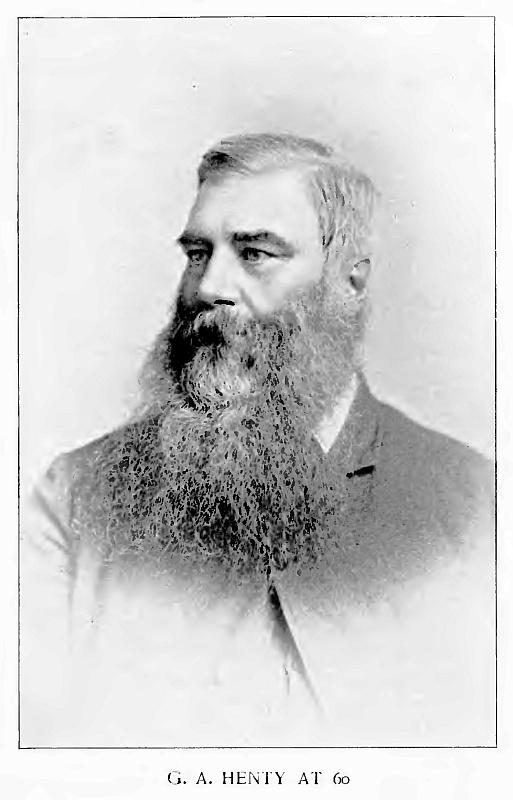
Now a glance at Henty’s portrait seems to stamp him, big-bearded and bluff, with the learned look of one who, being a traveller, must be endowed with the knowledge that would enable him to treat any complaint with skill. As a matter of fact, if called upon for aid in a case of emergency or ordinary ailment, he was quite prepared to open a medical battery upon a sufferer. It is, therefore, in no wise surprising that during his travels in Servia the Turkish gendarmes occasionally applied to him to treat their complaints. Even his own zaptieh, who after a few drops of opium was ready to cry, like the man in the old tooth-tincture advertisement, “Ha, ha! Cured in a instant!” was always afterwards ready to spread his master’s reputation and increase the number of his grateful patients.
Of course there are some who would shrug their shoulders at this and softly murmur, “Quack!” But one fails to see it. In fact, the writer feels disposed to assert that the reputation of hakeem was very honestly earned by one who had commenced his profession with a good sound English education, who had served a certain time in the military hospitals of the Crimea and in Italy, who had been a student in sanitary matters, who had worked hard among the sick and wounded, and to whom anything in the shape of a military hospital had an intense attraction. We must remember, too, that he had learned much from the sufferings he was called upon to witness in this later war, where the surgeon and physician were so terribly in the minority, and in a country where, during certain of the horrible attacks and defences, it was no unusual thing for the camp-followers to go round at night, and, to use a horrible, old, and familiar expression, put the enemy’s wounded out of their misery.
This knowledge on the part of Henty, and his readiness also and ability to give some slight alleviation of their sufferings and help to the wounded, enabled him to make sure of a friendly welcome, to say nothing of smiles and gratitude, almost wherever he went—except among the Tcherkesses.
Chapter Thirty Five.
Philosophy in Camp.
No one need wonder that enthusiastic boys and young men who read Henty feel the spirit of emulation rise within them, while their young hearts glow with the desire to imitate him and to become a war correspondent. Well, so it would be grand; but the question has arisen since the last war—Is a war correspondent of Henty’s type not a thing of the past? One writes this with the recollection of how a friend met with such discouraging treatment in the Russo-Japanese War that he and his fellows were ready to turn back homeward in disgust. They found that it had become general versus editor, and that the general had all the winning cards in his hand, while the troubles which Henty encountered during the Franco-German War, and in which he was worsted, had all become intensified. War correspondents, in brief, were treated as individuals who were to be kept out of danger and hoodwinked as to what was going on; in short, they realised that Othello’s occupation, to be Shakespearean, was about gone.
But yea or nay, such a life as Henty’s is enough to raise the spirit of emulation among the young, always too prone to see the bright side and not the dull. It is only fair, though, that they should read both sides. Of course, after the weary tramp, the sufferings from heat and cold, hunger and thirst, there was something very “jolly”, as a boy would say, about the hearty welcome of the camp fire, the odorous cigarette, the fragrant coffee, the song, the story, and the genial looks of man to man in the full enjoyment of a well-earned evening’s rest. But then there was that other side: the places he had to stop at, fagged, faint, and hungry after a long day’s journey; the bare mud floor, a mat for a bed, the momentary rejoicing at the fact that he had found a sheltering hut, though one innocent of window and with no means of fastening the door. The correspondent is, however, only too glad to throw himself down and yield with a sigh to that terrible overmastering sleep, that letting go of everything, that slackening of the too tight bow-string, that general relaxation—yes, only to sleep—sleep—sleep, and then—ugh!—only to be awakened by the attack, fierce and combined, of every sort of vermin mentioned in natural history, quadrupedal and entomological. Ugh! Horrors, diabolical and disgusting these, calculated to promote a vivid wakefulness such as would make the war correspondent feel keenly that what before had seemed to be impossible had suddenly become possible. With a feeling of despair at such times he would unbuckle his writing-case, tear open ink-holder with a snap, light his lantern, and begin to make notes, or set his teeth hard as he continued to write a portion of a letter already begun—one of those letters so full of picturesque description and vivid account of that last coming-on of the enemy and his gallant defeat, or the enforced retreat, with the horrible slaughter that it entailed—one of those letters, in short, that are so enthralling to read in the morning paper, and tell so well of the ability of the practised writer, but which he, poor fellow, has written from beginning to end in misery and also in supreme doubt as to whether it would ever reach its destination.
But whether it did or not, whatever failure there might be to face in connection with the postal communication, the letters had to be written. How, when, or where—that is nothing to the reader. There before the writer was the something attempted, and at last the something done, to earn the night’s repose, though that repose was too often disturbed or made impossible in the way which one has attempted to depict in connection with the natural history that frequently haunted a Servian hut, in the lovely country where often only man was vile.
Again and again, too, there was the deafening roar of the guns, the Turks especially being great in artillery, and the nauseous, dank, sulphuretted hydrogenous clinging smell of powder in the air, a most familiar odour to the industrious war correspondent who strives hard to do his duty by his paper; and this too often supplemented by that other sickening odour frequently associated with death, horrible when fresh, most horrible when days have gone by and the slain have not been hidden by the busy spade.
The frequent smell of powder in the air to the weary correspondent is often enough safe and antiseptic, though still associated with the horrors of war and connected with death; but with so many risks to be run, one asks in wonder this question, how is it that the war correspondent usually manages to escape unharmed? Fortunate for him it is that he, like so many others who have urgent duties to perform, has no time to think of aught save that which comes in the day’s work.
Then there is the food difficulty in a devastated country. That is a matter, of course, which has to be got over; but it is not so easy to surmount the difficulties with servants, and in the Turco-Servian War Henty had a varied experience. He states that he engaged one who professed to be able to cook, but who could not prepare food even in the most primitive way, while another who had undertaken to look after the horses, it would be quite reasonable to declare, had most probably never touched a horse in his life. The consequence was that those most patient of beasts, which were often the very life of a war correspondent, suffered badly, while as to the action of the professed cook—for it is presumed that a man who undertakes to cook properly professes to be that artist, even though he may not be a chef—a diet of very bad bread, caviare, and German sausage, though convenient in the extreme in the way of transportation from place to place, begins after a time to pall.
But Henty seems to have taken for his moral aphorism: “Sufficient for the day is the evil thereof.” Had it not been so, he could never have passed unscathed through what he did. In fact, his murmurs about the troubles he encountered were few and far between. So patient, indeed, does he show himself to have been, judging from his letters, that one is tempted at times to go so far as to call him a great man. To judge from the calm, easy-going way in which his letters paint him as taking life, he seems often enough to be regarding it and its accidents as a great joke, while one would imagine that if there were one person whom he encountered who deserved to be laughed at, it was himself.
His philosophy is often really great, even if he does not himself deserve the appellation, while his letters read as if he had reached a stage in educating himself wherein the ordinary troubles of life, which we as a rule are accustomed to regard as very serious, were during this campaign shrunk in his eyes to the calibre of the very small. What he does set forth as being a really terrible difficulty is that of obtaining water for an “honest wash.”
Chapter Thirty Six.
The Turkish Army.
Henty carefully studied the ways and means of the Turkish army, not only the uniform and ornament, but the customs in connection with the various battalions. Though the Ottoman forces are not such as can be held up as examples of military excellence, he extols them as being composed of brave and admirable fighting men who are on the whole abominably paid, whose pittance is shamefully in arrear, but who still go patiently and uncomplainingly on, content with the small mercies they receive, and the kindly treatment of their officers who suffer with them. They march the more cheerfully from the fact that during a campaign every battalion has its own band, while as a rule the bandsmen have gained so much from the West that their performances of popular music are far above contempt.
As a rule here in England ordinary people do not know much of Turkish music. “The Turkish Patrol” and that very old favourite, “The Caliph of Bagdad”, seem to belong nearly as much to the West as to the East; but in Servia Henty was made familiar with plenty of good Western operatic music, which was always bright and cheering in dreary times when on march. And while discoursing upon the bands he notes that, just as in English regiments, they take their serious part in the war, their play being of course connected with the production of enlivening strains to lighten the dull hours of a heavy march, their work being as bearers of the wounded.
National music such as is familiar to the people of the country is abundant and popular, of course; but it was amusing at one time in camp, when the war was dragging slowly on, to find that a band which played every evening under the Pasha General’s tent finished up with a few bars of “God Save the Queen.”
Constantly observant, Henty was always attracted by everything connected with the Turkish hospitals. He was quite fair. If he saw anything in their management deserving of condemnation he spoke out. On the other hand, if he noticed anything, however trifling, worthy of praise, it was carefully noted. He records with something like a feeling of pride in his fellow-men, how an officer, having the power to command, had ordered that one of the bands should go down to the camp hospital to play for an hour every day, the Turkish officers declaring to him that the music raised the spirits and improved the condition of the sick and wounded. He continues with an anecdote of the se non è vero, è ben trovato type, namely, that a poor fellow, who had lost his arm in one of the first skirmishes, had been so revived by the music that he had begged permission to join the ranks again with a limb of wood! Of course it may be true; but everyone is at liberty to doubt, and one cannot help giving the Turkish narrators the credit of trying a joke upon their foreign chronicler.
During this campaign, on the principle that straws sometimes indicate the direction from which the wind blows, Henty grew more observant of matters connected with the sufferings of human life. It was as if many of his notes and remarks were forced upon him by his own feelings, and as though his personal sensations sharpened his observation.
Here was he, a man who had passed through the heats and colds of mountainous Africa in the march to Magdala, complaining, justly enough, of course, but in words that indicated how keenly he must have suffered, of the heat and cold of Asia Minor. He says of the one that it is terrible by day, while the other is piercing by night, and both extremes even he, a strong man, found very hard to bear—harder terms these than any which he applied to the heavy stagnant heat of Ashanti.
Then he speaks of the skin tents as being simply unbearable when the sun was up, while the flies were maddening, and he has a thoughtful word for the poor horses, which suffered as much as their riders, being almost devoured by the darkening swarms.
He notes, too, that the Turkish sentinels when on duty were provided with a small umbrella tent to shelter them from the heat of the sun and from the rain; that a Turkish sentinel does not pace up and down when on sentry-go, but stands immovable all the time while he is on duty, and adds dryly that he has plenty of time for observation in the Turkish camp, for the army is dilatory in its movements. Then he turns to make some fresh observation, as there is no fighting going on, upon the appearance of a battalion of Egyptian soldiers which had joined the camp. The men were clothed in white from head to foot, with the exception of the tarboosh, which was, of course, scarlet, and, with his old military instinct aroused, he compares the Egyptian uniform with the Turkish, to the disadvantage of the latter in their blue serge.
He goes on, too, to comment not only upon their dress, but upon their evolutions—unfixing bayonets, grounding arms, etc—and their activity. The Egyptians were dark brown of skin, but the Turks were no darker than Spaniards, often as fair as Englishmen.
On another day his attention is attracted by a raid that has been made by the irregulars connected with the army, ending in a skirmish with the Servians, and a return laden with plunder, consisting of goats, cattle, and horses. He ends up with a pithy memorandum that the Bashi-Bazouks receive no pay, so make the surrounding country keep up their supplies.
With regard to the food supplies of the regulars, it seems that every Turk carries a leathern pouch which contains ground coffee and sugar, so that with a little bread and water they can get on pretty well.
As for the Bashi-Bazouks, who depend upon the country, which would probably account for their unpopular character, Henty noted them a good deal. They were a peculiarly mixed lot, apparently raised wherever men could be obtained, many of them being negroes of Herculean proportions. He notes, too, how laughter seems to go with the black, whether he be in the Turkish army, a negro from the Guinea Coast (such as strengthened or weakened our army in the Ashanti campaign), seen civilised in the West Indies, or serving in New York. There is always at the slightest provocation the disposition to part the thick lips, bare the big white ivory teeth, and burst into the hoarse horse-laugh. A rough lot, these Bashi-Bazouks, but Henty’s eyes must have glistened with eager interest and flashed with the desire of a collector who had a little museum of his own at home, as he examined their weapons. These were the arms of a dozen different nations, some carrying rusty, worthless old pistols, while others had damascened blades of beautiful wavy forging and razor-like keenness, such as could not be bought for money.
Towards the end of his connection with this campaign he constantly recurs to the various skirmishes, many being encounters mostly brought on by Servian patriots—small affairs in which no military skill was brought to bear, and in which the injuries were, for the most part, the result of musket bullets, the wounds by sword and bayonet being few. He goes on to complain bitterly of the Eastern callousness and conduct of man to man, the indifference he witnessed being revolting. And then later, when at last the war became fiercer, his humanity was again stirred and he referred to the hospitals in one of the towns, which he described as “chock full”, so encumbered, in fact, that wounded men had to lie in the streets from day to day, the people passing them by and noticing them no more than if they were logs of timber.
In some of the rooms used there were neither beds nor mattresses, but simply the hard brick floor, for the wounded to lie upon in their blood-saturated clothes, waiting till one of the medical men could find time to attend to them. The doctors were working the while like slaves, extracting bullets or dressing wounds, and then giving the poor fellows a little plum brandy before they were lifted into a bullock-cart, with a truss of hay for a seat, and sent to recover or die elsewhere, while many who could not bear transport had to stay until nature mercifully intervened, and glory and patriotism became the mists of another and a brighter day.