"The Story of an Active Life" (continued 3)
Reading edition
Many of the caves that closely adjoined each other varied in the most extraordinary manner. Some seemed to be dark and murky, suitable homes for gnomes and evil genii. Misshapen monsters appeared to lurk, eerie and gruesome, in obscure corners; slimy and uncouth reptiles seemed to crawl and grovel in the damp mire, looking horribly real, though only fancy save in the solidity of stone.
And then, gloomily seen on high, weird, shadowy creatures, dank and bat-like with their dusky wings, appeared to be hovering just beneath the roof, till a nameless horror seemed to pervade the gloomy atmosphere, and the imagination peopled the place with unearthly creatures which the mind refused to believe were illusory, so real were they in their stony extravagance; yet all were the work of nature, formed through the dark ages slowly, drop by drop.
There they were in the dim nooks and recesses, seeming, as the smoking candles flickered upon their glistening surfaces, to beckon and grin, peering round twisted buttresses, gloating, vampire-like, on the passer-by from behind the fallen columns, and producing a shuddering horror, as they seemed to be only waiting till the visitors to these awful shades had passed before they sprang.
It was here that even the brilliant rays of magnesium failed to dispel the gathered blackness, and the strange shapes stood out more spectral and awe-inspiring than before. And it was water—water everywhere, drip, drip, drip, never ceasing—the hardest of hard water, that the most thirsty in these caverns would shrink from drinking, for he would know that he was sipping liquid stone, the stone that had built up everything around, and which would go on almost silently building fresh wonders until Time should be no more. And in spite of the flash and brilliancy of beauty as opposed to the dull, glistening, slimy look of much of nature’s work, there was something shuddering in its inspiration as he who gazed at the same time had what was going on conveyed to him through his ears—the drip of water never ceasing, and its feeble echoes seeming to rustle with mysterious whisper throughout these shadowy cells and proclaim the wonder-work in process of construction.
It was with a strange feeling of relief that they passed on out of these awe-inspiring caverns into a region where, in delightful contrast, the eyes were welcomed with a sight of what could only be the dwelling-places of the inhabitants of a kind of fairyland. Here all was graceful pinnacle, delicate spire, tapering point, and slender pillar, each frosted alike with silvery rime, which made the finger shrink when touching them; for it seemed, according to everyday knowledge, quite startling that these beautiful works of nature should feel cool and temperate; the visitor felt that they ought to sting the nerves with pain, for their sparkling effect looked so exactly as though it had been produced by frost.
Icy, too, appeared much of the beauty now—the sparkling fairy couches spread with frosty lace, the gauzy floating folds encrusted with gems. Everywhere the lights flashed and glittered, refracted in a thousand colours; for here, too, seemed to be the caves of crystal-land, the homes of the water sprites who dwelt where water had now become pure, solid, and perfect for evermore, where water had become pure ice that was not cold, where even the floor was white sparkling sand scattered with gleaming shells, above which the water fays floated, and the sea sprites played and chased fish in the ice grottoes.
Such were some of George Henty’s impressions of the Grotto of Adelsberg, and he concludes by saying that any traveller who has ever had the opportunity of seeing that home of nature’s wonders lit up as he had, would surely bear him out in saying that, so far from exaggerating, he has but touched upon a few of the varied and extraordinary beauties of the place.
Chapter Thirteen.
Mining for Mercury.
Still feeling his great interest in mining to an extent that makes one wonder that he did not make that pursuit the work of his life to the same extent as he made yachting the pleasure, Henty now made his way to Idria to make a careful examination of the quicksilver mines, the property of the Austrian government. The journey was undertaken partly from its being likely to form an interesting letter, but still more probably from a desire to foster his own inclinations. And no wonder! For it is not every man who could write in perfect sincerity, “My experience of mines is very extensive,” and then go on to talk like a past master of mining in general, not in support of this assertion, but in proof of his general knowledge.
Reaching the quicksilver mines, which are, as is probably known, very few and far between upon the face of the earth, he gives a thorough description of the place. The workmen, he tells us, number some six hundred, the buildings connected with the mine are good and well kept, the posts and doors painted the familiar black and yellow of Austria, while the imperial arms, surmounted by the two crossed hammers, are fixed to the various offices.
In old works accounts are given about condemnation to the quicksilver mines and the convict life of the unfortunates, but Henty’s account of the place seems to prove everything to be very businesslike and matter-of-fact, and the old descriptions that blackened the administration would appear to have been extremely highly coloured. The government has erected a theatre for the use of the workmen, and has in other ways laid itself out to study their comforts in a manner for which its habitual detractors would hardly have given it credit.
The pay of the miners is about eightpence a day, apparently a very small sum, but which is above the average gain in a country where the necessaries of life are extremely cheap. When they are ill, and this is not infrequently the case, for the fumes of mercury are extremely deleterious, they receive three-quarter pay, together with medicine and medical attendance, while they are provided for in old age.
After this brief socio-political statement, the businesslike miner and student of geology speaks of the formation of the country where the mines are situated. This is an oolite limestone, that is to say, the cream-coloured soft building stone so familiar in building, which hardens in time, and is generally dubbed Bath-stone.
He was rather surprised that a quicksilver mine should be here, and he made a careful examination of the surface of the neighbourhood before descending, but could discover no signs of the existence of a mineral vein, and so felt at a loss to imagine what induced the original investigators to set to work at that particular spot.
Here is his version of the old story which credits the discovery of quicksilver as being due to a barrel-maker who, after making a tub, placed it under a dropping spring to see if it would hold water. When he came to look at it again, he found it contained what he took to be a certain amount of glistening water; but on attempting to move the tub, he discovered it to be so heavy that he could not lift it, the supposed water being the enormously heavy liquid, quicksilver.
Henty also relates that a spring that arose in Idria had been observed to deposit in the hollows of the stone small quantities of quicksilver. This came to the notice of a merchant from Trieste, who happened to be stopping in the neighbourhood. Being a business man whose head was screwed on the right way, he came to the conclusion that this quicksilver must issue from the rock in company with water, and that if he sank to a sufficient depth, the source from which the spring drew the mercury would be discovered. Without any delay he obtained a grant from government, began to sink, and carried on quicksilver-mining for some years with success. But it soon became evident to him that the primary source of the fluent metal was much deeper down, and to reach it much larger capital was required than he could command; so, still acting as the business man, he sold his works to the government, no doubt at an excellent profit, and by the government they have been carried on ever since. They are now the richest and most extensive of any in Europe, with the exception only of those at Almaden, in Spain.
Henty’s stay in Idria was only short; but being furnished with a guide, and having put on the suit of miner’s clothes provided for visitors, he commenced his descent. This was made by means of a number of inclined shafts of admirable masonry, worked in a perfect oval, and about seven feet in height. These can be best conceived by imagining a perfectly dry London sewer being placed nearly on end. In these shafts small stone steps were formed, by which the descent was made without fatigue or difficulty. He considered that these shafts were superior, both in arrangement and workmanship, to anything he had ever seen in his great experience.
On descending he noticed that the mine was worked, to speak technically, in five levels, and that in some places the quicksilver was in the familiar glistening globules in a soft and partially decomposed state. But the greater portion occurred in the aforesaid limestone itself, and even where it was present in the enormous proportion of eighty per cent it was not visible; but the ore resembled very rich brown haematite ironstone. In describing his visit, Henty goes on to write about the warmth of the atmosphere and the close mineral odour, and to relate how, in consequence of the deleterious mercurial fumes, the miners are unable to work in the richest parts for more than two hours at a time.
He continues, then, quite as a man accustomed to inspecting mines, declaring that the timbering, i.e. the supports, of the levels, ventilation, and other arrangements of the mine are good. But he never saw labour so completely thrown away in any undertaking of the kind he ever visited; for the miners were constantly employed upon poor barren-looking stuff, which the most unpractised mining man—including, of course, himself—might have seen would never lead to anything. Had their work taken the shape of small galleries for exploration, it might have been explicable; but the men were almost all engaged in greatly widening previously-made passages where nothing whatever had been found, nor was likely to be. He accounts for this, like a practical man, by supposing that, as a miner could only work for a few hours a week upon the rich spots, and as the management are obliged to keep a large succession of men for working continuously, they put the men to work in the barren places purely to keep them employed.
Satisfied with his inspection, he at last made the ascent, coming up a nearly perpendicular shaft, worked by water-power, in the large and dirty basket in which the ore is lifted to the surface. He then proceeded to the smelting-houses, where the quicksilver is extracted from the ore. These were about a mile from the town; but the furnaces were not at work at that time of year—October—on account of the fumes thrown off being so extremely deleterious to vegetation and to the cattle which fed upon it, as in grazing they, of course, took up a certain amount of the mercury deposited upon the herbage.
The smelting, or, as it might more properly be called, the distilling, of the mercury is only carried on in winter, when the fumes that escape from the furnaces fall upon the surface of the snow, which in that mountainous country covers the earth, and are washed away when the thaw comes in the spring. The poorer ores are crushed under stamps, and the mineral is separated by dressing and shaking tables. The richer stuff is at once carried to the furnaces, where it is roasted, and the mercurial fumes which are evolved by this process are collected in adjoining chambers. Henty goes on, like a mining expert, to criticise the imperfect way in which the processes are carried out, adjudging that under better management the fumes which spread over the surrounding country would be far less noxious.
The total amount of quicksilver produced by this one mine annually is about two thousand five hundred pounds, and this is exported in iron bottles for the use of the gold and silver mines of Mexico, Peru, and Brazil.
Surprise was expressed at the commencement of this chapter that literature had not lost her able writer for boys by his being absorbed by the mining profession. His remarks concerning miners gained from his own observation pretty well justify this comment, for, moralising upon the people under observation at the quicksilver mines of Idria, he says that among no class of the population of various countries is there so great a resemblance as between miners. However the peasantry in general may attire themselves, the miner wears a universal garb. He shaves closely, so that the dust and dirt, which his occupation involves, may be the more readily removed when he returns to the upper air; and if the workers in the lead-mines of the island of Sardinia (where he had been, to study them), the Slav from Illyria, the Frenchman, the Belgian, the Cornish, Welsh and Newcastle miner, with all of whom he had made acquaintance, were massed together, the shrewdest observer would be puzzled to separate the men belonging to the different nationalities. They wear the same coarse flannel attire; they have the same loosely-hung limbs, the same muscular development about the shoulders, and the same weakness of leg; their faces are uniformly pale and sallow from working in places where daylight never penetrates; they are hard drinkers, strong in their likes and dislikes, very independent, and great sticklers for their rights.
Certainly, he continues, these Idrian miners are more fortunate in many respects than their fellows, for their houses are singularly large, clean, and commodious. Their government lays a considerable extra tax upon wine, because its use is very hurtful to the men engaged in the mercury works, but its price does not prevent the miners from partaking of it freely.
Henty slept in Idria but one night, and he found it very late before the little town settled into tranquillity. Every time he closed his eyes and endeavoured to go to sleep, a burst of discordant singing from parties returning from wine-shops reminded him unpleasantly that miners will be miners all the world over.
The next morning he left for Italy, and he amusingly describes his experiences of travel in a primitive conveyance hung very low, without any springs whatever. This should have been drawn by a pair of horses, but was actually only drawn by a single beast trotting upon one side of the pole. The shaking upon the rough road traversed was something terrible, and in the course of a six hours’ journey he was rather glad of a rest of half an hour and a relief from the shaking.
As the village inns were all alike, he describes one as a sample, in which he partook of some very weak, warm stuff which they called broth. The room set apart for the meal was low and whitewashed, crossed by the rough beams which supported the room above. In one corner was an immense stove, five feet high and six feet square, covered with green-glazed earthenware tiles. A seat ran round this, and upon the top a layer of maize was spread out to dry. In another corner was a small cupboard. But even there art was represented by roughly-coloured prints dealing with the Prodigal Son, in the attire of a Venetian senator of the Middle Ages. There was a crucifix with a small lamp upon it, a great clock like those seen in English country cottages, with a preternaturally loud tick, and there was a strange-looking table, which he found upon examination was a paste-board and flour-bin combined. Three puppies and two kittens scampered and played about upon the floor, which was of stone, but beautifully clean.
Reader, do you like struddle? Most probably you are quite ignorant of what the question means. Henty was in precisely the same mental condition when, after eating his soup, his hostess asked him if he would like some struddle.
Henty assented, without having the slightest idea of what struddle might be, and the hostess brought in a plate of what resembled boiled three-corner puffs; but, though sweet, they were not triangular jam tarts, for the contents were principally onions and parsley, and quite uneatable.
Chapter Fourteen.
The Abyssinian Campaign.
Henty was not one who, during a long life, indited many letters dealing with his ordinary social communings with his friends, from which chapters might be extracted concerning his thoughts upon political or social subjects, his leanings towards life in general, or his interest in some special subject. He rarely wrote home save, as has been before said, to tell of the state of his health, referring those he loved to his long professional letters in the columns of the journal he represented. But in justice to one of the most industrious of men, his family fared, as far as interesting and descriptive matter was concerned, much better than those connected with the most chatty of correspondents, who scatter manuscript as opposed to his print.
Autobiographies are few. There are plenty of the young and enthusiastic who begin life by writing a journal, but those who keep it up to the end are very, very rare. Unconsciously, however, George Alfred Henty pretty well passed his days in writing his own life, and, as fate would have it, a life of the most stirring kind.
The letters he did write to his colleagues upon business, those of a social nature, or on matters connected with some literary transaction to a fellow club member, as well as those between editor and contributor, or with the positions reversed, were always the same—written in a minute neat hand upon small note-paper and in violet ink. But of the many possessed by the writer not one seems to contain material that would be interesting to the general reader. Owing, perhaps, to their want of egotism, they do not tell their own tale of the man’s nature one half so well as the columns he wrote during his long connection with the newspaper press.
And thus it is that through his early manhood onward, through maturity to his thoroughly vigorous old age—if it can be termed old age when a man is robust and virile till beyond three-score years and ten—Henty’s life formed so many chapters of energetic and active career, marked, as it were, by passages generally warlike, connected with the warfare of nations.
At the time of which one is writing, that is, the year following the freeing of Italy, he spent much of his time making tentative unofficial efforts with his pen; but this was prior to the commencement of the long series of novels and stories written especially for the youth of England. For the next year he began to devote considerable attention to his little yacht, finding exercise and refreshing peaceful life afloat. Yachting was the one hobby of his manhood, and a recreation in which he indulged himself at every opportunity, even to the very last. In this way he recouped himself, and made up for the worry and excitement such as falls to the lot of a war correspondent, who is never free from the strain of thinking out what will be the most interesting thing to record among the many incidents occurring around him. There is invariably anxiety about how to write and where to write, and when the account is written the additional worry of how to get in touch with the post and make sure that you have done everything possible to ensure the matter reaching its destination safely and expeditiously.
The year’s comparative rest that followed the adventures in Italy was needed, for Henty was awaking fully to the fact that a war correspondent’s life makes a heavy drain upon the stored-up forces of the Bank of Life; and it must not be forgotten that his health exchequer in youth was at a very low ebb.
It may have been instinct—the natural desire of the weak to gain strength—that induced Henty to direct his attention so much to the sea; and without doubt this favourite pursuit of yachting, which took him away from town life, from the strain of mind and the weary hours at the desk, to where he could breathe the free air of heaven and cast off care, strengthened him and prepared him for the next bout of duty that he would be called upon to undertake.
It was just a year after the conclusion of the Italian war when he was called upon to gird himself for another period of active service, and leave civilised Europe for the heats and colds of semi-barbarous mountainous Africa. The cry of the sufferers had awakened patient Britain to the fact that she could no longer stop her ears to the piteous plaint of the captives, no longer suffer the mocking insolence of the defiant ignorant ruler, King Theodore of Abyssinia; and Sir Robert Napier was preparing his forces for the invasion of that comparatively unknown and warlike land.
All this is well-recorded history. Henty’s adventures begin with his start for the front, after reaching Bombay, where his first troubles commenced with the choice of attendants. Servants swarmed, but experience seemed to show that it was considered the correct thing to hire oneself out to a master bound for Abyssinia, and, just before he left, to disappear with his purse and any handy portable property.
Henty’s first experience was with a mild Hindoo, who directly after fell sick, while this man’s brother, engaged by a colleague, was at the last moment melted by the tears of an aged and despairing mother, and the two rogues decamped laden with plunder.
This difficulty got over, necessaries were packed, and a vessel was chosen in which Henty and a friend were to sail in company with some of the troops. They were a little disturbed, though, when they discovered that the only available bath below had to be removed to make room for three and a half tons of gunpowder. It was a change which by no means added to their comfort or to their feelings of security.
However, in spite of hindrances and delays, he, a brother special, and three officers made their start, choosing by preference to sleep on deck, partly because the nights al fresco were delightful, though rather cold, but more on account of the imaginary dangers that might arise from the monsters which haunted the berths below. It may have been the effect of imagination and extreme terror, but these creatures appeared to be as large as cats, and much quicker footed, probably from having more legs. Their horns resembled those of bullocks, and in their utter fearlessness of man they attacked him ferociously. Henty christens them vampires, though he does not record that they practised the bloodthirsty habits of those creatures, and then he comes down to plain fact and explains that his bêtes noires answered to the common name of cockroach.
One of his first experiences of sleeping on deck with his comrades was to be awakened by a splash of water in his face, and as the vessel was given to rolling he attributed this to spray; but only for an instant, for down came a rush of water as if emptied from a bucket. In a moment he was upon his feet to begin dragging his bed over to leeward. Then came a rude awakening to the fact that the splash and the bucketing were caused by rain, which raged down as if pumped by a hundred steam fire-engines. There was nothing for it but to laugh, as the party gained the cabin floor drenched, and with their silken pyjamas clinging to their skins.
The customary troubles on board the small vessel, laden to a great extent with heterogeneous stores, came to an end, but not without incident, for navigation in the Red Sea is a most intricate and dangerous business, as its western shore is studded with islands and coral reefs.
The vessel was running along with a favourable breeze, and Henty had been watching the low shore with its stunted bushes and strange conical hills bearing a fantastic resemblance to hay-cocks, while a mighty range of mountains loomed up in the distance. The outlook was interesting enough, for this was his first sight of Abyssinia; but then came a very narrow escape. They were sauntering about, watching the land and listening to the calls of the sailor heaving the lead in the chains. First it was ten fathoms, then two minutes elapsed and the man cried five fathoms, whereupon a shout came from the captain: “Stop her! Turn her astern!” In the momentary pause of the beat of the screw the sailor’s voice came again: “Two fathoms!”—a dire warning to those on board the steamer.
But the screw had been reversed, and the yellow water was foaming round them, showing that the sand at the bottom of the shallow water was being churned up as the steamer, still forging more and more slowly ahead, came to a standstill. Then the fact was patent that they were ashore; while thoughts of shipwreck began to be busy in the brain.
The customary business of trying to get the vessel off ensued; orders flew about; the vessel was driven ahead, then astern; but she remained fast, and seemed to be moving only on a pivot.
The troops and crew were ordered up and tramped here and there—marching aft, then forward, but without result. They were run in a body from side to side, to give the vessel a rolling motion. Still no result. Then another plan was tried, so as to loosen the craft from the clinging sand and work out a sort of channel; and this was managed by the soldiers running to one side and then jumping together, then back across the deck and jumping again, the effort being made by every active person on board, till it seemed as if all were engaged in a frantic war-dance.
After this anchors were got out, and the men set to work at the capstan, the only result being that they seemed to be fishing for coral, pieces of which were dragged up looking ominously suggestive of what would happen if some of the glistening white dead rock pierced the vessel’s skin.
There seemed at last to be no chance of getting off unless a portion of the cargo were discharged. Accordingly when an Arab dhow came into sight and dropped anchor, a bargain was made with the sheich, her captain, for him to come alongside and lighten the steamer by taking on board a portion of the cargo and the whole of the troops. This, Eastern fashion, took an enormous amount of talking, and when all was settled it was found that the water was too shallow for the big dhow to come alongside, with the result that this expedient was given up.
Then another dhow came and anchored at a short distance, presenting something novel to the traveller. This vessel proved to be bound for their own port, namely, Annesley Bay, and it was laden with a portion of the transport that was to help the expedition across the wild country towards Magdala, to wit, a herd of no fewer than twenty-two camels. The poor animals, the so-called ships of the desert, were packed together in a boat that did not look large enough to hold half that number.
At last real help came within signalling distance, and this proved to be one of the Peninsular and Oriental Company’s big steamers. She had half of one of our regiments on board, and was towing a consort with the remaining half of the 33rd Regiment from Karachi.
A boat was sent from the great steamer, and an officer came on board to examine the state of affairs. He very soon came to the decision that the water was too shallow for his vessel, the Salsette, to come within towing distance. As the grounded ship was in no danger, he was obliged to leave it to its fate; but to the great satisfaction of Henty and his colleague, on ascertaining their destination he offered them a passage for the rest of the way. In due course they arrived very comfortably at the starting-point for the expedition.
Chapter Fifteen.
Incidents of Transport.
There was plenty to see at the far-from-cheerful place which was to become the depot of troops and stores. A pier was being run up for landing purposes, and vessels were discharging slowly, with the promise of a deadlock unless more convenience for landing the contents of the vessels that were lying idle was provided.
To all intents and purposes they were at the edge of a desert, and here everything that was necessary for the expedition had to be landed. An enclosure was filled with stacks of pressed hay for the mules and piles of grain and rice—goods that would be easily damaged, but were fairly safe, nevertheless, owing to being in a hot and comparatively rainless district.
Besides the regular labourers that had been engaged, brightly clothed women, looking particularly picturesque, had been sent over from India on purpose to grind the corn for the troops. Tents had arisen, forming quite a canvas town; and storehouses were being constructed by Chinese carpenters, so that the place was rapidly becoming busily populous. In addition to those at the landing-place, clusters of tents were scattered within a circle of a mile, while the main camp of the expedition was a mile and a half inland, consequent upon the scarcity of water. For at the beginning all living things, men and beasts, had to depend for the principal life-sustainer, water, on the supply obtained from the ships. Consequently every steamer in the harbour was at work night and day condensing, at a cost of twopence halfpenny a gallon for the coal consumed in the process.
Henty’s senses of sight and smell were offended as they had not been since the Crimea. Dead mules, camels, and oxen lay everywhere about the shore, and attempts were being made to get rid of the offence by burning the carcasses. Wherever the poor brutes were lately dead, vultures were congregated, many so gorged with flesh that they could hardly rise when approached, while others, where some poor beast had lately expired, were walking about at a distance, as if not quite certain that the animal was dead.
It was a doleful picture—one of the accessories of the glories of war. Here and there half-starved mules were wandering about, their heads down, their ears drooping, and their eyes growing dim with the approach of death; others staggered down to where the sea rippled on the sands, and tasted again and again the briny water; while others still, half-maddened by the heat and thirst, drank copiously, to drop dead where they stood, or crawl away to die miserably in the low desolate-looking scrub.
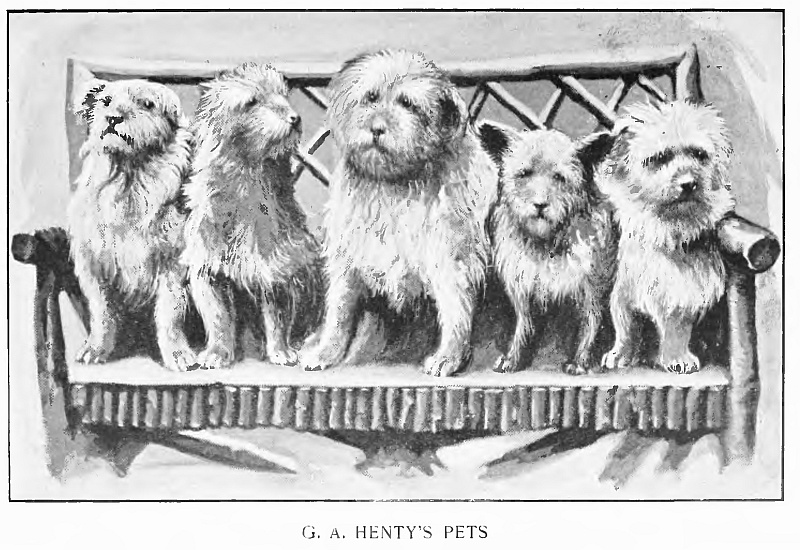
A man with a great love for domestic animals, Henty generally had about half-a-dozen dogs of the Scotch terrier and other breeds to share with him the quiet of his home study, supplemented by two or three cats which lived in fairly good harmony; the sight of these suffering dumb creatures therefore strongly moved his sympathies.
Before his landing, his attention had been attracted by the cruel way in which the wretched, doleful camels were packed in the dhow, and the sight of these beasts of burden being disembarked drew his attention at once.
The native boats could not get nearer than two or three hundred yards from the shore, for the water was not more than three or four feet deep, and into these shallows the poor brutes were dragged and thrust, when, dazed by the novel position, they for the most part lay down, their long necks raising their curious heads just above the surface, while they made no attempt to make for the land. Some never did make any effort, and later their bodies would be seen drifting here and there, growing more buoyant under the hot sun as decomposition set in. Others, however, struggled to within fifty yards of the shore before lying down, to look, with their erect necks and partly submerged bodies, just like gigantic waterfowl. As for those that were driven ashore, want of food and the evil treatment received during their transit had reduced them to the most miserable plight. Their bones were almost starting through their skins; and while at the best of times, when well fed and watered, a camel in its utterances is a most doleful, murmurous creature, these poor brutes lay as if dead upon the sand, uttering feebly the almost human moaning and complainings peculiar to their race.
Whether from mismanagement or callous brutality, the treatment of the unfortunate mules and camels landed on these desolate shores was painful in the extreme, and droves of hundreds untended were wandering about, striving for a few days’ existence by plucking scanty shoots, previous to sickening and dying.
The scenes, Henty says, were frightful everywhere, but worst of all at the water-troughs, where the half-mad animals, especially the mules, struggled for a drink at a time when water was almost worth its weight in gold. They fought wildly for a draught of that for which they were dying, biting and kicking till many of them in their weakness were knocked down and trampled to death, a fate which at least saved them from perishing miserably under their burdens upon the road.
Thoroughly angered by the neglect, and in accordance with the intense desire of the practical man to have everything done orderly and well, Henty busied himself and inquired why these scattered mules were left untended, to learn that nearly the whole of the mule and camel drivers had deserted. In fact, at the beginning of the arrangements in connection with the transport, everything seemed to have gone wrong. The mules and camels were dying of thirst and neglect; consequently the advance brigade could not be supplied with food. Someone was in fault, but, as is often the case, the mistakes of one are visited upon no one knows how many. But there, it is easy to find fault.
It must have seemed almost bliss to get away from the misery and confusion in the neighbourhood of Annesley Bay. At least there was the hope of ceasing to be tormented by the flies that were increasing and multiplying, as they did farther north in the old Pharaonic days. There was the prospect of a weary desert journey over sand and rock, with a pause here and there where wells existed with their scanty supply of water, or others were being dug, but there was the promise of a pleasanter existence afterwards, since the camp station was nearly five hundred feet above sea-level, with a likelihood of comparative coolness.
It was a long and dreary ride, with nature apparently against the intruders. As a consequence, with animals as well as with man everything seemed to go wrong. One of Henty’s principal complaints was still of the flies, which he considered to be, up to the present, the greatest nuisance he had met with in Abyssinia. He declared them to be as numerous and as irritating as they were in Egypt; but he consoled himself with the fact that they went to sleep when the sun set, and as there were no mosquitoes to take their place, he was able to sleep in tranquillity, that is to say, to lie down in the sand. Water, of course, was too scarce for a wash; but here again there was consolation—a good shake on rising, and the dry clean sand all fell away.
Still, there was a fresh anxiety for him in connection with the traveller’s greatest worry, that is, luggage. He was much troubled by the fact that the troop of mules which bore the officers’ necessaries had not turned up, and one of the missing animals was the carrier of his own luggage and stores.
On this march Henty had his first experience of the desert wells. These wells were dug in the bed of what in the rainy season must have been a mighty torrent fifty yards wide. He states that he had seen many singular scenes, but this was the strangest. The wells were six in number, about a dozen feet across and as many deep. All the water had to be raised in buckets by men standing upon wooden platforms who passed the full buckets from hand to hand. The water was then emptied into earthen troughs, which soon became mud basins, and from these the animals were allowed to drink to the tune of a perpetual chant kept up by the natives, without which the latter seemed unable to work.
Round the wells was a vast crowd of animals—flocks of goats and small sheep, strings of draught bullocks, mules, ponies, horses, and camels, and about them stood the regular inhabitants of the country in their scanty attire, armed with spears, swords like reaping-hooks, and heavy clubs. The women among them were either draped in calico or picturesquely clothed in leather, and plentifully adorned with necklaces of seeds or shells.
Here, too, the trouble with the thirsty animals was often terrible, the camels being especially unmanageable. One of them, for instance, because its pack had slipped beneath it, began to utter strange uncouth cries, kicking and plunging wildly, until it started a stampede among the mules, many of which had probably never seen any of these ungainly beasts before.
When matters settled down, the little party made for the commissariat tent to draw their rations, and here a religious trouble arose among some of the Parsee clerks of one of the departments. They complained bitterly that there was no mutton, and that it was contrary to their religion to eat beef. The commissariat officer regretted the circumstances, but pointed out that at present no sheep had been landed, while the small ovine animals of the country were mere skin and bone.
Henty closes this little scene with the moral that Parsees should not go to war in a country where mutton is scarce, and he wonders how the Hindoo soldiers will manage to preserve their caste intact.
Chapter Sixteen.
En Route for Magdala.
The famous march to Magdala had now begun, and Henty’s recorded recollections are full of interest and observation.
At one time he came upon a party of excited soldiers who had suddenly disturbed a troop of the great baboons which haunt the stony mountains, and, with visions of specimens flashing across his mind, he joined in the chase, revolver in hand, racing and climbing among impeding thorns, compared to which an English quickset hedge was nothing at all. After a couple of hours’ hunt, followed out as eagerly as when he was a boy, he found that the quarry was quite at home and that he was not, with the result that he thought he lost pounds in weight by his exertions, but that the toil did him good.
Before the starting of the expedition, the press had been full of the predictions of the busybodies who know all about everything, and had prophesied that those who went were to die of fever, malaria, sunstroke, tsetse fly, guinea worm, tape-worm, and other maladies. It was soon found, however, that everybody enjoyed vigorous health, and that though the army was in expectation of being hindered by, and of having to fight their way through, the forces of the petty kings or chiefs through whose countries they passed, very little of a serious nature occurred to hinder the advance to the stronghold of the stubborn monarch of Abyssinia.
Nothing seems to have been too small for Henty’s observation, and his letters to the journal he represented teem with references to the various objects that caught his eye. At one time he was describing the appearance, uniforms, and physique of the Indian troops, the Beloochs, or the manners and customs of the scoundrelly camp-followers. Then he would descend directly afterwards to such minor matters in natural history as the feeding habits of the sheep ticks, which in places swarmed. In another place he discourses in a much more interesting fashion than a scientific student (for he omits the hard technical names) of the vegetation seen around, such as gigantic tulip trees, and a shrub of whose name he confesses his ignorance, though he considers it notable from the sprays resembling asparagus. He is attracted by plants of the cactus tribe, particularly by one that spreads out a number of arms pointing upwards, making it resemble a gigantic cauliflower. Then, evidently feeling doubtful about the suitability of so matter-of-fact a description, he makes a brave shot at the Latin name—almost the only one he records—the scientific italics, Euphorbia candalabriensis, looking novel and strange. Later, with a frank display of doubt, he declares that he does not vouch for the correctness of this name.
Onward still, hour by hour and day by day, we follow him, noting how eager and fresh he is in the morning, and how weary as the day’s march approaches its end. At these times we find him recording the unpleasantnesses of the route, such as the influence upon the atmosphere of the dead carcasses of the worn-out animals, from whose neighbourhood the great vultures rose lazily and wheel away.
The heat of the sun was at times intense, but the nights were sometimes bitterly cold, too cold to sleep, and when at last sleep came, again and again the weary travellers were disturbed by the antics of one of the beasts that bear about the worst character of any that have been brought into domestic use, and whose obstinacy has become a proverb. One of these mules would break loose from its head ropes, and, as if urged on by some malignant spirit of mischief, would nearly upset the tent by stumbling over the pegs and getting itself involved amongst the ropes, when, as if bitterly resenting the presence of their mischievous distant relative, the horses would seem perfectly savage, and threaten to break loose and stampede. Four or five times in a night Henty or one of his colleagues would have to get up and go out in the cold to stone the brute, while the grooms, who were sleeping for mutual protection close to the horses’ heads, and who were rolled up in their rugs, wonderful to state, heard nothing.
But this was not the only manner in which the calm of the night’s rest would be disturbed, for the black followers who acted as servants to the group of war correspondents seemed to have a natural proclivity for quarrelling among themselves, often rousing up their masters in alarm to find out what some outburst might mean. Long after his return from Abyssinia, Henty would amuse his literary friends by chatting over these troubles of the night.
As a change from this we find Henty noticing the beauty of the country, the picturesqueness of the narrow gorges through which they passed, and the profusion of wild figs, golden-blossomed laburnum, and acacias, the last white-flowered and with pods of the clearest carmine. Getting now upon colour, he describes the beauty of the numerous humming-birds (query, sun-birds) and the gorgeous plumage of others of larger size that, startled by the strangeness of their visitors, perched at a short distance from the path. Again, the descriptions of the brilliant butterflies which flitted here and there among the flowers are strongly suggestive of the observant boy longing for a net and a few cardboard boxes and pins.
These charming rides had to give way to work of a very different nature, which included dismounting, leading their ponies, and preparing to ascend the mountain side; for the valleys and ravines gave way to steep tracks covered with boulders, the tropical valley with its beautiful foliage was succeeded by stunted pines, and the sappers were set busily at work forming a track of zigzags for the force to ascend.
At times the store and ammunition-bearing mules had to ascend places as steep as flights of stairs, with the steps as much as three feet high; but, nothing daunted, the force pressed on.
Later, an ambassador from one of the local kings, whose country was being traversed, met the advancing force, and it was considered an act of wisdom to give him a sample of what our well-drilled troops could do, in the way of a little sham-fight. The display was so effectively carried out that this monarch considered it good policy not to support King Theodore with his army of seven thousand men.
At the first camp among the mountains the native Abyssinians, led by curiosity, or possibly with other intentions if opportunity served, swarmed around, exciting Henty’s interest in their swords and spears. Certain specimens he managed to secure (not those of the poorer classes, but those of costly silver), and these he afterwards hung upon the walls of his study at home.
As compared with the slight bayonet of our men, fixed to the rifle barrel, the Abyssinians’ spears were formidable weapons, from six to ten feet long, and weighted at the butt. Their bearers could throw them over thirty yards with great force and with no little accuracy, while in a hand-to-hand fight, or when offering resistance to a charge, they were dangerous weapons in the grasp of an active man.
At one time Henty records an unpleasant check to his proceedings in the shape of an order being promulgated that no correspondents were to accompany the expedition; but when another general took over the command, this embargo was removed, and we find him at the front again, after a long weary pause which had forced him into inactivity at the base.
In spite of obstacles upon obstacles the troops were progressing. The heavy guns surmounted the rugged mountain-paths, and the savage cruel tyrant passed from mocking defiance to alarm, as his scouts brought him tidings of the slow and determined march, higher and higher towards his stronghold, of the punitive force which conquered slowly and steadily every physical difficulty.
Then there were rumours that King Theodore was beginning to repent, and that he was ready to give up his many prisoners, releasing them from their long captivity. But the expedition still rolled onwards and upwards—cavalry, infantry, and the heavy and light mountain guns—ready to carry Magdala by coup de main if it were feasible, or bring the tyrant into submission by a prolonged siege.
Though everything seemed to be done very deliberately, the advance never stayed, with the troops still healthy and well, the losses only occurring among the transport animals as the result of accident, hard usage, and disease. It was a varied little army which composed this expedition, horse and foot—light-mounted Hussars, sturdy infantry, and dark-browed men of India in their picturesque uniform,—green frocks, red sashes, and scarlet turbans. The picturesque was not lacking, either, in the work of surmounting the stern rugged passes, where the engineer officers with their sappers cleverly and speedily constructed bridges over gully and gash.
The progress by this time had become steady and methodical. The losses were terrible, but fresh animals arrived to take the place of those which were swept away by disease. The chief halts were made at the stations formed at the wells, many of the latter being constructed on the new ingenious principle which came into note at that time. These wells were afterwards familiar at home as Abyssinian wells. Thus slowly, but steadily, our lightly burdened troops continued on their way, each day bringing them nearer to where Theodore had gathered his forces in the mountain aerie, which he had believed impregnable.
Chapter Seventeen.
Jottings by the Way.
During the advance Henty relates that three of the officers of the 4th Regiment of Foot were witnesses of a horribly barbarous custom practised among the natives of Abyssinia, a custom which shows the callousness of the natives to the sufferings of the animals in domestic use. The practice was recorded by James Bruce as witnessed by him during his travels in Abyssinia, towards the end of the eighteenth century, in connection with his attempts to discover the sources of the Nile. Upon his return, when he described the manners and customs of the people of Abyssinia, his narratives were received with mingled incredulity and ridicule, and the practice now in question was treated as an outrageous traveller’s tale. Certainly the problem whether nature would readily heal the wound described gave some excuse for want of faith in what approaches the marvellous.
The operation described by Bruce, but which has been denied by all subsequent travellers, and by the Abyssinians themselves, probably through some feeling of shame at their own barbarity, was that of cutting a steak from the body of a living ox. Our officers came upon the natives just as they were engaged in the act. The unfortunate bullock was thrown down, and its four legs were tied together. The operator then cut an incision near the spine, just behind the hip joint. Next, separating the skin from the flesh, he cut two other incisions at right angles to the first, this enabling him to lift up a flap of skin four or five inches square. After this, by cutting with his knife diagonally, so as to pass the keen instrument partly under the skin, he cut out a lump of flesh larger in length and width than the flap of skin. The hole made was then filled with a particular preparation, and the flap of skin was replaced and plastered over with mud. Finally, the feet of the poor animal, which had kept up a low moaning while the operation was going on, were untied, and it was given a kick to make it get up. It should be mentioned that the operator cut two or three gashes in the neighbourhood of the wound, apparently as a sign to show that the animal had been operated upon in that part. The officers observed that several of the other cattle of the same herd were marked in a precisely similar manner. It was remarked, too, that during the operation the poor animal bled very little, and half an hour afterwards was found walking about and feeding quietly.
Anatomists have denied, Henty continues, the possibility of an animal being able to walk after such treatment; but here was the indisputable fact. There is the possibility that the antiseptic nature of the huge plaster, used to fill up the vacancy from which the piece of flesh had been cut, was sufficient to make it heal in the pure clear air of mountain Africa.
Fortunately, from our few losses—unfortunately, from a scientific point of view—we have no record of how clean-cut wounds in the human being fared in Abyssinia. On the other hand, the rapid healing of flesh and muscle on the lofty tablelands of the Transvaal during the Boer War was almost marvellous.
Everywhere on his way to the front Henty found something fresh to describe. One day there was to be rocket practice, the operators being the Naval Brigade, with its frank-looking, free-and-easy Jacks, who were anxious to be ready to astonish the natives with their singular missiles. There was not room in the valley where they were in camp, so the plan was tried of drawing the tubes up one hill and firing across to the next hill, about two thousand yards away.
There were twelve mules, each with a tube and a supply of ninety rockets. There were four men to each tube, besides the one who led the bearer. At the word “Unload!” the tubes, each about three feet in length, were taken off the mules and arranged in line upon a sort of stand, with an elevator, which could be adjusted to any required angle.
The order first given was to try ten degrees of elevation, and at the command “Fire!” a stickless rocket rushed from the tube like a firework, and buzzed through the air to the opposite hill. Three rockets were fired at this elevation, and then three from an elevation of five degrees, all apparently passing to their mark in a way likely to strike terror into the hearts of the defenders of Magdala.
These men of the Naval Rocket Brigade, who had come up to join the military, proved to be an admirable body of men, ready to endure fatigue and hardship with the good temper peculiar to sailors. Contrary to what might have been expected, seeing how little marching a man-of-war’s man is accustomed to get, they marched better than soldiers, and never fell out, even on the most fatiguing journeys. Their quaint humour provided great amusement to the troops, and the way in which they talked to their mules, which they persisted in treating as ships, was irresistibly comic.
Henty mentions one sailor who was leading a mule with a messmate walking behind, when they came to where a body of soldiers was stationed. This did not seem to concern the sailors, who had been given orders to carry out, and so they went straight on. “Hallo, Jack!” cried one of the soldiers good-humouredly. “Where are you coming to?”
“Coming?” said Jack. “I ain’t a-coming anywheres. I am only towing the craft. It’s the chap behind who does the steering. Ask him.” It was always the same with the tars. The mule’s halter was either the tow-rope or the painter. They starboarded or ported their helm, tacked through a crowd, or wore the ship round, in a most amusing way. On one occasion an officer called out: “Sergeant-major!” There was no answer. “Sergeant-major!” (louder). Still no reply. A third and still louder hail produced no response. “Boatswain, I say, where are you?”
“Ay, ay, sir!” was the instant answer from the man who was close by, but who had quite forgotten that in the service ashore of the Rocket Brigade he took the new rank of Sergeant-major.
The Jacks made curious friendships during the advance, and a good deal of comradeship soon existed between them and the Punjabis, although neither understood a word of the other’s language. During a halt the cheerful sailors would sometimes get up a dance to the music of the band of the soldiers from the Five Rivers Region. The band played well, seated in a circle and looking extremely grave, while the sailors would stand up in couples or octettes and solemnly execute quadrilles, waltzes, and polkas, to the great astonishment of the natives, who crowded round looking on in wonder at what to them seemed a profound mystery.
The Punjab Pioneers seem to have been a splendid regiment, and their services under their gallant major proved to be most valuable during the expedition, for their leader divined the spots where water ought to be found, and it was dug for until a gushing supply of the precious necessary was forthcoming.
Chapter Eighteen.
King Theodore at Bay.
At last the spot was reached where the army could take up its position to look across at Magdala, which appeared like a three-topped mountain with almost perpendicular sides. And here the whole force rested and girded up their loins for the final struggle.
The advance had been long and wearisome; but as soon as the men were refreshed by a rest all was excitement, and the next morning the troops were again in motion. Henty started early in the full conviction that something would take place, while the men in his neighbourhood, who had been suffering after their last march the night before from want of water, were looking eagerly forward to reaching the welcome stream that could be seen flowing at the bottom of the ravine below.
Here, however, came a disappointment. There was abundance of water in a river eighty yards wide, and waist deep; but it was the colour of coffee with milk, and nearly opaque with mud. In fact, it was like a dirty puddle in a London street just after being churned up by an omnibus. However, there was nothing for it. All had a drink, and then the men filled their canteens before they prepared to wade across.
Later, the heat was terrible. Everyone was devoured with a burning thirst, and any money would have been given cheerfully for a drink of pure water. When, that afternoon, a storm passed over, and they caught just the tail end of the rain which fell, Henty was glad to spread out his waterproof sheet, and he caught nearly half a pint of what he declared was the most refreshing draught he had ever tasted.
Matters now grew very exciting. Henty and his colleagues could see with their glasses the enemy’s guns upon the fortifications, with artillerymen passing from gun to gun and loading them in succession.
Behind the spectators the troops were still advancing. The Naval Rocket Brigade emerged from the flat below and were joining the Punjabis, when, almost at the same moment, a dozen voices proclaimed that a large force was coming down the road from the fortress. Glasses were turned in that direction, and a large body of horse and footmen were seen hurrying down pell-mell. The question arose, did this mean a peaceful embassy or fighting?
All doubt was soon at an end: a gun boomed, and a thirty-two pound shot struck the ground in front of the Indian troops. It was war, then—defiance. King Theodore meant to fight, but not within the walls of Magdala; he was coming out to engage the British forces in the open.
The fight had begun; a steady fire was kept up from the fortress guns, and Henty says: “A prettier sight is seldom presented in warfare than that of the enemy’s advance. Some were in groups; some were in twos and threes; here and there galloped chiefs in their scarlet cloth robes. Many of those on foot were in scarlet and silk, and they came on at a run, the whole force advancing across the plain with incredible and alarming rapidity.” It was for some time doubtful whether they would not reach the brow of the little valley, along which the Rocket train was still coming in a long single file, before the infantry could arrive to check them. After a few minutes, however, the infantry came up at the double, all their fatigue and thirst having vanished at the thought of a fight.
Almost immediately the enemy had their first answer to the guns of the fortress in the shape of a rocket whizzing out upon the plain, for Jack was alive, and a cheer rang out as other rockets followed in rapid succession, making the Abyssinians stop short in utter astonishment at this novel way of making war. But the chiefs urged them forward, and they advanced again, being now not more than five hundred yards from where Henty and his colleagues stood watching them.
With his glass he could distinguish every feature, and as he looked at them advancing at a run with shield and spear, he could not help feeling pity for them, knowing what a terrible reception they were about to meet with; for in another minute our line of skirmishers had breasted the slope and opened a tremendous fire.
The enemy, taken completely by surprise, paused, discharged their firearms, and then slowly and doggedly retreated, increasing their speed as they felt how hopeless was the struggle against antagonists who could pour in ten shots to their one.
Meanwhile the infantry regiment advanced rapidly, driving the retreating men before them. The native regiment followed up, and the lookers-on could see the battle was almost won, for the troops advanced so rapidly that the Abyssinians could not regain the road to the fortress, but, chased by the rockets, were driven to the right, away from Magdala.
All this time the guns from the fortress kept up their fire upon the advancing line, but most of the shot went over the men’s heads. So bad was the aim of the king’s gunners, that he himself was nearly killed while superintending the working of one of his big guns by his German prisoners.
In another portion of the field a more desperate fight was being carried on by the defenders, and step by step Sir Robert Napier’s forces were developing the attack. The mountain train of steel guns got into position and sent in a terrific fire, speedily stopping the head of another of the enemy’s columns, while the Punjabis poured in a withering fire and afterwards charged with the bayonet. As a result King Theodore suffered a crushing defeat, for upwards of five thousand of his bravest soldiers had sallied out to the attack, while scarcely as many hundreds returned.
All this took place in the midst of a tremendous thunderstorm, with the deep echoing roar of the thunder completely drowning the heavy rattle of musketry, the crack of the steel guns, and the boom of the enemy’s heavy cannon upon the heights.
A tremendous cheer rose from the whole British force as the enemy finally retired, and thus terminated one of the most decisive skirmishes which had perhaps ever occurred; it was memorable, too, as being the first encounter in which British troops ever used breech-loading rifles.
Chapter Nineteen.
The Fall of the Curtain.
The eventful day was now closing in, and everyone was glad to wrap himself in his wet blanket and to forget hunger and thirst for a while in sleep. Strong bodies of troops were thrown out as pickets, and the men were under arms again at two in the morning, lest Theodore should renew his attack before daybreak.
Then news was brought in that there was plenty of water to be had in a ravine near at hand, and the Indian bheestees were sent down with the water-skins, in company with soldiers with their canteens. But the water was worse than any they had drunk before, for the place had been a camp of Theodore’s army. Numbers of animals, mules and cattle, had been slaughtered there; the stench was abominable, and the water nearly as much tainted as the atmosphere. Still, there was no help for it; all had to drink the noxious fluid. After obtaining a little food, Henty rode over to where he could leave his horse and go down into the ravine. Here fatigue parties were engaged in the work of burial; and in plain simple words Henty describes the scene as shocking—certainly his picture is too dreadful to be dwelt upon.
In good time that morning there was a tremendous burst of cheering, for two of the prisoners had come in with proposals from the king; and the embassage reported that Theodore had returned after the battle to say to them with a noble simplicity: “My people have been out to fight yours. I thought I was a great man and knew how to fight. I find I know nothing. My best soldiers have been killed; the rest are scattered. I will give in. Go you into camp and make terms for me.”
There was something almost Scriptural in the tone of resignation these words breathed—words which invited the sympathy of all thinking men for the conquered. But this feeling was deadened directly news arrived of the horrors that had taken place in Magdala on the very day before the arrival of the British. Theodore had ordered all the European captives out to be witnesses of what he could do, and before their eyes he put to death three hundred and forty prisoners, many of whom he had kept in chains for years. These included men, women, and little children. They were brought out and thrown upon the ground, with their heads fastened down to their feet, and the brutal tyrant went among the helpless group and slashed right and left until he had killed a score or so. Then, growing tired, he called out his musketeers and ordered them to fire upon the crowd, which they did until all were despatched, when their bodies were thrown over a precipice. His usual modes of execution were the very refinement of cruelty, the sufferers being tortured and then left to die.
With this knowledge Sir Robert Napier declined to grant any conditions whatever, demanding an instant surrender of the whole of the European prisoners and of the fortress, promising only that the king and his family should be honourably treated.
The two captives who had borne the king’s message returned with this answer, to come back in the afternoon with a message from Theodore begging that better terms might be offered him; but the general felt obliged to refuse, and the ambassadors departed once more amid the sorrowful anticipations of the camp.
To the great joy of all, however, Mr Flad, one of the messengers, again came to camp with the joyful news that all the captives would be with them in an hour. This proved correct, and with the exception of Mrs Flad and her children the whole of the captives were released.
Meanwhile the king was allowed till noon the next day to surrender Magdala, otherwise the place would be stormed, and the making of scaling-ladders was begun; long bamboo dhooly poles were utilised for the sides, and handles of pickaxes for the rungs.
Within the next few days Mrs Flad and her children were brought into camp, and several of the principal chiefs came in and showed that Theodore’s strength was crumbling away, for they declared their willingness to surrender; but the king held out. The storming parties were arranged, and the cavalry were sent out to cut off the tyrant’s retreat. Meanwhile a great exodus of the people was going on, the fortress being cleared of the non-combatants.
During the attack which followed, while the garrison kept up a scattered fire with bullets, none of which reached our troops, there were not wanting signs to indicate the despair of the partly-forsaken monarch. Driven frantic by his position, the wretched man could be plainly seen galloping about with some half a dozen of his chiefs in a sort of aimless frenzy.
At last the storming party advanced, the defenders of the gate were cleared away after a feeble defence, and the fighting was over, with no killed on the British side and only fifteen wounded. The remaining inhabitants, rejoicing that the days of the tyranny were over, crowded out to offer the conquerors refreshing drink, while Theodore was discovered lying dead.
Henty’s task was done, and not choosing to wait for the slow return of the troops, he, together with three others, making with the ten servants, syces and mule-drivers, a formidable and well-armed little company, started on the way down. It was a bold undertaking, nevertheless, for they had to pass through a disturbed country where convoys were being constantly attacked and muleteers murdered, and where scarcely a day passed without outrages being committed by the Gallas, the inhabitants of Northern Abyssinia, who were always upon plunder bent.
Their servants were all armed with spears, the baggage mules were kept in close file, and Henty and another rode in front, the two others in the rear, with cocked rifles and revolvers ready to hand. Owing to their state of preparedness, and the fierce look of the well-armed English leader, though they passed a party or two of sixty of the Gallas, equipped with spears and shields, and a desire to use the former if they had the chance, these rogues sneaked off among the bushes, and the war correspondent and his colleagues reached the depot and port in peace. But not entirely, for, to use Henty’s own words, “When coming down country from the Abyssinian business the Gallas stopped us on one occasion and proposed to loot the entire caravan, but I was able to half-choke the life out of the gentleman who tackled me personally.” In fact, the party had ample opportunity of realising the risk and danger to which a war correspondent is exposed.
Chapter Twenty.
The Suez Canal.
Upon Henty’s return from the Abyssinian campaign in 1868 his active busy mind incited him to take a calm home rest from his warlike labours by writing one of his first books, based upon his correspondent letters, and entitled, The March to Magdala. This, published towards the end of the year, was full of vigorous description, and as an epitome of the war it achieved a very fair success. In addition it served to make the reading public better acquainted with a name already familiar to the newspaper world.
Very shortly after this essay now, he wrote and sent out through the same publishers, Messrs Tinsley Brothers, his second three-volume novel, All but Lost. This was in 1869, and long before the days when he devoted himself to the young readers of his works of adventure.
At the end of the year he undertook another expedition. This, however, was of a peaceful nature, to wit, the task of describing the epoch-marking inauguration of M. Ferdinand de Lesseps’s magnum opus, the Suez Canal. It was a pleasant duty, for the correspondent was practically a privileged visitor, and one of the representatives of civilisation who had come to partake of Ismail Pasha’s munificent hospitality, in company with other guests who may fairly be classed as representing “the world.”
He wrote a series of letters full of vivid word-painting, descriptive of Cairo en fête, of ball and banquet, of the illuminations, and of the state of the ancient city—of the Egypt where of old the children of Israel were enslaved, and helped to build the monuments which still remain. He also touched on the homes which were raised and built with the straw-mingled clay that ages ago crumbled into dust, and is now being excavated and basket-borne to spread upon the agricultural land as an extra fertiliser of the almost too fertile earth.
Henty had a great opportunity here for his descriptive pen, and his letters abound with pictures of the Aladdin-like state of the place, of the way in which money was lavished to provide a grand reception for empress and emperor, viceroy and prince, and the rest of the distinguished guests whom the Khedive delighted to honour. Cairo presented such a scene, that the writer felt that he could readily imagine himself transported into the times of the Arabian Nights as it might have been on the occasion of the marriage of Aladdin to the princess of his heart, one Badroulboudour. The illuminations in the soft transparency of an Egyptian atmosphere presented a fairy-like aspect. Flags of all nations hung perfectly still in the soft air, side by side with lanterns and decorations of a more national kind. There were fireworks everywhere; rockets ascended with a hiss and roar in rapid succession, while dazzling fires of every hue that chemistry has won from earth’s minerals threw broad floods of colour like nocturnal rainbows, only more iridescent in their mingling, along the street and across the square. Noise was not wanting, for petards exploded with unpleasant frequency; and as the salvoes died out there was constantly arising the peculiar dull subdued roar of the thronging multitude in ecstasy at the unwonted sight.
In the side streets the crowd was strangely novel to the eyes of the foreign visitor, and as carriages crowded with spectators made their way slowly through the throng of the ordinary Egyptian city dwellers, strongly reinforced by the inhabitants from all the country round, the eyes of the stranger were constantly attracted by the silent, solemn-looking, white-turbaned Mussulman, and the dark, blue-robed, muffled, and yashmak-wearing women—all eyes for the looker-on. It was a strange and constant change from light to darkness in the generally ill-lit city. One minute the spectator would be traversing a street that presented the appearance of a long ball-room, with lines of chandeliers running down the centre only a few paces apart. From these hung festoons and garlands of coloured lamps, while several lines of lanterns ran along the houses on either side. Then a few steps and the visitor plunged into a narrow way, sombre, suggestive, and gloomy, possibly illumined only by the glowworm-like rays of a single lamp, with a few slippered people hurrying softly, almost shadow-like, as they made their way towards the line of illuminations.
In the brightly lighted streets the looker-on from any elevation gazed down upon a perfect sea of turbans and also at a long line of carriages, each preceded by its wand-bearing runners shouting boisterously to the crowd to clear the way. It was one long festival for rich and poor alike, and the variety of the scene was wondrous. The occupants of the carriages, whose drivers forced their way through the good-tempered crowd, were often the closely-veiled inhabitants of the harems of the rich, not as a rule the harem of the Eastern story, the word harem now more truly meaning simply the ordinary home. But in many cases these were guarded jealously by attendant eunuchs, and preceded by runners bearing braziers or cressets of flaming wood.
But the houses on either side were not occupied merely by flaming lamps, for from the latticed windows over the shops the female inhabitants of the city, eagerly throwing off the customary reserve, peered down upon the passing throng. Colour in the lighted streets and diversity were everywhere in company with rampant irregularity, for each decorator had worked according to his own sweet will. No two streets were alike either in occupants or in decoration. Sombre and sordid buildings crowded close upon palaces, and while one street was dark and empty, with its sporadic lamps, the next was crowded with a dense mass listening to the plaintive music of the native bands discoursing wild and, possibly to the hearers, delicious strains, but strains containing too much bagpipe and cymbal for the foreign ear. In another, as if it were some gigantic old-world fair, the merry-featured, strangely robed throng was clustering round a knot of dancing girls, Egyptian Terpsichoreans. These displayed their ideas of the poetry of motion in a singularly wild and picturesque manner, and were evidently frantically admired by the holiday-keeping lookers-on.
By way of change, after hours of wandering through the crowded and illuminated streets, Henty describes one of the palaces where the principal guests were accommodated by the Khedive. This was reached after a quiet drive to its site, a short distance from the town. Here in the soft darkness of the Egyptian night the illuminations were superb, and the description exemplifies the lavish recklessness of the host on behalf of his guests. In front of the palace was a space forming a parallelogram of considerably over a quarter of a mile long by some three hundred yards wide. This was surrounded by an arched trellis-work, resembling somewhat in its detail the delicate tracery of a cathedral cloister. The wooden structure was literally covered upon both sides with illumination lanterns, and looked like some gnome or fairy fabric of fire. Round it was a carriage drive which passed between it and the palace, and against the walls of the palace itself glittering lights were fixed in the same order as upon the wooden framework, so that to the spectator it was as if he gazed down a vista of two interminable walls of fire connected by arches of coloured lamps. The effect was exquisite, heightened as it was by the ascending rockets which burst and showered down coloured stars in constant succession. Pyrotechnic fires burned here and there, and threading as it were the falling stars, the strains of band after band of music blended their enchantment with the beauty of the scene.
This is but a slight description of one of the many sights embraced by the enormous fête provided for the Khedive Ismail’s world-invited guests, and picture after picture Henty painted of these scenes by night and by day. He also visited the various points of interest in the neighbourhood, notably the Pyramids, going by the road to these ancient monuments which had been slave-constructed by order of the Khedive, as if in a fit of lavish recklessness he had determined to emulate the doings of some Pharaoh of old, so that his French empress visitor should have a special way made smooth across the desert to the old world-famous pyramidal tombs. Visitor and special correspondent Henty was, but he spoke out as the quiet, thoughtful Englishman in translating the words of the wise old Orientals who thoughtfully shook their heads and added their quiet Cui bono? over the thriftless wanton expense. There was banqueting and feasting, and all at a time when the treasury was depleted, when the civil and military forces had their payments in arrear, and when national debt heaped upon national debt. All this could only end in the bankruptcy which too surely came.
Most of this renowned spectacle was preliminary to the long-expected opening of the canal, and, ignoring the head-shaking of the thoughtful, the great mass of the light-hearted Egyptians, rich and poor alike, went to see and share in the festivity, and took no thought of the future. The world had come to see the opening of the canal, the finish of a stupendous undertaking, the inception of a clever western, but thoroughly Egyptian and Pharaoh-like in its audacity. At last the shovel and basket of the drudging slaves as well as workers for hire, were cast aside, and the waters flowed through what American visitors sardonically styled “the ditch”, opening nearly a hundred miles of waterway extending from Suez to Timsah, now re-christened, or Mahommedanised into Ismailia. Along this “ditch” there was a grand procession of state barges, steam launches, and visitor-bearing craft, all made the more imposing by the presence of a squadron of British battleships, whose approach to the entrance with the saluting thunder of their great guns Henty dwells upon, though, apparently with a grim chuckle of British irony, he relates how two of the marine monsters got aground.
The procession, however, seems to have been petty in comparison with the innate grandeur of M. de Lesseps’s enterprise and what it meant to the future of the civilised world. Later, as if to make up for his words respecting the grounding of the huge iron-clads, which were doomed to flounder like whales in a rivulet before they got off, Henty hastens to paint vividly and evidently with a feeling of pride the aspect of the ships of war of every European nation, the dark line of sailors who manned the yards, cheering vociferously, the clouds of powder smoke mingling with the volumes from the funnels drifting slowly across the water, the lofty lighthouse, and the populous town which had sprung up as if under the wand of a magician. And that magician was M. de Lesseps, the sun of whose greatness sank in sadness years after, when, as if vaulting ambition had overleaped itself, he died half-forgotten and broken-hearted at the temporary failure of his other great venture, the canal to join Pacific and Atlantic, which, these many years after the great man’s death, promises to be the accomplished fact of the twentieth century.
George Henty was always a sailor at heart, and never happier than when, hatless in a brisk breeze, he was watching the easing off or the tightening of a sheet, while his hands played with the spokes of the wheel which governed a vessel’s course. So it is not surprising that in his description of the grand fêtes and rejoicings over the opening of the canal he should find a businesslike corner at the bottom of one of his letters to talk about the chances of a vessel passing easily through the sand-bordered ribbon of water which joined the Mediterranean and Red Seas. He says: “I have been favoured with a log of the soundings taken on board the Cambria during her passage through the canal,”—he speaks like the man in his element—“and I am bound to say that they are far more favourable than from all other accounts I could have believed possible. The total number of soundings were seventy-six. They were taken, with the exception of the passage of the Bitter Lakes, during the whole passage at intervals of a nautical mile, and of the seventy-six soundings no fewer than fifty-six gave a depth of twenty-seven feet and over, while of the remaining twenty only four were below twenty-two feet, one only giving as little as nineteen feet of water. This table of soundings shows that the canal is upon the average of a depth of twenty-six feet; and although it is unquestionable that the vessels drawing only eighteen feet did scrape the ground in several places during their passage, the soundings taken by Mr Ashbury showed that these must have been, with the exception of the lump of rock at Serapium, mere accidental mounds and banks which had been left in the process of dredging.”
And here, too, it will not be out of place to add a few words written after the inauguration, and finis coronat opus had been added to Henty’s descriptions of the great event. Just overleaf it was the sailor speaking upon the achievement and the canal’s possibilities of carrying out the objects for which it was designed. He is now speaking as the thoughtful leader-writer, and somewhat in these words he begins to count the cost of the entertainment provided by the Khedive. “Admitting,” he says, “that the cost of all this enterprise has been enormous, amounting as they say here to two millions sterling, to what good has this sum been spent? For it is not the viceroy’s private money, but the national revenue, and one feels in the position of the guests of the directors of some public company, One says, ‘Yes, it is a splendid banquet; but what will the unfortunate shareholders say?’ I can reply that the shareholders do not like it at all. Why should French journalists, German professors, and English heads of chambers of commerce be taken up the Nile at the expense of the people of Egypt?”
But it is only fair to say that this was not written in a grudging spirit, for Henty had found time to praise warmly the admirable management and kindly welcome given to the Khedive’s guests, and his final remarks were veined with a feeling of sorrow that the hospitality should have been so profuse.
At the dispersal of the crowd of visitors it seems as if it occurred to Henty that this would be a most favourable opportunity, after making himself acquainted with the land of the captivity and the ancient works in Egypt, to take in reverse the journey made of old in the days of famine, and visit the Holy Land. This happy thought he put into execution, and making a tour through the Holy Land, he ended by visiting Jerusalem before his return to England.
Chapter Twenty One.
The Franco-German War.
There was very little time for rest in this life of work between the Egyptian festivals, Eastern travel, and the terrible European disaster looming ahead, the crisis which culminated in the declaration of war between France and Germany in the June of the year following his return home. But somehow or other, before starting for Berlin Henty contrived to have one of his first boys’ books upon the stocks, and this was published at the end of that year—1870—during his absence.
Meanwhile he started for the front, and on his way he writes: “We had a break of nearly two hours at Cologne before the departure of the train for Berlin. Here for the first time I had before me the actual preparation for war. In France, in Brussels, and at various stations along this line, soldiers in uniform had been conspicuously absent. Here they were everywhere busy. Baggage wagons moved hither and thither loaded with stores; tumbrels with ammunition rumbled along the streets. Here was a company of soldiers each with two new needle-guns upon his shoulder; there another party was dragging stores in hand carts. Going on to the bridge and looking down on to the river, I saw a steamer with some field-gun carriages packed on her deck, while a gang of men were loading her with countless coils of field-telegraph wire. Upon the walls was a notice that two thousand labourers were required on the following day for work upon the fortifications. Judging by the number of troops I saw about, the garrison of Cologne must at present be very large indeed, and every hour must increase it as the reserves flock in. All the young men are leaving.”
The waiter at the hotel where he dined, a delicate-looking young fellow, told him that he was off directly to join the infantry, while a comrade who came in to say good-bye was on the point of starting for the cavalry. There was no brag or pretence of indifference about any of the young fellows. The country required them, and they were perfectly ready to go, and, if necessary, to die for her.
At the station the confusion was tremendous. Trains had come in, and other trains were starting. The one for Berlin was of enormous length, and literally crammed. Cheers and counter cheers were being exchanged by the occupants and the people on the platform. Hands and handkerchiefs waved adieux, which in many cases would be for long indeed. There was but little weeping on the part of the women, of whom only a few were present. No doubt they had wept over the parting ones, and blessed them when they left, remaining behind to pray rather than shake the confidence of their loved ones at the start. As the train moved slowly out of the station, across the bridge, and out into the level country beyond, the darkness was falling and the mist rising; but on through the night they went, stopping occasionally, taking in men and more men, adding carriage after carriage to an already enormous length, until, had not the line been perfectly level, the two powerful locomotives could not have drawn the load. Trains were waiting at the various junctions, all crowded, and at every halt, as daylight came, labourers were seen gathering to work upon the fortifications, showing that Germany meant to be fully prepared for the worst, while side by side with the manifold preparations for war there was smiling peace, with the crops extending as far as eye could reach. The wheat was ripe and ready for the sickle, the oats and barley coming on, while the ground was covered with the blossoms of the poppy and the bright yellow of the lupins. The crops were unusually heavy over the whole of Prussia, and there were to be no hands to gather them, save those of the women and old men, for the whole country was joining the ranks of the able-bodied and marching for the seat of war.
At length he was in the city which the French anticipated entering when in their mad enthusiasm they paraded their own streets, shouting ”À Berlin!” and from here, now grown to be one of the band of trusted war correspondents, Henty writes to the journal he was again representing of the wild state of confusion and growing excitement connected with the Prussian preparations.
Matters, moreover, did not work easily for the war correspondent, for he had to pass his time in Berlin in a series of attempts to obtain permission to accompany the Prussian army to the front. Delays and promises followed each other, and he was kept eager and fretting with disappointment like a hound in the leash, hoping and yet doubting, till at last all he could get was an official reply to his application, stating that it had been decided to follow the example of the French and refuse permission for correspondents to accompany the army, or even to hover after it to pick up information in the rear.
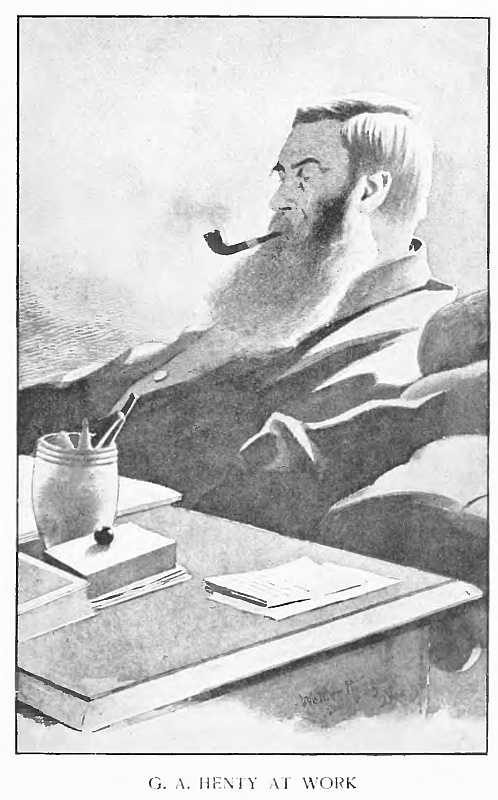
To hesitate and not take action in some shape Henty felt might prove loss of time, and perhaps the missing of some vastly important piece of news for the journal he represented, and this at a time when rumour was quietly whispering that before long a mandate would be issued from head-quarters that postal as well as travelling communication would be almost entirely cut off.
Henty was a thoughtful man of stern determination, and once he had made up his mind he satisfied himself by making a final application to the authorities. All he could learn though was that his requests were under consideration, and that a decision would be given later. This decision, he felt sure, would be in the negative, and he determined to return to England for the purpose of making a fresh start.
He made for the station at once, to find that the difficulties had already begun. A fierce struggle for tickets was going on among those who wished to leave the city, and he was informed by a clerk that tickets were only issued for a short distance on the way. This, of course, meant that the railways were already in the hands of the government for the conveyance of troops, and pretty evident proofs of this change in the state of affairs were all around him in the shape of piled rifles ornamented with pickelhaubes, the spiked helmets of the Teutons.
It would be of no use, he felt, to wait the pleasure of the stolid, head-shaking Germans, fretting and worrying, while possibly he would be receiving from his own head-quarters, from an angry editor, letters asking what he was about in keeping him waiting for that which is the very life-blood of a newspaper in time of war.
It was all plain enough, that he had come to a wise decision. The great dislocation of the German railway system had begun, and ordinary passengers were having to make way for the movements of troops. In spite of his energy he was stopped again and again, before finally reaching Frankfort, whence he gained England, and in roundabout fashion crossed to France, where after endless difficulties he managed to get pretty close to the French army, and saw what he could of the war.
During his enforced sojourn in Berlin, and while waiting impatiently for his official permit to accompany the German army, the soldier within him was not idle, and, doubtless with a map at hand, he began to make his notes, in the shape of a letter dwelling upon the position, and the possibilities of how the men would fight. He dwelt upon the dash and go of the French in the rôle of invaders, and came to the conclusion that if France took the offensive, crossed the Rhine, and struck first at Stuttgart and then at Munich, the Prussians would be at their best, for they would be fighting in defence of their native soil.
These conclusions were come to at a time when he was still waiting, for he writes: “To my application to be allowed to accompany the army I have as yet received no reply.” In the event of an acquiescence to his request, he says: “I shall have no further difficulty, but shall go where the army goes. In the event of a refusal, my object will be to gain some central point and then wait events.”
All these surmises were followed by the stern refusal, as aforesaid, which turned him back, to learn afterwards how futile were the conclusions to which he had come, for, as will be well remembered, the battle-cry of the French, “A Berlin!” proved to be so much vanity, the Germans themselves assuming the offensive and sweeping everything before them almost from the first.
Afterwards he was one of the lookers-on when maddened France was in the throes of those wild scenes which are history now—times of disorder and disorganisation, of brigades being marched here and there in purposeless movements until, when at last they did encounter their foe, defeat followed defeat; the civilised world meanwhile watching with bated breath for the next news of disaster till there came la débâcle, the crowning horror of Sedan, and the surrender of the emperor.
Chapter Twenty Two.
The Commune.
Early in the year 1871, after the signature of peace, Henty in pursuit of his journalistic duties entered Paris, and during the wild days of its occupation by the Commune he passed a life of adventure of which volumes might be written, for, in brief, he saw all the fighting very closely. It was a wild time, in which no man’s life was safe, and in the absence of law and order an Englishman bound to investigate and report upon the proceedings of the ill-governed city dare hardly call his soul his own.
During this period Henty’s letters teem with information, all showing his keen observation of minutiae. He describes the gathering and marching down the Rue de Rivoli of one of the first armies of the Commune, an army the more dangerous to the republic through so many trained fighting men of the regular army having joined its ranks. The determination and hatred of the settled government of the motley company made up for their want of uniformity. With respect to their weapons, he describes how a great many in the ranks, numbering in all some ten thousand, were armed with the chassepot rifle, but the majority had old muskets converted into snider breech-loaders, while a certain percentage had nothing better than the old muzzle-loader. It was an armed mob, though mingled with it were battalions of the National Guard in the pay of the Commune. Later, when encountering the forces of the regular army, the solidity of the much-talked-of fraternity was exemplified at the first encounter, for, amidst cries of “Vive la République!” and patriotic outbursts, one side would appeal to the other with a touching cry: “Surely you will not fire on your brethren!” The answer to this would be a volley, with the weaker side making a rapid retreat in search of shelter.
Henty was very soon saying to the newspaper he represented: “I write my daily letter in doubt as to whether it will ever come to hand. The post has ceased to run, and we are cut off from all news from the provinces. The gates of Paris are closed, we are in a state of siege, and the passengers of such trains as are running are told that they will not be allowed to return.” The misery and suffering connected with the great siege were quite forgotten, the fighting began again, and once more the streets of the brilliant city were echoing with the rattle of musketry, a sound punctuated with the sharp thud of the field-pieces that were more and more brought into action, and whose shells in the early days had a startling effect upon the insurgent members of the Commune. For Henty observed the steadiness of the National Guards, who remained at their posts and showed no signs of flinching, while on the other hand the inexperienced, undrilled men of the insurgent ranks were prone to throw themselves down flat in the road at each flash of a cannon and remain there until the shell had burst, perhaps three hundred yards away.