"The Story of an Active Life" (continued 2)
Reading edition
The deeply-bronzed soldiery politely exchanged salutes as the travellers questioned them about the prospect of finding a resting-place for the night, the answer to which was: “Have you any bread?”
“Yes,” replied Henty. “Well, then,” said a Garibaldian, with a smile which showed his white teeth, “you may think yourselves very lucky, signori, for we have had none to-day, and though we have had notice that some will come in this afternoon, it is more likely that it will not.”
This was disconcerting; but feeling that they could travel no farther they determined to persevere, in the hope that something might turn up; and if matters did prove to be at the worst they still had their open carriage, which would, at all events, with its cushions make sleep more easy, and keep them off the ground.
They had given a lift to one of the Garibaldians, and though amused by their predicament, he laughingly tried to assist them by suggesting that they should go on, and stop and knock at every door until they found someone who would give them a lodging. The notion seemed to be good, and to carry out the Italian’s suggestion they drew up at the best-looking house they could see, and knocked boldly at the door.
This was opened by an elderly priest, who raised his eyebrows in wonder, and glanced at the carriage and its occupants, and then at the Garibaldian who was acting as their guide, when an eager conversation ensued in the soft fluent Italian tongue. The guide, speaking with energy, explained with enthusiasm that those whom he had brought to claim the priest’s hospitality were two English gentlemen, whose hearts were in the Italian cause, and who, much interested, had come out on purpose to see the war; they were weary with their long journey and sought a refuge for the night—a lodging for which they were perfectly ready to pay with the customary generosity of their nation.
It was all very flowery, but most effective, for the priest smiled and bowed and bade them enter, declaring his readiness to place a room at their service, but shrugging his shoulders as he told with much gesticulation how he lamented that owing to the exactions of the Austrians, who had been there only the week before, and many of whom had been quartered in the house, he had nothing in the way of food to offer them; however, anything they could procure his servants would cook.
Perhaps it was due to perseverance having been rewarded and to having gained a lodging that, hungry though they were, they began to contemn their supply of bread. Surely, they thought, in a village like this it should not be impossible to find something more tasty, now that fate had provided them with a cook. So they sallied out, and leaving the more frequented streets, which swarmed with the hungry volunteers, they turned down first one lane and then another with no result. At length Henty, tired by his journey, was beginning to feel a return of the despondency which attacks a hungry man, when he stopped short, catching his companion by the arm and holding up his hand, for from a small house on one side of the lane he heard a familiar suggestive sound, which is precisely the same in the boot of Italy as it is in some rustic English county. It was the welcome cluck of fowls, shut up somewhere behind bars for safety. This promised a prize if negotiation were carried to a successful issue, and hands involuntarily plunged into pockets, to be followed by the faint and smothered chink of coin. Money should be able to purchase poultry at some price or other, even in times of war; if not, as it was a time of war, and as the two young Englishmen were upon a foraging expedition in a foreign country, why should they not—
Dark thoughts suggested themselves, and visions of a bright fire and a browning chicken began to dawn and sharpen the rising appetite, but they were dissipated at once by the opening of the door, at which they had loudly knocked. An animated parley commenced with the occupant of the cottage, the said parley ending at last in the correspondents becoming the masters of a couple of fowls, whose united ages, by the way, they found, when they came to eat them, must have been a long way on towards the age of one of themselves.
But all the same they felt satisfied in their ravenous condition at having obtained even these world-worn birds at only about five times their proper price, especially as on returning towards the priest’s house they again encountered the friendly Garibaldians, who had been less fortunate than themselves.
There was still another drawback, that which comes to a hungry man even though he has obtained a whole fowl to himself, and this was the waiting while it was cooked. While this was in process Henty had to try and curb his impatience by examining the beauty of the scenery. But at last the repast was ready, and their friend the priest made them up beds, on which they passed the night in a far more luxurious manner than they had anticipated.
Chapter Seven.
The Battle of Lissa.
There were times when Henty had to take shelter from the Austrian fire, and others when he found himself exposed to that of the friendly army, whose skirmishers, made plainly visible by their scarlet shirts, began to send up little puffs of smoke from behind hedges and amongst trees, while crack! crack! the reports of the rifles rang out and echoed down the ravines, to die away amongst the distant hills.
Then, too, one of his narrow escapes happened when he was on his way to Brescia. He had some difficulty in getting there, for every vehicle was requisitioned for the public service, and he thought himself extremely lucky in being able to get his luggage sent on, leaving him free to undertake the walk of some five-and-twenty miles. This was no serious undertaking to a well-shod athlete, being only one-fifth more than a tramp across our own Dartmoor, but with this difference, that the home walk would be through the crisp bracing air some fifteen hundred feet above the sea, while here the labour was very heavy, the heat of the Italian July sun being tremendous.
However, just when he had proceeded half-way on his journey, and was suffering severely from the torrid air, which felt too hot to breathe, he, little anticipating what was to prove the outcome, congratulated himself upon what he looked upon as a stroke of luck, for, hearing wheels behind, he drew up by the side of the road, to stand panting and wiping his streaming brow, signing to the military driver of a government cart. This man willingly agreed to give him a lift as his destination was the same, and explained that he was going to fetch a load of ice for the benefit of the wounded.
It was rough travelling, but the change from the labour of tramping the road, which seemed to return the heat of the sun with fivefold power, was delightful, and the rattle and bumping of the clumsy cart by contrast became almost an exquisite pleasure.
In this way five more miles were added to those which he had walked, and in describing the adventure which followed, Henty naïvely remarks that doubtless he should have ridden happily the whole distance into Brescia had not the ill-groomed, blind mare which drew the cart, suddenly conceived that she was being ill-treated by the addition of this stranger to her load. She accordingly stopped short and began lashing out most viciously, nearly breaking the arm of the soldier who was driving, and then dashed off at full speed. Seeing that she was blind, her course was not a very long one, and before they had gone far down the mountain road which gradually grew more and more shelf-like, the mare’s flight became wildly erratic, until she checked herself most painfully by running her head against the rocks which rose up on their right. After holding his breath for some time Henty relieved his overburdened chest in a deep sigh, for he had been debating in those brief minutes whether he should not risk everything and trust to his agility to spring out. He now, however, began to breathe freely, and, dropping down from the cart into the road, he stared about him at his position, and realised how very near he had been to bringing his correspondent’s task to a sudden end. Had the mare in her blindness turned to the left instead of the right, horse, cart, and its occupants would have gone headlong over the low protecting parapet at the side, deep down a stony precipice, with only one result.
In his matter-of-fact way Henty goes on to say: “This was not a thing to be tried twice, and I once more set off to walk, and in a mile came to a village, where by great luck I found a vehicle which brought me into Brescia in safety.”
In his eagerness to obtain the fullest information about the military proceedings between the opposing armies, Henty never spared himself. Wherever there was an engagement pending, or taking place, if it were in the slightest degree possible he would be there, running all risks, and at any cost; so that when the news came of the possibility of there being a naval engagement between the Italian and Austrian fleets, it was only natural that with his sailor-like proclivities Henty should wish to be present.
As we have seen, he was well provided with introductions and credentials which facilitated his being with the army; but these hardly seemed likely to benefit him much with the navy. However, he was not the man to be daunted by difficulties. If a naval fight did take place, it was bound to be one of special interest, for though for years past the old-fashioned wooden walls and two- and three-deckers of this and other countries had been gradually changing into armour-clads, this was to be the first occasion when an encounter would take place between the ponderous monsters. It was an event which would prove, not only to scientists but to their captains and crews, how they would behave.
The question that arose, therefore, was how the representative of the Standard could get on board one of the vessels. Doubting what reception would be given to one who announced himself as a war correspondent, Henty proceeded, sailor-like, upon another tack. After the training he had gone through and the work he had done, he considered himself justified in posing as an engineer eager to grasp exactly what would take place under fire, and in this character, as a scientific man, the difficulty was solved, for he was allowed to be present at the naval battle which took place in the Mediterranean off Lissa, the principal island of Dalmatia, some forty miles from the mainland, on the 20th of July, 1866.
It was no trivial affair, but one as worthy of notice as any of the great battles of history, for the Italian fleet which set sail consisted of twelve iron-clads and eight wooden frigates, with their attendant gun and despatch boats.
The island was strongly fortified by the Austrians, and the battle began with an attack upon the forts, which responded fiercely, and the grim reality of the encounter was soon learned by those on the iron-clads when shells began to burst on board. But this attack was only in anticipation of the coming of the Austrian fleet, which was soon after signalled as being in sight, and its formidable nature was evident directly it approached. Its three lines were composed of seven iron-clads, one wooden ship of the line, five wooden frigates, two corvettes, and twelve gunboats, the last mentioned carrying six guns each.
The two fleets were not long in coming to close quarters, and it was soon proved that sailors could fight as well in iron-clads as in the towering old wooden craft of yore.
The thunder was deeper from the much heavier modern guns, the impact of the modern missiles (elongated bolts, not balls) and the crash of the bursting explosive with which they were charged far more awful; but amidst the noise, confusion, and deafening explosions the spectator could grasp but little of what was taking place outside the vessel he was on.
There was a certain grim novelty about being rammed, and the shock sent everyone who was not holding on, prostrate, convinced, or at least quite ready to imagine, that the vessel struck must be sent to the bottom. But this portion of the encounter did not prove to be so damaging as was anticipated, probably owing to the close quarters into which the two fleets were brought, and to the want of impetus of the striking ship. In fact, as the broadsides were exchanged, and the vessels were passing and repassing each other, they were in such close neighbourhood that at times the muzzles of the guns almost touched each other, and the effect was terrific. Numbers of men were killed on board the vessel upon which Henty made his mental notes. Shells crashed upon the iron armour, and were in some cases thrown off, but others passed in through the port holes and burst inside, committing terrible havoc, while at one time a broadside was received which glanced off. A vast amount of damage was done, though, when they ran stem on to the nearest opponent with an awful crash and then backed off, to see dimly through the smoke that the Austrian adversary was evidently sinking.
The result was that the Battle of Lissa supplied ample proof of the consequences following an encounter between two iron-clad fleets; but it was days after the noise and turmoil of the battle were at an end that Henty found an opportunity to pay a visit to the Italian fleet with the object of ascertaining how the various systems of iron-plating had borne the hammering of the shot and shell during this novel sea-fight.
His first visit was to a vessel of nearly six thousand tons burden, and before going on board he was pulled slowly round her, stopping from time to time to examine the shot marks in her side. And now it was surprising to see how little damage had been done. The shot had made round dents of four to five inches in diameter, and from one to two and a half inches deep, but the marks made by the shells in the armour-plate were more ragged, some of the dents being from eight to twelve inches in diameter, rough and uneven, while, when a shell had struck where the plates joined, pieces were broken completely off. Altogether, as far as her iron armour was concerned, this vessel, which had been engaged for more than an hour with two or three Austrian iron-clads, came out of the ordeal remarkably well. Not one of her plates was penetrated, cracked, or seriously loosened; but on getting round to her stern her weak point was at once noticeable, and that was the rudder, which was quite unprotected. Some six or seven feet of the unarmoured stern also was quite exposed, a fact which resulted in the loss of a sister ship, whose rudder was disabled almost at the beginning of the contest, so that she soon became an easy prey to her adversaries.
In the case of the Re de Porto Gallo, the vessel Henty visited, her iron-plating was covered with a casing of wood, some nine inches thick, to a height of two feet above the water-line, and upon this her copper sheathing was fastened. The whole of her port bulwark, with the exception of some fifty feet at the stern, was carried away by a collision with the adversary, the two vessels grinding together along their whole length.
On mounting to the deck, Henty goes on to say, he first began to see to what a terrible fire she had been exposed. Her rigging had been cut to pieces; black ragged holes where shells had struck and burst were to be seen; her boats were completely smashed to pieces.
In the case of another vessel, the shot and shell marks were rather deeper, and the dents and ragged marks of the shells indicated that she had had to encounter heavier metal, while Henty’s keen scrutiny showed him that the iron-plating which protected her must have been of a much more brittle nature; but even here it was quite plain to him that the protection afforded by the ponderous iron plates was most effective, and it was remarkable, considering how close the adversaries had been together, that more serious damage had not been done.
In noticing Henty’s account of the iron clothing of the Italian fleet, and the effect upon the ships of the enemy’s guns, it must be borne in mind that some forty years have wrought vast changes in naval warfare, and it can easily be conceived how different would have been the havoc wrought if the encounter had been with the armament of such a vessel as, say our own unfortunate Montagu, or the Sutlej, with the twin occupants of its revolving turrets and the ponderous bolt-shaped shells they could hurl.
These investigations appear to have been of the greatest interest to the young correspondent, but he was not satisfied; the sailor within him made itself heard. He was satisfied with the value of armour-plates in protecting a man-of-war, but he wanted to know how, plated with these ponderous pieces of iron, such vessels would behave in a heavy sea.
He had not long to wait, for he wrote directly afterwards that there had been a heavy squall, and one of the iron-clad fleet had had to run for the harbour, rolling so much from her weight, and shipping so much water, that she went down; but, fortunately, all hands were saved.
There had been a day of intense heat. The next morning it was hot and close without a breath of wind, and Henty states that he had been rowed across the harbour for his morning dip. At that time there was not a ripple upon the water, but on his return at nine o’clock the sky was becoming a good deal overcast, while about half-past ten he was a witness of one of the squalls peculiar to the Mediterranean, and made familiar to old-fashioned people in the words and music of “The White Squall.” Sheets of water, without the least preliminary warning, dropped suddenly from the clouds; the furious wind tore along, driving before it every light object; outdoor chairs and tables were swept away, and the wind was master of everything for about twenty minutes. When the fierce storm had passed on, and the rain had ceased, he, knowing what the consequences of such a raging tempest must be, hurried down to the landing-place to note what the sea had done.
He was astounded. His first looks were directed at the iron-clads. They were lying at anchor, and rolling bulwark-deep in so alarming a manner that it was fully proved to him that, had necessity forced them to go into action, they could not have opened their port-holes to work their guns, for had they done so they would certainly have been swamped.
Nature seemed to be mocking at the ponderous vessels, and green seas were rushing completely along the decks of the iron-clad which afterwards foundered.
He could see at the time by means of a telescope that the crew were engaged in dragging tarpaulins over her hatchways, while from the funnels of the whole fleet dense clouds of black smoke were rolling up, as the engineers were evidently working hard to get up steam, so as to relieve the strain upon their anchors, or to enable their captains to shift their berths. Later he could see that several of the vessels had taken shelter in the harbour, but the Affondatore was still in her berth, with her engines hard at work going ahead to relieve the strain upon her anchor.
Speaking as one accustomed to the sea, he was under the impression that the captain was afraid to make for the harbour, outside which the vessel lay, for to have done so would have necessitated his exposing her broadside to the tremendous waves, which, though the sea had somewhat subsided, still swept right over her bows. These were now apparently two or three feet lower than the stern, so that at the utmost the ponderous vessel was only six feet out of the water altogether, and she looked as if she had taken a great deal of water on board.
At length, as Henty watched, he began to see that she was changing her position. Her head turned slowly towards the harbour, her main-sail was set to steady her, and she began to steam slowly in. But in spite of the sail that had been hoisted she rolled heavily, and by degrees seemed to have lost all power of riding over the waves, which now made a clean sweep over her, until at times he lost sight of her bow for some seconds together.
At last, after expecting from time to time to see her founder, he saw that she had reached the harbour in safety, to anchor just inside the end of the mole, some three hundred yards from shore, and, growing excited as he felt in doubt about her position, he jumped into a boat and pulled out to her, to find that her bow was not above two feet out of water, while her stern was a foot higher than it had been on the previous day. In spite of man-of-war order, a good deal of excitement evidently prevailed. The crew were busily engaged in relieving her bows by carrying all weight as far aft as possible, and evidence of the peril of her position was plainly shown by the engines being hard at work pumping.
So he began to feel hopeful that as the vessel was now in still water she would be safe, but the hope was vain. Either recent repairs over the shot holes received in action had given way, or some of her upper plating, weakened by a shot, had opened with the strain. Whatever was wrong, as Henty watched he could see that she was getting lower in the water, which in little more than another half-hour was level with her bow.
Then it was that, feeling that it was impossible to do more, orders were given which resulted in the boats being lowered, and with discipline well preserved they were manned, while launches came out to her assistance and took off the crew to the last man.
It was a painful scene which soon followed. The grand vessel’s bow was now some distance below the surface, while the stern still maintained its buoyancy; but all at once, as if the iron-clad monster were making a desperate struggle for life, she gave a sudden heavy roll before steadying herself, and remained in her proper position with only a slight list to starboard. Then she sank slowly and calmly, and all was over with the gallant ship.
Henty described at length the battle of Lissa, of which no better account could have been given than that of this unbiased spectator; but upon the appearance of a lengthy official report, he did not hesitate to turn stern critic and fall foul of the brag and bombast which disfigured its columns. No doubt to flatter Italian pride this was so full of inflation, that the English correspondent flatly compared it with the never-to-be-forgotten narrative delivered by the stout knight to Prince Hal and his companions.
Chapter Eight.
The End of the War.
Henty writes of Brescia as a Garibaldian town, that is to say, a town garrisoned by volunteers, and after being there for some days gaining knowledge of these patriots, he takes advantage of the occasion to attempt some description of their state.
At one time he found the station crowded as if the whole population had assembled, and he explains the reason of the unusual scene. A train of enormous length had just entered the station crammed with red-shirted volunteers, who were being received with tremendous cheers, which they responded to as lustily. Then ensued an affecting scene, for numbers of the regiment had friends and relations in the town who were searching eagerly from carriage to carriage enquiring if they were safe.
The train was only to stop for ten minutes, and the men were not supposed to alight; but no orders could keep them in, and a scene of wild embracing, handshaking, and kissing ensued, mingled with eager enquiries after relatives in other regiments, good wishes, and farewells. Then the station bell rang and the train moved on, the soldiers waiting till the last moment and then jumping on as it was in motion, so that as it moved out of the station it presented an extraordinary aspect, men in scarlet shirts leaning out of every window and standing on the foot-board the whole length as closely as they could, while others were even on the roofs, and all waving their hands and cheering. He heard afterwards that some of the men in their enthusiasm and excitement rode the whole of their journey upon the steps, while three or four in the various trains were killed from leaning too far out and striking their heads against the abutments of bridges.
The commissariat arrangements, into which as a matter of course he would be prone to enquire, were, he declares, vile. In fact, he says the arrangements for feeding these poor fellows were, like all other matters connected with the volunteers, shamefully bad. Some of them, in a three days’ journey, had no food but bread and cheese and a little wine.
At another town he found the place crowded with Garibaldians, who had taken possession bodily of the inn he reached. Tables were spread out in the court-yard, at which parties were sitting; upstairs and down the inn was thronged. The landlady and waiters received their English visitors with an air of languid indifference very different from their customary manner. At the first complaint Henty was assured that for three days and nights they had not rested, and that as fast as one regiment of the volunteers went off another took its place. The men were all famished by long fasting in the train, and only too glad to sit down to a regular meal again.
Here he found that although the Garibaldians were better clad than when he first encountered them, for they had all got red shirts, and caps of some shape or other, many of them were sadly neglected. Some were almost shoeless, others had only just previously received their arms. Moreover, with the exception of the Bersaglieri regiments, which had ten rounds of ball cartridge each, no ammunition whatever had been supplied. They were in a melancholy slate for an active force just taking the field—no shelter tents, so that they had to sleep in the open air, and most of them had only one blanket to serve as a cloak in the daytime and a cover at night.
Some of them had not even this poor protection, and had to sleep on the ground, however wet the night, with no other protection than their red shirts and trousers. Fortunately for them, they had patriotic faith and enthusiasm; but there was no ambulance train or any accommodation whatever for the wounded, and, speaking generally, the commissariat arrangements were so bad that it was no unusual thing for a regiment to go all day without food.
The result was indignation on the part of the volunteers at the scandalous treatment they were receiving; but this only made them still more desirous to get at the enemy and show that, ill-used though they were, when it came to fighting they could do as well as the line. For it seemed that there was considerable jealousy and ill-feeling between the two services, the Garibaldians believing firmly that the treatment they were receiving was caused by those in authority, and when the news came of a disastrous defeat of the regular troops, it was received by the volunteers with something like satisfaction and a full belief that they would do better when their turn came.
“Indeed,” says Henty, “it must be owned that they had very much more than a sufficiently good opinion of themselves, for they firmly believed that they could defeat anything like an equal number of Austrians, even though the latter were provided with artillery, as they would be.”
Henty learned from the plucky fellows that they did not believe much in the value of ball cartridges, but pinned their faith entirely on the bayonet, against which weapon he did not believe that they would be able to stand for an instant. His opinion was that if the Garibaldians came upon a body of the well-drilled Austrians in a steep place, or where they were in confusion, the volunteers’ impetuous onslaught would be irresistible; but on the other hand, he could not believe that out on the plain disorderly rushes could ever break the Austrians’ steady steel lines.
At this time a battery of mountain artillery was attached to Garibaldi’s command; but the guns were so clumsy and the carriages so primitive that Henty believed they were not likely to prove of much assistance, and, continuing his remarks about the uniformity and aspect of the Garibaldian troops, he grimly notes that consequent upon sleeping upon the wet ground, the red shirts were beginning to lose their original brilliancy of colour. He has, though, a few words of praise for the volunteer cavalry, the Guides, who were extremely useful as vedettes. Their grey-blue uniform with black cord braiding, natty scarlet caps and high boots, gave them a very soldierlike appearance, while for night duty they had very long cloaks of the same colour as the uniform, and lined with scarlet.
Henty had always words of praise for the unquenchable pluck of the Garibaldians, the indomitable determination that, in spite of bad drilling, clumsy discipline, and bad leading, finally led them to success. Garibaldi himself, however, came in for criticism, for he declares, after recording a wound that the general had received, that it was greatly to be regretted that he should expose himself to danger, and that his young officers should be so eager to do the fighting themselves instead of steadying their men and leading them.
Then again he attacks the commissariat in his customary, vigorous way, while reporting after one of the fights the wantonness which could send three thousand men from a town to march twenty-five miles without breakfast to begin with or supper to finish with, this being only a common specimen of the commissariat arrangements. “Certainly,” he seems to growl, in a quotation, “somebody ought to be hanged; I do not know who it is, nor do I care, but such mismanagement has, I believe, never been equalled. All the same,” he says, “the volunteers take it with wonderful good temper.”
Picturesque, he says, as was the appearance of the Garibaldian camp, so bright and gay with the scarlet shirts of the soldiery and the green arbours, that it looked like a gigantic military picnic, it was the abode of as badly a fed set of men as were to be found in Europe. A little bread or biscuit and soup, doled out at the most uncertain intervals, with occasionally meat and frequently nothing at all, was the food which the government of Italy bestowed upon her volunteers, many of whom had left luxurious homes to fight her battles; and in some cases the men were so reduced from weakness that at certain stations many of them had to be taken into hospital. The poor fellows were fed, when fed at all, with a mixture with bread swimming in it which was called soup, but which was utterly innocent of meat in its composition, and tasted simply of tepid water; a sort of raw sausage, flavoured strongly with garlic, and a mess of either rice or macaroni, with something called meat in it, but utterly untastable; and yet this same food was at one time, while Henty was with the volunteer army, all that he could depend upon for himself—that or nothing. Campaigning with the Garibaldians was sorry work, but, soldierlike, Henty tightened his belt and fought his way on with the volunteers in expectation until they won.
Still with the head-quarters of Garibaldi, and in the midst of the heat of an Italian July, Henty writes again in the midst of warfare, with all day long the boom of cannon and the sharp crack of musketry sounding in his ears. And as he writes, he says, the confusion outside, the talking of innumerable Garibaldians under the window of the humble room of which he thinks himself fortunate to call himself master for the time, the rumbling of carts, the shouting of the drivers, and the occasional call of the bugle, all remind him that he is in the midst of war on a large scale.
The heat has been terrible; not a breath of wind stirring, and the cicadas in the vineyards which line the roads through which he has passed have been in the full tide of song. “The noise,” he says, “that these insects make on a hot day is something astounding. It is a continued succession of sharp shrill sounds such as might be made by a child upon a little whistle.” He asks his reader to imagine an army of children, thousands strong, lining the road and all blowing upon these whistles, “and you will have an idea of the prodigious thrill of sound produced by myriads of these creatures.”
“Zeno,” he says, “the old Greek philosopher who was mated to a shrew, is reported to have exclaimed: ‘Happy the lives of the cicadas, since they all have voiceless wives.’ But I think that it is equally fortunate for humanity in general, for if the female cicadae were in any way as voluble as the males, it would be impossible to exist in the neighbourhood of the vineyards at all without losing one’s sense of hearing.”
But insects, the boom of cannon, the rumble of tumbrels, and the crackle of musketry notwithstanding, the war correspondent’s communications had to be written, and two of his most interesting pieces of news, which are rather ominous in sound, are that the general’s son, Ricciotti Garibaldi, who is serving as a private in the Guides, is at present ill, though nothing serious is apprehended, while Garibaldi’s wound still causes him great pain and inconvenience. He can do nothing for himself, but he is the enthusiastic general still, even though he has to be lifted from the sofa upon which he lies all day, and carried by four men to his carriage, the anxiety he feels at the state of affairs greatly retarding his recovery.
Chapter Nine.
Impressions of Italy.
In what had now become a sight-seeing perfect holiday time for Henty, prior to his being present to witness the entry of the Italian troops into Venice and the departure of the Austrians, Ravenna, with its antiquities, its museums and traditions, was too great an attraction to a literary man to be passed over. He appreciated to the full the ruins of the old Christian churches, the cathedrals, the traces of the Roman emperors, the glorious fir woods with their pleasant shades, and raked up memories of poet and student who had been attracted there in their time, such as Dante, Boccaccio, and Dryden. All three have written their recollections, while Byron worked there, finding other points of interest beyond its quiet charm. For it was in Venice that he wrote Marino Faliero, The Two Foscari, Cain, and other poems.
But every city of the Italian plains had its attractions for Henty, and his writings at this date are one long record of a country which teems with memories of the past.
Much as he was interested in the fairs and markets and antiquities, Henty was too much of the sailor and soldier not to be attracted by a little scene at Ancona on his last morning there, and that was in connection with the landing from the fleet of a body of sailors for certain evolutions upon the parade. They brought ashore twelve light guns, apparently about five-pounders, each manned by six Italian Jacks. These guns were promptly taken to pieces, and a couple of the men caught up the gun, the rest the wheels, ammunition boxes and carriages, and bore them down to the boats. Then, at the word of command, they carried them up again to the drill-ground, and in a little over a minute the guns were put together, mounted, loaded, and ready to open fire, the limber, in charge of two of the six men, standing a little in the rear. The whole evolution was remarkably good, and the rapidity most striking. At the word of command the guns were fired; they limbered up directly, and the men attached a sort of harness which went across their chests, and dashed off as fast as they could run till a halt was called, fresh position taken up, the guns unlimbered, loaded, and discharged again in an incredibly short space of time.
As Henty watched them the sailors seemed to be taking their task as if it afforded them the greatest amusement, and to one who had never witnessed any such drill before it appeared to be an exercise that ought to be introduced to our own navy, which, as far as he knew, had not been furnished with these light portable guns for landing operations, “for there is no question,” he says, “that they would be of immense service if two or three of these little guns were added to every vessel of our fleet.”
This was, of course, prior to Henty’s experience in connection with Magdala and Ashantee, where he found our sailors on landing expeditions in no wise behind those of the Italian fleet. Later it came to his lot, after his own war-correspondent campaigns were at an end, to deal with correspondence, letters, and telegrams connected with the Boer war, in which our Jacks performed wonders, not with toy guns, but with the monsters on their specially-contrived carriages, under the manipulation of Captain Hedworth Lambton and Captain Percy Scott, which startled our enemies.
With ears relieved from the incessant roar of cannon to listen instead to the ringing of joy-bells and the cheers which welcomed the declaration of an armistice, Henty gladly availed himself of an opportunity to visit the old Italian cities, so as to see what life was like in these old-world places. Much of the quaint and antiquated still lingers round these towns, not only in the buildings, but in the habits of the people, suggestive of the days when Shakespeare and his contemporaries constructed their dramas, laying their scenes in Verona, Venice, Padua, Mantua, and other places, the very names of which suggest slashed doublets, rapiers, family enmities, relentless vendettas, keen-bladed swords, stilettoes, bravoes, feathered caps, poisoned cups, and all the rest.
Starting from Ancona, he went over to Sinigaglia, now upon the railway, but formerly a Roman station, and later of considerable importance in the Middle Ages, when war used often to rage between the states of the Pope and the family of Malatesta at Rimini. Here, too, Caesar Borgia made his name infamous by causing the Condottieri, his allies, to be strangled, an act of treachery suggestive of the massacre of the Janissaries at Constantinople.
These names suggest old-world celebrity, but Henty had come over for a change, sick for the time being of war and its rumours. The bow-string had been tight for some time, sending literary arrows speeding west, and the fact that a rather famous fair was being celebrated attracted him, in expectation of seeing what Italy would be like when its people were en fête at a function similar to our own old Bartlemy or Greenwich.
In visiting Sinigaglia, a place associated with such names as the above, he fully expected to revel in the picturesque; but he found that the Italians, troubled as they are with such terrible epidemic visitations, have grown to pay greater respect to sanitary measures than did their ancestors, and in consequence ancient ruins with their echoes of the past do not receive the respect we pay to them in England. He found one grand old citadel, but the Italians had been behaving to it like Vandals, or, to be more familiar of speech, like our honest old British churchwardens when they distribute whitewash. Other ruins, such as nowadays we place under the care of some learned society, he found had been patched up and turned to some useful purpose.
The fair was in full force, but by no means English-looking. There were no roundabouts, either steam or worked by expectant boys in return for an occasional ride; no swings, no dramatic shows, no giants, no fat or spotted ladies, no freaks such as our American friends accustomed to Saint Barnum of show fame rejoice to see, no music, no noise. It did not seem at all like a fair; but he found other attractions in the large town of about twenty-three thousand inhabitants, which was built as a fort about a third of a mile from the almost tideless sea, which, after the fashion of Venice, was connected therewith by a wide and deep canal. This canal offered passage for good-sized vessels, and ran up right through the town, all of which was very interesting from a commercial point of view; but it was the middle of hot August, and the place had a greater attraction for our traveller because it happened to be one of the most fashionable watering-places of eastern Italy. Henty here draws attention to the great advantage the Italians possess in living on a sea like the Mediterranean, where bathing-places can be erected, and where at all times there is a sufficient depth of water to enable one so desirous, to have a plunge without having to go lumbering out in one of the miserable rickety boxes on wheels which we call bathing-machines.
The same advantages are offered in the harbour of Ancona, at which town, at this period, Henty was making his head-quarters. Here he found floating baths represented by a chamber of about fifteen feet square, into which the sea had free ingress, and also a larger bath big enough for a swim, while if one were so disposed there was egress to the sea.
To return to Sinigaglia: seeing that it was fair time the streets were furnished with awnings to keep off the sun, and the place was after all very attractive, with its streets filled with women displaying their baskets of goods for sale. Being a fête day the peasantry had flocked in from the surrounding country in their best and most picturesque costumes of bright colours and snowy white, with their hair carefully dressed in a peculiar fashion, and a plentiful display of gold necklaces or ear-rings. Their dark hair, warm complexions, and large dark eyes all tended to form a very attractive scene.
Henty however always displayed a mind receptive of anything connected with utility. As a rule he looked out for matters concerning sanitation, and while he condemned the vandalism, he had a word to say here respecting the purifying effect of whitewash. But in a place like this, so intimately associated with the old and historical, it is amusing to find that he takes a walk round the outskirts of the ancient city, and very unpoetically notes that the hills about Sinigaglia would gladden the heart of a London brickmaker if they could be dropped down in the neighbourhood of the metropolis. It stands to reason that he must have had Southall in his eye, for he says that the Sinigaglia hills are entirely composed of fine brick clay of apparently unlimited depth and extent.
As far as the fair was concerned, Henty writes soon after from Rimini—most poetic of names!—that he was glad that he went back to Ancona for the fair in that town, for it differed entirely from that at Sinigaglia, in that it was especially lively, amusing, and attractive.
“The fair,” he says, “begins where Ancona ceases.” The attractions were almost entirely devoted to the young, so that for the time being the place was turned into an attractive toy-land. The Grand Promenade of Ancona, in the neighbourhood of the sea, and planted with rows of trees, was the centre of interest. The fair stalls, which were most abundant, were small, but were made most attractive. Each had its speciality, and was, of course, thronged with eager, bright-eyed children. One contained drums only; the next military toys, small swords, guns and pistols; the next would be all small carts; then came one with dolls’ furniture, most neatly made in japanned tin or iron. A little farther on the stalls were filled with the noisy playthings so dear to children’s hearts—whistles, trumpets, accordions, and rattles of the most ingenious construction and maddening power. Then, again, there were stalls displaying the ingenuity and delicacy of Italian taste, where they sold only dolls’ head-dresses, the most jaunty little caps, hats, and veils conceivable, quite an equipment, in fact, for the heads of a whole troop of little fairies.
Then, again, there were many stalls with dolls dressed in the extreme of fashion; but in a fatherly manner, suggestive of thoughts of home, he goes on to say that “the dolls themselves would not at all come up to an English child’s idea of what such a toy ought to be, being all cheap wooden dolls. I did not see one made of wax in the fair.”
Many of the toys exhibited were unquestionably German, similar to those seen in our own bazaars, but some, particularly the drums, he noticed were Italian. It was easy to detect the difference in the colouring, the paints used being of less clear and bright shades; and they were unvarnished, which is seldom or never the case with German toys. Round these stalls the crowd of little people and their friends was constant.
Observant of the country again, Henty goes on to say, with thoughts of home: “Children here have few amusements, few toys, and still fewer of those charming story-books with which so many of our booksellers’ shop windows are full, especially about Christmas time.” It is worthy of notice that this was in 1866, about two years previous to the production of Henty’s first boys’ story, and over thirty years before the time when, with scrupulous regularity, the booksellers’ shop windows were annually displaying two or more of his own productions specially written for the young.
The parents and the friends seemed disposed to indulge the children to the utmost upon this occasion, for all had their hands full of toys. Boys drummed and blew trumpets and whistles till he was nearly deafened; little girls clung tightly to the skirts of their mothers’ dresses with one hand, and with the other held out their new dolls admiringly before them; and appeared to be continually questioning their friends as to whether they were quite sure that sundry other purchases carried in paper bags were safe.
It was a charming scene, for the stalls were lit up by candles, which burned steadily in the serene summer air. Nothing could have been more attractive—the crowds, the pleasure of the children, the number of well-dressed people in their varied refinements of fashion, and the peasant women in their bright-coloured handkerchiefs, but many with no other decoration to their heads save their abundant smooth and neatly-braided hair.
Other picturesque features in the crowd were afforded by the soldiers, sailors, and marines, with their round hats and drooping plumes of black cocks’ feathers, and the uniforms of the National Guards and officers of all these services.
Passing onward, he came upon stalls significant of his being in a hot country, for at these only fans were sold—fans of every size and colour. In Italy, it must be remembered, as in Japan, nearly everyone carries a fan, and uses it instead of a parasol to shade the face when walking and to cool the bearer when sitting down.
And now began the stalls of the vendors of more useful articles. First were the basket-makers and turners, trades which seemed to be generally united, as if the women of the family pursued the one branch, the men the other. There were baskets of every size and form, from those which might hold a lady’s fancy-work, right up to the enormous holder in which Falstaff himself might have been borne.
The turners’ display of the works of their lathes was wonderful in variety, and included wooden bowls, platters, distaffs, and spindles, strings of buttons, bowls, and articles that were more the work of the carving tool, in the shape of spoons, taps, and pegs.
Then there were stalls with articles made from horn instead of wood, followed by displays of articles in iron and tin, notably small charcoal stoves, coffee-roasting apparatus, and ladles, while last in utility there were sieves of cane, wire, and horse-hair. The variety was wonderful. Now the stalls were covered with hats—from the coarsest straw or chip, to those once fashionable in England and worn by our grandmothers under the name of Tuscan and Leghorn,—while a brisk sale of cutlery was being carried on, men selling wooden-handled knives of the cheapest kind, such as the peasants always have at hand.
Elsewhere there were copper cooking utensils in plenty. Cooking in Italy is almost always done in copper pans and pots, and there is no cottage so poor that it has not its half-dozen, at least, of these brightly kept vessels.
And now, where the crowd was thickest, Henty found that he had been too hurried in his judgment of Italian fairs, for he found the old English fair equalled, if not excelled. Here were the shows and menageries, with the outside pictures of terrific combats with impossible animals, conspicuous among them being a snake, by the side of which the sea serpent would sink into insignificance, engaged in the operation of devouring a boat-load of Hindus, or so they seemed to be by their complexion and costume. This show boasted a band, while its neighbour contained our old friends the wax figures, representing heroes of modern times, among which he noted that, in remembrance of the Crimea, the showman had done England the honour of placing Lord Raglan. By way of extra attraction the little exhibition was furnished with an organ and cymbals.
If he had shut his eyes now, he says, he could almost have imagined himself in England—the music, the shouting of the touters at the booths, the blowing of trumpets and whistles, the beating of small drums, all recalling home. But there was one difference that was unmistakable. There was no pushing, no foul language; there were no drunken people, no roughs, all of which appear to be the inseparable elements of an English fair.
There were a great number of fruit stalls, which seemed to be doing a good business among the lower orders, especially at the counters devoted to the sale of slices of water-melon, which the people of Italy seem never tired of eating. Henty ventures to say they were very nice to one who got used to them, but for his part, he declares he would just as soon have eaten the same weight of grass.
When he left the place that night the proceedings were still in full swing, and when he returned to it at six o’clock the next morning, there was the same crowd as late the night before, and a brisk trade was still going on. Noticing again the vast number of fruit stalls, the thought occurred to him that it was fortunate that there was no cholera in the town, for if all the fruit that he saw in Ancona were consumed by the people before it got bad, it would produce an increase of that epidemic which was terrible to contemplate. There were hundreds of cart-loads of melons, water-melons, and peaches, which were poor tasteless things and always picked too soon; he declares he never tasted a ripe peach while he was in Italy. Pears too, figs, and grapes were plentiful; but he gives them no praise.
To his surprise and amusement, perhaps consequent upon Ancona being so old-world a city, he came upon one relic of the past, and that was a stall for supplying the matches such as our grandmothers used, such, in fact, as used to be sold by every pitiful vendor in the streets, in the shape of long thin strips of wood cut into a sharp point at each end, dipped in melted sulphur, and then tied up in bunches like fans. These were, of course, the predecessors of the lucifer matches, as they were called, which were sold in neat little boxes, with an oblong piece of sanded card laid on the top. This folded across, and between its folds the match was drawn sharply, when it burst into flame. These were soon succeeded by a somewhat similar match, with the sand-paper a fixture on the bottom of the box, and the priming of the match so increased in inflammability that the ignition took place as at the present time, and the name Congreve Light came in, the “light” soon dying out, and giving way to Congreve or matches only. Of course, those which Henty saw on sale were for use in connection with the old-world flint and steel and tinder-box.
Passing on that morning, he went through the Custom House, to find beyond it the regular food market at its height. Hundreds of neatly dressed peasant women and girls were standing with their baskets before them, ready to supply eggs, butter, cheeses, fowls, turkeys, ducks, pigeons, and larks, for the most part alive, but doomed. There were one or two baskets which contained puppies, probably, however, not doomed, at least, to be cooked. But there were baskets in plenty containing delicacies in the nature of molluscs! He was within reach of the sea, but they were neither oysters, scallops, mussels, cockles, nor winkles, but the fine pale-shelled, spiral, Roman snails, that doubtless had been captured in the moist eve or early morn when ascending the poles of some vineyard. Delicate, but not tempting to the English taste.
To do the fair thoroughly, Henty, before leaving, visited the cattle, to find that the supply of horses was just then very small; but there was the prospect that, directly peace was signed and the enormous transport train paid off, horses would become as cheap in Italy as they then were dear.
There was a large show, though, of the beautiful patient, docile, draught oxen, which were fetching from twenty to thirty pounds a pair; and with these he concluded his inspection of the two fairs. He then suffered a most Inquisition-like examination of his baggage, and started for a visit to one of the smallest republics in the world, a country close to the Adriatic shore, which had been for some time attracting his attention. This he hoped to see and report upon before the festivities of peace should commence consequent upon the complete freedom of Italy, or troubles should arise once more and make busy in other ways the war correspondent’s pen.
Chapter Ten.
The Visit to San Marino.
On his way to San Marino Henty found himself at Rimini. This place is the Ariminium of the Romans. It was enlarged and beautified by Julius and Augustus Caesar. Here, too, in a.d. 359 the Aryan doctrine was denounced. As the centuries rolled by, the town fell into the hands of the Lombards, and was given by the Emperor Otho to Malatesta, whose family ceded it to the Venetians, from whom it was afterwards wrested by the Popes, and it remained part of the Papal dominions till 1860.
It has its antiquities, the principal one being an arch erected in honour of Augustus, and bearing still in perfect preservation the old Roman carvings, representing on one side Jupiter and Minerva, on the other, Neptune and Venus.
Another antiquity that took Henty’s attention as being well worthy of notice, from the way in which it brought back to his memory Westminster School and his studies of the classics, was a short pillar in the market-place with an inscription stating that Caesar stood upon it to harangue his soldiers before passing the Rubicon. Caesar, history informs us, was a short stout man, and Henty’s old studies led him to believe that he could not have looked well upon that short column, upon which he would probably have been lifted by the officers of his staff; and somehow or other—perhaps the weather was not very genial—the column did not impress him with any particular feeling of veneration. His ideas ought to have been classic and stern; but it is strange, as he says, what inopportune ideas strike one. He approached the stone with a thorough belief in it, prepared to picture Caesar aloft, and the heavy-armed legionaries of the Roman cohorts standing armed, leaning upon their spears, with the eagles they had carried triumphantly through so many campaigns erect in their midst. But as he came fully into sight of the stone, the thought of the difficulty of getting upon it and of Caesar’s ungraceful figure brought to his mind the remembrance of H.K. Browne’s etching representing the immortal Pickwick standing upon a chair, with one hand under his coat-tails and the other outstretched, as he harangued the members of his club. And all belief in the legend of the stone faded away at once. In fact, Henty was not an imaginative man. Neither was he a great humourist; but when he was in humorous vein his humour was dry and good.
By the way, legend says that it was at Rimini that Saint Anthony preached to the fishes when the people refused to hear him, and that San Marino, who was a native of Dalmatia, across the Adriatic Sea, came over and settled here. He gave his name afterwards to the little republic and to the mountain which Henty’s driver pointed out to him—rising far above all the hills in its neighbourhood, nearly fifteen miles away—at the beginning of a very charming drive in an open carriage drawn by one of those novelties that are not often let for hire—a very fair horse.
This curious little state is in its own way perfectly unique, and its existence is the more singular from its being situated in Italy, though for centuries in the Middle Ages that country was the scene of an uninterrupted succession of wars. The hand of every country was against its neighbours. Towns changed owners every few years; states were swallowed up, conquered, reconquered, but San Marino has remained.
The law of strength was the only law recognised—that law which says he shall take who has the power, and he shall keep who can; for the weakest always went to the wall. It is then most singular that this little territory of about eight thousand inhabitants should have remained intact for more than fifteen centuries, and that now, while all its powerful neighbours have become merged into one great state, this tiny republic should be the sole portion of Italian soil possessing a separate autonomy.
History tells us that in the old Roman days, soon after the persecution of the Christians by the Emperor Diocletian commenced, San Marino, finding that there was no rest for his people in Rimini, led his little flock out from that city and established a Christian colony at the summit of the highest and most rugged mountain in that part of the country, then probably a place surrounded by untrodden forests; and the little state thus founded has remained separate ever since.
The road to San Marino led across an undulating and very richly cultivated country, where the peasants were engaged gathering in the grape harvest, which that year, from the extreme dryness of the early part of the season, was the worst the people had ever known. They were also occupied picking the maize, which is so important an item of the Italian farmer’s crop.
Indian corn is a little better known now in connection with its beautiful growth than when Henty paid his visit, but his description of what was to him almost a novelty is still pleasant reading. He tells us how the plants are thinned out as soon as they appear above the ground, and the blades are left to grow on about a foot apart in a climate where they spring up to the height of about six feet. The stalks, he says, “for the first two feet above the ground are about the diameter of a man’s thumb, but towards the top they expand to a considerable extent.”
He had seen maize growing in its early stage during his previous visits to Italy, but never before having passed the hot season there, this was the first time he had witnessed the harvest, and it was a matter of surprise to him that such thin stalks could support the weight of a head of maize. But now to him the mystery was explained. At about two feet from the ground, at the time the plant flowers, the stem increases in size, presently opens, and a thick shoot makes its appearance, apparently composed of a compressed bunch of leaves. This becomes larger and larger, the leaves expand, open more and more, and spread out like broad wavy blades of grass. The head or cob of maize swells out and forms at its summit a great silky pale golden tassel, while, as the cob becomes larger and larger, much of the upper part of the stalk in the process of the ripening dies and falls off. Then the lower leaves drop away, the grand beauty of the field of maize passes, and from the time the crop is ripe until the harvest the field seems to be composed of stumps with bunches of dead leaves at the top. These leaves, however, enclose the great solid, regularly formed or apparently built-up head of maize, which is left drying as it stands in the torrid sunshine, till it is cut off and carted to the farms. At this stage the Indian corn is taken in hand by the women and children of the family, and the separate grains are picked off and exposed on cloths to dry perfectly in the sun.
Passing the cultivated fields and crossing the little stream which forms its boundary, Henty learned that he was in the Republic of San Marino, that the circumference of the state was thirty-five miles, and that the mountain, or crag as it should rather be called, rose almost in its centre. With the exception of the rock itself, every part was extremely fertile and well cultivated, and of more value than land in the surrounding country, on account of the absence of taxation and other advantages peculiar to the republic, chief among which was the freedom from military conscription. Every male in San Marino is, it is true, a soldier, but soldiering involves no fighting or absence from home. Although all are liable to be called upon to serve in case of necessity, only those under a certain age are on ordinary occasions called out. The strength of this regular army of the republic is eight hundred men. Of these, seven hundred form the National Guard; the remaining hundred are the body-guard of the president.
They have their uniform of blue, the National Guard having red facings, the body-guard yellow, the band white. Then they have their national flag of blue and white; and a police force administered by a chief and five carbineers, whose uniform is dark blue with white cross-belts and grey trousers, so that they look on the whole much like the carbineers of the Italian service. These five are, of course, always on duty, and are regular salaried police. The army only appears in uniform upon Sundays and fête days, when the men are drilled; but the troops receive no pay.
“We arrived,” says Henty, “at the village of Serravalle. Here the carriage stopped, and I had to take my seat in a little pair-wheeled trap drawn by a good-sized pony. These berruchinos, as they are called, are by no means comfortable, for instead of being boarded, the floor is composed of a loose network of cords, which affords little rest for the feet. They have no dash- or splash-board, and you are consequently in unpleasant proximity to the horse’s heels, if it should take it into its head to kick. They have, besides, no rail or other rest for the back.” It was an intensely hot day, and at the village from which he made his fresh start he was glad to accept the loan of an immense blue umbrella. And now began an adventure.
They had ascended a steep hill, so steep that the driver got down and walked, and he had not retaken his seat when, without the slightest previous notice of its intention, and presumably induced thereto by the bite of a fly in some more than ordinarily tender part, the wretched little pony started off at full gallop.
At this time Henty was sitting quietly under the umbrella, tranquilly smoking and chatting to the driver, when there was a sudden jerk. His feet having no hold and his back no support, the former flew up into the air and his head went back. Instinctively he made a desperate grasp at the side rail with his unoccupied hand, but it gave way, and in an instant he was on his back in the middle of the road with the blue umbrella perfectly shut up beneath him. Fortunately the trap was not very high, and his bones were at that period of his life very well protected, so in a moment he was on his feet again, much more astonished than hurt. Bearing the relics of the blue umbrella he pursued the trap, which in spite of the efforts of the driver was going on at full speed, dragging him after it, and it was three or four hundred yards from the place where the pony started before the man was able to bring it to a standstill.
A little scene ensued, for when he came up Henty found the driver looking pale as death, and so much scared that it was with the greatest difficulty he could be persuaded that his fare was not seriously hurt.
It was rather a remarkable escape; but Henty states that he was so little shaken that he did not even suffer with a headache from the effects. Of course, however, the principal damage was to the blue umbrella, and on his return to Serravalle he had a very lengthy amount of talk and argument with the old lady, its owner, as to the amount of compensation to be paid, for it was irretrievably ruined.
The rest of Henty’s journey to the Burgo of San Marino, a village containing about seven hundred inhabitants, was uneventful. It is planted at the foot of a precipice, at the top of which the old town, which is populated to about the same extent, is perched. It is a remarkable mountain, rising as it does almost perpendicularly, and therefore being a very suitable spot for the erection of a fortress in the old dangerous times, for all around there lie nothing but softly swelling hills, no other so suitable a defensive place occurring until far back in the Apennines, another twenty-five miles inland.
The rock is about half a mile long, and to the east the face is absolutely perpendicular, while to the west it has a gradual but still rapid fall, the land being cultivated up to the very walls of the town upon its summit.
There is no flat ground upon the top. It is a mere narrow ridge, the descent beginning from the very edge of the perpendicular east face. When looking up the rock from the road all that is seen of the town are three towers perched upon the three highest points, and the church. None of the houses is visible owing to their position upon the west slope.
Enquiries brought an introduction to one of the ancients of the place, who acted as cicerone to strangers visiting San Marino, and during a walk he was found to be charged with a pretty full description of the politics and history of the little state.
Everything was in a delightful state of innocency, honour more than money seeming to be generally the object sought. There were two captains-regent instead of presidents, who were allowed seventy-five francs each during their term of office of six months. The home and foreign ministers were each paid two hundred and fifty francs for office expenses, postage, etc. The commander-in-chief of the army got honour alone and not a sou besides, and apparently had to pay for his own uniform. Then came the highest paid officials of the republic. These were three, two physicians and one surgeon, who received thirteen hundred and fifty francs, or fifty-four pounds a year each, and for this had to be at the call of all the citizens of the state, to whom they rendered their services gratis. The only patients who had to put their hands in their pockets were those who lived out of town, and they had also to provide conveyance.
There was a judge who went on circuit, and he was chosen for a period of three years, but might be re-elected twice. To meet these stupendous demands, which meant an expenditure of about three thousand pounds a year, the government raised a revenue by the profits upon the sale of tobacco and salt, these being, as in other parts of Italy, state monopolies.
In addition to this a very small tax was levied on the landed proprietors, and the Italian government paid a sum of eighteen thousand francs a year, which was used for making roads, assisting the poor, giving aid in cases of loss by fire or misfortune, and repairing the public buildings. This sum was paid by the Italian government for customs dues.
Following his guide, Henty found the city to be a long narrow village on and below the crest of the cliff. It was enclosed by a wall some twenty-five feet high, surmounted by numerous round bastions. It showed every proof of having been very strong in former times, and even then, although the walls were very old and crumbling, it was evident that a thousand men could defend it for some time against a strong force, the rock falling so steeply away below it that it would be difficult to bring cannon to bear on it. Within the walls the houses were all crowded together; the streets, although they all zigzagged upwards, were so steep that no horse could draw a vehicle up them.
Among the antiquities of the place were the old Assembly Hall and the building which contained the rooms of the captain regent, displaying the arms of the republic—three towers with plumes on the tops and the motto “Libertas.” These towers represented the three which stood upon the highest points of the rocks. The view from the summit of the rock was superb. A thousand feet below lay the Burgo. Beyond that for miles upon miles spread a gently undulating country, dotted with innumerable towns and villages, stretching away to the seashore. To the north lay a perfectly flat marsh land through which the Po and Adige find their way into the sea, this—the Adriatic—looking like a blue wall dotted with white sails. The guide assured the visitor that just before sunrise the mountains of Dalmatia, a hundred miles distant at least, were plainly visible.
Away to the west the Apennines shut in the view. Upon one of the spurs the castle of Saint Leon was visible, where the celebrated Cagliostro was imprisoned and died.
Henty observed upon his descent to the gate of the tower six strong posts, four being placed to make a parallelogram with cross pieces at the top, to one of which was attached a windlass. The remaining two posts were placed one in front and one behind, the whole suggesting the possibility that they had been used in former times in the defence of the tower. On being questioned, however, the guide explained that they were used for a much more matter-of-fact purpose. When oxen are being shoved they are not so calm and patient over the operation as a horse, generally objecting very strongly to the performance. Hence they were driven in between the posts, ropes were fastened to the cross-bar on one side, these were attached to the windlass, and when this was turned, the bullock was swung up into the air, and his feet fastened to the posts in front and behind.
It proved to be a delightful visit, the visitor ending by dining at a little auberge in the village at the foot of the hill, where to his surprise he found that they had an excellent cook.
Chapter Eleven.
A Land of Mystery.
Henty, having been interested in mining early in life, was at any time eager to seize upon an opportunity to plunge into the bowels of the earth, and not long after he commenced as war correspondent to the Standard, that is, at the termination of the Italo-Austrian campaign, he took occasion when at Trieste to run up into the hill country for a few days and visit the three great sights of Carniola, namely, the Grotto of Adelsberg, the Lake of Zirknitz, and the quicksilver mines of Idria.
Here the man who had studied mining in his youth with the possibility of succeeding to his father’s industrial occupation was in his element, and showed himself ready to study the country with an open and receptive mind. He was eager at once to investigate the mountainous and sterile country covered by the Alps and Tyrol, the vast forests and their timber, the transport, the burning of charcoal, and the general cheerlessness of a land of desolation often covered with huge boulders and scaurs of white stone. Quite the geologist here, he notes the hard white limestone of the secondary formation, quarried extensively, being excellent for building, and known through Italy as Istrian marble. He speaks of it as being the same stone which extends through Carniola and through Dalmatia into Greece, and here he seems to revel in a kind of exciting pleasure as he finds himself in a limestone formation somewhat similar to that of our own Derbyshire, asking to be explored and tempting him to excursions, honeycombed as it is with fissures and caverns.
Probably in no tract of country of equal size in the world are there so many singular freaks of nature. Rivers of navigable size and depth issue from its mountains—rivers which far surpass the subterranean streams of Central France—and these, after running for a few miles, enter a cavern and lose themselves as suddenly and mysteriously as they appeared.
It is a land of mystery and wonder, and, as if the spirit were moving within him to store up his mind with the natural wonders for attractive stories to come, such as would in some form or another fascinate readers yet unborn, Henty, with great eagerness, embraced the opportunity here offered to explore a wild land of savage sterility, where, as if to be in keeping with the “crag, knoll, and mound confusedly hurled, the fragments of an earlier world,” terrible tempests sweep with irresistible force. In the fury which rages in this inhospitable region, horses and wagons are not infrequently hurled over precipices, and a foot passenger, surprised in one of the tempestuous mountain squalls, is forced to seek for shelter beneath the parapets that have been built along the road.
Here he found that he was in a country where the railroads were protected by strong stone walls ten or twelve feet high, or equally lofty wooden palisading supported on both sides by massive struts, so as to afford some shelter to the passing trains which, when the gales are at their worst, are quite unable to pursue their journey.
Here, too, the engineering difficulties encountered in the construction of one of the lines had the deepest interest for Henty as a mining engineer, for not only was he face to face with the difficulties of the making of the railroad, but also with those of obtaining a supply of water at the various stations. Where the line ran, all was aridity and desolation. The water was below, requiring the help of powerful engines to raise it, and aqueducts over the surface to bear it along, one of these water-bridges being twenty-five miles in length. It was a very giant-land for a writer of fiction to fill with adventure.
Passing through this country of desolation, he at last reached the well-named village of Adelsberg, which in a state of nature might very well have supplied the crags where the eagles built. This he found a comfortable well-to-do village, Swiss-like in appearance, with its chalet style of architecture; but he was bent on the works of nature, and drove out to the famed Lake of Zirknitz, a piece of water that has obtained fame through its peculiar habit of quitting its bed once a year for a few weeks and so supplying the natives of those parts with an opportunity for growing a crop of coarse grass and millet before its return. This is all a suggestion of the peculiar workings of the subterranean waters below, and the regularity is more or less wonderful.
About midsummer the waters of the lake begin to shrink, growing lower and lower, and so rapidly that, after about twenty days in July, the lake is empty, remaining so till September or October, according to the season. This is the rule; but as there is no rule without an exception, the lake sometimes remains full for three or four years together, to the great loss of the people of the stony neighbourhood, who depend upon the little crop of buckwheat and millet which they are able to grow in the muddy bed. They also look forward to another harvest given to them when the water dries away; for, strange to state, at this time a plentiful supply of fish that flourish in the depths of the lake is left high and dry, and forms a portion of the natives’ food.
Knowing the character of the lake, Henty on his visit had looked forward to finding the place empty; but it presented no attraction for the visitor, appearing to be only an ordinary sheet of water some four miles long by three wide. There were villages about its shores, and a few small islands dotted its surface; but no opportunity was afforded him of examining what to a mining engineer would have been a matter of intense interest, the natural machinery which operates in the remarkable process of emptying and refilling. For above ground the lake has neither outlet nor inlet; but the limestone which forms its bed contains a number of funnel-shaped holes communicating with the vast caves, grottoes, and reservoirs in the mountains, by which the water enters or is drawn off. Some of these act as ebbing-pipes only; by others the water both enters and retires.
Upon occasions when the lake is empty, and there has been a sudden storm in the mountains, the water pours into the dry bed with such wonderful force and rapidity that it is sometimes filled in twenty-four hours. The annual emptying of the lake, however, is observed almost as a fête by the surrounding villages. The church announces the strange phenomenon, and the inhabitants become fishers for the nonce. Nets are prepared, and every description of vessel is held ready for the capture of the fish left behind when the water retreats, the nets being principally used as the waters sink and the funnel-shaped holes can be reached by the fishermen, who endeavour to cover these orifices before the fish can descend through them into the natural reservoirs below.
As the waters gradually disappear, a certain number of little pools are left, each being the property of one or other of the villages, and bearing its name. These pools vary greatly in the extent of the harvest they yield the villagers. One year a pool will contain cart-loads of fish, another year perhaps only a few dozen.
Henty gives a most interesting account of the strange phenomenon, but says nothing respecting the quality of the fish, except such as is conveyed by the eagerness of the inhabitants to obtain this natural yielding of the lake. They in all probability, however, belong to the coregonus family, a kind of lake fish which in variety haunt the lakes of Central Europe, and which one can answer for being very good eating, a quality not often possessed by fresh-water fish. In this case, as salt forms a large source of trade in the neighbourhood of Lake Zirknitz, the fish obtained from its waters most likely partake of the firmness and good qualities of those obtained from the sea.
In this mountainous region Henty’s observation was always busy, and he notes everything, not forgetting the accommodation. He describes the inns as rude, but not uncomfortable, the cookery not bad, but considers the people display an undue affection for stewed apples, which they look upon as a vegetable to be consumed with meat of all kinds.
He was much interested, too, in the custom of the villagers of keeping bees. He noticed in some villages several long carts, upon each of which were placed some twenty or thirty bee-hives of the shape of fig-boxes, but about two feet and a half long by a foot wide and nine inches deep. These hives are the property of various villagers, who club together, take a cart, and send it from place to place, so as to give the bees a fresh hunting-ground and a change of blossom for their supply.
Of course it is in the nature of a bee to be busy. Here they all seemed to be very active and hard at work, but they were rather a nuisance in the villages by reason of their numbers. However, they seemed particularly good-tempered bees, a fact of which Henty gives an example, and were not so much a nuisance through offering injury as from their habit of clustering upon the grapes and other fruits exposed for sale.
Henty says he remonstrated with a market woman, of whom he was willing to buy a bunch of grapes, when she held it out to him with eight or ten bees upon it, busily extracting honey, whereupon she laughed at him, picked the insects off with her fingers, and held them out to him to show that they were not disposed to use their stings even when roughly handled. An interesting fact this in natural history, and one which Henty admired, though he preferred seeing it done with other fingers than his own, and was quite content that the woman should have a poor opinion of his personal courage. But there are bees and bees, some more aggressive than others.
We all know the qualities of our own native bee, and any bee-keeper, unless he has been stung frequently and become inured, will tell you that the bees imported of late years from Liguria, and now acclimatised, have a rather vicious disposition.
These from the neighbourhood of Adelsberg are in all probability the reverse in character. Certainly they seem to vary, for Henty describes the honey as by no means good, being very dark-coloured, and having a strong, unpleasant twang. On the other hand, the flavour depends upon the neighbouring growth of flowers, and the taste may be given by some nectary common to the neighbourhood, possibly by what Henty describes when he says the fields were bright with purple crocus, which he had never before seen flowering at this time of year—October—evidently a mistake on his part, for the colchicum, the producer of the old-world remedy for gout.
Chapter Twelve.
A Subterranean Excursion.
The next day Henty started for his eagerly anticipated plunge into the far-famed Grotto of Adelsberg, and he frankly declares at once that there are some sights of which it is impossible by mere words to convey any adequate impression, and to do justice to which it would be necessary to combine the epithets and imagery of a dozen languages.
“Foremost among these,” he says, “is the Grotto of Adelsberg, and I had hardly entered it when I became painfully conscious that the idea with which I had come—namely, of writing a description which should give a vivid conception of the most beautiful and varied succession of grottoes in the world—was hopelessly beyond my powers.”
The entrance to the caverns is about a mile from Adelsberg, and a little way up the side of a limestone mountain whose strata dip at an angle of about forty-five degrees. Immediately below the entrance a good-sized stream plunges into a low cavern and reappears only some ten miles distant in a direct line to the north. But some idea of the actual course of this river may be gained from the fact that pieces of cork thrown in where the river disappears do not emerge again for twelve hours, which goes to prove that the distance they have travelled is more than double the above. There are, it seems, two entrances, and in the one followed, the path at first led through a passage or corridor of no great length, and then opened suddenly into a noble cavern known as the “Dome.”
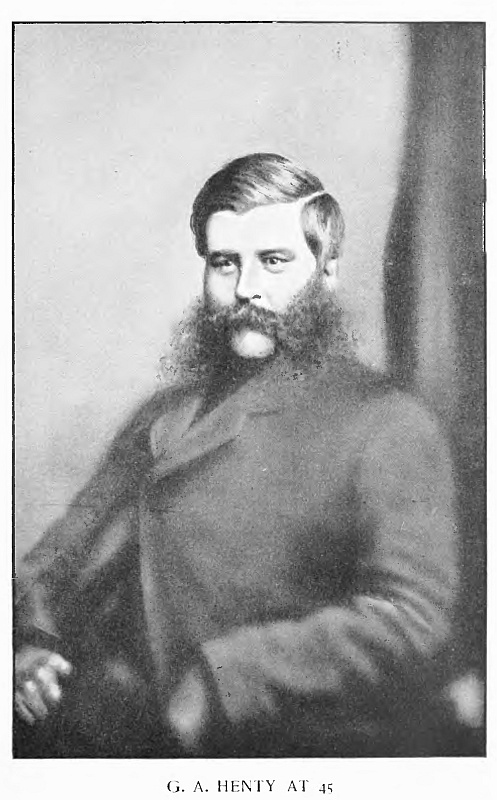
This was all that was known of the grottoes till the year 1819, when a workman accidentally destroyed a stalactite screen and discovered the entrance to the apparently illimitable series of caves beyond. Of these, five miles in length have been explored; but the end has not been reached, and they extend for unknown distances in several directions. The effect of the Dome is superlatively grand. It is three hundred feet in length and one hundred feet in height and width. The sides are quite perpendicular, and at about half their height a natural gallery runs partially round them. The view from this is magnificent in the extreme. The guides who accompanied the visitors placed candles at short intervals along the parapet, but their light barely pierced the gloomy expanse. Upward the roof loomed dark and vague. Beneath, the river, which had commenced its subterranean passage, rushed brawling among rocks, and was crossed by a wooden bridge lit up by two rows of candles, whose rays were reflected in broken flashes from the black tumbling water.
At the extreme end of this vast hall a faint blue light showed where the daylight beyond struggled in at the outlet of the river cave. Above and around the roar of the stream was re-echoed and answered by a thousand low reverberating murmurs. The whole effect was ineffably solemn and awe-inspiring. Henty and his companions having provided themselves with magnesium wire at Trieste, this was now used, and the effect was absolutely startling. The light streamed out into the most distant recesses, the candles faded to dim red points, and the roof, which had before appeared of fabulous height, seemed now to be crushing down upon them, the stalactites of its rugged surface standing out clear and well defined. Then, as the bright white light with its clouding smoke died out, the darkness deepened with oppressive heaviness. Everything had been so grand, that it needed all the persuasions of the guide, who assured the party that far more beautiful things were to be seen beyond, before they could be induced to leave this spot and to ascend the steps which led to the entrance of the inner caves.
The path which they followed then was upwards of three miles long, and so arranged that they returned by a different series of grottoes from those they had traversed. The variety of scenery displayed in these three miles was extraordinary. Sometimes the way contracted into low narrow passages, at others opened out into enormous halls. Chambers and corridors, fairy grottoes and gloomy caves, alternated with each other, and the principal halls were popularly named the Ball-room, the Concert-room, and the Calvary. The Ball-room was of nearly the same proportions as the Dome, except that the height was not so great, but its character was entirely different. It was graceful and airy, and was apparently illuminated with numerous chandeliers. The floor was perfectly smooth and level, and at one end an artificial orchestra had been erected in the midst of a group of crags and stalagmites. This, once a year, is really used as a ball-room for a dance, to which thousands of the surrounding peasantry flock. Nothing could be more beautiful than the way in which the walls are decked by nature. Everywhere from walls and roof depend masses of stalactites of the most graceful and elegant forms. Floating draperies are festooned around. Filmy, semi-transparent veils seem to wave gently to and fro as they sparkle in the numerous lights. Here appear drooping pendants and tapering spike-like projections; there, majestic pillars and clustering columns.
The Concert-room is similar in character, but larger and narrower, and hence issued an immense and gloomy corridor more than a hundred feet high. The floor was covered with masses of loose rock, whose huge and rugged shapes loomed, distorted and uncouth, in the faint light of the candles.
From this abode of gloom they entered the Calvary, which appeared to be the largest of all the halls. It must have been three hundred feet long and upwards of two hundred wide. At one end rose a lofty heap of rocks that had fallen from the roof and been cemented together by stalagmites. It bore a resemblance to a great shrine, and was brilliantly illuminated, while the rest of the vast space lay in deep and mysterious shadow. From the lower end, where the observers stood, the floor sloped steeply up. It was composed of misshapen blocks of stone, for at some far-distant period the whole interior, now a flat bare surface, must have fallen with a mighty crash, brought down by the weight of the stalactites that had formed upon it. That the catastrophe happened long ages since was evidenced by the fact that the whole floor was covered with stalagmites of various sizes and heights, which looked as though a forest of great pines had once grown there, till their trunks had been snapped short off by the swoop of some mighty whirlwind.
There was a weird grandeur about this hall which was almost appalling, producing as it did questioning fancies respecting the possibility of a repetition of the old-world scene.
In the corridors and caves that intervened between these principal chambers and halls there was an infinity of fantastic shapes, in which fancy could trace almost every known form. A monstrous bee-hive, a Brobdingnagian tortoise, huge fallen trees covered with lichens growing rankly, half-rounded nodules, and great wart-like protuberances. In one place the roof would be supported by Gothic columns, farther on by unshapely props and buttresses. In one corner rough stems as of ivy seemed to be clinging to the wall, or the gnarled trunks of oaks thrust themselves up between the blocks. Above one cave it seemed as if a great tree were growing, whose twining roots hung down from the roof.
And so on, and so on, fancy helping the visitor to believe that he was gazing upon long ranges of organ pipes, upon stems of palm-trees with well-defined marks whence the broad leaves had sprouted, or upon basaltic columns, with wide steps slowly formed by ages, where water had trickled down. Farther on, too, at intervals, creamy-red couches seemed to be temptingly placed, with folds of a soft white material thrown carelessly over them, while long flags and fringed draperies of admirable texture and design drooped down from chinks and crannies in the roof, as if to form decorations for some fête in the world of the gnomes.
There was no end to the wonders wrought by nature’s own sculptors—fonts, chalices, exquisitely chased imaged shrines, and strange confessionals; groups of statuary wrought in beauty, with roofs above covered with fretwork of the most delicate tracery; and in opposition there was the grotesque on every hand, with squat heathen idols, grim corbels, and in the darkness, with Doré-like effect, diabolical-looking creations or works as of some enchanter’s wand. In parts everything was so real, that it was impossible not to believe that that cascade, glistening as it did when the lights were turned upon it, was not deep water, but only stone, or that a fountain glittering with diamond spray in the passing light was not composed of liquid drops.
In one cave the wall seemed to be hung in ruddy masses of stalactite of so truly a fleshy tint that they seemed to be palpably strips of flesh, which carried the spectator back to old classic readings and the legends of the Latin ancients. For it seemed as if the cave might be the spot where Apollo had skinned Marsyas, and Henty listened as if expectant of hearing the sufferer’s howls re-echo through the vast labyrinth. For here seemed to hang his flesh—great strips of muscle and tendon, some looking cold and stiff, others soft and limp, with the glowing tint of life still warm upon them. It was terribly real.
Earthy solutions had stained some of the stalactites of a dirty grey hue, the material of the carbonate of lime being dull and coarse; but others again were white as alabaster, the carbonate giving place to the sulphate, and looking pure and semi-transparent. In many places the surface of the deposit of lime, slowly formed of nature’s great patience, was smooth as polished marble, while in other places, suggestive of the more ready work of heated springs of water charged with lime, the deposit was uneven as masses of coral. The tints, too, varied from clear white to cream colour, orange, and red; and while in many places the drooping stalactites were dull and soft-looking, and reflected no light, in others they sparkled with myriads of coruscations as of diamonds, emeralds, and rubies; or rather, as they changed and flashed in the passing light, they resembled rocks over which a thin film of jewels was streaming, or a sudden blaze of sunshine upon hoar frost.
And it was not only the eye that was dazzled and seemed to gather an imagination of its own; but there were wonders for the ear, for now and again there were hanging masses offering themselves to be struck, waiting there in the whispering silence of the vast halls of wonder, to give out a clear bell-like sound which varied from the sharp ring of a struck glass to the deep soft boom of some cathedral bell, the tone being invariably much purer and sweeter from the semi-transparent blocks than from those that were formed of material which was loose and coarse.