Part 3 — SECTION II. PRINTED BOOKS ILLUSTRATED WITH ENGRAVINGS BY TORY OR HIS PUPILS.
George Burnham Ives translation
1515
There appeared for the first time, in the books of Hours published by Simon Vostre about 1515, three engravings which are clearly distinguishable in method of execution from those previously used by the same bookseller, to which the three new ones were thereafter added.
Thenceforth Vostre's Hours contained three varieties of engraving: (1) The old gothic woodcuts (among which must be reckoned the Dance of Death with dotted background), which figure in the editions issued by that bookseller even in the fifteenth century; (2) Two large drawings in the Renaissance style, which appear in his editions of 1507 and which may be attributed to Jean Perreal, Tory's teacher; (3) The three in question, which do not appear earlier than 1514 or 1515. These engravings are: (I) The Adoration of the Shepherds, signed with the letter G in a gothic shield; (II) The Adoration of the Magi; (III) The Circumcision; the last two signed with this monogram: . The G is still inclined to the gothic, but the second letter is altogether roman. In my judgement, this monogram should be translated by the words, 'Godofredus faciebat,' or 'fecit.' It is true that the ascription of these engravings to Tory has been contested; but Jules Renouvier, whose taste was so unerring, and who cannot be accused of infatuation for Tory, did not hesitate to adopt my hypothesis. 'In the last of Vostre's Hours,' he says, in the pamphlet that he published concerning that bookseller, 'we see, besides the plates executed in the old French manner, which have not disappeared as yet, other plates in the Italian and German manners, subjects treated in an altogether novel style: the Adoration of the Shepherds, the Adoration of the Kings, and the Circumcision, are composed of small figures in a large ground; the design has recovered all its delicacy, in its clearly drawn forms, and the cutting is done with no less diversity than care. Here, luckily,' continues Renouvier, 'a monogram enables us to attribute the engravings to their author. It is a G alone, or enclosing an F, subscribed on a shield or in a cartouche hanging from a branch. They have been claimed for Geofroy Tory, and with good reason, for the manner in which these plates are executed accords with what we know of that excellent artist.'

It is, perhaps, to these engravings, so successfully executed, that we should ascribe the partiality that Tory afterwards displayed for books of Hours, of which, as we have seen, he put forth several editions, in diverse formats, and with a large number of engravings on wood done by himself.
1516-1518
Here is to be placed Tory's second journey to Rome,[319] from which he returned more Italian than ever, in respect to art.
1519-1520
Under this date, which was when Tory was working at the manuscripts I have described above, I shall place, albeit somewhat conjecturally, two small engravings on wood, signed with the letters G T, which appear in a publication of M. Varlot entitled: 'Illustration de l'ancienne imprimerie troyenne' (4to, 1850). They are numbers 84 and 131, the first in the criblé style, the second in the style of the Renaissance. My ascription of them to Tory is based upon the facts that they are of his time, as we may infer from the one in the criblé style, and that the initials G T are entirely consistent with that period of the life of our artist, who sometimes signed his name in full, Geofroy Tory, as witness his Hours of 1524.
The first of these engravings, number 84, represents a Descent from the Cross. The letters G T are at the foot of the plate, and are some distance apart.[320] In the same collection there is another engraving of the same series, but not signed—number 78. It represents a bishop blessing a sick man who lies entirely nude before him. These two are 48 millimetres wide by 62 high.
Number 131 represents a scene from Terence. The letters G T are side by side at the foot of the plate, which is 33 millimetres high by 55 wide. In the same collection, numbers 132 and 133, are two other woodcuts of the same series, but not signed. Lastly, in an edition of Æsop, published recently at Troyes, by the printer Baudot, we find a woodcut which probably had the same origin, and found its way into this volume by chance. These four engravings are evidently from an edition of Terence in a small format; I have been unable to find it.
1520-1521
I shall place under this date a title-page, in octavo, forming a border, engraved for Simon de Colines, and bearing his mark and his initials. This printer, who succeeded in 1520 Henri Estienne, the first of the name, whose widow he married, wished to mark his printings in some special way, and to that end applied to Tory, who was a friend of the family. Tory engraved the title-page in question, in the criblé style, then much in vogue; and on it are seen rabbits, or conils, which is believed to be an allusion to the name of Colines.[321] Tory's mark appears in white, at the foot of the engraving, to the right. I have seen this engraving in an Epitome of the 'Adages' of Erasmus, in Latin, printed by Simon de Colines, in 1523, in octavo, under this title: 'Johannis Brucherii Trecensis Adagiorum ad studiosæ juventutis utilitatem ex Erasmicis chiliadibus excerptorum epitome.' It was probably Tory, too, who engraved Colines's large mark with the rabbits (Silvestre, no. 79), which is in the same style, and which appears in the Hours of 1524; but it does not bear the double cross. Tory also engraved for Colines two other marks in a very different style (Silvestre, nos. 80 and 329), and a multitude of borders and illustrations for his books.
Colines certainly employed Tory more than any other printer did, as we shall see in the sequel. This fact leads me to believe that Lottin is mistaken in bestowing upon Colines the title of engraver of letters, attributing to him doubtless the engraving of the graceful italics that he used in works written in verse; I am convinced that those letters are the work of Tory. I will call attention, however, to the fact that the capitals that go with these italics are roman, and may belong to the roman letters which Simon de Colines had from Henri Estienne. But the font is enriched with some white two-line letters, of a charming design, which are certainly Tory's, as are the floriated letters used by Colines and his stepson Robert Estienne.
1521-1522
I. Tory engraved also for Simon de Colines a magnificent title-page intended for a very rare work, which, for that reason, I think that I ought to describe in detail (after one of the copies in the Bibliothèque Nationale), for its existence has been doubted.[322]
The book is entitled: 'Commentarii initiatorii in quatuor Evangelia,' etc., with no author's name on the title-page; but it was written by Jacques Lefèvre d'Etaples, as we shall see in a moment. It is a folio, of 6 unnumbered preliminary leaves, and of 377 numbered leaves, making 192 sheets, divided into 50 folds of 4 sheets each, except the first, which has only 3. The signatures go from a to ddd consecutively. The text of the Gospels is set in large type (great primer), the notes in smaller type (pica), in which there are some very handsome Greek characters, with accents, which were still a novelty at that time.
The title is in a wide border, engraved on wood, decorated with the symbols of the four evangelists, beneath which are printed passages from their works. This border, which is signed with the Lorraine cross at the foot, on the right side, is .225 metre high by .166 wide.
On the second preliminary leaf the author's preface begins, under this heading: 'Jacobi Fabri Stapulensis ad Christianos lectores in sequens opus Præfatio.' It ends on the fourth preliminary leaf, with the date, 'Meldis, anno M. D. XXI.' Then follows a concordance of the four Gospels, in the form of tablets closed at top and bottom by unsigned engravings.
The Gospel according to St. Matthew, which opens the book, begins with a superb ornamented L, on a criblé background, .058 metre in height by .055 in width. The Gospel according to St. Mark, which opens on leaf 115 (erroneously printed 215), begins with an I of the same style and dimensions. The Gospel according to St. Luke begins on folio 175 verso, with an F like the two preceding letters. The Gospel according to St. John begins on folio 259, with the I that has already done duty in the Gospel of St. Mark. These letters, which are altogether in the style of those afterwards engraved by Tory for Robert Estienne, seem to me to be fairly attributable to him, although unsigned.
In the balance of the book we find a large number of other letters ornamented in the criblé style, but of smaller size, which cannot be Tory's.
On folios 101 verso and 102 recto are certain astronomical figures, unsigned, which I dare not attribute to Tory; but I do not hesitate to attribute to him a large engraving on folio 182 verso. It represents Jesus in an aureole of flame. Below him is the sea; above him the Father Everlasting, blessing with the right hand, and holding in his left hand the globe surmounted by a cross. He is uttering these words which we read in a scroll: 'Hic est filius meus dilectus in quo mihi bene complacui.' This engraving, including its border, is .210 metre in height by .137 wide.
On the last page is a subscription in these words: MELDIS, IMPENSIS SIMONIS COLINAEI ANNO SALVTIS HVMANAE M. D. XXII. MENSE IVNIO.
Who printed this book? Not Simon de Colines, as La Caille said, and as Maittaire and Panzer have repeated after him, for the subscription means simply that the printing was done at his expense. One can understand, in truth, that Simon de Colines, who had at the time an extensive typographical establishment at Paris in full blast, could not leave that city to print a book at Meaux. Nor was it a local printer, for no other contemporary printing at Meaux is known; moreover, the mechanical execution of this volume, and the engravings with which it is embellished, prove that it did not come from a wretched provincial workshop.
In my opinion there is but one way of explaining this typographical enigma. It is this: Guillaume Briçonnet (second of the name), having been appointed Bishop of Meaux in 1518, took with him to that town his friend Lefèvre d'Etaples, to whom he entrusted the administration of his diocese. Etaples employed his leisure in writing various religious works, among others the Commentaries on the Gospels, which were finished in 1521. Wishing to have this bulky volume, which was of capital importance to him, printed under his own eyes, and being unable to leave Meaux, where he was detained by his duties, Lefèvre simply imported from Paris a portion of Simon de Colines's printing-office, with a small staff.[323] In this way he could not only superintend the printing of his book, but also lend a hand at need, after the example of many another scholar of that time who did not scorn to practise the printing art.
What I have said is a mere hypothesis, it is true; but this hypothesis is surrounded by circumstances which give it a powerful appearance of truth. In addition to what I have said above, I will say that the types of Lefèvre d'Etaples' book are the same as those used in an octavo printed at Paris by Simon de Colines in 1523,—a book which I have already cited and which I now have before me. It is entitled: 'Joannis Brucherii Trecensis Adagiorum ... ex Erasmicis chiliadibus excerptorum Epitome.' The title-page has a border signed with the Lorraine cross. More than that, the first ornamental letter in Etaples' book, which is an A on a criblé background, is also the first letter of the book of Johannes Brucherius; whence we see that the typographical material sent to Meaux returned to Paris immediately after Etaples' book was printed.
Doubtless that is why we have only one book dated at Meaux at that period; it might be, however, that advantage was taken of the momentary existence of this printing-office at Meaux to set up some trifling work, in 1521 or 1522; but that would not in any wise modify my conclusion.
II. Tory engraved also, at about the same time, for a printer at Troyes named Jean Lecoq, the title-page, in the shape of a border, of a 'Gradual'[324] of the Cistercian Order—a very large and handsome folio, printed at Troyes in 1521. This engraving is in the criblé style, with the double cross in white at the foot, on the right. At about the same time he engraved in the same style Jean Lecoq's mark, which appears at the end of the volume, and of which a reproduction may be seen in M. Silvestre's book, no. 875.
As this Gradual is very rare (only one copy of it is known to exist, which I have seen in M. Tross's collection) and very beautiful, I think it well to describe it. It is almost needless to say that it is printed in gothic type.
First of all, above the title there is a line printed in black:—
Jesus ✥ Maria Bernard
(It is well known that St. Bernard was the founder of the Cistercian Order.) Then, in red (I complete the abbreviated words):—
'Graduale ad usum Cisterciensis ordinis: secundum capituli generalis venerabilium patrum ejusdem ordinis diffinitionem in sequenti paginas declarata: noviter per quendam Clarevallensem monachum ad debitam formam utiliter redactum. Et Johannis Lecoq impressoris Trecis commorantis solertia diligenter impressum. Anno Domini Millesimo quingentesimo vicesimo primo.' (Here Lecoq's large mark: Silvestre, no. 877.) 'Cum privilegio.'
The volume is made up of 2 preliminary leaves, for the title, etc., and 252 pages of text, divided as follows: First part, without pagination, of 18 signatures (a to s) of 4 sheets each, except the last, which has only 2,—in all, 140 leaves. Second part, folios 1 to 112, having 14 signatures (A to O) of 4 sheets—in all, 112 leaves.
The paper is very strong and fine. It is one of the earliest books printed with music in France, and it reflects great credit on the presses of Troyes, and especially upon Jean Lecoq, first of the name. Names of places and persons are consistently printed with capitals. The work is illustrated with a few engravings; but its most remarkable feature is the ornamental initials and uncial letters with which it is embellished.
At the end, by way of colophon, are these words:—
'Explicit Graduale secundum usum ordinis Cisterciensis, Trecis impressum
Per Johannem Lecoq, Anno Domini Millesimo quingentesimo vigesimo primo Die sexta mensis Martii. Laus Deo.'
Here Lecoq's mark with the Lorraine cross in white.
This volume came from the ancient monastery of Oliva, near Dantzig.
1522
I. We may place under this date two other frontispieces signed with the Lorraine cross. The first is a large engraving divided into four compartments, and representing armies in battle array, with cannon. The two upper compartments are connected by the shield of France, surmounted by a crown and encircled by the order of Saint-Michel, from which branches of rose-bushes depend on either side. In each compartment there is a cartouche. Tory's mark is at the foot of the lower left-hand compartment, in which the banner of France is seen waving. This engraving appears in the 'Rozier historial de France,' a folio printed in gothic type, at Paris, for François Regnault, February 10, 1522, before Easter; that is to say, 1523 new style. In the cartouches the following words are printed in red, in gothic type: 'Bataille ronde,' 'Bataille de pointe,' 'Bataille de feu,' 'Bataille de fourche.'[325] It appears in another edition of the same book, printed in 1528 for the same bookseller; also, in a translation of Cæsar's 'Commentaries,' printed by Pierre Vidoue, in 1531, for the booksellers Poncet Le Preux and Galiot du Pré. This translation is a folio volume divided into two parts, the first translated by Étienne Delaigue, called Beauvoys, the second by Robert Gaguin. The plate in question is at the end of the first part, folio 95 verso. The whole book is printed in black, both text and engraving. I am indebted for my knowledge of the engraving to M. Robert-Dumesnil fils.
II. The second engraving, in the form of a border (folio size), representing a number of grotesque and licentious subjects, appears in an edition of the 'Histoire du saint Graal,' published by Philippe le Noir, sworn bookseller and binder to the University of Paris, on October 24, 1523. The bookseller's initials are in the compartment at the top of the border.[326]
In this book, as well as in those last described, there are other engravings; but they are not the work of Tory, to whom only the important pieces were assigned. These other engravings had, doubtless, appeared elsewhere.
As for the engraving executed by Tory (which reappears in many other works printed by Philippe le Noir), it is a copy of a plate engraved by Urs Graf, dated 1519, and used by Pierre Vidoue, printer at Paris,[327] particularly in a Virgil of 1529, folio, which is now in the Bibliothèque Mazarine. The four principal subjects of this engraving, placed at the four corners of the border, represent: (1) Men lighting torches at a woman's posterior; (2) A woman carrying off a man in a basket[328]; (3) The death of Pyramus and Thisbe; (4) The judgement of Paris.
1523
While working for others, Tory busied himself with a long series of engravings intended for books of Hours to be published by himself.[329]
'It is upon turning over these plates,' says M. Renouvier,[330] 'that one appreciates to the full his style—rich, diversified and immeasurably clever in ornamentation, distorted out of proportion, diabolic in the drawing of faces, descending too often to downright awkwardness in the carriage of the head and to a habit of bellying out draperies; and, finally, overweighted by a sort of heaviness in the forms. The artist's greatest facility is shown in the arrangement of his figures, and in the decoration of his porticoes. Whatever he may say, it would seem that what he studied at Rome with the best results were the baths of Titus and the arabesques of Giovanni da Udino.'
1524-1525
We have seen that Tory had been in the habit for some time of signing his engravings with a double cross; but this had not yet become an invariable signature. For instance, about 1524 he often used a monogram in which his name and surname—or, to use the terms of the present day his Christian name [prénom] and his family name [nom de famille]—both appear. It consists of a capital G, enclosing a smaller S, with the double cross above. This means, in my opinion, that Tory was the engraver only ('Godofredus Torinus sculpsit'), in distinction from the cross alone, which means that Tory both drew and engraved the pieces on which it appears. In fact, we find in most of those signed with the monogram a roughness of aspect which is not characteristic of Tory's usual style.

However that may be, here is a list of the pieces known to me on which this monogram appears.
I. LE BLAZON DES HERETIQUES.
Quarto of 14 leaves, in gothic type, printed by Philippe Le Noir, 'sworn binder to the University of Paris,' with a privilege from the court of the Parliament of Paris, dated December 21, 1524. This is a satirical production, in verse, attributed to Pierre Gringoire, otherwise called Vaudemont, at the head of which appears the figure, or effigy, of the 'heretic,' signed with the monogram in question. The description of the effigy is as follows:
En gibeciere on luy voit ratz avoir, Qui sont rongeans et serpens detestables En son giron faisant mords diffamables. De son sian sort ung aspre feu vollant, Qui cueur et corps et livres est bruslant.[331]
This very rare work was reprinted at Chartres, in 1832, under the auspices of M. Hérisson, the librarian of that city. The reprint contains a facsimile of the engraving.
II. HEURES DE NOSTRE DAME, TRANSLATEES EN FRANCOYS ET MISES EN RITHME PAR PIERRE GRINGOIRE, DIT VAUDEMONT, PAR LE COMMANDEMENT DE ... MADAME REGNEE DE BOURBON, DUCHESSE DE LORRAINE, etc.
A quarto, in gothic type, undated, but containing a table of Easter-Days beginning with 1524, and a privilege dated October 10, 1525.
This book, which was published by the bookseller Jean Petit, contains 13 large engravings, a list of which follows:—
1. The Annunciation.
2. Adam and Eve.
3. The Cross.
4. The Holy Ghost.
5. The Descent of the Holy Ghost upon the Apostles.
6. David praying for Zion, threatened with the divine thunderbolts.
7. The Virgin and the Child Jesus.
8. A Family at Table (Pentecost?).
9. Eight Naked Children Praying; the Holy Trinity in the Heavens.
10. The Manna.
11. David's Penance.
12. The Triumph of Death.
13. Jesus receiving the Crown of Thorns and the Reed.
Only the last of these bears the monogram that I have described[332]; but the other engravings, being in the same style, should all be attributed to Tory. We might perhaps also attribute to him the six analogous engravings which appear in the same author's 'Chants royaux' (printed at the same time and usually bound with the Hours), but not one of which is signed. They represent:—
1. The Synagogue: Jesus in the background, entering a pillar.
2. The Prodigal Son: Jesus in the background, curing a woman.
3. Hunters: Jesus in the background, curing one possessed of devils.
4. The Miracle of the Loaves and Fishes.
5. Entrance of Jesus into Jerusalem.
6. The Crowning with Thorns.
These two books have been reprinted several times. I know of four quarto editions of the Hours.[333] The first is the one I have just described. It contains some other engravings, in an entirely different style from Tory's, which appear also in other books of Hours of older date. The second has a table of Easter-Days beginning with 1528, and a privilege dated November 15, 1527. In other respects it is similar to the earlier one. The third has a table of Easter-Days beginning with 1534. It is like the last except in one point: in place of the final engraving there is a different one, signed in the same way, representing Job at prayer before his burning house, and his neighbours reviling him. This engraving proves that Tory must have engraved a longer series from which the printer took this one at random, being unable at the moment to find the one that he required. The fourth has a calendar beginning with 1540. It is like the second, except for the privilege, which is dated November, 1525, doubtless by mistake. These four editions are all in the Bibliothèque de l'Arsenal.
III. HISTOIRE ... DE LA ... GLORIEUSE VICTOIRE OBTENUE CONTRE LES SEDUITZ ET ABUSEZ LUTHERIENS MESCREANZ DU PAYS DAULSAYS ... PAR ... ANTHOINE ... DUC DE CALABRE ..., PAR NICOLE VOLCYR (otherwise called Volkire) DE SEROUVILLE, etc.
Small folio, in gothic type, without date of printing, but with a privilege dated January 12, 1526 (1527 new style), issued by Jean de la Barre, 'garde de la prévôté' of Paris. The battle took place in 1525.
Volcyr's work contains seven engravings, but only the last two, at the beginning of the last two books, are signed. We may, however, I think, attribute to Tory the one at the head of the first book also. A description of these engravings follows:—
1. Frontispiece representing Faith: a helmeted woman trampling upon the dragon.
2. The author, seated, writing his book.
3. A large plate representing a warrior (the Duke of Calabria?) amidst his men, waving his sword.
4. A bishop praying.
5. The author offering his book to the prince. A fine plate on which are several scattered letters, the meaning of which I am unable to conceive.
6. A large plate representing the attack on the town of Saverne. At the top is the word 'Saberna.'
7. A large plate representing the vision of the Passion. Jesus at prayer, a halo about his head; facing him, angels presenting the Cross; behind him, other angels bearing the post to which he was bound; all about him, the instruments of his torture. This plate is altogether in the manner of those in the following work.
IV. THE LABOURS OF HERCULES.
Twelve large plates, folio, owned by the Bibliothèque Nationale. Each of them was formerly accompanied by a number and by a quatrain in French explaining the subject; unfortunately these have been removed from most of the plates,[334] and it is impossible for me to-day to place them with full assurance in the order in which they belong. However, that given below seems to me most natural. The three which retain their numbers are marked by an asterisk.
1. The Nemean Lion.
2. The Lernean Hydra.
*3. Cerberus.
4. Antæus.
5. Archelaus.
6. Hippodamia.
7. Geryon.
8. The Pillars of Hercules.
*9.The Cretan Bull.
*10. The Erymanthian Boar.
11. Cacus.
12. Hercules at the Stake.
All of these engravings are signed:

We give here, as specimens, three of the quatrains accompanying the engravings; they are the only ones preserved at the Bibliothèque Nationale. They may very well be the work of Gringoire, like the verses of the 'Blazon des Hérétiques,' of the same date.
Number 3 Il braue les enffers (chose à luy tresaisee), Et le chien Cerberus, aux trois chefz surmontant; Il va les Infernaux main à main combattant, Pour mettre en liberté son bon amy Thesee.
Number 9 Les furieux Thaureaux (choses esmerveillables) De ses deux bras nerveux Il maitrise aisement, Et leur faict faire Ioug desoubs luy forcement Encor qu'on estimat qu'ils fussent indomptables.
Number 10 Ung sanglier escumeux à la grand' dent pointue, Qui hommes, vignes et bleds degatoient enragé, Et par qui l'vniuers estoit endommagé, Seul, par sa hardiesse, Il acreuante et tue.[335]
The orthography of these verses proves that they were printed in the seventeenth century[336]; but the very appearance of the verses, and the condition of the plates, which are already worm-eaten, are sufficient to justify one in assigning to the latter a very much earlier date than to the former. So that I can do no better than to refer them to the year 1525, when we find Tory using the same monogram.
Tory seems to have attempted in these plates to imitate Mantegna, whose work he may have studied in Italy; but he had the good sense to abandon this manner, which was not his own; or perhaps we should say that he did no more than follow designs which were supplied to him.
This is what M. Renouvier has to say on this subject:—
'The plates signed with a G surmounted by the Lorraine cross are of more importance. The Labours of Hercules, in twelve plates, are the work of no commonplace artist. The drawing assumes a masterly, even a rough, character, seeking effects in the play of muscles and of facial expression in imitation of Mantegna and Albrecht Dürer; the cutting follows up the effect of the burin. Bartsch mentioned them among the old German masters, and the monogrammatists wavered between Jean Schoorel, Georges Scharfenberg, Giuseppe Scolari, etc.; their French origin was not suspected until some proofs were found on which the engravings were accompanied by French quatrains. Then, when the same mark was found on a plate used as a frontispiece to Pierre Gringoire's "Blazon des Hérétiques" (1524), and on several vignettes in the Hours rendered into verse, by the same poet, it was attempted to make a wood-engraver of Gringoire, who was a Lorrainer, herald-at-arms to Duc René II, and likely enough to display the cross of Lorraine over his initial. This much is certain: that the mark consisting of a G with the cross of Lorraine is found also on the plates of a Lorraine book—"Duc Anthoine's Victory over the Lutherans"—published by his secretary Volcyr, who paid the expenses of the publication, "being unable to find any bookseller who was willing to undertake it, as well because of the portraits and cuts of the illustrations as of the printing hereof," and caused it to be issued, not in Lorraine, but in Paris, by Galliot Dupré, in 1526. It is to be noticed that this bookseller's mark, which represents a galliot, also has a Lorraine cross surmounting his cipher. Now, the attribution of these plates to Geofroy Tory is based upon some very ingenious comparisons of marks; the style of the engravings places no insurmountable obstacle in the way of such attribution, but it must be admitted that the engraver was led very far astray from his earlier works by his imitation of the German manner. It is possible, because French engraving, at the beginning of the sixteenth century, was pulled in four directions at once, so to speak, by national habit, by Flemish taste, by German mania, and by Italian charm. M. Bernard would give the fullest sanction to this second attribution if he could find any evidence of a journey of Tory's to Alsace or Lorraine of a later date than his journey to Italy; the importation of woodcuts from those provinces, then a common occurrence, would indeed suffice, so far as the common herd of our engravers is concerned, to explain this alteration in their manner. I will mention in a moment an example, also out of Lorraine, which must certainly have been known to Tory. Whatever the fact may be, the Labours of Hercules deserve an honourable place among the first attempts on a large scale of French engraving, beside the plates of Jean Duvet. The British Museum, like our Cabinet des Estampes, has acquired a set of them. Two of the plates in the latter set have the quatrains which are lacking in the corresponding ones in the Paris set; these are, the fifth: "The sly Archelaus 'gainst Hercules doth contend"; and the seventh: "The mighty Geryon, despicable tyrant," etc.'
1526
I. I have said that the floriated letters of Simon de Colines and Robert Estienne were engraved by Geofroy Tory. I cannot furnish material proof of the fact with regard to those of Colines; but I am about to produce incontestable evidence with regard to Estienne's. A letter in one of his alphabets is signed with the Lorraine cross, and that letter is the G, the initial of Tory's own name, or, as we say to-day, his first name (prénom). It is as if he had written 'Geofroy Tory' in full. But in this case, in opposition to what we find in the preceding engravings, the cross, instead of being above the G, is below it, and hidden as much as possible in order not to injure the design of the 'antique letter.' This circumstance proves not only that Tory was the engraver of Robert Estienne's floriated letters, but also that the double cross was that artist's mark.
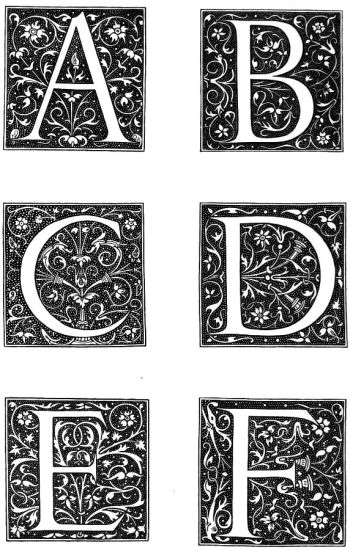
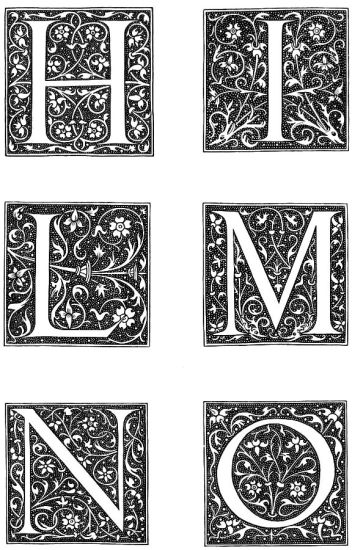
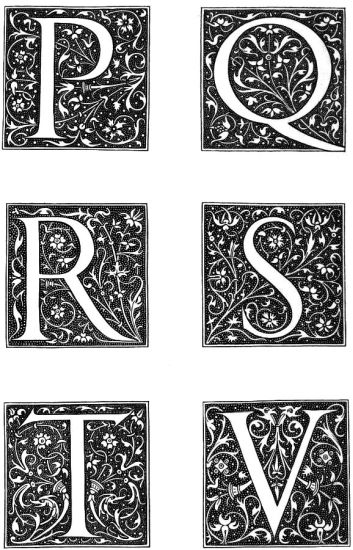
Is it not, in truth, a striking fact that Tory chose the letter G to place his mark upon? He was not withheld by the consideration that that letter, not being in very common use, especially at the beginning of words, appeared rather infrequently in books.[337] As always, logic prevailed with him over every other consideration. Let us see how far it carried him.
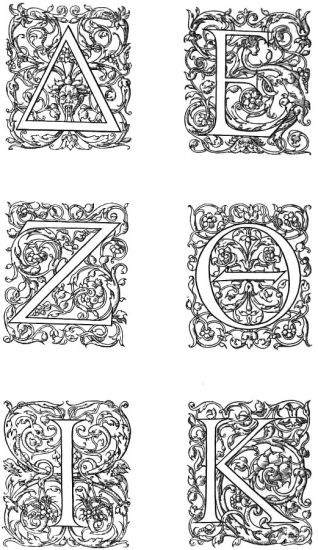
Later, he engraved a Greek alphabet, in the same style, for Robert Estienne; as he could not put his mark on the gamma, which bears no resemblance to the G, he put it on no letter, but on one of the friezes executed to accompany those beautiful floriated letters.[338] See the frieze in question at the beginning of the second volume of the Works of Eusebius, three volumes, folio, 1544.[339]
II. Besides these two alphabets of capital letters, Tory engraved for Robert Estienne about the same time, six different marks for his typographical sign, the 'Olive-Tree,' of which a description will be found later on, in section 3.
III. Tory also engraved, about the same time, for Simon de Colines, a border in the criblé style, at the foot of which is a sun which certain centaurs, incited thereto by women, are trying to seize. (Silvestre, no. 523). This border is probably of 1526, when Colines turned over to Robert Estienne his father's establishment and set up for himself at the 'Soleil d'Or,' opposite the Collège de Beauvais. It appears, to my knowledge, in two octavo volumes of 1529: 'Compendium Grammaticæ græcæ Jacobi Ceporini,' and 'Liber de opificio Dei.'
1526-1528
This whole period was, in all probability, absorbed by the labour of engraving and editing 'Champ fleury.' For one of the first engravings in that book is dated 1526, and it was finished early in 1529. Although the majority of these engravings are not signed, they must all belong to Tory, at all events so far as the designs are concerned.[340] I cannot attempt to enumerate them all here, for there are more than five hundred, counting as one each of the letters in the various alphabets; but I propose to mention the more important ones. For historical information concerning the book, I refer the reader back to what I have said thereon in the first and second parts of this volume.
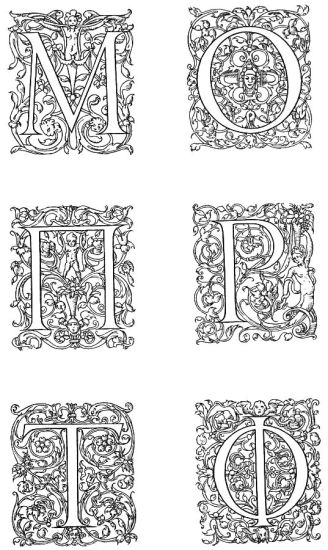
The title-page is enclosed in a very pleasing border,[341] and it has moreover an engraving of the Pot Cassé reversed.[342] On the verso are the arms of France.[343]
Folio 1 of text: the letter L, which I have already reproduced.[344]
Folio 3 verso: the Gallic Hercules. This engraving, dated 1526, and signed with the Lorraine cross, represents Hercules holding his club in one hand and a bow in the other. He is followed by divers persons of all conditions, fastened by the ear to a chain that issues from the hero's mouth. This is an allusion to the power of eloquence over the French. The strength of the Gallic Hercules lies not in his arms but in his mouth.[345]
Folio 9 verso: cut of the lisflambe, a species of lily; it is the swamp iris, called to-day the iris flambe.
Here the first book ends.
The second contains thirty-seven geometrical figures, which it would be no less difficult than unprofitable to describe. They are, for the most part, representations of different letters. At the end of this book is the 'Triumph of Apollo and the Muses,' 'to show that they who have knowledge of goodly letters have the advantage over the ignorant.' This engraving, which is in two parts,[346] both signed with the Lorraine cross (folios 29 verso and 30 recto), represents Apollo in a chariot, escorted by the Muses, Liberal Arts, etc., and followed by Bacchus, Ceres and Venus as prisoners.[347]
On the very last page (folio 30 recto) is an engraving of the lisflambe surmounted by an A made up of three I's.[348]
The third book has, in the first place, twenty-eight engravings of Roman letters. The twenty-ninth represents a gothic S (folio 42 verso). The thirtieth is a representation of the Pot Cassé, signed with the Lorraine cross (folio 43 verso).[349]
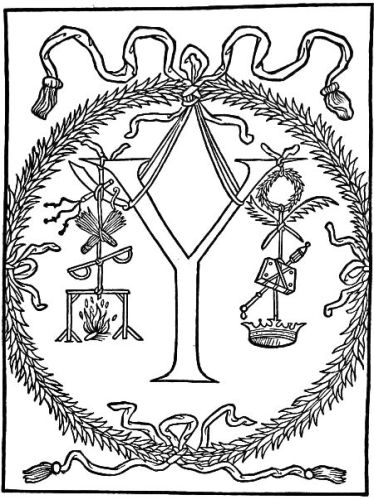
Next come thirty-eight other cuts of letters, and two curious drawings of the letter Y (folio 63 recto and verso).[350] Then two ordinary copies of the letter Z, and an allegory based on the shape of that letter (folio 65).[351]
On folio 65 verso is a representation of various punctuation marks.
Folios 68 verso and 69 recto: a Hebrew alphabet of forty letters or symbols.
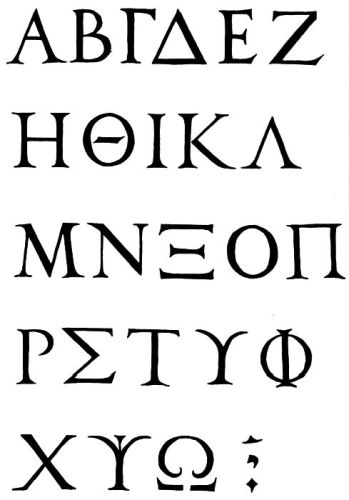
Folio 71 recto: the Greek alphabet of twenty-four letters and three accents.[352]
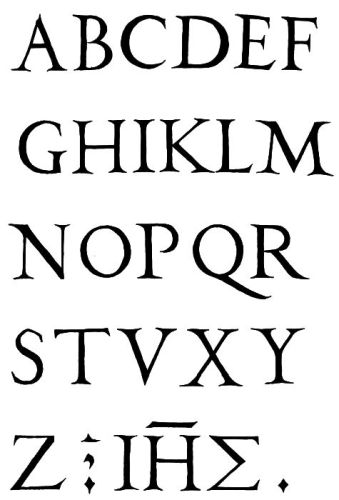
Folio 72 recto: the Latin alphabet[353] of twenty-three letters, with three punctuation marks, and the Greek abbreviation of the name of Jesus.
Folio 74 recto: the alphabet of cadeaulx letters, consisting of twenty-three letters and one mark.
Folio 74 verso: the alphabet of letters de forme, consisting of twenty-nine letters or symbols, with two lines of text added.
Folio 75 recto: the alphabet of bastardes letters, consisting of twenty-eight letters or symbols, followed by two lines of text.
Folio 75 verso: the alphabet of tourneures letters, consisting of twenty-three letters.
Folio 76 recto: the alphabet of Persian, Arabic, African, Turkish and Tartar letters, thirty in all.
Folio 76 verso: the alphabet of Chaldæan letters, consisting of twenty-three.
Folio 77 recto: the alphabet of goffes letters, otherwise called imperiales and bullatiques, twenty-three in number.
Folio 77 verso: the alphabet of fantastic letters, to the number of twenty-three.
Folio 78 recto: the alphabet of utopiques and voluntaires letters, to the number of twenty-three.
Folio 78 verso: an alphabet of floriated letters used in the course of the book, twenty-three in number.[354]
Folio 79 recto: a series of ciphers or intertwined letters, to the number of ten.
Folio 80 recto, and last: a border of graceful design,[355] in which occur Tory's mottoes: 'Menti bonæ Deus occurrit'; 'Sic ut, vel ut'; 'Omnis tandem marcescit flos.' And in the centre is the Pot Cassé, unsigned, although it seems to be the same cut that appears on folio 43 verso, with the cross removed.
1527
I. NOTABLES ENSEIGNEMENS, ADAGES ET PROVERBES, FAICTZ ET COMPOSÉS PAR PIERRE GRINGOIRE, DIT VAULDEMONT.
Octavo, in gothic type, of 68 leaves; for sale by Galliot du Pré; printed by Simon du Boys, February 1, 1527 (1528 new style).
On the verso of the second leaf is a wood-engraving with the Lorraine cross at the right. It represents Gringoire offering his book to the king, who is seated. In the background, a garden with a bee-hive and bees flying about it. (Bibliothèque Nationale.)
II. LES HYMNES COMMUNES DE L'ANNEE: TRANSLATEZ DE LATIN EN FRANÇOIS EN RITHME, PAR NICOLAS MAUROY LE JEUNE, DE TROYES, avec privilege du roy pour trois ans. (Mark of Jean Lecoq.) On les vend à Troyes es hostels de Nicolas Mauroy, etc.
The privilege is of 1527. Small folio, in gothic type, printed in red and black; signatures A to T.
This volume, which I saw in 1858, at M. Techener's, contains a large number of engravings in the criblé style, and others in the modern style; but only three of them are signed; these are:—
1. A Last Supper, criblé.
2. A Last Supper, 'à la moderne.'
3. The Virgin, seated, holding the Child Jesus (folio 89 verso).
This book may give us the date of the other signed engravings found at Troyes, which were published by M. Varlot in his 'Illustration de l'imprimerie troyenne' (Troyes, 1850, folio).
III. HOURS OF THE VIRGIN, in Latin, published by Tory, but printed by Simon de Colines; octavo.[356]
IV. HOURS OF THE VIRGIN, in Latin, published by Tory, but printed by Simon Dubois; quarto.[357]
1528
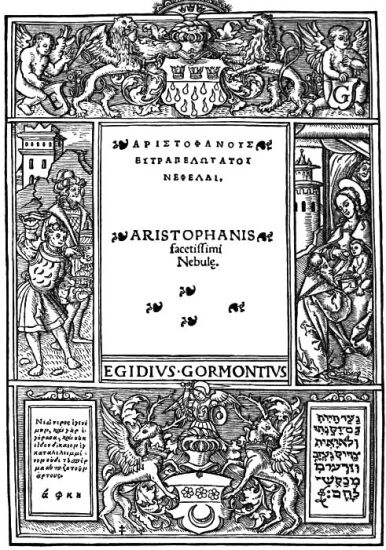
I. ARISTOPHANES.
In 1528 Pierre Vidoue printed, at the expense of Gilles de Gourmont, nine comedies of Aristophanes, in Greek, which were published separately, in quarto form, under the editorship of Jean Cheradam.[358] All of these have a frontispiece engraved by Tory, of which a description follows. At the foot, under the words 'Egidivs Gormontivs' in large letters, is a shield with the Gourmont arms (three roses in chief and a crescent in point), supported by two winged stags with ducal coronets about their necks, the crest being a helmet above which is a St. Michael holding a naked sword.[359] At the left, a Greek inscription; at the right, an inscription in Hebrew. The two uprights represent the wise men offering their gifts to the Child Jesus lying on his mother's knees. At the top is a shield with three crowns in chief (this was the sign of Gilles de Gourmont, as may be seen on the title-page of 'Champ fleury'), and tears in the field. This shield has for supporters, on the right a lion, on the left a griffin, and for crest a helmet surmounted by a fan-shaped ornament. On either side is an angel with wings holding a shield; that on the left enclosing an E, that on the right a G, the initials of Gilles de Gourmont's name in Latin (Egidius Gourmontius). The Lorraine cross is at the foot of the border, on the left.[360]
II. ENCHIRIDION PRECLARE ECCLESIE SARUM, DEVOTISSIMIS PRECATIONIBUS AC VENUSTISSIMIS IMAGINIBUS, ET IIS QUIDEM NON PAUCIS REFERTUM. (Here the mark of Thielman Kerver—two unicorns holding a shield au Gril, with the T. K., and, beneath, the full name, Thielman Kerver.) Parisiis ex officina librarie vidue spectabilis viri Thielmanni.
Small octavo, Paris, 1528, with engravings signed with the Lorraine cross.[361] Printed in red and black, in gothic type. There are 31 signatures of 8 leaves,—a to z, and A to G (signatures x and y have only four leaves each). In all there are 232 numbered leaves, plus 4 leaves of index not numbered.
The volume begins with the title-page, followed by a calendar, the whole occupying 13 leaves, after which comes the text. It contains 54 engraved plates, 12 of which are in the calendar, and a large number of initial letters representing sacred subjects. Beneath each plate is a quatrain in English.
The 12 plates in the calendar represent allegorical subjects. They are enclosed in oval borders, and are 71 millimetres by 55. Consequently they are all out of proportion to the size of the book, which is 84 millimetres by 48. It is evident therefore that they were not made for it. At the foot of each, in the border, is the name of the month. The engraving for the month of February represents a school; that for March, a hunt; that for April, a gentleman and lady, walking in the country, arm in arm; that for July, a domestic interior. The last is the only one of these engravings that I have seen, and that only in a copy. The Lorraine cross may be seen at the foot.
Here follows a list of the other engravings of this priceless volume, of which only a single copy is known to exist. It is to be observed that the pages on which they appear are not numbered, as the cuts occupy the whole space.
1. The Trinity.
2. The Annunciation.
3. The Visitation.
4. Jesus arrested by the Jews.
5. Nativity of Jesus.
6. Jesus before Pilate.
7. The Annunciation to the Shepherds.
8. The Crowning with Thorns.
9. The Adoration of the Magi.
10. The Bearing of the Cross.
11. The Circumcision.
12. Jesus on the Cross.
13. The Flight into Egypt.
14. The Descent from the Cross.
15. The Coronation of the Virgin.
16. The Placing in the Tomb.
17. David and Bathsheba.
18. David and Joab.
19 to 23. The Story of David.
24. Dance of the Dead.
25. Three Men on Horseback in a Forest.
26. Adam and Eve expelled from Paradise.
27. Adam and Eve condemned to labour.
28. The Creation of Man.
29. Six Men praying before a Bier.
30. Birth and Death.
31. Purgatory.
32. Extreme Unction.
33. Job.
34. A Woman, seated, surrounded by
the Virgin, the Evil One, and a
Man bearing the World.
35. The Trinity (same as no. 1).
36. Jesus in Limbo.
37. The Resurrection.
38. Jesus appearing to His Mother.
39. Jesus appearing to Mary Magdalen.
40. Jesus at Emmaus.
41. The Incredulity of St. Thomas.
42. The Ascent of the Virgin.[362]
1529
I. ENCOMIUM TRIUM MARIARUM, etc., JOANNIS BERTAUDI.
Quarto, Paris, Josse Bade, 1529.
The Bibliothèque Mazarine has two copies of this priceless volume, one on paper, the other on vellum, which differ slightly in respect to the title-page. The one on vellum reads: 'Encomium Joannis Bertaudi Petragorici Turrisalbæ in ducatu Engolismensi alumni, de cultu trium Mariarum adversus Lutheranos, cum missa solemniore et officio canonico earundem, auspiciis augustissimæ principis Joannæ, Aurelianensis, Gyveriensium dominæ ac comitis de Barcq.' This is followed by a large plate signed with the Lorraine cross, and representing the three Maries, etc. There is no publisher's name; nothing but Josse Bade's mark at the end of the book.
The title-page of the copy on paper reads: 'Encomium trium Mariarum cum earumdem cultus defensione adversus Lutheranos, solemnique missa et officio canonico, in quibus omnibus desideres nihil, emissum opera et industria Joannis Bertaudi Petragorici, utriusque juris licentiati, Turrisque Albæ in ducatu Engolismensi alumni, auspiciis augustissimæ principis Joannæ Aurelianensis, Gyveriensium dominæ ac comitis de Barcq.' Then follows Josse Bade's mark: 'Prelum Ascensianum,' taking the place of the engraving of the three Maries. And below, 'Venundatur Jodoco Badio et Galeoto a Pratis.'
This difference is explained by the fact that the copies on vellum were not intended for sale, so that no bookseller's name was placed on them, and, furthermore, they were embellished with the cut of the three Maries.
This volume contains three short productions by Jean Bertaud, all directed to the same end—the defence of the worship of the three Maries.
They are entitled:
(1) Encomium trium Mariarum. (2) Officium trium filiarum beatæ Annæ. (3) De cognatione sacerrimi Joannis Baptistæ.
There are some twenty engravings, but none of them are signed except that of the three Maries. And, as Josse Bade was an old printer, who had no known relations with Tory, we may assume that these engravings are not by our artist. At most, we may attribute to him the shield of Orléans, at page 4 of the first work.
II. HOURS OF THE VIRGIN (sixteenmo), in Latin, published by Tory, for himself.[363]
III. LA TABLE DE L'ANCIEN PHILOSOPHE CEBES.
Two small volumes, octavo, with a border for each page. The double cross appears on some, not all, of these borders.[364]
IV. ÆDILOQUIUM ... Item: EPITAPHIA SEPTEM DE AMORUM ALIQUOT PASSIONIBUS, etc.
Octavo, Simon de Colines, 1530.
This little book is enriched by eight engravings: a frontispiece borrowed from the octavo Hours of 1527, and seven small subjects corresponding to the seven epitaphs. The latter are certainly Tory's, although not signed. They are:—
1. Two hearts pierced by an arrow.
2. Two hearts in a circle.
3. Two hearts bound together by cords.
4. Two hearts in a boat.
5. A pig sniffing at two hearts.
6. Two hearts, a distaff, etc.
7. Two hearts being kicked by a horse.
See, for other details, what I have said of this book on pages 92 and 93.
1530-1531
Queen Eléonore's CORONATION and ENTRÉE, and the EPITAPHS of the Queen-Mother, Louise de Savoie:—three quarto brochures, of which I have spoken on pages 130 to 134; a description of the engravings follows.
I. THE CONSECRATION AND CORONATION OF THE QUEEN; three sheets, quarto.
On the first page, a border, with the word 'Salus' at the foot; the privilege is on the verso. The text begins on the second leaf, with the letter L reproduced on page 1. On the last page is another border, with the word 'Salus,' and the date of printing, March 16, 1530, old style.
II. ENTRÉE OF THE QUEEN; six sheets, quarto.
On the first page the same border as on the first page of the Hours of 1524-25; the privilege is on the verso. On page A ij recto, another border and an ornamental letter R, after the style of the L in the work last described. A iiij recto, another border. B iij recto, a border, with the motto 'non plus' at the top. B viij verso, another border, with the word 'Salus' at the foot; this is identical with that of the last page of the 'Coronation.' E viij recto, another border. F i verso, a lovely drawing of a 'present made to the queen, of two candlesticks.' On the last page the border of the last page of 'Champ fleury,' and the date of the printing, Tuesday, May 9, 1531.
III. EPITAPHS OF LOUISE DE SAVOIE; two sheets and a half.
First page, the border of the frontispiece of the Hours of 1524-25, with the Pot Cassé of the first page of 'Champ fleury.' Last page, the border of the last page of 'Champ fleury' and the Pot Cassé of the first page; also the date of printing, October 17, 1531. In all three we find the decorated letters of 'Champ fleury.'
These three brochures, bound together in a small volume, are in the Bibliothèque de l'Arsenal. The borders used in them reappear later as frames for the engravings of a book of Hours, quarto, printed in roman type, in red and black, of which I know neither date nor place of printing nor name of printer, as I have seen nothing except a few leaves of the book, preserved at the Bibliothèque Nationale, with the works of Tory.
1531
I. BOOK OF HOURS, quarto, printed by Tory for himself.[365]
II. BOOK OF HOURS, octavo, with arabesques of flowers, insects, animals, etc., as in the quarto Hours of 1527.[366]
III. TERENTIANUS MAURUS, DE LITERIS, etc. NICOLAO BRISSÆO ... COMMENTATORE.
Quarto, Simon de Colines, 1531.
This book is dedicated to Guillaume Petit, Bishop of Senlis, whose arms, with the Lorraine cross, appear on the verso of leaf 8 of the front matter. The motto is: 'Utinam novissima providerent.'
IV. CLAUDII GALENI PERGAMENI DE ANATOMICIS ADMINISTRATIONIBUS LIBRI NOVEM, JOANNE GUNTERIO ANDERNACO, MEDICO, INTERPRETE.—Parisiis, apud Simonem Colinæum, 1531.
Large folio, with an engraved frontispiece having the Lorraine cross at the foot, on the left.
The frontispiece represents several different subjects. At the top is Jesus healing the leper; at the foot, doctors dissecting a dead body and lecturing to a numerous audience; at the sides, full-length portraits of the most celebrated physicians of antiquity; in the centre of the plate is a scroll bearing the Latin title transcribed above. This frontispiece was, doubtless, used with others of the works of Galen.
Simon de Colines also published, in 1536, an edition of the works of Galen, under the supervision of the same editor (folio of 172 pages), and embellished with five beautiful floriated letters engraved by Tory. In it we find also, at the head of the epistle to the reader, an ornamental S surmounted by a coat of arms,—a charming design, but not signed.
1532
LATIN BIBLE of 1532; folio; Robert Estienne.
The title-page is decorated with a frieze signed with the Lorraine cross, bearing the word 'Biblia' in large letters. It is a scroll surrounded by vines, with the brazen serpent at the left, and Jesus on the Cross at the right.
1533
The BON MESNAGER of Pierre des Crescens, printed by Nicolas Cousteau for Galliot Dupré. Folio, 1533. The frontispiece, representing Dupré presenting the book to François I, is signed with the Lorraine cross.
Inasmuch as Tory died in 1533, it will, perhaps, seem that I ought to stop here in this enumeration. But as many engravings executed by his own hand were not printed until later, and, moreover, as those signed with the Lorraine cross alone came from his establishment, which was managed by his wife after his death, I have thought best to pursue my investigations concerning the engravings with the Lorraine cross to the end.
1534
I. SERMONES IUDOCI CLICHTOVEI NEOPORTUEN. DOCTORIS THEOLOGI ET CARNOTEN. CANONICI.
Folio, Paris, Thielman Kerver's widow, 1534. The privilege is dated 1534. (Bibliothèque S.-Geneviève, and Bibliothèque Mazarine.)
The Latin title which I have transcribed is engraved in great gothic letters, arranged in the shape of a cul-de-lampe, and terminated by a small black heart-shaped ornament (not unlike those used by Simon de Colines), in which is the Lorraine cross. This circumstance leads me to believe that Tory engraved this title-page in gothic letters; a most interesting fact if true, for they are probably the only letters in that style that he ever engraved, after those on folios 42 verso, 74, etc. of 'Champ fleury'; and it is all the more strange because the rest of the book is printed in roman type. It may be that there was another edition in gothic type.
However, this volume contains many other engravings signed with the Lorraine cross, and others which, although unsigned, seem to be Tory's.
Folio 1, following the title, a large T, adorned with fleurs-de-lis, on a background strewn with the same flowers.
Folio 5 verso, a large ornamental P, representing the Eternal Father.
Folio 19, the Virgin in a halo of fire, with the Child Jesus (signed).
Folio 21, Jesus among the Apostles, holding a saw (signed).
Folio 43, Moses receiving the Tables (signed).
Folio 63 verso, the Ark in the form of a church (signed).
Folio 77, the Annunciation, in an oval border (octavo).
Folio 88, Birth of Jesus (small octavo).
Folio 135, the Resurrection (signed).
Folio 148, the Ascension (signed).
Folio 154 verso, the Virgin among the Apostles (small octavo).
Folio 157 verso, the Trinity (signed).
Folio 161, Easter (signed).
Folio 221, Birth of the Virgin. She is in her mother's womb, holding the Child Jesus (octavo).
Folio 325, Jesus tempted by the Devil (octavo).
The octavo engravings appear in several other books printed by the Kervers.
II. PAULI BELMISSERI PONTREMULANI, ARTIUM ET MEDICINÆ DOCTORIS, EQUITIS, ET POETÆ LAUREATI, OPERA POETICA.
Quarto, of 108 numbered, plus 4 preliminary unnumbered leaves.
Printed in 1534, but with no name of printer or bookseller. On the first page is a quarto plate, representing the author crowned with laurel, standing between François I and Clement VII. Beneath these three personages are their respective arms, and above their heads their names: Franciscus, Paulus, Clemens. The Lorraine cross is at the foot, on the left. The same plate appears on the last page.
1535
LES TROYS PREMIERS LIVRES DE L'HISTOIRE DE DIODORE SICILIEN, TRANSLATEZ DE LATIN EN FRANÇOYS, PAR ANT. MACAULT.... On les vent a Paris, en la rue de la Juifverie, devant la Magdaleine, à l'enseigne du Pot Cassé....[367]
Quarto, 1535. This book is embellished with a magnificent frontispiece representing Macault presenting his book to François I. Although unsigned, it is certainly Tory's.
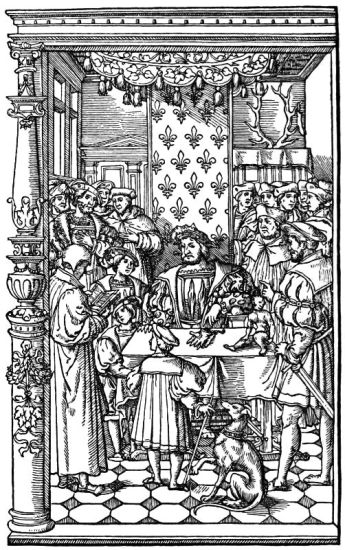
'His chef-d'œuvre,' says M. Renouvier,[368] 'is, perhaps, the frontispiece of Macault's "Diodorus," in which we see François I seated in a chair with a back carved with fleurs-de-lis, at table with his children, his monkey, his greyhound, and his courtiers, while Macault reads his book to him. This engraving, the authorship of which is unquestionable, does not bear the Lorraine cross; the master published without that mark many another work which M. Bernard, in his scrupulous exactitude, has chosen not to mention. As some compensation for the works which I have denied to Tory, I may be allowed the pleasure of mentioning here one which M. Bernard has not attributed to him: "Les Fables d'Esopes mises en rithme françois," by Gilles Corrozet (Paris, Denys Janot, 1542). As the copy that I saw is not complete, it may be that the Lorraine cross might have been found somewhere in the book; but, in any event, that would not change the conviction based upon examination of the plates. The small engravings, with the first four lines of the fables, are set in borders decorated with pilasters and pediments in the master's style, and illustrated at the base with tiny drawings of amorous subjects, treated with his somewhat heavy-handed delicacy.
'There came from Tory's establishment, in the later years, many engravings of blended types which can be attributed to none but pupils, or even apprentices; analysis will always be impossible; when we have cast a light upon the head of a school, we must leave the tail to languish in the shadow. I will mention here, however, one pupil of Geofroy Tory, whom M. Bernard does not mention, namely, François Gryphe, brother of Sébastien Gryphe of Lyon. He engraved and printed, in 1539, a New Testament which, as very rarely happens, mentions the engraver of the plates on the title-page as well as in the privileges from the King and the Parliament which stand at the beginning and end of the book respectively. "Novum testamentum illustratum insignium rerum simulacris, cum ad veritatem historiæ, tum ad venustatem, singulari artificio expressis." (Here the mark of the griffin.) "Excudebat Fran. Gryphius, AN. MDXXXIX." And in the privilege: "Francoys Gryphius, bookseller, printer and tradesman, commorant in Paris ... prayed that he be permitted to cause to be printed and sold the New Testament, illustrated by him."
'The volume is a small octavo; the Lorraine cross does not appear, but there is a letter L engraved by Tory, and a series of small plates executed with a delicacy instinct with firmness, in accordance with types, attitudes and rules which can belong to no other school than his.'[369]
1536
I. HORÆ IN LAUDEM BEATISSIME VIRGINIS MARIÆ AD USUM ROTHOMAGENSEM. PARISIIS, AD INSIGNE VASIS EFFRACTI, 1536.
Small octavo, roman type, line engravings.[370]
II. LAZARII BAYFII ANNOTATIONES, etc.
Quarto, Robert Estienne, 1536.
Charles Estienne, brother of the printer, who seems to have been the editor of this book, informs us, in a brief preface, that the drawings scattered through it were taken by him from ancient monuments, and especially from marbles still extant at Rome. Several of the plates bear the Lorraine cross, Robert Estienne's mark, on the title-page; also the engraving on page 19 of 'De re navali' (repeated on page 168), and those on pages 4, 44 and 64 of 'De re vestiaria'. All the other engravings, although not signed, probably came from Tory's workshop. This book was reprinted by Robert Estienne, in 1549, in the same form. Here is a summarized list of the engravings contained in it: In the first part, 'De re navali,' are some twenty representations of antique vessels, biremes, triremes, etc., of which one is signed; in the second part, 'De re vestiaria,' three are signed: (1) a woman; (2) a man; (3) a soldier; in the third part, 'De vasculis,' are eight or ten representations of vases, etc., not signed.
All these engravings were reproduced on copper in a reprint of Baïf's work, published in Grævius's great collection called the 'Treasure of Antiquities,'[371] and, strangely enough, the artist has left the Lorraine cross on the first.[372] This mark appears again in column 1100 of the same volume, in an analogous work by another author. The same engraving was reëngraved on copper, with the cross, for the edition of Grævius's 'Thesaurus,' published at Venice in 1732, after the edition of Utrecht. This later edition was like the earlier one, and the engraving in question appears in the same volume and same column. So that we have an engraving on copper, with the Lorraine cross, executed in the eighteenth century!
1536-1540
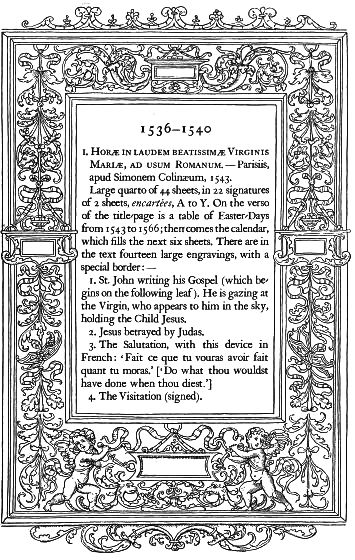
I. HORÆ IN LAUDEM BEATISSIMÆ VIRGINIS MARIÆ, AD USUM ROMANUM.—Parisiis, apud Simonem Colinæum, 1543.
Large quarto of 44 sheets, in 22 signatures of 2 sheets, encartées, A to Y. On the verso of the title-page is a table of Easter-Days from 1543 to 1566; then comes the calendar, which fills the next six sheets. There are in the text fourteen large engravings, with a special border:—
1. St. John writing his Gospel (which begins on the following leaf). He is gazing at the Virgin, who appears to him in the sky, holding the Child Jesus.
2. Jesus betrayed by Judas.
3. The Salutation, with this device in French: 'Fait ce que tu vouras avoir fait quant tu moras.' ['Do what thou wouldst have done when thou diest.']
4. The Visitation (signed).
5. The Birth of Jesus.
6. The Annunciation to the Shepherds (with the date 1537).
7. The Adoration of the Magi (signed).
8. The Circumcision (signed).
9. The Flight into Egypt.
10. The Death of Mary (signed).
11. Jesus on the Cross (signed).
12. The Descent of the Holy Ghost upon the Apostles (signed).
13. The Penance of David (signed).
14. Jesus restoring Lazarus to life.
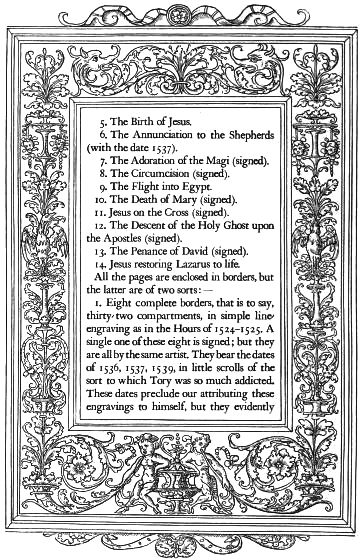
All the pages are enclosed in borders, but the latter are of two sorts:—
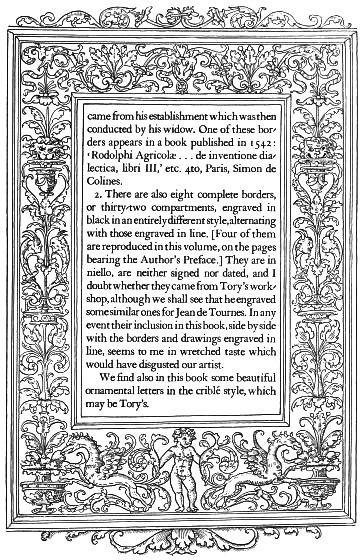
1. Eight complete borders, that is to say, thirty-two compartments, in simple line-engraving as in the Hours of 1524-1525. A single one of these eight is signed; but they are all by the same artist. They bear the dates of 1536, 1537, 1539, in little scrolls of the sort to which Tory was so much addicted. These dates preclude our attributing these engravings to himself, but they evidently came from his establishment which was then conducted by his widow. One of these borders appears in a book published in 1542: 'Rodolphi Agricolæ ... de inventione dialectica, libri III,' etc. 4to, Paris, Simon de Colines.
2. There are also eight complete borders, or thirty-two compartments, engraved in black in an entirely different style, alternating with those engraved in line. [Four of them are reproduced in this volume, on the pages bearing the Author's Preface.] They are in niello, are neither signed nor dated, and I doubt whether they came from Tory's workshop, although we shall see that he engraved some similar ones for Jean de Tournes. In any event their inclusion in this book, side by side with the borders and drawings engraved in line, seems to me in wretched taste which would have disgusted our artist.
We find also in this book some beautiful ornamental letters in the criblé style, which may be Tory's.
The book was reprinted in 1549, in the same form, by Renaud and Claude Chaudière, successors to Simon de Colines.
II. In the same year 1543, Simon de Colines published another book of Hours, octavo, which seems to be a smaller edition of the one I have just described. Like that one, it is composed of 22 signatures, A to Y.
The title-page reads: HORÆ IN LAUDEM DEI AC BEATISSIMÆ VIRGINIS MARIÆ AD USUM ROMANUM, UNA CUM CALENDARIO RECENS [sic] EMENDATO. This within a portico-shaped border, at the top of which is the name Simon de Colines. At the foot of the page: 'Parisiis, apud Simonem Colinæum.—1543.'
As in the quarto Hours of the same date the borders of the text pages are arabesques of two styles, some in line and the others in black; and the drawings, to the number of 13, are set in a special border. Some of these borders bear the date 1537, and one of them has the name Simon de Colines in full, which proves that the engravings were executed for him. A list of the drawings follows; only one of them is signed, but all seem to be the work of Tory.
1. St. John writing his Gospel (signed).
2. Calvary.
3. The Salutation.
4. The Visitation.
5. The Nativity.
6. The Annunciation to the Shepherds.
7. The Adoration of the Magi.
8. The Presentation.
9. The Flight into Egypt.
10. The Coronation of the Virgin.
11. Pentecost.
12. Bathsheba at the Bath.
13. Job on the Dunghill.
The only copy of this book that I know of formerly belonged to the late M. Renouvier, of Montpellier, who showed it to me in 1858. It lacks ten leaves immediately following the title-page, which leaves undoubtedly contained the calendar.
1537
I. LES ANGOISSES ET REMEDES DAMOUR DU TRAVERSEUR EN SON ADOLESCENCE (Jean Bouchet).
Quarto, gothic type, printed at Poitiers, January 8, 1536 (1537, new style), by Jean and Engilbert de Marnef. The privilege is dated November 15, 1536.
There are two woodcuts signed with the Lorraine cross: the printers' mark, on the first page; and, at the end of the preliminary pages, an engraving representing a man in a long robe engaged in writing; facing him and below him are four persons, also in robes, from whom he is apparently deriving his inspiration. Near these latter, at the left, is a woman holding a light.[373]
II. LE JUGEMENT POETIC DE L'HONNEUR FEMININ ... PAR LE TRAVERSEUR (Jean Bouchet).
At the end are these words: 'Imprimé à Poictiers le premier d'avril M. D. XXXVIII, par Jean et Engilbert de Marnef, freres.' This volume, which is arranged like that last described, contains eleven engravings, five of which are signed with the double cross.
Folio A 5 verso. A large plate representing the author presenting his book to François I. The King is seated on his throne and surrounded by his court. (Signed at the left.)
Folio B 1 recto. A meeting of the Parliament of Paris. (Signed at the right.)
Folio B 4 recto. Fame announcing the demise of Louise de Savoie, mother of François I. (Signed at the left.)
Folio B 7 recto. Mercury on his way to the field of Truth; below, Charon in his boat. (Not signed.)
Folio C 1 verso. The field of Truth. Four persons, of whom three are seated in a sort of thicket; and above them, a château. (Signed in the centre.)
Folio C 7 verso. The deceased (Louise de Savoie), her head encircled by a wreath and holding in her right hand a bunch of flowers. (Signed at the right.)
Folio D 3 recto. Fortune holding a wheel in one hand, and a standard in the other. (Not signed.)
Folio D 6 verso. Repetition of C 7.
Folio E 5 verso. Mercury, with the caduceus in his hand, speaking to a man in a robe, and pointing out a palace to him. (Not signed.)
Folio E 7 recto. A large hall adorned with statues. (Not signed.)
Folio L 8 verso. A winged personage, wrapped in a cloak, and having eyes in his hands and feet. (Not signed.)
At the end of the volume the mark of the Marnefs. (Signed.)
1538
MISSAL OF PARIS, 1539; folio. The Lorraine cross on two large folio plates, one of which, dated 1538, represents God the Father seated on his throne, his head surrounded by a halo; he is dressed like the Pope; over his head, a triangular pediment. The other, not dated, represents Christ on the Cross; the Blessed Virgin and St. John are standing at his sides, and this inscription is printed in a semicircle over the cross: 'Absit michi gloriari nisi in crvce D[omi]ni n[ost]ri Jesvs Christi.'
These two subjects, which are often found in collections, sometimes on paper and sometimes on vellum, sometimes black and sometimes coloured (the mark and the date very often disappear under the colours[374]), were first printed, so far as my knowledge goes, in the Missal of Paris, published in 1539 by Thielman Kerver's widow. There follows a description of this priceless volume, of which I know but one copy in Paris.[375] It is entitled: 'Missale ad usum Ecclesiæ Parisiensis, noviter impressum, et emendatum per deputatos a reverendissimo domino Johanne de Bellayo, Parisiensi episcopo,' etc. Then comes Thielman Kerver's usual mark, and below: 'Prostat Parisiis in vico divi Jacobi, apud Iolandam Bonhomme, vidue spectati viri Thielmanni Kerver, ad signum Unicornis, ubi et excusum fuit, anno Domini M. D. XXXIX.'
This work makes a large folio volume, printed in red and black, in gothic type, with a large number of unsigned engravings in the text. These engravings are of three sorts,—(1) floriated letters on a black ground; (2) small drawings of the same size, but of a very graceful renaissance type; (3) drawings of octavo size, which were commonly used by Thielman Kerver's widow in the books of Hours published by her, and of which I have already had occasion to speak.[376]
The two large drawings signed with the Lorraine cross face each other in signature V, in the second part of the book, where the pagination is discontinued. They have been reprinted several times in other editions of the same book. I will mention particularly the edition, undated, published in the name of Guillaume Merlin, bookseller, a copy of which is in the Bibliothèque Mazarine[377]; that of 1543, at the Bibliothèque Sainte-Geneviève; that of 1559 (all published by Iolande Bonhomme or her son Jacques Kerver); and lastly a Missal of Cluny, of which I shall speak later.
Although these books are printed on paper, the plates in question are always printed on vellum in editions of the sixteenth century; but this precaution was neglected in later centuries.
1538-1540
Latin Bible in two folio volumes, bearing the dates 1538, 1539, 1540. Paris, Robert Estienne. The word 'Biblia' appears on the title-page in a scroll signed with the Lorraine cross, of which I have already had occasion to speak, under the date of 1532, and which appears in others of Robert Estienne's books.[378] The second title follows: 'Hebræa, chaldæa, græca et latina nomina ... restituta cum latina interpretatione.' This has led some bibliographers to assume, erroneously, that the book was a polyglot affair. It is printed throughout in Latin; there are simply a few Hebrew words in the dissertation to which the second title in question applies, and which is printed in the second volume, with a title-page of its own, dated 1538. The New Testament, also in the second volume, is dated 1539, not 1540, as M. Renouard mistakenly says.[379] The Bible alone, that is to say, the first volume and the beginning of the second, bears the date 1540. In each part we find Robert Estienne's large mark, signed with the Lorraine cross. The first volume contains also eighteen magnificent engravings representing the Tabernacle of Moses, Solomon's Temple, etc., executed under the direction of François Vatable, Royal Professor of Hebrew Literature. The Lorraine cross appears on the large plate of the camp of the Israelites, on folio 35; but I dare not upon this evidence alone attribute all the other engravings to Tory.[380] In any event the floriated letters used in the book are certainly Tory's, for we find the designs mentioned by him in his 'Champ fleury.' It is a fact worth noting that these letters seem to have been cast, or, at least, reproduced by stereotyping, for they are often repeated on the same page, without the slightest change in the design.
The Bibliothèque Nationale has a superb copy of this book on vellum, with the arms of François I. It was reprinted in the same shape by Robert Estienne in 1546, and by his son Henri in 1565. In this last edition, printed at Geneva, we no longer find the two small drawings which appear, with the frieze, on the title-page of the edition of 1532. (See p. 204, supra.) The frieze in this later form appears in other books of the Estiennes. I have seen it in a folio Xenophon printed for Fugger.
1540-1548
AMADIS DE GAULE, French translation by Nic. de Herberay, Seigneur des Essarts, for the first eight books; first edition printed between 1540 and 1548, by Denis Janot, for the booksellers, Vincent Sertenas, Estienne Groullau, and Jean Longis. Folio, with engravings.
I have seen only two of these engravings signed with the Lorraine cross, but several others seem to have come from the same workshop. The great majority of them, however, are of another make. The two that are signed are: (1) Book II, chap. 2, a large plate representing a sort of temple. A man armed cap-à-pie under a portico. At the right are shields hanging upon posts; at the left, a man kneeling on the ground, holding a naked sword in the air with his right hand, and another hand grasping it. This represents a scene from the 'Île Ferme.' (2) Book VI, chap. 56, a small plate representing four persons on horseback near a château in front of which stands an armed man. This cut does not seem to have any connection with the subject, and may well have been taken from another older work.
There is a copy of this book on vellum in the Bibliothèque Nationale.
1541
I. PRAXIS CRIMINIS PERSEQUENDI, ELEGANTIBUS ALIQUOT FIGURIS ILLUSTRATA, JOANNE MILLÆO ... AUCTORE.
Folio; Paris, Simon de Colines, 1541. Some copies have on the title-page only the names of the brothers Arnould and Charles les Angeliers. (Bibliothèque Nationale.)
There are in this book thirteen large folio cuts, besides the frontispiece. A single one, the seventh, is signed, but all are by the same hand. Following is a description of them, or, rather, a brief list; for a description would lead us into too minute details:[381]—
1. Several men slain in divers ways, on a public square where there is a large crucifix.
2. Examination of the bodies of the wounded lying in a room.
3. Examination of the witnesses.
4. The accused summoned by public outcry.
5. Arrest of the accused.
6. Examination of the accused.
7. Confrontation of the witnesses with the accused (signed).
8. Ratification of decree of pardon.
9. Torture by water.
10. Torture by the boots.
11. Torture by compressing the wrists.
12. Condemnation of the guilty.
13. Execution of the guilty.
There is at the Bibliothèque Nationale a magnificent copy of this book on vellum, with the arms of France in miniature on the verso of the title-page.
II. THE FIRST VOLUME OF THE CATHOLIQUES ŒUVRES ET ACTES DES APOSTRES, by Simon de Greban; followed by the MYSTERE DE L'APOCALYPSE, by Louis Choquet. Printed for Arnould and Charles les Angeliers, May 27, 1541. 'On les vend en la grand salle du Palais, par Arnould et Charles les Angeliers freres.' Folio; Paris, 1541.
This work is embellished with engravings, of which only one is signed with the Lorraine cross. This one, which is on folio I recto of the Acts of the Apostles, represents the descent of the Holy Ghost upon the Apostles. It is enclosed in a border, of octavo size, and belongs to a series of engravings for a book of Hours published by Guillaume Merlin in 1548.[382] The engraver's mark is in a small circle at the left of the foot of the border. Beside it is an angel holding two shields in which are the letters G. M. (Guillaume Merlin). The frontispiece of the Acts of the Apostles has a border in which is the date 1537. The same border surrounds the frontispiece of the Mystery of the Apocalypse, but there it is without the date. This last-named portion of the volume contains 13 engravings and a border, in Tory's style, but without the Lorraine cross. One of them bears the letters P. R. There is a copy at the Bibliothèque Nationale.
III. HOURS OF THE VIRGIN, octavo, in roman type, but with the borders 'à la moderne' described on page 128, supra.
This book, printed by Olivier Mallard in 1541, was copied doubtless from the edition made by Tory about 1531, which I have been unable to examine. Mallard's edition, of which I have seen a copy on vellum, belonging to M. Émilien Cabuchet, the painter, and another on paper, consists of twenty-three octavo signatures, A to Y. The title-page reads; HORÆ IN LAUDEM BEATISSIM. VIRGINIS MARIÆ, AD USUM ROMANUM. (Here the Pot Cassé.) Parisiis, apud Oliverium Mallardum, sub signo Vasis Effracti, 1541. The last page, on which is printed a curious 'prescription against the plague,' ends thus: 'Excudebat Parisiis Oliverius Mallard, bibliopola regius, sub signo Vasis Effracti.'...
In this edition there are 16 different borders; each leaf has the same border on both recto and verso. There are also 16 of the engravings of the sixteenmo Hours of 1529, those not reproduced being nos. 1, 19 and 21 of that edition.
The word 'Rom.' printed on the first page of each signature leads me to believe that Mallard published at the same time, in the same format, an edition of Hours 'ad usum Parisianum,' but I have found no trace of such an edition.
After Olivier Mallard's death, which occurred, as I have said heretofore, in 1542, his typographical outfit seems to have been acquired by Thielman Kerver II (son of the first Thielman and Iolande Bonhomme, who lived, as did his father before him, on Rue Saint-Jacques); for he published in 1550 a book of Hours similar to that printed in 1541 by Mallard. It contains the same borders and the same drawings, but in a different arrangement. The borders have been lengthened by means of a most ungraceful addition to the side-pieces; as for the drawings in two parts, no pains has been taken to place the parts facing each other, so that their meaning would be uncertain if we had no other editions of the engravings. In fine, this book is very imperfect. It consists of twenty-two and a half signatures, A to Y. The title-page reads thus:—
HORÆ IN LAUDEM BEATISSIMÆ VIRGINIS MARIÆ AD USUM ROMANUM. (Here the mark of Thielman Kerver, with the Lorraine cross.) 'Parisiis, apud Thielmannum Kerver, vico sancti Jacobi, sub signo Cratis. M.D.L.' The book closes with the curious 'prescription' found in Olivier Mallard's edition of 1541, which is in these words: 'Approbatissima medicina contra pestem.—Recipe quantum potes de amaritudine mentis contra peccata commissa, cum vera cordis contritione, potius libram quam unciam. Hæc misceantur cum aqua lacrymarum, et facies vomitum per puram confessionem. Deinde sumas illud sacratiss. electuarium corporis Christi, et tutus eris a peste.'
The book is printed in red and black. I have seen a copy on paper at M. Potier's bookshop. There is an imperfect copy at the Bibliothèque Mazarine, and a perfect one at Sainte-Geneviève.
About the same time there was published a small duodecimo volume of four signatures, in French, with the same borders. It begins thus: 'Here follows the method of receiving the blessed sacrament devoutly.' It is like the book last-described except that it is printed in only one colour, and that it is a little longer and wider.[383] To lengthen the borders, sections have been added to them. It is most peculiar that a duodecimo volume should be larger than an octavo, but the fact is unquestionable: formats were already beginning to increase in size. Near the end of the book is a little treatise with this heading: 'Here follows a devout meditation as to the manner in which thou shouldst ordain and arrange the whole day,' etc. And after that: 'The life of Madame Sainte-Marguerite, with prayer to be said for women pregnant and in travail.'
This book is in the Bibliothèque Mazarine, in the same collection as the last. It contains four small engravings, of which only one seems to me to belong to Tory: it is the Christ on the Cross, which appears in the quarto Hours of 1542, now to be described.
1542
I. Hours, according to the Roman use, quarto, in Latin, published by Olivier Mallard in 1542. This rare volume, of which I know only one copy, belonging to M. Aerts, of Metz,[384] who himself kindly brought it to me at Paris, is a reproduction of the Hours printed by Tory in 1531; the type, however, is smaller. It consists of nineteen signatures of two quarto sheets encartées, signatures A to T. The title-page reads: HORAE IN LAUDEM BEATISS. VIRGINIS MARIÆ AD USUM ROMANUM. OFFICIUM TRIPLEX.—Parrhisiis, apud Oliverium Mallard, impressorem Regium. The rest is as in the edition of 1531. On the last page: 'Parrhisiis, ex officina Oliverii Mallard, Regii impressoris, Ad insigna Vasis Effracti. Anno salu. M. D. XLII. Mense Augusti.' Then come the two lines:—
'Effracti, lector, subeas insignia vasis, gregios flores ut tibi habere queis.'
The table of Easter-Days, on the verso of the title-page, goes from 1542 to 1571; then comes the calendar, in which the order of the edition of 1531 has been followed in the arrangement of the borders, although the type, being smaller, would have permitted the more regular arrangement of the edition of 1524-25.
The book is printed in two colours, except signatures B, C, and D, which are in black only—a most unusual state of things. The engravings are the same as those of the edition of 1531, but the floriated letters are different. The Passion, which begins on folio B 3 verso, is enriched by the small Christ on the Cross which we find in the Hours of 1529, but without the four additional subjects (bees, etc.), which there accompany it.[385] It is probable that some accident happened to the plate, and that only the Christ was saved. We find also in this volume, at the foot of the border, the crowned C of Queen Claude of France, who had then been dead about fifteen years.
The Lorraine cross, which had disappeared from several of the larger engravings as early as the edition of 1531, appears on almost none of them in that of 1542. For example, it has been expunged from the Birth of Jesus and the Circumcision. The only ones which retain it are the Visitation, the Crucifixion, and the Descent of the Holy Ghost. It remains on the borders also.
Signature E begins with a leaf the recto of which is blank, while on the verso is the angel of the Annunciation, as in the edition of 1531. The large plate, the Triumph of the Virgin Mary, is also included in this edition.
II. HORE BEATE MARIE VIRGINIS AD USUM FRATRUM PREDICATORUM ORDINIS SANCTI DOMINICI: FIGURIS UTRIUSQUE TESTAMENTI AC PERVENUSTIS IMAGINIBUS ET IIS QUIDEM NON PAUCIS, PASSIM DECORATE, ATQUE OFFICIO CONCEPTIONS IMMACULE VIRGINIS ET OFFICIO SANCTI DOMINICI IN ALIIS ORARIIS ACTENUS IMPRESSUS NEQUAQUE INSERTIS AD AUCTE. (Here the figure of St. Dominic holding an open book in his left hand, and in the right a staff with the cross at the end. At his feet lies a dog. The Lorraine cross is at the left.) Venundantur Parisiis, in edibus vidue spectabilis viri Thielmanni Kerver, in vico divi Jacobi, sub signo Unicornis, ubi et impresse.—M.D. XLII.'
Octavo; signatures A to X, and a to c: in all, 26 forms. The title-page engraving reappears on leaf R 4 verso. The others are not signed.
III. HEURES À L'USAGE DE TOUL: AU LONG SANS REQUERIR.
Octavo of 156 unpaged leaves. Calendar from 1541 to 1564. At the bottom of the last page are the words: 'Imprimé à Troyes chez Jean Lecoq.' Gothic type, printed in red and black.
The only copy of this book that I have seen is in the Bibliothèque Publique of Besançon. It has 30 engravings, including the printer's mark, which is on the title-page. The mark and three other engravings of the first series are signed with the Lorraine cross. A list of all the engravings follows:—
First series, .06 mm. by .043 mm.
1. Printer's mark (signed).
2. Jesus in the Garden of Olives (signed).
3. Annunciation of the Virgin.
4. The Visitation.
5. The Nativity.
6. Adoration of the Shepherds.
7. Adoration of the Magi.
8. The Presentation in the Temple.
9. Massacre of the Innocents.
10. Death of the Virgin (signed).
11. The Crucifix.
12. Pentecost.
13. Bathsheba at the Bath (signed).
14. Resurrection of Lazarus.
15. Vision of St. Gregory.
Second series, .034 mm. by .022 mm.
1. The Trinity.
2. Death piercing with a Spear the Great Men of Earth.
3. St. Anne.
4. All Saints.
5. Ecce Homo.
6. The Virgin.
7. The Beheading of St. John Baptist.
8. St. Sebastian.
9. St. Nicholas.
10. St. Martin.
11. St. Catherine.
12. St. Barbara.
13. Our Lady of Pity.
14. Virgo Gloriosa.
15. Our Lady of the Seven Sorrows.
IV. DYALOGUE INSTRUCTOIRE DES CHRESTIENS EN LA FOY, ESPERANCE ET AMOUR DE DIEU COMPOSÉ PAR FRERE PIERRE DORÉ, DOCTEUR EN THEOLOGIE.... Imprimé nouvellement par Denys Janot, demourant en la rue Neufve Nostre Dame, à l'enseigne Sainct Jehan Baptiste, pres Saincte Geneviefve des Ardens.
Sixteenmo, 1542. On the verso of the title-page is an engraving signed with the Lorraine cross. It represents the Virgin standing on a crescent, holding the child Jesus in her arms, and surrounded by a halo. (Bibliothèque Nationale.)
1543-1544
SOMMAIRE DE CHRONIQUES, CONTENANS LES VIES, GESTES ET CAS FORTUITZ DE TOUS LES EMPEREURS D'EUROPE, etc. By J. B. Egnatius, translated by G. Tory.[386]
There were several other editions of these chronicles. M. Hippolyte Boyer mentions one of 1541, in his 'Histoire des Imprimeurs et Libraires de Bourges' (8vo, Bourges, 1854), p. 27; Antoine du Verdier, another, of 1543, in his Bibliothèque françoise. This much is certain—that M. Renouvier owned a copy, with illustrations, dated 1544. It is an octavo, 'for sale by Charles l'Angelier, in the "grand'salle du Palais."' It contains 112 leaves (signatures A to O), plus 4 unnumbered leaves. The engravings are of two sorts: the first represents an emperor on horseback, carrying a battle-axe; there is no mark, but it is engraved with much delicacy and distinguished by the little cartouches of which Tory was so fond; this figure is reproduced several times. The others are busts of emperors, roughly engraved, which cannot be Tory's. It may be noted that the edition published by Tory in 1530 contains no engravings.
1545
DE DISSECTIONE PARTIUM CORPORIS HUMANI, etc. By Charles Estienne. Folio, Simon de Colines, 1545.
There are in this book about sixty large anatomical plates. Five are signed with the Lorraine cross—folios 149, 150, 151, 154, 155. The last four bear also the name of Jollat, with the dates 1530, 1531, 1532. Here is what M. Renouvier has to say on the subject: 'Simon de Colines ... employed another wood-engraver of some note, Mercure Jollat, to whom Papillon attributed almost all of our gothic books of Hours. He should be reckoned only among the engravers of an altogether modernized manner. His name is written Iollat, the first letter in the zodiacal sign of Mercury, followed by the dates 1530, 1531, and 1532, and accompanied by the Lorraine cross, on four plates of Charles Estienne's book on the dissection of the human body, representing the cadaver in its skin and the cadaver with the skin removed. The drawing of the figures has been attributed, even by Brulliot, to Woeiriot; but it is really the work of the surgeon Estienne Rivière, who is named on the title-page and in the preface as the painter of the bones, ligaments, and all the anatomical details. His initials, S. R., appear on a tablet hanging from the branches of a tree in the first plate. The engraving, which varies considerably, would seem to be the work of different hands, or, at least, to have come from an establishment which practised diverse styles and which sometimes put forth work done by apprentices. The workmanship of the plates with Jollat's mark seemed to me more monotonous—not unskilful although less picturesque. I am not now passing upon their scientific merit, but upon their picturesque interest simply.'[387]
The inscription of Jollat's name on plates marked with the Lorraine cross seems, at first glance, quite hard to explain, especially with the general opinion concerning the former of these artists, based on Papillon's statements. But as the story of Jollat's work as an engraver still remains to be told, I think I may safely say that he simply designed the plates that bear his name in Charles Estienne's book, and that they were engraved by Tory, or, at least, in his workshop. We have seen, in fact, that Tory was Simon de Colines' favourite engraver. To be sure, M. Renouvier seems to be of opinion that all the plates were designed by Estienne Rivière, whence he concludes that the engraving is by Jollat; but this is a mistaken opinion, based on a sentence in the preface. Rivière, who was a friend of Charles Estienne, may have designed the majority of the plates in Charles Estienne's book, and yet not have designed all of them. Those signed Jollat evidently belong to that artist, who seems to have designed a number of them before the work was placed in Rivière's hands.
I am confirmed in my belief that Jollat was the designer of the plates in question by the fact that his name is always accompanied by the dates, and that those dates are not those of the engraving, which I propose to prove. There are only five plates signed with Jollat's name and with the Lorraine cross in the Latin edition of Charles Estienne's book, published by Simon de Colines in 1545. In the following year the same printer issued a French edition of this work, under the title, 'La Dissection des parties du corps humain' (folio, 1546), in which we find two additional plates so marked and dated 1532. Why did not these plates appear in the first edition, if they were engraved by Jollat?
But here is another fact even more conclusive. In 1575 the bookseller Jacques Kerver published a volume of engravings without text, entitled 'Les Figures et portraicts des parties du corps humain' (folio), in which we find not only the seven engravings with the cross, of the edition of 1546, but three others, also bearing Jollat's mark and the Lorraine cross, and dated 1533. Evidently these plates appeared in some earlier edition, unknown to me,[388] for it was not Kerver who had them engraved; he simply made use of the woodcuts of which he had become the owner. But why did they not appear in the edition of 1546? That is a matter easily explained.
Charles Estienne informs us in the preface to his book that the printing was well advanced in 1539, but that it was interrupted by a lawsuit. We give his own words in the French edition of 1546: 'All of which things were well-nigh finished in the year 1539, and almost so far as the middle of the third book printed, when, by reason of a suit that was begun, we were forced (to your great discontent, methinks) to lay aside this work and to desist from the completion thereof; for so long that in the mean time it has been possible for many others to invent new ideas touching this matter, and to make use at their will of many sheets filled with our writings; for it was not possible for the printer so closely to safeguard his book, so long suppressed, that some persons curious to learn of novel things might not take away some sheets, still uncorrected, and send them into Germany.'
Now let us see what was the cause of this suit. Charles Estienne does not inform us, but it has been disclosed by M. Ambroise Didot, in his 'Essai sur la Gravure.' The famous Vésale had published at Venice, in 1538, through the printer B. Vitalis, a treatise on anatomy, embellished with numerous plates, which was copied in several places, and notably in Paris, despite the privilege granted by the Republic. Later, wishing to issue a new and improved edition of his book, Vésale applied to Oporin, professor of Greek, and printer at Basle, to whom he sent his plates, which had been engraved at Venice by Calcar, a pupil of Titian. In 1543 Oporin finished printing this new edition, for which the author had, no doubt, obtained privileges from various sovereigns, especially from the King of France. This seems to be proved by the suit instituted against Charles Estienne. That is why the latter could not publish, in his edition of 1545, all the plates which he had had made, and which appeared only at intervals as the date of Vésale's privilege was left behind. As we have seen, he gives it to be understood in his preface that it was he who was robbed in Germany.
As this is a favourable opportunity, I will say a few words concerning Jacques Kerver's publication, of which I have never seen any mention,[389] but which is of great interest to us. It is a folio volume, containing 61 large plates besides a considerable number of small ones. There is no other text than the explanations printed on the plates,[390] and a brief note to the reader, which begins thus: 'Friend reader, seeing that medicine is not at all essential to preserve the health and to banish all diseases, which often, on slight occasion, assail us, and that anatomy, or the description of the parts of the human body, mainly serves us therein, I have determined not to fail to exhibit them to you here.' We give a description of those plates in the book which are of interest to us.
Plates which appear only in Kerver's volume.
1. The human body in its relation to the signs of the zodiac (folio A 2 verso). This bears Jollat's name, the date 1533, and the Lorraine cross.
2 and 3. The human body in its relation to the seven planets (folio A 3 recto and verso). These two bear the same marks as the preceding.
Plates which appear in the edition of 1546.
4. Skeleton seen from the left side (folio 11 of the edition of 1546, and A 3 verso of that of 1575). Jollat's name, the Lorraine cross, no date.
5. Skeleton seen from the right side (folio 11, 1546, folio A 5 verso, 1575). Jollat's name, the date 1532, and the Lorraine cross.
Plates which appear in all three editions.
6. Man flayed, front view (folio 149, 1545; folio 151, 1546; folio B 2 recto, 1575). The cross alone.
7. Man flayed, right side (folio 150, 1545; folio 152, 1546; folio B 2 verso, 1575). Jollat's name, the date 1532, and the Lorraine cross.
8. Man flayed, rear view (folio 151, 1545; folio 153, 1546; folio B 3 recto, 1575). The same marks as in the last case.
9. Man in his skin, front view (folio 154, 1545; folio 160, 1546; folio B 3 verso, 1575). The same marks as in the last case.
10. Man in his skin, rear view (folio 155, 1545; folio 161, 1546; folio B 5 recto, 1575). The same marks, with the date 1531.
Many others of the plates may belong to Tory, but as they are not marked, I shall not speak of them here.
Something analogous to what I have just described took place with reference to the engravings of Tory's Hours. Having become the property of the Kervers, as we have seen,[391] they were used by them for a long while. We shall mention later the octavo Hours published by Thielman II in 1550, 1552, and 1556, in which he utilized the woodcuts of the edition published by Olivier Mallard in 1541. His son Jacques did better than that: in 1574 he published a large octavo edition of the Hours of the Virgin, in which he used the woodcuts of the quarto editions issued by Tory himself in 1524 and 1527. As the crosses were removed in almost every instance, one might have some right to deny their source, were not the books published by Tory a half century before, at our hand to demonstrate it. Jacques Kerver's book being rare, and of a date subsequent to the period covered by my work, it seems to me that it may be well to give a bibliographical description of it, from the copy owned by M. Chedeau, which M. Potier, bookseller, has kindly furnished me.
'Officium beatæ Mariæ Virginis nuper reformatum et Pii V, pont. max., jussu editum.—Apud Jacobum Kerver, via Jacobea, sub insigni Unicornis.—1574.' Large octavo, with illustrations from the quarto edition published by Tory in 1524-1525, surrounded by borders taken from Tory's quarto edition of 1527, but reduced in size, mutilated, transposed, etc.
Here is a list of the plates:—
1. The Annunciation (two plates).
2. The Salutation.
3. The Nativity.
4. The Adoration of the Shepherds.
5. The Adoration of the Magi.
6. The Circumcision.
7. The Flight into Egypt.
8. The Coronation of the Virgin.
These eight plates are repeated three times. Then come:—
9. The Triumph of Death.
10. David's Penance.
11. Jesus on the Cross.
12. Pentecost.
Number 8 is taken from the quarto Hours of 1527; but all the others are in the Hours of 1524-1525. Numbers 2 and 12 still bear the Lorraine cross.
There is no doubt in my mind that the Kervers printed also the quarto Hours (1531) which I mentioned on page 201, and in which we find the borders of the Hours of 1524-1525, and the porticoes of the opuscula of 1530-1531. The plates are not signed and cannot be Tory's, but as a list of them may assist in the discovery of this edition, I will mention here those which are at the Bibliothèque Nationale:—