GEOFROY TORY (continued 2)
George Burnham Ives translation
The only relic that we have of Tory to-day, outside of his books and works of art, is a volume from his library, as his signature in the genitive case indicates. It is a manuscript on vellum, containing the orations of Cicero against Verres, in Latin. This volume was acquired, presumably after Tory's death, by his patron Jean Grolier, who wrote his motto at the end of the text: 'Joannis Grolierii Lugdunensis et amicorum.' From the library of this illustrious bibliophile, the manuscript passed to Colbert's library, then to the king's. It is preserved to-day [1857] in the Bibliothèque Nationale. We give below a facsimile of Tory's signature, which appears on the first flyleaf:—

God. Torini Biturici
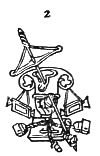
Tory made use of ten marks, besides the Pot Cassé that appears on his bindings. We reproduce them all, although only two (nos. 5 and 10) are signed.[170] Some of them were used by other booksellers after him, as we have already seen.
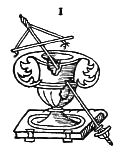
No. 1
This mark is to be found in the borders of the Hours (quarto) of 1527. (See page 37, supra.)
No. 2
This form of the Pot Cassé appears in the borders of the Hours (quarto) of 1524-1525, alike in the copies which bear the imprint of Tory and in those printed by Simon de Colines. (See page 37, supra; also Part 2, § 2, no. 1, infra.)
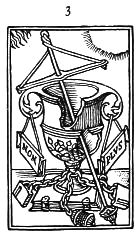
No. 3
This variation will be found on the first page of those copies of the Hours (quarto) of 1524-1525 which bear the imprint of Tory. (See Part 2, § 2, no. 1 (2d and 3d), infra.)
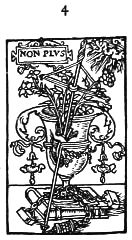
No. 4
This appears on the title-page of 'Champ fleury.' (Silvestre, 'Marques Typographiques,' no. 931.)
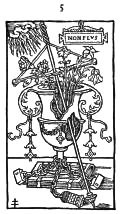
No. 5
This appears on folio 43 verso, of 'Champ fleury.' (Silvestre, no. 803.)
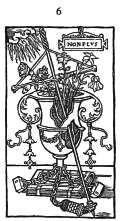
No. 6
This mark, which differs from no. 5 only in the absence of the cross of Lorraine, appears on the last page of 'Champ fleury.' I am unable to suggest any reason for the removal of the cross. (Silvestre, no. 171.)
No. 7
This mark is found only at the end of the little poem written by Tory on the death of his daughter, which was published February 15, 1524, new style. We have already referred to this poem on page 15; but it is reproduced at length in Part 2, § I, no. 9.
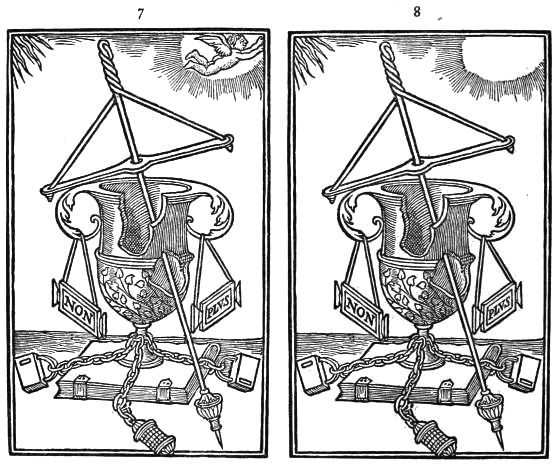
No. 8
This mark, which differs from the preceding only in the omission of the little figure in the clouds, appears on the last page of the Hours of 1524-1525 (those copies with Tory's imprint) in Latin. (Silvestre, no. 356.)[171]
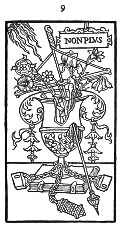
No. 9
This mark appears on the title-page of the Hours (quarto) of 1527. It was used by Jean Mallard, bookseller at Rouen, 1542.[172] (Silvestre, no. 604.)
No. 10
I have never as yet seen this mark in any book of Tory's; but I have found it in books published by Richard Cotereau, bookseller at Chartres, in 1557, and by Philippe Cotereau, bookseller at Blois, in 1603. (See p. 41, supra.) The presence of the Lorraine cross is, it seems to me, a sufficient proof that it should be attributed to Tory. (Silvestre, no. 929.)
We have already observed that Tory was not only a bookseller and printer, but a binder as well. To complete the list of our artist's professional acquirements an example of the toolings that he used to decorate the covers of some of the volumes bound by him, is reproduced [on the cover of the present volume.[173] The reproduction is from the cover of a copy of the works of Petrarch, printed at Venice in 1525, and now preserved in the Library of the British Museum.] The Pot Cassé, in its simplest form, appears among the arabesques of this binding. Tory had also had engraved a larger plate of the same, for use on the binding of quartos, or, rather, of folios. The design is almost identical. Sometimes the Pot Cassé is accompanied by the drill. This design appears on a copy of Macault's translation of Diodorus Siculus, printed as late as 1536, 'au Pot Cassé.' This beautiful volume, in M. Didot's magnificent library, is sufficient proof that Tory's widow continued his various industries for a considerable time.
It is hardly necessary to say that the same tools could, with some slight additions, be used in binding volumes of all sizes, from the octavo up.