Front matter (continued 6)
Reading edition
Kinnison didn't know what would happen if a mind—to say nothing of two of them—died while in his mental grasp, and he did not care to find out. Therefore, a fraction of a second before the crash, he jerked free and watched.
The explosion and its consequences did not look at all impressive from the Lensman's coign of vantage. The mountain trembled a little, then subsided noticeably. From its summit there erupted an unimportant little flare of flame, some smoke, and an insignificant shower of rock and débris.
However, when the scene had cleared there was no longer any shaft leading downward from that crater; a floor of solid rock began almost at its lip. Nevertheless, the Lensman explored thoroughly all the region where the stronghold had been, making sure that the clean-up had been one-hundred-per-cent effective.
Then, and only then, did he point the speedster's streamlined nose toward Star Cluster AC 257-4736.
In his hidden retreat so far from the galaxy's crowded suns and worlds, Helmuth was in no enviable or easy frame of mind. Four times he had declared that that accursed Lensman, whoever he might be, must be destroyed, and had mustered his every available force to that end, only to have his intended prey slip from his grasp as effortlessly as a droplet of mercury eludes the clutching fingers of a child.
That Lensman, with nothing except a speedster and a bomb, had taken and had studied one of Boskone's new battleships, thus obtaining for his patrol the secret of cosmic energy. Abandoning his own vessel, then crippled and doomed to capture or destruction, he had stolen one of the ships searching for him and in it he had calmly sailed to Velantia, right through Helmuth's screen of blockading vessels. He had in some way so fortified Velantia as to capture six more Boskonian battleships. In one of those ships he had won his way back to the Prime Base of the patrol, with information of such immense importance that it had robbed the Boskonian organization of its then overwhelming superiority.
More, he had found or had developed new items of equipment which, save for Helmuth's own success in obtaining them, would have given the patrol a definite and decisive superiority over Boskonia. Now both sides were again equal, except for that Lensman and—the Lens.
Helmuth still quailed inwardly whenever he thought of what he had undergone at the Arisian barrier, and he had given up all thought of securing the secret of the Lens by force or from Arisia. But there must be other ways of getting it——
And just then there came in the urgent call from Boyssia II, followed by the stunningly successful revolt of the hitherto innocuous Blakeslee, culminating as it did in the destruction of Helmuth's every Boyssian device of vision or of communication. Blue-white with fury, the Boskonian high chief flung his net abroad to take the renegade; but as he settled back to await results a thought struck him like a blow from a fist: Blakeslee was innocuous. He never had had, did not now and never would have, the cold nerve and the sheer, dominating power he had just shown. Toward what conclusion did that fact point?
The furious anger disappeared from Helmuth's face as though it had been wiped therefrom with a sponge, and he became again the coldly calculating mechanism of flesh and blood that he ordinarily was. This conception changed matters entirely. This was not an ordinary revolt of an ordinary subordinate. The man had done something which he could not possibly do. So what? The Lens again. Again that accursed Lensman, the one who had somehow learned really to use his Lens!
"Wolmark, call every vessel at Boyssia base," he directed, crisply. "Keep on calling them until some one answers. Get whoever is in charge there now and put him on me here."
A few minutes of silence followed, then Vice Commander Krimsky reported in full everything that had happened and told of the threatened destruction of the base.
"You have an automatic speedster there, have you not?"
"Yes, sir."
"Turn over command to the next in line, with orders to move to the nearest base, taking with him as much equipment as is possible. Caution him to leave on time, however, for I very strongly suspect that it is now too late to do anything to prevent the destruction of the base. You, alone, take the speedster and bring away the personal files of the men who went with Blakeslee. A speedster will meet you at a point to be designated later and relieve you of the records."
An hour passed—two, then three.
"Wolmark! Blakeslee and the hospital ship have vanished, I presume?"
"They have." The underling, expecting a verbal flaying, was greatly surprised at the mildness of his chief's tone and at the studious serenity of his face.
"Come to the center." Then, when the lieutenant was seated, "I do not suppose that you as yet realize what—or rather, who—it is that is doing this?"
"Why, Blakeslee is doing it, of course."
"I thought so, too, at first. That was what the one who really did it wanted us to think."
"It must have been Blakeslee. We saw him do it, sir. How could it have been any one else?"
"I do not know. I do know, however, and so should you, that he could not have done it. Blakeslee, of himself, is of no importance whatever."
"We'll catch him, sir, and make him talk. He can't get away."
"You will find that you will not catch him and that he can get away. Blakeslee alone, of course, could not do so, any more than he could have done the things he apparently did do. No, Wolmark, we are not dealing with Blakeslee."
"Who then, sir?"
"Haven't you deduced that yet? The Lensman, fool—the same Lensman who has been thumbing his nose at us ever since he took one of our first-class battleships with a speed boat and a firecracker."
"But—great blinding rockets, how?"
"Again I admit that I do not know—yet. The connection, however, is quite evident—thought. Blakeslee was thinking thoughts utterly beyond him. The Lens comes from Arisia. The Arisians are masters of thought—of mental forces and processes incomprehensible to any of us. These are the elements which, when fitted together, will give us the complete picture."
"Still I don't see how they fit."
"Neither do I—yet. However, it should be clear to you that we do not want that Lensman thinking such thoughts as that into this base."
"We certainly do not. However, surely he can't trace——"
"Just a moment! The time has come when it is no longer safe to say what that Lensman cannot do. Our communicator beams are hard and tight, yes. But any beam can be tapped if enough power be applied to it, and any beam that can be tapped can be traced. I expect him to visit us here, and we shall be prepared for his visit. That is the reason for this conference with you. Here is a device which generates a field through which no thought can penetrate. I have had this device for some time, but for obvious reasons have not released it. Here are the diagrams and complete constructional data. Have a few hundred of them made with all possible speed, and see to it that every being upon this planet wears one continuously. Impress upon every one, and I will also, that it is of the utmost importance that absolutely continuous protection be maintained, even while changing batteries.
"Experts have been working for some time upon the problem of protecting the entire planet with such a screen, and there is some little hope of success in the near future; but individual protection will still be of the utmost importance. We cannot impress it too forcibly upon every one that every man's life is dependent upon each one maintaining his thought-screen in full operation at all times. That is all."
When the messenger brought in the personal files of Blakeslee and the other deserters, Helmuth and his psychologists went over them with minutely painstaking care. The more they studied them the clearer it became that the chief's conclusion was the correct one. Some one had, in some way, brought an extraordinary mental pressure to bear.
Reason and logic told Helmuth that the Lensman's only purpose in attacking the Boyssian base was to get a line on Grand Base; that Blakeslee's flight and the destruction of the base were merely diversions to obscure the real purpose of the visit; that the Lensman had staged that theatrical performance especially to hold him, Helmuth, while his beam was being traced, and that was the only reason why the visiset was not sooner put out of action; and, finally, that the Lensman had scored another clean hit.
He, Helmuth himself, had been caught flat-footed. His face hardened and his jaw set at the thought. But he had not been taken in. He was forewarned and he would be ready, for he was coldly certain that Grand Base and he himself were the real objectives of the Lensman. That Lensman knew full well that any number of ordinary bases, ships, and men could be destroyed without damaging, materially, the Boskonian cause.
Steps must be taken to make Grand Base as impregnable to mental forces as it already was to physical ones. Otherwise, it might well be that even Helmuth's own life would presently be at stake, and that life was a thing precious indeed. Therefore, council after council was held; every contingency that could be thought of was brought up and discussed; every possible precaution was taken. In short, every resource of Grand Base was devoted to the warding off of any possible mental threat which might be forthcoming.
Kinnison approached that star cluster with care. Small though it was, as cosmic groups go, it yet was composed of some hundreds of stars and an unknown number of planets. Any one of those planets might be the one he sought, and to approach it unknowingly might prove disastrous. Therefore, he slowed down to a crawl and crept up, light year by light year, with his ultra-powered detectors fanning out before him to the limit of their unimaginable reach.
He had more than half expected that he would have to search that cluster, world by world; but in that, at least, he was pleasantly disappointed. One corner of one of his plates began to show a dim glow of detection. A bell tinkled and Kinnison directed his most powerful master plate into the region indicated. This plate, while of very narrow field, had tremendous resolving power and magnification; and in it he saw that there were eighteen small centers of radiation surrounding one vastly larger one.
There was no doubt then as to the location of Helmuth's base, but there arose the question of approach. The Lensman had not considered the possibility of a screen of lookout ships. If they were close enough together so that their electromagnetics had even a fifty-per-cent overlap, he might as well go back home. What were those outposts, and exactly how closely were they spaced? He observed, advanced, and observed again; computing finally that, whatever they were, they were so far apart that there could be no possibility of any electro overlap at all. He could get between them easily enough. He wouldn't even have to baffle his flares.
They could not be guards at all, Kinnison concluded, but must be simply outposts, set far outside the solar system of the planet they guarded; not to ward off one-man speedsters, but to warn Helmuth of the possible approach of a force large enough to threaten the Grand Base of Boskonia.
Closer and closer Kinnison flashed, discovering that the central object was indeed a base, startling in its immensity and completely and intensively fortified; and that the outposts were huge, floating fortresses, practically stationary in space relative to the sun of the solar system they surrounded. The Lensman aimed at the center of the imaginary square formed by four of the outposts and drove in as close to the planet as he dared. Then, going inert, he set his speedster into an orbit—he did not care particularly about its shape, provided that it was not too narrow an ellipse—and cut off all his power. He was now safe from detection. Leaning back in his seat and closing his eyes, he hurled his sense of perception into and through the massed fortifications of Grand Base.
For a long time he did not find a single living creature. He traversed hundreds of miles, perceiving only automatic machinery, bank after towering, mile-square bank of accumulators, and remote-controlled projectors and other weapons and apparatus. Finally, however, he came to Helmuth's dome; and in that dome he received another severe shock. The personnel in that dome were to be numbered by the hundreds, but he could not make mental contact with any one of them. He could not touch their minds at all; he was stopped cold. Every member of Helmuth's band was protected by a thought-screen as effective as the Lensman's own!
Around and around the planet the speedster circled, while Kinnison struggled with this new and entirely unexpected setback. This looked as though Helmuth knew what was coming. Helmuth was nobody's fool, Kinnison knew; but how could he possibly have suspected that a mental attack was in the book? Perhaps he was just playing safe. If so, the Lensman's chance would come. Men would be careless; batteries weakened and would have to be changed.
But this hope was also vain, as continued watching revealed that each battery was listed, checked, and timed. Nor was any screen released, even for an instant, when its battery was changed; the fresh power source being slipped into service before the weakening one was disconnected.
"Well, that proves that Helmuth knows," Kinnison cogitated, after watching vainly several such changes. "He's a wise old bird. The guy really has jets. I still don't see what I did that could have put him wise to what was going on."
Day after day the Lensman studied every detail of construction, operation, and routine of that base, and finally an idea began to dawn. He shot his attention toward a barracks he had inspected frequently of late, but stopped, irresolute.
"Uh-uh, Kim, maybe better not," he advised himself. "Helmuth's mighty quick on the trigger, to figure out that Boyssian thing so fast——"
His projected thought was sheared off without warning, thus settling the question definitely. Helmuth's big apparatus was at work; the whole planet was screened against thought.
"Oh, well, probably better, at that," Kinnison went on arguing with himself. "If I'd tried it out maybe he'd have got onto it and laid me a stymie next time, when I really need it."
Since he had accomplished everything that he could do for the time being, he went free and hurled his speedster toward Earth, now distant indeed. Several times during that long trip he was sorely tempted to call Haynes through his Lens and get things started; but he always thought better of it. This was altogether too important a thing to be sent through so much subether, or even to be thought about except inside an absolutely thought-tight room. And besides, every waking hour of even that long trip could be spent very profitably in digesting and correlating the information he had obtained and in mapping out the salient features of the campaign that was to come. Therefore, before time began to drag, Kinnison landed at Prime Base and was granted instant audience with Port Admiral Haynes.
"Mighty glad to see you, son," Haynes greeted the young Lensman cordially, as he sealed the room thought-tight. "Since you came in under your own power, I assume that you are here to make a constructive report?"
"Better than that, sir. I'm here to start something in a big way. I know at last where their Grand Base is, and have detailed plans of it. I think that I know who and where Boskone is. I know where Helmuth is, and I have worked out a plan whereby, if it works, we can wipe out that base, Boskone, Helmuth, and all the lesser master minds, at one wipe."
"Holy jumping rockets!" For the first time since Kinnison had known him the old man lost his poise. He leaped to his feet and seized Kinnison by the arm. "I knew you were good, but not that good! The Arisians gave you the treatments you wanted, then?"
"They sure did," and the younger man reported as briefly as possible everything that had happened, then outlined the plan upon which he had been working so long.
"I am just as sure that Helmuth is Boskone as I can be of anything that can't be proved," Kinnison declared, bending over a huge chart and sketching rapidly. "Helmuth speaks for Boskone, and nobody else ever does, not even Boskone himself. None of the other big shots know anything about Boskone or ever heard him speak; but they all jump through their hoops when Helmuth, 'speaking for Boskone,' cracks the whip. And I couldn't get a trace of Helmuth ever taking anything up with any higher-ups. Therefore, I am dead certain that when we get Helmuth we get Boskone.
"But that's going to be a real job of work. I scouted his headquarters from stem to gudgeon, as I told you; and Grand Base is absolutely impregnable as it stands. I never imagined anything like it. It makes Prime Base here look like a deserted cross roads after a hard winter. They've got screens, pits, projectors, accumulators, all on a gigantic scale. In fact, they've got everything. But you can get all that from the tape. I have learned definitely that we cannot take them by any possible direct frontal attack. Even if we attacked with every ship and mauler we've got throughout the galaxy they could stand us off. And they can match us, ship for ship. We'd never get near that base at all if they knew that we were coming."
"Well, if it's such an impossible job, what——"
"I'm coming to that. It is impossible as it stands; but there's a good chance that I'll be able to soften Grand Base up. You know, like a worm—bore from within. Anyway, that's the only possible way to do it, so I've got to try it. You'll have to put detector nullifiers on every ship assigned to the job, but that'll be easy. I would suggest sending all the maulers and first-class battleships we've got, but you will, of course, work that out later."
"The important thing, as I gather it, is timing."
"Absolutely to the minute, since I won't be able to communicate, once I get inside their thought-screens. How long will it take to concentrate everything we've got and put it in that cluster?"
"Seven weeks—eight at the outside."
"Plus two for allowances. QX. At exactly Hour 20, ten weeks from to-day, let every projector of every vessel that you can possibly get there cut loose on that base with everything they can pour in. Where's that other print? Here—twenty-six main objectives, you see. Blast them all, simultaneously to the second. If they all go down, the rest will be possible. If not, it will be just too bad. Then work along these lines here, straight from those twenty-six stations to the dome, blasting everything as you go. Make it last exactly fifteen minutes, not a minute more or less. If, by fifteen minutes after twenty, the main dome hasn't surrendered by cutting its screens, blast that, too, if you can. It'll take a lot of blasting, I'm afraid. From then on you and the fleet commander will have to do whatever is appropriate to the occasion."
"Your plan doesn't cover that, apparently. Where will you be? How will you be fixed—if the main dome does not cut its screens?"
"I'll be dead, and you'll be just starting the damnedest war that this galaxy ever saw."
XXIII.
While servicing and checking over the speedster required only a couple of hours, Kinnison did not leave Earth for almost two days. He had requisitioned much special equipment, the construction of one item of which—a suit of armor such as had never been seen upon Earth before—caused almost all of the delay. When it was ready the greatly interested port admiral accompanied the young Lensman out to the steel-lined, sand-filled concrete dugout, in which the suit had already been mounted upon a remote-controlled dummy. Fifty feet from that dummy there was a heavy, water-cooled machine rifle, with its armored crew standing by. As the two approached the crew leaped to attention.
"As you were," Haynes instructed.
"You checked those cartridges against those I brought in from Aldebaran I?" asked Kinnison of the officer in charge, as, accompanied by the port admiral, he crouched down behind the shields of the control panel.
"Yes, sir. These are twenty-five per cent over, as you specified."
"QX—commence firing!" Then, as the weapon clamored out its stuttering, barking roar, Kinnison made the dummy stoop, turn, bend, twist, and dodge, so as to bring its every plate, joint, and member into the hail of steel. The uproar stopped.
"One thousand rounds, sir," the officer reported.
"No holes—no dents—not a scratch or a scar," Kinnison reported, after a minute examination, and got into the thing. "Now give me two thousand rounds, unless I tell you to stop. Shoot!"
Again the machine rifle burst into its ear-shattering song of hate; and, strong as Kinnison was and powerfully braced by the blast of his drivers, he could not stand against the awful force of those bullets. Over he went, backward, and the firing ceased.
"Keep it up!" he snapped. "Think they're going to quit shooting at me because I fall down?"
"But you had had nineteen hundred!" protested the officer.
"Keep on pecking until you run out of ammunition or until I tell you to stop," ordered Kinnison. "I've got to learn how to handle this thing under fire." The storm of metal again began to crash against the reverberating shell of steel.
It hurled the Lensman down, rolled him over and over, slammed him against the backstop. Again and again he struggled upright, only to be hurled again to ground as the riflemen, really playing the game now, swung their leaden hail from part to part of the armor, and varied their attack from steady fire to short, but savage, bursts. But finally, in spite of everything the gun crew could do, Kinnison learned his controls.
Then, drivers flaring, he faced that howling, chattering muzzle and strode straight into the stream of smoke- and flame-enshrouded steel. Now the air was literally full of metal. Bullets and fragments of bullets whined and shrieked in mad abandon as they ricocheted off that armor in all directions. Sand and bits of concrete flew hither and yon, filling the atmosphere of the dugout. The rifle yammered at maximum, with its sweating crew laboring mightily to keep its voracious maw full-fed. But, in spite of everything, Kinnison held his line and advanced. He was a bare ten feet from that raving, steel-vomiting muzzle when the firing again ceased.
"Twenty thousand, sir," the officer reported, crisply. "We'll have to change barrels before we can give you any more."
"That's enough!" snapped Haynes. "Come out of there!"
Out Kinnison came. He removed heavy ear plugs, swallowed four times, blinked and grimaced. Finally he spoke. "It works perfectly, sir, except for the noise. It's a good thing I've got a Lens. Even though I was wearing plugs, I won't be able to hear a sound for three days!"
"How about the springs and shock absorbers? Are you bruised anywhere? You took some real bumps."
"Perfect—not a bruise. Let's look her over."
Every inch of that armor's surface was now marked by blurs, where the metal of the bullets had rubbed on the shining alloy, but that surface was neither scratched, scored, nor dented.
"QX, boys—thanks," Kinnison dismissed the riflemen. They probably wondered how any man could see through a helmet built up of inches-thick laminated alloys, with neither window nor port through which to look; but if so, they made no mention of their curiosity. They, too, were patrolmen.
"Is that thing an armor or a personal tank?" asked Haynes. "I aged ten years while that was going on; but, at that, I'm glad you insisted on testing it as you did. You can get away with anything now."
"I've found that it is much better technique to learn things among friends here, than among enemies." Kinnison laughed. "It's heavy, of course—over three hundred kilos, net. I won't be walking around in it much, though; and even that little I'll be flying it instead of walking it. Well, sir, since everything's all set, I think I'd better fly it over to the speedster and start flitting, don't you? I don't know exactly how much time I am going to need on Trenco."
"Might as well," the port admiral agreed, as casually, and Kinnison was gone.
"What a man!" Haynes stared after the monstrous figure until it vanished in the distance, then strolled slowly toward his office, thinking as he went.
Nurse MacDougall had been highly irked and incensed at Kinnison's casual departure, without idle conversation or formal leave takings. Not so Haynes. That seasoned campaigner knew that gray Lensmen—particularly young gray Lensmen—were prone to get that way. He knew, in a way she never would and never could know, that Kinnison was no longer of Earth.
He was now only of the galaxy, not of any one tiny dust grain of it. He was of the patrol. He was the patrol, and he was taking his new responsibilities very seriously indeed. In his fierce zeal to drive his campaign through to a successful end he would use man or woman, singly or in groups, ships, even Prime Base itself, exactly as he had used them: as pawns, as mere tools, as means to an end. And, having used them, he would leave them as unconcernedly and as unceremoniously as he would drop pliers and spanner, and with no realization that he had violated any of the nicer amenities of life as it is lived!
And as he strolled along and thought, the port admiral smiled quietly to himself. He knew, as Kinnison would learn in time, that the universe was vast, that time was long, and that the Scheme of Things, comprising the whole of eternity and the cosmic all, was a something incomprehensibly immense indeed. With which cryptic thought the space-hardened veteran sat down at his desk and resumed his interrupted labors.
But Kinnison had not yet attained Haynes' philosophic viewpoint, any more than he had his age, and to him the trip to Trenco seemed positively interminable. Eager as he was to put his plan of campaign to the test, he found that mental urgings, or even audible invectives, would not make the speedster go any faster than the already incomprehensible top speed of her drivers' maximum blast. Nor did pacing up and down the little control room seem to help very much. Physical exercise he had to perform, but it did not satisfy him. Mental exercise was impossible; he could think of nothing except Helmuth's base.
Eventually, however, he approached Trenco and located, without difficulty, the patrol's space port. Fortunately, it was then at about eleven o'clock, so that he did not have to wait long to land. He drove downward inert, sending a thought ahead of him: "Lensman of Trenco Space Port—Tregonsee or his relief? Lensman Kinnison of Sol III asking permission to land."
"It is Tregonsee," came back the thought. "Welcome, Kinnison. You are on the correct line. You have, then, perfected an apparatus to see truly in this distorting medium?"
"I didn't perfect it—it was given to me."
The landing bars lashed out, seized the speedster, and eased her down into the lock; and, as soon as she had been disinfected, Kinnison went into consultation with Tregonsee. The Rigellian was a highly important factor in the Tellurian's scheme; and, since he was also a Lensman, he was to be trusted implicitly.
Therefore, Kinnison told him briefly what occurred and what he had it in mind to do, concluding: "So you see, I need about fifty kilograms of thionite. Not fifty milligrams, or even grams, but fifty kilograms; and, since there probably isn't that much of the stuff loose in the whole galaxy, I came over here to ask you to make it for me."
Just like that. Calmly asking a Lensman, whose sworn duty it was to kill any being even attempting to gather a single Trenconian plant, to make for him more of the prohibited drug than was ordinarily processed throughout the galaxy during a solarian month! It would be just such an errand were one to walk into the treasury department in Washington and inform the chief of the narcotics bureau, quite nonchalantly, that he had dropped in to pick up ten tons of heroin! But Tregonsee did not flinch or question—he was not even surprised. This was a gray Lensman, and his plan would work.
"That should not be too difficult," Tregonsee replied, after a moment's study. "We have several thionite processing units, confiscated from zwilnik ships and not yet picked up by headquarters; and all of us are, of course, quite familiar with the technique of extracting and purifying the drug."
He issued orders and shortly Trenco Space Port presented the astounding spectacle of a full crew of the Galactic Patrol devoting its every energy to the whole-hearted breaking of the one law it was supposed most rigidly, and without fear or favor, to enforce!
It was a little after noon, the calmest hour of Trenco's day. The wind had died to "nothing"; which, on that planet, meant that a strong man could stand against it; could even, if he were agile as well as strong, walk about in it. Therefore, Kinnison donned his light armor and was soon busily harvesting the purple-leaved plants, which, he had been informed, were the richest sources of thionite.
He had been working for only a few minutes when one of the "natives" came crawling up to him; and, after ascertaining that his hard steel armor was not good to eat, drew off and observed him intently. Here was another opportunity for practice, and in a flash the Lensman availed himself of it. Having practiced for hours upon the minds of various Earthly animals, he entered this mind easily enough, finding that the Trenconian "flat" was considerably more intelligent than a dog. So much so, in fact, that the race had already developed a fairly comprehensive language.
Therefore, it did not take long for the Lensman to learn to use his subject's peculiar limbs and other members, and soon the flat was working like a Trojan. And, since he was ideally adapted for his wildly raging Trenconian environment, he actually accomplished more than all the rest of the force combined.
"It's a dirty trick I'm playing on you, fellow," Kinnison told his helper after a while. "Come on into the receiving room and I'll see if I can square it with you."
Since food was the only logical tender, Kinnison brought out from his speedster a small can of salmon, a package of cheese, a bar of chocolate, a few lumps of sugar, and a potato, offering them to the Trenconian in order. The salmon and the cheese were both highly acceptable fare. The morsel of chocolate was a delightfully surprising delicacy. The lump of sugar, however, was what really rang the bell. Kinnison's own mind felt the shock of pure ecstasy as that wonderful substance dissolved in the trenco's mouth. He also ate the potato, of course—any Trenconian animal will, at any time, eat anything containing carbon, even limerock, gasoline, or truck grease—but it was merely food, nothing to rave about.
Knowing now what to do, Kinnison led his assistant out into the howling, shrieking gale and released him from control, throwing a lump of sugar upwind as he did so. The trenco seized it in the air, ate it, and went into a very hysteria of joy.
"More! More!" he insisted, attempting to climb up the Lensman's armored leg.
"You must work for more of it, if you want it," Kinnison explained. "Break off these plants here and carry them over into that empty thing over there, and you get more."
This was an entirely new idea to the native, but after Kinnison had taken hold of his mind and had shown him how to do consciously that which he had been doing unconsciously for an hour, he worked willingly enough. In fact, before it started to rain, thereby putting an end to the labor of the day, there were a dozen of them toiling at the harvest and the crop was coming in as fast as the entire crew of Rigellians could process it. And even after the space port was sealed they crowded up, paying no attention to the rain, bringing in their small loads of leaves and plaintively asking admittance.
It took some little time for Kinnison to make them understand that the day's work was done, but that they were to come back to-morrow morning. Finally, however, he succeeded in getting the idea across, and the last disconsolate turtle-man went reluctantly away. But sure enough, next morning, even before the mud had dried, the same twelve were back on the job. The two Lensmen wondered simultaneously how those trencos could have found the space port. Or had they stayed near it through the storm and flood of the night?
"I don't know," Kinnison answered the unasked question, "but I can find out." Again and more carefully he examined the minds of two or three of them. "No, they didn't follow us," he reported then. "They're not as dumb as I thought they were. They have a sense of perception, Tregonsee, about the same thing, I judge, as yours—perhaps even more so. I wonder—why couldn't they be trained into mighty efficient police assistants on this planet?"
"The way you handle them, yes. I can converse with them a little, of course, but they have never before shown any willingness to coöperate with us."
"You never fed them sugar." Kinnison laughed. "You have sugar, of course—or do you? I was forgetting that many races do not use it at all."
"We Rigellians are one of those races. Starch is so much tastier and so much better adapted to our body chemistry that sugar is used only as a chemical. We can, however, obtain it easily enough. But there is something else. You can tell these trencos what to do and make them really understand you. I cannot."
"I can fix that up with a simple mental treatment that I can give you in five minutes. Also, I can let you have enough sugar to carry on with until you can get in a supply of your own."
In the few minutes during which the Lensmen had been discussing their potential allies, the mud had dried and the amazing coverage of dense, succulent "grass" was springing visibly into being. So incredibly rapid was its growth that in ten minutes more the plants were large enough to be gathered. The leaves were lush and rank, in color a vivid, crimsonish purple.
"These early-morning plants are the richest of any in thionite, but the zwilniks can never get more than a handful of them because of the wind," remarked the Rigellian. "Now, if you will give me that treatment, I will see what I can do with the Flats."
Kinnison did so, and the trencos worked for Tregonsee as industriously as they had for Kinnison—and ate his sugar as rapturously.
"That is enough," decided the Rigellian presently. "This will finish your fifty kilograms and to spare."
He then "paid off" his now enthusiastic helpers, with instructions to return when the sun was directly overhead, for more work and more sugar. And this time they did not complain, nor did they loiter around or bring in unwanted vegetation. They were learning fast.
Well before noon the last kilogram of impalpable, purplish-blue powder was put into its impermeable sack. The machinery was cleaned; the untouched leaves, the waste, and the contaminated air were blown out of the space port; and the room and its occupants were sprayed with anti-thionite. Then and only then did the crew remove their masks and air filters. Trenco Space Port was again a patrol post, no longer a zwilnik's paradise.
"Thanks, Tregonsee, and all you fellows——" Kinnison paused, then went on, dubiously, "I don't suppose that you will——"
"We will not," declared Tregonsee. "Our time is yours, as you know, without payment; and time is all that we gave you, really."
"Sure—that and about a thousand million credits' worth of thionite."
"That, of course, does not count, as you also know. You have helped us, I think, even more than we have helped you."
"I hope that I have done you some good, anyway. Well, I've got to flit. Thanks again. I'll see you sometime, maybe." And again the Tellurian Lensman was on his way.
XXIV.
Kinnison approached Star Cluster AC 257-4736 warily, as before; and as before he insinuated his speedster through the loose outer cordon of guardian fortresses. This time, however, he did not steer even remotely near Helmuth's world. He would be there too long; there was altogether too much risk of electromagnetic detection to set his ship into any kind of an orbit around that planet. Instead, he had computed a long, narrow, elliptical orbit around its sun, well inside the zone guarded by the maulers. He could compute it only approximately, of course, since he did not know exactly either the masses involved or the perturbing forces; but he thought that he could find his ship again with an electro. If not, she would not be an irreplaceable loss. He set the speedster, then, into the outward leg of that orbit and took off in his new armor.
He knew that there was a thought-screen around Helmuth's planet, and suspected that there might be other screens as well. Therefore, shutting off every watt of power, he dropped straight down into the night side, well clear of the citadel's edge. His flares were, of course, heavily baffled; but even so he did not put on his brakes until it was absolutely necessary. He landed heavily, then sprang away in long, free hops, until he reached his previously selected destination: a great cavern thickly shielded with iron ore and fully five thousand miles from his point of descent. Deep within that cavern he hid himself, then searched intently for any sign that his approach had been observed. There was no such sign. So far, so good.
But during his search he had perceived with a slight shock that Helmuth had tightened his defenses even more. Not only was every man in the dome screened against thought, but also each was now wearing full armor. Had he protected the dogs, too? Or killed them? No real matter if he had—any kind of a pet animal would do; or, in a pinch, even a wild rock-lizard! Nevertheless, he shot his perception into the particular barracks he had noted so long before, and found with some relief that the dogs were still there, and that they were still unprotected. It had not occurred, even to Helmuth's cautious mind, that a dog could be a source of mental danger.
With all due precaution against getting even a single grain of the stuff into his own system, Kinnison transferred his thionite into the special container in which it was to be used. Another day sufficed to observe and to memorize the personnel of the gateway observers, their positions, and the sequence in which they took the boards. Then the Lensman, still almost a week ahead of schedule, settled down to await the time when he should make his next move. Nor was this waiting unduly irksome; now that everything was ready he could be as patient as a cat on duty at a mouse hole.
The time came to act. Kinnison took over the mind of the dog, which at once moved over to the bunk in which one particular observer lay asleep. There would be no chance whatever of gaining control of any observer while he was actually on the board, but here in barracks it was almost ridiculously easy. The dog crept along on soundless paws; a long, slim nose reached out and up; sharp teeth closed delicately upon a battery lead; out came the plug. The thought-screen went down, and instantly Kinnison was in charge of the fellow's mind.
And when that observer went on duty his first act was to admit Kimball Kinnison, gray Lensman, to the Grand Base of Boskone! Low and fast Kinnison flew, while the observer so placed his body as to shield from any chance passer-by the all-too-revealing surface of his visiplate. In a few minutes the Lensman reached a portal of the dome itself. Those doors also opened—and closed behind him. He released the mind of the observer and watched briefly. Nothing happened. All was still well!
Then, in every barracks save one, using whatever came to hand in the way of dog or other unshielded animal, Kinnison wrought briefly but effectively. He did not slay by mental force—he did not have enough of that to spare—but the mere turn of an inconspicuous valve would do just as well. Some of those now idle men would probably live to answer Helmuth's call to extra duty, but not too many—nor would those who obeyed that summons live long thereafter.
Down stairway after stairway he dived, down to the compartment in which was housed the great air purifier. Now let them come! Even if they had a spy ray on him, now it would be too late to do them a bit of good. And now, by all the gods of space, that fleet had better be out there, getting ready to blast!
It was. From all over the galaxy that grand fleet had been assembled; every patrol base had been stripped of almost everything mobile that could throw a beam. Every vessel carried either a Lensman or some other highly trusted officer; and each such officer had two detector nullifiers—one upon his person, the other in his locker—either one of which would protect his whole ship from detection.
In long lines, singly and at intervals, those untold thousands of ships had crept between the vessels guarding Grand Base. Nor were the outpost crews to blame. They had been on duty for months, and not even an asteroid had relieved the monotony. Nothing had happened or would. They watched their plates steadily enough—and, if they did nothing more, why should they? And what could they have done? How could they suspect that such a thing as a detector nullifier had been invented?
The patrol's grand fleet, then, was already massing over its primary objectives, each vessel in a rigidly assigned position. The pilots, captains, and navigators were chatting among themselves jerkily and in low tones, as though even to raise their voices might reveal prematurely to the enemy the concentration of the patrol forces. The firing officers were already at their boards, eyeing hungrily the small switches which they could not throw for so many long minutes yet.
And far below, beside the pirates' air purifier, Kinnison released the locking toggles of his armor and leaped out. To burn a hole in the primary duct took only a second. To drop into that duct his container of thionite, to drench that container with the reagent which would in sixty seconds dissolve completely that container's substance without affecting either its contents or the metal of the duct, to slap a flexible adhesive patch over the hole in the duct, and to leap back into his armor—all these things required only a trifle over one minute. Eleven minutes to go—QX.
Then in the last barracks, even while the Lensman was arrowing up the stairways, a dog again deprived a sleeping man of his thought screen. That man, however, instead of going to work, took up a pair of pliers and proceeded to cut the battery leads of every sleeper in the barracks, severing them so close that no connection could be made without removing the armor.
As those leads were severed, men woke up and dashed into the dome. Along catwalk after catwalk they raced, and apparently that was all that they were doing. But each runner, as he passed a man on duty, flicked a battery plug out of its socket; and that observer, at Kinnison's command, opened the face plate of his armor and breathed deeply of the now drug-laden atmosphere.
Thionite, as has been intimated, is perhaps the worst of all known habit-forming drugs. In almost infinitesimal doses it gives rise to a state in which the victim seems actually to experience the gratification of his every desire, whatever that desire may be. The larger the dose, the more intense the sensation, until—and very quickly—the dosage is reached at which he passes into such an ecstatic stupor that not a single nerve can force a stimulus into his frenzied brain. In this stage he dies.
Thus there was no alarm, no outcry, no warning. Each observer sat or stood entranced, holding exactly the pose he had been in at the instant of opening his face plate. But now, instead of paying attention to his duty, he was plunging deeper and deeper into the paroxysmally ecstatic profundity of a thionite debauch from which there was to be no awakening. Therefore, half of that mighty dome was unmanned before Helmuth even realized that anything at all out of order was going on.
As soon as he realized that something was amiss, however, he sounded the "all-hands-on-duty" alarm and rapped out instructions to the officers in the barracks. But the cloud of death had arrived there first, and to his consternation not one quarter of those officers responded. Quite a number of men did get into the dome, but every one of them collapsed before reaching the catwalks. And three fourths of his working force were hors de combat before he located Kinnison's speeding messengers.
"Blast them down!" Helmuth shrieked, pointing, gesticulating madly.
Blast whom down? The minions of the Lensman were themselves blasting away now, right and left, shouting contradictory but supposedly authoritative orders.
"Blast those men not on duty!" Helmuth's raging voice now filled the dome. "You, at Board 479! Blast that man on Catwalk 28, at Board 495!"
With such detailed instructions, Kinnison's agents, one by one, ceased to be. But as one was beamed down another took his place, and soon every one of the few remaining living pirates in the dome was blasting indiscriminately at every other one. And then, to cap the Saturnalian climax, came the zero second.
The grand fleet of the Galactic Patrol had assembled. Every cruiser, every battleship, every mauler hung poised above its assigned target. Every vessel was stripped for action. Every accumulator cell was full to its ultimate watt; every generator and every arm was tuned and peaked to its highest attainable efficiency. Every firing officer upon every ship sat tensely at his board, his hand hovering near, but not touching, his firing keys, his eyes fixed glaringly upon the second hand of his synchronized electric timer, his ears scarcely hearing the droning, soothing voice of Port Admiral Haynes.
For the old man had insisted upon giving the firing order himself, and he now sat at the master timer, speaking into the master microphone. Beside him sat von Hohendorff, the grand old commandant of cadets. Both of these veterans had thought long since that they were done with space war forever; but only an order of the full Galactic Council could have kept either of them at home. They were grimly determined that they were going to be in at the death, even though they were not at all certain whose death it was to be. If it should turn out that it was to be Helmuth's, all well and good—everything would be on the green. If, on the other hand, young Kinnison had to go, they would, in all probability, have to go, too—and so be it.
"Now remember, boys, keep your hands off those keys until I give you the word." Haynes' soothing voice droned on, giving no hint of the terrific strain he himself was under. "I'll give you lots of warning. I am going to count the last five seconds for you. I know that you all want to shoot the first bolt, but remember that I, personally, will strangle any and every one of you who beats my signal by a thousandth of a second. It won't be long now; the second hand is starting around on its last lap. Keep your hands off those keys. Keep away from them, I tell you, or I'll smack you down. Fifteen seconds yet. Stay away, boys; let 'em alone. Going to start counting now." His voice dropped lower and lower. "Five—four—three—two—one—fire!" he yelled.
Perhaps some of the boys did beat the gun a trifle; but not many, or much. To all intents and purposes it was one simultaneous blast of destruction that flashed down from a hundred thousand projectors, each delivering the maximum blast of which it was capable. There was no thought now of service life, of equipment or of holding anything back for a later effort. They had to hold that blast for only fifteen minutes; and if the task ahead of them could not be done in those fifteen minutes it probably could not be done at all.
Therefore, it is entirely useless even to attempt to describe what happened then, or to portray the spectacle that ensued when beam met screen. Why try to describe high C to a man born deaf? Suffice it to say that those patrol beams bored down, and that Helmuth's automatic screens resisted to the limit of their ability. Nor was that resistance small. It was of such power that, years later, astronomers observed and recorded a peculiarly behaving Nova in Star Cluster AC 257-4736.
Had Helmuth's customary staff of keen-eyed, quick-witted lieutenants been at their posts, to reënforce those primary screens with the practically unlimited power which could have been put behind them, his defenses would not have failed, even under the unimaginable force of that Titanic thrust; but those lieutenants were not at their posts. The screens of the twenty-six primary objectives failed, and the twenty-six stupendous flotillas moved slowly, grandly, voraciously, each along its designated line.
Every alarm in Helmuth's dome had burst into frantic warning as the massed might of the Galactic Patrol was first hurled against the twenty-six vital points of Grand Base; but those alarms clamored in vain. No hands were raised to the switches whose closing would unleash the hellish energies of Boskone's irresistible projectors; no eyes were upon the sighting devices which would align them against the attacking ships of war.
Only Helmuth, in his inner-shielded control compartment, was left; and Helmuth was the directing intelligence, the master mind, and not a mere operator. And, now that he had no operators to direct, he was utterly helpless. He could see the stupendous fleet of the patrol; he could understand fully its dire menace; but he could neither stiffen his screens nor energize a single beam. He could only sit, grinding his teeth in helpless fury, and watch the destruction of the armament which, if it could only have been in operation, would have blasted those battleships and maulers from the skies as though they had been so many fluffy bits of thistledown.
Time after time he leaped to his feet, as if about to dash across to one of the control stations; but each time he sank back into his seat at the desk. One firing station would be little, if any, better than none at all. Besides, that accursed Lensman was back of this. He was—must be—right here in the dome, somewhere. He wanted him to leave this desk; that was what he was waiting for! As long as he stayed at the desk he himself was safe. For that matter, this whole dome was safe. The projector had never been mounted that could break down those screens. No—no matter what happened, he would stay at the desk!
Kinnison, watching, marveled at his fortitude. He himself could not have stayed there, he knew; and he also knew now that Helmuth was going to stay. Time was flying; five of the fifteen minutes were gone. He had hoped that Helmuth would leave that well-protected inner sanctum, with its unknown potentialities; but if the pirate would not come out, the Lensman would go in. The storming of that inner stronghold was what his new armor had been designed for.
In he went, but he did not catch Helmuth napping. Even before he crashed the screens his own defensive zones burst into furiously coruscant activity, and through that flame there came tearing the metallic slugs of a high-caliber machine rifle.
Ha! There was a rifle, even though he had not been able to find it! Clever guy, that Helmuth! And what a break that he had taken time to learn how to hold this suit up against the trickiest kind of machine-rifle fire!
Kinnison's screens were almost those of a battleship; his armor almost, relatively, as strong. And he could hold that armor upright. Therefore, through the raging beam of the semiportable projector he plowed, and straight up that torrent of raging steel he drove his way. And now from his own mighty projector, against Helmuth's armor, there raved out a beam scarcely less potent than that of a semiportable. The Lensman's armor did not mount a water-cooled machine rifle—there was a limit to what even that powerful structure could carry—but grimly, with every faculty of his newly enlarged mind concentrated upon that thought-screened, armored head behind the belching gun, Kinnison held his line and forged ahead.
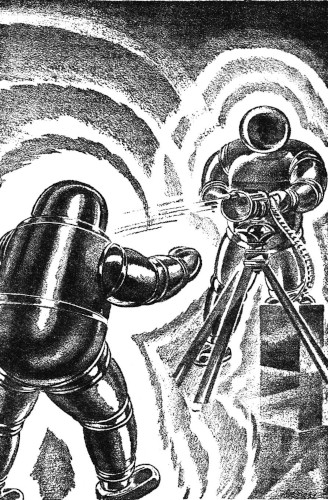
But Helmuth could not now reach that ball of force—and Kinnison's mighty armor forged undamaged through the hail of metal.
Well it was that the Lensman was concentrating upon that screened head; for when the screen weakened slightly and a thought began to seep through it toward an enigmatically sparkling ball of force, Kinnison was ready. He blanketed the thought savagely, before it could take form, and attacked the screen so viciously that Helmuth had either to restore full coverage instantly or die then and there. For the Lensman had studied that ball long and earnestly. It was the one thing about the whole base that he could not understand, the one thing, therefore, of which he had been uneasily afraid.
But he was afraid of it no longer. It was operated, he now knew, by thought; and, no matter how terrific its potentialities might be, it now was and would remain perfectly harmless; for if the pirate chief softened his screen enough to emit a thought, he would never think again.
Therefore, Kinnison rushed. At full blast he hurdled the rifle and crashed full against the armored figure behind it. Magnetic clamps locked and held; and, driving projectors furiously ablaze, he whirled around and forced the madly struggling Helmuth back, toward the line along which the bellowing rifle was still spewing forth a continuous storm of metal.
Helmuth's utmost efforts sufficed only to throw the Lensman out of balance, and both figures crashed to the floor. Now the madly fighting armored pair rolled over and over—straight into the line of fire.
First Kinnison—the bullets whining, shrieking off the armor of his personal battleship and crashing through or smashing ringingly against whatever happened to be in the ever-changing line of ricochet. Then Helmuth—and the fierce-driven metal slugs tore, in their multitudes, through his armor and through his body, riddling his every vital organ.
[Transcriber's Note: Chapter V. heading missing in original text.]