Front matter (continued 4)
Reading edition
Short as was the time necessary to traverse any interplanetary distance, the solarians were detected and were met in force by the ships of Boskone. But scarcely had battle been joined when the enemy began to realize that this was to be a battle the like of which they had never before seen; and when they began to understand it, it was too late. They could not run, and all space was so full of interference that they could not even report to Helmuth what was going on. These first, peculiarly teardrop-shaped vessels of the patrol did not fight at all. They simply held on like bulldogs, taking without response everything that the white-hot projectors could hurl into them.
Their defensive screens radiated fiercely, high into the violet, under the appalling punishment being dealt out to them by the batteries of ship and shore, but they did not go down. Nor did the grip of a single tractor loosen from its anchorage. And in minutes the squat and monstrous maulers came up. Out went their cosmic-energy blocking screens, out shot their tractor beams, and out from the refractory throats of their stupendous projectors there raved the most terrifically destructive forces generable by man.
Boskonian outer screens scarcely even flickered as they went down before the immeasurable, the incredible violence of that thrust. The second course offered a briefly brilliant burst of violet radiance as it gave way. The inner screen resisted stubbornly as it ran the spectrum in a wildly coruscant display of pyrotechnic splendor; but it, too, went through the ultra-violet and into the black.
Now the wall shield itself—that inconceivably rigid fabrication of pure force, which only the instantaneous detonation of twenty metric tons of "duodec" had ever been known to rupture—was all that barred from the base metal of Boskonian walls the utterly indescribable fury of the maulers' beams. Now force was streaming from that shield in veritable torrents.
So terrible were the conflicting energies there at grips that their neutralization was actually visible and tangible. In sheets and masses, in terrific, ether-racking vortices, and in miles-long, pillaring streamers and flashes, those energies were being hurled away—hurled to all the points of the sphere's full compass, filling and suffusing all near-by space.
The Boskonian commanders stared at their instruments, first in bewildered amazement and then in sheer, stark, unbelieving horror as their power intake dropped to zero and their wall shields began to fail—and still the attack continued in never-lessening power. Surely that beaming must slacken down soon. No conceivable mobile plant could throw such a load for long!
But those mobile plants could—and did. The attack kept up, at the extremely high level upon which it had begun. No ordinary storage cells fed those mighty projectors; along no ordinary busbars were their Titanic amperages borne. Those maulers were designed to do just one thing—to maul—and that one thing they did well, relentlessly and thoroughly.
Higher and higher into the spectrum the defending wall shields began to radiate. At the first blast they had leaped almost through the visible spectrum, in one unbearably fierce succession of red, orange, yellow, green, blue, and indigo, up to a sultry, coruscating, blindingly hard violet. Now the doomed shields began leaping erratically into the ultra-violet. To the eye they were already invisible; upon the recorders they were showing momentary flashes of black.
Soon they went down; and in the instant of each failure one vessel of Boskonia was no more. For, that last defense gone, nothing save unresisting metal was left to withstand the ardor of those ultra-powerful, ravening beams. As has already been said, no substance, however refractory or resistant or inert, can endure even momentarily in such a field of force. Therefore, every atom, alike of vessel and of contents, went to make up the searing, seething burst of brilliant, incandescently luminous vapor which suffused all circumambient space.
Thus passed out of the scheme of things the vessels of the solarian detachment of Boskonia. Not a single vessel escaped; the cruisers saw to that. And then the attack thundered on to the bases themselves. Here the cruisers were useless; they merely formed an observant fringe, the while continuing to so blanket all channels of communication that the doomed bases could send out no word of what was happening to them. The maulers moved up and grimly, doggedly, methodically went to work.
Since a base is always much more powerfully armored than is a battleship, the reduction of these fortresses took longer than had the destruction of the fleet. But the bases could no longer draw power from the Sun or from any other heavenly body, and their other sources of power were comparatively weak. Therefore, their defenses also failed under that never-ceasing assault. Course after course their screens went down, and with the last one went the base. The maulers' beams went through metal and masonry as effortlessly as steel-jacketed bullets go through butter, and bored on, deep into the planet's bedrock, before their frightful force was spent.
Then around and around they spiraled, until nothing whatever was left of the Boskonian works; until only a seething, white-hot lake of molten lava in the midst of the planet's frigid waste was all that remained to show that anything had ever been built there.
Surrender had not been thought of. Quarter or clemency had not been asked, nor offered. Victory, of itself, was not enough. This was, and of stern necessity had to be, a war of utter, complete, and merciless extinction.
XIV.
The enemy strongholds so insultingly close to Prime Base having been obliterated, the solarian fleet sailed on into space. For a few weeks game was plentiful enough. Hundreds of raiding vessels were overtaken and held by the patrol cruisers, then blasted to vapor by the maulers.
Many Boskonian bases were also reduced. The locations of most of these had long been known to the intelligence service; others were detected or discovered by the fast-flying cruisers themselves. Marauding vessels revealed the sites of others by succeeding in reaching them before being overtaken by the cruisers. Others were found by the tracers and loops of the signal corps.
Very few of these bases were hidden or in any way difficult of access, and most of them fell before the blasts of a single mauler. But if one mauler was not enough, others were summoned until it did fall. One fortress, a hitherto unknown and surprisingly strong Sector Base, required the concentration of every mauler of the solarian fleet; but they were brought up and the fortress fell. As has been said, this was a war of extinction and every pirate base that was found was reduced.
But one day a cruiser found a base which had not even a spy-ray shield up, and a cursory inspection showed it to be completely empty. Machinery, equipment, stores, and personnel had all been evacuated. Suspicious, the patrol vessels stood off and beamed it from afar, but there were no untoward occurrences. The structures simply slumped down into lava, and that was all.
Every base discovered thereafter was in the same condition, and at the same time the ships of Boskone, formerly so plentiful, disappeared utterly from space. Day after day the cruisers sped hither and thither throughout the vast reaches of the void, at the peak of their unimaginably high pace, without finding a trace of any Boskonian vessel. More remarkable still, and for the first time in years, the ether was absolutely free from Boskonian interference.
Following an impulse, Kinnison asked and received permission to take his ship on scouting duty. At maximum blast, he drove toward the Velantian system, to the point at which he had picked up Helmuth's communication line. Along that line he drove for twenty-two solid days, halting only when a considerable distance outside the galaxy. Ahead of him there was nothing whatever except one or two distant and nebulous star clusters. Behind him there extended the immensity of the galactic lens in all its splendor. But Captain Kinnison had no eye for astronomical beauty that day.
He held the Brittania II there for an hour, while he mulled over in his mind what the apparent facts could mean. He knew that he had covered the line, from the point of determination out beyond the galaxy's edge. He knew that his detectors, operating as they had been in clear and undistorted ether, could not possibly have missed a thing as large as Helmuth's base must be, if it had been anywhere near that line; that their effective range was immensely greater than the largest possible error in the determination or the following of the line. There were, he concluded, three possible explanations, and only three.
First, Helmuth's base might also have been evacuated. This was almost unthinkable. From what he himself knew of Helmuth that base would be as nearly impregnable as anything could be made, and it was no more apt to be vacated than was the Prime Base of the patrol. Second, Helmuth might already have the device he himself wanted so badly, and upon which Hotchkiss and the other experts had been at work so long—a detector nullifier. This was possible, distinctly so. Possible enough, at least, to warrant filing the idea for future consideration. Third, that base might not be in the galaxy at all, but in that star cluster out there straight ahead of the Brittania II, or possibly in one even farther away. That idea seemed the best of the three. It would necessitate ultra-powerful communicators, of course, but Helmuth could very well have them. It squared up in other ways. Its pattern fitted into the matrix very nicely.
But if that base were out there—it could stay there—for a while. The Brittania II just wasn't enough ship for that job. Too much opposition out there, and not—enough—ship. Or too much ship? But he wasn't ready, yet, anyway. He needed, and would get, another line on Helmuth's base. Therefore, shrugging his shoulders, he whirled his vessel about and set out to rejoin the fleet.
While a full day short of junction, Kinnison was called to his plate, to see upon its lambent surface the visage of Port Admiral Haynes.
"Did you find out anything on your trip?" he asked.
"Nothing definite, sir. Just a couple of things to think about, is all. But I can say that I don't like this at all. I don't like anything about it or any part of it."
"No more do I," agreed the admiral. "It looks very much as though your forecast of a stalemate might be about to eventuate. Where are you headed for now?"
"Back to the fleet."
"Don't do it. Stay on scouting duty for a while longer. And, unless something more interesting turns up, report back here to base. We have something that may interest you. The boys have been——"
The admiral's picture was broken up into flashes of blinding light and his words became a meaningless, jumbled roar of noise. A distress call had begun to come in, only to be blotted out by a flood of the Boskonian static interference, of which the ether had for so long been clear.
"Got its center located?" Kinnison barked at his communications officer. "They're close—right in our laps!"
"Yes, sir!" And the radio man snapped out numbers.
"Blast!" the captain commanded, unnecessarily; for the alert pilot had already set the course and his levers were even then flashing across their arcs. "I don't know what we can do, since we haven't got a thing to do anything with, if that baby is what I think it is. But believe me, we'll try!"
Toward the center of disturbance shot Brittania II, herself emitting now a scream of peculiarly patterned interference which was not only a scrambler of all possible communication throughout that whole sector of the galaxy, but also an imperative call for any mauler within that sector. So close had the Brittania II been to the scene of depredation that for her to reach it required only minutes.
There lay the merchantman and her Boskonian assailant. Emboldened by the cessation of piratical activities, some shipping concern had sent out a freighter, loaded probably with highly "urgent" cargo; and this was the result. The marauder, inert, had gripped her with his tractors and was beaming her into submission. She was resisting, but feebly now; it was apparent that her screens were failing. Her crew must soon open ports in token of surrender, or roast to a man; and they would probably prefer to roast.
Thus the situation in one instant. The next instant it was changed; the Boskonian discovering suddenly that his beams, instead of boring through the weak defenses of the freighter, were not even exciting to a glow the mighty protective envelopes of a cruiser of the patrol.
He switched from the diffused heat beam he had been using upon the merchantman to the hardest, hottest, most penetrating beam of annihilation he mounted—with but little more to show for it and with no better results. For the Brittania II's screens had been designed to stand up almost indefinitely against the most potent beams of any space ship, and they stood up. Increase power as he would, to whatever ruinous overload, the pirate could not break down Kinnison's screens; nor, dodge as he would, could he again get in position to attack his former prey. And eventually the mauler arrived; fortunately it, too, had been fairly close by. Out reached its mighty tractors. Out raved one of its tremendous beams, striking the Boskonian's defenses squarely amidships.
That beam struck and the pirate ship disappeared—but not in a hazily incandescent flare of volatilized metal. The raider disappeared bodily, and still all in one piece. He had put out shears of his own, snapping even the mauler's tractors like threads; and the velocity of his departure was due almost as much to the pressor effect of the patrol beam as it was to the thrust of his own powerful drivers.
It was the beginning of the stalemate Kinnison had foreseen.
"I was afraid of that," the young captain muttered; and, paying no attention whatever to the merchantman, he called the commander of the mauler. At this close range, of course, no possible ether scrambler could interfere with visual apparatus, and there on his plate he saw the face of Clifford Maitland, the man who graduated No. 2 in his own class.
"Hi, Kim, you old space flea!" Maitland exclaimed in delight. "Oh, pardon me, sir," he went on in mock deference, with an exaggerated salute. "To a guy with four jets, I should say——"
"Seal that, Cliff, or I'll climb up you like a squirrel, first chance I get!" Kinnison retorted. "So they've got you skippering one of the big battle wagons, huh? Lucky stiff! Think of a mere infant like you being let play with so much high power. But what'll we do about this heap here?"
"Damn if I know. It isn't covered, so you'll have to tell me, captain."
"Who am I to be passing out orders? As you say, it isn't covered in the book. It's against G I regs for them to be cutting our tractors. But he's all yours, not mine. I've got to flit. You might find out what he's carrying, from where, to where, and why. Then, if you want to, you can escort him either back where he came from or on to where he's going, whichever you think best. If this interference dies out, you'd better report to Prime Base and get some real orders. If it doesn't, use your own judgment, if any. Clear ether, Cliff, I've got to buzz along."
"Free landings, space hound!"
"Now, Vic"—Kinnison turned to his pilot—"we've got urgent business at base. And when I say 'urgent' I don't mean perchance. Let's see you burn a hole in the ether." And that worthy snapped his levers over to maximum blast.
The Brittania II made the run to Prime Base in a few days, and scarcely had she touched ground when Kinnison was summoned to the office of the port admiral. As soon as he was announced, Haynes brusquely cleared his office and sealed it against any possible form of intrusion or eavesdropping before he spoke. He had aged noticeably since these two had had that memorable conference in this same room. His face was lined and careworn; his eyes and his entire mien bore witness to days and nights of sleeplessly continuous work.
"You were right, Kinnison," he began, abruptly. "A stalemate it is, a hopeless deadlock. I called you in to tell you that Hotchkiss has your nullifier done, and that it works perfectly against all long-range stuff. It works fairly well on vision, except at close range. Against electromagnetics, however, it is not very effective. About all that can be done, it seems, is to shorten the range; it has not been possible, as yet, to develop a screen against magnetism. Perhaps we expected too much."
"I can get by with that, I think. I will be out of electromagnetic range most of the time, and nobody watches their electros very close, anyway. Thanks a lot. It's ready to install?"
"Doesn't need installation. It's such a little thing you can put it in your pocket. It's self-contained and will work anywhere."
"Better and better. In that case I'll need two of them—and a ship. I would like to have one of those new automatic speedsters.[4] Lots of legs, cruising range, and screens. Only one beam, but I probably won't use even that one so——"
"Going alone?" interrupted Haynes. "Better take a battle cruiser, at least. I don't like the idea of your going out there alone."
"I don't particularly relish the prospect, either. But it's got to be that way. The whole fleet, maulers and all, isn't enough to do by force what's got to be done, and even two men are too many to do it in the only way it can be done. You see, sir——"
"No explanations, please. It's on the spool, where we can get it if we need it. Are you informed as to the latest developments?"
"No, sir. I heard a little coming in, but not much."
"We are almost back where we were before you took off in the Brittania II. Commerce is almost at a standstill, all over the galaxy. All shipping firms are practically idle. But that is neither all of it nor the worst of it. You may not realize how important interstellar trade is; but as a result of its stoppage general business has slowed down tremendously. As is only to be expected, perhaps, complaints are coming in by the thousand because we have not already blasted the pirates out of space, and demands that we do so at once. They do not understand the true situation, nor realize that we are doing all that we can do. We cannot send a mauler with every freighter and liner, and mauler-escorted vessels are the only ones to arrive at their destinations."
"But why? With tractor shears on all ships, how can they hold them?" asked Kinnison.
"Magnets!" snorted Haynes. "Plain, old-fashioned electromagnets. No pull to speak of, at a distance, of course, but with the raider running free, a millionth of a dyne is enough. Close up—lock on—board and storm—all done!"
"Hm-m-m. That changes things. I've got to find a pirate ship. I was planning on following a freighter or liner out toward Alsakan. But if there aren't any to follow—I'll have to hunt around some——"
"That is easily arranged. Lots of them want to go. We will let one go, with a mauler accompanying her, but well outside detector range."
"That covers everything, then, except the assignment. I can't very well ask for leave, but maybe I could be put on special assignment, reporting direct to you?"
"Something better than that." And Haynes smiled broadly, in genuine pleasure. "Everything is fixed. Your release has been entered in the books. Your commission as captain has been canceled, so leave your uniform in your former quarters. Here is your credit book and here is the rest of your kit. You are now an unattached Lensman."
The release! The goal toward which all Lensmen strive, but which so comparatively few attain, even after years of work! He was now a free agent, responsible to no one and to nothing save his own conscience. He was no longer of Earth, nor of the solarian system, but of the galaxy as a whole. He was no longer a tiny cog in the immense machine of the Galactic Patrol; wherever he might go, throughout the immensity of the entire island universe, he would be the Galactic Patrol!
"Yes, it's real." The older man was enjoying the youngster's stupefaction at his release, reminding him as it did of the time, long years ago, when he had won his own. "You go anywhere you please and do anything you please, for as long as you please. You take anything you want, whenever you want it, with or without giving reasons—although you will usually give a thumb-printed credit slip in return. You report if, as, when, where, how, and to whom you please—or not, as you please. You don't even get a salary any more. You help yourself to that, too, wherever you may be—as much as you want, whenever you want it."
"But, sir—I—you——I mean—that is——" Kinnison gulped three times before he could speak coherently. "I'm not ready, sir. Why, I'm nothing but a kid. I haven't got enough jets to swing it. Just the bare thought of it scares me into hysterics!"
"It would. It always does." The admiral was very much in earnest now, but it was a glad, proud earnestness. "You are to be as nearly absolutely free an agent as it is possible for a living, flesh-and-blood creature to be. To the man on the street that would seem to spell a condition of perfect bliss. Only a gray Lensman knows what a frightful load it really is; but it is a load that such a Lensman is glad and proud to carry."
"Yes, sir, he would be, of course, if he——"
"That thought will bother you for a time—if it did not, you would not be here—but do not worry about it any more than you can help. All I can say is that in the opinion of those who should know, not only have you proved yourself ready for release, but also you have earned it."
"How do they figure that out?" Kinnison demanded, hotly. "All that saved my bacon on that trip was luck—a burned-out Bergenholm—and at the time I thought that it was bad luck, at that. And VanBuskirk and Worsel and the other boys and Heaven knows who else pulled me out of jam after jam. I'd like awfully well to believe that I'm ready, sir, but I'm not. I can't take credit for pure dumb luck and for other men's abilities."
"Well, coöperation is to be expected, and we like to make gray Lensmen out of the lucky ones." Haynes laughed deeply. "It may make you feel better, though, if I tell you two more things: first, that so far you have made the best showing of any man yet graduated from Wentworth Hall; second, that we of the court believe you would have succeeded in that almost impossible mission without VanBuskirk, without Worsel, and without the lucky failure of the Bergenholm. In a different, and now, of course, unguessable fashion, but succeeded, nevertheless. Nor is this to be taken as in any sense a belittlement of the very real abilities of those others, nor a denial that luck, or chance, does exist. It is merely our recognition of the fact that you have what it takes to be an unattached Lensman.
"Seal it now, and buzz off!" he commanded, as Kinnison tried to say something; and, clapping him on the shoulder, he turned him around and gave him a gentle shove toward the door. "Clear ether, lad!"
"Same to you, sir—all of it there is. I still think that you and all the rest of the court are cockeyed; but I'll try not to let you down." And the newly unattached Lensman blundered out. He stumbled over the threshold, bumped against a stenographer who was hurrying along the corridor, and almost barged into the jamb of the entrance door instead of going through the opening. Outside he regained his physical poise and walked on air toward his quarters; but he never could remember afterward what he did or whom he met on that long, fast hike. Over and over the one thought pounded in his brain: unattached! Unattached!! UNATTACHED!!
And behind him, in the port admiral's office, that high official sat and mused, smiling faintly with lips and eyes, staring unseeingly at the still-open doorway through which Kinnison had staggered. The boy had measured up in every particular. He would be a good man. He would marry. He did not think so now, of course—in his own mind his life was consecrate—but he would. If necessary, the patrol itself would see to it that he did. There were ways, and such stock was altogether too good not to be propagated. And, fifteen years or so from now—if he lived—when he was no longer fit for the grinding, grueling life to which he now looked forward so eagerly, he would select the Earthbound job for which he was best fitted and would become a good executive. For such were the executives of the patrol. But this daydreaming was getting him nowhere, fast; he shook himself and plunged again into his work.
Kinnison reached his quarters at last, realizing with a thrill that they were no longer his. He now had no quarters, no residence, no address. Wherever he might be, throughout the whole of illimitable space, there was his home. But, instead of being dismayed by the thought of the life he faced, he was filled by a fierce eagerness to be actually living it.
There was a tap at his door and an orderly entered, carrying a bulky package.
"Your grays, sir," he announced, with a crisp salute.
"Thanks." Kinnison returned the salute as smartly; and, almost before the door had closed, he was stripping off the space black-and-silver gorgeousness of the captain's uniform he wore, and was donning gray.
The gray—the unadorned, neutral-colored leather that was the proud garb of that branch of the patrol to which he was thenceforth to belong. It had been tailored to his measurements, and he could not help studying with approval his reflection in the mirror: the round, almost visorless cap, heavily and softly quilted in protection against the helmet of his armor; the heavy goggles, opaque to all radiation harmful to the eyes; the short jacket, emphasizing broad shoulders and narrow waist; the trim breeches and high-laced boots, incasing powerful, tapering legs.
"What an outfit—what an outfit!" he breathed. "And maybe I ain't such a bad-looking ape, at that, in these grays!" He did not then, and never did realize that he was wearing the plainest, drabbest, most strictly utilitarian uniform in the known universe; for to him, as to all others who knew it, the sheer, stark simplicity of the unattached Lensman's plain gray leather transcended by far the gaudy trappings of the other branches of the service. He admired himself boyishly, as men do, feeling a trifle ashamed in so doing; but he did not then and never did appreciate what a striking figure of a man he really was as he strode out of quarters and down the wide avenue toward the Brittania II's dock.
He was glad indeed that there had been no ceremony or public show connected with this, his real and only important graduation. For as his fellows—not only his own crew, but also his friends from all over the Reservation—thronged about him, mauling and pummeling him in congratulation and acclaim, he knew that he couldn't stand much more. If there were to be much more of it, he discovered suddenly, he would either pass out cold or cry like a baby. He didn't quite know which.
That whole howling, chanting mob clustered about him; and, considering it an honor to carry the least of his personal belongings, formed a yelling, cap-tossing escort. Traffic meant nothing whatever to that pleasantly mad crew, nor, temporarily, did regulations. Let traffic detour; let pedestrians, no matter how august, cool their heels; let cars, trucks, yes, even trains, wait until they got past; let everything wait, or turn around and go back, or go some other way. Here comes Kinnison! Kinnison, gray Lensman! Make way! And way was made—from the Brittania II's dock clear across base to the slip in which the Lensman's new speedster lay.
And what a ship this little speedster was! Trim, trig, streamlined to the ultimate she lay there, quiescent but surcharged with power. Almost sentient she was, this power-packed, ultra-racy little fabrication of space-toughened alloy, instantly ready at his touch to liberate those tremendous energies which were to hurl him through the infinite reaches of the cosmic void.
None of the mob came aboard, of course. They backed off, still frantically waving and throwing whatever came closest to hand; and as Kinnison touched a button and shot into the air he swallowed several times in a vain attempt to dispose of an amazing lump which had somehow appeared in his throat.
XV.
It so happened that for many long weeks there had been lying in New York space port an urgent shipment for Alsakan. And not only was that urgency a one-way affair. For, with the possible exception of a few packets, whose owners had locked them in vaults and would not part with them at any price, there was not a single Alsakanite cigarette left on Earth!
Luxuries, then as now, soared feverishly in price with scarcity. Only the rich smoked Alsakanite cigarettes, and to those rich the price of anything they really wanted was a matter of almost complete indifference. And plenty of them wanted, and wanted badly, their Alsakanite cigarettes. There was no doubt of that.
The current market report upon them was: "Bid, one thousand credits per packet of ten. Offered, none at any price."
With that ever-climbing figure in mind, a merchant prince named Matthews had been trying to get an Alsakanbound ship into the ether. He knew that one cargo of Alsakanite cigarettes safely landed in any Tellurian space port would yield more profit than could be made by his entire fleet in ten years of normal trading. Therefore, he had for weeks been pulling every wire, and even every string, that he could reach—political, financial, even at times verging altogether too close for comfort upon the criminal—but without results.
For, even if he could find a crew willing to take the risk, to launch the ship without an escort would be out of the question. There would be no profit in a ship that did not return to Earth. The ship was his, to do with as he pleased, but the escorting maulers were assigned solely by the Galactic Patrol, and that patrol would not give his ship an escort.
In answer to his first request, he had been informed that only cargoes classed as necessary were being escorted at all regularly; that seminecessary loads were escorted occasionally, when of a particularly useful or desirable commodity and if opportunity offered; that luxury loads, such as his, were not being escorted at all; that he would be notified if, as, and when the Prometheus could be given escort. Then the merchant prince began his siege.
Politicians of high rank, local and national, sent in "requests" of varying degrees of diplomacy. Financiers first offered inducements, then threatened to "bear down," then put on all the various kinds of pressure known to their pressure-loving ilk. Pleas, demands, threats, and pressures were alike, however, futile. The patrol could not be coaxed or bullied, cajoled, bribed, or cowed; and all further communications upon the subject, from whatever source originating, were ignored.
Having exhausted his every resource of diplomacy, politics, guile, and finance, the merchant prince resigned himself to the inevitable and stopped trying to get his ship off the ground.
Then, like the proverbial bolt from the blue, New York sub-base received from Prime Base an open message, not even coded, which read:
Authorize space ship Prometheus to clear for Alsakan at will, escorted by patrol ship B 42 TC 838, whose present orders are hereby canceled. Signed, Haynes.
A demolition bomb dropped into that sub-base would not have caused greater excitement than did that message. Neither the base commander, the captain of the mauler, the captain of the Prometheus, nor the highly pleased but equally surprised Matthews could explain it; but all of them did whatever they could to expedite the departure of the freighter. She was, and had been for a long time, practically ready to sail.
As the base commander and Matthews sat in the office, shortly before the scheduled time of departure, Kinnison arrived—or, more correctly, let them know that he was there. He invited them both into the control room of his speedster; and invitations from gray Lensmen were accepted without question or demur.
"I suppose that you are wondering what this is all about," he began. "I'll make it as short as I can. I asked you in here because this is the only convenient place in which I know that what we say will not be overheard. There are lots of spy rays around here, whether you know it or not. The Prometheus is to be allowed to go to Alsakan, because that is where pirates seem to be most numerous, and we do not want to waste time hunting all over space to find one.
"Your vessel was selected, Mr. Matthews, for three reasons, and in spite of the attempts you have been making to obtain special privileges, not because of them: first, because there is no necessary or seminecessary freight waiting for clearance into that region; second, because we do not want your firm to fail. We do not know of any other large shipping line in such a shaky position as yours, nor of any firm anywhere to which one single cargo would make such an immense financial difference."
"You are certainly right there, Lensman!" Matthews agreed, whole-heartedly. "It means bankruptcy on the one hand and a fortune on the other."
"Here's what is to happen. The ship and the mauler blast off on schedule, fourteen minutes from now. They get about to Valeria, when they are both recalled—urgent orders for the mauler to go on rescue work. The mauler comes back, but your captain will, in all probability, keep on going, saying that he started out for Alsakan and that's where he's going——"
"But he wouldn't. He wouldn't dare!" gasped the ship owner.
"Sure he would," Kinnison insisted, cheerfully enough. "That is the third good reason your vessel is being allowed to set out: because it certainly will be attacked. You didn't know it until now, but your captain and over half of your crew are pirates themselves, and——"
"What? Pirates!" Matthews bellowed. "I'll go down there and——"
"You'll do nothing whatever, Mr. Matthews, except watch things, and you will do that from here. The situation is entirely under control."
"But my ship! My cargo!" the shipper wailed. "We'll be ruined if——"
"Let me finish, please," the Lensman interrupted. "As soon as the mauler turns back it is practically certain that your captain will send out a message, letting the pirates know that he is easy prey. Within a minute after sending that message, he dies. So does every other pirate aboard. Your ship lands on Valeria and takes on a crew of space-fighting wildcats, headed by Peter VanBuskirk. Then it goes on toward Alsakan. When the pirates board that ship, after its prearranged, half-hearted resistance and easy surrender, they are going to think that all hell's out for noon. Especially since the mauler, back from her 'rescue work,' will be tagging along, not too far away."
"Then my ship will really go to Alsakan, and back, safely?" Matthews was almost dazed. Matters were entirely out of his hands, and things had moved so rapidly that he hardly knew what to think. "But if my own crews are pirates, some of them may——But I can, of course, get police protection if necessary."
"Unless something entirely unforseen happens, the Prometheus will make the round trip in safety, cargoes and all—under mauler escort all the way. You will, of course, have to take the other matter up with your local police."
"When is the attack to take place, sir?" asked the base commander.
"That's what the mauler skipper wanted to know when I told him what was ahead of him." Kinnison grinned. "He wanted to sneak up a little closer about that time. I'd like to know, myself, but unfortunately that will have to be decided by the pirates after they get the signal. It will be on the way out, though, because the cargo she has aboard now is a lot more valuable to Boskone than a load of Alsakanite cigarettes would be."
"But do you think you can take the pirate ship that way?" asked the commander, dubiously.
"No. But he will cut down his personnel to such an extent that he will have to head back for base."
"And that's what you want—the base. I see."
He did not see—quite—but the Lensman did not enlighten him further.
There was a brilliant double flare as freighter and mauler lifted into the air. Kinnison showed the ship owner out.
"Hadn't I better be going, too?" asked the commander. "Those orders, you know."
"A couple of minutes yet. I have another message for you—official. Matthews won't need a police escort long—if any. When that ship is attacked it is to be the signal for cleaning out every pirate in Greater New York—the worst pirate hotbed on Tellus. Neither you nor your force will be in on it directly, but you might pass the word around, so that our own men will be informed ahead of the Telenews outfits."
"Good! That has needed doing for a long time."
"Yes. But you know it takes a long time to line up every man in such a big organization. They want to get them all, without getting any innocent by-standers."
"Who's doing it? Prime Base?"
"Yes. Enough men will be thrown in here to do the whole job in an hour."
"That is good news. Clear ether, Lensman!" And the base commander went back to his post.
As the air-lock toggles rammed home, sealing the exit behind the departing visitor, Kinnison eased his speedster into the air and headed for Valeria. Since the two vessels ahead of him had left atmosphere inertialess, as would he, and since several hundred seconds had elapsed since their take-off, he was, of course, some ten thousand miles off their line as well as being uncounted millions of miles behind them. But the larger distance meant no more than the smaller, and neither of them meant anything at all to the patrol's finest speedster. Kinnison, on easy touring blast, caught up with them in minutes. Closing up to less than one light year, he slowed his pace to match theirs and held his distance.
Any ordinary ship would have been detected instantly—long since, in fact—but Kinnison rode no ordinary ship. His speedster was immune to all detection save electromagnetic or visual, and, therefore, even at that close range—the travel of half a minute for even a slow space ship in open space—he was safe. For electromagnetics are useless at that distance; and visual apparatus, even with subether converters, is reliable only up to a few mere thousands of miles, unless the observer knows exactly what to look for and where to look for it.
Kinnison, then, closed up and followed the Prometheus and her mauler escort; and as they approached the Valerian solar system, sure enough, the recall messages came booming in. Also, as had been expected, the renegade captain of the freighter sent back, first his defiant answer, and then his message to the pirate high command. The mauler turned back; the merchantman kept on. Suddenly, however, she stopped, inert, and from her ports were ejected discrete bits of matter—probably the bodies of the Boskonian members of her crew. Then the Prometheus, again inertialess, flashed directly toward the planet Valeria.
An inertialess landing is, of course, highly irregular, and is made only when the ship is to take off again immediately. It saves all the time ordinarily lost in spiraling and deceleration, and saves the computation of a landing orbit, which is no task for an amateur computer. It is, however, dangerous.
It takes power, plenty of it, to maintain the force which neutralizes the inertia of mass, and if that force fails, even for an instant, while a ship is upon a planet's surface, the consequences are usually highly disastrous. For in the neutralization of inertia there is no magic, no getting of something for nothing, no violation of Nature's law of the conservation of matter and energy. The instant that force becomes inoperative the ship possesses exactly the same velocity, momentum, and inertia that it possessed at the instant the force took effect.
Thus, if a space ship takes off from Earth, with its orbital velocity of about eighteen and one half miles per second relative to the Sun, goes free, dashes to Mars, lands free, and then goes inert, its original velocity, both in speed and in direction, is instantly restored, with consequences better imagined than described. Such a velocity, of course, might take the ship harmlessly into the air; but it probably would not.
But the Prometheus landed free, and so did Kinnison. He stepped out, fully armored against Valeria's extremely heavy atmosphere and laboring a trifle under its terrific gravitation, to be greeted cordially by Lieutenant VanBuskirk, whose fighting men were already streaming aboard the freighter.
"Hi, chief!" the Dutchman called, gayly. "Everything went off like clockwork. Won't hold you up long—be blasting off in ten minutes."
"Ho, Lefty!" the Lensman acknowledged, as cordially, but saluting the newly commissioned officer with an exaggerated formality. "Say, Bus, I've been doing some thinking. Why wouldn't it be a good idea to——"
"Uh-uh, it would not," denied the fighter, positively. "I know what you're going to say—that you want in on this party—but don't say it."
"But I——" Kinnison began to argue.
"Nix," the Valerian declared flatly. "You've got to stay with your speedster. No room for her inside, as she's full to the last meter with cargo and with my men. You can't clamp on outside, as that would give the whole thing away. And besides, for the first and last time in my life I've got a chance to give a gray Lensman orders. Those orders are to stay out of and away from this ship—and I'll see to it that you do, too, you little Tellurian wart! Boy, what a kick I get out of that!"
"You would, you big, dumb Valerian ape. You always were a small-souled type!" Kinnison retorted. "Piggy-piggy——Haynes, huh?"
"Uh-huh." VanBuskirk nodded. "How else could I talk so rough to you and get away with it? However, don't feel too bad. You aren't missing a thing, really. This thing is in the cans already, and your fun is up ahead somewhere. And by the way, Kim, congratulations. You had it coming. We're all behind you, from here to the next universe and back."
"Thanks. And the same to you, Bus, and many of 'em. Well, if you won't let me stow away, I'll tag along behind, I guess. Clear ether—or rather, I hope it's full of pirates by to-morrow morning. Won't be, though, probably; don't imagine they'll move until we're almost there."
And tag along Kinnison did, through thousands and thousands of parsecs of uneventful voyage.
Part of the time he spent in the speedster, dashing hither and yon. Most of it, however, he spent in the vastly more comfortable mauler; to the armored side of which his tiny vessel clung with its magnetic clamps while he slept and ate, gossiped and read, exercised and played with the mauler's officers and crew, in deep-space comradery. It so happened, however, that when the long-waited attack developed he was out in his speedster, and thus saw and heard everything from the beginning.
Space was filled with the old, familiar interference. The raider flashed up, locked on with magnets, and began to beam. Not heavily—scarcely enough to warm up the defensive screens—and Kinnison probed into the pirate with his spy ray.
"Terrestrials—and Americans!" he exclaimed, half aloud, startled for an instant. "But naturally they would be, since this is a put-up job and over half the crew were New York gangsters."
"The blighter's got his spy-ray screens up," the pilot was grumbling to his captain. The fact that he spoke in English was immaterial to the Lensman; he would have understood equally well any other possible form of communication or of thought exchange. "That wasn't part of the plan, was it?"
If Helmuth, or one of the able minds at his base, had been directing that attack it would have stopped right there. The pilot had shown a flash of feeling that, with a little encouragement, might have grown into a suspicion.
But the captain was not an imaginative man. Therefore: "Nothing was said about it, either way," he replied. "Probably the mate's on duty. He is not one of us, you know. All the better if he is. The captain will open up. If he doesn't do it pretty quick, I'll open her up myself. There, the port's opening. Slide a little forward.... Hold it! Go get 'em, men!"
Then men, hundreds of them, armed and armored, swarmed through the freighter's locks. But as the last man of the boarding party passed the portal something happened that was most decidedly not on the program: the outer port slammed shut and its toggles drove home!
"Blast those screens! Knock them down! Get in there with a spy ray!" barked the pirate captain. He was not one of those hardy and valiant souls who, like Gildersleeve, led, in person, the attacks of his cutthroats. He emulated, instead, the higher Boskonian officials and directed his raids from the safety of his control room; but, as has been intimated, he was unlike those officials in that he lacked directorial ability. Thus it was only after it was too late that he became suspicious. "I wonder if somebody could have double-crossed us? Hi-jackers?"
"We'll soon know," the pilot growled, and even as he spoke the spy ray got through, revealing a very shambles.
For VanBuskirk and his Valerians had not been caught napping, nor were they a crew—unarmored, partially armed, and rendered even more impotent by internal mutiny, strife, and slaughter—such as the pirates had expected to find.
Instead of such a crew the boarders met a force that was overwhelmingly superior to their own—not only in point of numbers, but even more markedly in the strength and agility of its units. Also, the defenders were more capably armed than were the attackers, since, in addition to the efficient armor of the patrol and its ultra-deadly portable weapons, at least one of those terrific semiportable projectors commanded every corridor of the freighter. In the blasts of those projectors most of the pirates died instantly, not knowing what struck them, not even knowing that they died.
They were the fortunate ones. The others knew what was coming and saw it as it came, for the Valerians did not even draw their DeLameters. They knew that the pirates' armor could withstand for many minutes any hand weapon's beams, and they disdained to remount the heavy semiportables. They came in with their space axes, and at the sight the pirates broke and ran screaming in panic fear. But they could not escape. The toggles of the exit port were not only in their sockets, but they were also locked in them.
Therefore, the storming party died to the last man; and, as VanBuskirk had foretold, it was scarcely even a struggle. For any ordinary space armor is just so much tin against a Valerian swinging a space ax.
The spy ray of the pirate captain got through just in time to see the ghastly finale of the massacre, and his face turned first purple, then white.
"The patrol!" he gasped. "Valerians—a whole company of them! I'll say we've been double-crossed!"
"Right-o—we've jolly well been," the pilot agreed. "You don't know the half of it yet, either. Somebody's coming, and it isn't a boy scout. If a mauler should suck us in, we'd be very much a spent force, what?"
"Cut out the conversation!" snapped the captain. "Is it a mauler, or not?"
"A bit too far away yet to say, but it probably is. They wouldn't have sent those jaspers out without cover, old bean. They knew that we can burn that freighter's screens down in an hour. Better cut the beams and get ready to run, what?"
The commander did so, wild thoughts racing through his mind. If a mauler got close enough to him to use magnets, he was done. Cutting arcs would burn through his armor like cheese, and he had no fighting men left. And even if he had—even a full crew of the most savage fighters known would have to be inescapably cornered before they would mix it with what that mauler had aboard. He would have to go back to base, anyway——
"Tally ho, old fruit!" The pilot slammed his levers over to maximum blast. "It's a mauler and we've been bloody well jobbed. Back to base?"
"Yes." And the discomfited captain energized his communicator, to report to his immediate superior the humiliating outcome of the supposedly carefully planned coup.
XVI.
As the pirate fled into space Kinnison followed, matching his quarry in course and speed. He then cut in the automatic controller on his drive, the automatic recorder on his plate, and began to tune in his beam tracer; only to be brought up short by the realization that the spy ray's point would not stay in the pirate's control room without constant attention and manual adjustment. He had known that, too. Even the most precise of automatic controllers, driven by the most carefully stabilized electronic currents, are prone to slip twenty feet or so at even such close range as ten million miles, especially in the bumpy ether near solar systems, and there was nothing to correct the slip. He had not thought of that before; the pilot always made those minor corrections as a matter of course.
But now he was torn between two desires. He wanted to listen to the conversation that would ensue as soon as the pirate captain got into communication with his superior officers; and, especially should Helmuth put in his beam, he very much wanted to trace it and thus secure another line on the headquarters he was so anxious to locate. He now feared that he could not do both—a fear that soon was to prove well-grounded—and wished fervently that for a few minutes he could be two men—or at least a Velantian; they had eyes and hands and separate brain compartments enough so that they could do half a dozen things at once and do each one well. He could not; but he could try. Maybe he should have brought one of the boys along, at that. No, that would wreck everything, later on; he would have to do the best he could.
Communication was established and the pirate captain began to make his report. By using one hand on the ray and the other on the tracer, Kinnison managed to get a partial line and to record scraps of the conversation. He missed, however, the essential part of the entire episode, that part in which the base commander turned the unsuccessful captain over to Helmuth himself. Therefore, Kinnison was surprised indeed at the disappearance of the beam he was so laboriously tracing, and to hear Helmuth conclude his castigation of the unlucky captain with:
"—not entirely your fault. We will not punish you at all severely this time. Report to our base on Aldebaran I. Turn your vessel over to base commander there and do anything he tells you to do for thirty of the days of that planet."
Frantically, Kinnison drew back his tracer and searched for Helmuth's beam; but before he could synchronize with it the message of the pirates' high chief was finished and his beam was gone. The Lensman sat back in thought.
Aldebaran! Practically next door to his own solarian system, from which he had come so far. How had they possibly managed to keep concealed, or to re-establish, a base so close to Sol, through all the intensive searching that had been done? But they had. That was the important thing. Anyway, he knew where he was going, and that helped.
One other thing he hadn't thought of—and one that might have spoiled everything—was the fact that he couldn't stay awake indefinitely to follow that ship! He had to sleep sometime, and while he was asleep his quarry was bound to escape. He, of course, had a CRX tracer, which would hold a ship without attention as long as it was anywhere within even extreme range; and it would have been a simple enough matter to have had a photo-cell relay put in between the plate of the CRX and the automatic controls of the spacer and driver—but he had not asked for it. Well, luckily, he now knew where he was going, and the trip to Aldebaran would be long enough for him to build a dozen such controls. He had all the necessary parts and plenty of tools. It would give him something to do to break the monotony of the voyage.
Therefore, following the pirate ship easily as it tore through space, Kinnison built his automatic "chaser," as he called it. During each of the first four or five "nights" he lost the vessel he was pursuing, but found it without any great difficulty upon awakening. Thereafter he held it continuously, improving day by day the performance of his apparatus until it could do almost anything except talk.
After that he devoted his time to an intensive study of the general problem before him. His results were highly unsatisfactory; for in order to solve any problem one must have enough data to set it up, either in actual equations or in logical sequences, and Kinnison found that he did not have enough data. He had altogether too many unknowns and not enough knowns.
The first specific problem was that of getting into the pirate base. Since the searchers of the patrol had not found it, that base must be very well hidden indeed. And hiding anything as large as a base on Aldebaran I, as he remembered it, would be quite a feat in itself. He had been in that system only once, but——
Alone in his ship, and in deep space although he was, he blushed painfully as he remembered what had happened to him during that visit. He had chased a couple of dope runners to Aldebaran II, and there he had encountered the most vividly, the most flawlessly, the most remarkably and intriguingly beautiful girl he had ever seen. He had seen beautiful girls and women, of course, before and in plenty. He had seen beauties amateur and professional—social butterflies, dancers, actresses, models, and posturers, both in the flesh and in Telenews plates—but he had never supposed that such an utterly ravishing creature as she was could exist outside of a thionite dream. As a timidly innocent damsel in distress she had been perfect, and if she had held that pose a little longer Kinnison shuddered to think of what might have happened.
But, having known too many dope runners and too few patrolmen, she misjudged entirely, not only the cadet's sentiments, but also his reactions. For, even as she came amorously into his arms, he had known that there was something screwy. Women like that did not play that kind of game for nothing. She must be mixed up with the two he had been chasing. He got away from her, with only a couple of scratches, just in time to capture her confederates as they were making their escape. He had been afraid of beautiful women ever since. He'd like to see that Aldebaranian hell-cat again—just once. He'd been just a kid then, but now——
But that line of thought was getting him nowhere, fast. It was Aldebaran I that he had better be thinking of: barren, lifeless, desolate, airless, waterless; bare as his hand, covered with extinct volcanoes, cratered, jagged, and torn. To hide a base on that planet would take plenty of doing, and, conversely, it would be correspondingly difficult of approach. If on the surface at all, which he doubted very strongly, it would be covered.
In any event, all its approaches would be thoroughly screened and equipped with lookouts on the ultra-violet and on the infra-red, as well as on the visible. His detector nullifier wouldn't help him much there. Those screens and lookouts were bad—very, very bad. Question: could anything get into that base without setting off an alarm?
His speedster could not even get close; that was certain. Could he, alone? He would have to wear armor, of course, to hold his air, and it would radiate. Not necessarily—he could land out of range and walk, without power; but there were still the screens and the lookouts. If the pirates were on their toes it simply wasn't in the cards; and he had to assume that they would be alert.
What, then, could pass those barriers? Prolonged consideration of every facet of the situation gave definite answer and marked out clearly the course he must take. Something admitted by the pirates themselves was the only thing that could get in. The vessel ahead of his was going in. Therefore, he must and would enter that base within the pirate vessel itself. With that point decided there remained only the working out of a method, which proved to be almost ridiculously simple.
Once inside the base, what should he—or rather, what could he—do? For days he made and discarded plans, but finally he tossed them all out of his mind. So much depended upon the location of the base, its personnel, its arrangement, and its routine, that he could develop not even the rough draft of a working plan. He knew what he wanted to do, but he had not even the remotest idea as to how he could go about doing it. Of the opening that appeared, he would have to choose the most feasible and fit his actions to whatever situation then and there obtained.
So deciding, he shot his spy ray toward the planet and studied it with care. It was, indeed, as he had remembered it—or worse. Bleakly, hotly arid, it had no soil whatever, its entire surface being composed of igneous rock, lava, and pumice. Stupendous ranges of mountains crisscrossed and intersected each other at random, each range a succession of dead volcanic peaks and blown-off craters. Mountainside and rocky plain, crater wall and valley floor, alike and innumerably were pock-marked with subcraters and with immensely yawning shell holes, as though the whole planet had been, throughout geologic ages, the target of an incessant cosmic bombardment.
Over its surface and through and through its volume he drove his spy ray, finding nothing. He bored into its substance with his detectors and his tracers, with results completely negative. Of course, closer up, his electromagnetics would report iron—plenty of it—but that information would also be meaningless. Practically all planets had iron cores.
As far as his instruments could tell—and he had given Aldebaran I a more thorough going over, by far, than any ordinary surveying ship would have given it—there was no base of any kind upon or within the planet. Yet he knew that a base was there. So what? So—maybe—Helmuth's base might be inside the galaxy after all, protected from detection in the same way, probably by solid miles of iron or of iron ore. A second line upon that base had now become imperative. But they were approaching the system fast; he had better get ready.
He belted on his personal equipment, including a nullifier, then inspected his armor, checking its supplies and apparatus carefully before he hooked it ready to his hand. Glancing into the plate, he noted with approval that his chaser was functioning perfectly. Pursued and pursuer were now both well inside the solar system of Aldebaran; and, as slowed the pirate, so slowed the speedster.
Finally, the leader went inert in preparation for his spiral. But Kinnison was no longer following. Before he went inert he flashed down to within fifty thousand miles of the planet's forbidding surface. He then cut his Bergenholm, threw the speedster into an almost circular orbit, well away from the landing orbit selected by the pirate, cut off all his power, and drifted. He stayed in the speedster, observing and computing, until he had so exactly defined its path that he could find it unerringly at any future instant. Then he went into the air lock, stepped out into space, and, waiting only to be sure that the portal had snapped shut behind him, set his course toward the pirate's spiral.
Inert now, his progress was so slow as to seem imperceptible, but he had plenty of time. And it was only relatively that his speed was low. He was actually hurtling through space at the rate of well over two thousand miles an hour, and his powerful little driver was increasing that speed constantly by an acceleration of two Earth gravities.
Soon the vessel crept up, beneath him now, and Kinnison, increasing his drive to five gravities, shot toward it in a long, slanting dive. This was the most ticklish minute of the trip, but the Lensman had assumed correctly that the officers of the badly undermanned ship would be looking ahead of them and down, not backward and up. They were, and he made his approach unseen. The approach itself, the boarding of an inert space ship at its frightful landing-spiral velocity, was elementary to any competent space man—simplicity itself. There was not even a flare to bother him or to reveal him to sight, as the braking jets were now doing all the work. Matching course and velocity ever more closely, he crept up—flung his magnet—pulled up, hand over hand—opened the emergency inlet lock—and there he was.
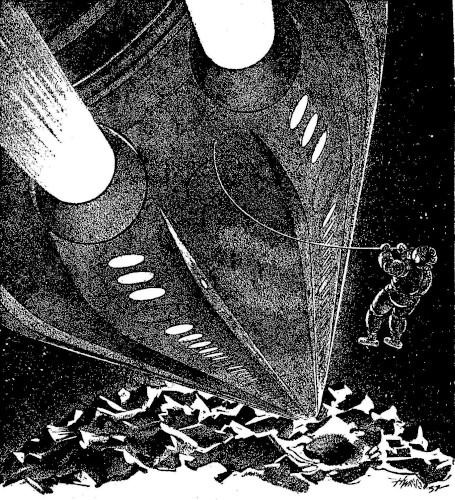
Matching course and velocity, he crept up—flung his magnet, pulled up, hand over hand——
Unconcernedly, he made his way along the sternway and into the now deserted quarters of the fighters. There he lay down in a hammock, snapped the acceleration straps, and shot his spy ray into the control room. And there, in the pirate captain's own visiplate, he observed the rugged and torn topography of the terrain below, as the pilot fought his ship down, mile by mile.
Tough going, this, Kinnison reflected, and the bird was doing a nice job, even if he was taking it the hard way, bringing her down straight on her nose instead of taking one more spiral around the planet and then sliding in on her under jets, which were designed and placed specifically for such work. But taking it the hard way he was, and his vessel was bucking, kicking, bouncing, and spinning on the terrific blast from her braking jets. Down she came, fast; and it was only after she was actually inside one of those stupendous craters, well below the level of its rim, that the pilot flattened her out and assumed normal landing position.
They were still going too fast, Kinnison thought. But the pirate pilot knew what he was doing. Five miles the vessel dropped, straight down that Titanic shaft, before the bottom was reached. The shaft's wall was studded with windows; in front of the craft loomed the outer gate of a gigantic air lock. It opened; the ship was trundled inside, landing cradle and all, and the massive gate closed behind it. This was the pirates' base, and Kinnison was inside it!
"Men, attention!" The pirate commander snapped then. "This air is deadly poison, so put on your armor and be sure your tanks are full. They have rooms for us, having good air, but don't open your suits a crack until I tell you to. Assemble! All of you that are not here in this control room in five minutes will stay on board and take your own chances!"
Kinnison decided instantly to assemble with the crew. He could do nothing in the ship, and it would be inspected, of course. He had plenty of air, but space armor all looked alike, and his Lens would warn him in time of any unfriendly or suspicious thought. He had better go. If they called a roll——But he would cross that bridge when he came to it.
No roll was called; in fact, the captain paid no attention at all to his men. They could come along or not, just as they pleased. But since to stay in the ship meant death, every man was prompt. At the expiration of the five minutes the captain strode away, followed by the crowd. Through a doorway, left turn, and the captain was met by a creature whose shape Kinnison could not make out. A pause, a straggling forward, then a right turn.
Kinnison decided that he would not take that turn. He would stay here, close to the shaft—where he could blast his way out if necessary—until he had studied the whole base thoroughly enough to map out a plan of campaign. He soon found an empty and apparently unused room, and assured himself that through its heavy, crystal-clear window he could indeed look out into the vastly cylindrical emptiness of the volcanic shaft.
Then, with his spy ray, he watched the pirates as they were escorted to the quarters prepared for them. Those might have been rooms of state, but it looked to Kinnison very much as though his former shipmates were being jailed ignominiously, and he was glad that he had taken leave of them. Shooting his ray here and there throughout the structure, he finally found what he was looking for: the communicator room. That room was fairly well lighted, and at what he saw there his jaw dropped in sheerest amazement.
He had expected to see men, since Aldebaran II, the only inhabited planet in the system, had been colonized from Tellus and its people were as truly human and Caucasian as those of Chicago or of Paris. But these—these things——He had been around quite a bit, but he had never seen nor heard of their like. They were wheels, really. When they went anywhere they rolled. Heads where hubs ought to be—eyes—arms, dozens of them, and very capable-looking hands——
"Vogenar!" a crisp thought flashed from one of the peculiar entities to another, impinging also upon Kinnison's Lens. "Some one—some outsider—is looking at me. Relieve me while I abate this intolerable nuisance."
"One of those creatures from Tellus? We will teach them very shortly that such intrusion is not to be borne for an instant."
"No, it is not one of them. The touch is similar, but the tone is entirely different. Nor could it be one of them, for not one of them is equipped with the instrument which is such a clumsy substitute for the sense of perception with which all really intelligent races are endowed in their minds. There, I will now begin to——"
Kinnison snapped on his thought-screen, but the damage had already been done.
In the violated communications room the angry observer went on: "—attune myself and trace the origin of that prying look. It has disappeared now, but its sender cannot be distant, since our walls are shielded and screened. Ah, there is a blank space which I cannot penetrate, in the seventh room of the fourth corridor. In all probability it is one of our guests, hiding now behind a thought screen." Then his orders boomed out to a corps of guards. "Take him and put him with the others!"
Kinnison had not heard the order, but he was ready for anything, and those who came to take him found that it was easier far to issue such orders than to carry them out.
"Halt!" snapped the Lensman, his Lens carrying the crackling command deep into the wheelmen's minds. "I do not wish to harm you, but come no closer!"
"You? Harm us?" came a cold, clear thought, and the creatures vanished. But not for long. They, or others like them, were back in moments, this time armed and armored for strife.
Again Kinnison found that rays were useless. The armor of the foe-mounted generators as capable as his own; and, although the air in the room soon became one intolerably glaring field of force, in which the very walls themselves began to crumble and to vaporize, neither he nor his attackers were harmed. Again, then, the Lensman had recourse to his medieval weapon, sheathing his DeLameter and wading in with his ax. Although not a VanBuskirk, he was, for an Earthman, of unusual strength, skill, and speed; and to those opposing him he was a very Hercules.
Therefore, as he struck and struck and struck again, the cell became a gorily reeking slaughter pen, its every corner high-piled with the shattered corpses of the wheelmen and its floor running with blood and slime. The last few of the attackers, unwilling to face longer that irresistible steel, wheeled away, and Kinnison thought flashingly of what he should do next.
This trip was a bust so far. He couldn't do himself a bit of good here now, and he'd better buzz off while he was still in one piece. How? The door? No. Couldn't make it. He'd run out of time quick that way. Better take out the wall. That would give those Wheelmen something else to think about, too, while he was doing his flit.
Only a fraction of a second was taken up by these thoughts; then Kinnison was at the wall. He set his DeLameter to minimum aperture and at maximum blast, to throw a cutting pencil against which no material substance could stand. Through the wall that pencil pierced—up, over, and around.
But, fast as the Lensman had acted, he was still too late. There came trundling into the room behind him, upon four low wheels, a truck, bearing a squat and monstrous mechanism. Kinnison whirled to face it. As he turned the section of the wall upon which he had been at work blew outward with a deafening crash. The ensuing rush of escaping atmosphere picked the Lensman up as though he had been a straw and hurled him out through the opening and into the shaft. In the meantime the mechanism upon the truck had begun a staccato, grinding roar, and as it roared Kinnison felt slugs ripping through his armor and tearing through his flesh, each as crushing, crunching, paralyzing a blow as though it had been inflicted by VanBuskirk's space ax.
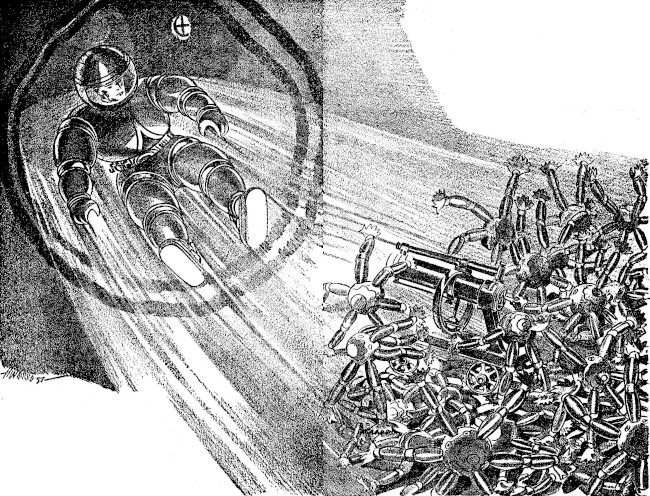
The rush of escaping atmosphere picked the Lensman up as though he had been a straw—hurled him out——
This was the first time that Kinnison had ever been really badly wounded, and it made him sick. But, sick and numb, senses reeling at the shock to his slug-torn body, his right hand flashed to the external controller of his neutralizer. For he was falling inert. It was only ten or fifteen meters to the bottom, as he remembered it. He had mighty little time to waste if he were not to land inert. He snapped the controller. Nothing happened. Something had been shot away. His driver, too, was dead. Snapping the sleeve of his armor into its clamps he began to withdraw his arm in order to operate the internal controls, but he ran out of time. He crashed, on the top of a subsiding pile of masonry which had preceded him, but which had not yet attained a state of equilibrium, underneath a shower of similar material which rebounded from his armor in a boiler-shop clangor of noise.
Well it was that that heap of masonry had not yet had time to settle into form, for in some slight measure it acted as a cushion to break the Lensman's fall. But an inert fall of forty feet, even cushioned by rocks, is in no sense a light one. Kinnison crashed. It seemed as though a thousand pile drivers struck him at once. Surges of almost unbearable agony swept over him, as bones snapped and bruised flesh gave way. He knew dimly that a merciful tide of oblivion was reaching up to engulf his shrieking, suffering mind.
But, foggily at first in the stunned confusion of his entire being, something stirred, that unknown and unknowable something, that indefinable ultimate quality that had made him worthy of the Lens he wore. He lived, and while a Lensman lived he did not quit. To quit was to die then and there, since he was losing air fast. He had plastic in his kit, of course, and the holes were small. He must plug those leaks, and plug them quick.
His left arm, he found, he could not move at all. It must be smashed pretty badly. Every shallow breath was a searing pain. That meant a rib or two gone out. Luckily, however, he was not breathing blood; therefore, his lungs must still be intact. He could move his right arm, although it seemed like a lump of clay or a limb belonging to some one else.
But, mustering all his power of will, he made it move. He dragged it out of the armor's clamped sleeve, forced the leaden hand to slide through the welter of blood that seemed almost to fill the bulge of his armor. He found his kit box, and, after an eternity of pain-racked time, he compelled his sluggish hand to open it and to take out the plastic.
Then, in a continuously crescendo throbbing of agony, he forced his maimed, crushed, and broken body to writhe and to wriggle about, so that his one sound hand could find and stop the holes through which his precious air was whistling out and away. Find them he did, and quickly, and sealed them tight; but when he had plugged the last one he slumped down, spent and exhausted. He did not hurt so much, now; his suffering had mounted to such terrific heights of intolerable keenness that the nerves themselves, in outraged protest at carrying such a load, had blocked it off.
There was much more to do, but he simply could not do it without a rest. Even his iron will could not drive his tortured muscles to any further effort until after they had been allowed to recuperate a little from what they had gone through.
How much air did he have left, if any, he wondered, foggily and with an entirely detached and disinterested impersonalness. Maybe his tanks were empty. Of course, it couldn't have taken him as long to plug those leaks as it had seemed to, or he wouldn't have had any air left at all, in tanks or suit. He couldn't, however, have much left. He would look at his gauges and see.
But now he found that he could not move even his eyeballs, so deep was the coma that was enveloping him. Away off somewhere there was a billowing expanse of blackness, utterly heavenly in its deep, softly-cushioned comfort; and from that sea of peace and surcease there came reaching to embrace him huge, soft, tender arms. Why suffer, something crooned at him. It was so much easier to let go!
XVII.
Kinnison did not lose consciousness—quite. There was too much to do, too much that had to be done. He had to get out of here. He had to get back to his speedster. He had, by hook or by crook, to get back to Prime Base! Therefore, grimly, doggedly, teeth tight-locked in the enhancing agony of every movement, he drew again upon those hidden, those deeply buried resources which even he had no idea he possessed. His code was simple: the code of the Lens. While a Lensman lived he did not quit. Kinnison was a Lensman. Kinnison lived. Kinnison did not quit.
He fought back that engulfing tide of blackness, wave by wave as it came. He beat down by sheer force of will those tenderly beckoning, those sweetly seducing arms of oblivion. He forced the mass of protesting putty that was his body to do what had to be done. He thrust styptic gauze into the most copiously bleeding of his wounds. He was burned, too, he discovered then—they must have had a high-powered needle ray on that truck, as well as the rifle—but he could do nothing about burns. There simply wasn't time.
He found the power lead that had been severed by a bullet. Stripping the insulation was an almost impossible job, but it was finally accomplished, after a fashion. Bridging the gap proved to be even a worse one. Since there was no slack, the ends could not be twisted together, but had to be joined by a short piece of spare wire, which, in turn, had to be stripped and then twisted with each end of the severed lead. That task, too, he finally finished, although he was working purely by feel and half conscious withal in a wracking haze of pain.
Soldering those joints was, of course, out of the question. He was afraid even to try to insulate them with tape, lest the loosely twined strands should fall apart in the attempt. He did have some dry handkerchiefs, however, if he could reach them. He could, and did, and wrapped one carefully about the wires' bare joints. Then, apprehensively, he tried his neutralizer. Wonder of wonders, it worked! So did his driver!
In moments then he was rocketing up the shaft, and as he passed the opening out of which he had been blown, he realized with amazement that what had seemed to him like hours must have been minutes only, and few even of them. For the frantic Wheelmen were just then lifting into place the temporary shield which was to stem the mighty outrush of their atmosphere. Wonderingly, Kinnison looked at his air gauges. He had enough—if he hurried.
And hurry he did. He could hurry, since there was practically no atmosphere to impede his flight. Up the five-mile-deep shaft he shot and out into space. His chronometer, built to withstand even severer shocks than that of his fall, told him where his speedster was to be found, and in a matter of minutes he found her. Against her side he flashed in inertialess collision. He forced his rebellious right arm into the sleeve of his armor and fumbled at the lock. It yielded. The port swung open. He was inside his own ship.
Again the encroaching universe of blackness threatened, but again he fought it off. He could not pass out—yet! Dragging himself to the board, he laid his course upon distant Tellus, too distant by far to permit of the selection of such a tiny objective as Prime Base. He connected the automatic controls.
He was weakening fast, and knew it. But from somewhere and in some fashion he must get strength to do what must be done—and somehow he did it. He shoved his levers out to maximum blast. Hang on, Kim! Hang on for just a second more! He disconnected the spacer. He killed the detector nullifiers. Then, with the utterly last remnant of his strength he thought into his Lens.
"Haynes." The thought went out blurred, distorted, weak. "Kinnison. I'm coming—com——"
He was done—out cold, utterly spent. He had already done too much—far, far too much. He had driven that pitifully mangled body of his to its ultimately last possible movement; his wracked and tortured mind to its ultimately last possible thought. The last iota of even his tremendous reserve of vitality was consumed and he plunged, parsecs deep, into the black depths of oblivion which had so long and so unsuccessfully been trying to engulf him.
But Kimball Kinnison, gray Lensman, had done everything that had had to be done before he blacked out. His final thought, feeble though it was, and incomplete, did its work.
Port Admiral Haynes was seated at his desk, discussing matters of import with an officeful of executives, when that thought arrived. Hardened old space hound that he was, and survivor of many encounters and hospitalizations, he knew instantly what that thought connoted and from the depths of what dire need it had been sent.
Therefore, to the amazement of the officers in the room, he suddenly leaped to his feet, seized his microphone and snapped out orders. Orders, and still more orders. Every vessel in seven sectors, of whatever class or tonnage, was to shove its detectors out to the limit. Kinnison's speedster is out there somewhere. Find her—get her—kill her drive and drag her in here, to No. 10 landing field. Get a pilot here, fast—no, two pilots, in armor. Get them off the top of the board, too—Watson and Schermerhorn if they're anywhere within range. He then called Base Hospital.
"Lacy!" he barked at the dignified chief surgeon. "I've got a boy out that's badly hurt. He's coming in free. You know what that means. Send over a good doctor. And have you got a nurse who knows how to use a personal neutralizer and who isn't afraid to go into the net?"
"Coming myself. Yes." The doctor's voice was as crisp as the admiral's. "When do you want us?"
"As soon as they get their tractors on that speedster. You'll know when that happens."
Then, neglecting all other business, the port admiral directed in person the far-flung screen of ships searching for Kinnison's flying midget.
Eventually she was found; and Haynes, cutting off his plates, leaped to a closet in which was hanging his own armor. Unused for years, nevertheless it was kept in readiness for instant service; and now, at long last, the old space flea had a good excuse to use it again.
Armored, he strode out into the landing field across the paved way. There awaiting him were two armored figures, the two top-ranking pilots. There were the doctor and the nurse. He barely saw—or, rather, he saw without noticing—a saucy white cap atop a riot of red-bronze-auburn curls, a symmetrical young body in its spotless white. He did not notice the face at all. What he saw was that there was a neutralizer strapped snugly into the curve of her back, that it was fitted properly, and that it was not yet functioning.
For this that faced them was no ordinary job. The speedster would land free. Worse, the admiral feared—and rightly—that Kinnison would also be free, but independently, with a latent velocity different from that of his ship. They must enter the speedster, take her out into space and inert her. Kinnison must be taken out of the speedster, inerted, his velocity matched to that of the flier, and brought back aboard. Then and only then could doctor and nurse begin to work on him. Then they would have to land as fast as a landing could be made. The boy should have been in the hospital long ago.
And during all these evolutions and until their return to ground the rescuers themselves would remain inertialess. Ordinarily such visitors left the ship, inerted themselves, and came back to it inert, under their own power. But now there was no time for that. They had to get Kinnison to the hospital; and besides, the doctor and the nurse—particularly the nurse—could not be expected to be space-suit navigators. They would all take it in the net, and that was another reason for haste. For while they were gone their latent velocity would remain unchanged, while the actual velocity of their present surroundings would be changing constantly. The longer they were gone the greater would become the discrepancy. Hence the net.
The net—a leather-and-canvas sack, lined with softly padded inner-spring mattresses, anchored to ceiling and to walls and to floor through every shock-absorbing artifice of steel spring and of rubber cable that the mind of man had been able to devise. It takes something to absorb and to dissipate the kinetic energy which may reside within a human body when its latent velocity does not match exactly the actual velocity of its surroundings—that is, if that body is not to be mashed to a pulp. It takes something, also, to enable any human being to face without flinching the prospect of going into that net, especially in ignorance of exactly how much kinetic energy will have to be dissipated.
Haynes cogitated, studying the erect, supple young back, then spoke, "Maybe we'd better cancel the nurse, Lacy, or get her a suit——"
"Time is too important," the girl herself put in, crisply. "Don't worry about me, admiral; I've been in the net before."
She turned toward Haynes as she spoke, and for the first time he really saw her face. Why, she was a raving beauty—a knock-out—a seven-sector call-out——
"Here she is!" In the grip of a tractor the speedster had flashed to ground in front of the waiting five, and they hurried aboard.
They hurried, but there was no flurry, no confusion. Each knew exactly what to do, and each did it.
Out into space shot the little vessel, jerking savagely downward and sidewise as one of the pilots cut the Bergenholm. Out of the air lock flew the port admiral and the helpless, unconscious Kinnison, inertialess both and now chained together. Off they darted, in a new direction and with tremendous speed, as Haynes cut Kinnison's neutralizer. There was a mighty double flare as the drivers of both space suits struggled against that which had been the young Lensman's latent velocity.
As soon as it was safe to do so, out darted an armored figure with a space line, whose grappling end clinked into a socket of the old man's armor as the pilot rammed it home. Then, as an angler plays a fish, two husky pilots, feet wide-braced against the steel portal of the air lock and bodies sweating with effort, heaving when they could and giving line only when they must, helped the laboring drivers to overcome the difference in velocity.
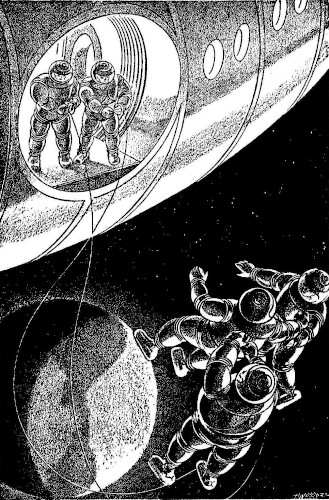
Then two husky pilots played the armored figures on the steel cables as an angler plays a fish, aiding the struggling drivers to overcome the velocity.
Soon the Lensmen, young and old, were inside. Doctor and nurse went instantly to work, with the calmness and precision so characteristic of their highly skilled crafts. In a trice they had him out of his armor, out of his leather, and into a hammock, perceiving at once that except for a few pads of gauze they could do nothing for their patient until they had him upon an operating table. Meanwhile the pilots, having swung the hammocks, had been observing, computing, and conferring.
"She's got a lot of speed, admiral—most of it straight down," Watson reported. "On her landing jets it'll take two G's on a full revolution to bring her in. With both of us at the controls we can balance her down, but it'll have to be on her tail and it'll mean over five G's all the way. Which do you want?"
"Which is more important, Lacy, time or pressure?" Haynes transferred decision to the surgeon.
"Time." Lacy decided instantly. "Fight her down!" His patient had been through so much already of force and pressure that a little more would not do additional hurt, and time was most decidedly of the essence.
Starkly incandescent flares ripped and raved from driving jets and side jets. The speedster spun around viciously, only to be curbed, skillfully if savagely, at the precisely right instant. Without an orbit, without even a corkscrew or other spiral, she was going down—straight down. And not upon her under jets was this descent to be, nor upon her more powerful braking jets. Those two master pilots, Prime Base's best, were going to kill the awful inertia of the speedster by "balancing her down on her tail." Or, to translate from the jargon of space, they were going to hold the tricky, cranky little vessel upright upon the terrific blasts of her driving projectors, against the Earth's gravitation and against all other perturbing forces, while her driving force counteracted, overcame, and dissipated the full frightful measure of the kinetic energy of her mass and speed!
And balance her down they did. Haynes was afraid for a while that that intrepid pair were actually going to land the speedster on her tail. They didn't—quite—but they had only a scant hundred feet to spare when they nosed her over and eased her to ground on her under jets.
The crash-wagon and its crew were waiting, and as Kinnison was rushed to the hospital the others hurried to the net room. Doctor Lacy first, of course, then the nurse; and, to Haynes' approving surprise, she took it like a veteran. Hardly had the surgeon let himself out of the "cocoon" than she was in it; and hardly had the terrific surges and recoils of her own not inconsiderable one hundred and forty-five pounds of mass abated than she herself was out and sprinting across the sward toward the hospital.
Haynes went back to his office and tried to work, but he could not concentrate. He made his way back to the hospital. There he waited, and as Lacy came out of the operating room he buttonholed him.
"How about it, Lacy, will he live?" he demanded.
"Live? Of course he'll live," the surgeon replied, gruffly. "Can't tell you details yet—won't know, ourselves, for a couple of hours yet. Buzz off, Haynes. Come back at six o'clock—not a second before—and I'll tell you all about it."
Since there was no help for it the port admiral did "buzz off," but he was back promptly on the tick of the designated hour.
"How is he?" he began, without preamble. "Will he really live, or were you just giving me a shot in the arm?"
"Better than that, much better," the surgeon assured him. "Definitely so; yes. He is in much better shape than we dared hope. Must have been a very light crash indeed—nothing seriously the matter with him at all. We won't even have to amputate, from what we can see now. He should make a one-hundred-per-cent recovery, not only without artificial members, but with scarcely a scar. He couldn't have been in a space crack-up at all, or he would not have come out with so little injury."
"Fine, doc—wonderful! Now the details."
"Here's the picture." And the doctor unrolled a full-length X-ray print, showing every anatomical detail of the Lensman's interior structure. "First, just notice that skeleton. It is really remarkable. Slightly out of true here and there right now, of course, but I believe that it is going to turn out to be the second absolutely perfect male skeleton I have ever seen. That young man will go far, Haynes."
"Sure he will. Why else do you suppose we put him in gray? But I didn't come over here to be told that. Show me the damage."
"Look at the picture—see for yourself. Multiple and compound fractures, you notice, of legs and arm, and a few ribs. Scapula, of course—there. Oh, yes, there's a skull fracture, too, but it doesn't amount to much. That's all. The spine, you see, isn't injured at all."
"What d'you mean, 'that's all'? How about his wounds? I saw some of them myself, and they were not pin pricks."
"Nothing of the least importance. A few punctured wounds and a couple of incised ones, but nothing even close to a vital part. He won't need even a transfusion, since he stopped the major hemorrhages himself, shortly after he was wounded. There are a few burns, of course, but they are mostly superficial—none that will not yield quite readily to treatment."
"Mighty glad of that. He'll be here six weeks then?"
"Better call it twelve, I think—ten at least. You see, some of the fractures, especially those in the left leg, and a couple of the burns, are rather severe, as such things go. Then, too, the length of time elapsing between injury and treatment didn't do anything a bit of good."
"In two weeks he'll be wanting to get up and go places and do things; and in six he'll be tearing down your hospital, stone by stone."
"Yes." The surgeon smiled. "He is not the type to make an ideal patient; but, as I have told you before, I like to have patients that we do not like."
"And another thing. I want the files on his nurses, particularly the red-headed one."
"I suspected that you would, so I had them sent down. Here you are. Glad you noticed MacDougall—she's by way of being my favorite. Clarrissa MacDougall—Scotch, of course, with that name—twenty years old. Height, one hundred sixty-eight centimeters; weight, sixty-six kilos. Here are her pictures. Never mind the conventional photo; this X-ray is the one that counts. Man, look at that skeleton! Beautiful! The only really perfect skeleton I ever saw in a woman——"
"It isn't the skeleton I'm interested in," grunted Haynes. "It's what is outside the skeleton that my Lensman will be looking at."
"You needn't worry about MacDougall," declared the surgeon. "One good look at that picture will tell you that. She classifies. With that skeleton she has to. She couldn't leave the beam a millimeter, even if she wanted to. Good, bad, or indifferent; male or female; physical, mental, moral, and psychological; the skeleton tells the whole story."
"Maybe it does to you, but not to me." And Haynes took up the "conventional" photograph—a stereoscope in full and absolutely true color, an almost living duplicate of the girl in question. Her thick, heavy hair was not red, but was a vividly intense and indescribable auburn, a gorgeous mass of coppery bronze, flashed with red and gold. Her eyes—bronze was all that he could think of, with flecks of topaz and of tawny gold. Her skin, too, was faintly bronze, glowing with even more than healthy youth's normal measure of sparkling vitality. Not only was she beautiful, the port admiral decided; in the words of the surgeon, she "classified."
"Hm-m-m. Worse even than I thought," he muttered. "She's a menace to civilization." And he went on to read the documents. "Family—hm-m-m. History.... Experiences.... Reactions and characteristics ... behavior ... psychology ... mentality——"
"She'll do, Lacy," he advised the surgeon finally. "Keep her on with him."
"But see here, Haynes, you suspicious old granny!" snorted the doctor. "He won't be falling for anybody yet. Why, he's just been unattached. He'll be bulletproof for quite a while. You ought to know that young Lensmen—especially young gray Lensmen—can't see anything but their jobs, for a couple of years, anyway."