Front matter (continued 5)
Reading edition
"His skeleton tells you that, too, huh?" Haynes grunted, skeptically. "Ordinarily, yes! but you never can tell, especially in hospitals."
"More of your layman's misinformation!" Lacy snapped. "Contrary to popular belief, romance does not thrive in hospitals; except, of course, among the staff. Patients oftentimes think that they fall in love with nurses, but it takes two people to make one romance. Nurses do not fall in love with patients, because a man is never at his best under hospitalization. In fact, the better a man is, the poorer a showing he is apt to make."
"And, as I forget who said, a long time ago, 'no generalization is ever true, not even this one,'" retorted the port admiral. "When it does hit him it will hit hard, and we'll take no chances. How about the black-haired one?"
"Well, I just told you that MacDougall has the only perfect skeleton I ever saw in a woman. Brownlee is very good, too, of course, but——"
"But not good enough to rate Lensman's mate, eh?" Haynes completed the thought. "Then take her out. Pick the best skeletons you've got for this job, and see that no others come anywhere near him. Transfer them to some other hospital—to some other floor of this one, at least. Any woman that he ever falls for will fall for him, in spite of your ideas as to the one-wayness of hospital romance; and I don't want him to have such a good chance of making a dive at something that doesn't rate up. Am I right or wrong, you old sawbones, and for how much?"
"Well, I haven't had time yet to really study his skeleton, but——"
"Better take a week off and study it. I've studied a lot of people in the last sixty-five years, and I'll match my experience against your knowledge of bones, any time. Not saying that he will fall this trip, you understand—just playing safe. Good-by, Lacy!"
XVIII.
Kinnison was dragged out of unconsciousness by the knowledge that he had landed his speedster inertialess. He came to—or, rather, to say that he came half to would be a more accurate statement—with a yell directed at the blurrily seen figure in white which he knew must be a nurse.
"Nurse!" Then, as a searing stab of pain shot through him at the effort, he went on, thinking at the figure in white through his Lens: "My speedster! I landed her free! Get the space port——"
"There, there, Lensman," a low, rich voice crooned, and a red head bent over him. "The speedster has been taken care of. Everything is on the needles; go to sleep and rest."
"But my ship——"
"Never mind your ship," the unctuous voice went on. "It was landed and put away——"
"Listen, dumb-bell!" snapped the patient, speaking aloud now, in spite of the pain, the better to drive home his meaning. "Don't try to soothe me! What do you think I am, delirious? Get this and get it straight. I said that I landed that speedster free. If you don't know what that means, tell somebody that does. Get the space port—get Haynes—get——"
"We got them, Lensman, long ago." Although her voice was still creamily, sweetly soft, an angry color burned into the nurse's face. "I said everything is on zero. Your speedster was inerted; how else could you be here, inert? I helped do it myself, so I know that she is inert."
"QX." The patient relapsed instantly into unconsciousness and the nurse turned to an interne standing by. (Wherever that nurse was, at least one doctor could almost always be found.)
"Dumb-bell!" she flared. "What a sweet mess he's going to be to take care of! He's not even conscious yet, and he's calling names and picking fights already!"
In a few days Kinnison was fully and alertly conscious. In a week most of the pain had left him, and he was beginning to chafe under restraint. In ten days he was "fit to be tied," and his acquaintance with his head nurse, so inauspiciously begun, developed even more inauspiciously as time went on. For, as Haynes and Lacy had each more than anticipated, the Lensman was by no means an ideal patient. In fact, he was most decidedly the opposite.
Nothing that could be done would satisfy him. All doctors were fatheads, even Lacy, the man who had put him together. All nurses were dumb-bells, even—or specially?—Mac, who with almost superhuman skill, tact and patience had been holding him together. Why, even fatheads and dumb-bells, even high-grade morons, ought to know that a man needed food!
Accustomed to eating everything that he could reach, three or four or five times a day, he did not realize—nor did his stomach—that his now quiescent body could no longer use the five thousand or more calories that it had been wont to burn up, each twenty-four hours, in intense effort. He was always hungry, and he was forever demanding food.
And food, to him, did not mean orange juice or grape juice or tomato juice or milk. Nor did it mean weak tea and hard, dry toast and an occasional soft-boiled egg. If he ate eggs at all he wanted them fried—three or four of them, accompanied by two or three thick slices of ham.
He wanted—and demanded in no uncertain terms, argumentatively and persistently—a big, thick, rare beefsteak. He wanted baked beans, with plenty of fat pork. He wanted bread in thick slices, piled high with butter, and not this quadruply-and-unmentionably-qualified toast. He wanted roast beef, rare, in great chunks. He wanted potatoes and thick brown gravy. He wanted corned beef and cabbage. He wanted pie—any kind of pie—in large, thick quarters. He wanted peas and corn and asparagus and cucumbers, and also various other worldly staples of diet which he often and insistently mentioned by name.
But above all, he wanted beefsteak. He thought about it days and dreamed about it nights. One night in particular he dreamed about it—an especially luscious porterhouse, fried in butter and smothered in mushrooms—only to wake up, mouth watering, literally starved, to face again the weak tea, dry toast, and, horror of horrors, this time a flabby, pallid, flaccid poached egg! It was the last straw.
"Take it away," he said, weakly; then, when the nurse did not obey, he reached out and pushed the breakfast, tray and all, off the table. As it crashed to the floor, he turned away, and, in spite of all his efforts, two hot tears forced themselves between his eyelids.
It was a particularly trying ordeal, and one requiring all of even Mac's skill, diplomacy, and forbearance, to make the recalcitrant patient eat the breakfast prescribed for him. She was finally successful, however, and as she stepped out into the corridor she met the ubiquitous interne.
"How's your Lensman?" he asked, in the privacy of the diet kitchen.
"Don't call him my Lensman!" she stormed. She was about to explode with the pent-up feelings which she, of course, could not vent upon such a pitiful, helpless thing as her star patient. "Beefsteak! I almost wish they would give him a beefsteak, and that he'd choke on it—which, of course, he would. He's worse than a baby. I never saw such a—such a brat in my life. I'd like to spank him! He needs it. I'd like to know how he ever got to be a Lensman, the big, cantankerous clunker! I'm going to spank him, too, one of these days; see if I don't!"
"Don't take it so hard, Mac," the interne urged. He was, however, very much relieved that relations between the handsome young Lensman and the gorgeous redhead were not upon a more cordial basis. "He won't be here very long. But I never saw a patient clog your jets before."
"You probably never saw a patient like him before, either. I certainly hope he never gets cracked up again."
"Huh?"
"Do I have to draw you a chart?" she asked, sweetly. "Or, if he does get cracked up again, I hope they send him to some other hospital." And she flounced out.
Nurse MacDougall thought that when the Lensman could eat the meat he craved, her troubles would be over; but she was mistaken, Kinnison was nervous, moody, brooding, by turns irritable, sullen, and pugnacious. Nor is it to be wondered at. He was chained to that bed, and in his mind was the gnawing consciousness that he had failed. And not only failed—he had made a complete fool of himself. He had underestimated an enemy, and as a result of his own stupidity the whole patrol had taken a setback. He was anguished and tormented.
Therefore: "Listen, Mac," he pleaded one day. "Bring me some clothes and let me take a walk. I need the exercise."
"Not yet, Kim," she denied him gently, but with her entrancing smile in full evidence. "But pretty quick, when that leg looks a little less like a Chinese puzzle, you and nursie go bye-bye."
"Beautiful, but dumb!" the Lensman growled. "Can't you and those cockeyed croakers realize that I'll never get any strength back if you keep me in bed all the rest of my life? And don't talk baby talk at me, either. I'm well enough at least so that you can wipe that professional smile off your pan and cut that soothing bedside manner of yours."
"Very well—I think so, too!" she snapped, patience at long last gone. "Somebody should tell you the truth. I always supposed that Lensmen had to have brains, but you've acted like a spoiled brat ever since you've been here. First you wanted to eat yourself sick, and now you want to get up, with bones half knit and burns half healed, and undo everything that has been done for you. Why don't you snap out of it and act your age for a change?"
"I never did think nurses had much sense, and now I know they haven't." Kinnison eyed her with intense disfavor, not at all convinced. "I'm not talking about going back to work. I mean a little gentle exercise, and I know what I need."
"You'd be surprised at what you don't know." And the nurse walked out, chin in air. In five minutes, however, she was back, her radiant smile again flashing.
"Sorry, Kim, I shouldn't have blasted off that way, I know that you're bound to back-fire and to have brain storms. I would, too, if I were——"
"Cancel it, Mac," he began, awkwardly. "I don't know why I have to be such a mutt as to be crabbing at you all the time."
"QX, Lensman," she replied, entirely serene now. "I do. You are not the type to stay in bed without it griping you; but when a man has been ground up into such hamburger as you are, he has to stay in bed whether he likes it or not, and no matter how much he pops off about it. Roll over here, now, and I'll give you an alcohol rub. But it won't be long now, really—pretty soon we'll have you out in a wheel chair——"
Thus it went for weeks. Kinnison knew his behavior was atrocious, abominable; but he simply could not help it. Every so often the accumulated pressure of his bitterness and anxiety would blow off; and, like a jungle tiger with a toothache, he would bite and claw anything or anybody within reach.
Finally, however, the last picture was studied, the last bandage was removed, and he was discharged as fit. And he was not discharged, bitterly although he resented his "captivity," as he called it, until he really was fit. Haynes saw to that. And Haynes had allowed only the most sketchy interviews during that long convalescence. Discharged, however, Kinnison sought him out.
"Let me talk first," Haynes instructed him at sight. "No self-reproaches, no destructive criticism. Everything constructive. Now, Kimball, I'm mighty glad to hear that you made a perfect recovery. You were in bad shape. Go ahead."
"You have just about shut my mouth by your first order." Kinnison smiled sourly as he spoke. "Two words—flat failure. No, let me add two more—as yet."
"That's the spirit!" Haynes exclaimed. "Nor do we agree with you that it was a failure. It was merely not a success—so far—which is an altogether different thing. Also, I may add that we had very fine reports indeed on you from the hospital."
"Huh?" Kinnison was amazed to the point of being inarticulate.
"You just about tore it down, of course, but that was only to be expected."
"But, sir, I made such a——"
"Exactly. As Lacy tells me quite frequently, he likes to have patients over there that they don't like. Mull that one over for a bit. You may understand it better as you get older. The thought, however, may take some of the load off your mind."
"Well, sir, I am feeling a trifle low, but if you and the rest of them still think——"
"We do so think. Cheer up and get on with the story."
"I've been doing a lot of thinking, and before I go around sticking out my neck again I'm going to——"
"You don't need to tell me, you know."
"No, sir, but I think I'd better. I'm going to Arisia to see if I can get me a few treatments for swelled head and lame brain. I still think that I know how to use the Lens to good advantage, but I simply haven't got enough jets to do it. You see, I——" He stopped. He would not offer anything that might sound like an alibi; but his thoughts were plain as print to the old Lensman.
"Go ahead, son. We know you wouldn't."
"If I thought at all, I assumed that I was tackling men, since those on the ship were men, and men were the only known inhabitants of the Aldebaranian system. But when those Wheelmen took me so easily and so completely, it became very evident that I didn't have enough stuff. I ran like a scared pup, and I was lucky to get home at all. It wouldn't have happened if——" He paused.
"If what? Reason it out, son," Haynes advised, pointedly. "You are wrong, dead wrong. You made no mistake, either in judgment or in execution. You have been blaming yourself for assuming that they were men. Let us suppose that you had assumed that they were the Arisians themselves. Then what? After close scrutiny, even in the light of after-knowledge, we do not see how you could have changed the outcome." It did not occur, even to the sagacious old admiral, that Kinnison need not have gone in. Lensmen always went in.
"Well, anyway, they licked me, and that hurts," Kinnison admitted, frankly. "So I'm going back to Arisia for more training, if they'll give it to me. I may be gone quite a while, as it may take even them a long time to increase the permeability of my skull enough so that an idea can filter through it in something under a century."
"Um-m-m." Haynes pondered. "It has never been done. They are a peculiar race, incomprehensible—but not vindictive. They may refuse you, but nothing worse—that is, if you do not cross the barrier without invitation. It's a splendid idea, I think; but be very careful to strike that barrier free and at almost zero power—or else don't strike it at all."
They shook hands, and in a space of minutes the speedster was again tearing through space. Kinnison now knew exactly what he wanted to get, and he utilized every waking hour of that long trip in physical and mental exercise to prepare himself to take it. Thus the time did not seem long. He crept up to the barrier at a snail's pace, stopping instantly as he touched it, and through that barrier he sent a thought.
"Is it permitted that I approach your planet?" he asked, neither brazenly nor obsequiously. He was matter-of-factly asking a simple question and expecting a simple reply. He knew that to these beings, whatever they really were, salutations and identifications were alike superfluous. Nor was he met as Helmuth had been met.
"Ah, 'tis Kimball Kinnison, of Earth," a slow, deep, measured voice resounded in his brain. "Neutralize your controls. You will be landed."
He did so, and the inert speedster shot forward, to come to ground in a perfect landing at a regulation space port. He strode into the office, to confront the same grotesque, dragonlike entity who had measured him for his Lens not so long ago. Now, however, he stared straight into that entity's unblinking eyes, in silence.
"Ah, you have progressed. You realize now that vision is not always reliable. At our previous interview you took it for granted that what you saw must really exist, and did not wonder as to what our true shapes might be."
"I am wondering now, seriously," Kinnison replied. "And if it is permitted, I intend to stay here until I can see your true shapes."
"This?" And the figure changed instantly into that of an old, white-bearded, scholarly gentleman.
"No. There is a vast difference between seeing something myself and having you show it to me. I realize only too well that you can make me see you as anything you choose. You could appear to me as a perfect copy of myself, or as any other thing, person or object conceivable to my mind."
"Ah, you have indeed progressed. While you were expected to return, you are ahead of time by several of your years. When you approached the barrier it was supposed that you came to ask for some particular information, but now that I search your mind I perceive that what you seek is not mere information, but is indeed knowledge."
"You say that you expected me. How could you know that I was coming? I didn't decide definitely myself until only a couple of weeks ago."
"It was inevitable. When we fitted your Lens we knew that you would return if you lived. As we recently informed that one known as Helmuth——"
"Helmuth! You know, then, where——" Kinnison choked himself off. He would not ask for help in that. He would fight his own battles and bury his own dead. If they volunteered the information, well and good; but he would not ask it. Nor did the Arisian furnish it.
"You are right," the sage remarked, imperturbably. "For strong development it is essential that you secure that information for yourself."
Then he continued his previous thought: "As we told Helmuth recently, we have given your civilization an instrumentality—the Lens—by virtue of which it should be able to make itself secure throughout the galaxy. Having given it, we could do nothing more of real or permanent benefit until you Lensmen yourselves began to realize what it was that we had given you. That realization has been inevitable; from the first it has been certain that in time your minds would become strong enough to discover the theretofore unknown depths of power of your Lenses. As soon as any mind made that discovery it would, of course, return to Arisia, the source of the Lens, for additional instruction; which, equally of course, that mind could not have borne previously.
"Decade by decade your minds have become stronger. Finally you came to be fitted with a Lens. Your mind, while pitifully undeveloped, had a latent capacity and a power that made your return here certain. Since your enlensment there has been one other who will return. Indeed, it has become a topic of discussion among us as to whether you or that other would be the first advanced student."
"Who is that other, if I may ask?"
"Your friend, Worsel, the Velantian."
"He's got a real mind—'way, 'way ahead of mine," the Lensman stated, as a matter of self-evident fact.
"In some ways, yes. In other and highly important characteristics, no."
"Huh?" Kinnison exclaimed. "In what possible way have I got it over him?"
"I am not certain that I can explain it exactly in thoughts which you can understand. Broadly speaking, his mind is the better trained, the more fully developed. It is of more grasp and reach, and of vastly greater present power. It is more controllable, more responsive, more adaptable than is yours—now. But your mind, while undeveloped, is of considerably greater capacity than his, and of greater and more varied latent capabilities. Above all, you have a driving force, a will to do, an undefeatable mental urge that no one of his race will be able to develop for many cycles of time to come. Since I selected you as the first to return, I am naturally gratified that you have developed so rapidly."
"Well, I have been more or less under pressure, and I got quite a few lucky breaks. But at that, it seemed to me that I was progressing backward instead of forward."
"It is ever thus with the really competent. Prepare yourself!"
He launched a mental bolt, at the impact of which Kinnison's mind literally turned inside out in a wildly gyrating spiral vortex of dizzyingly confused images.
"Resist!" came the harsh command.
"Resist! How?" demanded the writhing, sweating Lensman. "You might as well tell a fly to resist an inert space ship!"
"Use your will—your force—your adaptability. Shift your mind to meet mine at every point. Apart from these fundamentals neither I nor any one else can tell you how; each mind must find its own medium and develop its own technique. But this is a very mild treatment indeed, one conditioned to your present strength. I will increase it gradually in severity, but rest assured that I will at no time raise it to the point of permanent damage. Constructive exercises will come later; the first step must be to build up your resistance. Therefore, resist!"
The force, which had not slackened for an instant, waxed slowly to the very verge of intolerability; and grimly, doggedly, the Lensman fought it. Teeth locked, muscles straining, fingers digging savagely into the hard leather upholstery of his chair he fought it; mustering his every ultimate resource to the task——
Suddenly, the torture ceased and the Lensman slumped down, a mental and physical wreck. He was white, trembling, sweating, shaken to the very core of his being. He was ashamed of his weakness. He was humiliated and bitterly disappointed at the showing he had made; but from the Arisian there came a calm, encouraging thought.
"You need not feel ashamed; you should instead feel proud, for you have made a start which is really surprising, even to me, your sponsor. This may seem to you like needless punishment, but it is not. This is the only possible way in which that which you seek may be found."
"In that case, go to it," the Lensman declared. "I can take it."
Day after day and week after week the "advanced instruction" went on, with the pupil becoming ever stronger, until he was taking without damage thrusts that would have slain him instantly a few weeks since. The bouts became shorter and shorter, requiring as they did such terrific outpourings of mental force that not even the master could stand the awful strain for more than half an hour at a time.
And now these savage conflicts of wills and minds were interspersed with real instruction, with lessons neither painful nor unpleasant. In these the aged scientist probed gently into the youngster's mind, opening it and exposing to its owner's gaze vast caverns whose very presence he had never even suspected. Some of these storehouses were already partially or completely filled, needing only arrangement and connection. Others were nearly empty. These were catalogued and made accessible. And in all, permeating everything, was the Lens.
"Just like clearing out a clogged-up water system; with the Lens the pump that wouldn't work!" exclaimed Kinnison one day.
"More like that than you at present realize," assented the Arisian. "You have observed, of course, that I have not given you any detailed instructions nor pointed out any specific abilities of the Lens which you have not known how to use. You will have to operate the pump yourself; and you have many surprises awaiting you as to what your Lens will pump, and how. Our sole task is to prepare your mind to work with the Lens, and that task is not yet done. Let us on with it."
Eventually the time came when Kinnison could block out entirely the suggestions of his mentor, but he did not reveal that fact; nor, now blocked out, could the Arisian discern it. The Lensman gathered all his force together, concentrated it, and hurled it back at his teacher; and there ensued a struggle none the less Titanic because of its essential friendliness. The very ether seethed and boiled with the fury of the mental forces there at grips, but finally the Lensman beat down the other's screens. Then, boring deep into his eyes, he willed with all his force to see that Arisian as he really was. And instantly the scholarly old man subsided into a—a brain! There were a few appendages, of course, and other appurtenances and incidentials to nourishment, locomotion, and the like, but to all intents and purposes the Arisian was simply and solely a brain.
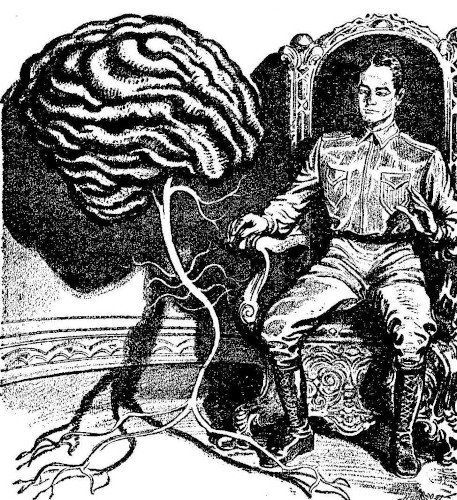
He willed with all his force to see him as he really was. And instantly—the scholarly old man subsided into a brain.
Tension ended; conflict ceased; and Kinnison apologized.
"Think nothing of it." And the brain actually smiled into Kinnison's mind. "Any mind of power sufficient to block mine is, of course, able to hurl no feeble bolts of its own. See to it, however, that you thrust no such force at any lesser mind, or it dies instantly."
Kinnison started to stammer a reply, but the Arisian went on: "No, son, I knew and know that the warning is superfluous. If you were not worthy of this power and were you not able to control it properly you would not have it. You have obtained that which you sought. Go, then, with power."
"But this is only one phase, barely a beginning!" protested Kinnison.
"Ah, you realize even that? Truly, youth, you have come far and fast. But you are not yet ready for more, and it is a truism that the reception of forces for which a mind is not prepared will destroy that mind. Thus, when you came to me you knew exactly what you wanted. Do you know with equal certainty what more you want from us?"
"No."
"Nor will you for years, if ever. Indeed, it may well be that only your descendants will be ready for that for which you now so dimly grope. Again I say, young man, go with power."
Kinnison went.
XIX.
It had taken the Lensman a long time to work out in his mind exactly what it was that he had wanted from the Arisians, and from no single source had the basic idea come. Part of it had come from his own knowledge of ordinary hypnosis; part from the ability of the Overlords of Delgon to control from a distance the minds of others; part from Worsel, who, working through Kinnison's own mind, had done such surprising things with a Lens; and a great part indeed from the Arisians themselves, who had the astounding ability literally and completely to superimpose their own mentalities upon those of others, wherever situate. Part by part and bit by bit the Tellurian Lensman had built up his plan, but he had not had the sheer power of intellect to make it work. Now he had that, and was ready to go.
Where? His first impulse was to return to Aldebaran I and to invade again the stronghold of the Wheelmen, who had routed him so ignominiously in his one encounter with them. Ordinary prudence, however, counseled against that course.
"You'd better lay off them a while, Kim old boy," he told himself quite frankly. "They've got a lot of jets and you don't know how to use this new stuff of yours yet. Better pick out something easier to take!"
Ever since leaving Arisia he had been subconsciously aware of a difference in his eyesight. He was seeing things much more clearly than he had ever seen them before, more sharply and in greater detail. Now this awareness crept into his consciousness and he glanced toward his tube lights. They were out—except for the tiny lamps and bull's-eyes of his instrument board the vessel must be in complete darkness. He remembered then, with a shock, that when he entered the speedster he had not turned on his lights. He could see, and had not thought of them at all!
This, then, was the first of the surprises the Arisian had promised him. He now had the sense of perception of the Rigellians. Or was it that of the Wheelmen? Or both? Or were they the same sense? Intently aware now, he focused his attention upon a meter before him. First upon its dial, noting that the needle was exactly upon the green hair line of normal operation. Then deeper. Instantly, the face of the instrument disappeared—moved behind his point of sight, or so it seemed—so that he could see its coils, pivots, and other interior parts. He could look into and study the grain and particle size of the dense, hard condensite of the board itself. His vision was limited, apparently, only by his will to see!
"Well—ain't—that—something!" he demanded of the universe at large; then, as a thought struck him: "I wonder if they blinded me in the process?"
He switched on his lamps, discovering that his vision was unimpaired and normal in every respect; and a rigid investigation proved to him conclusively that in addition to ordinary vision he now had an extra sense—or perhaps two of them—and that he could change from one to the other, or use them simultaneously, at will! But the very fact of this discovery made Kinnison pause.
He hadn't better go anywhere, or do anything, until he had found out something about his new equipment. The fact was that he didn't even know what he had, to say nothing of knowing how to use it. If he had the sense of a hoot owl he would go somewhere where he could do a little experimenting without getting his jets burned off in case something slipped at a critical moment. Where was the nearest patrol base—a big one, fully defended? Let's see—Radelix would be about the closest Sector Base, he guessed. He'd find out if he could raid that outfit without getting caught at it.
Off he shot, and in due course a fair, green, Earthlike planet lay beneath his vessel's keel. Since it was Earthlike in climate, age, atmosphere, and mass, its people were, of course, more or less similar to humanity in general characteristics, both of body and of mind. If anything, they were even more intelligent than Earthlings, and their patrol base was a very strong one indeed. His spy ray would be useless, since all patrol bases were screened thoroughly and continuously. He would see what a sense of perception would do. From Tregonsee's explanation, it ought to work at this range.
It did. When Kinnison concentrated his attention upon the base he saw it. He advanced toward it at the speed of thought and entered it; passing through screens and metal walls without hindrance and without giving alarm. He saw men at their accustomed tasks and heard, or rather sensed, their conversation: the everyday chat of their professions. A thrill shot through him at a dazzling possibility thus revealed.
If he could make one of those fellows down there do something without his knowing that he was doing it, the problem was solved. That computer, say; make him uncover that calculator and set up a certain integral on it. It would be easy enough to get into touch with him and have him do it, but this was something altogether different.
Kinnison got into the computer's mind easily enough, and willed intensely what he was to do; but the officer did not do it. He got up; then, staring about him in bewilderment, sat down again.
"What's the matter?" asked one of his fellows. "Forget something?"
"Not exactly." The computer still stared. "I was going to set up an integral. I didn't want it, either. I could swear that somebody told me to set it up."
"Nobody did," grunted the other, "and you'd better start staying home nights. Then maybe you wouldn't get funny ideas."
This wasn't so good, Kinnison reflected. The guy should have done it and shouldn't have remembered a thing about it. Well, he hadn't really thought he could put it across at that distance, anyway. He didn't have the brain of an Arisian. He'd have to follow his original plan, of close-up work.
Waiting until the base was well into the night side of the planet and making sure that his flare baffles were in place, he allowed the speedster to drop downward, landing at some little distance from the fortress. There he left the ship and made his way toward his objective in a rapid series of long, inertialess hops. Lower and shorter became the hops. Then he cut off his power entirely and walked until he saw before him, rising from the ground and stretching interminably upward, an almost invisibly shimmering web of force. This, the prowler knew, was the curtain which marked the border of the reservation, the trigger upon which a touch, either of solid object or of beam, would liberate a veritable inferno of the most destructive agencies generable.
To the eye that base was not impressive, being merely a few square miles of level ground, outlined with low, broad pill boxes and studded here and there with harmless-looking, bulging domes. There were a few clusters of buildings. That was all—to the eye—but Kinnison was not deceived. He knew that the base itself was a thousand feet underground; that the pill boxes housed lookouts and detectors; and that those domes were simply weather shields which, rolled back, would expose projectors second in power not even to those of Prime Base itself.
Far to the right, between two tall pylons of metal, was the gate, the only opening in the web. Kinnison had avoided it purposely; it was no part of his plan to subject himself yet to the scrutiny of the all-inclusive photo cells of that entrance. Instead, with his new sense of perception, he sought out the conduits leading to those cells and traced them down, through concrete and steel and masonry, to the control room far below.
He then superimposed his mind upon that of the man at the board and flew boldly toward the entrance. He now actually had a dual personality; since one part of his mind was in his body, darting through the air toward the portal, while the other part was deep in the base below, watching him come and acknowledging his signals!
A trap lifted, revealing a sloping, tunneled ramp, down which the Lensman shot. He soon found a convenient storeroom. Slipping within it, he withdrew his control carefully from the mind of the observer, wiping out all traces of that control as he did so. He then watched apprehensively for a possible reaction. He was almost sure that he had performed the operation correctly, but he had to be absolutely certain; more than his life depended upon the outcome of this test. The observer, however, remained calm and placid at his post; and a close reading of his thoughts showed that he had not the faintest suspicion that anything untoward had occurred.
One more test and he was through. He must find out how many minds he could control simultaneously, but he'd better do that openly. No use making a man feel like a fool needlessly. He'd done that once already, and once was too many times.
Therefore, reversing the procedure by which he had come, he went back to his speedster, took her out into the ether, and slept. Then, when the light of morning flooded the base, he cut his detector nullifier and approached it boldly.
"Radelix base! Lensman Kinnison of Tellus asking permission to land. I wish to confer with your Lensman. My screens are down."
A spy ray swept through the speedster, the web disappeared, and Kinnison landed, to be greeted by four fellow Lensmen with a quiet and cordial respect—cordiality for his Lens and respect for his gray. The base commander knew that his visitor was not there purely for pleasure. Gray Lensmen did not take pleasure jaunts. Therefore, he led the way into his private office and shielded it.
"My announcement was not at all informative," Kinnison admitted then, "but my errand is nothing to be advertised. I've got to try out something, and I want to ask you four Lensmen to coöperate with me for a few minutes."
"You need not ask——" began the commander.
"No, this is not an order at all, simply a request. You see, I've been working a long time on a mind controller, and I want to see if it works. I'll put four books on this table, one in front of each of you. Now I would like to try to make two or three of you—all four of you if I can—each bend over, pick up his book, and hold it. Your part of the game will be for each of you to try not to pick it up, and to put it back as soon as you possibly can if I do make you obey. Will you?"
"Sure!" the three of them chorused.
"There will be no mental damage, of course?" asked the commander.
"None whatever, and no after effects. I've had it worked on myself, a lot."
"Do you want any apparatus?"
"No, I have everything necessary. Remember, I want top resistance."
"Let her come! You'll get plenty of resistance. If you can make any one of us pick up a book, after all this warning, I'll say you've got something."
Lensman after Lensman, in spite of strainingly resisting mind and body, lifted his book from the table, only to drop it again as Kinnison's control relaxed for an instant. He could control two of them—any two of them—but he could not quite handle three. Satisfied, he ceased his efforts.
As the base commander poured long, cold drinks for the sweating five, one of his fellows asked: "What did you do, anyway, Kinnison? Oh, pardon me, I shouldn't have asked."
"Sorry," the Tellurian replied uncomfortably, "but it isn't ready yet. You'll all know about it as soon as possible, but not just now."
"Sure," the Radeligian replied. "I knew I shouldn't have blasted off as soon as I spoke."
"Well, thanks a lot, fellows." Kinnison set his empty glass down with a click. "I can make a nice progress report on this dojig now. And one more thing. I did a little long-range experimenting on one of your computers last night."
"Desk 12? The one who thought he wanted to integrate something?"
"That's the one. Tell him I was using him for a mind-ray subject, will you, and give him this fifty-credit bill? Don't want the boys needling him too much."
"Yes, and thanks. And—I wonder——" The base commander evidently had something on his mind. "Say, can you make a man tell the truth with that? And if you can, will you?"
"I think so. Certainly I will, if I can. Why?" Kinnison knew that he could do so, but he did not wish to seem cock-sure.
"There's been a murder." The other three glanced at each other in understanding and sighed with profound relief. "A particularly fiendish murder of a woman—girl, rather. Two men have been accused. Each has a perfect alibi, supported by honest witnesses; but you know how much an alibi means now. Both men tell perfectly straight stories under the Lens and all other lie detectors. Either one of those men is lying with a polish I would never have believed possible, or both are innocent. And one of them must be guilty; these are the only suspects. If we try them now we make fools of ourselves; and we can't put off the trial very much longer without losing face. If you can help us out you'll be doing a lot for the patrol throughout this whole sector."
"I can help you," Kinnison declared. "For this, though, better have some props. Make me a box—double Burbank controls, with five baby spots on it—orange, blue, green, purple and red. I want the biggest set of head phones you've got, and a thick, black blindfold. How soon can you try 'em?"
"The sooner the better. It can be arranged for this afternoon."
The trial was announced, and long before the appointed hour the great courtroom of that world's largest city was thronged. The hour struck. Quiet reigned. Kinnison, the Lensman, in somber gray, strode to the judge's desk and sat down behind the peculiar box upon it. In dead silence two other Lensmen approached. The first invested him reverently with the head phones; the second so enwrapped his head in black cloth that it was apparent to all observers that his vision was completely obscured.
"Although from a world far distant in space, I have been asked to try two suspects for the crime of murder," Kinnison intoned. "I do not know the details of the crime nor the identity of the suspects. I do know that they and their witnesses are within these railings. I shall now select those who are about to be examined."
Piercing beams of intense, varicolored light played over the two groups, and the deep, impressive voice went on: "I know now who the suspects are. They are about to rise, to walk, and to seat themselves as I shall direct."
They did so, it being plainly evident to all observers that they were under some awful compulsion.
"The witnesses may be excused. Truth is the only thing of importance here; and witnesses, being human and therefore frail, obstruct truth more frequently than they further its progress. I shall now examine these two accused."
Again the vivid, weirdly distorting glares of light lashed out, bathing in intense monochrome and in various ghastly combinations first one prisoner, then the other; the while Kinnison drove his mind into theirs, plumbing their deepest depths. The silence, already profound, became the utter stillness of outer space as the throng, holding its very breath now, sat enthralled by that portentous examination.
"I have examined them fully. You are all aware that any Lensman of the Galactic Patrol may, in case of need, serve as judge, jury, and executioner. I am, however, none of these; nor is this proceeding to be a trial as you may have understood the term. I have said that witnesses are superfluous. I will now add that neither judge nor jury is necessary. All that is required is to discover the truth, since truth is all-powerful. For that reason, also, not even an executioner is needed here—the discovered truth will in and of itself serve us in that capacity.
"One of these men is guilty; the other is innocent. From the mind of the guilty one I am about to construct a composite, not of this one fiendish crime alone, but of all the crimes he has ever committed. I shall project that composite into the air before him. No innocent mind will be able to see any iota of it. The guilty man, however, will perceive its every revolting detail; and, so perceiving, he will forthwith cease to exist in this plane of life."
One of the men had nothing to fear—Kinnison had told him so, long since. The other had been trembling for minutes in uncontrollable paroxysms of terror. Now this one leaped from his seat, clawing savagely at his eyes and screaming in mad abandon.
"I did it! Help! Mercy! Take her away! Oh-h-h——" he shrieked, and died, horribly, even as he shrieked.
Nor was there noise in the courtroom after the thing was over. The stunned spectators slunk away, scarcely daring even to breathe until they were safely outside.
Nor were the Radeligian Lensmen much more at ease. Not a word was said until the five were back in the commander's office at base. Then Kinnison, still white of face and set of jaw, spoke. The others knew that he had found the guilty man, and that he had in some peculiarly terrible fashion executed him. He knew that they knew that the man was hideously guilty.
Nevertheless, the Tellurian said, "He was guilty—guilty as all the devils in all the hells of the entire universe. I never had to do that before, and it gripes me—but I couldn't shove the job off onto you fellows. I wouldn't want anybody to see that picture who didn't have to, and without it you could never begin to understand just how atrociously and damnably guilty that hell hound really was."
"Thanks, Kinnison," the commander said, simply. "Kinnison. Kinnison of Tellus. I'll remember that name, in case we ever need you as badly again. But, after what you just did, it will be a long time—if ever. You didn't know, did you, that all the inhabitants of four planets were watching you?"
"Holy rockets, no! Were they?"
"They were. And if the way you scared me is any criterion, it will be a long, cold day before anything like that comes up again in this system. And thanks again, gray Lensman. You have done something for our whole patrol this day."
"Be sure to dismantle that box so thoroughly that nobody will recognize any of its component parts." Kinnison managed a rather feeble grin. "One more thing and I'll buzz along. Do you fellows happen to know where there's a good, strong pirate base around here anywhere? And, while I don't want to seem fussy, I would like it all the better if they were warm-blooded oxygen breathers, so that I won't have to wear armor all the time."
"What are you trying to do, give us the needle, or something?" This is not precisely what the Radeligian said, but it conveys the thought Kinnison received as the base commander stared at him in amazement.
"Don't tell me that there is such a base around here!" exclaimed the Tellurian in delight. "Is there, really?"
"There is. It is so strong that we have not been able to touch it, and it is manned and staffed by natives of your own planet, Tellus of Sol. We reported it to Prime Base some eighty-three days ago, just after we discovered it. You're direct from there——" He fell silent. This was no way to be talking to a gray Lensman.
"I was in the hospital then, fighting with my nurse because she wouldn't give me anything to eat," Kinnison explained with a laugh. "When I left Tellus I didn't check up on the late data—didn't think I would need it quite so soon. If you've got it, though——"
"Hospital! You?" queried one of the younger Lensmen.
"Yeah—bit off more than I could chew." And the Tellurian briefly described his misadventure with the Wheelmen of Aldebaran I. "This other thing has come up since then, though, and I won't be sticking my neck out that way again. If you've got such a made-to-order base as that in this region, it'll save me a long trip. Where is it?"
They gave him its coördinates and what little information they had been able to secure concerning it. They did not ask him why he wanted that data. They may have wondered at his temerity in daring to scout alone a fortress whose strength had kept at bay the massed patrol forces of the sector; but if they did so they kept their thoughts well screened. For this was a gray Lensman, and very evidently a super-powered individual, even of that select group whose weakest members were powerful indeed. If he felt like talking they would listen; but Kinnison did not talk. He did the listening.
Then, when he had learned everything they knew of the Boskonian base, he said, "Well, I'd better be buzzing. Clear ether, fellows!" And he was gone.
XX.
Out from Radelix and into deep space shot the speedster, bearing the gray Lensman toward Boyssia II, where the Boskonian base was situated. The patrol forces had not even yet been able to locate it definitely; therefore, it must be cleverly hidden indeed. It was manned and staffed by Tellurians—and this was fairly close to the line first taken by the pilot of the pirate vessel whose crew had been so decimated by VanBuskirk and his Valerians. There couldn't be so many Boskonian bases with Tellurian personnel, Kinnison reflected. It was well within the bounds of possibility, even of probability, that he might again encounter here his former, but unsuspecting, shipmates.
Since the Boyssian system was less than a hundred parsecs from Radelix, a couple of hours found the Lensman staring down upon another green and Earthly world. Very Earthly indeed was this one. There were polar ice caps, areas of intensely dazzling white. There was an atmosphere, deep and sweetly blue, filled for the most part with sunlight, but flecked here and there with clouds, some of which were slow-moving storms. There were continents, bearing mountains and plains, lakes and rivers. There were oceans, studded with islands great and small.
But Kinnison was no planetographer, nor had he been gone from Tellus sufficiently long so that the sight of this beautiful and homelike world aroused in him any qualm of nostalgia. He was looking for a pirate base; and, dropping his speedster as low into the night side as he dared, he began his search.
Of man or of the works of man he at first found little enough trace. All human or pseudohuman life was apparently still in a savage state of development; and, except for a few scattered races, or rather tribes, of burrowers and of cliff or cave dwellers, it was still nomadic, wandering here and there without permanent habitation or structure. Animals of scores of genera and species were there in myriads, but neither was Kinnison a biologist. He wanted pirates; and, it seemed, that was the one form of life which he was not going to find!
But finally, through sheer, grim, bulldog pertinacity, he was successful. That base was there, somewhere. He would find it, no matter how long it took. He would find it if he had to examine the entire crust of the planet, land and water alike, kilometer by plotted cubic kilometer! He set out to do just that; and it was thus that he found the Boskonian stronghold.
It had been built directly beneath a towering range of mountains, protected from detection by mile upon mile of native copper and of iron ore.
Its entrances, invisible before, were even now not readily perceptible, camouflaged as they were by outer layers of rock which matched exactly in form, color, and texture the rocks of the cliffs in which they were placed. Once those entrances were located, the rest was easy. Again he set his speedster into a carefully observed orbit and came to ground in his armor. Again he crept forward, furtively and skulkingly, until he could perceive a shimmering web of force.
With minor variations, his method of entry into the Boskonian base was similar to that he had used in making his way into the patrol base upon Radelix. He was, however, working now with a surety and a precision which had then been entirely lacking. His practice upon the patrolmen and his terrific bout with the four Lensmen had given him knowledge and technique. His sitting in judgment, during which he had touched almost every mind in the vast assemblage, had taught him much. And, above all, the grisly finale of that sitting, horribly distasteful and soul-wracking as it had been, had given him training of inestimable value; necessitating as it had the infliction of the ultimate penalty.
He knew that he might have to stay inside that base for some time; therefore he selected his hiding place with care. He could, of course, blank out the knowledge of his presence in the mind of any one chancing to discover him; but since such an interruption might come at a critical instant, he preferred to take up his residence in a secluded place. There were, of course, many vacant suites in the officers' quarters—all bases must have accommodations for visitors—and the Lensman decided to occupy one of them. It was a simple matter to obtain a key, and, inside the bare but comfortable little room, he stripped off his armor with a sigh of relief.
Leaning back in a deeply upholstered leather arm chair, he closed his eyes and let his sense of perception roam throughout the great establishment. With all his newly developed power he studied it, hour after hour and day after day. When he was hungry the pirate cooks fed him, not knowing that they did so. He had lived on iron rations long enough. When he was tired he slept, with his eternally vigilant Lens on guard.
Finally, he knew everything there was to be known about that stronghold, and was ready to act. He did not take over the mind of the base commander, but chose instead the chief communications officer as the one most likely and most intimately to have dealings with Helmuth. For Helmuth, he who spoke for Boskone, had for many long months been the Lensman's definite objective.
But this game could not be hurried. Bases, no matter how important, did not call Grand Base except upon matters of the most dire urgency, and no such matter eventuated. Nor did Helmuth call that base, since nothing out of the ordinary was happening—to any pirates' knowledge, that is—and his attention was more necessary elsewhere.
One day, however, there came crackling in a triumphant report: a ship working out of that base had taken noble booty indeed; no less a prize than a fully supplied hospital ship of the patrol itself! As the report progressed, Kinnison's heart went down into his boots and he swore bitterly to himself. How in all the nine hells of Valeria had they managed to take such a ship as that? Hadn't she been escorted?
Nevertheless, as chief communications officer, he took the report and congratulated heartily, through the ship's radio man, its captain, its officers, and its crew.
"Mighty fine work; Helmuth himself shall hear of this," he concluded his words of praise. "How did you do it? With one of the new maulers?"
"Yes, sir," came the reply. "Our mauler, accompanying us just out of range, came up and engaged theirs. That left us free to take this ship. We locked on with magnets, cut our way in, and here we are."
There they were indeed. The hospital ship was red with blood; patients, doctors, internes, officers and operating crew alike had been butchered with the horribly ruthless savagery which was the customary technique of all the agencies of Boskone. Of all that ship's personnel only the nurses lived. They were not to be put to death—yet. In fact, and under certain conditions, they need not die at all.
They huddled together, a little knot of white-clad misery in that corpse-littered room, and even now one of them was being dragged away. She was fighting viciously, with fists and feet, with nails and teeth. No one pirate could handle her; it took two of the huskies to subdue that struggling fury. They hauled her upright and she threw back her head, in panting defiance. There was a cascade of red-bronze hair and Kinnison saw—Clarrissa MacDougall! He remembered that there had been some talk that they were going to put her back into space service! The Lensman decided instantly what to do.
"Stop, you swine!" he roared through his pirate mouthpiece. "Where do you think you're going with that nurse?"
"To the captain's cabin, sir." The huskies stopped short in amazement as that roar filled the room, but answered the question concisely.
"Let her go!" Then, as the girl fled back to the huddled group in the corner, he said, "Tell the captain to come out here and assemble every officer and man of the crew. I want to talk to everybody at once."
He had a minute or two in which to think, and he thought furiously, but accurately. He had to do something, but whatever he did must be done strictly according to the pirates' own standards of ethics; if he made one slip it might be Aldebaran I all over again. He knew how to keep from making that slip, he thought. But also, and this was the hard part, he must work in something that would let those nurses know that there was still hope, that there were a few more acts of this drama yet to come. Otherwise he knew with a stark, cold certainty what would happen. He knew of what stuff the space nurses of the patrol were made, knew that they could be driven just so far, and no further—alive.
There was a way out of that, too. In the childishness of his hospitalization he had called Nurse MacDougall a dumb-bell. He had thought of her, and had spoken to her quite frankly, in uncomplimentary terms. But he knew that there was a real brain back of that beautiful countenance, that a quick and keen intelligence resided under that red-bronze thatch. Therefore, when the assembly was complete he was ready, and in no uncertain or ambiguous language he opened up.
"Listen, you—all of you!" he barked, savagely. "This is the first time in months that we have made such a haul as this, and you fellows have the brazen gall to start helping yourselves to the choicest stuff before anybody else gets a look at it. I tell you now to lay off, and that goes exactly as it lays. I, personally, will kill any man that touches one of those women before they arrive here at base. Now you, captain, are the first and worst offender of the lot." And he stared directly into the eyes of the officer whom he had last seen entering the dungeon of the Wheelmen.
"I admit that you're a good picker." Kinnison's voice was now venomously soft, his intonation distinct with thinly veiled sarcasm. "Unfortunately, however, your taste agrees too well with mine. You see, captain, I'm going to need a nurse myself. I think I'm coming down with something. And, since I've got to have a nurse, I'll take that red-headed one. I had a nurse once with hair just that color, who insisted on feeding me tea and toast and a soft-boiled egg when I wanted beefsteak; and I am going to take my grudge out on this one here for all the red-headed nurses that ever lived. I trust that you will pardon the length of this speech, but I want to give you my reasons in full for cautioning you that that particular nurse is my own particular personal property. Mark her for me, and see to it that she gets here—exactly as she is now."
The captain had been afraid to interrupt his superior, but now he erupted.
"But see here, Blakeslee!" he stormed. "She ought to be mine, by every right. I captured her; I saw her first; I've got her here——"
"Enough of that back talk, captain!" Kinnison sneered elaborately. "You know, of course, that you are violating every rule by taking booty for yourself before division at base, and that you can be shot for doing it."
"But everybody does it!" protested the captain.
"Except when a superior officer catches him at it. Superiors get first pick, you know," the Lensman reminded him, suavely.
"But I protest, sir! I'll take it up with——"
"Shut up!" Kinnison snarled, with cold finality. "Take it up with whom you please, but remember this, my last warning: Bring her in to me as she is and you live. Touch her and you die! Now, you nurses, come over here to the board!"
Nurse Macdougall had been whispering furtively to the others, and now she led the way, head high and eyes blazing defiance. She was an actress, as well as a nurse.
"Take a good, long look at this button, right here, marked 'Relay 46,'" came curt instructions. "If anybody aboard this ship touches any one of you, or even looks at you as though he wants to, press this button and I'll do the rest. Now, you big, red-headed dumb-bell, look at me. Don't start begging—yet. I just want to be sure that you'll know me when you see me."
"I'll know you, never fear, you—you brat!" she flared, thus informing the Lensman that she had received his message. "I'll not only know you—I'll scratch your eyes out on sight!"
"That'll be a good trick if you can do it," Kinnison sneered, and cut off.
"What's it all about, Mac? What has got into you?" demanded one of the nurses, as soon as the women were alone.
"I don't know," she whispered. "Watch out; they may have spy rays on us. I don't know anything, really, and the whole thing is too wildly impossible, too utterly fantastic to be even partially true. But pass the word along to all the girls to ride this out, because my gray Lensman is in on it, somewhere and somehow. I don't see how he can be, possibly, but I just know that he is."
For, at the first mention of tea and toast, before she perceived even an inkling of the true situation, her mind had flashed back instantly to Kinnison, the most stubborn and rebellious patient she had ever had—more, the only man she had ever known who had treated her precisely as though she were a part of the hospital's very furniture. As is the way of women—particularly of beautiful women—she had orated of women's rights and of women's status in the scheme of things. She had decried all special privileges, and had stated, often and with heat, that she asked no odds of any man living or yet to be born. Nevertheless, and also beautiful-woman-like, the thought had bitten deep that here was a man who had never even realized that she was a woman, to say nothing of realizing that she was an extraordinarily beautiful one! And deep within her and sternly suppressed the thought had still rankled.
At the mention of beefsteak she all but screamed, gripping her knees with frantic hands to keep her emotion down. For she had had no real hope; she was simply fighting with everything she had until the hopeless end, which she had known could not long be delayed. Now she gathered herself together and began to act.
When the word "dumb-bell" boomed from the speaker she knew, beyond doubt or peradventure, that it was Kinnison, the gray Lensman, who was really doing that talking. It was crazy; it didn't make any kind of sense at all; but it was, it must be, true. And, again, woman-like, she knew with a calm certainty that as long as that gray Lensman were alive and conscious, he would be completely the master of any situation in which he might find himself. Therefore, she passed along her illogical but cheering thought, and the nurses, also being women, accepted it without question as the actual and accomplished fact.
They carried on, and when the captured hospital ship had docked at base, Kinnison was completely ready to force matters to a conclusion. In addition to the chief communications officer, he now had under his control a highly capable observer. To handle two such minds was child's play to the intellect which had directed, against their full fighting wills, the minds of two and three quarters alert, powerful, and fully warned Lensmen!
"Good girl, Mac!" he put his mind en rapport with hers and sent his message. "Glad you got the idea. You did a good job of acting, and if you can do some more as good we'll be all set. Can do?"
"I'll say I can!" she assented fervently. "I don't know what you are doing, how you can possibly do it, or where you are, but that can wait. Tell me what to do and I'll do it!"
"Make a pass at the base commander," he instructed her. "Hate me—the ape I'm working through, you know—all over the place. Go into it big. You maybe could love him, but if I get you you'll blow out your brains—if any. You know the line—play up to him with everything you can bring to bear, and hate me all to pieces. Help all you can to start a fight between us. If he falls for you hard enough the blow-off comes then and there. If not, he'll be able to do us all plenty of dirt. I can kill a lot of them, but not enough of them quick enough."
"He'll fall," she promised him gleefully, "like ten thousand bricks falling down a well. Just watch my jets!"
And fall he did. He had not even seen a woman for months, and he expected nothing except bitter resistance and suicide from any of these women of the patrol. Therefore, he was rocked to the heels—set back upon his very haunches—when the most beautiful woman he had ever seen came of her own volition into his arms, seeking in them sanctuary from his own chief communications officer.
"I hate him!" she sobbed, nestling against the huge bulk of the base commander's body and turning upon him the full blast of the high-powered projectors which were her eyes. "You wouldn't be so mean to me, I just know you wouldn't!" And her subtly perfumed head sank upon his shoulder. The base commander was just so much soft wax.
"I'll say I wouldn't be mean to you!" his voice dropped to a gentle bellow. "Why, you little sweetheart, I'll marry you. I will, by all the gods of space!"
It thus came about that nurse and base commander entered the control room together, arms about each other.
"There he is!" she shrieked, pointing at the chief communications officer. "He's the one! Now let's see you start something, you rat-faced clunker! There's one real man around here, and he won't let you touch me—ya-a-a!" She gave him a resounding Bronx cheer, and her escort swelled visibly.
"Is—that—so——?" Kinnison sneered. "Get this, baby-face, and get it straight. You were marked as mine as soon as I looked the ship over, and mine you're going to be, whether you like it or not, and no matter what anybody else says or does about it. And as for you, chief, you're too late. I saw her first. And now, you red-headed hussy, come over here where you belong!"
She snuggled closer into the commander's embrace and the big man turned purple.
"What do you mean, too late?" he roared. "You took her away from the ship's captain, didn't you? You said that superior officers get first choice, and they do. I am the boss here and I am taking her away from you. Get me? You'll stand for it, too—yes, and you'll like it. One word out of you and I'll have you spread-eagled across the mouth of No. 6 Projector!"
"Superior officers do not always get first choice," Kinnison replied, with bitter, cold ferocity, but choosing his words with care. "It depends entirely upon who the two men are."
Now was the time to strike. Kinnison knew that if the base commander kept his head, the lives of those valiant women were forfeit, and the Lensman's whole plan seriously endangered. He himself could get away, of course—but he could not see himself doing it under these conditions. No, he must goad the commander to a frenzy. Mac would help. In fact, and without his suggestion, she was even then hard at work fomenting trouble between the two men.
"You don't have to take that from anybody, big boy," she was whispering, urgently. "Don't call in a crew to spread-eagle him, either; beam him out yourself. You're a better man than he is, any time. Blast him down. That'll show him who's who around this base!"
"When the inferior is such a man as I am, and the superior such a one as you are," the biting, contemptuously sneering voice went on without a break, "such a bloated swine, such a mangy, low-down cur, such a pussy-gutted tub of lard, such a worthless, brainless spawn of the lowest dregs of the sourest scum of space, such an utterly incompetent and self-opinionated ass as you are——"
The outraged pirate chief, bellowing incoherently in wildly mounting rage, was leaping toward a cabinet in which were kept the DeLameters.
"—then, in that case, the inferior keeps the red-headed wench himself. Put that on a tape, chief, and eat it. Then, if you are too much of a lily-livered coward to do anything about it yourself, have me spread-eagled," the Lensman concluded, cuttingly.
"Blast him! Blast him down!" the nurse had been shrieking; and, as the raging commander neared the cabinet, no one noticed that her latest and loudest scream was "Kim! Blast him down! Don't wait any longer—beam him down before he gets a gun!"
But the Lensman did not act—yet. Although almost every man of the pirate crew stared spellbound, Kinnison's enslaved observer had for many seconds been jamming the subether with Helmuth's personal and urgent call. It was of almost vital importance to his plan that Helmuth himself should see the climax of this scene. Therefore, the communications officer stood immobile, while the profanely raving base commander reached the cabinet, tore it open, seized a DeLameter, and swung it savagely toward him!

XXI.
But Blakeslee, the chief communications officer whose mind and body Kinnison was using, was already armed. Kinnison had seen to that. And as the base commander wrenched open the arms cabinet that happened for which the Lensman had been waiting. Helmuth's private lookout set began to draw current; that potentate himself was now looking on, and the enslaved observer had already begun to trace his beam. Therefore, as the raging commander of Boyssia's pirate base swung about with raised DeLameter he faced one already ablaze; and in a matter of seconds there was only a charred and smoking heap where the commander had stood.
Kinnison wondered that Helmuth's cold voice was not already snapping from the speaker, but he was soon to discover the reason for that silence. Unobserved by the Lensman, one of the observers had recovered sufficiently from his shocked amazement to turn in a riot alarm to the guard room. Five armed men answered that call on the double, stopped and glanced around.
"Guards! Blast Blakeslee down!" Helmuth's unmistakable voice blared from his speaker.
Obediently and manfully enough the five guards tried; and, had it actually been Blakeslee confronting them so defiantly, they probably would have succeeded. It was the body of the communications officer, it is true. The mind operating the muscles of that body, however, was the mind of Kimball Kinnison, gray Lensman, the fastest man with a ray pistol old Tellus had ever produced; keyed up, expecting the move, and with two DeLameters out and poised at hip! This was the being whom Helmuth was so nonchalantly ordering his minions to slay! Faster than any watching eye could follow, five bolts of lightning flicked from Blakeslee's DeLameters. The last guard went down, his head a shriveled cinder, before a single pirate bolt could be loosed.
"You see, Helmuth," Kinnison spoke conversationally to the board, his voice dripping vitriol, "playing it safe from a distance, and making other men pull your chestnuts out of the fire, is a very fine trick as long as it works. But when it fails to work, as now, it puts your tail right into the wringer. I, for one, have been for a long time completely fed up on taking orders from a mere voice; especially from the voice of one whose entire method of operation proves him to be the most pitifully arrant coward in the galaxy."
"Observer! You other at the board!" snarled Helmuth, paying no attention to Kinnison's barbed shafts. "Sound the assembly—armed!"
"No use, Helmuth, he is stone deaf," Kinnison explained, voice sweetly venomous. "I am the only man in this base that you can talk to, and you won't be able to do even that very much longer."
"And you really think that you can get away with this mutiny—this barefaced insubordination—this defiance of my authority?"
"Sure I can. That's what I have been explaining to you. If you were here in person, or ever had been; if any of the boys had ever seen you, or had ever known you as anything except a disembodied voice, maybe I couldn't. But, since nobody has ever seen even your face, that gives me a chance——"
In his distant base Helmuth's mind had flashed over every aspect of this unheard-of situation. He decided to play for time; therefore, even as his hands darted to buttons here and there, he spoke. "Do you want to see my face?" he demanded. "If you do see it, no power in the galaxy——"
"Skip it, chief," sneered Kinnison. "Don't try to kid me into believing that you wouldn't kill me now, under any conditions, if you possibly could. As for your face, it makes no difference whatever to me, now, whether I ever see your ugly pan or not."
"Well, you shall!" And Helmuth's visage appeared, concentrating upon the rebellious officer a glare of such fury and such power that any ordinary man must have quailed. But not Blakeslee-Kinnison!
"Well! Not so bad, at that—the guy looks almost human!" Kinnison exclaimed, in the tone most carefully designed to drive even more frantic the helpless and inwardly raging pirate chieftain. "But I've got things to do. You can guess at what goes on around here from now on." And in the blaze of a DeLameter Helmuth's plate, set, and "eye" disappeared. Kinnison had also been playing for time, and his enslaved observer had checked and rechecked this second and highly important line to Helmuth's ultra-secret base.
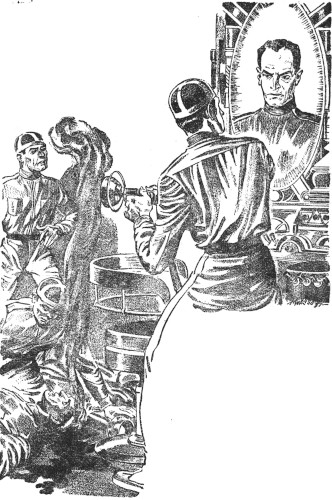
An instant later Helmuth's view-plate vanished in the DeLameter's blaze.
Then, throughout the fortress, there blared out the urgent assembly call, to which the Lensman added, verbally: "This is a one-hundred-per-cent call-out, including crews of ships in dock as well as regular base personnel. Bring also the patrol nurses. Come as you are and come fast. The doors of the auditorium will be locked in five minutes and any man outside those doors will be given ample reason to wish that he had been on time."
The auditorium was right off the control room, and was so arranged that when a partition was rolled back the control room became its stage. All Boskonian bases were arranged thus, in order that the supervising officers at Grand Base could oversee, through their instruments upon the main panel, just such assemblies as this one was supposed to be. Every man hearing that call assumed that it came from Grand Base, and every man hurried to obey it.
Kinnison rolled back the partition between the two rooms and watched for ray pistols, as the men came streaming into the auditorium. Ordinarily only the guards went armed—three of them were left—but possibly a few of the ship's officers would be wearing their DeLameters.... Four—five—six—the captain and the pilot of the battleship that had captured the nurses, and a vice commander of another, besides the three guards. Knives, billies, and such did not count.
"Time's up. Lock the doors. Bring the keys and the nurses up here," he ordered the six armed men, calling each by name. "You women take these chairs over here; you men sit there."
Then, when all were seated, Kinnison touched a button and the steel partition slid smoothly into place.
"What's coming off here?" demanded a guard. "Where's the commander? How about Grand Base? Look at that board!"
"Sit tight," Kinnison directed. "Hands on knees. I'll burn any or all of you that make a move. I have already burned the old man and five guards, and have put Grand Base out of the picture. Now I want to find out just how we seven stand." The Lensman already knew, but he was not tipping his hand.
"Why we seven?"
"Because we are the only ones who happened to be wearing guns. Every one else of the entire personnel is unarmed and is now locked in the auditorium. You know how apt they are to get out until one of us lets them out."
"But Helmuth—he'll have you blasted for this!"
"Hardly. My plans were not made yesterday. How many of you fellows are with me?"
"What's your scheme?" demanded the vice commander.
"To take these nurses to some patrol base and surrender. I'm sick of this whole game; and, since none of them have been hurt, I figure they'll bring us a pardon and a fresh start—a light sentence at least."
"Oh, so that's the reason——" growled the captain.
"Exactly. But I don't want any one with me whose only thought would be to burn me down at the first opportunity."
"Count me in," declared the pilot. "I've got a strong stomach, but enough of these jobbies is altogether too much. If you can wangle anything short of a life sentence for me I'll go back, but I bloody well won't help you against the——"
"Sure not. Not until after we're out in space. I don't need any help here."
"Do you want my DeLameter?"
"No, keep it. You won't use it on me. Anybody else?"
One guard joined the pilot, standing aside; the other four wavered.
"Time's up!" Kinnison snapped. "Now, you four fellows, either go for your guns or else turn your backs, and do it right now!"
They elected to turn their backs and Kinnison collected their weapons, one by one. Having disarmed them, he again rolled back the partition and ordered them to join the wondering throng in the auditorium. He then addressed the assemblage, telling them what he had done and what he had it in mind to do.
"A good many of you must be fed up on this lawless game of piracy and anxious to resume association with decent men, if you can do so without incurring too great a punishment," he concluded. "I feel quite certain that those of us who man the hospital ship in order to return these nurses to the patrol will get light sentences, at most. Miss MacDougall is head nurse. We will ask her what she thinks."
"Better than that," Mac replied clearly. "I am not merely 'quite certain,' either—I am absolutely sure that whatever men Mr. Blakeslee selects for his crew will not be given any sentences at all. They will be pardoned, and will be given chances at jobs in the merchant service."
"How do you know, miss?" asked one. "We're a black lot."
"I know you are," she replied serenely. "I won't say how I know, but you can take my word for it that I do know."
"Those of you who want to take a chance with us line up over here," Kinnison directed, and walked rapidly down the line, reading the mind of each man in turn. Many of them he waved back into the main group, as he found thoughts of treachery or signs of inherent criminality. Those he selected were those who were really sincere in their desire to quit forever the ranks of Boskone, those who were in those ranks because of some press of circumstance rather than because of a mental taint. As each man passed inspection he armed himself from the cabinet and stood at ease before the group of women.
Having selected his crew, the Lensman operated the controls that opened the exit nearest the hospital ship, blasted away the panel, so that that exit could not be closed, unlocked a door, and turned to the pirates.
"Vice Commander Krimsky, as senior officer you are now in command of this base," he remarked. "While I am in no sense giving you orders, there are a few matters about which you should be informed. First, I set no definite time as to when you may leave this room. I merely state that you will find it decidedly unhealthy to follow us at all closely as we go from here to the hospital ship. Second, you haven't a ship fit to take the ether, as your blast levers have all been broken off at the pivots. If your mechanics work at top speed, new ones can be put on in exactly two hours. Third, there is going to be a very severe earthquake in precisely two hours and thirty minutes, one which should make this base merely a memory."
"An earthquake! Don't bluff, Blakeslee. You couldn't do that!"
"Well, perhaps not a regular earthquake, but something that will do just as well. If you think I am bluffing, wait and find out. But common sense should give you the answer to that. I know exactly what Helmuth is doing now, whether you do or not. At first I intended to wipe you all out without warning, but I changed my mind. I decided that I would rather leave you alive, so that you could report to Helmuth exactly what happened. I wish that I could be watching him when he finds out how badly one man rooked him, and how far from foolproof his system is. But we can't have everything. Let's go, folks!"
As the group hurried away, Mac loitered until she was near the form of Blakeslee, who was bringing up the rear.
"Where are you, Kim?" she whispered urgently.
"I'll join up at the next corridor. Keep further ahead, and get ready to run when we do!"
As they passed that corridor a figure in gray leather, carrying an extremely heavy object, stepped out of it. Kinnison himself set his burden down, yanked a lever, and ran. And as he ran fountains of intolerable heat erupted and cascaded from the mechanism he had left upon the floor. Just ahead of him, but at some distance behind the others, ran Blakeslee and Mac.
"Gosh, I'm glad to see you, Kim!" she panted, as the Lensman caught up with them and all three slowed down. "What is that thing back there?"
"Nothing much—just a KJ4Z hot-shot. Won't do any real damage—just melt this tunnel down so that they can't interfere with our get-away."
"Then you were bluffing about the earthquake?" she asked, a shade of disappointment in her tone.
"Hardly," he reproved her. "That isn't due for two hours and a half yet, but it'll happen on schedule time."
"How?"
"You remember about the curious cat, don't you? However, no particular secret about it, I guess—ten duodec bombs placed where they'll do the most good, and timed for exactly simultaneous detonation. Here we are. Don't tell anybody I'm here."
Aboard the vessel, Kinnison disappeared into a stateroom while Blakeslee continued in charge. Men were divided into watches; duties were assigned; inspections were made, and the ship shot into the air. There was a brief halt to pick up Kinnison's speedster; then, again on the way, Blakeslee turned the board over to Crandall, the pilot, and went into Kinnison's room.
There the Lensman withdrew his control, leaving intact the memory of everything that had happened. For minutes Blakeslee was almost in a daze, but struggled through it and held out his hand.
"Mighty glad to meet you, Lensman. Thanks. All I can say is that after I got sucked in I couldn't——"
"Sure, I know all about it. That was one of the reasons I picked you out. Your subconsciousness didn't fight back a bit, at any time. You are to be in charge, from here to Tellus. Please go and chase everybody out of the control room except Crandall."
"Say, I just thought of something!" exclaimed Blakeslee, when Kinnison joined the two officers at the board. "You must be that particular Lensman who has been getting in Helmuth's hair so much lately!"
"Probably. That's my chief aim in life."
"I'd like to see Helmuth's face when he gets the report of this. I've said that before, haven't I? But I mean it now, even more than I did before."
"I'm thinking of Helmuth, too, but not that way." The pilot had been scowling at his plate, and now turned to Blakeslee and the Lensman, glancing curiously from one to the other. "Oh, I say——A Lensman, what? A bit of good old light begins to dawn; but that can wait. Helmuth is after us, foot, horse, and marines. Look at that plate!"
"Four of them already!" exclaimed Blakeslee. "And there's another! And we haven't got a beam hot enough to light a cigarette, nor a screen strong enough to stop a firecracker. We've got legs, but not as many as Helmuth's fliers. You knew all about that, though, of course, before we started; and from what you have pulled off so far you've got something left on the hooks. What is it? What's the answer?"
"Indetectability," replied Kinnison. "We can detect them, but they can't detect us. All you have to do is to stay out of range of their electros and drill for Tellus."
"That's hard to believe, but it must be true. There are nine ships on the plates now: all Boskonians and all certainly looking for us, but not a one of them has paid any attention to us."
"Nor will they. And, by the way, who or what is Boskone?"
"Nobody knows. Helmuth speaks for Boskone, and nobody else ever does, not even Boskone himself—if there is such a person. Nobody can prove it, but everybody knows that Helmuth and Boskone are simply two names for the same man. Helmuth, you know, is only a voice. Nobody ever saw his face until to-day."
"I'm beginning to think so, myself." And Kinnison strode away, to call at the office of Head Nurse MacDougall.
"Mac, here's a small, but highly important box," he told her, taking the neutralizer from his pocket and handing it to her. "Put it in your locker until you get to Tellus. Then take it, yourself, and give it to Haynes, himself, in person, and to nobody else. Just tell him I sent it. He'll know all about it."
"But why not keep it and give it to him yourself? You're coming with us, aren't you?"
"Probably not all the way. I imagine I'll have to shove off before we get back to Tellus."
"But I want to talk to you!" she exclaimed. "Why, I've got a million questions to ask you!"
"That would take a long time"—he grinned at her—"and time is just what we don't have right now, either of us." And he strode back to the board.
He labored for hours at a calculating machine and in the tank; finally to squat down upon his heels, staring at two needlelike rays of light in the tank and whistling softly between his teeth. For those two lines, while exactly in the same plane, did not intersect in the tank at all! Estimating as carefully as he could the point of intersection of the lines, he punched the "cancel" key to wipe out all traces of his work and went to the chart room. Chart after chart he hauled down, and for many minutes he worked with calipers, compass, goniometer, and a carefully set adjustable triangle. Finally he marked a point—exactly upon a small, plain dot already upon the chart—and again whistled.
"Huh!" he grunted. He rechecked all his figures and retraversed the chart, only to have his needle pierce again the same tiny, unmarked dot. He stared at it for a full minute, studying the map all around his marker.
"Star Cluster AC 257-4736," he ruminated. "The smallest, most insignificant, least-known star cluster he could find, and my largest possible error can't put it anywhere else. Kind of thought it might be in a cluster, but I never would have looked there. No wonder it took a lot of stuff to trace his beam. It would have to be four numbers Brinnell harder than a diamond drill to work from there."
Again whistling tunelessly to himself, he rolled up the chart upon which he had been at work, stuck it under his arm, replaced the others in their compartments, and went back to the control room.
"How's tricks, fellows?" he asked.
"QX," replied Blakeslee. "We're through them and into clear ether. Not a ship on the plate, and nobody gave us even a tumble."
"Fine! You won't have any trouble, then, from here in to Prime Base. Glad of it, too. I've got to flit. That'll mean long watches for you two, but it can't very well be helped."
"But I say, old bird, I don't mind the watches, but——"
"Don't worry about that, either. This crew can be trusted, to a man. Not one of you joined the pirates of your own free will, and not one of you has ever taken an active part——"
"What are you, a mind reader or something?" Crandall burst out.
"Something like that," Kinnison assented with a grin.
Blakeslee put in, "More than that, you mean. Something like hypnosis, only more so. You think that I had something to do with this, but I didn't. The Lensman did it all himself."
"Um-m-m." Crandall stared at Kinnison, new respect in his eyes. "I knew that unattached Lensmen were good, but I had no idea they were that good. No wonder Helmuth has been getting his wind up about you. I'll string along with any one who can take a whole base, single-handed, and make such a bally ass to boot out of such a keen old bird as Helmuth is. But I'm in a bit of a dither, not to say a funk, about what is going to happen when we pop into Prime Base without you. Every man jack of us, you know, is slated for the lethal chamber without trial. Miss MacDougall will do her bit, of course, but what I mean is, has she enough jets to swing it?"
"I think that she has; but to avoid all argument I've fixed that up, too. Here's a tape, telling all about what happened. It ends up with my recommendation for a full pardon for each of you, and for a job at whatever he is found best fitted for. It is signed with my thumb print. Give it or send it to Port Admiral Haynes as soon as you land. I've got enough jets, I think, so that it will go as it lays."
"Jets? You? Right-o! You've got jets enough to lift fourteen freighters off the North Pole of Valeria. What next?"
"Stores and supplies for my speedster. I'm doing a long flit and this ship has supplies to burn, so I'd like to have my little can loaded, Plimsoll down."
The speedster was stocked forthwith. Then, with nothing more than a casually waved salute in the way of farewell, Kinnison boarded his tiny space ship and shot away toward his distant goal. Crandall, the pilot, sought his bunk; while Blakeslee started his long trick at the board. In an hour or so the head nurse strolled in.
"Kim?" she queried, doubtfully.
"No, Miss MacDougall. It's Blakeslee. Sorry——"
"Oh, I'm glad of that. That means that everything is settled. Where's the Lensman—in bed?"
"He has gone, miss."
"Gone! Without a word? Where?"
"He didn't say."
"He wouldn't, of course." The nurse turned away, exclaiming inaudibly, "Gone! I'd like to cuff him for that, the lug! Gone! Why, the great, big, lobsterly clunker!"
XXII.
But Kinnison was not heading for Helmuth's base—yet. He was splitting the ether toward Aldebaran instead, as fast as his speedster could go; and she was one of the fastest things in the galaxy. He had two good reasons for going there before he attempted Boskone's Grand Base: first, to try out his skill upon nonhuman intellects—if he could handle the Wheelmen he was ready to take the far greater hazard; second, he owed those Wheelmen something, and he did not like to call in the whole patrol to help him pay his debts. He could, he thought, handle that base himself.
Knowing exactly where it was, he had no difficulty in finding the volcanic shaft which formed the entrance to that Aldebaranian base. Down that shaft his sense of perception sped. He found the lookout plates and followed their power leads. Gently, carefully, he insinuated his mind into that of the Wheelman at the board, discovering, to his great relief, that that monstrosity was no more difficult to handle than had been the Radeligian observer. Mind or intellect, he found, were not affected at all by the shape of the brains concerned; quality, reach, and power were the essential factors.
Therefore, he let himself in and took position in the same room from which he had been driven so violently. Kinnison examined with interest the wall through which he had been blown, noting that it had been repaired so perfectly that he could scarcely find the joints which had been made.
These Wheelmen, the Lensman knew, had explosives; since the bullets which had torn their way through his armor and through his flesh had been propelled by that agency. Therefore, to the mind within his grasp he suggested "the place where explosives are kept?" and the thought of that mind flashed to the storeroom in question. Similarly, the thought of the one who had access to that room pointed out to the Lensman the particular Wheelman he wanted. It was as easy as that. And since he took care not to look at any of the weird beings, he gave no alarm.
Kinnison withdrew his mind delicately, leaving no trace of its occupancy, and went to investigate the arsenal. There he found a few cases of machine-rifle cartridges, and that was all. Then he went into the mind of the munitions officer, where he discovered that the heavy bombs were kept in a distant crater, so that no damage would be done by any possible explosion.
"Not quite as simple as I thought," Kinnison ruminated. "But there's a way out of that, too."
There was. It took an hour or so of time; and he had to control two Wheelmen instead of one, but he found that he could do that. When the munitions master took out a bomb-scow after a load of H.E., the crew had no idea that it was anything except a routine job. The only Wheelman who would have known differently, the one at the lookout board, was the other whom Kinnison had to keep under control. The scow went out, got its load, and came back. Then, while the Lensman was flying out into space, the scow dropped down the shaft. So quietly was the whole thing done that not a creature in that whole establishment knew that anything was wrong until it was too late to act—and then none of them knew anything at all. Not even the crew of the scow realized that they were dropping too fast.