Front matter (continued 2)
Reading edition
"Cut me loose!" commanded Kinnison at last. "Even you can't take much more of that. No use letting them break your back. Cut, I tell you. I said cut, you big, dumb, Valerian ape!"
But if VanBuskirk heard or felt the savagely voiced commands of his chief, he gave no heed. Straining to the very ultimate fiber of his being, exerting every iota of loyal mind and every atom of Brobdingnagian frame, grimly, tenaciously, stubbornly the gigantic Dutchman held.
Held while Worsel of Velantia, that grotesquely hideous, that fantastically reptilian ally, plowed toward the two patrolmen through the horde of Catlats; a veritable tornado of rending fang and shearing talon, of beating wing and crushing snout, of mailed hand and trenchant tail.
Held while that demon incarnate drove closer and closer, hurling entire Catlats and numberless dismembered fragments of Catlats to the four winds as he came.
Held while the raging tumult, whose center was Worsel, swept over his rigid body like an ocean wave breaking over an immovable rock.
Held until Worsel's snakelike body, a supple and sentient cable of living steel, tipped with its double-edged, razor-keen, scimitarlike sting, slipped into the tunnel beside Kinnison and wrought grisly havoc among the Catlats close-packed there!
As the terrific tension upon him was suddenly released VanBuskirk's own efforts hurled him away from the cliff. He fell to the ground, his overstrained muscles twitching uncontrollably, and on top of him fell the fettered Lensman. Kinnison, his hands now free, unfastened the clamps linking his armor to that of VanBuskirk and whirled to confront the foe. But the fighting was over. The Catlats had had enough of Worsel of Velantia; and, shrieking in baffled rage, the last of them were disappearing into their caves. He turned back to VanBuskirk, who was getting shakily to his feet.
"Thanks a lot, Worsel; we were just about to run out of time——" VanBuskirk began, only to be silenced by an insistent thought from the grotesque stranger.
"Stop that radiating! Do not think at all if you cannot screen your minds!" came the urgent mental commands. "These Catlats are a very minor pest of this planet Delgon. There are others worse by far. Fortunately, your thoughts are upon a frequency never used here—if I had not been so very close to you I would not have heard you at all—but should the Overlords have a listener upon that band, your unshielded thinking may already have done irreparable harm. Follow me. I will slow my speed to yours, but hurry all possible!"
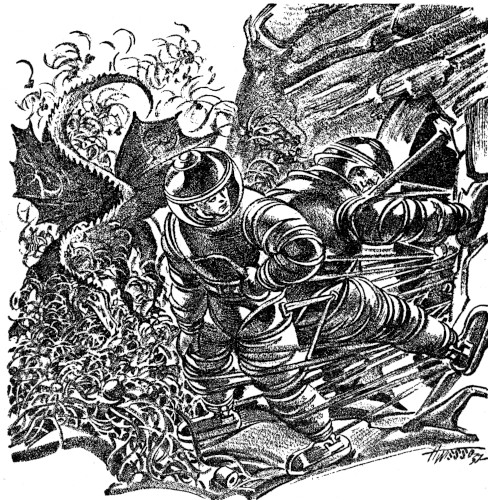
"Stop that radiating! Do not think at all if you cannot screen your mind," came the mental command.
"You tell 'im, chief," VanBuskirk said, and fell silent; his mind as nearly a perfect blank as his iron will could make it.
"This is a screened thought, through my Lens," Kinnison took up the conversation. "You don't need to slow down on our account. We can develop any speed you wish. Lead on!"
The Velantian leaped into the air and flashed away in headlong flight. Much to his surprise, the two human beings kept up with him effortlessly upon their inertialess drives, and after a moment Kinnison directed another thought.
"If time is an object, Worsel, know that my companion and I can carry you anywhere you wish to go at a speed hundreds of times greater than this that we are using," he vouchsafed.
It developed that time was of the utmost possible importance and the three closed in. Mighty wings folded back, hands and talons gripped armor chains, and the group, inertialess all, shot away at a pace that Worsel of Velantia had never even imagined in his wildest dreams of speed. Their goal, a small, featureless tent of thin sheet metal, occupying a barren spot in a writhing, crawling expanse of lushly green jungle, was reached in a space of minutes. Once inside, Worsel sealed the opening and turned to his armored guests.
"We can now think freely in open converse. This wall is the carrier of a screen through which no thought can make its way."
"This world you call by a name I have interpreted as Delgon," Kinnison began, slowly. "You are a native of Velantia, a planet now beyond the Sun. Therefore, I assumed that you were taking us to your space ship. Where is that ship?"
"I have no ship," the Velantian replied, composedly, "nor have I need of one. For the remainder of my life—which is now to be measured in a few of your hours—this tent is my only——"
"No ship!" VanBuskirk broke in. "I hope we won't have to stay on this God-forsaken planet forever—and I'm not very keen on going much farther in that lifeboat, either."
"We may not have to do either of those things," Kinnison reassured his sergeant. "Worsel comes of a long-lived tribe, and the fact that he thinks his enemies are going to get him in a few hours doesn't make it true, by any means. There are three of us to reckon with now. Also, when we need a space ship we'll get one, if we have to build it. Now, let's find out what this is all about. Worsel, start at the beginning and don't skip a thing. Between us we can surely find a way out, for all of us."
Then the Velantian told his story. There was much repetition, much roundabout thinking, as some of the concepts were so bizarre as to defy transmission, but finally the Earthman had a fairly complete picture of the situation within that strange solar system.
The inhabitants of Delgon were bad, being characterized by a type and a depth of depravity impossible for a mind of Earth to visualize. Not only were the Delgonians enemies of the Velantians in the ordinary sense of the word; not only were they pirates and robbers; not only were they their masters, taking them both as slaves and as food cattle; but there was something more, something deeper and worse, something only partially transmissible from mind to mind—a horribly and repulsively Saturnalian type of mental and intellectual, as well as biological, parasitism. This relationship had gone on for ages.
Finally, however, a thought-screen had been devised, behind which Velantia developed a high science of her own. The students of this science lived with but one purpose in life: to free Velantia from the tyranny of the Overlords of Delgon. Each student, as he reached the zenith of his mental power, went to Delgon, to study and if possible destroy the tyrants. And after disembarking upon the soil of that dread planet no Velantian, whether student or scientist or private adventurer, had ever returned to Velantia.
"But why don't you lay a complaint against them before the council?" demanded VanBuskirk. "They'd straighten things out in a hurry."
"We have not heretofore known, save by the most unreliable and roundabout reports, that such an organization as your Galactic Patrol really exists," the Velantian replied, obliquely. "Nevertheless, many years since, we launched a space ship toward its nearest reputed base. However, since that trip requires three normal lifetimes, with deadly peril in every moment, it will be a miracle if the ship ever completes it.
"Furthermore, even if the ship should reach its destination, our complaint will probably not even be considered, because we have not a single shred of real evidence with which to support it. No living Velantian has ever seen a Delgonian, nor can any one testify to the truth of anything I have told you. While we believe that that is the true condition of affairs, our belief is based, not upon evidence admissible in a court of law, but upon deductions from occasional thoughts radiated from this planet. Nor were these thoughts alike in tenor——"
"Skip that for a minute—we'll take the picture as correct," Kinnison broke in. "Nothing you have said so far shows any necessity for you to die in the next few hours."
"The only object in life for a trained Velantian is to liberate his planet from the horrors of subjection to Delgon. Many such have come here, but not one has found a workable idea; not one has either returned to or even communicated with Velantia after starting work here. I am a Velantian. I am here. Soon I shall open that door and get in touch with the enemy. Since better men than I am have failed, I do not expect to succeed. Nor shall I return to my native planet. As soon as I start to work the Delgonians will command me to come to them. In spite of myself I will obey that command, and very shortly thereafter I shall die, in what fashion I do not know."
"Snap out of it, Worsel!" barked Kinnison, roughly. "That's the rankest kind of defeatism, and you know it. Nobody ever got to the first check station on that kind of fuel."
"You are talking about something now about which you know nothing whatever." For the first time Worsel's thoughts showed passion. "Your thoughts are idle—ignorant—vain. You know nothing whatever of the mental power of the Delgonians."
"Maybe not—I make no claim of being a mental giant—but I do know that mental power alone cannot overcome a definitely and positively opposed will. An Arisian could probably break my will, but I'll stake my life that no other mentality in the known universe can do it!"
"You think so, Earthling?" And a seething sphere of mental force encompassed the Tellurian's brain. Kinnison's senses reeled at the terrific impact; but he shook off the attack and smiled.
"Come again, Worsel. That one jarred me to the heels, but it didn't quite ring the bell."
"You flatter me," the Velantian declared in surprise. "I could scarcely touch your mind—could not penetrate even its outermost defenses, and I exerted all my force. But that fact gives me hope. My mind is, of course, inferior to theirs, but since I could not influence you at all, even in direct contact and at full power, you may be able to resist the minds of the Delgonians. Are you willing to hazard the stake you mentioned a moment ago? Or rather, I ask you, by the Lens you wear, so to hazard it—with the liberty of an entire people dependent upon the outcome."
"Why not? The spools come first, of course—but without you our spools would both be buried now inside the cliff of the Catlats. Fix it so that your people will find these spools and carry on with them in case we fail, and I'm your man. There—now tell me what we're apt to be up against, and then let loose your dogs."
"That I cannot do. I know only that they will direct against you mental forces such as you never even imagined. I cannot forewarn you in any respect whatever as to what forms those forces may appear to assume. I know, however, that I shall succumb to the first bolt of force. Therefore, bind me with these chains before I open the shield. Physically, I am extremely strong, as you know; therefore, be sure to put on enough chains so that I cannot possibly break free, for if I can break away I shall undoubtedly kill both of you."
"How come all these things here, ready to hand?" asked VanBuskirk, as the two patrolmen so loaded the passive Velantian with chains, manacles, handcuffs, leg irons and straps that he could not move even his tail.
"It has been tried before, many times," Worsel replied bleakly, "but the rescuers, being Velantians, also succumbed to the force and took off the irons. Now I caution you, with all the power of my mind—no matter what you see, no matter what I may command you or beg of you, no matter how urgently you yourself may wish to do so—do not liberate me under any circumstances unless and until things appear exactly as they do now and that door is shut. Know fully and ponder well the fact that if you release me while that door is open it will be because you have yielded to Delgonian force, and that not only will all three of us die, lingeringly and horribly, but also, and worse, that our deaths will not have been of any benefit to civilization. Do you understand? Are you ready?"
"I understand. I am ready," thought Kinnison and VanBuskirk as one.
"Open that door."
Kinnison did so. For a few minutes nothing happened. Then three-dimensional pictures began to form before their eyes—pictures which they knew existed only in their own minds, yet which were composed of such solid substance that they obscured from vision everything else in the material world. At first hazy and indistinct, the scene—for it was in no sense now a picture—became clear and sharp. And, piling horror upon horror, sound was added to sight. And directly before their eyes, blotting out completely even the solid metal of the wall only a few feet distant from them, the two outlanders saw and heard something which can be represented only vaguely by imagining Dante's Inferno an actuality and raised to the nth power!
In a dull and gloomy cavern there lay, sat, and stood hordes of things. These beings—the "nobility" of Delgon—had reptilian bodies, somewhat similar to Worsel's, but they had no wings and their heads were distinctly apish rather than crocodilian. Every greedy eye in the vast throng was fixed upon an enormous screen which, like that in a motion-picture theater, walled off one end of the stupendous cavern.
Slowly, shudderingly, Kinnison's mind began to take in what was happening upon that screen. And it was really happening, Kinnison was sure of that. This was not a picture any more than this whole scene was an illusion. It was all an actuality—somewhere.
Upon that screen there were stretched out victims. Hundreds of these were Velantians, more hundreds were winged Delgonians, and scores were creatures whose like Kinnison had never seen. And all these were being tortured; tortured to death both in fashions known to the Inquisitors of old and ways of which even those experts had never an inkling.
Some were being twisted outrageously in three-dimensional frames. Others were being stretched upon racks. Many were being pulled horribly apart, chains intermittently but relentlessly extending each helpless member. Still others were being lowered into pits of constantly increasing temperatures or were being attacked by gradually increasing concentrations of some foully corrosive vapor which ate away their tissues, little by little. And, apparently the pièce de résistance of the hellish exhibition, one luckless Velantian, in a spot of hard, cold light, was being pressed out flat against the screen, as an insect might be pressed between two panes of glass. Thinner and thinner he became, under the influence of some awful, invisible force, in spite of every exertion of inhumanely powerful muscles driving body, tail, wings, arms, legs, and head in every frantic maneuver which grim and imminent death could call forth.
Physically nauseated, brainsick at the atrocious visions blasting his mind and at the screaming of the damned assailing his ears, Kinnison strove to wrench his mind away, but was curbed savagely by Worsel.
"You must stay! You must pay attention!" commanded the Velantian. "This is the first time any living being has seen so much! You must help me now! They have been attacking me from the first; but, braced by the powerful negatives in your mind, I have been able to resist and have transmitted a truthful picture so far. But they are surprised at my resistance and are concentrating more force. I am slipping fast. You must brace my mind! And when the picture changes—as change it must, and soon—do not believe it. Hold fast, brothers of the Lens, for your own lives and for the people of Velantia. There is more—and worse!"
Kinnison stayed. So did VanBuskirk, fighting with all his stubborn Dutch mind. Revolted, outraged, nauseated as they were at the sights and sounds, they stayed. Flinching with the victims as they were fed into the hoppers of slowly turning mills; wincing at the unbelievable acts of the boilers, the beaters, the scourgers, the flayers; suffering themselves every possible and many apparently impossible nightmares.
The light in the cavern now changed to a strong, greenish-yellow glare; and in that hard illumination it was to be seen that each dying being was surrounded by a palely glowing aura. And now, crowning horror of that unutterably horrible orgy of sadism resublimed, from the eyes of each one of the monstrous audience there leaped out visible beams of force. These beams touched the aura of the dying prisoners—touched and clung. And as they clung the aura shrank and disappeared.
The Overlords of Delgon were actually feeding upon the ebbing life forces of their tortured, dying victims!
VI.
Gradually and so insidiously that the Velantian's dire warnings might as well never have been uttered, the scene changed. Or rather, the scene itself did not change, but the observers' perception of it slowly underwent such a radical transformation that it was in no sense the same scene it had been a few minutes before; and they felt almost abjectly apologetic as they realized how unjust their previous ideas had been.
For the cavern was not a torture chamber, as they had supposed. It was, in reality, a hospital, and the beings they had thought victims of brutalities unspeakable were, in reality, patients undergoing treatments and operations for various ills. In proof whereof the patients—who should have been dead by this time were the early ideas well-founded—were now being released from the screenlike operating theater. And not only was each one completely whole and sound in body, but he was also possessed of a mental clarity, power, and grasp undreamed of before his hospitalization and treatment by Delgon's super surgeons!
Also, the intruders had misunderstood completely the audience and its behavior. They were really medical students, and the beams which had seemed to be devouring rays were simply visibeams, by means of which each student could follow, in close-up detail, each step of the operation in which he was most interested. The patients themselves were living, vocal witnesses of the visitors' mistakenness, for each, as he made his way through the assemblage of students, was voicing his thanks for the marvelous results of his particular treatment or operation.
Kinnison now became acutely aware that he himself was in need of immediate surgical attention. His body, which he had always regarded so highly, he now perceived to be sadly inefficient; his mind was in even worse shape than his physique; and both body and mind would be improved immeasurably if he could get to the Delgonian hospital before the surgeons departed. In fact, he felt an almost irresistible urge to rush away toward that hospital instantly, without the loss of a single precious second. And, since he had had no reason to doubt the evidence of his own senses, his conscious mind was not aroused to active opposition. However, in his subconscious, or his essence, or whatever you choose to call that ultimate something of his that made him a Lensman, a "dead, slow bell" began to sound.
"Release me and we'll all go, before the surgeons leave the hospital," came an insistent thought from Worsel. "But hurry—we haven't much time!"
VanBuskirk, completely under the influence of the frantic compulsion, leaped toward the Velantian, only to be checked bodily by Kinnison, who was foggily trying to isolate and identify one thing about the situation that did not ring quite true.
"Just a minute, Bus. Shut that door first!" he commanded.
"Never mind the door!" Worsel's thought came in a roaring crescendo. "Release me instantly! Hurry, or it will be too late, for all of us!"
"All this terrific rush doesn't make any kind of sense at all," Kinnison declared, closing his mind resolutely to the clamor of the Velantian's thoughts. "I want to go just as badly as you do, Bus, or maybe more so—but I can't help feeling that there's something screwy somewhere. Anyway, remember the last thing Worsel said, and let's shut the door before we unsnap a single chain."
Then something clicked in the Lensman's mind.
"Hypnotism, through Worsel!" he barked, opposition now aflame. "So gradual that it never occurred to me to build up a resistance. Holy rackets, what a fool I've been! Fight 'em, Bus—fight 'em! Don't let 'em kid you any more, and pay no attention to anything Worsel sends at you!" Whirling around, he leaped toward the open door of the tent.
But as he leaped his brain was invaded by such a concentration of force that he fell flat upon the floor, physically out of control. He must not shut the door. He must release the Velantian. They must go to the Delgonian cavern. Fully aware now, however, of the source of the waves of compulsion, he threw the sum total of his mental power into an intense negation and struggled, inch-wise, toward the opening.
Upon him now, in addition to the Delgonians' compulsion, beat at point-blank range the full power of Worsel's mighty mind, demanding release and compliance. Also, and worse, he perceived that some powerful mentality was being exerted to make VanBuskirk kill him. One blow of the Valerian's ponderous mace would shatter helmet and skull, and all would be over. Once more the Delgonians would have triumphed. But the stubborn Dutchman, although at the very verge of surrender, was still fighting. He would take one step forward, bludgeon poised aloft, only to throw it convulsively backward.
Again and again VanBuskirk repeated his futile performance, while the Lensman struggled nearer and nearer the door. Finally, he reached it and kicked it shut. Instantly, the mental turmoil ceased and the two white and shaking patrolmen released the limp, unconscious Velantian from his bonds.
"Wonder what we can do to help him revive," gasped Kinnison. But his solicitude was unnecessary; the Velantian recovered consciousness as he spoke.
"Thanks to your wonderful power of resistance, I am alive, unharmed, and know more of our foes and their methods than any other of my race has ever learned," Worsel thought, feelingly. "But it is of no value whatever unless I can send it back to Velantia. The thought-screen is carried only by the metal of these walls; and if I make an opening in the wall to think through, however small, it will now mean death. Of course, the science of your patrol has not perfected an apparatus to drive through such a screen."
"No. Anyway, it seems to me that we'd better be worrying about something besides thought-screens," Kinnison suggested. "Surely, now that they know where we are, they'll be coming out here after us, and we haven't got much of any defense."
"They don't know where we are, or care——" began the Velantian.
"Why not?" broke in VanBuskirk. "Any spy ray capable of such scanning as you showed us—I never saw anything like it before—would certainly be as easy to trace as an out-and-out gas blast!"
"I sent out no spy ray or anything of the kind," Worsel thought, carefully. "Since our science is so foreign to yours, I am not sure that I can explain satisfactorily, but I shall try to do so. First, as to what you saw. When that door is open, no barrier to thought exists. I merely broadcast a thought, placing myself en rapport with the Delgonian Overlords in their retreat. This condition established, of course I heard and saw exactly what they heard and saw—and so, equally of course, did you, since you were also en rapport with me. That is all."
"That's all!" echoed VanBuskirk. "What a system! You can do a thing like that, without apparatus of any kind, and yet say 'that's all'!"
"It is results that count," Worsel reminded him gently. "While it is true that we have done much—this is the first time in history that any Velantian has encountered the mind of a Delgonian Overlord and lived. It is equally true that it was the will power of you patrolmen that made it possible, not my mentality. Also, it remains true that we cannot leave this room and live."
"Why won't we need weapons?" asked Kinnison, returning to his previous line of thought.
"Thought screens are the only defense we will require," Worsel stated, positively, "for they use no weapons except their minds. By mental power alone they make us come to them; and, once there, their slaves do the rest. Of course, if my race is ever to rid the planet of them, we must employ offensive weapons of power. We have such, but we have never been able to use them. For, in order to locate the enemy, either by telepathy or by spy ray, we must open our metallic shields—and the instant we release those screens we are lost. From those conditions there is no escape," Worsel concluded, hopelessly.
"Don't be such a pessimist," Kinnison commanded. "There are a lot of things not tried yet. For instance, from what I have seen of your generator equipment and that screen, you don't need a metallic conductor any more than a snake needs hips. Maybe I'm wrong, but I think we're a bit ahead of you there. If a DeVilbiss projector can handle that screen—and I think it can, with special tuning—VanBuskirk and I can fix things in an hour so that all three of us can walk out of here in perfect safety—from mental interference, at least. While we're trying it out, tell us all the new stuff you got on them just now, and anything else that, by any possibility, may prove useful. And remember you said this is the first time any of you had been able to cut them off. That fact ought to make them sit up and take notice. Probably they'll stir around more than they ever did before. Come on, Bus—let's tear into it!"
The DeVilbiss projectors were rigged and tuned. Kinnison had been right; they worked. Then plan after plan was made, only to be discarded as its weaknesses were pointed out.
"Whichever way we look there are too many 'ifs' and 'buts' to suit me," Kinnison summed up the situation finally. "If we can find them, and if we can get up close to them without losing our minds to them, we could clean them out if we had some power in our accumulators. So I'd say the first thing for us to do is to get our batteries charged. We saw some cities from the air, and cities always have power. Lead us to power, Worsel—almost any kind of power—and we'll soon have it in our guns."
"There are cities, yes"—Worsel was not at all enthusiastic—"dwelling places of the ordinary Delgonians, the people you saw being eaten in the cavern of the Overlords. As you saw, they resemble us Velantians to a certain extent. Since they are of a lower culture and are much weaker in life force than we are, however, the Overlords prefer us to their own slave races.
"To visit any city of Delgon is out of the question. Every inhabitant of every city is an abject slave and his brain is an open book. Whatever he sees, whatever he thinks, is communicated instantly to his master. And I now perceive that I may have misinformed you as to the Overlords' ability to use weapons. While the situation has never arisen, it is only logical to suppose that as soon as we are seen by any Delgonian the controllers will order all the inhabitants of the city to capture us and bring us to them."
"What a guy!" interjected VanBuskirk. "Did you ever see his top for looking at the bright side of life?"
"Only in conversation," the Lensman replied. "When the ether gets crowded, you notice, he's right in here, blasting away and not saying a word. But there's one thing we haven't thought of: power. I've got only eight minutes of free flight left in my battery; and with your mass, you must be about out. Come to think of it, didn't you land a trifle hard when we sat down here?"
"Practically inert."
"That means we've got to get some power. Well, it's not so bad, at that; there's a city right close."
"Yes, but as far as I'm concerned it might as well be on Mars. You know as well as I do what's between here and there. You can take my batteries and I'll wait here."
"On your emergency food, water, and air? That's out!"
"What else, then?"
"I can spread my field to cover all three of us," proposed Kinnison. "That will give us at least one minute of free flight—almost, if not quite, enough to clear the jungle. They have night here; and, like us, the Delgonians are night sleepers. We start at dusk, and to-night we recharge our batteries."
The following hour, during which the huge, hot Sun dropped to the horizon, was spent in intense discussion, but no significant improvement upon the Lensman's plan could be devised.
"It is time to go," Worsel announced, curling out one extensile eye toward the vanishing orb. "I have recorded all my findings. Already I have lived longer and, through you, have accomplished more, than any one believed possible. I am ready to die. I should have been dead long since."
"Living on borrowed time's a lot better than not living at all," Kinnison replied, with a grin. "Link up. Ready? Go!"
He snapped his switches and the close-linked group of three shot into the air and away. As far as the eye could reach in any direction extended the sentient, ravenous growth of the jungle; but Kinnison's eyes were not upon that fantastically inimical green carpet. His whole attention was occupied by two all-important meters and by the task of so directing their flight as to gain the greatest possible horizontal distance with the power at his command.
Fifty seconds of flashing flight, then: "All right, Worsel, get out in front and get ready to pull!" Kinnison snapped. "Ten seconds of drive left, but I can hold us free for five seconds after my driver quits. Pull!"
Kinnison's driver expired, its small accumulator completely exhausted; and Worsel, with his mighty wings, took up the task of propulsion. Inertialess still, with Kinnison and VanBuskirk grasping his tail, each beat a mile-long leap, he struggled on. But all too soon the battery powering the neutralizers also went dead and the three began to plummet downward at a sharper and sharper angle, in spite of the Velantian's Herculean efforts to keep them aloft.
Some distance ahead of them the green of the jungle ended in a sharply cut line, beyond which there was a heavy growth of fairly open forest. A couple of miles of this and there was the city, their objective—so near and yet so far!
"We'll either just make the timber or we just won't," Kinnison, mentally plotting the course, announced dispassionately. "Just as well if we land in the jungle, I think. It'll break our fall, anyway; and hitting solid ground inert at this speed might be pretty serious."
"If we land in the jungle we will never leave it"—Worsel's thought did not slow the incredible tempo of his prodigious pinions—"but it makes little difference whether I die now or later."
"It does to us, you pessimistic croaker!" flared Kinnison. "Forget that dying complex of yours for a minute! Remember the plan and follow it! We're going to strike the jungle, about ninety or a hundred meters in. If you come in with us you die at once, and the rest of our scheme is all shot to pieces. So when we let go, you go ahead and land in the woods. We'll join you there, never fear; our armor will hold long enough for us to cut our way through a hundred meters of any jungle that ever grew—even this one. Get ready, Bus. Leggo!"
They dropped. Through the lush succulence of close-packed upper leaves and tentacles they crashed—through the heavier, wooded main branches below, through to the ground. And there they fought for their lives; for those voracious plants nourished themselves not only upon the soil in which their roots were embedded, but also upon anything organic unlucky enough to come within reach. Flabby but tough tentacles encircled them; ghastly sucking disks, exuding a potent corrosive, slobbered wetly at their armor; knobbed and spiky bludgeons whanged against tempered steel as the monstrous organisms began dimly to realize that these particular titbits were encased in something more resistant far than skin, scales, or bark.
But the Lensman and his giant companion were not quiescent. They came down oriented and fighting. VanBuskirk, in the van, swung his frightful space ax as a reaper swings his scythe—one solid, short step forward with each swing. And close behind the Valerian strode Kinnison, his own flying ax guarding the giant's head and back.
Masses of that obscene vegetation crashed down upon their heads from above, revolting cupped orifices sucking and smacking; and they were showered continually with floods of the opaque, corrosive sap to the action of which even their armor was not entirely immune. But, hampered as they were and almost blinded, they struggled indomitably on; while behind them an ever-lengthening corridor of demolition marked their progress.
"Ain't we got fun?" grunted the Dutchman, in time with his swing. "But we're quite a team at that, chief—brains and brawn, huh?"
"Uh-huh," dissented Kinnison, his flying weapon a solid disk of steel to the eye. "Grace and poise; or, if you want to be really romantic, ham and eggs."
"Rack and ruin will be more like it if we don't break out before this confounded goo eats through our armor. But we're making it—the stuff's thinning out and I think I can see trees up ahead."
"It is well if you can," came a cold, clear thought from Worsel, "for I am sorely beset. Hasten or I perish!"
At that thought the two patrolmen forged ahead in a burst of furious activity. Crashing through the thinning barriers of the jungle's edge, they wiped their lenses partially clear, glanced quickly about, and saw the Velantian. That worthy was "sorely beset" indeed. Six animals—huge, reptilian, but lithe and active—had him down. So helplessly immobile was Worsel that he could scarcely move his tail, and the monsters were already beginning to gnaw at his scaly, armored hide.
"I'll put a stop to that, Worsel!" called Kinnison, referring to the fact, well known to all us moderns, that any real animal, no matter how savage, can be controlled by any wearer of the Lens. For, no matter how low in the scale of intelligence the animal is, the Lensman can get in touch with whatever mind the creature has and reason with it.
But these monstrosities, as Kinnison learned immediately, were not really animals. Even though of animal form and mobility, they were purely vegetable in motivation and behavior, reacting only to the stimuli of food and of reproduction. Weirdly and completely inimical to all other forms of created life, they were so utterly noisome, so completely alien that the full power of mind and Lens failed entirely to gain rapport.
Upon that confusedly writhing heap the patrolmen flung themselves, terrible axes destructively a-swing. In turn, they were attacked viciously; but this battle was not long to endure. VanBuskirk's first terrific blow knocked one adversary away, almost spinning end over end. Kinnison took out one, the Dutchman another, and the remaining three were no match at all for the humiliated and furiously raging Velantian. But it was not until the monstrosities had been gruesomely carved and torn apart, literally limb from hideous limb, that they ceased their insensately voracious attacks.
"They took me by surprise," explained Worsel, unnecessarily, as the three made their way through the night toward their goal, "and six of them at once were too much for me. I tried to hold their minds, but apparently they have none."
"How about the Overlords?" asked Kinnison. "Suppose they have received any of our thoughts? We patrolmen at least have been doing a lot of unguarded radiating lately."
"No," Worsel made positive reply. "The thought-screen batteries, while small and of very little actual power, have, nevertheless, a very long service life. Now let us again go over the next steps of our plan of action."
Since no more untoward events marred their progress toward the Delgonian city, they soon reached it. It was for the most part dark and quiet, its somber buildings merely blacker blobs against a background of black. Here and there, however, were to be seen automotive vehicles moving about, and the three invaders crouched against a convenient wall, waiting for one to come along the "street" in which they were. Eventually one did.
As it passed them Worsel sprang into headlong, gliding flight, Kinnison's heavy knife in one gnarled fist. And as he sailed he struck—lethally. Before that luckless Delgonian's brain could radiate a single thought it was in no condition to function at all; for the head containing it was bouncing in the gutter. Worsel backed the peculiar conveyance along the curb and his two companions leaped into it, lying flat upon its floor and covering themselves from sight as best they could.
Worsel, familiar with things Delgonian and looking enough like a native of the planet to pass a casual inspection in the dark, drove the car. Streets and thoroughfares he traversed at reckless speed, finally drawing up before a long, low building, entirely dark. He scanned his surroundings with care, in every direction. Not a creature was in sight.
"All is clear, friends," he thought, and the three adventurers sprang to the building's entrance. The door—it had a door, of sorts—was locked, but VanBuskirk's ax made short work of that difficulty. Inside, they braced the wrecked door against intrusion. Then Worsel led the way into the unlighted interior. Soon he flashed his lamp about him and stepped upon a black, peculiarly marked tile set into the floor; whereupon a harsh, white light illuminated the room.
"Cut it, before somebody takes alarm!" snapped Kinnison.
"No danger of that," replied the Velantian. "There are no windows in any of these rooms; no light can be seen from outside. This is the control room of the city's power plant. If you can convert any of this power to your uses, help yourselves to it. In this building is also Delgon's closest approximation to a munitions plant. Whether or not anything in it can be of service to you is, of course, for you to say. I am now at your disposal."
While the Velantian was thinking these things Kinnison had been studying the panels and instruments. Now he and VanBuskirk tore open their armor—they had already learned that the atmosphere of Delgon, while not as wholesome for them as that in their suits, would, for a time at least, support human life—and wrought diligently with pliers, screw drivers, and other tools of the electrician. Soon their exhausted batteries were upon the floor beneath the instrument panel, greedily absorbing the electrical fluid from the busbars of the Delgonians.
"Now, while they're getting filled up, let's see what they mean by 'munitions' in these parts," Kinnison ordered. "Lead on, Worsel!"
VII.
With Worsel in the lead, the three interlopers hastened along a corridor, past branching and intersecting hallways, to a distant wing of the structure. There, it was evident, manufacturing of weapons was carried on; but a quick study of the queer-looking devices and mechanisms upon the benches and inside the storage racks lining its walls convinced Kinnison that the room could yield them nothing of permanent benefit. There were high-powered beam projectors, it was true; but they were so heavy that they were not even semiportable. There were also hand weapons of various peculiar patterns, but without exception they were ridiculously inferior to the DeLameters of the patrol in every respect of power, range, controllability, and storage capacity. Nevertheless, after testing them out sufficiently to make certain of the above findings, Kinnison selected an armful of the most powerful models and turned to his companions.
"Let's go back to the power room," he urged. "I'm nervous as a cat. I feel stark naked without my batteries; and if any one should happen to drop in there and do away with them, we'd be sunk without a trace."
Loaded down with Delgonian weapons, they hurried back the way they had come. Much to Kinnison's relief he found that his forebodings had been groundless; the batteries were still there, still absorbing myriawatt hour after myriawatt hour from the Delgonian generators. Staring fixedly at the innocuous-looking containers, he frowned in thought.
"Better we insulate those leads a little heavier and put the cans back in our armor," he suggested finally. "They'll charge just as well in place, and it doesn't stand to reason that this drain of power can go on for the rest of the night without somebody noticing it. And when that happens those Overlords are bound to take plenty of steps—the nature of none of which we can even guess at."
"We must have power enough now so that we can all fly away from any possible trouble," Worsel suggested.
"But that's just exactly what we are not going to do!" Kinnison declared, with finality. "Now that we've found a good charger, we aren't going to leave it until our accumulators are chocka-block. It's coming in faster than full draft will take it out, and we're going to get a full charge if we have to stand off all the vermin of Delgon to do it."
Far longer than Kinnison had thought possible they were unmolested, but finally a couple of Delgonian engineers came to investigate the unprecedented shortage in the output of their completely automatic generators. At the entrance they were stopped, for no ordinary tools could force the barricade VanBuskirk had erected behind that portal. With leveled weapons the patrolmen stood, awaiting the expected attack. But none developed. Hour by hour the long night wore away, uneventfully. At daybreak, however, a storming party appeared and massive battering-rams were brought into play.
As the dull, heavy concussions reverberated throughout the building the patrolmen each picked up two of the weapons piled before them and Kinnison addressed the Velantian.
"Drag a couple of those metal benches across that corner and coil up behind them," he directed. "They'll be enough to ground any stray charges. If they can't see you they won't know you're here, so probably nothing much will come your way direct."
The Velantian demurred, declaring that he would not hide while his two companions were fighting his battle.
But Kinnison silenced him fiercely. "Don't be a fool!" the Lensman snapped. "One of these beams would fry you to a crisp in ten seconds, whereas the defensive fields of our armor could neutralize a thousand of them, from now on. Do as I say, and do it quick, or I'll beam you unconscious and toss you in there myself!"
Realizing that Kinnison meant exactly what he said, and knowing that, unarmored as he was, he was utterly unable to resist either the Tellurian or their common foe, Worsel unwillingly erected his metallic barrier and coiled his sinuous length behind it. He hid himself just in time.
The outer barricade had fallen, and now a wave of reptilian forms flooded into the control room. Nor was this any ordinary investigation. The Overlords had studied the situation from afar, and this wave was one of heavily armed—for Delgon—soldiery. On they came, projectors fiercely aflame, confident in their belief that nothing could stand before their blasts.
But how wrong they were! The two repulsively erect bipeds before them neither burned nor fell. Beams, no matter how powerful, did not reach them.
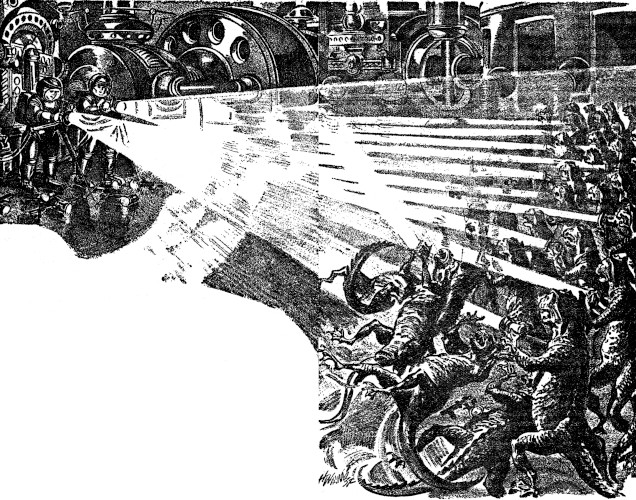
The two repulsively erect bipeds before them neither burned nor fell. Beams—no matter how powerful—did not reach them at all——
Nor were these outlandish beings inoffensive. Utterly careless of the service life of the pitifully weak Delgonian projectors, they were using them at maximum drain and at extreme aperture—and in the resultant beams the Delgonian soldier slaves fell in scorched and smoking heaps. On came reserves, platoon after platoon, only and continuously to meet the same fate; for as soon as one projector weakened the invincibly armored man would toss it aside and pick up another. But finally the last commandeered weapon was exhausted and the beleaguered pair brought their own DeLameters—the most powerful portable weapons known to the military scientists of the Galactic Patrol—into play.
And what a difference! In those beams the attacking reptiles did not smoke or burn. They simply vanished in a blaze of flaming light, so did also the near-by walls and a good share of the building beyond! The Delgonian hordes having disappeared, VanBuskirk shut off his DeLameter.
Kinnison, however, left his on, angling its beam sharply upward, blasting into fiery vapor the ceiling and roof over their heads, remarking: "While we're at it we might as well fix things so that we can make a quick get-away if we want to."
Then they waited. Waited, watching the needles of their meters creep ever closer to the "full-charge" marks; waited while, as they shrewdly suspected, the distant, cowardly hiding Overlords planned some other, more promising line of physical attack.
Nor was it long in developing. Another small army appeared, armored this time; or, more accurately, advancing behind metallic shields. Knowing what to expect, Kinnison was not surprised when the beam of his DeLameter not only failed to pierce one of those shields, but did not in any way impede the progress of the Delgonian column.
"Well, we're all done here, anyway, as far as I'm concerned." Kinnison grinned at the Dutchman as he spoke. "My cans've been showing full back pressure for the last five minutes. How about yours?"
"Same here," VanBuskirk reported, and the two leaped lightly into the Velantian's refuge. Then, inertialess all, the three shot into the air at such a pace that to the slow senses of the Delgonian slaves they simply disappeared. Indeed, it was not until the barrier had been blasted away and every room, nook, and cranny of the immense structure had been literally and minutely combed that the Delgonians—and through their enslaved minds the Overlords—became convinced that their prey had in some uncanny and unknown fashion eluded them.
Now high in the air, the three troopers traversed, in a matter of minutes, the same distance that had cost them so much time and strife the day before. Over the monster-infected forest they sped, over the deceptively peaceful green lushness of the jungle, to slant down toward Worsel's thoughtproof tent. Inside that refuge they snapped off their thought-screens and Kinnison yawned prodigiously.
"Working days and nights both is all right for a while, but it gets monotonous in time. Since this seems to be the only really safe spot on the planet, I suggest that we take a day or so off and catch up on our eats and sleeps."
They slept and ate; slept and ate again.
"The next thing on the program," Kinnison announced then, "is to clean out that den of Overlords. Then Worsel will be free to help us get going about our own business."
"You speak lightly indeed of the impossible," Worsel, again all glum despondency, reproved him. "I have already explained why the task is, and must remain, beyond our power."
"Yes, but you don't quite grasp the possibilities of the stuff we've got to work with now," the Tellurian replied. "Listen: you could never do anything because you couldn't see through or work through your thought-screens. Neither we nor you could, even now, enslave a Delgonian and make him lead us to the cavern, because the Overlords would know all about it 'way ahead of time and the slave would lead us anywhere else except to the cavern. However, one of us can cut his screen and surrender; possibly keeping just enough screen up to keep the enemy from possessing his mind fully enough to learn that the other two are coming along. The big question is—which of us is to surrender?"
"That is already decided," Worsel made instant reply. "I am the logical—in fact, the only one—to do it. Not only would they think it perfectly natural that they should overpower me, but also I am the only one of us three sufficiently able to control his thoughts so as to keep from them the knowledge that I am being accompanied. Furthermore, you both know that it would not be good for your minds, unaccustomed as they are to the practice, to surrender their control voluntarily to an enemy."
"I'll say it wouldn't!" Kinnison agreed, feelingly. "I might do it if I had to, but I wouldn't like it and don't think I'd ever quite get over it. I hate to put such a horrible job off onto you, Worsel, but you're undoubtedly the best equipped to handle it—and even you may have your hands full."
"Yes," the Velantian said, thoughtfully. "While the undertaking is no longer an absolute impossibility, it is difficult—very. In any event you will probably have to beam me yourselves, if we succeed in reaching the cavern. The Overlords will see to that. If so, do it without regret. Know that I expect it and am well content to die in that fashion. Thousands of better men than I am would be only too glad to be in my place, meaning what it does to all Velantia. Know also that I have already reported what is to occur, and that your welcome to Velantia is assured, whether or not I accompany you there."
"I don't think I'll have to kill you, Worsel," Kinnison replied, slowly, picturing in detail exactly what that steel-hard reptilian body would be capable of doing when, unshackled, its directing mind was completely taken over by an utterly soulless and conscienceless Overlord. "If we can't keep from going off the deep end, of course you'll get pretty tough and I know that you're hard to handle. However, as I told you back there, I think I can beam you unconscious without killing you. I may have to burn off a few scales, but I'll try not to do any damage that can't be repaired."
"If you can so stop me it will be wonderful indeed. Are we ready?"
They were ready. Worsel opened the door and in a moment was hurtling through the air, his giant wings arrowing him along at a pace no winged creature of Earth would even approach. And, following him easily at a little distance, floated the two patrolmen upon their inertialess drives.
During that long flight scarcely a thought was exchanged, even between Kinnison and VanBuskirk. To direct a thought at the Velantian was, of course, out of the question. All lines of communication with him had been cut; and, furthermore, his mind, able as it was, was being taxed to the ultimate cell in doing what he had set out to do. And the two patrolmen were reluctant to converse with each other, even upon their tight beams, radios, or sounders, for fear that some slight leakage of thought energy might reveal their presence to the ever-watchful Overlords. If this opportunity were lost, they knew, another chance to wipe out that hellish horde might never present itself.
Land was traversed, and sea; but finally a stupendous range of mountains reared before them and Worsel, folding back his tireless wings, shot downward in a screaming, full-weight dive. In his line of flight Kinnison saw the mouth of a cave, a darker spot of blackness in the black rock of the mountain's side. Upon the ledged approach there lay a Delgonian—a guard or lookout, of course.
The Lensman's DeLameter was already in his hand, and at sight of the guardian reptile he sighted and fired in one incredibly fast motion. But, rapid as it was, it was still too slow. The Overlords had seen that the Velantian had companions of whom he had been able to keep them in ignorance theretofore.
Instantly, Worsel's wings again began to beat, bearing him off at a wide angle; and, although the patrolmen were insulated against his thought, the meaning of his antics was very plain. He was telling them in every possible way that the hole below was not the cavern of the Overlords, that it was over this way, that they were to keep on following him to it. Then, as they refused to follow him, he rushed upon Kinnison in mad attack.
"Beam him down, Kim!" VanBuskirk yelled. "Don't take any chances with that bird!" He leveled his own DeLameter.
"Lay off, Bus!" the Lensman snapped. "I can handle him—a lot easier out here than on the ground."
And so it proved. Inertialess as he was, the buffetings of the Velantian affected him not at all; and when Worsel coiled his supple body around him and began to apply pressure, Kinnison simply expanded his thought-screen to cover them both, thus releasing the mind of his temporarily inimical friend from the Overlord's grip. Instantly the Velantian became himself, snapped on his own shield, and the three continued, as one, their interrupted downward course.
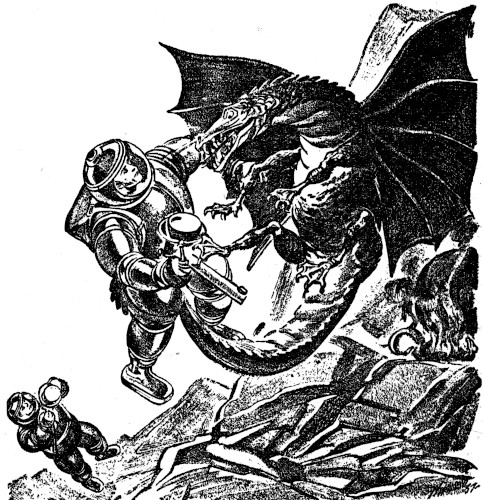
Inertialess as he was, the buffetings of the Velantian affected him not at all——Then he simply expanded his thought-screen——
Worsel came to a halt upon the ledge, beside the practically incinerated corpse of the lookout, knowing, unarmored as he was, that to go farther meant sudden death. The armored pair, however, shot on into the gloomy passage. At first they were offered no opposition. The Overlords had had no time to muster an adequate defense. Scattering handfuls of slaves rushed them, only to be blasted out of existence as their hand weapons proved useless against the armor of the Galactic Patrol. Defenders became more numerous as the cavern itself was approached; but neither were they allowed to stay the patrolmen's progress. Finally, a palely shimmering barrier of metal appeared to bar their way. Its fields of force neutralized or absorbed the blasts of the DeLameters, but its material substance offered but little resistance to a thirty-pound sledge swung by one of the strongest men ever produced by any planet colonized by the humanity of Earth.
Now they were in the cavern itself—the sanctum sanctorum of the Overlords of Delgon. There was the hellish torture screen, with its burden of mental and physical pain. There was the horribly avid audience, now milling about in a mob frenzy of panic. There, upon a raised balcony, were the "big shots" of this nauseous clan; now doing their utmost to marshal some force able to cope effectively with this unheard-of violation of their age-old immunity.
A last wave of Delgonian slaves hurled themselves forward, futile projectors furiously aflame, only to disappear in the DeLameters' fans of force. The patrolmen hated to kill those mindless slaves, but it was a nasty job that had to be done. The slaves out of the way, those ravening beams bored on into the massed Overlords.
And now Kinnison and VanBuskirk killed, if not joyously, at least relentlessly, mercilessly, and with neither sign nor sensation of compunction. For this unbelievably monstrous tribe needed killing, root and branch. Not a scion or shoot of it should be allowed to survive, to continue to contaminate the civilization of the galaxy. Back and forth, to and fro, up and down swept the raging beams of the DeLameters, playing on until in all the vast volume of that gruesome chamber nothing lived save the two grim figures in its portal.
Assured of this fact, but with DeLameters still in hand, the two destroyers retraced their way to the tunnel's mouth, where Worsel anxiously awaited them. Lines of communication again established, Kinnison informed the Velantian of all that had taken place, and the latter gradually cut down the power of his thought-screen. Soon it was at zero strength and he reported jubilantly that for the first time in untold ages, the Overlords of Delgon were off the air!
"But surely the danger isn't over yet!" protested Kinnison. "We couldn't have got them all in this one raid. Some of them must have escaped, and there must be other dens of them on this planet somewhere?"
"Possibly; possibly." The Velantian waved his tail airily—the first sign of joyousness he had shown. "But their power is broken, definitely and forever. With these new screens, and with the arms and armament which, thanks to you, we can now fabricate, the task of wiping them out completely will be comparatively simple. Now you will accompany me to Velantia where, I assure, the resources of the planet will be put solidly behind you in your own endeavors. I have already summoned a space ship. In less than twelve days we will be back in Velantia and at work upon your projects. In the meantime——"
"Twelve days! Holy jumping rockets!" VanBuskirk exploded.
Kinnison said, "Sure—you forget that they knew nothing of our free drive. We'd better hop over and get our lifeboat, I think. It's not so good, either way, but in our own boat we'll be open to detection less than two hours, as against twelve days in the Velantians'. And the pirates may be here any minute. It's as good as certain that their ship will be stopped and searched long before it gets back to Velantia, and if we were aboard it would be just too bad."
"And, since the crew knows about us, the pirates soon will, and it'll be just too bad, anyway," VanBuskirk reasoned.
"Not at all," interposed Worsel. "The few of my people who know of you have been instructed to seal that knowledge. I must admit, however, that I am greatly disturbed by your conceptions of these pirates of space. You see, until I met you I knew nothing more of the pirates than I did of your patrol."
"What a world!" VanBuskirk exclaimed. "No patrol and no pirates! But at that, life might be simpler without both of them and without the free space drive—more like it used to be in the good old airplane days that the novelists rave about."
"Of course, I could not judge as to that." The Velantian was very serious. "This in which we live seems to be an out-of-the-way section of the galaxy; or it may be that we have nothing that the pirates want."
"More likely it's simply that, like the patrol, they haven't got organized into this district yet," suggested Kinnison. "There are so many millions of solar systems in the galaxy that it will probably be thousands of years yet before the patrol gets into them all."
"But about these pirates," Worsel went back to his point. "If they have such minds as those of the Overlords, they will be able to break the seals of our minds. However, I gather from your thoughts that their minds are not of that strength?"
"Not so far as I know," Kinnison replied. "You folks have the most powerful brains I ever heard of, short of the Arisians. And speaking of mental power, you can hear thoughts a lot farther than I can, even with my Lens or with this pirate receiver I've got. See if you can find out whether there are any pirates in space around here, will you?"
While the Velantian was concentrating, VanBuskirk asked: "Why, if his mind is so strong, could the Overlords put him under so much easier than they could us 'weak-minded' humans?"
"You are confusing 'mind' with 'will,' I think. Ages of submission to the Overlords made the Velantians' will power zero, as far as the bosses were concerned. On the other hand, you and I could raise stubbornness to sell to most people. In fact, if the Overlords had succeeded in really breaking us down, back there, I believe that we would have been insane for the rest of our lives."
"Probably you're right. We break, but don't bend, huh?"
Then the Velantian was ready to report. "I have scanned space to the nearer stars—some eleven of your light years—and have encountered no intruding entities," he announced.
"Eleven light years—what a range!" Kinnison exclaimed. "However, that's only a shade over two minutes for a pirate ship at full blast. But we've got to take a chance sometime, and the quicker we get started the sooner we'll get back. We'll pick you up here, Worsel. No use in you going back to your tent—we'll be back here long before you could reach it. You'll be safe enough, I think, especially with our spare DeLameters. Let's get going, Bus!"
Again they shot into the air; again they traversed the airless depths of interplanetary space. To locate the temporary tomb of their lifeboat required only a few minutes, to disinter her only a few more. Then again they braved detection in the void; Kinnison tense at his controls, VanBuskirk in strained attention listening to and staring at his unscramblers and detectors. But the ether was still blank as they materialized in an inertialess landing beside the waiting Velantian.
"All right, Worsel, snap it up!" Kinnison called, and went on to VanBuskirk, "Now, you big, flat-footed Valerian space hound, I hope that that spaceman's god of yours will see to it that our luck holds good for just seven minutes more. We've had more luck already than we had any right to expect, but we can put a little more to most gosh-awful good use!"
"Noshabkeming does bring spacemen luck," insisted the giant, grimacing a peculiar salute toward a small, golden image set inside his helmet, "and the fact that you warty, runty little space fleas of Tellus haven't got sense enough to know it, doesn't change matters at all."
"That's tellin' 'em, Bus!" Kinnison applauded. "But if it helps charge your batteries, go to it. Ready to blast! Lift!"
The Velantian had come aboard; the tiny air lock was again tight, and the little vessel shot away from Delgon toward far Velantia. And still the ether remained empty as far as the detectors could reach. Nor was this fact surprising, in spite of the Lensman's fears to the contrary; for the patrolmen had given the pirates such an extremely long line to cover that many days must yet elapse before the minions of Boskone would get around to visit that unimportant, unexplored, and almost unknown solar system.
En route to his home planet Worsel got in touch with the crew of the Velantian vessel already in space, ordering them to return to port posthaste and instructing them in detail what to think and how to act should they be stopped and searched by one of Boskone's raiders. By the time these instructions had been given, Velantia loomed large beneath the flying midget. Then, with Worsel as guide, Kinnison drove over a mighty ocean upon whose opposite shore lay the great city in which Worsel lived.
"But I would like to have them welcome you as befits what you have done, and have you go to the dome!" mourned the Velantian. "Think of it! You have done a thing which for ages the massed power of the planet has been trying vainly to accomplish, and yet you insist that I alone take full and complete credit for it!"
"I don't insist on any such thing," argued Kinnison, "even though it's practically all yours, anyway. I insist only on your keeping us and the patrol out of it, and you know as well as I do why you've got to do that. Tell them anything else you want to. Say that a couple of pink-haired Chickladorians helped you and then beat it back home. That planet's far enough away so that if the pirates chase them they'll get a real run for their money. After this blows over you can tell the truth—but not until then.
"And as for us going to the dome for a grand hocus-pocus, that is completely and definitely out. We're not going anywhere except to the biggest space yard you've got. You're not going to give us anything except a lot of material and a lot of highly trained help that can keep their thoughts sealed.
"We've got to build a lot of heavy stuff fast; and we've got to get started on it just as quickly as the gods of space will let us!"
VIII.
Worsel knew his council of scientists, as well he might, since it developed that he himself ranked high in that select circle. True to his promises, the largest space port of the planet was immediately emptied of its customary personnel, which was replaced the following morning by an entirely new group of workmen.
Nor were these replacements ordinary laborers. They were young, keen, and highly trained, taken, to a man, from behind the thought-screens of the scientists. It is true that they had no inkling of what they were to do, since none of them had ever dreamed of the possibility of such engines as they were to be called upon to construct.
But, upon the other hand, they were well versed in the fundamental theories and operations of mathematics, and from pure mathematics to applied mechanics is but a step. Furthermore, they had brains—knew how to think logically, coherently, and effectively, and needed neither driving nor supervision—only instruction. And best of all, practically every one of the required mechanisms already existed, in miniature, within the Brittania's lifeboat, ready at hand for their dissection, analysis, and enlargement. It was not lack of understanding which was to slow up the work; it was simply that the planet did not boast machine tools and equipment large enough or strong enough to handle the necessarily huge and heavy parts and members required.
While the construction of this heavy machinery was being rushed through, Kinnison and VanBuskirk devoted their efforts to the fabrication of an ultra-sensitive receiver, tunable to the pirates' scrambled wave bands. With their exactly detailed knowledge, and with the cleverest technicians and the choicest equipment of Velantia at their disposal, the set was soon completed.
Kinnison was giving its exceedingly delicate coils their final alignment when Worsel wriggled blithely into the radio laboratory.
"Hi, Kimball Kinnison of the Lens!" he called gayly. Throwing some twenty feet of his serpent's body in lightning loops about a convenient pillar, he made a horizontal bar of the rest of himself and dropped one wing tip to the floor. Then, nonchalantly upside down, he thrust out three or four eyes and curled their stalks over the Lensman's shoulder, the better to inspect the results of the mechanics' efforts. Gone was the morose, pessimistic, death-haunted Worsel who had wrought and fought beside the armored pair upon fantastically inimical Delgon. This was a new Worsel entirely; gay, happy, carefree, and actually frolicsome—if you can imagine a thirty-foot-long, crocodile-headed, leather-winged python as being frolicsome!
"Hi, your royal snakeship!" Kinnison retorted in kind. "Still here, huh? Thought you'd be back on Delgon by this time, cleaning up the rest of that mess."
"The equipment is not ready, but there's no hurry about that." The playful reptile unwrapped ten or twelve feet of tail from the pillar and waved it airily about. "Their power is broken; their race is done. You are about to try out the new receiver?"
"Yes—going out after them right now." Kinnison began deftly to manipulate the micrometric verniers of his dials.
Eyes fixed upon meters and gauges, he listened—listened—increased his power and listened again. More and more power he applied to his apparatus, listening continually. Suddenly he stiffened, his hands becoming rock-still. He listened, if possible even more intently than before; and as he listened his face grew grim and granite-hard. Then the micrometers began again, crawlingly, to move, as though he were tracing a beam.
"Bus! Hook on the focusing beam antenna!" he snapped. "It's going to take every milliwatt of power we've got in this hook-up to tap his beam, but I think that I've got Helmuth direct, instead of through a pirate-ship relay!"
Again and again he checked the readings of his dials and of the directors of his antenna; each time noting the exact time of the Velantian day.
"There! As soon as we get some time, Worsel, I'd like to work out these figures with some of your astronomers. They'll give me a right line through to Helmuth's headquarters—I hope. Some day, if I'm spared, I'll get another!"
"What kind of news did you get?" asked VanBuskirk.
"Good and bad both," replied the Lensman. "Good in that Helmuth doesn't believe that we stayed with his ship as long as we did. He's a suspicious devil, you know, and is pretty well convinced that we tried to run the same kind of a blazer on him that we did the other time. Since he hasn't got enough ships on the job to work the whole line, he's concentrating on the other end. That means that we've got plenty of days left. The bad part of it is that they've got four of our boats already and are bound to get more. Lord, how I wish I could call the rest of them! Some of them could certainly make it here before they got caught."
"Might I then offer a suggestion?" asked Worsel, suddenly diffident.
"Surely!" the Lensman replied in surprise. "Your ideas have never been any kind of poppycock. Why so bashful all at once?"
"Because this one is so—ah—so peculiarly personal, since you men regard so highly the privacy of your minds. Our two sciences, as you have already observed, are vastly different. You are far beyond us in mechanics, physics, chemistry, and the other applied sciences. We, on the other hand, have delved much deeper than have you into psychology and the other introspective studies. For that reason I know positively that the Lens you wear is capable of enormously greater things than you are at present able to perform. Of course, I cannot use your Lens directly, since it is attuned to your own ego. However, if the idea appeals to you, I could, with your consent, occupy your mind and use your Lens to put you en rapport with your fellows. I have not volunteered the suggestion before because I know how averse your mind is to any foreign control."
"Not necessarily to foreign control," Kinnison corrected him. "Only to enemy control. The idea of friendly control never occurred to me. That would be an entirely different breed of cats. Go to it!"
Kinnison relaxed his mind completely, and that of the Velantian came welling in, wave upon friendly, surging wave of benevolent power. And not only—or not precisely—power. It was more than power; it was a calm, cool, placid certainty, a depth and clarity of perception that Kinnison in his most cogent moments had never dreamed a possibility. The possessor of that mind knew things, cameo-clear in microscopic detail, which the keenest minds of Earth could perceive only as chaotically indistinct masses of mental light and shade, of no recognizable pattern whatever!
"Give me the thought pattern of him with whom you wish first to converse," came Worsel's thought, this time from deep within the Lensman's own brain.
Kinnison felt a subtle thrill of uneasiness at that new and ultra-strange dual personality, but thought back steadily, "Sorry—I can't."
"Excuse me, I should have known that you cannot think in our patterns. Think, then, of him as a person—an individual. That will give me, I believe, sufficient data."
Into the Earthman's mind there leaped a picture of Henderson, sharp and clear. He felt his Lens actually tingle and throb as a concentration of vital force such as he had never known poured through his whole being and into that almost-living creation of the Arisians, and immediately thereafter he was in full mental communication with the chief pilot of the ill-fated Brittania! And there, seated across the tiny mess table of their lifeboat, was Thorndyke, the master technician.
Henderson came to his feet with a yell as the telepathic message bombarded into his brain, and it required several seconds to convince him that he was not the victim of space insanity or suffering from any other form of hallucination. Once convinced, however, he acted. His lifeboat shot toward far Velantia at maximum blast.
Then: "Nelson! Allerdyce! Thompson! Jenkins! Uhlenhuth! Smith! Chatway——" Kinnison called the roll of the survivors.
Nelson, the Brittania's communications officer, answered his captain's call. So did Allerdyce, the juggling quartermaster. So did Uhlenhuth, a technician. So did those in three other boats. Two of these three were apparently well within the danger zone, and might get nipped in their dash, but their crews elected without hesitation to take the chance. Four boats, it was already known, had been captured by the pirates. The remaining eight were either so distant as to be out of range of even the Worsel-driven Lens, or they had been taken by pirates who had not yet reported to Helmuth.
"Eight out of twenty," Kinnison mused. "Not so good, but it could have been a lot worse. They might very well have taken us all by this time."
Then he turned to the Velantian, who had withdrawn his mind as soon as its task was done. "Thanks, Worsel," he said simply. "Some of those lads coming in have got plenty of just what it takes, and how we can use them!"
One by one the lifeboats of the Brittania came into port, where their crews were welcomed briefly, but feelingly, before they were put to work. Nelson, the communications officer, among the last to arrive, was to the Lensman particularly welcome.
"Nels, we need you badly," Kinnison informed him as soon as greetings had been exchanged. "The pirates have a beam, carrying a peculiarly scrambled wave that they can receive and decode through any kind of ordinary blanketing interference, and you're the best man of us all to study their system. Some of these Velantian scientists can probably help you a lot on that—any race that can develop a screen against thought figures to know more than somewhat about vibration in general. We've got working models of the pirates' instruments, so that you can figure out their patterns and formulas. That ought to be simple.
"When you've done that, I want you and your Velantians to design something that will scramble all the pirates' communicator beams in space, from here to the near rim of the galaxy. If you can fix things so that they can't talk, any more than we can, it'll help a lot, believe me!"
"QX, chief, we'll give it the works." And the radio man called for tools, apparatus and electricians.
Then throughout the great space port the many Velantians and the handful of patrolmen labored mightily, side by side, and to very good effect indeed. Slowly, the port became ringed about by, and studded everywhere with, monstrous mechanisms. Everywhere there were projectors: refractory-throated demons ready to vomit forth every force known to the expert technicians of the patrol. There were absorbers, too, backed by their bleeder resistors, air gaps, ground rods, and racks for discharged accumulators. There, too, were receptors and converters for the cosmic energy which was to empower many of the devices. There were, of course, atomic motor generators by the score, and battery upon battery of gigantic accumulators. And Nelson's high-powered scrambler was ready to go to work.
These machines appeared crude, rough, unfinished; for neither time nor labor had been wasted upon nonessentials. But inside each one the moving parts fitted with micrometric accuracy and with hair-spring balance. All, without exception, functioned perfectly.
At Worsel's call, Kinnison climbed up out of a great beamproof pit, the top of whose wall was practically composed of tractor-beam projectors. Pausing only to make sure that a sticking switch on one of the screen-dome generators had been replaced, he hurried to the heavily armored control room, where his little force of fellow patrolmen awaited him.
"They're coming, boys," he announced. "You all know what to do. There are a lot more things that we could have done if we'd had more time, but as it is we'll just go to work on them with what we've got." And Kinnison, again all brisk captain, bent over his instruments.
In the ordinary course of events the pirate would have flashed up to the planet with spy rays out and issuing a peremptory demand for the planet to show a clean bill of health or to surrender instantly such fugitives as might lately have landed upon it. But Kinnison did not—could not—wait for that. The spy rays, he knew, would reveal the presence of his armament; and such armament most certainly did not belong to this planet. Therefore, the instant that the pirate ship came within range of his detectors he acted; and forthwith everything happened at once, with furious swiftness.
A tracer lashed out, the pilot ray of the rim battery of extraordinarily powerful tractors. Under the urge of those beams the inertialess ship flashed toward their center of action, which was the geometrical center of the space port's deep rayproof pit. At the same moment Nelson's scrambler burst into activity, a dome-screen against cosmic-energy intake, and a full circle of super-powered attacking rays.
All these things occurred in the twinkling of an eye, and the vessel was being slowed down by the atmosphere of Velantia before her startled commander could even realize that he was being attacked. Only the presence of automatically reacting defensive screens saved that ship from instant destruction; but they did so save it and in seconds the pirates' every weapon was furiously ablaze.
In vain. The defenses of that pit could take it. They were driven by mechanisms easily able to absorb the output of any equipment mountable upon a mobile base, and to his consternation the pirate found that his cosmic-energy intake was at, and remained at, zero. He sent out call after call for help, but could not make contact with any other pirate station. Ether and subether alike were closed to him; his signals were blanketed completely. Nor could his drivers, even though operating at ruinous overload, move him from the geometrical center of that incandescently flaming pit, so inconceivably rigid were the tractors' clamps upon him.
And soon his power began to fail. His vessel, designed to operate upon cosmic-energy intake, carried only enough accumulators for stabilization of power flow, an amount ridiculously inadequate for a combat as profligate of energy as this. But, strangely enough, as his defense weakened, so lessened the power of the attack. It was no part of the Lensman's plan to destroy this superdreadnaught of the void.
"That was one good thing about the old Brittania," he gritted as he cut down, step by step, the power of his beams, "nobody could block her off from what power she had!"
Soon the stored-up energy of the battleship was exhausted and she lay there, quiescent. Then giant pressers went into action and she was lifted over the wall of the pit, to settle down in an open space beside it—open, but still under the domes of force.
Kinnison had no needle rays as yet, the time at his disposal having been sufficient only for the construction of the absolutely essential items of equipment. Now, while he was debating with his fellows as to what part of the vessel to destroy in order to wipe out its crew, the pirates themselves ended the debate. Ports yawned in the vessel's armored side and they came out fighting.
For they were not a breed to die like rats in a trap, and they knew that to remain inside their vessel was to die whenever and however their captors willed. They knew also that die they must if they could not conquer. Their surrender, even if it should be accepted, would mean only a somewhat later death in the lethal chambers of the law. In the open, they could at least take some of their foes with them.
Furthermore, not being men as we know men, they had nothing in common with either human beings or Velantians. Both of them were vermin, as they themselves were to the beings manning this surprisingly impregnable fortress here in this waste corner of the galaxy. Therefore, space-hardened veterans all, they fought, with the insane ferocity and desperation of the ultimately last stand; but they did not conquer. Instead, and to the last man, they died.
As soon as the battle was over, before the interference blanketing the pirates' communicators was cut off, Kinnison went through the captured vessel, destroying the headquarters visiplates and every automatic sender which could transmit any kind of a message to any pirate base.
Then the interference was stopped; the domes were released; the ship was removed from the field of operations. Then, while Thorndyke and his reptilian aides—themselves now radio experts of no mean attainments—busied themselves at installing a high-powered scrambler aboard her, Kinnison and Worsel scanned space in search of more prey. Soon they found it, more distant than the first one had been—two solar systems away—and in an entirely different direction. Tracers and tractors and interference and domes of force again became the order of the day. Projectors again raved out in their incandescent might, and soon another immense cruiser of the void lay beside her sister ship. Another and another; then, for a long time, space was blank.
The Lensman then energized his ultra-receiver, pointing his antenna carefully into the galactic line to Helmuth's base, as laid down for him by the Velantian astronomers. Again, so tight and hard was Helmuth's beam, he had to drive his apparatus so unmercifully that the tube noise almost drowned out the signals, but again he was rewarded by hearing faintly the voice of the pirate director of operations.
"—four vessels, all within or near one of those five solar systems, have ceased communicating; each cessation being accompanied by a period of blanketing interference of a pattern never before registered. You two vessels who are receiving these orders are instructed to investigate that region with the utmost care. Go with screens out and everything on the trips, and with automatic recorders set on me here.
"It is not believed that the patrol has anything to do with this, as ability has been shown transcending anything it has been known to possess. As a working hypothesis it is assumed that one of those solar systems, hitherto practically unexplored and unknown, is, in reality, the seat of a highly advanced race, which perhaps has taken offense at the attitude or conduct of our first ship to visit them. Therefore, proceed with extreme caution, with a thorough spy-ray search at extreme range before approaching at all. If you land, use tact and diplomacy instead of the customary tactics. Find out whether our ships and crews have been destroyed, or are only being held. And remember, automatic reporters on at all times. Helmuth, speaking for Boskone—off!"
For minutes Kinnison manipulated his micrometer in vain. He could not get another sound.
"What are you trying to get, Kim?" asked Thorndyke. "Wasn't that enough?" The message had been re-broadcast to the minds of the others by Worsel, as fast as it had entered the Lensman's ears.
"No, that's only half of it," Kinnison returned. "Helmuth's nobody's fool. He's certainly trying to plot the boundaries of our interference, and I want to see how he's coming out with it. But no dice. He's so far away and his beam's so hard that I can't work him unless he happens to be talking almost directly toward us. Well, it won't be long now until we'll give him some real interference to plot. Now we'll see what we can do about those two other ships that are heading this way. On your toes, everybody."
Carefully as those two ships investigated, and sedulously, as they sought to obey Helmuth's instructions, all their precautions amounted to exactly nothing. As ordered, they began a spy-ray survey at extreme range; but even at that range Kinnison's tracers were effective and those two ships also ceased communicating in a blaze of interference. Then recent history repeated itself. The details were changed somewhat, since there were two vessels instead of one; but the pit was of ample size to accommodate two ships, and the tractors could hold two as well and as rigidly as one. The conflict was a little longer, the beaming a little hotter and more coruscant, but the ending was the same. Scramblers were quickly installed and Kinnison addressed his men, already in the ships.
"Well, we're about ready to shove off again. Running away has worked twice so far, with very good results—once in the old Brittania, and once in the pirate's own ships. It should work again, if we can ring in enough variations on the theme to keep Helmuth guessing a while longer. Maybe, if the supply of pirate ships keeps up, we'll be able to make Helmuth furnish us transportation all the way back to base!
"Here's the idea. We've got six ships, and there's enough of us to drive them. Some of the younger Velantians have joined us, in spite of the fact that I've told them the chances are against them ever getting back. Enough of them, in fact, to make up almost full crews of us all. But six ships isn't enough of a squadron to fight through the fleets that Helmuth will have organized if we go in a body. So we'll spread out radially, covering thousands of parsecs before we get halfway to base, and broadcasting every watt of interference we can put out all along the way, in as many different shapes and powers as our apparatus will permit. We can't talk to each other, of course, but nothing else can talk anywhere in the same sector of the galaxy, either, and that will give us the edge. Each ship will be on its own, as we were before in the boats; the big difference being that we'll be in superdreadnaughts instead of lifeboats.
"Now, Worsel, if the pirates check up and follow the disturbance we are going to make sure they won't bother you folks at all. In fact, if they ever succeed in finding the center of that interference there will be nothing there except empty space. But if they don't follow us—and Helmuth is apt to insist upon a thorough study of this region before he does anything else—you folks are due for an inspection; and the next inspection will mean a real battle instead of a slaughter. The first spy ray will reveal this stuff here. But I don't suppose you want to hide it or destroy it?"
"We do not," the Velantian replied, positively. "Let them come, in whatever force they care to bring. The more that attack here, the less there will be to halt your progress. This armament represents the best of that possessed by both your patrol and the pirates, with improvements developed by your scientists and ours in full coöperation. We understand thoroughly its construction, operation, and maintenance. You may rest assured that the pirates will never levy tribute upon us, and that any pirate visiting this system will remain in it, permanently!"
"'At-a-snake, Worsel—long may you wiggle!" Kinnison exclaimed. Then, more seriously, "Maybe, after this is all over, I'll see you again sometime. If not, good-by. Good-by, all Velantia! All set, boys? Clear ether and light landings to you all! Blast off!"
Six ships, once pirate craft, now vessels of the Galactic Patrol, hurled themselves into and through Velantian air, into and through interplanetary space, out into the larger, wider, more unobstructed emptiness of the interstellar void. Six, each broadcasting with prodigious power and volume an all-inclusive interference through which no pirate communicator or visiray beam could possibly be driven!
IX.
Kimball Kinnison sat at his controls, smoking a rare, festive cigarette and smiling, at peace with the entire universe. For this new picture was in every element a different one from the old. Instead of being in a pitifully weak and defenseless lifeboat, skulking and hiding, he was in one of the most powerful battleships afloat, driving boldly at full blast almost directly toward home. Instead of only two, the patrolmen were now three in number, and LaVerne Thorndyke, master technician, was a telling addition to their force. Also, they had under them almost a normal crew of alert and highly trained Velantians.
Best of all, the enemy, instead of being a close-knit group, keeping Helmuth informed moment by moment of the situation and instantly responsive to his orders, were now entirely out of communication with each other and with their headquarters, groping helplessly. Literally, as well as figuratively, the pirates were in the dark—the absolute blackness of interstellar space. Then Thorndyke entered the room, frowning slightly.
"You look like the fabled Cheshire Cat, Kim," he remarked. "I hate to spoil such perfect bliss, but I'm here to tell you that we ain't out of the woods yet, by seven thousand rows of trees."
"Maybe not," the Lensman returned, blithely, "but compared to the jam we were in a while ago we're not only sitting on top of the world; we're perched right on the exact apex of the universe. They can't send or receive reports or orders, and they can't communicate. Even their detectors are mighty lame. You know how far they can get on electromagnetic detectors and visual apparatus. Furthermore, there isn't an identification number, symbol, or name on the outside of this buzz buggy. If it ever had one the friction and attrition have worn it off, clear down to the armor. What can happen that we can't cope with?"
"These engines can happen," the technician responded, bluntly. "The Bergenholm is developing a meter jump that I don't like a little bit."
"Does she knock? Or even tick?" demanded Kinnison.
"Not yet," Thorndyke confessed, reluctantly.
"How big a jump?"
"Pretty near two thousandths maximum. Average a thousandth and a half."
"That's hardly a wiggle on the recorder line. Drivers run for months with bigger jumps than that."
"Yeah—drivers. But of all the troubles anybody ever had with Bergenholms, a meter kick was never one of them, and that's what's got me guessing as to the whichness of the why. I'm not trying to scare you—yet. I'm just telling you."
The machine referred to was the neutralizer of inertia, the sine qua non of interstellar speed, and it was not to be wondered at that the slightest irregularity in its performance was to the technician a matter of grave concern. Day after day passed, however, and the huge converter continued to function, taking in and sending out its wonted torrents of power. It developed not even a tick, and the meter jump did not grow worse. And during those days they put an inconceivable distance behind them.
During all this time their visual instruments remained blank; to all optical apparatus space was empty save for the normal tenancy of celestial bodies. From time to time something invisible or beyond the range of vision registered upon one of the electromagnetic detectors, but so slow were these instruments that nothing came of their signals. In fact, by the time the warnings were recorded, the objects causing the disturbances were probably far astern.
One day, however, the Bergenholm quit—cold. There was no laboring, no knocking, no heating up, no warning at all. One instant the ship was speeding along in free flight; the next she was lying inert in space. She was practically motionless, for any possible velocity built up by inert acceleration is scarcely a crawl, as free space speeds go!
Then the whole crew labored like mad. As soon as they had the massive covers off, Thorndyke scanned the interior of the machine and turned to Kinnison.
"I think we can patch her up, but it'll take quite a while. Maybe you'd be of more use in the control room—this ain't quite as safe as a church, is it, lying here inert?"
"Most of the stuff is on automatic trip, but maybe I'd better keep an eye on things, at that. Let me know occasionally how you're getting along." And the Lensman went back to his controls—none too soon.
For one pirate ship was already beaming him viciously. Only the fact that his defensive armament was upon its automatic trips had saved the stolen battleship from practically instantaneous destruction.
As Kinnison had already remarked more than once, Helmuth was far from being a fool, and that new and amazingly effective blanketing of his every means of communication was a problem whose solution was of paramount importance. Almost every available ship had been, for days, upon the fringe of that interference, observing and reporting continuously. So rapidly was it moving, however, so peculiar was its apparent shape, and so contradictory were the directional readings obtained, that Helmuth's computers had been baffled.
Then Kinnison's Bergenholm failed and his ship went inert. In a space of minutes the location of one center of interference was known. Its coördinates were determined and half a dozen warships were ordered to rush that spot. The raider first to arrive had signaled, visually and audibly; then, obtaining no response, had anchored with a tractor and had loosed his bolts. Nor would the result have been different had every one aboard, instead of no one, been in the control room at the time of the signaling. Kinnison could have read the messages, but neither he nor any one else then aboard the erstwhile pirate craft could have answered them in kind.
Soon the two space ships attacking the turncoat became three, then four, and still the Lensman sat unworried at his board. His meters showed no overload; his noble craft was easily taking everything her sister ships could send.
Then Thorndyke stepped into the room, no longer a natty officer of space. Instead, he was stripped to sweat-soaked undershirt and overalls. He was covered with grease and grime, and what of his thickly smeared face was visible was almost haggard with fatigue. He opened his mouth to say something, then snapped it shut, as his eye was caught by a flaring visiplate.
"Holy jumping rockets!" he exclaimed. "At us already? Why didn't you yell?"
"How much good would that have done?" Kinnison wanted to know. "Of course, if I had known that you were loafing on the job and could have snapped it up a little, I would have. But there's no particular hurry about this. It'll take more than four of them to break us down, and I was hoping that before they can overload us you'd have us traveling. What was on your mind?"
"I came up here—one, to tell you that we're ready to blast; two, to suggest that you hit her easy at first; and three, to ask if you know where there's any grease soap. But you can cancel two and three. We don't want to play around with these boys much longer—they play too rough—and I ain't going to wash up until I see whether she holds together or not. Blast away—and won't those guys be surprised!"
"I'll say so. We were, too, when the Velantians showed us how to compute a screen that would cut a tractor like so much cheese. Here she goes!"
The Lensman twirled a couple of knobs, then punched down hard upon three buttons. As he did so the flaring plates became dark; they were again alone in space. To the dumfounded pirates, inert as they were and with their supposedly unbreakable tractors locked in full grip, it was as though their prey had slipped off into the fourth dimension. Their tractors gripped nothing whatever, their ravening beams bored unimpeded through the space occupied an instant before by resisting screens. They did not know what had happened, or how; and, being deep in the field of interference, they could neither report to nor be guided by the master mind of Boskone.