Chapter VIII · FROM SKYE TO CALCUTTA.
Reading edition
“With a low silver-tongued monotony
The little billows whisper as they fall,
Calm is the forehead of the outer sea
As though it would not rewake at all.
“But yestermorn, like mountains earthquake shaken,
The waters swayed against the dawning light,
And now they lie, like sorrows overtaken
By weary sleep, that cannot wait for night.”
O hone! O hone! to think that such a change could have passed o’er the spirit of our dream. Here we are once again in beautiful Loch Staffin. But can it be that this is indeed the fairy bay in which, so few days ago, we took such exceeding delight? Now the pattering rain falls with dull plash on the sullen waves; a heavy ground swell rolls us to and fro, and the cold spray dashes over us; the bitter wind whistles through the rigging, or blows in hollow gusts, echoing among the crags; on every side the lowering sky is black with gathering storm; the slippery, black rocks are flecked with salt sea-foam, and there is no beauty in the dripping sea-weed, or the wet sands, or the flapping sails of the fishers’ boats—with their rich brown changed to dirty black.
It is with infinite difficulty that we effect a landing (for business has brought us here, and must be attended to); but as to embarking again, it is simply impossible. So there is nothing for it but to spend the night ashore in the little inn. All night we hear the sullen moaning of the wind, and the waves beating heavily on the shingle; and when the cheerless dawn breaks over the cheerless land, nothing is visible through the colourless mist, save heaps of tangle and weed lying in dark masses along the shore. Nevertheless we must re-embark 345with all speed, for the skipper distrusts his anchorage, and wants to run for Portree. So we are off, and look up at the great basaltic rocks, all dim and grey, wondering what had made them so beautiful in our eyes? Our question is answered by the sun himself, shining out suddenly through the mist, lighting up the grand old Storr—now right above us, and revealing a thousand beauties of form and colour. Still we pass along the same basaltic pillars, which at one spot are fairly bent over, as if by some vast pressure in their early life. By the time we reach Portree, the evening is clear and sunny. Next morning, when we would again set sail, we find ourselves becalmed.
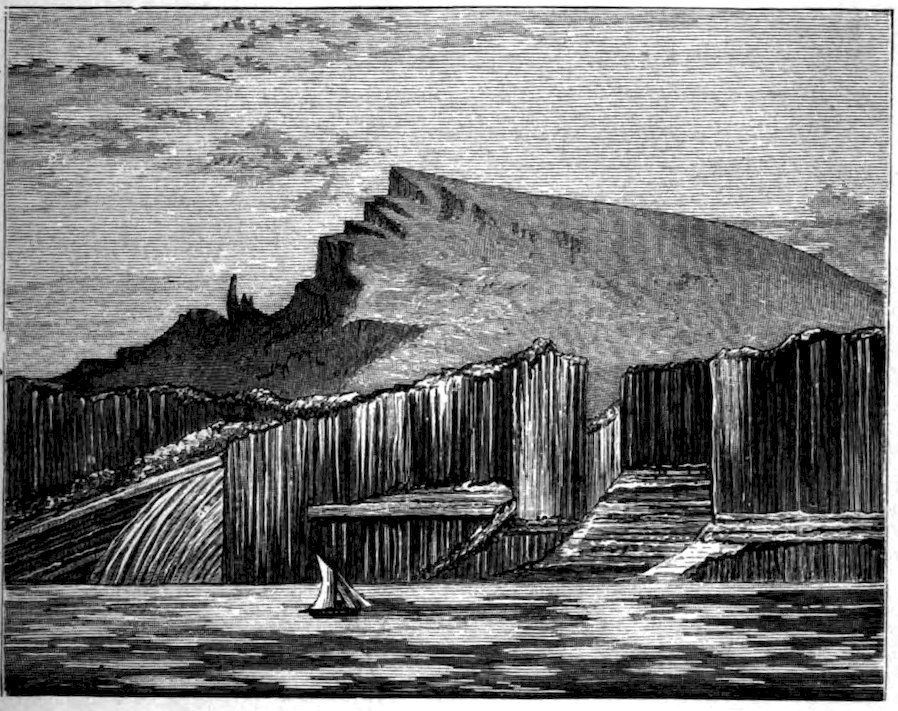
THE STORR.
You remember our first arrival at Portree was by the steamer at 4 A.M., and we awoke to find only torrents of rain. Now we had time enough to row about the harbour, fishing and sketching from all points, and rejoicing in the stillness of a calm as perfect 346as that wherein Milton describes the beginning of Messiah’s reign of peace:—
“The winds with wonder whist,
Smoothly the waters kiss’t,
Whispering new joy to the mild ocean,
Who now hath quite forgot to rave,
While birds of calm, sit brooding on the charmëd wave.”
I think no more perfect image of peace exists than these soft white-breasted “birds of calm,” floating on a mirror so still, that each white plume is reflected; the brightest spots on the broad plain of gleaming light.
This fine sea-loch divides itself into an inner and an outer harbour, perfectly land-locked. The former is still known to the older fishers as Loch Columbkille, being one of the spots specially dedicated to St. Columba, who was patron saint of half of Skye, and many neighbouring isles. The other half was the property of St. Maelruhba. At the further end of the loch, close to the sheriff’s house, is a small rocky islet, where a few fragments of building and traces of old graves are all that now remain to mark the spot where once stood the oldest monastic building in Scotland; so, at least, say certain of our wisest antiquarians. Early and late we rowed about on those calm waters; sometimes landing in some little creek, where the great rocks sheltered us from the burning sun, and the cool wavelets, rippling over white sand, whispered an irresistible invitation to bathe. Then, wandering along the shore, some heathery knoll would tempt us to linger amid its fragrant purple till the mellowing evening light called us back to our floating home.
Alongside of the Gannet lay two yachts, similarly becalmed, the inmates of which, for lack of better distinction, we dubbed the “Cockneys” and the “Paddies;” and we took the usual British interest in one another’s proceedings. At last we made sure of a gale, and determined to sail next morning. So at 3 A.M. I went off to the head of the bay to get a final sketch of the Storr; and returned, of course, to find the breeze more sleepy than ever. Next day we determined we would get under way; so we contrived to get to the mouth of the harbour, and there lay immovable till the men got into the boat, and, rowing with all their might, contrived to tug us back, greatly to the 347edification of the Cockneys and the Paddies, who had had too much wit to try.
You see our sailors were above the common practice of whistling for the wind, as their brethren the fisher folk do to this day in most real earnest. Hugh Miller tells us how, often, when he has been sailing with the Cromarty fishermen in calm weather, he has watched them with faces anxiously turned in the direction whence they expect the breeze, and earnestly invoking the wind in a shrill, tremulous whistling. He says that one evening when it was blowing hard he commenced whistling a careless tune, whereupon one of the men instantly silenced him, saying, “Whist, whist, lad! we hae mair nor eneugh wind already.” He traces this superstition back to the old days of mythology, when each spirit of air or earth or water must be invoked in its own language and in its own manner. He quotes another instance of this conciliatory dealing with the elements, when, in the case of a rising storm, one of the fishers used to be told off to sit astern and continually move his hand to and fro over the waves, as though making mesmeric passes, to soothe the spirit of the storm. The St. Kilda men came nearer to “pouring oil upon the water,” inasmuch as they made a pudding of the fat of sea-fowl, and fastened it to the end of their cable, to hinder the waves from breaking. Sometimes the fiery Highlanders opposed wrath to wrath; and there is one angry tide always chafing and fretting off the coast of Mull which is called the “Men of Lochaber,” because, having occasion to cross over to Mull, the contrast of these waves with their quieter waters amazed and angered them to such a pitch that they drew their dirks and stabbed the waves!
Speaking of oil upon the waters, how strange it is that we should hear so much of its use and yet go on thinking of it as wholly a fiction. So far back as the days of Pliny, he tells us how “all seas are made calme and still with oyle, and therefore the dyvers do spurt it abroad with their mouths into the water, because it dulceth the unpleasant nature thereof, and carryeth a light with it.” In later days we have heard of the fishers at Gibraltar pouring oil on the sea to still its motion, so that they might the better see the large oysters lying beneath; and the fishermen of Bermuda do likewise when the ripple of the water prevents their seeing clearly enough to strike their fish. The divers of the 348Mediterranean actually do spurt oil, in the way Pliny described, in order to clear the light under the surface of the water by the stillness so caused. And on our own Scottish rivers, both poachers and other folk besides well know the use of a good flask of oil in smoothing the surface of the deep brown pool where the silvery salmon lie all unconscious of the impending spear. We also hear of the fishermen of Lisbon, when finding the surf on the bar of the Tagus unusually rough, emptying a bottle or two of oil into the sea, and thereby soothing the waves so far as to be able to pass the breakers in safety. I wonder how the experiment would answer at Madras! It has further been observed that the leakage of oil pumped up with bilge-water out of whaling vessels, seems to surround them with smooth water while their neighbours are pitching in a chopping sea. The herring fishers on our Scotch coasts say they can tell at a distance where the shoals of fish lie by the smoothness of the water over them (we know how oily they are); and the seal fishers used to detect when their victims were eating their oily fish below the water by the unruffled surface above them.
A curious letter on this subject, shown to Dr. Franklin, seems first to have called his attention to the matter. The letter told of a stormy passage in a Dutch ship, when the captain, to prevent the waves from breaking over the vessel, poured a small quantity of olive oil into the sea, a little at a time, not more than four quarts altogether; and so effectual did this prove, that the writer suggested that surely the same simple means might be made greater use of. Franklin accordingly tried sundry experiments on a very rough pond one windy day. He found that when he stood to leeward the wind blew the oil back to the shore; but on going to the other side of the pond, one teaspoonful produced an instant calm over a considerable space, and spreading rapidly, soon made an oily film over an extent of at least half an acre, which he says became as smooth as a looking-glass. He afterwards tried the experiment on a larger scale with less effect than he expected, for the swell continued, only the surface was not wrinkled or broken, and though the sea around was white with crested waves, there were none in the smooth track left by his boat, and he noticed that a barge rounding the headland under sail, at once turned into that oily path as on to a turnpike road. It is curious that after the subject had 349been so far taken up by so learned a man, it should not have been turned to more practical account. Possibly a few extra kegs of oil may still come to be looked upon as part of the regular stores of our fishers. As concerned our present cruise we needed no such soothing influence, for we watched the smooth, glassy, unrippled surface of the water till we despaired of ever getting out of harbour. At last, however, the welcome breeze sprang up, and when the spirit of the wind did awaken it did so in good earnest, and we straightway returned to Loch Staffin, where I had determined to have a fortnight alone with the rock-spirits of Quiraing. It was very dismal to watch my playfellows sail away in the evening, but I received a cordial welcome in the wee inn, though “inn” I should not call the kindly farmhouse where I found myself in the position of an honoured guest. My gentle landlord was most assiduous in his care, and being the only creature who could speak a word of English, used anxiously to come and interpret whatever information might be necessary to the one fair spirit who was my minister—namely, a strapping, cheery wench, Peggy Mòr, who, though of course utterly guiltless of English, was wonderfully “gleg at the uptak.” This was fortunate, as her master was generally absent all day. When my intelligent giantess succeeded in understanding my various signs she would pat and stroke me exultingly, uttering clicks and chuckles of exceeding interest and delight.
Mine host was, in some way, responsible for all the lunatics in the district, and being a man of a tender heart, could rarely resist the appeal of any who were particularly anxious to leave the asylum and find occupation among his herdsmen. So it came to pass that various strange beings haunted the neighbourhood, haavelings, as we call half-witted creatures on the mainland. One in particular who herded the kye was engaged in a ceaseless warfare with devils, and was for ever battling with invisible foes, in order to protect himself and us. The raging waves were an especial annoyance to him, and he attributed their noise to myriads of women roaring in concert. It used to amuse me in the evenings to hear all the farm lads and lasses gathered round the kitchen fire, “laughing and daffin’ and lilting and quaffing,” and after their simple supper of porridge and milk, singing all manner of Gaelic songs and choruses, which were 350just sufficiently softened by distance to lose their harshness; “low winding songs, with as little beginning or end as the murmur of a brook,” and well in keeping with the wild sea and mountains round me.
Each day that promised a tolerable allowance of sunshine I went up to the Rock Wilderness, getting a lift in “the cart,” which was full of sweet fresh straw, very needful, considering the character of the ground over which we jolted. But on the whole the rain had the best of it, and though a waterproof rug and waterproof coat made me quite amphibious, my sketching blocks lived under shadow of an umbrella, which alas! was rapidly giving up the ghost. What was to be done? The problem was solved by the return of mine host from a distant cattle market, whence he brought me a fairin’—a roll of pale brown ribbon. It mattered not that the poor umbrella was dark maroon; we sewed strips of ribbon down each seam, and little patches of ribbon under every tear, and when our masterpiece was finished, it not only defied wind and rain, but was the admiration of all beholders—nay, more; it proved a fruitful topic of conversation, which is no mean praise in these parts!
Events were few and far between. In three weeks about three drowned tourists arrived from Portree viâ the Storr—pedestrians, of course—and one day, while I sat painting on the shore, a very large English yacht came in, with a steam-tug to take care of her. The owner having packed as many of his party as could find room into “the cart,” went off to Quiraing. I was much amused at noting the difference between the English sailors who manned this yacht and those we had had to do with. The latter were grave thoughtful men, content with the simplest fare, biscuit, herrings, and milk, and appreciating the beauty of scenery as much as we did ourselves. These, like a pack of wild boys were intent only on the fun of foraging, and capturing sheep, fowls, eggs, whatever they could lay hands on, and their verdict on each place where they had halted was solely dependent on the commissariat. Then I began to realize how curiously this contrast must have struck the frugal old Highlanders, when first the Saxons came among them, and the grim humour that prompted their retort to some English taunt—a retort which became proverbial—“Show me a Southron, and I will show you a glutton!” Far be it from me to apply such a term to these jolly tars. 351Nevertheless, not one of them gave a glance at the strange scene their master had come so far to look at, though they found considerable amusement in watching my sketch of it.
Three months later, when I embarked for India at Southampton, a cheery voice wished me luck, and that I might get good drawings, and looking up, I recognised one of these hearties. Just beyond him, on the deck, sat one of “the Paddies,” who was equally astonished at meeting a neighbour from the Gannet. He left us at Aden, going to see Bombay and the North-West Provinces. A month later, as I sat in a lovely garden in Agra, I started at hearing my name. There stood my friend, who having “done” India thoroughly, was on the eve of embarking for Australia, or any other place where English, and English only, would greet his ear!
When the time came that I must bid adieu to Quiraing, my friends at Uig, true to the good old precept, “Welcome the coming, speed the parting, guest,” escorted me as far as Portree. My next halting-point was Sligachan Inn, which stands on the borders of Lord Macdonald’s deer forest of Sconser.
The drive from Portree to Sligachan was over a heathery moor, a broad expanse of rich browns and purples, with patches of vivid green, or dark moss with darker peat stacks ready cut for winter fuel. Here and there a broken sea-bank, and a rippling stream; and beyond, an ever-changing outline of fine mountain forms, just appearing through the mist, then vanishing again. The inn, though small, is comfortable enough, and affords shelter to a wondrously varied multitude of tourists and travellers. Members of the Alpine Club, distinguished artists, statesmen, ecclesiastics, botanists, geologists, yachting parties, pleasure seekers of all sorts, drovers, excisemen, down to that class of tourist who “does” Skye as a sort of unpleasant duty, and confides to his friend “‘ow hawfully the ’orses gibbed coming up these ’ideous, ’orrible, ’ills,” adding that if only Nature had “put all the ’ills into the ’ollows, it would have been a much finer country.” Also giving him startling information of all sorts, such as that “A gwilse is the female of a gwouse,” and making oh! such havoc of all local names. One of these southern gentlemen, whose presence had only been remarked by his excessive silence, suddenly electrified his neighbours by springing wildly towards the window, exclaiming, “There they 352are! There they are! Don’t you see the red deer?” at the same time pointing out a couple of collie dogs which were quietly surveying the world from the brow of the hill. After this failure the unhappy man once more relapsed into silence, and made no further attempt to enliven the public. But none of these conveyed to our ears so curious a sensation as when a pretty young woman, who had been listening in much bewilderment to a discussion about Oban, suddenly looked up, and with an expression of beaming intelligence, exclaimed, “Well to be sure! Why, I thought you were talking of Oban in London!” Judge of our first feelings of mystification, and congratulate us on our command of countenance, in that, as a vision of Holborn Hill slowly presented itself to our minds, we contrived not to move a muscle![63]
But though we take our quiet laugh at the Sassenach, perhaps he, in his turn, may find his little joke at the expense of some of our northern worthies, and may treasure up such speeches as that of a certain drover, who, moved with indignation at finding himself supplied with a dessert-spoon at second-course, shouted to the damsel in waiting to bring back his soup-spoon, exclaiming, “Hoot! lassie, isna ma mouth just as big for pudding as for kail?”
Many a good story has been told under that roof, and many a queer longwinded discussion of every topic under heaven, overheard, with more or less amusement, by people, who, accustomed 353always to go on trotting round and round their own social cabbage-leaf, here catch perhaps the only glimpse they ever get of the existence of their fellows, whose diverse caste has run them likewise into their several grooves; grooves wherein (like those delicate white-shelled creatures[64] which bore their thousand paths through the hard rock, yet rarely break through the thin stone barrier that separates them each from the others), they may work their way through this hard world from their birth to their grave, each ramming his own head against the stone wall, and buying his own experience without once coming in friendly contact with his nearest neighbours, or venturing to run in any of their thousand and one smoothly-worn paths. Here, however, for once, they do just meet, and bring with them enough of their own individuality to make them amusing studies for one another.
And of all this, you get full benefit, as the little inn boasts of only one private sitting-room, and the occupant thereof is considered by the other inmates exclusive indeed. I for one had been so long alone with the Rocks and the Peggy Môr, that I was not disposed to shun my species! Moreover I was fortunate enough to fall in with thoroughly pleasant companions, who, arriving on the same day as myself, were likewise in no hurry to leave so beautiful a spot. So we formed ourselves into a most agreeable coterie, and found abundant pleasure, social and scenic, during the three happy weeks we spent beneath the shadow of the dark Cuchullins. Of those kindly companions, one alas! may never more tread mountain crag. Ere two summers had passed, during which he had scaled many a cloud-capped summit, he met his fate suddenly, as he had always himself predicted. Wandering alone on the Maritime Alps, a falling mass of rock struck and killed him in a moment. Some peasants brought tidings to Mentone of the death of an unknown Englishman, and after a while it was known that this was our friend of the Cuchullins, and that yet another of the companions of these two short years had passed away from earth.
The inn stands on a flat peat-moss, just where a brown trout-stream rushes down Glen Sligachan into a salt sea-lake of the same name. To the right of the valley towers the mass of dark peaks, eight of which are upwards of 3,000 feet in height. Of 354these, Scuir-na-gillean or the gillie’s hill, claims precedence. It earned its name in remote ages from a legend that two lads had been killed while attempting to scale its dark crags, and till very recently its summit was deemed inaccessible. Even to the most experienced cragsman the ascent is no child’s play, as has been recently but too well proven, when a member of the Alpine Club met his death alone among these cruel black rocks, his body being found next day at the foot of a precipice.
On the other side of the valley rises a ninth peak of similar height (Blabhein, pronounced Blaven), also of greenish black hyperstene; its strangely serrated outline cutting hard against the sky.
Against it, in strong relief, stands Marskow, one of a group of conical hills of red syenite, whose steep sides are furrowed by the torrents (true children of the storm) that rush down literally from the clouds. These red hills seem like huge piles of disintegrated rock, pale flesh colour, more curious than beautiful, though a brilliant green herbage has managed to creep up the lower slopes, and glances with rainbow light when touched by that “clear shining after rain,” with which dwellers in a hill country become so familiar. Another of these pink hills bears the name of Glamaig, whose shoulder, Scuir-na-Mairi, or the crag of Mary, was so called in memory of a woman who was there killed in attempting to rescue her cow.
At the head of the valley stands one cone whose name, Trodhu, recalls the days when the old Norsemen overran the land, and left traces of their presence all along the coast. Such names as Skeabost, Orbost, Kirkabost, Hushibost, Bornaskitag, Hungladder, Valtos, and a thousand more seem to carry us north to Scandinavian shores. For this cone of Trodhu you must make, if you wish to look down on the far-famed Loch Corruisk, literally the corrie of the water. Three hours’ good walking or pony-riding should take you up beautiful Glen Sligachan, and by a steep ascent to the shoulder of Trodhu, whence the view on a clear day is magnificent. Wild hills rise high on every side of you; their dark rocky crests half veiled by wreaths of floating mist. Far below you lies black Loch Duich, connected by a streamlet with blacker Corruisk, whence a river, perhaps a quarter of a mile long, rushes down the rocks into Loch Scavaig, the most exquisitely transparent green sea-loch, on whose calm surface is mirrored a great white waterfall that comes tumbling over the crags. The contrast in colour between these lochs is most striking; the fresh-water so sombre, like darkest indigo—the salt water so wondrously green. On the latter float a few brown and red specks, veiled with the faintest thread of blue smoke, which tells that the fishers have kindled fires on board their boats, and are cooking their midday meal of fresh herrings. A little apart from these, flutters a tiny white sail no bigger than a fairy’s wing, which proves to be a yacht just anchoring in the bay. And beyond Loch Scavaig lies the great blue sea, from which rise the shapely hills of Rum, and the lower shores of Canna and other isles.
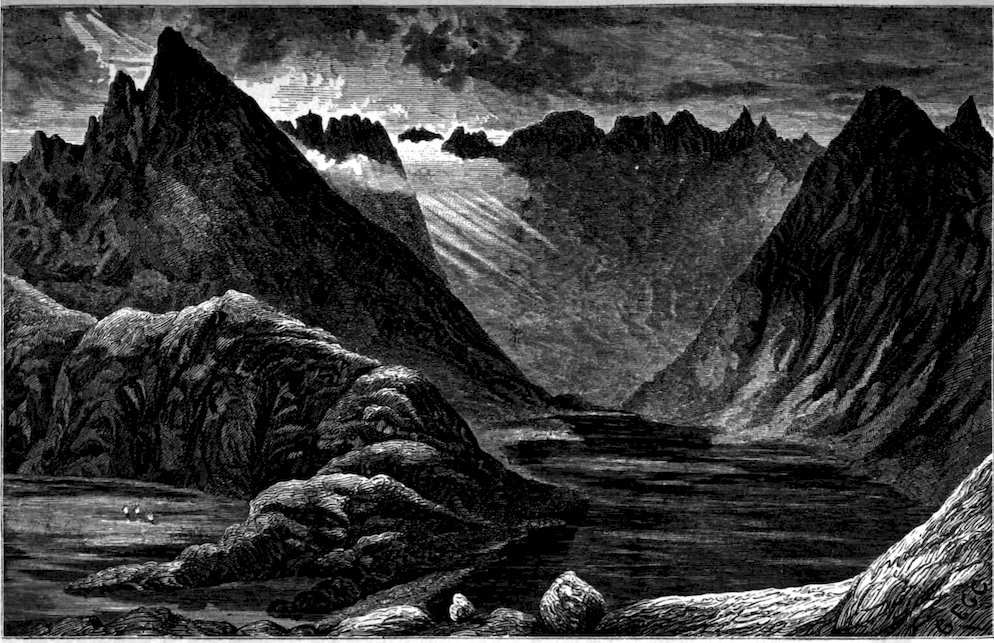
LOCH CORRUISK, SKYE. To face p. 354.
355Beautiful however as is such a day of glorious sunshine, when we feel the mere fact of existence to be bliss unspeakable, there is no denying that fine dry weather is certainly not the time to see these hills in their glory. We thought ourselves singularly fortunate in having selected a perfect day for our first visit to the corrie of the waters, little thinking how a few days of sunshine would inevitably have parched and scorched the rocks, and dried up every trickling stream and tiny waterfall. We started, having our minds thoroughly imbued with Scott’s description of this scene, “so rude, so wild,—yet so sublime in barrenness.”
“For rarely human eye has known
A scene so stern as that dread lake
With its dark ledge of barren stone.
Seems that primeval earthquake’s sway
Hath rent a strange and shattered way
Through the rude bosom of the hill,
And that each naked precipice,
Sable ravine, and dark abyss
Tells of the outrage still.
The wildest glen but this can show
Some touch of Nature’s genial glow,
But here—above, around, below,
On mountain or in glen,
Nor tree, nor shrub, nor plant, nor flower,
Nor aught of vegetative power,
The weary eye may ken,
For all is rock at random thrown,
Black waves, bare rocks, and banks of stone.”
At the summit of the ridge below Trodhu we paused breathless with delight at the glory of the panorama outspread before 356us. There, as is customary, we turned the ponies loose, an amount of trust which these wise creatures never betray. This done we started for a long and fatiguing scramble down the steep hillside, fairly awed by our solemn expectations, which intensified as we neared the ridge whence we might overlook those black mysterious waters. Once there!... O bitter disappointment! This weird and wonderful scene of whose barren grandeur we had read such descriptions in poetry and prose—and had seen such exaggerated pictures, beginning with Turner’s far-famed drawing, where overhanging cliffs are shown overshadowing the black water; is this Corruisk? This the peerless loch whose stillness and solitude poets have sung, as though no other spot of earth could show such leaden-hued waters, embosomed in such a wilderness of rugged rock mountains, whose black pinnacles seem to pierce the heavens, towering far above the masses of floating clouds which for ever hang around their summits? We looked for such grim solemnity as should befit the chosen home of spirit-giants, and we beheld only a little dark tarn, with grassy shore, surrounded by hills, very steep certainly, but not very impressive, and all of much the same height, running in a slightly jagged line across a cloudless blue sky; while every detail of arid rock and every tuft of grass stood out clearly revealed in the calm sunshine. Not a wreath of friendly mist was there to lend mystery to the scene, but far up the valley a party of odious tourists were making the sad hills echo their vulgar shouts! We stood mute with disappointment—and if we had not been too tired, I think we should have gone straight back to the brow of the hill. However by degrees a few clouds stole up, and some hill-tops were partially veiled, and dark crags stood out in relief—and as the sun moved westward long shadows from the great rocks fell athwart the weary land. The shouting snobs were gone, and nature’s still small voice spoke for herself.
Then we began to realize what that scene might be under dark effects of storm and thunder—at the outgoings of morning and evening—or in the clear starlight. So we determined to come back, and try a second impression. And the second led to a third; and the third to a fourth; and the oftener we went, the better we loved that wild ride through Glen Sligachan, and the dark valley where the deep, blue-black tarns 357gleam like black diamonds beside the emerald sea-loch. Often we halted just to listen to the intensely solemn silence, broken only by faint whispers of the breeze that just fanned the light mists in the corries, or the rippling murmur of the quiet brooklet as it flashed here and there in the sunlight. And sometimes when a jarring human voice rang harshly in our ears, disturbing those perfect harmonies, we did feel—oh, such sympathy!—with the grand old Indians, who believed that the lonely stillness of their tranquil lakes was especially sacred to the Great Spirit, and that His wrath would sink the canoe of any rash mortal who dared to lift up his voice while on the waters.
Once in the days of the early settlers, a white woman had occasion to cross Lake Saratoga, and the Indians, ere they started, warned her of the danger that one rash word might bring. It was a calm, cloudless sky, and the canoe sped like an arrow athwart the smooth waters. Suddenly, when in the middle of the lake, the strong-minded woman determined to prove to these simple folk the folly of their belief. So, like the shouting snobs at Corruisk, she lifted up her voice in a wild cry that woke every echo of the hills. The Indians were filled with consternation. They uttered no word, but straining every nerve, rowed on in frowning silence. They reached the shore in safety, and the soulless woman triumphed. But the Mohawk chief looked upon her with scorn. “The Great Spirit is merciful,” he said. “He knows that the white woman cannot hold her peace!”
The apparent size of the corrie is strangely deceptive. It is almost impossible to make the eye realise that the loch can be a mile in length; and yet we know that it is nearly four, and that a grassy valley lies at the further end, where the black rocks seem to close in so precipitously. Well do the red deer know how to prize that oasis in the rock wilderness—truly green pastures beside still waters. Yet not even here does “the antlered monarch of the waste” reign in peace. Once, at least, this little glen was the scene of as good a day’s sport as ever fell to the lot of solitary stalker.[65] It was before the days of cartridges and breechloaders, when men were liable to have their sport spoilt and their tempers ruffled by the failure of a damp cap. In the present instance, the irritating cause was the lack 358of that small essential; for, after a long and tiring walk across the hills, the sportsman suddenly bethought him that he had forgotten to replenish his store. In vain were his pockets turned out, in hopes of finding hidden treasure in some corner. All his search only produced five caps; short allowance, you must confess, with which to start on a long day’s stalking. However, he pushed on, and made for the head of Corruisk. Judge of his dismay when he beheld five stags quietly feeding by the stream that trickles through the green valley. All through the long day he stalked them, one by one; and at midnight returned home, with one cap in his pocket, having bagged the four fine heads each with a single shot, while the fifth was so poor as not to be worth having. Next day the foresters went in search of their prizes, and found them in spots so inaccessible, that they had to cut them up where they lay, and bring them down piecemeal, as no pony could possibly carry such a burden on such ground.
But if the corrie of the waters has thus its tale to tell of the kingly red deer, Loch Scavaig has older legends of the days when its shores were haunted by fierce wild boars. On the edge of the loch there is a cave wherein the chief of the Mackinnons once found shelter when separated from his followers by the luck of the chase. He kindled a fire, and proceeded to cook some of his venison on the embers. In one hand he held a large bone off which he was cutting slices ready for dressing, when a rustle on the dry sea-weed in the mouth of the cave made him look up to see a dark creature approaching him with gaping jaws and wicked tusks. He recognised a savage wild boar, and, having no choice between absence of body and presence of mind, he made good use of the latter. Holding the bone upright in his hand, he awaited the charge of the grizzly brute, and dashed his arm down its throat, the cross-bone, of course, holding the terrible jaws open, and leaving him full time to despatch the foe with his hunting-knife. To this feat the Mackinnons of the present day owe their crest, which is a boar’s head, open-mouthed—apparently choked by a great bone. This description of his cutting slices ready for dressing, points to a common manner of preparing food in those wild days by simply squeezing the meat between two flat stones, or two battens of wood, till all the blood was forced out. Of course, 359there were many cases when kindling a fire would have been inconvenient, and this was always ready.
This story of Mackinnon’s crest must remind Oxonians of the kindred legend telling how a student of Queen’s College was wandering in Shotover Wood, and reading a volume of Aristotle, when a fierce wild boar charged him open-mouthed. The electrified student had no alternative but to thrust Aristotle down the boar’s throat, which most effectually choked him; in memory of which exploit the boar’s head, borne into hall with all due pomp, still graces the Christmas dinner at Queen’s.
One very striking geological feature of this district is the prevalence of the class of rocks known to Alpine travellers as roches moutonnées and blocs perchés, that is to say, long swelling surfaces of bare rock, in form like the outline of a great stranded whale, whereon lie poised huge detached boulders of rock of totally different formation. These vast rounded slopes of gritty chocolate-coloured sandstone are almost always quite bare, even the kindly lichen failing to obtain a resting-place thereon. All along the margin of the lakes, and indeed everywhere on the lower slopes of these hills, these rounded red masses appear, invariably lying in a transverse position to the general direction of the valley; telling of a time, far hidden in the remotest mist of ages, when mighty glaciers lodged in every ravine of those dark mountain ranges, and thence slowly descended to the valleys with sure though imperceptible progress, smoothing the rugged rocks as they passed over them, and bearing on their cold ice-waves huge boulders of fallen rock, weighing perhaps fifty tons or more, for many such still lie in the valleys; gigantic masses which, from their formation, must evidently have been carried hither from far-distant points. These boulders, of every size, from the least to the greatest, lie scattered in every glen, as though the giants of the mountain had been pelting their pigmy foes in the lower world.
Constantly we find these erratic blocks perched on the very edge of the rounded rock, as though the ice-wave had had no power to carry them further; and so ever since, through the storms and hurricanes of centuries untold, they have remained there, poised, as if waiting for some new motive force to send them crashing down the hill. Although the action of the glaciers has planed these swelling forms to such apparent 360smoothness, you need but step upon them to find that they are in truth all grooved with continuous minute lines; the result of which is, that so far from being slippery, they are in reality so rough to the foot as to afford a perfectly secure hold, and a most agreeable surface on which to walk. A few days after returning to the mainland, I heard the Archbishop of York make very striking reference to these glacial marks, as illustrating the gradual moulding of human character and the ineffaceable traces of daily life on the far-distant future; and straightway there rose before me a vision of Corruisk in antedeluvian days!
Strange indeed are the pictures that suggest themselves when, from time to time, Mother Earth reveals to us hints of the marvellous geological changes through which, in her long life, she has had to pass. Phases of poverty and of wealth, of burning heat and bitter cold. Imagine days when British coal-fields were forests of waving palms and giant tree-ferns, rich and beautiful as a tropical jungle. Days, too, when these isles were peopled with such monstrous reptiles as those which haunt the dreams of our children after a day at the Crystal Palace—creatures whose remains have been found even on yonder blue Isle of Eigg. Not that the reptiles had it all to themselves. Gigantic elephants and kindred creatures roamed through the forests and there left their bones, which, after countless ages, have been dug up in the streets of London and of Oxford by puny bipeds, who little dreamt that they had built their cities on the very site of the great mammoth cemeteries! The bipeds, however, seem to have invaded the land before all these curious beasts had become extinct; so at least we may infer from finding the bones of the woolly-haired rhinoceros lying beside those of the rein-deer, the roebuck, and the horse, in the cave of Aurignac, where apparently they had graced certain funeral feasts, and the survivors, who were evidently gourmets, had split the rhinoceros’s bones to extract the marrow! Moreover, in some of the British caves the remains of brown bears and grizzly bears, hyenas and cave lions, elk and bison, have been found together with objects manufactured by man.
Poor Mother Earth tells of far more sudden alternations of heat and cold in her northern regions, where not only are the perfectly-preserved carcases of woolly elephants found embedded 361in the ice-cliffs, but huge buried forests, such as those in North Greenland, where now no shrub can brave the cold, but where, in the very heart of the glaciers, fir trees, oaks, elms, laurels, plantains, and magnolias have been dug up—not their branches and trunks only, but even leaves and cones, all perfectly preserved. It seems as if Greenland and Siberia are now passing through the same course of treatment to which Britain was subjected so many ages ago; possibly their shores may some day be considered as the temperate zone, when our isles have attained some condition as yet undreamt of!
Sometimes we varied our route up Glen Sligachan by invading the Hart o’Corrie, a deep, dark gorge running into the very heart of the Cuchullins, which rise on every side in mighty crags—ash-coloured, seamed with a green that is well-nigh black, and streaked with tremulous lines of white that tell of rushing waters. No sound of living thing is there save the cry of the muir-fowl startled from their sanctuary in the rich blossoming heather; yet there was once an awesome night when these rocks echoed the shouts of warriors and the cries of the dying; and a great boulder of red rock, known as “the Bloody Stane,” still marks the spot where a fierce battle was fought by the MacAllisters, the Macdonalds, and the MacLeods, whose lands still meet at this very spot, so each clan buried its dead on its own ground; and this it is which makes the place so eerie in the moonlight, for as we all know, the fairies fashion their bows and arrows from the ribs of men buried where the lands of three lairds meet.
Many a fierce clan-feud have these silent hills witnessed, as some still testify by the names they bear. Thus one dark spur overhanging Corruisk is known as Strona Stree, or the Hill of Strife, the possession of its bare and rugged crags having been hotly contested by jealous chiefs. And at the back of this range lies the Corry-na-Criech, or Corry of the Fight, a deep, dark gorge, where the MacLeods surprised the Macdonalds in the act of dividing the spoil gathered in a foray on their own homes. Then followed quick revenge, and the red rocks were dyed of a deeper hue, with the life-blood of many a sturdy clansman.
In some of the marshy pools in these valleys we found a very rare, but very ugly plant growing abundantly,[66] namely, the jointed pipewort, so called because of its stalk being jointed and set at 362seven or eight angles; its roots are coral-like. The plant is indigenous to North America, and its only British homes are at this spot, the neighbouring Isle of Coll, and a few small islets near. It is also found at Connemara in Ireland. To botanists its rarity makes its existence here a point of considerable interest, otherwise its insignificance would fail to attract notice.
The expeditions to Corruisk always involved a stiff day’s work, generally of twelve hours, of which eight were spent on the road, going and returning. Moreover it was such a road as was not pleasant after dusk, even for such sure-footed ponies as those we rode, so that we always had reluctantly to leave off work just when the lights were most beautiful; and our faithful, sturdy lout, Donald, took good care that we should not outstay what he considered the right time. The height of artistic pleasure would be to visit Corruisk with such a tent as that in which I spent the following summer, amid loftier, but scarcely more beautiful mountains.
Our homeward ride was always a delight, as we watched every changing effect of sunset and gloaming, pass over beautiful Blaven and Marskow, and their dark brethren. There was something eerie in the companionship of our own shadows, lying right across the valley, on the opposite hillside, as if some silent spirit of the mountain were haunting our footsteps. Sometimes they fell far below us, and rested in ghostly stillness on the white vapours that lay there hushed in deathlike silence, motionless as “the mist that sleeps on a waveless sea.” And far overhead the solemn mountains towered, Marskow and Glamaig glowing ruddier and more golden in the light of the setting sun, and Blaven rearing his dark crest against a pale green sky—a marvellous confused mass of crags, ashy-grey as the heron’s wing, and cutting black in strange serrated outline against the clear frosty heaven.
Many a time since then have the words of the “city poet,”[67] come floating back to my mind, with the same great longing once more to return to that beautiful wild valley—
“O wonderful mountain of Blaven!
How oft since our parting hour
You have roar’d with the wintry torrents,
You have gloom’d through the thunder-shower.
363O Blaven, rocky Blaven!
How I long to be with you again,
To see lash’d gulf and gully
Smoke white in the windy rain.
To see in the scarlet sunrise
The mist-wreaths perish with heat,
The wet rock slide with a trickling gleam
Right down to the cataract’s feet;
While toward the crimson islands,
Where the sea-birds flutter and skirl,
A cormorant flaps o’er a sleek ocean floor
Of tremulous mother-of-pearl.”
It was always an amusing lottery, on returning in the evening to the little inn, to ascertain who were the fresh arrivals, as many of our southern friends came there for a few days, and looked upon a chance meeting in Skye much as if we had met in Kamschatka.
I had been fortunate in securing a tiny little attic which possessed the only window with a view of the Cuchullins, so I could see them at all hours and seasons, in beautiful moonlight, and before dawn. Then when I saw a clear pale sky, I knew what was coming, and went away down the shore of the little bay to watch the fiery finger touch the peaks, while their perfect image lay mirrored at my feet. Gradually the fire spread, till the whole mass gleamed crimson in the clear frosty air, and the cloudless sky was a faint lemon colour, and deep purply shadows lay on the brown peat-moss. By the time that all this beauty had faded to the “light of common day,” it was time to feel how chilling was the air, and turn breakfastward, with some compassion for the sleepers who came so far in search of beauty, and invariably missed the cream of it.
It is only by letting these varied aspects of the hills sink through your eyes into your imagination, that you really get into the spirit of the place, and of those remote days when Cuchullin and Diarmid, Ossian, and Fingal dwelt among these wilds, with their beautiful wives, and stalwart sons and daughters, brave vassals and trusty hounds, whose adventures in chase and war have been the theme of the islesmen ever since. Gradually they have taken colour from the poetic imaginations of a people nurtured among stormy mountains and dreary moorlands—wild mists and rocks, with wilder seas around—the legends becoming more and more shadowy and weird as they were transmitted 364from one generation to another, till sea foam and drifting vapour—wraiths and spirits of earth, sea, and air became so interwoven with each heroic deed, and the whole so magnified by the mists of ages, that they have taken the form of those Ossianic legends, whose first appearance in the civilised world occasioned a turmoil among men who had not cared to note for themselves how the commonest story of the present day becomes fraught with poetic imagery when heard from the lips of these untutored children of the mist; keenly sensitive as they are to all spiritual influences, whether of faith or of mere superstition. A people, moreover, who, from the dawn of life always live more or less in memory of the “steadfast doom of death;” whose chief anxiety is to stint themselves of luxuries during life that they may provide fair linen for their winding sheet, and a funeral feast for those who shall carry them to their grave. One of their legends tells of a strange burial on one of these misty summits, which bears the name of Ben-na-Cailliach, the old wife’s hill. For, just as the old granite-faced pyramids of the east received the ashes of mighty kings, so this great pyramid of unhewn red granite is sacred to the memory of an old viking’s daughter, whose spirit could not brook to sleep beneath green turf, so she bade her people carry her to the top of the mountain “that she might sleep right in the pathway of the Norway wind.” It was a hard task, and a steep and difficult ascent, but the command of the dead must be obeyed. So there they laid her alone in the starlight, and the wild winds and storms have for long ages raved and battled around that lonely cairn.
“Strange grave without a name,
Whence the uncoffined clay
Shall break again—oh, wondrous thought!—
Before the Judgment Day.”
You will find many a cairn as you wander over these steep hillpaths, each one marking where some funeral procession has halted; for many a long and weary tramp will the Highlanders take, sooner than suffer the dead to be laid in unloved ground, and all alike have the same longing to be buried at the old home, and sleep with kindred dust. So when a man dies, his old Bible and dirk, blue bonnet and plaid, are laid on his coffin, and his friends gather round, while a few last words of reverent 365prayer are uttered; then, shouldering their heavy burden, they start for the far-away kirkyard, while the wild pibroch echoes through the misty hills. In olden days it would have been the wilder coronach, but this is now a memory of the past. At every spot where the coffin has rested a cairn of loose stones is heaped up, and in future each passer by is expected to add a stone in reverence for the dead. Curiously enough such cairns also mark the spot where malefactors have perished or have been buried, and each passer by flings a stone in token of abhorrence of their crime, or, as some folks say, to appease the unquiet spirit, which the old Celts believed was doomed to hover near the unhallowed spot. Whichever is the true meaning, the custom is still kept up. It is curious to remember that in Egypt, Syria, Ceylon, and some other lands, cairns are likewise heaped, with strangely divers meaning—either in honourable memory of the dead, or in abhorrence of some evil action. The difference seems to be, that in the former case the stone is laid carefully, in the latter it is thrown contemptuously.
Such a funeral procession as I have described you may chance to see winding its way through these wild glens towards Skeabost, where a rocky river runs between low, green hills into a blue sea-loch, both bearing the same name, Snizort. On an island in the stream stands just such a ruined kirk as those in Mull and Cantyre, with the same old carved stones and rank grass—old knights with their swords, old mossy inscriptions, some stones broken, others upheaved. The place was known in olden days as “Sanct Colm’s kirk in Snesfurd, in Trouterness.” It is a bonnie resting-place; but the frequent influx of new sleepers, and the rushing and babbling of the divided waters, take away from the perfect peace and silence—and the feeling of being alone with generations long since forgotten, which lend such a charm to those quiet tombs among the green bent hills. There is no bridge to connect the island with the banks of the river, so the funeral processions from either side of the country must ford the stream, and sometimes they find it in spate, and have to wait for hours—it may be days—before they can lay their clansman beneath the sod. Happily they find no lack of creature comforts in the tidy village, and the usual approved method of keeping up their spirits is rarely neglected. Nor need we wonder if, returning from the little inn through the gloaming or 366in the moonlight, strange eerie tales gather round the Island of the Dead—of weird phantoms riding on dark storm clouds, or bright spirits on the moonbeam, connecting it with the world of shadow.
There is sometimes a poetry of scene and thought about these Highland funerals that sounds like an allegory in real life. Thus, one quiet autumn day, two strangers wandered into the old kirkyard of Kilmorack, perched on the top of a grey crag which rises abruptly from the Beauly, the darkest of black-brown rivers, whose colour seems only intensified by the scarlet and green and golden leaves of the overhanging trees. As they lingered among the grey memorial stones, they noted a little company sitting near a spot where the green grass had been newly upturned. Presently one of these came forward, and offering the strangers a cogie containing mountain dew, asked “if they would drink to the bride, for she had gone home that day.” Such a toast could not be refused. Then all the mourners came up, and each silently grasped the hand of these new-comers who had wished their dear one God-speed on her far journey to the Land o’ the Leal. Afterwards they inquired who was this traveller to the spirit-land, and heard that it was no bride of earth, but a village lassie who had thus passed away in her spring-time.
Numerous as are these ancient burial-grounds, they are not all held in equal favour. In Easter Ross, for instance, where every green bay along the coast has its quiet kirkyard beside the sea, though the old church itself has generally mouldered away, you will notice a strange predominance of very small graves, and may naturally suppose that child-life in Ross-shire is at an unusually low ebb. The truth of the matter is, that some peculiar sanctity is attached by the people to the kirkyard of Nigg, to which they will carry their dead from distances of forty miles, and the little graves by the lone sea-side are for the most part those of unbaptized children, who are not deemed worthy to be laid beside Christian dust in the much-esteemed ground of Nigg. This, however, implies a superstitious reverence for baptism which a genuine Highlander will indignantly disclaim; only in the strictest confidence would such a confession be unwillingly made.
The implied disrespect to the poor babies reminds me of a 367speech made by the old grave-digger at Nairn, in a year of sad mortality among the little ones. A friend seeing him at work asked, “Weel, John, hae ye had a gude season?” “Hoot na!” was the answer; “just a heap of sma’ trash!” You perceive that being paid so much per foot for his work, his profits varied with the stature of all comers.
Happily for the survivors, the old customs of extravagant funeral feasts are now well-nigh among the things of the past. Such feasting, for instance, as has been recorded at the funeral of one of the Lords of the Isles in Iona, when nine hundred cows, each valued at three marks, were consumed! Or that of Sir William Hamilton, which cost 5,000l., equal to two years of his salary as Lord Justice Clerk! Or, again, that of the Mackintosh, in 1704, when cooks and confectioners were brought from Edinburgh—no easy matter in those days—and extravagant feasting was continued for a whole month, waiting the arrival of the chief mourner, who had to be sought and found in the south of England. Indeed one account says that the body lay in state at Dalcross Castle for upwards of two months, during which open house, in the widest acceptation of the term, was kept, claret flowing incessantly. When at length the funeral day arrived, the procession extended for four miles, the first man having reached the churchyard of Petty before the last had left the castle!
Such profusion marks the same strange law of hospitality which forbade a Highland chief to question his unbidden guest as to his business until the expiration of a year, should he choose to stop so long. Hence the Gaelic sentence which describes the house of a chief as “the point to which the road of every stranger leads.” Not that the chief had any monopoly of this unbounded liberality. The poorest of these islanders were so ready to entertain strangers and load them with the best they had to give, that in olden days we hear of unprincipled persons from the mainland frequenting the Hebrides for no other purpose than that of sponging on their neighbours; and when the first householder whom they honoured with a visit had been eaten out of house and home, he took them on to his next neighbour, where they remained and repeated the process.
Perhaps the quaintest illustration of a hospitable board literally 368groaning under the weight of good things heaped upon it, was a great dinner given to Argyle by M‘Eachin, in Cantyre, whereat every creature he could possibly lay hands on was roasted whole, and set on the table “standing on its stumps!” There were an ox, a goat, a sheep, a stag, a roe, hares, rabbits, and all manner of poultry, and many another good thing, cooked in such fashion as might well have given Soyer a dream of Bedlam!
There was one part of the coast which, to our great regret, we had not time to visit, namely, that of Talliskar, which is said to be very fine columnar basalt. We also omitted seeing the spar cave at Strathaird, which Sir Walter Scott declared to be one of the three finest caves in Scotland, the other two being Smowe, in Orkney, and Staffa. He records how, having with difficulty clambered up the smooth, polished ascent, over water-worn marble, he slid down again after the manner of schoolboys, greatly to the detriment of his pantaloons! Within the cave is a deep pool of limpid fresh water, and the roof is encrusted with stalactites, which, when seen by torchlight, glitter like fairy frost-work. Unfortunately the smoke of the torches, and the destructive habits of tourists are rapidly destroying all beauty.
At length the sad day came, when we were compelled to bid adieu to beautiful Skye—its mountains, and its kindly people. We took the coach to dreary Broadford, where I suppose most future visitors will be landed by steamers from Strome Ferry, the new railway terminus. Just imagine the snorting iron horses having found their way even to these wilds (solitudes no longer), and making those grand old summits echo back their hideous shriek and whistle. The poet’s nightmare of seeing a railway “bridge the Hebrides” has well-nigh been rendered a vulgar fact, and his wail over the great Saxon invasion keeps ringing in our ears—
“Land of Bens and Glens and Corries,
Headlong rivers, ocean floods!
Have we lived to see this outrage
On your haughty solitudes?
· · · · ·
Strange to them the train—but stranger
The mixed throng it bubbles forth,
Strand and Piccadilly emptied
On the much-enduring North!”
369All of which is very fine theoretically; but practically it must be confessed that a luxurious railway coupé has some advantages over a crowded coach; and as to our brethren of the city, I only hope they may all carry away as sunny memories of Skye as have clung to me. To them above all others, the four-and-twenty hours which transport them from the heart of London to the farthest limits of these wild hills should be a concentrated essence of delight—and no British railway could possibly lie through scenes more beautiful, than does the new Skye line. The old folk will tell you that the railway is no new idea to them, for, just as the making of the Caledonian Canal had long been foretold by seers, who beheld ships with great white sails passing to and fro, where other men could see only broom and heather,—so, more than two hundred years ago, Coignoch Oig, the prophet of Brahan in Ross-shire (many of whose prophecies have already been strangely verified) foretold that a day was coming when every stream would be bridged, when a white house should stand on every hill, and balls of fire would pass rapidly up and down Strathpeffer. More especially, for the last thirty years have they expected the railway, for it was about that time, “just thirty years syne,” that the folk travelling by the coach, between Loch Carron and Strome Ferry, (by the old road, which ran very near where the railway now goes), were startled one dark winter night by seeing a great light coming towards them, and as it drew nearer they saw that it was a huge dark coach with fiery lamps—they could see no horses; only a great glare of flames and sparks, and it rushed past them at a place where there was no road, and vanished among the mountains. After this, the mysterious coach was seen at frequent intervals for two or three years—till at last the coachman could no longer stand the constant strain on his nerves, and gave up running at night.
This is the story that you may hear from any old “cailliach” as she sits in the gloaming, crooning her old songs by the light of the red peat fire, or spinning her endless yarns to the group of bare-legged and bare-armed lassies, whose bright eyes glitter in the ruddy light as they press around her, or cling closer one to another, as the interest of the story becomes more thrilling. Presently the lads will join them, for the day’s work is done, and “e’en brings a’ hame” to the pleasant fireside.
370But we must return to the coach which we left toiling along the steep hilly road, only two years ago; and already we look back to these as to “the old coaching days!” Yet there are people still living who remember when the coaches first began to run regularly north of Aberdeen, and what a grand thing that was thought. Nay, more; there are many gentlemen who can vividly recollect going from here to London in a sailing smack, as the simplest and least troublesome route. How often I have heard my father describe such voyages, and the annoyance of being becalmed for days together. Then came the coasting steamers; a grand improvement, and many a merry sail we have had in them between London and Moray. Now all these are things of the past. You breakfast one morning in sight of the great Skye hills, and the next finds you at Euston Square—a process so simple, that life becomes one incessant railway journey, for ever whirling to and fro!
On the present occasion, we were not oppressed by the encroachments of civilisation. Our route lay by Kyle Akin, or Kyle Hakin (the Straits of Haco), where we had to cross Loch Alsh by ferry. Happily the weather was calm and dry, else the crossing in a small open boat might have been unpleasant. The scramble of young natives to secure a fair share of our luggage and our coin was something startling to behold in Britain.
Close to Kyle Akin are the ruins of Castle Moil, an old square keep, whose solid and substantial walls seem to form part of the rock on which they stand, overhanging the water. It was built by the daughter of a Norwegian king (or some say, by a Scottish dame, known as Saucy Mary), who exacted a toll from all vessels passing through the Kyles; and kept a strong chain stretched from shore to shore as a toll-bar, the chain being fastened with iron rings to the rocks on either side.
We drove on viâ Balmacarra and Loch Alsh till we reached Dornie Ferry, where, with one honourable exception (and he was an American), we found every man connected with the ferry hopelessly drunk, in honour of a cattle show. Some were surly; some were cheery; others helplessly imbecile, having attained the same pleasant stage as that worthy Londoner, who, returning home at an advanced hour of the morning “shlightly shober,” plumed himself on being particularly early, having passed the great tower of Westminster just as Big Ben was 371striking one, and what was more, “it had struck one sheveral times”!
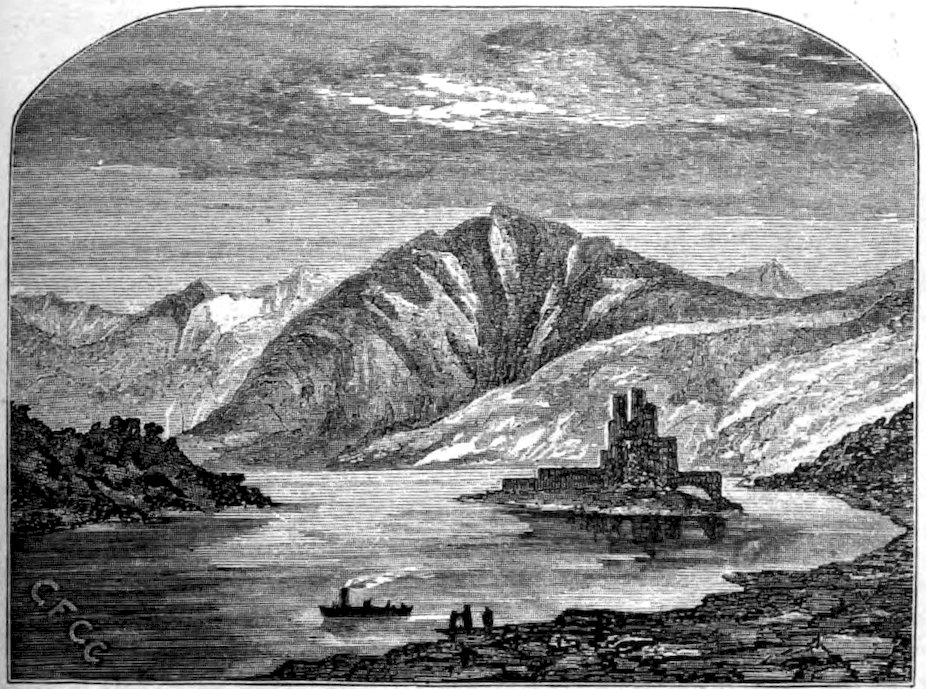
CASTLE OF EILEAN DONAN.
Being thus forcibly detained, we consoled ourselves by sketching the old castle of Eilean Donan, which stands on an island in Loch Duich. It was built on the site of an old vitrified fort, by Alexander II., to overawe the Danes and Norwegians; and the first constable of the castle was one Kenneth Matheson, whose descendants were known as MacKennich, the sons of Kenneth. Hence sprang the Mackenzies of Seaforth. Since then the old castle has been twice consumed and twice rebuilded. In the last instance it was taken for Prince Charlie by a farmer who held that all stratagems are fair in love and war. So he feigned sore distress at the prospect of stormy weather, and induced the governor to lend him some hands to help in rapidly garnering the harvest. No cloud on the political sky, threatened danger in that quarter, and the unwary governor sent a detachment of his men to turn their swords into sickles. 372In their absence, a strong body of Kintail men, surprised the enfeebled remnant, and captured their stronghold.
Then the last Earl of Seaforth rallied all the men of Kintail to fight in the Stuart cause, and as the pipes struck up their heart-stirring notes the enthusiasm knew no bounds, and the crags around re-echoed the wild shouts that rose, as one and all started up to dance on the old leaden roof ere they went forth to join the prince. That defiant war-dance was the last merrymaking of these brave lads. A few days later a wail of grief and woe resounded from every hill and valley, for news of battle and of defeat had been brought by the foe, who came to burn the castle (A.D. 1719), and to tell how that gallant band had shed their hearts’ blood for their king on Sherriffmuir.
When we had waited fully a couple of hours, our American friend thought some of his men might be made to work; and, though they presented the lively appearance of inebriated owls, they made a start; and under pressure of startlingly strong language, did succeed in getting across. It was, however, 10 p.m. before we reached Shiel House Inn, which stands at the head of Loch Duich—a blue sea-loch—fringed with golden sea-weed. The house is a pleasant one to halt at. Behind it rise the Seven Sisters of Kintail, a group of grassy, cone-shaped hills, bearing so strong a family likeness as to have earned this name. Next day we had a lovely walk up Mam Ratakan, to see the sun set once more behind the far-distant Cuchullins, and as we turned to descend, a wondrous effect of storm and rainbow swept over the Peaks of Kintail.
About a mile from Sheil House is a subterranean cave, close to the road, into which (if you are curious to see what was probably the dwelling of some old Pict) you may crawl. Once inside, you will find a chamber eight feet high, paved and lined with large flag-stones, and with a stone roof of long slabs, resting on cross rafters, also of stone.
We greatly regretted not having left a day to see the Falls of Glomak, by far the highest in Scotland, and within a very beautiful ride of Glen Shiel. However, we were bound to push onwards to lovely Glen Quoich, where the pleasant weeks slipped by all too quickly. Very charming were the long glorious days on dark Loch Hourn, and pleasant too the social evenings in the sunniest of sunny homes, when the deer-stalkers 373and fishers returned in the gloaming to tell of their day’s sport, and to dream away happy hours in a paradise of roses and fair women, lulled by that
“Music, which gentlier on the spirit lies
Than tired eyelids upon tired eyes,”
music which seemed to glide away on each moonlight ripple, as the tiny wavelets of the blue loch plashed against the trim, well-mown lawn.
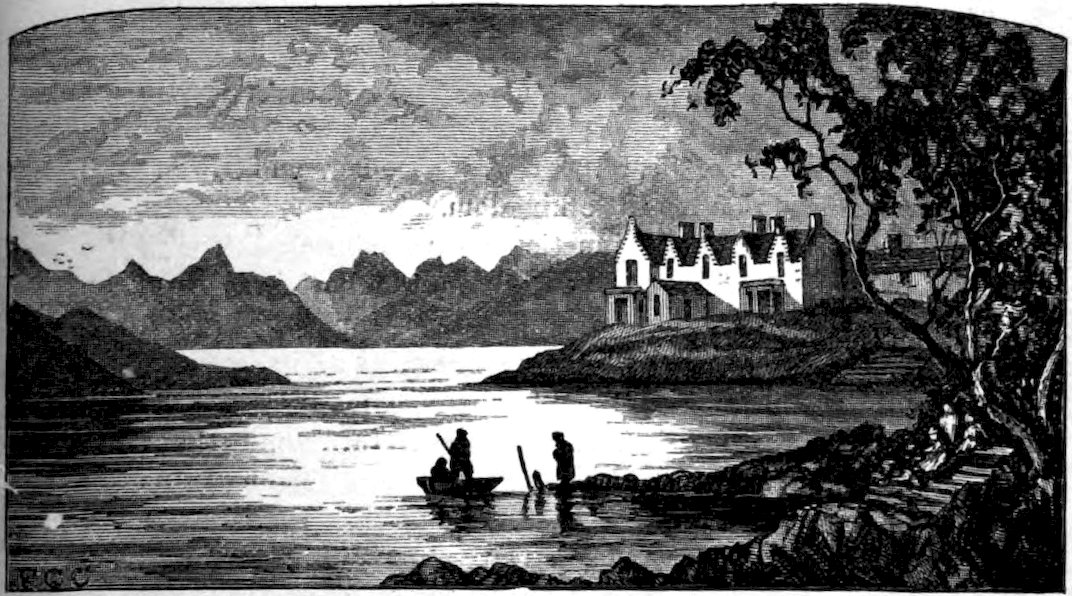
GLEN QUOICH.
The calm bosom of the lake is dotted with little birch-clad islands. One of these, about the centre of the loch, was for many years the home of a bold outlaw, Ewen MacPhee, who, having in an evil hour enlisted, soon found the trammels of barrack life and the study of goose-step altogether unendurable. So he returned to his native wilds in Glengarry, where he was captured as a deserter, but, watching his opportunity, he made one brave bound from off a rock so precipitous that his escort cared not to follow; they fired at him, but missed their aim. Dashing his hand-cuffs against a rock, Ewen was once more a free man, and for many years found a safe haven amongst the hills of Lochiel, where he chased the red deer, as his fathers had 374done before him. Here he wooed and won a maiden of tender years, and he and his child-bride—she was but fourteen—reared their flocks of wild goats, or wandering by the bonnie burn-side, thence drew silvery fish enough for their simple table. After some years, the fear of the law made Ewen seek a surer refuge for his wife and her little ones; so he took possession of this little island, where, beneath the shadow of the birch-trees, he built a bower for his love, wherein she lived for many long years in safety. The loch supplied them with fish, and the neighbouring hills with game; there, too, they contrived to find pasturage for about sixty wild goats, asking leave of no man. When Mr. Ellice bought Glen Quoich, MacPhee came, as a dutiful vassal, to do homage to his liege, bringing him an offering of goats’-milk cheese, and promising that he would not molest the new laird, provided he was left undisturbed in his island home. The free speech and bold bearing of this wild Highlander won the heart of the new-comer, and Ewen was left in possession of his little kingdom.
One tiny island, at the junction of the river Quoich with the loch, has for many a long year been the burial-place of the neighbourhood. From far-distant hills the people bring their dead, and row across the stream in sunshine or in storm, to lay them in the ancient churchyard where so many bygone generations rest in peace beneath the green turf, amid the murmurous voices of flowing waters, with the echoing hills on every side.
A beautiful drive down Glen Garry brought us to old Invergarry Castle and so to Fort Augustus, still called by the Highlanders Cill Chuimein, in memory of that Cuming the Fair who twelve hundred years ago held the bishopric of the Isles as seventh Bishop of Iona, but known to the Sassenach only by the name of the grey old fort, whose rough walls still bear the names of the Duke of Cumberland’s soldiers, carved in their idle leisure in those grim quarters.
To you and to me those grey walls bring far other memories—such memories as consecrate some few spots of earth, and mark them for evermore as hallowed ground where Heaven’s own angels have paused rejoicing. Nay, more, places which have been to us as the very gate of heaven, whence there have been vouchsafed to us such glimpses of the glorious light within the vail as may well cheer and sustain us along the darkest and dreariest turns that can await us on life’s journey.
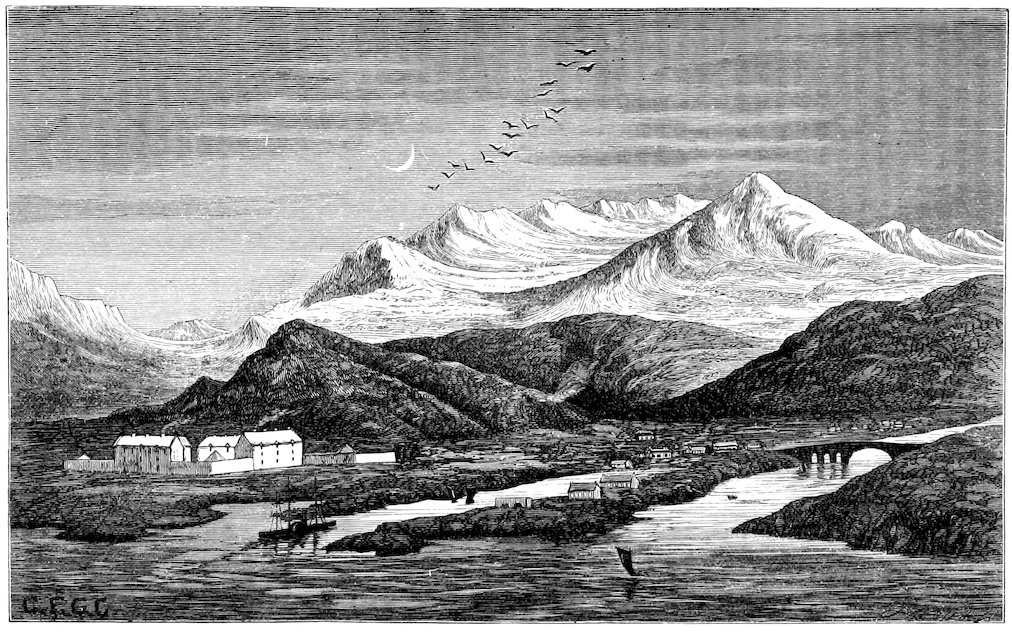
FORT AUGUSTUS AND THE GLENGARRY HILLS. To face p. 374.
375Many a time, during the intervals of anxious watching, you and I have looked down from those windows on the wild wintry storms, which, sweeping over the cold grey hills, turned the blue waters of Loch Ness to inky darkness. And again, when the strange chill of early morning told that the long sleepless night was drawing to a close, how often we have stood together watching for the crimson dawn which flushed Glen Garry’s snowy peaks, and faded away to leave them dazzling and glittering in the clear sunlight. Then one (whose mighty strength was slowly ebbing as night after night passed by in pain and weariness, yet to whose lion-like beauty each morning seemed to add a new, refining touch of radiant spirit-light) would look up and whisper the words of an old, old promise, telling how scarlet of a deeper dye might yet be made whiter than that snow, to shine in the light of perfect day.[68]
Day after day slipped by among old memories and old friends, and we were on the eve of returning to the ordinary life of high civilisation, when a letter reached me from a sister far over the seas, suggesting that, having seen the finest hills in Scotland, I should join her for a summer in the Himalayas.
I think that if the post had gone that same morning the idea would have been dismissed at once as utterly preposterous; but as some hours must elapse before the old runner returned, there was no use in answering at once. And so, while Loch Ness patiently sat for its portrait, it gave me so many good reasons for going, and dismissed all difficulties so summarily, and its little wavelets seemed to run to such a jingle of Cuchullins and Koolins, and collies and coolies, that when the old postman did start he was laden with a perfect budget of letters—one to secure a passage in the next P. and O. ship; another to Winsor and Newton for stores of fresh paints and Brobdingnagian sketching-blocks in tin cases; a third to Thornton for such a waterproof as should mock at Indian rains; and a fourth to Macdougal for extra warm raiment, an investment much jeered at by my friends, but one which proved the very comfort of my life in India.
376Then away we sailed in the little steamer, taking a farewell look at Castle Urquhart, said to have been once an old holding of the Clan Cumming, and in later days one of the old royal forts of Scotland, besieged by Edward I. in 1303, and which stood many a hard tussle with the English in the succeeding years. For the last three hundred years there has been no mention of it in any chronicle of fight or fray. It is now a picturesque ruin, rising from the loch on a rocky promontory. The Highlanders call these grey ruins Strone Castle, and believe that two mysterious vaulted cells are hollowed in the rock below. The one contains a countless treasure of gold; but in the other a fearful pestilence is sealed up, which, if once released, would stalk forth in irresistible might and depopulate the land, having first slain the rash hand that opened its prison door. So the dread of liberating so dire a scourge has even subdued the covetous craving for gold, and the treasure-chamber remains inviolate.
Thus ended my pleasant six months’ wanderings in the Western Isles. A fortnight later, (a fortnight divided into infinitesimal visits to an incredible number of relations), I started for the Eastern Highlands, and bidding farewell to Britain’s grey shores on a gloomy November day, proceeded in search of sunshine, light, and colour—a quest speedily rewarded with success. The six weeks’ voyage, amid new scenes and pleasant companions, was a delight in itself, and its close was only welcomed because older friends and more bewildering novelties greeted our arrival in the strange Eastern world.
END OF VOL. I.
LONDON: R. CLAY, SONS, AND TAYLOR, PRINTERS, BREAD STREET HILL.
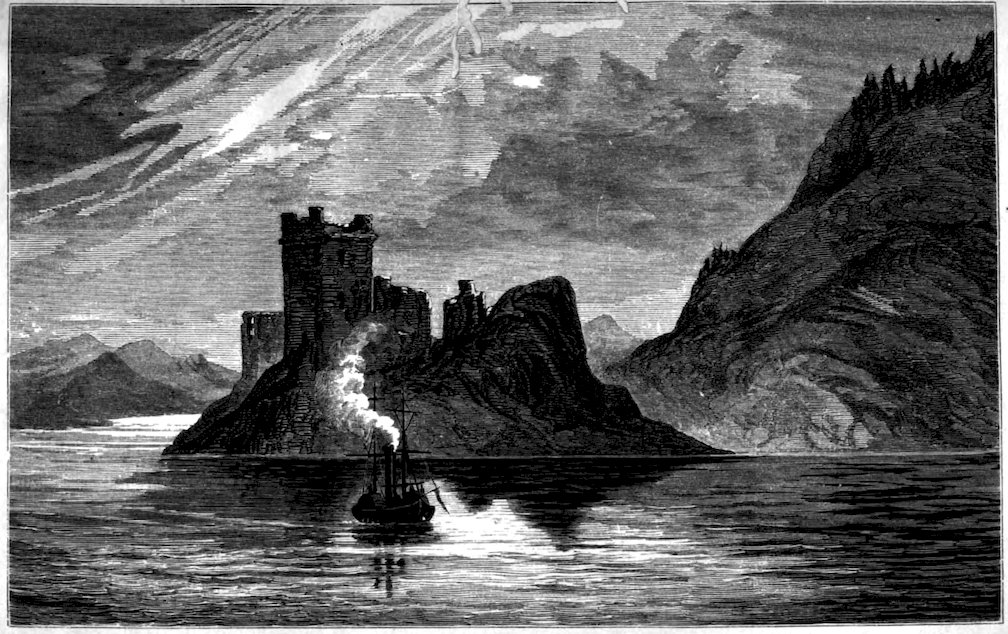
CASTLE URQUHART. To face p. 376.
TRANSCRIBER’S NOTES
Fixed typos; non-standard spelling and dialect retained.
Renumbered footnotes and moved them all to the end of the final chapter.