Chapter II · THE INNER HEBRIDES. (continued 2)
Reading edition
Tradition seems, however, to have very unfairly fixed this legend on St. Columba. There seems small doubt that it refers to a very much more ancient period, when Iona was most especially the Sacred Isle of the Druids, and known only as Inis Druineach, or Nan Druidhean, “the Druids’ Isle,” which continues to this day to be the name by which the Highlanders call it. Another old legend of the isle, quoted by several writers of the last century,[17] tells of a circular Druidic temple which has now disappeared (at least, we failed to find it). It consisted of twelve great stones, beneath each of which a human victim was buried.
Sir Walter Scott has told us that the Picts thus bathed the foundation of their strong buildings in blood, as a propitiation to the spirits of the earth, and that sometimes a human body was thus buried beneath the foundation stone; sometimes only that of an animal. The Welsh too, in building their strong 70forts, found it necessary thus to appease the earth, else the spirits would demolish by night whatever was built during the day. Thus in Borneo, a slave is still sometimes buried; though more frequently, both there and in India and Ceylon, the burial of a chicken is now considered a sufficient offering. To such as care to trace coincidences between the customs of East and West, these traditions are therefore, of marked interest.
For the same reason, and supposing the probability of the Isle having in early days been colonized by settlers from the east, the name bestowed upon it by the Druids is worthy of note. In the oldest Irish annals it is spoken of simply as I or Hii, which is commonly supposed to have simply meant “The Island,” par excellence, but which some assert to have been equivalent to the name Ei, Lord, under which the Sun-God Apollo was worshipped at Delphi. The addition of “On” would mark the Isle as specially consecrated to the Sun; as in Egypt we read of On, the city of the Sun. The word Ionn in old Irish signifies the Almighty God. In Basque the same word is Ioun. The Scandinavians and Welsh worshipped Baal the Sun-God under the title[18] of Ion, and the Trojans under that of Iona. Hence the Ionian Isles and Colonies of the Greeks. These latter, however, were among the ancient worshippers of the Dove, and it seems to have been the custom of many nations to unite the worship of the Sun with that of their representative plant or living creature—their Totem God in fact,—who was thus in many instances identified with the Sun. Thus the Babylonians, whose great Pyramids were dedicated to the Sun-God, “were also called Iönim, or children of the Dove; and their city Jönah; the Dove being the national emblem and depicted on the military standard and on one of the gates.”
Whether Dove-worship had any hold in these northern regions does not seem to have been ascertained,[19] but so soon as St. Columba settled on the Island as his head-quarters, it was suggested that its name Iona signified in Hebrew a dove. Hence 71the common belief that the Island was called after Columba, as indeed it was, being thenceforth commonly known as I-Colm-Kill, “the Isle of Columba’s cell.” To his predecessors there now remained only a little earth; the spot still known as Pitandruich, “the grave of the Druids.” Only the sons of Erin still retained the old name, and spoke of the Holy Isle as the Irish Drunish. Not that all traces of the ancient faith were at once swept away. Even in the last century, Pennant tells of an unmistakable Cromlech; two great upright stones, supporting a third. He was also told by Bishop Pocock, that on the Eve of St. Michael, the islanders brought all their horses to a small green hillock, whereon stood a circle of stones, surrounding a cairn. Round this hill they all made the turn sunwise, thus unwittingly dedicating their horses to the sun.
There seems also every reason to believe that the 360 great stone crosses, which by the bigotry of a Protestant Synod were cast into the sea, as being “monuments of idolatrie,” may originally have been Druidical monoliths, possibly inscribed with the rude cross, which, as the emblem of universal nature, we find in various heathen lands; or perhaps with that circle divided into four equal parts, which was the Scandinavian symbol of the sun-god, and may possibly have first suggested the form of the ancient round-headed cross. But whatever the original inscriptions may have been, there can be no doubt that the monks of Iona found ample employment in carving beautiful and elaborate designs, like those few which still remain, thereby turning the memorials of a heathen worship to Christian uses. We know that in all parts of the kingdom, these sacred stones were, (by order of Pope Gregory, A.D. 601), sprinkled with holy water; and thus sanctified, while the people were still permitted to offer sacrifices of blood, according to their old customs. In like manner in speaking of the first dawn of Christianity in America, Souvestre says, “On lui baptisa ses idoles, pour qu’elle pût continuer à les adorer. Ce fut ainsi que, ne pouvant déraciner les Menhirs, on les fit Chrétiens, en les surmontant d’une Croix, ainsi que l’on substitua les feux de Saint Jean à ceux qui s’allumaient en l’honneur du soleil.” Thus the people might continue to offer sacrifice to the gods of their fathers, while bearing the name of Christians. In Ireland too, Borlase has told us how crosses were carved on old Druidic monuments, that the people 72who could not give up their superstitious reverence for these stones, might henceforth pay them a sort of justifiable adoration, as Christian memorials. Doubtless the same history belongs to those tall monoliths, surmounted by a roughly hewn cross and circle, which stand by themselves, on the barren heaths of Cornwall, with no trace of human work near, except the ancient Celtic barrows, and grey weather-beaten Druidic stones. Even in Scotland, we still find great Menhirs, such as those at Meigle and Aberlemnie, where the cross appears in combination with many Pagan emblems; serpents, large fish, centaur, mirror and comb, and sun-circles;—or that at Deir in Aberdeenshire, engraven on one side with a rude cross, but on the other with the circle, crescent, or double-wheel, crossed by a royal sceptre emblematic of the worship of sun, moon and planets. Even on the more advanced round-headed cross we find the same strange mixture of Christian and Pagan emblems, commemorating both faiths, and blending as the Runic knots, which so mysteriously interlace the whole. The number of these stones of Iona is remarkable—three hundred and sixty.
At the time when Mohammed protested against the idolatrous worship of the Caaba at Mecca, it was surrounded by 360 rude unsculptured stones, all of which he caused to be destroyed, though he allowed his followers to retain their custom of walking seven times in procession, Deisul, i.e., Sunwise, round the Caaba itself, in reverence for Abraham and Ishmael, who he declared had rebuilt it after the deluge. For you know the original Caaba was a tabernacle of radiant clouds, which came down from heaven in answer to the prayer of Adam, who besought the restoration of that shrine where he had been wont to worship in Paradise, and around which he had so often seen the angels move in adoring procession. When, therefore, the cloud temple was restored to him, he daily walked round it seven times sunwise, in imitation of the angels. On the death of Adam, this tabernacle returned to heaven, but one resembling it in form, was built by Seth; this being destroyed by the deluge, was subsequently rebuilt by Abraham, to whom the Angel Gabriel brought a precious black stone from Paradise, to be inserted in a corner of the outer wall, and adored by the faithful and reverently kissed. This stone is an aerolite of oval form, seven inches in diameter, and incircled by a silver band.
73Mohammed having by this angelic legend sanctified the old intense reverence for this black stone, permitted the people still to kiss it and do it homage, as tens of thousands do to this day. It is curious that long before his own public career had commenced, he was chosen by the people as the most fit person to lift this sacred stone into its place as chief corner stone, after the building had undergone certain necessary repairs. Here from time immemorial, the Arabs had been wont to assemble for solemn worship; and here, when vast multitudes were gathered together, bards and poets sought to win fame by pouring forth in song or recitation just such stirring or pathetic lays, as those whereby Ossian and his kindred bards enthralled our Celtic forefathers.
Perhaps among those who heard their lays, may have been Odin the Scythian himself, it is said once a worshipper of the only God, ere he sought his way to Scandinavia and became the demigod of his people. Perhaps (who knows?) some of his followers may have brought to our isles the tradition of the 360 sacred stones. We know that many such Scandinavian settlers did come to our shores, bringing their own traditions to mingle with those of our fathers, and a curious blending of manifold superstitions we have acquired from the various invaders of our land—Phœnician and Norse, Semitic and Aryan. Mohammed being wise in his generation, encouraged these old pilgrimages to Mecca, and made much of the bards, knowing well their influence on their listeners. So instead of the old lays of the desert, they sang new songs in his praise, and their prize poems were written in letters of gold and posted on the gates of the Caaba.[20]
Speaking of Dove-worship in its possible connection with Iona—it is worthy of note, that amongst the idolatrous emblems which Mohammed found in the Temple at Mecca, were two pigeons carved in wood, sacred to Semiramis. These he caused to be destroyed, as well as the 360 monoliths. Nevertheless, with his accustomed sagacity in turning old superstitions to his own account, he tamed the white dove to sit on his shoulder and peck grains of wheat from his ear, that when the simple Arabs beheld the bird first hovering near, then lighting upon him, as though 74whispering in his ear, they might believe that the spirit of God thus revealed His will to His Prophet. Thenceforth their reverence for the Dove was recognised as orthodox, and even to this day a golden Dove is suspended within the Caaba in memory of this tradition, while myriads of living doves nestle in safety in the city of Mecca, none daring to molest them. You will remember how, in the Latin Church, the Holy Spirit is represented as thus resting in the likeness of a Dove, on the shoulder of St. Gregory, and inspiring his writings; also the clouds of almost sacred doves, which claim special protection from priests and people, as they nestle amid the rich carvings of St Mark’s beautiful church at Venice, the home where probably their ancestors were encouraged to settle by the Byzantine architects, who brought their eastern grace and colour to this western world.
Another curious fact is, that the black stone, which Mohammed could not induce the Arabs to cease from worshipping, had its counterpart in Iona. It was preserved in the Cathedral till the year 1830, and in such reverence was it held, that on it solemn oaths were sworn and agreements ratified. A similar black stone, lying close to the sea, was also long worshipped in the Isles; just as in India, at the present day, we are told that one of the most sacred forms under which Juggernaut is worshipped, is that of a shapeless black stone, unhewn, with diamonds let in, as eyes. You will recollect that Juggernaut, with his rolling cars, is held to be symbolic of the sun.
It would be strange indeed if the coincidence in the number of these 360 great monoliths at Iona, and at Mecca, had been the result of mere accident, when we remember that both these races, who worshipped the heavenly bodies, divided the zodiac into 360 degrees;—that the Arabs, as well as the ancient Hindoos, and their Western Druidic brethren, reckoned a lunar year of 360 days, believing the sun’s revolution to be completed in the same period.
Among the stones of Iona, destroyed by order of the Synod, were three crystal balls, which lay in three hollows worn on a large stone slab. Every person visiting the island was expected to turn each of these thrice round following the course of the sun, according to the custom of Deisul, of which we find so many traces in these Isles. The action of course represented the motion and form of the earth or the apparent motion of the sun. 75The stone on which they rested was called Clach-bratha, because it was supposed that when they had, by constant friction, worn a hole right through the stone, then the brath or burning of the world would come. The stone still lies beside the door of St. Oran’s Chapel, though, unfortunately, it has been broken across the middle. In size and shape it resembles a flat tombstone, and might be passed by as such, were it not for a row of cup-like hollows worn at one end of it. These were pointed out to me by the old guide, as having been, in his youth, occupied by stone balls, about the size of a child’s head—balls which doubtless had replaced the original crystal destroyed by that barbarous Synod. He told me, that in his younger days, he, like all his neighbours, had never passed that place without stopping to turn each of these balls thrice sunwise for luck. How and when these also disappeared, he could not tell. Probably, like their predecessors, they had fallen victims to some ruthless and senseless hater of ancient superstition, himself too ignorant to perceive the bearing of such trivial matters on divers vexed questions of the day—faint whispers from the speechless past, they make one long the more to unravel its mysteries.
For instance, how curious is the coincidence between this custom of the old Druids of Iona and that of the modern so-called Fire Worshippers. Rabbi Benjamin in his account of the Ghebers at Onlam, says: “Early in morning, they go in crowds, to pay their devotions to the sun, to whom upon all the altars are consecrated spheres, resembling the circles of the sun, and when he rises, the orbs seem to be inflamed, and turn round with a great noise, while the worshippers, having every man a censer in his hand, offer incense to the Sun.” The crystal globe seems also to have been reverenced as a sacred symbol by the Babylonians; at least we hear of such a one being suspended on high in the camp of the great king, that it might catch and reflect the first rays of the rising sun. This connection between the symbolism of the East and West was repeatedly recalled to my mind while wandering through the depths of mighty forests in Ceylon. There, in the ruins of the vast city of Anaradhapura, which flourished upwards of two thousand years ago, I noted three sacred Bulls carved in stone, each resting on a small pedestal. To this day, women, whose offspring are not so numerous as they desire, drag these figures round and round three times, following 76the course of the sun. At another ancient city, whose ruins lie hidden mid the richest wealth of tropical vegetation (Pollonarua), I noticed a flat stone, the counterpart of the Clach-bratha of Iona, dented with such hollows as could only have been worn by the continual rotation of a heavy stone ball. A custom akin to the sunwise turning of the balls, and one which was so long retained that it is doubtful whether it is even now wholly extinct, was that of making three turns sunwise in solemn procession, round the dead, as they lay on the green hillock of Eala, the Mound of Burden; that is, the spot near the Martyr’s Bay where corpses were laid on first landing when brought to their last resting-place on the Holy Isle. There they were sometimes waked for three days and nights, with singing of psalms, and wild wailing coronachs, ere they were borne, slowly and sadly, with bitter lamentations, along the “Street of the Dead,” and through the Narrow Way, to the place prepared for them in the Reilig Orain, there to be laid mid kindred dust. It is strange that this isle should be so generally spoken of as having borrowed all its sanctity from the fame of St. Columba, the truth being that (to whatever cause it was attributable) the same feeling of superstitious reverence for the isle was clearly in existence long before he found his way thither. Thus we find King Fergus sailing to Iona for his coronation, though the mainland would surely have been more convenient for that ceremony; and we afterwards hear of his body being carried thither for burial, many years before the fiery young priest had been exiled from his loved home in the Emerald Isle.[21]
We find yet another trace of the old heathenism in connection with one account of the cause of that exile and of the unjust decision, which stirred up Columba’s wrath against the Irish King, and led to his taking so violent a part in what we may call the civil wars, that he was recommended to carry his energies across the seas, which he accordingly did, greatly to the benefit of Scotland. The story was, as you may remember, that the youthful Columba (always of a devout turn and addicted to sacred studies) was struck with special admiration of a Book of Psalms belonging to St. Finian. The latter, saint though he was, must have been a noted churl, for Columba dared not ask leave to copy the manuscript, but determined to do so in secret, 77for which purpose he remained in the church every night after vespers. He had no candle, but a miraculous light shone from his hand and illuminated the page while he wrote.
After a while, this mysterious light attracted attention and led to his discovery. St. Finian, however, feigned ignorance till the work was completed, and then he claimed it for his own—a claim which the vexed scribe resisted. The matter was referred to King Diarmid, who decided that “To every cow belongs her own calf,” hence, to every book its copy, a judgment the injustice of which Columba hotly resented. This book was afterwards known as the Catach or Book of Battles, by reason of the great battles and bloodshed to which it gave rise. Soon it came to be used as a charm, which secured victory to any army which possessed it, provided it was carried thrice sunwise round the host on the morning of battle. This most precious relic is still preserved in the Royal Irish Academy in Dublin; it is a Psalter encased in a highly ornamental silver shrine.
The accounts of St. Columba’s obtaining possession of Iona are various. One tells how he cured the Arch-Druid Broichan of a sore disease, by a draught of water in which he had dipped a white pebble, thereby converting him to Christianity, and inducing him to give up his Isle at the bidding of King Brude. The more plausible story is that it was granted him by his kinsman Conal, the Christian King of the Northern Scots. Certain it is, that this little isle became henceforth the centre of such work as has rarely fallen within the scope of one man. On every side Columba’s resistless energies spread themselves forth, as he sailed from isle to isle, from shore to shore—the busiest Bishop that ever ruled and comforted a flock of his own gathering. Though we associate his name so wholly with Iona, we know that the greater part of his time was spent in constant visitation of the neighbouring isles and mainland, where he founded upwards of fifty churches, while in latter life he so far retracted his vow of eternal separation from the Emerald Isle that at least thirty abbeys and churches in Ireland are said to owe their origin and celebrity to him. Besides the work he did in person, he sent forth his brethren in all directions to teach and to preach, so that ere long there was scarcely an island or a quiet bay along the seaboard where one or other of the Celtic 78Fathers had not built his little lonely chapel, to shed its ray of light on the Gentiles’ world.
With all these dreams of old days fresh in our minds, you need not wonder that every corner of the Isle seemed to us haunted by the spirits of Druids and Culdees. My favourite evening stroll was a solitary expedition across the moor towards the western side of the Isle, to the wildest rocky valley, where a small circle of stones is still dear to the islanders, as the Cathan Cuildich, or tabernacle of the Culdees, for here, they say, it was that the Standard of the Cross was first planted, and that the little band of Christians were wont to assemble in secret, to worship after the new fashion taught them by these strange Missionaries. The circle was however probably of older date still; its avenue of carefully placed stones seems rather to belong to the buildings we call Druidic, and whether as temple or tomb, was probably associated with the earlier form of worship. The mysterious gloom of this lonely glen seemed well in keeping with both traditions. I generally found my way there just as the closing day left the valley in deep shadow, often made darker still by heavy clouds overhead, which, closing in, carried the eye onward, to where the sea and far-away isles lay bathed in lurid sunset light. Not a sound was there to break the deep stillness of the hour, save when the low whistle of the curlew, or the sharp cry of some lonely sea-bird, woke the echoes for one little moment, only to be succeeded by silence more intense.
Returning thence in the deepening twilight, I loved to rest a while on the green hillock overlooking the old monastery, which still bears the name of Tor Ab, the Abbot’s hill; because here it was said, he was wont to sit and survey his domain, or else scan the blue waters, to catch the first glimpse of galleys that might be approaching his Isle, bearing saints or sinners—perplexed brethren, or warriors red-handed from foray or murder—coming to seek his counsel in their difficulties, or absolution from their crimes. Once the little hill was crowned with one of those tall Ionic crosses, the site of which, however, is now marked only by a fragment of the base. Soon a golden glow in the eastern sky told that the great yellow moon was about to rise behind the hills of Mull; another moment and the old Cathedral stood out in deepened shadow against 79the rippling silver of the intervening straits—those narrow straits, across which the brethren of the monastery used to ferry those pilgrims, who chose to shorten their long sea-voyage by traversing Mull’s savage mountain glens, and who, on reaching the opposite shore, had only to cry aloud to attract the attention of the brethren.
Now, all is very still and lonely within those once hospitable walls, where only a few sheep browse peacefully, while a colony of jackdaws find shelter in the crannies of the great Cathedral tower. The islanders have divers superstitions about these birds, which they would on no account molest. They maintain that since the days of Columba they have claimed a home in his monastery, and that their numbers have never either increased or decreased, but that they are uncanny birds, and know many things. I confess I was sometimes tempted myself to agree with the latter clause, for there was something strangely weird in the way they guarded the old place, and resented the approach of human footsteps. Again and again I tried the experiment of whether I could not enter the sacred precincts under cover of night without arousing these vigilant birds, but invariably failed. I might wander wherever I pleased outside their domain, but the moment I stepped within the gate, how noiselessly soever I entered, the watchful sentinel sounded the alarm. As I stood motionless in the deep shadow of the tower I could see him going his rounds, to waken the colony who seemed to be sleepily remonstrating at being thus disturbed, and very much disposed to return to their slumbers, but the instant I ventured to move so much as a hand, the whole body started up with angry, querulous cawing, and after an instant of noisy confusion formed themselves into a close phalanx, a corps of observation, intent on watching every movement of the invader. Thenceforth not a cry was uttered, but in total silence this black cloud of witnesses swept backwards and forwards athwart the dark sky; no sound save that of multitudinous rushing of wings, which, like a blast of wind, one moment came sweeping close above my head, the next seemed to vanish into space, losing itself in the darkness, anon returning at intervals of a couple of minutes. Often I tried to deceive them by moving rapidly along under cover of some dark wall or row of tall columns, but it was quite useless; the dark cloud returned, straight as the flight of an arrow, not to 80the place where they had left the foe, but direct to the spot where I then stood. This invariably went on as long as I stood within the Cathedral walls. The very moment I stepped beyond it, the cawing recommenced, and continued while the black, living cloud, once more settled down on the ruined tower, and composed itself to sleep, not caring how long I might linger in the Reilig Orain, the sacred enclosure round St. Oran’s Chapel, where sleep the kings, and saints and warriors of old.
This place is called in Gaelic, “the ridge of kings,” and formerly three separate covered chapels, inscribed in Latin as Tumulus Regum Scotiæ, Tumulus Regum Hyberniæ, Tumulus Regum Norwegiæ, were set apart to receive the royal dead of those nations. Now however all trace of the chapels has vanished, and the kingly dust has mixed itself with common clay, without even the distinction of such beautifully carved stones as mark the graves of abbots and warriors—stones inscribed with figures of the chase or emblems of life on land and sea—knights in full armour with long two-handed swords, or ecclesiastics in their robes and mitres; all showing as clear in the bright moonlight as at midday; nevertheless gaining from that soft reflected light something of the mystery and peaceful calm which is ever lacking in the rude, uncompromising noon. One stone is shown, (of red unpolished granite, marked only with a rudely cut cross) beneath which sleeps a nameless King of France, of whom tradition avers that he was compelled to abdicate the crown, and then retreated to this isle to find a last resting-place among Macleods and Macleans, Mackinnons, MacQuarries, and Macdonalds.
Whatever peace may have been in store for the dead, there certainly was not much security for the living, who again and again beheld their homes laid waste and their lives in jeopardy by the incursions of savage Danes and Norsemen. Four times between the years A.D. 795 and 825 was the island ravaged by the latter, who on the last occasion massacred sixty-eight members of the brotherhood. Little more than a century passed, ere they returned, and, landing on Christmas Eve, wasted the island, and murdered the abbot and fifteen of his monks. It was after this, that Queen Margaret rebuilt the chapel of St. Oran, a tiny place it seems to us, but one to which surely, some unwonted influence was attached, for we hear how, when a few 81years later, Magnus Barefoot landed here with his wild hordes, he was the first to enter the chapel, but awe-stricken, he started back, and closing the door, commanded that the place and the people should be left undisturbed.
One lovely walk in the early summer morning, is up the green hill of Dunii, which though little more than 300 feet in height, is nevertheless the highest point of the island, which thence appears outspread, map-like, before us, while on every side, as far as eye can reach, the sea is dotted with countless islands, changing colour with the varying play of light, as showery cloud, or glittering rainbow float over them, transforming cool pearly greys into living opal. “Dark Ulva’s Isle” and Inch Kenneth and the distant peaks of Jura, claim our glance by turns, while just across the narrow straits, the great hills of Mull, piled up in strange fantastic form, rise from behind a huge rampart of red granite, the latter contrasting strongly in colour with the clear aquamarine tints of the sea, toned here and there to richest purple by the great beds of brown sea-ware, which lie hidden beneath the water, themselves unseen, yet none the less doing their part in that beautiful picture, and whispering a nature-parable on hidden influences. A little further the same sea is blue as the sky which it reflects—nay, bluer by some tones—a fair setting for the Holy Isle, with its long reaches of pure white shell-sand, which gleam dazzlingly in the sunlight; and the eye hails the rich green grass and banks of delicious white clover and wild thyme which grow so luxuriantly wherever this white lime sand can find its way, and indeed all over the Machars (as these sandy reaches are called). Looking down from our green hill-top, on this scene of so many historic associations, it needed but a little play of fancy to pass over the intervening twelve centuries, and call up visions of that old life, when in place of the stately cruciform cathedral of massive red granite, the ruins of which lie before us, there existed but a rude group of monastic cells, clustering round as rude a church, a church however, from which Christian hymns were wont to rise in tones so sweet and clear that the heathen could not choose but listen and believe. One of St. Columba’s distinguishing features was that marvellously clear and musical voice, so powerful, that according to his biographers, he could be distinctly heard a mile off.
82Just below us still lie the remains of that well-laid, causewayed, road which connected the monastery with the western, and only fertile, side of the island. Along that road St. Columba was carried shortly before his death, in a car drawn by oxen, that he might once more behold his brethren working in their fields, and looking down on that peaceful scene, the grand old saint, whose busy, useful life on earth was so nearly ended, announced to his faithful co-workers that the hour of his departure was now at hand, and standing up on the waggon he lifted his hands heavenward and blessed them, and likewise blessed the happy isle which he was so soon to leave. A week later, on the last day of his life, he once more ascended his favourite green hillock, and looking down on his loved monastery, he blessed the land, the granaries, and the people; then he pronounced his farewell benediction on the isle in words that proved prophetic, for he foretold how “this little spot, so small and low, should, nevertheless, be greatly honoured, not only by Scots, kings, and peoples, but by foreign chiefs and barbarous nations, and saints of other churches.”
Returning to his cell after vespers, he continued his work of transcribing the Psalter, and ending at the thirty-fourth Psalm, told his brethren that Baithen[22] must finish it. When the midnight bell had rung to herald the dawn of the Sunday festival, and call the brethren to matins, he rose quickly, and hurrying forth with feeble steps, hastened towards the church, not waiting to trim his lamp, but finding light enough in the summer night to guide him along the oft trodden path.[23] The first to follow him was the faithful Diarmid, who on approaching the church beheld a radiant light beaming forth from the windows, and entering quickly beheld a glorious vision of angels, who vanished as he drew near. He called his master aloud, but no voice answered. Other brethren now hurried in, bearing lanterns, and beheld their loved abbot lying prone before the altar, unable to speak, but his face radiant with joy. He strove once more to raise his hand to bless his weeping children, and as the hand fell back powerless, the master spirit passed away.
Thus in the seventy-sixth year of his age died this kingly 83priest. A man of fiery energy, bold, impetuous, passionate (anything but dove-like), earnest alike in teaching, counselling, reproving; unsparing of himself, and continually braving peril by sea and by land, “in journeyings often, in perils of robbers (or pirates), in perils by the heathen, in perils in the wilderness and in the sea, in weariness and painfulness, in watchings and fastings, in hunger, and thirst, and cold.” St. Paul himself can scarcely have borne a harder life than did our Celtic apostle. In personal appearance he was tall and commanding, with regular features, and long hair falling on either shoulder, the tonsure being only worn on the crown of the head. It is said that in later years a halo of glorious light shone around him and illumined the little cell where he was wont to pray. Also that angels came and talked to him on the hill, still called by the people Cnoc-an-Aingel, “the Angel’s Hill.”
Curiously enough, the spot pointed out as having been his place of burial is not within the precincts of St. Oran’s chapel, the site always occupied by the church of the Culdees, but on the further side of the cathedral, which, six hundred years later, was built by the Church of Rome. His saintly remains, however, did not long find rest upon Iona, for when, again and again his followers were driven forth from their homes by ruthless invaders, they carried his bones with them, both as precious relics, and to save them from molestation. Kells in Ireland and the cathedral of Dunkeld in Scotland, henceforth divided the honour of possessing them, and thus it was that, until the close of the fifteenth century, Iona came to be included in the diocese of Dunkeld.
One more point of great interest on the isle is the Port-na-Churraich, or Harbour of the Boat, the spot where St. Columba and his brethren are said to have buried the frail wicker corracle in which they sailed hither, lest they should ever be tempted to return to their beloved Ireland; not, however, till they had climbed the neighbouring hill to ascertain that the Emerald Isle was no longer even in sight; hence the name of that hill is to this day the Cairn-cul-n’-Erin, denoting that henceforth they had turned their backs for ever on Erin’s shore. Wishing to visit this point by water, so as to miss none of the beauty of the many-coloured rocks which lie on the south side of the isle, I chartered a boat intending to row thither, close 84along the coast. The weather hitherto had been so faultless that any immediate change seemed impossible, and the dull grey clouds on the horizon spoke their warning so vainly that I made no objection when the boatmen proceeded to hoist a sail. Clumsily in truth they did it, yet it was not till we were fairly under weigh that I realized that their unsteadiness was due to having been over well treated by their friends on board the steamboat, which had called that morning, and in fact that the barley bree had done its work pretty effectually. Meanwhile the wind was rapidly freshening, and a heavy swell setting in, so that, instead of keeping sufficiently near the shore to distinguish its peculiarities, we spent the afternoon in making long and wearisome tacks, and by the time we reached our destination the waves had grown so angry that landing at all was a matter of considerable difficulty. Once ashore, I deemed it more prudent and pleasant to find my way home alone across the moor, greatly to the dismay of my boatmen, whose chivalry was not so clouded by their potations as to let them be willing to desert their charge in so wild a place. I am sure their minds were greatly relieved when, in the evening, on returning to the Baile Mòr (the great town) they found me safe in my usual comfortable quarters.
The spot on which we, like the Celtic fathers, landed is a small bay, closed in by great rocks of gneiss—certainly not much of a harbour, to judge from the violence with which the great waves sweep in and dash themselves upon the beach—a beach composed wholly of hillocks of shingle, composed chiefly of green quartz and serpentine, and red felspar, all glittering like jewels when wet with mist and spray; very pretty to look at, but most unpleasant to scramble over. In the middle of this stony expanse lies one small grassy hillock, just the shape of a boat lying keel uppermost, and, curiously enough, corresponding in size to the measurements of St. Columba’s Curragh. This is the place where it is supposed to be buried, and the only spot where (doubtless out of compliment to the Emerald Isle) the grass contrives to grow. A little further, and far above reach of the highest tide, the shingle is heaped up into innumerable great cairns, said to have been piled, stone by stone, by penitents working on their knees, in expiation of divers crimes. A more painful and wearisome form of treadmill could 85hardly be devised than that of which these heaps are still the tokens.
Turning away from this dreary scene, for once sympathising with Montalembert’s colourless description of the grey and misty Hebridean sea, and cold inhospitable shores, I made the best of my way across the hills towards the cathedral, guided by the position of the neighbouring islands. The storm was gathering fast, and a cold chilling blast would scarcely suffer me to linger a moment at the Pit-an-druidh, the cairn which marks the burial-place of Columba’s predecessors. An old man was standing by who told me that he had seen this grave opened by men who doubted the legend, and that sure enough they had found a great heap of human bones, all of which were reverently replaced. It was well, however, to have found this tangible proof of the actual presence of men, whose shadowy memory has been almost wholly lost in the dim mist of ages. I felt, while standing beside those lonely graves, that there was something strangely in keeping with their desolation in the wild wailing of the sobbing wind, which seemed to echo the dirge-like moaning of the sullen waves, as if murmuring a solemn requiem for the forgotten dead.
Near this place stands the only cottage still remaining on the Isle, with the old fashioned fire-place hollowed in the centre of the floor, and with no chimney except a hole in the middle of the roof. Its inmates gave me cordial welcome, and as the gudeman of the house “had the English” we sat and chatted awhile beside the cheery blaze. He pointed out the manifold advantages of a fire-place that allowed of no monopoly, but round which the whole family could always gather, and as to the idea of any extra danger being involved, he could only say he had reared as promising a brood as any father could desire, and no accident had ever befallen his hearth. As to the smoke, they were used to it, and really had little more than their neighbours, whose wide chimneys let in as much cold air as they let out smoke. So you see there are advantages even in a central fire.
It was pleasant once more to find myself safely lodged beneath Mrs. Ritchie’s comfortable roof. That night there was no moonlight visit to the jackdaws or to the ghostly kings. Such boats as had put out to sea were hurrying home, and the fishers were preparing for foul weather. All night long the waves roared, 86and the winds raved and shook the shutterless windows till we were fain to own that the name of Ithona, the Isle of Waves, was as just a description as Ishona, the Blessed Isle, which hitherto we had believed to be the name most suitable to so calm and peaceful a retreat.
But with the dawn the angry waves were hushed, and the sea that had been churned like yeast gradually subsided, only heaving as though still sullen, till at length, as if exhausted with its own passion, it once more lay still, and calm, and smiling.
Distinctly visible from Iona, at a distance of about eight miles, lies Staffa “the Isle of Columns,” so its name signifies in the Scandinavian dialect. An island now as famous for its natural wonders, as Iona for its human associations, though, strange to say, while the latter has from time immemorial been a centre of attraction, first to the Pagan, and then to the Christian world, the fame of Staffa dates back only for one century. It is just one hundred years since its wonderful caves were first discovered by Sir Joseph Banks, whose glowing descriptions drew thither a handful of geologists and men of letters. Now the name of the Isle is a household word in the mouths of thousands of tourists who pour in thither day by day, throughout the summer, and spend one little hour rushing from cave to cave, disturbing the solemn echoes with their howling and hooting, to the unspeakable disgust of the seals, and cormorants, and white sea-mews whose solitude is thus rudely invaded—to say nothing of the feelings of the mighty Fingal, whose spirit is supposed still to haunt the wondrous cavern that bears his name.
I need not say how eminently unsatisfactory to many minds, must be such a mode of scampering over one of nature’s most awe-inspiring works. But the only way in which it is possible for anyone not yachting to see it more leisurely, is by remaining at Iona, or Ulva, and taking a boat thence for the day. And truly, it is well worth this exertion, to know the inexpressible delight of standing alone within that glorious cave, with no sound of jarring human voice to disturb the sacred silence of that grand temple, “not made with hands” but reared by the great Creator Himself. A wondrous fane indeed, with the perfect symmetry of its countless gigantic columns, and marvellous roof, formed like the strange pavement outside, and like the gallery on which we stand, of the broken bases of hexagonal 87pillars, which fit together in faultless honeycomb. The colouring too, is a marvel of beauty, for this basalt combines every tint of rarest marble that ever human skill brought together to decorate the costliest temple. Warm red and brown, and richest maroon tones prevail, but the whole gleams with green and gold lichen and sea-weed, while here and there a mosaic of pure white lime has filtered through, encrusting the pillars, which seem transformed to snowy alabaster.
Ever and anon, the innermost depths of the great chancel gleam with a sudden flash as the clear green wave comes swelling in, overflowing the causeway of broken pillars that forms so marvellous a pavement, and breaking in pure white foam which shows more dazzling against the gloom of that sombre background, and casting trembling reflected lights, which trickle and waver over every hidden crevice of roof, or clustered columns. Quick as thunder-roar follows the lightning-flash is that white gleam succeeded by a booming sound louder than the thunder itself, yet mellow as the sweetest note of some huge organ, and wakening echoes deeper and more sonorous than ever throbbed through dim cathedral aisle;—echoes which linger and repeat themselves on every side, and are but hushed for one moment of awful silence while the exquisite green water recedes, only to rush back again with renewed force, re-awakening that thrillingly-solemn chorus, which in ages long gone, earned for this cave its old Gaelic name of Uaimh Bhinn, the melodious cavern.
Altogether it is a scene of which no words can convey the smallest idea, and, as we pass suddenly from the glaring sunlight, into that cool deep shade, and look down into the wondrous depths of that world of clear crystalline green we cannot choose but believe that we have invaded the chosen home of some pure spirit of the sea—some dainty Undine, whose low musical notes we can almost think we discern mingling with the voice of the waves.
For us, this cavern has acquired a special interest, since the day when one of our kinsmen narrowly escaped finding here a briny grave among the seals and cormorants. He had left his boat and scrambled along from one basaltic pillar to another, till he was far in the interior of the cave, when a terrified shout from those outside, made him turn round, to see the whole mouth of the cave darkened by one mighty green wave, pouring its volume of water towards the spot where he stood.
88There was not a second to lose, but by a quick flash of inspiration, he remembered having a moment before, observed one pillar so detached from its fellows, that a man could clasp it; and springing to the spot where it stood, he grasped it, with so firm a hold, that, though the rushing waters boiled and surged above his head, he was safe—and when the wave receded, he was able to follow it, and rejoin the more cautious friends who pale with terror, were watching to see his drowned body floating on the water. The steamboat authorities remonstrated with him for his imprudence, but were quite pacified on his assuring them that he had no wish to do it again! It seems that this occasional big wave is a well-known feature of this sea, and one for which the wary are always on the alert.
Although the chief interest of the isle, naturally attaches to Fingal’s cave, there are many others, whose beguiling beauty might well bid us linger awhile in each. Such are “Mackinnon’s” and the “Boat Cave”—the latter so called because it can only be entered by a boat. But more curious than these, is that known as the “Clam-shell,” where the huge columns instead of standing vertically, lie bent like the curved ribs of a ship, showing at both ends of the pillars the invariable honeycomb pattern, and telling of some strange and unwonted influence, which most have affected the mass of molten basalt, and prevented its assuming its regular upright form.
But it is time we passed on to other isles; else you will never have patience to listen to the story of our further wandering. From Iona we, of course, returned to Oban, that great centre of all the West Coast steamers and coaches, thence starting at daybreak for the Isle of Skye, and a more exquisite fifteen hours’ sail than this proved could not well be imagined. The sea was like glass, or oil, or whatever you can think of that is most smooth and mellow.
“Each puny wave in diamonds rolled
O’er the calm deep, where hues of gold
With azure strove, and green.”
Every peak and shapely outline of island or mainland lay before us in ethereal lilac, On the one side Ben Cruachan, without a cloud, on the other, the wild beautiful ranges of Mull.
Every rock, every inlet, every old castle has its own tradition. Of one desert rock a mile from Castle Duart, on the shore of 89Mull, it is told how the chief of the Macleans, having married the Lady Elizabeth, the daughter of Archibald, second Earl of Argyle, thereby incurred the wrath of his own clan, who swore that the blood of the Campbells should never rule over them. Rather than this, they would slay both the lady and her little one. The cowardly husband consented to remain passive. One dark winter’s night, they forced her into a small boat, and without pity for her tears and cries, left her on this barren rock, which at high tide is covered by the waves. Slowly the tide rose; and in her bitter anguish she cried in vain in the darkness, and yet there was no voice that answered—no friendly fisher had spread his nets near that treacherous rock. The remorseless waves crept on and on, lipping so gently over her white feet, and silently stealing upward, till she stood knee-deep in the cold, icy darkness; and still her straining ear could catch no sound of welcome oars. Only the white sea-birds circled round, and mingled their sharp, piercing cries with her own. The cruel waters had reached her breast, as the first flush of dawn streaked the east, when a tiny skiff came in sight. With agonised effort she managed to attract attention. The fishers proved to be some of Argyle’s men, who, having thus rescued their ladye from the very brink of the grave, soon brought her safely to her father’s castle. Here she remained hidden till a solemn announcement of her death was sent by her disconsolate husband, who of course had connived at the abduction of the lady. Presently he arrived, with his kinsmen and followers, all clad in deepest dule, to mingle their lamentations with those of her bereaved father.
Argyle received them, also clad in black, and a solemn feast was prepared in the great hall; when the door opened, and the lady entered, superbly dressed, and calmly took her seat at the table. Maclean sprang up aghast, and escaped as far as the castle gate, where the Lord of Lorne, following, slew him as he fled. His kinsmen were made prisoners, and detained as hostages for the safety of the infant, which had been saved by its nurse, and was in due time restored to its mother.
It fared worse, however, with another infant chief of these turbulent Macleans, whose young life was forfeited as a sure revenge on its father. The story runs that Maclean of Lochbuy went forth on a grand hunting expedition, taking with him his 90wife and only child; the latter being still in the arms of its nurse. The deer, hotly pursued by the hounds, came swiftly up the glen, but turning aside by a narrow pass, guarded only by one of Maclean’s vassals, they burst past him, and escaped. The chief, in dire wrath, caused the man to be instantly stripped and flogged in presence of the clan, a degradation which the hot Highland blood could not brook. Before that day was done, the insult was amply avenged, for the forester, burning with rage, watched his opportunity, and in a moment snatched the heir of Lochbuy from the arms of the nurse, and, bounding from rock to rock with the speed of a red deer, he reached an almost inaccessible crag overhanging the sea which boiled below. The screams of the agonised mother, the anguish of the father, were as music and balm to the triumphant Highlander, who laughed aloud as he held the shrieking child outstretched above the waters. In mad despair Maclean craved forgiveness, and prayed for the life of his only little one. At length Allastair relented, and made conditions with his chief. He agreed to restore the child, provided Maclean would bare his own back to the cord, and submit to be publicly scourged, as he had been, in presence of his clansmen. To their grief and indignation the chief consented, and calmly underwent the penalty that must for ever degrade him in their eyes, hoping thereby to save his child. Then turning once more to the pinnacle where Allastair still stood high in mid-air, he bade him fulfil his promise and restore the child. With a burst of fiendish laughter the vassal held the child aloft, and crying aloud “Avenged! avenged!” he sprang from the cliff, still grasping the infant. In another second the raging waters had closed above him, and sucked him down into some deep basaltic cavern, whence, says the legend, neither wave nor storm ever brought back the body of man or child to the wailing mother, who day after day, through long years, wandered wearily, seeking for her little one in every crevice of those cruel rocks.
Beautiful Ben Cruachan has also his own legend to tell concerning the formation of Loch Awe, a story handed down by a long line of Gaelic bards, from the days of Ossian himself, even to the present time. He tells how, in bye-gone ages, the Cailleach Vera or Bera, the aged daughter of Griannan, the Mountain of the Sun, kept ceaseless vigil on his summit. To her charge had 91been committed a certain spring on the top of the highest crag, and her duty it was each night to seal up the mouth of the fountain, laying thereon a mystic stone, carved with strange symbols, ere the sun’s last ray had kissed the mountain-top. For many long ages she had done her work faithfully, and prosperity blessed the fertile lands around. But in an evil hour, Vera was overcome by the gentlest of all insidious foes. When the wild deer gathered around her, waiting to be milked, one refractory hind darted away from the herd, and Vera followed her, over moor and moss, till her aged limbs were weary; so on returning to her seat beside the fountain, she laid her down to rest in the sunny noontide, and a sweet dreamy sleep stole over her. The day wore on—the shadows of evening crept up the mountain side. Vainly did the sun’s last rays gleam on the sleeper. The fountain still lay unsealed, and the murmuring of its waters only lulled her in deeper slumber. The darkness closed around, and with it came a mighty tempest, but still Vera slept. Three times the sun rose and set, ere she awoke from that strange deep dream-world. Then, starting up, she remembered her duty, and sought to seal the fountain with the mystic stone. But instead of its quiet waters, a raging torrent now poured down the mountain side, and all the flood gates of heaven seemed open; while crashing thunder rolled amid the hills. Then, as she glanced downward to the valley of Lorn, hitherto the greenest and most fertile land in all Argyle, she beheld only a raging sea of dark, stormy waters; and Vera the Aged trembled, for she knew what mischief her ill-timed sleep had wrought. Even to this day, the waters lie in the valley; and in wild wintry squalls they can still rage as madly as when first they flooded the land; and the fisher, whose frail boat has battled with those black waves, will tell you that at such times Loch Awe is “awesome” indeed.
But when the great lake, with its green islands and overhanging birches, lies bathed in peaceful sunlight, shepherd and fisher alike confess that Vera’s sleep was no dire evil after all. One little island in the midst of those broad waters has for centuries been dear to the hearts of the people. They call it Inishail; and here in olden days an order of Cistercian nuns found a calm retreat, and solemn chaunts and litanies rose from that old chapel, and floated upward through the sunlit air. 92Here too many a solemn funeral procession came rowing up the lake, while women’s voices wailed shrill coronachs, and the pipes played wild pibrochs and laments. For from many a distant valley the dead were brought, that they might sleep within sound of holy prayer and psalm. Here, even to this day, new generations are laid beside their fathers, but the boat that bears them comes and goes in silence; for some of the “unco guid” fear that the bagpipes are wicked, so the old pathetic music has been put down, and no sound now breaks the stillness, save the shrill cries of the beautiful oyster catchers, or the liquid whistle of the curlew. But wild flowers innumerable lend their honeyed fragrance to this sweet and quiet spot, where a tremulous cloud of blue bells veils each nameless grave, their dainty cups scarce stirred by the faint breezes, which seem as though they loved to linger here. A silent, lonely resting-place is this little island of the dead, floating on the clear, blue waters; while the great hills watch on every side, in grand shadowy masses, as if guarding that store-house of most precious dust.
But beautiful as we may deem this lovely lake, its creation was an hour of bitter grief to poor old Cailleach Vera, who straightway forsook her home on Ben Cruachan, and passed over to the Emerald Isle, where a hilly range at Lough Crew still bears her name. Here she busied herself in piling a great number of cairns of all sizes, which remain to this day. In an evil hour, however, she contrived to break her neck, and several Irish traditions record her burial near one of these great tumuli. One of the most curious Dolmens in County Meath is commonly known as her house, while a roughly hewn stone seat, quaintly engraven with mystic lines and circles, is shown as her chair.
As we sail onward, legends seem to multiply. A wild tale was told us of the little Island of Canna, lying on the other side of Rum. On the top of a high rock, quite detached from the Isle, are the ruins of a small castle, to which the sole access is by a dangerous, almost precipitous path among the crags. This is
“Canna’s tower, that steep and grey
Like falcon-nest o’erhangs the bay.”
From these giddy turrets a fair woman looked and watched through many weary years for the help that never came. One of the cruel Ocean Lords had brought her from foreign shores, and being madly jealous of her beauty, chose this grim fortress 93as a cage meet for his lovely captive; and many a time the boatmen passing near her prison saw her weeping on the castle wall, or heard a plaintive song in some strange unknown tongue. Even to this day they whisper how the fishers who pass by that grey crag in the moonlight have heard low music of a lute, and the sad heart-broken cry of a woman.
When Pennant visited this island in the middle of last century he was much struck by the multitude of horses, in proportion to the few scattered herds of sheep; and also noticed a quaint old trace of sun-worship, like that practised in Iona, namely, that on the Eve of St. Michael every lad mounted his horse without saddle, taking some lass en croupe. He might take his neighbour’s wife if he pleased, but not his own. The couples then rode in procession from the village to an old stone cross, round which they rode thrice sunwise, afterwards returning to a publichouse, where the lass treated her swain, and all present shared a huge oat-cake, made in the form of a quadrant of a circle, and daubed with milk and eggs. The cake was so large as to consume two pecks of meal. Of the origin of this quaint custom the people knew nothing, save its antiquity. It was also observed in the Long Island and North and South Uist, where the places of meeting were the old graveyards.
Now the green island yields its sweet pasture to lowing herds of kine; and calm pictures of pastoral life meet you at every turn, telling the every-day story of many a quiet life, begun, continued, and ended on this lonely sea-girt rock. Those who have dwelt among its people tell of their generous kindliness to the strangers, but never fail to wonder at the strange undertone of melancholy which seems to pervade the whole character of all these islanders, as though a life-long communing with mists and waves had enfolded their spirits in a silent chill, such as comes over even the unimaginative and the full-fed, when wandering on some barren moor, with, cold, grey, spiritual mists floating on every side. Perhaps these people of Canna grow weary of “the ever-sounding and mysterious main,” for from time immemorial they have laid their dead on the furthest point inland, where only a distant murmur of the sea can reach them. A little rugged kirkyard it is; a field of rank waving grass, dotted with grey rocks, carried thither from the shore, to mark the resting-place of the sleepers; while a broken cross of yellow sandstone 94guards this lone God’s-acre. It is one of those stones that tells, perhaps, of ancient superstitions, for on it are carved divers emblems of unknown meaning; amongst others, a camel, the sole instance in which that Eastern treasure appears in Scottish sculpture. There also remain some traces of a church, once dedicated to St. Columba.
Every ledge of this rocky coast is the abode of countless sea-birds. All along the face of the crags they make their home; they float on the waters, and they float in mid-air, with ceaseless varying cry. White gulls and grey gulls; kittiwakes and sea-swallows; black-headed gulls, and snowy gannets; cormorants innumerable, with black glistening plumage, and long necks that rise snake-like from the water; and, quaintest of all, the little puffins with their thick scarlet beaks, peeping out from the old rabbit-holes, or teaching their fluffy infants their first lessons in a life on the ocean wave.
We were now rounding the Point of Ardnamurchan, a bluff, windworn headland, against which a heavy surge continually beats, the strong tides here keeping up a ceaseless turmoil, though the sea all around be calm, as it was this day. This is the most westerly point of Scotland, and in olden days an imaginary line from this point divided the Hebrides into two sovereignties, those to the north being Nordereys, the others Sudereys. When the land was divided into Episcopates, the latter were assigned to the Bishop of Man. Hence the title “Sodor and Man.” The Nordereys were subject to the ecclesiastical government of Iona, and now form part of the Bishopric of Argyle and The Isles.
We next passed the low green pasture lands, which form the Isle of Muck, or Mouach, the isle of swine, once probably the haunt of the wild boar, which has bequeathed its name to many a hill and valley. I should rather have said the wild sow. The boar has namesakes of its own, as Beinn-an-tuirc, but the sow has Scuir-na-Mouach, Sloch-Muick, the swine’s pass, Muckerach, Stron-na-Muich, Ben Muich Dhù, Glen Muick, Loch Muick, Dun-a-muc, Muckairn. There are also two other isles known as Eilan-na-Muck, to say nothing of the Boar of Badenoch and the Sow of Athol on the Highland line! while in Ireland we find Muck Island and Port Muck, near Belfast, and the Abbey of Muck-a-more, the great sow, near Antrim, and Muckross on the lake of Killarney.
95It is believed by many learned authorities that swine were held sacred by our ancestors. We know for a fact that they were so amongst the Gauls, and that they had the run of the sacred oak-groves of the Druids, where they found a plentiful supply of acorns, and were treated with all possible respect, just as they now are in China, where pig-worship prevails to a considerable extent, and where sacred pigs are kept in sacred styes, and only approached with deepest reverence: a fact duly chronicled by sundry dwellers in Canton, where, nevertheless, the worshippers of divers other gods do not scruple to offer pigs in sacrifice, without the slightest regard for the feelings of their porkyolatrous neighbours.
A curious hint of some strange reverence for this ungainly creature has just been brought to light, by the discovery in a tumulus at Beregonium, near Oban, of an urn, in which were stored precious bones and teeth, which Professor Owen has pronounced to be unmistakably those of a pig! It is quite possible that our ancestors had adopted this symbolism from the ancient Scandinavian mythology; from which, also, they had borrowed the custom of gracing the Christmas or Yule festival with the wild boar’s head. Whether a lingering feeling of the homage due to the “primitive mysterious boar” had anything to do with its use as an ecclesiastical decoration, I leave others to decide; certain it is that among the records of the old cathedral at St. Andrew’s (anciently called Muckross, the sow’s headland), it is stated that in A.D. 1520 a gigantic boar was killed, which had slain both men and cattle. The tusks were sixteen inches in length, and were attached to the high altar. Probably, however, their position had no deeper reason than the caprice of some reverent Nimrod, just as in the far east, we see the beautiful ibex horns and other trophies of the chase nailed up upon the hill temples by the Pahari sportsmen.
We had left behind us in Cantyre one noted haunt of these grim old tuskers, namely, Beinn-an-tuirc, the hill of the wild boar, where Diarmid, Fingal’s mightiest hunter, slew a terrible beast which had long ravaged the land. But Connan of the little soul was jealous of Diarmid’s fame, and sought to compass his death. Now, Diarmid, like Achilles, was only vulnerable in the heel. Therefore Connan, with fair words of praise, bade him measure the length of the boar. Diarmid was barefooted, but he measured 96from snout to tail, and the bristles bent beneath his foot. But Connan bade him measure backwards, and a venomous bristle pierced his heel, so that he died.
Then all the mighty hunters cried out in their grief because Diarmid, the swift of foot and the sure of aim, lay dead. And his beautiful wife, Griana, heard that evil had befallen him, and she hastened to his aid. But as she hurried on, it chanced that one drew a bow at a venture, and the arrow pierced her heart, so that she fell mortally stricken. Then they carried her to the side of Diarmid, and laid the beautiful and the mighty in one grave. And all the heroes stood around in grief, and Fingal, leaning on his spear, wept bitterly in silence. And Diarmid’s hounds gathered close round his bier, and large tears fell from their soft faithful eyes, because they had loved Diarmid with exceeding love.
Speaking of the wild boar, it is interesting to remember that all those places in the English lakes in which the word Greys occurs, as Gryesdale-tarn, near Helvellyn, Gryesfell, Grasmere, and also such names as Eversley, Evershot, and Evershaw (derived from eofer, the wild boar), all bear testimony to his presence there in olden days, though he has long since passed away, together with the wolves and the beavers, both of which have likewise bequeathed their names to some of their old haunts, such as Wolferton near Sandringham, Wolferlow in Hereford, and Wolvesey near Winchester, where the Welsh used to pay their annual tribute of wolves’ heads. The beavers have left many a trace of their favourite retreats in the midland counties, where we find such names as Bevercoates, Beverstone, and Beverley, which are all said to mark the beaver’s haunts. So, we are told, do sundry Welsh names, such as Nant Francon, Llyn-y-Afrange, and Sarn-yr-Afrande, that is, the broad-tailed, which being interpreted, are the beaver’s dale, the beaver’s pool, and the beaver’s dam. Curious, is it not, to think that these shy, strange creatures should once have been so abundant in Scotland, that their fur was a considerable article of trade, the duty to be levied thereon being among the items recorded in the Acts of Parliament of David I., King of Scotland? As to the wolves, it is said that the last of that grisly race was slain in 1680 by the spear of Sir Ewen Cameron.
Still we sail onwards, startling the sea-birds, which float in 97busy, noisy crowds, wherever the herring lead them, and scarcely deign to rise from the water at our approach. From the very bows of the ship they float upwards in white and grey clouds, and hover around us for a few seconds with angry cries, then once more returning to the herring shoals, they recommence fishing in good earnest.
Behind the green shores of Muick (the Eilan na-Muchel as its people call it) rise the fine rocky cones of Rum or Ronin; shapely hills, bearing such names as Haskeval, Halival, Scuir-na-Gillian. Green pasture lands, and purplish heather, clothe those steep mountain sides, where bleating flocks pick their dangerous way among the grey crags. But to-day all is bathed in a soft lilac haze, veiling such small detail; and the beautiful hills stand out in grand simple form, all reflected faultlessly in the glassy sea, which, except in the wake of our vessel, is literally without a ripple. A few fishing-boats, with rich brown sails, vainly crave one little breeze to speed them on their way. Sorely must their patience be tried with such long waiting, and we need not wonder if they watch us speeding onward with something of the feeling of the old boatman, who for the first time saw a steamer working against wind and tide, and as he watched her red chimney pouring forth its volume of black smoke, cried out, “Get awa’ wi’ your deil’s reek; I’m just sailing as it pleases the breath o’ God!”
If it had not been for the “Deil’s reek” we should have made but little progress on this calm glorious day. As it was, new beauties opened before us at every turn. On the one hand lay Loch Moidart, opening into the mainland. Here stand the ruins of Castle Tyrim, burnt by Clanranald, its own laird, when starting to fight at Sheriff-muir, to prevent the Campbells from gaining possession of it. Then comes the Scuir of Eigg, a huge rocky mass of porphyry lowering like some stupendous Tower of Babel, from a mighty rampart of Æark trap rock and columnar basalt, the latter inclining to slender columns, few exceeding one foot in diameter. Some of these have fallen; others are broken across and form a curious pavement of honeycomb pattern. Hugh Miller tells us that this whole mass overlies a vast forest of petrified trees, an extinct species of pine, now lying below the encroaching waves, but still telling its own mysterious story of the broad greenwood that flourished 98here before that strange columnar cliff had been upheaved, and cooled and split into those tall pillars. Now, not one twig exists to whisper of the old forest, and the great fort of the giants towers in naked majesty above the low grassy island. Its height is, I believe, 1,340 feet.
Here a terrible deed of vengeance was once enacted. Some of the Macleods having landed on this island of the Macdonalds, and being too marked in their attentions to the daughters of the clan, were seized, bound hand and foot, and then turned adrift in a boat, which a kindly wind wafted safely to Skye. Their version of the story roused the wrath of Macleod, who collected a very strong body of men, and sailed to the island to take summary vengeance.
The terrified inhabitants, knowing themselves powerless to meet such a force, concealed themselves so effectually, that Macleod returned to his galleys, thinking that his victims had taken refuge in the Long Island. One unhappy man, however, ventured from his hiding-place, and was immediately espied, and tracked through the snow to a cave, the entrance to which was partly concealed by a stream of water falling over it. This, the Macleods now turned into a new channel, and gathering a vast heap of turf and fern at the mouth of the cave, made such a bonfire as suffocated all the luckless islanders—200 in number—and their bleached bones lay here for many a long day, though whether this civilised century has utilised them as bone manure deponent sayeth not. The bones were there in the days of Sir Walter Scott. He was barbarous enough to carry off a skull, to the great annoyance of his sailors, who vowed that the wearisome calms which kept the vessel stationary for so long, were all in consequence of this sacrilege.
These old Highlanders were swift in their revenge, and I don’t fancy the hot blood is altogether quenched yet. It is not so very long since the duty of forgiveness being urged on a dying man, he was reminded in whose hands vengeance must lie. “Aye,” said the would-be penitent, “it is too sweet a morsel for mortal man.” “Weel, weel,” he added, “I’ll forgie him.” But (turning to his son) “De’il take ye, Donald, gin ye forgie him.” And it is a story of yesterday, how one of another race being asked on his deathbed whether he could forgive all his foes, Sank back with a grim smile of satisfaction, murmuring, “Je n’en ai plus. Je les ai tous écrasés!”
99There is another great cave in this neighbourhood, where in the days of persecution after 1745, a large body of Roman Catholics used to meet for public worship, a huge ledge of rock acting as pulpit and altar—a wild temple indeed, with the ceaseless voice of the restless wind and waves murmuring solemn litanies on every side.
We neared Skye in the beautiful evening light, first coasting along the peninsula of Sleat, which seemed fertile and well wooded, the latter being by no means a common feature in these islands. We caught a glimpse of Armadale, the home of the Macdonalds, Lords of the Isles, whose people still bear them in their hearts, as truly as in the olden days when the proud chiefs carried the sense of their sovereignty with them, wherever their wanderings might lead them. One chief, best known as Donald Gorm, having found his way to Ireland, was bidden to the lord lieutenant’s table, and entering late, took a vacant seat near the door. His host sent to ask him to come to the head of the table; but the chieftain’s reply, more proud than courteous, was, to “tell the earle, that wherever Macdonald sits, that is the head of the table.” Macdonald made the same speech to Macleod of Dunvegan on whose shores he was driven by stress of weather, during one of the interminable feuds of these two houses. He claimed hospitality from his foe, and was welcomed. But seeing on the table a boar’s head, which he held to be an evil omen, he seated himself before the salt, in the midst of his own men, and when Macleod bade him come up beside him, made this same reply. This passed off well enough, but later, a quarrel arose as to the merits of their respective dirks and the strong right hand which wielded them; then a whispered caution from a Macleod lass to a Macdonald sweetheart, made the chief decide not to sleep in the castle, but remain with his men in the barn prepared for them, whence at midnight, they silently sallied forth and took refuge under a great rock; soon they beheld a broad sheet of flame from the old Barn lighting up sea and sky, the dry heather prepared for their couch having done its work well as fuel to kindle that treacherous tower. And while the Macleods rejoiced over their own vile misdeeds, the Macdonalds marched calmly back to their galley, with their pipes playing, and with a shout of defiance, the blazing and crackling of that inhospitable roof lighting them on their way. We were now passing through the 100Sound of Sleat, and the warm flush of sunset lighted up the wild beauty of Knoydart and Glenelg, “the glen of beauty;” and gleamed on the waters of Loch Nevis, and dark Loch Hourn, the lakes of heaven and of hell. Now we are in the channel of Kyle Rhea, “Straits of the king,” which separates Skye from the mainland; it is but half a mile across, and lies under the shadow of Bein na Caillach, “the old wife’s hill,” which looms dark and huge above us.
Then comes another narrow channel, Kyle Akin, Straits of Haco, and we pass the islands of Scalpa and Raasay, and all this time we are drawing nearer and nearer to the great shadowy Cuchullins, the most beautiful mountain mass in all Scotland, and never seen to greater advantage than on such a night as this, when the broad moonlight gleams upon the water, making midnight clear as noon. Indeed, in this sweet summer time it can hardly be said that there is any night at all, for often I have seen the last faint flush of the gloaming, still tinting the west, when the first mysterious shimmer of the dawn began to tinge the eastern skies;
“And east and west, without a breath,
Mixt their dim lights, like Life and Death,
To broaden into boundless day.”
We were scarcely weary of watching this ever-changing loveliness, when at four in the morning we reached Portree—or rather Portrigh—the King’s Port, the harbour having been so named in honour of King Haco, or as some say, only in recent times, in memory of James V., who landed here while on one of his romantic tours of exploration. As to the island itself, Pennant says its name comes from the Norwegian Ski a mist, and that it was called Eilan Shianach, the cloudy island, by reason of the floating mists and clouds that so constantly rest on its high peaks. Others declare the name of Skye to be derived from “Skianach,” i.e., “winged,” because the headlands of Waternish and Trotternish were supposed to give something of the form of wings to the body of the island. It certainly is curious that this, the largest island of Scotland, should be so deeply indented by the sea that no point of it exceeds four miles in distance from the ocean; very few places exceed two miles. We found comfortable quarters at the Hotel and began our life in Skye by such a sleep as I trust you may enjoy this night.
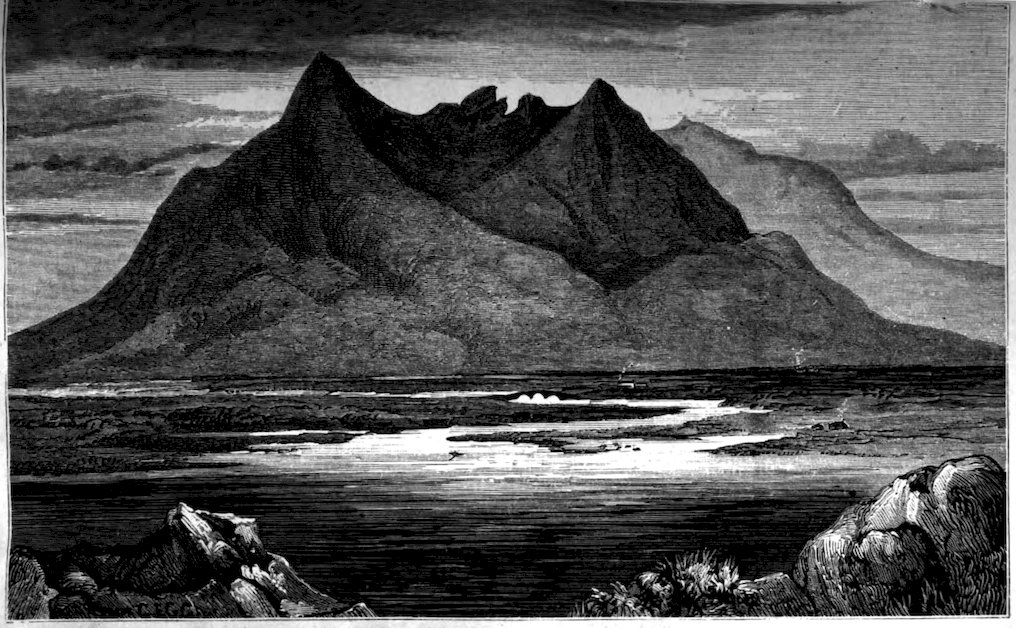
THE CUCHULINS. To face p. 100.
101