Chapter II · THE INNER HEBRIDES.
Reading edition
“The Isles, where dewy morning weaves
Her chaplet with the tints that twilight leaves;
Where late the sun, scarce vanished from the sight,
And his bright pathway graced the short-lived night.”
Real Argyleshire rain! Drenching, pouring, soaking, pitiless rain! How it did rain! After such a spell of sunshine, why should it have chosen this very morning to begin this cruel work just as we started for a forty-six mile drive, first across the hills to Campbeltown, and thence to Tarbert, along a coast whose beauty we had already proved, and with which we had vainly hoped to refresh our memories? Our conveyance was the lumbering old coach which still runs between Campbeltown and Tarbert, and it was suggested that we should go inside; but, thinking the remedy worse than the disease, we preferred testing our good and trusty waterproofs; a panoply without which they would be rash indeed who would venture to set foot in the dominions of His Hieland Glory, the great MacCailian Môr, and brave his lawless rain.
It was some consolation that the worthies at the various stages, for once, allowed that it was something more than a “fine saft day,” and condescended to take refuge under their own roofs, and leave drowned understrappers to do all the work; while good John, our gentle Jehu, whose aversion to the whip was as great as that of our host at Losset, soothed and coaxed obedience out of the most unpromising quadrupeds. “Steady, my wee pet,” to a great raw-boned brute, with a wicked eye. “Noo, my bonnie lassie,” to a long-legged, clumsy old cow. A very master in the art of kindly flattery, is this master of the ribbons.
30As we drove along the coast, we had a farewell peep of the little Isle of Gigha, the burial-place of the Macneils, a meet haven for these turbulent island lords, with the wildest sea-waves for ever guarding their rest. On several of the old tombs we can still trace the rudely-carved two-handed sword, half hidden by a coating of warm dark moss. Some relics, too, there are, of yet more ancient days. Great cairns near which stand tall rough monoliths, once, doubtless, suggesting names that in their day were deemed immortal, but of which all tradition has long since been lost. At one place there is a group of three such old cairns, and one great monolith, which has been carved into the semblance of a cross, by some zealous Christian of old. Near this is a well, which the Macneils of yore had only to stir, if they were windbound, and straightway a favourable gale arose, to speed them on their course. A little further to sea lies the low shore of Islay, so called from Yla or Eila, a Danish princess, whose grave near the bay of Knock is still marked by two large upright stones.
Here, too, on the brink of the river Laggan, “Brian of Ila” was buried, standing upright, and holding in his hand a spear, such as that which he used to dart at the salmon. The ruling passion, you see, was strong in death. In Islay, beside Loch Finlagan, one (or more) of the old Lords of the Isles held his court; and standing on a big stone seven feet square, received the homage of all his vassals, a ceremony graced by the sanction of the Church; “for,” says the old chronicle, “the Bishop of Argyle and seven priests did anoint and crown him king of the Isles, placing his father’s sword in his hand, whereupon he swore to protect the Islesmen, and do justice to all his subjects.”
It is curious to note the strange quibble by which this peninsula of Cantyre came to be included among the Hebrides. A very narrow neck of land, such as that which connects this with the mainland, is generally called Tarbat or Tarbert, from two old words: Tarruing, to draw, and Bata, a boat; because in some cases it saved both time and trouble to drag the boats across the isthmus, rather than sail round the land. This was especially true of the Mull of Cantyre, whose difficult navigation and fearful storms were so dreaded, that vessels of nine or ten tons were frequently drawn by horses out of the west loch to that on the east (a distance of barely a mile), thus avoiding the long and 31dangerous sail all round the peninsula. This fact was taken advantage of by the Norwegian king, Magnus, “the barefoot king,” when Donald-Bane of Scotland was forced to cede to him the Western Isles, including all places that could be surrounded in a boat. Placing himself in the stern of a boat, he held the rudder, was drawn over this narrow track, and thus took possession of the Mull.
Well, it poured without intermission till we reached Tarbert, where there still remain the ruins of a castle built by the Bruce. Thence we took the steamer to Lochgilphead, where a smaller steamboat was waiting to take us through the Crinan Canal, and we sat on the deck to catch a glimpse of old Duntroon Castle, but it looked grey and cold and wet, and not a bit like the same place where we used to sail, or row, or scramble in the sunny summer evenings. At Crinan we again changed steamers, and still the rain poured on: “It was never weary.” We knew that on our left lay the Islands of Scarba and Jura, between which rush the mighty tides which swirl and roar round a hidden reef in mid channel, whence shelving rocks on every side project far under the water, and so create the whirlpool of Corrievreckan, “The cauldron of the foaming tide,” which boils and ferments as the impetuous currents meet, till the waves are heaped up like pyramids, which break and spout in dashing spray. Sometimes this wild ferment makes the whole sea white with foam, and then the people say that the Caillach (the old hag) has put on her kerchief, and any ship rash enough to approach would meet its certain doom.
The legend of these tumultuous waters tells that the word Bhreacan (Corrie-Bhreacan), which some have translated as “foaming stream,” was really the name of a brave young Danish prince, who loved a daughter of the Lord of the Isles, and desired to woo and win her. Her father did not favour his suit, yet, not willing to offend the King of Lochlin, he answered craftily that the prince should indeed have his daughter providing he would prove his courage and his skill as a seaman, by anchoring his galley for three days and three nights in the dread whirlpool. The young prince, nothing daunted, returned to Lochlin to consult with his wise men as to the best means of safety. They bade him take three cables,—one of hemp, one of wool, and one of woman’s hair. The hempen 32cable and the woollen one were easy to find, but as to the third, every hair of which must come from the head of a maiden of spotless fame, it demanded such sacrifice as few damsels would care to make. However, the prince was beloved, and the fame of his beauty and of his brave deeds in love and war, had reached the bower of many a Danish maid. So the daughters of the land cut off their long fair locks, and a cable was woven thereof, which should resist the mightiest tempest that ever raged in that seething cauldron. Then the prince returned to the father of his love and announced his readiness to do his will. He anchored in the whirlpool. The first day the hempen cable broke. The second day the woollen one parted. The third day came, and the gift of the maidens of Lochlin still held its ground. The young prince was full of gladness, for his triumph seemed nigh at hand. But alas! for that law which makes the strength of the mightiest cable equal only to its weakest link. There was one fair tress binding him to the anchor of his hope which had been shorn from the head of one whose fame was no longer without blemish. So the resistless might of unspotted purity was not there to bind the raging waters, and the last rope parted, and the ship was sucked down in the mad whirling vortex, down, down, down, to the unfathomable depths of ocean. But the body of the prince was brought to land by his faithful dog, and dragged to a cave that bears his name, where a little cairn still marks the spot where Bhreacan was buried. The dog returned to the water, doubtless seeking some other friend, and he perished in a lesser whirlpool between the Isles of Scarba and Lunga, and that Sound is still known as the Grey Dog’s Slap.
To the north-west of Scarba lies the little island of Elachnave, where there remain traces of some of the very earliest monastic buildings, situated near an ancient cemetery of the roughest sea-stones, one of which bears a rudely graven cross; there are also two beehive cells of slate, covered with grass, perhaps the humble homes of holy men of old.
All this time we were passing through scenery which we believed to be bewilderingly lovely, if we could but have seen it, instead of the sheets of grey rain, which poured down incessantly from the heavy clouds. But towards evening, as we neared Oban, the quiet little harbour, as its name implies, the dark 33storm drifted away, and the sun shone forth in penitent beauty, changing the whole face of nature. Instead of earth, sea, and sky being all of one leaden hue, the scene was now flooded with tender rainbow-coloured light; fairy islands in the far distance seemed to float ethereally on the opal-tinted sea, and the great hills of Mull appeared as if rising from the waves, like some pale spirit, faintly visible through the tremulous evening light.
Just beyond the town rises the stern old Castle of Dunolly, perched on a grey projecting craig, which, rising abruptly from the shore, commands the harbour on either side; a strong tower of defence in olden days, and one which no foeman’s galley could approach unseen. Now a picturesque garden nestles round the base of the craig, adding gem-like touches of colour to the flush of heather which lies in every cranny of the grey rock, while a background of green and gold foliage serves as a rich setting to the whole. Near the base of the cliff one huge rock boulder stands upright, as if placed there by some giant hand. This is known as the Dog’s Stone, for here it was that Fingal was wont to tie his faithful dog Bran in ages long before Macdougals or Campbells had taken possession of the land. You know this grim old fortress of Dunolly was the eerie where the Macdougals of Lorn, eagle-like, built their nest overhanging the waves. They were lineal descendants of the first Dougal, Lord of the Isles, son of the great Somerled, whose place of burial we noted at Saddell. The old castle is now in ruins, later generations having preferred to build themselves a modern home in a more sheltered nook, where, among other family treasures, they still retain the far-famed brooch of Lorn, snatched from the Bruce by their ancestor John of Lorn.
Resolved to make the most of so beautiful an evening, we wandered along the shore in the direction of Gallanach, by far the most lovely, and yet the least frequented road in the neighbourhood of Oban, winding beneath grey crags, close to the sea; and disclosing at every turn some fresh vision of beauty; dreamy isles or the nearer mainland.
The dewy freshness of a sweet spring morning tempted us forth betimes, to explore another fine old ruin, the Castle of Dunstaffnage, a far more imposing mass of building than Dunolly, though lacking the grandeur of its rocky ramparts. But the low grassy shore on which it stands is washed all 34round by the blue sea-loch, so that at high tide it is in fact an island, and the waters, coming close in shore, serve as a mirror to reflect the grey weather-beaten fortress, only rendering its image in mellower tones than the stern walls ever wear in reality. Nor is its beauty lessened when the receding waters expose the dark rocks fringed with golden sea-weed,—rocks on which you may sometimes surprise a whole family of seals basking in the warm sunshine,—a grey old grandmother surrounded by her children and grandchildren, the latter dark in colour as the dry wrack on which they lie. They will slip shyly into the water at your approach, but perhaps you may wile them back with some plaintive song, for they have keen ears for music, and will brave even the dreaded human presence for the sake of some favourite melody. Often, while sailing on this very loch, we have tested this curious fact, and watched the black shining heads appearing from time to time, as these music-loving creatures swam in the wake of our galley, attracted by the sound of songs, or of old Scotch tunes played on an accordion. Talking of “grey old grandmothers,” I remember one patriarchal seal, who in her old age had turned so silvery white that as she lay on the rocks close in shore, we all with one accord agreed that it must be a sheep which had fallen from the cliffs overhead. As we sailed nearer, the likeness seemed to increase, even to the experienced eyes of our older sportsmen; so we determined to put off a boat and rescue the poor sufferer who lay so still and motionless, only from time to time turning her head uneasily at our approach. It was not till we were within easy shot (a shot which, of course, was never fired) that the old lady condescended to lift herself up, and, looking down on us in calm surprise, plunged into the cool clear waves, leaving the invaders very much astonished at their own lack of discrimination.
In a cool shady glade, a stone’s throw from the castle, stands a ruined chapel, ivy-clad, where many a carved stone tells of the sleepers who have here found so calm a resting-place after life’s turmoil—a lonely spot, seldom trodden by human foot, but haunted by white-winged sea-birds that float spirit-like in mid-air, sometimes alighting on the hallowed ground, and peering about inquisitively, as they walk solemnly over tombs of Vikings and Chiefs of old. Apart from the exceeding natural 35beauty which lends such a charm to all this coast, there is the special interest of countless old legends, which connect not only these grey ruins, but all the country round, with the successive holders of the soil,—those divers races who by turns have swept over the land, each leaving their little mark behind them. The very name of this district—Beregonium—falls strangely on the ear, accustomed rather to the sound of Celtic or of Norse than to such classic old Latin, and reminds us of the days when Roman invaders, having driven out the earlier settlers, seem to have recognised the importance of this position as a key alike to the Hebrides and the western coast. Here, in the massive headland (which, jutting into the sea, commands both plain and ocean), they found a position so strongly fortified by Nature’s ramparts of rugged rock, as to require but small aid from human skill to convert it into an impregnable encampment.
Of the original inhabitants, little is of course known, but this spot is believed to have been one of the principal settlements of the Dalriads, if not the capital of their kingdom. Certain it is, that many of the oldest legends of Ossian cluster round this immediate neighbourhood, where Fingal is said to have held his court and shared with his warriors in wild feasts and frays.
From Dunstaffnage we overlook a desolate tract of wide flat moorland, known as Loch Nell Moss, lying between the blue waters of Loch Etive and the broad Atlantic. Here various traces have recently been discovered of the homes and graves of our Pagan ancestors, suggesting dim and shadowy visions of their life in far remote ages. Half way across the Moss rises a large cairn, built of rounded water-worn stones, and surrounded by stunted trees. This has recently been excavated; and in the heart of the tumulus were found two megalithic chambers, containing human remains and urns. Also divers white quartz stones, such as various Pagan nations were wont to bury with their dead, apparently as emblems of purity and indestructibility, thus possibly conveying some idea of immortality and of sin forgiven or cancelled, as when the Greeks of old symbolized a release from some obligation by the giving or receiving of a white stone,—a custom probably alluded to in the book of Revelations in the promise “To him that overcometh .... I will give a white stone, and in the stone a new name written.” Or the 36allusion may have been to the ancient form of ballot, when the favoured candidate was known by the number of white stones which fell to his share. In the present instance, the white stones were arranged in pairs, on a ledge of rock projecting above the urns, a single stone being placed at each end of this double row; another single white pebble was found inside one of the urns.
A considerable number of similar pebbles of white quartz have recently been discovered in various old British tombs on the Isle of Cambrae, as also within the Sacred Circle on the Isle of Man; a circle, by the way, which from time immemorial has been held in such reverence, that to this day the Parliament of the island is there convened. These pebbles were also found in most of the old tombs recently excavated in the neighbourhood of Dundee, in fact so frequent was their presence, that it was common for the workmen employed in excavating to exclaim, “Here are the two stones! now we will get the bones.” Rock crystal is sometimes found in lieu of the white quartz.
As a curious trace of a similar custom in a far-distant land I may mention that Dr. W. F. Cumming tells me that he found several graves thus strewed with white pebbles near the temple of Deir, the capital of Nubia, above the second Cataract of the Nile. A kindred coincidence (bearing on the religious and funereal rites of our ancestors) is, that in several tumuli, at Dundee, Inverary, Letcombe Castle in Berks, and Maiden Castle near Weymouth, there have been found conical stones of white quartz, each in connection with human remains, and precisely similar to those found in the excavations at Nineveh which are now to be seen in the British Museum, the only difference being that the latter are covered with inscriptions, and representations of serpents and of the sun and moon.
Turning from these dwellings of the dead to the sunny shores of Loch Etive, we next come on traces of a lake village, of considerable size, and in fair preservation. Here, on removing accumulations of peat-moss, which would seem to have been the growth of twenty, or perhaps thirty centuries, a series of oval palings were found, still surrounded by wooden stakes, which doubtless once supported conical thatched roofs, like those dwellings of the old Gauls described by Strabo as circular, with lofty tapering roofs of straw. However suggestive to the initiated are these slight remains of the homes of their ancestors, they offer small attraction to the general public, compared with the hints of the ancestral worship recently discovered in Glen Feochan in the rival district of Loch Nell, which, though bearing the same name as the Moss aforesaid, lies about three miles on the other side of Oban.
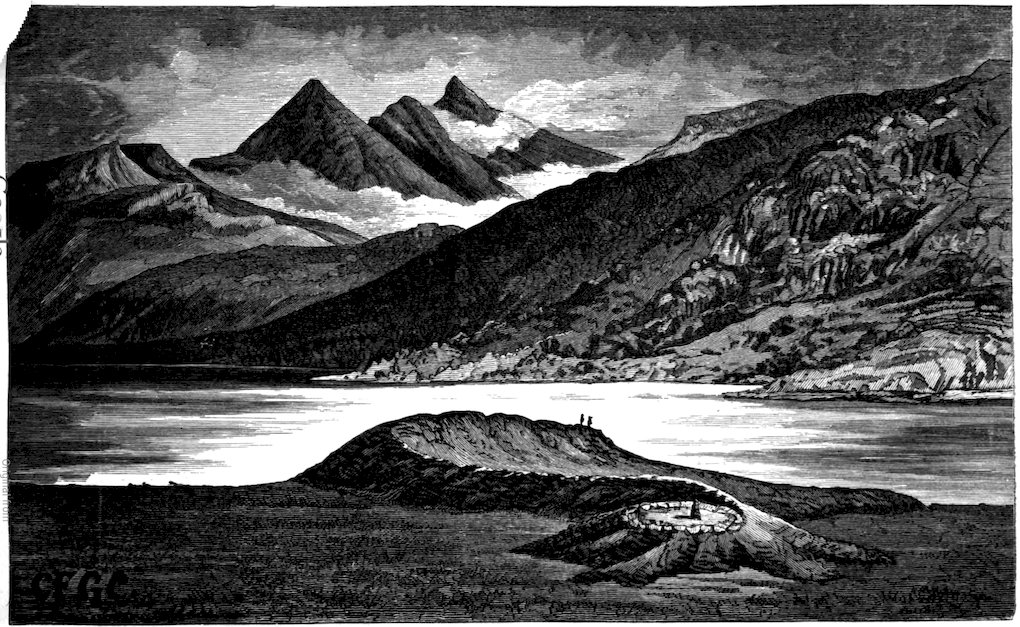
SERPENT-SHAPED MOUND NEAR OBAN. To face p. 37.
37Here lies a huge serpent-shaped mound, the very existence of which, strange to say, was utterly unknown to the scientific world till discovered by Mr. Phené, and by him revealed to the Antiquarian Society in the summer of 1871. Being in Oban soon afterwards, we lost no time in setting forth in search of the monster. Half an hour’s drive brought us to the shores of Loch Nell, beyond which Ben Cruachan proudly rears her triple crest, standing in dark relief against the delicate white vapours which cling to her so lovingly, sometimes veiling, sometimes crowning, this stately queen, as they float around her with ceaseless motion.
The carriage-road winds along the shore, and through broken hummocky ground, in some places clothed with grass, in others with heather and bracken; and, but for the presence of one of the few initiated who had fortunately accompanied us, we should assuredly have passed close below the heathery mound which forms the Serpent’s tail (in fact, the road has been cut right across the tip of it), without ever suspecting that it differed from the surrounding moorland. In short, we should have been no wiser than our forefathers, who for centuries have passed and repassed along the same beaten track, whence only an occasional sportsman or shepherd has had occasion to diverge. It does seem strange, however, that not one of these, looking down from the higher ground to westward, should ever have called attention to so remarkable a form, and one, moreover, which rises so conspicuously from the flat grassy plain, which stretches for some distance on either side, with scarcely an undulation save two artificial circular mounds, in one of which lie several large stones forming a cromlech. These circles are situated a short distance to the south, to the right of the Serpent, but too far to be shown in the sketch.
Finding ourselves thus unconsciously in the very presence of the Great Dragon, we hastened to improve our acquaintance, and in a couple of minutes had scrambled on to the ridge which 38forms his backbone, and thence perceived that we were standing on an artificial mound three hundred feet in length, forming a double curve like a huge letter S, and wonderfully perfect in anatomical outline. This we perceived the more perfectly on reaching the head, which lies at the western end, whence diverge small ridges, which may have represented the paws of the reptile. On the head rests a circle of stones, supposed to be emblematic of the solar disc, and exactly corresponding with the solar circle as represented on the head of the mystic serpents of Egypt and Phœnicia, and in the great American Serpent Mound. At the time of Mr. Phené’s first visit to this spot there still remained in the centre of this circle some traces of an altar, which, thanks to the depredations of cattle and herd-boys, have since wholly disappeared. The people of the neighbourhood have an old tradition that in remote ages this was a place of public execution, and, from various analogies in the customs of other nations, it seems likely enough that this was the case, and that this wild glen may have been to many the valley of the shadow of death, whether their lives were taken judicially or offered in sacrifice.
The circle was excavated on the 12th October, 1871, and within it were found three large stones, forming a chamber, which contained burnt human bones, charcoal, and charred hazel-nuts. Surely the spirits of our Pagan ancestors must rejoice to see how faithfully we, their descendants, continue to burn our hazel-nuts on Hallow-e’en, their old autumnal Fire Festival, though our modern divination is practised only with reference to such a trivial matter as the faith of sweethearts! A flint instrument was also found, beautifully and minutely serrated at the edge; nevertheless, it was at once evident, on opening the cairn, that the place had already been ransacked, probably in secret, by treasure-seekers, as there is no tradition of any excavation for scientific purposes having ever been made here.
On the removal of the peat-moss and heather from the ridge of the serpent’s back, it was found that the whole length of the spine was carefully constructed with regularly and symmetrically placed stones, at such an angle as to throw off rain; an adjustment to which we doubtless owe the preservation, or at least the perfection, of this most remarkable relic. To those who know how slow is the growth of peat-moss, even in damp and 39undrained places, the depth to which it has here attained, though in a dry and thoroughly exposed situation and raised from seventeen to twenty feet above the level of the surrounding moss, tells of many a long century of silent undisturbed growth, since the days when the Serpent’s spine was the well-worn path daily trodden by reverent feet. The spine is, in fact, a long narrow causeway, made of large stones, set like the vertebræ of some huge animal. They form a ridge sloping off in an angle at each side, which is continued downwards with an arrangement of smaller stones, suggestive of ribs. The mound has been formed in such a position that the worshipper standing at the altar would naturally look eastward, directly along the whole length of the great reptile, and across the dark lake, to the triple peaks of Ben Cruachan. This position must have been carefully selected, as from no other point are the three peaks visible.
This reverence for some Triune object, whether a triple-pointed hill, the junction of three rivers, or the neighbourhood of three lakes, seems to have been a marked characteristic of almost every ancient faith. It was some such dim conception of the worship due to an adorable Trinity in Unity which led to the almost universal adoption of some sacred triple symbol, such as the trident of Neptune, which we find again, placed on the pinnacle of every temple of Siva, and carried in the hands of his worshippers. It is daily painted on the forehead of every worshipper of Vishnu, and even reappears as the mystic symbolic letter painted outside the Phylactery worn on Jewish brows, albeit the wearers have long since lost all clue to its hidden meaning. Again, we find it in old drawings of Babylonish priests, who bear it in their hands; and it has been shown that not only was this symbol held in deepest and most mysterious reverence in the temple of Apollo at Delphi, but also that the far-famed idol Juggernaut, representing the same sun-god, is, when undressed, and shorn of its gorgeous raiment, simply a triple symbol with a head rudely engraven on the central limb, for the adoration of the vulgar uninitiated. The idea is further carried out by the fact that the great Juggernaut is only one of a group of three great idols, his brother and sister dividing with him the homage of the people. All these three were, so runs the legend, miraculously fashioned by Vishnu 40himself from one divine log of timber. His brother is also endowed with stumps for arms, so that he also is a triple symbol; but the sister is merely a rough block of wood, with a head carved thereon.
In truth, this doctrine enters largely into the faith of Hindoostan, where the worship of the Trimurti, or three principal gods united in one perfect Being, forms the key-stone of Brahminism. Moreover, we know that the faithful Hindoos who crowd in such countless multitudes to bathe at Allahabad, are drawn thither not merely by the sanctity of the junction of the two great rivers visible to human eye, but by their firm belief that a third and more holy river of life-giving water here pours its stream invisibly into the bosom of the Ganges. Perhaps the most singular instance of reverence for a mystic triple number is to be found where we would least expect it, namely, among the Buddhists; in whose solemn and very ancient service for the ordination of priests, each question and answer, each sacred vow and declaration of faith, must be repeated thrice. That ordination service is said to have been used without alteration for upwards of two thousand years, since the days when the Sanchi Tope (mightiest of Buddhist relic shrines), was reared by the immediate followers of Buddha, and its gateways crowned with the mysterious triple symbol.[3] Even in the decorations of modern Buddhist temples I have often been struck with the recurrence of the threefold number, both in the grouping of sacred lotus blossoms, and that of saintly figures, sometimes seated on the clouds,—decorations generally copied with monkeylike imitation from ancient temples, by modern priests, ignorant of all hidden meaning in the work of their predecessors.
The ancient Egyptians likewise believed the Spirit of Good to be threefold; hence on Theban monuments the gods are shown in groups of three. Sometimes Osiris, Isis, and their son Horus, are thus grouped; sometimes in place of Osiris we find Nephthys, sister of Isis. These are also represented by the figure of a triangle.... Thus too, I am told (though I know not on what authority), that the Persians of old were wont to reverence the threefold leaves of the shamrock, as symbolic of a Divine Triad, to whom this plant was consecrated by the sons of Iran for many long centuries ere St. Patrick made use of the 41same green leaf to exemplify the same mystery to the sons of Erin—a leaf, moreover, to which they already attached some mysterious meaning, regarding it as a certain charm against serpents and all venomous reptiles.[4]
In like manner, the Druids (those Ghebres of the West), who venerated the sacred mistletoe by reason of its mystic triple branches and triple clusters of white berries, were not likely to overlook so mighty an embodiment of the same symbol as a great mountain, with its threefold summit towering heavenward, as if to draw thither the eyes and hearts of a race who were careful to consecrate all such natural types in their worship of Nature’s God.
It was a knowledge of this tendency that first led Mr. Phené to examine minutely all the least trodden glens in the neighbourhood of any such natural features, as for instance round the Eildon and Arran hills, seeking for traces which should mark the spot as sacred; and in each case, among other so-called Druidic remains, he has found just such mounds of reptile form as he was in search of, none however so remarkable as this strange old Serpent, which for so many centuries has lain here undisturbed, as if guarding the valley. All of these are more or less akin to the reptile mounds discovered in Ohio and Wisconsin by Messrs. Squier and Lapham, always in connection with sacrificial or sepulchral remains. One of these in particular is of an unmistakeably serpentine form; and the position of the altar in the circle or oval at the head of the Serpent is identical with that of this Argyleshire mound, the head in each case lying towards the west. The American mound is, however, on a larger scale than its Scotch cousin, being altogether a thousand feet long. It points towards three rivers, thus indicating the reverence for the triple symbol,—another instance of which occurs on the hill known as Lapham’s Peak, on whose lofty summit three artificial mounds were found, carefully constructed of stone and earth,—materials which must have been transported thither with very great labour.
Whatever may have been the origin of these huge serpent-shaped mounds, their existence seems to suggest a clue to the 42meaning of various ancient legends concerning enormous serpents which covered acres of land; the very fact of their dimensions being given in terms of land-measurement seeming to imply that the writers merely alluded in poetic terms to Ophite or Dracontic temples where these symbols were worshipped. Thus we hear of dragons in Mauritania so great that they were covered with grass. Alexander the Great was taken to see a sacred dragon five acres in extent, lying in a low valley, surrounded by a high wall: to this dragon the Indians offered sacrifices of flocks and herds. Strabo mentions two such dragons in India, one measuring eighty cubits in length, the other a hundred and forty. And on the plains of Syria, near the land of snake-adoring Hivites, lay a serpent about an acre in length, of such bulk that two horsemen riding on either side could not see each other, while its mouth was so great that a man might ride in thereat—an experiment not likely to be tried were the reptile a living creature!
But all these are dwarfed by the legendary Dragon of Damascus, which is described as a serpent covering fifty acres of land! a description which Bryant interprets as including a grove and garden round the Ophite temple. He also quotes Ovid’s account of the serpent Python as covering several acres, alluding surely, not to the serpent itself, but to that temple of Delphi which Apollo built with great stones on the spot where he had slain the Python—a temple which Stukely infers to have been similar to our own great temple of Avebury or Aubury in Wiltshire, i.e. a circle whence started two wavy serpentine avenues, forming the Ophite symbol; and although his theories on this subject are now commonly held in ridicule, it should at least be remembered that the form was far more perfect in his day (1723) than it now is, many great stones having been broken up by farmers in his time, and the work of destruction still continuing mercilessly when Deane wrote in 1830.
The same ridicule also attaches to those who claim the marvellous temple of Carnac in Brittany as an instance of serpentine form, and who try to show that these huge monoliths are arranged in a sinuous course, so as to describe the figure of a monstrous snake, so vast, indeed, that its windings are eight miles in length and must have originally been marked by ten thousand stones, many of those still standing being 43upwards of fifteen feet high, while one measures forty-two feet in circumference. In support of this theory, these Ophite antiquarians tell us that the peasants of the neighbourhood have an annual dance at the Carnival, which exactly describes the symbol of the Sun and Serpent. They also say that Carnac is derived from two words meaning fire and snake, hac being the old Celtic name for the serpent. In confirmation of this, we are reminded that the common name for snakes in some parts of England is to this day hag-worms. Hence the name hag to describe an old witch, supposed to have derived supernatural knowledge from her familiar spirits—perhaps originally a snake-priestess. The same word occurs in the Hakpen hills in Wiltshire, and is interpreted as meaning ‘serpent’s head,’ being the place where the serpentine avenue of Aubury terminates. The latter name is brought forward as evidence, and shown to be derived from aub and ur, meaning ‘serpent’ and ‘light;’ thus exactly describing the worshipful Sun-Serpent!
It certainly is a fact worthy of notice, that wherever—in Europe, Asia, Africa, and America—names occur combining the syllables Ob and On (the Serpent and Sun deities of Egypt and Phœnicia), there these forms of worship can be proved to have once prevailed; and so it has been suggested as not impossible, that just as the Israelites called the first place where they encamped, after the upraising of the brazen serpent Oboth, the race who built the serpentine mound, terminating in a solar circle, and who doubtless were settlers from some eastern land, may have given the name of Ob On, or Oban, to the nearest town.
But whatever disputes may arise concerning these vague derivations, and the still more vague forms, of the old temples of which we have been speaking, there can be no doubt whatever of the clearly-defined outlines of the great mound now before us; though, whether its serpentine (or rather Saurian) form is to be accepted as any direct proof of serpent worship in this land, or whether it was simply reverenced as the representative of some tribe (a Totem, in short, of some extinct British race answering to the Nagas, or snake tribes, of the East), will doubtless prove a fertile subject for discussion for many years to come. Certainly we know that the worship of the serpent and of the serpent’s egg, by the Druids, is a matter of history; 44and we are told that they were wont to place live serpents, as symbols, at the foot of the altar during the time of sacrifice, a custom common to almost every ancient nation. In Greece and Rome, Egypt and Chaldea, Arabia and Central Asia, in China and Thibet, throughout the whole Indian empire from Cachmere to Cape Comorin, in Ceylon and multitudinous other isles, in Mexico and Peru, as well as throughout the whole of Africa, the same extraordinary worship is shown to have prevailed. Passing northward, we find it in Scythia and Scandinavia, as also among vast tribes near the Oural mountains and throughout Northern Europe, notably among the tribes on the Ob or Obi river, which is said to have derived its name from the reverence in which this reptile was held. The ancient Muscovites and the people of Poland worshipped domestic serpents, which glided at large in every home and were reverently tended, all misfortunes being attributed to some negligence in their service. This continued till the end of the fourteenth century, when the last heathen duke of Lithuania received Christian baptism. The people of Lapland, the Fins, Norwegians, Swedes, and Danes, all cherished these household gods, which shared the children’s milk! The Vandals also kept domestic snakes; some lived in hollow trees, and the women went thither to pray, carrying offerings of milk, as many do at the present day in India and Ceylon. The Lombards continued to worship a golden viper and a tree long after they were professedly Christian. It was not till A.D. 663 that Barbatus, Bishop of Benevento, finding this custom still prevalent, persuaded them to cut down the tree, and allow him to melt the golden viper, and make thereof a sacramental chalice.
Deane quotes a curious proof of the homage which was still paid to the serpent symbol by the semi-Christianized people of Constantinople so late as the seventeenth century. It seems that Constantine had brought thither the celebrated serpentine column, or conical tripod, from Delphi, whereon the Pythian priestess sat when delivering her oracles. This column was a triple-headed serpent of brass. “When Mahomet II., the Turkish conqueror of Constantinople, entered the city and beheld this object, he inquired ‘What idol is that?’ at the same time hurling his iron mace with such force that he knocked off the lower jaw of one of the serpent-heads. Upon 45this, immediately, a great number of serpents began to be seen in the city; whereupon the people besought him to leave that image alone, as only through its power no other serpents could molest them. Wherefore that column remains to this day. And although, in consequence of the lower jaw of the brazen serpent being struck off, some serpents do come into the city, yet they do no harm to anyone!”[5]
The ancient Serpent Temples of Cambodia with their many-headed snakes, and the temples and rock sculptures of India and Ceylon, showing the hooded cobra rising as a canopy above so many of the gods and overshadowing even the pure and perfect Buddha, tells how this worship was gradually idealized. Strange, indeed, it is to trace how the creature which to us is the very type of all things evil, should there have been recognized as the embodiment of good, and to find thousands and tens of thousands of sculptures of that seven-headed snake, which to its worshippers symbolized their ideal of that Seven-fold Spirit of Wisdom, Whom Christians adore! For thus in mythology the serpent has ever filled a double part; sometimes appearing as a meet emblem of the wisdom of God, sometimes as the type of the subtlety of the Arch Fiend,—one day exalted (as with the Ophites of Alexandria) to a place of honour even upon the Christian altar; the next hurled down to the nethermost hell, as when the ancient Scandinavians sang of the dark shore where the sinful dead found themselves in a dread chilling abode, formed entirely of serpents, twined and intertwined, fold within fold, like wattled wickerwork. And all the serpents’ heads were turned inwards toward that vast and terrible cavern, continually vomiting forth floods of venom, wherein writhed these wretched ones in their hopeless anguish. We know that the Chaldeans, like the Chinese, worshipped a winged dragon as the Being excelling in wisdom; and the Mexicans adored a mighty feathered snake, as well as the great serpent which symbolized the life-giving sun.
This divine feathered serpent, who was born of a daughter of Earth, was the great lawgiver and civilizer who taught the Mexicans, not religion only, but also agriculture and the use of metals; and when he had finished his mission on earth he 46departed, promising to return. Therefore when the Spaniards arrived in Mexico their coming was hailed as that of the returning god. In the Mexican mythology, as in those of Egypt and Greece, the Serpent appears as emblematic of so many divers gods, that he is evidently considered a symbol of the intrinsic divinity common to them all. Nor was his worship only symbolic. Both in Mexico and Peru there were great snake temples, where the living creature was adored and received offerings of human victims. The entrance to the temples was guarded by huge serpent idols, while the sacred drums whereby the worshippers were summoned were covered with skins of large serpents, and the gods within the temples were all entwined with serpents.
A cast of one of their idols was brought to this country—the figure being partly human, while the hands and arms are rattlesnakes; and the drapery is entirely composed of wreathed rattlesnakes woven into what the Mexicans called a garment of snakes. It is to be hoped that this deadly species was not included among the tame serpents which glided at large in every home as household gods! Some of the Mexican sculptures show human beings conversing with the serpent, while others show a conflict between them, the victor being sometimes a man, sometimes a god; in one, the god is cutting off a dragon’s head, but not till the dragon has bitten off his foot at the heel.
The Spaniards recorded very similar forms of worship in Peru, where in one temple they saw a vast image of a serpent of divers metals, with his tail in his mouth, to which annual human sacrifice was offered. At another temple they were told how ‘the devil did speak visibly,’ the medium of his oracles being a spotted snake. The Aztecs, like the Hindoos, reverenced the serpent biting his own tail as the emblem of eternity—the symbol of time ever revolving on itself and returning into itself. They also held the casting of the serpent skin as symbolic of an ever-renewed youth and spring-tide.
To give the names of the gods to whom the symbolic serpent was held sacred would be to enumerate well-nigh every deity in the mythology of every ancient nation, this being the one only characteristic common to all these faiths; a circumstance that would be utterly unaccountable on any theory other than that 47of some tradition common to all, such as that of the Serpent of Paradise. It is easy to perceive how quickly the belief in his supernatural wisdom would lead to his worship; and thus from age to age the arch-enemy has kept up his character as serpent tempter, inducing all mankind to yield abject veneration and adoration to the repulsive reptile whose form he had once assumed.
Of course, the earliest traces of this worship are to be looked for in Chaldea; and accordingly we find that in the great temple in Babylon there were two very large serpents of silver. Moreover the people worshipped a great living dragon (or serpent, for the two words are used promiscuously by old writers, as when, in Bœotia, a dragon had laid waste the town of Thespiæ, and Jupiter commanded that an annual human sacrifice should be offered to the Serpent. Or again, in biblical language, we read in the Revelations that “The great dragon was cast out; that old Serpent called the Devil, which deceiveth the whole world.”) In ancient Persia both the good and the evil principle (Ormuzd and Ahriman) were symbolized by serpents, which were represented contending for the mundane egg. In Mesopotamia, in Syria, in Ethiopia, they were likewise held in reverence, and it is asserted by various writers that to this day both Arabs and Hindoos eat the heart and liver of serpents, hoping thereby to acquire a knowledge of the language of animals. The same curious notion gave rise to the old Celtic legends concerning that pure white serpent, which, if caught and boiled, would confer the gift of omniscience on the first man who tasted this broth, and who would moreover become the wisest of doctors.
Akin to this is the old Greek fable, telling how, when Melampus had saved the lives of two snakes they came to him as he slept under an oak, and licked his ears, whereupon he was able to understand the chirping of birds, and was gifted with prophecy. The same gift of prophecy was bestowed when serpents ‘with their tongues cleansed the passages of the senses’ of sleepers in the temple of Apollo, and made them so sharp of hearing that they could hearken to the counsel of the gods. Others requited certain blind men who had done them service by licking their eyes, and so bestowing on them sight far keener than any human vision.
The primitive inhabitants of Canaan were also snake-worshippers 48(indeed, their name, Hivite, is said to be equivalent to the Greek Ophite). Hence, when the Hebrews intermarried with these tribes, and served their gods, they in fact adopted this worship, which accounts for the readiness with which veneration for the brazen serpent led to actual adoration and burning incense thereto, so that Hezekiah was compelled to destroy it, with other idols. Undoubtedly, faith in the supernatural knowledge of the creature lingered in Palestine till much later days, as we gather from the frequent allusions to consulting ‘those that have familiar spirits,’ an expression which should rather be translated[6] ‘serpents,’ the word used (Ob or Oub) being the same as describes the serpent worshipped in Egypt. Passing on thither, we find the same wide-spread superstition. That this worship was coeval with that of the sun is shown by the earliest Egyptian mythology, relating how Helius, the Sun-god, married Ops, the Snake-goddess. Though peculiarly consecrated to three or four of the principal gods, there is scarcely one Egyptian deity which is not occasionally symbolized by the serpent, and the living reptiles were adored in great temples at Elephantina, Thebes, Alexandria, Onuphis, and Metele, where they were fed with flour and honey by their appointed priests.
There is reason to believe that this strange worship still contrives to continue its existence in the land, in spite of the rigorous laws of Mohammedanism. Bishop Pocock mentions having been shown a cleft in a rock on the Nile, near Raigny, where the great serpent Heredy is said to have dwelt since the days of Mahomet. Against the rock is built a mosque, but the Bishop noticed much blood, and the remains of beasts lately killed, which clearly told their story of recent sacrifice to the Serpent. He says the Christians have as great faith as the Mohammedans in its power to cure all manner of diseases, and adds, that, once a year, the women of the land go a pilgrimage to his shrine, to seek his favour, as the Grecian women of old were wont to do to their serpent gods.
In the mythology of Greece there is scarcely one fable in which the serpent does not figure, nor one god which is not thus symbolized. First we have Cadmus slaying his famous dragon, and planting its teeth, which spring up as armed men, and build 49Thebes. Then Cadmus and his wife are themselves transformed into serpents, and as such are adored by the people. Next comes the founding of Athens by Cecrops, whose first care is to erect an altar to Ops, the serpent-goddess. One fable after another tells how divers gods temporarily assumed the form of either a dragon or a serpent for reasons of their own, generally in order to win some maiden of earthly mould. Sometimes we find the serpent entwining the helmet or the mystic staff of sage Minerva; then he figures in the drunken revels of Bacchus and Isis. Health-giving Esculapius and his sister Hygeia are both invariably accompanied by serpents, sometimes coiled in the lap, or drinking from a chalice, sometimes carried on high like the brazen serpent of the Israelites. Now we have Jupiter taking the form of a “dragon” to deceive Proserpine. Then Apollo, the sun-god, slays the Pythian serpent, and himself gives oracles at Delphi, which were previously revealed by that creature of supernatural wisdom, in whose honour solemn services were held every seventh day.
The latter is a curious fact when taken in connection with the existence of certain Greek sculptures, whereon the serpent is shown entwined in the branches of a tree, with a woman standing by, and seems another link connecting this worship with the traditions of Eden. It occurs again in Orissa, where, at Surabulpore, there lives, or did live a few years ago, a great and holy serpent, seen by various European travellers, which came forth from its cave every seventh day to devour a goat offered to it by the people. Another of these sculptures[7] represents a man kneeling near the woman, as if worshipping the serpent; while on the other side old Charon approaches, leading Cerberus to guard the tree. Live serpents were kept and honoured in the dominions of all the Grecian gods. In Macedonia serpents of largest growth were cherished as household gods, and were the playfellows of the infant children. One was kept in the Acropolis, and consecrated to Minerva, on the walls of whose temples were sculptured Medusa’s heads, fair and beautiful, with snake-entwined hair. There were sacred groves adjoining most of the principal temples of Apollo, both in Greece and Italy, where living serpents were attended by priestesses, and suffered to glide about at their own sweet will, consuming honey-cakes, 50delivering oracular responses to all comers, and occasionally killing a priestess who, with heedless foot, chanced to molest one of her slippery gods.
The husbandmen annually made solemn pilgrimages to these temples, and offered propitiatory sacrifices to the serpents, supplicating a good harvest. If the reptiles were pleased to accept their offerings of cake and wine, the omen was hailed with gladness. It would seem as if the original curse of the ground and its produce for the serpent’s sake, had led to the belief that he who had brought about such mischief still exerted some mysterious influence, whereby he had power to regulate the produce of the earth and her fruits. Hence the Chariot of Ceres, goddess of agriculture, was drawn by serpents, and throughout Hindoostan the serpent is to this day adored as one of the Gram Deotas, or corn-gods, to whom special sacrifice is made at seed-time and harvest.
The head of the serpent has now been so far bruised that his nominal adherents are comparatively few. Perhaps the most curious instance of his open and avowed worship in the present day, among a people professing high civilization, is to be found among the Celestials, who, Buddhists though they be, cannot allow so dangerous a power to remain unpropitiated. Their edition of the old legend tells of a wicked serpent whose head was crushed by a woman; and in their temples they represent a goddess in the act of crushing the reptile. But on the principle of always conciliating evil, they offer sacrifices, not to the good goddess, but to the wicked snake; and in the city of Canton there is at least one temple where, in the very presence of Buddha’s statues, is an altar whereon smoulder warm coals, round which lies coiled a living serpent, which is daily fed and worshipped by the people. Near him on the same raised altar are placed certain sacred shrubs; so here we find the old tree and serpent worship still lingering in the heart of this great populous city.
But to see it in its glory we must turn to such purely uncivilised savages as the Fiji Islanders, or the negroes of Dahomey, over whom the serpent continues to hold sway, just as he probably has done from the earliest ages. Bishop Crowther, writing from one of the Niger Mission Stations, says that it is impossible to rear either goats, sheep, young pigs, or any sort of poultry, by 51reason of the multitude of cobras, which, being considered sacred by the Brass-men, must on no account be killed, but are allowed to overrun the country and help themselves to whatever they please! A still more curious reference to this fact occurs in Britain’s treaty with the natives, made in November, 1856, which contains a clause stating that, owing to the hindrance to trade, from white men having in their ignorance killed certain species of boa constrictors which enter houses and are considered sacred, and having thus excited the anger of the Brass-men, “it is hereby forbidden to all British subjects to harm or destroy any such snake, but they are required, on finding the reptile on the premises, to give notice thereof to the chief man in town, who is to come and remove it.” Just imagine letting a boa constrictor disappear under your bed while the authorities are providing an honorary escort for their god!
All along the western coast of Africa the serpent holds sway, more especially in Congo and Whidah, where the chief temple is called “The Serpent’s House.” Here a great retinue of priests and priestesses, subject to a high priest, await to interpret the serpentine oracles to all anxious pilgrims. We are told that these priestesses are called the daughters of God, and are tattooed with serpentine figures. When Bosman visited these tribes in 1697, he was duly impressed with the pomp and ceremonial of the temples, but chiefly with the fanaticism of the worshippers; for, an Englishman having accidentally killed a snake, the people rose en masse, and massacred all white men on whom they could lay hands, after which they burned their bodies and their goods. Shortly afterwards a hog chanced to kill another snake, whereupon a thousand armed Whidanese went forth, sword in hand, throughout the land, to slay every luckless pig they met! Their tradition of this ancient faith is that in remote days a sacred serpent came to them from some remote land, to claim their adoration, which was freely given. This old serpent still lives, and all his descendants are unspeakably holy. They combine this worship with that of tall trees and the ocean. The custom is not peculiar to these tribes. It is the common practice of all the negro race in every emergency to consult an Obi man or Obi woman, just as Saul in his troubles sought a woman full of “Ob;” that is, possessed of a familiar spirit, or serpent of wisdom.
52On the eastern coast the serpent holds a less prominent place, and, as among the Zulus is simply reverenced as a probable incarnation of their ancestral spirits, whom they do worship, and in whose guardianship they have full confidence. Hence in describing the good or evil that has befallen them, they attribute it to the watchfulness or neglect of their snake; either they suppose him to be sitting up wide awake, or else they mournfully conclude that he is coiled up in deep sleep. The appearance of certain snakes in their villages, more especially one beautiful green variety, is hailed with joy; sacrifices are offered to him, and he is coaxed to stay there as a welcome guest.
In Cashmere the worship of the Naga was formerly so prevalent that in the time of Akbar, A.D. 1560, there were in that kingdom forty-five temples devoted exclusively to his service, while in seven hundred others were carved images of him, which received due share of adoration.[8] To this day the descendants of the Naga tribes of Cashmere are remarkable for their medical skill and possession of healing arts and nostrums, which their ancestors, in common with Esculapius, received from the health-giving serpent. The same skill in healing is attributed to him by many nations. The Celts acquired their medical lore by drinking serpent-broth; the Mexicans hung snake-bones round the neck of the sick; in Pegu, at the birth of a child, a snake’s tongue is tied within a tiny bell and hung round the baby’s neck as a preventive of sickness and harm. And in many parts of India it is customary, in cases of illness, to make a serpent of clay or metal, literally a brazen serpent, and offer sacrifice to it on behalf of the sufferer.
In the mythology of Hindoostan, as in that of many other lands, the serpent maintains his two-fold character—sometimes as a power of good, sometimes of evil. Even where he is not ostensibly worshipped, he appears in connection with the gods, either as a symbol of Siva, the lord of life, or twined round the neck or arms of Vishnu, Juggernaut, Mahadeo, Parvati, and others; sometimes he is coiled up as a couch whereon the god slumbers, the head of the cobra (sometimes single, sometimes five-fold, sometimes seven-fold) forming a protecting canopy.
On the other hand, in the Hindoo hell, as in that of Scandinavia, there are living walls of poisonous serpents, intertwined 53in horrible contortions. And we know that the chief feat of Krishna was to slay the wicked serpent Kaliya, which, nevertheless, continues to receive a certain share of worship, just as the Pythian snake was adored at Delphi, even by the worshippers of Apollo, its destroyer, on the principle that powers of evil must be conciliated.
The open and avowed worship of the serpent lingered in Southern India long after it had ostensibly been driven out from the north by the Aryan conquerors. Thus a richly jewelled image of the seven-headed Naga is one of the three principal gods in the great temple at Maduva. Till very recently it was retained in Ceylon, but even there has latterly fallen into discredit, though it is undoubtedly not extinct. Indeed, within the last few years, there was a snake temple on the small adjacent island of Nainativoe, where the priests daily fed a multitude of sacred cobras; and I am told that on the isle of Tranative, off Jaffna, there is still a temple sacred to cobras, where living reptiles glide about and are tended by priests and priestesses. The natives on the north-west coast of Ceylon showed us black seeds with sharp points, which they call “naga-darana,” or snake’s fangs. These they lay as propitiatory offerings near the hiding-place of any serpent. Their objection to killing a snake, or allowing us to do so, was always very great, and if they could possibly allow it to escape they generally did so. One of our friends, whose house at the mouth of a beautiful river attracted our especial admiration, told us it had only one drawback, namely, the multitude of covered baskets containing cobras which the people living farther up the stream floated off from their own lands and which constantly were washed ashore in his garden! How strange it did seem to us, while, with an irrepressible shudder, we watched these creatures wriggling along in their horrid coils, to remember that we were looking on the gods of our forefathers—the creature, above all others, whose worship has been most universal!
Although the living serpent has ceased to hold a prominent place in public worship, it is still, as we have seen, recognised in all villages throughout Hindoostan as the principal corn-god,[9] to whom sacrifice is offered at seed-time and in harvest, 54and at all other times when rain or fair weather is unseasonably delayed. Even the Brahmins (!) join in these snake festivals and receive their share of the offerings. Some even carry a snake-skin in their holy books. The chief festival is held just after the season when the snake, having cast its skin, comes forth in renewed beauty.
In the native almanacs the fifth day of Srawan is noted as the birthday of the Naga king, and the day whereon serpents must be worshipped. So the people draw a serpentine figure on their houses, and do homage thereto. Then they adjourn to the nearest rocks or trees where serpents are known to live, and which are marked by small cairns smeared with red or black paint. They plant sticks near the hole, and, winding white cotton thread round them, hang up festoons of fragrant flowers; then they lay offerings of fruit, sugar, ghee, and flour round the hole, into which they pour milk, or lay it in saucers. Then the women, joining hands, circle five times round the snake’s dwelling, after which they prostrate themselves, and anxiously await his appearing to know whether their gift is graciously accepted. Should the serpent prove sulky, the omen is dire indeed. He receives similar bribes in all times of sickness. Moreover, when a child is first shaved, after teething or other infantile ailments, the hair is generally offered to some serpent, the Brahmins being present to sanction proceedings which they cannot prevent, and to accept small offerings.
This being the case, it is natural that the natives should strongly object to killing a snake if they can by any possibility drive him away. Like the people of Ceylon, they infinitely prefer to catch him alive, and carry him by night to the lands of the next village, where they turn him adrift. If, however, compelled to kill him, they put a copper pice in his mouth and give him a funeral pyre, and, while burning his body, assure him that they are guiltless of his blood; that they slew him by command of their masters, or because they could not otherwise prevent his biting their chickens or their children.
These serpent funerals must latterly have given a good deal of trouble to the natives of certain districts, where the destruction of these reptiles amounts to quite a large item in government expenses. At Burdwan, for instance, the sum of thirty 55thousand rupees (three thousand pounds) has been paid to the snake-killers within a wonderfully short time, and it is devoutly to be hoped that the desire of gain may induce the natives to overcome their superstitions and attack their common foe in real earnest. It has been suggested that a graduated scale of reward should be offered for different species of snakes, varying with the deadliness of their bite, the highest sum being of course given for the cobra—at once the most sacred and the most dangerous—to whose fang are attributed one-fourth of the annual deaths from snake-bite. These, as a total, are annually estimated at from eleven to twenty thousand, in a population of one hundred and twenty millions. It is hoped that a judicious addition of strychnine and carbolic acid to the offerings of milk and sugar placed at the entrance to the nest of the reptile, may prove among the most efficacious means of ridding the country of this pest.
In our own British Isles comparatively few traces of such reverence are to be found; yet, considering how commonly the adoration of sun and serpent are linked together, and that both are said to have been reverenced by the Druids, it is worthy of note that, till within the last century, all manner of customs for the good of the crops[10] were kept up on the days which in olden times were observed as sun-festivals. Moreover, in the shadowy mythology of early Britain we hear of a god Hu, who was worshipped as the dragon ruler of the world, and whose car was drawn by serpents: there was also a goddess Ceridwen answering to Ceres, who had a car similarly yoked with a serpentine team.[11] Similar inference may be drawn from a very curious old Bardic poem, concerning Uther Pendragon, the Wonderful Dragon,[12] descriptive of the religious rites of the early English, wherein the worshipper, while calling on Bel, the dragon king, describes himself as making the orthodox turn sunwise, first round the consecrated lake, then round the sanctuary, whereon 56is depicted the gliding king pursuing the fair one; while within the sacred circle of huge stones the great dragon, evidently a living serpent, moves round over the vessels containing the drink-offering, whence it may be inferred that the British Druids, like the Syrian Ophites, and Egyptian worshippers of Isis and Bacchus, encouraged the serpent to glide over the gifts on the altar. Mr. Deane notices, as a curious coincidence, that the word draig here translated dragon, signifies also the supreme god. Also that, in one of these poems, the priest enumerates his own titles as a Druid, a prophet, a serpent. Hence it seems probable that the numerous legends which tell of the early Christian saints having conquered serpents, as when St. Hilda changed all the Yorkshire snakes into Ammonites, when St. Patrick banished them from Ireland, and St. Columba from Iona, while St. Keyna changed those of Somersetshire into upright stones, had reference to the conversion or expulsion of their worshippers.
It may be that the great mound lying before us beside the dark mountain tarn may have been just such a temple as this old bard describes, and that within the circle of stones a living serpent may in truth have glided over the offerings of a people, taught by these priests of an Oriental faith to unite this worship with that of the great Day Star, and who day by day gathered round this strange altar, while watching for the first streak of dawn in the eastern sky—the first glowing ray which, gilding Ben Cruachan’s triple peak, told them that the great Sun-god had once more arisen to gladden the earth. Perhaps we ought rather to say Sun-goddess, inasmuch as sun and mountain are alike feminine in the Gaelic tongue.
It is a strange vision that rises before us, as our fancy pictures this gloomy valley beside the dark waters, not silent and solitary as now, but thronged with worshippers congregating from every remote corner of the hills to witness the awful sacrifices which white-robed priests with shaven crowns offered upon the mystic altar, in presence of the mountain and the dragon.
Whatever may have been the true origin of this snake reverence in Britain, certain it is that in countless old Gaelic legends of the West Coast and of the Hebrides, the serpent holds a place of such importance as we can hardly imagine to have been acquired by such puny representatives of the race as are to be found on our British moors, though we are bound to confess that Ben Cruachan 57does give shelter to an unwonted multitude of small adders. And although Hugh Miller tells of the existence of fossil Saurians in the Isle of Eigg, we can hardly give our ancestors credit for pushing their geological researches so far, or for tracing their traditions from such pre-Adamite sources. It certainly is remarkable that almost all these legends are also to be found in the folk-lore of India and Persia.
Thus the story of how Fraoch, for the sake of his golden-haired love, fought with, and killed, and was killed by, a terrible water-snake which infested Loch Awe, has its counterpart in the history of Krishna, the Indian Sun-god, who for love of the pretty milk-maids, fought a terrible battle à l’outrance with the black water-serpent, which poisoned the blue waters of the sacred Jumna, coming up thence to devour the herds which pastured between Muttra and Bindrabund. More fortunate than Fraoch, Krishna slew his foe without receiving dire injury himself, though his heel was bitten in the conflict. When the dragon was dead, his carcase dried up, and became a mountain, whereon children played in peace, a happy termination to the story, and one which possibly alluded to some serpent or dragon-shaped mound, which may have existed on the shores of the Jumna, just as this does here, on the brink of Loch Nell. The Indian story goes on to tell that men and animals afterwards sought refuge with Krishna within the serpent’s head—a story which seems to refer to some custom of sacrifice, or possibly of self-immolation, and which tallies curiously with the Gaelic tradition before alluded to, which points out the Argyleshire Serpent Mound as an ancient place of execution or sacrifice. Similar to these legends of Fraoch and of Krishna, is that told in the old Gothic mythology, where Thor fights the great serpent and bruises his head, but in so doing is himself brought on one knee; finally he slays his foe, but at the expense of his own life; for at the close of the conflict he falls back dead, overpowered by the suffocating venom which the dying serpent vomits forth. We find the same legend again in the battle of Perseus with the sea monster; of Hercules with the hydra; Apollo with the python, and many another dragon-myth, with our own St. George, of course, at the head of the list; always the same story of a mighty holy power which does battle with evil, and finally destroys the destroyer—though too often at the cost of the deliverer’s own life.
58In all these nations we find the same strange anomaly—the worship of a creature—which, according to their own traditions, represents a conquered power of evil. For there is scarcely a land which has not some tradition of the Fall, and promised Redemption. Egypt and Hindoostan, Greece and Persia, Scandinavia and Mexico, all tell of a vanquished serpent and a triumphant hero (son of a celestial father and a terrestrial mother), who, after victory, is numbered with the gods; all recognise the seed of the woman bruising, yet bruised, in the conflict. For only by suffering does the victor conquer; most often he is bitten in the heel, and so dies, as did the Krishna of the Hindoos, who is generally represented crushing with his foot the head of the great serpent. Even Apollo, though unscathed by the python, was compelled to depart from the world for nine revolutions of the years, after which he might return in glory, purified, to take possession of his temple.
I have already alluded to those Gaelic legends wherein a white snake figures in connection with medicinal lore. Thus when a nest of seven serpents is discovered, containing six brown adders and one pure white one, the latter caught and boiled, confers the gift of omniscience on the first man who tastes of this serpent-“bree” (broth), and who thereafter becomes the wisest of doctors. Whether this strange story is traceable to the worship of Esculapius, or the Brazen Serpent, or to some tradition older still, it is remarkable that we should find it here at all. This identical story occurs also in the German folk-lore.
In all old Gaelic legends great reverence was always due to the white snake, which was described as the king of snakes. It is believed by some of the old Highlanders still to exist in the land—a faith which is occasionally confirmed by the appearance of a silvery grey specimen. In Ceylon a silvery white snake is sometimes found, which the natives likewise recognise as the king of the cobras, and venerate exceedingly. I have myself seen one of these, the sanctity of which was duly impressed on me. The Arabs of Mount Ararat have also a story of a great white snake, and of a royal race of serpents, to which all others do homage.
Perhaps the most curious of all these links to Eastern tradition are those which seem most directly connected with Egypt—such as the legend quoted by Sir Walter Scott in “The Abbot,” telling 59how the serpent or dragon pursued Sabœa, daughter of the king of Egypt—a story so popular in this country that it was a favourite subject for the mummers, and thus figured in one of the oldest pastimes in Scotland. This Egyptian lady is said to reappear again and again in our folk-lore, and sundry legends tell of her landing on Scottish shores and converting the people, though in what new form of faith she instructed them does not appear. Certain it is, that according to both Scotch and Irish chronicles, it was from an Egyptian princess named Scota that the great nation of the Scots claim descent; and it was from her, moreover, that they received that mystic coronation stone whereon from time immemorial all Scottish Sovereigns, including Her Most Gracious Majesty Queen Victoria, have of necessity been seated when assuming the Royal Crown. This stone is described in the ancient chronicles of the Picts and Scots as “Pharaoh’s stone from Egypt;” and they further state that its earliest resting-place in Scotland was at Beregonium—a famous settlement of the Dalriad Scots, on Loch Etive, whence it was next removed to the strong tower of Dunstaffnage.
The mention of these names suggests so strong a local interest that I must give you a general summary of the various forms of the legend, which traces back the history of this venerated stone through all its wanderings, starting from the plains of Luz, where, on one memorable night some four thousand years ago, it served as the pillow whereon Jacob rested his weary head while beholding the vision of angels. Thence it was carried into Egypt by the Israelites as a precious memorial, and there it was left by them on the night of their hurried departure from the land of their captivity, but continued to be held in reverence by the Egyptians. Now there was a certain Prince of Athens named Gathelus, who arrived in Egypt in search of a wife, just at the time of the Exodus, and claimed the hand of Scota, the beautiful daughter of Pharaoh. Here, I must tell you, the chronicles confuse generations—the Irish version describing the Greek Prince as Nel, and Gathelus as his son.[13]
60The young couple seem to have had a wholesome terror of the plagues wherewith Egypt had been scourged, and determined to seek a new home; so, taking with them a handful of the Egyptian army which had escaped from the destruction of the Red Sea, and a company of Greek “heroes of dark blue weapons,” they made their way to Spain, carrying with them the Israelite stone of good omen. They founded a kingdom at Brigantium, where, according to one account, they lived and died, and their descendants for many generations were crowned on the mystic stone; till at length, about the year B.C. 580, Simon Breck, a younger son of one of these kings of Spain, determined to found a new kingdom for himself, and having carried off the precious regal stone, he made his way to the shores of Ireland, “ane rude island opposite to Spaine, in the north, inhabited by ane rude people, having neither laws nor manners.” He called this people Scoti, after the name of his Egyptian ancestress, and the land Hibernia, after his favourite general Hiber. Another version of the story tells how Scota herself came in person to the Emerald Isle, and so captivated the sons of Erin by her 61beauty and her grace, that in her honour they thenceforth adopted the name of Scoti, and called their land Ibernia, after her son Iber.
Thus the Stone of Luz was brought to figure in the story of the Irish Kings. Time wore on, and we next hear of it, when a later descendant of Scota, Fergus I., son of Ferchard, sailed across the stormy seas, and established a new colony of Scots in Argyleshire, where he built the town called Beregonium. Of course, he did not fail to bring with him the mysterious stone, which his ancestors had held in such honour from generation to generation. Here, however, it found but a temporary resting-place, for already the fame of Iona, the Druid’s Holy Isle, made Fergus decide on going thither for his coronation. Once more, therefore, this migratory stone was embarked, that its presence might sanction the ceremony. Thus it reached Iona about A.D. 530. We next hear of it in A.D. 597, when Columba—like Jacob of old—adopted it as his stony pillow, and thereon rested his sacred head when he slept the sleep of death. Then, for the second time, this wondrous stone became associated with angelic visions; for as the dark shades of death were closing round him, St. Columba beheld bright angels coming down from heaven, and their presence filled the little church with unearthly light—a light whose splendour illuminated the whole sky, while the angelic guard wafted the saintly soul from the Holy Isle to the place prepared for it in Heaven.
Soon after St. Columba’s death, the venerated treasure was removed to Evonium (now called Dunstaffnage) by Evenus, one of the shadowy Dalriadic kings, who built his tower on the same site as the mighty ruined fortress of later days now stands. A hollow niche in one of the vaults is pointed out as the resting-place of this well-guarded treasure.
At Dunstaffnage the wandering stone seems to have remained undisturbed till the year A.D. 834, when its travels recommenced, and it was removed to Scone by Kenneth II. to commemorate his having there obtained his chief victory over the Picts. At Scone, as we all know, it was suffered to remain till 1296, when Edward I. transported it to London, and deposited it in its present honourable position in the grand old Abbey of Westminster, where to this day it still retains its old king-making prerogative, and lies in a hollow space beneath the seat 62of King Edward’s wooden coronation chair, whence it continues to impart its mystic virtue to every British sovereign. To the outward eye it appears only to be a rough block of red sandstone rudely squared, and measuring 26 inches in length, 16¾ inches in breadth, and 10½ inches in depth. Its cracked and battered appearance tells of many a chance blow received in the course of its wanderings, while the rusty iron rings attached on either side to facilitate its transport, are also suggestive of its many migrations from kingdom to kingdom.
A strangely-suggestive link, in truth, is this time-honoured symbol of royalty, connecting ages far apart by one curious bond, namely, the utterly unaccountable reverence for a poor battered old stone, the history and origin of which are alike matter of vaguest tradition, and which, nevertheless, retains its position, deeply-rooted in the very heart of our monarchic constitution, connecting the stateliest ceremony of modern England with the earliest trace of superstitious homage paid to the rude warrior chiefs of the Dalriad Scots, or our still more shadowy ancestral princes of Ireland; a stone, in short, which has been the silent witness, as well as the authority for, the coronation of each successive generation in these isles for upwards of 2,400 years. Even Cromwell, grim destroyer of all monuments of superstition, did not disdain to borrow a legalising virtue from the old stone, for we are told that “when he was installed as Lord Protector in Westminster Hall, he was placed in the chair of Scotland, brought out of Westminster Abbey for that singular and special occasion.”
The Dean of Westminster, speaking of its present position in his grand old abbey, compares it to “Araunah’s rocky threshing-floor in the midst of the Temple of Solomon, carrying back our thoughts to races and customs now almost extinct; an element of poetic, patriarchal, heathen times; a link which unites the throne of England with the traditions of Tara and Iona, and connects the charm of our complex civilization with the forces of Mother Earth, the stocks and stones of savage Nature.”
But stranger still are the low dreamy whispers from far-distant lands and a long-forgotten past, which tradition murmurs concerning this venerable relic. One ingenious writer, who has lately striven to prove the identity of the lost Israelites with the Anglo-Saxons—a race whose name and history can be traced no 63farther back than the time when they migrated from the banks of the Araxes; that is to say, from the very region where we lose all trace of the lost sheep of the house of Israel; and who thus claims an Israelitic origin for the British race, beholding in the prosperity of England and her vast colonies a literal fulfilment of all God’s promises to Israel, as distinct from the Jews; the fulfilment in short of God’s covenant with his servant Jacob, when He promised that his seed should be as the dust of the earth for multitude, and should spread abroad to the west, and to the east, and to the north, and to the south; a prophecy, by the way, which certainly does seem to apply to the Anglo-Saxons better than to any other race, and one moreover which the Church of England seems unconsciously to have taken home to herself, in that she teaches her children to pray for blessings on themselves as “God’s chosen people,” and special inheritance[14]—this writer, I say, points triumphantly to the miraculous preservation of this rude stone as that very pillar of witness which, transported from its far-distant home at Bethel to its present place of honour in England’s noblest temple, the abbey founded by her great Saxon king, Edward the Confessor, has become the most precious treasure of the English monarchy, while still retaining to popular name of “Jacob’s Pillow.”[15]
He, however, ignores the tradition of the Egyptian princess, and quotes another old chronicle to show that the Lia Fáil, or Stone of Destiny, was brought direct to Ireland about the year B.C. 580, by the Tuatha de Danan, whom he believes to have been the tribe of Dan. He recognises in Simon Breck the Hebrew prophet Baruch, whom he believes to have escaped from Egypt in the ships of Dan,[16] in company with Jeremiah and the daughters of the King of Judah, one of whom, on reaching Ireland, bestowed her royal hand on the Ulster prince, bringing as her dower the king-making stone, whereon he was straightway crowned. Thus came the house of David to reign in these isles, and thus it came to pass that the Pillow of Jacob continues to this day to lend its mystic sanction to the existence of the British monarchy. Mr. Glover also quotes an Irish prophetic 64rune, purporting to have been uttered by one of the wandering Israelites aforesaid, asserting that,—
“Unless the Fates are faithless grown,
And prophet’s voice be vain,
Where’er is found this sacred stone,
The Wanderer’s Race shall reign”—
thereby of course proving our Most Gracious Queen to be a lineal descendant of the fugitive maid of Judah!
But to return from this Israelitish phase of the story to that version which tells of our Egyptian ancestress, and of her journey westward, bearing “Pharaoh’s stone from Egypt,” I regret to say that Mr. W. Skene has striven to bring his usual painful historical accuracy to bear on this charming legend, in order to prove that it was never heard of prior to the year 1301, when Baldred Bisset quotes it in presence of the Pope, while pleading the cause of Scottish independence of English rule. So instead of giving Bisset credit for his knowledge of antiquarian lore, he assumes that he must have invented the story then and there to suit his own purposes. Skene also balances one old chronicle against another, hoping thereby to disprove the history of the stone’s wanderings, and showing that it was lying quietly at Scone during all the time of its reputed travels. Nevertheless, we retain our good old version of the story, as revealing the true and indisputable history of our early connection with Egypt, and of how the Scots bear the name of the Egyptian princess Scota, and their Gaelic tongue that of Gathelus. And as to her Greek prince Nel, why here is a whole district bearing his name, though ignorant men will persist in declaring that Loch Nell only means Loch of the Swans; and to crown all, here, by the shores of this lonely loch, there remains to this day a huge mysterious serpent-shaped mound, about which nobody knows anything, and which certainly has no sort of resemblance to any other mound in the kingdom.
One after another these quaint legends rose to our minds as we looked down on the grim old guardian of Glen Feochan revealing himself alternately as a thing of darkness and of light, in every changing aspect of the hour. Now and then a sharp sudden shower swept over the hills, casting deep cloud-shadows on land and loch; then the sun once more burst forth, shedding a golden glory over the purples, browns and golds of the manytinted 65moorland But the dragon cared neither for sun nor showers. He lay still in his place, couching by the waters, and keeping ceaseless vigil just as he has already done for centuries untold, and as doubtless he will continue to do, till some mighty convulsion shall shake the strong foundations of the earth, and bury him beneath the tumbled fragments of the hills.
I wrote just now of the tradition which tells how the coronation stone was the very pillow whereon St. Columba rested his dying head. I need hardly say that one of our chief objects in visiting the Hebrides was to make our pilgrimage from Oban to Iona, that little lonely isle round which such countless memories have clustered from all ages; once the Holy Isle of the Druids, and held most sacred by our Pagan forefathers, and in later ages, that is to say, some thirteen hundred years ago, so hallowed by the burning and shining light of that most energetic of saints, Columba, that all races of northern Europe made pilgrimage thither, in constant succession, some seeking the learning of the fathers; wise men coming from afar to consult those deemed wiser still, on affairs of Church and State; chieftains and vikings coming to seek blessing; penitents to confess their crimes (murder and sacrilege and cruel forays), that they might do penance meet, and open a fresh account with heaven. Here kings came, seeking consecration, and their fleets of strange quaint galleys, with curious sails and multitudinous oars, were anchored in these quiet harbours; such vessels as that in which King Haco came from Norway—a great ship built wholly of oak, having twenty-seven banks of oars, and adorned with curiously-wrought gilded dragons. Oftener than all came sad funeral processions, galleys freighted with the dead coming to claim a last resting-place in this hallowed isle of graves. Chiefs and kings, ecclesiastics and warriors, were thus brought from afar across the stormy seas, that their dust might not be disturbed by the terrible flood announced in an ancient prophecy—
“Seven years before that awful day
When time shall be no more,
A watery deluge shall o’er sweep
Hibernia’s mossy shore.
The green-clad Islay, too, shall sink,
When, with the great and good,
Columba’s happy isle shall rear
Her towers above the flood.”—Translation.
66Thus it came to pass that on this bleak isle,
“Beneath the showery west,
The mighty kings of three fair realms were laid.”
Here forty-eight crowned kings of Scotland sleep their last sleep; a long list of royal names, ending with those of the murdered Duncan and Macbeth, both of whom were, as Shakespeare says of Duncan:—
“Carried to Colm’s-kill,
The sacred store-house of his predecessors,
And guardian of their bones.”
Four kings of Ireland were also buried here, and even from “Noroway over the foam” were royal dead carried hither. Eight Danish and Norwegian sea kings were brought in solemn state, that they might sleep the more peacefully near Columba’s sainted dust; of great lords, temporal and ecclesiastical, the multitude is without number, and includes at least one Bishop of Canterbury, Turnbull by name; and among the monuments of these holy men were 360 carved stone crosses, which in later days were destroyed by order of a ruthless Synod. In short the island has been described as “the Jerusalem of the various Celtic tribes, who sought safety in the eternal world by laying their bones in Iona.” Strange, is it not? to think of all the interests that gather round one little rocky isle, lying so far away in the midst of this lone Hebridean sea, and to think how from its wave-beaten shores the great pure light arose, which radiating thence on every side, never waned till the whole land was Christianized, and churches and chapels were established in every corner. Then the noble Mother Church, having done her great work, seems to have died an unnatural death, and been suffered to fall into such a state of ruin and decay as is hard to account for, unless the solution lie in that old proverb which tells how, “when the croziers became golden, the bishops became wooden,” and so perhaps the old fire and vigour died out, and the churchmen preferred more secure dwellings on the mainland, to the dangers and perils that surrounded them on Columba’s Isle.
Remote, indeed, must have seemed their island home, when frail sailing boats were their sole means of access to the great world, and a difficult and dangerous journey this was too, for the pilgrims who crowded thither; but an easy pleasure-trip nowadays for the bands of tourists who, availing themselves of Mr. 67Hutcheson’s swift steamers, contrive to “do” Iona and Staffa as mere incidents in a delightful day’s sail, returning to their comfortable hotels at Oban in very good time for a late dinner! It is needless, however, to remark that such a trip allows only about one hour’s halt on either isle, just time to run helterskelter from point to point, rushing in mad haste over ground which more reverent and leisurely pilgrims would fain traverse on their knees; at least figuratively!
Of course there are points of interest in every corner of the holy isle which these luckless tourists cannot possibly visit in their one little hour, during which they must, with breathless speed, follow the guide, who rapidly pours forth his concentrated history of each spot ere he hurries on to the next point—a history which they may digest at leisure, when they once more rush on board, feeling surely very much like over-fed turkeys on escaping from the clutches of a merciless crammer. The velocity of their meal, however, depends a good deal on the season of the year; in other words, on the number of sheep which the steamer may have to carry from isle to isle, to or from their winter pastures; so that perhaps in the height of summer the halt may be somewhat more leisurely. And indeed, I am bound to confess that we felt we had wasted a good deal of compassion on the unhappy tourist flock when we noticed how many of them found time to spend fully half their allotted hour on the holy isle in eating and drinking, which they might as well have done on board!
Nevertheless there must be many true pilgrims who would thankfully spend a few days on the isle, were they aware of the existence of a cosy little inn, within a stone’s throw of the cathedral kept at the time of our visit by the kindliest of Highland landladies, to whose motherly care we can bear full testimony, as well as to the excellence and abundance of her dairy produce. Such bowls of creamy milk, and snowy curds, with fresh floury rolls! Such fare as recalled the childish feasts served to us in bygone years by a faithful Highland dairymaid, whose delight it was thus to minister to “her little calves.” Who would not be a pilgrim to Iona to share such fare? Nevertheless my kindly hostess would scarcely think that I did justice to her house, if I allowed you to imagine that she was lacking in all the more orthodox courses of fish, flesh, and fowl; but those I leave you to test for yourself!
68To us there was a charm even in the name of her house. Fancy being welcomed to St. Columba’s Arms! The arms of that very unchivalrous saint, who guarded the strict and severe sanctity of his isle so jealously that he would not suffer womankind to set foot thereon; nay, forbade even cattle on their account, because, he said, “Where there is a cow there must be a woman, and where there is a woman there must be mischief!” So such tradesmen and labourers as were indispensable to the monastic community, and so had to live on the isle, and yet insisted on having wives, were obliged to keep them on a neighbouring islet, called the Woman’s Isle.
Even in death Columba would not suffer feminine dust to rest on this holy ground; nor could even the Lords of the Isles obtain a little space where they might lay their wives and their little ones. Consequently while they themselves were buried in Iona with all due ceremony, these lesser creatures were always taken to the Isle of Finlagan. After a while, however, the women carried the day, and the Canoness of St. Augustine here established a nunnery, or rather a priory of Austin nuns, where, doubtless, the fair daughters of the land lived lives to the full as holy as the holy brethren. The ruins of this nunnery are the first object that we come to on landing. They bear date from about the 12th century, which is also the date of the oldest part of the cathedral, though it was not finished till somewhat later. Of the actual buildings of St. Columba, all trace has, of course, long since passed away, as we may well believe from their frail nature, all his churches on island or mainland being built of wood and wattle, thatched with reeds, where such could be obtained, while here, where wood was probably almost as unknown in his day as it is now (though his biographers do mention that the brethren were sent forth to gather bundles of twigs to build their hospice), the buildings must have been chiefly made of unmortared stone and rubble. Consequently, by far the oldest Christian building on the isle is that which bears the name of St. Oran’s Chapel, which was built in the eleventh century, (that is, five hundred years after St. Columba’s death) by the saintly Queen Margaret, wife of Malcolm Canmore, on the very site of the original chapel, built by the great Abbot himself, and called by the name of his friend and co-worker.
Touching this chapel, the Highlanders have a legend, which, 69if true, would tend to prove that the search for truth at any price had not gained favour among these Culdee teachers. It is said that while they strove to build this (the first Christian Church on the Druid Isle) the power of the evil spirit so prevailed, that the walls were overthrown as fast as they were raised. Then it was revealed to the perplexed saint that a compromise must be made, and one last sacrifice offered to the powers of evil. Oran having generously devoted his own life to the good cause, was interred alive, and remained three days in the grave. On the third day, St. Columba, wishing for one last look at his friend, caused the earth and stones to be removed, when, to the amazement of all, Oran sat up, and spake, revealing strange stories of the border land, more especially that the doctrine of hell, as commonly understood, was a mere fiction of priestcraft, having no real existence. St. Columba having a firm faith in the Eternity of Evil, could by no means suffer such revelations to proceed, so he ordered the earth to be thrown in again, and the voice from the tomb was silenced. You see he lived in the Dark Ages, before the Spirit of Enquiry was fully awakened. Perhaps also, he shared the sentiments of a district visitor who once asked me if I could tell her the names of any strong damnatory tracts, as her people seemed to find them so very consoling.