Chapter IV · A STRING OF QUAINT BEADS FROM MANY LANDS.
Reading edition
“How gallantly, how merrily, we ride along the sea!
The morning is all sunshine, the wind is blowing free;
The billows are all sparkling, and bounding in the light,
Like creatures in whose sunny veins, the blood is running bright.”
· · · · ·
“Not down the breeze more blithely flew,
Skimming the wave, the light sea-mew,
Than the gay galley bore
Her course upon that favouring wind,
And Coolin’s crest has sunk behind
And Slapin’s caverned shore.”
To those who make their home in the Isles, the possession of a yacht, or, at least, of a good sailing-boat, becomes almost a necessity. In the first place, all beauty lies along the seaboard; and the visit to a neighbour even on the same island, which may entail a wearisome land journey through dreary country, is often a short and beautiful sail; when, instead of noisily jolting and grinding along a hard road, you may glide silently through air and water—perhaps the only way in which you can ever revel at once in stillness and motion. Besides, to be continually within sight of countless islands, and chains of blue hills, without the means of exploring them, would be tantalizing indeed.
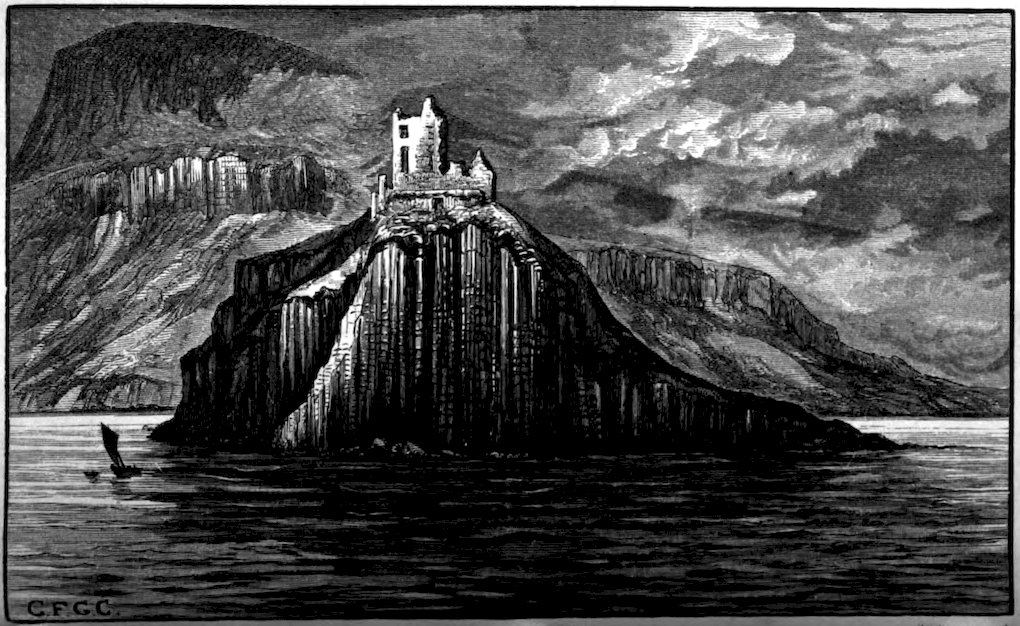
DUNTULM CASTLE. To face p. 129.
So it came to pass that the little fairy “Gannet” flapped her white wings one sunny afternoon, and bade us sail with her over the merry green waves to the opposite coast of Grieshernish, one of the few sheltered nooks where the plantations have actually struggled up to treehood. Here we found our chief amusement in a wonderful music-room, wherein every conceivable variety of musical instrument had its appointed place. Besides piano and 129harmonium, flute and guitar, there was every variety of organ, from the finger-organ down to the most elaborate grinder, with such an array of puppets as would have made the fortune of an itinerant organist. Then there was every species of large mechanical instrument, from a common musical-box up to a large self-acting organ, which played all the favourite operas like a first-rate brass band. Another, something similar, called a Euterpean, gave us more solemn music. Others play reels and dance-music. Next come harp, violin, violoncello, bagpipes, trumpet, cornet-à-piston, reed-pipe—every musical instrument you can conceive down to a Jew’s-harp. For aught I know, sackbut, psaltery, and dulcimer, may have been stowed away in some recess of that wonderful room. It was a quaint fancy of one who had spent his best years on Indian plains, and who had devised this method of shutting out sight and sound of the wild storms and tempests that so often raved round his western home.
We returned to Uig in the evening so well pleased with the swift, lovely little yacht, that we determined to start at once for a cruise round the coast—a cruise so delightful, that I am utterly at a loss whether to award the palm of real enjoyment to yachting in the Hebrides or camping in the Himalayas.
Each day we sailed just so far as might seem pleasant, gliding silently over the waters, rejoicing in the stillness of our noiseless progress; no jarring sound of wheels; no straining engines, or whirring steam; only the plash of wavelets when we anchored for the night in some quiet natural harbour, under the lee of some bluff headland, whence we could row close in shore among all the beautiful cliffs and caves, landing on the small islands to the astonishment of every species of sea-fowl, and of colonies of rabbits, which last proved a very welcome addition to our larder. One favourite anchorage was just below Duntulm Castle; in a clear, green bay, with a pleasant island on one side, where multitudes of large white-winged gannets make their home, and gather wonderingly round their namesake. They were sorely puzzled by our intrusion into this, their sanctum; and often, as we sat on the brink of the cliff where they had built their nests they would swoop past us again and again, flapping their great wings within a foot of us, with wild angry cries as if to drive us away again. If you ever anchor in this quiet bay, you 130must land alone, in the early morning, on this little island; and though the smooth grassy slope is drenched with heavy dew, clamber up to the top, and you will find yourself overlooking a precipitous rock face, down into the clearest green depths; only disturbed by the ripple where the top of some broken basalt pillar rises above the surface.
The old castle stands facing you on a great stack of clustering pillars. On either side, and in the background, lie smooth green slopes, crowned with another range of reddish basalt. The quiet mists are still sleeping in the valley, and above them towers a dark solid mass, which is the Quiraing. Then, as the first rosy flush touches the hill top, the dewy vapours float upward to greet the dawn, and the closed flowers open their cups, and all manner of happy winged insects awake to dance in the quivering sunlight. Everything around you is quiet and still. The only sound is that of
“... The murmuring surge,
That on th’ unnumbered idle pebbles chafes;”
for there is not a grain of sand within miles of you—only sharp shingly beach; so if you want to bathe, and love to paddle about on the soft, yellow sand, you must go to Kilmaloig Bay, or to Loch Staffin.
Now, if you turn and look out to sea, there lies the Long Island on the one hand, and on the other Loch Seaforth, and the wild hills of Torridon, in Rosshire. And much nearer you is the Island of Fladdahuan—Fladda of the Ocean, one of those early Missionaries who here built his cell and chapel. The island, as seen from here, is like some great sea monster. For one large isle lies like a great solid head, while a long line of smaller rocky knobs suggests the dorsal fin of some huge creature swimming across the Minch.
The ruins of Fladda’s chapel were long extant. On the altar lay a round, bluish stone, which was always moist. Should fishermen be detained here by contrary winds, they first walked sunwise round the chapel, then poured water on this stone Hindu-fashion, and shortly a favourable breeze would certainly spring up. It likewise cured diseases, and the people swore solemn oaths by it.
There was a similar stone in the Isle of Arran, of a green colour, and the size of a goose’s egg. It was known as the stone 131of St Molingus, and was kept in custody of the Clan Chattan; and the popular belief was, not only that it cured diseases, but that, if it were thrown at an advancing foe, they would be terror-stricken, and retreat. It was also a solemn thing to swear by. I was strongly reminded of this Hebridean custom when, wandering in the solemn shade of the great forests of Ceylon, in the immediate neighbourhood of the ancient ruined city of Pollonarua, we were shown, in the court of a village temple, a flat slab of stone, esteemed so sacred, that the most hardened villain dares not perjure himself when compelled to swear by it. He must lay thereon a firnam—a coin less than a farthing in value—and then take the required oath.
In these our Western Isles there were many varieties of stones esteemed sacred—more especially such as were perforated; also various crystals. One such magic crystal, the size of a hen’s egg, is still preserved at Ardvoirlich in Perthshire, and it is believed that water into which it has been dipped cures cattle of distemper. Even now, graziers come long distances to procure this precious medicine—sometimes more than forty miles—and are greatly disgusted at finding that the far-famed “Clach Dearg” has been deposited at the bank with other family treasures, and can by no means be borrowed. Whence and when it came to Ardvoirlich is unknown, no tradition existing on the subject; but its silver setting is supposed to be of Oriental work. The person coming for this curative water had to draw it himself, and carry it into the house, where the crystal was dipped in it, and it was then carried off in bottles. But it was necessary that it should enter no other house by the way; so should the bearer visit his friends on his homeward route he most leave the bottle outside.[26] A stone of the same sort is the hereditary property of the Robertsons of Struan. It is called 132the Clach-na-Bratach; or, Stone of the Standard, having been found sticking to the flag-staff of the chief of Clan Donnachaidt on the morning of the Battle of Bannockburn. Since then the clan has never gone forth to battle without carrying this stone, whose varying colour boded good or evil. On the eve of Sheriff-muir, a large flaw was detected in it, and all present knew that evil would befall them on the morrow. No medical stores an needed by those within hail of this precious charm, inasmuch as the water in which it has been thrice dipped, will assuredly cure all manner of diseases of men, of cattle, and of horses.
The Druids specially prided themselves on the miracles wrought by their own magic crystal balls, or adder’s stones as they were called. Of these the most precious were ring-shaped, and supposed to be the crystallized saliva of serpents by them thrown into the air, and caught by watchful wizards ere it reached the earth. We hear of precisely the same superstition at the present day in the East. A recent traveller tells us that in the ruins of Tadmor, he met an old hag who described to him how she had just been watching two serpents thus form a magic crystal, which she had found; she showed him a pearl, which she firmly believed to be made of serpent’s slime.
These magic balls have been found in divers parts of Europe, generally in sepulchral urns. Twenty such crystals were discovered in an alabaster urn at Rome, and one at Tornay, in the tomb of Chilperic, King of France, who died A.D. 480. In his tomb were also found the bones of the horse on which he was supposed to appear in the presence of Odin. Two of these rock crystals were recently found in a tumulus near Dundee. On some of these precious Druidical stones were graven figures of serpents coiled up. In later ages others were adorned with Christian symbols; perhaps a silver rim bearing the names of Gabriel, Michael, Uriel, Raphael; and a silver cross on the top. According as the crystal was clear or clouded, the destiny of the future was explained. Spenser in his “Fairie Queen” tells of such a stone. He says:—
“Such was the glassy globe that Merlin made,
And gave unto King Ryence for his gard,
That never foes his kingdom might invade;
But he, it knew at home, before he hard
Tydings thereof, and so them still debarred.”
133It is said that the central gem in the brooch[27] which the Bruce was compelled to leave a prey to Macdougall of Lorn, because he could not extricate it from the grasp of his dead foe, is one of these magic crystals, and that beneath it is a hollow space to contain some other amulet. It certainly proved a trusty talisman, in that hour of direst need, when its master was so sorely beset by overpowering odds, and we may well believe that it was a hard necessity which forced him to abandon it.
A list of many such magical stones was compiled two hundred years ago by a Welshman curious in these matters—in which he mentions upwards of fifty varieties in common use among his countrymen and the Highlanders; some round, some oval, some hollow rings, some of crystal, some of glass, but all alike were used medicinally, and more especially on May-day at the feast of Beltane, they were dipped in water, with which the cattle were sprinkled to save them from the power of witches and elves.
A talisman of this sort belongs to the family of Græme of Inchbrakie—a bead from the necklace of a luckless old wife who, about the year 1715, was burnt at Crieff on a charge of witchcraft. The Laird of Mongie, her foster son, was the only person who dared to plead for her life, and in gratitude for his goodwill she bit this bead from off her necklace (her hands being bound), and spat it towards him, promising that so long as he and his descendants preserved that charm, the house of Inchbrakie should never lack a direct heir, or lose their patrimony. In the same breath she cursed the neighbouring house of Mongie, declaring that till the nearest river ran dry, it should have no lineal descendant. Moreover, she bitterly bewailed the loss of another magic stone, which she believed would have effectually preserved her from all the malice of her foes.
The Campbells of Glenlyon and the Bairds of Auchmeddan have similar magical curing-stones; that of the latter is a silver-mounted black flint, bearing date 1174, and is now the property of the Frasers of Findrack. But the most remarkable of all these is one belonging to the Lockharts of Lee, in Lanarkshire, known as the Lee penny, and immortalized by Sir Walter Scott as “The Talisman.” It is a small red pebble, heart-shaped, set in a coin of Edward IV. It was supposed to have been an 134amulet brought from the Holy Land in the time of the Crusades. Like the crystal balls, it was to be drawn round any vessel containing water, and dipped thrice therein. That water, henceforward, had power to cure all manner of diseases. Not only did the people bring their cattle from all parts of the kingdom to drink of this medicine, but, when a terrible plague ravaged Newcastle in the time of Charles I., the townsfolk were allowed to borrow the penny, on giving a bond of 6,000l. for its sure restoration. So precious did they find it, that they desired to be allowed to forfeit the money, and keep the groat with the charmed stone, a proposition to which the Laird of Lee would by no means accede. Afterwards, when the Synod busied itself with the suppression of all manner of superstitions, it found no fault in the Lee penny, inasmuch as it undoubtedly possessed curative gifts, which were wrought without the use of any unlawful charms or sorceries. So to this day, cattle-owners come from afar to ask for bottles of water in which the magic penny has been dipped; (a ceremony which, I believe, is generally performed by some member of the family, to secure the safety of the talisman) and these precious bottles are hung up, all ready for emergencies in many a cow-byre in Lanarkshire.
Amongst the magical stones which to this day command the reverence of the people, I may mention a crystal ball in the family of Willox, hereditary cattle-curers at Nairn. Whatever mischief befalls the cattle in the neighbourhood, the remedy is sure. Willox is summoned, and presently arrives, bringing some curious old harness, which is said to be a witch-bridle; also this round crystal, which is placed in a bucket of water, and is certain to reflect the face of whatever bad neighbour has bewitched the cattle by his evil eye. A few years ago, this crystal was produced in Court in Inverness, its owner having got into trouble, during a year of grievous murrain, when people of all sorts, even highly educated, were shown to have come from all parts of the country to consult its owner. Amongst others who had applied to him for the good of their cattle, was a highly respected English lady, well known in the neighbourhood for her general acuteness and common sense. The crystal having been duly inspected was restored to its master who will doubtless exhibit it to all curious in such matters. In many of the Isles an old flint arrow-head is still thought most valuable for 135the same purpose. The people call them elf-shot and believe them to have been hurled at the cattle by evil fairies!
St. Fladda’s blue stone has led us into a long digression. To return to our post on the rock. The sleepers in the yacht are now all astir, and as you look down on the picturesque sailors in their blue jerseys and long scarlet knitted caps, all so busy unfurling the white sails, you know that there is a chance of a move before long. So you hail the wee boat, that has been fetching the morning supply of milk, and practice your rowing, till a tune on the pipes announces that breakfast is ready.
Then you will sail slowly along the coast, starting early while the sun is still in the east, lighting up the cliffs, and you must keep as near the shore as you dare, or you will lose all beauty. And the slower the better, for every fresh turn shows you new, strange caves, or masses of tall basaltic columns, sometimes cut across, as if by some giant knife, showing a slanting section of all the pillars, but more frequently overlaid with rich soil and green pasture, and above it all the ever-changing masses of the Quiraing tower like grim fortifications. From this side you can hardly believe that they are not great masses of grey masonry; so utterly different are they from the red or yellow basalt which composes the greater part of the sea-coast for the next few miles. A very wonderful formation it is, with those regular hexagonal columns, that look as though carefully chiselled according to geometrical laws. Learned men tell us that it was once a red-hot fluid, which, in cooling, crystallised in this manner, and experiments are shown with chemical mud, which being allowed to cool, gradually assumes the same forms, and give us miniatures of Staffa, and all this coast.
Very beautiful are these caves and rock masses, where, on the slightest provocation, the green waves rush in with such sudden swell, and dash right over them in wild white spray. This it is which makes the danger of lingering too long in the pleasant nooks and caves, sheltered from the open sea. You may chance to find, as you row confidingly out of your little haven, that a sudden breeze has sprung up, fretting the white sea-horses, and making them chafe and toss so angrily that your tiny boat may find it hard work enough to return to the mother-craft.
Such risk as this I encountered at an exquisite spot in Kilmaluoc Bay, so called in memory of St. Moluoc, whose lowly cell 136once stood on the green shores of this quiet little harbour. As we rowed close in shore we discovered a place where the rock face was riven, and showed light within. There was just space for the little boat to float in, passing under a low archway in the rock, when suddenly we emerged into an open space so lovely that any scenepainter who could produce such a transformation-scene for next Christmas would assuredly make his fortune. We had floated into a circular basin, whose rocky sides opened into several long deep caves, beneath whose shadow the water grew dark and mysterious, of the deepest emerald tint, while beneath us lay a clear, transparent aquamarine, through whose depths we could plainly see our own shadow rest on the yellow sand far below. Tiny jelly-fish, edged with lilac spots and long white fringe, floated beside the delicate pink sea-weeds in the clear green water; and as we looked upward to the deep blue sky, we saw that the rock was crowned with heather and ferns and tall grasses, changing from golden cream to silvery, as the light wind rippled over them, though no breath of air stirred near us. And from every cleft in the rock grew tall spikes of crimson foxgloves (the folk’s glove of olden days), and clusters of blue bells, and all manner of flowers, blue and white and yellow.
There was not a sound to be heard save the swish-swish of the dancing wavelets just outside. So perfectly did the rocks round us deaden all noise, that when the yacht fired her little gun as a signal for the immediate return of the boat, I still sat quietly painting, utterly unconscious of any change, and it was not till we had floated clear of the arch by which we had entered, and caught sight of the open sea, that we realized anything being amiss. A heavy ground swell had set in, and the yacht, not daring to lie where she was, was running before the wind, seeking a safer harbour, and leaving us either to go ashore, or pull after her, as might seem best to Norman Campbell, the trusty yachtsman, who was rowing me. He being a strong muscular young fellow, and a thorough seaman, chose the latter, and a stiff two miles he had before we came up with the yacht, which had found a place where she could venture to lie to and wait for us.
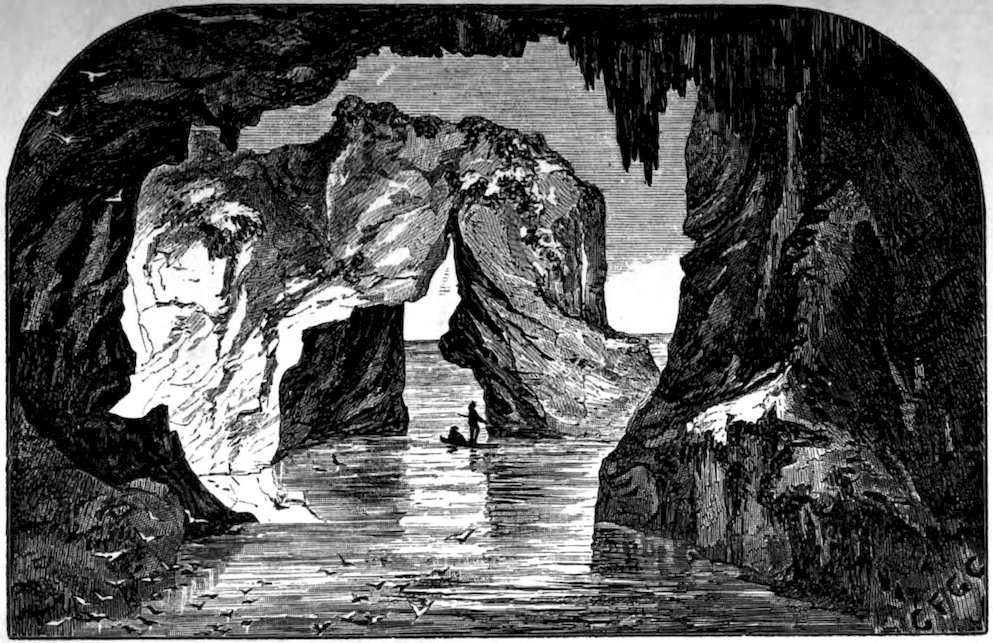
SCHLOCH MADDIE CAVE, SKYE. To face p. 136.
I fear Martin the skipper expended some forcible Gaelic on my escort, but these Skye lads are used to gales of all sorts, and are not easily ruffled; and when we anchored for the night in beautiful Loch Staffin Bay, the most harmonious peace reigned 137among the crew, and the hours were enlivened as usual by wild Gaelic songs and choruses, or by stories of smuggling, in which the fathers and kinsfolk of the narrators generally took a prominent part. For to have been a professional smuggler is considered just as respectable as any other method of earning a livelihood. Then we were told many wild legends of the coast, and can bear witness how marvellously these gain in interest when the narrator can point out the very spot where the weird spirit appeared, or the miserable victim perished. And if divers caves will claim the same history, well, you must try and believe it to be true of each in turn.
Take such a wild, wailing pibroch as McCrimmon’s Lament, which whether played on the pipes in the early morning at a Highland funeral, with an accompaniment of wild cries from the sea-birds, or else sung by a chorus of plaintive voices, while the little waves splash against the ship, and the wind moans in fitful gusts, is about the most wildly mournful of all Gaelic Laments. It becomes positively thrilling when the singers pause, and pointing to a dark yawning cavern, extending far under the land, tell you that there, into that very cave, the bold piper marched, followed by his faithful dog; that he ventured bravely on, resolved to explore the dark passage, and that about a mile inland, where a deep hole is supposed to open into the subterranean passage, his watchful friends still heard his heart-stirring music, when suddenly it ceased, and soon an awful struggle was heard, and McCrimmon’s cry of anguish arose, telling of some awful creature that was grappling with him in the darkness. Then the cries ceased. Soon afterwards the miserable dog, which had been flayed alive, and had lost even the power of howling, crept to the mouth of the cave to die. And since that day no rash adventurer has been so foolhardy as to tempt the like fate. I must confess to having been painfully désillusionnée on hearing the same story told of the cave at Keill, in the Mull of Cantyre, and of half a dozen different spots on the west coast. Nevertheless you sometimes hear deliciously “creepy” stories, such legends as may well inspire the fishers with an ill-defined, mysterious dread of certain spots. Such is the tale that tells how on the shore of one of those dim isles (either Barra or Tyree, I forget which) is the cave where Ossian and his heroes sit spellbound in a long deep sleep.
138One day a bold fisher discovered this very cave, and entering, beheld this grand band of sleepers. Near them hung the magic horn, at the third blast of which, blown by mortal lips, he knew they would all awaken. He was a brave man, who scorned all fear, so he put his lips to the horn and blew such a shrill call that the cormorants and the sea-mews came shrieking forth from the dark recesses of the cavern. A strange indescribable dread took possession of him; nevertheless he repeated the blast more loudly than before, and every rock seemed to echo back the sound with strange spirit-laughter. Ere its tones had died away, he who seemed chief of the heroes, and was in truth Ossian himself, stirred in his sleep, and half awoke. He bade the rash intruder cease, and turning on his side, slept once more. The terrified fisher fled, and straightway sailed from the magic isle, and from that day to this no man has ever been able to find the cave where the heroes of Ossian sleep.
Although the influence of the clergy and of the schoolmaster is rapidly rooting out all traces of grey superstition, it still has some hold in the more remote corners of the land; and the non-existence of kelpies and brownies and urisks is by no means so clearly proven, that a midnight encounter with them would be a thing to risk lightly. The kelpies, as you know, are water-spirits which are always malignant, and delight in causing the floods to rise rapidly and overwhelm the unwary traveller, while their mocking cry rings in his drowning ears; that the kelpies are “bye-ordinar” irreverent is evident from the legend of the old kirkyard at Conan—a green dreamy hillock, where autumn leaves float silently down from overshadowing boughs, a russet covering for the grey mossy stones. Round the foot of the hillock rushes the dark-brown river, once the favourite haunt of a kelpie. One wild night when the storm was raging and the river was in spate, the song of the kelpie was heard above the voice of the winds and waters, and those who heard it trembled, for they knew that the kelpie sought human blood. Then in hot haste a messenger rode up whose errand would brook no delay, and he urged his horse to swim the stream, but the steed shrank back affrighted, and strong hands drew back the foolhardy rider, and vowed he should not thus court destruction. So they locked him up within the old chapel, and all night long the wild tempest battled and raved. When the morning light dawned they went 139to release him, that he might go on his way in safety, but they found him dead, for the kelpie had entered the sanctuary, and had not even dreaded the holy water, but seizing its victim, had held his face therein till he was drowned. So you see it was a very irreverent kelpie indeed!
All over Scotland there are legends of these water-goblins. Thus at Choill-a-chroin, “the wood of lamentation,” near Loch Vennachar, a beautiful pony once came playfully up to a merry group of children, and suffered several of the little innocents to clamber on its back. Then suddenly wheeling round, it galloped off with them, and plunged into the cold waves, and the mothers wept and wailed greatly for the little ones who might never return. This was the form in which it constantly appeared to the Shetlanders. Sometimes a kelpie would assume the form of a splendid black horse, which would appear at the market in charge of some strange uncanny-looking fellow. So fine a beast was sure to find a purchaser, and for a while all would go well, only its strange love for water was noticed, and it would prance and plunge with delight when a bucketful was thrown over it. At last, on some distant expedition, it was sure to be overtaken by a wild storm, and when the ford had swelled to a raging torrent, and its master was compelled to trust to the good swimming of its steed, he discovered too late that he was bestriding the awful kelpie, who would plunge with him into the depths of the foaming waters, never to rise again. We heard many a strange story, too, of those kindly brownies, who used to do so many good turns to lighten the drudgery of farm or household work, and take their payment in bowls of cream and other delicacies, just as the glashans did in the Isle of Man, or the pwaccas in Wales, or as the gins still do in the far-away deserts of Scinde. In every case the description of the creature is the same; he is like a dwarfish human being, covered with long hair, and breathing heavily; having moreover large eyes and great strength, which he willingly employs for any mortal to whom he takes a fancy, working for him hard and faithfully year after year; but nevertheless apt to be sullen and morose, and on slight provocation, to depart for ever.
It is curious to find this good brownie doing just the same work in the far east as in these western isles; but this is only one of many kindred superstitions. The people of Scinde have from 140time immemorial been able to draw the milk from their neighbour’s cows, just as well as any Highland wife; their witches divine from sheep-bones, and take the form of tigers and other beasts, just as easily as a Scottish witch transforms herself into a hare or a stag. They tell wild stories of rakshas or demons of the mountains, and of bhoots or ghosts of the dead; but those who have tried to collect these legends say that there, as in our own Highlands, this becomes year by year more difficult, for the old folk are dying off, and the rising generation do not care to speak of these things, so that the old stories are fast disappearing from the east as well as from the west.
Still there are tribes such as those of the Belooch hills who would be as unwilling as a Highlander to seek out the haunts of a gin, and who tell of magic caves through which the fairies sometimes admit mortals to their subterranean Paradise, where they all dance unceasingly from one year’s end to another beneath trees laden with fruit, which is all made of gold and precious stones.
Precisely the same story is told of a rock in the forest of Glenavon, in Strathspey, and of a green hillock in Strathglass, known as the Beatha Og, or Young Birch, on account of the trees that overhang the fairy knoll; as also of many another place both in Scotland and in Wales. In every case some wanderers are beguiled into a lighted cavern, where they find friends whom they had long since buried dancing with the fairies in merry rounds and reels. Invariably some of the party taste of the fairies’ good cheer, and forthwith join the dance, and the mere prudent abstainers are forced to go home without them. Should they return to seek for their lost friends, they hear only the waving of the birches and the rippling of the stream, till perhaps seven years later, on some mystic night such as Midsummer’s Eve or New Year, the cavern once more becomes visible, the dancers are as merry as before, and any mortal who has the courage to enter, armed either with a cross of the rowan-tree or a dagger of cold steel, such as all fairies abhor, may rescue his companions from their enchantment, though to them it will seem as if the seven years of hard dancing had been but as one night’s merrymaking.
These fairies are always clad in green, and are particularly vicious against anyone daring to wear their colour, more especially 141on Friday, when they have double power, and when a genuine Highlander will shrink from any allusion to them as being “no canny,” or at least to be made with marked respect, as to beings invisibly present, and who need to be conciliated. This is what Scott referred to when he told how
“The Highlander, whose red claymore,
The battle turned on Maida’s shore,
Will on a Friday morn look pale
If asked to tell a fairy tale.
He fears the vengeful Elfin King,
Who leaves that day his grassy ring;
Invisible to human ken,
He walks among the sons of men.”
Why these creatures should be called Daoine Shi’ich, or men of peace, I cannot imagine, unless from that curious feeling which prompts so many races to propitiate evil demons who might harm them, rather than serve the good who will do them no ill. For these men of peace are spiteful creatures, jealous of human joys, and especially anxious to abstract new-born babies (which they have only power to do before baptism), leaving in their place their own cross-grained brats, with voracious appetites, always “skirling” for meat. These are known as changelings; hence the use of that name to describe a puny unsatisfactory child.
In South Uist there is the valley of Glenslyte, haunted by spirits called “Great Men,” and formerly whoever entered this valley must perforce repeat certain sentences, committing themselves to the guidance of these beings: for should this ceremony be omitted, they believed they would inevitably go mad, which (like the Chinese custom of beating gongs during an eclipse to save the sun from extinction) involved a risk too great to run.
Till very lately there existed all manner of curious methods for consulting oracles, such as sewing up a man in a cow’s hide, and leaving him for the night on some hill-top, that he might be made a spirit-medium. The commonest sort of divination was practised by means of the shoulder-blades of beasts slain in sacrifice, just as at the present day the shepherds of Niolo in Corsica foretell coming events by the left shoulder-blade of a goat or sheep. And it is a matter of firm belief, now that charms exist whereby a man can spoil his neighbour’s barm (yeast), and a woman can prevent cows from yielding their milk, and, by some 142invisible agency, appropriate it for her own use. She can also by evil arts take away the milk from nursing mothers. As to the superstitions connected with death, they are still numberless. There are warnings in the flight of birds, the howling of dogs, sights and sounds mysterious and undefined; and which are readily construed into good or evil. A hare or a fox crossing the path is held to be so sure a token of evil, that educated men have been known to turn back, declaring they could not travel after receiving such a sign of danger; and even in civilized Morayshire and Perthshire I know one or two stalwart men who have no hesitation in believing that certain poor harmless old wives are witches, who have the power to take the form of those animals. One old wife lately told us that there had been some talk lately about poaching hares. “But deed she kent it was na auld Geordie, nor young Geordie either. For ye see, we’re afeared o’ th’ hares. Ou gin ye wad kill a hare ye dinna ken wha ye wad be killin’! Deed the half of them’s witches!” This enlightened old lady was adorned with Prince Alfred’s photograph, set as a brooch, in which she had invested capital to the amount of one penny! Nor is it very long since one of the gamekeepers (in whom our Sassenach friends are wont to behold their ideal of a stalwart Highlander) wounded a hare, and triumphantly told us that the next time he saw a certain innocent old wife at the kirk her arm was in a sling, so surely there remained no room for doubt as to her dealing in witchcraft! As to the stories concerning second sight (which answers to the clairvoyance of the south), they are legion, and implicitly believed to this day. There is scarcely a village in which some one has not been favoured by ghostly apparitions from dead or living. Either the person seen has already died, or else his doom is swiftly approaching.
That the faith in fairy lore is not by any means extinct was proved to us only the other day when a lady in Banffshire asked an old woman how she came to know of a rather unusual cure for some illness. She replied that she had learnt that and many other things from a wife who had been spirited away by the fairies, and had lived with them underground for eight years. But having said thus much, the old lady relapsed into a mysterious silence, and though much questioned as to the manners and customs of the fairies and their guest, she refused to say another word, for 143“Ou! it wasna safe to be speaking o’ the gude folk; maybe they would be spiriting her awa’ next!”
One favourite story is of a lovely woman, clad in green robes and green mantle, carrying in her arms a young goblin child. She enters a cottage and sits down by the hearth, fanning the embers to warm her numbed hands; then by mere action of the will she draws the heart’s blood of one of the children to feed her young goblin, and sure enough when morning breaks one of the little ones is dying.
The belief in all these weird and wondrous legends has been greatly kept up by the old custom of story-telling round the peat fires in the long winter evenings; but the ban of the Church now lies so heavily on all that tends to encourage superstition, that the popular lore seems in danger of dying out, or of being preserved only by such collectors as Campbell of Islay, whose Gaelic mother tongue and local sympathies enable him to “draw” every blue bonnet and white mutch that cross his path. It is a matter of considerable difficulty nowadays to induce any of the younger generation to relate these old stories, partly from the dread of being laughed at by unbelievers, who look on their legends as being “just blethers,” and still more because their solemn unimaginative teachers try to put down all such foolish tales as utterly unworthy of wise and Christian men, though at the same time the schoolmasters labour hard to store the minds of their pupils with an amount of Greek and Latin mythology that would astonish most village schools in England. They little think what exceeding interest there may be for learned men in this old Gaelic mythology which is so fast dying out, and of its many strange analogies to the most ancient legends of the far east.
There is scarcely one of these fables which has not its twin brother in those of far-distant lands, and in these days when the common origin of the Aryan races is a question so widely discussed, when we are told how strongly Gaelic is akin to Sanskrit, and that Ceylon and St. Kilda were alike peopled by a Celtic race which started from a central point in Asia, it is strange indeed to find that both these islands have from time immemorial believed the same curious traditions, somewhat altered of course in their oral transmission from generation to generation, but virtually the same.
144In the Hebrides you will hear how John, the fisher’s son, leaped his horse over a strait to an island in the Sound of Barra, where he slew a dragon with nine heads and rescued a beautiful princess.
Precisely such a nine-headed dragon as is minutely described in these Gaelic legends is found sculptured on temples in Cambodia and India, where the old serpent worship prevailed in the most remote ages. One magnificent temple in Cambodia sacred to a seven-headed serpent still remains perfect, though probably more than a thousand years old. Many more were doubtless destroyed by the Aryan conquerors, who waged war on the Nagas, or serpent-worshippers, and who continually describe their sun-god as strangling the serpents of night.
A parallel to the history of how the Hindu god, Indra, slew the water monster, Vitra (as told in the Rig Veda), has been pointed out in the Gaelic legend of how Fraoch killed a great serpent on the Ross of Mull.
The wildest tales of Ossian are found again in the old Persian poets; and a thousand other instances might be adduced.
Nor is it alone in legends such as these that we mark strange coincidences. Such fragments of the old Gaelic and Irish mythologies as still exist, bear the strongest resemblance to those both of India and Ceylon, a similarity all the more striking as existing between gods whom neither the Aryans of east nor west would have worshipped in the days of their pure early faith. For just as the most recent interpretations of the ancient Vedas prove that in the original worship of Brahma all use of idols was strictly prohibited; so in these isles, and wherever the Druids held sway, no images of any sort were tolerated, and there seems no doubt that at one time the Celts adored only one supreme God. After a while, however (probably after they had mingled with the aboriginal races), they seem to have adopted a creed as complex, and fallen into idolatry as gross, as that of their degenerate Hindu brethren.
It would seem as if our forefathers had even devised images of their gods, for we find Gildas, a very old author, writing of “the monstrous idols of our country, almost surpassing in number the very devilish devices of Egypt, of the which we behold as yet some, both within and without the walls of their forsaken temples now mouldering away, with deformed portraitures, and terrible countenances, after the accustomed manner.” But what 145is most singular of all is that the very names of these gods and their histories are said to have a striking affinity to those now worshipped in the East. To begin with, it is stated that the most sacred name in the Celtic mythology—the holy and mystic title of the Almighty, was that very word Om or Aum (He who is), a title so sacred that a Brahmin will not utter it aloud, while the Buddhist repeats it a thousand times in his daily worship, and sculptures it on all holy places. Then Chreeshna was actually an old Irish name for the sun-god whom the Hindus adore as Krishna. The cruel goddess, Kali, too, had a namesake in Ireland, and the site where her altars stood is yet known as Leeba Caili, or the bed of Caili. As further examples I may quote
Saman answering to Samanaut.
Can „ „ Chandra.
Neith „ „ Nate.
Bud „ „ Buda.
Buda is the name under which, even to this day, the people of Ceylon reverence the planet Mercury. It is curious to observe how, with them, the system of Bali, or planetary worship, still reigns, in defiance of all prohibitions of Buddhist or Christian masters; just as in these British isles the same homage was rendered to all the host of heaven for many centuries after Christianity had held its partial sway. We may notice, by the way, that in the division of the week the people of Ceylon have not only retained the seven days, but have actually named each after the very same planet to which it had been dedicated in the western world.
Another very striking analogy has been shown to exist between the symbols considered sacred in the planetary worship of Ceylon and those which we find sculptured on the ancient memorial stones of pagan Britain; stones which we believe to be relics of a faith almost identical with the Bali. Not only do we find elaborately carved crescents, discs, double wheels, linked together by a royal sceptre, such as might naturally suggest themselves as emblems of the sun, but we also find fish, geese, serpents, and highly idealized elephants and camels,[28] 146the three last-named being creatures which would scarcely have presented themselves to the minds of our ancestors had not some tradition of these unknown forms reached them from the eastern world. It is, therefore, very remarkable to find that the elephant, the crescent, and the goose are sacred symbols in common use on the sculptured stones of Ceylon. Also, but more rarely, I have observed the fish among the emblematic paintings in the temples. It is also remarkable that another emblem found on these stones, namely the figure of a man cutting the throat of a bull, should be identical with the symbol of the Persian sun-god, Mithras.
The extreme reverence of both peoples for fire and water is another link between them. The Aryans of the east, we know, held Agni, the fire-god, in such honour that he must needs be present at all their religious ceremonies; indeed the presence of fire as a divine witness was often their sole marriage service. Of the veneration of our own ancestors for the same fire-god and for the water-spirits, we still find strange traces, though devotion to fire and water has, in general, superseded that of the simple elements. In Goojerat the presence of fire and water is still held essential at all marriage ceremonies. A square is formed in the centre of which a fire is kindled. At each corner of the square nine water vessels are piled, one above the other. The bride and bridegroom, standing by the fire, offer sacrifice; and after divers ceremonies they walk four times, sunwise, round the sacred element, and conclude by worshipping the polar star. Sometimes the marriage is by proxy. The warrior husband sends his sword as his representative. In this case the bride and her steel spouse make the circle round the fire twice only and she repeats that ceremony twice when she has actually reached the dwelling of her lord.
As to the divers forms of trial by ordeal, both with fire and water, we know that they were just as highly esteemed in the east as in Britain. There, as well as here, the accused was made to walk between burning ploughshares, or plunge his arm into boiling water.[29] There, too, the witches of old were thrown into ponds, either to prove their innocence by sinking, or their guilt by floating; in which case they were summarily 147despatched, and thus, whether innocent or guilty, society was rid of them.
The minute similarity between these various forms of trial among our own ancestors and the Hindus is very singular. In Britain the supposed culprit was made to plunge his arm into a cauldron of boiling water and thence pick out a pebble, after which the arm was tied up in linen and woollen cloths, and judicial watchers were set over the man to see that these were not unbound for three days. If at the end of that time no scar was found on the arm the accused was held innocent. The custom in India is, or was, that a man accused of a capital crime who chose this method of trial should, for several days previous to the ordeal, have his arm tied up in wax cloth to prevent any deceit. This cloth was sealed up with the great State seal, and in British districts was sealed with the Company’s arms, while a European guard watched over the prisoner. On a given day a piece of money was dropped into a cauldron of boiling oil, the prisoner’s arm was unsealed and washed, after which, while the Brahmins offered prayers for a just decision, he plunged his arm into the cauldron and picked out the coin. Then the wax cloth was again sealed up, and the prisoner guarded for several days. When the bandages were finally removed the condition of his arm revealed his guilt or his innocence.
In the Rajmahal hills the form of trial still in use is to drop a ring into a pot of boiling water, mixed with boiling oil and cow-dung; the accused must plunge in his hand and draw out the ring. Should he be innocent his hand will not be burnt, but if guilty the pot will boil up and scald him. The ancient Cingalese had precisely the same custom.
The well-known Indian ordeal of making the persons accused of any crime attempt to swallow a mouthful of consecrated rice, which would certainly choke the guilty person, also had its counterpart among our forefathers in the ceremony known as the Corsned, or morsel of execration. A piece of barley bread and a bit of cheese were laid on the altar, and any priest accused of crime was compelled to try and swallow a portion in presence of his brethren and the congregation, all of whom prayed fervently that if he were guilty the archangel might seal his throat that he might be unable to do so. The custom may have existed long before a Christian priesthood 148adopted it as their peculiar test, for such it was generally, in later days considered; yet there is no doubt that the laity also were subjected to the same ordeal, as when Godwin, Earl of Kent, being accused of the murder of King Edward’s brother, appealed to it, with fatal result.
As to the ordeal of walking blindfold over red-hot ploughshares, we turn from the page of English history to that of Hindu mythology to find descriptions identical in all points. In the former we read how Queen Emma, mother of Edward the Confessor, being accused of unfaithfulness to her lord, triumphantly vindicated her innocence by walking barefoot and blindfold, unhurt, over red-hot ploughshares. Precisely similar was the test by which the Hindu king Rama made his beautiful wife, Seeta, prove her purity, when rescued from the hands of Ravana, the king of Lanka. One strongly-marked similarity between our common ancestors was that firm faith in the immortality of the soul, which undoubtedly found a place in the Celtic creed, and which Cæsar mentions as one of the tenets of the Druids. In the tumuli of Britain, as well as those of India, skeletons of animals have been found as if placed ready for food; swords also that would have been precious to the living, were buried with the dead, that they might not be left defenceless on awakening. The old Gauls buried written statements of accounts and claims of debts, that they might be carried on in the next life; and so well was this creed acted upon that men would lend one another money, trusting to repayment when they met in some new phase of existence. I doubt whether modern Hindus would be equally trusting, or the Pharisees of olden days either, if indeed, as Josephus affirms, they too held this doctrine. Certainly we may infer that they did so from the readiness with which they suggested that Christ was merely a new incarnation of Elijah, Jeremiah, or one of the prophets, and also from that strange question respecting the man who was born blind, “Did this man sin or his parents, that he was born blind?”
A quaint trace of the old Druidical teaching of transmigration is the notion not yet wholly extinct, that when a man is slowly lingering away in consumption, the fairies are on the watch to steal his soul that they may therewith give life to some other body. To prevent this, old wives are often anxious to cut 149the nails of the sufferer, that they may tie up the parings in a bit of rag, and wave this precious charm thrice round his head, Deus Sol! Even to this day we are sometimes startled to find persons believing, not only that certain animals are witches in disguise, but that the dead have returned to earth in these strange forms. I have heard such stories whispered with bated breath, in our own hills, and the same traditions are common in the wilds of Cornwall, where we heard a gamekeeper positively refusing to fire at a fox that haunted a certain house, and came constantly baying under the windows. He was not deterred by any fox-hunting scruples, but by the conviction that the animal was really “poor Mr. Frank,” whose spirit returned to an earthly form sometimes in the form of a hare, sometimes as a black cock, but most often as a fox. No Brahmin could have been more decided in his views.
Another curious link between the highlanders of India and of Scotland is the custom now in use among the Khonds (a tribe in Madras), of gathering together their forces in time of need, by sending round an “arrow of summons,” which was identical with that “fiery cross” so well known to our ancestors, who, in times of danger used to slay a goat, and making a cross of wood, seared its extremities in fire, and extinguished them in the blood of the sacrifice. This was in constant use so late as 1745, and was known as the cross of gathering, or as Craan Tarigh, the cross of shame, because shame, fire, and blood awaited any man from the age of sixteen to sixty who failed to come to the help of his clan. It is said that in the isle of Shetland the arrow was the sign retained till very late days, just as it still is among these primitive Khonds, a race in which each family still bears the name of some animal, which is its Totem, or representative animal, so that the tribes are known as bears, owls, monkeys, or deer. They have neither temples nor images, because they cannot believe that a temple made with hands can be the favoured abode of God, so they prefer to worship him on hoar rocks amid the silence of the eternal hills, beside still fountains and by flowing rivers, or in the deep shade of sacred groves where the sound of axe is never heard. They reverence forests, rivers, and mountains, sun, moon, and planets, as types of the Creator’s power, very much as our own ancestors did in bygone ages.
150Even in simple questions of food, of clean and unclean meats, many curious coincidences occur in the customs of brown men and white.
Readers of Ossian and kindred Gaelic lore have sometimes been struck by the readiness with which mighty hunters of old feasted on the wild boars they had slain in the chase, as when Fingal and his son Ossian, and all the other heroes devoured the boar Scrymner. They note this fact in connection with the Scotch abhorrence of pork and pig’s flesh in all forms. It is, therefore, not without interest to notice that though the modern Hindus abhor the domestic pig almost as much as do the Mahommedans, they will feast on wild boar to any extent. Even high-class Brahmins will sometimes partake of this dainty, in remembrance of their sacred hog Baraha, who was an incarnation of Vishnu. Several learned men assert that in this land also the wild boar was once held sacred, and even in later times his effigy has been represented on the ancient British coinage.
It is curious that in Egypt also the Copts mark precisely the same distinction between the wild and tame pig, a prejudice which they are supposed to have retained from the remotest times; an inheritance doubtless from their Phœnician ancestors, who held pig in such abhorrence that they bequeathed the antipathy to all their race. It has been recorded even of the gluttonous Heliogabalus that he rigidly abstained from pork and bacon in every form, because of his Phœnician descent. As to these modern Egyptians, they will in no case rear pigs or taste the flesh of the tame animal, whereas that of the wild boar is considered a most desirable feast. One difference assigned is that the latter is almost entirely a vegetarian, whereas civilization has degraded the appetite of his tame brother. So hateful to the old Egyptians were the domestic swine, that should a man accidentally touch one with the hem of his garment he was rendered unclean. Yet at the full moon pigs were freely sacrificed to Bacchus, and the people feasted on their flesh. Each family slew a pig at their own door, while those who were too poor to afford one made an image of dough, which they offered instead. Doubtless the Jewish sin of eating pig was hence associated with idolatry, as we generally find that eating swine’s flesh and broth made 151thereof is associated with burning incense to strange gods, and on forbidden altars. This, too, would account for the intense abhorrence with which the Jew regarded poor piggy—far in excess of that merited by other things equally prohibited by the Levitical law. Thus in the account given in Maccabees of the persecution under Antiochus, we find that they submitted to every species of degradation, to the defilement of their altars, and the dedication of their temples at Jerusalem and Mount Gerizim, to Jupiter. They even submitted to walk in idolatrous processions at the licentious feast of Bacchus, carrying ivy like the rest of his worshippers, but when it came to the question of swallowing swine’s flesh, there they stood firm, from the least to the greatest, and we hear even of a mother standing by to see her sons murdered piecemeal with indescribable tortures rather than purchase life and wealth by this concession. One by one her seven sons were thus slain, while she encouraged then to endure to the end, and finally died with them.
Another interesting point of resemblance between the ancient Celt and the modern Hindu is the religious abhorrence in which the latter holds poultry, as being unclean, so that he will on no account taste it or touch it. The poultry market of India is, I believe, entirely supplied by Mahommedans, or by men too degraded to have any caste. The Celts we know were forbidden to eat a hen, a goose or a hare. The repugnance to the latter is not yet wholly extinct in some districts.
As to the goose it seems to have been held too sacred for food in all parts of the world. Here our forefathers sculptured it among the sacred emblems on their holy stones, together with elephants and horses. We find it, in the same company, carved on the most ancient stones of Ceylon. In Rajpootana and other parts of Hindostan it is specially dedicated to Hari, the Hindoo god of battle, who is also worshipped under the symbol of a sword. In Burmah the goose still floats on the royal standard as the national emblem. We find it receiving solemn worship in ancient Egypt, as also in Scandinavia, where it was sacred to Odin, and where the goose festival has been christianized to the honour of St. Martin instead of St. Michael as in this land. As to the old Romans, we all remember how the sacred geese of Juno saved the capitol, but though they doubtless gained great popularity thereby, their sanctity was a much older story. 152Even to this day the modern Italians fatten geese which are rarely, if ever, brought to table.
The very name of the bird has altered strangely little in its westward journey. Thus in the ancient Pali, it is Hanza; in Egyptian, Hanza; with the Romans, Anser. In Malay, Gangsa; in old German, Ganza; in English, Gander.
Equally wide-spread seems to have been the reverence for certain fish. It was affirmed by an ancient writer[30] that the people of Caledonia never ate fish. Certainly it is remarkable that in all Ossian’s songs of the chase, when he skims over flood and field, rivers and seas, no allusion whatever is made to the catching of fish. Yet we find these rudely carved on many holy stones, together with the mirror, which the sea-faring folk to this day declare to be always seen in the hands of mermaids. Their description of these fishy maidens and mermen answer, precisely to the old accounts of the fish god and goddess, Dagon and Derceto, which were worshipped by the Syrians and Phœnicians, who, for their sakes, would eat no fish. The temple of Derceto, at Ascalon, was on the edge of a deep lake full of fish, which, like those in the tanks in India, were held sacred, and religiously fed. Venus also protected the finny tribes, and on certain old Phœnician coins, fish appear in connection with the crescent moon. The priests of ancient Egypt were also forbidden to eat fish; and to this day certain tribes exist in Caufiristan and the remote Hindu-Koosh mountain ranges, who worship a god whom they call Dagon, and who religiously abstain from eating fish.
The ancient prohibition of the use of poultry, seems no wise to have interfered with its use as a most suitable propitiatory offering in all cases of need. In Britain as in India and Ceylon, a red cock seems from time immemorial to have possessed peculiar virtue, and to have retained such hold on the popular mind, that Christian teachers have found it well-nigh as difficult to check this sacrifice in the one land as in the other, even among their most hopeful converts. Among the Santhals, and various other tribes both of Northern and Southern India, it is customary in every case of dangerous illness, to sacrifice a cock beside the patient, to whatever demon is supposed to have caused his malady. A live cock is also nailed to the funeral 153pyre. And in our own Western Highlands, and in some of the border counties, it was till very recently quite a common ceremony to kill a cock beside the sick man, and either bury it beneath the floor of the cottage, or at least let its blood trickle into a hole in the floor. To this was probably added some of the patient’s hair, and some parings of his nails! This is generally supposed to be a trace of the old Roman worship of Esculapius, but I fancy that some older tradition still, must have taught the same practice to the Hindus. I believe this custom to be by no means extinct in Britain.
Sir James Simpson mentions several instances within his own knowledge in which this strange remedy has been resorted to, for the cure of fits, epilepsy, and insanity. In one case a cock was killed and deposited in a hole in the kitchen floor, on the spot where a child had fallen down in a fit of convulsions; and a Ross-shire lassie told him that the neighbours were urging her mother to try the like cure for the same cause! He also speaks of the sacrifice of cats, moles, and other animals. Thus, at Nigg, in Ross-shire, a lad being attacked with epilepsy, his friends laid on his head a plate, and above it, held a living mole, by the tail. They then cut off its head, and allowed the blood to drip on to the plate. Three moles were thus killed in succession, but without effect.
This offering a life for a life is the common Hindu practice in cases of sickness. Various domestic animals are brought into the room from a belief that they will absorb the noxious principles of disease, and act as disinfectants. When they are supposed to have done their work, they are thrown from the window. Even in the case of so enlightened a Hindoo as the young Rajah of Kolapore, whose recent death at Florence was a cause of so much regret, the presence of four European physicians would have been considered by no means sufficient had these traditional Hindu prescriptions been neglected; and as the Florentine authorities might justly have objected had these wretched animals been cast from the windows into the street, they were thrown down into an open courtyard!
Even the modern Jews seem to have borrowed this ceremony of cock sacrifices from their pagan neighbours. We know that the Levitical law makes no provision for any such thing. Yet the Rabbis are not only as strict as modern Hindus, or ancient 154Celts, in excluding all poultry from the holy city, but like them command that on the eve of the Great Day of Atonement the head of each house shall take a cock, and, having tied its legs together, shall swing it thrice sunwise round his own head, uttering a certain formula of words. The women of the household are not present, but they may in like manner deal with a hen, which they afterwards eat together. The Jews, however, are said to object to the use of a red cock, and, if possible, procure one that is pure white.
It seems that in old times the custom of sacrificing a cock by night at places where four roads meet was quite as common in India as in Britain, where this is one of the dark deeds most frequently laid to the charge of witches. Thus in 1324 we find a lady of high estate, Dame Alice Kyteler, accused by the Bishop of Ossory of having sacrificed nine red cocks and nine peacocks’ eyes to an evil spirit, at a place near Kilkenny where four roads meet, and having then boiled part of the flesh and other villanous compounds in the skull of a felon. About the same time we hear how the Cardinal of Gaæta, afterwards Pope Boniface VIII., was accused of similar communication with demons by drawing round him a circle, and therein sacrificing a cock. We know that drawing the circle was another ceremony common to sun-worshippers. Thus in Ceylon, where, as we before observed, the old worship of the planets has been incorporated with the purer faith of Buddha, the most solemn festival of the year is that of the midsummer full moon, when priests and people march in procession to the great river near Kandy, and, at the moment of sunrise, draw a magic circle on its waters with a golden sword, and, filling their water vessels within this mystic line, carry this sacred water to the temple of Buddha, where it is religiously treasured till the following year. Thus too the Arabs draw a mystic circle round any property which they are obliged to leave unprotected; and they, as we know, sacrificed cocks to the sun, long before the days of Mahomet. We also obviously trace sun-worship in such a sacrifice as one described at Llandegla in Denbighshire, where an epileptic patient was directed to go three times sunwise round the Holy Well, where he was to wash himself, and cast in an offering. He was then to carry a cock thrice sunwise round the well, and thrice round the church, and was himself to lie all night beneath the Communion Table, with 155his head resting on the Bible,—a curious blending of “the Table of the Lord” with the service of devils. A very common ceremony in the Highlands was for a man who believed himself to be in danger from fairies to draw a circle round himself with a branch of oak, a certain charm.
Speaking of the kindred superstitions of divers races, have you ever noticed how curiously those having reference to salt appear in many lands? For instance, the common Scotch belief that spilling salt at table will be the sure precursor of a quarrel finds a strange illustration in some of the oldest Italian pictures of the Last Supper, in which Judas is represented as having just overturned the salt. We all know how, among the Old Scotch and Irish, the place of the salt at table divided the honoured guests from those of lower rank, so that to sit below it involved a very humble position. Here, as in the East, eating salt together seems always to have symbolized a certain sacredness in hospitality, akin to the Arabic respect thereto—something of the obligation to fidelity implied in such scriptural expressions as “being salted with the salt of the palace,” or “having made a covenant of salt.” Hence, too, the Persian description of a traitor as one faithless to salt.
We know that not only the Jews, but also the Greeks, Romans, and other heathen nations, offered salt with every sacrifice. Whether this was done in Britain I do not know; but of the Jewish belief that a sprinkling of salt was “good for the land,” we find a trace in the old Scotch and Irish custom, that when the sowers went forth to sow the fields, the wife of the farmer first of all sprinkled a handful of salt, to ensure a good crop. Also when a man was appointed to any new position, women threw handfuls of salt after him to bring him luck.
As to our common custom of throwing salt over the left shoulder, to avert the quarrel which is sure to follow the upsetting thereof, it is said to be simply an offering to some devil, who was supposed to be the master of salt, and angered by its waste; unless, therefore, this atonement were made to him, he would stir up strife among the guests. On the other hand, the Egyptian women sprinkle salt on their floor in the name of God, in order to prevent evil spirits from entering their dwelling.
156Another custom which seems equally wide-spread is that of saying “God bless you!” to a person who sneezes, a custom which we generally trace back to the days of the plague, when this was held to to one of its first symptoms. But it seems that even the Siamese always wish long life to one who sneezes, because they believe that an angel holds the book wherein is written the life of every mortal, and as he turns to the page which contains the history of any particular person, that person infallibly sneezes, and so his friends wish him good luck in the reading of his fate. And likewise one of the old Greek poets speaks of an evil-minded person who refuses to say “Jupiter save him” when one of the company sneezes. Thus, too, in the “Odyssey,” when Penelope has just heard a rumour that gives her hope of the return of Ulysses, Telemachus sneezes violently, which she at once hails as a happy omen.
The old Jewish Rabbins, too, have curious traditions on this matter. They say that before the days of the patriarchs all men died of sneezing. They never sneezed but once, and straightway gave up the ghost. Jacob was the first man who died from sheer old age. So after his day, it was found that to utter words of blessing during the act of sneezing would avert all danger. And so it came to pass that every ruler ordained this custom in his land; and this, says the Talmud, is the reason why the same practice is found in all nations, even among the savage tribes of Africa. Thus when the King of Sennaar sneezes, all his courtiers turn aside and slap their thighs. But a sneeze from the King of Monomotapa is a very serious matter indeed, for all his courtiers must salute him in so loud a voice, that all who wait in the ante-chamber may hear and join in the acclamation, while those in the further rooms join chorus, till the very guards and sentinels take it up, and all passers-by in the streets, hearing the well-known salutation, must utter it aloud, so that the wave of benediction runs along every street of the city—and a pretty hubbub it creates.
But we have no need to go to savages for examples. The graceful “Eviva” or “Felicita,” of the Italians, and the sacred invocation of the Spaniards “Jesus!” will at once suggest themselves as implying some kindred notion—a greeting that shall avert some real evil from the person addressed. Hence the exclamation of a Spanish girl, when an English lady 157remarked that she had just had a violent sneezing fit, “Ah! Pobrecita!” poor little thing, “and I was not there to say Jesus! for you.”
In Egypt when a person sneezes, he exclaims, “Praise be to God!” and all who are present say, “God have mercy on you!” to which the sneezer replies, “God guide us all!” But should he yawn, he must cover his mouth with his hand, and say, “I seek refuge with God from Satan the accursed.” But no one wishes him luck, for they believe that the devil is ever watching to leap into a gaping mouth!
But all these curious coincidences between the customs as well as the traditions of the Eastern and Western world have tempted us to wander on and on from fairy tales to mythology, till we have drifted off into a vague world of superstitions that have carried us far away from the old Gaelic songs and legends, with which our sailors whiled away the lovely summer evening.
It was late before the little yacht was ready for the night, and her crew turned into their tiny cabin “for’ard.” The evening lights were so beautiful that we lingered on deck, hour after hour, scarcely knowing how to turn away from so much loveliness. There had been a golden sunset behind the Quiraing, which still stood out in rich purple against a lemon-coloured sky—while the calm sea reflected both. Each changing tint of the opal had rested by turns on all the islands and the hills of Torridon. Now the clear moonlight gleamed on the water, and silvered the soft white mists that half shrouded Ben Etra, even lending poetry to the little inn, with its group of thatched byres and offices.
But the other side of the bay lay in its own deep shadow, and it was not till we saw it in the early morning that we realized how beautiful it was. Green banks sloped gently down to the water’s edge, crowned with perpendicular stacks of basalt, in three distinct masses. It is from these basaltic columns that Loch Staffin, like Staffa, takes its name. Nearer us, a great headland of rock and greenest grass rose abruptly, half enclosing a shore of the smoothest yellow sand; while every mark and cleft in the rock lay clearly mirrored below. The scene was irresistibly suggestive of bathing; so, being by this time fully competent to pass as “able-bodied sea-women,” we rowed ourselves ashore, and vowed that no bathing-ground had ever been 158so charming; and that here must be our head-quarters fur the present.
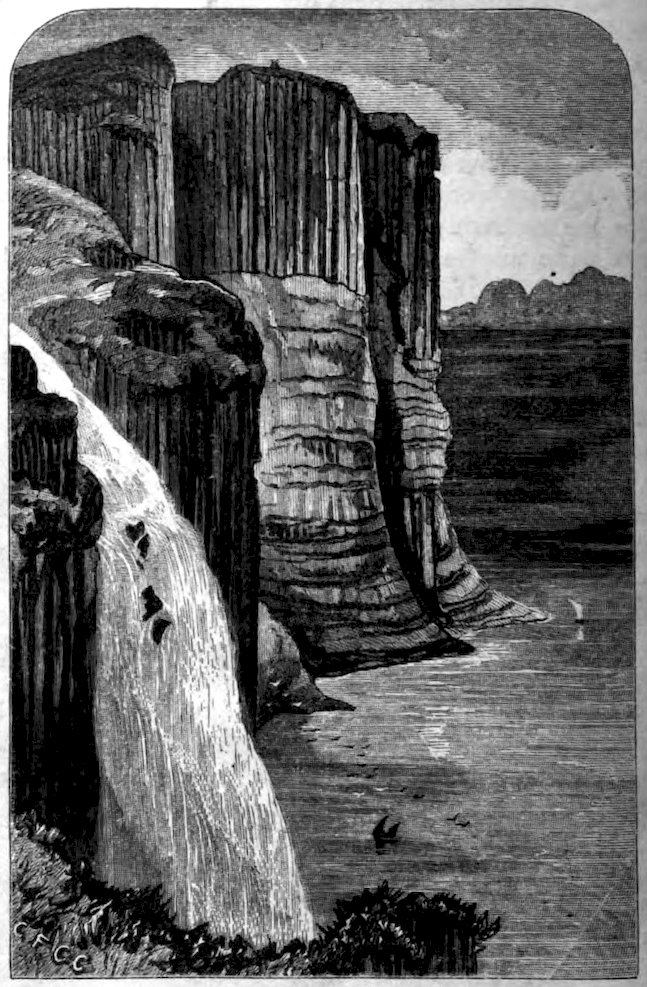
KILT ROCK.
Later in the day we had a lovely row all along the coast to a wonderful headland known as the Kilt Rock, by reason of the many-coloured strata of which it is composed. From the green sea upwards, layers of oolitic limestone, oolitic freestone and shale, alternating with lines of grass, lie horizontally; while rising vertically from these is a great mass of red, 159brown, and yellow columnar basalt: so huge are these pillars, that they quite dwarf those of Staffa; indeed Macculloch, whose sea-side geology was generally accurate, calculates them at five or six times the magnitude of those in the wonderful little Isle. On the top of this cliff[31] lies an extensive loch (Loch Mialt is the sound, though as to Gaelic spelling, he is rash who ventures to attempt it!) a loch with reedy shores, haunted by innumerable water-fowl. Hence the waters fall into the sea below, in flashing spray—a clear fall of 300 feet.
As we rowed slowly along, in the warm bright sun, so warm indeed that the men’s faces and arms, tough sailors though they were, were all blistered with the heat, and looked up to the cliffs above, and down into the waters beneath, with such an intensity of delight, as became almost oppressive, there was something overwhelming in the feeling of the amazing strength and immutability of those dry, scorching rock walls, contrasted with the perfect stillness of the exquisite green water, through the clear depths of which we peered down into the marine forest, whence trees and shrubs of every variety of form and colour stretched their branches upward 160to the light. There were giant brown sea-wares of many forms, some waving like graceful palms; others tossing great arms aloft, like the patriarchs of this untrodden jungle. Some have thick stems, and broad fleshy leaves of the richest golden brown, every leaf ten or twelve feet long. Some are smooth and leathery, and others all plaited, and fringed, and folded, and twisted, and crimped, as if the laundry-maids of the sea had no other work to do but just to get them up. Then we passed over others with large fan-like leaves; some that look like bunches of long pink or green ribbon; and countless varieties of delicate pink, and lilac, and olive sea-flowers and sea-weeds, like floating lace-work, woven in some fairy loom—more brilliant in this temperate sea, than either in tropics, or colder regions.
And in all this beautiful, luxuriant vegetation, myriads of dainty sea creatures make their home. Every lace-like weed seems beaded with black pearls, which are the smallest mussels you ever saw. You cannot lift up the tiniest plant but you will find on it a score of living things, whose delicacy of structure arrests your eye, even without the help of that best of companions, a small magnifying-glass.
As to the wonders of the invisible life of the sea, as shown by a good microscope—the almost invisible weeds, which give food and beautiful homes to millions of our fellow-creatures, and the endless varieties which float in every drop of water—that is a field of enjoyment quite by itself. Only, be sure that next time you get the chance you look at some common oyster-spat through a good glass, for I think that (except perhaps the purple bunches of grapes, which are only dust from the blossoms of the marsh mallow), no lifeless thing can be more beautiful. But the most careless eye can scarcely look down into a sea whose depths teem with such exuberance of life, animal and vegetable, without noticing something of the beauty that nestles under every leaf, lodges under each root, hides in every crevice: thousands of creatures, each of wonderful organism, building their curious nests of sand and glutinous matter, floating on the warm surface of the water, or drifting lazily hither and hither in the gentle current.
After passing the Kilt Rock, we came on what seemed to me still more curious geological freaks. There were patches of many-coloured rock; but in particular, just above the sea-level was a 161long layer of pale grey oolite, wherein at regular intervals were imbedded great round boulders, like huge black cannon-balls. We landed at Lon Fern, a region of black volcanic-looking rocks, some standing apart like quaint figures. One statue of John Knox in a black gown was so unmistakeable, that we pointed to it simultaneously.
This bay is like one vast aquarium. I never before saw so many living creatures in so small a space. Such multitudes of sea-anemones of every colour, and tiny star-fish, and little silvery eels, and shoals of fish no bigger than minnows. And then the countless varieties of crabs! Poor little half-naked hermits; dwellers in other folk’s houses; and braver little creatures who are ready to fight life’s battle for themselves, though they are so delicate as to be almost transparent, and their tender claws could scarcely nip the tiniest sea-anemone. Sometimes a great big fellow (a parten, as we northerners call him), would swim up from his rock home under the sea-weeds, and peer at us with his curious eyes, and then sink down again, faster than he rose, to his hiding-place in the fairy garden, among corallines and sea-weeds of every hue, crimson and gold and bronze—and lustrous metallic greens and purples. Besides these, there were innumerable jelly-fish, from the tiniest atoms of orange, or red-currant jelly, to the great giants who would overflow the largest jelly mould that ever was made. And such beauties as they are, with their delicate rings and stars of lilac, and the fringe of long sensitive fingers floating in graceful festoons.
The longer we looked, the more convinced we were, that, in spite of Kingsley, we had really discovered St. Brandan’s Fairy Isle for ourselves. There it lay before us, just as he describes it, “reflected double in the still, broad, silver sea.” That wonderful water world, where the water-babies, and all other little water-creatures, play hide and seek in the great water-forests. There, just as he tells us, was the Isle, “full of pillars, and its roots full of caves; and its pillars of black basalt, with ribbons of many-coloured sandstone, all curtained and draped with sea-weeds, the rocks covered with ten thousand sea-anemones of all beautiful colours and patterns, just like the gayest flower-bed. And here and there the soft white sand where the water-babies sleep every night, taking no heed of the little flounders which wriggle about in the sand, or of the crabs 162which lie buried under it, and only peep out with the tips of their eyes.”
Vainly we hunted and peered into every bright shallow pool for one glimpse of those most enchanting fairies who rule in this watery world—Mrs. Doasyouwouldbedoneby, and Mrs. Bedonebyasyoudid. For the sun overhead was scorchingly hot; and the glare from the water much the same; and the thought of sea ices, made of seacow’s cream, positively made our mouths water. But alas! our blind eyes had not been opened to discern their presence, so we were forced to turn inland, to a shady, quiet, happy nook among the silent grey rocks, with their beautiful ferns and grasses, and wild thyme and blue bells—and here we enjoyed ourselves and our luncheon as we could only do on such a day and in such a scene.
After awhile, my companions went off to call at a large farm, near which are some remains of the old Fort of Dun Deirg, so-called in memory of Dargo, the Druid, so the people say. I first inspected the rough sheiling—half natural boulders of rock, half loose stones—where the salmon fishers live; then idly, for lack of better occupation, wandered up a long grassy slope called Rhuna Brathrain, the Brother’s Hill, or as some say, Rhu-na-Bratan, the salmon’s headland, from the fact that the beautiful silvery fish love to lie in the clear green water below, which accordingly yields the best fishing off the island. Suddenly, as I reached the summit, such a scene burst on my astonished sight as left me fairly breathless with delight. The grassy slope, as I might have guessed, ended in an abrupt precipice, and right at my feet, far below, lay the clear calm sea, while from the shore one huge basalt needle stood up level with the hill whereon I stood. All along the coast lay sunny bays, each inclosed by great masses of columnar basalt, always crowned with rich green pasture. Bight before me towered the Storr, a mountain of the same character as the Quiraing, rising almost perpendicularly from the sea to a height of two thousand feet. Its smooth surface is clothed with rich green grass, while the rocky face which lies towards the sea is one mighty mass of broken crag. In every direction are heaped confused piles of rock, tossed about in forms gigantic and terrible, like the colossal ruins of some stupendous city, or the burial-place of some race of giants; a place utterly desolate and silent, where the spirits of the past 163may dwell undisturbed in unbroken solitude, and where the floating vapour-wreaths that cling to the weird rock figures, seem like the ghostly winding-sheets of an army of mighty dead.
The autumn of 1872 added a new element of eerieness to this unearthly scene, for here was found the body of a poor young Englishman, who, wearying all too quickly of the cares and sorrows of earth, selected this lonely spot as the most fitting to put an end to the young life that weighed on him so heavily. His body was carried to Portree for burial, for you know, in Scotland, even the rash dead, who has fallen by his own hand, is not excluded from a resting-place in the kirkyard, but is laid, with unbaptized infants, in the cold shade on the north side of the church. It seems, however, that such burials are liable to meet with opposition from the fishers, not from any special fear of the kirkyard being haunted but from a belief that for seven years to come the herrings will forsake the coast! In the present instance, whatever demur may have arisen, the funeral was suffered to proceed, and I have not heard whether the harvest of the sea has suffered in consequence.
High above this wilderness of grand pinnacles and tumbled crags, towers one gigantic rock-needle, poised as if in mid-air, on the summit of a great grass-covered crag. This is par excellence, the Storr. Its height is 165 feet, its circumference at the base 240 feet, and as it cuts clear against the sky, like some vast minaret pointing heavenward, it becomes a landmark whereby the fishers may guide their course for many a mile; the only wonder is that it should not ere this have been in some way utilized as a vast natural light-house, a guide for the night as well as the day.
Beyond this magnificently wild scene lie the blue Cuchullin and Sconser Hills, and the little Isle of Raasay, with the wild coast of Applecross, Torridon, and Gairloch, as a background, and as I looked down on the calm waters, a few brown sails of far-away herring boats were all that recalled human life and toil.
Along the horizon lay soft, silvery grey clouds, all reflected in the water, while from the clear blue overhead came such a chorus of laverocks as seemed to bring floating back pleasant memories of sweet home-voices singing joyous songs, 164to the blythesome “bird of the wilderness,” soaring on dewy wing through downy clouds. “Hail to thee, blythe spirit!” When the larks had vanished sunward, there followed a hush and stillness of unutterable delight—a “silence more musical than any song,” while the hot sunshine, pouring its flood of light on earth and sea, enfolded all nature in a dreamy, sleepy haze.
Looking forward to a delightful row homeward, I at last came down from my beautiful crag, losing sight of the sea for half an hour. To my dismay, on reaching the shore, and looking back in the direction whence we had come, I found that a sharp breeze had sprung up, and long heavy waves were beating violently on the rocks. It was clearly impossible for the boat to carry us in such a sea. The sailors, however, said that they could get her back to the yacht if we could go round by land.
It was a weary six miles walk, and we were pretty well tired already, but as there was no alternative, we just “set a stout heart to a stey brae,” and clambering once more to the top of the cliffs, found there a tolerably level road, and faced the dull grey mist as cheerily as we could. We could see nothing else on every side of us; and every sheep we met was so magnified by the fog as to be suggestive of some ghostly monster. At last we reached the desolate loch sacred to all manner of wild fowl, which looked up wonderingly as we passed. Still, on and on, we trudged through the soaking mist, with an ever-changing escort of curlews and plovers, circling round us with shrill angry whistle till we were well past the homes of their little ones. Then a fresh colony would be equally distressed by our approach, and took up the chorus of alarm.
At last we reached the little Inn at Stencholl, and here my companions determined to spend the night; but as we were not expected, and neither rooms nor supper were ready, I preferred going on board to my own little cabin, after getting good milk and scones, and a thorough good drying at Sandy M‘Leod’s blazing peat fire.
Have you ever, when thoroughly drenched, and in prospect of a long cold drive home, tried the experiment of pouring whisky into your boots? I cannot say I have ever tried it myself, but those who have, maintain that even if their supply is insufficient for both internal and external use, they consider the latter more important as a preventive against dangerous chills. 165Happily I had no need to try either on the present occasion as a very few minutes’ rowing saw me safe on board the Gannet.
Next morning broke calm and beautiful. I went ashore, and found my companions none the worse for our expedition, but not inclined to repeat it. So I returned to our favourite sandy bay, where a group of many-coloured rough Highland cattle were cooling themselves in the sea, and nibbling sea-weed which I believe in winter time, when other pasture is buried in snow, affords a livelihood to cattle and sheep, and sometimes even to deer. The sailors were filling our barrels at a spring of deliciously cool water, gurgling up from a cleft in the rock.
Beyond the blue sea lay the beautiful Ross-shire coast, every peak of the grand Torridon Hills standing out in clear relief. One in particular, a great cone of pure white crystalline quartz, glittered in the sunlight as though covered with fresh snow. From Gairloch to beyond Applecross that magnificent mountain range lay unclouded—a perfect sea of peaks and cones and great shoulders—a grand tract of treeless deer forest, in whose jealously guarded precincts lie hidden deep rocky corries, as wildly beautiful as, and practically far more inaccessible than, any Himalayan pass. Verily the cup of Tantalus was a perfect joke to the woes of an artist dwelling in a land of deer-stalkers, daily looking with ever-increasing longing at the barrier of great brown hills which inclose the paradise, one rapid glance at which still haunts his dreams, but where he may not again dare to set foot, under penalty of instant expulsion by a whole army of vigilant foresters, backed by grim laws of trespass.
To the southern ear this use of the word forest always sounds a strange misnomer; and the raw Saxon who ventures to wonder at the absence of trees is apt to be rather startled at first by such a posing reply as “Trees! wha ever heard of trees in a forest?” Nevertheless, when for the satisfaction of our Sassenach friends, we refer them to their beloved Dr. Johnson, we find he defines forest as a word descriptive of “any untilled tract of ground.” You see he had been in the north country himself, and knew all about it. If lack of tillage be all that is required to constitute a forest, there is not much fear of those wild hills ever losing their rank as such.
In those deep corries lie unnumbered treasures for fern-lovers. The delicate parsley fern grows there in rich abundance; and 166there are sheltered nooks by the sea where the tall Osmunda Regalis flourishes undisturbed.
“Fair ferns and flowers, and chiefly that tall fern
So stately of the Queen Osmunda named.”
That wild coast still keeps legends of its early Christian days, and tells how just twelve hundred years ago, St. Maelruhba, who like Columba was descended from Niel of the Nine Hostages, King of Ireland, and like him, too, was a most zealous convert to the new faith, sailed over the sea from Bangor, and landing at Aber-crosen (the mouth of the Crosen), now known as Applecross, founded a church and monastery there, which received the name of Comaraich, the Sanctuary, and was acknowledged as a haven of refuge for criminals and debtors, a privilege which I believe it could claim to this day. On the little isle of Croulin, near Applecross, was Maelruhba’s oratory—and other memorials of his missionary wanderings remain in various parts of the country, where he is remembered as Malruba, Malrue, Mourie, or Maree. He was patron saint of the south-eastern half of Skye, the remainder of the isle being under the care of St. Columba. To him were dedicated the churches of Kilmoray in Brackadale, Kilmaree in Strath, and Aski-Malruby, commonly called Killashig. The parish of Kilarrow in Islay was also his, and though its church has wholly disappeared, a few carved slabs still mark the old kirkyard. In his honour beautiful Loch Maree is said to have changed its ancient name as an arm of Loch Ewe. The farm of Kinloch Ewe, at the head of the fresh-water Loch Maree, still retains the original name, though now some miles distant from its salt-water godmother; a fact which, taken in connection with the different levels of these lakes, seems to point to some very curious topographical change. One of the many islands on Loch Maree, commonly called Eilean Mowrie, or Malruba’s Isle, became a favourite retreat of the saint; and his chapel, burial-ground, and well, are still held by the people in such veneration that they resort thither to bathe, and drink, and hang up rags and other offerings on the bushes. It was formerly considered especially efficacious in curing insanity, and patients were taken there to bathe, and then rowed sunwise round the island, getting an occasional dip in the Loch as they went on. Malruba is said to have been slain near Conan Bridge, and his body was carried to 167his monastery at Aber-crosen, beside the sea, where a grey stone in a thicket of brambles marks his tomb.
Zealous as he was in teaching the people, he does not seem to have been altogether successful, for so late as the year 1656 we find the ecclesiastical authorities endeavouring to stop the annual sacrifice of bulls on the 25th of August to St. Mourie, “whoever he might be, saint or demon.” This recipient of dubious honour was, in fact, poor Malruba himself. The people also carried milk to the tops of the high mountains, and there poured it out upon the rocks as an oblation. The Presbytery was much troubled at the impossibility of checking these heathenish offerings, and found that not only at Applecross, but also at Loch Carron, Loch Broom, Kintail, and other places in this district, but more especially at Gairloch and Loch Mourie this demon had “his monuments and his remembrances.” The “sacrificeing of beests in ane heathenish manner” on the Eilean Mourie in Kinlochewe again troubled the Church in 1678, and “Mourie his poore ones, and Mourie his deviles” continued obstinately to hold their ground in these remote valleys. From these dreamy legends of the distant hills I was roused by the sound of footsteps, which in that silent spot was somewhat of a rarity. Looking up, I perceived that there was a gathering of the fisher folk, for from every side of the hills I could see groups of people approach, all making for this very spot, till two or three hundred had assembled; and I found that all the fisher lads were to start in the afternoon for the herring fishery on the east coast, and their sweethearts and wives, and old fathers and mothers, and little brothers and sisters, had all come down to see them off.