FROM THE CAPE TO CAIRO
Reading edition
[Frontispiece: I advanced with outstretched Hand (missing from book)]
From the Cape to Cairo
The First Traverse of Africa from South to North
BY EWART S. GROGAN AND ARTHUR H. SHARP
T. Nelson & Sons, Ltd.
copyright info
extra publisher info
TO THE MEMORY OF THE GREATEST AND MOST FAR-SEEING OF BRITISH IMPERIAL STATESMEN,
THE RT. HON. CECIL JOHN RHODES,
THIS VOLUME IS RESPECTFULLY DEDICATED BY EWART SCOTT GROGAN AND ARTHUR HENRY SHARP.
Government House, Buluwayo,
7th Sept., 1900.
My Dear Grogan,
You ask me to write you a short introduction for your book, but I am sorry to say that literary composition is not one of my gifts, my correspondence and replies being conducted by telegrams.
I must say I envy you, for you have done that which has been for centuries the ambition of every explorer, namely, to walk through Africa from South to North. The amusement of the whole thing is that a youth from Cambridge during his vacation should have succeeded in doing that which the ponderous explorers of the world have failed to accomplish. There is a distinct humour in the whole thing. It makes me the more certain that we shall complete the telegraph and railway, for surely I am not going to be beaten by the legs of a Cambridge undergraduate.
Your success the more confirms one's belief. The schemes described by Sir William Harcourt as "wild cat" you have proved are capable of being completed, even in that excellent gentleman's lifetime.
As to the commercial aspect, every one supposes that the railway is being built with the only object that a human being may be able to get in at Cairo and get out at Cape Town.
This is, of course, ridiculous. The object is to cut Africa through the centre, and the railway will pick up trade all along the route. The junctions to the East and West coasts, which will occur in the future, will be outlets for the traffic obtained along the route of the line as it passes through the centre of Africa. At any rate, up to Buluwayo, where I am now, it has been a payable undertaking, and I still think it will continue to be so as we advance into the far interior. We propose now to go on and cross the Zambesi just below the Victoria Falls. I should like to have the spray of the water over the carriages.
I can but finish by again congratulating you, and by saying that your success has given me great encouragement in the work that I have still to accomplish.
Yours, C. J. RHODES.
PREFACE TO NEW EDITION.
Since bringing out the first edition of this book, I have revisited the United States, Australasia, and Argentina in order that I might again compare the difficulties before us in Africa with the difficulties which these new countries have already overcome. I am now more than ever satisfied that its possibilities are infinitely great. Of the fertility and natural resources of the country I had no doubt. But two great stumbling-blocks loomed ahead: they were the prevalence of malaria and the difficulty of initial development owing to the dearth of navigable waterways. The epoch-making studies by Major Ross and other scientists of the influence of the mosquito on the distribution of malaria have shewn that we are within measurable distance of largely minimising its ravages, if not of completely removing it from the necessary risks of African life. A comparison of the death-rates in Calcutta, Hong-Kong, and other malarious regions with the present rates has also proved how immense is the influence of settlement on climate. As to the other obstacle, the question of access, I was amazed to find that in the United States the railways practically have absorbed all the carrying trade of the magnificent waterways, which intersect the whole country east of the Rockies. Naturally, these waterways were of immense assistance in the original opening up of the country, but now that the railways are constructed, they are of little importance.
I would also point out to those who still profess mistrust of the practical objects of railway construction in Africa, the object-lesson which the trans-American lines afford. They were pushed ahead of all settlement into the great unknown exactly as the Cape to Cairo line is being pushed ahead to-day. But there is this difference: in America they penetrated silent wastes tenanted by naught else than the irreconcilable Redskin, the prairie marmot, and the bison; while in Africa they pass through lands rich in Nature's products and teeming with peoples who do not recede before the white man's march.
Another point: when the main railway system of Africa, as sketched out by Mr. Rhodes, is complete, there will be no single point as remote from a port as are some of the districts in America which are to-day pouring out their food-stuffs along hundreds of miles of rail.
In the words of the old Greek, "History is Philosophy teaching by examples." The world writhes with the quickening life of change. The tide of our supreme ascendancy is on the ebb. Nations, like men, are subject to disease. Let us beware of fatty degeneration of the heart. Luxury is sweeping away the influences which formed our character. It is as though our climate has been changed from the bleak northern winds to the tropic's indolent ease. Yet we have still a chance. While we sleep, broad tracks have been cut for us by those whom we revile. Far and wide our outposts are awake, beckoning to the great army to sweep along the tracks. Let each man with means and muscles for the fray go forth at least to see what empire is. Clive, Hastings, Rhodes, a thousand lesser men whose tombs are known only to the forest breeze, have left us legacies of which we barely dream. Millions of miles of timber, metals, coal, lie waiting for the breath of life, "pegged out" for Britain's sons. In these our destiny lies. We live but once: let us be able, when the last summons comes, to say with the greatest of us all, "Tread me down. Pass on. I have done my work."
CONTENTS.
CHAP.
The Cape to Beira and the Sabi
The Pungwe and Gorongoza's Plain--Second Expedition
The Zambezi and Shiré Rivers
Chiperoni
British Central Africa and Lake Nyassa
Karonga to Kituta across the Tanganyika Plateau
The Chambesi
Tanganyika
The Rusisi Valley
Lake Kivu
The Volcanoes
Mushari and its Cannibals
The Rutchuru Valley and the Albert Edward Lake
Katwe to Toro
Toro to Mboga
Semliki Valley and Kavalli's Country
Albert Lake and Upper Nile to Wadelai
Wadelai to Kero
Kero to Abu-Kuka and back to Bohr
In Dinka-land
In Nuerland
The Sobat to Cairo
The Trans-Continental Railway
Native Questions
LIST OF ILLUSTRATIONS
I advanced with outstretched Hand (missing from book) . . . Frontispiece
It was a gruesome Sight
And I was compelled to stoop down and grope
One or more of the neighbouring Chiefs came to pay his Respects
On the Track of the Cannibals
Balegga waiting for Elephant
There were numbers of Dinkas fishing here
Map of the Route
FROM THE CAPE TO CAIRO.
CHAPTER I.
THE CAPE TO BEIRA AND THE SABI.
To describe the first stage of the route from the Cape to Cairo, that is to say, as far as the Zambesi, which I accomplished four years ago, would, if time be counted by progress, be reverting to the Middle Ages. The journey to Buluwayo, which meant four dismal days and three yet more dismal nights, in a most dismal train, whose engine occasionally went off on its own account to get a drink, and nine awful days and nine reckless nights in a Gladstone bag on wheels, labelled coach, can now be accomplished in, I believe, two and a half days in trains that rival in comfort the best efforts of our American cousins. When I think of those awful hundreds of miles through dreary wastes of sand and putrefying carcases, the seemingly impossible country that the Buluwayo road passed through, the water-courses, the hills, the waterless stages, and the final oasis, where one could buy a bottle of beer for 10s. 6d., and a cauliflower for 363., and that now men sit down to their fresh fish or pheasant for breakfast, where the old scramble daily took place for a portion of bully beef and rice; and when I think that the fish and pheasant epoch is already old history, then I know that the hand of a mighty wizard is on the country, and that yet one more name will go down to the coming ages which will loom big midst the giants that have built up an Empire such as the world has never seen. When I think, too, of my numerous friends in the country who have given their heave, some a great heave, some a little heave, yet a heave all together, and who toil on unaware of their own heroism, turning aside as a jest the vituperation of their countrymen; and when I think how I have seen the old Viking blood, long time frozen in Piccadilly and the clubs, burst forth in the old irresistible stream, then I know that it is good to be an Englishman, and a great pity fills me for those whose lives are cast in narrow ways, and who never realise the true significance of Civis Britannicus sum.
My first experience of Africa was gained in the second Matabele war, when Rhodesia was yet young. The railway had only reached Mafeking, and my experiences were not such as to make me desire a second visit. But the spirit of the veldt was upon me, and in comfortable England these trials sank into the misty oblivion of the past, and a short twelve months after I again started for those inhospitable shores.
However, I will not weary the reader with what he has had dinned into his ears for the last four years, by describing Rhodesia; nor will I dilate on how, at Lisbon, through a Bucellas-induced haze, I noticed that all the men had a patch in their trousers, all the women were ugly, all the food was dirty, and all the friendly-disposed were thieves, nor will I hurt the feelings of the Deutsch Ost Afrika Cie. by telling how badly managed their boats are; how they are perambulating beershops, disguised as liners; how conducive to sleep is a ten-strong brass band at five yards, seized with religious enthusiasm at 7 a.m. on Sunday morning--all these I will pass over, knowing that a Cicero redivivus alone could do justice to the theme.
Beyond this, suffice it to say, that on February 28th of the year of our Lord 1898, Arthur Henry Sharp and Ewart Scott Grogan, in company of sundry German officers and beer enthusiasts, took part in the usual D.O.A.'s Liner manoeuvre of violently charging a sandbank in the bay of Beira on a flood-tide, to the ear-smashing accompaniment of the German National Anthem. In the intervals of waiting to be floated, and finding out how many of our loads had been lost, we amused ourselves by catching sharks, which swarmed round the stern of the vessel. Beira, as every one knows, is mainly composed of galvanized iron, sun-baked sand, drinks, and Portuguese ruffians, and is inhabited by a mixed society of railway employés, excellent fellows, Ohio wags, and German Jews. The Government consists of a triumvirate composed of a "king," who also at odd times imports railways, the British Consul, and the Beira Post, and sundry minor Portuguese officials, who provide entertainment for the town, such as volley-firing down the main streets, dredging operations in the lagoon at the back of the town, bugle-blowing, etc., etc. The dredging operations and the subsequent depositing of the mud on the highways were undertaken, I believe, in a friendly spirit of rivalry as to the death-rate with Fontesvilla (a salubrious riverside resort about thirty miles inland); a consequent rise to thirty in one day established a record that, I believe, is still unbeaten. There was a Portuguese corvette in the bay, and I had the pleasure of dining on board; the doctor, a most charming specimen of the Portuguese gentleman (and a Portuguese gentleman is a gentleman), helped me to pass my things through the Custom House, and those who know Beira will understand what that means. At Beira I met many old friends, amongst them the ever-green Mr. Lawley, indefatigable as of yore, and was surprised to see the immense strides that the town had made in fourteen months. If it is not washed away some day, it should become second only in importance to Delagoa Bay. Before starting north, we determined to have a few months' shooting, and with this end in view took train to Umtali with the necessary kit. The new site of Umtali township is a more commanding position than the old one, and already a large number of fine buildings had been put up, but now that the temporary activity consequent on its being the railway terminus has passed away, I cannot foresee much future for the place, as the pick of the mines appear to be over the new Anglo-Portuguese boundary, and will be worked from Macequece.
We decided to try the Sabi, a river running parallel to, and south of, the Pungwe, having heard great accounts of the lions in that part; and with this end in view, hired a wagon, which after many days landed us and ours at Mtambara's Kraal on the Umvumvumvu, a nice stream running into the Udzi, which is a tributary of the Sabi. Mtambara was formerly a chief of considerable importance, but the advent of the white man has reduced him to the position of a mere figurehead; he is a phthisical old gentleman of no physique, decked out in a dirty patch of cloth and a bandolier of leather and white beads; he squats and takes snuff, takes snuff and squats, and had not yet joined the Blue Ribbon Army. There being no road to the Udzi, we had to send the wagon back and collect carriers for our loads. Two days' hard walking brought us to the edge of the high veldt, whence the path dived down the most fantastic limestone valley, between high cliffs thickly clothed with foliage, and topped by rows of square rock pillars, splashed with the warm tints of the moss and lichens that festooned their sides. At our feet lay the bush-clad plain of the Udzi, a carpet of green picked out with the occasional silver of the river itself, and in the hazy distance stretched an unbroken range of purple hills, backed by the silvery green and dull smoke-red of sunset. On the third day we camped on the Udzi, about six miles above its junction with the Sabi. The whole country is covered with low black scrub, and though there are many impala[#] and small buck, there are very few large antelopes, so after a few days' inspection we came to the conclusion that it was not good enough, and decided to return to Umtali and risk the climate of my old shooting grounds on the Pungwe.
[#] A small antelope (Æpyceros melampus).
Sharp went back by the road to pick up the loads and sick men at Mtambara's, while I followed up the Udzi for about twenty miles, and then struck across country to reach Umtali quickly in order to send out a wagon. After leaving the river-basin, I camped on a kopje about 1,000 ft. high, where I had one of the finest views it has ever been my fortune to see.
Beyond the valley lay range upon range of hills, stretching far as the eye could reach; fleecy clouds covered the sun, bursting with every conceivable shade, from delicate rose to deepest purple, backed by that wondrous green (or is it blue?) that so often in the tropics accompanies Phoebus to his rest; rarely one may see it at home in summer-time, as intangible as it is delicate, and, permeating the whole landscape, a sinuous mesh of molten red, a ghostly sea from which the peaks reared their purple silhouettes, until they faded into the uncertainty of lilac mists, like some billowy sea nestling to the bosom of the storm-cloud. From here I walked to Umtali, a distance of sixty miles, in nineteen hours, as I was anxious about the sick men at Mtambara's, and long will the ripple of the ensuing brandy-and-soda linger in my memory. After securing the services of a wagon, I had to lay up for a couple of days with fever and a bad foot, but turned out for a concert given as a house-warming by the latest hotel. It was a typical South African orgie, in a long, low, wooden room, plainly furnished with deal tables, packed to overflowing with the most cosmopolitan crowd imaginable, well-bred 'Varsity men rubbing shoulders with animal-faced Boers, leavened with Jews, parasites, bummers, nondescripts, and every type of civilized savage. Faces yellow with fever, faces coppered by the sun, faces roseate with drink, and faces scarred, keen, money-lustful, and stamped with every vice and some of the virtues; a substratum of bluff, business advertisement, pat-on-the-back-kick-you-when-you're-not-looking air permeated everything, and keen appreciation of both musical garbage and real talent.
Starting for Salisbury, where I wanted to look up some old friends, I was made the victim of one of those subtle little jests so much appreciated by many of the petty officials in South Africa, who are for ever reminding one of their importance. I turned up at three, the advertised time for the coach's departure, and, finding no mules or signs of activity, learned that (being an official case) three meant three Cape time, or four Umtali time. So I went back to my hotel, and again turning up at ten to four, found that the coach had left at a quarter to four without blowing the bugle, and knowing that there was one passenger short; this necessitated a nine-mile walk to old Umtali in the rain, which, after three days' fever, was very enjoyable. The company, a pleasant one, was somewhat marred by the presence of a fat Jew of the most revolting type; unkempt curly black hair, lobster-like, bloodshot eyes with the glazed expression peculiar to tipplers and stale fish, a vast nose pronouncedly Bacchanalian, the hues of which varied from yellow through green to livid purple, and lips that would shame any negro, purple as the extremity of the nose, a small, straggling moustache and a runaway chin, the whole plentifully smeared with an unpleasant exudation, kept perpetually simmering by his anxiety lest some one should steal a march on him, made a loathsome tout ensemble that is by no means rare in South Africa. The way that creature fought for food! Well! I have seen hyænas and negroes fighting for food, but never such hopelessly abandoned coarseness as he displayed at every meal on the road, and for no apparent reason, as there was plenty for all, and by general consent he had the monopoly of any dish that he touched.
Salisbury, which is quite the aristocratic resort of Rhodesia, had made very little progress during my eighteen months' absence, though there had been some activity in the mining districts. The business of ferreting out the murderers in the late rebellion was still proceeding, and I saw about thirty condemned negroes in the gaol, and more were daily added. I went to one of the sittings and saw so many gruesome relics, burnt pipes, charred bones, skulls, etc., that I did not repeat my visit. I was forcibly struck by the absolute justice meted out: the merest technicality of law or the faintest shade of doubt sufficing for acquittal. Many of the natives in custody thus escaped, although their guilt was certain and well known. My return journey to Umtali was enlivened by the company of one of the civic dignitaries of Salisbury, who was going to "give it hot to Rhodes," shake him up a bit, and generally put things straight. In one day I had the whole future policy of Rhodesia and all outstanding difficulties like labour, etc., disposed of as though they were the merest bagatelles. So struck was I with the masterly grasp of gigantic questions that I fell into a profound slumber, whereupon, realizing that after all I was but an ordinary mortal, and consequently possessed of but ordinary intelligence, he roused me, and in five minutes sketched out a plan that would make my intended trip north a certain success; this, with more personal advice on a score of points, lasted till Umtali, where we found so-called celebrations in full swing. These celebrations (or barmen's benefits, as they should more appropriately be called) are of common occurrence, and are invariably got up on any sort of excuse; they take the outward form of a few pieces of bunting, and result in every one but the licensed few finding themselves next morning considerably poorer, and in an abnormal demand for Seidlitz powders. Society at Umtali groups itself into two classes, those who have liquor and those who have not, and each class into three divisions: first, a small number who have killed lions and say very little about it; secondly, a large number of persons who have not killed lions, but tell you they have, and say much about it; and thirdly, a very large number who have not killed lions, but think it necessary to apologize for the fact by telling you that they have not lost any.
CHAPTER II.
THE PUNGWE AND GORONGOZA'S PLAIN.
"The bulky, good-natured lion, whose only means of defence are the natural ones of tooth and claw, has no chance against the jumping little rascal, who pops behind a bush and pokes a gun straight at the bigger brute's heart."--MARIE CORELLI.
Instead of following the Urema as on a previous trip, we marched up the Pungwe almost as far as Sarmento, an old Portuguese settlement, and then struck off north to a long lagoon that lies on the western extremity of Gorongoza's plain. Here we found enormous quantities of game, thousands of wildebeeste and zebra, and many impala, waterbuck, and hartebeeste. At night a hyæna came and woke us up by drinking the soapy water in our indiarubber bath, which was lying just outside our tent. We turned out and drove him away, but had no sooner climbed into our beds again than he returned and bolted with the bath, and, before we could make him drop it, had mauled it to such an extent that it was of no further use.
As after the first night we heard no lions, we decided to move across to the Urema. On the way we sighted three eland, but though Sharp and I chased them for about eight miles we were unsuccessful.
Towards the Urema the plain opens out to a great width and becomes very swampy, and as the water had just subsided, it was covered with short sweet grass. Here we saw between 40,000 and 50,000 head of game, mostly wildebeeste, which opened out to let us pass and then closed in again behind. It was a wonderful sight; vast moving masses of life, as far as the eye could reach. A fortnight later they had eaten up the grass, and most of them were scattered about the surrounding country. Some of the swamps were very bad, and we were finally compelled to camp in the middle far from any wood.
The next day we struck camp and marched up the Urema to a belt of trees which we could see in the distance. Several good streams, the most important being the Umkulumadzi, flow down from the mountains, and meandering across the plain, empty themselves into the Urema. Sharp and I went on ahead of our caravan, and keeping well to the south-west to avoid swamps, came on a nice herd of buffalo which we stalked. At our shots a few turned off into some long tufts of grass, while the main body went straight away. One, evidently sick, came edging towards us, and I gave him two barrels, Sharp doing likewise; I then gave him two more and dropped him. I kept my eye on where he lay as we advanced to get a shot at the others, who had again stood about 100 yards farther on, and he suddenly rose at thirty yards and charged hard, nose in air, foaming with blood, and looking very nasty. I put both barrels in his chest without the slightest effect, and then started for the river, doing level time and shouting to Sharp to do likewise; all the crocodiles in the universe seemed preferable to that incarnation of hell. But Sharp had not yet learnt his buffalo, and waited for him. I heard a shot, and stopped in time to see the beast stagger for a second with a broken jaw, then come on in irresistible frenzy; but still Sharp stood as though to receive a cavalry charge, crack rang out the rifle, and the great brute came pitching forward on to its nose, and rolled within three yards of Sharp's feet with a broken fetlock. It was a magnificent sight, and the odd chance in a hundred turned up. Now Sharp knows his buffalo, and is prepared to back himself, when one turns nasty, to do his hundred in 9-4/5 seconds.
Except an elephant, there is nothing harder to stop than a charging buffalo, as, when once he has made up his mind, he means business; there is no turning him, and if he misses he will round and come again and hunt a man down like a dog. Holding his head in the air as he does in practice, and not low down as in the picture-books, he gives no mark except the chest, which is rarely a dropping shot. Having hacked off his head (the buffalo's), we went in pursuit of our caravan, and found that Mahony had pitched camp in the most perfect spot imaginable. A strip of open park-like bush ran down from the mountains, cutting the vast Gorongoza plain into two portions, and abutting on the river, where it had spread into a small lagoon with banks 20 ft. high. Beyond lay another plain stretching away to the bush that lies at the foot of the ridge which runs north and south, and is the watershed of the Urema and the coast. In all directions from our camp we could see herds of game grazing. Flocks of fowl flighted up and down the watercourse, huge crocodiles leered evilly at us as they floated like logs on the oily water, broken only by the plomp-plomp of the numerous fish, and now and then the head of a mud-turtle rose like a ghost from below, without even a ripple, drew a long hissing breath, and as silently vanished. As there was lions' spoor by the water, we strolled out after tea and dropped a brace of zebra by the edge of the bush. After an eventful night, during which leopards coughed, lions roared, hyænas dashed into camp and bolted with my best waterbuck head, we all turned out early. Sharp went down the river, while Mahony and I went to our baits. The first had completely vanished, and the second had been dragged some three hundred yards under the shade of a palm-tree. Here we picked up the spoor of a big lion, who had evidently got our wind as we left camp. We followed for about a mile along the bush, when Mahony saw him watching us round the corner of an ant-hill. The lion, seeing that he was observed, doubled like a flash, and before Mahony could fire, had dashed into a small patch of thick jungle. We lost no time in following, and were carefully picking our way through the undergrowth, when I heard a deep grunt about twenty yards to my right, and saw him, tail straight in the air, vanishing through the bush. Mahony rushed along the jungle; while I made a desperate burst through the thorn into the open. I just caught a glimpse of the lion going through the scattered palms towards the open plain. When I reached the end of the palms, he was going hard about two hundred yards away. Using the double .500 magnum, I removed his tooth with the first barrel, and with the second pulled him up short with a shot in the hind leg. Mahony then arrived on the scene and gave him a .500, while I finished him off with two shots from the .303. He was a very old lion with his teeth much broken, but had a good mane, and measured as he lay from tip to tip 9 ft. 10-½ in.
As the moon was now full, I determined to sit up, and having killed a zebra close to two small palms, I built a screen of palm-leaves and awaited events. The first two nights nothing came but mosquitoes, and the third night two hunting dogs turned up, but I didn't fire for fear of disturbing some lions which I could hear in the distance. These dogs are very beautiful animals with long bushy tails. They hunt in large packs, and must destroy an immense quantity of game. Shortly after the dogs had vanished a lion came to the jungle which was about four hundred yards away, and apparently detecting my scent, in spite of the competition of the zebra, which was three days old, vented his disapproval in three stupendous roars. This is one of the few occasions on which I heard a lion really roar, though every night for months I have heard packs of them in all directions. The usual cry is a sort of vast sigh taken up by the chorus with a deep sob, sob, sob, or a curious rumbling noise. The true roar is indescribable. It is so deceptive as to distance, and seems to permeate the whole universe, thundering, rumbling, majestic. There is no music in the world so sweet. Let me recommend it to the Wagner school! Thousands of German devotees, backed by thousands of beers, could never approach the soul-stirring glory of one Felis leo at home. I then heard him going away to the north, rumbling to himself at intervals, and at 5 a.m. left my scherm[#] and started in pursuit, hoping to come up with him at daybreak in the plain. I could still hear his occasional rumblings, and, taking a line by the moon, made terrific pace. After leaving the ridge, I plunged into a dense bank of fog that lay on the plain, but still managed to keep my line, as the moon showed a lurid red and remained visible till sunrise. The lion had stopped his meditations for some time, and imperceptibly the light of day had eaten into the fog, when suddenly my gun-boy "Rhoda" gripped me by the arm, his teeth chattering like castanets, and said that he saw the lion in front. At the same instant I thought that I saw a body moving in the mist about seventy yards away, now looking like an elephant, now like a jackal. Then the mist swirled round, wrapping it in obscurity once more. I followed carefully, when suddenly an eddy in the fog disclosed a male lion thirty yards away, wandering along as if the whole world belonged to him. He rolled his head from side to side, swished his tail, poked his nose into every bunch of grass, then stopped and stood broadside on. I raised the .500, but found that I had forgotten to remove the bunch of cloth which served for a night sight, and, before this was remedied, the chance was gone. Again I followed and again he turned, when I dropped him with a high shoulder shot. As the grass was only 3 in. high and the lion not more than thirty yards distant, we lay flat and awaited the turn of events. He lashed out, tearing up the ground with his paws, then stood up and looked like going away. I fired again. This gave him my whereabouts. He swung round and began stalking towards me to investigate matters, so I snatched my .500 and knocked him over with one in the chest. We then retired to a more respectful distance. But he rose again, and once more I fired. Still he fought on, rolling about, rumbling, groaning, and making frantic efforts to rise, till I crept up close and administered a .303 forward shot in the stomach, which settled him. He died reluctantly even then. It is astonishing how difficult lions are to kill, if the first shot is not very well placed. I attribute it to the fact that after the first shot there is practically no subsequent shock to the system. This is especially remarkable in the larger brutes, such as the elephant, rhino, or buffalo. If the first shot is misplaced, one can fire shot after shot, even through the heart, without immediate effect. He was a good lion, in the prime of life, with mane, teeth, and claws perfect.
[#] Fence or screen.
Sharp meanwhile had been making his first acquaintance with that ingenious device of the devil's, the jigger,[#] which confined him to the camp for a week with a very ugly foot.
[#] The jigger, the "pulex penetrans."
Mahony, who had gone down-river, saw a male lion, but failed to stop him with a long shot, but the next day in the same place came unexpectedly on two lionesses, both of which he wounded. As they took refuge in the grass, which was very extensive and thick, and he saw a cub, he sent into camp for another gun. Sharp turned out in spite of his foot, and I followed immediately when I returned to camp and found the note. After a hard spurt of six miles, I met them coming back in triumph with the pelt of one lioness and five small rolls of fur and ferocity slung on poles. The cubs had been captured with difficulty. One only succumbed after being bowled over with a sun helmet. They were great fun in camp, and throve amazingly on cooked liver, of which they devoured enormous quantities. Two of them were males, and three of them (one male and two females[#]) are now disporting themselves in the Society's Gardens in Regent's Park.
[#] One female has since died.
Hoping to see something of the other lioness or the lion I returned to the same place next day, and after examining the neighbourhood of the grass, pushed on still farther to the centre of the swamp. In this swamp the river spreads out into a vast network of channels, with a small central lagoon. Owing to the dryness of the season, it was possible to cross most of the channels, which were then merely mud-troughs, and to reach the lagoon, which was about four hundred yards wide. Here I witnessed a most extraordinary sight. About fifty hippo were lying about in the water, and on the banks. As the water was not in most parts deep enough to cover them, they presented the appearance of so many huge seals basking in the sun. They climbed in and out, strolled about, rolled in, splashing, shouting, blowing, and entirely ignoring my presence. After watching them for some time, I sent my boys to the far end to drive them past. The boys yelled and threw stones at them. Suddenly the hippo took alarm and rushed en masse for the narrow channel of the waterway. Down this they swarmed, kicking the water 30 ft. in the air, throwing their heads back, roaring, thundering, and crashing along, while I stood on the bank at twenty yards and took photographs, all of which unfortunately failed.
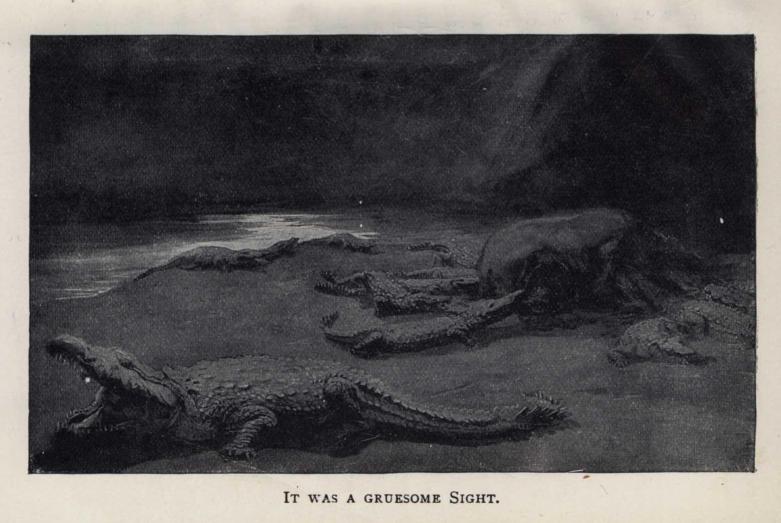
It was a gruesome Sight.
The banks of every channel and mud-hole were lined with huge yellow masses of crocodiles; thousands and thousands of wildfowl (mainly Egyptian and spur-wing geese), which were nesting in the hippo holes, kept up a ceaseless din; herds and herds of game appeared as though dancing in the mirage, and the whole scene was one to delight the heart of a lover of nature. There indeed one felt one was far from the madding crowd.
During the night we were awakened by the most terrific yells, and found that some crocodiles had gone into the boys' quarters. Fortunately they contented themselves with removing about two hundredweight of meat.
As the lions appeared to have left the country, we moved up the river to our original camp for a week to give the plain a rest, and bagged an eland. Sharp secured a good lioness in the lion donga.
On our return I shot a zebra for bait in the strip of bush. Turning out somewhat reluctantly at 5.30 a.m. with no hopes of success, as the lions had been very quiet all night, I was cutting the wind rather fine when I saw a number of birds sitting at a respectful distance from the carcase. Approaching cautiously, I saw some brute apparently pulling at something, but could not see clearly what it was, as it was still more or less dark. I knew it must be a lion from its bulk, yet dared not think so. I retraced my steps for the wind and crept up to within sixty yards under cover of a stunted palm. Peering cautiously round, I saw, in the middle of a circle of some two hundred vultures, a grand old lion, leisurely gnawing the ribs. Behind him were four little jackals sitting in a row. It would be difficult to imagine a more perfect picture. In the background stretched the limitless plain, streaked with mists shimmering in the growing light of the rising sun. Clumps of graceful palms fenced in a sandy arena where the zebra had fallen. Round its attenuated remains, just out of reach of the swish of the monarch's tail, was a solid circle of waiting vultures, craning their bald necks, chattering and hustling one another. The more daring quartette sat within the magic circle like four little images of patience, while the lion in all his might and matchless grandeur of form, leisurely chewed and scrunched the tit-bits, magnificently regardless of the watchful eyes of the encircling canaille. Loath to break the spell, I watched the scene for fully ten minutes, then, as he showed signs of moving, I took the chance afforded of a broadside shot and bowled him over with the .500 magnum. I tried to reload but the gun jammed. The lion rose, and after looking round for the cause of the interruption, without success, started off at a gallop. With a desperate effort I closed the gun and knocked him over again. He was a fine black-maned lion, and measured as he lay in a straight line from tip to tip 10 ft. 4 in.--a very unusual length.
Another morning, taking an early stroll, I met an old cow hippo and a calf, wandering about far from the river. I accompanied them for some time watching them, but when I caught the youngster by the tail the old lady turned round in answer to its squeals, and opening her mouth to its fullest extent, some 6 ft., gave vent to a terrific roar, which reminded me that it was breakfast-time. On another occasion presumably the same pair strolled past within one hundred yards of our breakfast-table, but they out-distanced the boys who went in pursuit, and plunged into the river, easy winners.
As Sharp had shot a brace of hippo in our pool, we had them dragged out on to the sandbank opposite, and built a grass screen at the lower end of the hippo tunnel which led down through the bush from the high ground above the river. Fortunately, as it afterwards transpired, we took the precaution to block up the top entrance with stones. Here Sharp and I posted ourselves for the night in hopes of lions. When all was quiet, scores of vast crocodiles came out of the pool, and so successfully did they rend and tear the huge carcases that in the morning nothing remained but a few bones. It was a gruesome sight, the great loathsome reptiles tearing vast blocks of hide like brown paper, then crawling away to digest their morsel, then again advancing to the attack, while a row of hyænas sat silhouetted against the sky on the high bank opposite, or trotted uneasily to and fro, moaning and howling unceasingly, yet fearing to approach the evil mass of reptiles. Crowds of mosquitoes and sandflies added their plaintive song. Suddenly with a mighty rush five hippo dashed down the bank, then, recovering from their alarm, strolled quietly by at five yards, the moonlight gleaming white on their wet backs.
Having heard some lions at sunrise to the east I started in pursuit, and, following along an extensive dry donga that cut through the plain, found some fresh spoor which I lost in the endless sea of dry long grass that covered the greater part of the plain. This I fired, and then came round by the river, hoping to see some of them if they were driven from their cover. When nearly home I saw a lion stand up in the low scrub about a thousand yards away. He had our wind, and started across the bare plain at a gallop, making for the long grass. I set off in hot pursuit with my gun-boy. When the lion stopped to look I stopped, hoping that he would think I was not following him. Whereupon my boy, who would never learn the trick, sailed gracefully over my shoulder. The lion, apparently taking us for some harmless mountebanks, slackened his pace, and only reached the grass about five hundred yards ahead of me. Rushing in on his tracks, I was fortunate enough to catch a glimpse of his mane above the grass, as he crossed a place where the grass was rather shorter than elsewhere. He had turned at right angles from his course, and had ceased to worry himself about me. Following hard, I got a chance at sixty yards, and knocked him over with a shot from the .500 magnum high on the shoulder. Owing to the smoke, the lack of landmarks, and the height of the grass (about 4 ft. 6 in.), I lost his exact whereabouts, and after slipping in another cartridge, walked past him. He suddenly rose at twenty-five yards and charged straight. The incredible rapidity of his onslaught and the cover afforded by the grass rendered aiming impossible. I merely swung the gun on him and dropped him at four yards with a shot in the neck, then hastily retired. After waiting for some time and hearing no sound, I again advanced, this time with the greatest caution. I could soon distinguish his shoulder at ten yards between the grass. Not wishing to damage his skin unnecessarily, I took my small rifle and fired at his shoulder. The shot had hardly struck when he again rose and charged like lightning. Another lucky shot from the second barrel, which entered the old wound, laid him out. His head was within three yards of my feet. Even then he would not die, although unable to rise, and it needed three more shots to finish him. This was the first time I had been charged by a lion, and I was amazed at the incredible rapidity of their movements. My respect for friend lion increased a thousandfold.
The following day was evidently a lion's holiday, for Mahony and I, following the river to where I had dropped a zebra, put up two lionesses out of some scrub. I hit them both with a right and left. Mahony also hit one, which we secured. But the other one crossed the river, making a clean jump of 34 ft., and reached a large patch of long grass where we lost her. The wind dropped, and consequently the grass would not burn. Nor could we follow her spoor. Sharp, crossing the plain to the Umkulumadzi, met a lion and a lioness, and killed the lion with a shot in the neck. On his way home he met another lion, and with a shot at ten yards from the 10-bore removed a bunch of the mane. The lion jumped into a small patch of impassable reed from which he could not be induced to move, so was wisely allowed to stay, as handling a gun inside would have been impossible. This was our grand finale at lion camp, and we again moved to our old spot by the water-hole in the jungle, but without success.
The variation in the Lichtenstein hartebeeste was very remarkable, the type in this jungle being a heavy beast without face markings, the frontal bone very prominent and the white rump indistinct, while near Gorongoza's hills they were smaller, had a white blaze on the forehead, and were without the peculiar frontal prominence, the rump, too, being very white. The nocturnal attentions of the hyænas were most annoying, diabolical peals of laughter in rapid succession making sleep almost impossible. Failing to find buffalo, we again marched up the Pungwe, and to the lagoon where we had started proceedings.
The first morning after losing a splendid eland, in company with Mahony, I met a fretful porcupine taking his morning constitutional. We waited till he walked within five yards and then gave chase. For a time the pace was hot, till I headed him off, and grabbed him, by the long hair on his neck, which promptly gave way (I mean the hair). I was again closing on him, when he suddenly backed, driving one quill through my boot, 1-½ in. through my little toe, and a dozen others into my leg, one through the tendon. One of my boys was badly mangled in a similar manner, and it was only after giving the fretful one a playful tap on the skull that we made him fast. I regret to say that two days afterwards he died.
As the officials of a so-called Gorongoza Development Co., with its headquarters on the Dingi-Dingi, had seized our boys on their way to Fontesvilla with trophies, and ill-used them, we marched to the Pungwe, where I branched off to arrange matters, the others following the river towards Sarmento. I found seven or eight yellow-visaged creatures, a Portuguese-French mixture, who in three years had disposed of a capital of, I believe, some hundreds of thousands of francs, with the stupendous result of an asset comprising about fifty acres of castor oil (one of the most ineradicable weeds of the country). The Governor, who was very polite, told me that he was entitled to levy shooting licences, and after some talk we closed the matter with a payment of £10, which I should advise the shareholders of the Gorongoza Development Co. to keep an eye on, as it is the only return they are ever likely to see. He also told me that he should like a lion hunt, and had even sat up by his fowl-house for that purpose. Not long after we met him, vinously inclined, in Beira--the cheque had been cashed. On the Pungwe we watched some native blacksmiths at work. Several of their tools were very ingenious.
Again we marched north, and striking the Pungwe by Tiga's Kraal, crossed the island and the Dingi-Dingi, and eventually camped at the junction of a broad sandy river with the Urema. Sharp bagged a good buffalo with a 42-inch head the first night; and the following morning we found that a male lion had visited the carcase, but retired before our arrival. We tossed up as to who should sit up that night, and I was unlucky enough to win; unlucky, in that I spent one of the most awful nights it has ever been my lot to endure. Having built a small platform, 6 ft. from the ground, I repaired thither with a thick blanket at sunset. Soon about thirty hyænas appeared, and continued fighting, snarling, and uttering diabolical yells all night; while battalions of mosquitoes refreshed themselves at my expense, biting my knees, even through a camel's-hair blanket and flannel trousers.
At last, about an hour before dawn, I fell asleep, and was awakened at sunrise by a scuffling noise behind me. I turned round, on murder intent, expecting to find a belated hyæna, and beheld, ten yards away, a grand old lion slowly dragging the carcase under the shade of a tree. Still half asleep, I reached for the 10-bore, and killed him with a shot high on the shoulder, and went back to breakfast, feeling thoroughly ashamed of myself. I consider sitting up over a bait an unpardonable form of murder, if there is the remotest possibility of shooting a beast in fair hunt.
A few days later, when on the way to our camp in the jungle, I overshot the track in some long grass, and spent a terrible day in consequence. I could not be certain that I had crossed it, or if I had crossed, of not doing so again if I returned. The only safe course was to follow some definite direction. I judged the whereabouts of the junction of the Gorongoza plain and the Urema, and went straight ahead through thick and thin. Some of the bush was terrible, and the only way to pass was by climbing along the boughs of the trees above. The experience gave me a clear idea of how people lose themselves irretrievably, as I found it needed a tremendous effort of will to compel myself to go on and on. The temptation to try another direction is almost invincible, and nothing is easier than to lose one's nerves on these occasions. However, I at length emerged, torn and bleeding from head to foot, and throwing myself into the river, regardless of crocodiles, lay there, drinking in the water through every pore. Much refreshed, but with the unpleasant prospect of spending the night there, I climbed up on to the path that runs along the river-bank, and saw to my amazement the spoor of two horses; this I followed up; and half an hour later, as it was getting too dark to see, I caught the glimmer of a fire in the distance. Here I found Mr. H. S. H. Cavendish of Lake Rudolph fame, and Mr. Dodson of the British Museum, who had just arrived on a shooting trip.
After an uncomfortable night in a horse's nose-bag and a cloud of mosquitoes, I hurried to my camp to relieve Sharp's anxiety, meeting a search-party of natives on the road. Next day I returned to Cavendish, to see how the fever from which he was suffering had progressed. During lunch a native rushed in, saying that he had been bitten by a night-adder (one of the most deadly snakes in Africa). I promptly collared him by the arm, stopped the circulation with some string, slit his finger crosswise with my pocket-knife, exploded some gunpowder in the cut, while Dodson administered repeated subcutaneous injections of permanganate of potash. Meanwhile the arm, chest, and left side swelled to the most appalling proportions. Cavendish then appeared on the scene with a bottle of whisky, three parts of which we poured down his throat. Then we told off three strong men to run the patient round the camp till he subsided like a log into a drunken stupor. The following morning he was still alive, but the swelling was enormous, and the colour of his nails indicated incipient gangrene. Not knowing what else to do, we put a pot on the fire, and made a very strong solution of the permanganate which we kept gently simmering, while six stalwart natives forced the unfortunate's hand in and out. His yells were fearful, but the cure was complete. The swelling rapidly subsided, the nails resumed their normal colour, and the following morning, with the exception of the loss of the skin of his hand, he was comparatively well.
A note from Sharp informed me that the Portuguese ruffians of the Gorongoza Development Co. had again raided our camp when he was out shooting, had removed the whole concern, beaten, threatened to shoot, and eventually made prisoners of all our boys.
This considerate proceeding they repeated with Mr. Illingworth's party. Needless to remark, our protests were received by the British Consul with the diplomatic interest due to the subject, a request to formulate them on paper, and an intimation that our trouble would be superfluous, as nothing could be done.
Having heard that another Portuguese official, who was reported to be looking for me, was in the vicinity, I asked him to come to dinner. Whereupon he refrained from arresting me, and asked me to stay with him instead; accordingly I returned with him to his station, and the following morning marched into Fontesvilla and caught the train to Beira, where I found Sharp busy packing and sending off the trophies.
CHAPTER III.
THE ZAMBESI AND SHIRÉ RIVERS.
Though very loath to leave our happy hunting-grounds, we had to tear ourselves away and make preparations for the long march north, so went down to Durban to lay in a few necessaries, an extra .303 in case of accidents, and to obtain the time and rate of our chronometer from the observatory.
On our return to Beira we embarked on the Peters for Chinde, finding as fellow-passengers the Congo Telegraph Expedition under Mr. Mohun--six white men, one hundred Zanzibaris, thirty donkeys, and a few cows, etc.
To our horror, on disembarking the next day, we found that all our heavy luggage, tents, etc., had been put on the wrong boat at Beira, and were on their way to Delagoa Bay. As the telegraph line is generally in a state of collapse, owing to the white ants eating the posts, and to vagaries on the part of the Portuguese or natives, it took some days to inform the agent.
Chinde offers no attractions except to those who are waiting for a home-going boat, so we made up our minds to go on to Chiromo, and have a little shooting till our things turned up, and we could proceed on our journey.
The African Lakes Corporation, to whom we had consigned a splendid full-plate camera, denied any knowledge of it. We afterwards found that it had passed through their hands, and had been stowed on a sunny and rain-swept verandah for three months, with a result that may be imagined. They had also inadvertently overlooked thirty of our cases of provisions, which we found at the last moment in their store.
Having borrowed a tent from Mr. Mohun, and being tired of sardines as a staple article of diet, we made a start up-river, only to find ourselves worse off afloat than we had been ashore, the Company we had the misfortune to travel by having apparently realized how to provide the minimum of comfort with the maximum of charge.
On each side of the steamer a barge was made fast, so progress was not rapid. It was the dry season. The river was very low, and intervals of rest on sandbanks were of frequent occurrence. The banks being very high, one very rarely saw the neighbouring country. No game was ever to be seen, while on the broad river only an occasional native canoe or a gunboat, bustling down-stream, broke the monotony.
Every night the boat tied up to lay in a supply of wood, sometimes near a native village, and occasionally near a sugar plantation; at the latter we were generally given some green vegetables, which were a great boon.
The water is pumped up from the river and distributed by channels over the cane-swamps, and in the time to come, as more of the river-banks are taken up by these Sugar Concessions, this drain on the water will make a considerable difference to navigation in the dry season.
Amongst the legitimate productions of the cane, they here manufacture Scotch whisky, the labels and bottles being imported from the home markets in large quantities. The most important estate is managed by a French company, superintended by ten Europeans (mainly French). The system of irrigation is very complete, and the work of cleaning is done by steam-ploughs, managed, of course, by Scotchmen. Mills are in course of erection, and the bottles, thistle and all complete, will soon be in requisition. Three hundred hectares are already planted, and the Company intend immediately planting five hundred more.
There is another important Sugar Company, owned by the Portuguese and managed by a Scotchman. The output from its extensive plantations during the season, which lasts three months, amounts to one hundred and twenty tons a week.
It is a dreary, hot, monotonous journey.
The river is most uninteresting, of great breadth, with low grass-covered banks and destitute of trees, except near the delta, where there are some thriving cocoanut plantations. The stream is cut up by numerous islands and sandbanks, haunted by vast flocks of geese, pelicans, and flamingoes.
At Senna there are a few miserable huts, and a few yet more miserable Portuguese, and at Songwe there is an Indian settlement, where there is some trade from the interior.
On reaching the Shiré we were transferred to an animated tea-tray, by courtesy called a steamer, which carried us to Chiromo. The food for five Europeans for two and a half days consisted of one ancient duck, three skinny fowls, and a few tins of sardines. There was no bread, butter, milk, or Worcester sauce, without which life, or rather native cookery, is intolerable. Luckily, at the villages on the way we were able to buy fowls, eggs, and tomatoes.
Before reaching Chiromo we put in at the first B.C.A. post, Port Herald, where dusky Napoleons ponder over wild orgies of the past. A broad road planted with shade trees leads up to the collector's house, and cross-roads, similarly planted, give quite a pleasant appearance to the place, backed in the distance by a high mountain.
Chiromo is laid out at the junction of the Ruo and Shiré rivers, while on the north-west side the station is hemmed in by the vast Elephant Marsh, now a closed game preserve, owing to the inconsiderate slaughter in time past. Lions can be heard almost every night, and the day previous to our arrival a lion appeared in the town in broad daylight, and carried off a native. Though the available population turned out to slay, he escaped untouched. Many shots were fired at him from many varieties of guns, and the range varied from five to five hundred yards. But still he wandered round, the least excited individual in the place. Eventually the Nimrod of Chiromo, who arrived late, hurt his feelings by tumbling off a tree on to his back. This was too much, and he majestically stalked off into the Marsh, wondering at the inscrutable ways of men.
Leopard spoor was also a common sight in the street in the morning, while in the Ruo the crocodiles lived an easy life, with unlimited black meat at their command near the bathing-places.
From its position, the town is the inland port of British Central Africa, and with the fast-growing coffee industry will become a place of considerable importance. Already the building plots command a high price, and stands are being eagerly bought up by the African Flotilla Company and Sharrers' Transport Company, who are rapidly ousting the African Lakes Corporation from their position of hitherto unquestioned monopolists. There are also several German traders who display considerable activity, apparently with satisfactory results, and there are rumours of a coffee combination, financed by a prominent German East Coast firm, making their headquarters here.
A large estate on the right bank of the Shiré, called Rosebery Park, is owned by the African Flotilla Company, which makes excellent bricks, and opposite the town a fibre-extracting company has started work. The company has obtained Foulke's patent fibre-cleaning machine, and a concession of the fibre-gathering rights over all Crown lands, and another similar concession in the Portuguese territory.
The plant employed is Sanseveira, of which there are about twenty varieties, the most common in the neighbourhood being S. cylindrica and S. guiniensis; the former, owing to the greater ease with which it can be worked, being the most valuable. The length of leaf is 3 to 6 ft., and the diameter about ¾ in. I found it growing in immense quantities on the plains round Chiperoni.
The treatment is very simple. The green stuff is put over rollers, which take it past a rapidly revolving brush under a strong jet of water. The resulting fibre is then dried in the shade, tied into bundles, and is ready bleached for the market. Consequently the cost of production is very low. The fibre is fine, strong, and clean, and the waste is very small, the proportion of fibre to reed being 4 per cent. The strength is estimated at two and a half times that of the best manilla.
The cost of fuel (wood) to run one engine for a day is only four shillings, and as the fibre needs no cleaning, only one process is necessary.
Mr. H. MacDonald, the Collector and Vice-Consul, royally entertained us at his house, the only cool spot in Chiromo. His method of providing fish for dinner was to fire a round from his .303 into the edge of the river, when one or two fish would rise stunned to the surface.
The climate of the vicinity is very trying to Europeans; the heat is intense, and, being a moist heat, is at times insufferable. We repeatedly registered 115° and 120° in the shade, and owing to the amount of vapour held suspended in the air, there was very little diminution of temperature at night.
Periodical waves of fever prostrate the population when the wind blows from the Elephant Marsh, and the death-rate assumes alarming proportions. A form of Beri-Beri is also prevalent.
Large numbers of natives frequently apply for permission to come over from the Portuguese country and settle in British territory, and the population is thus becoming very dense, and food is easily obtainable in large quantities.
CHAPTER IV.
CHIPERONI.
The Ruo, the main tributary of the Shiré river, which two rivers at their angle of confluence enclose Chiromo (native word, "the joining of the streams"), rises in the Mlanje Hills, whence it flows in two main streams which join about twenty-five miles north of its junction with the Shiré. Ten miles south of this are the beautiful Zoa Falls.
As there was every prospect of having to wait some weeks for the errant loads, we made arrangements for some shooting, having heard great tales of the rhinoceros on Mount Chiperoni, which lies about forty miles east of the Ruo in Portuguese territory. Having been provided with porters by Mr. MacDonald, and obtained a permit from the Portuguese, which entitled us to carry a gun and shoot meat for the pot, we crossed the river and marched up towards Zoa.
The country was exceedingly dry and burnt up: consequently the little game that remained in the vicinity was concentrated near the water. After some hard days' work under an impossible sun, I shot a klipspringer, which, curiously enough, was down in the flat country, and fully twenty miles from the nearest hills. The bristly hairs reminded me of a hedgehog, and came out in great quantities during the process of skinning. These antelopes are exceedingly heavy in the hind quarters, short in the legs, and have the most delicate feet imaginable. We both searched high and low for koodoo, which were reported to be plentiful, but without effect, though I found a couple of worm-eaten heads lying in the bush; and for some days we had no luck with sable, although there was much fresh spoor; but eventually I succeeded in bagging a fair bull. No antelope looks grander than an old bull sable, standing like a statue under some tree, his mighty horns sweeping far back over his shoulders. The bristling mane gives a massive appearance to his shoulders; there is something suggestive of the goat about him, both in his lines and carriage: a giant ibex!
One evening some natives came to camp with a wonderful catch of fish, amongst which I noticed four different species. One was a long, eel-shaped fish with a curious bottle snout, and very small teeth. The eye, entirely covered with skin, was almost invisible. There is a closely allied fish in the Nile. Another one resembled a bream with very large fins. A third resembled a carp with enormous scales, and was very poor eating. While the fourth, which I have never seen elsewhere, and which was unknown to Mr. MacDonald, who is a keen naturalist, resembled a heavily-built carp with large scales and prominent fins, and was of a beautiful green colour.
Sharp having decided to go to the north of Nyassa to arrange transport across the plateau, then returned to Chiromo, and I quickly followed. But a few days later I again crossed into Portuguese territory, and marched east along the telegraph line to M'Serrire on the Liadzi, a tributary of the Shiré.
The following morning, quietly strolling through some dense bush, I saw two grand bull sable browsing on the tender shoots of a massive creeper. I fired at the better of the two, and they both galloped away. It was easy to follow their spoor in the soft, peaty soil, and a quarter of a mile away I came on him lying dead. The shot had passed through both lungs. In the evening, when tubbing, I was beset by bees who come in clouds for the moisture, and after an exciting and one-sided conflict I hurriedly withdrew, dashed in a state of nudity through the astonished village, and sought refuge in a hut. The stings induced a severe fever, and the next two days were spent in bed and indignant meditation.
Hearing that some old Cambridge friends of mine had arrived in Chiromo, I marched in and spent a jovial evening with MacDonald, who was entertaining them.
A new detachment of Sikhs arrived under Lieut. Godfrey. It was splendid to see the contrast between the manners of these magnificent men and those of the local negro. The respect shown to all Englishmen by these gentlemen of gentlemen, coupled with their proud carriage and air of self-respecting-respectful independence, contrasted well with the slouching, coarse insolence of the hideous African.
A naïve individual arrived by the same boat for some official post, and asked whether it was usual to leave cards on the converted natives and their wives. He appeared to be a striking example of the appalling ineptitude of many of the officials chosen for the difficult and serious work they undertake.
Tales of rhinoceros and elephant fired me with the desire to make a trip to Chiperoni, a large mountain mass east of the Ruo; but my ignorance of the language made such an undertaking difficult, so that I wasted some days in endeavouring to find a companion. Preparatory to starting, it was necessary to make friends with the Portuguese official. The usual man was away, and his locum tenens was the captain of the gunboat, which was moored to the bank opposite MacDonald's house.
From previous experience, I had learnt that with Portuguese and natives everything depended on outward appearance; and, as my wardrobe was little calculated to inspire respect, I went round the town and gathered much gorgeous raiment, the finishing touch being supplied by the doctor in the shape of a red-and-white medal ribbon, torn from a pocket pincushion. Resplendent in such gauds, with a heavy riding-whip, spurs (I had noticed that spurs are indispensable to Portuguese polite society, even at sea), and balancing a No. 6 helmet on a No. 8 head, I was rowed across the river in great pomp by the administration boat, midst the blare of trumpets and waving of flags.
The Portuguese officer, a delightful gentleman, received me with open arms, placed the whole country and all that was therein at my disposal, and gave me a "Viesky-soda," insisting on drinking the same thing himself--a stretch of hospitality that was attended with the direst results.
The following morning, having given up all hopes of finding a companion, I collected a dozen raw natives and a Chinyanja dictionary, and on November 10th crossed the Ruo and marched twelve miles to the Liadzi, a parallel stream to the Ruo, and also flowing into the Shiré. Five miles further I forded the Zitembi, another parallel stream of some volume. This I followed up to a village called Gombi (little bank), which is perched on a small cliff at the junction of the Zitembi with a feeder. I had had considerable difficulty in obtaining guides, the natives being very surly, and absolutely refusing any information of the best means of reaching Chiperoni, or of the probability of sport, and at Gombi things reached a climax, the chief telling me that he wanted no white man in his country, that the Portuguese forced them to work for nothing, and demanded a 5 r. hut tax, that my men would obtain no food, etc., etc., ad nauseam. However, seeing that I was not to be trifled with, he changed his tone, and brought me flour and fowls, guides to show me game, and a guide to Chiperoni for the morrow. In the afternoon I took a walk round and shot some meat, seeing plenty of fresh rhino, buffalo, eland, sable, and other buck spoor. The country seemed so promising that I decided, if unsuccessful at Chiperoni, to return for a few days. There was an albino woman in the village; all her children, to the number of five, were also albino, and at several other villages in the vicinity I saw specimens, which would argue a strong hereditary tendency. In many of the villages in the higher valleys there were numerous cases of goitre, some very pronounced, and an extraordinary number of lepers and idiots. This was attributable to the isolating influence of mountainous regions, through difficulty of communication, and the consequent tendency to inbreed. The whole of the next day I followed the Zitembi, till, at its junction with a large feeder, about twenty-four miles from Gombi, there is a village called Chirombo. The stream, which is a series of cascades, and lined with bamboo, is exceedingly beautiful, and, by a reconnaissance on the morrow, I ascertained that it rises on the north of Chiperoni. From here Chiperoni has quite an imposing effect. It is a terraced cone deeply seared by water-courses, and rises from the middle of a basin formed by a circle of less prominent peaks, the most important of which is Makambi to the west. Far away to the north-west were visible the heights of Mlanje, while to the east stretched an unending forest-clad plain that reaches to Mozambique. Woods of mahobahoba (the wild loquat) and many flowering trees covered every rise, and the flat interior of the basin; and the glorious golds, reds, russets, and browns of our autumn, which in these climes beautify the landscape in spring, were at their richest, while a carpet of vivid green and purple flowers lay spread beneath the shade. It was a beautiful country, cool, even at midday, cold at night, free from mosquitoes and flies, and every mile or so an ice-cold stream came tumbling down behind its curtain of ferns and orchids.
Marching round the southern face of Chiperoni for twenty miles, we came to a long ridge or arete which I followed till within 500 ft. of the summit, which is rocky and precipitous, but would offer no difficulty to a man without a load. Here I camped on a small plateau in a glade of mahobahoba. It was a delightful change after the sweltering heat of Chiromo, and I could imagine myself again in Switzerland as I looked out over miles of rolling upland and undulating forest. There were numerous signs of elephant which were feeding on the small sugary loquats, but I failed to find any, though I followed one spoor for many miles. From here we worked round to the east face, till, being short of food, I was obliged to follow one of the numerous streams down to the plain. Here was a considerable but scattered population with a large number of domestic pigeons, pigs, ducks, and cats. The pigs were the ordinary bush-pig, while the pigeons, which were blue rocks, must have been originally introduced by the Portuguese. The stream, which flows into the Misongwe, a tributary of the Shiré, is called the Machingiri, and there are numerous signs of rhino, though few antelopes; however, I managed to bag a good sable. As my boys were following very badly on the paths, I cut straight across to Gombi through the forest, a very long, waterless march, and on arrival found there was not one boy a hundred yards behind; after that I had no further difficulty with them. At Gombi I decided to stop for a few days, and the next morning, after spooring a herd of sable for two hours, I shot a splendid bull.
I had told the chief, who was now most friendly, that I was going to shoot sable, and he came and asked me what I intended to kill the next day, and was much amused when I jokingly replied that I should bring home a rhinoceros.
With this end in view I started early, at 5.30 a.m., and crossing the river, skirted along the foot of the hills, and killed a bull hartebeeste for the Mahomedan boys, who refuse to eat the meat of any beast that has not had its throat cut before death. Although this is a great nuisance (as cutting the throat spoils the head skin), it is right to respect such customs, and I always made a point of killing something else, so that they should not suffer for their belief.
At 7.30 I found fresh rhinoceros spoor which I followed under a blazing sun till 12.30. The country had been very difficult, and I was just beginning to despair when I heard a snort, and looking up, saw the rhino trotting round the corner of an ant-hill, behind which he had been sleeping. On seeing me he stopped, snorting, blowing, and stamping, looking exceedingly nasty. I was carrying my .303, and turning round for my 4-bore, I found that all my boys had bolted up a small thorn tree, from the branch of which they were hanging like a cluster of bees. They had thrown down the gun, and I was compelled to stoop down and grope about for it in the undergrowth. The brute was blowing and snorting only fifteen yards away, and I felt very uncomfortable, as in my position I offered a magnificent target. However, at last I found the gun, and firing past his cheek, hit him full on the edge of the shoulder. Instantly there arose a very hell of sound, squealing, stamping, and crashing of bushes and grass. The smoke hung like a pall around me, and I thought he was charging. Having nowhere to run to, I stayed where I was, and suddenly his huge mass dashed past the edge of the smoke-cloud, and I saw him disappear at a tremendous pace into the grass. We followed hard, but though he bled freely and lay down several times, we did not come up to him again till 3 p.m., when we found him standing at ten yards' distance in a bushy nullah far up in the hills. I fired the 4-bore at his shoulder, knocking him down, but he rose again, and tried to climb the far bank; so I fired the second barrel hurriedly; the cartridge split at the back, and I was knocked over a tree two yards behind. That stopped him, and three solid bullets from the .303 finished him.
I found that the first shot had penetrated about 2 ft., smashing all the shoulder, yet he travelled for two and a half hours, over the steepest hills and through some precipitous water-courses.
In cutting off his head, I found an old iron native bullet in the muscle of his neck.
We were terribly exhausted from the desperate work in a pitiless sun, and hastily grilled a portion of his liver, which was excellent.
A twelve-mile trot brought us back to camp at 7 p.m., and the old chief turned out in state to meet me, and falling upon his knees, rubbed his face in the dust in token of admiration at my powers of prescience.
The natives departed in hundreds there and then to cut up the meat, and arrived early the next morning with the head intact; twenty boys carried it slung on a pole. Skinning it was a fearful business, and occupied me till dark; toil that I have much regretted, since I find that the skull, skin, and many other trophies and curios have been unfortunately lost in transit.
The old chief again came to me and asked me what I was going to kill. I suggested eland for a change; and knowing that there were several herds near where I had killed the rhinoceros, I set off in that direction, my local guides carefully placing a bunch of leaves under a bush on the left-hand side of the path. This, they informed me, ensured success.
The country was full of splendid hunting-grounds; the young grass was sprouting from the black, peaty soil, and the new foliage of the trees afforded grateful shade, beneath which one could walk for hours without encountering any undergrowth.
The spoor of buffalo, rhinoceros, sable, and hartebeeste was plentiful, but nothing would satisfy me except eland, and it was not till midday that I found tracks fresh enough to follow. A six-mile burst brought me in sight of a herd of twenty, and I was creeping round under cover of some trees to obtain a good shot at the leading bull when a boy, who had followed me from the village, let off a dozen ear-piercing whistles to inform me that he too had seen them. Away dashed the eland, and any one who has once followed alarmed eland does not eagerly repeat the mistake. They usually keep up a steady trot till they are clear of the obnoxious neighbourhood, and when they do stand are so wary that approach is impossible. The offending native was an ordinary type of the creatures depicted in books as wonderful hunters and trackers. Personally I have never found a native of Africa who was anything but an abominable nuisance out hunting; and after many trials I strictly confined my hunting attendants to one or two gun-bearers whom I trained to act instantly on a definite set of signs, and never used them for any purpose, except to occasionally follow obvious spoor when I wanted to rest my eyes; even then they needed watching, or they would go wrong. The Bushmen are, of course, an exception to this rule.
On my way back to camp I was startled by a deafening report and the shriek of a bullet past my head. The boy who was carrying my 4-bore had slipped the safety-bolt back, and the trigger had caught in a twig. He was, of course, carrying the gun loosely on his shoulder, and the effect of the explosion of fourteen drams of powder was terrific. It knocked him several feet off the path and stunned him, while the gun described a graceful parabola, and landed, muzzle downwards, on a patch of soft soil, fortunately escaping damage.
A messenger arrived in the evening with a note to the effect that the stray baggage had arrived, and the following day I returned to Chiromo after a most enjoyable trip.
CHAPTER V.
BRITISH CENTRAL AFRICA AND LAKE NYASSA.
At last, on November 28th, I left Chiromo and started up the river once more in the good ship Scott, and again realized the feelings of a pea on a drum. Fortunately the skipper was so ill with fever that we took charge of the boat ourselves, and thus contrived to have something to eat.
We had lost six valuable weeks through our kit having been put on the wrong boat at Beira, and as Mohun's expedition had gone on in front we lost eventually six weeks more, through the transport on the Tanganyika plateau being temporarily demoralized. Thus the carelessness of our agent delayed us in all three months. Such is African travel. I no longer fret when my train is ten minutes late. Even after this wait some of our things never turned up at all. Mr. Commissioner Alfred Sharpe, C.B., the greatest and most reticent of African Nimrods, was on board, but we tried in vain to induce him to tell us some of his experiences. However, he gave me a piece of advice that afterwards stood me in good stead: that, when charged by an elephant, the safest course was to remain quite still till the brute was within four yards, and then to blaze in his face. This almost invariably turns the brute or makes him swerve; my experience has certainly proved its efficacy. Mr. Sharpe has the reputation of being the hardest and most daring shikari who ever followed an elephant; and many amusing tales are current of how in the excitement of the chase he would charge cow elephants to make them get out of his way, in order that he might obtain his shot at the leading bull. In view of the success that attends many of the imaginative literary efforts of missionaries and week-end tourists on the subject of Africa, it is a great pity that the few men like Alfred Sharpe and Lawley of Beira railway fame, who have had gigantic experience of Africa past and present, resolutely refuse to record their invaluable data in a book. Sir Harry Johnston and Selous have set an admirable example, and if a few more men of their stamp would write, much of the misleading balderdash that now passes current as representing the Dark Continent would be happily crushed out of existence.
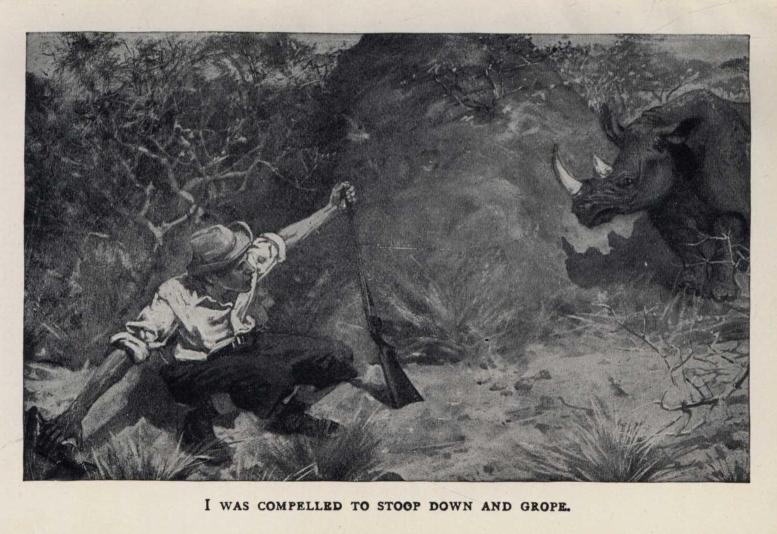
I was compelled to stoop down and grope.
A slight mishap with the machinery delayed us for several hours, and it was not till noon the following day that we reached Makwira's village. Young Makwira, who is quite the young gentleman, in knickers, stockings, spats, collar, and hard hat, provided us with whiskies and milk, and discussed local politics, displaying no little acumen. I believe that it was his father who used to be a terror to all travellers on the Shiré, and that but a few years ago, when the elephant still roamed in thousands on the Elephant Marsh, undisturbed by the shrill whistle of the stern-wheeler or the bark of the playful 4-bore. It was either old Makwira or another genial darky in the vicinity, who for some time kept a tame Portuguese band, and utilized the bandsmen when off duty as machila-carriers.[#]
[#] Machila: Portuguese word acclimatized; a hammock slung to a pole and carried by a team of men.
The Elephant Marsh is a large tract of country lying on the left bank of the Shiré river, north of Chiromo. In days gone by it teemed with elephant, buffalo, and game of all descriptions; but the persistent gunner soon drove the elephant away and decimated the other beasts. And it was due, I believe, to Sir Harry Johnston that it was made into a game reserve. The effect has been most beneficial. Herds of waterbuck and buffalo come to the banks of the river, and lazily watch the steamers pass; and even elephant have been occasionally seen of late playing in their old haunts. A more suitable spot for a reserve could not have been selected. The Shiré and Ruo rivers to the south-west and east, and the highlands to the north, form natural boundaries; there is plenty of water and ample grazing at all times of the year. Every night one may hear the lions roaring. By legislative foresight a game paradise has been saved in the midst of one of the busiest and most progressive of our African possessions.
At Makwira's we reluctantly bade farewell to Mr. H. C. MacDonald, whose dry humour and all-embracing hospitality had made my weary sojourn in Chiromo one of the most delightful stages in our journey. The company on the steamer was rather embarrassed by the extravaganzas of an evangelical madman, who had arrived in the country in a state of destitution, and who is probably by now, under the title D.B.S., a burden on the community. Such men should be caged, or at least prevented from running loose amongst the natives, and adding to the already well-nigh insuperable difficulties of the administration.
A few hours' run brought us to Katunga's, the African Lakes Corporation's port for Blantyre. The Government station is a little distance further up the river. The crocodiles, which were very numerous, had been causing much mortality amongst the natives; one had even seized the station's bucket, which, for greater safety, was lowered into the river to draw water from the end of a long pole.
The Government station is the highest navigable point of the river south of the rapids, and everything has to be unshipped and carried round to the upper river by native porters or wagons. From Katunga's to Blantyre there is a well-constructed road, with a half-way house belonging to the African Lakes Corporation. Captain Rhoades, of the B.C.A. navy, accompanied me in a mule-cart, and we arrived at Blantyre, the commercial centre of B.C.A., about sunset. The road quickly mounts from the Shiré valley on to the plateau of the highlands. Looking back over the valley from the edge of the plateau the view is superb; and much of the scenery through which the road passes is very beautiful. Most of the highlands are covered with woods, which at that season were in the full glory of their vernal tints; the grass was springing up green, and carpeted with millions of beautiful purple flowers resembling crocuses. There were many specimens of the mahobahoba tree, or wild loquat: the timber of this tree is much prized for telegraph poles and similar uses; and the broad dark-green leaves are exceedingly handsome. We passed several comfortable-looking homesteads belonging to coffee-planters, and the fields of neatly-planted coffee-shrubs staggering under their burden of snowy blossom made me fancy that I was back in the fruit-farms of Kent.
Coffee is the great industry of British Central Africa, and one that is likely to bring the little protectorate into the vanguard of our new possessions in the near future. The quality is second to none; some of the crops have realized the highest price on the London markets. At present the industry is more or less paralyzed, owing to the majority of the planters having started operations on borrowed capital, and, with one or two exceptions, without previous experience of coffee. But as soon as the plantations are put on a sound business footing the prosperity of the community should be assured, always provided that the administration, by judicious legislation as to rate of pay for labourers, prevents the labour market from being spoilt. The present rate of pay is three shillings a month, and a rise must be prevented at all costs. The labour supply, properly handled, should prove well-nigh inexhaustible, and, owing to the immigration from the Portuguese sphere, is steadily increasing. I was informed by many men that the first crop should pay the expenses of the first three years during which there is no yield. This is a magnificent return, and by judicious combines, capitalization, and concentration, Nyassa coffee should become an important industry. The coffee being of such quality, is only used for blending at present, so that there is little chance of over-production. It is one of the few African countries that has natural easy communication with the coast, and when a light railway has been built, and shipping and agency have been properly organized, the cost of transport will be very small. There is also undoubtedly great scope for subsidiary and supplementary industries, such as cocoa and rubber.
I consider that in British Central Africa there is an excellent opening for British capital--an opening that appears to be as yet practically unknown at home. The fact is that Africa is supinely neglected where it cannot flaunt the magic war-cry, Gold. The Germans, who are ever on the alert, are already alive to its possibilities, and there were rumours of a great coffee combine financed by well-known German East Coast capitalists. It is to be hoped that England will awake to the chance before the ground has been cut from under her feet, as has already been done in so many places that I have visited. The wily Teuton is very much alive to the advantages afforded by British rule, and has already levied heavy toll on the budding possibilities of trade in our African dominions. Our trouble is that, with few exceptions, we do not send out the right men, but consider that any one is good enough for Africa. This is far from being the case, as new business lines have to be adopted to ensure success. Adaptability and enterprise belong to genius and not to mediocrity, and no country requires a more delicately-adjusted combination of dash, tact, and perseverance than Africa.
There is a passable hotel in Blantyre, and many fine buildings in brick. The missionaries have built a large church, and laid out avenues of eucalyptus which have grown wonderfully well. Unfortunately, as in Rhodesia, the white ants attack the roots when the trees attain a certain height. Extensive plantations would unquestionably considerably modify the climate, which is far from good. The worst type of hæmoglobinuric fever is very prevalent, and the death-rate is consequently high. However, as more and more land is brought under cultivation, the country should become healthier. Probably much of the fever that prevails is brought from the lowlands, which must be traversed before arriving in the higher altitudes: an improved service with the coast will obviate this to some extent. At Blantyre I met with much kindness at the hands of Mr. Codrington, the Commissioner of Northern Rhodesia, Major Harding, C.M.G., who had been recruiting Angonis for the B.S.A. Police, and Mr. Wilson of the Trans-Continental Telegraph, an old school and Cambridge friend, whom I was much surprised to find in this out-of-the-way corner of the world. Three days later I left with Mr. Hall of the African Flotilla Company in machilas for Zomba, the administrative capital. We were to spend the night at the Nomasi river, which we reached in a torrential downpour. Our delight, when we discovered that the transport people had sent our tents and provisions by the wrong road, may be imagined. Fortunately we learned that Mr. Harrison, whom we had met on the river, was camped in the vicinity, and he kindly provided us with a shakedown and something to eat. The following day we reached Zomba, having passed through many flourishing coffee estates. Here Mr. C. C. Bowring put us up and plied us with all the obtainable luxuries and comforts, in the intervals of a fight to the death with a swarm of irate bees who had taken possession of the interior of the wall of his house. The view across Lake Shirwa and the forests that clothe the flat plains which surround the lake ranks amongst the finest that I have seen in Africa. Vast purple masses of hills enclose the placid lake and its forest-clad plains, and the eye roams on over an infinity of broken upland and shimmering haze. The Government House is a large picturesque building standing in the midst of a well-planted tropical garden, which had, however, been lately ravaged by a flight of locusts. There was tennis accompanied by a tea-party, presided over by Miss Harrison, who has nursed many a sick man back to life, and it seemed as if I had suddenly dropped back into civilized England. After two pleasant days spent in these unwonted surroundings, I started in a machila for Liwonde on the Upper Shiré, where I arrived at sunset, and was entertained by Mr. Drummond Hay, an old "Herzog" friend. I am much shocked to hear that he has since fallen a victim to the climate.
From Liwonde the S.S. Monteith took me to Fort Johnston, which is the port of Lake Nyassa, and is situated a few miles south of the bar at the outlet of the lake. A short distance from Fort Johnston the river opens out and forms the small lake Pamalomba, formerly a great haunt of elephant. The lake is very shallow, and as the steamer passes along, the disturbed mud emits enormous volumes of marsh gas: so great is the quantity that the water has the appearance of violently boiling. There have been several instances of men being blown out of their cabins, owing to their having ignited the gas by absent-mindedly striking a match. When Sharp passed with Mr. Mohun, somebody threw a lighted match overboard. Instantly a sheet of flame passed over the barge that was being towed alongside, and two saddles were seriously burnt.
As we arrived at Fort Johnston late in the evening, I elected to sleep on board, and was much gratified to find that two couples of married German missionaries, not content with having monopolized the only two cabins, had rigged up a large canvas enclosure and were sleeping on deck. Consequently, I was compelled to place my blankets by the wheel and sleep in the wind and dew.
Mr. Wallis, the Vice-Consul, entertained me. He has laid the new town out most admirably, and I could scarcely believe that it had all been done in a few months. The place was alive with rats, who amused themselves all night by tobogganing down my face, rushing along my body, and taking flying leaps from my feet into outer darkness.
Commander Cullen took me over H.M.S. Gwendoline, the large new gunboat that had just been launched for patrolling the lake. It is a splendid work to have accomplished, when the difficulties of transporting some of the heavy portions round the rapids are taken into consideration. I was also introduced to a budding diplomatist, who informed me with pride that he had fired a soft-nosed bullet at an elephant at one thousand yards. The elephant escaped.
On December 15th I started on the voyage up the lake in the S.S. Domira, and at midday made Monkey Bay. It is a most beautiful little spot, and reminded me forcibly of the South Sea Islands. Bold rocky headlands plunge into the lake and enclose a white strip of sand with straggling villages at the back. The water is clear as crystal, and broken by the heads of hundreds of natives diving, swimming, and splashing about. Ringing peals of laughter echo in the rocks and startle the troops of baboons that sit watching with curious eyes the trim little steamer. Picturesque groups of natives are scattered about the beach, and the little picaninnies are playing on the skeleton of a wrecked Arab dhow, little dreaming what that dhow had meant to their fathers a few years before. In the afternoon I strolled out, hoping to get a shoot at koodoo, for which the place is famous. But the koodoo were not at home; however, I saw several impala, and shot a small buck which I believe to have been the duiker described by Sir Alfred Sharpe as a probable new species. Unfortunately, my natives devoured the skull and the rats ate the skin. It was a small, reddish-brown buck, similar in build to a klipspringer, with wiry hair and thick, high-standing hind quarters.