FROM THE CAPE TO CAIRO (continued 5)
Reading edition
At Viboko I was compelled to wait, the shore in front being impracticable and the heights behind unscaleable, till Mswa sent down the canoes, which I had requested by numerous envoys. My boys were badly in need of a rest, the work having been very trying since Kahanama's, and the fever from which I was suffering made it equally acceptable to me. In the afternoon two natives arrived, saying that a muzungu[#] was coming down to meet me with ten canoes. After inquiries as to what kind of Askaris he had, etc., etc., I gathered that it must be a Belgian official, so killed the fatted calf in the guise of a skinny sheep and sundry osseous frames masquerading as dorkings, and then plunged for the second time into the turgid flow of Zola's Rome, to cleanse my French of probable Swahili trespassers. I even exhumed a tie, and having produced a menu that exhausted all the possible combinations and permutations of an African larder, awaited anxiously his arrival, picturing to myself the joys of a little talkee-talkee once more. A stiff southerly breeze evidently was delaying them, and it was not till after dark that we heard the wild canoe-song of the flotilla, which had rounded the point and caught sight of our camp-fires. Giving a last twirl to my moustache and a nautical hitch to the Poolesque garment aforesaid, and composing my features to the iron-clad smirk indispensable to such occasions, I advanced to do the honours, and grasped the hand of a dirty, greasy little negro clad in, or rather smeared over with, a prehistoric piece of cloth! Here was my muzungu! here my gallant Belgian staggering under the gold braid of a hat of that peculiarly unbecoming shape affected by French guards and German tourists, and majestically trailing the orthodox 30-franc sword! Inquiries elicited the fact that the parasitic relic of Manchester above mentioned established a valid claim to the title of muzungu in these parts. However, he had brought the canoes, so I readily forgave him, and next day we arrived at the old Soudanese station, Mswa. Mswa is the name of the chief, who is a vassal of Tukenda, and Mahagi is the name of the country itself. He is an intelligent old native, and remembered seeing that ubiquitous officer, Bt.-Major Vandeleur, D.S.O., when he crossed from Kibero, and was delighted at the photograph which forms the frontispiece to his book entitled Campaigns on the Nile and Niger. Here let me recommend travellers to take out photographs of men who have gone before them; the effect is wonderful on those natives who can grasp the idea, though, of course, to many natives a picture is merely a piece of paper. It convinces those who can understand it that you are speaking the truth--a possibility so utterly foreign to the native mind. After exchanging presents he retired, promising to bring more boys in the morning to work the canoes; but in the morning none were forthcoming, and after waiting some time while Mswa rushed frantically round the country, shouting to his people, who walked off into the grass and laughed at him, I concluded that he was either incompetent or trying to make a fool of me, and, to his consternation, manned the canoes with my own men and started. As I expected, enough men were immediately forthcoming, but too late, and I held on my way.
[#] Muzungu: white man.
We did not reach Mahagi till after dark. Here the hills again recede from the lake-shore, leaving an alluvial plain from one to two miles wide, which is densely populated by Lures, while in the hills there are numerous villages of Balegga. Tukenda is the big man, whose influence reaches from south of Mswa to Boki; he has a small herd of cattle and large flocks of goats, and his people are evidently flourishing and very friendly. So dense is the population that the natives have been emigrating down the lake, and have started new villages on the unoccupied sand-spits. At Boki a grand old tusker came sailing by the camp, and after a stern chase and much expenditure of powder, condescended to strike his colours. He was a perfect specimen of the Toro type above described, standing 11 ft. 1 in. at the shoulder, with a forefoot of 62 in., and measuring 5 ft. 6 in. round the elbow, while his tusks were 6 ft. 10 in. and 7 ft 1 in. long, weighing respectively 72 lbs. and 76 lbs. A small patch of forest about two miles by one mile comes down from the hills to the lake-shore, and as my boys had heard elephant there when cutting wood, I went for a stroll after the midday heat of the sun. Never have I seen a more delightful or interesting scene; countless herds of elephant had trampled down the undergrowth, leaving vast shady chambers joined in all directions by galleries. Some of these chambers were fully an acre in extent, and every vestige of vegetation underfoot had been crushed into a level carpet, upon which it was a pleasure to walk. As one entered these delightful retreats, troops and troops of monkeys lined the branches and gazed on us with fearless curiosity; while two or three hundred of the beautiful black-and-white colobus monkey performed the most amazing acrobatic feats overhead. Emerging on the far side I saw a herd of ten elephant. They were standing in long grass, but fortunately there was a small ant-hill close by; climbing up this I found them all with ears widespread advancing in line towards me, and had it not been for the fortuitous existence of this point of vantage they would have walked right on top of us, the grass being about 8 ft. high. They presented a glorious spectacle as they came sailing along, all canvas set (I can find no other word to express the motion of an elephant in grass), ten old tuskers, their ivory now and again gleaming white above the grass; on they came till, when within thirty yards, one turned and gave me a chance. He dropped to the shot, but quickly recovered; succumbing, however, after two more. I damaged three more considerably before exhausting the magazine, and then dashed off in pursuit, passing one which had dropped about five hundred yards off, and reached an ant-hill from which I could see number three evidently very sick. I dropped him with a forehead shot, but he recovered, and eventually reached the forest carrying another ten bullets. Here I followed again, but it was impossible to keep his spoor owing to the perfect maze of tracks, and after wandering around for some time, I climbed up an ant-hill with a large funnel down the middle. From this elevation I saw him standing not more than fifteen yards away. I fired the 10-bore, which staggered him, and knocked me down the funnel, but I scrambled out again just in time to give him the second barrel, which brought him down at the same time that I once more retired into my Stygian retreat; a 3 in. ridge of crumbling earth 15 ft. from the ground is not the most advisable basis from which to fire a 10-bore paradox. All these elephant were of the same type, huge solid beasts with shortish, thick tusks; 6 ft. 10 in., 7 ft. 3 in., 5 ft. 6 in., 5 ft. 6 in., 6 ft. 4 in., 6 ft. 5 in., and weighing 76 lbs., 78 lbs., 56 lbs., 56 lbs., 60 lbs., and 61 lbs. respectively.
The next day I found the fourth that I had hit very hard. He had fallen within two hundred yards of the other two, but owing to the long grass I had not seen him. His tusks weighed 49 lbs., and measured 6 ft. and 5 ft. 10 in., making a total of 633 lbs. for the day.
Between Boki and Munyagora there is a ten-mile stretch of inhospitable scrub covered with a species of acacia, with huge white thorns springing in pairs from hard bulbous excrescences. Formerly there was a settlement named Mjamori about half way, but the chief Akem has fled with his people to Munyagora; he told me that he had fled from the Belgians. I here made the discovery that "Billygee" is a generic term for the Congo officials, and not, as I had previously imagined, the name of an individual. From Munyagora to Igara, which lies at the bend of the river, the country is thickly populated. The Lures build very primitive shelters and surround each village with a scherm of thorn-tree; they do not appear to cultivate the soil, but breed large numbers of goats, which look very sleek and comely. The country, which is very barren and parched, is admirably adapted to that abominable quadruped, which is never so happy as when confined to a little sand and the rancid smell of its own kind.
I was an object of the greatest curiosity, especially to the ladies of these communities, who came in large numbers to inspect me (front seats at bath time being in great request), and who, whether from a ridiculous sense of modesty or a laudable desire to do honour to the occasion, donned over and above the national costume of a small piece of string tied round the waist, a hopelessly inadequate apron of dried grass: a garment that, from the simplicity of its cut and the small quantity of material employed in its composition, I should have no hesitation in classing with the species of female extravagance known, I believe, to the fair sex as tailor-made. The men, who seem to be of a hopeful disposition, spend much time in making wicker baskets resembling two lobster-pots fastened together like a cottage loaf; these they leave in the river tied to sticks and without bait. I saw many hundreds of these, and large numbers of natives visiting them, but only one fish, though my olfactory sense warned me of the vicinity of at least one more. They have a pretty little myth about buying food from the Balegga for fish, and as they do not kill their goats and certainly had not been buying lately, I cannot imagine what they live on; but I do know that in six hours they removed every scrap of five large bull elephant, hides, bones, and all; a small trifle of about twenty tons; so conclude they live a kind of boa-constrictor's existence. Many of the young men aggravate the natural ugliness of their faces by inserting pieces of glass about 5 in. long in their under-lip. One and all carry small bows, with reed arrows tipped with long thin spikes of iron neither barbed nor feathered. Most of the chiefs and elders are obviously of different race, some having the Galla features more or less pronounced. Here at the north end of the lake one emerges quite suddenly from the "Bantu" peoples to the Nilotic, and the line of division is wonderfully sharply defined. There are numbers of reedbuck and nsunu, and in the bush a small very red oribi of which I failed to procure a specimen. I also saw a herd of hartebeeste, and shot a cow; they closely resembled the Lichtenstein, though the rump was not so white, and the horns lie closer together and stand more erect than those of Lichtenstein. Mr. Cape tells me that Jackson's hartebeeste, which it appears to resemble in other respects, is a considerably larger beast; so that it is to be hoped that he will be able to take a skull and hide home for identification.
CHAPTER XVIII.
WADELAI TO KERO.
I arrived at Wadelai on October 1st, and found Lieut. Cape, R.A., in command; the boma is built on a small hill overlooking the miniature lake, and is slightly south of Emin's old site. Here, as elsewhere, the drought had been very serious, and the country consequently looked bare and uninviting. After Rhodesia, B.C.A., and Northern Rhodesia, it was difficult to believe that this land of administrative chaos had been occupied for six years. The mail arrived three weeks overdue, and some loads which had or ought to have been already a month on the road, were three weeks afterwards still untraceable, although the whole distance is only a fortnight's march, while station loads sent off yet three weeks earlier were still unheard of. Nowhere has the Government made any effort to introduce even bananas, much less fruit-trees, vegetables, wheat, or rice; no system of mail service has been organized, and no regulations as to import, duties, etc., had been issued. At Toro I asked for information about the transit dues, naturally objecting to pay the ordinary export duty of 15 per cent. on ivory which I had obtained outside the Protectorate. My request was ignored, and at Wadelai I was met by a demand for duties based on regulations apparently issued for our benefit, but by an error of judgment bearing a date subsequent to our crossing the frontier. From this I can only gather, either that the possibility of the country becoming a trade-route (one of the raisons d'être, I presume, of the railway) had never been entertained, or that it was part of the penny-wise, pound-foolish policy that robs officials of their hunting trophies, and maintains, at the preposterous figure of 14 rupees 8 annas a month, a large number of Waganda boatmen on the Nile, where they die like flies of dysentery brought on by unsuitable food. The country is quite unsuited to these Waganda, who are all banana-eaters, millet being the staple food; and this, coupled with the great difference in altitude, is killing them by dozens, while the banks of the Nile itself are lined with capable canoemen, who could be engaged at 3s. a month; 14 r. 8 a. a month to raw natives, many of whom are mere boys, is sufficient in itself to damn any country's future which will be dependent on its agriculture. Where would B.C.A. be with wages for raw labour at £1 a month? It is an uphill fight now at 3s. rate; 8 r. a load from Kampala to Fajao, a fourteen days' march, what produce will bear transport rates like this? Similarly the pay of the Soudanese is absurd; they actually do not know what to do with their money; and the only result of the late rise in their pay is that they no longer cultivate on their own account, but buy everything at exorbitant rates from the natives. They would have been equally contented and equally well off with half the sum, the effect of the other half being increased drunkenness and a general rise in the price of native produce. The Government should have its own plantations or make allotments to the station natives, instead of the present system of money rations, as it will be very difficult to induce the natives to work while they can sell enough produce at exorbitant rates to obtain their few luxuries, and in the near future to pay their hut-tax. Another gross piece of folly was the introduction of the rupee instead of the English currency.
It was very pleasant to find some one to talk to again; in six weeks one finds out what a terribly uninteresting fellow one is. After a rest of three or four days spent in waiting for the overdue mails and the arrival of the Waganda canoe fiasco, Lieutenant Cape took me out to see the Shuli country and for a general trot round, the pièce de résistance to be an old bull giraffe that Sheikh Ali, the local potentate, reported to be in his neighbourhood. My host was fortunate enough to be able to leave the station for a few days, though we were hampered in our movements by his having to keep within a day's march. This, I believe, was the second time he had succeeded in getting away for a day or two in his year's residence. The really important work of inspecting the country and winning the confidence of the natives had to give way to the soldierly occupation of sorting mails, and retailing beads and yards of cloth, which could be equally well done by an Indian at 10 or 15 r. a month. This playing at shop is, as far as I could judge, the sole raison d'être of these stations, and perhaps a desire on the part of the Government to show the unfortunate officer who has been inveigled into this Downing Street-warranted paradise what an insignificant thing he and his wants (at home we should say necessaries of life) are compared with a Dinka's boots or a Baluchi's ginger. The whole transport of the Protectorate has been paralyzed to supply a miserable mob of Baluchis with rations which their white officers would gladly have bought at their weight in gold, and who have been, are, and will be utterly useless in the country. Heaven knows what they have cost, and Heaven, I presume, knows why they were brought, for I am sure no one else does. There was not one single pound of flour in any station that I passed through, and no white man had been able to obtain a load of the common necessaries of life for months, because what little transport there was had been monopolized to hurry through the Soudanese belts, blankets, comic opera uniforms, and boots, which they take off and give to their boys to carry when they walk. One gallant officer amused me much by telling me that the one touch of civilization of the past year had been a ginger-pudding made from a surplus ounce of the Indians' rations.
We had a delightful trip, killing a good elephant, 71 lbs. and 61 lbs. (broken tusks); but the giraffe turned out to be an unsociable old gentleman and not on view; we were always nearly coming on him, but never quite came. The country was full of rhino, the difficulty being to avoid them. One day natives came in to report an elephant in the Shuli country, and we hurried off to the spot. Here we found that he had killed a woman who had met him unexpectedly on the path. Unfortunately we failed to avenge her, as, after following for some hours, we lost the spoor owing to the hardness of the ground. The following morning they brought us news of buffalo, which turned out to be three rhino lying under a tree. They started off, making a great variety of strange sounds, and after a stern chase we slew the old bull, which stood 5 ft. 5 in. at the shoulder, and measured 12 ft. in length. Unfortunately we had also wounded one of the cows during the bombardment, and so had a long tramp to finish her. On the morrow we again had news of buffalo, and this time found, but they escaped without a shot, Cape's .303 missing fire. For some reason or other they travelled hard, and just as we were coming close again, a confounded old cow rhino, which was evidently sleeping close to their track, charged Cape most viciously. Fortunately he turned her at three yards with a double barrel from the .303, and she rushed past me with a youngster, tail and nose in air and squealing like a steam-whistle, in hot pursuit. I dropped her with a spine-shot from my .303, but to our annoyance she recovered after dragging her hind quarters for fifty yards, and led us a long and exhausting dance in a desperate sun. She was a saucy old lady, but our battery was too much for her, and she never charged again, although after the first burst she made no frantic efforts to go away. A very long shot from Cape's 8-smoothbore glanced off her shoulder. Curiously enough, I had an exactly similar experience with my rhino on the Chambesi: the first shot from my 4-bore glanced off the shoulder, although a broadside shot at thirty yards and striking 18 in. below the ridge. Of course both these guns fired spherical balls. In Cape's case I distinctly heard the bullet strike, and then again strike the trees far away. I regret to say we never caught the calf; he stayed behind in the grass at an early stage of the fracas; he was the funniest-looking little chap imaginable, and reminded me of the mock turtle; if taught to follow, he would have made quite a sensation in the Park. The elephant, which measured 11 ft. 6 in. at the shoulder, 58 in. round the fore foot, 18 ft. round the edge of the ear, 4-½ ft. from the earhole to the outside edge, was chiefly remarkable for the complacent way in which he received a really extraordinary sequence of lead; we kept up a running bombardment over about half a mile; and it was not till Cape put an experimental shot into his leg that we could induce him to take any notice of us. This brought him round sharp, and I popped a shot in, in front of the eye, which knocked him down. Even then he made desperate efforts to get up again, and would have succeeded had it not been for the slope on which he was lying, and the fact that his legs were up-hill.
About this time life became rather a burden, owing to the terrific storms that broke over us nightly. The first one removed my tent as you would a candle-extinguisher, and left me exposed to a torrent of ice-cold water (one can hardly call it rain, as it comes in one solid mass, like an inverted bath). This experience--and a more awful one I cannot conceive--made us both rather nervous, and the greater portion of the succeeding three nights was spent in anxious wakefulness, desperate hammerings at pegs and holding of poles, to the accompaniment of a running and not too polite commentary on Nature and her ways, sustained in a high falsetto to keep up one another's courage. But this became rather wearying, and we consequently returned to Wadelai. The Shulis, whose country lies to the east of the Lures, and extends from the Somerset Nile to about 48 north, are similar in appearance to their Lure neighbours. They hunt game by means of nets and regularly organized battues, and seem to be fair shikaris compared to the other people in this part of Africa. They appear to be braver than the Lures, who are the most abject curs. Near Mahagi I have seen elephant's droppings on the roofs of the huts, and the fields trodden flat, and this in spite of there being a number of guns in the country, while we did succeed in inducing some Shulis to follow the spoor of the murderous elephant above-mentioned, but at the chatter of a monkey they hurriedly disappeared, and it needed ten minutes to collect them again. They build very neat villages, laid out on a definite plan, and very superior to the primitive hayricks of the Lures. An outer ring of huts, with the spaces between stoutly palisaded, encloses alternate rings of grain-stores and huts, while the centre is occupied by a dining and "jabbering" place, formed by piling stout poles in tiers; these, like most of their other possessions, being stained with a kind of red clay. In some central position a large pigeon-loft is built, in which all the small babies are stowed and shut up for the night; a very excellent idea, and one that might be introduced at home. Many of the young bloods wear neat head-dresses made of human hair, with an outer layer of beads and culminating in a peak in front, which is tipped with an old cartridge-case or other gaudy object. They paint their bodies in gruesome patterns with red-and-white clay, and do not distress themselves about the proprieties. They still own considerable herds of cattle and enormous flocks of goats and sheep, and their cultivations are very extensive. Numbers of chiefs came to pay their respects, glad of the opportunity of doing so without passing through Lure country, which they must do to visit Wadelai. One old gentleman arrived with a cane-bottomed chair, which he said had once belonged to Emin; he also distinctly remembered Sir Samuel Baker. His two chief wives came and called on us; they were pleasant-featured women, and scrupulously clean, but their appearance was much spoilt by the inevitable piece of glass and enormous earrings. This wearing of a piece of glass in the lower lip is very curious, and peculiar, I believe, to the Shulis and Lures.
On October 22nd, giving up all hopes of my loads, I sent back my Manyema via Kampala, and embarking in my man-of-war with five trusty Watonga, my small boy from Ujiji, and my two Wa Ruanda, I started down stream once more, and profiting by a strong current, made considerable progress, and encamped on the left bank by one of the first villages of the Madi. The Madi are a fine race, closely allied to the Lures; they surround their villages with a dense thorn hedge, and the only means of ingress is through small holes 2 ft. high. They make beautiful arrows with barbs of a great variety of patterns.
Here the mosquitoes were terrible, and as they were small enough to penetrate the mesh of my net, sleep was out of the question, while my wretched natives spent the night in reminiscences of the happy lands flowing with milk and honey now left far behind. On the following day the river widened considerably, in some places resembling a lake rather than a river. In the vicinity of Bora, the old Egyptian station, it must be at least four miles broad, and the current is almost imperceptible, except where the sudd is so extensive as to leave only one or two small channels. There are enormous numbers of hippopotami in these reaches, and they constitute a very real danger to navigation. One of the Uganda canoes, in emerging from the Unyama, a river opposite Dufilé, was attacked, and only escaped by running into the sudd. Captain Delmé Radcliffe, the officer commanding this district, was attacked in the steel boat; and an infuriated old bull chased me for fully half a mile, at one time being within five yards of the stern, but a well-placed shot from my revolver eventually induced him to desist from the pursuit. The Madi attack them with a harpoon-head, fastened to the end of a shaft by a twist of the rope to which it is attached, and so arranged as to detach itself after the delivery of the stroke from the shaft, which remains in the hand of the hunter, while the rope is free to run out until the float, which is tied to the other end, can be thrown overboard. The ridge of hills that commences at Wadelai gradually increases in height, till at Bora the hills become quite imposing; then they rapidly diminish, and a few miles south of Dufilé vanish completely, giving place after a few miles of level ground to some isolated kopjes. On the left bank a range of hills runs parallel to the Nile, opposite Wadelai, but at a distance of about twenty miles from the river; then they bend to the east and merge into the formidable peaks that dominate Dufilé and the Karas rapids. On the bank of the river, and even in mid-stream, there are some picturesque kopjes black with cormorants. In the vast wastes of weed and water through which one passes it is easy to trace the formation of the formidable barriers which further north render navigation almost impossible. There is a small plant, similar in form to our well-known London Pride, which grows in the water, and is entirely independent of the soil, deriving its sustenance from the water by means of a tangle of roots resembling seaweed, and which descend to a depth of 1 ft. 6 in. to 2 ft. This plant grows in enormous quantities at the mouth of the Semliki, and in the placid reaches of the Victoria Nile, and single plants and even large masses are carried by the wind and current, and eventually are caught by a snag, a bed of water-lilies, or a bank of sand; they are soon followed by others, and by degrees the mass becomes enormous. Then grass-seeds are dropped by birds or driven by the wind, and the mass is quickly matted by the grass; driftwood, plants, and refuse of all sorts soon accumulate, and the rotting remains and mud that settles from the stream form a solid bottom. Then come the papyrus and the dense reeds, and what was originally a stick or a water-lily has in a few months become a solid island. There are numbers of Uganda kob and hartebeeste on the banks, but remarkably few ducks or geese. The neighbourhood of old Dufilé appears to be very densely populated, and at my camp, near the old site, I was visited by numbers of natives, who told me that the Belgian post was further down, below the commencement of the rapids, and that the Belgians had been recently fighting a tribe living in the hills.
The following morning, after narrowly escaping shooting the rapids, owing to a mistake in Bt.-Major Vandeleur's map, which transposes the river Unyama and the stream which flows in farther north, I reached Afuddu, a post built in the bottom of a crater several miles from anywhere, and surrounded by dense bush. A more concise summing up of Uganda methods than that afforded by the placing of Afuddu would be difficult to conceive. Subsequent inquiries elicited the monstrous fact that the site had been chosen because of a magnificent shady tree which serves as an open-air dining-room: in fine, two white men and a hundred odd Soudanese are condemned to live in a mosquito-bush situated in a hollow surrounded by hills, two hours from the river and off the main road to Fort Berkeley, for the shade afforded by a tree during meal-times. Naturally the site is now to be changed, which means the loss of a year's work. I was much distressed to find Lieut. Langton of the 21st Lancers, the O.C., in bed with black-water fever. Fortunately two days later Dr. Walker arrived from Lamogi, and when I left all danger was past. The Commandant of new Dufilé sent over wine and other luxuries for the invalid, and sent me a most pressing invitation to go and shoot with him, which, owing to my anxiety to arrive at Fort Berkeley, and obtain the latest news, I was unable to accept.
After three days' wallowing in the unheard-of luxury of glass, china, silver, milk and butter galore, for which Afuddu is justly famous, I set off with thirty Madi porters provided by a neighbouring chief, and crossing the line of hills north of the Unyama, camped on the Asua, which in the rains is a very formidable river. On the road I saw my first herd of giraffe, but owing to the necessity of avoiding delay, the country being uninhabited, and consequently foodless, I had to rest content with a long look through my binoculars. I was much impressed with their immense height and extraordinary action. The road to Fort Berkeley crosses the plateau several miles east of the Nile, and passes through a stony, inhospitable country, the haunt of numerous rhinoceros, antelope, and elephant. Scores of rocky streams flow west to the Nile. In the neighbourhood of the large hills, four days from Afuddu, their banks are clothed with dense masses of bamboo. The third day out we passed through the deserted fields and villages of a chief, Krefi, who, owing to some difference as to the porterage of food with the authorities at Fort Berkeley, has moved with all his people from the road towards the interior. This has been a sad blow to the transport of the region, as formerly a relay of porters and food were to be obtained, whereas now the porters from Afuddu have to do the whole five days to Alimadi's villages, and that without being able to obtain food on the road, an innovation which they naturally resent. At Alimadi's I found a detachment of Soudanese from Fort Berkeley buying food. Alimadi himself is a decent old chief, and still owns a few head of cattle; I believe the only herd in the vicinity that has survived the depredations of the Dervishes. Between here and Fort Berkeley the road traverses the sites of numerous villages, the inhabitants of which have either fled or been slain. Fort Berkeley is quite in keeping with the other stations on the Nile, having been carefully placed under a brow which commands the interior of the zariba. A swamp to the west between the fort and the river, and an extensive swamp to the south, add to the general salubrity of the situation. The nearest food-centres are two days' march, with the consequent result that half the garrison is constantly away buying food. The Maxim has been mounted behind a large acacia tree, which effectively screens it from an imaginary enemy, but at the same time confines its firing area to the inside of the fort, and gives a general finish-off to the situation. The station has been provided with an Egyptian clerk, who can only write Arabic, which is not required, and whose duties are consequently limited to holding a tape-yard at the Stores issue, for which herculean task he receives the very respectable sum of a hundred rupees a month.
Captain Dugmore, D.S.O., the officer in command, received me with every kindness, and nearly broke my heart by assuring me that I should spend Christmas with him. I had counted on being home by Christmas; a vain hope, as it afterwards transpired, and his prediction came near being fulfilled. He was engaged in completing a magnificent water-wheel à la Chinoîse, compounded of broken-up chop-boxes and empty tins. The extraordinary relics employed in its construction and the ingenuity displayed filled me with amazement. But, alas! its life was short, for after three days of service it collapsed in a high wind, which, considering that the only elements available for the construction of its axle were some green wood and a sardine-tin, was not remarkable. Here, as elsewhere, all the crops had failed, owing to the drought, and Captain Dugmore's wheat, though cherished with loving care, was gradually disappearing before the ubiquitous termite. As the launch was away, we were in the ignominious position of being dependent on the Belgians for a ferry across the river. Shabby! shabby! is the only word for our methods in Africa. At present on the Nile we have one steel boat refloated off Mahagi, and below the cataracts one steam-tub. Add to this a few useless Waganda canoes, one of which, after an initial cost of, say, £100, carries one load, and all of which are warranted to spoil half their contents owing to the enormous leakage inevitable in canoes consisting of planks sewn together by fibre, and you have our Upper Nile fleet; while the Belgians, whose transport difficulties are at least equal to ours, have a large steamer and a dozen fine steel whale-boats, with several more in construction and on the road. The majority of the Belgians (there are about twenty on the Nile) are well lodged in burnt-brick houses, while, with the exception of a weird construction in sun-dried brick at Fort Berkeley, all our officers are housed, like the natives, in grass and mud huts. The sum of the situation is this. The Belgians under Chaltin reached the Nile, drove out the Dervishes from Redjaf after some stiff fighting, followed them up, and eventually, by repeated activity and the effective occupation and fortification of Kero on the 5-½° parallel, compelled them in self-defence to evacuate Bohr. They then put their steamer on the river, and by a reconnaissance towards the Bahr-el-Ghazal, ascertained that the Dervishes had left the country, presumably to join the Khalifa in Kordofan. In the meanwhile Colonel Martyr's expedition arrives on the scene, and after establishing four posts--Wadelai, Lamoji, Afuddu, and Fort Berkeley--in the most unsuitable positions, succeeds in launching a small steam-tub capable of holding about ten men, and in which it is impossible to put both wood and supplies at the same time. Everybody, the officers of the expedition included, imagined that an effort was to be made to effect a junction with the Egyptian forces--an excellent opportunity of acquiring a maximum of "kudos" at a minimum of cost, a chance that does not come to all men--and the chance slid by.
From Bohr to Gaba Shambeh there is an excellent waterway, and at the same time that we were bolting from the mosquitoes and imaginary difficulties, some Senegalese with a French officer were flying the tri-colour at Gaba Shambeh, and were advancing their interests via Abu-kuka towards Bohr. After such dismal failures, and in view of the prevailing chaos, it is hardly to be wondered at that the Commissioner found it advisable to issue general orders to the effect that any officials writing home to their friends, and mentioning abuses in letters which should appear in the Press, would be held responsible. At Fort Berkeley I seemed to have come to a full stop. The steam-tub, with Dr. Milne and Capt. Gage, who had suddenly started with Commandant Henry and the Belgian steamer on a reconnaissance towards Khartoum, was still away, and though they had been absent more than two months there was no reliable news. But the arrival of Inspector Chaltin, the victor of the Dervishes at Redjaf, opened up new possibilities. In response to his cordial invitation Captain Dugmore and I repaired to Redjaf in a Belgian whale-boat, and in the intervals of an amazing sequence of various wines and spirituous liquors, Inspector Chaltin kindly invited me to join him at Kero, adding that he would make inquiries about the possibility of going from Bohr overland, and offering me every assistance in his power.
Accordingly, a few days later I found myself again at Redjaf, the guest of the charming commanding officer of the station, Commandant Colin. Here I learnt that I was to proceed slowly down river in the company of M. Beaupain, the judge, a most ardent sportsman, and to whom I am indebted for many kindnesses. The mushroom-stone mentioned by Baker in Ismaïlia is still extant, though hardly of the dimensions depicted. The Dervishes had thrown up enormous earthworks, and the outline of the old station and the foundations of the houses are still visible; while, as at Bedden, lime-trees and oil-seed acacia imported by Emin are flourishing. A few hours' paddling brought us to Lado, which is a howling waste in a wilderness of swamps. Here the river is already of considerable breadth and a network of enormous islands, many of which were covered with crops of red millet, which looked very promising despite the drought. The agricultural possibilities of these thousands of isles and islets immediately after flood as a rule are very great; at highest river most are inundated, but sowings after the first fall give enormous crops, the soil, which is composed of alluvium and decaying vegetation, being of extraordinary richness. The formation of many is very curious, resembling nothing so much as a coral island, a solid bank of varying thickness enclosing a lagoon, with the stream flowing all round. Lieut. Engh received me with the greatest hospitality, and we spent several delightful days in this historic waste. There is here a fine herd of cattle looted from the Dervishes. The earthworks of the old station are enormous, and need a garrison of fully one thousand men. At present there is a small palisaded enclosure in one corner which contains the station, and the approaches are commanded by two Krupp guns and a Maxim posted on a brick tower. But Inspector Chaltin talks of removing the main station from Kero to Lado, owing to its greater agricultural possibilities, in which case the whole extent of the earthworks will be utilized. Between here and Redjaf are enormous swamps, which further north on the Kero road become still more extensive, in places opening out into vast lagoons. The lagoon immediately to the south of Kero is about fifteen miles in circumference, though not more than half a mile wide at the river neck. To the east lie the hills of Gondokoro, and beyond them other ranges of hills with a large population and many cattle. These are the last eminences till we reach the hills of Kordofan, and the country settles down into one vast dismal flat, a wilderness of water, weed, and scrub; the haunt of thousands of hippo, elephant, and dismal marabout storks; the paradise of malaria, misery, and mosquitoes.
Six hours' paddling brought us to Kero, the frontier station of the Congo Free State, on the 5-½° parallel, which is their temporary limit as arranged by treaty with the French. The station is a marvellous example of energy, although only in existence for one year. A large and well-built brick house for the inspector has been completed, and the majority of the whites, to the number of about ten, are housed in baked-brick cottages. There are several large whale-boats, and more in course of erection. At one time there were a thousand Askaris, a number which has been reduced since the reconnaissance of Commandant Henry towards the north, which ascertained that the Dervishes had retreated via Rumbek and Mashra er Rek towards Kordofan. The high bank on which the station stands being the promontory at a sharp bend of the river, is being rapidly eaten away by the stream, and the water-edge is now thirty yards further back than a year ago. This shows to what an extent and with what marvellous rapidity the Nile changes its course. The quantity of fish is prodigious, and an Anzande fisherman keeps the station daily supplied with fish of the best quality. Some attain to a weight of 200 lbs., and several enormous specimens have been obtained by dynamite explosions which are the evening amusement. The Anzande method is very ingenious. The fisherman selects a shallow spot, and with a clever knack throws a funnel-shaped net weighted round the rim, and attached by the apex to a cord, by means of which he feels if any fish have been covered; he then slowly draws in, and the weights, thus closing together, form a bag with the fish struggling in the meshes. Several times I saw him take a dozen large fish at a time, and half an hour's work in almost the same spot sufficed to provide fish for all the white men, and many to spare. The food question is one of considerable difficulty, grain being only obtainable at a distance of several days, which necessitates the continued absence of half the garrison. However, the natives managed to eke out their daily ration of one small cup of red millet with fish, an occasional hippo or antelope, and a kind of plum which grows in profusion in the district; it has a hard outer shell, then one-tenth of an inch of sweet fibre which leaves an after-taste of quinine, and finally a hard stone containing a kernel that cooked tastes like a mixture of prussic acid and quintessence of quinine; however, the natives devour them with avidity, and also extract an oil which I am told is quite tasteless--a fact that, after tasting one of the kernels, I am prepared to take on trust. There is also a small berry tasting like an old apple, from which they make a form of bread, which at first sight I pardonably mistook for clay. There was plenty of snap about the Congo State soldiers, who paraded daily with drums and bugles, and it was easy to see by the general efficiency and the progress made in a short time that the country was under a strong man, the whole Nile district forming a very agreeable contrast to the Tanganyika chaos.
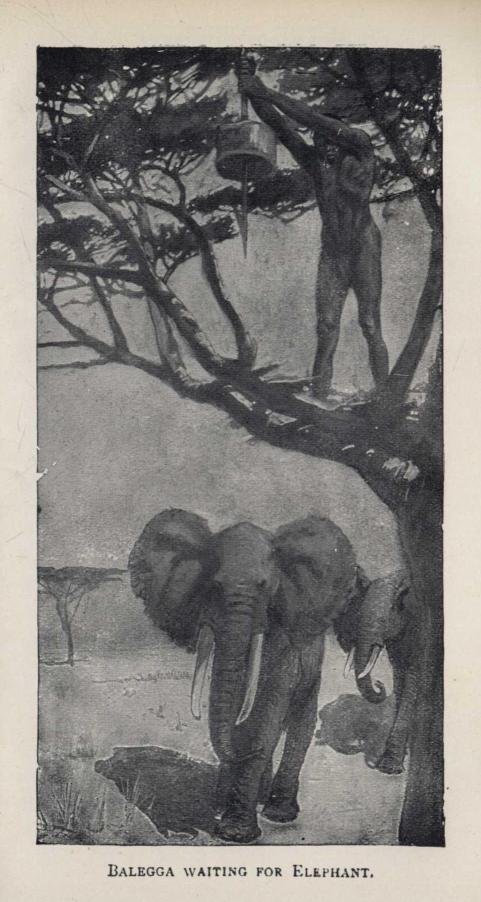
BALEGGA WAITING FOR ELEPHANT.
CHAPTER XIX.
KERO TO ABU-KUKA AND BACK TO BOHR.
As considerable anxiety was felt as to the fate of the steamer, which had been now three months absent without sending news, Inspector Chaltin decided to send Commandant Renier with a whale-boat to Shambeh to endeavour to obtain information, and very kindly offered me the opportunity of accompanying him, with orders to assist me forward in every possible way. As I was suffering from congestion of the liver, which prevented me from standing up straight, and from a remittent fever which showed no inclination to disappear, I gladly availed myself of the chance, knowing that activity alone would keep the fever in check, and that it was advisable to reach the sea as soon as possible. The camp was beaten up for volunteers to go with me overland either from Bohr or Shambeh, as circumstances might dictate, with the result that one small boy, a Dinka, and a mad criminal in chains, were forthcoming, with which formidable recruits on December 20th, I, an old Egyptian Dervish prisoner with a broken leg, a dozen soldiers, and sundry nondescripts, departed in one of the large whale-boats. I carried away with me many pleasing souvenirs of Inspector Chaltin's hospitality, and everybody's kindness and welcome, and also the sincere hope that never should I set eyes on Kero or any other spot on the Upper Nile again.
For several miles the stream follows the bank, then branches off to the east, and for miles and miles loses itself in a labyrinth of isles of weed. In vain we searched for a landing-place, and it was not till 5 p.m. that we found a small plantation of millet with a few wretched Baris stifling in a fog of mosquitoes on a mud-bank. The following day we paddled for hours, seeing nothing but tall reeds, hippo, and sand-spits, and eventually reached the left bank again at a spot called Semsem, owing to the immense plantations of that grain which existed here in the time of the Dervishes. Here there is a bank nearly 6 ft. high, with a large tree tenanted by hundreds of marabouts; to the south-west and north are swamps, and to the east, beyond the river, stretches one vast howling melancholy--reach upon reach of reed and rush, strips of lagoon, and again rush and reed, till on the far horizon a thin purple haze shows the line of the right bank.
The few Baris that we met on the islands informed us that they had come thither because they had been worsted in an encounter with the Dinkas to the north-west. Their villages were very scattered, the huts being dotted in ones and twos throughout their fields of millet. They beat the ground immediately surrounding their huts into a hard concrete, which they kept well swept, and upon which they dry the seeds of the nenuphar preparatory to pounding it into flour. As most of their huts were covered with strings of drying meat and strips of hippo hide, they would appear to be expert hippopotamus hunters. All their canoes are very tiny, and they work them with consummate skill. The amount of fish that they spear is wonderful. It is very sad to think how the Baris have been wiped out by the Dervishes. It will be remembered what a formidable people they were in Sir Samuel Baker's time; putting thousands of warriors into the field, and owning vast herds of cattle. Now, with the exception of those who took refuge in the Gondokoro hills, they are to all intents and purposes extinct. A few scattered settlements of miserable fisher-folk alone show the extent of the former Bari kingdom. The whole road from Krefi's kraal to Fort Berkeley is lined with the stone foundations of former Bari villages, and the country is strewn with discarded stones, used for grinding the corn. There is still, according to report, plenty of cattle in the Gondokoro hills, but with that exception and the exception of the few beasts owned by Ali-madi, all those vast herds spoken of by Baker have been looted and destroyed. Fortunately the Dervish wave did not reach further than Dufilé, so that the southern Nile above the rapids was left untouched. The country east of the Nile, except on the actual river-banks, was also practically untouched, hence the Eastern Dinkas escaped their depredations, and still own enormous heads of cattle. The Western Dinkas were less fortunate, as the Dervishes from the Bahr-el-Djebel and the Bahr-el-Ghazal penetrated far into the Niam-Niam country, and were at one time a serious menace to the Congo Free State. This is the only valid excuse for the Belgian occupation of the Nile; but I think the result could have been equally well accomplished by protecting the Congo Nile watershed. Still, the Belgians carried out their expedition with consummate ability, and all honour is due to Inspector Chaltin for his able leadership. It was a gross error of statesmanship that ever permitted them to obtain a footing on the Nile. For, however good their intentions, their methods are not ours; and their presence cannot but tend to unsettle the natives.
The key to the difference between their methods and ours lies in the fundamentally distinct objects for which we acquire territory. We acquire territory for generations yet unborn, trusting thereby to find an outlet for surplus population in the congested days to come. It is to the future benefit of the race that we look. We expect no immediate return. It is as with a man who starts farming, and with an eye to the future buys the call on the surrounding country. But with the Belgians it is quite different. They expect immediate returns. They say this country is no good, we can get no ivory or rubber, why do we stay here? And they are advising the evacuation of the Nile stations. It is as with a man who leases a vast tract of country and cuts down all the timber for sale, hoping thereby to obtain a large and immediate return on his money, ignoring the future, or believing his lease to be merely temporary. The greatest difficulty with which the Belgians have to contend--one that paralyzes all their efforts, however genuine--is the character of the tribes from whom they recruit their soldiers. I myself, having had experience of Manyema, can fully appreciate their difficulties in this respect. The majority of the tribes drawn upon are cannibals, and they are so low in the scale of civilization, and in many cases so vice-sodden from their association with Arabs of the Tippoo Tib fraternity, that it is impossible to make any impression upon them. Most natives can be touched in their pride or sense of the responsibility of a soldier's position. But these brutes are mere brutes, feeling the whip if it is laid on sufficiently thoroughly, and nothing else. As I pointed out to Inspector Chaltin, if the Congo State would draw its soldiers mainly from the northern tribes, such as the Makrakas and Niam-Niams, they would obtain the raw material that could be trained to a sense of responsibility and self-esteem. The ruffians that they employ at present cannot be trusted for one hour away from the superintendence of a white man. Cases of outrages committed by the mail-carriers on even the natives on the British side of the river are of daily occurrence. I can bear witness to the distress that they caused Inspector Chaltin, but they are inevitable with the existing state of the Free State forces. Another potent factor is the inadequacy of the commissariat arrangements; the Belgians are at present endeavouring to maintain about one thousand five hundred men in a country destitute of supplies. They have to make expeditions ten days' march into the interior to obtain any supplies at all. And I am convinced by the frequency of the shooting affrays that their methods of obtaining these supplies are not, in our ideas, legitimate. Knowing, too, the difficulty that we have in buying provisions for one hundred men only on the British side, and having seen the trade goods taken out by the Belgians, I am sure that "commandeering" is largely resorted to. Anyhow it is significant that all the natives on the Congo Free State side are retiring further and further inland, while the natives on the British side are rapidly resettling on the river-bank, from which they were driven by the Dervishes. Owing to the difficulty that the Belgians find in obtaining supplies, the ration per man is one small cup of millet a day; out of this he has probably to feed a slave boy, one or two wives, and Heaven knows how many children. Yet they all look sleek and fat. How do they manage it? The conclusion is obvious. When I was hunting with Captain Dugmore, the local natives on our side dare not go alone into the bush, as they said that they would be caught and eaten. Another great source of weakness is the Belgian method of treating their natives. They are too familiar with them, and then, when, as the inevitable result, the natives become impertinent, brutally severe. In treating natives it is indispensable to emphasize the distinction between black and white, yet at the same time to let the native see that you respect him in his own line, but take your own absolute superiority for granted. Hair-splitting justice is a sine qua non; and, I believe, herein lies our success with inferior peoples; it is the one thing that they can understand, and which inspires more respect than anything else.
On the third day we met the first Dinkas, miserable, amphibious objects, eking out a precarious existence on a semi-submerged island; here we camped, in a visible--nay, tangible--atmosphere of rotting fish, mud-caked niggers, marabouts, and kites; and at sunset, with a long-drawn expectant howl the mosquitoes arrived: little ones, big ones, black ones, mottled ones, a whirling, wailing fog of miniature vampires, that kept up the mournful dirge till the cold hour before sunrise, when with a sigh of relief we pushed off in our boat, and after five hours' paddling reached Bohr, which lies on the right bank at a sudden bend of the river. The original zaribas of the Dervishes and the more substantial earthworks thrown up when they heard of the occupation of Kero are already falling to pieces, and the elephant now takes his midday siesta midst the grinning skulls and calcined bones that are scattered about, all equally regardless of the wanton brutality of the near past. The past fades fast in Africa; yet another year, and the cotton-bush will have hid the mouldering relics of the earthworks, and the white ant will have seen the last grin of those gruesome jaws.
The fort of the Dervishes was of very considerable extent; about five hundred yards by six hundred yards, the long side lying on the river. There are still signs of a primitive effort at drainage, and the enormous quantity of cotton shrubs are a proof of the suitability of the soil to this product could it be brought within touch of a market. There are also unlimited numbers of gum-trees and tamarinds.
We had a few dynamite cartridges with us, and we obtained a good supply of fish by a couple of explosions. Amongst the numerous kinds that floated up to the surface was a curious fish similar to the species that I have mentioned as having been brought to me from the Ruo river near Chiromo. It was a long, eel-like fish, with the eyes covered by skin, the dorsal fin running down to and joining the diminutive tail. The snout was long and tubular, and the flesh lay in long, thin, delicate flakes like the flesh of the skate. Another species had the head and fore-part of the body encased in an adamantine shield armed with dangerous spikes on the back and by the pectoral fins. Its tail was shaped like the tail of a shark, which it resembles in general form, although the mouth was not underneath as with the shark's. A third species, very common all over this section of the Nile, much prized, and justly so, for the richness of its flesh, is covered with disproportionately enormous scales of circular form; its general form approximates to that of a red mullet. The commonest kind was the gorgeous tiger-fish, which is one of the most beautiful fish that swim.
There are large numbers of natives in the vicinity, and when we had at length convinced them of our pacific intentions, they brought milk and quantities of fish and fowls. It appears that such was the anxiety of the Dervishes in departing that the Dinkas succeeded in relieving them of their cattle. As a protection against mosquitoes the natives smother themselves in wood-ash, and the long lines of tall, gaunt, grey spectres slowly threading their way into the bush, each with a bright, broad-bladed spear, and a small gourd of milk or a decaying fish, present a very curious spectacle. Having stopped for a day to buy supplies, amongst which was a goat, rather less meaty than my hand, whose two hind legs combined would have had no chance against an English mutton-chop, we once more launched forth into the weary waste. We camped successively on a mud-bank tenanted by a few forlorn natives, from whom we obtained a small supply of grain at an exorbitant rate, and on a network of sun-dried hippo-holes whose authors resented our intrusion all night, expressing their disapproval by that strange variety of coughs, bellows, grunts, squeals, and roars peculiar to that misshapen pachyderm. Here we fired the 20 ft. reeds to modify the mosquito plague. They were very dry except at the base, and the terrific sheet of flame, capped by a vast cloud of smoke catching the red lights from the fire, afforded a picture of indescribable grandeur. It thundered away like a mighty sea of molten iron, licking up the country as it sped eastward; and we "smiled loud out" to think of the billions of mosquitoes that were perishing in its line; and the funny old hippo roared in astonishment, blinking their pink eyes at the alarming spectacle.
On the third day, having seen throughout the whole voyage from Bohr one tree at a distance of several miles, we were startled during lunch by the cry of "Steamer!" and rounding a bend in the river we saw the British steam-tub labouring up-stream with a bunch of ribbons that had once been a Jack flying at her stern. She was soon alongside, and we found on board Mr. Mulders, a naturalized American Dutchman, who built the Belgian steamer, in command, and two Belgians, one of whom was confined to his bed by a severe attack of sciatica which necessitated his return to Kero. In answer to our eager inquiries we learnt that they had spent the three months in the sudd, making prodigious efforts to cut a channel, and that eventually, after living waist-deep in water, sleeping on water, eating strange birds and being eaten by mosquitoes, steaming for miles in search of a stick or grain, they had abandoned their steamer, leaving her in charge of a few Askaris, and the whole party, including the French officer from Shambeh, who daringly followed them in a flotilla of native canoes, had started in the boats with the idea of dragging them by main force over the vegetation. The British boat was sent back with the sick men for supplies and mails, and with orders to return and patrol the vicinity of the obstructions at intervals of a week, blowing her whistle and endeavouring to find out whether the party would return, and, if no news had been obtained by the middle of March, to return with the Belgian steamer to Kero.
I consider this successful attempt of Capt. Gage of the 7th Dragoon Guards, and Dr. Milne, as one of the most daring feats ever accomplished in the history of African travel. They suffered indescribable hardships for nearly four months, during all which time they hardly slept one night on land; but were compelled to see the long hours of darkness through, night after night, cramped up in a small boat or lying on the vegetation, tormented by myriads of mosquitoes, and with very little more substantial than native porridge to keep their spirits up. Day after day, nothing but that vast expanse of weed of a hopelessness beyond civilized conception; day after day dragging their boats through and over stinking bogs and spongy masses of weed tenanted by a thousand crocodiles--not knowing where they were, nor, in characteristic British fashion, caring, yet ever keeping their face forward, strong in the knowledge that perseverance must succeed. Their food ran short, and to return was impossible. Had they not come unexpectedly upon Major Peake's steamers they would probably all have perished. Very few people can ever have any conception of the magnitude and apparent hopelessness of their task. The terror of those stupendous wastes! They have eaten like rust into my very heart, as they must do with all those who launch forth into their seemingly unending desolation.
From information I found it was impossible to land anywhere north of Bohr on the right bank, so decided that the only course open to me was to return to that salubrious resort. Commandant Renier kindly offered to take me on if I thought it worth while to make the attempt; however, it was obviously useless, and with a heavy heart I started back on my tracks. We steamed up-river until we came to the enormous Lake Powendael, which lies between the river and the left bank six hours north of Bohr, and there we anchored till morning, when we sent a boat ashore in search of wood. The lake is about twenty miles by ten, and very shallow, numerous banks covered with ducks, geese, pelicans, and other strange birds showing above the surface. The Dervishes were reported to have sunk their steamer here, but an exhaustive search by the small boat failed to find sufficient water to cover it; probably it was sunk in the channel near Abu-kuka or Shambeh, as these are almost the only spots where it is possible to reach the left bank. The following day we reached Bohr, and as one of my Wa Ruanda who had been sick was finished off by mosquitoes, and my Dinka had bolted with what he could lay his hands on, my numbers were reduced to my four Watonga, two small boys, one Ruanda, the criminal lunatic, and the youth from Kero. With these it was obviously impossible to start, and Commandant Renier kindly offered me some Askaris. Five boys from Sierra Leone turned up in answer to a call for volunteers, and with my numbers swelled to the vast total of fourteen, I made a start on December 30th.
CHAPTER XX.
IN DINKA-LAND.
The native information as to my route was decidedly discouraging, but knowing by now the value of native information, it was with reasonable hopes of success that I disposed of my bed and other luxuries, and put the first of three hundred miles behind me. As I started late, I camped at the first large village that I met, a distance of six miles from Bohr. Here there was an enormous population living round the extensive lagoons that stretched in all directions, and after the first few minutes of suspense, a brisk trade started in fish and grain, and eventually in milk. On the following day we succeeded in dodging several lagoons, but had to wade up to our necks and cross another nearly a mile wide on a very treacherous layer of vegetation. Skirting the edge of the water, we came on a herd of twenty elephant, and I dropped a good bull with a couple of .303's in the head. The quantities of goats and sheep possessed by the natives were extraordinary, enormous herds grazing in every direction in the rich vegetation growing in the swamps. After cutting off meat from the elephant, I followed one of the numerous paths which led inland, and meeting hundreds of natives on the way, arrived at a large, scattered village, where we camped.
The main population, which is very dense, lives in the bush at a distance of sometimes several miles from the river, and water is one of the most expensive supplies, though, except in seasons of severe drought, such as when I passed through, there are evidently numerous pools scattered all over the bush. Owing to the drought there was no grain obtainable, and the natives were eating the seeds of a water-plant resembling a crown-artichoke (the nenuphar) and the kernels of the before-mentioned plums. A very affable and intelligent gentleman, who had accompanied me for some miles, offered his services as guide, which I gladly accepted, and after marching for an hour I arrived at another extensive village. Here, as elsewhere, all the huts were isolated and surrounded by a fence of thorns to ward off the lions, which were very numerous. On the path we met hundreds and hundreds of natives, many of enormous stature, 6 ft. 4 to 6 ft. 6, who were going to cut up the elephant, and they were all very friendly. At the village I waited for my boys to close up, but after some time one was still missing, and as boys whom I sent back told me that they could not find him, I packed my people and belongings into one of the thorn-fences, and went back with one soldier and some Dinkas whom I persuaded to accompany me.
About a mile away I met my headman and my guide of the morning returning with the delinquent, who was none other than the criminal lunatic. It appears that he had decided to return home, and, as a preliminary, had distributed my blankets, mosquito-curtain, and clothes amongst the natives. By an extraordinary stroke of luck I recovered them intact, with the trivial exception of one of my two shirts; it was due to my guide, and he and the two men who brought them in were handsomely rewarded; so was the runaway. The flies by day, the mosquitoes by night, rendered life well-nigh impossible, and with visions of impassable swamps, waterless deserts, and famine in front, I heartily wished myself quit of Africa and all its abominations, as I have so often done before, and shall no doubt so often do again. In the afternoon, at the urgent request of many hungry Dinkas, I sallied forth and slew a good bull elephant. I had chased him for several miles, pouring in lead whenever I could see him, till at last he stood. This gave me my chance, and he dropped to a shot in the head. But as I was going up to inspect him, he suddenly rose and sloped away. I fired four shots from the 10-bore at him as he passed. At the fourth he stopped, turned his head towards me, and quite deliberately began to advance, examining carefully with his trunk every palm-bush. There was no unseemly haste about his action. He meant investigating the matter. My position was most uncomfortable, as, if I fired, I should give him my whereabouts, and certainly could not drop him; while, if I moved from the cover of the diminutive palm-tree behind which I was standing, he would immediately see me, and the country was too open to escape. So, for lack of another alternative, I waited. On he came quite quietly, that snake-like trunk writhing round every corner, till there were but two more palm-trees between him and me: out went that trunk once more; he stopped, swayed slowly to and fro, and fell with a mighty crash--dead. His tusks must have weighed about 60 lbs. apiece. It was heart-breaking to leave them lying there, and to think that I had had to kill such a magnificent beast for the sake of his meat. The natives were very much delighted, and evidently thought me a great institution, and for several days afterwards I was pestered with requests to shoot elephant, till I began to wish I had never seen such a beast. They promised to take the tusks of those I had slain to Bohr, and to give them to the steamer when she returned, but I don't suppose I shall see them again.[#]
[#] They turned up seven years later, the natives having kept them for me till a Government station was established.
The river, which is here one vast sea of grass, the opposite bank being quite invisible even from an eminence of 20 ft., continually branches inland in the form of long, narrow, meandering lagoons, which, I suppose, are apologies for rivers in this part of the world. As some of them are several miles in length, progress is very difficult, and every moment I dreaded to see a new one. However, I successfully dodged most of them, but had some trouble with one a mile broad, which we eventually passed by wading, the water being in places up to my boys' necks. At one time my small boy, with my revolver, prismatic compass, and coat, disappeared completely, but was extricated by an obliging Dinka of about 6 ft. 7 in. The prevalence of crocodiles, and a slimy bottom pitted with elephant-holes, did not facilitate matters.
Enormous numbers of Dinkas came to see me beaten by this obstruction; and after two hours' exhausting conversation in signs, during which I displayed all my remaining trade goods, I had still failed to induce a guide to show me the way across. In native fashion they all wanted to see what I would do. At last, utterly disgusted, I started to wade, intending to swim if we could not manage otherwise, as I dare not waste the two or three days that would be necessary to march round. When they saw that I was quite determined, several came with me and showed me the shallowest path across. They were hugely delighted when I presented them with a Jubilee medal and some beads, but said that they dare not go any further, as the next village was not their village, signifying that if they went they would be speared. A short march soon brought us to the village in question. The natives were rather nervous at first, but soon brought us plenty of rotten fish and a little milk. Here my surviving Ruanda man succumbed to the attacks of the mosquitoes, which defied description; he had been ailing for some time, and being too desperate to keep them off, he was literally sucked dry. It was absolutely necessary to turn in half an hour before sunset and to make all the preparations possible for the night. I piled all my belongings round the edge of my net, and kept a green wood fire burning at each end: then I lay inside, smoked native tobacco (of remarkable pungency), and prayed for morning. As soon as the sun went down they started operations. It was like having a tame whirlwind in one's tent. They could not possibly have been worse: had there been thousands more it would not have mattered, as not a single one more could have found room on any exposed part of one's anatomy. Every night two or three hundred contrived to enter my net; I have no idea how. The most pernicious and poisonous kind was a very small black mosquito, that might possibly have penetrated the mesh. I used to turn out in the morning feeling perfectly dazed from the amount of poison that had been injected during the night. The natives of the country obviate the nuisance by lining their huts with a deep layer of burnt cow-dung, in which they lie. They also smear a paste made of this ash and cow's urine all over their bodies. The women carefully collect all the dung and spread it out to dry. In the evening, when the cattle are brought in to be milked, they burn it. The smoke serves to keep the flies from the beasts during the milking. Then all the ash is collected and placed in the huts.
Following the river, we made good progress till a halt was called by the presence of a stupendous old bull elephant with magnificent tusks, who was dozing on the path. We shouted to him to get out of the way, and he slowly turned round, stalked towards us, and when within fifty yards curled up his trunk, spread his ears, rumbled and came. Crash went every load, and I found myself in a medley of tent and boxes, pots and pans, with a double .303 loaded with soft-nosed bullets, looking at him in amazement; but the shot fortunately turned him, and away he went, screaming and trumpeting, giving my blankets a parting kick as he swung round. This is the only time I have seen one aggressive without due cause. Owing to the absence of water and the quantity of plum-trees, of which they are very fond, there were enormous numbers of elephant along the river-bank, and except where they were on the path we scarcely noticed them, every day passing several herds. I was wild when I thought of the prodigious but futile efforts that Sharp and I made round the volcanoes to find them, when we had porters galore, while now, having no porters, I looked upon them as a nuisance, owing to the delay they caused. Here, and for some days afterwards, close to the line of bush, there was a well-defined river with a stream of one and a half to two miles an hour, which would be navigable for flat-bottomed punts. The numbers of hippo were incredible, literally thousands and thousands. At every two hundred yards there was a great purple bank of twenty, fifty, or a hundred lying with their bodies half exposed, while others were wandering about in every direction on the vegetation, islands, and mud-banks. They practically ignored our presence, though we often passed within ten yards of them. Other game was scarce; I only saw a few waterbuck, bushbuck, and once the track of a giraffe, though plenty of guinea-fowl, and a few ducks and geese; but these were of little use, as, on opening my last box of shot-cartridges, they fell to pieces, being eaten through and through with rust. At one village a native produced a recent number of Black and White, carefully wrapped up in a piece of goatskin, and pointed out with great glee a picture of Dreyfus; as I had no interpreter, and the natives no longer understood my ten words of pigeon Arabic, I have not the remotest conception how it came into this outlandish spot. It was very difficult to obtain supplies, owing to the general famine, so I shot another elephant, which came down to water near camp, and made my boys smoke a three-days' supply of meat. The following day we saw two large herds of elephant, one mainly composed of good bulls. Some, showing splendid ivories, refused for a long time to leave the path. We were compelled to stone them. Then, making good progress, we camped opposite a ferry, which led to an island where I could see some natives. They quickly collected, and in a few minutes there was a crowd of several hundred, with a solid hedge of spears glinting in the sun. At first they were very doubtful; then, suddenly realizing that it was all right, they swarmed across, yelling and whooping, and in one minute my diminutive camp was one howling black mass. At first things looked rather anxious, but some slaps on the back and a long-winded repetition of arâm, which appears to be the local form of salaam, quickly spread a broad grin over the mass; they brought me a present of about thirty large fish, and there was soon a brisk trade in milk, of which they had an unlimited supply, so that all my men had a good wholesome feed. They proved very friendly, and I much regret that our conversation was strictly limited to arâm, which, however, appears to have considerable significance, being invariably responded to by much grunting and a peculiar clucking noise like the soliloquy of an old hen. Every one in Dinka-land carries a long-bladed spear, a pointed fish-spear, and a club made of a heavy purple wood, while the important gentlemen wear enormous ivory bracelets round their upper arm; strict nudity is the fashion, and a marabout feather in the hair is the essence of chic. They are all beautifully built, having broad shoulders, small waist, good hips, and well-shaped legs. The stature of some is colossal. It was most curious to see how these Dinkas, living as they do in the marshes, approximate to the type of the water-bird. They have much the same walk as a heron, picking their feet up very high, and thrusting them well forward. Their feet are enormous. Their colossal height is, of course, a great advantage in the reed-grown country in which they live. They are the complete antithesis of the pigmy, as the country in which they live is the complete antithesis of the dense forest that is the home of the dwarfs. Many of these strange African peoples form most interesting reading to a student of evolution. The adaptability of a race to its surroundings is wonderful. The favourite pose of a Dinka is in reality the favourite pose of a water-bird. It is most interesting to note that surroundings should produce a similar type in families as remote from one another as birds and men.
My headman woke me in the morning with the pleasing information that my home-sick criminal had disappeared in the night, so the body of my tent had to go by the board, a severe loss, as afterwards transpired. During this day's march and a part of the next, the population changed entirely, the well-bred Dinkas giving place to a miserable fishing-folk, who are presumably the Woatsch spoken of, as reported to live here, by Sir S. Baker. They are an extraordinary people, of a very low stage of civilization, and showed abject terror at the sight of beads and cloth. I imagine they took me for a god, as each village, man, woman, and child, persisted in escorting me for a mile or so, doing the honours with a deafening chant, and continually pointing to the sun; this, though very flattering, hardly acted as a sedative on my fever, and I was heartily thankful to leave them behind; at one spot there must have been fully five hundred men who formed a solid phalanx round me, and sang at the top of their voices for a distance of two miles. They appeared not to have the remotest conception of barter, and hid their faces when I produced any of my trade goods, so that it was impossible to buy any food. Even during the night small bands approached to a respectful distance and chanted, and at one watering-place about a hundred loathsome hags danced a wild fandango around me, uttering the shrillest cries conceivable, and accompanying them with a measured flap-flap of their long pendant dugs; then, as a grand finale, all threw themselves on their faces at my feet, and with one ear-piercing shriek dispersed into the bush, leaving me under the impression that I was in the Drury Lane pantomime, outside two bottles of champagne. Never in all Africa had I met such embarrassing and impossible people. In the intervals of these trying performances I noticed that the country was slightly more elevated, and that there was a profusion of large trees. This would be the best position for a Government station. But it soon settled down again into the dismal flat of sun-baked clay, thorn, and palm-scrub, which in places recedes, leaving large plains that are flooded in ordinary seasons; here there were numbers of small buck, and I saw a beautiful male Cobus maria. It was a most handsome little beast, and was running with a large herd of other waterbuck, and had the same action as the Uganda kob. I was much disappointed, from lack of porterage, to lose the opportunity of procuring such a rare specimen. The variety of aquatic birds was enormous; amongst others, a beautiful black-and-white ibis; but I looked in vain for Balæniceps rex. The kites, marabouts, and vultures were a great nuisance. On several occasions a kite actually took my dinner out of the frying-pan on the fire while the cook's back was turned.
After the singing gentry, it was with no little relief that I met some respectable Dinkas again with large herds of cattle; they, too, appeared to be ignorant of the elements of barter, and it was only after an hour's dumb-crambo business that they brought an antediluvian fish as a feeler; this I immediately bought at great price, and then they realized that there was something in the idea, and brought a good supply. They have absolutely none of the fear of, and respect for, the white man that one finds all over Africa except in the regions of Exeter Hall legislation, but merely regard one as a great joke, and, on the whole, not such a bad sort of fool. They are all the most inveterate, pertinacious, and annoying beggars, and evince the greatest astonishment when one refuses to distribute one's belongings gratis amongst them. One in particular amused me, a 6 ft. 4 giant, who took a fancy to my last pair of trousers, and when, pleading modesty, I refused his request, he stamped and howled like a spoilt child. He then proceeded to make himself very objectionable, and forced his way into my tent, refused to quit, and brandished his club. This was too much, so I suddenly took him by the scruff of the neck and the seat of where he wished my trousers to be, and, trusting in the superiority of a beef and beer diet over one of fish and thin milk, to his intense amazement, ran him out of camp, and imparted a final impetus with a double-barrelled drop-kick, backed by a pair of iron-shod ammunition boots. I was surprised to find how weak he was, despite his colossal stature. The others took it as a huge joke, and an hour afterwards he returned and behaved himself very well, on the morrow guiding me for some miles.
From here the country changes completely, opening out into a limitless plain, dotted here and there with clumps of borassus palm, growing on small, flat-topped eminences which are the only possible camping-grounds. The channel (which I christened the Gertrude Nile, and which had never hitherto been more than half a mile from the bush) bends away to the west and spreads out into large marshes, though its course is still obvious, and the plain, which is a mass of matted, half-burnt reed, hippo and elephant holes, is scored with numerous channels of water and mud, and towards the bush, which is soon at least fifteen miles from the river, is covered with small ant-hills. There is an enormous population on these plains, with huge herds of cattle and goats, though it is impossible to say where they live, and they are wonderfully clever at hiding their cattle, and light smoke fires to prevent them from making a noise. I marched for hours without seeing a native, but when pitching camp I could see hundreds and hundreds advancing in Indian file from all directions, or if I took a line that led far from water, a group would appear like magic to put me right. There was something uncanny about knowing that one was watched by hundreds without ever seeing more than an occasional individual perched on one leg, the other foot resting on his knee, on the top of a far ant-hill, and looking like a long black stork. The first day that I camped in the plain I was visited by at least a thousand natives.
With the exception of one or two slight fracas with my boys, they were well-behaved, and I bought a large supply of fish; but the second day about fifteen hundred turned up, and having nothing to sell, became very obstreperous. They tried to steal, so I ordered the vicinity of my tent to be cleared, and hustled several fairly roughly. One turned on me, and I knocked him down, cutting my hand badly on his teeth. They took my rough handling very well, but immediately resented any movement of my boys, and one silly young blood danced a dangerous war-dance, brandishing his spear round one of my Askaris, till I broke it for him, and gave him two or three reminders with a heavy hippo-whip. They then became very much excited, and I spent the rest of the afternoon with my hand on my revolver, momentarily expecting a general émeute, when, no doubt, we should have fared badly. Fortunately, there were two respectable old gentlemen who did their best to keep the younger blades quiet. One man bolted with a bit of cloth; a miss-fire from my .303 saved his life, and one of the old gentlemen, not knowing that I had pulled the trigger, signed to me to hold, and had the cloth fetched back; he then succeeded in clearing the camp of about half the turbulent rabble, for which I was very thankful. They then began to slowly file off, but about a hundred, including some of the most noisy ruffians, remained; these I quickly cleared with a heavy whip in one hand and my revolver in the other. They did not like the whip and smiled at the revolver, evidently thinking it a sort of club, till I shot a confiding marabout which was watching the proceedings, when there was a race for first place to less dangerous quarters.
On the march we came upon a belated hippo out on the plain, and there was a great hunt, about two hundred natives chasing him and plunging their spears into his body, till at last, covered with blood, he turned to bay, when I finished him off with a shot in the head.
A few miles further on I shot a Senegal hartebeeste, which gave us a supply of meat. On the third day we succeeded in shaking off our too attentive friends, and although we marched for six hours only made seven miles, owing to the necessity of feeling one's way round the swamps and the difficult nature of the ground. In many places the burnt vegetation was of the consistency of coke, and severely cut my boys' feet. The plain still widened, and the Gertrude Nile tended more decidedly towards the west. The bush was no longer visible, but to the west of the swamps there appeared to be a slight ridge with a dense covering of borassus.
We camped near a cattle village, and the people seemed friendly, though, as usual, somewhat turbulent. Two came into the camp after dark, evidently to see if we were on the alert, and were summarily ejected. In the morning about a hundred came and gave considerable trouble, and persisted in following us on the march. I noticed that two or three were closing round each of my boys, while at the same time about twenty were packing behind me. I turned round to drive them off, when my fools of Watonga were suddenly seized with a panic, and, throwing their loads down, ran towards me, shouting, "We are all lost!" Of course that started the game, and my best Congo soldier fell, stabbed to the heart, and two more went down with cracked skulls. I took the chief and his right-hand man with a double barrel, then turning round, found my boy had bolted with my revolver. At the same moment a Dinka hurled his spear at me; I dodged it, but he rushed in and dealt me a swinging blow with his club, which I fortunately warded with my arm, receiving no more damage than a wholesome bruise. I poked my empty gun at his stomach, and he turned, receiving a second afterwards a Dum-dum in the small of his back. Then they broke and ran, my army with eight guns having succeeded in firing two shots. I climbed up a high ant-hill that was close, and could see them watching at about three hundred yards for our next move, which was an unexpected one, for I planted a Dum-dum apparently in the stomach of one of the most obtrusive ruffians, whom I recognized by his great height. They then hurried off and bunched at about seven hundred yards, and another shot, whether effectual or not I could not see, sent them off in all directions, and the battle was finished. It was all over in a shorter time than it takes to tell the tale, but while it lasted it was fairly warm. I never expected to see my happy home again, nor did I feel much happier when I had time to look round. I was alone; at my feet lay my Congo Askari, in the last spasmodic shudder of death; a few yards away lay three more of my men, streams of blood slowly trickling from gaping wounds in their heads. The distorted figures of the three Dinkas, shot at close quarters, were the only other breaks in the dismal monotony of the marsh. I shouted, and slowly--one by one--my miserable curs emerged from patches of reed and bog-holes. Then the three wounded came-to from their swoon; one was very slightly hurt, but the other two were quite mad for days after. It was necessary, therefore, to throw away still more of our belongings. There was only one thing that could go, and that was Sharp's 60g. Holland and Holland paradox, half of which is peacefully reposing under some scrub, while the other half is at the bottom of a mud-hole. After dressing the heads of the two soldiers, who, with the trifling exception of insanity, did not seem much the worse, one for a gash 2 in. long and down to the bone on his temple, and the other for two gaping holes on the top of his skull, we hurried on, fearing the Dinkas might return en masse. But they contented themselves with watching us, and when I dropped the topmost man of a bunch of five on an ant-hill at six hundred yards, they only made further observations at a distance of a mile.
The news spread like wildfire, for, several miles further on, when passing within half a mile of a village, a band of ten old men came towards me, waving their arms in the air to show that they were unarmed. I went to meet them, and when quite close they started the old singing business, so I hurried off, after treating them to several arâms with an attempted pacific intonation. They then sent milk after me, but I waved them off, thinking it advisable to try by forced marches to break the line of communication.
Shortly afterwards, crossing a swamp on a dangerous bridge of weed burnt to the water level, I saw a specimen of Balæniceps rex standing quite close to me. I was on the point of firing, when a hippo put his head through the bridge at about ten yards, and regretfully I had to shoot him instead for his beef. Half a dozen Dinkas appeared, and, after making a great pacific demonstration, approached and helped to finish him off. He took several shots, and each time I fired they ran to a distance of at least two hundred yards, so they had evidently heard of the morning's proceedings. After cutting off some meat we continued our march, and it was not till 4 p.m. that I found another place where it was possible to camp, having buried most of my beads on the road to further lighten the loads. For the same purpose, in the evening I made a distribution of cloth and burnt a quantity, together with all my boys' rags.
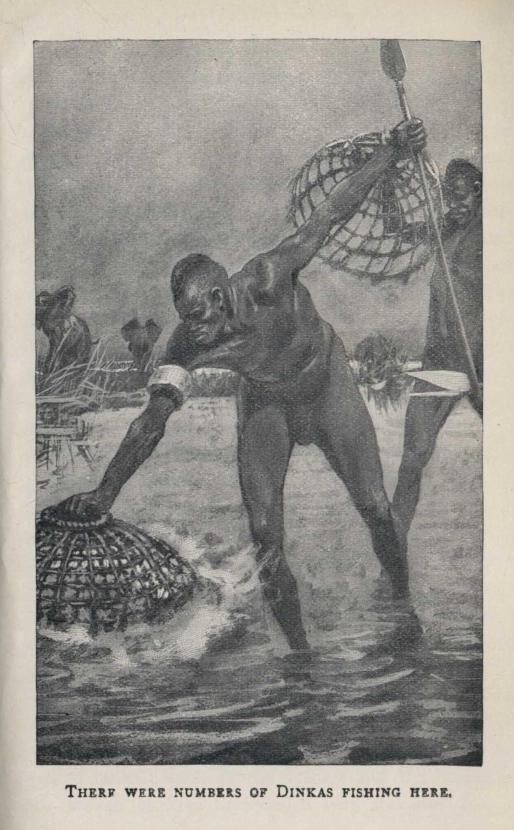
THERE WERE NUMBERS OF DINKAS FISHING HERE.
The night passed peacefully, though I thought it advisable to put on a double sentry, and on the morrow, weary of swamps, I struck east towards the great burnt plain, and then marched due north, trusting to luck for water. I found numerous holes where the water had not quite dried up, and met many isolated groups of desponding natives spearing a loathsome four-legged reptile or fish, some of which, for lack of more delicate fare, I had to eat; and after marching for about fifteen miles, I again came on extensive swamps which stretched far to the east, and seemed likely to give me much trouble, if not to effectually prevent me going further. Being totally ignorant of the country, and without means of asking the simplest question of the natives, I had been fearing all along that I should arrive at some impassable obstacle. I was very anxious on this point, as it would have been impossible to return. Arriving unexpectedly on the edge of the first pool, I found it one mass of small duck, with a spur-winged goose standing up in the middle. I fired at him with my .303, and he dropped, the bullet striking him with most unusual noise. My boy, wading in, returned not only with the goose, but also two duck. The bullet had struck the goose's back, removing his intestines and half his breast, then cut off the head and broken the wing of No. 1 duck, and neatly cleaned No. 2. It was a Dum-dum, and must have exploded like a shell. I have often noticed that the bullets with the most penetration, such as the solid, nickel-coated, and the Dum-dum, shatter small animals and birds more effectually than the more expansive bullets, such as the Jeffrey and the lead-nose. This stroke of luck provided a very welcome change to my mournful diet of doubtful fish, occasional milk flavoured with cow's urine, which is used for washing the dairy utensils, and a strange cheese of my own manufacture.
We camped on the top of a layer of burnt vegetation overlying a morass, and my tent nearly disappeared in the night, while I was seized with furious bouts of vomiting, caused by the quantity of salt in the water. To make matters more cheerful, I discovered that my last two tins of tobacco were mouldy, and I only wished that I could enjoy it as much as the mosquitoes appeared to do, who settled in clouds on the rim of my pipe waiting their turn for a space on my epidermis. Several either climbed inside or bit me through a pair of ammunition boots. I had a severe cold and a stiff arm; my cook boy had dysentery; one of the Congo soldiers had a dreadful foot, which rendered walking a terrible torture; and the two gentlemen with cracked skulls were semi-delirious, so that, on the whole, we were a jovial party, our joviality being materially increased by the impossibility of making a fire, owing to lack of fuel.