FROM THE CAPE TO CAIRO (continued 3)
Reading edition
The Soudanese officer in charge was most friendly, and the neighbouring chiefs arrived in long procession and paid their respects. They presented us with several goats and sheep, and when we expressed the wish to purchase more, they brought them along in a ceaseless stream. Subsequently we discovered that the affable Soudanese officer and his brother ruffians, hearing of our approach, had annexed several herds from some villages two days north; these were the beasts that arrived in such bewildering profusion. They had insisted on the owners accepting a handful of beads, thereby establishing a claim to legitimate purchase, and compelled the local natives to bring the beasts in to us as their own property.
There are numerous small villages in the vicinity of the post, and the people, who live in the most wretched huts, thrown up like hayricks, appear to have been very thoroughly bled by their undesirable neighbours.
An extraordinary feature of Kivu, and the rivers and small lakes of the Kivu system, is the absence of hippopotami and crocodiles. As they swarm in Tanganyika and the Rusisi to the south, and in the Rutchuru and Albert Edward Lake to the north, this is very remarkable. Probably the abrupt nature of the shore, the depth of water, and the absence of sandbanks and shelving beaches may account for it. The only possible landing-and-resting-places would be the papyrus swamps that I have mentioned as existing at the mouths of the streams; and the water, hurrying down from high altitudes, and shaded from the sun by the papyrus, is here intensely cold, and therefore unsuited to their requirements.
The natives brought us quantities of fish similar in appearance to bream, and of most delicate flavour. The same fish is common in Tanganyika and the Albert Edward. This was the only species that I saw in Kivu, and the natives told me that there are no large fish, such as are found in the other lakes. A conspicuous feature is the extraordinary number of large otters, which are to be seen in scores swimming and diving in every bay. Lake Ngami in South Africa is also remarkable for the number of otters, the skins of which are obtainable in quantities from the natives.
There are many butterflies on the rich pasture-land, the most common kind being almost identical with our Coleas edusa.
After a day's rest we marched to Ishangi, the base of Dr. Kandt, who is making an exhaustive study of all the "district." He was most kind, and gave us much useful information and advice.
His work is being done with characteristic German thoroughness. In a recent surveying expedition, in the course of which he travelled 560 miles, he found his error on rounding up the trip amounted to less than a quarter of a mile. This astounding result was obtained by counting every step, and taking three bearings a minute. It is this amazing attention to detail which makes the Teuton so formidable a competitor. Amongst many most interesting specimens, he had the finest pair of tusks that it has ever been my fortune to see. Unfortunately we had no scales, and it was impossible to judge of their weight. The elephant had been shot in Mushari, the country where I afterwards narrowly escaped being eaten. Hearing from the natives that the beast was in a small gully close to camp, Dr. Kandt sallied forth with four soldiers; only the back of the elephant was visible over the scrub, and they fired a volley at four hundred yards. One lucky shot hit the knee and disabled the beast, when the gallant doctor established a valid claim to having killed an elephant, as he naïvely remarked, by finishing it off. Close to Ishangi is Lubengera, the site of a former Congo Free State station, where a few black troops had been posted to raid cattle from the rich cattle districts of Lubengera and Bugoie.
The mean of my aneroid readings on the lake level was 5,000 ft., and the height of the hills contiguous with the lake ranged between 5,500 and 6,000 ft.
At Ishangi we purchased some spears, amongst others an interesting specimen from Bunyabungu, on the west side of the lake. It was simply a long, coarse spike, and the natives said that the people of Bunyabungu could not manage the final stage of beating it out into a blade. Dr. Kandt warned us about the thieving propensities and light-fingered ability of the Wa Ruanda, and told us how he had suffered from their depredations. One thief had entered his closed tent under the nose of the sentry, and abstracted a pair of trousers from under the pillow on which the doctor was lying. Another had removed the fly of his headman's tent. Consequently, the following night we took the precaution of carefully closing our tents, and of placing all the loads in the third tent, with men sleeping at each end. Notwithstanding, the following morning a tin box weighing 60 lbs. had been taken from my tent, and had completely vanished, while two canvas kit-bags had been abstracted, cut open, and the desirable contents removed. Thus, at one fell swoop, we lost our sextant, artificial horizon, boiling-point thermometers, a bag of one hundred sovereigns, all my trousers, stockings, and socks, and many valuable papers, books, and photographs. On this discovery we summoned the chief, our old friend Ngenzi, who had been hanging on our flanks for about forty miles. He arrived with a supercilious smile and a host of attendants. Having explained the situation, I asked him what he intended to do. "There are many bad men in my country of whom I know nothing," he answered, and again that evil smile flitted over his countenance. It was obvious that bluffing was to be the order of the day; so, taking the same line, we clapped him into the guard-tent, stopped his drinks and smokes, put a guard with fixed bayonets over him, and delivered an ultimatum to the effect that, unless the stolen goods were restored intact by midday, we should take further steps. Of course he protested absolute ignorance, but the sudden and resolute nature of our proceedings took him unawares, and for once the guile of the native failed him. Instead of protesting to a finish, which would have left us powerless to act, he produced by his men a few of the articles that seemed most important to him, such as caps and native shirts. This proved his complicity, and at twelve noon we decided to act. Sharp opened a case of Snider cartridges, issued rounds to the ten men who carried guns, and prepared the camp for defence; while I took my revolver and an old French cutlass purchased in Cornhill, and with my two Watonga carrying my rifles, climbed the hill on which the chief village was situated. Hundreds of natives with spears turned out and showed signs of an intention to resist me.
I harangued them, explained what had happened, and told them that my quarrel was with Ngenzi, and with Ngenzi only; that he had allowed thieves to come and steal the goods of strangers in his country, strangers who had come to see their country, to pass through it on a long journey to far lands, and who had come in peace paying for what they (the natives) brought, receiving and giving presents. I then told them that I was going to take all Ngenzi's cattle, drive it in to the German post, and let the Germans, their overlords, decide between us. I warned them that any man coming to the camp would be shot, but that they might bring food as usual for sale. Eventually, without firing a shot, I collected and drove in to the camp one hundred and ninety head of cattle.
They made a few tentative rushes at me, but were repulsed by the simple expedient of waving the cutlass in the air. Such were the terrible Ruanda people, whose reputation has spread far and wide, and whose country has been left alone for fear of their military organization. At least five thousand men sat on the hill-tops and watched three men with a revolver, cutlass, and two rifles drive off one hundred and ninety head of cattle; and I am inclined to think that most Central African warfare could be settled as easily. Had I had despatches to write I might have acted differently.
The Germans, overestimating the power of the Ruanda kingdom, had weakened the white man's prestige by subsidizing Ngenzi with extravagant gifts of cloth; and he imagined that he could bleed any one who came into his country.
I have always utterly refused to pay "hongo"[#] to any native, and never give presents until I have received one. Then, if the present is a liberal one, I give a yet more liberal present; but if the present is niggardly, I give the exact market value of the goods received, unless, of course, the niggardliness is due to poverty.
[#] Tax on people passing through chief's territory.
We placed a strong guard over the cattle, and removed our camp from the undesirable vicinity of the villages to a round, flat-topped hill half a mile to the south. At one end we pitched our three tents and arranged the boys' tents to complete the circle. Inside we fixed a long rope plaited from banana fibre, and kept in position by spears. Inside this circle we drove all the cattle, and we placed pickets round the side of the hill to guard against surprise or an attempt to stampede the herd. The moon rose about midnight, and during the hours of darkness Sharp and I took it in turns to go the rounds. The noise was appalling, as some of the cows had lost their calves; and one or two attempts were made to break through, but we succeeded in quieting them before the panic became general. Thanks to our precautions, the night passed without incident, and in the morning Sharp drove the whole herd over to Ishangi and gave them into the charge of the Soudanese, whom we had summoned from the post at the tail of Kivu.
Of course, immensely exaggerated accounts of our proceedings spread throughout the land, and the chief near Dr. Kandt went to him and asked him whether he had better fly from the country. He was promptly reassured, and the doctor kindly came over to see if he could be of any assistance, while the Soudanese officer sent his men to scour the outlying villages to see if they could find any of our property, but without avail.
Fortunately the natives did not attack Sharp on the road, and with the exception of some difficulty in crossing bogs, he arrived without mishap.
We sent in an exhaustive report to Lieut. von Gravert, and released Ngenzi with a caution. He promptly made up for lost time in the way of tobacco and pombe, and was most respectful. That sinister smile has for ever faded from his dusky features, and I am sure the lesson has been of inestimable benefit to him.
For many days to come it was curious to see the military appearance of our Manyema: no one stirred from the camp without two spears, a sword-knife, and, if possible, a gun with fixed bayonet.
The smaller fry were delighted at the humiliation of the mighty Mtusi, and many came in to do obeisance and thank us for our action.
Society in Ruanda is divided into two castes, the Watusi and the Wahutu.
The Watusi, who are practically identical with the Wahuma, are the descendants of a great wave of Galla invasion that reached even to Tanganyika. They still retain their pastoral instincts, and refuse to do any work other than the tending of cattle; and so great is their affection for their beasts, that rather than sever company they will become slaves, and do the menial work of their beloved cattle for the benefit of their conquerors. This is all the more remarkable when one takes into consideration their inherent pride of race and contempt for other peoples, even for the white man. They are most jealous of their descent, and no Mtusi woman ever marries any one but a Mtusi. A Mtusi man will take another woman as a working wife, but his true wife is invariably of his own stock, and her children alone can succeed to his position.
The half-castes, and individuals with any trace of Mtusi blood, form a medium between the full-blooded Watusi and the aborigines, whom they call Wahutu, but associate only with the upper class, or are the paramount chiefs of insignificant districts. Many signs of superior civilization, observable in the peoples with whom the Watusi have come into contact, are traceable to this Galla influence.
The hills are terraced, thus increasing the area of cultivation, and obviating the denudation of the fertile slopes by torrential rains. In many places irrigation is carried out on a sufficiently extensive scale, and the swamps are drained by ditches. Artificial reservoirs are built with side troughs for watering cattle. The fields are in many instances fenced in by planted hedges of euphorbia and thorn, and similar fences are planted along the narrow parts of the main cattle tracks, to prevent the beasts from straying or trampling down the cultivation.
There is also an exceptional diversity of plants cultivated, such as hungry rice, maize, red and white millet, several kinds of beans, peas, bananas, and the edible arum. Some of the higher-growing beans are even trained on sticks planted for the purpose. Pumpkins and sweet potatoes are also common; and the Watusi own and tend enormous herds of cattle, goats, and sheep. Owing to the magnificent pasturage, the milk is of excellent quality, and they make large quantities of butter. They are exceedingly clever with their beasts, and have many calls which the cattle understand. At milking-time they light smoke-fires to keep the flies from irritating the beasts.
All the dairy utensils are of wood, and are kept scrupulously clean; but they have an unpleasant method of repairing cracked jars by filling up the crevices with cow-dung, and of using the urine as the cleansing medium.
They are tall, slightly-built men, of graceful, nonchalant carriage, and their features are delicate and refined. I noticed many faces that, bleached and set in a white collar, would have been conspicuous for character in a London drawing-room. The legal type was especially pronounced.
Centuries of undisputed sway have left their mark in the blasé, supercilious manner of the majority; and in many ways they are a remarkable and far from unattractive people.
The Wahutu are their absolute antithesis. They are the aborigines of the country, and any pristine originality or character has been effectually stamped out of them. Hewers of wood and drawers of water, they do all the hard work, and unquestioning, in abject servility, give up the proceeds on demand. Their numerical proportion to the Watusi must be at least a hundred to one, yet they defer to them without protest; and in spite of the obvious hatred in which they hold their overlords, there seems to be no friction.
Formerly there was a far-reaching and effective feudal system, which constituted the proverbial strength of the kingdom of Ruanda.
The king was supreme, and the sole owner of all the cattle in the country; the large provinces were administered by prominent Watusi, usually blood-relations of his Majesty, whose power locally was absolute, but who were directly responsible to him for the acts of the subordinate chiefs and for the loss of cattle. Each subordinate, again, had the use of a portion of the cattle, for which he was directly responsible to the satrap of the district. The king's title is "Kigeri;" "Ntwala" is the title of the satraps; and the term "Sultani" is usually applied to the smaller chiefs. The old Kigeri died, and the rule passed to his son Musinga, who appears to have been a mere child.
There is a native superstition against the Kigeri being seen by strangers, and consequently a substitute, an individual known to the natives as Pamba Rugamba, has been presented to the Germans who have visited the Residence. The child appears also to have died, and the power now is divided between Kisunga and Gwamu or Mwami. Mwami was the name told to me by many natives, but it appears to be merely a title, as other natives addressed me as "Mwami." These two men were described as the sons of the old Kigeri, possibly by another wife than the mother of Musinga; but son is such an elastic term with natives that they may have been nephews. This division has materially weakened the strength of the Ruanda kingdom.
In Africa almost every kingdom is divided against itself, as well as against every other, so that unity is indeed strength. And it was this unity which constituted the power of Ruanda and of the Zulus, just as at the present day it constitutes the power of the mighty Dinka and Shilluk tribes of the Nile.
While Sharp was away I purchased several curios from the natives, and amongst others a most curious bracelet that I was informed came from the Nyema district of the Congo. It consisted of a semi-tubular circle of iron, the hollow being filled up with a crude ivory mosaic held in place by rubber.
The Germans, who have a favourable opinion of the possibilities of the Ruanda country, are talking of sending emigrants there. The soil is very rich, but the country is so inaccessible that I fail to see how they could be self-supporting--a desirable condition for emigrants--or how they could cultivate anything for export that would bear the cost of transport.
Amongst the natives who brought produce for sale were two pigmies; they were most curious little fellows, and appeared to be immensely powerful. I fancy they were not quite pure-bred dwarfs, or else they had been enslaved when young, as they had none of the shyness so characteristic of this singular little people, and appeared to be living with the local natives.
To the south-east the enclosing line of hills culminates in four large peaks of 8,000 to 9,000 ft. All four are conspicuous landmarks for many miles.
A favourite device of the Manyema carriers, when in a country of thieves, is to conceal a load of cloth during the night; in the morning they arrive in great distress, and say that a load has been stolen; nothing can be done; the unsuspecting traveller abuses the natives, the land, and other things, and the wily Manyema annexes the lost load on his return home. To obviate this, we informed them that every man in future would be held responsible for his own load, and that he would have to make good, out of his pay, any loss or damage. This was doubly necessary, as Swahilis and Manyema generally contrive to find a boy or starveling who will carry their load for a consideration. Apropos of this point, I find the following in my diary: "Talk about Charles Kingsley's description of sweating as a result of civilization! Here we have porters hiring natives who hire others to the fourth degree, each walking along like a gentleman and pocketing his proportion. There is nothing new in this world."
The difficulty of preventing our Manyema ruffians from swindling the natives was almost insuperable. After the Ngenzi fracas, I discovered that they were making capital out of our action to extort things from the natives; so I insisted that for a time every transaction should be performed before me. If a carrier wished to buy a bunch of bananas from a native, he brought the native with the bananas to my tent, and they bargained, and the price was paid in my presence.
One of the blackest of our villains promptly sent his small boy out into a neighbouring plantation, whence he issued in the scanty garb of a local native with a bunch of bananas. The villain, the boy, and the bananas appeared before me, and they solemnly performed the bargaining and payment. But I had been waiting for that villain, and without appearing to do so, watched the issue. They all repaired to their tent, and the boy resumed his garments, when they fell to on what they fondly believed was a cheap feed--a belief which a ceaseless succession of fatigue-duties soon dispelled.
Three fiords, several miles in length, necessitated a wide detour. The scenery was superb: a lacework of bays, lochs, and inlets with endless choppy waves of hills sweeping away to the great purple surf of the distant ranges; islets galore, and the vast rugged mass of the island of Kwijwi as a background.
For several days we had much trouble in allaying the fears of the natives; terrible accounts had preceded us, and the entire population fled to the hills on our approach. The fact of our carriers being Manyema, a name of terror throughout Central Africa, was not reassuring to the poor creatures, whose only knowledge of Manyema had been gathered from the Congo Free State soldiers, who for a time had been posted on Kivu, and from reports of the atrocities committed by the revolted troops during the past five years. Accounts also of the cannibals who were battering at the gates of Bugoie must have reached them from their northern kinsfolk. Black masses of natives in a silvery sea of glinting spearheads watched us from every hill-top. Fortunately we had several days' food for our men, and when the natives saw that we passed through without touching even a bunch of bananas, they were reassured, and a few were eventually induced to approach and talk. We caught two of our men stealing, and inflicted condign punishment before a small body of natives who were in camp, explaining the circumstances, and telling them, in case of a repetition of the offence, to come and lay a complaint. But it would be easier to stop a monkey from scratching than a Manyema from stealing; and as the state of unrest of the native population was a grave danger, and petty thefts would probably have precipitated an attack, which we were ill prepared to repulse, we confined all our boys to camp, made water-carrying for the whole camp a fatigue-duty, and established a market where the natives might sell their produce under our personal supervision. I explained the expediency of our action, and told them that there were some such abandoned ruffians amongst them that they must all suffer for the misdeeds of the miscreants. They appeared satisfied, but as we were sitting down to lunch, I noticed an unusual stir in the lines. On going out I found that they were all packing up their belongings and preparing to depart; about thirty were already moving off. It was obviously an attempt to bluff us, as the experience of the boys who ran away at Tanganyika had taught them that it would be impossible to avoid detection even if they succeeded in passing through Ngenzi's country, which they knew would be impossible in view of the then state of the natives. It was a critical moment. If the camp broke up, the entire expedition would be inevitably massacred by the Ruanda. I took my rifle and dashed off in pursuit, accompanied by my two Watonga; while Sharp, revolver in one hand and rifle in the other, threatened to shoot the first man who moved. Rushing over a rise, I saw the ringleader, one of our worst villains, and the originator of the idea, leading about two hundred yards away; I fired at him, just as he turned the corner of the hill, fully intending to drop him. The bullet removed his fez. Down he dropped into the grass, and the whole thirty did likewise. After a few shots in the air, to keep up their anxiety, I sent a headman out to order them back to camp, saying that the affair was now ended, and that I should not know who had left camp. As I expected, every one was present at roll-call, half an hour after dark. The position was saved. In the course of a long harangue, I informed them again of the absolute necessity of confining them to camp till the natives should be reassured; explained that I had spared the ringleader this time, and had removed his hat to show him with what ease I could have killed him had I wished to do so (a remark that my gun-bearer, Makanjira, assured them was true); said that it was for their benefit that we desired friendly relations with the population; we had no desire to see a lot of dirty natives, we wished nothing from them; had we not, as they well knew, food for many weeks in boxes? But if the natives refused to come, where would they be able to buy goats, fowls, tobacco, and all the things that rejoiced the stomachs of men?
The bluff was outbluffed, and with ringing cheers the men returned to their fires to jabber and howl with laughter far into the night. From discontent to merry laughter is but a momentary transition with the African.
From the ridge on which we were encamped we looked down upon a perfect spot, a long arm of the lake winding in between striking hills, terminating in a small bay. Banana palms with the tiny villages nestling in their midst fringed the shore. Weird little islands covered with ibis and demoiselle crane were dotted about. A wall of papyrus showed where the tumbling stream that danced down the encircling hills entered the lake, and the glorious colouring and strong shadows brought out the picture into striking relief. Sharp said it reminded him of Japan; there was an air of dolce far niente heavy with the lush glamour of the tropics that carried me back to the South Seas.
The following day we succeeded, after much shouting, in inducing a half-bred Mtusi to come to us. We gave him a present, and told him to go and explain that we wanted to buy provisions; and that if the natives would not come we should be compelled, much against our will, to take what was necessary. He departed, promising to do so, but nobody appeared. After waiting several hours, I took ten men out with me, and cut sufficient bananas for the men; and though I tried for two days to induce the chief to come for payment, he never appeared. This was the sole occasion during the whole of my long trip in Africa when I had to commandeer anything from the natives. I quite agree with Colonel Lugard when he says that it is unnecessary. This was the last time that we had any difficulty with the natives. Seeing that we refrained from looting their fields, they plucked up courage, and came in the same numbers as when we first entered the country. The hordes of warriors whom we had seen sitting on the tops of the hills in the distance came and mingled freely with our men, and a brisk trade started in the numerous products of the country. From many of our camps the scenery was most beautiful; as we rounded the south-eastern corner of the lake, the whole expanse of water opened out before us. The track we followed often led over hills 1,500 ft. above the lake; and from many positions we could look down on the vast oily expanse of water, deep set in its basin of innumerable hills, dotted with a thousand islets, stretching far away till it was lost in the shimmering haze of the northern shore, where, crisp and clear, towered the mighty mass of Mount Götzen, whose jet of smoke alone broke the steel-blue dome of sky.
Close to this part are the sources of the Nyavolongo, which are the real sources of the Victoria Nile. At the actual angle of the lake there is an extensive valley, which is the real frontier of Ngenzi's district, Mukinyaga. Every available inch of this extensive fertile valley is covered with luxuriant crops of beans, peas, sweet potatoes, and millet. To the east, up this valley, lies the road to the old Kigeri's residence, which is about five days' march from the lake.
Here there is a district which is divided up amongst many chiefs, and which seems to have no representative name. At the mouth of the stream that flows down this valley, the lake shores, if possible, are still more broken than elsewhere. The hills which cover the country around Kivu appear to have been sprinkled out of a pepper-pot, they are in the main disconnected, and the country seems almost to have boiled. The hollows are in places filled with papyrus swamps, many of which have drained dry, and now form level lawns a few feet above the lake.
The population round this valley is enormous. The northern wall of the valley rises very abruptly, and the path led along precipitous passes. The scenery is most striking. From the top of this plateau we caught our first glimpse of the volcanoes, the sharp outline of the four main peaks standing out clear and crisp above the misty haze that surrounds their base.
One day's march brought us to the district of Lubengera, which is remarkable for the number of Watusi. There seems to be no prominent chief among them. The banana plantations are of amazing extent, and literally clothe many of the hills from top to bottom. In this district especially we remarked the extreme neatness of the fields and the scattered nature of the villages. The Ruanda do not live together in great numbers, but are scattered far and wide over the country; their villages would perhaps be more aptly described as farms.
It is remarkable that throughout the whole of this country, as in the valley of the Rusisi, there were no antelope, and until we arrived near the wooded slopes of the volcanoes, where a few of the natives had bushbuck skins, we never saw any traces of their having been obtained.
All the natives of Ruanda are great smokers; they use small, neatly-made, and sometimes grotesquely-carved, black clay pipes. At this stage we were much troubled by complaints from our boys of petty thefts. On going thoroughly into the question, I found that besides the numerous slave boys whom our Manyema carriers had brought up from Ujiji, they had picked up many more on the road. Some of these had recently bolted, taking everything upon which they could lay their hands. As it was desirable to stop this, we had all the boys' boys brought up, and registered them. All those who could not show that they had come either from Ujiji or Usambara were given twenty-four hours' notice to quit. I also forbade our carriers to hire local natives to carry their loads, and thus rendered our caravan on the march much more compact, and thereby less open to attack.
On the far coast of the lake two striking hills were plainly visible; these are evidently placed on the two promontories which I have suggested as existing in my map. From the numerous observations which I took, I came to the conclusion that the islands to the north of Kwijwi have either risen since Count Götzen's visit, or else that he underestimated their size; which seems scarcely possible, as he actually landed on one or two of them.
As we were approaching the north end of the lake, several attempts were made to raid the camp at night, and at one place in particular the thieves were very resolute, and succeeded in stealing many small things from the boys. The sentry came and woke me up during the night, and told me that persistent attempts were being made to enter the camp; so I went out, and taking up my position outside the lines, under the cover of a small bush, I succeeded in capturing one of the thieves by collaring him low. This form of attack was unexpected, and though he was greased he failed to escape. The following morning he was handed over to the chief, and suffered the usual penalty of convicted thieves, his head being cut off and placed on the path, as a warning to others. This fortunate capture definitely settled the thieving question.
After crossing the Kashale, we entered the populous and fertile district of Bugoie. The chief is variously called Gwamu or Mwami, and is now, as I have before stated, one of the joint kings of Ruanda. All the way up this coast the scenery is exquisite; nowhere, except in the sounds of New Zealand, have I ever seen anything so fine, and the nearer we approached to the mighty volcanoes, the more dazzlingly beautiful and the more imposing it became.
At one of our camps we were besieged by an army of biting and poisonous ants, and I was just turning in when they assaulted my tent. Countless thousands swarmed all over my blankets and into my boxes and my clothes, and over every available inch both of my person and belongings. Calling my boys to my rescue, we endeavoured to save at least a blanket, and fled precipitately. But so thick were they that it was impossible to escape them. However, eventually the main body had moved on to other people's quarters, and I succeeded in rescuing my camp-bed, which I fixed up in another tent with all four legs in basins of water; by this means I managed to pass the night without more than three or four hundred around me. Sharp, who at first had looked upon it as a great joke, became the main object of their attentions during the small hours of the morning.
Here the people became very friendly again, and one chief provided us with two guides and two cattle-men, who undertook to go with us as far as the northern slopes of the volcanoes. One of these guides and one of the cattle-men bolted the following day with a few trifles, but the other two stuck to us well, and found our company so agreeable that they even followed me right through to the Nile, where they met a sad fate.
The Ruanda people are even more superstitious than most Central African natives. They wear medicine (native name dawa) to guard them against every conceivable ill, such as pains in the stomach, leopards, death, etc., etc. It is curious that the natives, like the lower animals, seem to be unable to grasp the fact that they will die; such a thing as a natural death they cannot understand, and always attribute the event to some form of violence, which, if not obvious, they describe as the effect of the "evil eye." The tip of a cow's horn, inlaid with ivory, is considered particularly efficacious against a pain in the side; and if a man wears two small leather bottles round his neck, he can never die. A large red bean is a sure preventive against leopards. One native wore an extraordinary bracelet; it was made of wood, and beautifully worked with various metals; the total weight must have been at least two pounds. He promised to come into camp and sell it to me; but, having promised, naturally did not come. Of all the liars in Africa, I believe the people of Ruanda are by far the most thorough. I have pointed to a mountain 13,000 ft. high, at a distance of three miles, and asked my native guide whether there was a mountain there: he would say "No!" On the march, if I asked whether there was water near, and he told me "yes," I knew that it would take at least six hours to find the next stream, and therefore camped where I was; if, however, he said that there was no water, one could be perfectly certain of finding several streams within the course of the next ten minutes. Even amongst themselves they appear to talk in the same way, and many of the instances, such as I have mentioned, are so extraordinary that I cannot help thinking that it is a custom. I believe at one place on the coast there is a form of Swahili which is spoken backwards, or rather the end of the word is put first. It seems to me to be just conceivable that the same train of reasoning may affect the habits of speech of the Wa Ruanda.
The natives assured me that there were many elephant on the north side of the volcanoes and also to the west, in the countries of Mushari and Gishari; for this reason I was sorely tempted to doubt their existence; however, from Dr. Kandt's remarks we thought it would be worth while, later on, to go and see.
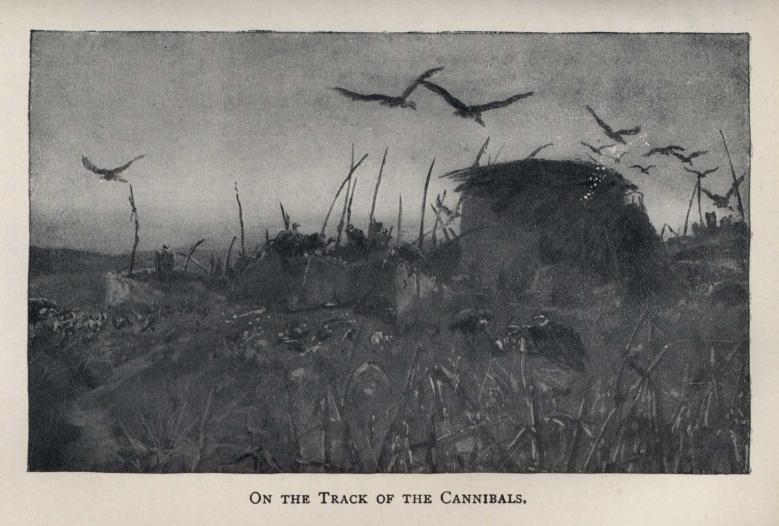
On the Track of the Cannibals.
We had a lot of trouble with our cattle-folk. The head cattle-man was a most persistent, pertinacious scoundrel, and as soon as he was detected in one villainy he invariably tried another; the result being that, although we had ten cows, there was barely enough milk for two people, and butter was quite out of the question. So we determined to take the thing in hand, and make a big effort to find out where the leakage was. As we had expected, under our personal supervision, there was a quantity of milk, enough for us both, and plenty with which we could make butter.
The method of making butter, a task which was entrusted to the headman's wife, is as follows: The woman squatted down on the ground, and taking an enormous flat gourd, containing milk which had been kept for three days, she proceeded to rock it to and fro, bringing it up short against her thigh. She assured us that, for the purpose of obtaining butter, it was absolutely necessary to insert two small pieces of wood as medicine. Judging from the quantity of butter, I doubted its efficacy; and suspecting that there was some new villainy in hand, as we obtained about a quarter of an ounce of butter from a bucket full of milk, we waited till the process was complete, and then told her to bring the gourd to us. All my doubts as to the efficacy of the two bits of wood were removed when I discovered that they were just large enough to jam in the neck of the gourd, and that, perched on the top of them, was a pound and a half of butter. She was quite unabashed at the discovery, and evidently mentally prayed that she would have better luck next time, which I have no doubt she did, although not in that particular method.
On our last march up the side of the lake the cattle were, owing to the steep nature of the road, left a long way behind; a band of natives attacked them, but the cattle-guard, firing a few rounds, which did more harm to themselves than to anybody else, repulsed the attack. Hearing about it, I sent Makanjira, my gun-bearer, back, and with his help they brought them all in without mishap.
At the north-east corner of the lake there is an abrupt descent, and to the north of the lake the country is flat, gently sloping to the base of the large, active volcano.
CHAPTER XI.
THE VOLCANOES.
At the base of the descent there is a small bay, the resort of many fishermen, and beyond, two small isolated peaks, on the slope of one of which we camped. In the evening I climbed to the top of the one nearest to the lake to take observations of all the promontories down the east coast.
I think the view is the finest I have ever seen. Far to the south stretched the mighty expanse of water; dark promontories of every shape and size jutted far into the lake; Kwijwi stood out in bold outline; and the mighty wall of mountains on the west was dimly visible on the far horizon. Below me stretched a great plain, the eastern part densely covered with fields of millet and banana plantations, dotted with a thousand huts. In all the fields hundreds of women were working, and small herds of cattle and goats were slowly wending their way to the lake. To the west, the plain was covered with young forest. To the north towered the terrific mass of Mount Götzen, vomiting forth a great volume of black smoke. The old volcanoes towered aloft above the clouds, which swirled in constant eddies about their base. Entranced with the view, I waited till the sun declined and dropped like a molten ball behind the bold outline of the hills; then the moon came up, bathing the waters of the lake in silvery light.
The natives visited our camp in hundreds, and brought numerous presents of goats and sheep, and an unlimited quantity of supplies for sale. We told them that we wanted to buy eggs--a request that always astonishes the natives, who are not used to the ways of white men, as they themselves never eat them. One old gentleman rushed away, and shortly returned, bringing a dirty basket with a frowsy old hen and about fifteen small chickens emerging from the eggs, and was surprised because we said they were of no use to us. We tried to explain that we preferred them fresh, and he evidently thought that we were making a fool of him.
Here we were informed that in the pass between the volcanoes there was no water, and that we should have to purchase what we required at great price from the natives, who obtain a purple liquid by tapping the stems of the banana palms.
The large volcanoes, of which there are six, fall naturally under two heads. The two western ones are still active; the highest I have described on my map as Mount Götzen, in honour of Count Götzen, who was the first to discover Kivu, and who made the ascent of the peak which I have named after him. Owing to the impossibility of obtaining representative names to these mountains, I have suggested names for them. On one of the mountains on which I camped, I obtained no less than thirty-six names of the same place. Mount Götzen is a stupendous mass, and has three craters. The central crater, described by Count Götzen, is very extensive; the bottom of the crater is quite flat, and has two cleanly-drilled vent-holes; the northern and the southern craters are now extinct. It is covered with the densest imaginable forest, almost to the summit; and Count Götzen found it absolutely necessary, during his ascent, to fetch all water from the lake.
Slightly to the north-west of this peak another volcano, covering an enormous area, has formed since Count Götzen's passage through the country. He mentions considerable activity at the end of the ridge; and two years before I passed through the country there had been a terrific eruption, in the course of which this volcano formed; its crater is several miles in circumference. I have described it as Mount Sharp, after my fellow-traveller.
The eastern system is still more imposing. The four main peaks have long been extinct, and the form of the highest, which I have described as Mount Eyres, after Mrs. Eyres of Dumbleton Hall, Evesham, is very striking, reminding me forcibly of the Matterhorn, as seen from the Riffelalp. The height of Mount Eyres is over 13,000 ft., and its summit was almost invariably covered with snow in the morning. A dense, impenetrable forest runs up to a height of 11,500 ft., above which there is open woodland. The actual summit, or last 500 ft., is practically bare. The top has the appearance of slightly overhanging, and shows some bold rock faces. The next volcano in the chain I have described as Mount Kandt, after the eminent scientist who is making such exhaustive studies of Ruanda and the north-west territories of the German sphere.
We insisted upon all our boys buying gourds for water, in case of there being any difficulty in obtaining it on the road. The waterless stage to be traversed was a long one, and we therefore only made a short march, and camped at the last watering-place, which was about four miles from the lake. This was the site of Gwamu's village. Gwamu himself, following the traditions of the Ruanda kings, retired to the mountains, but left his headman to receive us with a handsome present of goats and necessaries.
The population here was enormous, every available inch of country was cultivated, and this portion of Bugoie is undoubtedly the most prosperous, the most densely populated, and the most fertile spot that I have seen in Africa.
Fifteen miles to the east, the range that encloses the Rift Valley culminates in a striking peak. It is known to the natives as Hembe è Bugogo. This peak is at a pronounced angle in the range; and northwards the enclosing hills recede towards the east. The volcanoes themselves are a quite distinct system, having risen out of the bed of the Rift Valley.
On the following day we started on our waterless march with many misgivings. Our route lay along the base of the hills, then over a small chain of extinct volcanic craters, then across the flat, swampy plain, which lies to the east of Mount Götzen. In all directions there are isolated, extinct craters, still perfect in form, and invariably terraced and covered with crops of peas and beans.
We camped in the vicinity of three large, straggling villages. The natives were not very friendly at first, although the headman of Gwamu had accompanied us, and about tea-time one of our men rushed in to say that the herds had been attacked and that they had lost thirty goats and sheep, and that one man had been wounded with a spear. I hurried out to the scene, but it was too late to do any good, and I returned, bringing in the remnants of our flocks.
The path then passed over the summit of the pass between Mount Götzen and Mount Eyres. I found the height to be approximately 7,000 feet. Half a mile from our camp I discovered a small cave open at both ends, in which there was a pool of water, which the natives refused to drink; whether from superstition or because the water is poisonous, I could not say.
At the base of Mount Eyres there are several small craters, and on the north side of the base there is a little rugged patch of country, where the path descends into abrupt ravines, and passes through a strip of the most luxuriant tropical forest, on the far side of which the wonderful pastures, characteristic of this country, recommence. Here, we were told, was the elephant country.
Gwamu's headman was still with us, and he brought in many of the surrounding chiefs. At first they were very friendly and brought us plenty of supplies for sale, the article of exchange in greatest request being salt. Judging from their phenomenal mendacity, I can quite understand their need of it.
Here we purchased several bows made by the dwarfs. They are quite distinct from any other bow that I have seen. The arc is in two pieces, an outside sheath of split cane with another piece of wood let in to the groove; both are neatly bound together by reed, and the string is composed of one blade of a very tough reed which grows in the forest. We also procured some strings of beads which the natives said had come from the west; they are very primitive, and appear to have been made of some kind of shell.
The following morning we went out in search of elephant.
The forest was full of traps set by the Pigmies. The ordinary type was a bamboo bent towards the game-path with a string fastened to the ground, where it was tied in a running noose; by this means, I am informed, they catch many pigs and small quadrupeds of the forest. They also fix spears, weighted with heavy blocks of wood, in the trees, and the elephant passing underneath releases the spear by breaking the cord with which it is attached; but I think their usual method of slaying elephant is by firing poisoned arrows into them--having done which, they follow the unfortunate beast for days, until it drops.
The country was so impenetrable that hunting was a practical impossibility, so two days later I started with ten boys to see if I could find an easier hunting-ground. I passed round to the north of Mount Eyres, and pitched my camp on an eminence of 9,000 ft., overlooking the Rutchuru Valley. Here I immediately found fresh elephant-tracks. A herd of ten had passed towards the north, and a solitary old bull had gone towards the forest on the mountain slope. This I elected to follow, and in an hour and a half I could hear him not far away, tearing down branches of trees. His spoor was bigger than any spoor I have ever seen, and the size of the brute, when I first saw him, filled me with astonishment. Unfortunately he was not standing broadside on, and it was impossible for me to go round. From where I stood, I could see the small glade in which he was standing, but could only see a portion of his head and the ridge of his back. I watched him for some time picking the leaves off a tree; then, having eaten all the leaves within reach, without apparent effort he seized the trunk of the tree about 16 ft. from the ground and laid it flat. The tree had a diameter of more than 2 ft. Fearing that he might move into the impenetrable jungle that surrounded us, I took the shot, difficult as it was; he fell, but instantly recovered himself and dashed away, getting the second barrel in his flank as he did so. For several hours I followed him, without getting another shot, though I found where he had again fallen down and lost much blood. A few hundred yards further on I heard him in some very thick bush; my guide, who was following on the spoor, refused to advance, and I had perforce to take the lead. The wind was very shifty, and he suddenly detected our presence, venting his disapproval in a series of unpleasant grunts. Suddenly, hearing a great crashing of bushes, I thought that he was moving away, and hurried forward as fast as the difficult track would allow, in the hopes of catching a glimpse of him. The noise was terrific, and it suddenly dawned upon me that, so far from moving off, he was coming on. I was powerless to move--a fall would have been fatal--so waited; but the forest was so dense that I never saw him till his head was literally above me, when I fired both barrels of the double .500 magnum, which I was carrying, in his face. The whole forest seemed to crumple up, and a second later I found myself 10 ft. above the ground, well home in a thorn-bush, while my gun was lying ten yards away in the opposite direction; and I heard a roar as of thunder disappearing into the distance. A few seconds later, the most daring of my boys, Zowanji, came hurrying along with that sickly green hue which a negro's face assumes in moments of fear, and with his assistance I descended from my spiky perch. I was drenched with blood, which fortunately proved to be not mine, but that of the elephant; my gun, which I recovered, was also covered with his blood, even to the inside of the barrels. The only damage I sustained was a slightly twisted knee. I cannot say whether the elephant actually struck me, or whether I was carried there by the rush of country.
Following on his tracks, I found enormous pools of blood, and half a mile further on I again heard grunts, which showed that he had caught my wind. He rushed about, uttering those strident shrieks that are so terrifying, but, after his last experience, refused to charge. I spent an exceedingly nervous five minutes, while he devastated half an acre of forest. Then he moved on again, and it was not till two hours later that I caught him up. He was standing in a dense bamboo thicket, and I fired the .500 at his head; he fell to the shot, but quickly recovered and went away. Yet another time I caught him up, and approached within ten yards, but the thicket was so dense that I could not see an inch of his body. I might have turned his flank, but in so doing should have given him my wind, and I funked it. He shortly moved on, and after twice falling pulled himself together, and went through the bamboo forest at an increased pace. I followed hard, but never saw him again, and at sunset was compelled to give up the chase.
We were at an altitude of 9,000 ft. and spent the night sitting naked round a fire, while the rain beat out any lingering sentiments for elephant-hunting that had survived the day's work. The old volcanic soil of these forests is so porous that above the valley there are no streams. We had had nothing to eat or drink since 6 a.m., and it was not till 11.30 the following morning that we found a cattle-station in the forest. Here we drank a quantity of milk, and eventually arrived in camp at two in the afternoon. My boys were almost dead with fatigue, and I myself slept for fifteen hours without rocking.
In following elephant through these forests it was necessary to cut one's way with a native axe on the path that the elephant had traversed only five minutes before. At times, for many yards one never touched the ground, but had perforce to climb along the tree-trunks, and the dense vegetable growth, constantly slipping and falling into thorn-bush and nettles, all of which the elephant would take in his stride; while the bush was so solid that, after the elephant had brushed it aside, it flew back to its original position.
This nettle, which, I believe, is peculiar to these volcanoes, is the most appalling creation that I have ever dreamed of. Some were 10 ft. in height, and it was impossible to brush them aside; they were covered with myriads of long, almost invisible, spines, which penetrated khaki, flannel, and everything except leather. The pain produced by contact with them was nearly unbearable, but fortunately subsided in about ten minutes. At times they were so bad that my natives could no longer move, and I had to beat down a track before they could pass. Many times they sat down and howled like babies. Some of the trees that had been torn down by the elephant were of enormous dimensions, and I had never before even guessed at the stupendous power of the African elephant.
I found that the country here was no easier than that which I had just left, and therefore marched north down the long sloping spur that leads into the valley of the Kako.
The district round the base of Mount Eyres is called Bwisha. It is ruled by a powerful chief called Kahanga. His main village was elaborately protected by a palisade, around which trees and creepers had been planted to consolidate the structure, and it was surrounded by many smaller villages. The whole of the adjacent country was densely planted with banana, and all the intervening land was covered with fields of peas, beans, and millet.
My track led down a small stream that flowed into the Mungawo, which is the western head-waters of the Kako, as the southern part of the Rutchuru is called; it is consequently one of the most distant sources of the Albert Nile. The territory between the Mungawo and the Kako is called Shoni; here I made many inquiries about elephant, and, as usual, was informed that there were none actually there, but that there were tremendous quantities elsewhere.
Kahanga was at first rather suspicious, but plucking up courage at the insignificant proportions of my caravan, he eventually became very communicative, and told off some men to guide me round the country.
Leaving this village I marched to the east, along the base of four extinct volcanoes, to find out the real truth of the vexed question of Mfumbiro.
Mfumbiro, as a mountain, is unknown to the natives, but I eventually ascertained that it is merely a native word which means "The place where there is fire." And when I reached the country where Mount Mfumbiro had been supposed by an imaginative treaty-maker to be, I was informed that "Mfumbiro" was used by the natives in that part to represent the district of the active volcanoes.
In reaching my destination I passed through many almost impenetrable forests of bamboo, and crossed the head-waters of the main stream of the Kako. The natives appeared to be rather disturbed, and suspicious of my intentions. With such a weak caravan I did not desire to have any trouble; I therefore hastily retreated to the base of Mount Eyres once more.
Close to Kahanga's village there is a small pool, probably a relic of the lake that once filled this Rift Valley, as there are a few hippopotami therein, and the hilly nature of the country that surrounds this small lake renders it improbable that they have any connection with the outside world.
From here I made my first attempt to cross the great lava streams that fill the trough of the valley, with the intention of inspecting Mushari, which Dr. Kandt had told me teemed with elephant. Inquiries which I made confirmed his report, and the natives appeared particularly anxious for me to go there. It was not till my eventual arrival in Mushari that I really understood the reason of their anxiety.
When I had penetrated a short distance into the tangled scrub that has sprung up on the edge of the lava-stream, my guide mysteriously disappeared; and as it was already late in the day, and I knew that there was no chance of obtaining water till I reached the hills on the far side, I returned. Passing round the base of the terrace which overhangs the lava-stream, I eventually arrived back at our main camp. On the way I traversed a wonderful succession of plantations and villages. The natives bring all their water from a distance of six miles.
I found that Sharp, after losing two stone in frantic efforts to find elephant, had given up the game as a bad job, and together we started to make another attempt to cross into Mushari.
The natives stated that there was a track round Mount Götzen, and it was not until we had actually started that they informed us that it was impossible to take cattle there. One man volunteered to show the way, but at the last moment endeavoured to escape. However, he was caught, and a string was tied round his neck. I explained to him that I could not risk being left without a guide, and had therefore been compelled to take that precaution, promising him, however, a supplementary present when he had completed his task, as compensation for his offended dignity. He then protested that the track was impossible, saying that there was no water for two days, nor any food, and that the path was so bad that it would cut everybody's feet to pieces. Sharp and I accordingly arranged that it would be better to see what the path was like before moving with the whole caravan. For this purpose I started with half a dozen men, carrying my necessaries, while Sharp returned to our camping-place.
I and my boys set out for the slopes of Mount Götzen, and on the way managed to pick up two more guides. After climbing a very steep hill, we arrived on a flat terrace, where there were many signs of elephant; this we crossed and plunged into the dense forest, characteristic of the slopes of these volcanoes. The track was almost indistinguishable, and the recent depredations of elephant had rendered it practically impassable. After eight hours' work we found that it would be impossible to reach a pool of water which, my guide acknowledged, existed at some distance. At this point two of the guides mysteriously vanished, and I sincerely congratulated myself on having tied the third one up.
I waited for my boys to close up, but waited in vain: all except two had lost the track, and though I fired round after round, there was no response. Everything, with the exception of the inside of my tent, was with the boys who had strayed. To afford some shelter we fixed up this part of the tent on some poles, which we cut with a sword-bayonet.
Torrential rains fell all night, but unfortunately we had no means of catching the water, as the roof of foliage above our heads caught the fall and poured it on to us through unexpected channels. It was exceedingly cold, and we had no food. However, the night passed somehow, and the following morning, retracing our steps and firing shots at intervals, we eventually discovered the other boys. The sun was very hot, and selecting an open glade, we sat down and dried ourselves, while making a square meal.
In the midst of my meal I had an idea that somebody from behind was looking at me; and turning round, I saw the hideous, distorted features of a pigmy leering at me in open-mouthed astonishment through the bush against which I was resting. When he saw that he was detected he dashed away at an incredible pace, and my boys failed to catch him. These pigmies are usually described by travellers as implacably hostile to strangers, but I never had any trouble with them, although I came in contact with many.
Having no water or food, I had, for the second time, to abandon the attempt to reach Mushari, and sorrowfully retraced my steps to camp, burning on my way the hut of the guide who had bolted; a punishment that he richly deserved, as he had undertaken to come for payment and had left me, thinking that I should be lost, and taking with him my axe.
In this part of Africa the natives use the word "tanganyika" for any lake or extensive body of water.
On my way into camp I saw another pigmy in one of the villages. He had brought honey to trade with the Ruanda people for grain. The natives informed me that the pigmies have no settled villages, nor do they cultivate anything. They live the life of the brute in the forests, perpetually wandering in search of honey or in pursuit of elephant; when they succeed in killing anything, they throw up a few grass shelters and remain there till all the meat is either eaten or dried. They depend upon the other natives for the necessary grain, which they either steal or barter for elephant-meat or honey. All their knives, spear-heads, and arrow-heads they likewise purchase from other people, but they make their own bows and arrows. So well are these made that they are held in great esteem by the surrounding people. This pigmy fled on my approach, and although the country was perfectly flat, and therefore my boys were on equal terms when they tried to catch him, he easily escaped. The pace at which he ran was extraordinary. It is curious to notice how perfectly adapted they are to the surroundings in which they live; the combination of immense strength necessary for the precarious hunting-life they lead, and of compactness, indispensable to rapid movement in dense forest, where the pig-runs are the only means of passage, is a wonderful example of nature's adaptability.
After a few days' rest I made my third and successful attempt to cross the lava-beds, which I describe in the following chapter on Mushari.
Sharp undertook to take the live stock and the main caravan round the southern slope of Mount Götzen, and to eventually meet me in Mushari. This involved a waterless tramp of twenty-five miles, unless he could find the pool of water spoken of by Count Götzen as existing in a small crater on the lava-bed between Mount Götzen and the lake.
On the road he had to pass near the place where he had lost our thirty sheep and goats, and he determined to recapture them, if possible. Seeing a large flock being driven off across the plain he gave chase, followed by two of his boys, while the main caravan halted. After a sharp dash over the roughest country imaginable, semi-disintegrated lava and scrubby bush, he succeeded in collecting twenty-five goats, and in driving them to his camping-place. The natives meanwhile collected in large numbers and fired volleys of arrows at him, all of which fortunately missed their mark. When he rejoined the main body of his caravan he found that two men had been wounded by arrows. An enormous concourse of natives rapidly gathered on the surrounding hills.
Having pitched his camp and put the place in a position of defence, he was hailed by a deputation from the chief, who said that he wished to pay Sharp "hongo." Sharp promptly informed them that the chief must arrive with wood, water, and thirty-five goats, as compensation for the loss which we had sustained and the trouble which they had caused us. All this the chief undertook to do. He was a fine native, standing over 6 ft. After a long delay he returned with three goats, and without wood or water. So he was promptly bound with his four headmen and placed in the guard-tent. After much prevarication and some little delay the goats were produced, and with them a small tusk of ivory; whereupon the prisoners were released and their hearts made glad by a handsome present of cloth and beads to show that, now that the account was squared, there was no ill-feeling.
The following day he had much difficulty in getting his caravan through the difficult country, and failing to find water, he was compelled to descend to the shore of Kivu, where a sharp attack of fever delayed him for some days.
The boys, who had picked up wild rumours of the existence of bad men in the country to be penetrated, almost mutinied, and Sharp was fortunately relieved of the necessity of risking a mutiny through pushing on by the receipt of a note from me to the effect that he must return at once, as the country was full of cannibals and devastated from end to end.
CHAPTER XII.
MUSHARI AND ITS CANNIBALS.
After these two unsuccessful attempts to reach Mushari--first, north by Kahanga's country, and secondly, by the path that runs round the base of Mount Götzen--I determined to cut straight across the lava-streams, in spite of everything that the natives said to dissuade me. Lies, lies, lies, I was sick to death of them, and resolved to go to Mushari by the direct route, cost what it might, the behaviour of my pagazi,[#] which caused my second attempt to fail, making me only the more determined to show them that their little games were of no use. In vain I sent out to the villages for guides, none were forthcoming; frightened, as I afterwards discovered, by my boys, they obstinately assured me there was no way across; that we should die of thirst, be eaten by lions, and so forth, ad nauseam. I gave out orders that all my boys were to make sandals, and prepare food and water for two days. In the morning three-quarters of them hobbled up on sticks, pleading sickness; and when I finally started, half of them burst into tears and swore that they were not slaves, to be led into the wilderness to die. When we reached the edge of the lava-stream, there were no shoes or food or water; but when I once stepped on to the stones, the whole scene changed. Beads were produced, natives with sandals for sale brought forth, guides sprang up in bewildering plenty, and, as I had half suspected, I found there was a well-used track across. There is one thing to be said for the Manyema: they play their game right out to the end.
[#] Porters.
We went south-west for four hours across the eastern stream, making about half a mile an hour; it is like a very broken glacier such as that which lies under the north-west side of the Aiguille du Dru near Chamounix, huge blocks of lava piled one upon the other, and sharp as razors. The length is about twenty miles, and breadth about two in the narrowest part. Further north it branches off to the east and west, the western branch mingling with the great western stream about fifteen miles from the pass between Mount Götzen and Mount Sharp. The natives say that the lava came down two years ago, and that great numbers of elephants were killed; I myself saw the bones of one in our comparatively short traverse.
Already there are patches of bush several miles in extent where the stream eddied, stayed by some extra strong clump of trees, and so wonderful is the tropical growth produced by the combination of damp and fertile soil, that in another twenty years all obvious trace of the great eruption will have been erased. The trees on all the higher spurs which were above the level of the streams were snapped off short by the wind, and lie in regular rows towards the main centres of disturbance. The eruption must have been accompanied by considerable seismic waves, huge rents occurring in the surrounding forests; and very beautiful these rents are, being already converted by a luxuriant nature into exotic ferneries. After leaving the lava the path led west into the bush, and about 4 p.m. we reached a pool of water formed by an old crater. My inquiry as to the death-rate caused much merriment, and the evening passed with howls of joy and those unearthly noises which in Africa pass current for song.
Here we were joined by numbers of natives coming from Mushari with loads of food. On inquiry I found that they were refugees, having been driven out by the Baleka or Bareka, a tribe of cannibals from the Congo who had raided their country. They told me that those who had survived were living in the forest, and that great numbers were dying every day of hunger. On the morrow we skirted along the base of the new volcano for about fourteen miles through the most beautiful glades, coming across several pools of water. Dead natives lined the path, showing that the tales of our last night's companions were only too true. Towards evening we reached the great western stream, and here we met several natives who were living amongst the stones in the most awful misery, hardly daring even to make a fire. They said that they had been living thus for six months. When driven to despair by hunger, they would make a dash for an armful of half-ripe grain, each time losing some of their number by the Baleka, who were watching all the paths. I lined their bellies and warmed their hearts (identical organs, I believe, in the African and perhaps some others) with beans; and in the morning we advanced into the dreaded land. All the paths up the hills that led to the uplands of Mushari were lined with grain and torn skins, relics of those unfortunates who had been caught; and dried pools of blood, gaunt skeletons, grinning skulls, and trampled grass told a truly African tale. On arriving at the top of the ridge a beautiful rolling country opened out before us, dotted with clusters of grass huts and stately trees; russet patches of ripening mtama contrasted with the emerald green of the wild banana, range upon range of purple hills melted into the nether-world of a tropical horizon. But we were not to enjoy the scenery long, for distant howls showed that we had been observed, silhouetted as we were against the sky; and strings of black figures, brandishing spears and howling at the expected feast, came running down from a neighbouring hill. I was still uncertain as to the exact state of affairs. The refugees and the numerous corpses made it obvious that there was something in the wind, but I imagined that it was merely an ordinary case of native fractiousness, some intertribal squabble, such as occurs every day in these remote corners of the Dark Continent, and that the Baleka and their doings were merely a characteristic effort of the African imagination. But the diabolical noise made by the onrushing natives decided me that the matter was serious. I questioned my guide as to their intentions, and was scarcely reassured by his naïve remark: "They are coming to eat us." Accordingly I kept quiet behind a clump of grass till they were quite close and there was no further doubt of their intentions, and opened fire with my light rifle. They disappeared like rabbits into the standing crops.
We then hurried on to the huts from which we had seen these people come; but they were too quick for us, and fled. A cloud of vultures hovering over the spot gave me an inkling of what I was about to see, but the realization defies description; it haunts me in my dreams, at dinner it sits on my leg-of-mutton, it bubbles in my soup--in fine, Watonga would not eat the potatoes that grew in the same country, and went without food for forty-eight hours rather than do so: ask your African friends what that means; negroes have not delicate stomachs. Loathsome, revolting, a hideous nightmare of horrors; and yet I must tell briefly what I saw, for the edification of any disciple of the poor-dear-black-man, down-with-the-Maxim, Africa-for-the-African Creed, who may chance to peruse these pages.
Item.--A bunch of human entrails drying on a stick.
Item.--A howling baby.
Item.--A pot of soup with bright yellow fat.
Item.--A skeleton with the skin on lying in the middle of the huts; apparently been dead about three months.
Item.--A gnawed thigh-bone with shreds of half-cooked meat attached.
Item.--A gnawed forearm, raw.
Item.--Three packets of small joints, evidently prepared for flight, but forgotten at the last moment.
Item.--A head, with a spoon left sticking in the brains.
Item.--A head, one cheek eaten, the other charred; hair burnt, and scalp cut off at top of forehead like the peel of an orange; one eye removed, presumably eaten, the other glaring at you.
Item.--Offal, sewage.
Item.--A stench that passeth all understanding, and, as a fitting accompaniment, a hovering cloud of crows and loathly, scraggy-necked vultures.
Every village had been burnt to the ground, and as I fled from the country I saw skeletons, skeletons everywhere; and such postures, what tales of horror they told! Let this suffice, worse than all this I saw, and that I have not exaggerated one jot or tittle, may God bear me witness! I would not have entered into these revolting details, but that I think it advisable that those who have not the chance of seeing for themselves should know what is going on every day in this country. A beautiful yellow covers this spot on the map, with a fringe of red spots with flags attached, denoting (as the map informs you) stations of the Congo Free State. And yet a peaceful agricultural people can be subjected to horrors like this for months (without any one knowing). And why? Because the whole system is bunkum--the so-called partition of Africa. The stations marked do not exist; and read, mark, learn, and inwardly digest this fact: I have to pay a licence to carry a gun in the country.
The next day I reached Kishari, and found that this beautiful and well-watered country had been converted into a howling wilderness, Kameronse having suffered to the same extent. Thus a tract of country about 3,000 square miles in extent has been depopulated and devastated. I do not believe that two per cent. of the thousands of inhabitants have survived the massacre and famine: in Kishari and Kameronse there is not one single soul. And all this is directly attributable to the revolted Askaris of the Congo: they led the attack with thirty guns, took all the cattle, and then departed, leaving this horde of hyænas in their wake; and a similar fate has, I suppose, befallen all those tribes between Tanganyika and Albert Edward through whose country they passed.
The partition or occupation of Africa with a view to sound colonization--that is, to fit the country as a future home for surplus population--is the obvious duty of the nations which form the vanguard of civilization. This is the object of our occupation of the various territories under the British flag, and of the Germans in the East and South-west Africa, and, I believe, of the French in the north, to make new markets and open up country for coming generations; to suffer temporary loss for the future benefit of overcrowded humanity. Experience and the suitability of our institutions are the reasons of our success. The predominance of militarism is the reason of the hitherto comparative failure of the two great land powers, and corruption and senile decay are the reasons of the abject failure of the nation that led the van of colonization. However, experientia docet, and Germany, at least, is laying a sound foundation for a broader colonial policy, while Portuguese occupation is only a negative failure. But what can be said in favour of permitting a vast tract of country to be run merely as a commercial speculation without more legitimate objective than that of squeezing as much rubber and ivory out of the natives as possible; of arming large numbers of savages and entrusting them to inexperienced men from a land of untravelled commercials to whom expatriation is akin to disgrace; of making the administrators of districts to all intents and purposes farmers of the taxes? However sound the intentions of the fountain-head, there can be no responsible administration without a connection with a definite home government. Men do not take employment in Africa for the joke of the thing. Hopes of preferment or pecuniary profit are what induce them to give up the comforts of civilization, and where the former is lacking the latter must be offered, or only the dregs of other trades will be forthcoming.
Then followed two of the worst days of my life. Rapid movements alone could save us from annihilation, and we travelled from sunrise to sunset, camping in patches of forest, and concealing our route by leaving the paths and forcing our way through the grass. Mummies, skulls, limbs, putrefying carcases washing to and fro in every limpid stream, marked the course of the fiendish horde. An insufferable stench filled the land, concentrating round every defiled homestead. This was the Congo Free State. Fear of being rushed at night made sleep well-nigh impossible, tired as we were. The country was exceedingly beautiful. Wild stretches of undulating hills, streaked with forest and drained by a hundred streams, each with its cargo of bloated corpses, made a terrible combination of heaven and hell. It was a scene that made one wonder if there be a God. To the west I could see two lakes nestling between the hills. A stream connects the two, and empties out at the south end, flowing, I imagined, towards the Congo. Flights of gorgeous butterflies floated here and there, and, settling on the gruesome relics, gave a finishing touch to the horrors of that land.
Leaving Kishari, we passed over the watershed, about 9,500 ft., and descended into Kameronse. Here we were met by the same scenes of desolation; the whole country had been swept clean--not so much as a sweet potato, which grow almost as weeds, was left. As we were skirting along a large papyrus swamp, which absorbs all the neighbouring streams, we came on the fresh spoor of natives. I had only just seized my gun, for which I had to wait about ten minutes, when a woman, girl, and two small boys appeared. These my natives captured; and no sooner did the woman realize that she had fallen into undesirable quarters, than she offered to show us where her relations lay. I followed the direction indicated with great caution, the way leading through very tall and thick grass; and as I turned a corner, my guide flashed past me like a streak of lightning, and I found myself confronted by half a dozen gentlemen of anthropophagic proclivities on supper intent. The unexpected apparition of a white man checked their rush, and dodging a spear, I got my chance and dropped one with a shot through the heart, two others escaping by my magazine failing to feed the barrel. We rushed on in pursuit, and shortly came on their encampment in a banana grove; here were the same ghastly relics as we had seen before. It appeared that they had raided an outlying village of Bugoie the previous night, and had caught two unfortunate wretches, whose remains were baking and stewing in pots. From the number of the rude huts there must have been at least fifty Baleka, but they had disappeared into the grass and papyrus, and we saw no more of them. Some baskets of grain were lying about, and these the Manyema eagerly seized upon; but I could not bring myself to eat any, and my Watonga were equally fastidious, although we had been almost without food for three days. Our captives were terribly thin, and these outlying bands of raiders are evidently leading but a hand-to-mouth existence; and as the Baleka have cut their boats adrift by wiping out the whole country behind them (in their wanton madness they even cut down the banana palms), I am afraid the people of Bugoie will eventually succumb, although hitherto they have held out. As yet they have only had to repel the attacks of small bands, the main mass of the Baleka being still occupied in demolishing the mtama fields of northern Mushari. When the general onslaught begins, I think they will have to give way before the thousands of savages rendered desperate by the impossibility of retreat, and those, too, men of superior courage. Those Baleka that I had the chance of observing at close quarters were well made and pleasant-featured, averaging not more than 5 ft. Their possessions--baskets, shields, knives, etc.--are very crude, and their dress consists of air and an occasional scrap of hide, human or otherwise. Whether they have a definite country or not, I cannot say; some natives told me that they have, many days' journey west of Kivu, while the majority say that they lead a nomadic existence like a flight of locusts, eating up just as effectually whatever they come across. At a rough estimate, there cannot have been less than 5,000 of them in the countries I passed through.
The next morning we came on another small encampment, which, fortunately, had been unable to see our fires, owing to the dense bush, although we were not half a mile away. To my amazement our guide, seeing one gentleman apart from the rest and unarmed, rushed in and speared him. The others turned on me, but were dispersed with a couple of shots. This was the last we saw of the Baleka, as, in the evening, we reached the outskirts of Bugoie, but skulls and charred relics for many miles bore witness to their recent raids. Very glad I was of a night's rest, for although the moral and sometimes physical effect of firearms on these unsophisticated people is very great, still the danger of being rushed at night, or in the dense forest and long grass, made it very anxious work; also the smallness of my caravan--twelve carriers with only two sniders, and such excitable curs at the end of them that I forbade them to fire--made us a tempting prey for any large number of natives we might meet; however, this was balanced by the rapidity of our movements and unexpected appearance, which would have been impossible with a larger caravan.
Such was the country that had been described to me by Dr. Kandt, who had visited it six months before, as a beautiful district teeming with peaceful agricultural folk. The natives informed me that of all that flourishing community but sixty remained. I was very anxious about Sharp, fearing that he might enter the country by a different road to that by which I had just left. Had he arrived hampered by a large caravan and cattle, he must inevitably have been destroyed. Hoping that he was still south of the volcanoes, I hurried east through the forest that is springing up on the great lava-bed thrown out by the last eruption but one. Here too the path was strewn with skulls, showing the desperate efforts that the Baleka had made to force an entry into Bugoie. Late in the afternoon we arrived at an old volcanic cone. This was the outpost of Bugoie, and the few wretched survivors, seeing us approaching through the forest, naturally mistook us for Baleka, and quickly prepared for battle. It was only after an hour's shouting that we allayed their fears. With some difficulty we managed to procure a jar of bad water, which we sadly needed, having had nothing to drink since daybreak, and we endeavoured to appease our ravening hunger with a brace of pumpkins, which was all the poor creatures had to offer us. Their destitution was complete, and filled me with pity, but I was powerless to assist them. It was impossible to obtain any definite information about Sharp, and it was with the direst forebodings that I started the following morning, as I knew that there was now no chance of intercepting him. However, an hour later I met an elderly pigmy in the forest and managed to induce him to talk. He was a splendid little fellow full of self-confidence, and gave me most concise information, stating that the white man with many belongings had passed near by two days before, and had then gone down to the lake-shore, where he was camped at that moment. These people must have a wonderful code of signs and signals, as, despite their isolated and nomadic existence, they always know exactly what is happening everywhere. He was a typical pigmy as found on the volcanoes--squat, gnarled, proud, and easy of carriage. His beard hung down over his chest, and his thighs and chest were covered with wiry hair. He carried the usual pigmy bow made of two pieces of cane spliced together with grass, and with a string made of a single strand of a rush that grows in the forests.
I sent off two of my boys with a note to Sharp, and pushed on as fast as possible to the food districts of Bugoie, where my boys ate so much that I despaired of their surviving. For the next two days I was very ill, owing to my having eaten a number of green bananas in the first banana plantation that I entered. The scarcity of water made it still more difficult to endure the pangs of hunger during the last day of our march.
Having partially recovered, I marched back to my northernmost camp and waited for Sharp. The natives, thinking that I could be imposed upon with my small caravan, ignored my presence, and in face of several requests refused to bring in food for sale. The country was very rich in produce, so I warned the chief that unless he brought in food in the ordinary way for sale I should be obliged to come and take what I wanted, as I could not starve. I was just preparing to carry out my threat, when Sharp arrived, and the chief soon turned up with a diseased sheep and about a quart of flour, which I promptly clapped on to his head, while Sharp roared with laughter at him. He tried hard to maintain his dignity, but with little effect: a little, tub-bellied man, he presented the most ridiculous spectacle imaginable as he stalked out of camp half black, half white, preceded by his awed followers. In the afternoon he returned with plenty of supplies, and after receiving a handsome present in exchange, retired quite satisfied. After making yet two more attempts after elephant, in the course of which I came on many cattle-yards hidden in the deepest recesses of the forest, we gave it up as hopeless, and determined to press on to the Albert Edward Lake. During one of my elephant hunts I came on the skeleton of a gigantic ape, larger than anything I have ever seen in the anthropoids, but I never saw a live specimen, though the natives assured me that they were plentiful, and were a great source of annoyance to the villages, being in the habit of carrying off stray women.
While exploring with a small number of followers, I observed some ape-like creatures leering at me from behind banana-palms, and with considerable difficulty my Ruanda guide induced one of them to come and be inspected. He was a tall man with the long arms, pendent paunch, and short legs of the ape, pronouncedly microcephalous and prognathous. At first he was terribly alarmed, but soon gained confidence, and when I asked him about game and elephant, he gave me most realistic representations of them and of how they should be attacked. I failed to exactly define their status, but from the contempt in which they were held by the Wa Ruanda their local caste must be very low. The stamp of the brute was so strong on them that I should place them lower in the human scale than any other natives I have seen in Africa. Their type is quite distinct from the other people's, and, judging from the twenty to thirty specimens that I saw, very consistent. Their face, body, and limbs are covered with wiry hair, and the hang of the long, powerful arms, the slight stoop of the trunk, and the hunted, vacant expression of the face, made up a tout ensemble that was a terrible pictorial proof of Darwinism. Two of them accompanied me to Mushari. On the road they showed me the ease with which they can make fire with their fire-sticks.
CHAPTER XIII.
THE RUTCHURU VALLEY AND THE ALBERT EDWARD LAKE.
On June 26th we started on our march to the Albert Edward Lake, and camped that night near Kahanga's village. Many of the more important men came and paid their respects to us, but Kahanga himself did not turn up. We inquired of his Prime Minister for what reason he had not done so, and were informed that he was ill; but having, as I thought, seen him, as I passed, looking far from ill, I made further inquiries, and discovered that he was afraid of our caravan, and imagined that if he came to our camp we should make him prisoner and demand a big ransom of ivory. I can only imagine that he had heard of other white men behaving in this manner. I tried hard to induce him to come, but in vain. As when I was there before with only a few boys he had been exceedingly friendly, it is obvious under what disadvantages one labours when travelling through Africa with a big caravan.
The following day we crossed the Mungawo, and following the ridge of the spur which runs down to the junction of the Mungawo and the Kako through the Shoni district, we camped on a bluff overlooking the Kako itself.
The Kako, as the southern portion of the Rutchuru is called, is a large body of water, many feet deep, and quite unfordable. Its banks are clothed with dense forests.
The people of Shoni were most friendly, and we purchased a large supply of beans. At this camp I saw a waterbuck, the first antelope that we had seen for many weeks.
We crossed the river by a native bridge formed of trunks of trees thrown across and bound together with fibre. Beneath, the Kako thundered, a mighty torrent, and the cloud of spray had left a saline deposit on the rocks, which was much appreciated by our cattle.
The name of the district into which we had entered was Imukubsu. From here we had a magnificent view of the volcanoes, and having dropped 4,000 ft. we were enabled to see what an imposing mass Mount Eyres is; its form on this side is an exact facsimile of the Matterhorn from the Riffelalp.
Here we purchased some of the curious hippo spears that are used by all the natives on the Albert Edward Lake; they have a large piece of cork or light wood on the end of the haft which floats the spear if they miss their aim. We also purchased some medicine for producing rain; it was a small goat's horn filled with the congealed blood of chickens.
Our Baleka prisoners were most amusing. Their joint clothing when captured consisted of one string of beads, half a dozen wire bracelets, and a human tooth as a pendant to a necklace of elephant hair. They were very hungry, and quite pleased with their quarters. It was a terrible sight to see how they tore and devoured half-raw meat, but apparently they missed the flavour which they had particularly affected, as they could never satisfy themselves. Because of the quantity of food they consumed, our boys viewed them with considerable disfavour. We issued for their use a large block of soap, and insisted on their bathing in every available stream; after that we presented them with some blue cloth and a red blanket, draped in which they appeared quite respectable, although the style of costume did not seem to lend itself to their figures or type of beauty.
The western side of the valley is covered with luxuriant forest, and the eastern side consists of rolling grass land till fifteen miles from the lake, when the country settles down into one vast plain.
The people of Imukubsu appear to be practically independent of the Kigeri, although they are undoubtedly part of the Ruanda stock.
Here four streams flow down from the east, the most important being the Fuko. At the outlet of the Fuko the Kako becomes the Rutchuru, and the district to the east is called Bukoma, and is very sparsely inhabited. Still further to the east lies the district of Ijomba, which centres round two rather prominent peaks. Six miles further north there is again a considerable population, and large plantations of bananas.