FROM THE CAPE TO CAIRO (continued 6)
Reading edition
In the morning we repeated the same tactics, and after finding plenty of water early in the march, only reached a camping-place at sunset. The country became slightly more cheerful, several trees about the dimensions of a healthy cabbage appearing on the horizon, and I saw the spoor of several giraffe, though where the giraffe themselves contrived to hide was more than I could guess. Our camp was near a large village where there were at least one thousand five hundred head of cattle, besides sheep and goats, and the chief brought me a fine fat bull-calf, which settled the nervous question of food for two days. These people, too, had evidently heard of the fracas, and only approached my camp in small bands, for which I was very grateful.
There were numbers of Dinkas fishing here. Their method is as follows: About a dozen men, each taking a large basket open at the bottom and with a hole at the top, advance in line through the shallow portions of the lagoon. Grasping the basket by the hole at the top, they dash it down on to the mud in front of them. I suppose if they catch a fish inside they pull it out of the hole at the top. I never saw them catch one, although they appeared to be quite hopeful.
The styles of coiffure affected by the Southern Dinkas had now changed, the prevailing fashion being to wear the hair long and frizzed out like a mop, while some of the young exquisites caked it with a white clay brought out to a peak behind. The rambling village, with its groups of figures and long lines of home-coming cattle dimly seen in the smoke of a hundred fires as I approached at sunset, was very picturesque.
CHAPTER XXI.
IN NUERLAND.
The following two days I still kept to the plain, on the first day finding plenty of water, and camping near a mud-trough where the water was flowing west; but on the second day we wandered into a waterless wilderness, and taking a north-west course marched for hours before we reached a stream. Our sufferings were intolerable, increased as they were by the salt nature of the water which we had been drinking for days. Half the boys fell by the road, and lay helpless till relieved by the water I sent back. I was beginning to despair of saving them, when from the only ant-hill for miles I saw a flight of birds, and after an hour's sharp burst I arrived at a large vlei, where to my joy I found that the water was flowing north, and was less salt. At an early stage of that day's march I had to leave yet another load. Soon after starting I saw a herd of at least four hundred hartebeeste, and on the vlei, where we camped, the numbers of ducks, geese, and pelicans were extraordinary. At my first shot I killed two large spurwings, and a few more rounds provided geese for all the camp, while I revelled in the luxury of pâté de foie maigre; but the little plump teal, knowing that I had no shot-gun, kept flighting backwards and forwards in thousands. Two guns might have had an evening's sport that they would have remembered for a lifetime. A few miles from camp I met some Nuer who had come to meet me. The chief, who was very sociable, though, like all, an incorrigible beggar, had been to Fashoda in the old times, and again my classic Arabic came into play. He asked after Emin, and seemed surprised to hear of his death, and also after Wadelai and Lado, and was particularly anxious to know if there was still a zariba at Bohr. He laid great stress on this point, asking me over and over again, so I imagined he wished to verify reports he had received of the flight of the Dervishes.
The following day I marched to the junction of the Kohr with the Bahr-el-Zaraf. In Justus Perthe's old map it is suggested that this Kohr is the outlet of the streams crossed by Lupton Bey in the hills east of Gondokoro. This cannot be so, as the natives at Bohr assured me that there was no water many days east; and if these streams are the feeders of this Kohr, they must, by the contour of the country, pass close to Bohr. Nor could the channel be dry, as the Kohr held plenty of water. Hence I am inclined to think that Lupton's streams either flow into the Nile south of Bohr, or pass down the other side of the watershed into the Pibro, the largest tributary of the Sobat. As Lupton went overland from Gondokoro to Bohr, and does not mark any significant feeder of the Nile, it is probable that the latter hypothesis is correct. That is, that they flow into the vast marsh recently located as the headwaters of the Pibro. If this is correct, the Kohr must also drain out of the Pibro marsh, in which case the country between the Sobat and the Bahr-el-Zaraf is an island.
The whole length of the bank was cut up with giraffe and elephant spoor, and as I could see for miles and miles in every direction and never saw one, I suppose they come great distances for water. The Kohr, though evidently from the exposed mud-flats of considerable width in the rains, was here not more than twenty yards wide and four feet deep; and the numbers of hippo and clouds of pelicans and cranes made sleep almost impossible.
The surrounding country assumed a little more character, long lines of palm-trees enlivening the awful monotony of that heart-breaking plain. The Nuer, though well-set-up, appear not to have the same unusual stature as the Dinkas; they wear circlets of cowries round their hair, which they grow long like a mop; the woolly buttons of the negroid, though visible from time to time up till now, have quite disappeared. Nothing impressed me so much as the vast flocks of birds. With five shots from a rifle I killed three geese, eight duck, and two pelicans, and that from camp: had I fired at some of the flocks I saw on the march I might have doubled the result.
Following the river, which has a very devious course, I saw large numbers of natives, and they were all very friendly, insisting on indulging in the trying practice of spitting in one's hand or on one's chest, which signifies intense respect; the Dinkas have the same objectionable custom.
For two days I saw numbers of natives with large herds of cattle and plenty of small palm-tree canoes, but a very limited supply of grain, and on the third day I came to a small Kohr with about a dozen large villages. Hundreds of natives came out to meet me, and I had some difficulty in driving them off, as, confident in their numbers, they were inclined to be boisterous.
A few miles further on, one of my Congolese soldiers, who, against all orders, lagged behind a few minutes, mysteriously disappeared, and an exhaustive search failed to find any trace either of him or of natives. The country was very open, and he was carrying a rifle, so they must have spirited him away very cleverly. From here to the mouth of the Zaraf there is only one village, so that for food I was entirely dependent on my rifle. At first there was no difficulty, as the river swarmed with hippo, and there were numbers of hartebeeste, Mrs. Gray's waterbuck, leucotis, reedbuck, waterbuck, and roan. A magnificent bull of the latter species I at first took to be a sable, owing to the extraordinary length of his horns, and with the cussedness of his kind he stood and watched us all pass at a distance of thirty yards. But for several days afterwards I had the greatest difficulty in obtaining meat, subsisting entirely on pelicans, one day being even reduced to marabout soup, and it was not till within thirty miles of the mouth that I again came into a game country, where the bush comes down to the river. Here I saw numerous giraffe, and one day marched for hours through small herds of cow elephant. It was curious that I saw nothing but bulls on the Nile swamps, while on the Zaraf there were huge numbers of breeding cows, and I only saw the spoor of a very few bulls, and those were mostly small. For days the muddy tide rolls slowly on between banks of sun-baked mud, unrelieved by swamps or vegetation. The flocks of birds no more break the depressing monotony, naught but great, loathly crocodiles, that slip without a sound into the turgid flow, bald-pated marabouts, and screaming kites. No sign of hope; a vast reserve for God's foulest creatures, and a fitting one. Ye gods, what a land! The old boyhood's desire to shriek and break something that invariably recurred on Sunday morning broke out afresh, and I felt that I was near that indefinable boundary beyond which is madness.
About thirty miles south of the Abiad an extensive Kohr, which was dry when I passed, flows into the Zaraf. Close by there is a small ridge a few feet above the level of the surrounding country; here I camped and saw a great variety of game. Four giraffe came and peered over a bush at me while I was having my bath, and thoroughly enjoyed the novel spectacle. They showed no inclination to move away, and I had a splendid chance of having a good look at them. The situation was quaint. It struck me as an admirable study for René Bull or Mr. Shepherd.
Soon after sunset two grand old lions commenced calling to one another, and I could hear them gradually approaching across the plain. They met about a mile from my camp, and after a round of hearty greetings, settled down into silence. As the wind was in their direction, I ordered all my boys up close to my tent and made two large fires. They still remained silent, so I knew that they were near; but after waiting some time I concluded that they did not mean business, and turned in. I had only just crept inside my mosquito-curtain when the sentry called out to me that they were in camp. I scrambled out, but was just too late! They had calmly strolled past in the full light of the fire, and I saw a tail disappear round the corner of a bush. Snatching up a blazing log, we dashed out, but, of course, never saw them, as there was too much bush; however, they were not in a hurry, and an occasional sniff showed that they were still inspecting, but they would not show in the firelight again, and, whenever I went out, sneaked off, till, getting tired of the game, they strolled away grumbling across the plain, and treated me to a farewell roar that will long linger in my ears as Savage Africa's farewell!
For on the morrow my troubles ended. We were plodding wearily along, wondering how to tide over the next four days, which I had estimated as the time necessary to reach the Sobat, when I saw in the far distance a curved pole swaying in the wind. For a long time it puzzled me; then I realized that it must be the mast of a boat, but dared not believe it, though certain that no palm-stem could swing to that angle. Presently I saw figures moving to and fro, and then one in white cloth, and soon we had evidently been noticed. A short council of war took place, and then an unmistakable Soudanese soldier came out to meet me, carefully inserting a cartridge in his rifle as he approached. Throwing my rifle on to my left shoulder, with a conciliatory and pacific smile I advanced with outstretched hand, and evidently convinced him that I was at least harmless, for with a 3 ft. 6 grin he drew his cartridge and shook the proffered hand with vigour. I learned that Captain Dunn, R.A.M.C., was up the Zaraf for a few days' shooting, and that he was expected back in camp in a few minutes.
I could scarcely believe that it was all over, that my troubles were ended! Those four days, that I imagined still remained, had been a nightmare to me. All my men were sick; the majority of them had to be pushed along at the point of the spear, to prevent them from lying down and giving up the struggle. There were no more hippo and very little game: all our grain had long been exhausted, and but two pipefuls of sour tobacco remained. And then, at a sudden bend of the river, all this nightmare was dispelled! It was over! From being so long without vegetables, my hands had begun to turn black, and the continual anxiety of the last month, day and night, had told its tale on my nerves. With what unspeakable content I sat down and waited for Dunn's arrival it would be impossible to describe. I had not to wait long, for a few minutes later Captain Dunn emerged from the bush. The following conversation ensued:--
Captain Dunn: "How do you do?"
I: "Oh, very fit, thanks; how are you? Had any sport?"
Dunn: "Oh, pretty fair, but there is nothing much here. Have a drink? You must be hungry; I'll hurry on lunch. Had any shooting? See any elephant?"
Then we washed, lunched, discussed the war, and eventually Dunn asked where the devil I had come from, saying that at first he had taken me for another confounded Frenchman, and was trying to hunt up some French. All this six hundred odd miles from anywhere in the uttermost end of the earth--the Nile swamps. Verily we are a strange people. How De Tonquedec, the Frenchman, laughed at the tale!
Then we dropped slowly down-stream in the boat, and in the light of the myriad stars discussed the strange world into which the Father Nile was slowly carrying me. A whirl of thoughts made sleep impossible, and as I pondered over many things I thought long on the Fashoda incident. In the course of a chequered career I have seen many unwholesome spots; but for a God-forsaken, dry-sucked, fly-blown wilderness, commend me to the Upper Nile; a desolation of desolations, an infernal region, a howling waste of weed, mosquitoes, flies, and fever, backed by a groaning waste of thorn and stones--waterless and waterlogged. I have passed through it, and have now no fear for the hereafter. And for this choice spot thousands of homes might have been wrecked, and the whole of civilization rushed into a cockpit of mutual slaughter. Let me recommend France to send the minister responsible for the Marchand expedition for a short sojourn in the land: no fitter punishment could be found. What a sensible idea it would be if ministers of rival nations, foreseeing a dispute, were to buy in a large store of choice wines and cigars, leave them at home, and decide to spend the time, till the dispute should be amicably settled, in the bone of contention.
CHAPTER XXII.
THE SOBAT TO CAIRO.
I awoke in the morning to find the gyassa[#] moored off the base camp of Major Peake's sudd-cutting expedition. Close by lay a trim, smart-looking gun-boat. AH was bustle and stir on board, and it was obvious that they were getting up steam. I drank in the sight, momentarily expecting to see it fade before my eyes, and to find myself once more wearily plodding through those maddening swamps. The transition from ceaseless anxiety and hungry misery to full-bellied content and tobacco-soothed repose had been so sudden; I was as a man who, after long time staggering in the dark, is suddenly thrust into the full glare of sunlight, and could hardly grasp that it was at last all over. Nothing to do but sit and be carried along towards clean shirts, collars, glasses, friends--all that makes life a thing of joy. How many people realize what all these things mean? How many people have ever caught the exquisite flavour of bread-and-butter? the restful luxury of clean linen? the hiss of Schweppe's? One must munch hippo-meat alone, save one's sole shirt from contact with water as from a pestilence lest it fall to pieces, and drink brackish mud for days, to realize all this. Sensations are but contrasts, and in the strong picture contrasts must be strong. We all have our allotted portions of black and white paint; how we lay it on is a question of temperament. One mixes the pigments carefully and paints his life an even grey. Another dashes in the light and shade with a palette-knife. Such an one is the wanderer in strange climes.
[#] Nile sailing-boat.
Captain Hayes-Sadler, the Governor of Fashoda, was in command of the gunboat, and kindly offered to take me down to Khartoum. They told me that Captain Gage, Dr. Milne, Commandant Henri, Lieut. Bertrand, and Lieut. de Tonquedec had all passed about four days before. De Tonquedec, a most delightful and entertaining man, was the last Frenchman to evacuate the Nile. He had been sent up to supplement the occupation begun by Marchand, and had done by far the finest work of all. No undertaking has ever been more absurdly overrated than Marchand's expedition to Fashoda. It was seized upon by the military party, and boomed to the echo as a set-off to the Dreyfusards. As a matter of fact, he never touched an inch of new country, but merely carried out successfully a very able bit of transport organization with everything in his favour--sound lieutenants, unlimited funds, and one of the best-equipped expeditions that ever set foot in Africa, supported by excellent native troops in his Senegalese. All the labour of the country was retained for him, and compulsion used where there was any difficulty in obtaining carriers. Hundreds of miles of navigable water took his goods almost to the Congo-Nile divide, and thence it was simply a question of moving from post to post till the watershed was crossed, and he could place his boats on the navigable waters of the Nile. The only real difficulty, that of reoccupying the Bahr-el-Ghazal posts, had been already accomplished by the Belgians, whom the French kicked out. Once on the navigable Nile, they had but to go with the current till they reached Fashoda; the waters of the Bahr-el-Ghazal and Lake No happening to be comparatively free from sudd obstructions. They were strong enough to defy resistance at the hands of the Shilluks, who have nothing but ambatch canoes, and once entrenched at Fashoda they would have been poor creatures if they could not have beaten off a handful of Dervishes. As an able example of African transport it stands in the van of similar undertakings, but as a daring or dangerous feat it does not stand in the same class as Gage and Milne's descent of the Nile, or De Tonquedec's performance. His duty was a most hazardous one, as, with nothing but a handful of Senegalese and a sous-officier, he penetrated overland through the terrible Dinkas to the Upper Nile, and occupied Gaba Shambeh. Marchand is a world-word. When I arrived at Marseilles and inquired after De Tonquedec, nobody had ever heard of him.
Fortune favoured me when I started on the descent of the Nile. I knew that Khartoum had fallen, but nothing more. I had imagined that the Redjaf Dervishes were still occupying Bohr and the Upper Nile, and that the Khalifa was still at large on the Fashoda district of the Nile. But shortly after I started the Dervishes fled from Bohr before the advance of the Belgians, and while I was wearily plodding along, Sir Francis Wingate killed the Khalifa, and annihilated the Dervish army at Om Debrikat. The Abyssinians had finally retired from the Sobat, and by this happy combination of luck I had a clear route, though I did not know it, and my anxiety lest I should unexpectedly stroll into a Dervish or Abyssinian camp was considerable. Captain C. G. Steward, R.A., D.S.O., was in command of the base camp, and was sadly fretting at having had his orders to proceed to South Africa cancelled.
There were several gunboats employed on the sudd-cutting operations. Many of the Dervish prisoners had been sent south for the work, and were looking uncommonly well, which speaks volumes for the efficient transport system. The method of procedure was as follows:--The sudd, which at times is 30 ft. thick and sufficiently solid for the elephant to pass over, was cut into large blocks. A wire hawser was then attached, and the mass was pulled away by two steamers. When it floated clear it was cut up, and allowed to drift away with the stream. Many of these floating masses had accumulated opposite the base camp, and bade fair to form another sudd obstruction. In places where a portion was cut out, the water from the pressure caused by the pent-up river surged forth like a wave, bringing up water-logged canoes, bloated crocodiles, and various other unexpected apparitions. The fish rose in incredible swarms to these breathing-places. At one place the men took off their loose trousers, tied the ends, and baled out over four hundred large fish in less than an hour. The work was so hard that no one had time to get fever, and the health of the expedition had been excellent. After several months of desperate toil, the undertaking is now happily completed, and there is a clear riverway from Khartoum to Redjaf; and Fort Berkeley, the outpost of the Uganda Protectorate, instead of being nearly four months from Mombasa, is now within one month of Cairo. A weekly service of steamers should effectually prevent the sudd from re-forming. By judicious treatment, possibly on the lines that I have suggested in a subsequent chapter, the waterway might be made permanent, and its navigable facilities greatly improved. There is, undoubtedly, as pointed out by Gordon, the great difficulty of fuel, but probably in the near future oil will obviate this.
A few hours' steaming took us past the Sobat junction, where there is now but a small post of Soudanese under a native officer, and to the world-famed Fashoda. Here I handed over the first trans-continental post-bag, which I had brought through with me, to Captain Hayes-Sadler, who stamped the post-cards with the gorgeous red seal of Fashoda. Here, too, I received the first letter that had reached me for eighteen months, in which I learned that my oldest friend had fallen at Glencoe, at the very beginning of the war--to wit, Lieut. John Taylor, of the King's Royal Rifles. Curiously enough, the last letter that I had received on leaving civilization had been from him. Verily Africa is an accursed land. Many of the good friends whom I had met during our journey have already gone, and again and again I hear of fresh gaps in the chain.
I went and looked at the little French fort built of bricks that were taken from the ruined buildings of Fashoda. It is a very insignificant structure, and I should have been very sorry to be inside with a seven-pounder playing on the fort. There are still a few pawpaw trees planted by Marchand, the shrivelled fruit of which we took on board, and utilized as vegetable marrows. The Rek or King of the Shilluks lives near Fashoda; he is the descendant of a hundred kings, or something of that kind. I am not sure that his pedigree does not go back to the time of the Pharaohs. I had the pleasure of seeing his mop-headed Majesty ride past, attended by numerous courtiers. The Shilluk villages are about a mile away from the channel of the Nile, to avoid being flooded during the rains. The Dervishes kidnapped many thousands of the flower of their youth for military service. The Rek is a delightful old gentleman, and presented Captain Hayes-Sadler with an order not unconnected with crocodiles. The Shilluks are a most moral people, and live contentedly under an ample code of laws admirably suited to their social condition and mode of life. Any attempt to interfere with the belief and customs of such a people seems unwise. In view of the appalling misery and want at home, it is difficult to justify the large sums of money spent in upsetting the, in many cases, admirable existing state of society in Africa. Centuries have evolved a state of society most suitable to the surroundings and conditions of life. Why try to upset it? On the voyage down to Fashoda I saw many Shilluk fishermen wading in the shallow water, and endeavouring to spear fish. The spear used is of great length, and the pointed end is tied back to form a bow, by which means the point is induced to run along the top of, instead of sticking into, the mud. It seemed an unprofitable business, but, like most natives, they appear quite hopeful. They train their hair into gigantic mops, and dye it red with cow-dung. Many of the men have splendid features, and are extremely handsome. They hunt the hippo with great daring, pursuing the beasts in tiny ambatch canoes, which are often broken up by the infuriated bulls. They plunge a barbed spearhead into the skin, and then paddle ashore with the end of the attached rope; every one lends a hand, and the struggling brute is eventually hauled ashore and despatched.
North of Fashoda we saw many herds of waterbuck, hartebeeste (Senegalensis?), and roan grazing on the flats which lie between the marshy banks and the bush. One evening I was standing on deck, and noticed ahead of the steamer an animal sitting on the top of the bank watching us. As we passed alongside, it moved, and we saw that it was a splendid leopard. It strolled away quite unconcernedly, watching us round its shoulder, and slowly swishing its long tail to and fro; then it went and sat under a tree, whence it lazily regarded us till we were out of sight. At Djebel Ain we had to leave the gunboat, as the extraordinarily low Nile prevented steamers from crossing the ford, and we were forced to proceed to the next navigable stretch in a large gyassa or native boat. Djebel Ain is the end of the northern telegraph line, and I could at last wire and relieve the anxiety of my friends and relations. It was just fourteen months since I had left the end of the southern, or Mr. Rhodes's, section. Hayes-Sadler's Soudanese orderly, who looked after me, was a most delightful old gentleman. He could not quite understand me, and was continually demanding explanations of me: "Whence comes he, this man?" "Is he a soldier?" Hayes-Sadler explained that I was not, but was travelling for the pleasure of seeing the country. "Ah! you are a strange people, you English Effendis: how comes it that he wears not the moustache even as the other Effendis?" He was informed that I was of a slightly different ginss (tribe) to the others, and was quite satisfied at the explanation. After that he referred to me as "the Great White Effendi from the South." "He is a strange man, and verily comes from afar; yet I like that man--I look upon him as the apple of my eye," he informed his master. He was a splendid fellow, and I much enjoyed his polite and gentlemanly attentions after the dirty creatures with whom I had so long been in contact.
At the northern end of the ford we found the steamer waiting for us, and I first met Captain Gage and Dr. Milne, of whom I had heard so much. We were a numerous and jolly party on board, and with the exception of a morning's sand-grouse shooting, in the course of which eight guns bagged something over one hundred and fifty brace in a couple of hours, we arrived without further incident at Omdurman. Here we were bewildered with true Egyptian Army hospitality, and our time was spent in wildly flying from mess to mess.
The Sirdar gave a great dinner, at which he invited all the British and Egyptian commanding officers to meet the "tourists" from the south. Our simultaneous arrival was an extraordinary coincidence: Milne and Gage from the east, De Tonquedec, Bertrand, and Henri from the west, I from the south, and Hayes-Sadler from the north, and that in what was almost the uttermost end of the earth. After the dinner there was a great Soudanese dance; all the battalions broke up into their tribes and danced their tribal dances by torchlight: the spectacle was most weird. Sir Francis Wingate kindly asked me to stay with him at the Palace, which is already nearly completed.
The Soudan railway soon carried us down to Wady Halfa, thence a steamer to Assuan, and again the railway, and we once more stood in the roar of multitudes at the station in Cairo. And now it is all over. A few dangers avoided, a few difficulties overcome, many disappointments, many discomforts, and those glorious days of my life are already dim in the haze of the past. Here I stand, in the prosaic land of certainty and respectability! But far, far away, on those Urema flats, where the night-wind sighs to the grazing herds, my thoughts soar to the plaintive wail of the fish-eagle, and my heart throbs in unison with the vast sob-sob of the grandest of all created beasts, that mighty sound that is the very spirit of the veld, the great untrammelled field of Nature, far from all carking cares, pettiness, hypocrisy, and cant: where men may stretch themselves in generous emulation, find their apportioned level, and humbly worship at the great shrine of creation.
CHAPTER XXIII.
THE TRANS-CONTINENTAL RAILWAY.
Of the railway as far as Tanganyika I will say little, as I did not follow the route that has been selected. Its main scheme is already laid down.
But the route to be followed beyond the south end of Tanganyika is another matter, and one that will need much discussion.
Mr. Rhodes told me that he intended to take it across from Ujiji to the south end of the Victoria Nyanza, where presumably it would connect with Uganda and the rail-head of the Mombasa railway at Ugowe Bay by steamers. Thence it would pass through the Lake Rudolph district and along the western base of the Abyssinian highlands to the Blue Nile. The arguments for this route are wood-supply, the supposed wealth and the supposed comparative salubrity of the countries traversed. Before offering my suggestion it win be advisable to inquire into the aims and objects of the Cape to Cairo railway. As far as I have seen, no individual of those who furiously denounce or optimistically uphold the project has ever grasped the real essential of such a connection; they have either sneered at it as a wild dream, or concluded that it is intended to run as an opposition means of transport to the ocean liners. This, of course, it will never do, nor yet is it a wild dream. The railway and the telegraph are to be the vertebra and spinal cord which will direct, consolidate, and give life to the numerous systems that will eventually connect the vast central highroad with the seas.
Building railways is a speculation, but one that up to date has proved very satisfactory in Africa. There is a saying that "trade follows the flag," but I think it would be more correct to say that "the flag reluctantly follows trade," and I know that "trade hurries along in front of the railway." The amount of small industries and unexpected traffic that crop up on the advent of the railway is wonderful; I suppose because there is no trade in virgin Africa strictly speaking, and the line wakes it to life by opening up new possibilities and ideas to the native.
Until the railway comes no one can judge of the capabilities of the country; it lies dormant. The appalling transport question, the inaccessibility, and the high cost of living weigh too heavily upon the land. The magic talisman, gold, alone will lead men far from touch with civilization.
But apart from all commercial considerations, on moral grounds alone the railway or a through connection is an immediate necessity--in fine, a duty inseparable from the responsibilities that we have assumed. Lord Salisbury, in speaking of the Uganda railway, recognizes this when he says: "That" (i.e. the completion of the railway) "means the subjugation, and therefore the civilization, of the country. Nothing but that railway could give us a grip of the country which would enable us to take the responsibility of such a vast extent of territory."
No other system than the through connection would have the same wide-reaching influence for the same expenditure; and the start that its completion will give to radiating enterprise is incredible. It is but the vertebral principle in Nature, and applies as surely to a continent as to a worm.
The moral obligation, I repeat, is immediate and inseparable from our bounden duty to develop the country, to "subjugate" and thereby "civilize" the natives, and thus justify our assumption of rights in Africa.
But I also feel convinced that commercially the enterprise is sound. It is, of course, well-nigh impossible to form estimates of returns in a country that is absolutely stagnant, reposing in abysmal depths of barbarism; but the soil is there, the climate is there, the wild luxuriance of Nature is there, the labour is there, and it needs but the magic touch of the railway to weld them all into one producing whole. It is experimental, I allow, but all enterprise is based on experiment. We are too apt to take things as they are, and not to inquire into what things were before, and by analogy what things similarly placed are likely to become. We reason--"Africa is a waste; India is a garden; and India will remain a garden, and Africa will remain a waste." The day is not far distant when Africa will pour out her wealth of cattle, grain, minerals, rubber, cotton, sugar, copra, spices, and a thousand other products to a grateful world. And over and above this, will give a home of comfort to millions of Europeans now suffocated by lack of breathing-space, and afford a field of investment for the pent-up millions of capital that are crowding returns down to an impossible minimum. What better advertisement to draw these millions into circulation than a railway opening up the unknown!
The extension of the railway northwards from Buluwayo through the Mafungabusi, Sengwe, and Sangati coal-fields and the Bembesi, Lower Sebakwe, and Lower Umfuli gold-finds is, of course, a commercial certainty; and the second section through the notoriously wealthy Lo Maghonda gold-field is equally assured. But beyond that, after it crosses the Zambesi at the Victoria Falls, all estimates must be mainly hypothetical. The Katanga copper-fields, the enormous quantities of rubber, which are now giving such magnificent returns to the few traders in the country, and the recently-reported gold-finds by Mr. George Grey augur well for the future; but I cannot agree with Mr. Rhodes in some of his contentions urged on an unresponsive Government as arguments for their support of the northern extension.
He urges the native labour question, hoping to bring large supplies of natives south to work in the mines. This wholesale exportation and importation of labour, I am sure, is most pernicious to the general welfare of the country. It raises the cost of labour throughout the districts affected, and, as I have attempted to show elsewhere, is bound eventually to bring all labour up to the highest rate that has been obtained.
Say, for the sake of argument, that there are ten thousand natives in Buluwayo working for £4 a month, and ten thousand natives are induced to come south from Tanganyika, having contracted to work for so many months at 10s. a month. The Tanganyika natives will discover the current rates at Buluwayo, and will think that they have been swindled; if they do not break out into open revolt, they will return to their homes and spread the news, thereby prevent others from coming south at the 10s. figure, and raise the price of labour in their country far above its original level of 3s. a month. More may be induced to go at, say 30s. a month, and thus by degrees the price of labour throughout Africa south of Tanganyika will rise to £4. The original Buluwayo native will never work for less than the £4, and if crowded out by the imported natives, will form a most turbulent element in the country, and still the rate will go on rising. Exactly this process is going on now, but gradually, owing to the number of natives who come south being insignificant compared to what it would be with the facilities offered by a railway.
If the natives can be induced to settle, well and good. But it is not right that other districts should be made to pay for the administrative follies of districts which have not tackled the native question in the beginning. But more than this, the natives whom Mr. Rhodes wishes to bring to the mines do not exist; the country between the Zambesi and, Tanganyika is not densely populated as a whole, and even now the labour supply is not adequate to the demand on the Tanganyika plateau.
Again, he urges that the line will benefit the British Central Africa Protectorate by affording a means of transport of greater regularity and efficiency than the present system of river transport. This will never be. With organization and concentration the river route to Nyassaland will have no equal in South Africa for cheapness. From Chickwawa to Chinde at the mouth of the Zambesi there is an uninterrupted waterway of two hundred and fifty miles. It is obvious that a railway, two thousand miles long, with considerable haulage to the railway, can never compete with a waterway of two hundred and fifty miles. But he touches the right note again when he points out the necessity for providing against a repetition of the horrors of the Matabele rebellion with the turbulent tribes north of the Zambesi. The Angoni may yet, and the Awemba certainly will, prove a most turbulent element in society in Northern Rhodesia.
Such are roughly the pros and cons of the question of the advisability of a through connection.
From Cape Town to Buluwayo, a distance of one thousand three hundred and sixty miles, the railway is completed, and already giving handsome returns for the capital invested. From Buluwayo there will be a line passing through Gwelo to Salisbury to connect the Beira line, which, owing to its comparatively short mileage, will tap much of the commerce of Rhodesia.
The main line will branch north-west from Buluwayo, pass through the district of the Guay river, and cross the Zambesi at the Victoria Falls, where the curious formation will offer but slight difficulty to the construction of a bridge. Thence it will pass north to a point near Sitanda on the Upper Kafukwe, and east along the Congo-Zambesi watershed to a point near the Loangwa river, then again north along the watershed till it crosses the Chambesi, and from there to Kituta at the south end of Lake Tanganyika.
Thus far is a practical certainty of the next few years, the distance yet to be spanned amounting to eight hundred and sixty miles.
Beyond Kituta there is room for discussion. A splendid waterway of four hundred miles leads to the mouth of the Rusisi river, which might be navigated for thirty miles. This, however, might be rendered inadmissible by the existence of a bar which I consider probable, in which case the lake steamer could not navigate the river, as flat-bottomed boats cannot weather the seas on these lakes. Usambora would be the most suitable port at the north end, and from here a light railway could be laid for sixty miles along the flat bottom of the Rusisi valley with no more difficulty than the Soudan railway was laid.
From this point to Lake Kivu, which would be best touched at the loch immediately to the west of Ishangi, the distance is thirty miles, and a rise in level of 2,000 ft. has to be negotiated. But the configuration of the eastern valley, which I have mentioned as the probable old course of the Rusisi, would to a certain extent facilitate the sudden rise.
From this point to the bay at the north-eastern corner of the lake there is an excellent waterway of sixty miles. From this bay a light railway would pass through the neck between Mounts Götzen and Eyres, having to rise a further 2,000 ft. to the highest point that the line would attain to throughout its entire length. Thence by easy gradients it would drop to the Albert Edward Plains, which lie 3,000 ft. below the crest of the pass. Although this drop takes place in a distance of twenty miles, the contours of the country offer every facility. The line would then pass along under the eastern wall of the trough up the eastern side of the Albert Edward, across the narrow neck of Lake Ruisamba, and thence to Fort Gerry, or probably round the west of Ruwenzori and down the Semliki valley to the Albert Lake. It will be seen that I ignore the waterway afforded by the Albert Edward, although seventy-five miles long. I will explain my reasons subsequently. The objection to utilizing the Semliki valley is that, owing to the supineness of the British Government, it is in the Congo territory. Why we should have deviated from our policy of insisting on our rights in the Nile valley at this point I never could imagine, unless the ministers or delegates responsible were ignorant of the fact that the Semliki is as much a portion of the Nile as is the Bahr-el-Djebel. It is the obvious route for the railway, being the course of the huge rift valley that contains all these lakes, and although there is a drop of 1,500 ft. before the level of the Albert Lake is reached, it has immense advantages over the Fort Gerry route. Passing by Fort Gerry, the line would have to climb 2,000 ft. and then descend 3,000 ft. down the precipitous face that hems in the Semliki valley north-east of Ruwenzori proper. Another most important point in favour of the Semliki valley is that it is densely wooded, while to the east there is very little wood.
From the south end of Lake Albert to Dufilé at the head of the rapids there is a waterway of two hundred miles. From Dufilé to Redjaf the river is broken and rendered unnavigable by about one hundred miles of shallows and rapids. This stretch would have to be spanned by another light railway which would branch and tap the Shuli country to the east. Finally from Redjaf there is an uninterrupted watenvay of one thousand miles to Khartoum, whence there is rail and steamer communication with Cairo. As an alternative to this, the Dufilé-Redjaf line could be continued at very trifling cost across country to the Sobat Junction, which would perhaps be necessary to avoid the navigation and fuel difficulties of the Bahr-el-Djebel waterway. The line could be carried slightly to the east of my route through the swamps, and the hard, flat, well-wooded bush country presents no difficulties to railway construction. I was debarred from passing that way by the dearth of water consequent on the extraordinary drought. Such is the route that appears to me to have undoubted advantages. When once Kituta is reached, now merely a matter of a few years, a further construction of four hundred and ten miles of railway will render steam communication between the Cape and Cairo an accomplished fact. The scarcity of fuel on this route has been suggested as a difficulty. I will now return once more to Kituta, and point out the fuel centres on the line I have suggested.
There are ample forests on both shores of Tanganyika, which will afford an inexhaustible supply of fuel for ages. By utilizing the waterway both shores are tapped, and the well-nigh insurmountable obstacles to railway construction offered by the precipitous mountains that hem in the lake are turned.
From Tanganyika to Kivu there are no difficulties, with the exception of the rise that I have mentioned just south of the Kivu Lake. Again, by utilizing the Kivu Lake enormous difficulties are avoided in the impossible country that surrounds the lake. The hills are very high, very steep, very numerous, very erratic, and often disconnected by ridges or any gradients that would assist construction. Immediately north of the lake the country again becomes easy, and another inexhaustible supply of fuel is found on the volcanoes, while the country is extremely rich, and wonderfully healthy, and carries the densest population that I have seen in Africa.
The Rutchuru valley offers no difficulties, and another fuel country is found at the south-eastern corner of the Albert Edward Lake, while the country along the eastern side to Katwe is so easy and flat that it would probably be worth while to ignore the waterway as I have already indicated.
Of the Semliki valley I can only speak from observation of the northern half, which is as flat as a billiard-table; but as the drop is not very considerable, the southern half should present no serious obstacle, while it offers a magnificent fuel supply. The Semliki is a well-defined river, and could be easily bridged. Thus the whole course is free of natural obstacles, sufficiently provided with fuel, supplies, and labour, and, over and above, being direct, taps all these lakes, which in themselves are the foci of the trade of large districts. By adopting this course, in an incredibly short space of time, and at a figure many millions short of the estimated cost of a through line, the first and most important objects of the connection will be attained: namely, the consolidation of our influence--the strengthening of the Administration, and thus the lessening of the numbers of soldiers necessary to ensure order--immense cheapening of communication and of the cost of telegraph up-keep. Even were the through railway cheaper, this combination of rail and steamboat will be sufficient to feel the pulse of the country, and if the results justify the further expenditure, the line can easily be completed, while its main objects have been attained years earlier than would otherwise be possible. As all porterage has to be done by natives in Central Africa, a railway is even more necessary than where wagon transport is available. Owing to the impossibility of bringing anything heavy into the country, many industries are debarred even from being experimented upon. There is still a considerable amount of ivory in native hands throughout the lake region, and the amount of rubber is stupendous; both these products will bear heavy transport charges, and are in themselves sufficient to make a beginning until a brisk trade has been stimulated in other products.[#]
[#] E.g. the Congo railway.
These lakes, and the vast rift valley that contains them, are the natural highway which is fed by both sides of the continent. It must be remembered that Africa differs from other continents in the paucity of its outlets and means of outlet; no continent is so poorly endowed with harbours and navigable rivers for its size, excepting, perhaps, Australia, which is the antithesis of Africa in that its wealth lies along the coasts, while the centre is the pearl of Africa. Hence any route which offers natural advantages is of supreme importance.
The chief argument against this combination of rail and boat is the amount of handling that it will entail. I believe this is of no significance:--
First, because, as I have pointed out, there will be no through traffic. All the traffic will be local, in that it will be destined to feed the nearest radius that leads to the coast, or for the interchange of local produce.
Secondly, because of the immense difference in the capital to be sunk, and the cheapness of water transport compared to rail transport.
Thirdly, because of the large area tapped. Much of the freight would have to be brought in either case by water to the railway, and might as well be brought to one point as to another.
Fourthly, because labour is so plentiful, and as yet so ridiculously cheap that the cost would be very trifling.
Trade is allowedly conservative, but once it has been directed into a certain channel it needs a huge effort to divert it. Let us, then, establish a route as speedily as possible.
Finally, I wish I could induce some of the numerous philanthropists at home to see that by aiding enterprise of this description they strike at the very root of the slave trade, Belgian atrocities, cannibal raids, and the numerous other African diversions; and that in a few years they will assist to educate, elevate, civilize, and perhaps eventually to Christianize, the African natives more effectually than would be done in centuries by spasmodic mission work.
CHAPTER XXIV.
NATIVE QUESTIONS.
The enormous extent of Africa, and the consequent infinity of tribes widely divergent in origin, character, and habits, make it almost impossible to generalize on this most abstruse subject.
Still some principles may be laid down for the great negroid population of Africa which, as far as my experience goes, apply in most instances. I will ignore platitudes as to the equality of men irrespective of colour and progress, and take as an hypothesis what is patent to all who have observed the African native, that he is fundamentally inferior in mental development and ethical possibilities (call it soul if you will) to the white man.
He approaches everything from an entirely different standpoint to us. What that standpoint is, what his point of view is, by what mental refraction things are distorted to his receptive faculty, I cannot pretend to explain. I have failed to find any one who could. But the fact remains, that if a native is told to do anything, and it is within the bounds of diabolical ingenuity to do it wrong, he will do it wrong; and if he cannot do it wrong, he will not do it right. I can but suggest as an explanation that he is left-minded as he is generally left-handed. The following anecdotes will illustrate my meaning. They all came under my personal observation, and tend to show the impossibility of following a native's reasoning, if he does reason.
When I engaged the Watonga on Lake Nyassa, I informed them of all the salient features that they would see on the road, such as lakes, mountains that spat fire, mountains so high that the water became as stones, etc. As we passed each of these features I reminded them of what I had said, showing them that I had not lied, as they had imagined before starting. When the journey was nearly finished, I pointed out that everything had appeared as I had said, and asked them what they thought of it. Then spake the headman: "Lord, you are a wonderful lord. You told us of the four lakes, and how many days' journey it would take to pass them; you told us of the smoking mountains and the great mountains of the white water; of the elephants and the meat with necks like trees (giraffe); yet you have not been there before, as we well know. And as you would not have us, your servants, think you a liar, you put them there."
Again, I had told them of the size of the white man's houses; and when we arrived at Khartoum I showed them the palace as an example. They smiled and said: "Yes, it is very wonderful; but that is no house, it has been dug out of a hill."
When travelling up the Zambesi, I gave Sharp's Somali boy a Van Houten's cocoa-tin to open, telling him to make cocoa. He disappeared for a time, and returned with a tin-opener with which he proceeded to tear off the bottom of the tin. Having successfully accomplished this, he thrust a spoon in and pushed the lid off, with the result that all the cocoa fell out on to the ground. Then he looked at me with an expression of supreme contempt, as though to say: "I always thought the white men fools, but not quite such fools as to make a thing like that." He must have opened hundreds of tins before, both hermetically sealed ones and ordinary ones. Yet to this day he thinks me an idiot.
The small boy who was responsible for arranging my tent had been carefully instructed always to place my belongings in a certain order. Occasionally, through his having put my bed on an uneven piece of ground, I would tell him to change it to the other side, which meant reversing my boxes and table to bring them into the correct relative position. In doing this he was never satisfied till he had also reversed the square mat, and when I laughed at him for doing so he left the mat and put the boxes wrong, nor could he put them right till he had reversed the mat. This was most curious, and I could never grasp to my satisfaction what his train of reasoning was.
One day, when hauling a canoe up a very shallow tributary of the Nile, one of my boys, finding that he could not pull to advantage from the bed of the river, climbed inside and made superhuman efforts to drag it along. He quite failed to see the cause of my laughter, sulked, and refused to pull any more.
The answers of some natives who had been taken to England after a trip across Africa were instructive as showing the trend of a negro's mind. Questioned as to what appeared most wonderful to them, one replied: "The white man, when he wants anything, goes to the wall; then he obtains what he requires, light, drink, servants--in fact, everything." Another replied: "The selling-houses with rows and rows of meat, countless sheep and lumps of meat." And the third replied: "The little houses that run about the roads with horses." Of all the marvellous sights of civilization, three impressions stuck--bells, butchers' shops, and omnibuses. These few instances are sufficient to indicate in what unexpected channels the native's thoughts flow. His character is made up of contending elements, and is best explained by saying that he has no character at all. It is a blend of the child and the beast of the field. He is swayed by every wind that blows, yet may seize upon an idea and stick to it with remarkable tenacity, in spite of the most cogent arguments to and obvious advantages involved in the contrary.
He is as imitative as a monkey, and consequently is very apt at picking up crafts, gestures, and styles that are new to him, but is so bound down by tradition and custom that he never applies the improved methods of the white man to anything that he is accustomed to do in his own way.
His mind is so inactive and blank that he can carry for miles loads that he cannot pick up from the ground, by merely sinking his entity. He becomes mentally torpid, with the result that the effort is solely physical. A white man, though physically stronger, would fret himself into a state of utter fatigue in a quarter of the time.
In trifles he is impatient, yet will argue a question for a week till it is threshed out to the bitter end, and will accomplish with unceasing thoroughness a piece of carving or basket-work that takes months to perfect.
In debate he is extremely subtle, and in politics differs materially from the white man in that he can hold his tongue. On principle he never tells the truth, and consequently never expects to hear it. He is extremely suspicious, and his maxim is, "Mistrust every one." Yet a judicious laugh will inspire him with complete confidence. "When in doubt laugh," I have found a safe maxim in dealing with natives, and a well-timed laugh saved many ugly situations during our sojourn in the land.
He hates to be hurried; with him there is no idea of time. "Do not the days succeed one another?---then why hurry?" is his idea. He cannot understand at all the hurrying man.
His stage of evolution, which is but slightly superior to the lower animals, is the explanation of many of the seemingly inexplicable traits in his character, traits which are conspicuous in the bees and ants, and in varying degrees remarkable in other animals that have attained to some more or less complete communism. For instance, a native will share as a matter of course the last bite with any one of the same clan (a relationship that is expressed by the word "ndugu"), yet he will watch starve with the most perfect equanimity another native who, even though of the same tribe, does not come within that mystic denomination. Should, however, even his "ndugu" become very sick or otherwise incapable of taking his part in the battle of life, he is left to take care of himself as best he can, and everything is devoted to the sustenance of those who are still capable. In this respect the native is inferior to the elephant, who will at considerable risk to themselves endeavour to assist a wounded comrade from the field of battle. The fundamental basis of native society is local communism and disregard for all outside that commune; though at times the various communes that constitute a tribe will combine for some object of equal benefit to all. The rarity, however, of this combination for a purpose is what constitutes the essential weakness of all African peoples. The old Zulu régime, and the till recently remarkable cohesion of the Ruanda people, are the conspicuous exceptions, and are proof of what possibilities lie to the hand of dusky Napoleons in Africa. The Arabs fully realized and availed themselves of this inherent lack of combination amongst the tribes. The success of their policy of disintegration should serve as a useful example for our African statesmen. Many of our failures are to be attributed to our not having grasped the dominant fact that every chief who is left in possession of his power is a source of strength to ourselves, to be used as a counterpoise to every other chief similarly placed. It stands to reason that several definite units--to wit, clans consolidated under the ægis of responsible men--can be more easily brought to focus than a heterogeneous mass, incomplete in itself, and which will be bound to gravitate to any adventurer who may acquire a temporary hearing. The great mass, strangled as it is by innate superstition, hidebound by tradition, and so situated as to be incapable of enlightenment other than the most microscopically gradual, can never be brought thoroughly under white rule. It must be ruled by its constituted and therefore accepted chiefs, who alone can be made responsible to the Administration. How to bring these chiefs under our influence without lessening their local prestige, and how to infuse the necessary element of competition inter se, are the problems the solution of which will materially facilitate the thorny path of African administration. A curious quality, and one in some degree referable to this low stage of evolution, is their inability to grasp the idea of a natural death. If a man's head is smashed, they can associate the obvious cause and effect, but any death less easily explained is attributed to some such factor as the "evil eye." This is invariable with the Soudanese tribes, and is a source of unending trouble to the officers in command of Soudanese troops. Again, the utter disregard for the future would argue a social stage inferior to the bees. No native can be induced to look to the morrow. Over and over again we served out rations to our men, for, say, a week, and informed them that by no possible means could they obtain food during that week; yet on every occasion they ate it all the first day or threw away what they could not eat, trusting, in their characteristic optimism, that something would turn up. Nor do they ever learn from experience. Every year that the rains fail or their crops are for some reason deficient, they are caught and philosophically starve, yet two days more of work would place them beyond all possibility of famine.
Another very essential factor has to be taken into consideration in an endeavour to grasp the native character. That is the lack of the two sentiments, gratitude and pity, which enter so largely into the workings of the European mind. As far as I am aware, in all the Bantu dialects there is no word that remotely suggested either of these virtues. In the Swahili tongue the word asanti (thank you) has been borrowed from another language for the benefit of the mixed Hindu-Persian and Arab elements who constitute Swahili society. A few anecdotes will exemplify this lack.
I was paddling across the Shiré river to Chiromo, when a native asked me to give him a lift across. I did so, and no sooner had he landed, than he asked me for a present for having done so.
Another boy, who had been bitten by a deadly snake, came to me for treatment. With considerable difficulty, and the expenditure of my last bottle of whisky, I saved his life. Having completely recovered, he helped himself to such of my movables as he could conveniently annex, and absconded.
Their lack of the sense of pity is shown in their brutal treatment of animals, of the sick, and of those who are too old to work. Even the Portuguese or Spanish treatment of animals is Christian compared to a native's method. They are impervious to the sufferings of others, and rather regard them as a joke. On one occasion several boys were standing under a tree, when a snake dropped from a branch, and bit one of the boys on the cheek, causing the most intense pain which ended only in death. The other boys thought it great fun, and were distorted with laughter at the agonized convulsions of the unfortunate.
A further proof of the lack of these senses is their utter inability to understand them in others.
An amusing case that came to my notice is a proof in point. An official had engaged a cook at 10s. a month, who for three months gave complete satisfaction. At the end of that time he called the native before him, and explained that as he had done his work so well, his wages would be raised to 15s. a month. The cook appeared to be rather puzzled, and went away. The following morning he returned and demanded 15s., arguing that he was the same now as he had been before and that therefore he ought to have 5s. more for each of the three months which he had spent in his service. From that day he became useless, and eventually left, firm in the conviction that he had been swindled out of 15s.
Another man of my acquaintance saved a small child from a crocodile. The child's hand was badly torn, but after careful tending, with the help of a doctor brought at considerable expense from the nearest station, he was sent home completely cured. Thereupon the child's father and mother arrived on the scene, and demanded a large present because the child had been kept so long.
Gratitude or pity in others they attribute to fear, or the desire to get the better of them. They look upon kindness as a thing suspicious, a move to cloak some ulterior design. Nor can they understand leniency, but consider it weakness. They themselves are either abject grovellers or blustering bullies. The Arab understands this, and rules with a rod of iron; the natural result of which is that natives prefer Arab service to British, the philanthropy of which they do not understand, and either mistrust or despise. Strict justice they do understand; but it must be based on the "eye for an eye, tooth for a tooth" school. The unreasoning philanthropy which is the latest phase of our "unctuous rectitude" is as pearls before swine, and, as with other nations, so with natives, merely renders us objects of pity.
I trust that these few points are sufficient to indicate the difficulties that lie before the student of native character. Yet in spite of this, there exists a certain section of the community at home who presume to dictate the methods to be adopted in dealing with natives. Strong in their magnificent ignorance of the local requirements, racial characteristics, and the factors that make society, men are found who will condemn such acts as the desecration of the Mahdi's tomb. These individuals, unless specialists, would never dream of discoursing on the treatment of horses, spectral analysis, or any other subject requiring special study, yet, with a confidence sublime in its assurance, they will launch forth into the still more abstruse subject of native administration. Nothing is more to be deprecated than this meddling on the part of the stay-at-homes, in the methods adopted by the men specially selected to undertake the difficult task of ruling these peoples. We select the men whom we think most capable of promoting the prosperity of the countries in question, and instead of allowing them to find out by experience the methods most productive of good, we cramp their efforts by well-intentioned but fatal limitations on points of which we are necessarily profoundly ignorant. If, as a section of the press would lead us to believe, we are compelled to assume that every man who leaves this country ipso facto becomes an abandoned ruffian, the sooner we shut up our branch shops, and retain our servants under the watchful eye of the man in blue, the better for all concerned. But if, on the other hand, we are confident that we are promoting the welfare of the community at large by assuming these responsibilities, and believe that we can find reliable men to carry on the work, the least that we can do is to allow those men to profit by and regulate their methods on the experience that they must necessarily acquire, and which is necessarily denied to us. The fact that the method most productive of good in Africa is not the same as the method most productive of good at home is no evidence of the inadvisability of its adoption. A thousand and one factors known only to the man on the spot must be assumed. In the halcyon days that are no doubt coming, no one will be allowed to hold an important position in the Government who has not gone through the mill of travel. "What do they know of England who only England know?" What indeed! In an empire like ours, of which the British isles are already but the viscera, it is inconceivable that men who are largely responsible for the administration of that empire should display the gaping ignorance of the elements of which it is composed, which daily passes without comment. This external interference is of paramount importance. It is crushing all our African ventures, and with the rapidly-increasing facility of communication attendant on telegraphic construction, its effect is becoming daily more conspicuous. In the old days men were bound to act on their own initiative; now the tendency is to shirk responsibility by appealing to headquarters. This paralyzes decisive action, which alone is effective in dealing with natives. A general outline of policy should be adopted on the recommendation of the best available experts, but every possible detail should be left to the discretion of the local official. Many of the ridiculous restrictions that are made are nothing short of insults to the men affected by them. Imagine placing one man in charge of a district such as Toro--Toro is larger than Ireland, and consequently the position is one of enormous responsibility--and telling that man that he must not give more than twenty-five lashes to a native. It is grotesque. Twenty-five lashes would kill an average Toro native, but a hundred lashes barely make the dust fly off a Manyema porter. Surely details of this description should be left to the judgment of the man who can weigh the facts of the case.
But few people at home realize what an alarming and ever-growing difficulty has to be faced in the African native problem. It is a difficulty that is unique in the progress of the world. In Australia, Tasmania, New Zealand (in a minor degree), and America the aborigine has faded out of existence before the irresistible and to him insufferable advance of the white man. But not so the African, who in this sense differs entirely from other savages. Under the beneficent rule of the white man he thrives like weeds in a hot-house. Originally, the two great checks on population were smallpox and internecine strife. These have been minimized by the advent of white rule, and the resulting rate of increase is one to stagger the statistician. The stately Maori, the wild Australian, the chivalrous Tasmanian, and the grim Redskin have given up the struggle, and are fast going the way of the mammoth and the dodo, but in white-teethed content the negro smiles and breeds apace, mildly contemptuous of the mad Englishman who does so much for him and expects so little in return. What is to be done with this ever-increasing mass of inertia? We have undertaken his education and advancement. When we undertake the education of a child or beast we make them work, realizing that work is the sole road to advancement. But when we undertake the education of a negro, who, as I have endeavoured to show, is a blend of the two, we say, "Dear coloured man, thou elect of Exeter Hall, chosen of the negrophil, darling of the unthinking philanthropist, wilt thou deign to put thy hand to the plough, or dost prefer to smoke and tipple in undisturbed content? We, the white men, whom thy conscience wrongly judges to be thy superiors, will arrange thy affairs of state. Sleep on, thou ebony idol of a jaded civilization, maybe anon thou wilt sing 'Onward, Christian Soldiers!'"
A good sound system of compulsory labour would do more to raise the native in five years than all the millions that have been sunk in missionary efforts for the last fifty; but at the very sound of "compulsory labour," the whole of stay-at-home England stops its ears, and yells, "Slavery!" and not knowing what "slavery" is, yells "Slavery!" again, nor ever looks at home nor realizes that we are all slaves. Have we not compulsory education, taxes, poor-rates, compulsory this and compulsory that, with "jail" as the alternative? Nor are we paid by the State for being educated. Then let the native be compelled to work so many months in the year at a fixed and reasonable rate, and call it compulsory education. Under such a title, surely the most delicate British conscience may be at rest. Thereby the native will be morally and physically improved; he will acquire tastes and wants which will increase the trade of the country; he will learn to know the white man and his ways, and will, by providing a plentiful supply of labour, counterbalance the physical disadvantages under which the greater part of Africa labours, and thus ensure the future prosperity of the land, whereby, with the attendant security of tenure and of the rights of the individual, he will have that chance of progressive evolution which centuries of strife and bloodshed have denied him. Inducements might be offered to chiefs to make plantations of wheat, rice, coffee, and other suitable products, by exempting a number of their men, proportionate to the area cultivated, from the annual educational course.
This perpetual wail of "slavery," which is always raised to combat legitimate and reasonable discussion, is due to ignorance, to the inability to discriminate between the status of slavery and slave-raiding. Slave-raiding was a curse beyond belief, and is now, happily, to all intents a nightmare of the past, but the status of slavery is still widespread, and with many peoples is necessary and beneficent. The line between slavery and freedom is a very nice distinction. We can all be called upon to fight or to give up our goods for the common weal, or, as we phrase it, for the cause of progress. Then why should not other peoples be called upon to work for the cause of progress? There is a sound maxim in the progress of the world: "What cannot be utilized must be eliminated." And drivel as we will for a while, the time will come when the negro must bow to this as to the inevitable. Why, because he is black and is supposed to possess a soul, we should consider him, on account of that combination, exempt, is difficult to understand, when a little firmness would transform him from a useless and dangerous brute into a source of benefit to the country and of satisfaction to himself.
I invariably had trouble with my natives when they were not occupied. The native has no means of amusing himself, nor idea of making occupation, and consequently, like women similarly situated, has recourse to chatter and the hatching of mischief. Work, I am convinced, is the keynote to the betterment of the African; and he will not work for the asking. No amount of example will assist him. What are the results of several hundred years' communication with the Portuguese? A few natives wear hats, and the women's morals have deteriorated. Africa labours under many disadvantages--remoteness from markets, inaccessibility, dearth of waterways, and in parts a pestilential climate; but it has one great advantage in an inexhaustible supply of potential labour, which, if properly handled, should place it on terms of equality with countries more favourably endowed by Nature.
The first essential in opening up new country in Africa is for the Administration to fix a rate of pay, and to make that rate a low one. If it is left to competition the rate is bound to be forced up by contending trading companies. The first profits from new country are usually large, and the difficulty of obtaining labour very great before the native has gained confidence. Hence the rate dependent on competition is a fictitious one, and cannot be sustained under the conditions that will prevail subsequent to the harvesting of the first-fruits of the land. But it will be well-nigh impossible ever to lower the rate to meet diminishing profits. At first sight this seems severe on the native, but in reality it is not so. As he is, he has every necessary of life, and everything that we give him is a luxury. The taste for pay is a cultivated taste, and three shillings really gives him as much satisfaction as three pounds. The native on the Tanganyika plateau works more cheerfully for his three shillings a month than the Rhodesian native does for his two pounds, and yet beads and cloth are much more costly on the plateau than in Rhodesia. There is a short-sighted inclination amongst British officials to give the native more than he requires or even asks for, presumably simply because he is a native.
At one station I required a certain amount of labour, and as there was no precedent to go upon, we called up some of the local natives, and asked them for what sum they would be willing to do the work in question. They mentioned a figure which they evidently considered preposterous, but which, as a matter of fact, was very small. The official thereupon told them that they would get more. This naturally aroused their suspicions, and some of those who had at first been willing failed to turn up. It must always be remembered that the untutored native will work as readily for three shillings as he will for three pounds; and if he does not want to work, he will not do so for thirty pounds. The actual rate of pay carries no weight with him. It is merely a matter of whether he is in the mood. But, of course, if he has once received a certain figure he will never work for less, even if he is in the mood to do so. Were he to do so he would imagine that he had been swindled.
The Portuguese, for the simple reason that they themselves practically never pay their natives at all, failed to grasp the necessity of controlling the labour market in the Beira district, with the result that the wages of an ordinary carrier or labourer are one pound a month, and of an untrained house-boy from two pounds to three pounds a month. These sums were gladly paid in the original days of boom and prosperity, but in these days of comparative gloom they are feeling the pinch. Large supplies of labour are brought down from the Zambesi to minimize the difficulty, but with the sole result that this fictitious rate is spread to the regions that are being tapped when the labourers return to their homes. By this means the evil is gradually working up the Shiré river to British Central Africa. Rhodesia has, to a considerable extent, blighted her prospects by not grappling with the subject, in spite of the hysteria of those whose knowledge of natives, their ways, and of the best methods of dealing with them appears to be derived from week-end studies of the becollared fraternity who affect Margate and Brighton sands.
The name of Englishman is held high throughout Africa, and the Union Jack is the surest passport in the land. Let this be the answer to those who casually assume that because a man goes to Africa he necessarily becomes a brute, no matter what his social status, education, or previous mental condition. It is obviously to the interest of men who live as an infinitesimal minority amongst hordes of savages, to find out what means are most conducive to the proper control of those hordes, and to inspire them with that respect and assurance of justice, without which they will be in continual revolt, as has been the case with the natives of the Upper Congo since the substitution of Belgian and polyglot officials for the original staff of British and Americans. However, the damage is done, and I think the proposed remedy of importing "the teeming millions" of Lake Tanganyika (who, by the way, do not exist) a false and dangerous one. The imported natives, finding that they obtain less pay than the natives of the country, although they have come far from their own homes, break out in discontent, and, maybe, open revolt (as did the Angoni police, recruited and sent to Salisbury by Major Harding, C.M.G.), and when they return home spread the feeling of dissatisfaction far and wide. The Yaos who were sent to Mauritius were even a greater failure, and cannot but have the most pernicious influence on their return. Uganda has been similarly doomed as an agricultural country by the chaotic incompetence that supervened after the Lugard régime. British Central Africa alone of the young African States has steered a straight course through the stormy seas of labour questions. But British Central Africa has profited by its hitherto comparative insignificance, and, under the able guidance of Sir Harry Johnston, has found the right channel unruffled by the whirlwinds of adverse criticism, which have played with such unceasing ferocity upon Rhodesia. It seems hardly reasonable that one district should be called upon to pay for the mistakes made in another.
The establishment of native locations on a large scale in the districts that require labour will tend to ameliorate the labour scarcity and maintain wages at a reasonable level. On farms and plantations there is comparatively little difficulty in obtaining labour. The native is useless without his women-folk, but is easily induced to settle down in any spot required, if allotted so much land and allowed to bring his family, while at the same time a fillip is given to production when he finds that his women can add to his income by cultivating the various requirements of the white man.
To summarize; the questions of paramount importance are:--
1. To make the Administration the sole labour agents.
By this means the supply of labour can be evenly distributed through the year, or according to the country's requirements. The rate of pay can be fixed and maintained at a rational level. Undesirable people can be prevented from obtaining labour, and thereby adversely influencing the native. The native is protected against the employer, and guaranteed proper treatment by knowing that he has a court of appeal where he can obtain information and air his grievances.
2. To rule through the chiefs, and refrain from injuring their prestige.
Centuries cannot give the white man the power over the individual native that the recognized chief holds without question. The substitution of one chief for another is of no use unless the original chief is killed and his rightful heir instated. These matters are religion with natives. "Once a chief always a chief, even when dead," is their belief. To get a grip on an important chief and yet leave him his power is a difficult matter; and as these preliminary questions will affect the whole future of the country, the first step in administration should be entrusted to really able men, and not, as is too often the case, to any trader, hunter, or out-of-a-job who happens to be in the neighbourhood and to know a little of the language. By leaving the chiefs their power, administration is greatly facilitated by the resulting concentration of responsibility. All the petty questions and difficulties (which are often such dangerous ground, until the local customs are fully understood) devolve on the chief, and if there is any serious trouble the responsibility can be instantly located.
The prestige of the chiefs should be maintained in every possible way, such as exempting them from the hut-tax, allowing them a small armed escort, etc.
I realized the immense importance of this ruling through the chiefs when in the Chambesi district of Northern Rhodesia. Two chiefs of considerable influence, namely, Makasa and Changala, really administer the country under the direction of the collector. A criminal was wanted, and Changala handed him over in thirty-six hours; had he not done so, all the police in the district might have hunted for a year without success.
3. More attention must be paid to maintaining the prestige of the white man.
This is of paramount importance. There is rather a tendency amongst the officials to lower the non-official in the eyes of the native. This is fatal. The prestige must be maintained at all costs, as it is the sole hold that we have over the native. The rabble that is inseparable from a mining community is a great difficulty. But still much harm is caused by the ignorance of the youthful officials who are in positions for which they are in no wise fitted.
4. Officials should be forced to acquire a knowledge of the language.
The Germans set us a good example in their East Coast Protectorate, where a man must go through a preliminary course at the coast before being admitted to any position in the interior. I have seen much harm done by the employment of interpreters, who are invariably bribed, and only say what they wish to be said. This destroys the confidence of the native. I have always remarked the eagerness with which the native appeals to the white man who can converse direct with him.
5. The constant moving of officials from place to place should be avoided.
The native requires a long time to learn to know a white man and to feel confidence in him. In many places a game of general post with the officials seems to be the chief occupation of the Administration.
6. The official should be enabled and encouraged to travel round his district.
This is the surest means of inspiring confidence. At present most of the officials whom I met were tied to their stations by such statesmanlike duties as weighing out beads, measuring cloth, and copying out orders; all of which might be cheaply and effectually done by an Indian clerk. Travelling round and learning the natives is usually severely repressed at headquarters.
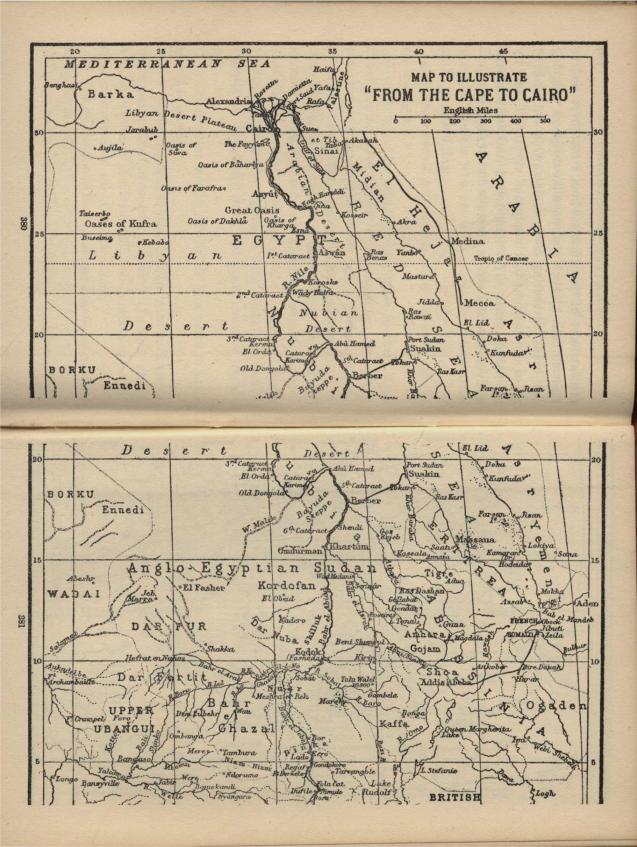
MAP TO ILLUSTRATE "FROM THE CAPE TO CAIRO" (northern half of map)
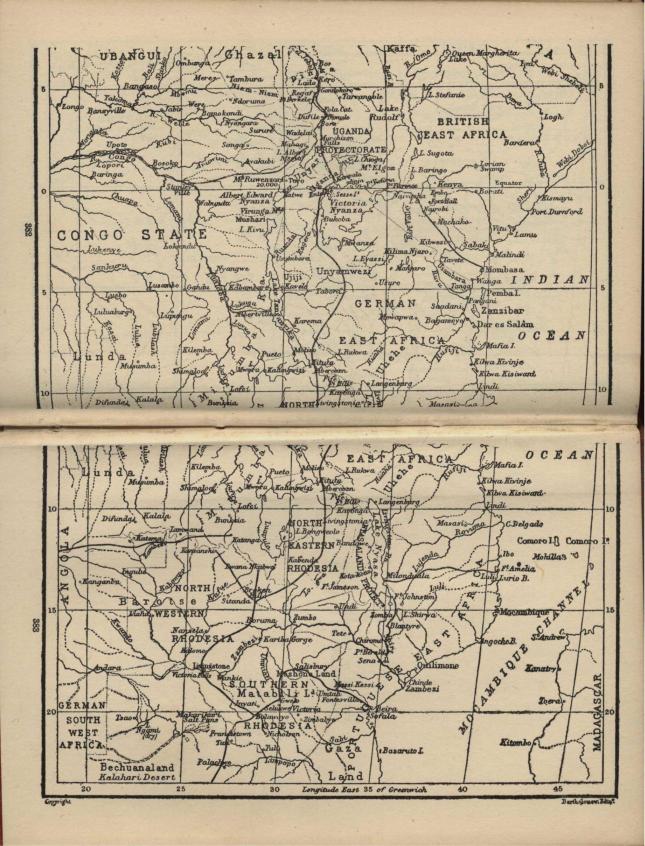
MAP TO ILLUSTRATE "FROM THE CAPE TO CAIRO" (southern half of map)
[Transcriber's note: larger versions of these maps (img-380.jpg and img-382.jpg) have been provided, but they are not linked into this etext.]
PRINTED IN GREAT BRITAIN AT THE PRESS OF THE PUBLISHERS